Doctoral Dissertations Theses, Dissertations, Capstones and Projects
Winter 2017
More Than a Silhouette: African American
Women’s Graduate Student Experience
Bridget Holly LoveUniversity of San Francisco, [email protected]
Follow this and additional works at:https://repository.usfca.edu/diss Part of theEducational Administration and Supervision Commons
This Dissertation is brought to you for free and open access by the Theses, Dissertations, Capstones and Projects at USF Scholarship: a digital repository @ Gleeson Library | Geschke Center. It has been accepted for inclusion in Doctoral Dissertations by an authorized administrator of USF Scholarship: a digital repository @ Gleeson Library | Geschke Center. For more information, please [email protected].
Recommended Citation
Love, Bridget Holly, "More Than a Silhouette: African American Women’s Graduate Student Experience" (2017).Doctoral Dissertations. 411.
MORE THAN A SILHOUETTE: AFRICAN AMERICAN WOMEN’S GRADUATE STUDENT EXPERIENCE
A Dissertation Presented to
The Faculty of the School of Education
International and Multicultural Education Department
In Partial Fulfillment For the Requirements for Degree
of the Doctor of Education
by
Copyright by
BRIDGET HOLLY LOVE, 2017 All Rights Reserved
African American women have been silhouetted. They have been reduced to a one
dimensional version of themselves and defined by societies White – male hegemonic
background. Currently, limited research exists on the experiences of African American
(AA) women graduate students from an Afrocentric perspective. Despite the increase
enrollment of AA women in higher education, barriers to degree completion still persist
as evidenced by the lower rates of graduation. The lack of AA women in higher
education demonstrates that the literature holds a minority position not unlike that of AA
women in society. Subsequently, the accomplishments, challenges and overall
experiences of these students are missing. To date, both scholarly literature and
educational praxis have dimensional voids in addressing the needs of women of African
descent in the academy. The purpose of this qualitative study was to describe and
understand the experiences of African American women graduate students by elevating
their voices. The two mechanisms of Black Feminist Thought: Matrix of domination
and intersectionality were used to understand the women’s experiences in the context of
being Black first, gendered a woman second and then the issues that arise from a textured
life where intersections of identity occur. This study addresses the gap in research by not
only drawing attention to statistical outcomes as reported by National reporting agencies
on student academic success but also brings to the surface the lived experiences of AA
women graduate students with respect to how they see their epistemological selves. The
researcher used both a survey and interviews to highlight the ways institutions further
own humanity. Recommendations are shared in relation to faculty and staff working with
AA women graduation students, institutional policy and practice, and reconceptualizing
human rights.
the Faculty of the School of Education in partial fulfillment of the requirements for the
degree of Doctor of Education. The content and research methodologies presented in this
work represents the work of the candidate alone.
Bridget Holly Love November 7, 2017
Candidate Date
Dissertation Committee
Dr. Betty Taylor November 7, 2017
Chairperson
Dr. Emma Fuentes November 7, 2017
Dr. Onllwyn Dixon November 7, 2017
To all of the Women in my family on whose shoulders I stand, this work is dedicated to
you: some in your memory and others in your honor.
“Her children arise up, and call her blessed” Proverbs 31:28
custom; fear to whom fear; honour to whom honour.
Romans 13:7
My acknowledgments will follow the order of this scripture: tribute, custom, fear
and honor. Each part of the legend is unique in contribution to my epistle, may it be alive
to those who read it.
Tribute
This work is dedicated to the woman in this study, the women in my family, the
women in my sphere and the women who will be encouraged and strengthened by its
contents. Someone once said that the journey of a thousand miles begins with the first
step. I pay tribute to the women who have stepped strong before me and whose lives
have intersected mine either in person or through their scholarly work. Sometimes we
step together in unison, sometimes your steps have set the pace for my own and at other
times my steps have helped others navigate confined spaces. So I pay tribute to the
women on the line as we keep in step. I say to you all: Keep step’n my life is more
robust because of your cadence!
To my writing buddies, my Saturdays have been enriched by the present of your
presence. We spent hours together in communion: Commiserating about life’s
challenges; hosting and performing in our version of comedy camaraderie; celebrating
each other’s successes and planning our post doc activities. We laughed together and you
let me cry in a safe space while we all trudged forward to a common goal. I salute you
ladies, you are the sisters that I never had but always wanted.
Taylor and committee members Drs. Emma Fuentes and Onllwyn Dixon. Their
presence on this journey added to my process in invaluable ways. I have learned how to
persevere against all odds and have grown tremendously journeying with them.
There were times when the road seemed arduous and unbearable but I was
reminded that this too would pass and that there was light at the end of the tunnel.
Without Dr. Taylor I would never have realized my own strength, resilience and
boundaries. For this I say thank you.
Dr. Fuentes, my activist. I am thankful for our long talks about community
building. It was your example of walking in solidarity in uncomfortable spaces that has
enabled me to activate my own agency and truly understand what it means to be socially
responsible.
Dr. Dixon, my midwife. Thank you, for your dedication to the craft and the
profession. You challenged me to push when I did not feel as though there was anything
left. You breathed with me when I could not breathe on my own. You made asking
questions easy, even when the labor was hard. For your commitment to me- an African
American woman scholar and my baby- this dissertation, I thank you.
Fear
I give reverence to the Lord who is faithful to his preceding word. It is through
Him that I live, move and have my being. It is only through submission to Him that I
have been able to unlock the wisdom of the ages.
mind of God that has taken me into near and distant lands. You all encouraged my
curiosity and gave me structure to pursue and obtain my high places. I esteem you.
Honour
I honour ALL in my community who have played any part in my journey. No
part was too small or will ever be forgotten. From the granting of solitude to write;
preparing meals for my consumption; releasing me from other obligations so that I could
focus on my studies; providing opportunities for retail and craft therapy; words of
encouragement spoken in my hearing as well as the conversations with God on my
behalf, I am thankful and grateful. Connected, the community of my beloved, you have
fortified, shielded, supported and invigorated my resolve to press toward the mark,
forward to do this work. To you I say, ‘¡Gracias para todo y Él es bueno!’
ABSTRACT ... iii
DEDICATION ... vi
ACKNOWLEDGEMENTS ... vii
Tribute ... vii
Custom ... viii
Fear ... viii
Honour ... ix
TABLE OF CONTENTS ... x
LIST OF FIGURES ... 1
LIST OF TABLES ... 2
PROLOGUE ... 3
MORE THAN A SILHOUETTE... 9
CHAPTER I: THE PROBLEM ... 10
Statement of the Problem ... 10
Background and Need for Study ... 11
Purpose of the Study ... 13
Significance of the Study ... 14
Research Questions ... 15
Matrix of Domination. ... 21
Intersectionality... 23
Definition of Terms... 27
CHAPTER III: THEORETICAL FRAME ... 31
Restatement of the Problem ... 31
Othering ... 33
Whiteness. ... 37
The Racialized Other ... 40
The Gendered Other. ... 45
The Educational Other. ... 51
The Intersectional Other. ... 65
Review of Theoretical Framework ... 75
CHAPTER IV: RESEARCH DESIGN AND METHODOLOGY ... 76
Restatement of the Purpose of the Study ... 76
Research Design... 76
Research Setting... 79
Participants ... 85
Population ... 89
Cross’s Racial Identity Scale. . ... 94
Interview Guide. ... 95
Data Collection Procedures ... 96
Stage 1: Survey. ... 97
Stage 2: Interview. ... 99
Data Analysis ... 100
Protection of Human Subjects ... 101
Background of the Researcher ... 105
Delimitations ... 107
Limitations ... 107
CHAPTER V: FINDINGS ... 109
Restatement of the Purpose of the Study ... 109
Participant Overview ... 111
Survey Findings ... 111
GENERATIVE THEMES ... 116
How do AA Women see Themselves? ... 116
Dark but Lovely. ... 117
Intersectional. ... 123
How do AA Women Experience PWIs? ... 130
Academic Obstacle Course. ... 131
What Types of Programs and/ Support do AA Women Receive that Contributed to Epistemological Self? ... 138
Epistemological Self.. ... 142
Faculty... 144
Academic Advising. ... 146
Sponsorship. ... 148
Rite of Passage. ... 149
SUMMARY OF FINDINGS ... 150
CHAPTER VI: DISCUSSION ... 154
Introduction ... 154
Ubuntu... 156
African American Women See Themselves as Interconnected. ... 159
African American Women Experience the Institution as a Rite of Passage. ... 160
African American Women Experience Predominately and Culturally White Institutions in Community. ... 163
Implications... 164
The World. ... 168
Recommendations ... 169
I Am Because You Are.. ... 170
Paradigm Shift ... 170
Institutional Support... 171
Become Invested in Students.. ... 172
Conclusion ... 172
Future Research ... 174
Personal Reflection ... 175
Letter to My Sistahs ... 177
REFERENCES ... 178
Appendix A: African American scholars program group survey ... 209
Survey Administered via Qualtrics ... 210
De-selection Response ... 217
Appendix B: IRB APPLICATION ... 218
Appendix C: IRB APPROVAL ... 223
Appendix D: Cross Racial Identity Scale ... 224
Appendix E: PERMISSION TO USE RESEARCH QUESTIONS ... 228
LIST OF FIGURES
Figure 1: Four-way Intersection Typifying the Overlapping Oppression Experienced by
African American Women. ... 73
Figure 2: Percentage of Graduate Students According to Gender at the University of San Francisco. ... 82
Figure 3: Women Graduate Students at the University of San Francisco. ... 84
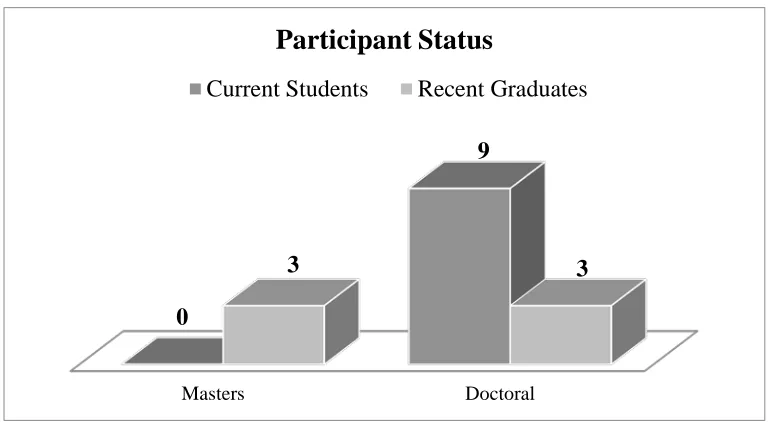
Figure 4: Participant Student Status in Spring 2017. ... 87
Figure 5: Participant Research Discipline. ... 87
Figure 6: Relationship of African American Women Graduate Students @ PWI to African American Graduate Students as a Whole ... 90
Figure 7: African American Women Graduate School Enrollment, Continuation and Graduation Trends ... 93
Figure 8: Participants Feelings and Perceptions about their Blackness. ... 121
LIST OF TABLES
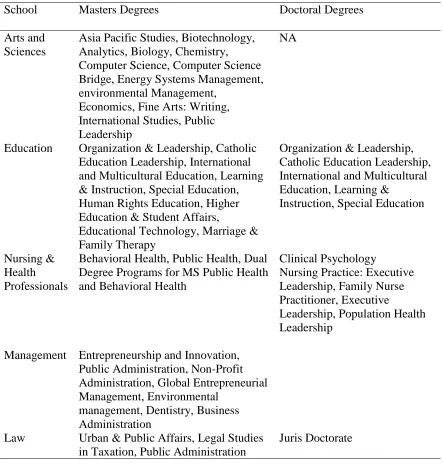
Table 1: Graduate Degrees Available at the University of San Francisco ... 83
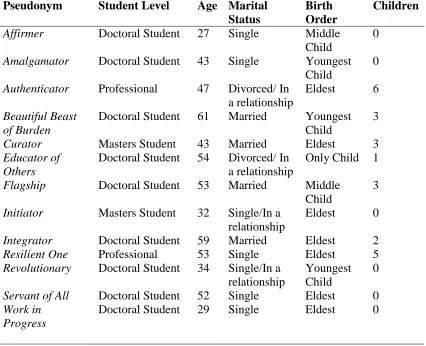
Table 2: Participant Pseudonyms and General Demographics ... 88
Table 3: Sample Items from the Cross Racial Identity Scale ... 113
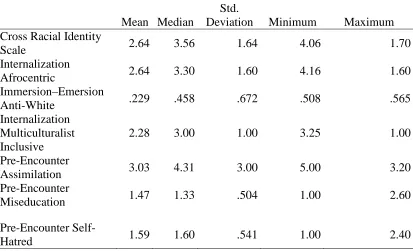
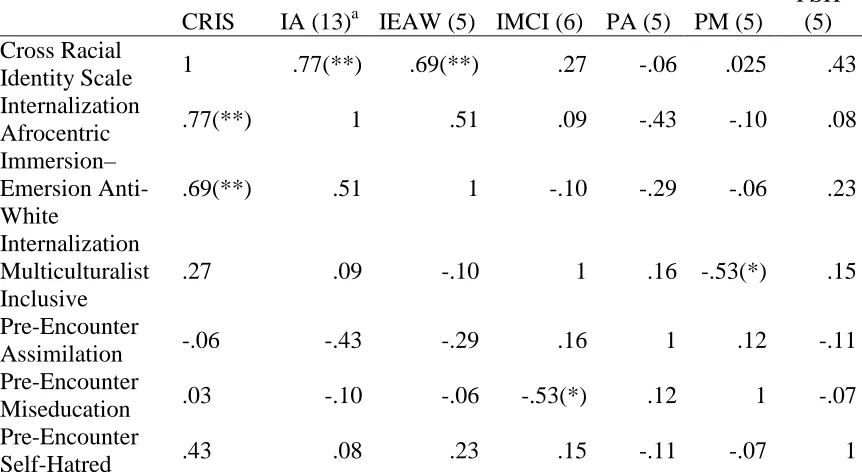
Table 4: Descriptive Statistics ... 114
PROLOGUE
As an African American woman in higher education, I have matriculated solely at
predominately White Institutions (PWI) unlike my parents who attended Historically
Black Colleges and Universities (HBCU); my experience leaves a lot to be desired. It has
been riddled with questioning of my competence as a scholar by those who are employed
to further develop and nurture the same. I have battled constant questions of the “right to
be” in the academic space beyond the undergraduate level and the land mines of limited
to no resources to support my personal growth in an Eurocentric, male-dominated
environment.
My experience as an African-American women attending predominately White
institution is that despite the letter of acceptance, I was never fully accepted, welcomed,
accommodated or honored. My voice was marginalized in these institutions and my
identity was compressed in a single silhouette (“angry”, “victim”, “statistic”, etc.). My
experiences are conflated as they intersect both racialized and gendered systems that
historically have not honored African Americans or women.
In contrast, those in my circle who attended historically Black colleges and
universities often talked about the “sisterhood” or “kinship” that gave them strength in
tough times and even extended past graduation. This was not my reality and so this study
for me in part is cathartic and in part I am driven to leave things better than how I found
them. I came to this study with a lot of questions about why we do what we do in higher
education: the people, process and politics. While I am not advocating for a reinvented
support systems that address the challenges of African American women who are
emerging as scholars at predominately White institutions.
For too long, being of darker hue has been the basis for othering. It began
with slavery, moved on to education, and its presence in employment is eminent.
The load is especially heavy for the African American woman-African American
first and then a woman second. Constrained by both racial origin and sex what
might be referred to as "double jeopardy", “double glass ceiling”, and “double
minority” I have experienced the workings of multiple forms of discrimination,
such as racism, sexism and classism, which have multiplicative and direct effect
in limiting my status in both educational and professional spheres.
I am a woman of African American descent, whose family hails from the South,
the granddaughter of sharecroppers, a first-generation Californian with interests in
African American, Judaic, Performance, Deaf, Middle Eastern, and Latin studies; all
parts of the complex interweaving of contrasting rhythmic patterns. As an
African-American woman, I have undulated attitudes, accents and appearance in a constant bid to
do the dance of acceptance.
This choreography has come at great cost: battle scars and wounds incurred by the
constant description by persons of authority describing a society that I am not in: the
psychological trauma of the double glass ceiling in corporate America where I have had
the equal pleasure of dance partners: discrimination on the basis of color first and then
gender and reverse discrimination where my success is viewed by persons within my own
As part of my world view where spirituality is at its core I explored and
manipulated movement principles based on the body, weight, space, time, and energy as I
dared to dance with God and the wisdom of my ancestors to transcend difficult situations,
systems and invisible boxes, prefabricated in efforts to subjugate Africans in the
American situation.
I dance out of necessity.
This is not because I have any rhythmic ability but because it is through
dance that I am freed. Dance links my historical heritage to a creative expression
that acts as a vehicle to help me see the world and navigate through it. Dancing to
my own cadence I embraced Afrocentricity as a world view which placed Africa
in the center of historical and philosophical discussions. This non-threatening
environment allowed me to enter in and out of the Afrocentric world view in a
multidisciplinary approach to living beyond the confinement of the Eurocentric
view alone.
Being an African American woman brings with it the blessing and cursing of the
dualities of consciousness of being gendered a woman and being of darker hue. I am
reminded of a song sung by CeCe Winans. The words reverberate that “you don’t know
the cost of the oil in my alabaster box”. I assert that part of the cost of each woman’s oil
is the degree and level of trauma experienced over her lifetime. Occurring only in the
New Testament of Biblical cannon and relating to spikenard ointment, the alabaster box
was used as a saving mechanism in the Middle East. The principal of the story, a
leper (Matthew 26:7; Mark 14:3; Luke 7:37). She was ridiculed by onlookers because
the amalgamation of her broken box and exposed ointment were the sum total of her life
savings: Experiential lessons of trauma and triumph.
Decades removed from slavery and the civil rights movement; traumatization
continues. I found that isolation is one of the biggest traumas that African American
women in higher education face and is triggered by interactions with faculty and students
alike or simply the lack thereof. It comes in the form of taxing physical and emotional
stamina, undermining authority, compromising competence, limiting the power that we
might conceivably exercise and thus limiting our opportunities for rewards, mobility in
organizations and overall self-actualization.
Trauma is only part of my story as it is part of the story of all women and
particularly African American women. However, trauma is shrouded in secrecy and
denial and is often ignored. Intentionally or unintentionally institutions, faculty and
administrators contribute to and recreate harm and trauma in the lives of African
American women. The impact of trauma is realized by African American women
spanning every age group and socio-economic status.
I too have an alabaster box that has been forged and filled over the better of 40
plus years. “Everything affects [learning and] development, and development is a
lifelong process” (Ratey & Galaburda, 2002, p. 17). Leonardo and Porter (2010) assert
that college campuses are not safe places for students of color. Not comprising the
critical mass of most colleges, students of color are thrust into environments that, at their
Powell, 2012). The experiences of African American women like myself are conflated
by the intersections of race and gender as well as the stand alone and compounded
traumas because of the same.
African American women who are repeatedly subjected to interlocking systems of
oppression have lifelong consequences. The hippocampus of the brain is subject to
alteration, leaving one lobotomized-unable to operationalize linguistic, resistant,
navigational, familial or aspirational capital to having complete suicidal tendencies.
Traumatic re-injury creates binaries that proliferate and extend themselves on any
number of newly produced trajectories. The bifurcation of the known into the newly
known is a product of conscious development itself, and is the means of a growing
interrelatedness. This means that without interventions like counseling, mentoring and
supportive social/academic networks the emotional stability, freedom and expression of
African American women is critically at stake.
My story is a story of self –discovery: Exploring and using personal strengths to
successfully navigate an environment that is always imposing and rarely nurturing. As an
emerging scholar, I have sought acceptance, networking, camaraderie and mentoring in
order to advance in the academy. Even as I move forward, I find that there is a void of
understanding, support and resources in the academy for Africa American women who
are similarly situated. This was my impetus to explore sisterhood and community
building in the shaping of scholars who occupy many roles simultaneously. In the
and the community at large. Elevating the voices of these scholars strengthens me and
my hope is that it will strengthen you.
History really does repeat itself in many ways but our response to it does not have
to be the same. Each interaction is an opportunity to grow and gain new perspective by
assigning and relinquishing ownership to the proper parties. In response to the system
MORE THAN A SILHOUETTE
I am more than a silhouette.
More than a dark image juxtaposed a backdrop of Whiteness, power and privilege. I am more than a statistic.
More than a number to support your diversity claim. I am more than a body without a name.
I am more than a stereotype.
I get angry, disappointed but I’m also polite. I am more than a memory of a Nation gone wrong. I am the barometer of justice, patience and acceptance.
I am more than a nameless, voiceless hue.
I am complex, textured and multifaceted just to name a few. Not segmented or parceled out for others to view.
Take me whole and unbroken, strong and persistent Take my pain and laughter; my past, present and future
I am a defender of the weak yet still supple and sweet.
I am more than average. Extraordinary is my name. My claim to fame is that I live
CHAPTER I
THE RESEARCH PROBLEM
Statement of the Problem
African American (AA) women have made consistent strides in gaining access to
higher education since the Civil Rights Movement. Increasingly earning doctorates in a
variety of disciplines, however, many AA women attending predominately White
institutions (PWI) share the feeling that despite the letter of acceptance, they are never
fully accepted, welcomed, accommodated or honored (Swail, 2003). AA women have
largely been left out of the discourse in academic circles. When they are included they
are marginalized and minimized to one-dimensional beings and defined by outsiders in
unflattering stereotypical terms (Evans-Winters & Esposito, 2010) or flat out presumed
incompetent (Gutiérrez y Muhs, 2012). Often marginalized in these institutions, their
experiences and voices are muted, and their multifaceted identities are often compressed
into a single dimension, (“angry”, “victim”, “single-mother”, etc.) (Ghavami & Peplau,
2013; Hill Collins, 2000; M. W. Hughey, 2007; Ladson-Billings & Tate, 1995). These
experiences are conflated as they intersect both racialized and gendered systems that
historically have not honored African Americans or women (Hill Collins, 2000).
There is limited research on the experiences of AA woman graduate students from
an Afrocentric perspective (R. Anderson, 2012; Asante, 1991, 1998; K. O. Cokley, 2005).
The void of experiences of AA women is further widened when the presence of
additional intersections beyond those of race and gender are present. Further, AA
sociocultural factors yet no major data sets cross reference the two groups.
Background and Need for Study
The history of AA women in higher education in the U.S. is a lesson in resilience.
AA women have made consistent strides in gaining access to higher education since the
civil rights movement (Collier-Thomas, 1982; Shavers & Moore, 2014). In particular,
they have increasingly earned doctorates in a variety of disciplines. The National Center
for Education Statistics (Integrated Postsecondary Education Data System (IPEDS),
2016) reported that AA women earned 60,948 graduate degrees in 2015 compared to
13,282 in 1977. However, their experiences and voices are often muted by institutional
realities that marginalize how they express their multifaceted identities (Evans-Winters &
Esposito, 2010). Zamani (2003) asserts that, “membership in both marginalized groups
[race & gender] often makes AA women invisible in colleges and universities” (p. 6).
Apart from biographical excerpts about a few prominent AA women in education
Collier-Thomas (1982) argue that AA women have been left out of scholarly writing,
leaving a void of the general history of these women in American. This includes their
challenges, accomplishments and overall experiences and therefore pointing to the need
for a critical analysis to honor how they construct and reconstruct their epistemological
selves in relation to the Eurocentric, male-dominated values in the academy (Dillard,
2000; Stanfield & Dennis, 1993).
More than 10 years apart from each other researchers Johnson-Bailey (2004) and
Winkle-Wagner (2015) assert that despite the increase enrollment of AA women in
rates of graduation. Shavers and Moore (2014) believe that overlooking the obstacles that
AA women face solely because they are successful in reentering higher education at
advanced levels is a “double edged sword”, meaning that these women are cut in both
directions: entry into the institution and exiting the same. AA women’s experiences in
higher education are tacit with barriers, such as not being networked, inability to get a
mentor, exclusion from information relationships, being given less challenging
assignments that may result in less opportunity for development and learning and
generally being second guessed at every turn, giving the appearance of incompetence
(Crenshaw, 2010; Hughey, 2010).
Shavers and Moore (2014) assert that “the research literature focusing
specifically on AA women attending PWIs is infrequent” because often the literature
does not delineate among them, their male counterparts or other marginalized people (p.
15). Although, the literature routinely discusses people of color in higher education at the
baccalaureate level, Shavers and Moore (2014) contend that the challenges and general
research by, for and about AA women pursing doctorates has been largely overlooked in
scholarly discourse.
AA women students like their white male and female counterparts need to feel
safe and supported to learn (Payne & Suddler, 2014; Shavers & Moore, 2014) . Without
these conditions, the mind reverts to a focus on survival (Coogan-Gehr, 2011). When AA
women experience comprehensive support that works to mitigate the extraneous
cognitive load the likelihood for academic success is greatly increased (Williams et al.,
instructors, and even the school as a system to mutually benefit (Murakami-Ramalho,
Piert, & Militello, 2008). Schwartz et al., (2003) suggest that environments that contain a
critical mass of the marginalized groups as faculty and staff support promote innovation,
inquiry, and risk taking. Moreover, such an environment reinforces and enhances the
leadership capacity in the academy because competent, excellent, and dedicated
educators want to work under such conditions. Given the intersectionality that exists for
AA women Zamani (2003) contends that “more attention should be paid to the
educational, social, and political positions of AA women in postsecondary education”
(p.6).
Purpose of the Study
The purpose of this study is to add to the body of research by and for AA women
in higher education. This study is a response to the call from bell hooks (1999) to “stir
from our psychic slumbers, to rise and rescue ourselves and one-another” through
exploring the experiences of AA women graduate students at predominately White
institutions with respect to how they see their epistemological selves (p. 236). Presently,
scholarly literature and educational practice are lacking depth and scope about the lived
experience of AA women graduate students, and, as a result, they lack effectiveness for
Significance of the Study
AA women in higher education are engaged in conflicting trends of high
enrollment but low graduation rates compared to other women (Winkle-Wagner, 2015).
Societal issues of race, gender and intersectionality can affect the academic outcomes of
AA women (Johnson-Bailey, 2004). It is important to note that race and gender are
intertwined for African-American women, and both are determinants in economic, social,
political, and educational status. Not only is research on the experiences of AA women in
higher education imperative to countermand racism in the academy but so is using a lens
that can explain the complex intersectionality that occurs with this group and the
subsequent interaction with interlocking systems of oppression. Additionally, how the
academy uses the intersection of race and gender to perpetuate White male hegemony
creates an encumbrance for AA women leaving them misrepresented or underrepresented
in educational literature.
This study aims to fill gaps in the literature by offering a focused - insider view of
the experiences of AA women graduate students in higher education at PWI while cross
referencing social and political oppressions with varied sociocultural factors. In so doing
the researcher hopes to uncover tools and resources that individuals and institutions can
use to shift academic outcomes by positively equalizing the number entering to the
number completing terminal degrees for AA women who attend PWIs.
This study also furthers Howard-Vitals’ (1989, p. 189) work addressing the
recommendations to: (1) examine studies already conducted, focusing on the conceptual
highlights what has happened in the research and what is happening to AA women in
higher education individually and as a group and, (3) as a study participates in the
generation of more knowledge about AA women in higher education.
Research Questions
This study is guided by questions intended to facilitate inquiry about the
experiences of AA women graduate students at predominately White institutions. The
overarching research question is: How do the experiences of AA women graduate
students at predominately White institutions serve to contribute to a more comprehensive
and nuanced understanding of their epistemological selves? In addition to the
aforementioned question the following four questions serve to unpack African American
women graduate student experiences:
1. How do African American women see themselves;
2. How do African American women see the institution;
3. How do African American women experience PWIs;
4. What types of programs and/ support do African American women receive that
CHAPTER II
THEORETICAL FRAME
Black Feminist Thought
Many African-American women do not identify with the majority group (White,
Eurocentric, Male/ Female) and tend to have their own interpretations of their oppression.
They also have different life experiences and views of reality. However, they lack the
vehicle to control the things that oppress them. Therefore, Hill-Collins (2000) asserts that
a new-separate epistemology is needed. One that gives "greater recognition of the
interplay of race, class, and gender in shaping women's oppression"(Hill Collins, 2000, p.
241). Hill-Collins (2000) writes that there is an AA woman's standpoint, and although
they can articulate their own standpoints, there is still a need for a separate
epistemology-the branch of philosophy that studies epistemology-the nature of knowledge, in particular its
foundations, scope, and validity. Anzaldua (1990) simplifies epistemology this way:
Theory, then, is a set of knowledges. Some of these knowledges have been kept
from us-entry into some professions and academia denied us. Because we are not
allowed to enter discourse, because we are often disqualified and excluded from
it, because what passes for theory these days is forbidden territory for us, it is vital
that we occupy theorizing space, that we not allow White men and women solely
to occupy it. By bringing in our own approaches and methodologies, we transform
that theorizing space. (p. xxv)
Patricia Hill Collins (2000) Black Feminist Thought (BFT) is centered on the idea
Collins, the term “gender” has a specific role in the construction of BFT. She puts forth
the convincing argument that everyone has an individual vantage- point of the world
based on his or her specific place in the “matrix of domination” (Hill-Collins, 1990).
Collins (2000) says; “U.S. Black women encounter a distinctive set of social practices
that accompany our particular history within a unique matrix of domination characterized
by intersecting oppression” (p. 23). What she means by this is that no two Black women
experience the exact same oppression; however, since all AA women share intersecting
oppressions they can build a collective standpoint based on shared views and
experiences. In the U.S. the separate oppressions like race, class, sexuality, citizenship,
religion, and gendercan intersect to build an even greater domination. For Collins (2000)
in the construction of BFT the two most important and disadvantaging oppressions that
all AA women share are race and gender and it is based on these intersecting oppressions
on which a collective group perspective is built.
Hill-Collins (2000) asserts that attempts to prioritize one form of oppression and
handling the remaining types of oppression as variables, proves wholly deficient to a
marginalized group that has historically experienced oppressive binaries with oscillation:
one form of oppression at a particular time takes a dominant role, only to recede as
another takes its place. Taking the historical example of the human rights movement
relative to African- Americans, and citing feminist Sojourner Truth, Hill- Collins (2000)
points out while AA men would eventually gain legal rights as men, this would only lead
to new gendered forms of domination for AA women, obscured by changes on a
interest convergence to enforce these dualities, for instance the essentialization of the
passionate character of AA women by Whites justified their sexual abuse, but an alternate
structuring of their essences as irrational was accomplished by keeping the same from
literacy (Hill Collins, 2006).
The perceptions of “Blackness” and the “Black Body” (Cruz, 2001; Scruggs,
2011) as property and inferior to Whites continues to be obstacles that AA women
encounter as trace evidence of slavery in the United States. Although the sexual cruelty
toward AA women is not the focus of this research, not mentioning it would subtract
from the overall demoralization, denigration and violation of basic human rights that AA
women endured and that continues to lay a backdrop for their objectification and
dismissal in society today (Leary & Robinson, 2005).
Historically, sexual abuse of enslaved Black women was partially rooted in a
patriarchal Southern culture that perceived all women, whether Black or White, as chattel
– property (Jacobs, Child, Jacobs, & Yellin, 2000). As such, property, slave masters
raped Black women for sexual pleasure as well as to increase the slave population as a
part of the practice of slave breeding, particularly after the 1808 federal ban on the
importation of slaves (Turner, 2017). Slave breeding involved coerced sexual relations
between male and female slaves, as well as sexual relations between a master and his
female slaves, with the intention of producing slave children (Turner, 2017). Beginning
in 1662, Southern colonies adopted into law the principle of partus sequitur ventrem, by
identity (Santos, 2016). The historical context of Black women’s slavery demonstrates
the extent to which they experienced the stratification of class, race and gender. In
educational environments there is a new domination that exists for AA women as a result
of their former slave status and present woman status.
What AA women have experienced is being the bodily producer of “Blackness,”
of “womanness,” and of the “worker” (hooks, 2001b; M. Hughey, 2010; M. W. Hughey,
2007; Ladson-Billings, 2009). Rarely have they been producers of anything with a
positive connotation. AA women are the wombs of Black/AA men. A third burden for
AA women is created when the White male hegemonic system uses the intersection of
race and gender to perpetuate inequality. Part of the status ascribed to AA women is a
function of the way that the majority of society marginalizes and demonizes
African-American men.
AA men in society tend to get greater coverage in the media and public life
generally because of their high disproportionate minority confinement number and the
extent to which their “physical prowess” perpetuates the stereotypes of the “stud male”
or the perception that “Black men are evil” (Howards & Reynolds, 2013; Oliver, 1989).
Current events in 2014-2017 as evidenced by the “Black Lives Matter” protests,
numerous articles, speeches, and public outcry surrounding AA men extends to AA
women in the role that they play in birthing and raising Black/AA men suggesting by
extension that they too are feared, distrusted and the object of continued subjugation and
These perceptions about Black women conflated by the state of being Black in the
United States – feared and hated, does not negate their needs or society’s responsibility to
them. For starters, the history of words, expressions, mannerisms and culture, what
Patricia Hill-Collins (2000) sees as “different expressions of common themes”, has
become the material basis for those inferior half productions of what it means to be
human and have rights (M. R. Howard-Vital, 1989). For example, she explains that AA
women remain oppressed through the images of "mammies, Jezebels, and breeder women
of slavery to the smiling Aunt Jemimas on pancake mix boxes, ubiquitous Black
prostitutes, and ... welfare mothers of contemporary popular culture" (Hill Collins, 2000,
p. 6).
Hill-Collins (2000) theorizes that for AA women in higher education oppression
of race and gender is countered by: (a) the presentation of an alternative social construct
based on African- American women's experiences, (b) a commitment to fighting against
race and gender inequality, (c) recognition of women's legacy of struggle, (d) the
promotion of empowerment through voice, visibility, and self-definition, and (e) a belief
in the interdependence of thought and action.
In BFT, when Hill-Collins argues for self-definition, self-valuing, and for an
emphasis on AA culture, what she is advocating for is the organized reclaiming of that
which has been produced and a new paradigm comprised of transformed consciousness
and ownership of both the product produced and the creative process. In order for AA
that the continuum of oppression and domination must be addressed. Her (Hill-Collins,
2000) matrix of domination articulates the connections (intersections) between many
different types of domination and oppression.
Matrix of Domination.
The matrix of domination in BFT illustrates intersectionality and its relation to
domination. Here there is an ideological shift away from the singular Eurocentric model
of looking at various systems of oppression separately to understanding them as
functioning simultaneously on different axes. This exposes the overlap and dependency
of each different system on each other in order to maintain and reproduce acts of
subordination over people. The matrix then serves to break down hierarchy with systems
of oppression, no longer pitting one against the other, but giving them equal weight.
According to Hill Collins (2000; 1990), there are five mechanisms of domination that
articulate connections between many different types of oppression:
1. Historical - Domination does not exist outside a history. There is a context
of time, space and place. For example: In the U.S. for example
domination was codified in the Southern region by redlining- in the 1930s
a discriminatory practice by which banks, insurance companies, etc.,
refuse or limit loans, mortgages, insurance, etc., and the Black codes -
codes of law that defined and especially limited the rights of former slaves
after the Civil War;
2. Ideological- Thoughts, beliefs, false statements, myths, propaganda that
3. Material - Domination requires access (i.e. money, influence and political
control) to power (actual, exerted or potential) and the technologies (i.e.
media, newspaper, and internet) These are vehicles by which power is
exerted;
4. Behavioral- These differences related to sex, sexuality, color, ethnicity,
age, gender, economic class or physical abilities that create ways of doing
things; and
5. Emotional – This requires situations in which the passion for or the desire
to control the "other" is intensified by any threat or perceived threat
against the dominator's status.
Replacing additive models of oppression with interlocking ones creates
possibilities for new paradigms (Hill Collins, 2000, p. 18). The significance of seeing
race, class, and gender as interlocking systems of oppression fosters a paradigmatic shift
of thinking inclusively about other oppressions, such as age, sexual orientation, religion,
and ethnicity. In addition, Hill Collins (2000)postulates that AA women are held captive
by Western-White male structures of knowledge.
Because elite White men control Western structures of knowledge validation,
their interests pervade the themes, paradigms, and epistemologies of traditional
scholarship. As a result, U.S. Black women’s experiences as well as those of
women of African descent transnationally have been routinely distorted within or
BFT offers marginalized groups new knowledge about their experiences that can
be empowering. By revealing new ways of knowing marginalized groups can define
their own reality. Collins (2000) emphasizes that BFT serves to reshape knowledge by
valuing experience and the subjective, while broadening the identity of the knower,
making the location of Black women a legitimate platform from which they can create
knowledge.
BFT works to challenge the matrix domination through radicalized thinking that
evaluates ideas around knowledge production, producers and consumers. Hill- Collins
(1990) suggests that resistance to domination begins with self -evaluation. By examining
our own internalized oppressive views of ourselves and others and the role we play as
oppressed and oppressor the process of liberation continues by creating a new history
along with behaviors and ideologies for successive generations.
Intersectionality
BFT acknowledges the intersectionality of African- American women which
originate from a legacy of struggle for AA women in society and addresses their
experiences of marginality in higher education (Evans-Winters & Esposito, 2010; Hill
Collins, 2000). In other words, AA women still do not receive the same rights as their
White female or male counter-parts resultant from a history of being denied the right to
vote, to hold political office, or to attend particular institutions of education. Hill –
Collins (1998; 2000) argues there are two dimensions that have caused the oppression of
domestic servants in homes of Caucasian men and women. Slavery both created negative
images of AA women and a system of devaluation (hooks, 2001b, 2001a). The second
dimension focused on the denial of AA women’s voting rights, the exclusion of AA
women and men from political positions, and the denial of equal treatment in the legal
system.
As Patricia Hill-Collins (2000) draws upon the lived experiences of the
oppressed, by identifying the interlocking systems of oppression she points to the binaries
that proliferate and extend themselves on any number of newly produced trajectories. The
bifurcation of the known into the newly known is a product of conscious development
itself, and is the means of a growing interrelatedness. What interlocking oppression tells
us is that AA women graduate students, experience oppression along any number of
vectors, and very often with several such vectors converging their very invisibility and
silence may mark their marginalized status. When AA women graduate students are
consistently marginalized at every vector and trajectory there comes a point when they
are no longer even considered as part of the conversation and lose all ground.
BFT sees marginalization and intersectionality as positions of power and
dominance not as positions of inferiority or fragmentation. To be on the fringe of society
through a BFT lens means having a wider perspective and greater vantage point than
singular vision alone. By bridging pedagogy and theory for audiences receiving little or
no exposure to such critical thought (T. M. Harris, 2007), BFT gives agency to AA
historical and current difficulties in society for AA women, BFT, provides a way of
knowing and understanding what is known; a way to wholly engage in society and
emerge as agents of power.
Moses (2010; 1990) affirms the importance of modeling and mentoring for AA
women. Learning from history an AA proverb describes a woman’s journey beautifully,
"I am because you are." Our power lies in our intersections of connectedness. Herein,
rests the activism component of BFT in that it resolves that both the transformed
consciousness of individuals and the social transformation of political and economic
institutions constitute essential ingredients for social change (Hill-Collins, 2000). If we
fail to support and uplift AA women in higher education, we all fail, we fail as a nation.
The activism of drawing upon the lived experiences of the oppressed, establishes
the political production of new forms of voiced power, the countermanding of the
products of one’s own image and the seizing of the knowness of one’s material existence.
Therefore, BFT, a production of Patricia Hill-Collins, situated in intersectionality as
defined by Kimberlé Crenshaw is a lens that allows the experiences of AA women (race,
gender, social status, age, ability, sexuality, etc.) to be viewed in their fullness where the
interdependence of experience and consciousness continue to shape the understanding of
AA women in higher education by and for the same.
BFT developed because research failed to acknowledge the work that AA women
perform, the types of communities in which they live, and the kinds of relationships they
those who are not Black and female (Hill-Collins, 1989), BFT accounts for the matrix of
domination and intersectional perspectives by encouraging these woman to identify,
redefine, explain, and share experiences of racism and sexism that may be unique
(Baxley, 2012; Hill Collins, 2000).
Prior to BFT, researchers deemed the experiences of AA women as inferior to the
experiences of the majority, dominant groups of White males, White females, and AA
males (Guy-Sheftall, 1982; hooks, 2001a; Walker, 1983). The experiences of AA women
in higher education are directly influenced by their racialized and gendered experience,
hence the need for research to explore these complexities. By understanding the nature
of navigating multiplicities of consciousness, institutions of higher learning can become a
source of leadership training by employing interventions that promote psychological
strength, purpose, comfort, and social capital for AA women graduate students. BFT is
intended to empower social change by presenting the experiences of AA women and
identifying the race, gender, and class oppressions.
BFT offers two significant contributions toward furthering our understanding of
the experiences of AA women graduate students at Predominately White Institutions and
the important connections among knowledge, consciousness, and the politics of
empowerment. First, BFT fosters a fundamental paradigmatic shift in how we think about
oppression- an interlocking system or matrix. By embracing a paradigm of race, class,
and gender as interlocking systems of oppression, it reconceptualizes the social relations
discussions in feminist theory and in the sociology of knowledge concerning ways of
assessing “truth”. Truth in this context is the experiential reality of AA women that
empowers them to define and interpret their own experiences. Since knowledge is
power BFT is a culturally sensitive lens that supports access to knowledge and therefore
power to AA women who are outside of the White male majority (Coogan-Gehr, 2011;
Ryu, 2009; Simmons, Lowery-Hart, Wahl, & McBride, 2013).
Definition of Terms
Essential to this study is the operationalization of specific terms to provide clear
understanding for the reader. The following definitions elucidate the study:
African- American (AA) - a United States citizen who is described as AA or Black,
Non-Hispanic by the United States Census Bureau. This term will be interchangeably used
with "Black” when quoted from other sources only. The author of this study prefers the
use of AA because the term connotes identifying with a minimum of two cultures
(African and American).
Afrocentrism - is a cultural worldview in the United States that focuses on the history of
black Africans. It is a response to global (Eurocentric/Orientalist) attitudes about African
people and their historical contributions (R. Anderson, 2012; Asante, 2016).
Epistemological - the origin, nature, methods, and limits of human knowledge (Dillard,
2000).
Higher Education - Study beyond the level of secondary education. Institutions of higher
fields as law, theology, medicine, business, music, and art. They also include
teacher-training schools, community colleges, and institutes of technology. At the end of a
prescribed course of study, a degree, diploma, or certificate is awarded.
Historically Black Colleges and Universities (HBCU) - The Higher Education Act of
1965, as amended, defines an HBCU as: “…any historically black college or university
that was established prior to 1964, whose principal mission was, and is, the education of
black Americans, and that is accredited by a nationally recognized accrediting agency or
association determined by the Secretary [of Education] to be a reliable authority as to the
quality of training offered or is, according to such an agency or association, making
reasonable progress toward accreditation.” HBCUs offer all students, regardless of race,
an opportunity to develop their skills and talents. These institutions train young people
who go on to serve domestically and internationally in the professions as entrepreneurs
and in the public and private sectors (United States House of Representatives, 1965).
Intersectionality- the point of view of the intersections in peoples’ lives in terms of the
different positions they hold in relation to gender, race and class and other social
categories. Intersectionality is also the process involved in constructing social inequities.
Insider vs. Outsider- “If I didn't define myself for myself, I would be crunched into other
people's fantasies for me and eaten alive.” "Those of us who stand outside the circle of
this society's definition of acceptable women; those of us who have been forged in the
crucibles of difference….”(Lorde, 1984).
Muted group - are certain groups of people who remain powerless compared to the
contributions in anthropology are the studies on gender and found that the studies made
by many ethnographers in the society was generalized to the male population and
accumulated the finding accepting only one side. The voices of the women and other
unheard have been ignored and muted. The narrow perspective to the society ignoring
almost half of the population affected the studies and the muted group theory brought a
light into the powers of the marginalized in the society.
Other - The defining of one group against another in which “the dominant culture
ascribes an undesirable trait (one shared by all humans) onto one specific group of
people. Othering reaches beyond defining the self as superior and the other as inferior.
Othering has determined the life experiences of groups of people at different times in
U.S. history. For example, portraying Native Americans as dangerous savages provided
European settlers in the U.S. the rationale to justify killing them and taking their land;
portraying African Americans as an inferior race provided the necessary logic to justify
slavery and later segregation during the Jim Crow era; and portrayals of Japanese
Americans as disloyal were used to justify their internment during World War II.
Phenomenon of Interest – Selection of individuals or groups of individuals that are
especially knowledgeable about or experienced with an occurrence, system or ideology
(Creswell, 2012).
Predominantly White Institution (PWI) - is the term used to describe institutions of higher
learning in which Whites account for 50% or greater of the student enrollment. However,
the majority of these institutions may also be understood as historically White institutions
It is in a historical context of segregated education that predominantly White colleges and
universities are defined and contrasted from other colleges and universities that serve
students with different racial, ethnic, and/or cultural backgrounds (e.g., historically Black
colleges and universities, HBCUs). U.S. higher education is rooted in the establishment
of the predominantly White college but over time has changed and proliferated (United
States House of Representatives, 1965).
Racialization - Processes of the discursive production of racial identities. It signifies the
extension of racial meanings to a previously racially unclassified relationship, social
practice, or group.
Spiral of Silence - propounded by the German political scientist Elisabeth
Noelle-Neumann in 1974 the theory describes the process by which one opinion becomes
dominant as those who perceive their opinion to be in the minority do not speak up
because society threatens individuals with fear of isolation.
White - a United States citizen who is described as White, non-Hispanic by the United
States Census Bureau. This term will be interchangeably used with "majority" (US
CHAPTER III
REVIEW OF LITERATURE
Restatement of the Problem
African-American (AA) women have largely been left out of the discourse in
academic circles. When they are included, they are marginalized or minimized into a
one-dimensional being and defined by outsiders in unflattering and stereotypical terms.
The void of experiences of AA women is further widened when the presence of
intersections beyond those of gender and race are present.
Research on AA women in higher education at PWI is important because these
environments are microcosms of a racialized and gendered society (Allen, 2010;
Bonilla-Silva, 2006; Collins, 1986; Faucher, 2010; MacPherson, 2011). “AA women enter
institutions of higher education that are characterized by barriers constructed according to
race, sex, and class” (Hughes & Howard-Hamilton, 2003, p. 95). The dominant
discourse does not often include the experience of AA women. Their omission from
educational research perpetuates the idea that AA women are not a valuable part of the
campus climate at predominantly White institutions (PWI) (Ladson-Billings & Tate,
1995).
This study will explore the experiences of AA woman in higher education at
predominately White institutions by examining their multifaceted identities through a
Black feminist thought (BFT) lens. Through a better understanding of student’s
climates by the inclusion of resources and faculty that meet the needs of AA women who
live multifaceted realities ensuring that AA women have access to social capital and
educational equity (Duncan & Barber-Freeman, 2008; Harris III, 2012) and possibly
increasing the graduation rate.
The literature reviewed in this study is set in the context of “othering”.
African-American women are “othered” in society in general, and in the arena of education
specifically (Ladson-Billings & Tate, 2000). As a group, they have less education, lower
levels of income, and poorer quality of life in general than their Caucasian counterparts.
History recounts the atrocities done to AAs and women before the abolition of slavery.
Scholar and activist James Baldwin (1965) asserts that we have a responsibility that goes
beyond just reading historical accounts.
History …is not merely something to be read. And it does not refer merely, or
even principally, to the past. On the contrary, the great force of history comes
from the fact that we carry it within us, are unconsciously controlled by its many
ways, and history is literally present in all that we do…And it is with great pain
and terror that one begins to realize this. In great pain and terror one begins to
assess the history, which has placed one where one is and formed one’s point of
view. In great pain and terror, because, therefore, one enters into battle with that
historical creation, oneself. (pp. 47–48)
Taking Baldwin’s (1965) cues on how to engage history by not merely reading it but
looking at it from the experiential point of view of AA women graduate students, the
relation to AA women graduate students “othering” is conceptualized in four ways: (1)
the racialized other, (2) the gendered other, (3) the educational other, and (4) the
intersectional other.
Othering
The backdrop of this study is set with the “othering” that AA women have
experienced over time. The literature review examines the systematic subordination of
AA women who have relatively little social power in the United States.
The concept of “othering” is integral to the comprehending of a person, as people
construct roles for themselves in relation to an “other” as part of a process of reaction that
is not necessarily related to stigmatization or condemnation. “Othering” is imperative to
national identities and hegemonic practices where admittance and segregation can form
and sustain boundaries and national character (Huber, 2011). “Othering” helps
distinguish between home and away, the uncertain or certain. It often involves the
demonization and dehumanization of groups, which further justifies attempts to civilize
and exploit these “inferior” others.
Othering is described and understood as the processes by which societies and
groups exclude “others” whom they want to subordinate or who do not fit into their
society (Evans-Winters & Esposito, 2010; Faucher, 2010; Lorde, 1984; E. Said, 2004).
By “othering,” I mean any action by which an individual or group becomes classified as
“not one of us.” Rather than always remembering that every person is a complex bundle
of emotions, ideas, motivations, reflexes, priorities, and many other subtle aspects, it’s
respect and dignity, than we are. The process of “othering” is always also connected to
racialization.
Racialization then provides a context for the third pillar of White supremacy to
operate. Comprised of orientalism and war, the third pillar of White supremacy
establishes societies need to have an “other” who is misunderstood, hated and feared (E.
Said, 2004; E. W. Said, 1994) . The logic of Orientalism marks certain people or nations
as inferior and posing a threat to the well-being of the empire. The threat then has to be
eradicated through military type efforts. This pillar was coined by Edward Said (1994)
who identified “Orientalism” as a generic term to describe the Western approach to the
Orient. Said (1994) asserts that Orientalism originated in the West and is an artificial
categorization of an intellectually stagnant Orient that encompasses a vast body of often
degrading Western literature and justifies imperialist Western policies by promoting a
sense of inherent superiority over “Orientals.” Therefore, according to Said (1994)
Orientalism is intrinsically linked with imperialism and culture.
Such divisions have existed throughout human history. This process originates
from the basic human tendency to separate one's own group from others, aka, “othering”
as soon as one encounters another, different group. Said (1994) asks an important
question in regard to the effect of Orientalism:
Can one divide human reality, as indeed human reality seems to be genuinely
divided, into clearly different cultures, histories, traditions, societies, even races,
The answer to this question is no, because of humanity's physical diversity. Difference,
just as it causes the creation of distinctions, breeds contempt, and drawing a distinct
dividing line between two groups only aggravates this feeling of being different, or in
many cases, superior. This, in turn, exacerbates the issue of feeling hostile towards
"others," because once one feels superior to another group; the innate desire to control
this inferior group inevitably arises. Thus, the result of Orientalism, from a humanistic
point of view, can only be negative.
Said (1994) challenges the standard conventions through which the West
portrays the Orient. He seeks to give agency and power back to the Orient by dispelling
harmful generalizations that have pit the East against the West and separated the Orient
from the Occidental. This includes such simplified versions of the Orient promoted by
the United States media, where "the demonization of an unknown enemy, for whom the
label terrorist serves the general purpose of keeping people stirred up” (E. W. Said, 1994,
p. xxvi) is often exploited by those holding the power. Further, Said (1994) argues that
this stagnated view of the Orient continued the misconceptions and negative beliefs
making the Orient the subject of othering from the West.
The core idea, that one can never escape one’s cultural baggage, is reiterated
several times in Orientalism (E. W. Said, 1994) and in the closing chapter, the author
states,
“My principal operating assumptions were – and continue to be – that fields of
learning, as much as the works of even the most eccentric artist, are constrained
by stabilizing influences like schools, libraries, and governments; moreover, that
both learned and imaginative writings are never free, but are limited in their
imagery, assumptions, and intentions.” (p. 201)
The white/black dichotomy creates a space for “othering.” Baldwin (Roediger,
1998), Feagin (2013) and Powell (2012) contend that “White” and “Black” as referents to
people are social constructs devised to give power to some (Whites) at the expense of the
other (in this case, Blacks). Most Americans generally believe that their society is fair
and just, and the legal system frames antidiscrimination law and doctrine with this
presupposition in mind. Most critical race theorists (Bonilla-Silva, 1997a, 2006;
Ladson-Billings & Tate, 1995) believe the opposite is true, however; “othering” for them is
ordinary, normal, and deeply embedded in everyday life and institutions. The
demonization of AAs has become widely accepted and normalized (Alexander & West,
2012; Alexander, 2011). From songs, rhymes, commercials and nursery stories such as
Snow White, to movie roles and stereotypes, job and school criteria, and old-boy
informal networks, favoritism for white, European ways exerts a subtle, ever-present
force (McIntosh, 1988). The dominate belief system of “hegemonic Whiteness” acts as a
Whiteness. Hughey (2010) believes that whiteness is a “racialized hierarchy in
which Whites benefit unjustly in every arena of life” (p. 1296). Hegemony
conceptualizes Whiteness as a configuration of meanings and practices that
simultaneously produce and maintain racial cohesion and difference in two main ways:
(1) through positioning those marked as ‘white’ as essentially different from and superior
to those marked as ‘non-white’, and (2) through marginalizing practices of ‘being white’
that fail to exemplify dominant ideals (M. Hughey, 2010, p. 1296). Powell (2012) calls
the same “color-blind jurisprudence” granting great advantages to some while
simultaneously denying it to others (p. 76). This social, cultural, ideological, or economic
influence exerted by a dominant group is also known as “white privilege”: the right,
advantage, or immunity granted to and enjoyed by white persons beyond the common
advantage of all others. It exists on an individual, cultural, and institutional level and
emanates from the West.
Americas’ history of “othering” and westernizing by conquest is based a
racialized hierarchy in society which Whites unjustly benefit in every arena of life (M.
Hughey, 2010, p. 1296). In contrast, people of color are objectified and oppressed on
multiple fronts. For persons of color oppression has been a part of what it means to be
an American where the ideology and culture were built on a foundation of Whiteness as
property (R. Alexander, 2011; Gusa, 2010; M. Hughey, 2010; Kiesling, 2001). The
formulation of “otherness” according to Harris (1993), embedded white privilege into
the very definition of property laying the foundation for the idea that Whiteness is a
and it was defined to include only the cultural practices of Whites. (C. I. Harris, 1993).
Further, Harris (1993) suggests that the idea of White identity and property were
synonymous while Black identity was synonymous with being a slave.
Slavery as a system of property facilitated the merger of white identity and
property. Because the system of slavery was contingent on and conflated with
racial identity, it became crucial to be "white," to be identified as white, to have
the property of being white. Whiteness was the characteristic, the attribute, the
property of free human beings. Slavery linked the privilege of whites to the
subordination of Blacks through a legal regime that attempted the conversion of
Blacks into objects of property. (p. 1721)
Therefore, Whiteness had value and those who possessed it were able to secure business
transactions and able to access to opportunities. This logic lurks behind almost every
ideology that has supported genocide, colonization, slavery, or xenocide (Feagin, 2013).
Farmer (2003), Takaki (1993) and, Said (1994) all provide examples of the
subjugation of different people groups over time. The nexus to this study is the history of
African Americans in general and the slave trade in particular. African slaves brought to
the Americas were often physically branded on their faces or shoulders. Even after that
practice was banned in the United States, less physical, but tangible, legal branding was
perpetuated by legislation and legal opinion as those in power worked to define what it
meant to be human and not property. African Americans were branded during slavery
and still are overshadowed by the branding of inferiority in relationship to the white