California State University, San Bernardino California State University, San Bernardino
CSUSB ScholarWorks
CSUSB ScholarWorks
Theses Digitization Project John M. Pfau Library
1992
Contraction and fixed point behavior of certain linear fractional
Contraction and fixed point behavior of certain linear fractional
transformations
transformations
Haragewen Abraham Kinde
Follow this and additional works at: https://scholarworks.lib.csusb.edu/etd-project
Part of the Mathematics Commons
Recommended Citation Recommended Citation
Kinde, Haragewen Abraham, "Contraction and fixed point behavior of certain linear fractional transformations" (1992). Theses Digitization Project. 1049.
https://scholarworks.lib.csusb.edu/etd-project/1049
CONTRACTION AND FIXED POINT BEHAVIOR OF CERTAIN LINEAR
FRACTIONAL TRANSFORMATIONS
A Project
Presented to the
Faculty of
California State Dniversity.
San Bernardino
In Partial Fulfillment
of the Requirements or the Degree
Master of
Ajrts
■ ■ ■ ' ■ in'
Mathematics
by
CONTRACTION AND FIXED POINT BEHA^
FRACTIONAL TRANSFO! .V
■■ A Project v:;
Presented to the
Faculty of :
California State Dniversity,
San Bernardino
IOR OF CERTAIN LINEAR
iRMATIONS
Haragewen Abraham Kinde
Dee einber 1992
Approved by
Dr. John Sarli, Chair, Mathematics
Dr. Charles Stanton
Dr. Yasha Karant
Dr. Terry Hallett, Graduate Coordinator
Abstract
Problem: What happens when we apply the theory of
contraction maps on the unit circle, in the complex plane, to
linear fractional transformations cj>f monomial and triangular
types.
Method and Design: See Page 3.
Conclusions: We examine the relation between;
1) analyticity on the unit disk,
2) contraction behavior on the unit circle.
3) fixed point behavior on the unit disk. To draw
conclusions about the action of some important subgroups of
linear fractional transformations
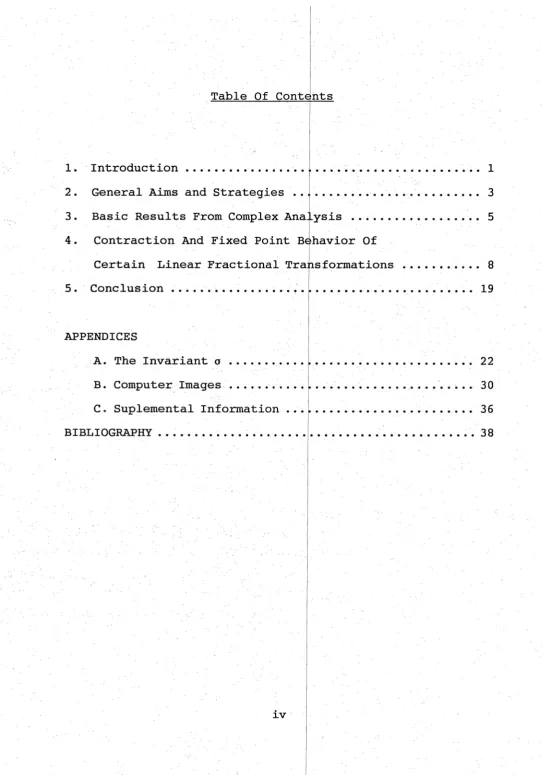
Table Of Conteihts
1. introduction ...
2. General Aims and Strategies ..
3. Basic Results From Complex Ana ysis . 5
4. Contraction And Fixed Point Behavior Of
Certain Linear Fractional Transformations 8
5. Conclusion ... ... 19
APPENDICES
A. The Invariant a ... 22
B. Computer Images ... 30
C. Suplemental Information 36
BIBLIOGRAPHY ... 38
1. IntroduGtion
The purpose of this project is to apply the of
contraction maps on the unit circle in the , to
linear fractional transformations of monomial and
A linear fractional transfoirniation T is a rational
function of the form T(z) = az + where a, b, c.
CZ +
and d are complex numbers and ad - be 0. This restriction
is very essential, for otherwise T"(z) = ad - be = 0 for
( CZ + d)2
all z, so T is identically constant. The function T maps
distinct points onto distinct imagBs. Note also that T has
a pole of order one at - d/c and lim T(z) = a/c . 'Z I
Hence, a linear fractional transformation is a one - to
- one mapping of the complex plane plus the point at ~ onto
itself. Conversely, a one - to - one function (analytic)
mapping of the complex plane plus " onto itself is a linear
fractional transformation. In addition, a linear fractional
transformation that is not identically equal to z has, at
most, two distinct fixed points z for which T(z)= z.
Linear fractional transformatLons are very important in
transfoinnations are :
a) They arei functions that preserve
angles between curves. Hence, they are important tools in
studying flows and fields, and in solving boundary - value
problems, b) Since linear fractional transformations can be
factored into translations, rotations, dilatations, and
reciprocation, ( which are called "simple types" ) these
transformations are extremely important in the study of
geometry, c) Linear fractional treinsformations have a major
role in the study of real one - dimensional projectivities,
since every projectivity can be represented by a linear
fractional transformation,
^incilly,
a
geometrical
characterization of linear fractional transformations is that
they are the only circle preserving transformations in the
2. General Aims And StrateQies
We will prove and make use of two baslG lemmas. The
first one is from complex analysis and is a consequence of
Rouche's Theorem. The second one is a computational lemma
from the theory of linear fractional transformations.
We will use T to denote an arbitrary linear fractional
transformation. The set of all transformation T forms a
group under composition which we \/ill denote by G . It is
well known that G is isomorphic to the projective linear
group over complex numbers.
We will analyze the action of transformations in the
monomial subgroup M of G consistirig of those T with either
a = d= 0orb = c = 0, and of triansformations in the upper
and lower triangular subgroups of G . We denote the upper
and lower triangular subgroups by U and L respectively.
In addition, throughout this text we will let C = -( z :
|z| = 1 } the unit circle, D = { z
IzI < 1 > the open unit
disk. We will be concerned with images of C and D under a
transformation T. By way of definition, we say that T
contracts, or shrinks C provided
T (exp(i6)) I < 1 for all
important properties of these actions:
1) Analyticity on the unit disk,
2) Contraction behavior on the unijt circle,
3) Fixed Point behavior on the unit disk.
The reason for focusincf on the^
e particular subgroups isthat certain surprising conclusions will be reached regarding
the interplay of these three properties. These conclusions
will be stronger than the lemmas W( use for tools, and will
be more specific.
Finally, we note that elements of the group G are
classified up to similarity by a:n invariant known as the
magnitude of T; see[3]. This inviriant determines whether
the transformation T is of Elliptic. Parabolic, Proper
Hyperbolic, Improper Hyperbolic, and Loxodromic type. In
appendix A , we will provide examples of transformations
exhibiting the behaviors we have analyzed in this project
according to the various similarity type. In addition, we
will illustrate some of these c6nclusions using computer
pictures of images of the disk for some examples in Appendix
3. Basic Results From Complex Analysis
Throughout this exposition we: will need certain result
from complex analysis. One of the important results is
Rouche's Theorem, which is as foilows; Suppose f and g are
analytic on an open set containing a piecewise smooth simple
closed curve F and its inside. If
If(z) + g(z) I < |f(z) I for
all z e F, then f and g have an equal number of zeros inside
F, counting multiplicities. ( The proof of this theorem can
be found in any complex variable t ext, such as [2].)
Lemma(1V : Suppose that f is analytic on a domain containing
{ z : |z|
1 }
and that| f(ex]p(i0))|<1
for 0^0:^ 2u.
Then f has exactly one fixed point; in the disk |z|< 1; that
is, if f shrinks C then the equation f(z) = z has precisely
one solution in D .
Proof;
Let g(z) = f(z) - z and h(z) = z. Clearly both g and h
are analytic oh a domain contain ng the closed unit disk.
Further,| g(exp(i0)) + h(exp(i0) 1 = 1 f(exp(i0)) I
1 = 1 h(exp(i0))
|
for all 0, 0 k 6 2ti. Hence, by Rouche's Theorem g and h
point in D counting multiplicities //
(We will refer to Lemma(l) as the fixed point lemma.)
We will also make extensive use of the following
technical lemma which is purely a c:onsequence of the complex
arithmetic of Linear Fractional Transformations.
1
Lemma(2)t A Linear Fractional Transformation T= a b
c d
contracts C iff lap + bp < cp + jdp - 2|cd - ^
Proof;
I T(exp(i0))I =
afexp(i6V^ +c(exp(ie)) + and this fraction
is less than one iff |a(exp(i0)) +
b| < |c(exp(i0)) + dj.
Since both sides are non - negativie, this ineqpiality is
equivalent to |a(exp(i0)) + bp <
c(exp(i0)) + dp. Since
jzp = z2/ we have
(5(exp(-10)+B))(a(exp(10)+b)) <
(B(
e3q)(-i0)+d))(c(exp(i0)+d))
which yields
aa+bB+ab(exp(10))+ba(exp(-10)) <
cC+
dd+c<r(exp(10))+dc(exp(10)
and then
I a|2+|bp+ 2Re(aB(exp(i0))) < jcp
+|dp+ 2Re(c3(exp(i0)))
which we can write as
Since only the far right hand term depends on 0 and the
inequa,lity must hold for all 0, the
contraction property willhold iff the inequality is satisfi^
d when the far right handterm achieves its minimiom . HoweiVer, the minimum value of
this term is -2 l ed - a"b|, Therefore, |T(exp(i0))
|< 1 for
all 6 iff |a|2 + |b|2 < |c[2 + jdj2 - 2|cd-aB|. //
(We will refer to Lemma(2) as the contraction lemma.)
In order to demonstrate the usefulness of the
contraction lemma, note that a transformation of the form
4. ContractIbn And Fixed Point Belavlor Of Certain Linear
Fractional Transfc rmations
A. Monomia1 Transformations ; These are transformations in
the subgroup M = { T e Mi b = c = 0 or a = d = 0 }.
Note that the set of transformations T = a 0 form a
0 d
a subgroup of index 2 in M. The other coset consists of
those transformations T = 0 b Thus, it is clear
G 0
why they are called monomial
transformations
♦
They have
either the form T(z) = b
or T(z) = a^z) .
c(z)
Case I. a = d = 0, T(z) = b
/ c(z
)If |b| < |c| then
1. T has singularity at the origin.
2. T shrinks C.
3. T has two fixed points insLde D.
1
Example; T(z) =
;
fixed points are ±(l+4i) /
2(17)
(4+i)zand property (2) is satisfied by t
he contraction lemma.If |b| = |c| then
1. T has singularity at the origin.
2. T does not shrink C.
3. T has two fixed points on
Example; T(z) = 1/z ;
fixed pointib are ± 1 which is on the
unit circle and property (2) is satisfied by the contraction
lemma.
If |bl > |c| then
1. T has singularity at the origin.
2. T does not shrink C.
3. T has two fixed points outside D.
Exctmplet T(z) = 7 / 2z ; fixed points are ± (7/2) and
property (2) is satisfied by the contraction lemma.
Case II. b = c = 0, T(z) = a(z)
1. T is analytic in D.
2. T shrinks C iff |a| < |d|
3. T has zero as its only fix:ed point in D.
Example: T{z) = z / (4+i) ;
the u
nique fixed point is zeroand by contraction lemma T shrinks C.
Note: The next two follow easily by the contraction lemma,
i) If I a] = ld| we have a pure rotp
tion on T(z) = exp(10)z.Thus, T does not shrink C. ii) If |a| > Idl T does not
shrink C.
B.
Upper Triangular Transfonr^ations
These areThese transformations T = I a b have the form T(z) = az+b.
0 d d
Sometimes they are referred to as integral transformations
I. Suppose a = d, then T(z) = z + b/d. Here we have
transformations of the form T(z) = z + r where.
1. T is analytic in D.
2. T does not shrink C for an
y .r
3. T has no fixed points unless r = 0 , which implies T
eguals the identity function which fixes everything .
Geometrically T is a pure translation which moves the
unit circle to a circle of radius i centered at F = b/d. Let
us use the contraction lemma to give an analytic proof of
property (2).
Proof of property f 2'>:
T(z) = z + r . Assuming F not equal to zero and
applying the contraction lemma tg T , if T shrinks C, we
would have
1 + I F |2 < 1 - 2] -F I
1 F
[2
<
-2] F 1
I F 1
<
-2, a contra
diction.Since F = b/d, F could be any ron-zero complex number .
Thus, T does not shrink C. //
II. Suppose b = d , then T(z) = Fz + 1. Here, as T
= a/d
varies, the images of C under T fo:t:m a family of concentric
circles centered at 1 . In addition,
1. T is analytic in D.
2. T does not shrink C for any P.
3. If r 4= 1/ T has unique fixed point which may or may
not be in the unit disk. If F = this implies , T has no
fixed point.
Proof of property (2)t
T(z) = Fz + 1 once again, assuming F not equal to zero
and applying the contraction lemma to T , if T shrinks C, we
would have
|F|2 +1 < 1-2
l-FI
|F|2 < -2|F|
|F| < -2 , a contradict
ion.Since F = a/d , F could be any illon-zero complex number .
Thus, T does not shrink C. //
Note: This case , b = d and c - 0 , is a counter example to
the converse of fixed point lemma Which is : If T has a
unique fixed point in C and is analytic in D, then T shrinks
C.
•. .V ■
Example: Let F = 3, T(z) - 3z +
1. T is analytic in D.
2. T does not shrink C by contraction lemma.
3. T has unique fixed point in D. Which is -5 .
So far we have looked at spec:ific cases. Now we will
conclude with the general case. That is the case where a, b
and d are possibly distinct .
Ill. Suppose a , b and d are arbiirary. Then T(z) = az + b
: ■ ■■ ■■ ■ ■■: d : ■;
where
1. T is analytic in D.
2. T shrinks C iff |b| < |c
- |a| .■ 3. T has unique fixed point
in D iff lb| < I d ^ a | .
Proof of property (2) :
Once again by the contraction lemma
lajz + |b|2 < |c|2 + |d|2 - 2|c(
- ab1 . But since c = 0
we have
|a]2 + |b|2 < |d|2 - 2|ab|
|a|2 + 2|a| |b| + |bl2 < |dl2
( I a 1 + IbI )2 < I d|2
since
both expressions are positive we can take their square root to obtain,Ia| + Ibl <
- a
Note: We have actually verified the fixed point lemma for
the case a, b, and d arbitrary and c,= 0, without the use of
Rouche's Theorem. We contrast the following two examples;
Examplefl^ t
T(z) = ((l+i)z + i) / (
5 - Si ) ,
Example(2):
T(z) = (5 - 21)z - i
In both cases, the fixed point 1+i
(-3 + 41) / 25 Is In D. In the first case T shrank C, where
as In the second case T does not shrink C.
C. Lower Triangular Transformations: These are
transformations In the subgroup ]L={TeG:b
= 0}. They
are of the form T(z) = az / (cz ^ d)
we have
1. T has singularity at -d/c .
2. T shrinks C Iff |a|2 < (|d| - |c|)2.
3. T has unique fixed point In D Iff [cj < |a-dl.
We will need to prove propeji
rtles (2) and(3). But beforedoing so we will show directly. without the use of Rouche's
Theorem , that property (2) Implies property (3) provided T
Is analytic In D.
Proof;
Assume jcl
conclude
< ld| .
. t
From [a
2 < ( jdj - lc|) 2 we can
|a| < |dl - Id
which implies |c| < |d| - |a|
using the Triangle Inequality we get
jcj < |d - aj
Thus, T has unique fixed point in D. //
Now we will prove properties (2) and (3).
Proof of property 12V ;
T(z) =
(az) / (cz + d)}.
Using contraction lemma
directly we get
|a|2 < |c|2 + |d|2 - 2|cd|
|a|2 < ( Id] - lc|)2
Therefore, T shrinks C iff jaj^ j< (jdj - |c|)2. //
Proof of property (3\ ;
T(z) = (az) / (cz+d). Note, for a transformation in
this group, zero will always be a fixed point. So, in order
to find the other fixed point, set T(z) = z. Now we have
(az) / (cz + d)
=
z
az
= cz^ +1 dz
cz2 + (d-a)z = 0
z( cz + (d-a)) = 0
either z = 0 or cz + (d-a) 0. Thus, the other fixed
point is z = (a-d) / c. Therefore, T will have a unique
fixed point in D iff |
a-d| /|
|i
c
s greater than one, whichimplies |c1 < |a-d|
//
Since the transformations in L have singularity at
-d/c, we investigate further to determine the behavior of T
when the pole is inside or outside D. Thus, we observe the
Case I. analytic in D.
By the contraction lemma if T shrinks C then T has
unique fixed point in D.
T(z) = ' iz ■
z + 7
By the contraction lemma T shrinks C and T has two
fixed points, 0 and -3, where 0 is the unique fixed point in
D. (see t B, Fig. 1, for ii
On the other hand, if T does not shrink C, T may or may
not have unique fixed point in D. Example; T(z) = lOz
z + 6
By the contraction lemma T does not shrink C , and T
has two fixed points, 0 and 4, where 0 is the unique fixed
point in D.
Example; T(z) = 3z
z + 3
Once again by the contractioii lemma T does not shrink
C, and T has a fixed point of multiplicity two at the
origin.
Note: The case where T shrinks C and T has no unique fixed
point cannot occur since property (2) implies property (3).
Case II. jcj > |d| singularity inside D.
By contrast with case I, if T shrinks C it will
necessarily has two fixed points in D. We see this as
follows:
Proof:
If zero was the only fixed [point in D we would have
|c| < la-d|
which is
^ I a I + 1 d I .
But then
|cl - |di < |al
which is equivalent to
|a|2 > (lc|-ldl)2.
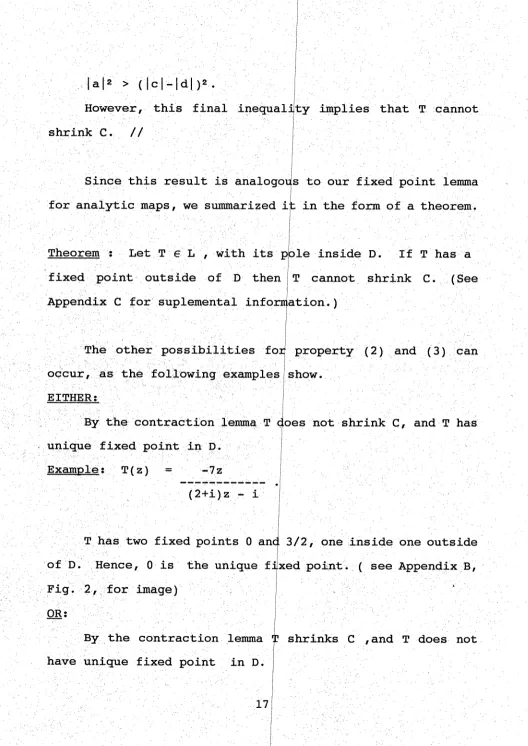
However, this final inequality implies that T cannot
shrink C. //
Since this result is ahalogous to our fixed point lemma
for analytic maps, we siuraaarized it in the form of a theorem.
Theorem : Let T e L , with its pole inside D. If T has a
fixed point outside of D then T cannot shrink C. (See
Appendix C for suplemental information.)
The other possibilities for property (2) and (3) can
occur, as the following examples show.
EITHER:
By the contraction lemma T does not shrink C, and T has
unique fixed point in D.
Example: T(z) = -7z
z - i
T has two fixed points 0 and 3/2, one inside one outside
of D. Hence, 0 is the unique fixed point. ( see Appendix B,
Fig. 2, for i:
OR: ,
By the contraction lemma T shrinks C ,and T does not
have unique fixed point in D.
Example: T(z) = iz
^^^«mm^mmt mmm mmi% mmm^mmm mmm ^
7z + (2+i)
T has two fixed points 0 and -2/7. Hence, both fixed
points are inside D. (see Appendjix B, fig. 3, for image)
OR;
The following examples show the question of
multiplicity is crucial for property (3)•
By the contraction lemma T shrinks C, and T does not
have unique fixed point in D.
Example: T(z) = z
4z + 1
T has a fixed point of multiplicity two at the origin.
OR:
By the contraction lemma T does not shrink C, and T does
not have unique fixed point in D.
Example: T(z) - 2z
3z+2
T has a fixed point of multiplicity two at the origin.
5. Conclusion
In conclusion , we have used linear fractional
transfbmations monomial and triangular types as explication
of the fixed point and contraction lemmas from complex
analysis. However, we have seen some surprising situations
and have cited examples for these situations. In short
siommarizing the different classes we have the following:
I. In the class of the monomial transformations we
observed that EITHER T had singularity at the origin where T
a) shrank C and had two fixed poiints in D, b) did not shrink
C and had two fixed points in D, c) did not shrink C and the
two fixed points were outside D; OR T was analytic in C
where T a) shrank C and had unique fixed point in D, b) did
not shrink G and had no unique fixed point in D. Hence, a
pure rotation. Thus, part a) of the latter conclusion showed
that this was the only situation where the fixed point lemma
could be satisfied under this class.
II. In the class of the upper triangular
transformations we obseirved that : T was analytic in D where
T a) did not shrink C for any V and had no fixed point in D,
did not shrink C for any F and had unique fixed point
which may or may not be in D. Notice, this situation implies
that: the converse of the fixed point lemnia will not hold.
(Surprising!!) c) did shrink C iff |b| < |d| - jaj and has
unique fixed point iff |b| < Id - a I . Notice this
conclusion proves the fixed point lemma without Rpuch©'s
Theorem. This is another surprising outcome!!
III. in the class the lower triangular
transfoiPnations we observed that:
a) T had singularity at:
d/c, b) T shrank C iff jaj^ < ([d|
I - IcI )2, c) T had unique
fixed point in D iff |c[ < ja -
In addition b) and C)were disjoint from one another.|( This was an interesting
conclusion ! )
Due to the singularity at -d/c we were curious to find
out about the behavior of T wh
k
the pole was inside oroutside of D. Thus, after several investigations we coneluded
that EITHER : T was analytic in D where T a) shrank C and had unique fixed point in D, b) did not shrink C and had
unique fixed point in D. OR: T had singularity inside D
where T a) did not shrink C and had the origin as its unique
fixed point in D, b) shrank C and had two fixed points inside
D/ c) did shrink C and had a fixed point of multiplicity two
at the origin d) did not shrink C and had a fixed point of
multiplicity two at the origin.
Thus, as a result of these surprising outcomes for this
class, we were able to summarize our observations in a
theorem.
Theorem : Let T e L with its pole inside of D. If T has a Le insi(
fixed point outside of D then T can not shrink C.
ADPendix A
I
The Invariant oWe have investigated the majner in which the monomial
and triangular type linear fracticlnal transformations behave
with respect to the three properties. That is ; 1)
analyticity on the unit disk, 2) contraction behavior on the
unit circle, 3) fixed point behavior on the unit disk. We
shall now study, using tables, their similarity invariant defined by ; o = (tr T)^
- 4 where T = a b
c d
T T T
o is sometimes called the magnitude of the linear fractional
transformation. Note that it can be shown that two linear
fractional transfoinaations are similar in the group G iff
their magnitudes are equal. See [3]
The transfoimiations T are classilfied as:
Parabolic { which is similar to a translation } if o = 0 ,
Elliptic { similar to a rotation} if -4 ^ o < 0,
Proper Hyperbolic {similar to a dilatation} if o > 0,
Improper Hyperbolic {similar to a dilatation} if o ^ -4 ,
Loxodromic {leaves ho circle invariant} if o is not real. Once again, [3] describes this choice of terminology in
terms of invariant pencils of circles in the Moebius plane.
Note: for the triangular type we nave either
T = a b or T = a 0
0 d c d
Note that, a = (a + d)2
4 in both cases.
;■ ad
For the monomial type there is the additional
possibility
T = 0 b in which case o ^ -4 c 0
In this appendix we will indicate whether or not a
transformation of a particular type can exhibit the
properties (1), (2), and (3), which we have analyzed in this
paper. For example: if we were considering T e M then we
will find neither Parabolic nor Proper Hyperbolic nor
Loxodromic transformations which are analytic in D. In this
case there are no transformatioins of these type in M. We
will indicate this in the table by the word NP to imply not
possible. On the other hand M contains Improper Hyperbolic
trans formations However, they are singular at the origin.
We will indicate this in the table by the word No.
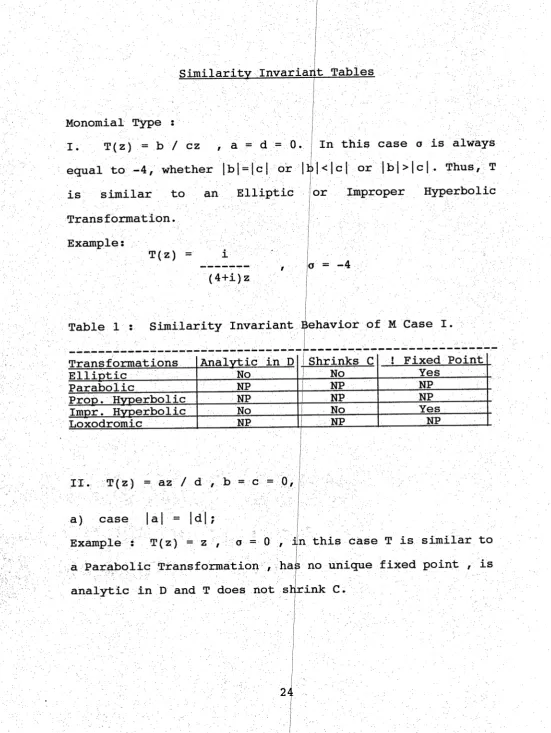
SvTni-laritv Invariar[t Tables
Monomial Ti^e :
I.
T(z) - b / cz , a - d = 0. In this case a is always
equal to -4, whether lbl=|cl or lb|<|c| or lbl>lc|. Thus, T
Elliptic
or Improper
Hyperbolic
is similar to an
Transformation.
T(z) =
o = -4
Table 1 : Similarity Invariant Behavior of M Case I.
Shrinks C I Fixed Point Transformations Analvtic in D
Yes
Elliptic No 1 No
Parabolic NP NP NP
Prop. Hvperbolic NP NP NP
No Yes
Impr. Hvperbolic No
lioxodromic NP NP NP
II.
z) = az / d f b = c = 0,
a) case [a] = ]d|;
Example : T(z) = z ,
50 - 0 , in this case T is similar to
a Parabolic Transformation , has no unique fixed point , is
b) case |a| < |b| ;
In this case T could either ibe similar to a Proper
Hyperbolic Transformation, which! implies that o > 0,
Example : T(z) = (2i)z / 5i , p = 0.9 .
or T could be similar to an Improper Hyperbolic
Transformation . This implies that o -4 ,
Example : T(z) = (3i)z/ -4i , o -4.01 .
or T could be similar to a Loxodromic Transformation
This implies that a is not real.
Example : T(z) = z / (4+i) , o ^ (26 - 32i) / 15 .
Table 2 : Similarity Invariant Behavior Of M Case II (b)
Transformations Analvtic in B Shrinks C ! Fixed Point
Elliptic NP NP NP
Parabolic NP NP NP
Prop. Hyperbolic Yes Yes Yes
Imp. Hvperbolic Yes 1 Yes Yes
Loxodromic Yes 1 Yes Yes
upper Triancnilar Transformations
T(z) = (az + b) / d }
I. If a = d then o = 0 , which implies that T is
Similar to a Parabolic Transformation.
z) = z + 3 .
il. If b ¥ d then either 0, which implies that T
is similar to a Proper Hyperbolic
Transformation,: T(z) = 4z / 5 1 / o =
or o -4 , which implies that T is similar to
an Improper Hyperbolic Transformation,
Example : T(z) = (7z - 2) / -2 / a = -5.79
or o is not real , which implies that T is
similar to a Loxodromic Transformation.
Example : T(z) = (4z + i) / i , j o = (32 + 60i) / -16
Table 3: Similarity Invariant Behavior Of U Case (II)
Transfomations Analytic in D Shrinks C ! Fixed Point
Elliptic NP NP NP
Parabolic Yes No No
Proper Hvperbolic Yes Yes No
Impr. Hvperbolic Yes i Yes No
Loxodromic Yes i Yes No
Ill. If a , b , and d are distinct then either a > 0,
which implies that T is similar to a Proper Hyperbolic
Transformation,
Example : T(z) = (z + 2) / 7> o |= 5.1 .
or o ^ -4f which implies T is similar to an Improper
Hyperbolic Transformation,
: T(z) = (
7z - 2 ) / -2 , o = -5.79 .
or a is not real, which implies that T is similar to a
Loxodromic Transformation.
+ i)z + i) / (5 - 2i), a = (49-21i)/58
Table 4: Similarity Invariant Behavior Of U Case(III).
Transformations Analytic in D Shrinks C 1 Fixed Point
NP NP NP
Parabolic NP NP NP
Proper Hyperbolic Yes Yes Yes
Impro. Hyperbolic Yes Yes Yes
Loxodromic Yes Yes Yes
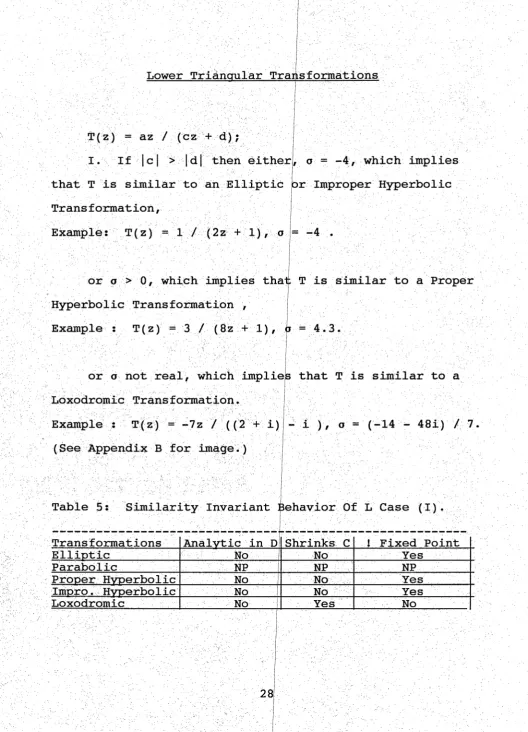
Lower Triancmlar Tramsforiaa1:ions
■
: T(z) = az^7 (cz + d);
I. If ]cI > Id] fcheil either, a =
-4, which impliesthat T is similar to an Elliptic pr
Transformation,
: T(z) - 1 / (2z + 1), o = -4 .
or o > 0, which implies that T is similar to a Proper
Hyperbolic Transformation ,
: T(z) = 3 / (8z + 1), p = 4.3.
or o not real, which implies that T is similar to a
Loxodromic Transformation.
Example : T(z) = -7z /
((2 + i)
= (-14 - 48i) / 7
(See Appendix B for image.)
Table 5; Similarity Invariant :Behavior Of L Case (I).
Transformations Analytic in D Shrinks C ! Fixed Point
Elliptic ■ ■ ^ No No Yes
Parabolic NP . NP , ^ NP
Proper Hvperbolic No No ■ Yes ■
Impro; Hvperbo1ic No NO Yes ■ ■ ■■
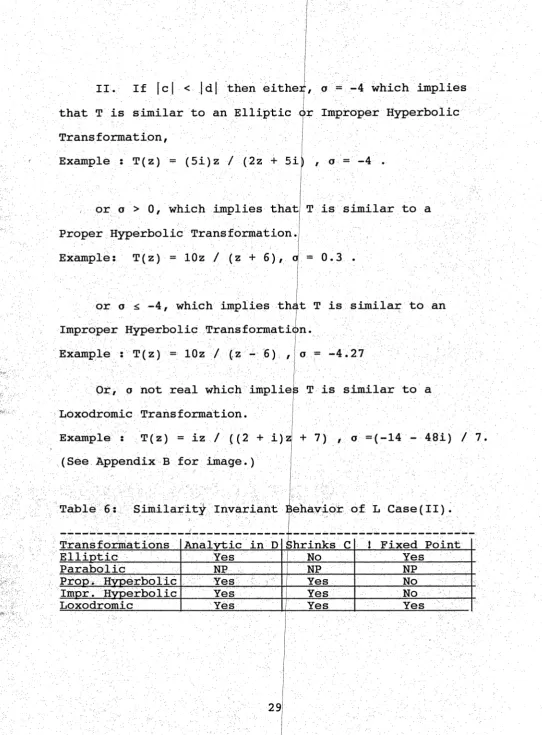
II. If IcI < IdI then either, o = -4 which implies
that T is similar to an Elliptic or Improper Hyperbolic
Transfomation,
Excimple : T(z) = (5i)z / (2z + 5i) , o = -4 .
or o > 0, which implies that T is similar to a
Proper Hyperbolic Transformation.
T(z) = lOz / (z + 6), a = 0.3 .
or o ^ -4, which implies that T is similar to an
Improper Hyperbolic Transformation.
: T(z) = lOz / (z - 6) , a = -4.27
■
Or, a not real which implies T is similar to a
Loxodromic Transformation.
Example : T(z) = iz / ((2 + i)z + 7) , o =(-14 - 48i) / 7.
(See Appendix B for image.)
Table 6: Similarity Invariant Behavior of L Case(II)
Transformations Analvtic in D Shrinks C ! Fixed Point
Elliptic : Yes No • Yes
Parabolic ■ NP NP • NP ■
ProD. Hvoerbolic • ■ ■Yes'^ ' ■i'"'" Yes -No^
Impr. Hvperbolic ■■ Yes Yes No
* Appendix B
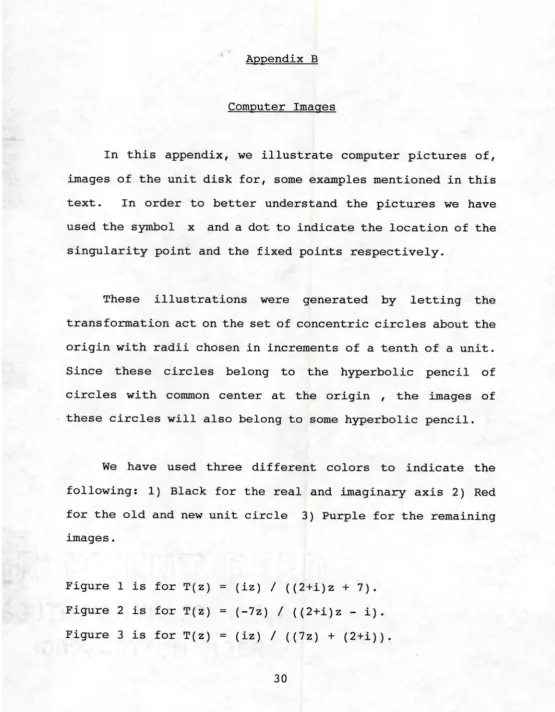
Computer Images
In this appendix, we illustrate computer pictures of, images of the unit disk for, some examples mentioned in this
text. In order to better understand the pictures we have
used the symbol x and a dot to indicate the location of the
singularity point and the fixed points respectively.
These illustrations were generated by letting the
transformation act on the set of concentric circles about the
origin with radii chosen in increments of a tenth of a unit.
Since these circles belong to the hyperbolic pencil of
circles with common center at the origin ,
the images of
these circles will also belong to some hyperbolic pencil.
We have used three different colors to indicate the
following: 1) Black for the real and imaginary axis 2) Red
for the old and new unit circle 3) Purple for the remaining
images.
Figure 1 is for T(z) = (iz) / ((2+i)z +7).
Figure 2 is for T(z) = (-7z) / ((2+i)z - i).
Figure 3 is for T(z) = (iz) / ((7z) + (2+i)).
Figure 4 is for T(z) = (3z) / ( 2z +1).Although this
exaiaple is not mentioned in this t€Jxt, we wanted to include
it^ i.n order to demonstrate the im(age of the disk when tke
fixed point is on the unit circle.
fig. 1
.y
/I, «fi' "
• ■r
\:i
yy^y
Uh
; ■ . ,/■ V''#i
f-I#
Py
.
• =
\
/. ,
H
fig. 3
» ■ : ■■■■• . •■■ ^ -,■ • ..r - ■••■■■^^ - v. ,
%-f' > - i ■ ' - "t, ■ ; "' ■•;' W ■ <
• ■ "• ••
' "
G
fig. 4
e R R AT U M
Page 36, Appendix: G Lemma (3) smould read as follows;
Lemma (3) r The group of automorphisms of the unit
disk ca,n be factored into the grcup of rotations about
the origin and the groub of trandlformations of the form
1 -a
Appendix G
Supplemental Information
Theorem ; Let T e L, with its polel inside D. If T has a
fixed point putside of D then T canno^ shriiik C.
Note; This theorem is in fact true for etny, linear
fractional transformation . That is, given any linear
fractional transformation T, whose pole is in D and has
fijced point outside D, T cannot shrLok C.
; The proof of
note requires
some techniques beyondthe two lemmas used in this paper . But we note that it
involves only one additional lemma which is proved in most
standard text about linear factional transformations.
Lemma(3) : The group of automorphismp of the unit disk can
not be factored into the group of rotations about the
origin and the group of transformatipns of the form
1 -a -JT 1
with a < 1.
Using lemma(3) we can extend the above theorem as
follows: First note that if d = 0 in our transformation
then we can assume that |c - 1 . Thus the transformation
T(z) 4= a + b/z has singularity at th<
origin. It is easyto see that if T has a fixed point outside of D then T
cannot shrink the unit dircle. On the Other hand if
d = 0 but the pole is inside the disk then we can compose
with an automorpism of D and reduce to the case where the
pole is at the origin we will not lose any generality by doing this since the automorphism in lemma(3) leaves the
outside of D invariant.
MM
. ■(:
■ ■" '
, ■ ■ r ■
BIBLIOGRAPHY
1) Burn, R.P., Groups; a path to geemetrv . Great Britain,
1987; rpt. in Great Britair^
University Press,Cambridge, 1988
2) Fisher, Stephen D., Complex Variables. 2nd ed.
Belmont, CA. Wadsworth, 1986.
3) Schwerdtfeger, Hans. Geometiry Of Complex Numbers
New York: Dover Publications, 1979.