World Maritime University
The Maritime Commons: Digital Repository of the World
Maritime University
World Maritime University Dissertations Dissertations
2015
Strategies for improving the competitiveness of the
Korean shipbuilding industry : Case study of
Hyundai Heavy Industries
Lee HyunWorld Maritime University
Follow this and additional works at:http://commons.wmu.se/all_dissertations Part of theStrategic Management Policy Commons
This Dissertation is brought to you courtesy of Maritime Commons. Open Access items may be downloaded for non-commercial, fair use academic purposes. No items may be hosted on another server or web site without express written permission from the World Maritime University. For more information, please [email protected].
Recommended Citation
Hyun, Lee, "Strategies for improving the competitiveness of the Korean shipbuilding industry : Case study of Hyundai Heavy Industries" (2015).World Maritime University Dissertations. 492.
i
WORLD MARITIME UNIVERSITY
Malmö, Sweden
STRATEGIES FOR IMPROVING THE
COMPETITIVENESS OF THE KOREAN
SHIPBUILDING INDUSTRY
Case study of Hyundai Heavy Industries
By
HYUN LEE
Republic of Korea
A dissertation submitted to the World Maritime University in partial fulfillment of the requirements for the award of the degree of
MASTER OF SCIENCE
In
MARITIME AFFAIRS
(SHIPPING MANAGEMENT AND LOGISTICS)
2015
ii
iii
ACKNOWLEDGEMENT
First of all, I would like to extend my sincere gratitude to KOSCO Co. Ltd and
Kostec Co. Ltd, Republic of Korea for giving me this great opportunity to extend my
knowledge and experience in Maritime Affairs at prestigious World Maritime
University to study Master of Science degree with specialization in Shipping
Management and Logistics.
My sincere appreciation goes to my distinguished supervisor, Professor Dr. Aykut. I.
Ö lçer, for being a good supporter and the best motivator. Since I started this
dissertation, he continuously gave me crucial comments, shared valuable information
and cheered me up. Through his support and tutelage, I gained more confidence and
inspiration. The skills I gained from him during the research will assist me during my
career progression and for this I humbly thank him.
I would like to express gratitude to my fellow colleagues, in the class of 2015, for all
their support and motivation during my research. I was lucky to be in a class of
students with vast academic and professional background. This gave me access to
valuable comments and insight whenever I needed it. My special thanks goes to
Edgar, Joseph, Juma, Lawrence, Poul, Radhit, Ranjit, Sun Bae Hong, Sung Man Jung,
Yudha for all the support they accorded me. I cherish their contributions in my
dissertation. In addition, I really appreciate my linguistic supervisor Anne Pazaver,
for her valuable comments to improve this dissertation.
Finally, I owe my profound gratitude to my family for their unparalleled support
during my study. To my father, Jonk Sik Lee, who has been my best mentor and
supporter always giving me the best guidance. He has been a source of my
inspiration since my childhood and I can proudly say that I owe my achievement is
due to unparalleled support. To my beloved mother, Nam Lyeon Park, I remain
grateful for her dedication, love and always being there for me. I thank my lovely
sister and brother, Bee Lee and Han Lee for their support and affection during my
iv
ABSTRACT
Title of Dissertation: Strategies for improving the competitiveness of the Korean Shipbuilding Industry: Case study of Hyundai Heavy Industries
Degree: MSc
Although external factors affect companies, companies need solutions to survive and sustain growth. However, the financial crisis of 2008 affected the Korean shipbuilding industry and companies recorded poor financial results. To solve this problem and increase the competitiveness of the Korean shipbuilding industry, it is necessary to find stabilizing suggestions and promising markets to diversify into.
Therefore, this research is aimed at proposing suggestions for problem solving and new market development. To deeply look into this situation, a case study of a particular company will be undertaken. The target company is Hyundai Heavy Industries and its competitors are Samsung Heavy Industries and Daewoo Shipbuilding & Marine Engineering.
The process involved four stages. The first stage where an external analysis were done for global, national and international regulation trends and the overall trends were extracted. The sectors where the trends were analyzed are green business, smart business and entertainment business. The second stage is an internal analysis which was achieved by examining the general background using a capability analyzing tool. In this stages seventeen resources with eight problems were found. Based on previous stages, in the third step, five problem-solving suggestions and nine take-off suggestions were proposed. The fourth step is suggestions adaptation for prioritization. To do this, all suggestions were listed and similar suggestions combined. The nine combined suggestions were assessed according to internal resources, external competition and needed time. Through this, high, medium and low level recommendations were given. High level recommendations are energy efficient vessel, advanced connected smart ship, B2C business, production costs and emotional approach. This will be followed by the ripple effect, where if the ideas are accepted, the company can solve encountered problems and create a new market. In addition, other Korean shipbuilding companies can also adopt the ideas or methodologies to increase competitiveness.
v
TABLE OF CONTENTS
Declaration ... ii
Acknowledgement ... iii
Abstract ... iv
Table of Contents ... v
List of Tables ... ix
List of Figures ... xi
List of Abbriviations ... xii
1. Introduction ... 1
1.1. Background ... 1
1.2. Research Objectives, Scope and Methodologies ... 3
1.2.1. Research Objectives and Scope ... 3
1.2.2. Research Methodologies ... 3
1.3. Limitations ... 6
2. External Analysis ... 7
2.1. Global Trend (World Trade Global Competition) ... 7
2.1.1. Smart shipping ... 8
2.1.2. Environmental Friendly ... 10
2.1.3. Quality of Life ... 11
2.2. National Trend (Korean Government Approach) ... 12
2.2.1. ICT Shipping (Smart shipping) ... 13
vi
2.2.3. Green growth (Maritime safety and environment) ... 16
2.2.4. Financial support Sectors (Governmental level support) ... 17
2.3. International Regulation Trend (IMO Regulation) ... 22
2.3.1. E-navigation (On-line communication) ... 23
2.3.2. Environmentally friendly (Sustainability) ... 24
2.4. Opportunity ... 25
2.4.1. Green business (Eco Ship) ... 26
2.4.2. Smart business (Smart ship) ... 26
2.4.3. Entertainment business (Cruise business) ... 27
3. Internal Analysis... 28
3.1. General back ground of company (Hyundai Heavy Industries) ... 28
3.2. Capacity Evaluation ... 29
3.2.1. Supporting activity ... 30
3.2.1.1. Firm Infrastructure ... 30
3.2.1.2. Human Resource Management ... 38
3.2.1.3. Technology Development ... 40
3.2.2. Production Process ... 50
3.2.2.1. Contract ... 51
3.2.2.2. Procurement ... 53
3.2.2.3. Production ... 55
3.2.2.4. Sea trial ... 58
3.2.2.5. Delivery ... 59
vii
4. Possible Suggestions ... 61
4.1. Problem solving suggestions ... 61
4.1.1. Profit maximization ... 62
4.1.2. Shortening distance ... 63
4.1.3. Eco-ship projects ... 64
4.1.4. Related diversifications ... 64
4.1.5. Increase passenger shipbuilding ... 66
4.2. Take-off suggestions ... 66
4.2.1. Green business ... 67
4.2.2. Green business + Smart business ... 67
4.2.3. Smart business ... 68
4.2.4. Smart business + Entertainment business ... 68
4.2.5. Entertainment business ... 70
5. Suggestions Adaptation ... 71
5.1. Feasibility test ... 71
5.1.1. Related diversification ... 73
5.1.2. Eco- ship ... 74
5.1.3. Green vessel project ... 75
5.1.4. Advanced connected smart ship ... 75
5.1.5. Entering B2C business ... 76
5.1.6. Passenger ship building ... 76
5.1.7. Decrease production cost ... 77
viii
5.1.9. Physical approach ... 78
5.2. Prioritize suggestions ... 79
5.3. Ripple effect ... 80
6. Conclusion ... 82
ix
LIST OF TABLES
Table 1 Net profit of Korean major three companies ... 2
Table 2 World travel trends (change in % over respective previous year) ... 12
Table 3 Research and development list ... 17
Table 4 Increasing rate of subsidies ... 19
Table 5 Trends in average revenues per kWh sold ... 20
Table 6 Market share in shipbuilding part ... 29
Table 7 Status of operationg profit and loss... 33
Table 8 Net profit of 2015 half term KRW million ... 34
Table 9 Specifics of drydocks ... 34
Table 10 Specifics of dock (SHI) ... 35
Table 11 Specifics of dock (DSME) ... 36
Table 12 Characteristics comparison table ... 38
Table 13 Workforce status (HHI) ... 38
Table 14 Producer of main engine ... 43
Table 15 Major programs and performances ... 44
Table 16 Status of passenger ships... 49
Table 17 Profit and loss per department in 2014 (HHI) ... 51
Table 18 Backlog of shipyard ... 53
Table 19 Price of raw materials (HHI) ... 54
Table 20 Price of raw materials (SHI) ... 54
Table 21 Price of raw materials (DSME) ... 54
Table 22 Performance by Ship Type (HHI) ... 55
Table 23 Performance by Ship Type (SHI) ... 56
x
Table 25 Resources and problems... 59
Table 26 Price of major products ... 73
xi
LIST OF FIGURES
Figure 1 Research methodology ... 4
Figure 2 The OECD Industrial Production Index and indices for the world ... 9
Figure 3 International seaborne trade, selected years (Millions of tons loaded) ... 10
Figure 4 Life expectancy ... 11
Figure 5 Reasons of using smartphone (plural response) ... 13
Figure 6 Increasing tendency of cruise market in Republic of Korea ... 16
Figure 7 Subsidies amount ... 18
Figure 8 Shipbuilding related government budget strategy ... 22
Figure 9 Concept of e-navigation ... 23
Figure 10 Process of find global trends ... 26
Figure 11 Capacity evaluation tool ... 30
Figure 12 Population of Korean major cities ... 40
Figure 13 Developing eco-friendly products ... 44
Figure 14 Sales of green energy... 46
Figure 15 Cooperative project of smart ship (HHI) ... 48
Figure 16 Connected smart ship ... 49
Figure 17 Passenger ship matrix of companies ... 50
Figure 18 Average company lifespan on S&P 500 Index (in years) ... 58
Figure 19 Problem solving suggestions ... 62
Figure 20 Combined suggestions ... 72
xii
LIST OF ABBREVIATIONS
APRG Advance Payment Refund Guarantee
BDI Baltic Dry Index
BOR Boil-Off Rate
B2C Business to Customer B2B Business to Business
BNEF Bloomberg New Energy Finance CCS Carbon Capture & Storage CCS Cargo Containment System
DSME Daewoo Shipbuilding & Marine Engineering
EC European Community
GHG Greenhouse Gas
HHI Hyundai Heavy Industries
HTEI Hyundai Technical Education Institute
ICT Information and Communications Technology IMO International Maritime Organization
TDM Temporary Defense Mechanism for Shipbuilding MBA Master of Business Administration
MECE Mutually exclusive and completely exhaustive MEPC Marine Environment Protection Committee MOU Memorandum of Understanding
PSL Pre-Shipment Loan
R&D Research and Development SHI Samsung Heavy Industries SOC Social Overhead Capital
1
1. Introduction
1.1. Background
In the period of changing paradigms in the market, reading the market needs and
taking rapid action in accordance with the current movement are important. Samsung
Electronics and Sony cases are good examples. From the 70s to the 90s, Sony was a
trend leader and an innovative company with representative goods such as the
Walkman. At that moment, it seemed hard to expect the collapse of Sony. However,
Sony did not take appropriate action to change according to market and customer
needs. This approach drove Sony to record net losses and decreased the value of the
company. On the other hand, Samsung Electronics continuously monitored the
market needs and trends, and changed in accordance with market movements.
Therefore, this strategy made Samsung Electronics to become one of the biggest
trend leaders. Continuous innovation and keeping up with the trends are crucial in
the fast changing society.
The Korean Shipbuilding industry is also likely to experience change. As Table 1
shows, the net profits1 of the three major shipbuilding companies, which were
Hyundai Heavy Industries (HHI), Samsung Heavy Industries (SHI) and Daewoo
Shipbuilding & Marine Engineering (DSME), had experienced problems. Except for
the DSME in 2013, all the three companies‟ net profits continuously declined. The
principal cause of those results was the financial crisis of 2008 which affected the
2
entire maritime industry. However, if an external factor threatens the sustainability of
a company, it is necessary to find a hedging solution which can create a different way
to generate profit.
Table 1 Net profit of Korean major three companies
(KRW million)
2010 2011 2012 2013 2014
HHI net profit 4,576,490 2,753,350 1,029,643 146,303 -1,769,215
SHI net profit 888,418 863,934 741,218 652,446 149,225
DSME net profit 776,036 648,255 175,853 241,893 112,087
Source: organized by author based on (Hyundai Heavy Industries, 2013, 2015a); (Samsung Heavy Industries, 2013, 2015a); (Daewoo Ship building & Marine Engineering, 2013, 2015a)
However, the level of decrease in the rate indicates it was not solely due to external
factors. There existed internal problems which contributed to unacceptable financial
performance. Therefore, this research will focus on identifying problems in the
Korean shipbuilding industry and finding promising markets to enter. To achieve this
goal, a deep analysis of one company will be an effective method. This is because by
case study, this dissertation can show a tailored way to conduct the whole process of
problem solving and methodology.
Among three major shipbuilding companies, HHI is appropriate to choose for the
case study. As Table 1 presents, HHI has recorded dramatic changes in its financial
status. Its decreasing rate of net profits is the highest and it has even recorded a net
loss of KRW 1,768,215 million in 2014, which is around USD 1.5 billion. Therefore,
HHI has been chosen for the case study, and this case study can be tailored and
adopted to other Korean shipbuilding companies. In addition, two other companies
are also analyzed together as competitors.
Moreover, the whole process of this research is not only applicable to Korean major
shipbuilding companies, but also to other shipbuilding companies in the Republic of
3 adopted other companies.
1.2. Research Objectives, Scope and Methodologies
1.2.1. Research Objectives and Scope
This research has two main objectives. One is finding encountered problems and
recommending solutions for the HHI. The other is finding a prospective market and
giving suggestions related to those sectors, which can improve competitiveness for
the company, in an innovative way.
As objectives are based on the HHI, the scope is also based on that. This research is
focused on external and internal factors, which can affect the company‟s business
activities. The company is in the business ecosystem, so external factors include all
of the parties at the international and national level. In addition, internal factors will
cover all supporting activities for production, and the entire production process.
In addition, the core businesses2 of the company is shipbuilding and offshore.
Therefore, research will be focused on those two business parts, but the identification
of a promising market will be open to every sector. If the suggestions help the
company become profitable and competitive by using its resources, then those can be
acceptable solutions. Moreover, this dissertation is limited in scope as it focused
mainly on the HHI. Other companies, SHI and DSME, are for comparison purposes.
1.2.2. Research Methodologies
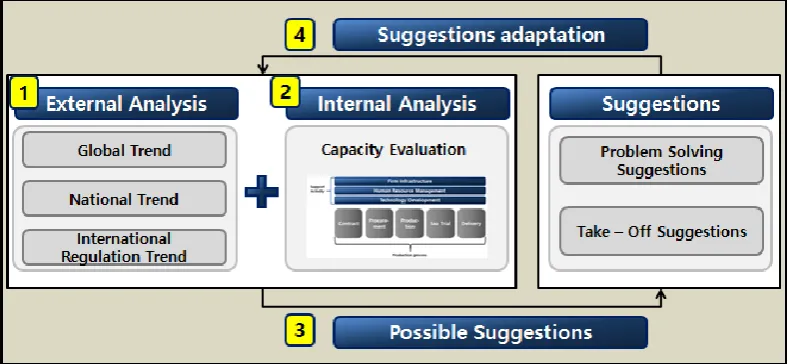
To achieve two main objectives, this research will use four-step approach and the
2
Core business is “the primary area or activity that a company was founded on or focuses on in its
4 methodology is illustrated in Figure 1.
Figure 1 Research methodology
Source: organized by author
The first step is an external analysis3 to identify the trends in the overall trends of the
shipbuilding industry. To identify the trends, a multi-dimensional approach will be
used. The three dimensions are global trends from world trade global competition,
national trends from the Korean governmental approach, and International regulation
trends from IMO regulations. The common points of the three dimensions are the
trends in the shipping industry and capturing those trends is the key to success in the
future markets.
The second step is an internal analysis4. To do an internal analysis, it is necessary to
look into the general background of HHI first and then by use a capacity evaluation
tool to identify the existing resources and problems of the company. The idea of a
capacity evaluation tool was adapted from Michael Eugene Porter‟s value chain5 .
3
The external analysis looks into surrounding environmental of companies. It is useful for determining market trends, opportunities and threats.
4 The internal analysis covers all situations inside companies. This analysis usually used to find
strengths and weaknesses of companies.
5
Because of the characteristics of the shipbuilding industry, this dissertation tailored
and used that tool. It consists of support activities and production process.
Supporting activities consist of firm infrastructure, human resource management and
technology development. In addition, the production process consists of contract,
procurement, production, sea trial and delivery. The supporting activity of
technology development will cover ongoing projects regarding three trends, which
are extracted from the first step.
The third step is to find possible suggestions and those suggestions are divided into
to two parts. One is problem-solving suggestions and the other is take-off
suggestions. Those two suggestions are linked to the two goals of this research.
Problem solving suggestions drive from the internal analysis problem part, and will
help to solve the existing problems. In addition, take-off suggestions, which are
related to finding promising markets, are linked to the external analysis trends part
and will give ideas for a promising market.
The fourth step is suggestion adaptation and to adapt each suggestion combining and
reorganizing suggestions from the third part is required. Because some suggestions
are highly linked with each other, by conducting this process, suggestions are
consolidated into a smaller number of suggestions. The next process looks into the
status of internal resources, external competition and needed time to assess
suggestions. Those three approaches are crucial for this step, because those are
criteria for doing feasibility tests and prioritizing suggestions. Based on prioritized
suggestions this dissertation will find ripple effects. This part will cover effects of
highly recommended suggestions, which consist of problem solving suggestions and
take-off suggestions, followed by medium level suggestions, and low-level
suggestions.
6
1.3. Limitations
The business sector is always open to unexpected factors, and it may be affected a lot
for that reason. In addition, those factors could possibly act as crucial information
that is not covered in this paper. In addition, suggestions described and prioritized
here are not necessarily the one best way. Therefore, all possibilities of suggestions
and measures are open. Companies can find more suitable suggestions from either
7
2. External Analysis
The coexistence of companies and society is essential in the 21st century. That is
because those parties influence and interact with each other to build a business
ecosystem. For companies, making good performances and drawing blueprints for
the future requires information. Especially, reading trends is a key factor to lead to
business success. The reason is that trends can act as indicators of customers‟ needs
and wants. Therefore, by reading trends in the business ecosystem, companies can
find opportunities in certain business sectors.
For these reasons, the aim of the external analysis chapter is finding trends in the
maritime industry. In the maritime field, many different interests are entangled, so a
multi-dimensional approach is needed to look into different parties. The multi-
dimensional approach has three angles. Those are global trend (world trade global
competition), national trend (Korean governmental approach) and international
regulation trend (IMO regulation). By looking at those approaches, this research can
find common points in the three angles. Those points will be the trends in the
maritime industry. Moreover, because trends are linked to opportunity, results from
the external analysis will be used for internal analysis and prospective market
identification.
2.1. Global Trend (World Trade Global Competition)
The shipping industry links the whole world and conducts business at the global level,
8
Therefore, the first dimension of the identified trend is a global trend, which is
related to world trade global competition. At this stage, the dissertation can establish
three key words, which are smart shipping, environmentally friendly and quality of
life.
2.1.1. Smart shipping
TGIF is not a restaurant branch anymore and we call 2010s the TGIF generation,
which represents Twitter, Google, I phone and Facebook. That movement is possible
with smartphones and internet connection. Thanks to both of them, the world is
getting closer. Accessing information all over the world is possible as is contact with
others at the opposite side of the globe. The paradigm of the whole industry has
changed.
Smartphones and maritime business have a common point. Vessels also connect the
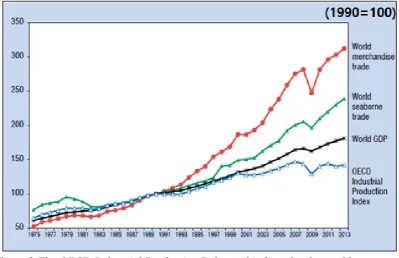
world by the ocean. As Figure 2 indicates, world seaborne trade makes up around 75
percent of world merchandise trade. The larger the portion of the market share6, the
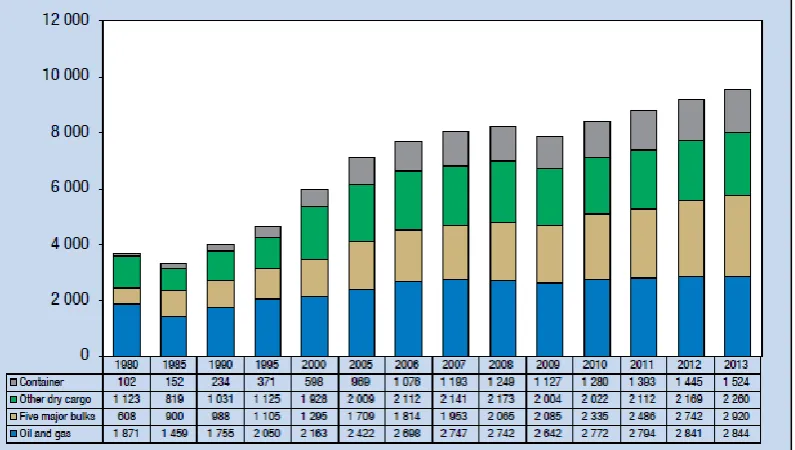
higher the possibility to play a key role. Figure 2 shows world seaborne trade is
continuously increasing and Figure 3 also shows that the increasing trend is valid in
all sectors of trade, which are container, other dry cargo, five major bulk, and oil and
gas. It means if a vessel is equipped with ICT (information and communications
technology) devices and can manage information, or if it can connect with
smartphone, value created from there will be significant.
In addition, “smart” can be defined by increasing automation level. One hot issue in
the maritime industry is shortage of seafarers. Because of this problem, Drewry‟s
Manning 2014 Annual report mentioned the carrier profitability has problems and it
forecasted that the problems would worsen. Estimated current officer supply is
around 610 thousand, and the shortfall of seafarers is around 19 thousand personnel
6
Market share is “a percentage of total volume of sales in a market captured by a brand, product,
9
and it is estimated to reach an additional 38.5 thousand persons by 2018 ("Carrier
Profitability in," 2014). Therefore, increased customization level will be a good
solution for this matter.
In this stream, the concept of e-navigation is surfacing. Initially, this concept was
raised for safety reasons, but it is extending to all ICT7 related business. The
movement has started. Regarding e-navigation, the United Kingdom Hydrographic
Office (UKHO) is conducting a world seminar of 23 spots until 2015, which started
on March 26th 2014, in Dublin, Ireland (Ministry of Oceans and Fisheries , 2014). In
addition, IMO is putting in place 17 essential services of e-navigation which it plans
to adopt until 2019 (Kim, 2015). Therefore, in the world trade global competition,
smart shipping is an ongoing and prospective issue.
Figure 2 The OECD Industrial Production Index and indices for the world
Source: UNCTAD, 2014
10
Figure 3 International seaborne trade, selected years (Millions of tons loaded)
Source: UNCTAD, 2014
2.1.2. Environmental Friendly
Environmental issues are always hot in all industry and the maritime field is not an
exception. Among many environmental issues in the business field, there is more
interest in issues that can create revenues. Therefore, issues which are not only
environmentally friendly and but also revenue friendly are hot issues of global trends.
One example is energy efficiency. Energy efficiency can reduce GHG (greenhouse
gas) emissions, so IMO adopted additional guidelines and amendments in April 2014.
IMO‟s Marine Environment Protection Committee (MEPC) continuously tries to
improve the design of ships, their size, and operational measures that can achieve
better speed management, especially efficient use of fuel (UNTAD, 2014). It can
reduce the emissions of CO2, GHG emissions and other toxic substances.
In addition, this issue is also beneficial from the economic point of view. The
business world generally follows the flow of money and it depends on supply and
demand. If a ship owner wants a certain product, the shipbuilder will build that
11 40 45 50 55 60 65 70 75 80 85
1960 1970 1980 1990 2000 2010 2011 2012
Australia Belgium
Brazil Canada
Chile China
Czech Denmark
Estonia Finland
France Germany
Greece Hyngary
Iceland India
Indonesia Israel
Italy Japan
Korea Luxembourg
Mexico Netherlands
New Zealand Norway
Poland Portugal
Russia Slovak Republic
Slovenia South Africa
Spain Sweden
Switzerland Turkey
United Kingdom United States they are sufficient to attract ship owners. The reason is that in the highly competitive
society, service fees are almost fixed by the market. In this situation, to increase
profit, ship owners have to reduce costs. As from 50 to 60% of the cost of running a
vessel is from fuel oil, effectively managing energy consumption will give a
significant cost savings effect. Therefore, many stakeholders including IMO,
government, ship owners and ship builders willing to increase the energy efficiency
of vessels. Those facts make global trends.
2.1.3. Quality of Life
Development and accumulated knowledge of medical technology change human life
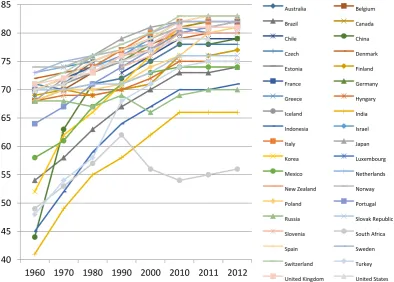
style. As Figure 4 shows, compared to the 1960s, life expectancy in 2012 was longer.
Longer life expectancy triggered people to think about quality of life. People started
to think about life after retirement and it makes differences.
Figure 4 Life expectancy
12
In addition, a World Tourism Organization (UNWTO) report shows arrivals of
international tourists grew by 4.8% in the first eight months of 2014 and world travel
trends shows continuous upward movement (Messe Berlin GmbH, 2014). Table 2
also supports the travel trend, which has continuously increased since 2011.
Therefore, a longer life span drives people to think about quality of life and that
movement affects increasing rate of travel.
Table 2 World travel trends (change in % over respective previous year)
2011 2012 2013 2014 YTD Outbound trips +5% +4% +4% +4.5%
Outbound nights +4% +2% +4% +3% Source: Messe Berline GmbH, 2014
2.2. National Trend (Korean Government Approach)
Characteristics of maritime business place much importance on global trends.
However, Korean shipbuilding companies do their business in Republic of Korea and
regulations and support affect companies. That is why, the national trend, which is
related to the Korean government approach also needs to be considered. The national
trend includes the Government of the Republic of Korea approach and Korean
Ministry of Oceans and Fisheries approach. Both parties have political effects on
the Korean shipbuilding industry. Regarding the national approach, this research
consists of four sub-chapters. Three of them, which are ICT shipping (smart
shipping), maritime policy (improve maritime tourism), maritime safety and
environment (green growth) are trends pertaining to the Korean government
approach, especially the approach of the Korean Ministry of Oceans and Fisheries. In
addition, the financial support part will describe all levels of the Korean government,
13
2.2.1. ICT Shipping (Smart shipping)
Traditionally, the main roles and functions of cellphones were phone calls and text
messages. However, the introduction of the smart phone has resulted in significant
changes in the role of cellphones. Only five years after the smartphone was adopted
in Republic of Korea, 80% of people are using smartphones (Lee, 2014). In addition,
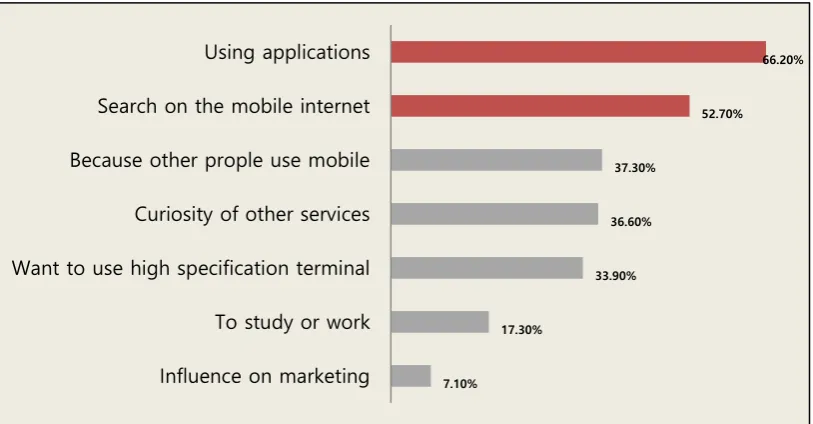
as Figure 5 represents, functions of the cellphone were shifted to web and apps. More
than 50% of people use smart phones for applications and to search on the mobile
internet, which is a shift that was hard to predict 5 years earlier. In the 21st century,
the majority of sectors use highly digitalized technology. However, because of
internet problems, people who work inside vessels hardly enjoy this privilege.
Nevertheless, the maritime field started changing from analog to digital and the
Korean government highly supports the trend toward e-navigation. The Minister of
Oceans and Fisheries supports mobile application of vessel monitoring systems, for
real time vessel location (Ministry of Oceans and Fisheries, 2015a). Moving platform
to mobile indicates that the maritime field has also started to jump into the smart
business, which has infinite possibilities. Especially, by managing information,
parties in this industry can get benefits.
Figure 5 Reasons of using smartphone (plural response)
Source: Lee, 2014
7.10% 17.30%
33.90% 36.60%
37.30%
52.70% 66.20%
14
However, the definition of e-navigation is slightly different from IMO and
government perspectives, which may cause misunderstanding. The definition of
e-navigation from IMO is:
“The harmonized collection, integration, exchange,
presentation and analysis of marine information on board and
ashore by electronic means to enhance berth to berth navigation and
related services for safety and security at sea and
protection of the marine environment” (http://www.imo.org).
This definition suggests that e-navigation is developing for safety, security and
environment, but government has a broader idea.
The Minister of Oceans and Fisheries contracts business agreements with Busan
National University Hospital regarding remote medical examination and treatment in
oceans. In addition, remote medical examination and treatment is one of the 17
essential services of e-navigation which is planned to be adopted by 2019 by IMO
(Kim, 2015). This means the boundary of e-navigation for the government is not only
a navigating function, but includes other functions. The government opens the
possibility to whole sector of ICT. Therefore, in this dissertation, the extended
concept of e-navigation will be referred to as smart shipping or ICT shipping.
In addition, the Korean government also tries to establish a sound foundation
regarding smart shipping. A government did feasibility test regarding e-navigation
from January to November of 2014 and plans to invest KRW 130.8 billion, about
USD 130.8 million, from 2016 to 2020. Republic of Korea, Denmark and Sweden
are international Test-Beds of e-navigation and are pushing ahead to establish
international standards (Ministry of Oceans and Fisheries, 2015a). Therefore, smart
15
2.2.2. Improve maritime tourism (Maritime Policy)
Improvements in quality of life make changes in customers‟ patterns of consumption.
Because of the Korean War, the 50s and 60s in Republic of Korea focused on finding
food, shelter, and clothes to survive. However, today Koreans have started to think
about how to improve their quality of life. For that, Koreans are highly interested in
health and entertainment.
In this stream, the government also supports the entertainment industry. From May
20th to 22nd of 2015, the Minister of Oceans and Fisheries, Gi Jun You held what
was termed „2015 Korea Cruise Shanghai Networking‟ to revitalization of the cruise
industry with his Chinese counterparts. At this meeting, both countries signed a
bilateral MOU (memorandum of understanding). In addition, the Minister of Oceans
and Fisheries established the Cruise industry enhancement law (Ministry of Oceans
and Fisheries, 2015b). Those facts indicate that the cruise business is highly
supported by the government.
In addition, at the national level, the cruise market is growing itself. As Figure 6
shows, the cruise market has continuously increased over the last 10 years. The
number of calls at ports of Republic of Korea increased around 12 times and
passenger growth has increased around 35 times. In the maritime field, a steady
increase in certain parts is an exceptional record. Because of the global financial
crisis, the BDI (Baltic Dry Index) dropped from 11,793 to 633 in 2008 and it caused
dark ages in maritime industry. In this period, the cruise market was not as affected
16
Figure 6 Increasing tendency of cruise market in Republic of Korea
Source: organized by author based on (Ministry of Oceans and Fisheries, 2013); (Lee, 2015)
2.2.3. Green growth (Maritime safety and environment)
The Korean government and IMO are highly linked with global regulation. In
addition, safe and environmentally friendly business is always a hot issue for the
IMO. As IMO regulations are going with government policies, the Korean
government is monitoring ongoing projects and trying to get preoccupancy of the
global standard. Toward that goal, the Minister of Oceans and Fisheries has invested
in new technology related to safety and environmental protection. The budget for
research and development was around 10.203 million dollars in 2012, 13.475 million
dollars in 2013, 18.800 million dollars in 2014 and 13.472 million dollars in 2015
(Ministry of Oceans and Fisheries, 2015a).
In addition, regarding green growth, the government also put efforts into enhancing
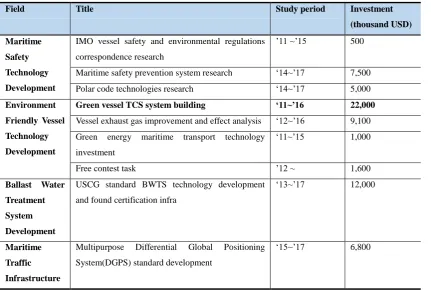
their safety and environmental levels. As Table 03 indicates, the field, title, study
period and investment amount of the research undertaken. 0
200 400 600 800 1000 1200
05' 06' 07' 8' 9' 10' 11' 12' 13' 14'
17
Among many existing studies, the Korean government put more effort into green
vessels. The Minister of Oceans and Fisheries invested around 65.5 billion dollars in
safety and the environment, and the largest investment is in green vessel TSC system
building which is around double the amount of the second biggest sector, Ballast
water treatment systems. With all of these factors, we can assume that from the
government side, safety and environment are hot issues and green vessels are
especially important. Those factors will be trends at the national level.
Table 3 Research and development list
Field Title Study period Investment
(thousand USD)
Maritime Safety Technology Development
IMO vessel safety and environmental regulations correspondence research
‟11 ~‟15 500
Maritime safety prevention system research „14~‟17 7,500 Polar code technologies research „14~‟17 5,000 Environment
Friendly Vessel
Technology Development
Green vessel TCS system building ‘11~’16 22,000
Vessel exhaust gas improvement and effect analysis „12~‟16 9,100 Green energy maritime transport technology
investment
„11~‟15 1,000
Free contest task ‟12 ~ 1,600
Ballast Water Treatment System Development
USCG standard BWTS technology development and found certification infra
„13~‟17 12,000
Maritime
Traffic Infrastructure
Multipurpose Differential Global Positioning System(DGPS) standard development
„15~‟17 6,800
Source: Ministry of Oceans and Fisheries, 2015a
2.2.4. Financial support Sectors (Governmental level support)
Described national trends from 2.1.1 to 2.1.3 are basically Korean Ministry of
Oceans and Fisheries approaches. Shipbuilding companies are highly related to this
18
Therefore, reading the tendency of the governmental approach is also crucial for
identifying trends.
The governmental approach is important not only because of trends but also because
of benefits. Compared to other products, shipbuilding requires large amounts of
capital. If a company can get financial support from the government, it will be
helpful. Therefore, this part will cover financial support related to three trends.
A common method of government support is through subsidies. According to the
2015 budget of the Korean government, the Korean government can afford to
subsidize its industries. As Figure 7 shows, the amount of subsidies increases
continuously and average growth rate is 6.5% (Ministry of Strategy and Finance,
2014). As the inflation rate of 2015 is expected to be 0.7%, 6.5% of growth rate is
comparatively high. In addition, as Table 4 shows, subsidies in 2015 increased in 100
percent of sectors. That means shipbuilding companies have the opportunity to
absorb this amount of subsidies for running their business.
Figure 7 Subsidies amount
Source: Ministry of Strategy and Finance, 2014
42.7 43.7 46.5
50.5 52.5
58.4
0 10 20 30 40 50 60 70
2010 2011 2012 2013 2014 2015
19 Table 4 Increasing rate of subsidies
(KRW trillion)
Type Budget Increasing
rate
Type Budget Increasing
rate
Health and welfare 115.5 8.5 ↑ SOC 24.4 3.0 ↑
Education 53.0 4.6 ↑ Agriculture
and Forestry
19.3 3.0 ↑
Culture, tourism 6.0 10.4 ↑ National
Defiance
37.6 5.2 ↑
Environment 6.7 4.0 ↑ Unity of
Diplomacy
4.5 6.9 ↑
R&D 18.8 5.9 ↑ Public order
Safety
16.9 7.1 ↑
Industry, Energy 16.5 7.0 ↑ Administration 59.2 3.4 ↑
Source: Ministry of Strategy and Finance, 2014
However, because of WTO regulations, there are restrictions on subsidies for the
Korean shipbuilding industry. In 1995, WTO was founded and regulations were
strengthening between member states, generating conflicts. Especially, import and
export related industries, such as steel, vessel, aircraft and energy industries were
affected a lot (Lee & Um, 2014).
This is because if any trading nation thinks that there has been an unfair trade, that
nation can file a litigation, which can affect sales. For example, EC (European
Community) sued the Korean vessel finance supporting system in 2005. The
Export-Import Bank of Korea provided APRG (Advance Payment Refund Guarantee) and
PSL (Pre-Shipment Loan) to avoid bankruptcy. EC thought it was unfair trading and
this problem was hard to resolve through bilateral consultation. In addition, Korea
and EC also have legal problems regarding TDM (Temporary Defense Mechanism
for Shipbuilding) (Lee & Um, 2014).
20
relationships, so minimizing conflict is crucial. In addition, understanding and
adoption of WTO regulations differs among countries. Therefore, getting financial
support in an indirect way is better than a direct way. There exist two major ways to
gain indirect support from the government. Those are reducing taxes and indirect
subsidies.
Reducing Taxes
Reducing taxes is one method of indirect support. The Korean government already
gives advantages to the industrial sector through a low electric tax rate. As Table 5
indicates, except for agricultural, the industrial electric fee is cheapest among all
sectors. Apart from electric tax, the government can also give advantages to the
shipbuilding industry by reducing the cost of materials for shipbuilding, for example,
steel tax or import machinery, which are engine, telecommunication system, pump
and other machines. Reducing tax for employees of the company is also a
suggestions. In the industrial level, companies have room to negotiate with the
government.
Table 5 Trends in average revenues per kWh sold
(Unit: won/kWh)
Year Residential Public
&Service
Educational Industrial
Agricul-tural
Street
light
Mid-night
Total
21
2008 114.97 95.30 78.58 66.24 42.38 72.50 78.7 78.76 2009 114.45 98.50 83.56 73.69 42.13 76.65 47.16 83.59 2010 119.85 98.93 87.23 76.63 42.54 81.13 50.49 86.12 2011 119.99 101.69 94.18 81.23 42.72 87.18 54.35 89.32 2012 123.69 112.50 108.84 92.83 42.90 98.89 58.65 99.10 2013 127.02 121.98 115.99 100.70 45.51 107.33 63.52 106.33 2014 125.14 129.75 114.15 106.83 47.31 113.39 67.33 111.28
Source: Korea Evaluation institution of industrial technology, 2015
Indirect subsidies
An indirect subsidy is also a good method for financial support. These subsidies are
from other sectors, which do not directly go to shipbuilding companies;
cross-subsidizing shipbuilding industry from other industries that are not into heavy
industries can be a good idea.
Table 5 shows that the Korean government divided subsidies into 10 parts, which are
health and welfare, education, culture, tourism, environment, R&D, industry and
energy, SOC (social overhead capital), agriculture and forestry, national defense,
unity of diplomacy, public order and safety, and administration. In addition, most of
these have the possibility to link with business boundaries of shipbuilding companies.
To effectively get indirect subsidies, companies have to look into strategies of
governmental budget allocation and follow the stream of that. The 2015 budget is
focused on economy, safety and hope sharing and the shipbuilding industry is mainly
related to the economic part. As Figure 8 shows, the economic part can be divided
into two parts, which are revitalizing the economy and creating economic power, and
each objective has a detailed strategy. Among those specific strategies, four specific
streams are related to the national trend of the shipbuilding industry.
Four budget strategies, which are related to the shipbuilding industry are smart
challenge project, energy efficiency, and tourism and educational-industrial
22
main idea of the smart challenge project is to try to combine ICT with existing
business. The shipbuilding business is also an existing business, so this business can
join this project. Secondly, energy efficiency can be linked to green growth. Part of
green growth is environment and energy efficiency is also one of the environmental
issues. Therefore, it is also possible to be a part of energy efficiency budgeting.
Thirdly, the tourism category contains maritime tourism. Therefore, this budget
strategy from the government is also related to this trend.
Finally, educational-industrial cooperation is related to all three trends. This is
because it is related to human resource management and every business needs
humans. Moreover, by doing educational-industrial cooperation, companies obtain
benefits from not only financial support but also innovative thinking from students
with positive company image.
Figure 8 Shipbuilding related government budget strategy
Source: organized by author based on (Ministry of strategy and finance, 2014)
2.3. International Regulation Trend (IMO Regulation)
23
because when a company is doing business under certain jurisdiction, that company
has to follow the rules in that place. As maritime business is a world business, there
is an organization that tries to establish regulations for member states. That
organization is IMO and the Republic of Korea is also one of the member states.
Therefore, looking into ongoing projects from the IMO side also helps to identify
trends. For IMO, safety and environment are always hot issues. There exists a safety
issue and an environmental issue regarding the shipbuilding industry. The safety
issue is e-navigation and the environmental issue is environmentally friendly
shipping.
2.3.1. E-navigation (On-line communication)
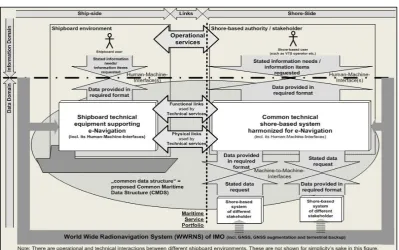
For safety reasons, IMO is interested in e-navigation. Miscommunication and
inefficiency can occur in ship-side and shore-side communication. To increase
efficiency and accuracy, the concept of e-navigation is suggested and actively under
investigation. The concept of e-navigation is illustrated in Figure 9.
Figure 9 Concept of e-navigation
24
According to IMO‟s Annex 7 of the draft e-navigation strategy implementation plan,
shipping is moving to the digitalization. This movement also involves the provision
of digital information and infrastructure. Digitized information means that IMO and
other parties can easily use and process that information. It can be used for not only
safety reasons, but also security or environmental protection. It also will reduce
administrative burdens and increase the efficiency of maritime trade and transport.
With those considerations, IMO has given attention to e-navigation, and has started
to take actions. From 2015 to 2019, IMO has set objectives and a timeline for
e-navigation (http://www.imo.org). This shift will affect the whole maritime industry
and also the shipbuilding industry.
2.3.2. Environmentally friendly (Sustainability)
Environmental issues are also continuously raised by IMO for sustainable growth.
Among environmental issues, energy efficiency and ship-source pollution are highly
related to the shipbuilding industry.
First of all, energy efficiency is a growing issue. That is because increased energy
efficiency drives greenhouse gas emission reduction. Here is an example. IMO‟s MEPC held a session regarding GHG emission reduction. That was the committee‟s
sixty-sixth session which ran from 31st of March to 4th of April 2014. The
background of that session was the measurement of increased energy efficiency and
reduction of GHG emissions. In addition, during that session, member states
discussed energy efficiency, technical cooperation, energy efficiency measurement,
international shipping GHG-emission update and climate change. As increasing
energy efficiency can reduce GHG emissions, this will be a trend for international
regulations.
Secondly, ship-source pollution is also important for IMO because of sustainable
growth. For ship owners those regulations are considerable. The reason is that after
25
linked to their profits. The Ballast Water Management (BWM Convention) could be
a good example of this issue. It is adopted but has not yet entered into force.
However, once it enters into force, ship owners have to install ballast water treatment
systems and it will directly affect the related parties. Therefore, this topic is also
trend for international regulations.
2.4.Opportunity8
By integrating three approaches, this research found three trends in the shipbuilding
industry. These will affect shipbuilding companies as external factors. In addition,
the trends related markets have special meaning. Those markets are prospective and
have a lot of opportunity. That is because the main characteristics of trend driven
business are increasing market size and representing customers‟ needs. Therefore,
those will be attractive sectors for companies to expand and develop their business.
Prospective markets could attract too many companies, which might cause cut-throat
competition. However, if the company has enough capability, it will provide a good
opportunity for the growth of the company. Therefore, looking into trends to find
opportunities is first step and then choosing appropriate trends by matching with
their resources is the next step. The first step is covered in this chapter and next step
will be cover in the following chapters.
The extracted three trends are green business, smart business and entertainment
business. The process of extracting trends is described in Figure 10. Each component
of global trends, national trends and international regulation trends can be grouped
into three categories, which reflects general trends of the maritime sector.
26 Figure 10 Process of find global trends
Source: organized by author
2.4.1. Green business (Eco Ship)
Green business is related to all three dimensions. The Global and international
regulation trend of environmental friendliness, and the national trend of green growth
along with financial support factor go to green business. In addition, in the
shipbuilding industry, all trends can bind with eco ships.
2.4.2. Smart business (Smart ship)
Smart business is also linked with the three trends. The global trend toward smart
shipping, the national trends of ICT shipping and financial support and international
regulations regarding e-navigation are related to smart business. Key issues of smart
business are digitization and ICT. Moreover, smart business is highly connected with
27
2.4.3. Entertainment business (Cruise business)
The entertainment business is supported by two categories. The global trend of
quality of life, and national trends toward improving maritime tourism and financial
support. The other trends are supported by all categories, but the entertainment
business is not. However, this business also provides a great opportunity for
companies. That is because global trends are moving toward enjoyment of life rather
than survival. In addition, this trend has a huge amount of support from governments
and lot of market needs. If a company has enough resources to develop this business,
28
3. Internal analysis
Internal analysis covers all information to identify the resources and problems of a
company (HHI). Resources9 and problems are important to diagnose as is
understanding a company‟s situation. In addition, this will link to the following
chapters. Resources will be used to find attractive markets, combined with the three
extracted trends and feasibility testing. Problems are also used to identify suggestions.
To find those two components, an internal analysis will look into the general
background of HHI and capacity evaluation. In addition, to look specifically into the
current situation, HHI is the targeted company and SHI and DSME are competitors
of the target company. SHI and DSME exist in a similar environment and haves
similar segments and positioning in the maritime industry. Therefore, comparing the
three companies will be helpful for internal analysis.
3.1. General back ground of the company (Hyundai Heavy Industries)
Hyundai is one of the biggest Chaebol companies, which has characteristics of
conglomerate family-controlled corporate groups in Republic of Korea. Ju Yung
Chung founded Hyundai in 1947 and he decided to establish shipbuilding in the early
of 1970s.
9
29
In addition, HHI has six business divisions, which are shipbuilding, off shore and
engineering, industrial plant and engineering, engine and machinery, electro electric
system, green energy and construction equipment. The core business division is
shipbuilding and most of the other divisions are doing related business. Moreover, as
Table 6 indicates, HHI has a good records of performance. It has the highest market
share and order amount in Republic of Korea. However, as Table 1 indicates, its
financial statements are problematic. Among the three companies, HHI is the only
company which had a net loss in 2014.
Table 6 Market share in shipbuilding
(1000 GT)
2014 2013 2012
Order
amount
Market
share
Order
amount
Market
share
Order
amount
Market
share
HHI 9,374 44.8% 17,731 64.4% 6,669 52.9% DSME 5,142 24.5% 4,470 16.2% 2,068 16.4%
SHI 2,561 12.0% 3,371 12.3% 1,128 9.0%
Others 3,920 18.7% 1,940 7.1% 2,735 21.7%
Total 20,952 100% 27,512 100.0% 12,600 100.0% Source: Hyundai Heavy Industries, 2015a
3.2. Capacity Evaluation
To effectively identify resources and problems, a capacity evaluation will use a
capacity evaluation tool, which is customized from Michael Porter‟s value chain.
Because of the characteristics of the shipbuilding industry, using the exact same
value chain is unsuitable. However, to effectively diagnosis a company requires a
tool, so by tailoring this tool, an appropriate capacity evaluation tool has been
30
As Figure 11 shows, the capacity evaluation tool consists of two parts. One is support
activity, which is separate from shipbuilding itself. The other is the production
process, which is the actual work of shipbuilding according to a timeline.
Figure 11 Capacity evaluation tool
Source: organized from author based on (Kotler & Keller, 2009)
3.2.1. Supporting activity
Supporting activities consist of firm infrastructure, human resource management and
technology development. In addition, components of this element support real
production activities.
3.2.1.1. Firm Infrastructure
Firm infrastructure includes general management, planning, finance, accounting,
legal and relationships (Kotler & Keller, 2009). Therefore, firm infrastructure will
look into resources related to those parts.
Managerial Core business
31
shipbuilding accounted for 31.2% of sales and offshore accounted for 13.4% of sales.
These sales figures ranked second and third out of the whole HHI group. The highest
recorded sales were from the refining part, but those sales derived from a subsidiary
company, Oilbank (Hyundai Heavy Industries, 2015a). Therefore, the core
businesses of HHI are shipbuilding and offshore. Moreover, DSME also has strength
in the same division. The shipbuilding and offshore department accounts for 58.04%
of sales. SHI is also in the same situation. This company can be divided into
Shipbuilding and offshore, and E&I. In SHI, sales of shipbuilding and offshore are
more than 4 times higher than in E&I. Therefore, all three companies have strengths
in shipbuilding and offshore.
Strategic product sector
Among shipbuilding and offshore capabilities, Korean major shipbuilding companies
focused on two sectors. One is high value-added special ships, and the other is
offshore facilities. However, the three companies have different strategies and
outputs in those sectors.
HHI has more strength in shipbuilding than offshore. For example, HHI puts a lot of
effort into building engines and other machinery inside vessels and successfully
production and sales. The company also has a record for the world‟s first smart ship
build, achieving 100 million GT in 2012. In addition, sales in shipbuilding are
around 2.5 times the offshore shipbuilding industry. Its shipbuilding encompasses
wide spectrum of ships in contrast to other shipyards.
SHI puts balanced efforts into shipbuilding and offshore in value added products.
According to SHI‟s sustainability report 2014, the company has remarkable results in
both sectors. In the shipbuilding sector, SHI developed the world‟s first bi-directional
arctic shuttle tanker and also built a super-large container, which is a 20,000TEU
containership. The offshore department also has a record of building the world‟s
32
and FPSO market products all over the world, and has had outstanding progress with
NNG-FPSO, TNP, and fixed platforms.
DSME is putting more focus on its offshore department. DSME is the only company,
that has the technologies and knowhow to build the whole spectrums of offshore
products including FPSO, fixed platforms, jack up rigs, semisubmersible drilling rigs,
and drillships. These accounted for 54.9% of sales in 2013, and compared to sales of
2010 this is 17.4% higher. The naval ship sector is also strategic for DSME. Based
on 30 years history, the company established a division of special ship business and
won contracts with the navies of the UK and Norway (Daewoo Ship building &
Marine Engineering, 2015a). However, DSME focuses more on offshore facilities.
Inappropriate Investment
Regarding financial investment, investing in offshore and plant was an inappropriate
investment. As Table 7 shows, the three sectors, that recorded the highest operating
loss in 2014 were shipbuilding, plant and offshore. Among them, operating losses in
shipbuilding will be discussed in chapter 2.2.2. However, accumulated operating
losses in offshore and plant are driven by inappropriate investment. HHI declared its
operating loss of USD 3 trillion in the financial statement at the end of 2014 an and it
was abrupt change from being green to red. The main reason for this result is lack of
original technology; the company borrowed 100% design from other countries
(Special Economy, 2015). This is one of the big problems of the financial net loss of
HHI. In addition, this result indicates that investing in certain department requires
careful consideration. According to the half term report of 2015, HHI has already
noticed that plant and offshore drive net loss and sales levels are also lower than
33 Table 7 Status of operating profit10 and loss
(KRW million)
Shipbuilding Offshore Plant Engine oil refining
2011 2,191,255 390,964 252,416 602,215 595,619
2012 1,041,449 318,193 106,002 346,844 307,213
2013 12,560 282,355 61,376 118,295 404,388
2014 (1,895,913) (230,305) (1,130,818) 10,870 228,451
Industrial Plant Green energy Finance Electro electric system
2011 461,914 (174,994) 89,712 (153,212)
2012 276,140 (106,448) 94,706 (75,309)
2013 194,271 (103,155) 34,489 90,508
2014 (33,391) (16,532) 36,290 86,342
Source: Hyundai Heavy Industries, 2015a
Moreover, DSME and SHI are in the same situation. Those two companies put
shipbuilding and offshore in the same department, so it may seem hard to figure out
the exact amount of money from offshore and plant. The three companies started to
use their invested assets to cover liability; it resulted in net loss. The amount of net
loss from January 1st to June 30th of 2015 is presented in Table 8. Even though that
department gives sales for the company, if invested assets are much higher, it will
give a net loss for the company. This fact indicates two important lessons. One is to
find appropriate new growth power is important. The other is considering about sunk
cost and fast exit when companies notice certain markets.
10
34 Table 8 Net profit of 2015 half term
(KRW million)
HHI SHI DSME
- 461,281 - 242,400 -2,434,986
Source: organized from author based on (Hyundai Heavy Industries, 2015b); (Samusng Heavy
Industries, 2015b); (Daewoo Shipbuilding & Marine Engineering,2015c)
Ship building facilities
HHI has 10 drydocks, nine are in UIsan and one is in Gunsan, and it has 9 Goliath
cranes and latest construction facilities. With that infrastructure, HHI can build 9.6
million G/T per year and also can manage 1.4 million tons of steels per year. In
addition, as Table 9 indicates, each drydock has its own specifics and is designed to
effectively build certain types of ships. For example, drydock no.1 is suitable for
building drillships, no.3 has advantages for building containerships and tankers
together; drydocks no.6 and no. 7 can be used for naval vessels and special purpose
ships; and drydock no.8 is used for LNG ships. The Gunsan Shipyard can build 20
ships annually. The shipyard which was built in 2009 and features a 1.3 million
DWT drydock, a 1,650 ton Goliath crane and cutting edge production facilities.
(Hyundai Heavy Industries, 2015d). These facts will be the strength and resources of
HHI. That is because, as Table 9, 10 and 11 shows, compared to other companies,
HHI has the largest number of drydocks and capacity, and covers diverse types of
ships. Therefore, shipbuilding facilities are one of the resources of HHI.
Table 9 Specifics of drydocks
Drydock No.1 Drydock No. 2
- Length: 390, Width 80, Height 12.7(m) - Length 500, Width 80, Height 12.7(m)
- Length 165, Width 47, Height 12.7(m) - Crane: Share with drydock no.1
- Crane: 1,290(t)x1, 450(t)x2, 40(t)x2,
30(t)x2
- Maximum size: 700,000(t)