Development of Probiotic Beetroot Drink
Anil PAnghAl
1, KirAn VirKAr
1, ViKAs KumAr
1,
sAnju B. Dhull
2, Yogesh gAt
1and nAVniDhi ChhiKArA
1*
1Department of Food Technology & Nutrition, Lovely Professional University, Jalandhar, India.
2Department of Food Science and Technology, Chaudhary Devi Lal University, Sirsa, India.
Abstract
The study was planned to prepare non- dairy probiotic drink using beetroot juice. Probiotic potential was examined on the basis of viability of Lactobacillus rhamnnosus, Lactobacillus plantarum and Lactobacillus delbrueckii sb. Probiotic drink was prepared at pH 6.5 and optimum fermentation temperature of 37 °C. There was gradual decline in pH and sugar content with time. Total phenols, flavonoids and antioxidant activity were enhanced in probiotic drink as compared to fresh juice sample. Study revealed that beetroot drink is a good approach for non-dairy probiotic, free from cholesterol and with health promoting components.
Current research in nutrition and Food science
Journal Website:www.foodandnutritionjournal.org
ContACt Navnidhi Chhikara [email protected] Department of Food Technology & Nutrition, Lovely Professional University, Jalandhar, India.
© 2017 The Author(s). Published by Enviro Research Publishers
This is an Open Access article licensed under a Creative Commons Attribution-NonCommercial-ShareAlike 4.0 International License (https://creativecommons.org/licenses/by-nc-sa/4.0/ ), which permits unrestricted NonCommercial use, distribution, and reproduction in any medium, provided the original work is properly cited.
To link to this article: http://dx.doi.org/10.12944/CRNFSJ.5.3.10
Article history
Received: 14 July 2017 Accepted:11 September 2017
Keywords
Lactobacillus rhamnnosus, Lactobacillus plantarum, Sensory Evaluation.
introduction
As economic status has improved, growing interest in health and well-being has resulted in increased intake of natural and health foods1 eveloping value added health promoting foods as well as phytochemical rich new raw material sources. Health professionals are motivating the consumers to avail beneficial effects of probiotic food for good health. The probiotic foods currently produced are dairy products and has limitations due to milk allergies and cholesterol content2. So non- dairy alternatives may be used to substitute dairy probiotics and can provide other health benefits also. Probiotic food formulations are leading to development of dietary supplementation with nutraceuticals and prebiotics3. Fruits and vegetables are highly valued food for their
Beetroot contains numerous nutrients including sodium, magnesium, potassium, vitamin C, betanin and antioxidants6,7.The beet root contained phenolic compound, carotenoids, betalain, vitamins and minerals which are major important bio compound and micronutrients and it is the 10th most powerful vegetables with antioxidant properties8. Betalins are present mainly in two forms i.e. betacyanin (red-violet Colour) and betaxanthin (yellow-orange colour). Betalain is water-soluble and nitrogen containing natural pigments which have a high coloring capacity9 along with antiviral, antioxidant, anti-inflammatory properties10, anti-cancerous11 with no side effect12. Both sub classes of betalins: betacyanin (red-violet Colour) and betaxanthin (yellow-orange colour), are present in red beet root in high concentrations. An effort was made to utilize all these health potential of beetroot in the form of a drink. The present study was planned to prepare a beetroot based probiotic drink
materials and methods
sample Procurement and Preparation
The fresh raw material beetroot was sorted from local market, cleaned and stored at 4 0C for further use. Juice was extracted by juicer in a food processor. The extracted filtered juice was pasteurized at 80 0C for 10 min. Pasteurized juice was further cooled to room temperature for microbial inoculation..
inoculum Preparation
Probiotic microorganisms Lactobacillus rhamnnosus, Lactobacillus plantarum and Lactobacillus delbrueckii sb were obtained from IMTECH, Chandhigarh. For inoculum, glycerol stock culture tube of
Lactobacillus plantarum, Lactobacillus rhamnnosus
and Lactobacillus delbrueckii sb. was transferred in 250 ml Erlenmeyer flask having 100 ml MRS broth. Broth was incubated for cell growth at 37 0C. growth was observed using spectrophotometer (590 nm). Incubation was carried out till the cell density reached 0.600 value corresponding to 9.00 Log CFU/ml, scale designed by McFarland13.
inoculation and Fermentation
The optimum fermentation conditions were optimised using central composite rotated experimental design (CCRD) at pH range 4-7 at temperature of 37 0C. These conditions were selected because
Lactobacillus can grow at this pH and temperature condition. The pH of clarified beetroot juice was adjusted with HCL (0.1 N). Then, pre-determined concentration of inoculum was added to beetroot juice as recommended for probiotic foods14 i.e., 7.00 log CFU/ml (1 ml of MRS broth containing 9.00 CFU/ml of Lactobacillus plantarum, Lactobacillus rhamnnosus and Lactobacillus delbrueckii sb.). Fermentation was performed statically in an incubator for 24 hr adjusted at 37 0C temperature.
sample Analysis
The fresh and probiotic beetroot juice analyzed for protein, acidity content, pH, TSS and betalain content by using different methods. The bile and acid tolerance were analyzed before addition of lactic acid bacteria15.
growth of Probiotic strains
Utilizing the optimized factor value (i.e., temp 37 °C and pH 6.5), culture were developed in pasteurized beetroot juice (700 mL in 1 L plastic flask) adding inoculum of lactic acid bacteria 2.5 %, 5 %, 7 % (V/V) and incubating at temperature 37 °C for 24 hrs. Tests for measuring the growth and viable cells counts16 were taken each two hour. Microbial growth was assessed on the basis of pH, acidity content and sugar utilization. pH was estimated by pH meter and acidity was measured by titration method. Sugar content was observed by DNS (dinitrosalicylic acid) method.
sensory evaluation
Sensory analysis was carried out by using semi-trained panelists using nine point hedonic scale from liked extremely (9) to disliked extremely (1) as described by Larmond17. Sample was evaluated on the basis of appearance, aroma, consistency, taste, mouth feel and overall acceptability.
statistical Analysis
results and Discussion
The three species of lactic acid bacteria (Lactobacillus plantarum, Lactobacillus rhamnnosus
and Lactobacillus delbrueckii sb.) were found to be capable of growing well on pasteurized beetroot juice without any specific nutrient requirement.
Viability of three strains on different pH level was observed (Table 1) and it was concluded that at pH 6.5, microbial count was more than 300 for all three strains. So, pH 6.5 was selected for further product development at 37 0C.
table 1: Viability of lactobacillus strain at variable ph level after 24 hrs
ph L. rhamnnosus L. plantarum L. delbruecki
4 100 80 90
5 200 150 190
6 250 200 240
6.5 >300 >300 >300
7 <250 <200 <230
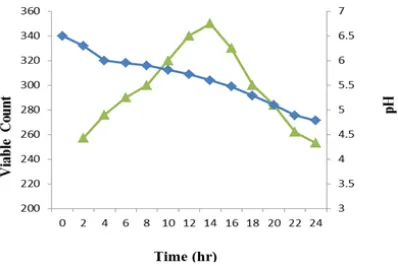
Fermentation of pasteurized beetroot juice was carried out by inoculating with culture of mixed starins (Lactobacillus plantarum, Lactobacillus rhamnnosus and Lactobacillus delbrueckii sb.). To evaluate growth kinetics, change in pH due to acid production and sugar utilization was observed. The probiotic culture suitability was observed on the basis of their acid and bile tolerance and study revealed that microorganisms were resistant to such conditions (Fig. 1).
Change in sugar Concentration With time
Lactobacillus requires sugar for growth and as the fermentation continues, sugar content of sample was declining gradually. Initially sugar (%) in juice was 9.97±0.09 which was decreased with time. Fig 2 clearly depicted that with microbial fermentation, sugar level decreased with time.
Fig. 1: Bile tolerance of lactobacillus strains at different ph level
The initial pH of inoculated juice was 6.5±0.03 and it gradually decreased to 4.75±0.03 in 24 hr (Fig 1). During fermentation, lactobacillus produces lactic acid which accounted for the decline in pH level. The initial acidity of the beetroot juice was 0.49 ±0.02 and was inclined to 1.02±0.01. Similar observations for pH decline and acidity incline were reported by other researchers Devi et al.,19, Shukla et al.,20 and Rafiq et al.,21.
Fig. 2: Changes in siugar content (%) during fermentation proximate analysis of fresh
beetroot juice
Proximate Analysis of Fresh Beetroot juice
also results in structural disintegration of cell walls leading to either liberation or synthesis of different antioxidant compounds. As antioxidants possess free radical scavenging capacity and health promoting
benefits, so the probiotic drink is highly valuable. Similar results have been reported by Kazimierczak
et al., 201622.
table 2: nutritional composition of fresh and probiotic drink
sample Acidity ph Protein sugar Antioxidant total Flavonoid (%) (%) (%) acitivity Phenol content (%)
(%) (%)
Fresh juice 0.49±0.02b 6.5±0.03a 3.74±0.08b 9.97±0.09a 75.8±0.05b 22.12±0.02b 3.61±0.01b Probiotic 0.78±0.01a 4.75±0.03b 3.77±0.09a 8.66 ±0.09b 78.1±0.05a 24.32±0.04a 3.85±0.02a drink
*Mean ± SD (n=3)
a* Different upper case superscripts in the same column indicate the significant difference (p<0.05)
sensory Analysis
The probiotic drink was less accepted (7±0.27) as compared to the fresh one (7.5±0.42), but the benefit of probiotic cultures in beetroot juice adds value in terms of health aspects. The highest mean appearance, aroma, consistency, taste, mouth
feel was observed in fresh beetroot juice than the probiotic one (Table 3). Results depicted that microbial fermentation may be used as suitable technology in formulation of health promoting foods.
table 3: sensory analysis of fresh and probiotic juice
sample Appearance Aroma Consistency taste mouth feel overall acceptability
Fresh juice 7±0.54a 8±0.28a 8±0.36a 7±0.42b 8±0.39a 7.5±0.42a Probiotic drink 7±0.51a 7±0.32b 7±0.42b 7.5±0.28a 7±0.19b 7±0.27b
*Mean ± SD (n=3)
a* Different upper case superscripts in the same column indicate the significant difference (p<0.05)
Conclusion and Future scope
Mixed culture of Lactobacillus plantarum, Lactobacillus rhamnnosus and Lactobacillus delbrueckii sb. carried out fermentation and survived in beetroot juice at optimum conditions. Strains possessed good viability in beetroot juice without any specific nutrient supplementation. There was non-significant increase in proximate composition of fresh beetroot juice with formulation of probiotic drink. Probiotic drink was found good in antioxidants, total phenols and flavonoids content. The study depicted that beetroot probiotic drink may act as good alternative
to serve lactose intolerant and the persons unable to consume probiotic dairy products due to allergic reactions23. Though lot of further research may be conducted regarding sensory improvement, storage stability and commercialization of probiotic drink.
Acknowledgement
references
1. Panghal A, Sharma K, Setia S, Ray A. Studies on utilization of whey for preparation of ready to serve (RTS) beverages. Beverage and Food World; 2007. 34(8):77-79.
2. Tissier H. The treatment of intestinal infections by the method of transformation of bacterial intestinal flora. CR Social Biology; 1906.60:359-61.
3. Azadnia PK, Khan Nazer AH. Identification of lactic acid bacteria isolated from traditional drinking yoghurt in tribes of Fars province.
Iranian Journal of Veterinary Research;
2009.10(3):235-40.
4. Yadav DN, Sharma M, Chikara N, Anand T, Bansal S. Quality characteristics of vegetable-blended wheat–pearl millet composite pasta.
Agricultural Research; 2014. 3(3):263-70. 5. Panghal A, Dhull N, Navnidhi, Khatkar B.S.
Whey Based Strawberry Ready to Serve (RTS) Beverage. Beverage and Food World; 2009. 36(4):28-30.
6. georgiev Vg, Weber J, Kneschke EM, Denev PN, Bley T, Pavlov AI. Antioxidant activity and phenolic content of betalain extracts from intact plants and hairy root cultures of the red beetroot Beta vulgaris cv. Detroit dark red. Plant Foods for Human Nutrition; 2010. 65(2):105-11.
7. Wootton-Beard PC, Moran A, Ryan L. Stability of the total antioxidant capacity and total polyphenol content of 23 commercially available vegetable juices before and after in vitro digestion measured by FRAP, DPPH, ABTS and Folin–Ciocalteu methods. Food Research International; 2011. 44(1):217-24. 8. Kushwaha R, Kumar V, Vyas g, Kaur
J. Optimization of Different Variable for Eco-friendly Extraction of Betalains and Phytochemicals from Beetroot Pomace.
Waste and Biomass Valorization; 2017.1-10. https://doi.org/10.1007/s12649-017-9953-6 9. Attia gY, Moussa ME, Sheashea ER.
Characterization of red pigments extracted from red beet (Beta vulgaris, l.) and its potential uses as antioxidant and natural food colorants. Egypt. Journal of Agriculture
Research; 2013. 91(3):1095-110.
10. Aro A, Amaral E, Kesteloot H, Rimestad A, Thamm M, Van Poppel g. Transfatty acids in French fries, soups, and snacks from 14 European countries: the TRANSFAIR study.
Journal of Food Composition and Analysis; 1998.11(2):170-7.
11. Collins R, Peto R, MacMahon S, godwin J, Qizilbash N, Hebert P, Eberlein KA, Taylor JO, Hennekens CH, Fiebach NH. Blood pressure, stroke, and coronary heart disease: part 2, short-term reductions in blood pressure: overview of randomised drug trials in their epidemiological context. The Lancet; 1990.
335(8693):827-38.
12. Jiang W, Zhang D, Bursac N, Zhang Y. WNT3 is a biomarker capable of predicting the definitive endoderm differentiation potential of hESCs. Stem cell reports; 2013. 1(1):46-52. 13. Kangler O, Weiss N. (1986) genus
Lactobacillus beijerinck 1901, 212AL.In Sneath PHA, Mair NS, Sharpe ME, Holt Jg (eds.) Bergey's Manual of Systematic Bacteriology. Baltimore, Williams and Wilkin Publishers.
14. Tsai CC, Lin PP, Hsieh YM. Three Lactobacillus strains from healthy infant stool inhibit enterotoxigenic Escherichia coli grown in vitro. Anaerobe; 2008. 14(2):61-67.
15. Succi M, Tremonte P, Reale A, Sorrentino E, grazia L, Pacifico S, Coppola R. Bile salt and acid tolerance of Lactobacillus rhamnosus strains isolated from Parmigiano Reggiano cheese. FEMS Microbiology Letters; 2005.
244(1):129-37.
16. Pereira AL, Maciel TC, Rodrigues S. Probiotic beverage from cashew apple juice fermented with Lactobacillus casei. Food Research International; 2011. 44(5):1276-83.
17. Elizabeth Larmond. Laboratory methods for sensory evaluation of food. Agriculture Canada; 1977.
system development during suckling-weaning transition: Probiotics for early immune maturation. Microbiology and Immunology, 2015. 114(8):1168-79.
19. Devi MS, Banumathi P, Jothi N. Studies on development and evaluation of whey based fruit beverages. Beverage Food World; 2004.
1:44-6.
20. Shukla M, Jha YK, Admassu S. Development of probiotic beverage from whey and pineapple juice. Journal of Food Processing Technology; 2013. 4(2):1-4.
21. Rafiq S, Sharma V, Nazir A, Rashid R, Sofi SA. Development of Probiotic Carrot Juice.
Journal of Nutrition Food Science; 2016.
6(534):2.
22. Kazimierczak R, Hallmann E, Lipowski J, Drela N, Kowalik A, Püssa T, Matt D, Luik A, gozdowski D, Rembiałkowska E. Beetroot (Beta vulgaris L.) and naturally fermented beetroot juices from organic and conventional production: metabolomics, antioxidant levels and anticancer activity. Journal of the Science of Food and Agriculture; 2014. 94 (13):2618-29.