RESEARCHARTICLE
Spatial refinement as
collection order relations
Zhong Zhao
School of Architecture and Urban Planning,
Hunan University of Science and Technology, Xiangtan, Hunan, China
Received: July 17, 2015; returned: September 28, 2015; revised: October 26, 2015; accepted: November 3, 2015.
Abstract:An abstract examination of refinement (and conversely, coarsening) with respect to the involved spatial relations gives rise to formulated order relations between spatial coverings, which are defined as complete-coverage representations composed of regional granules. Coverings, which generalize partitions by allowing granules to overlap, enhance hierarchical geocomputations in several ways. Refinement between spatial coverings has underlying patterns with respect to inclusion—formalized as binary topological relations— between their granules. The patterns are captured by collection relations of inclusion, which are obtained by constraining relevant topological relations with cardinality prop-erties such as uniqueness and totality. Conjoining relevant collection relations of equality and proper inclusion with the overlappedness (non-overlapped or overlapped) of the re-fining and the refined covering yields collection order relations, which serve as specific types of refinement between spatial coverings. The examination results in 75collection order relations including seven types of equality and34pairs of strict or non-strict types of refinement and coarsening, out of which19pairs form partial collection orders.
Keywords: refinement, partition, covering, spatial granule, class relation, collection rela-tion, order relation
1
Introduction
re-lations, which leads to formal interpretations of spatial refinement with a series of order relations, and thereby potentially offers new insights into hierarchical geocomputations.
1.1
Background
Structured in many different ways, spatial hierarchies underlie and facilitatehierarchical spatial reasoning[5,39], analyzing, and modeling, for example, in handling complexities via multi-level abstractions [38], switching between differentresolutions[42], and representing space as nestedcontainers[22]. A current computational abstraction of space and its regions isgranules[18,32,47], which will be used hereinafter in this paper. A spatial hierarchy is eitherfunctional—based on task decomposition, orstructural—based on space subdivision [5,21].
Aspatial inclusion hierarchy[39], a typical form of structural hierarchies, is a set of re-gional spatial granules partially ordered oninclusion [14,34]. With hierarchies building onlevels[13, 31,35,38,44,46], granules ordered by inclusion are intuitively situated at different levels, where anincludinggranule carries higher coarseness [39] at a higher level, while anincludedone lies at a lower level exposing more detail. Though a level may form with granules that make up only a partial coverage of the hierarchized space, which may be as large as the surface of the Earth, or as small as a city block, levels here refer to those having complete coverages only.
A spatial inclusion hierarchy consisting purely of complete-coverage levels is com-monly induced by one or more series of partitions. The partitions, each populating a dis-tinct level with its granules, have a partial order on refinement such that each granule in the refining partition isincludedorcontainedby some granule in the refined one [13,14,16]. A refinement isproperif it divides at least one granule of the refined partition, ornon-proper
between equal partitions [14,16].
The above conceptualizations of the refinement–inclusion association suggest formal interpretations of spatial refinement with specific types, which may be revealed by two or-dered partitions’ granule participation and granule correspondence in relevant spatial rela-tions. Granule participation refers to whether one partition has each of its granules divid-ing or divided by some granule in the other partition, and vice versa. Granule correspon-dence refers to patterns captured by the relations’cardinality propertiessuch as uniqueness and totality, which are formally defined forclass relations[27,28], yet may set-theoretically be reformulated for partitions as sets—instead of classes—of granules.
1.2
Overlapped representations
While partitions serve as a prevalent type of representations for spatial levels, typically as planar map layers in current GIS, their advantage is also their limitation: the granules of a partition do not overlap. A spatial level, however, is more general than a map layer and thus may arise in more-complex manners than from a partition. The following are some cases where the granules populating a level form acovering[24,43], a generalization of a partition that allows granules to overlap.
one regarding the complete-coverage distribution of a phenomenon (e.g., poverty, unem-ployment, job opportunities, real estate price, health services accessibility, public opinion on same-sex marriage, and support for a political candidate). In dealing with the MAUP, multiple datasets are incorporated into a single hierarchy. Then, for each region (i.e., gran-ule) in the fine-grained representation, one out of a set of candidate regions—each from a different dataset—is returned at the higher level, dynamically generating the coarse-grained representation as an optimal zoning for the variable(s) (e.g., unemployment rate) being analyzed. Both the representation and the collection of all the candidate regions at the higher level form coverings by possibly having overlapping granules from different datasets. Similar coarsening operations may be used in hierarchical spatial reasoning and applications such as improving location privacy by returning the least revealing candidate region at a higher level.
Case 2 On the occurrence of an event such as an industrial pollution or a natural disaster, spatial analyses and reasoning are performed at the same time for multiple government agencies that use respectively different datasets (e.g., administrative areas versus phys-iographic/topographic/geologic regions). Hierarchical computations within each dataset (vertical) as well as cross analyses between them (horizontal) are made within an integrated spatial hierarchy, where geographic categories with commensurate coarseness are modeled at the same level, resulting in coverings as in Case 1.
Case 3 Multiple complete-coverage levels are combined into a single level, or a level is itself a nested series ofsub-levelsforming a sub-hierarchy [46], which may further be finitely recursive. Such anested level, however complex its internal structure is, can be represented by a single covering. Nested levels are useful in simplifying the level structure of a complex inclusion hierarchy, which is typically a result of merging multiple hierarchies.
Case 4 Most real-world geographic features such as urban and rural regions adjoin
through gradual transition zones, which are either arbitrarily divided by crisp boundaries in current GIS or treated as broad boundaries of fuzzy or vague regions. It is, however, realistic and intuitively reasonable to model these features with their full extents such that they overlap in the otherwise transition zones (e.g., forest–grassland ecotones). Such over-lapped representations by coverings reflectnear-decomposability[35] between weakly inter-acting granules within any hierarchical level in the real world, and as well reveal—through intersections of overlapping features—the extents of the transition zones, where ecological
edge effects occur. Besides, some transition zones are big enough and have their unique characteristics distinguishing them from the regular categorical features. Then, a more comprehensive view of the variations within a landscape is usefully obtained by adding such transition features to a partition (or covering) in relevant categorical features, which results in an overlapped representation.
1.3
Approach
This paper develops a formal model of spatial refinement between coverings in the follow-ing four steps.
• Introduction ofcollection relationsbased onset cardinality properties, which are formu-lated by extending the cardinality properties of class relations [27, 28] to relations between sets (i.e., collections).
• Conceptualization of 2D point-set spatial granule, formulation of a spatial covering
of a decomposable space as a complete-coverage collection of spatial granules, and categorization of coverings into partitions (non-overlapped) ando-coverings (over-lapped) throughoverlappedness, as interpreted by coarse topological relations [9].
• Formulation of spatial refinement ascollection order relations. Applying certain combi-nations of set cardinality properties to relevant coarse topological relations [9] results in such collection relations of equality and proper inclusion that underlie refinement between spatial coverings. Then conjoining the underlying collection relation(s) with optionally the overlappedness of the refining and the refined covering yields each specific type of refinement as a collection order relation. Coarsening is derived as the converse relations of refinement.
• A further examination that reveals which of these collection order relations form par-tial collection ordersbetween spatial coverings.
The remainder of the paper is organized as follows. Section2reviews related work on granulation, topological relations, and class relations. Section 3 presents collection rela-tions as an extension to class relarela-tions. Section4formulates refinement and coarsening as collection order relations. Section5examines whether the collection order relations form partial collection orders. Section6draws conclusions and future work.
2
Related work
Levels in spatial hierarchies commonly arise frommultiple representations[1,3] such as land
subdivisions [20]. A computational abstraction regarding such notions as representation and subdivision isgranulation, lying in the center ofgranular computing[25,48], in which a hierarchy consists offamilies of granules[45].
2.1
Covering versus partition
In current computing theories, agranule is a clump or cluster of objects drawn together by indistinguishability, similarity, proximity, functionality, or indiscernibility [18,32,47], or more generally, a binary neighborhood [23]. Richly modeled with rough set [32] as well as fuzzy set [47] approaches, agranulationis a collection of granules that result from decomposing a finite universeU or clumping the objects in it, which in the crisp mode has two basic mathematical forms—partition and covering [24,43].
Addressing also thenon-partition cases[25] by allowing granules to overlap, acovering,
τ, is a collection of non-empty subsets ofU with their union beingU, therefore partitions are a special type of coverings [24,43].
Granule in the spatial context has different conceptualizations. Some examples are: a
cellof a space used possibly with the neighboring cells to describe the location of a region [36]; a regular closed subset of a spatial domain, which may have holes and appear in disconnected pieces [2]; and a subset of a spatial domain regarding a granularity such as
kilometersorprovinces[4].
Geospatial granulations are consistently modeled as partitions mainly because of their simple non-redundant way of representing complete coverages rather than out of a cogni-tive consideration. Aspatial partition, or aplanar subdivision, typically divides a space or a map’s plane intoareasorregions[12,13,14], which may form acategorical coverage[1] based on attribute values, or be modeled as spatial objects linked to an identifying property [14]. Considering the regularity of the shapes of geographic regions and the common bound-aries shared by bordering regions, spatial partitions are different fromset partitionsthat are composed of pairwise disjoint point sets [12,29]. A database-oriented approach formalized spatial partitions as a spatial data type by mapping each point inR2to one or more label values. A partition thus obtained is based oninterior regionsand bordersas regular open point sets, each forming a block with the points in it being labeled by an identical set of values [12]. A graph-theoretic model further presentsspatial partition graphsas discrete, implementable representations of map geometry [29].
Spatial coverings, in spite of a lack of conceptualizations, may arise from complete-coverage collections ofdelimited spatial entities[15], which are allowed to overlap. In ad-dition,multi-valued vector maps[7], where points, lines, and regions of multiple themes may overlap, provide implementation options that facilitate topological queries across map lay-ers (e.g., What provinces does the Loess Plateau extend over?).
2.2
Refinement, inclusion, and class relations
Given partitionsπ1andπ2of a finite universeU,π2is arefinementofπ1if each block ofπ2 is a part of some block ofπ1, and converselyπ1is acoarseningofπ2; aproper refinementofπ1 has at least one block ofπ1split, withπ1being anon-proper refinementof itself [14,16,43]. Refinement, which applies to coverings in a similar way [43], induces orders on coverings as well as partitions [14,43], though the possibility for granules to overlap leads to higher complexities.
Refinement and coarsening between spatial coverings are embodied byinclusionor con-tainment[14,34,41] between each other’s granules, which is formalized as binary topolog-ical relations by either the 9-intersection model [11] or the RCC theory [33]. Both models yieldeight baseregion–region relations inR2, among which three pairs are distinguished by whether the regions’ boundaries intersect (9-intersection model) or whether a subset re-lation is tangential (RCC), resulting infive coarserelations [9], referred to as DE5 here, and RCC-5 [6], respectively. The coarse topological relations further reduce to more-general
spatial order relations[19] accounting for region–region comparability regarding inclusion (Table1), with{OV,OUT}in DE5 and{PO, DR}in RCC-5 both generalized to incompara-ble.
topolog-RCC-5 DE5 Spatial order relations
EQ (EQual) EQ =equal =
PP (Proper Part) IN =coveredByorinside ≤
PPI (Proper Part Inverse) IN−1=coversorcontains ≥
PO (Partially Overlapping) OV =overlap incomparable DR (Distinct Regions) OUT =disjointormeet incomparable
Table 1: The corresponding RCC-5 [6] and DE5 [9] coarse topological relations, and spatial order relations [19].
ical relations (e.g.,EQandINin DE5). A current approach to a similar issue isclass relations
[8,26], where individualsare treated asinstancesof classesthrough instantiationsuch that
Inst(a, A)meansindividualais an instance of classA. A class relationRfrom classAto class
Bis denoted byRCP(A, B), whereCP specifies thecardinality properties[27,28] involving uniquenessandtotalitywith respect to the correspondinginstance relationr(a, b)fromatob, taking allaandbforInst(a, A)andInst(b, B)into account.
Donnelly and Bittner [8] first presented a model of five class relations by defining their
CPs:some,all-1,all-2,all-12, andall-all. As an extension to it, the M¨as [26,27,28] framework is based on fourbasic cardinality properties,LT,RT,LD, andRD, corresponding toleft-total,
right-total(surjective), left-definite(left-unique orinjective), andright-definite(right-uniqueor
functional) in binary relations, respectively. The framework presents a set of17abstract class relations[26], which arejointly exhaustive and pairwise disjoint(JEPD). Among the17JEPD relations,15are yielded by conjoining at least one of the four basic cardinality properties with a negation of the others [27]. Two examples are the definitions ofRRT(A, B) and
RRD LT(A, B)as follows.
RRT(A, B) :=RT(A, B, r)∧ ¬LD(A, B, r)∧ ¬RD(A, B, r)∧ ¬LT(A, B, r)
RRD LT(A, B) :=RD(A, B, r)∧LT(A, B, r)∧ ¬LD(A, B, r)∧ ¬RT(A, B, r)
Being two special cases, RLT RT–all(A, B)means every instance of Ahas an instance
relationrto every instance ofB;Rsome(A, B)means some instance ofAhas relationrto
some instance ofBexcludingLT,RT,LD, andRD, such that it is JEPD with the other16
relations and thereby more restrictive than the Donnelly and Bittner [8] definition.
The Tarquini and Clementini [37] model is another extension to the Donnelly and Bit-tner [8] approach, which, by treating classes as sets, links individuals to classes through set membership instead of instantiation. By forcing spatial relations to hold between distinct individuals only, the model does not apply to reflexive topological relations such asEQ
andequal.
3
Collection relations
Classes in class relations are types or kinds (e.g., geographic categories) abstracted from reality and particularized by their instances, therefore a class (e.g.,country) remains to be what it is no matter how many instances it has, where the instances are located, or whether the number of its instances changes [8]. Sets, in contrast, are identified by their members. A covering as a set of granules turns into a different set if any change to the memberships of its granules happens. Specifically, treating coverings as classes has the following problems, which do not exist, or are conveniently dealt with, if coverings are treated as sets.
First, although the instances of some geographic categories form complete coverages, for example, when restricted within a country, complete coverage is not a property of classes and thus is not guaranteed as by spatial coverings. Some classes are in certain hi-erarchical orders with respect to inclusion between their instances, but such orders do not necessarily coincide with refinement. For example,townsandcountiesare ordered, with
townsbeing contained by, and therefore subordinated to,counties. However, the proposi-tion “countiesare refined bytowns” is generally false, as a county is typically divided into not just towns, but also citiesand possibly other categories of town-level entities. Even
countiesmay form only a partial coverage of a country, where there might beboroughs, dis-tricts, or other categories of county-level entities as well. Since many simple classes such ascounty,borough,city, andtownhave complex relations among them, they are not directly applicable for interpreting refinement.
While simple classes may be combined into complex, abstract classes to form complete coverages that are ordered on refinement, such relations are in essence between the sets of the involved instances rather than between the classes. For example, thestatesare divided intocountiesand theirstatistical equivalentsin the United States, where thestatistical equiv-alentsinclude at leastparishes,boroughs,census areas, andindependent cities[40]. By taking
countiesandstatistical equivalentsas one complex class of entities, the proposition “counties and statistical equivalentsare a refinement ofstates” is true if the classes are confined within the United States such that their involved instances form exact complete coverages of the country. It implies, however, that the refinement holds betweenthe set of counties and sta-tistical equivalentsandthe set of statesof the United States rather than between the classes, which also have instances in other countries. In fact, a refinement does not hold fromcounty and statistical equivalenttostate, as their instances form different coverages of the world.
Alternatively, refinement may be enforced to hold between such specially defined classes, which are possibly complex and abstract, and have the same geographic restric-tion, such that each class has all of its instances forming an exact complete coverage of the same space. Examples of such classes are in the ordered series of{US state, US county and statistical equivalent, US county and statistical equivalent subdivision}, and{New England state, New England county, New England county subdivision}. A series of new classes thus have to be defined whenever a different hierarchized space (e.g., the coastal interstate regionSouthern Maine– Southeastern New Hampshire– Northeastern Massachusetts) is selected for analysis. These geographically determined classes correspond to, and almost serve as names of, the relevant sets. At this point, interpreting refinement as relations between sets is much more flexible and convenient.
change. This makes it difficult to distinguish between different types of coverages, which is crucial in examining refinement relations.
Finally, there are numerous ways of forming a covering with granules from different classes. For example, a covering that combines features of economy and culture may be generated by mergingeconomic regionsandcultural regions of the same state/province or country, or by augmenting a partition by either of the two classes with at least one instance of the other. As such, spatial coverings greatly outnumber classes. Since it would not be sensible to define a distinct class for each possible covering, treating coverings as sets is the necessary option for examining spatial refinement.
Therefore, instead of usingLT,RT,LD, andRD[27,28], here referred to asclass cardi-nality properties, this paper formulates four correspondingset cardinality properties—Lt and
Rtfor totality, andLd andRdfor uniqueness—by replacing instantiation with set member-ship. In the following definitions regarding setsXandY, a relationRfrom individualxto individualyis denoted byR(x, y).
Lt(X, Y, R) :=∀x∈X∃y∈Y :R(x, y) Rt(X, Y, R) :=∀y∈Y ∃x∈X :R(x, y)
Ld(X, Y, R) := (∀x, z∈X∀y∈Y :R(x, y)∧R(z, y)→x=z)∧Exist(X, Y, R) Rd(X, Y, R) := (∀x∈X∀y, z∈Y :R(x, y)∧R(x, z)→y=z)∧Exist(X, Y, R) Exist(X, Y, R) :=∃x∈X∃y∈Y :R(x, y)
Applying set cardinality properties to individual relations gives rise to similar relations between sets. Such set-cardinality-constrained relations are referred to ascollection relations, which are thereby distinguished from the relations such as set inclusion. Conjunctions and negations ofLt, Rt,Ld, and Rd result in15 pairwise disjoint collection relations in the same way the corresponding class relations [26] are yielded. For example,RRd Lt Rt(X, Y)
is defined as the conjunction ofRd,Lt, andRtwith the negation¬Ldas follows.
RRd Lt Rt(X, Y) :=Rd(X, Y, R)∧Lt(X, Y, R)∧Rt(X, Y, R)∧ ¬Ld(X, Y, R)
Also, the two corresponding special cases are defined as follows.
RLt Rt–all(X, Y) :=∀x∈X∀y∈Y :R(x, y)
RSome(X, Y) :=Exist(X, Y, R)∧ ¬Ld(X, Y, R)∧ ¬Rd(X, Y, R)
∧ ¬Lt(X, Y, R)∧ ¬Rt(X, Y, R)
As an extension to the M¨as [26,27] framework, theLt–Rt–Ld–Rd set cardinality con-straint system yields a corresponding JEPD set of17abstract collection relations, which are applicable to any topological relation between two sets such as coverings.
4
Collection order relations
and IN−1 turning into individual order relations. Similarly, two coverings haverefinement comparabilityif they are equal or one is a refinement (or coarsening) of the other, giving rise tocollection order relations. Due to the refinement–inclusion association (Section1.1), the essence of refinement, then, is that inclusion comparability (between regions) collectively turns into refinement comparability (between coverings). As such, relevant collection re-lations of the coarse, inclusion-comparable topological rere-lations (e.g., EQ,IN, andIN−1) appropriately serve as building blocks for constructing refinement-comparable collection order relations.
4.1
Spatial covering
The eight base and five coarse topological relations are restricted todisc-like regions, or re-gions without holes, each formalized as a point set inR2with a connected non-empty interior, a connected exterior, and a connected boundary [9,10,11]. Correspondingly, a 2D point-set
spatial granule, or simply agranule, is here defined as a disc-like region inR2. Topological relations between granules are hereinafter interpreted by the DE5 coarse relations [9].
Geospatial granulations provide representations of the real world, where a decompos-able space such as a country often comprises multiple disconnected regions. Thus for the remainder of this paper, a decomposable spaceSis a non-empty point set as the union of a finite number of disc-like regions that are mutually disconnected. Aspatial covering, or simply acovering, ofSis a set of spatial granules with their union beingS. In the following equation that definesV as a spatial covering ofS, denoted byCovering(V, S),S-granule(v)
restricts thatvis a spatial granule, and no two different granules ofV are equal (EQ).
Covering(V, S) :=∀v∈V : S-granule(v)∧V =S
∧ ∀v1, v2∈V : EQ(v1, v2)→v1=v2
A covering is characterized by whether its granules overlap, or itsoverlappedness. Yet “two granules overlap” may be interpreted in three different ways with decreasing exten-sions: a) by having common points, thus bordering granules overlap by sharing boundary points, from the set partition point of view, b) by having common interiors [33], or c) by having common interiors excluding the cases of equality and proper inclusion [11]. For the overlappedness of spatial coverings, b) is the appropriate interpretation and is used in this paper. Then, in terms of the DE5 coarse relations [9], a covering,V, is eithernon-overlapped
if its granules have pairwiseOUTrelations, oroverlappedif at least two of its granules are related byIN,IN−1, orOV, defined as follows.
Non-overlapped(V) :=∀v1, v2∈V :v1=v2→OUT(v1, v2)
Overlapped(V) :=∃v1, v2∈V : IN(v1, v2)∨IN−1(v1, v2)∨OV(v1, v2)
unique subset and therefore a complete coverage ofS can only be obtained through the union of all its granules, orredundantsuch that the arbitrary union of a non-empty proper subset of it equalsS. Such redundancy concepts apply to coverings in general, and there-fore partitions are non-redundant. However, the work presented in this paper is based on not distinguishing these cases.
For better indication and readability, this paper hereafter usesV,X, andO, typically with a subscript, to denote the same covering in general, implied to be a partition, or an
o-covering, respectively. For example, coveringVi is replaced where applicable by either partitionXioro-coveringOiif its overlappedness is known or specified.
LetVi,Vj,Xi,Xj,Oi, andOjdenote two coverings ofSin general and with their over-lappedness being explicit as non-overlapped or overlapped, respectively. A collection re-lation fromVitoVjwith respect to a DE5 coarse relation has the form DE5Cp(Vi, Vj), where
Cpspecifies theLt–Rt–Ld–Rdset cardinality properties.
4.2
Refinement
Combining the definitions of refinement between partitions [14,16] and between coverings [43], refinement intuitively falls into three broad, mutually exclusive types, givenVi as a refinement ofVj:
• Type A: a covering is an improper (in lieu of “non-proper”) refinement of itself;
• Type B:Vi is a proper refinement ofVjsuch that each granule ofViis a proper subset of some granule ofVj, and for each granule ofVjsome granule ofViis a proper subset of it; and
• Type C:Vi is a proper refinement ofVjsuch that a proper subset ofViforms a Type B refinement of a non-empty proper subset ofVj, while the remaining granules ofVi equal the remaining granules ofVjin a bijective way.
The following subsections explore these broad types and their combinations.
4.2.1 Type A: Improper refinement
Type A refinement implies equality between two coverings in terms of both geometry and position, which holds if and only if they have exactly the same granules. The underlying collection relation based on the DE5 coarse relations isEQLd Rd Lt Rt, a bijection of relation
EQ, giving rise to ageneral improper refinement fromVi toVj, denoted byVi =S Vj (equa-tion1).
Vi=S Vj:= Covering(Vi, S)∧EQLd Rd Lt Rt(Vi, Vj)∧Covering(Vj, S) (1)
Such equality implies that the two coverings have the same overlappedness, therefore
EQLd Rd Lt Rt(Xi, Xj)
Xi Xj
i1
i0 i2
i3 j1
j0 j2
j3
i0 j0
i1 j1
i2 j2
i3 j3
Xi Xj
(a)
EQLd Rd Lt Rt(Oi, Oj)
Oi Oj
i1
i2
i3 i0
j1
j2
j3 j0
(b)
i0
i1
i2
i3
j0
j1
j2
j3
Oi Oj
Figure 1: The two cases ofEQLd Rd Lt Rt: (a) from a partition (Xi) to a partition (Xj); (b) from ano-covering (Oi) to ano-covering (Oj).
More specifically, the overlappedness of therefiningcovering (the refinement) is referred to asleft overlappedness, denoted byLo, and the overlappedness of therefinedcovering is referred to asright overlappedness, denoted byRo, corresponding to the positions ofViand
Vj(equation1), respectively. With each ofLoandRobeing either specified with a predicate or unspecified, and thus each having three possible settings, combinations of these settings distinguish refinement into specific types.
Then, any collection order relation of improper refinement fromVi toVj is obtained as Vi =[L-][-R]S Vj from a tripartite formulathat has the central component beingVi =S Vj (equation2). The value of L or R is “N” fornon-overlappedor “O” foroverlappedindicating the particular specifiedLoorRorespectively, with L-, -R,Lo∧, and∧Roenclosed in[ ]being optional.
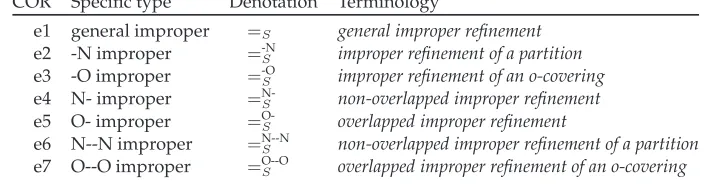
Vi=[L-][-R]S Vj:= [Lo∧]Vi=S Vj[∧Ro] (2) Out of the nine (32) combined settings ofLoandRo, seven are valid, each resulting in a relation with itsLoandRobeingunopposite, that is, either both specified as non-overlapped or overlapped, or at least one unspecified, such that the equality is possible. Table2lists these seven relations, with COR indicating collection order relation.
The superscript [L-][-R] for describing the specific type of a relation indicates whether overlappedness is specified on neither side (e1), on either the right side (e2, e3) or the left side (e4, e5), or on both sides (e6, e7). The descriptive terminology for specified over-lappedness isnon-overlappedoroverlappedforLoserving as an adjective modifyingimproper refinement, which correspond topartitionoro-coveringforRoindicating the type of the re-fined, respectively. Two examples, e4 (=
COR Specific type Denotation Terminology
e1 general improper =S general improper refinement
e2 -N improper =-NS improper refinement of a partition
e3 -O improper =-O
S improper refinement of an o-covering
e4 N- improper =
N-S non-overlapped improper refinement
e5 O- improper =
O-S overlapped improper refinement
e6 N--N improper =N--N
S non-overlapped improper refinement of a partition
e7 O--O improper =O--O
S overlapped improper refinement of an o-covering
Table 2: The collection order relations of improper refinement.
Xi =N-S Vj:= Non-overlapped(Xi)∧Covering(Xi, S)∧EQLd Rd Lt Rt(Xi, Vj)
∧Covering(Vj, S)
Oi =O--OS Oj:= Overlapped(Oi)∧Covering(Oi, S)∧EQLd Rd Lt Rt(Oi, Oj)
∧Covering(Oj, S)∧Overlapped(Oj)
An identity relation as is EQ, EQLd Rd Lt Rt is reflexive, symmetric, and transitive, with its converse collection relation having the same cardinality restriction, that is,
(EQLd Rd Lt Rt(Vi, Vj))−1 = EQLd Rd Lt Rt(Vj, Vi). In consequence, e1–e7 serve as the types of both improper refinement and its converse,improper coarsening.
4.2.2 Type B: Total refinement
Type B refinement istotalas it is both left-total (Lt) and right-total (Rt) ofIN, the embody-ing proper subset relation in DE5, not involvembody-ing the cases ofINLt Rt–all. A total (Type B) refinement of a partition,Xj, implies additionally right uniqueness (Rd) since the granules ofXj have pairwiseOUTrelations. The refinement is non-overlapped if it is also a par-tition,Xi. The collection relation from Xi toXj isINRd Lt Rt(Xi, Xj), which holds if each granule ofXihas anINrelation to exactly one granule ofXj, and for each granule ofXj some granule ofXi has anINrelation to it. The same cardinality restriction applies if the refinement is overlapped being ano-covering,Oi, resulting inINRd Lt Rt(Oi, Xj). Figure2 illustrates such two cases ofINRd Lt Rt, where the granules ofOi (Figure2b) are equal to their correspondents inXi (Figure2a) except thati0 inOiextends downwards to overlap i1, which is indicated by the gray top border ofi1as ifi0partially coversi1.
Combining these two cases yields aT-N refinement(total refinement of a partition) fromVi toXj, denoted byVi <T-NS Xj, where “T” indicates total, and “N” indicatesnon-overlapped regardingXj(equation3).
Vi <T-NS Xj:= Covering(Vi, S)∧INRd Lt Rt(Vi, Xj)
∧Covering(Xj, S)∧Non-overlapped(Xj) (3)
If a total refinement is of ano-covering, Oj, then its underlying collection relation is one of the pairwise disjoint collection relations of IN with both Lt and Rt (excluding
i1
i0 i2
i3
j0 j1 INRd Lt Rt(Xi, Xj)
Xi Xj
Xi Xj
(a)
i0
i1 j0
i2 j1
i3
i1
i2
i3 i0
j0 j1 INRd Lt Rt(Oi, Xj)
Oi Xj
Oi Xj
(b)
i0
i1 j0
i2 j1
i3
Figure 2: The two cases ofINRd Lt Rt to a partition (Xj): (a) from a partition (Xi); (b) from ano-covering (Oi).
(Figure4),INRd Lt Rt (Figure5), andINLt Rt (Figure6), each forming acandidate collection relationtoOjwith two cases, from a partition (Xi), or from ano-covering (Oi). In Figure3a, the granules ofOjare the four labeled regions (j0–j3) having the same shape and size but different orientations, withj3being partially covered byj1andj2, which are both partially covered byj0. In Figure3b,i1partially coversi0inOi, while inOjbothj1andj2partially coverj0, withj1being partially covered byj2. The relevant granules in Figures4–6overlap in similar ways.
Then, combining the cases in Figures 3–6, a T-O refinement (total refinement of an o-covering) fromVitoOj, denoted byVi <T-OS Oj, where “O” indicatesoverlappedregardingOj, is defined based on the disjunction of the four candidate collection relations (equation4).
Vi<T-OS Oj:= Covering(Vi, S)∧(INLd Rd Lt Rt(Vi, Oj)
∨INLd Lt Rt(Vi, Oj)∨INRd Lt Rt(Vi, Oj)∨INLt Rt(Vi, Oj))
∧Covering(Oj, S)∧Overlapped(Oj) (4)
Not distinguishing the overlappedness of either covering, aT refinement (general total refinement) fromVi toVj, denoted byVi <TS Vj, is obtained through the disjunction of T-N and T-O refinements (equation5).
Vi<TS Vj:= Covering(Vi, S)∧(INLd Rd Lt Rt(Vi, Vj)∨INLd Lt Rt(Vi, Vj)
∨INRd Lt Rt(Vi, Vj)∨INLt Rt(Vi, Vj))∧Covering(Vj, S) (5)
Then any collection order relation of total refinement is obtained asVi <[L-]T[-R]S Vjfrom the second tripartite formula (equation6), where the central component is Vi <TS Vj (T refinement).
IN
Ld Rd Lt Rt
(
X
i,
O
j)
X
iO
jX
iO
j(a)
i1 i0 i2
i3 j1 j0 j2
j3
i0 j0
i1 j1
i2 j2
i3 j3
IN
Ld Rd Lt Rt
(
O
i,
O
j)
O
iO
jO
iO
j(b)
j1 j2 j0 i2 i0i1 i0
i1
i2
j0
j1
j2
Figure 3: The two cases of INLd Rd Lt Rt to ano-covering (Oj): (a) from a partition (Xi); (b) from ano-covering (Oi).
i0 i1
i2 j3
j0
j2 j1
IN
Ld Lt Rt
(
X
i,
O
j)
X
iO
jX
iO
j(a)
i0 j0
i1 j1
i2 j2
j3 i2 i0 i1 j3 j0 j2 j1
IN
Ld Lt Rt
(
O
i,
O
j)
O
iO
jO
iO
j(b)
i0 j0
i1 j1
i2 j2
j3
i1 i0 i2
i3 j1 j0
j2
IN
Rd Lt Rt
(
X
i,
O
j)
X
iO
jX
iO
j(a)
j0 j1 j2 i0 i1 i2 i3 i3 i2 i1 i0 j1 j0 j2IN
Rd Lt Rt
(
O
i,
O
j)
O
iO
j(b)
O
i
O
jj0 j1 j2 i0 i1 i2 i3
Figure 5: The two cases ofINRd Lt Rtto ano-covering (Oj): (a) from a partition (Xi); (b) from ano-covering (Oi).
i1 i0 i2
i3 j0 j1 j3 j2
IN
Lt Rt
(
X
i,
O
j)
X
iO
j(a)
X
i
O
ji0 i1 i2 i3 j0 j1 j2 j3 j0 j1 j3 j2 i3 i2 i1 i0
IN
Lt Rt
(
O
i,
O
j)
O
iO
j(b)
O
i
O
ji0 i1 i2 i3 j0 j1 j2 j3
The formula yields nine valid collection order relations (Table3), with overlappedness specified on neither side (r1), on either side (r2–r5), or on both sides (r6–r9), as indicated by the specific types.
COR Specific type Denotation Terminology
r1 T <T
S general total refinement
r2 T-N <T-N
S total refinement of a partition
r3 T-O <T-O
S total refinement of an o-covering
r4 N-T <N-TS non-overlapped total refinement
r5 O-T <O-T
S overlapped total refinement
r6 N-T-N <N-T-NS non-overlapped total refinement of a partition
r7 O-T-N <O-T-NS overlapped total refinement of a partition
r8 N-T-O <N-T-OS non-overlapped total refinement of an o-covering
r9 O-T-O <O-T-OS overlapped total refinement of an o-covering
Table 3: The collection order relations of total refinement.
Among these nine relations, T-N and T-O refinements (r2, r3) defined in equations3and 4are two basic types revealing the sensitivity of the underlyingINCp (collection relation of
IN) toRoin total refinement.
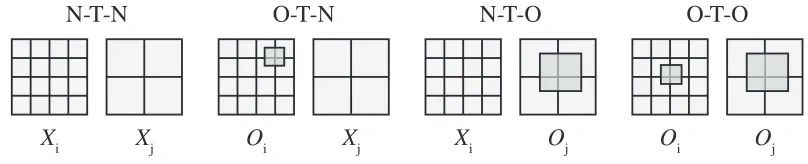
Relations r6–r9 form a detailed JEPD set of total refinement. Figure7illustrates these four types with simplified geometric examples, whereSand its granules are all unlabeled. The light-gray granules form a partition of each bounding box (S), while the translucent darker-gray ones turn four such partitions intoo-coverings. The illustration has one exam-ple for each type, therefore the involvedINCprelations are not interpreted or distinguished as are in Figures2–6.
N-T-N
X
iX
jO-T-N
X
jO
iN-T-O
X
iO
jO-T-O
O
iO
jFigure 7: The four detailed JEPD types of total refinement (r6–r9).
4.2.3 Type C: Partial refinement
Type C refinement ispartialas it combines Type A and Type B, duly splitting the two related coverings into corresponding non-empty proper subsets. The refined covering is divided into theimproperly refined subset and thetotally refined subset, and the refining covering is divided into theimproperly refining subset and the totally refining subset. For covering V, refining or refined, the two subsets are referred to asSubset A, denoted byVA, andSubset B, denoted byVB, corresponding to the Type A and the Type B component, respectively. The coverage byVAorVB may be disconnected even ifS is connected, andVA andVB make up aset partitionofV as in the following formulation.
The Type A and Type B components hold within two corresponding decomposable spaces, denoted bySAandSB, which are subsets ofSobtained as relevant arbitrary unions, that is,SA=VAandSB =VB, respectively. Despite the fact thatVAandVBare dis-joint sets of granules,SAandSBas decomposable spaces may overlap by having common interiors (Section4.1) and thus make up aset coveringofS, which is formulated as follows.
SetCovering({SA, SB}, S) :=SA⊆S∧SB⊆S∧SA∪SB=S
While the Type A component is improper (e1–e7), the Type B component as a total re-finement is interpreted by r1–r9. Then aP-N refinement(partial refinement of a partition) from
Vi to Xj, denoted byVi <P-NS Xj, and aP-O refinement(partial refinement of an o-covering) fromVitoOj, denoted byVi <P-OS Oj, are each formulated as a combination of an improper and a total refinement (equations7and8). SubsetsXjAandXjB are both non-overlapped as proper subsets of a partition, thus forming partitions ofSAandSB(equation7) respec-tively. SubsetsOjAandOjBas proper subsets of ano-covering may each be non-overlapped or overlapped, and therefore are treated as coverings ofSAandSBin general, respectively (equation8).
Vi <P-NS Xj:= Covering(Vi, S)
∧SetPartition({ViA, ViB}, Vi)∧SetPartition({XjA, XjB}, Xj)
∧VA
i =-NSA XjA∧ViB<T-NSB XjB
∧Covering(Xj, S)∧Non-overlapped(Xj) (7)
Vi<P-OS Oj:= Covering(Vi, S)
∧SetPartition({ViA, ViB}, Vi)∧SetPartition({OAj , OBj }, Oj)
∧VA
i =SA OAj ∧ViB <TSB OjB
∧Covering(Oj, S)∧Overlapped(Oj) (8)
AP refinement(general partial refinement), denoted byVi <PS Vj, is obtained through the disjunction of P-N and P-O refinements (equation9).
Vi<PS Vj:= Covering(Vi, S)
∧SetPartition({ViA, ViB}, Vi)∧SetPartition({VjA, VjB}, Vj)
∧VA
i =SA VjA∧ViB<TSBVjB
∧Covering(Vj, S) (9)
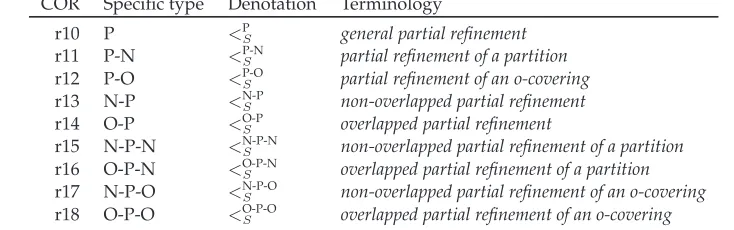
Then replacing the central component of the second tripartite formula (see equation6) with P refinement gives rise to the third tripartite formula, from which any collection order relation of partial refinement is obtained asVi <[L-]P[-R]S Vj(equation10).
COR Specific type Denotation Terminology
r10 P <P
S general partial refinement
r11 P-N <P-N
S partial refinement of a partition
r12 P-O <P-O
S partial refinement of an o-covering
r13 N-P <N-PS non-overlapped partial refinement
r14 O-P <O-P
S overlapped partial refinement
r15 N-P-N <N-P-NS non-overlapped partial refinement of a partition
r16 O-P-N <O-P-NS overlapped partial refinement of a partition
r17 N-P-O <N-P-OS non-overlapped partial refinement of an o-covering
r18 O-P-O <O-P-OS overlapped partial refinement of an o-covering
Table 4: The collection order relations of partial refinement.
Likewise, P-N (r11) and P-O (r12) refinements defined in equations7and8are two basic types from which the other relations in Table4are derived. While r15–r18 form a detailed JEPD set of partial refinement, the pattern of the O-P-O type varies with whetherSAandSB overlap (by interiors), denoted byovSASB, which is defined with the DE5 coarse relations as follows.
ovSASB:=
true, ifEQ(SA, SB)∨IN(SA, SB)∨IN−1(SA, SB)∨OV(SA, SB) false, ifOUT(SA, SB)
The pattern of O-P-O refinement also varies with the specified overlappedness of the four subsets. Being equal, the two Subsets A have the same overlappedness, denoted by
oA. Subset B of the refining covering and Subset B of the refined covering have their over-lappedness denoted byoIBandoJB respectively. Similar to L and R,oA,oIB, andoJB are each valued “N” or “O” respectively. Then,16(24) more-detailed combinations for r15–r18 are yielded by the4-tuple as follows.
ovSASB, oA, oIB, oJB
Figure8 illustrates these 16patterns for r15–r18, 13of which are subtypes of O-P-O refinement. The granules in the Subsets A are drawn as the translucent white boxes. The granules in the Subsets B are represented by the light-gray boxes, which form partitions ofSB, and the translucent darker-gray ones each turning one of these light-gray partitions into ano-covering ofSB. The first two patterns (N-P-N and O-P-N) are with the sameSA and SB. In the other14patterns, an enlargedSB remains identical, whileSA is drawn with another three different extents, one for N-P-O and O-P-O (a) – O-P-O (e), and one for each of the two lower rows whereSAandSBoverlap in the bottom-right quadrant of each bounding box (S).
4.2.4 Proper (strict) and non-strict refinements
Type B and Type C refinements are proper by inducing strict collection orders. Ageneral proper refinementfromVi toVj, denoted byVi <S Vj, is therefore derived as the disjunction of a T and a P refinement (equation11).
〈
false
, N, N, N〉
N-P-N
X
iX
jO-P-N
X
jO
iN-P-O
X
iO
jO-P-O (a)
O
iO
j〈
false
, N, O, N〉
〈
false
, N, N, O〉
〈
false
, N, O, O〉
〈
false
, O, N, N〉
O-P-O (b)
O
iO
jO-P-O (c)
O
jO
iO-P-O (d)
O
iO
jO-P-O (e)
O
iO
j〈
false
, O, O, N〉
〈
false
, O, N, O〉
〈
false
, O, O, O〉
〈
true
, N, N, N〉
O-P-O (f)
O
iO
jO-P-O (g)
O
jO
iO-P-O (h)
O
iO
jO-P-O (i)
O
iO
j〈
true
, N, O, N〉
〈
true
, N, N, O〉
〈
true
, N, O, O〉
〈
true
, O, N, N〉
O-P-O (j)
O
iO
jO-P-O (k)
O
jO
iO-P-O (l)
O
iO
jO-P-O (m)
O
iO
j〈
true
, O, O, N〉
〈
true
, O, N, O〉
〈
true
, O, O, O〉
Then the fourth tripartite formula is obtained for proper refinement by replacing the central component with Vi <[*]S Vj, where * is an optional truncation symbol for “T” or “P” indicating whether a proper refinement is specified as total or partial, referred to as
totalness, or with totalness unspecified (equation12).
Vi<[L-][*][-R]S Vj:= [Lo∧]Vi <[*]S Vj[∧Ro] (12) The formula yields27(33) types of proper refinement including r1–r18 and nine types (r19–r27) with totalness unspecified (Table5), with the latter being derived as relevant dis-junctions. For example,-N proper refinementis the disjunction of T-N and P-N,O- proper
combines O-T and O-P, andN--O properis the generalization of N-T-O and N-P-O refine-ments.
COR Specific type Denotation Terminology
r19 general proper <S general proper refinement
r20 -N proper <-NS proper refinement of a partition
r21 -O proper <-OS proper refinement of an o-covering
r22 N- proper <N-S non-overlapped proper refinement
r23 O- proper <O-S overlapped proper refinement
r24 N--N proper <N--NS non-overlapped proper refinement of a partition
r25 O--N proper <O--NS overlapped proper refinement of a partition
r26 N--O proper <N--OS non-overlapped proper refinement of an o-covering
r27 O--O proper <O--OS overlapped proper refinement of an o-covering
Table 5: The collection order relations of proper refinement with totalness unspecified.
While total and partial refinements are proper (strict), refinements so called asnon-strict totalornon-strict partialare not valid as they would be generalized tonon-strict proper, that is,non-strict strict, which is self-contradictory. As a result, non-strict refinements are only derived from the proper refinements that have totalness unspecified (r19–r27).
The most-general type of non-strict refinement, ageneral refinement fromVi toVj, de-noted byVi≤S Vj, is obtained as the disjunction of r19 (general proper refinement) and e1 (general improper refinement) (equation13).
Vi≤SVj:=Vi <S Vj∨Vi=SVj (13) Then any type of non-strict refinement is obtained asVi ≤[L-][-R]S Vjfrom the fifth tripar-tite formula, where the central component isVi≤SVj(equation14).
Vi ≤[L-][-R]S Vj:= [Lo∧]Vi≤SVj[∧Ro] (14) The formula yields each non-strict type as the disjunction of a pair of corresponding proper (r19–r27) and improper (e1–e7) types, except for O--N proper (r25) and N--O proper (r26), which do not have improper correspondents by precluding equality with opposite L and R. The formula then results in seven collection order relations (r28–r34) of non-strict refinement (Table6).
COR Specific type Denotation Terminology r28 general ≤S general refinement
r29 -N ≤-NS refinement of a partition
r30 -O ≤-O
S refinement of an o-covering
r31 N- ≤
N-S non-overlapped refinement
r32 O- ≤
O-S overlapped refinement
r33 N--N ≤N--N
S non-overlapped refinement of a partition
r34 O--O ≤O--O
S overlapped refinement of an o-covering
Table 6: The collection order relations of non-strict refinement.
4.3
Coarsening
Being the converse of refinement, coarsening falls into three corresponding broad, mutually exclusive types. As for each converse pair of specific coarsening and refinement types, their underlying collection relations and settings of overlappedness conversely correspond to each other.
The converseness of class relations [26,28] applies to collection relations via model ex-tension. Thus, if an individual relation R has a converse, a collection relation of it has a converse as well, which is of the converse individual relation R−1 with swapped left and right uniqueness and totality, that is,Rd forLd,RtforLt, and vice versa. For exam-ple,(INRd Lt Rt(Vi, Xj))−1= IN−1Ld Lt Rt(Xj, Vi). Accordingly, proper (Type B and Type C) coarsening is based on each relevantIN−1Cp as the converse of the correspondingINCpin proper refinement.
Moreover, the two related coverings in each specific type of refinement have their po-sitions swapped in the converse coarsening relation. Thus, the settings of Lo andRo in the refinement are accordingly swapped in the coarsening, whereLo and Rorefer tothe overlappedness of the coarsening(covering) andthe overlappedness of the coarsened covering re-spectively. For example, the converse of an N- improper refinement is a -N improper coars-ening, that is,(Xi =N-S Vj)−1 =Vj =-NS Xi, with the two types belonging to the same set of relations (e1–e7) that interpret both refinement and coarsening of Type A.
Type B (total) coarsening implies left and right totality in the underlyingIN−1Cp, which excludesIN−1Lt Rt–all. With its candidateINCp depending onRo, total refinement isright sensitive. Conversely, total coarsening isleft sensitive, that is, the underlyingIN−1Cp is af-fected byLo—the overlappedness of the coarsening instead of the coarsened—due to the swapped settings betweenLoandRoas described above.
Specifically, the converse of a T-N refinement, which implies right uniqueness (Rd), is an N-T coarsening implying left uniqueness (Ld). Then anN-T(non-overlapped total)coarsening
fromXitoVj, denoted byXi >N-TS Vj, is underlain byIN−1Ld Lt Rt(Xi, Vj)(equation15).
Xi>N-TS Vj:= Non-overlapped(Xi)∧Covering(Xi, S)
∧IN−1Ld Lt Rt(Xi, Vj)∧Covering(Vj, S) (15)
IN−1Cprelations as follows.
(INLd Rd Lt Rt(Vi, Oj)∨INLd Lt Rt(Vi, Oj)∨INRd Lt Rt(Vi, Oj)∨INLt Rt(Vi, Oj))−1 = IN−1Ld Rd Lt Rt(Oj, Vi)∨IN−1Rd Lt Rt(Oj, Vi)∨IN−1Ld Lt Rt(Oj, Vi)∨IN−1Lt Rt(Oj, Vi)
Then anO-T(overlapped total)coarseningfromOitoVj, denoted byOi >O-TS Vj, is obtained accordingly (equation16).
Oi>O-TS Vj:= Overlapped(Oi)∧Covering(Oi, S)∧(IN−1Ld Rd Lt Rt(Oi, Vj)
∨IN−1Ld Lt Rt(Oi, Vj)∨IN−1Rd Lt Rt(Oi, Vj)∨IN−1Lt Rt(Oi, Vj))
∧Covering(Vj, S) (16)
Similarly, equations15 and 16 define two basic types of total coarsening. A further examination of coarsening, which is omitted here, leads to34 collection order relations (c1–c34) as the converses of the corresponding relations of refinement.
In all, inclusion comparability transforms into refinement comparability through75 col-lection order relations (seven improper,34refinement, and34coarsening), such that two coverings ofS are comparable if any converse pair out of the75relations holds between them, otherwise they are incomparable.
5
Partial collection orders
Collection order relations of refinement and coarsening have their major potential appli-cations in such geocomputations where spatial hierarchies of partially ordered levels, each formed by a covering, play a significant role. The usefulness of these relations, therefore, is closely related to their applicability as partial orders. A partial order is either strict or strict. A strict partial order is irreflexive, asymmetric, and transitive, while a non-strict partial order is reflexive, antisymmetric, and transitive. Although spatial refinement between partitions is conceptualized as partial orders in both strict and non-strict ways [14,16], the question is whether such formulated collection order relations between spatial coverings based on collection relations, overlappedness, and totalness form partial orders. While such logical properties as reflexivity, irreflexivity, asymmetry, antisymmetry, and transitivity have not yet been fully studied for class relations [28], they are here analyzed with respect to the collection order relations, leading to the particular forms of partial or-ders between collections, referred to aspartial collection orders.
5.1
Strict partial collection orders
Regarding proper (strict) refinement, the following analyses are on irreflexivity, asymmetry, and transitivity.
Interpreted by a strict collection order relation, any proper refinement, with totalness specified or unspecified, is irreflexive, that is,¬(Vi <propS Vi), wherepropdenotes a combi-nation of [L-][*][-R] in r1–r27.
For the same reason, proper refinement is asymmetric, that is,Vi<propS Vj→ ¬(Vj<propS
Transitivity as a more complex property is here examined separately regarding the three different settings of totalness. It is found that if an individual relationRis transitive, in all the four cases of totality,Rall-1,Rall-2,Rall-12, andRall-all, which are equivalent toLT,RT,
LT ∧RT, andRLT RT–all [27,28], respectively, the class relations are transitive [8]. Such
transfer of transitivity conveniently applies to the collection relationINLt Rt, with relation
INbeing transitive, and Lt and Rt being the set versions of Rall-1 (LT) and Rall-2 (RT), respectively. It is also provable that a transitive individual relation constrained by either or both cases of uniqueness (Ld andRd) is transitive. Therefore, the other three candidate
INCprelations for total refinement,INLd Lt Rt,INRd Lt Rt, andINLd Rd Lt Rt, are transitive as well.
GiventB as a combination of [L-]T[-R] for total refinement (r1–r9),tB refinement is transitive ifVi <tB
S Vj∧Vj <tBS Vk → Vi <tBS Vk. Since exactly one candidateINCp holds
for any total refinement between two particular coverings, such aVi–Vj–Vk statement is true if only L and R intB are unopposite (Section4.2.1), such that the first two relations (Vi <tBS VjandVj <tBS Vk) do not negate each other by opposite specified overlappedness ofVj. Consequently, seven (r1–r6, r9) of the nine total refinement types are transitive except O-T-N (r7) and N-T-O (r8) due to the reason stated above.
As to partial refinement, letVi <tCS VjandVj <tCS Vk, wheretC denotes an applicable combination of [L-]P[-R] in r10–r18. The major issue on whethertCrefinement is transitive, or itstransitiveness, is the totalness of the third relation (fromVitoVk). In fact,VkA(Subset A ofVk) inVj <tCS Vk may by chance be totally refined by a subset ofVi, turningVi into a total refinement ofVk; otherwise,Vipartially refinesVk. Partial refinement, therefore, is not transitive due to the third relation’s uncertain totalness.
Proper refinement with totalness unspecified (r19–r27) involves both total and partial refinements in its transitivity, which has five cases regarding the actual totalness of the three relations in theVi–Vj–Vkstatement as follows.
• T∧T→T: a conjunction of two total refinements implying a third total refinement.
• T∧P →TorP∧T→T: a conjunction of a total and a partial refinement, in either order, implying a total refinement.
• P∧P→T: a conjunction of two partial refinements resulting in a total refinement.
• P∧P→P: a conjunction of two partial refinements resulting in a third partial refine-ment.
Similarly, seven (r19–r24, r27) of the nine proper refinement types with totalness un-specified are transitive by each having unopposite L and R, with O--N proper (r25) and N--O proper (r26) being the two exceptions.
In summary,14types of proper refinement—seven total (r1–r6, r9) and seven with to-talness unspecified (r19–r24, r27)—formstrict partial collection ordersby having irreflexivity, asymmetry, and transitivity.
5.2
Non-strict partial collection orders
For non-strict refinement, the following analyses are with respect to reflexivity, antisym-metry, and transitivity.
is reflexive if the improper case is reflexive on the proper case’s domain (i.e., the set of refining coverings), such that whenever the proper case holds, the improper case holds from the refining covering to itself. This requires that the setting of R inNS is not more restrictive than that of L, as a more restrictive R results in a smaller domain of the improper case. For example, -N refinement (≤-N
S) is not reflexive, as the refining covering in its proper
case (<-N
S) may be a partition or ano-covering, while its improper case (=-NS ) is restricted to
hold between partitions only. Consequently, five (r28, r31–r34) of the seven non-strict types are reflexive, with -N (r29) and -O (r30) being the two exceptions.
NSrefinement is antisymmetric ifVi≤NSS Vj∧Vj≤NSS Vi →Vi=NSS Vj. By each having unopposite L and R, such that the first two relations do not negate each other by oppo-site specified overlappedness ofVjorVi, and with proper cases holding between different coverings only, all the seven non-strict types are antisymmetric.
With improper refinement being transitive by conveying equality, the transitiveness of
NSrefinement comes down to the transitiveness of its proper case. Consequently, all the seven non-strict types (r28–r34) are transitive, with their respective proper cases being the seven transitive proper types with totalness unspecified (r19–r24, r27).
As such, five non-strict refinement types (r28, r31–r34) formnon-strict partial collection ordersby having reflexivity, antisymmetry, and transitivity.
According to the above analyses, 19 types of refinement—14 proper and five non-strict—turn out to be partial collection orders.
Similar results are with the corresponding types of coarsening as the converse of re-finement, and therefore the examination is omitted here. Together, 38types of strict or non-strict refinement and coarsening—19of each—form a pool of partial collection orders for establishing spatial hierarchies with covering-based levels.
6
Conclusions and future work
This paper examined spatial refinement (and conversely, coarsening) between coverings, which differentiate by overlappedness into partitions (non-overlapped) ando-coverings (overlapped), and thereby offer enhanced ways of dealing with multiple spatial datasets and modeling real-world geographic features.
Refinement between spatial coverings varies with the overlappedness of the related coverings as well as their granule participation and correspondence in the inclusion rela-tions that embody refinement. Granule correspondence is captured by the relarela-tions’ cardi-nality properties involving uniqueness and totality, which result in collection relations of equality and proper inclusion when applied to relevant coarse topological relations. With granule participation, spatial refinement intuitively falls into three broad, mutually exclu-sive types: (A) improper (equality), (B) total, with each granule in one covering involved in proper inclusion with some granule in the other covering and vice versa, and (C) partial, a combination of A and B.
relations respectively, with the fourth resulting in27proper (strict) types, which include the18total and partial relations as well as nine relations with totalness (total or partial) unspecified. The fifth tripartite formula further yields seven non-strict types by combining relevant proper and improper relations.
Later examinations show that 14types of proper (strict) refinement (seven total and seven with totalness unspecified) form strict partial collection orders, and five non-strict types form non-strict partial collection orders. With coarsening, the converse of refinement, leading to corresponding results, out of the75collection order relations (seven improper and34pairs of strict or non-strict refinement and coarsening),38(19pairs) provide a pool of partial collection orders.
Future work will explore various partial collection orders of spatial coverings on re-finement, which result inspatial
![Table 1: The corresponding RCC-5 [6] and DE5 [9] coarse topological relations, and spatialorder relations [19].](https://thumb-us.123doks.com/thumbv2/123dok_us/1157204.1617799/6.612.131.464.113.187/table-corresponding-rcc-coarse-topological-relations-spatialorder-relations.webp)