Published by Faculty of Science, Kaduna State University
SPACE UPPER BOUND ANALYSIS FOR TRANSFORMATION
FROM ELEMENTARY REFERENCE-NET SYSTEM TO LOW-LEVEL
P/T NETS
Abdullahi Ismaila Jihad
Department of Computer Science, Faculty of Science, Kaduna State University, Kaduna, Nigeria
*Corresponding Author Email Address: [email protected]
ABSTRACT
Elementary Reference-nett Systems (ERS) is a class of Object-Oriented Petri Nets that follows the nets-within-nets paradigm. It combines theoretical properties as well as numerous practical needs for multi-agent-systems specification. However, it comes with some constraints that limit their expressiveness for automatic verification purposes due to the highly expressive nature of the underlying class of Petri nets. This article presents a set of transformation procedure from ERS to basic Petri nets in order to make verification feasible. It further establishes the space upper bound for the transformation which shows that the state space of the transformed P/T net grows exponentially as the number of object nets increases.
Keywords: Petri nets, object orientation, agent systems, interaction, mobility, transformation
1, INTRODUCTION
Petri nets (Murata, 1989) are a graphical and mathematical modelling formalism for describing and studying systems characterized as being concurrent, asynchronous, distributed and nondeterministic.
Several results on the theory as well as on the practical applications exist in the literature. To be able to handle large-scale system development, Petri nets are still being extended in many directions: Several concepts proposed assigning firing times to transitions (Holliday, 1987), another proposal allows tokens of different data types, called Coloured Petri nets introduced by Jensen (1987, 2013). More recently, efforts towards aligning system modelling by Petri nets with object-oriented programming languages have led to the development of the so-called object-oriented Petri nets (OOP-nets) that follows nets-within-nets paradigm introduced by Valk (1998) and reviewed in Valk (2003). This formalism permits structured objects, specified as nets to be in another net as tokens, and consequently leads to a nested system of nets. These extensions are suitable for modelling hierarchical multi-agent distributed systems. Some examples are worth mentioning: (Masri et al 2009) modelled and analysed wireless network protocols with OOP-nets. In the field of control system and engineering, there are many researches with OOP-nets: manufacturing system scheduling (Chen (200), and Miyamoto (2000)). For satellite tracking: Rinkcs et al (2014) developed the methodology for analysis of the automated guided vehicle systems using OOP-nets, just to mention a few. The formalism described in this paper is based on the Elementary Reference-net System (ERS), which is a framework for modelling systems that capture both nesting,
mobility and interaction of objects. The formal definition of ERS has been published elsewhere (Abdullahi & Mṻller 2016) and is not repeated here. However, some key aspects of the formal definition are discussed in Sect. III. The idea behind the approach described there was to provide a path to verification of properties of a slightly modified version of a class of OOP-nets, as a formal representation of previously studied formalisms of the nets in the Reference Nets by Kummer (2001). Although the theoretical results were still preliminary to verification, they demonstrated, the algorithm for transforming ERS into a single low-level Petri nets in order to make verification feasible.
The objective of this article is to establish isomorphism between the states of an ERS and that of the generate Petri net and to analyse the transformation algorithm in terms of the state space upper bound. In Sect. II we introduce definitions from theory of Petri net that seem relevant in establishing relationship between the isomorphic properties of state spaces of ERS and the transformed P/T net. Formal definition of ERS is presented in III. We recapitulate the transformation procedure illustrated with an example in Sect. IV. In Sect. V, we summarise the present contributions of analysing the transformation of ERS to a behavioural equivalent low-level P/T net, and conclude with an outlook.
2. Fundamentals of Petri Nets
Here we give some definitions from theory of P/T-net, Relevant for our study.
Definition 1 (P/T net). A place/transition (P/T net for short) is a tuple 𝑁 = (𝑃, 𝑇, 𝐹, 𝑊)where P is a finite set of places, T is a finite set of transitions, disjoint from 𝑃, 𝐹 ⊆ (𝑃 × 𝑇) ∪ (𝑇 × 𝑃)is the flow relation, and 𝑊: 𝐹 ⟶ ℕ\{0} is the arc weight function. If P and T are finite, the net 𝑁 is said to be finite. If 𝑊(𝑥, 𝑦) = 1 for all arcs (𝑥, 𝑦) ∈ 𝐹we usually omit W in the tuple and simply write (P, T, F) for a P/T net. The preset of a node x ∈ P ∪ T, denoted ⦁𝑥, is the set containing the elements that immediately precede 𝑥 in the net i.e. ⦁𝑥 = {𝑦 ∈ 𝑃 ∪ 𝑇|(𝑦, 𝑥) ∈ 𝐹} . Analogously, the postset of a node, denoted x⦁, can be defined.
Definition 2 (Marking and Enabled transition). A marking of a P/T net 𝑁 = (𝑃, 𝑇, 𝐹, 𝑊) is a function 𝑚: 𝑃 ⟶ ℕ. A P/T net system 𝛴=(𝑁, 𝑚0) is a net 𝑁 = (𝑃, 𝑇, 𝐹) together with an initial
marking 𝑚0. The zero marking with 𝑚(𝑝) = 0 for all 𝑝 ∈ 𝑃 is
denoted by 𝟎. A transition 𝑡 ∈ 𝑇 is enabled in a marking 𝑚 iff
𝑚(𝑝) ≥ 𝑊(𝑝, 𝑡) for all 𝑝 ∈ ⦁𝑡. Enablement of transition 𝑡 in marking 𝑚 is denoted by 𝑚[𝑡 >. A transition that is enabled
Fu
ll L
en
gt
h Rese
ar
ch
may or may not fire. Firing removes tokens from places in the preset of 𝑡 and puts new tokens onto places in the postset of 𝑡
according to the arc weight function. A transition 𝑡 that is enabled in a marking 𝑚 i.e. 𝑚[𝑡 >, may fire. The successor marking 𝑚′
is defined as 𝑚′ (𝑝) = 𝑚(𝑝) − 𝑊(𝑝, 𝑡) + 𝑊(𝑡, 𝑝). We
denote this by 𝑚[𝑡 > 𝑚′. The set of reachable markings of 𝛴 is the smallest (w.r.t. ⊆) set 𝑅𝑀(𝛴) with 𝑚0∈ 𝑅𝑀(𝛴) and 𝑚 ∈
𝑅𝑀(𝛴) iff 𝑚′[𝑡 > 𝑚, for some 𝑡 ∈ 𝑇 and 𝑚′∈ 𝑅𝑀(𝑁). For a
finite sequence of transition 𝜎 = 𝑡1, … 𝑡𝑘, we write 𝑚[𝜎 > 𝑚′ if
there are markings 𝑚1, … 𝑚𝑘+1 such that 𝑚1= 𝑚, 𝑚𝑘+1=
𝑚′ and 𝑚𝑖[𝑡𝑖> 𝑚𝑖+1, for all 𝑖 = 1, … , 𝑘. 𝛴 is k-bounded if, for
every reachable marking 𝑚 and every place 𝑝 ∈ 𝑃, 𝑚(𝑝) ≤ 𝑘, and 𝛴 is safe if it is 1-bounded. Moreover, 𝛴 is bounded if it is k-bounded, for some 𝑘 ∈ 𝑁. One can show that the set 𝑅𝑀(𝛴) is finite if 𝛴 is bounded i.e. if |𝑅𝑀(𝛴)| < ∞. A P/T net is 1-safe if all arc weights are 1 and there is at most one token in each place in every reachable marking.
3. Formal Definition of Ers
In this section, we recapitulate some key aspect of the formal definition of Elementary Reference-net System (Abdullahi & Bertie 2016). An ERS is comprised of a system net, a set of uniquely named object nets, variables labelling the arcs of nets and a synchronisation labelling for transitions. By convention, the components of the system net carry a hat: 𝑃̂, 𝑇̂, 𝑝̂, 𝑡̂, … etc.
A. Static Structure
Definition 3 (Static Structure). Let the triple 𝜂𝑖 = (𝑖, 𝑁𝑖, 𝑚𝑖) be
a named marked object net, where 𝑖, is a unique name of an
object net; 𝑁𝑖 is a structure of the object net, and 𝑚𝑖 is a marking
in 𝑁𝑖. (Let Σ = {(𝑖1, 𝑁1, 𝑚1), … , (𝑖𝑘, 𝑁𝑘, 𝑚𝑘)} be a finite set
of unique marked named object nets). The structure of an object net with a unique name 𝑖 ∈ Σ is a p/t net 𝑁𝑖= (𝑃𝑖, 𝑇𝑖, 𝐹𝑖),
where 𝑃𝑖, is the set of places of the object net, 𝑇𝑖 is the set of its
transitions and 𝐹𝑖⊆ (𝑃𝑖× 𝑇𝑖) ∪ (𝑇𝑖× 𝑃𝑖) is the flow relation.
Moreover, we assume that all sets of nodes (places and transitions) are pairwise disjoint and set 𝑃Σ≔
⋃𝜂𝑖∈Σ𝑃𝜂𝑖 𝑎𝑛𝑑 𝑇Σ≔ ⋃𝜂𝑖∈Σ𝑇𝜂𝑖. By 𝑁• we denote the name of
the object net which has no places or transitions so that we can have name for ordinary black tokens in our nets.
Definition 4 (Elementary Reference-net System (ERS)). Let
𝑉𝑎𝑟 be a finite set of named variables. An elementary reference-net system is a tuple 𝑅𝑆 = (𝑁̂, Σ𝑚0, ℓ, 𝓌, 𝑹𝟎)where 𝑁̂ = (𝑃̂, 𝑇,̂ 𝐹̂) is a p/t net called a system net, where 𝑃̂is
its set of places, 𝑇̂is its set of transitions and 𝐹̂ ⊆ (𝑃̂ × 𝑇̂) ∪ (𝑇̂ × 𝑃̂) is the flow relation.
Σ𝑚0≔ {(𝑖1, 𝑁1, 𝑚01), … , (𝑖𝑘, 𝑁𝑘, 𝑚𝑘0)}, is a finite set of
marked named object nets.
ℓ ⊆ (𝑇̂ ∪ {𝜏̂}) × (𝑇1i∪ {𝜏}) ×, … , (𝑇𝑘∪ {𝜏})\
{𝜏̂, 𝜏, … , 𝜏)} , is the synchronisation relation, where 𝜏̂ and 𝜏
are special symbols intended to denote inactions at the system and the object net levels respectively. If𝒕 = (𝑡̂, 𝑡1, … , 𝑡𝑘) and 𝑡̂, ≠ 𝜏 and ∃𝑖 ∈ {1, … , 𝑘} such
that 𝑡𝑖≠ 𝜏, then we say that 𝑁̂𝑎𝑛𝑑 𝑁𝑖∈ Σ for every 𝑖 ∈
{1, … , 𝑘} with 𝑘 = |Σ|, participate in 𝒕. This is the reason
why (𝜏̂, 𝜏, … , 𝜏) is excluded from the set of synchronisation relation: at least one object net must participate in every synchronisation action with the system net.
𝓌: 𝐹̂ ⟶ 𝑉𝑎𝑟 ∪ {𝑁•} is an arc labelling function such that
for an arc 𝑎̂ ∈ (𝐹̂) adjacent to a place 𝑝̂ the inscription of 𝓌(𝑎̂) matches the name of object net in 𝑝̂
𝑹𝟎specifies the initial making, where
𝑹𝟎: 𝑃̂ → ℕ ∪ 𝑀𝑆(𝛴)𝑤𝑖𝑡ℎ 𝛴 =
{(𝑖1, 𝑁1, 𝑚1), … , (𝑖𝑘, 𝑁𝑘, 𝑚𝑘}. It has to satisfy the
condition 𝑹𝟎(𝑝̂) ∈ ℕ ⟺ 𝑹𝟎(𝑝̂) ∈ {𝑁
⦁}.
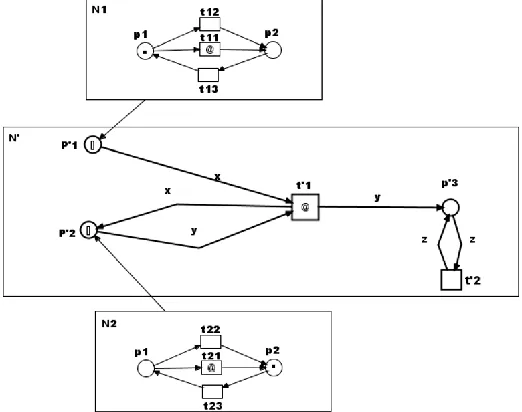
In the example of Fig. 1 an 𝑅𝑆 = (𝑁̂, 𝛴, ℓ, 𝓌, 𝑴𝟎) is shown,
where 𝛴 = {𝑁1, 𝑁2}. Arcs of 𝑁̂ can be identified by their
labelling from 𝓌(𝑡̂). Hence {x, y,} can be bound to marked named object nets in places 𝑝̂1 𝑎𝑛𝑑 𝑝̂2 adjacent to transition 𝑡′̂
to enable it. In the initial marking, places 𝑝̂1 𝑎𝑛𝑑 𝑝̂2 contain
references to the marked named object nets 𝑁1𝑎𝑛𝑑 𝑁2
respectively. They have the same structure and could be generated from a type N. 𝒩 = {𝑖|(𝑖, 𝑁𝑖,, 𝑚𝑖) ∈ 𝛴}, is a finite
set of object nets names.
More to the definition ERS, variables appearing on arcs adjacent to a transition 𝑡̂ of the system net must satisfy the following
conditions: Condition (1) variable appearing in the incoming arc of a system net transition 𝑡̂ must appear in an outgoing arc of 𝑡̂ or no such variable exist. Condition (2) variable appearing in an outgoing arc of a system net transition 𝑡̂ must appear in an
incoming arc of 𝑡̂ or no such variable exist. Conditions (1) and (2) are imposed to prevent the creation of object net at run time and to prevent the destruction of existing ones when a system net transition fires. Condition (3) joining of two object nets is not permitted, and (4) No splitting of an object nets. (This is because in reality, complex physical entities cannot be cloned at run time). With these structural restrictions, ERS still retain the capability to describe nesting of object nets, synchronisation, and mobility, but do not allow splitting of the inner marking of an object net or joining the inner marking of several object nets. For instance, if assuming these inner markings as modelling the inner state of an agent, this is a reasonable restriction and shows that ERSs are well suitable to model physical entities
Fig. 1: An example of an ERS
B. Dynamic Behaviour
For the dynamic behaviour, we start by introducing the notion of marking for elementary reference-net system ERS under
reference semantics. By Definition 4, an ERS contains a set Σ𝑚0≔ {(𝑖1, 𝑁1, 𝑚01), … , (𝑖𝑘, 𝑁𝑘, 𝑚𝑘0)} of marked named object nets. By ignoring the marking we obtain the set of (unmarked) named object nets Σ ≔ {(i1, N1), … , (ik, Nk)}. Hence in general a marking is given by:
1. a distribution of object nets or black tokens 𝑹: 𝑃̂ → ℕ ∪
𝑀𝑆(Σ) and
2. The vector 𝑴 = (𝑚1, … , 𝑚𝑘) with the current marking of each 𝑁𝑖 (1 ≤ 𝑖 ≤ 𝑘).
𝑹 specifies for each system net place 𝑝̂, a number of black tokens (if 𝑝̂ contains a black token or a multiset of unmarked named object nets we obtain the following Definition 5 below) Sometimes by abuse of notation, for a named object net
(𝑖, 𝑁𝑖, 𝑚𝑖) in a place 𝑝̂ of a marking 𝑹 of the system net we write 𝑹(𝑝̂) = 𝑖 meaning 𝑹(𝑝̂) = {(𝑖, 𝑁𝑖, 𝑚𝑖)}.
Definition 5. Given an elementary reference-net system 𝑅𝑆 = (𝑁̂, Σ𝑛𝑡, ℓ, 𝓌, 𝑹𝟎)we define ℳ ≔ {𝑀|𝑀 = (𝑚1, … , 𝑚𝑘) ∧
𝑚𝑖∈ 𝑀𝑆(𝑃𝑖)}. Then a marking of an elementary reference-net
system is a pair (𝑅, 𝑀) where 𝑀 ∈ ℳ and 𝑹: 𝑃̂ → 𝑀𝑆(Σ𝑛𝑡).
Specifying 𝑀0 by the initial markings of the marked named object
nets 𝑀0= (𝑚 1 0, … , 𝑚
𝑘
0) we obtain the initial marking (𝑹𝟎, 𝑴𝟎)
of 𝑅𝑆.
The set of all markings of 𝑅𝑆 is denoted by ℳr.
Like in other classes of High-level nets, variables are bound to names that are in a place 𝑝̂ of a marking 𝑹 of the system net
when firing a transition in order to determine which tokens are removed from preset and which are added to postset.
Let 𝑡̂ ∈ 𝑇̂ be a transition in the system net 𝑁̂, then •𝑡̂ = { 𝑝̂|(𝑝̂, 𝑡̂) ∈ 𝐹̂}, and 𝑡̂⦁ = {𝑝̂|(𝑡̂, 𝑝̂) ∈ 𝐹̂} are sets of its preset and postset. We denote by 𝓌(𝑡̂) ≔ {𝓌(𝑝̂, 𝑡̂)|(𝑝̂, 𝑡̂) ∈ 𝐹̂} ∪ {𝓌(𝑡̂, 𝑝̂)|(𝑡̂, 𝑝̂) ∈ 𝐹̂} = ⦁𝑡̂ × {𝑡̂} ∪ {𝑡} × 𝑡̂⦁ the set of all variables on arcs adjacent to 𝑡̂.
A binding 𝛽specifies which variables are bound to names, where
𝛽: 𝓌(𝑡̂) ∪ {•} ⟶ 𝒩 ∪ {𝑁⦁} with 𝒩 = {𝑖|(𝑖, 𝑁𝑖,, 𝑚𝑖) ∈ Σ}
satisfying the conditions: for each 𝑥 ∈ 𝓌(𝑡̂) ∪ {•}, there exist
𝑖 ∈ 𝒩such that 𝛽(𝑥) = 𝑖 𝑎𝑛𝑑 𝑖𝑓 𝑥 =• 𝑡ℎ𝑒𝑛 𝛽(𝑥) = 𝑁•. The firing rule will be introduced in three modes: First, we consider the mode when synchronisation occurs. In this mode we assume that a system net transition 𝑡̂ ∈ 𝑇̂ and one or more
object nets transition 𝑡𝑖∈ 𝑇Σ of some object nets 𝑁𝑖(𝑖 ≥ 1) are activated and all transitions are related by the synchronisation relation ℓ. That is, (𝑡̂, 𝑡𝑖) ∈ ℓ. This mode of the firing rule is called a synchronisation firing mode.
Definition 6 (synchronisation firing mode) Let(𝑹, 𝑴) be a
marking of an elementary reference-net system 𝑅𝑆 = (𝑁̂, Σ𝑛𝑡, ℓ, 𝓌, 𝑹𝟎), 𝑡̂ ∈ 𝑇̂ a transition of 𝑁̂ and let 𝛽 be a
variable binding defined for all 𝑥 ∈ 𝓌(𝑡̂) ∪ {•}. Let
𝛼1, . . . , 𝛼𝑘 ∈ Σ𝑛𝑡 be object nets involved in the firing of ̂ 𝑡̂. Then
𝑡̂ can fire provided that in each 𝛼𝑖∈ Σ𝑛𝑡 for every 𝑖 ∈
{1, … , 𝑘} a transition 𝑡𝑖∈ 𝑇Σ such that (𝑡̂, 𝑡1, … , 𝑡𝑘) ∈ ℓ. Then
(𝑡̂, 𝑡1, … , 𝑡𝑘) is activated in (𝑹, 𝑴) if:
∀ 𝑝̂ ∈ 𝑃:̂ (𝛽(𝓌(𝑝̂, 𝑡̂)), 𝑁𝛽(𝓌(𝑝̂,𝑡̂)), 𝑚𝛽(𝓌(𝑝̂,𝑡̂))) ∈ 𝑹(𝑝̂) and
∀𝑝 ∈ 𝑃𝑖∶ 𝛱𝑖(𝑴) ≥ 𝐹𝑖(𝑝, 𝑡𝑖),. (1)
This is denoted by (𝑹, 𝑴)[𝑡̂, 𝑡𝑖>Let be 𝑚𝑖[𝑡𝑖> 𝑚′𝑖 (w.r.t 𝑁𝑖).
The successor marking (𝑹′, 𝑴′) is defined by
𝑹′(𝑝̂)= 𝑹(𝑝̂)\ (𝛽(𝓌(𝑝̂, 𝑡̂)), 𝑁
𝛽(𝓌(𝑝̂,𝑡̂)), 𝑚𝛽(𝓌(𝑝̂,𝑡̂))) ∪
(𝛽(𝓌(𝑡̂, 𝑝̂ )), 𝑁𝛽(𝓌(𝑡̂,𝑝̂ )), 𝑚𝛽(𝓌(𝑡,̂ 𝑝̂))) : ∀𝑝̂ ∈
𝑃̂ and 𝑴′ = 𝑴
𝒊→𝒎𝒊 . (2)
This is denoted by (𝑅, 𝑀)[𝒕̂, 𝒕𝒊> (𝑹′, 𝑴′)
If a system net transition is activated and without being included in the synchronisation relation, a chosen net-token does not change it current marking as it changes its location in the system net. Such a firing mode is called system-autonomous. The following definition can be seen as a special case of Definition 6 where the involved object net markings are not changed, i.e.
𝑴′= 𝑴.
Definition 7(system-autonomous firing mode). Let (𝑹, 𝑴) be a marking of an elementary reference-net system 𝑅𝑆 = (𝑁̂, Σ𝑛𝑡, ℓ, 𝓌, 𝑹𝟎)and 𝑡̂ ∈ 𝑇̂ a transition of 𝑁̂ with a binding 𝛽
such that ∄(𝑡̂, 𝑥𝑖, … , 𝑥𝑘) ∈ ℓ ∶ ∃ 𝑖 ∈ {1, … , 𝑘} ∶ 𝑥𝑖≠ 𝜏.
Then 𝑡̂ 𝑖𝑠 activated in (𝑹, 𝑴) if there is a net token such that:
(𝛽(𝓌(𝑝̂, 𝑡̂)), 𝑁𝛽(𝓌(𝑝̂,𝑡̂)), 𝑚𝛽(𝓌(𝑝̂,𝑡̂))) ∈ 𝑹(𝑝̂)∀𝑝̂ ∈ 𝑃 ̂ . (3)
Since we use 𝜏, for inaction, this is denoted by (𝑹, 𝑴)[( 𝑡̂, 𝜏) >. The successor marking (𝑹′, 𝑴′) is defined by
∀𝑝̂ ∈ 𝑃̂ ∶ 𝑹′(𝑝̂)
= 𝑹(𝑝̂)\ (𝛽(𝓌(𝑝̂, 𝑡̂)), 𝑁𝛽(𝓌(𝑝̂,𝑡̂)), 𝑚𝛽(𝓌(𝑝̂,𝑡̂)))
∪ (𝛽(𝓌(𝑡̂, 𝑝̂ )), 𝑁𝛽(𝓌(𝑡̂,𝑝̂ )), 𝑚𝛽(𝓌(𝑡,̂ 𝑝̂)))
𝑴′= 𝑴 . (4)
This is denoted by (𝑹. 𝑴)[(𝑡̂1, 𝜏) > (𝑹′, 𝑴′) .
Definition 8(object –autonomous firing mode) Let (𝑹, 𝑴) be a marking of an elementary reference-net system 𝑅𝑆 = (𝑁̂, Σ𝑛𝑡, ℓ, 𝓌, 𝑹𝟎)and 𝑡𝑖∈ 𝑇𝑖 a transition of a net-token 𝑖 =
(𝑖, 𝑁𝑖, 𝑚𝑖) ∈ 𝑹(𝑝̂) for some 𝑝̂ ∈ 𝑃̂, such
that ∄(𝑡̂, 𝑥𝑖, … , 𝑡𝑖, … , 𝑥𝑘) ∈ ℓ, and 𝑡𝑖 is activated in 𝑁𝑖. Then
we say that (𝜏̂, 𝑡𝑖) is activated in (𝑹, 𝑴)
(denoted (𝑹, 𝑴)[(𝜏̂, 𝑡𝑖) >]. The successor marking (𝑹′, 𝑴′) of
RS is defined by
𝑹′= 𝑹 and
𝑴′= 𝑴
1→miif 𝑚𝑖[ 𝑡𝑖> 𝑚′𝑖 for Π𝑖(𝑴) = 𝑚𝒊 . (5)
This is denoted by (𝑹, 𝑴)[(𝜏̂, 𝑡𝑖) > (𝑹′, 𝑴′).
Definitions 6, to 8 could be easily merged. This is not done here to emphasise the differences.
To introduce the occurrence sequences for 𝐸𝑅𝑆 we assume an
𝐸𝑅𝑆 as defined in Definition 4. Let 𝑅𝑆 be an 𝐸𝑅𝑆 𝑎𝑛𝑑 (𝑹, 𝑴), (𝑹′, 𝑴′) ∈ ℳ
𝑟
Definition 9. For a new alphabet Γ ≔ (𝑇̂ ∪ {𝜏̂}) × (𝑇1∪ {𝜏}) ×, … , (𝑇𝑘∪ {𝜏})\(𝜏̂, 𝜏, … , 𝜏) where (𝜏̂, 𝜏, … , 𝜏)
denotes the neutral element of the free monoid Γ∗, we define:
(𝑹, 𝑴)[(𝜏̂, 𝜏, … , 𝜏) > (𝑹′, 𝑴′) if (𝑹, 𝑴) = (𝑹′, 𝑴′) and
(𝑹, 𝑴)[𝑤̆ (𝑡̂, 𝛼) > (𝑹′, 𝑴′) 𝑖𝑓 ∃(𝑹′′, 𝑴′′) ∶
(𝑹, 𝑴)[𝑤̆ > (𝑹′′, 𝑴′′) 𝑎𝑛𝑑
(𝑹′′, 𝑴′′)[(𝑡̂, 𝛼) > (𝑅′, 𝑀′) 𝑓𝑜𝑟 𝑠𝑜𝑚𝑒 𝑤̆ ∈ Γ∗, 𝑡̂, ∈ 𝑇̂ ∪
{𝜏̂} 𝑎𝑛𝑑 𝛼 ∈ ((𝑇1∪ {𝜏}) × , … , (𝑇𝑘∪ {𝜏}) . (6)
To denote that (𝑹′, 𝑴′) is reachable from (𝑹, 𝑴) by some occurrence sequence of actions we write (𝑹, 𝑴)→ (𝑹∗ ′, 𝑴′).
The set of reachable markings of a reference system RS from a marking (𝑹, 𝑴) is denoted by 𝑅(𝑅𝑆, (𝑹, 𝑴)). 𝑅(𝑅𝑆), is the set of markings reachable from the initial marking (𝑹𝟎, 𝑴𝟎),
i.e. (𝑅(𝑅𝑆) ≔ 𝑅(𝑅𝑆, (𝑹𝟎, 𝑴𝟎)). The reachability graph
(𝑅𝐺(𝑅𝑆) is obtain as for P/T-net systems, i.e. RG(RS) is a labelled directed graph whose nodes is the set of reachable markings and edges are the tuples ((𝑹, 𝑴), (𝑡̂, 𝛼), (𝑹′, 𝑴′)) ∈
ℳ𝑟× (𝑡̂, 𝛼) × ℳ𝑟 where (𝑹, 𝑴) (𝑡̂,𝛼)
→ (𝑹′, 𝑴′).
We now extend the definition of 1-safe P/T-net to ERS. Safeness guarantees that the state space of a P/T-net is finite and for a 1-safe net, on each place at most one token resides. Many problems for 1-safe nets e.g., reachability, and liveness become decidable in polynomial space. A P/T net is 1-safe if and only if for all reachable marking there is at most one token on each place. In a 1-safe P/T-net all reachable markings can be interpreted as set (of marked places).
We introduce two conditions for safeness of ERS in Definition 10 as a generalisation of the safeness notion for P/T-nets.
Definition 10 (1-safe ERS) 𝐿𝑒𝑡 𝑅𝑆 = (𝑁̂, Σ, ℓ, 𝓌, 𝑹𝟎)
𝑏𝑒 𝑎𝑛 𝐸𝑅𝑆. RS is 1-safe if and only if all reachable markings are
1-safe and if and only if in all reachable markings there is at most one net-token on each system net place and each net-token is 1-safe:
• ∀(𝑹, 𝑴) ∈ 𝑅(𝑅𝑆), ∀𝑝̂ ∈ 𝑃̂: (𝑅(𝑝̂), ) ≤ 1 and
• ∀(𝑖, 𝑁𝑖, 𝑚𝑖) ∈ 𝑹(𝑝̂) : ∀𝑝𝑖∈ 𝑃𝑖∶ ∀𝑝̂ ∈
𝑃̂ (𝑹(𝑝̂), Π𝑖(𝑴(𝑝𝑖)) > 0 ⟹ Π𝑖(𝑴(𝑝𝑖)) ≤ 1.
Observe that by this definition in the reachable marking of safe ERS each system net place is marked with at most one object net. The set {𝑹(𝑝̂)|𝑹(𝑝̂) ∈ 𝑅(𝑅𝑆), 𝑝̂ ∈ 𝑃̂} is thus a finite set and similar to the reachability set of safe P/T-net. Furthermore, the net-tokens are also safe by the definition and thus the set of reachable markings associated with them is finite too. This combination of the finite set of reachable markings associated with the system net and finite set of reachable markings associated the object net results in a finite state space for the ERS.
Observation 1. Given an ERS if for all reachable markings there is at most one token on each system net place and each net-token is 1-safe, then all reachable markings are 1-safe.
Theorem 1. If an ERS is safe, then its set of reachable markings is finite.
Proof. Let RS be a safe ERS. Let 𝑚 ∶= |𝑃̂| and 𝑛 ∶= 𝑚𝑎𝑥{|𝑃𝑖| |(𝑖, (𝑃𝑖. 𝑇𝑖, 𝐹𝑖), 𝑚𝑖) ∈ 𝒩} be the number of system net places and the maximum number of places present in an object net, respectively.
By definition of safe ERS each object net is 1-safe and hence there are at most 2𝑛 different markings an object net may have. By definition of safe ERS each system net place is either marked or unmarked with an object net with one of these markings, thus there are up to (1 + 2𝑛)𝑚 different markings of RS, i.e.
|𝑅(𝑅𝑆)| ≤ (1 + 2𝑛)𝑚.
□
4. The Transformation Procedure
In the following, we represent the set of transformation of Elementary Reference-net system into P/T nets as demonstrate in (Abdullahi & Bertie 2016). There are five rules which must be applied in sequence from Rule 1 to Rule 5. The first rule generates the set of places of the target P/T-net. The second rule defines the initial marking for the P/T-net. The third rule generates a family of transitions and arcs for each autonomous transition in the system net, and rule 4 generates family of transitions and arcs
for each autonomous transition in an object net from the set of all marked named object net. The fifth rule creates a family of synchronisation transitions which belongs to the system net, and synchronization transitions in each object net by combining Rule 3 and Rule 4.
The set of transformation rules will be illustrated with the example of an elementary reference-net system shown in Fig. 1. In the figure, there is the system net 𝑁’ represented by a net in the middle. Tokens residing in places 𝑝’1 and 𝑝’2 are references to marked named object nets 𝑁1 and 𝑁2. Their structures and inner markings are shown on the top and bottom of the system net. This net system will be translated into a P/T net system 𝑁∗. The main idea is to construct a simulating P/T-net where the set of places consists of tuples (𝑝̂, 𝑖) where 𝑝̂ is a system net place and 𝑖 ranges over all marked object net names that resides on 𝑝̂.
This set is finite due to the boundedness of the ERS. The set of transitions coincides with the set of transition relation
(𝑡̂, 𝑡1, … , 𝑡𝑘)∈ ℓin the marking( 𝑹, 𝑴) that is encoded in the connections from the places to these transitions. Also since ERS is finite there are only finitely many firing modes and hence the set of transition is also finite.
A. Transformation Rules
Let 𝑅𝑆 = (𝑁̂, 𝛴, ℓ, 𝓌, 𝑹𝟎) be an ERS with a set 𝛴 𝑛𝑡 of all
marked named object nets in the initial marking. By 𝑅 we denote the set of all names used in 𝛴𝑛𝑡 and by 𝑅𝑖 ⊆ 𝑅 the subset of all
names for marked object nets 𝑖. The net system 𝑅𝑆 will be translated into a flat P/T-net system 𝑁∗= (𝑃
𝑁∗∗, 𝑇𝑁∗∗, 𝐹𝑁∗∗, 𝑀0∗)
where 𝑀0∗ is the initial marking.
Rule 1: Generate places. To generate the set 𝑃𝑁∗∗ of places of a
P/T-net 𝑁∗we define two separate sets. The first, is the set 𝑃′
𝑁∗
of places from the system net 𝑁̂, and the second the set 𝑃𝑁∗ of
all places of each object net in the initial marking of the system net. Finally, we take the union of these set as the set 𝑃𝑁∗∗ of a
target P/T-net 𝑁∗, with the assumption that 𝑃′
𝑁∗∩ 𝑃𝑁∗∗= ∅.
he first set of places of 𝑁∗ is generated by duplicating all places
of the system net for each net-token name (𝑖, 𝑁𝑖, 𝑚𝑖), (𝑖 ≥ 1)
used in the initial marking of the system net and labelled it with a pair (𝑝′, 𝑖) where 𝑝′is a place in 𝑃̂ and 𝑖 is the name of the
possible net-token that reside on 𝑝′. Thus the set 𝑃′𝑁∗of places
of 𝑁∗from place of the system net is defined as follows:
𝑃′𝑁∗≔ ⋃𝑝′∈𝑃̂{(𝑝′, 𝑖)|𝑖 ∈ 𝑅, 𝑖 ≥ 1} . (7)
The second set of places of 𝑁∗ is generated by taking a copy of
each place in the set 𝑃𝑖 for each net-token and labelled it with a
pair (𝑝𝑖, 𝑖) where 𝑝𝑖 is a place in 𝑃𝑖 and 𝑖 is the name of the
net-token. Thus the set 𝑃𝑁∗of 𝑁∗ from places of each net-token is
defined as follows:
𝑃𝑁∗≔ ⋃𝑖∈Σ {(𝑝𝑖, 𝑖)|𝑝𝑖∈ 𝑃𝑖,
𝑛𝑡 𝑖 ∈ 𝑅, 𝑖 ≥ 1} . (8)
Therefore the set 𝑃𝑁∗∗ of a target P/T-net 𝑁∗is the union of these
set, namely
𝑃𝑁∗∗≔ 𝑃′𝑁∗∪ 𝑃𝑁∗ . (9) For the example ERS in Fig. 1, each place in system net is duplicated and labelled with each net-token namerepresented in
the initial marking as
(𝑝′
1, 1), (𝑝′1, 2), (𝑝′2, 1), (𝑝′2, 2), (𝑝′3, 1), (𝑝′3, 2)and one copy of places in the set 𝑃𝑖 for each net-token 𝑁𝑖 as
(𝑝1, 1), (𝑝2, 1), (𝑝1, 2), 𝑎𝑛𝑑 (𝑝2, 2) in P/T-net 𝑁∗ from Rule 1 as shown in Fig. 2 below.
Fig. 2: Set of places of P/T net
Fig. 3: Set of places with initial marking
Rule 2: Define the initial marking for 𝑁∗. For a P/T-net 𝑁∗ we
define an encoding of markings on places from the set of places
𝑃̂ in an ERS by markings on the generated places from 𝑃𝑁∗∗. If an
object net with name 𝑖 ∈ 𝑅 resides in a place 𝑝̂ in an initial
marking 𝑅0(𝑝̂) of the system net, then the number of black
tokens in place (𝑝̂, 𝑖) ∈ 𝑃𝑁∗∗ in the initial marking 𝑀0∗ in the
constructed net is the number of appearances of name 𝑖 in the
multiset 𝑅0(𝑝̂), namely
𝑀0∗(𝑝̂, 𝑖) = 𝑅0(𝑝̂). (10)
Similarly, we define an encoding of markings on places from the set of places 𝑃𝑖 on the generated places from 𝑃𝑁∗∗. If all places
(𝑝, 𝑖) for all 𝑝 such that (𝑝, 𝑖) ∈ 𝑃𝑁∗∗ is marked in the initial
marking 𝑀0 of the net-token 𝑖 ∈ ℝ
𝑖, then the number of black
tokens in place (𝑝̂, 𝑖) ∈ 𝑃𝑁∗∗ in 𝑀0∗ is the number black tokens
in 𝑀0(𝑝), namely
𝑀0∗(𝑝, 𝑖) = 𝑀0(𝑝). (11)
If a place in the system net is a place that contains a black token, then the unique copy corresponding to the place in 𝑁∗ is also
marked with a black token. It is easy to see that this encoding defines a one-to-one correspondence between marking in ERS and 1-safe markings in 𝑁∗. In the given ERS, reference to the
object net 𝑁1 resides in 𝑝̂1, and reference to the object net
resides in 𝑝̂2. Hence, we have tokens in (𝑝′1, 1) and (𝑝′2, 2)
for 𝑁∗. Likewise, we define the markings for places (𝑝
1, 1)
and (𝑝1, 2). This is illustrated in Fig. 3.
Rule 3: Generate a family of P/T-net transitions from a system net. We define a set 𝑇𝑠𝑎𝑡∗ of transitions of 𝑁∗ obtained from each
autonomous transition of the system net 𝑁̂ by duplicating each autonomous transition for each input arc variable of 𝑡̂ that may be bound to any of the named net-token name in each place adjacent to 𝑡̂ with appropriate input and output arcs, in 𝑁∗.
𝑇𝑠𝑎𝑡∗ ≔
⋃ {𝑡′
𝛽𝑖(𝑥)|𝑥 ∈ 𝑤(𝑡̂): 𝑡̂ 𝑖𝑠 𝑎 𝑠𝑦𝑠𝑡𝑒𝑚 𝑎𝑢𝑡𝑜𝑛𝑜𝑚𝑜𝑢𝑠 𝑡𝑟𝑎𝑛𝑠𝑖𝑡𝑖𝑜𝑛} 𝑡̂∈𝑇̂
(12)
In the example ERS, the set 𝑤(𝑡̂) of input arc variables that can be bound to a named net-token for 𝑡′2 is as follows:
𝛽(𝑤(𝑡′
2)) = {𝛽1= (𝑧 = 1) 𝛽2= (𝑧 = 2) (13)
Where in binding 𝛽1 the named object net 1 is bound to the input
arc variable 𝑧 and in binding 𝛽2, the named object net 2 is also
bound to the input arc variable 𝑧, respectively.
Therefore, two transitions 𝑡′21 𝑎𝑛𝑑 𝑡′22 are generated for transition 𝑡′2 from Rule 3.
The appropriate input and output arcs are added. We define a set
𝐹𝑠𝑎𝑡∗ representing arcs of system autonomous transitions in𝑁∗as follows:
𝐹𝑠𝑎𝑡∗ = ⋃𝑎̂∈𝐹̂{(𝑥′, 𝑦′|(𝑥, 𝑦) = 𝓌(𝑎̂), 𝑥′∈ 𝑃′𝑁∗(𝑥) ∪
𝑇𝑠𝑎𝑡∗ (𝑥), 𝑦′∈ 𝑃′𝑁∗(𝑦) ∪ 𝑇𝑠𝑎𝑡∗ (𝑦)} (14)
The set 𝐹𝑠𝑎𝑡∗ gives all possible pairs of a place and a transition
representing each system autonomous transition to be drawn in 𝑁∗. This is shown in Fig. 4.
Fig. 4: Transitions and arcs generated by Rule 3
Fig.5: Transitions and arcs generated after Rule 4
Rule 4:Generate a family of transitions representing autonomous transitions in each net-token. For a set 𝑇𝑛𝑎𝑡∗ of transitions of𝑁∗ obtained from each autonomous transition in the object net with name(𝑖, 𝑁𝑖, 𝑚𝑖) ∈ Σ𝑛𝑡we define a set of similar autonomous transitions as follows.
𝑇𝑛𝑎𝑡∗ ≔ ⋃𝑖∈Σ𝑛𝑡{𝑡|𝑡𝑖∈ 𝑇𝑖∧ 𝑡𝑖 ∉ 𝓵} (15)
In the example fourtransitions 𝑡21, 𝑡22, 𝑡31, 𝑡32 are generated.
For each autonomous transition 𝑡21𝑎𝑛𝑑 𝑡31 in object net 𝑖 = 1,
similar transitions 𝑡11𝑎𝑛𝑑 𝑡31are generated in 𝑁∗, also, for each
autonomous transition 𝑡22𝑎𝑛𝑑 𝑡32 in object net 𝑖 = 2, similar
transitions 𝑡22𝑎𝑛𝑑 𝑡32 are generated in 𝑁∗ from Rule 4. Once more, appropriate input and output arcs are drawn so as to keep input and output places for each transition representing an object net autonomous transition𝑡 ∈ 𝑇𝑛𝑎𝑡∗ in 𝑁∗. Let us define a set𝐹𝑛𝑎𝑡∗ of arcs of object nets autonomous transitions in 𝑁∗as follows:
𝐹𝑛𝑎𝑡∗ = ⋃𝑎𝑖∈𝐹𝑖{(𝑥𝑖
′, 𝑦
𝑖′)| (𝑥𝑖,𝑦𝑖) ∈ 𝐹𝑖, 𝑥𝑖′ 𝑃𝑁∗(𝑥𝑖) ∪
𝑇𝑛𝑎𝑡∗ (𝑥𝑖,), 𝑦𝑖′ ∈ 𝑃𝑁∗(𝑦𝑖) ∪ 𝑇𝑛𝑎𝑡∗ (𝑦𝑖,)} (16) The set𝐹𝑛𝑎𝑡∗ gives all possible pairs of a place and a transition representing each object net autonomous transition to be constructed n in 𝑁∗. This is depicted in Fig. 5 above, for the
example ERS
Rule 5: Generate a family of transitions representing synchronisation transitions obtained from the system net and object nets. An occurrence of a synchronous firing presumes simultaneous occurrence of a transition 𝑡̂ ∈ 𝑇̂ with a set of transitions given by a binding 𝛽 in system net, and some net-tokens transitions (𝑡1, … , 𝑡𝑘) ∈ ℓ. Therefore, a corresponding
synchronisation transition in the P/T-net 𝑁∗, is composed of each
synchronous transitions in each possible object net referenced in the initial marking of the system net that can occur synchronously with the system net together with a synchronous transition in the system net. This can be viewed as a combination of Rule 3 and Rule 4 with the condition that all involved transitions must be elements in the transition relation ℓ of an ERS.
Transitions (𝑡1, … , 𝑡𝑘) occur simultaneously with 𝑡̂ ∈ 𝑇̂ of a
system net, if (𝑡̂, (𝑡𝑖, … , 𝑡𝑘)) ∈ 𝓵. We generate synchronisation
transitions from an ERS in a P/T-net 𝑁∗ accordingly. This implies
that we will have |ℓ| such transitions in 𝑁∗. Each of these
transitions is composed of a system net transition 𝑡̂ ∈ 𝑇̂, and some transitions of net-tokens that participate in synchronous firing of 𝑡̂. The family of these transitions sets is defined as follows.
𝑇𝑠𝑦𝑛𝑐𝑖
∗ ≔
⋃ {𝑡𝑖.𝛽𝑖(𝑥)= {𝑡̂, 𝑡1, … , 𝑡𝑘}|𝑥 ∈ 𝑤(𝑡̂), 𝑡̂ ∈ 𝑇̂, 𝑡1∈ 𝑇1, … , 𝑡𝑘∈ 𝑇𝑘} . 𝑘
𝑖=1
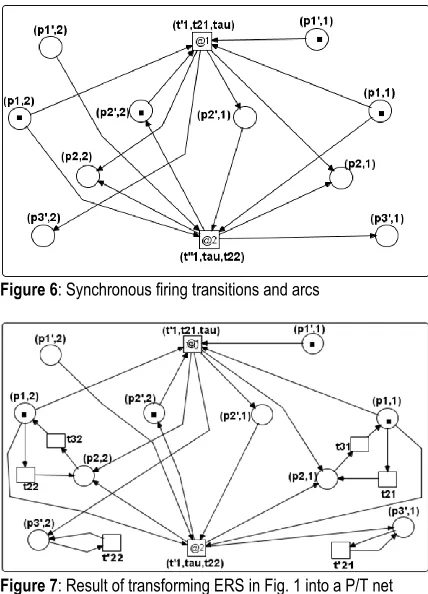
(17) In our example two places𝑝̂1 𝑎𝑛𝑑 𝑝̂2are marked with one net-token each in the initial marking. We add two transitions 𝑡1=
{{𝑡̂1, 𝑡21, 𝜏} and 𝑡2= {𝑡̂1, 𝜏, 𝑡22}annotated with @1 and @2, which is shown in Fig. 6.
The result of transforming ERS into P/T-net is shown in Fig. 7
Figure 6: Synchronous firing transitions and arcs
Figure 7: Result of transforming ERS in Fig. 1 into a P/T net
5. Isomorphic Property of the State Spaces and Analysis of Space Upper Bound
A. Isomorphic Property of State Space Spaces
In this subsection we establish an isomorphism between the states of an ERS and the generated 1-safe P/T-net. In Rule 2 we defined two separate initial markings for the P/T-net N∗: M
0∗(p̂, i) and M0∗(p, i). The former is an encoding of markings from the set of places P̂ of the system net in an ERS and the latter is an encoding of markings from the set of places Pi of an object nets i. Likewise, we defined three sets of transitions: Tsat∗ , Tnat∗ , and Tsynci
∗ from Rule 3, Rule 4 and Rule 5 respectively in N∗. In
the following, we define some mappings from the P/T-net to an ERS.
Definition 11. A mapping 𝑓̂ maps a marking 𝑀∗ of a P/T-net 𝑁∗
from the set of places 𝑃̂ to markings 𝑅 of a system net of an ERS as follows:
𝑓̂(𝑀∗)(𝑝̂, 𝑖) = 𝑅(𝑝̂) 𝑠𝑢𝑐ℎ 𝑡ℎ𝑎𝑡 (𝑝̂, 𝑖) ∈ 𝑃
𝑁∗∗: 𝑝̂ ∈ 𝑃̂: 𝑖 ∈ 𝑅 (18) Definition 12 A mapping 𝑓 maps a marking 𝑀∗ of a P/T-net 𝑁∗
from the set of places 𝑃𝑖 of net-token 𝑖 of an ERS to a marking
𝑀 of an object net of an ERS as follows:
𝑓(𝑀∗)(𝑝, 𝑖) = 𝑀(𝑝) 𝑠𝑢𝑐ℎ 𝑡ℎ𝑎𝑡 (𝑝, 𝑖) ∈ 𝑃
𝑁∗∗: 𝑝 ∈ 𝑃𝑖: 𝑖 ∈ 𝑅
(19)
Definition 13 𝑔̂ is a mapping that maps a transition 𝑡′
𝛽𝑖(𝑥)∈
𝑇𝑠𝑎𝑡∗ of P/T-net 𝑁∗ to a system-autonomous firing mode (𝑡̂, 𝜏) ∉
𝑑𝑜𝑚(ℓ) of an ERS as follows:
𝑔̂(𝑡′
𝛽𝑖(𝑥)) = (𝑡̂, 𝜏) , (20)
Definition 14𝑔 is a function that maps a transition 𝑡 ∈ 𝑇𝑛𝑎𝑡∗ of
P/T-net 𝑁∗to an object-autonomous firing mode (𝜏, 𝑡
𝑖) ∉
𝑑𝑜𝑚(ℓ) of an ERS as follows.
𝑔(𝑡) = (𝜏, 𝑡𝑖) . (21) Definition 15 𝑔𝑠 is a mapping function that maps a transition
𝑡𝑖.𝛽𝑖(𝑥)∈ 𝑇𝑠𝑦𝑛𝑐𝑖
∗ of P/T-net 𝑁∗ to a synchronisation firing mode
(𝑡̂, 𝑡1, … , 𝑡𝑘) ∈ ℓ of an ERS as follows:
𝑔𝑠(𝑡𝑖.𝛽𝑖(𝑥)) = {(𝑡̂, 𝑡1, … , 𝑡𝑘)} (22) With respect to these definitions, the following lemmas related to ERS and a P/T-net constructed by Rules 1 to 5, hold.
Lemma 1 For the initial marking at the system net level, the following equality holds:
𝑅0(𝑝̂) = 𝑓̂ (𝑀
0∗)(𝑝̂, 𝑖). (23)
Lemma 2 Suppose that 𝑅 = 𝑓̂(𝑀∗) and (𝑡̂, 𝜏) = 𝑔̂(𝑡′
𝛽𝑖(𝑥)).
The following proposition holds:
𝑀∗[𝑡′
𝛽𝑖(𝑥)> ⇔ 𝑅[(𝑡̂, 𝜏) > . (24)
Lemma 3 Suppose that 𝑅1= 𝑓̂(𝑀1∗), 𝑀1∗[𝑡′𝛽𝑖(𝑥)> 𝑀2 ∗, and
𝑅1[𝑔̂(𝑡′𝛽𝑖(𝑥)) > 𝑅2. The following equality holds.
𝑅2= 𝑓̂(𝑀2∗) . (25)
Lemma 4 For the initial marking of the object net, the following holds:
𝑀0(𝑝) = 𝑓(𝑀
0∗)(𝑝, 𝑖) . (26) Lemma 5. Suppose that 𝑀 = 𝑓(𝑀∗) and (𝜏, 𝑡
𝑖) = 𝑔(𝑡). The
following proposition holds:
𝑀∗[𝑔(𝑡) > ⇔ 𝑀[((𝜏, 𝑡
𝑖)) > . (27)
Lemma 6. Suppose that 𝑀1= 𝑓(𝑀1∗), 𝑀1∗[𝑡 > 𝑀2∗, and
𝑀1[𝑔(𝑡) > 𝑀2. The following equality holds:
𝑀2= 𝑓(𝑀2∗). (28)
Lemma 7. Suppose that (𝑅1,𝑀1) = 𝑓𝑠(𝑀1∗) and 𝑡𝑠=
𝑔𝑠(𝑡𝑖.𝛽𝑖(𝑥)). The following proposition holds:
𝑀1∗[𝑔𝑠(𝑡𝑖.𝛽𝑖(𝑥)) > ⇔ (𝑅1, 𝑀1)[𝑡𝑠>. (29)
Lemma 8 Suppose (𝑅1, 𝑀1) = 𝑓𝑠(𝑀1∗), 𝑀1∗[𝑡𝑖.𝛽𝑖(𝑥)> 𝑀2 ∗
and(𝑅1, 𝑀1)[𝑔𝑠(𝑡𝑖.𝛽𝑖(𝑥)) > (𝑅2, 𝑀2). The following holds:
(𝑅2, 𝑀2) = 𝑓𝑠(𝑀2∗) . (30)
From the above Lemmas, the following theorem holds.
Theorem 2 Let RS be a 1-safe ERS. Let also N∗ be a 1-safe P/T-net obtained from RS by the set of transformation Rules 1 to 5 above. Then state spaces of RS and N∗ are isomorphic.
Proof: Lemmas 1 and 4 defines a one-to-one mapping between the initial markings of the 1-safe P/T-net N∗and the initial marking in RS. From Lemma 2 a system-autonomous firing mode
(𝑡̂, 𝜏) is enabled in a marking (𝑅, 𝑀) if, and only if, the
corresponding transition𝑡′
𝛽𝑖(𝑥)is enabled in the corresponding marking 𝑀∗. Similarly, from Lemma 5 an object-autonomous firing mode(𝜏, 𝑡𝑖)is enabled in a marking(𝑅, 𝑀) if, and only if, the corresponding transition 𝑡 is enabled in the corresponding
marking 𝑀∗. Again, from Lemma 7 a synchronous firing mode
(𝑡̂, 𝑡1, … , 𝑡𝑘)is enabled in a marking(𝑅, 𝑀)if, and only if, the corresponding transition 𝑡𝑖.𝛽𝑖(𝑥) is enabled in the corresponding 𝑀∗. Finally from Lemmas 3, 6 and 8, the generated markings in the 1-safe P/T-net can be mapped to the
generated markings in the RS.
□
Thus we have shown that every ERS can be transformed to behaviourally equivalent 1-safe P/T-net. In the next subsection we analyse the space upper bound associated with transforming an ERS into 1-safe P/T-net.
B. Space Upper Bound Analysis for the Transformation In this subsection we discuss the space upper bound analysis associated with translating ERS into a 1-safe P/T-net. Let us suppose that the number of adjacent places for transition at the system net level is at most 𝜌, the number of places for each
transition of object nets is at most 𝛾, the number of object nets is
𝑘, and the number of to tokens in the initial marking of the system and object nets is 𝛿.
The space complexity of generating places at Rule 1 is
𝑂(𝑘|𝑃̂| + |𝑃𝛴|) because at most 𝑘 copies of object net places are generated for each place of the system net, and at most |𝑃𝛴| are generated for each place of object nets. The space complexity of generating initial marking at Rule 2 is 𝑂(𝛿).The number of bindings for each arc variable adjacent to each transition of the system net is at most kρ; therefore, the space complexity of generating transitions at Rule 3 is 𝑂(𝑘𝜌|𝑇̂|). The number of arcs for each transition is at most ρ; therefore, the complexity of generating arcs at Rule 3 is 𝑂(𝑘𝜌𝜌|𝑇̂|). The space complexity of generating transitions at Rule 4 is 𝑂(|𝑇𝛴|). The number of arcs for each transition of object nets is at most γ; therefore the space complexity of generating arcs at Rule 4 is 𝑂(𝛾|𝑇𝛴|).
One transition representing a synchronous transition is composed of at most 𝑘 + 1 transitions because of transition relation
function; therefore, the number of transitions represented in the set of synchronous transitions will grows to the 𝑘 + 1 power of the number of transitions in the ERS. Consequently, the complexity of generating transitions at Rule 5 is 𝑂(𝑘(𝑘+)𝜌|𝑇̂|). In the worst case, 𝜌 and 𝛾 equals the number of places and k
grows as the number of object nets increases. Thus, the complexity of complete transformation is exponential with the size of the ERS. Moreover, due to conditions (1), (2), (3) and (4) imposed on variables appearing on arcs adjacent to a transition t̂
of the system net in definition 4, the space upper bound for complete transformation is exponential with the size of the components of the ERS. As a result, the space requirement for the transformation from ERS to a low-level Petri nets is very huge.
6. Conclusion
As introduced in this article, various classes of OOP-nets are proposed so far. ERS follows the net-within-net paradigm by considering a Petri net as an object. Such a formalism is suitable to model applications in, for example, an agent context but further applications are expected. Not only simulation techniques but analytical schemes are important, however only studies about decidability of the reachability have been carried out so far. The need for application analytical method has encourage and driven the development of a set of transformation rule from ERS to Petri nets. Analysis shows that states space of ERS and the resulting
Petri net are isomorphic, however the space required by the algorithm grows exponential with the size components of an ERS. Future developments are expected to implement and bundle the transformation algorithm into a software tool.
Acknowledgement
The author would like to express his gratitude to family and friends
REFERENCES
Abdullahi, I. J. and Mϋller, B. (2016). Towards efficient verification of elementary object systems. In CS&P 2016, volume 247, pages 86{100. Humboldt University and CEUR.
Chen, P. A. (2000) Use Case Driven Object-Oriented Design Methodology for the Design of Multi-Level Workflow Schemas. PhD thesis, Department of Computer Science, Ill. Inst. of Tech., Chicago, IL.
Holliday, M. A. and Vernon, M. K. (1987). A generalized timed petri net model for performance analysis. IEEE Transactions on Software Engineering, vol. 12, pp. 1297 - 1310. Jensen, K. (1981). Coloured petri nets and the invariant-method.
Theoretical computer science, 14(3):317{336.
Jensen, K. (2013). Coloured Petri nets: basic concepts, analysis methods and practical use, volume 1. Springer Science & Business Media.
Kummer, O. (2002). Referenznetze: Dissertation zur Erlangung des Doktorgrades am Fachbereich Informatik der Universit•at Hamburg. Logos.
Masri, A., Bourdeaudhuy, T., and Toguyeni, A. (2009) Performance Analysis of Wireless Networks with Object Oriented Petri Nets, Proc. of Electronic Notes in Theoretical Computer Science vol.242, pp.73-85,
Miyamoto, T., Krogh, B. H., and Kumagai, S. (2002). Context-dependent agents for real-time scheduling in manufacturing systems, IEICE Trans. Fundamentals, vol. E 85-A, no.11, pp. 2407-2413.
Murata, T. (1989). Petri nets: Properties, analysis and applications, Proc. IEEE, vol.77, no.4, pp.541-580. Rinkcs, A., Gyimesi, A., and Bohcs, G. (2014). Adaptive
Simulation of Automated Guided Vehicle Systems Using Multi Agent Based Approach for Supplying Materials”, Journal of Applied Mechanics and Materials.
Valk, R. (1998). Petri nets as token objects. Application and Theory of Petri Nets, 1420:1-24.
Valk, R. (2003). Object Petri Nets: Using the nets-within-nets paradigm, advanced course on petri nets 2003 (J. Desel, W. Reisig, G. Rozenberg, eds.), 3098. Appendix A: Proof of Theorem, 3.