RESEARCH ARTICLE
A SECURE 2 LAYER LSB BASED AUDIO STEGANOGRAPHY USING HUFFMAN CODING
1
Ratul Chowdhury,
*2Samir Kumar Bandyopadhyay and
3Anirban Das
1
Department of Computer Science and Engineering, Future Institute of Engineering and Management,
Kolkata, India
2
Department of Computer Science and Engineering, University of Calcutta, Kolkata, India
3
UG student, Jogesh Chandra Chowdhuri College, Kolkata, India
ARTICLE INFO
ABSTRACT
Inthis paper we present a novel audio steganography method where the concept of Huffman coding and sparse matrixhas been introduced. The proposed method has reduced the secret message using Huffman coding and in next phase it exploits the sparse representation of the reduced string to embed secret message into higher semantic level of the cover audio file.For embedding purpose,the traditional LSB method has been used. The proposed method maintains both the stego signal quality and embedding capacity, which are the two major requirements of any steganography algorithm. The experimental resultillustrates that the stego signal generated by proposed method are perceptually indistinguishable from the original cover file. The experimental result is qualified by two quality measure Mean square errorand Signal to Noise Ratio. When compared with other methods, the proposed method is shown to be superior on addressing major requirements, imperceptibility, undetectability and capacity major.
Copyright©2016,Ratul Chowdhury et al.This is an open access article distributed under the Creative Commons Attribution License, which permits unrestricted use, distribution, and reproduction in any medium, provided the original work is properly cited.
INTRODUCTION
Information security is the technique of restricting information from unauthorized access, use, disclosure, disruption, modification, perusal, inspection, recording or destruction. Increasing need of secure private information transmission over internet inspired by many researchers to make great efforts to explore steganography methods. The rapid e-communication over the internet has led to the use of three security techniques: cryptography, watermarking and steganography. In cryptography, the content of the messages are mangled. In watermarking, data are hidden to convey some information such as ownership and copyright. The third one is steganography. The word Steganography was derived from ancient Greek words steganos meaning "covered, concealed or protected" and graphein meaning "writing”. Undetectebility is the major issue of any steganography algorithm. Undetectability ensures that the stego signal, containing the secretmessage is indistinguishable from the original signal bymeans of either the human auditory system (HAS) or steganalysismethods.
*Corresponding author:Samir Kumar Bandyopadhyay,
Department of Computer Science and Engineering, University of Calcutta, Kolkata, India
Unlike cryptography, the message is unaltered in steganography. Here the messages are hidden within a media in such a way that none can understand the very existence of the message i.e. it cannot be perceived by human. Such systems only make sense when there is an intruder. This intruder may be passive and merely observe the traffic, or he may be active and modify it. So the arrack can be of two type’s passive and active attack. In steganography applications, passive attack is considered while its goal is to detect whether steganography is being used or not and it does not disturb the communication before detecting the suspicious signals. Active attacks such as noise addition, MPEG audio coding, cropping, time shifting, filtering, resampling, requantization etc. The combination of cryptography and steganography increases the level of security. In first level the secret message is encrypted by different cryptography algorithm and in next level the encrypted message is embedded into the cover file. In this proposed method, we have used Huffman coding which not only reduce the size of the secret message into a desirable length, at the same time it provides a level of encryption. Huffman coding is a lossless data compression algorithm, the idea behind it is to assign variable length codes to input characters, lengths of the assigned codes are based on the frequencies of corresponding
ISSN: 0976-3376
Asian Journal of Science and Technology Vol. 07, Issue, 07, pp.3216-3222, July,2016ASIAN JOURNAL OF
SCIENCE AND TECHNOLOGY
Article History:
Received 28th April, 2016
Received in revised form 21st May, 2016
Accepted 19th June, 2016
Published online 30th July, 2016
Key words:
characters present in it. According to this algorithm, the most frequent character gets the smallest code and the least frequent character gets the largest code. In next part we have applied the concept of sparse matrix into the reduced string. In sparse matrix representation, only the value of nonzero elements is stored in memory to reduce the wastage of memory. In our method a 4*4 temporary matrix has been constructed from the reduced target string where most of elements are zero. We have done the second level encryption by sending the location of the nonzero elements that is their row and column number. The second advantage is that we don’t have to send the value of the nonzero elements because we are working with the binary sequence where nonzero means 1.The traditional LSB method has been used for embedding purpose. It is the simplest steganography technique to embed the bits of the target string into the least significant position of the cover file. Modulating the least significant bit does not result in human-perceptible difference because the amplitude of the change is very small.
Related work
Steganography is the technique of secure communication where the existence of the communication itself cannot be detected. On the otherhand, steganalysis is the art of detecting the secret communication. The medium which is used to carry message are called cover media which is basically image, audio or video file over public media. The concept of cryptography is about concealing the content of the message where the concept of steganography is concealing the existence of the secret messages. The ultimate goal is to embed the messages into the cover media in such a way that its existence is undetectable (Malik, Hafiz et al., 2015). In steganography system, it is basically assumed that there is a secret key agreement between sender and receiver. The secret key has been send through a secure channel. On the other hand, the stego signal is transmitted through public channel. In the receiving side, by using the secret key, the hidden message is extracted from the stego file. To hide the existence of the secret message into the stego file, cryptography and steganography are sometimes combined. There are basically two types of attack in the field of data hiding: passive and active attack. The goal of passive attack is to detect weather stegagraphy is being used or not. Itdoes not disturb the communication before detecting the suspicious signals. Active attacks such as noise addition, MPEG audio coding, cropping, time shifting, filtering, resampling, requantization, etc, (Ahani
et al., 2015).
Steganography algorithm works in two domain frequency: domain and time domain. In frequency domain audio steganography methods are the ones in which various transform domains such as Fast Fourier Transform (FFT), Discrete Cosine Transform (DCT), and Discrete Wavelet Transform (DWT) are used to embed the secret message in the coefficients of the cover audio. Another data hiding technique is least significant bit modification it works in time domain. LSB methods typically achieve both high payload and low perceptibility. However, because the fact that the data are hidden in the least significant bit may be known, LSB methods are vulnerable to extraction by unauthorized parties, (Ahani et
al., 2015). So cryptography and steganography are now
combined. Audio steganography technique must satisfy three core conditions.
Capacity: Capacity means the amount of secret
information that can be embedded within a cover audio file.
Transparency: Transparency evaluates how well a secret
message is embedded into a cover audio so that its existence is undefined.
Robustness: Robustness measure is the ability of secret
message to withstand against attacks.
The popular audio steganography techniques are (Kiah et al.,
2011 and Zamani et al., 2009).
Low bit encoding: It is technique to store the data into
the least significant bits of the cover file. It is a simple technique and by using this technique and by using this technique a huge volume of text can be embedded into a cover file (Banerjee et al., 2013).
Phase coding: Phase coding works by substituting the
phase of an initial audio segment with a reference phase, this phase actually represents the hidden data.
Spread spectrum technique: It is a technique designed
to encode any stream of data via spreading the encoded data across as much of the frequency spectrum as possible (Roshidi Din et al., 2006).
Echo hiding: Echo technique embeds data into a cover
audio signal by introducing an echo; the hidden data can be adjusted by two parameters, the first one is amplitude and the second is offset. These two parameters represent the magnitude and time delay of the embedded echo.
of data (Kiah, 2011). This gives an increased robustness against noise addition. Lots of different idea has been used in image steganography. Chaos Based Spread Spectrum Image Steganography (CSSIS) a novel scheme of (CSSIS) involving the use of chaotic encryption and chaotic modulation in spread spectrum image steganography (SSIS)has been proposed
(Satish et al., 2004), 3d steganography is another approach
based on a novel multilayered embedding scheme to hide secret messages in the vertices of 3D polygon models (Chao
et al., 2009).
Detailed method for encryption
Steps to build Huffman Dictionary
The compression of the secret message by using Huffman coding has been done by using four steps:
Construction of a private key.
Probability calculation of each character present in the private key.
Huffman tree construction.
Conversion of the target string into code word from the Huffman tree.
Construction of private key
A private key has been constructed into the sending side. The private key is basically a pangram string which contains all the characters and special symbols. There is an agreement between sender and receiver is that the same private key should be present in the receiving side.
Probability calculation of each character present at the private key
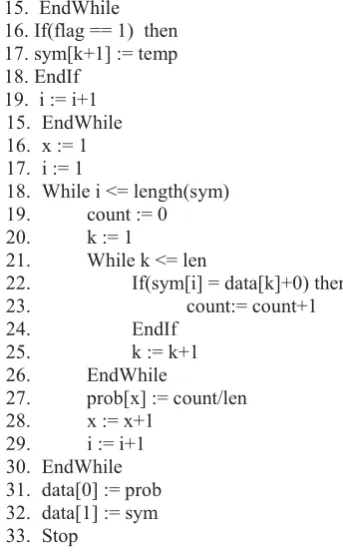
Probability of occurrence of each character into the private key is calculated by (Total number of occurrence of each character)/ (the length of the private key). The calculate probability algorithm describes the exact method and its output shown in Table 1.
Algorithm calculate probability
Input: The pangram string
Output: Probability of each character present in the pangram string.
1. Start
2. len = length(data)
3. sym[1] := data[1]+0
4. prob[1] := 1;
5. i := 2
6. While i <= len :
7. temp := data[i]+0
8. flag := 1
9. k := 1
10. While k <= length(sym)
11. If(sym[k] = temp) then
12. flag := 0
13. EndIf
14. k := k+1
15. EndWhile 16. If(flag == 1) then 17. sym[k+1] := temp 18. EndIf
19. i := i+1
15. EndWhile
16. x := 1
17. i := 1
18. While i <= length(sym)
19. count := 0
20. k := 1
21. While k <= len
22. If(sym[i] = data[k]+0) then
23. count:= count+1
24. EndIf
25. k := k+1
26. EndWhile
27. prob[x] := count/len
28. x := x+1
29. i := i+1
30. EndWhile
31. data[0] := prob
32. data[1] := sym
33. Stop
String:-“i love computer science.”
Symbol Probability
105 0.0833
32 0.1250
108 0.0417
111 0.0833
118 0.0417
101 0.1667
99 0.1250
109 0.0417
112 0.0417
117 0.0417
116 0.0417
114 0.0417
115 0.0417
110 0.0417
46 0.0417
Table 1. Probability calculation of each character Present in the private key
Huffman tree construction
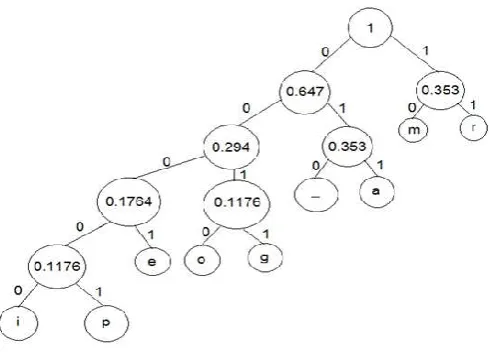
In this phase the input is an array of unique characters with their frequency of occurrences and output is the Huffman Tree. The following steps illustrate the construction.
Create a leaf node for every unique character and add it to the priority queue.
Repeat Step 2.1 to 2.3 while no_of_nodes > 1[Here, no_of_nodes is number of nodes in the priority queue.]
Delete 2 nodes from the queue which has the lowest frequency (Highest priority).
Create a new node with the frequencies equal to the sum of the two node’s frequencies. Then make the first taken node is the left child and the second node is the right child of new node.
Insert the new node in the queue.
The remaining node of the queue is root node of the tree.
Figure 1 shows the tree construction
Figure 1. Huffman tree construction
Construction of temporary matrix from the reduced target string
The reduced string is nothing but a binary sequence and it should be a multiple of 16.If the sequence is not multiple of 16, padding some extra 0 at the beginning of the string has been done. A temporary 4*4 matrix has been constructed form the reduced target string shown in Figure 2.
Figure2. Construction of temporary matrix
Row and column number estimation of each nonzero element
From each 4*4 temporary matrix we have to find the location number of each nonzero element. A temporary table has been constructed which contains the location of each nonzero elements and its corresponding binary equivalent. These
binary equivalent values are further used for LSB replacement.The temporary table construction from matrix 1 and 2 are shown in Table 2 and 3.
Table 2. Number of nonzero elements with their location from Figure 2 first matrix
No of nonzero elements Row value Column value
1 0(00) 1(01)
2 0(00) 2(10)
3 1(01) 3(11)
4 2(10) 1(01)
5 2(10) 2(10)
6 3(11) 3(11)
Table 3.Number of nonzero elements with their location from Figure 2 second matrix
No of nonzero elements Row value Column value
1 0(00) 1(01)
2 0(00) 2(10)
3 1(01) 2(10)
4 1(01) 3(11)
5 2(10) 1(01)
6 2(10) 2(10)
7 3(11) 1(01)
Size estimation
Each temporary matrix contains 16 characters of the target string. So the number of temporary matrix from the target string will be :- (No of characters in the target string/16).If the target string is not a multiple of 16,add some extra 0 in the beginning of the string to convert it into multiple of 16.
LSB replacement
The LSB of the first 10 rows of the cover file are replaced by the number of temporary matrix. From row number 11 select each temporary matrix and replace each LSB of the cover file by the location of the nonzero element present in that matrix. After embedding the whole encrypted message into the cover file , the required stego file will be created.
Detailed method for decryption
The stego file is the input to the receiving end.In two phases,the operation is performed in the receiving end. In first phase the required reduced string has been constructed by temporary matrix construction. In second phase the Huffman decryption algorithm has been used to find the required target string.
Digital encoding of the stego file
It performs bit level manipulation to encode the message. The following steps are
Accept the stego file as input.
Finds its binary equivalent.
Block it into 8-bits pattern.
Size estimation
Temporary matrix construction
A temporary 4*4 matrix has been constructed where all the elements are initially 0. After row number 10, each 4 consecutive rows first define the number of nonzero elements containingin the temporary matrix and the next part defines the row and column number of each nonzero element. After identifying the row and column number of each nonzero element replace the corresponding position of the temporary matrix by 1. The matrix construction is shown in Figure 3.
Figure 3. Temporary matrix in the receiving side
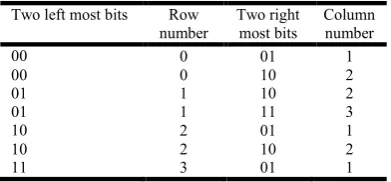
Now let us consider the LSB of the four sequential consecutive blocks are 0111, 0001,0010,0110,0111,1001,1010,1101.The decimal equivalent of the first four LSB is 7, which signifies the number of nonzero elements in the temporary matrix . For the rest of the elements, two left most bit signifies the row number and two right most bit signifies the corresponding column number of the nonzero element. The location of the nonzero elements isshown in Table 4.
Table 4. Location identification of the nonzero elements
Two left most bits Row number
Two right most bits
Column number
00 0 01 1
00 0 10 2
01 1 10 2
01 1 11 3
10 2 01 1
10 2 10 2
11 3 01 1
The row and column number identified from table 4 are the location of the nonzero elements. The matrix construction from the nonzero elements isshown in Figure 4.
Figure 4. Construction of temporary array with nonzero element
Construction of reduced target string from the temporary matrix
All the content of the temporary matrix are stored in a temporary array successively. After completing the entire temporary matrix, the required target string will be created.
Construction of original target string
From the reduced target string the desired target string is constructed by using Huffman decryption algorithm. This has been performed by two steps
By using the private key the Huffman dictionary has been constructed in the same way in the sender side.
By using the Huffman dictionary the required target string has been constructed.
Algorithm Encryption
Input: A cover audio file and a target string.
Output: A Stego file.
1. Start
2. Digitalize the cover file and group it into 8 bits block. 3. Input the target string.
4. Construction of private key which is basically a pangram string consists of all the characters and special symbol. 5. Probability calculation of each characters of the private
key using algorithm calculates probability.
6. Construction of Huffman tree using algorithm Huffman_Tree.
7. Using Huffman tree convert all the characters of the target string into code words which is the encrypted and reduced version of the original target string.
8. The target string should be multiple of 16 if not convert it into multiple of 16 by padding some extra zeros at the start of the string.
9. Store 16 characters of the target string into a4*4 temporary matrix in row major order.
10.This temporary matrix construction procedure will continue until the end of the target string.
11.From each 4*4 temporary matrix create a temporary table which consists of each nonzero element’s row and column number.
12.Each temporary matrix contains 16 elements.So the number of temporary matrix is (No of characters present in the target string)/16. Suppose the number of temporary matrix is temp.
13.Replace the LSB of row number 1-10 of the cover file with the binary representation of temp.
14.For each temp performs the following steps:
Replace the next four consecutive LSB of the cover file by the binary equivalent of nonzero elements contains into the temporary matrix constructed from the target string. Suppose the number is num.
For each num performs the following steps:
Replace the next four consecutive LSB of the cover file by the row and column number of each nonzero element one by one.
15. The stego file has been created. 16. Stop
Algorithm Decryption
Input: The stego file.
Output: The target string.
1. Start.
2. Accept the stego file.
3. Finds the binary equivalent of stego file and group it into 8 bits block.
5. Construct a 4*4 temporary matrix (A) consist of all zeros.
6. For each value temp performs the following steps: 7. The decimal equivalent of the LSB of the next four
consecutive rows gives the number of nonzero elements into the temporary matrix. Suppose the number is num. 8. For each value of num performs the following steps:
From this point the LSB of each four consecutive row of the cover file gives the row and column number of each nonzero element present in the temporary matrix. The two most significant bits identified row number and the two least significant bits identified the column number.
Find the row and column number of each nonzero element.
Replace the corresponding row and column of the temporary matrix (A) by 1 and rest are zero.
The whole reduced target string is constructed form the temporary matrix sequentially and store in an array temp_reduced.
9. Private Key construction in the receiving side.
10.By using the private key the original target string has been constructed form temp_reduced.
11.Stop.
RESULTS
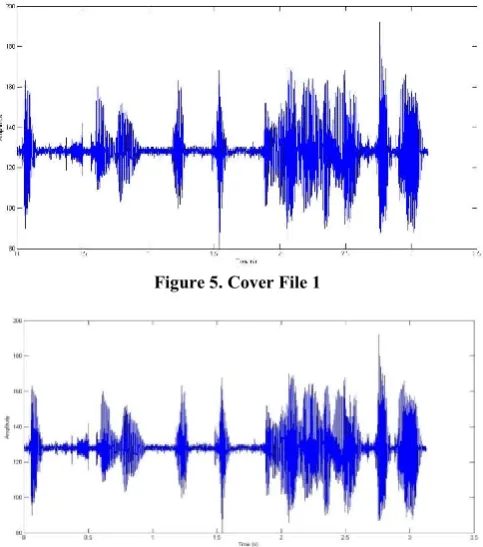
In result analysis phase we have used two sets of cover file: cover file 1 and cover file 2 shown in figure 5 and figure 9 .Three different length datasets has been used for transmission purpose. After embedding the target string into cover file 1 and cover file 2 the corresponding stego file are shown in Figure 6 to 8 and Figure 10 to 12.
Figure 5. Cover File 1
Figure 6. Cover File 1 after embedding 440 char(s)
Figure 7. Cover File 1 after embedding 350 char(s)
Figure 8. Cover File 1 after embedding 250 char(s)
Figure 9. Cover File 2
Figure 10. Cover File 2 after embedding 200 character(s)
Figure 12. Cover File 2 after embedding 400 character(s)
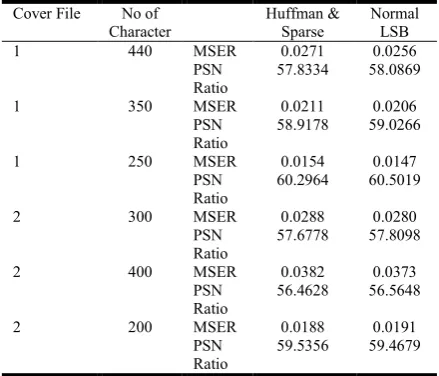
Imperceptibility and undetectability are the two major criteria of any steganography algorithm. The above graph illustrates that after embedding small, medium and large datasets, the stego file are perceptually indistinguishable from the original cover file. Their sound isalso audibly same. In the next section, we have compared our proposed method with traditional LSB method by twoquality measure Mean square error (MSE) and Signal to Noise Ratio (SNR). The comparison is shown in Table 5.
Table 5.Comparison with standard LSB method
Cover File No of
Character
Huffman & Sparse
Normal LSB
1 440 MSER 0.0271 0.0256
PSN Ratio
57.8334 58.0869
1 350 MSER 0.0211 0.0206
PSN Ratio
58.9178 59.0266
1 250 MSER 0.0154 0.0147
PSN Ratio
60.2964 60.5019
2 300 MSER 0.0288 0.0280
PSN Ratio
57.6778 57.8098
2 400 MSER 0.0382 0.0373
PSN Ratio
56.4628 56.5648
2 200 MSER 0.0188 0.0191
PSN Ratio
59.5356 59.4679
The above table illustrates that the Mid square error (MSER) and Signal to noise ratio (SNR) value of our proposed method is nearly equal to standard LSB method. At the same time, it provides a strong encryption. In normal LSB method,there is no security of data; the data is openly padded into the LSB of the cover file. But in first level , our proposed method encrypt and compress the target string by Huffman coding and in second level only the location of the nonzero elements has been padded.
Conclusion
We have proposed a novel audio steganography method by using the concept of Huffman coding and sparse matrix. A huge volume of text can be embedded into the cover file by using this method. By using a predefined private key, the Huffman encoding has been performed and the secret messages are embedded into non-zero elements of the sparse representation. The experimental results havebeen qualified
into two quality measures:Mid square error and Signal to noise ratio. The experimental result shows that difference between the original cover file and the stego file is minute. When compared with traditional LSB method, the value of the Mid square error and Signal to noise ratio shows that it is nearly equal to LSB method. So we can conclude that an improved data security has been obtained by our proposed method.
REFERENCES
Ahani, Soodeh, Shahrokh Ghaemmaghami, and Z. Jane Wang. 2015. "A sparse representation-based wavelet domain speech steganography method."Audio, Speech, and Language Processing, IEEE/ACM Transactions on 23.1 (2015): 80-91.
Banerjee, Sean, Sandip Roy, M. S. Chakraborty, and Simpita Das. 2013. "A variable higher bit approach to audio
steganography." International Conference on In Recent
Trends in Information Technology (ICRTIT), pp. 46-49.
IEEE, (2013, Jul 25-27), Chennai, India.
Bhowal, K., Bhattacharyya, D., Pal, A.J., Kim, T.H. 2013. “A GA based audio steganography with enhanced security.” Telecommunication Systems., Apr 1; 52(4):2197-2204.
Chao, Min-Wen, et al. 2009. "A high capacity 3D
steganography algorithm."Visualization and Computer Graphics, IEEE Transactions on 15.2 (2009): 274-284.
Datta, Biswajita, Souptik Tat, and Samir Kumar
Bandyopadhyay. 2015. "Robust high capacity audio
steganography using modulo operator."International
Conference onComputer, Communication, Control and Information Technology (C3IT), IEEE, (2015, December
21-24), Himachal Pradesh, India.
Kiah, M.L., Mat, B. B. Zaidan, A. A. Zaidan, A. Mohammed Ahmed, and Sameer Hasan Al-bakri. 2011. "A review of
audio based steganography and digital watermarking." Int.
J. Phys. Sci., 6, no. 16 (2011): 3837-3850.
Malik, Hafiz, K. P. 2012. Subbalakshmi, and Ramamurti Chandramouli. "Nonparametric steganalysis of qim steganography using approximate entropy." Information Forensics and Security, IEEE Transactions on 7.2 (2012): 418-431.
Rahim, L.B., Bhattacharjee, S. and Aziz, I.B. 2014. “An Audio Steganography Technique to Maximize Data Hiding Capacity along with Least Modification of Host”. In Proceedings of the First International Conference on Advanced Data and Information Engineering (DaEng-2013) Jan 1 (pp. 277-289). Springer Singapore.
Roshidi Din, Hanizan Shaker Hussain, and Sallehuddin Shuib, ―”Hiding secret messages in images: suitability of different image file types”, Wseas Tionsransac on Computers, vol. 6(1), January 1 2006, pp. 127 -132.
Satish, K., et al. 2004. "Chaos based spread spectrum image
steganography."Consumer Electronics, IEEE Transactions on 50.2 (2004): 587-590.
Vimal, Jithu. "Literature Review on Audio Steganographic Techniques."
Zamani, M., Manaf, A., Ahmad, R.B., Jaryani, F., Taherdoost, H, Zeki, A.M. 2009. ”A secure audio steganography
approach”. International Conference on Internet
Technology and Secured Transactions, (ICITST) (2009
Nov 9) pp. 1-6. IEEE, London, UK.