R E S E A R C H A R T I C L E
Open Access
Delayed appendectomy versus early
appendectomy in the treatment of acute
appendicitis: a retrospective study
Chang Sik Shin, Young Nam Roh and Jae Il Kim
*Abstract
Background:The controversy still exists about the timing of operation for appendicitis. The aim of this study was to compare the outcomes between early appendectomy and delayed appendectomy and assess the feasibility of delayed operation.
Methods:The medical records of patients with acute appendicitis who received operation between January 1,
2011 and December 31, 2011, were retrospectively reviewed. Outcome measures were white blood cell (WBC) count at postoperative first day, time to soft diet, complication rate, surgical site infection (SSI) rate, length of hospital stay, and readmission within 30 days.
Results:During the study period, a total of 478 patients underwent appendectomies, and 145 patients were excluded, leaving 333 who met inclusion criteria. Based on the time from arrival at hospital to incision, they were divided into two groups: 177 (53.2%) in group A and 156 (46.8%) in group B. There were no significant differences in preoperative demographics and clinical data between two groups. The mean WBC count at postoperative first day of group B were lower than that of group A (p= 0.0039). There were no significant differences in time to soft diet, length of postoperative hospital stay, complication rate, and readmission rate between two groups. SSI including intra-abdominal abscess was also shown no significant difference (Group A, 1.7% and Group B, 3.9%; p= 0.3143).
Conclusions:This study revealed that delayed appendectomy was safe and feasible for adult patient although the clinical outcomes of delayed appendectomy were not superior to those of early appendectomy. We suggest that surgeons would decide the appropriate timing of appendectomy with consideration other situations such as available hospital resources.
Keywords:Appendicitis, Early appendectomy, Delayed appendectomy
Introduction
Acute appendicitis has been the most common intra-abdominal condition requiring operation. Emergency ap-pendectomy at the time of diagnosis was the standard of care for treatment of acute appendicitis during last cen-tury. Any delay in operation has been believed to increase postoperative morbidity or progress to complicated ap-pendicitis such as perforated apap-pendicitis or periappendi-ceal abscess [1,2].
However, the concept of emergency appendectomy has been recently challenged by studies which suggested that acute appendicitis could be treated medically, or delaying surgery did not show any increasing morbidity [3-7]. On the other hand, there are other studies which supported that appendicitis needed emergency surgical procedure and delay in surgery increased complication and length of hospital stay [8-10].
The controversy still exists about the timing of oper-ation for appendicitis. The aim of this study was to compare the outcomes between early appendectomy and delayed appendectomy and assess the feasibility of delayed operation.
* Correspondence:[email protected]
Department of Surgery, Ilsan Paik Hospital, Inje University College of Medicine, 170 Juhwaro, Ilsanseogu, Goyangsi, Gyeonggido, Republic of Korea
Materials and methods Patients
This study was designed as a retrospective, observational study at a single institution. The medical records of patients with acute appendicitis who received operation between January 1, 2011 and December 31, 2011, were retrospectively reviewed. We excluded the following pa-tients: (1) those who were under 16 years or over 65 years old, (2) those who underwent other surgical procedures along with appendectomy, such as cholecystectomy or oo-phorectomy, (3) pregnant women, and those with severe other medical disease requiring intensive care, (4) those who underwent incidental, interval, and negative append-ectomies. The patients were then divided into two groups for comparison: Group A, those with a time from arrival to incision less than 8 hours and Group B, those with a time from arrival to incision longer than 8 hours.
Data collection
The data were collected from the electronic medical re-cords (EMR). The following parameters were included: demographics, duration from onset of symptoms to visit our hospital, time from arrival to diagnosis as ap-pendicitis, time form diagnosis to operation, initial vital signs, initial laboratory findings, method of ap-pendectomy, combined drainage procedures, patho-logic findings, postoperative laboratory findings, time to a soft diet, postoperative complications, length of hospital stay, hospital costs, and readmissions within 30 days of surgery. We analyzed preoperative, operative, and postoperative clinical data obtained from each group. Hospital costs consisted of the total costs covered by National Health Insurance (NHI) and charges for non-covered items―non-covered bed charges or materials. The data on the following items were analyzed: the total hospital costs, the total costs covered by NHI and copay-ment by patients.
Outcome measures
Outcome measures were white blood cell (WBC) count at postoperative first day, time to soft diet, complication rate, surgical site infection (SSI), length of hospital stay, and readmission within 30 days.
Statistical analysis
The data were analyzed using SAS enterprise ver. 5.1 statistical software (SAS Inc, Cary, NC, USA). Demo-graphics and clinical characteristics were expressed as means for continuous variables or proportions for cat-egorical variables. The chi-square test was used to com-pare differences in categorical variables. Student’s t test or the Wilcoxon rank sum test was used to compare dif-ferences in continuous variables. Thepvalue of less than 0.05 was considered statistically significant.
Results
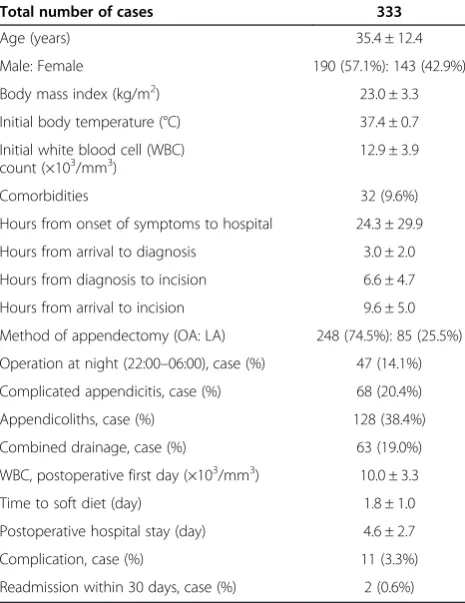
During the study period, a total of 478 patients underwent appendectomies, and 145 patients were excluded, leaving 333 who met inclusion criteria. Demographics and clinical characteristics of included cases are shown in Table 1. The mean age of patients was 35.4 years. There were 190 males (57.1%) and 143 females (42.9%). The average time from arrival at our hospital to diagnosis was 3.0 hours. The average time from diagnosis as appendicitis to skin sion was 6.6 hours. The average time form arrival to inci-sion was 9.6 hours. Based on the time from arrival at our hospital to incision, they were divided into two groups: 177 (53.2%) in group A and 156 (46.8%) in group B.
Comparisons of demographics and preoperative char-acteristics between two groups are shown in Table 2. There were significant differences in time parameter due to study design. There were no significant differences in age, sex ratio, body mass index (BMI), body temperature, initial WBC count, and comorbidities between two groups. Comparisons of operative characteristics between two groups are shown in Table 3. There were no significant differences in the ratio of laparoscopic appendectomy, op-erating time, the ratio of complicated appendicitis, and the ratio of accompanying external drainage procedure, and the ratio of accompanied by appendicoliths. There were significant differences between two groups in the
Table 1 Demographics and clinical characteristics
Total number of cases 333
Age (years) 35.4 ± 12.4
Male: Female 190 (57.1%): 143 (42.9%)
Body mass index (kg/m2) 23.0 ± 3.3
Initial body temperature (°C) 37.4 ± 0.7
Initial white blood cell (WBC) count (×103/mm3)
12.9 ± 3.9
Comorbidities 32 (9.6%)
Hours from onset of symptoms to hospital 24.3 ± 29.9
Hours from arrival to diagnosis 3.0 ± 2.0
Hours from diagnosis to incision 6.6 ± 4.7
Hours from arrival to incision 9.6 ± 5.0
Method of appendectomy (OA: LA) 248 (74.5%): 85 (25.5%)
Operation at night (22:00–06:00), case (%) 47 (14.1%) Complicated appendicitis, case (%) 68 (20.4%)
Appendicoliths, case (%) 128 (38.4%)
Combined drainage, case (%) 63 (19.0%)
WBC, postoperative first day (×103/mm3) 10.0 ± 3.3
Time to soft diet (day) 1.8 ± 1.0
Postoperative hospital stay (day) 4.6 ± 2.7
Complication, case (%) 11 (3.3%)
ratio of operation at night (Group A, 22.0% and Group B, 5.1%;p< 0.0001), and in the ratio of accompanying exter-nal drainage procedure (Group A, 24.9% and Group B, 12.2%;p= 0.0033).
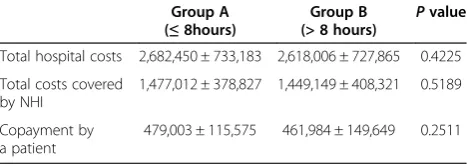
Comparisons of postoperative outcomes between two groups are shown in Table 4. The mean WBC count at postoperative first day of group B were lower than that of group A (p = 0.0039). There were no significant differ-ences in time to soft diet, length of postoperative hospital stay, complication rate, and readmission rate between two groups. Although surgical site infection (SSI) rate includ-ing intra-abdominal abscess (IA) of group B was slightly higher than that of group A, there was also no significant statistical difference (Group A, 1.7% and Group B, 3.9%; p= 0.3143). Table 5 shows results of hospital costs be-tween two groups and there were no significant differ-ences in all comparative variables.
Discussion
In Korea, the imaging modalities are so popular, and the payments are covered by national health insurance system.
Radiologic evaluation could help surgeons to confirm the diagnosis and to recognize the location of appen-dix, and/or other intra-abdominal conditions requiring other procedures. All patients in this study received radio-logic evaluation such as abdominal computed tomog-raphy (CT), abdominal ultrasonogtomog-raphy and they were diagnosed with acute appendicitis.
Appendectomy has still been the most common non-elective surgical procedure performed by general surgeons [11,12]. It was usually prepared at the time of diagnosis as appendicitis and done within hours to prevent the pro-gression of inflammation. However, the quality of antibi-otics was improved in the last few decades and interval appendectomy for periappendiceal abscess was shown bet-ter outcomes than early operation. Recent studies sug-gested that periappendiceal abscess in selected cases could be managed by nonsurgical treatment without interval appendectomy [13,14]. Furthermore, successful results of nonsurgical antibiotics treatment for selected cases with uncomplicated appendicitis were reported in recent litera-tures [6,15,16]. However, at the present, we do not agree that appendicitis is medical disease.
Controversies regarding the timing of operation in patients needed operation still exist. Some studies still supported that the outcomes of immediate or prompt appendectomy were better than those of delayed pendectomy [8-10,17,18]. They advocated that delayed ap-pendectomy produced more postoperative complication Table 2 Comparisons of demographics and preoperative
characteristics between two groups
Group A (≤8 hours)
Group B (> 8 hours) P
value
Number of cases 177 (53.2%) 156 (46.8%)
Age (yrs) 35.9 ± 125 34.7 ± 12.1 0.3758
Sex ratio (Male: Female) 103:74 87:69 0.6592
Body mass index (kg/m2) 23.1 ± 3.4 22.7 ± 3.1 0.2822
Body temperature (°C) 37.4 ± 0.7 37.4 ± 0.6 0.7701
Initial white blood cell count
(×103/mm3) 12.6 ± 3.8 13.3 ± 4.0 0.1150
Comorbidities 21 (11.9%) 11 (7.0%) 0.1915
Hours from onset of symptoms to hospital
26.4 ± 22.5 22.0 ± 16.7 0.1835
Hours from arrival to diagnosis 2.4 ± 1.1 3.6 ± 2.6 <0.0001
Hours from diagnosis to operation 3.4 ± 1.4 10.4 ± 4.3 <0.0001
Hours from arrival to operation 5.8 ± 1.5 13.9 ± 4.0 <0.0001
Table 3 Comparisons of operative characteristics between two groups
Group A (≤8 hours)
Group B (> 8 hours) P
value
Laparoscopic
appendectomy, case (%)
42 (23.7%) 43 (27.6%) 0.4513
Operation at night (22:00–06:00), case (%)
39 (22.0%) 8 (5.1%) <0.0001
Operating time (minute) 56.3 ± 21.8 53.5 ± 19.4 0.2236
Complicated appendicitis, case (%) 40 (22.6%) 28 (18.0%) 0.3408
Appendicoliths, case (%) 73 (41.2%) 55 (35.3%) 0.3097
Combined drainage, case (%) 44 (24.9%) 19 (12.2%) 0.0033
Table 4 Comparisons of postoperative outcomes between two groups
Group A (≤8 hours)
Group B (> 8 hours) P
value
WBC, postoperative first day
(×103/mm3) 10.5 ± 3.2 9.5 ± 3.3 0.0039
Time to soft diet (day) 1.9 ± 1.1 1.7 ± 0.8 0.0806
Postoperative hospital stay (day) 4.9 ± 2.8 4.4 ± 2.7 0.0719
Complication, case (%) 3 (1.7%) 8 (5.1%) 0.1225
Surgical site infection, case (%) 3 (1.7%) 6 (3.9%) 0.3143
Readmission within 30 days, case (%)
1 (0.6%) 1 (0.6%) 1.0000
Table 5 Comparisons of hospital costs between two groups
Group A (≤8hours)
Group B (> 8 hours)
Pvalue
Total hospital costs 2,682,450 ± 733,183 2,618,006 ± 727,865 0.4225
Total costs covered by NHI
1,477,012 ± 378,827 1,449,149 ± 408,321 0.5189
Copayment by a patient
479,003 ± 115,575 461,984 ± 149,649 0.2511
Values are presented as KRW (Korean won, Korean monetary unit). 1 USD = 1,108 KRW.
such as surgical site infection. On the other hand, some studies suggested that there was no significant differ-ence of outcomes between early and delayed append-ectomy [7,19,20]. In addition, several studies showed negative impact of prolonged working hours for residents or sleep deprivation on clinical performance and cognitive abilities [21,22].
The timing of surgery was actually affected by other factors such as limited operating room availability, lim-ited anesthesia availability, limlim-ited equipment availabil-ity, as well as decision of a surgeon like results in survey of pediatric surgeons [23]. In our hospital, all of eight surgeons preferred early appendectomy and they per-formed appendectomy within a few hours after diagnosis except midnight, if possible. However, number of surgi-cal residents was reduced and diseases to need operation were increased during last decade. Therefore waiting time to appendectomy has been naturally lengthened although early appendectomy was planned.
In our study, there were no significant differences in demographics, preoperative clinical characteristics be-tween early appendectomy and delayed appendectomy groups. It means that disease severity such as fever, WBC count either uncomplicated or complicated appendicitis did not affect the timing of surgery. In addition, there was no significant difference in the ratio of accompanied by appendicoliths between two groups. In our study, the presence of appendicoliths did not affect the timing of sur-gery unlike with results of recent studies [24,25].
There were no significant differences in time to soft diet and length of postoperative hospital stay between two groups. There were also no significant differences in all parameters regarding hospital costs between two groups. Especially, there was no significant difference in complica-tion rate including surgical site infeccomplica-tion. One patient in group A and one patient in group B readmitted due to postoperative intra-abdominal abscess within 30 days. These results were similar with previous other studies [7,19,20]. Therefore delayed appendectomy is safe similar with early appendectomy.
Moreover, mean WBC count at postoperative first day of group B was lower than that of group A. These results might be due to sufficient and effective preoperative intra-venous (IV) antibiotics injection to cover aerobic and an-aerobic colonic flora [26]. In our hospital, when a patient was diagnosed as uncomplicated appendicitis by clinical and radiologic evaluation, IV cephalosporin (first or sec-ond generation) was given to the patient. If a patient was diagnosed as complicated appendicitis, IV metronidazole was added. As a result, patients in group A received single dose preoperative antibiotics and patients in group B re-ceived those twice or three times.
There are several limitations of this study. Firstly, this study was retrospective observational study. As above
mentioned, several situations such as lack of resident, tight operation schedule made prospective study difficult. Sec-ondly, optimal timing of appendectomy could not be elu-cidated. We expect to solve these limitations through the large prospective randomized trial in the near future.
Conclusions
We still consider that appendicitis is not a medical dis-ease but a surgical disdis-ease. This study revealed that de-layed appendectomy was safe and feasible for adult patients with appendicitis although the clinical outcomes of delayed appendectomy were not superior to those of early appendectomy. Therefore, we suggest that surgeons would decide the appropriate timing of appendectomy with consideration other situations such as available hos-pital resources.
Competing interests
This work was supported by the 2012 Inje University research grant. We declare that we have no competing interests.
Authors’contributions
CSS, YNR, and JIK carried out study design, acquisition and analysis of data, and drafted the manuscript. JIK carried out the statistical analysis. YNR and JIK revised the manuscript. All authors read and approved the final manuscript.
Received: 10 December 2013 Accepted: 19 January 2014 Published: 21 January 2014
References
1. Temple CL, Huchcroft SA, Temple WJ:The natural history of appendicitis in adults. A prospective study.Ann Surg1995,221(3):278–281.
2. Eldar S, Nash E, Sabo E, Matter I, Kunin J, Mogilner JG, Abrahamson J:Delay of surgery in acute appendicitis.Am J Surg1997,173(3):194–198. 3. Hansson J, Korner U, Khorram-Manesh A, Solberg A, Lundholm K:
Randomized clinical trial of antibiotic therapy versus appendicectomy as primary treatment of acute appendicitis in unselected patients.Br J Surg 2009,96(5):473–481.
4. Styrud J, Eriksson S, Nilsson I, Ahlberg G, Haapaniemi S, Neovius G, Rex L, Badume I, Granstrom L:Appendectomy versus antibiotic treatment in acute appendicitis. a prospective multicenter randomized controlled trial.World J Surg2006,30(6):1033–1037.
5. Varadhan KK, Humes DJ, Neal KR, Lobo DN:Antibiotic therapy versus appendectomy for acute appendicitis: a meta-analysis.World J Surg2010, 34(2):199–209.
6. Liu K, Fogg L:Use of antibiotics alone for treatment of uncomplicated acute appendicitis: a systematic review and meta-analysis.Surgery2011, 150(4):673–683.
7. Nagpal K, Udgiri N, Sharma N, Curras E, Cosgrove JM, Farkas DT:Delaying an appendectomy: is it safe?Am Surg2012,78(8):897–900.
8. Udgiri N, Curras E, Kella VK, Nagpal K, Cosgrove J:Appendicitis, is it an emergency?Am Surg2011,77(7):898–901.
9. Ditillo MF, Dziura JD, Rabinovici R:Is it safe to delay appendectomy in adults with acute appendicitis?Ann Surg2006,244(5):656–660. 10. Earley AS, Pryor JP, Kim PK, Hedrick JH, Kurichi JE, Minogue AC, Sonnad SS,
Reilly PM, Schwab CW:An acute care surgery model improves outcomes in patients with appendicitis.Ann Surg2006,244(4):498–504.
11. Pittman-Waller VA, Myers JG, Stewart RM, Dent DL, Page CP, Gray GA, Pruitt BA Jr, Root HD:Appendicitis: why so complicated? Analysis of 5755 consecutive appendectomies.Am Surg2000,66(6):548–554. 12. Lee HJ, Park YH, Kim JI, Choi PW, Park JH, Heo TG, Lee MS, Kim CN,
13. Andersson RE, Petzold MG:Nonsurgical treatment of appendiceal abscess or phlegmon: a systematic review and meta-analysis.Ann Surg2007, 246(5):741–748.
14. Lugo JZ, Avgerinos DV, Lefkowitz AJ, Seigerman ME, Zahir IS, Lo AY, Surick B, Leitman IM:Can interval appendectomy be justified following conservative treatment of perforated acute appendicitis?J Surg Res2010,164(1):91–94. 15. Vons C, Barry C, Maitre S, Pautrat K, Leconte M, Costaglioli B, Karoui M,
Alves A, Dousset B, Valleur P,et al:Amoxicillin plus clavulanic acid versus appendicectomy for treatment of acute uncomplicated appendicitis: an open-label, non-inferiority, randomised controlled trial.Lancet2011,377(9777):1573–1579.
16. Sakorafas GH, Mastoraki A, Lappas C, Sampanis D, Danias N, Smyrniotis V: Conservative treatment of acute appendicitis: heresy or an effective and acceptable alternative to surgery?Eur J Gastroenterol Hepatol2011, 23(2):121–127.
17. Teixeira PG, Sivrikoz E, Inaba K, Talving P, Lam L, Demetriades D:Appendectomy timing: waiting until the next morning increases the risk of surgical site infections.Ann Surg2012,256(3):538–543.
18. Giraudo G, Baracchi F, Pellegrino L, Dal Corso HM, Borghi F:Prompt or delayed appendectomy? Influence of timing of surgery for acute appendicitis.Surg today2013,43(4):392–396.
19. Yardeni D, Hirschl RB, Drongowski RA, Teitelbaum DH, Geiger JD, Coran AG: Delayed versus immediate surgery in acute appendicitis: do we need to operate during the night?J Pediatr Surg2004,39(3):464–469. discussion 464–469.
20. Stahlfeld K, Hower J, Homitsky S, Madden J:Is acute appendicitis a surgical emergency?Am Surg2007,73(6):626–629. discussion 629–630.
21. Eastridge BJ, Hamilton EC, O’Keefe GE, Rege RV, Valentine RJ, Jones DJ, Tesfay S, Thal ER:Effect of sleep deprivation on the performance of simulated laparoscopic surgical skill.Am J Surg2003,186(2):169–174. 22. Kahol K, Leyba MJ, Deka M, Deka V, Mayes S, Smith M, Ferrara JJ,
Panchanathan S:Effect of fatigue on psychomotor and cognitive skills. Am J Surg2008,195(2):195–204.
23. Dunlop JC, Meltzer JA, Silver EJ, Crain EF:Is nonperforated pediatric appendicitis still considered a surgical emergency? A survey of pediatric surgeons.Acad Pediatr2012,12(6):567–571.
24. Ishiyama M, Yanase F, Taketa T, Makidono A, Suzuki K, Omata F, Saida Y: Significance of size and location of appendicoliths as exacerbating factor of acute appendicitis.Emerg Radiol2013,20(2):125–130.
25. Lien WC, Wang HP, Liu KL, Chen CJ:Appendicolith delays resolution of appendicitis following nonoperative management.J Gastrointest Surg 2012,16(12):2274–2279.
26. Maa J, Kirkwood KS:The Appendix.InSabiston Textbook of Surgery: The Biological Basis of Modern Surgical Practice.19th edition. Edited by Sabiston DC, Townsend CM. Philadelphia, PA: Elsevier Saunders; 2012:1279–1293.
doi:10.1186/1749-7922-9-8
Cite this article as:Shinet al.:Delayed appendectomy versus early appendectomy in the treatment of acute appendicitis: a retrospective study.World Journal of Emergency Surgery20149:8.
Submit your next manuscript to BioMed Central and take full advantage of:
• Convenient online submission
• Thorough peer review
• No space constraints or color figure charges
• Immediate publication on acceptance
• Inclusion in PubMed, CAS, Scopus and Google Scholar
• Research which is freely available for redistribution