R E V I E W
Open Access
Childhood-onset granulomatosis with
polyangiitis and microscopic polyangiitis:
systematic review and meta-analysis
Michele Iudici
1,2, Pierre Quartier
3, Benjamin Terrier
1, Luc Mouthon
1, Loïc Guillevin
1and Xavier Puéchal
1*Abstract
Background:The data from cohorts of childhood-onset granulomatosis with polyangiitis (GPA) and microscopic polyangiitis (MPA) remain scarce and heterogeneous. We aimed to analyse the features at presentation, therapeutic approaches and the disease course of these rare diseases.
Methods:Electronic searches of Medline and the Cochrane Central Register of Controlled trials database were conducted. We also checked the reference lists of the studies included and other systematic reviews, to identify additional reports. We included all cohorts, cross-sectional studies or registries reporting features at presentation or outcomes in patients with a diagnosis of childhood-onset GPA or MPA (age <18 years). The pooled prevalence of clinical manifestations at presentation, ANCA and induction therapies for GPA and MPA was calculated.
Results:We reviewed 570 full texts and identified 14 studies on GPA and 8 on MPA. Childhood-onset GPA and MPA occurred predominantly in female subjects during adolescence. For GPA, ear-nose-throat (ENT) disease (pooled prevalence 82 % [95 % CI 78–87]), constitutional symptoms (73 % [95 % CI 55–88]), renal (65 % [95 % CI 49–79]), and lower respiratory tract (61 % [95 % CI 48–74]) manifestations were the most frequently reported at
presentation. Renal disease was a hallmark of MPA (94 % [95 % CI 89–97]). ANCA were detected in >90 % of children with GPA or MPA. Combined corticosteroids and cyclophosphamide was the most frequently used first remission-inducing treatment for GPA (76 % [95 % CI 69–82]) and MPA (62 % [95 % CI 20–96]). Relapses occurred more frequently in GPA (67–100 %) than in MPA (25–50 %). The leading causes of death were the disease itself, and infections.
Conclusions:Childhood-onset MPA and GPA remain severe diseases with frequent relapses and a high cumulative morbidity. Survival and disease-free survival need to be improved.
Keywords:Granulomatosis with polyangiitis, Microscopic polyangiitis, Paediatrics
Background
Systemic vasculitis in children accounts for 2 to 10 % of the conditions evaluated in paediatric rheumatology clinics [1, 2]. IgA vasculitis and Kawasaki disease are the most common [3], whereas childhood-onset anti-neutrophil cytoplasmic antibody (ANCA)-associated vas-culitis (AAV), including granulomatosis with polyangiitis
(GPA, Wegener’s), eosinophilic granulomatosis with
po-lyangiitis (EGPA, Churg-Strauss) and microscopic poly-angiitis (MPA) are more rare. Our knowledge of these diseases is based mostly on small cohort studies or, more frequently, case series or reports. Since the development of the first specific paediatric classification of vasculitis by the European League Against Rheumatism (EULAR) and the Paediatric Rheumatology European Society (PReS) in 2006 [4], the number of cohorts of patients with paediatric AAV, mostly GPA, reported has steadily increased [5–12].
Nevertheless, the data from such cohorts remain scarce and heterogeneous, and no attempt has yet been * Correspondence:[email protected]
1National Referral Center for Rare Systemic Autoimmune Diseases, Department of Internal Medicine, Hôpital Cochin, Assistance Publique– Hôpitaux de Paris (APHP), Université Paris Descartes, Paris, France Full list of author information is available at the end of the article
© 2016 The Author(s).Open AccessThis article is distributed under the terms of the Creative Commons Attribution 4.0 International License (http://creativecommons.org/licenses/by/4.0/), which permits unrestricted use, distribution, and reproduction in any medium, provided you give appropriate credit to the original author(s) and the source, provide a link to the Creative Commons license, and indicate if changes were made. The Creative Commons Public Domain Dedication waiver (http://creativecommons.org/publicdomain/zero/1.0/) applies to the data made available in this article, unless otherwise stated. Iudiciet al. Orphanet Journal of Rare Diseases (2016) 11:141
made to outline the main features of these rare diseases more precisely.
We conducted a systematic literature review and meta-analysis: 1) to summarize the principal clinical and demographic features on presentation; 2) to describe the course of the disease and 3) to describe the therapeutic approaches reported for children with GPA and MPA.
Methods
Literature search
We performed a systematic literature review and a meta-analysis, to obtain a best estimate of the prevalence of clinical manifestations at presentation and to review the treatments given to patients with childhood-onset GPA and MPA. The Meta-analyses of Observational Studies in Epidemiology (MOOSE) guidelines were followed [13]. We conducted a literature search on Medline and the Cochrane Central Register of Controlled trials database from January 1, 1950 to December 31, 2015, as reported on Additional file 1. We also checked the reference lists of the studies included and other systematic reviews on the topic, to identify additional reports.
Inclusion criteria and procedure
We included all cohorts, cross-sectional studies or regis-tries reporting data for features at presentation or out-comes in patients with a diagnosis of childhood-onset GPA or MPA (age <18 years). All papers providing a base-line description of the study population were considered. Studies reporting only data for specific subgroups of patients (e.g. only patients with nephritis) were excluded.
The titles and abstracts of all the references identified were reviewed independently by two of the authors (MI, XP). The full text of the articles considered potentially relevant was then screened and checked for eligibility. Any disagreements about article inclusion were resolved at this stage.
Data extraction
We used standardized data extraction forms. We re-corded the clinical manifestations at diagnosis, and the number of patients with at least one clinical manifest-ation within each organ/system domain, if specified. If the authors reported only the number of patients with a particular single clinical manifestation but not the sum of patients with at least one manifestation within a do-main (e.g. the number of patients with lung nodules etc., but not the total number of patients with respiratory in-volvement), we used the lowest estimate for the pooling of prevalence data. Clinical manifestations that were not described were considered to be absent.
Remission and relapses were defined according to
EULAR recommendations [14]. We checked the
accuracy of data extraction, and any inconsistencies were discussed and resolved.
Quality scoring
Two authors independently rated each paper for the risk of bias, based on the Methodological Evaluation of Observational research checklist, which was adapted for the specific research question [15] (Additional file 2).
Statistical analyses
All point estimates of analyses and their 95 % confidence intervals (95 % CI) were calculated by inverse variance
weighting. Heterogeneity was assessed by carrying out χ2
tests on Cochran’s Q statistic and by calculating I2. If
het-erogeneity was high (I2> 50 %), we used random-effect
models. Forest plots were constructed. We consideredp
-values <0.05 to be statistically significant. Data were ana-lysed with MetaXL (MetaXL 1.3, EpiGear International Brisbane). We did not use funnel plots to assess publica-tion bias because this technique was not applicable [16].
Results
Literature search
The literature search identified 570 hits in PubMed, and 0 in the Cochrane Library (Additional file 3). Thirty-three articles were considered to be potentially relevant. Another 12 potentially relevant articles were identified by an additional search and by screening the references of the included articles. Overall, we included 14 studies on GPA and eight on MPA.
Granulomatosis with polyangiitis
Characteristics of the studies included
We analysed data from 13 retrospective studies [5–7, 9–12,
17–22] and one prospective cohort [23]. One study
in-cluded two 20-year-old patients [17] and another used an upper limit of 19 years for the definition of childhood-onset AAV [23], but we decided to retain these studies in the ana-lysis to prevent the loss of useful information. In total, data for 294 patients (69 % girls) were included. The main char-acteristics of studies included are summarised in Table 1.
Risk of bias
The most frequent sources of bias were the sampling framework and the case definition for GPA, followed by patient selection (Additional file 2: Tables S1 and S2).
Clinical and laboratory features on entry into the study
Thirteen of the 14 studies included assessed the features of the patients on entry into the study [5–7, 9–12, 17–19, 21–23]. These studies included 277 patients in total: 145/ 194 (75 %) were Caucasian (data available for seven stud-ies), with a median age at disease onset of 11.6 years (data available for seven studies) and a median age at diagnosis
Table 1Main characteristics of the studies on childhood-onset granulomatosis with polyangiitis and features of the patients at presentation
First author Stegmayr [20]
Cabral [6]
Rottem [24]
Akikusa [5] Tahghighi [22]
Gajic-Veljic [23]
Iudici [11]
Sacri [12]
Arulkumaran [7]
Wong [19]
Orlowski [18]
Bohm [9]
Kosalka [10] Speciality Paediatric Nephrology Paediatric Rheumatology Paediatrics Paediatric Rheumatology Paediatric Rheumatology Paediatric Dermatology Adult Internal Medicine Paediatric Nephrology and Rheumatology Adult Rheumatology
Paediatrics Paediatrics Paediatrics Paediatrics
Country Sweden, Germany
USA, Canada
USA Canada Iran Serbia France France UK UK USA International Poland
Year of publication
2000 2009 1993 2007 2013 2013 2015 2015 2011 1998 1978 2014 2014
Years of enrolment
NA since 2004 NA 1984–2005 2002–2011 1992–2011 1965–2014 1986–2011 1996–2010 1986–1991 1952–1976 2000–2010 1995–2013
Study design Retrospective Cross-sectional 2004–2007: retrospectively collected March 2007-November 2008: prospectively collected
Prospective Retrospective Cross-sectional Retrospective
Retrospective Retrospective Retrospective Retrospective Retrospective Retrospective Retrospective Retrospective
Number of patients
7 65 23 25 11 3 25 28 7 12 6 56 9
Ethnicity (n) Caucasian 41 Caucasian, 4 mixed, 3 East Indian, 3 African American, 2 Hispanic, 1 Asian, 1 Middle Eastern, 6 not available
NA White 21/25 NA NA 19
Caucasian
21 Caucasian 5 Caucasian, 2 Afro-Carribean
NA 6 Caucasians 46 Caucasian
NA
F (n) 3 43 16 20 5 3 18 21 5 8 3 38 6
Median age at onset (range), years
NA NA 15.4 (9.3–19.4) NA NA 11 (6–16) NA NA 11.5 (9–15) 9 (0.5–14) 17 (13–20) 11.7 (1st and 3rd quartile 8.5–14.5)
12 (88–16)
Median age at diagnosis (range), years
14 (11–18) 14.2 (4–17) 14.5 (8.7–17.1)
11 (6–15) 14 (2–17) 12.8 (10.1–14.6)
Classification/ diagnostic tool used Presence of kidney biopsy, upper and lower respiratory tract disease, ANCA+
MD diagnosis Clinical history compatible with GPA and histopathological evidence of vasculitis or granulomas, or both ACR Criteria EULAR/ PRINTO/ PRES Clinical history compatible with GPA and histo-pathological evidence of vasculitis or granulomas, or both EULAR/ PRINTO/ PRES and Revised Chapel-Hill EULAR/ PRINTO/ PRES EULAR/ PRINTO/ PRES
ACR Criteria Histological examination in all patients EULAR/ PRINTO/ PRES EULAR/ PRINTO/ PRES or ACR criteria cANCA positivity (ELISA),n(%)
6/7 (85.7) 43 (66.2) NA 13/15 (86.7) 11 (100) 2 (66.6) 10/18 (55.5) 18/28 (64.2) NA 4 (33.3) NA 34/51 (66.6) NA
Table 1Main characteristics of the studies on childhood-onset granulomatosis with polyangiitis and features of the patients at presentation(Continued)
pANCA positivity (ELISA),n(%)
1/7 (14.2) 8 (12.3) NA NA 2 (18) 1 (33.3) 4/18 (22.2) 6/28 (21.4) NA 6 (50.0) NA 13/50 (26.0) NA
cANCA positivity (IFI),n(%)
NA 43 (66.2) NA 13/15 (86.7) 11 (100) 2 (66.6) 12/20 (60.0) NA 4/7 (57.1) 6 (50.0) NA NA NA
pANCA positivity (IFI),n(%)
NA 14 (21.5) NA 2/15 (13.3) NA 1 (33.3) 4/20 (20.0) NA 1/7 (14.2) 1 (14.2) NA NA NA
Clinical manifestations
Systemic,
n(%)
7 (100) 58 (89.2) 5 (71.4) 24 (96.0) 9 (81.8) 3 (100) 17 (68.0) 23 (82.1) 3 (42.8) 0 5 (83.3) 50 (89.2) 8 (88.8)
Mucocutaneous,
n(%)
2 (28.5) 23 (35.4) 2 (8.6) 8 (32.0) 3 (27.2) 3 (100) 6 (24.0) 15 (53.5) 4 (57.1) 10 (83.3) 3 (50.0) 36 (64.2) 4 (44.4)
Musculoskeletal,
n(%)
4 (57.1) 37 (56.9) 7 (30.4) 24 (96.0) 3 (27.2) 2 (66.6) 9 (36.0) 16 (57.1) 5 (71.4) 9 (75.0) 2 (33.3) 33 (58.9) 3 (33.3)
Ocular,n(%) 0 24 (36.9) 3 (13.0) 13 (52.0) 2 (18.8) 2 (66.6) 7 (28.0) 6 (21.4) 3 (42.8) 0 1 (16.6) 19 (33.9) 1 (11.1)
Ear, nose, and throat,
n(%)
7 (100) 52 (80.0) 20 (87) 21 (84.0) 8 (72.7) 2 (33.3) 21 (84.0) 21 (75.0) 4 (57.1) 11 (91.6) 6 (100) 51 (91.0) 5 (55.5)
Respiratory,
n(%)
6 (85.7) 52 (80.0) 5 (21.7) 20 (80.0) 2 (18.1) 0 17 (68.0) 19 (67.8) 3 (42.8) 7 (58.3) 5 (83.3) 44 (78.5) 7 (77.7)
Cardiovascular,
n(%)
0 0 2 (8.7) 5 (20.0) 1 (9.0) 0 0 0 0 0 0 0 0
Gastrointestinal,
n(%)
0 27 (41.5) 0 3 (12.0) 3 (27.2) 0 5 (20.0) 5 (17.8) 1 (14.2) 6 (50.0) 0 9 (16.0) 5 (55.5)
Neurological,
n(%)
0 16 (24.6) 1 (4.3) 2 (8.0) 1 (9.0) 0 1 (4.0) 1 (3.5) 1 (14.2) 2 (16.6) 1 (16.6) 8 (14.2) 1 (11.1)
Renal,n(%) 7 (100) 49 (75.4) 2 (8.6) 22 (88.0) 4 (36.3) 3 (100) 9 (36.0) 22 (78.5) 4 (57.1) 4 (33.3) 5 (83.3) 38 (67.8) 8 (88.8)
Treatment
Oral GCs ± IS,
n(%)
7 (100) 60 (92.3) 23 (100) 25 (100) NA 3 (100) 21 (84.0) 28 (100) NA NA 5 (83.3) NA 9 (100)
GCs ± CYC,
n(%)
6 (85.7) 54 (83.0) 18 (78.2) 15 (60.0) NA 3 (100) 18 (72.0) NA NA NA 3 (50.0) NA 9 (100)
GCs ± MTX,
n(%)
0 7 (10.7) 1 (4.3) 5 (20.0) NA 0 2 (8.0) NA NA NA 0 NA 0
GCs ± AZA,
n(%)
0 0 2 (8.6) 0 NA 0 2 (8.0) NA NA NA 0 NA 0
Plasmapheresis,
n(%)
4 (57.1) 9 (13.8) 0 0 NA 1 (33.3) 1 (4.0) NA NA NA 0 NA 0
NAnot available,ELISAenzyme-linked immunosorbent assay,IFIindirect immunofluorence,GCsglucocorticoids,ISimmunosoppressors,CYCcyclophosphamide,MTXmethotrexate,AZAazathioprine,GPAgranulomatosis with polyangiitis
Iudici
et
al.
Orphanet
Journal
of
Rare
Diseases
(2016) 11:141
Page
4
of
of 14 years (range: 4–17) (data available for six studies). Prevalence for the involvement of each organ/system is shown in Table 2.
ENT system involvement was the most frequent mani-festation observed, followed by constitutional symptoms, renal, lower respiratory tract, musculoskeletal and cuta-neous involvement (Fig. 1). Mild heterogeneity was ob-served only for ENT and neurologic involvement.
None of the patients had baseline gangrene or retinal vas-culitis, two of the“major”clinical manifestations according to the modified Birmingham Vasculitis Activity Score [24]. CNS (central nervous system) involvement occurred in 3 % (95 % CI 1–7 %; I2= 31 %) of patients, but no detailed infor-mation was provided. Other major manifestations included scleritis/episcleritis in 2 % (95 % CI 1–4 %; I2= 43 %),
ische-mic abdominal pain in 2 % (95 % CI 1–4 %; I2= 64 %),
haemoptysis/alveolar haemorrhage in 16 % (95 % CI 6–
29 %; I2= 84 %), and renal problems requiring dialysis in
2 % (95 % CI 1–5 %; I2= 48 %) of patients. Subglottic sten-osis and saddle nose were observed at presentation in 9 % (95 % CI 6–12 %; I2= 0 %) and 5 % (95 % CI 1–11 %; I2= 64 %) of patients, respectively, and lung nodules were ob-served in 10 % of patients (95 % CI 2–22 %; I2= 84 %).
A sensitivity analysis was performed. We first excluded the two studies including adult patients [7, 11], with no major impact on prevalence estimates and then the nephrology surveys [12, 19], resulting in a lower preva-lence of renal disease at admission (Additional file 4: Table S5). Following the grouping of studies by geographic origin (Europe or North America), we found that the prevalence of skin manifestations was higher in
Europe (prevalence 55 % [95 % CI 32–76] vs. 28 % [95 %
CI 14–45 %]; p= 0.01) [7, 10–12, 18, 19, 22], whereas
the prevalence of neurological involvement was higher in studies from North America [5, 6, 17, 23] (17 % [95 % CI 10–24] vs. 7 % [95 % CI 2–14];p= 0.043).
Seven studies provided information about ANCA
de-tection by immunofluorescence methods [5–7, 11, 17,
21, 22]. Positive results were obtained for c-ANCA in
71 % (95 % CI 56–84, I2= 59 %), and for p-ANCA in
20 % (95 % CI 13–27, I2= 0 %) of patients. The
esti-mated prevalence of anti-PR3 (proteinase 3) antibodies
was 69 % (95 % CI 58–80, I2= 60 %), whereas that of
anti-MPO (myeloperoxidase) antibodies was 21 % (95 % CI 16–27, I2= 25 %) (data available from 9 studies) [5, 6, 9, 11, 12, 18, 19, 21, 22].
Induction therapies and drug-related adverse events
The drugs used for induction therapy were reported in nine studies [5, 6, 10–12, 17, 19, 22, 23]. Corticosteroids were the most prescribed drugs (prevalence 95 %; 95 % CI 92–98; I2= 35 %), but it was not possible to determine the dose most frequently used. Immunosuppressants were also used (in monotherapy or with corticosteroids):
cyclo-phosphamide in 76 % (95 % CI 69–82; I2= 27 %) of
pa-tients, methotrexate in 10 % (95 % CI 6–16; I2= 0 %),
azathioprine in 2 % (95 % CI 0–5; I2= 26 %) and
plasma-pheresis in 8 % of patients (95 % CI 1–21; I2= 72 %). With the exception of plasmapheresis, immunosuppression pro-tocols were very similar between studies. The other drugs used for induction therapy included immunoglobulins, cyclosporine, colchicine and rituximab.
The principal drug-related adverse events reported were infections. Infertility, hemorragic cystitis, cataracts, glaucoma, osteoporosis, steroid myopathy, Cushing syn-drome, and depression were also reported. Growth re-tardation was observed in two studies [5, 20], but not confirmed in a third one [11]. Only one case of breast cancer diagnosed at age of 30 was reported.
Follow-up data for cumulative clinical manifestations, relapse, and survival
At least one item of information about the course of the dis-ease was reported in 11 articles [5, 7, 10–12, 17, 19–23]. The duration of the observation period was reported in four studies, and ranged from 2.7 to 18.5 years [5, 7, 11, 23]. At
Table 2Prevalence for the involvement of each organ/system at first consultation in childhood-onset granulomatosis with polyangiitis and microscopic polyangiitis
Organ/system ENT Systemic Renal Lower respiratory tract
Musculoskeletal Cutaneous Ocular Gastrointestinal Neurological Cardiovascular
GPA Pooled prevalence
82 73 65 61 55 44 24 19 13 4
95 % CI 78–87 55–88 49–79 48–74 43–67 32–57 15–34 10–30 9–17 1–9
I2 26 88 84 77 72 75 64 72 15 61
MPA Pooled prevalence
3 79 94 37 57 44 7 28 18 2
95 % CI 1–7 65–90 89–97 24–52 27–86 27–61 3–11 17–41 7–34 0–5
I2 0 64 47 67 89 73 0 55 72 0
Fig. 1Pooled prevalence for the most frequent organ/system involvement at first consultation in childhood-onset granulomatosis with polyangiitis
least one relapse occurred in 67 to 100 % of patients. Sur-vival data were available for 161 patients: 14 of these patients died (at a mean age (±SD) of 18 ± 11 years; based on data for eight patients), from sepsis in two patients, fungal infec-tion in one, pulmonary haemorrhage in three, chronic lung disease due to GPA in two, multiple-organ failure in one, and a heroin overdose in one. Cumulative incidence was 91 to 100 % for ENT involvement, up to 48 % for subglottic stenosis, up to 60 % for ocular disease and up to 88 % for renal involvement.
Microscopic polyangiitis
Literature search and characteristics of the studies included
We analysed data from eight retrospective cohorts [11, 12,
25–30] for a total of 130 patients (86/109 patients were
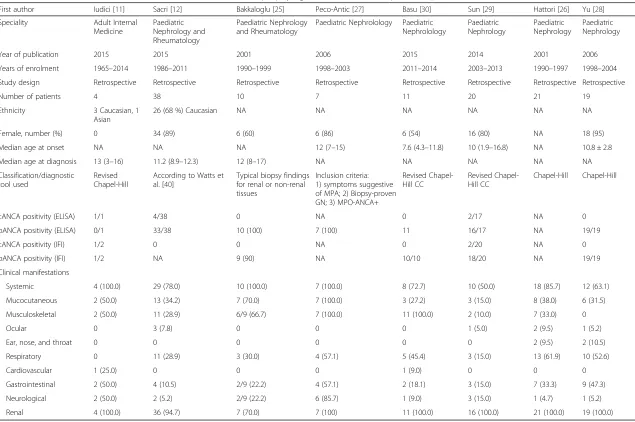
female [79 %]). The main organ/system involvement are summarised in Table 2 and the main characteristics of studies included in Table 3.
Risk of bias
The most frequent source of bias was the sampling frame-work for MPA, followed by patient selection and the def-inition of MPA (Additional file 2: Tables S3 and S4).
Clinical and laboratory features on entry into the study
For the 130 MPA patients identified, median age was 10.5 years at disease onset (data available for four studies) and 12 years at diagnosis (data available for three studies).
Renal disease was the most frequent manifestation on presentation, followed by systemic features, musculoskeletal, cutaneous, lower respiratory tract and gastrointestinal sys-tem involvement (Table 2). Heterogeneity between studies was low for renal, ENT, ocular, and cardiovascular involve-ment (Fig. 2). Lung infiltrates (18 % [95 % CI 6–35]; I2= 77 %) and alveolar haemorrhage (18 %, [95 % CI 5–35]; I2= 77 %) occurred at similar frequencies. ENT involvement was limited to sinusitis. Seizures were the most frequent neurological manifestation (5 % [95 % CI 2–9]; I2= 44 %) and purpura was the most frequent skin lesion (10 % [95 % CI 0–27]; I2= 86 %).
Following the grouping of the studies by geographic region of origin (Europe or Asia), we found that the
prevalence of skin manifestations (66 % [95 % CI 28–96]
vs. 29 % [95 % CI 19–40];p= 0.02) was higher in studies
from Europe [11, 12, 25, 27] (Additional file 4: Table S6). Information about immunofluorescence findings for ANCA positivity was available in five studies [11, 25,
28–30]. Positive results were obtained for c-ANCA in
4 % of patients (95 % CI 1–11, I2= 50 %), and for
p-ANCA in 94 % of patients (95 % CI 86–99, I2= 35 %).
The prevalence of anti-MPO antibodies was 93 % (95 % CI 83–99, I2= 52 %), that of anti-PR3 antibodies was 5 %
(95 % CI 1–11, I2= 0 %) (data from 8 studies) [11, 12,
25, 27–29].
Induction therapies and drug-related adverse events
Six studies reported the drugs used to induce remission [11, 25, 27–30]. In five of these studies, oral or intraven-ous cyclophosphamide was used with corticosteroids (62 %, 95 % CI 20–96, I2= 90 %). In one study [30], only rituximab was used. If we excluded this study from the analysis, the prevalence of cyclophosphamide use
in-creased to 77 % (95 % CI 45–99, I282 %). In one study
[27], plasmapheresis was also performed. No detailed in-formation about drug-related adverse events during follow-up was provided. One study stated that no cases of impaired fertility or cancer occurred during follow-up [29]. In another, only infections were described [30].
Follow-up data for cumulative clinical manifestations, relapse, and survival
Follow-up data were reported in seven articles [11, 12, 25,
27–30]. The duration of the observation period was
re-ported in six studies, and ranged from 4 to 55 months. At least one relapse occurred in 25 to 50 % of the patients (total of 63 patients from four studies) [11, 12, 25, 30]. Twenty-nine patients (22 %) developed end-stage renal disease or a need for dialysis during follow-up. All studies provided survival data. Six children died: one from the rupture of a hepatic aneurysm, one from pulmonary infec-tion, one from cytomegalovirus infecinfec-tion, and no informa-tion was available for the other patients.
Discussion
We conducted this study to provide a better definition of the principal manifestations of childhood-onset GPA and MPA at presentation and their course over time. This study is the first to use a systematic approach in-cluding a meta-analysis to analyse these rare paediatric conditions for which a small number of essentially retro-spective studies have been published to date.
We confirmed the female predominance of GPA and MPA in children. About 70 % of the GPA patients and 80 % of the MPA patients were girls. This finding con-trasts with those for studies in adults, which have reported an absence of difference in frequency between the sexes or a slightly higher frequency in men for [31–33]. We also confirmed that most of these paediatric cases were diag-nosed in adolescence.
As expected, the principal manifestations at disease onset were those involving the respiratory tract in pa-tients with GPA and the kidney in papa-tients with MPA. ENT involvement was rare in MPA, but was the most frequent clinical feature at presentation in GPA patients. It is, therefore, a potentially useful additional sign for distinguishing between these two conditions. Saddle
Table 3Main characteristics of the studies on childhood-onset microscopic polyangiitis and features of the patients at presentation
First author Iudici [11] Sacri [12] Bakkaloglu [25] Peco-Antic [27] Basu [30] Sun [29] Hattori [26] Yu [28]
Speciality Adult Internal Medicine
Paediatric Nephrology and Rheumatology
Paediatric Nephrology and Rheumatology
Paediatric Nephrolology Paediatric Nephrolology
Paediatric Nephrology
Paediatric Nephrology
Paediatric Nephrology
Year of publication 2015 2015 2001 2006 2015 2014 2001 2006
Years of enrolment 1965–2014 1986–2011 1990–1999 1998–2003 2011–2014 2003–2013 1990–1997 1998–2004
Study design Retrospective Retrospective Retrospective Retrospective Retrospective Retrospective Retrospective Retrospective
Number of patients 4 38 10 7 11 20 21 19
Ethnicity 3 Caucasian, 1
Asian
26 (68 %) Caucasian NA NA NA NA NA NA
Female, number (%) 0 34 (89) 6 (60) 6 (86) 6 (54) 16 (80) NA 18 (95)
Median age at onset NA NA NA 12 (7–15) 7.6 (4.3–11.8) 10 (1.9–16.8) NA 10.8 ± 2.8
Median age at diagnosis 13 (3–16) 11.2 (8.9–12.3) 12 (8–17) NA NA NA NA NA
Classification/diagnostic tool used
Revised Chapel-Hill
According to Watts et al. [40]
Typical biopsy findings for renal or non-renal tissues
Inclusion criteria: 1) symptoms suggestive of MPA; 2) Biopsy-proven GN; 3) MPO-ANCA+
Revised Chapel-Hill CC
Revised Chapel-Hill CC
Chapel-Hill Chapel-Hill
cANCA positivity (ELISA) 1/1 4/38 0 NA 0 2/17 NA 0
pANCA positivity (ELISA) 0/1 33/38 10 (100) 7 (100) 11 16/17 NA 19/19
cANCA positivity (IFI) 1/2 0 0 NA 0 2/20 NA 0
pANCA positivity (IFI) 1/2 NA 9 (90) NA 10/10 18/20 NA 19/19
Clinical manifestations
Systemic 4 (100.0) 29 (78.0) 10 (100.0) 7 (100.0) 8 (72.7) 10 (50.0) 18 (85.7) 12 (63.1)
Mucocutaneous 2 (50.0) 13 (34.2) 7 (70.0) 7 (100.0) 3 (27.2) 3 (15.0) 8 (38.0) 6 (31.5)
Musculoskeletal 2 (50.0) 11 (28.9) 6/9 (66.7) 7 (100.0) 11 (100.0) 2 (10.0) 7 (33.0) 0
Ocular 0 3 (7.8) 0 0 0 1 (5.0) 2 (9.5) 1 (5.2)
Ear, nose, and throat 0 0 0 0 0 0 2 (9.5) 2 (10.5)
Respiratory 0 11 (28.9) 3 (30.0) 4 (57.1) 5 (45.4) 3 (15.0) 13 (61.9) 10 (52.6)
Cardiovascular 1 (25.0) 0 0 0 1 (9.0) 0 0 0
Gastrointestinal 2 (50.0) 4 (10.5) 2/9 (22.2) 4 (57.1) 2 (18.1) 3 (15.0) 7 (33.3) 9 (47.3)
Neurological 2 (50.0) 2 (5.2) 2/9 (22.2) 6 (85.7) 1 (9.0) 3 (15.0) 1 (4.7) 1 (5.2)
Renal 4 (100.0) 36 (94.7) 7 (70.0) 7 (100) 11 (100.0) 16 (100.0) 21 (100.0) 19 (100.0)
NAnot available,ELISAenzyme-linked immunosorbent assay,IFIindirect immunofluorence
Iudici
et
al.
Orphanet
Journal
of
Rare
Diseases
(2016) 11:141
Page
8
of
Fig. 2Pooled prevalence for the most frequent organ/system involvement at first consultation in childhood-onset microscopic polyangiitis
nose was already present at presentation in 5 % of GPA patients, confirming previous observations of a higher rate of this complication in children [20, 23, 32]. Sinusitis was the only ENT feature observed in patients with MPA.
Renal disease was the leading feature of MPA, and was observed at onset in almost all children. However, as most of the surveys included were carried out at neph-rology centres, there may have been a referral bias. As for GPA, the data from the different cohorts were highly heterogeneous, but renal impairment was diagnosed in about 65 % of patients at presentation. This observation suggests that childhood GPA, when diagnosed, is a
mul-tisystem disease rather than a condition “limited” to the
upper airways, as proposed in the past [23, 34]. In addition, renal disease is not very common at presenta-tion in adults (17 % of patients in the study by Hoffman et al. [31]) but it generally occurs during the course of the disease. By contrast, it seems to have a much higher incidence at disease onset in children. Moreover, one fifth of the children with MPA displayed progression to ESRD (end-stage renal disease) or a need for dialysis during follow-up, highlighting the severity of renal dis-ease in these children.
In addition to the principal specific manifestations ob-served at presentation in GPA and MPA patients, systemic features were also frequent in three-quarters of patients at presentation and half the patients presented musculoskel-etal symptoms, as also highlighted by a recently published study by the ARChiVe Investigator Network [35]. Eye problems were rare, but were more frequent in GPA than in MPA, whereas gastrointestinal involvement was more frequent in MPA than in GPA patients. Cardiomyopathy was described in only two patients, both with MPA.
Special attention should be paid to alveolar haemorrhage and subglottic stenosis, which may be life-threatening. Alveolar haemorrhage was not rare at disease presentation in either MPA or GPA, being observed in about 18 % of patients. Subglottic stenosis was observed only in GPA pa-tients. Early reports suggested that the incidence of subglot-tic stenosis was higher in children with GPA than in adults. Rottem et al. [23] found that about 40 % of patients devel-oped subglottic stenosis during 8 years of follow-up, corre-sponding to rates five times higher than reported in adult surveys [23]. These data, together with those from a UK co-hort [20], led to the inclusion of subglottic stenosis in the paediatric classification criteria [4]. Our results give a more precise estimate of the impact of this complication on the course of paediatric GPA. The available data show that a fairly uniform proportion of paediatric cases (9 %) already display subglottic stenosis at presentation. By contrast, inci-dence was found to vary considerably over time. Cumulative incidence ranged from 16 % [11] to 40–48 % in studies with similar follow-up periods [8, 20, 23]. Overall, these data con-firm the previous finding of a higher risk of subglottic
stenosis in children than in adults, in whom a cumulative prevalence of 10 % has been reported [36].
A large proportion of the patients tested detected posi-tive for ANCA. Only one MPA patient with anti-PR3 antibodies was reported. However, one fifth of the GPA patients tested positive for anti-MPO antibodies, and this proportion was similar in all studies. The high prevalence of ANCA in children as compared to adults should be borne in mind when paediatricians are consid-ering a diagnosis of one of these diseases.
A number of different treatment regimens were used, but the drugs used to treat GPA differed little between studies, reflecting a relatively uniform approach to the induction of remission over the long time period cov-ered by this meta-analysis. Most of the information about treatment provided by the available reports
con-cerned “traditional” drugs, with rituximab treatment
re-ported in only one patient. This is consistent with the approval of rituximab registration for induction treat-ment in adult patients with GPA and MPA by the FDA in 2011 and by the EMA in 2013. Reports pointing out a good response to rituximab are rapidly increasing. Cyclophosphamide was the drug most frequently used to treat patients with MPA, and a protocol based on ri-tuximab and mycophenolate mofetil was considered as a first-line treatment in only one study, on 11 patients [30]. In this study, 90 % of the patients were in complete remission at the last follow-up visit.
The paucity of available information made it impos-sible to define the course of the disease with any degree of precision. For example, a detailed assessment of dis-ease activity over time is lacking. This could have been favoured by the delay in drawing up a specific index for paediatric conditions [37]. However, the available data suggest that most GPA patients experience at least one relapse, whereas disease flares are observed in less than half of all MPA patients. However, end-stage renal dis-ease was a particular problem in children with MPA. About one fifth of the children with MPA presented ESRD, whereas the proportion of GPA patients present-ing this condition was much lower. As in adults [38], the development of new therapeutic strategies should help to improve disease-free survival.
The burden of drug-related adverse effects was well described only in papers on GPA. The most frequent problems encountered were infections, followed by dam-age due to chronic corticosteroid and cyclophosphamide treatments. The data relating to growth retardation in GPA patients were inconsistent.
Overall, 7 % of the patients for whom follow-up data were available died during follow-up, mostly from disease-related and infectious complications. Respiratory complications were the leading causes of disease-related death in children with GPA. These data confirm that
GPA and MPA diseases in children are severe and diffi-cult to manage. Long-term survival remains a matter of concern and should be assessed in future reports.
This study has several limitations. First, determining the prevalence of clinical manifestations at the onset of AAV was not the main objective in most of the primary studies. So despite the fact that we used a broad search strategy, it is likely that we missed some relevant studies reporting these data. The large number of additional ar-ticles identified by manual searching is consistent with this hypothesis. Moreover, we cannot exclude the possi-bility that the descriptions of the features of patients at presentation were not always exhaustive. There was also considerable heterogeneity, which was explored through subgroup analysis, although it should be borne in mind that such analyses are known to be subject to certain limitations. Finally, at least one monogenic disease asso-ciated with early-onset polyarteritis nodosa such as ADA2 (Adenosine deaminase 2) deficiency has recently been described [39] and other monogenic disorders cor-responding to some cases of childhood-onset AAV with a narrower range of clinical features and a specific drug-response pattern may be discovered in the near future.
Conclusion
We found that the incidence of childhood GPA and MPA was higher in girls than in boys, with most cases diagnosed during adolescence. Renal disease was the main feature at presentation in patients with MPA, whereas ENT was the predominant feature in patients with GPA. Childhood-onset GPA was associated with a higher prevalence of renal disease and nasal deformities at presentation and a higher overall incidence of subglottic stenosis over time than GPA in adults. Relapses were more frequently observed in pa-tients with GPA than in those with MPA, and the leading causes of death were related to the disease itself or to infec-tions. Further improvements in survival and disease-free survival are required in these severe paediatric diseases.
Additional files
Additional file 1:Search strategy. (DOCX 14 kb)
Additional file 2:Risk of bias assessment. (DOCX 35 kb)
Additional file 3:Flow-chart of paper selection. (DOC 61 kb)
Additional file 4:Subgroup analysis. (DOCX 21 kb)
Abbreviations
AAV:ANCA-Associated vasculitis; ADA2: Adenosine deaminase 2; ANCA: Anti-neutrophil cytoplasmic antibody; CNS: Central nervous system; EGPA: Eosinophilic granulomatosis with polyangiitis (Churg-Strauss); EMA: European medicines agency; ENT: Ear, nose and throat; ESRD: End-stage renal disease; EULAR: European league against rheumatism; FDA: Food and drug administration; GPA: Granulomatosis with polyangiitis (Wegener’s); MOOSE: Meta-analyses of observational studies in epidemiology; MPA: Microscopic polyangiitis; MPO: Myeloperoxidase; PR3: Proteinase 3; PReS: Paediatric rheumatology european society
Acknowledgments
Not applicable.
Funding
No external funding for this manuscript.
Availability of data and materials
The datasets generated during and/or analysed during the current study are available on Medline and the Cochrane Central Register of Controlled trials database from January 1, 1950 to December 31, 2015, as reported on Additional file 1.
Authors’contribution
MI and XP conceptualized and designed the study, participated in study screening, data extraction, and interpretation of data, drafted the initial manuscript, and reviewed and revised the final manuscript; PQ, BT, LM and LG contributed to designing the study, participated in reviewing and revising the manuscript; All authors approved the final manuscript.
Competing interests
Drs Quartier, Terrier, Mouthon, Guillevin and Puéchal are employees of the Assistance Publique–Hôpitaux de Paris and Université Paris Descartes; Dr Puéchal has declared speaking fees (Roche, Pfizer < $10,000), consultancies and honoraria (LFB), congress inscription/travel/accommodations (Novartis, Roche, LFB < $5,000) and research grant (Pfizer); Dr Terrier has declared consultancies, speaking fees and honoraria (Roche, LFB < $10,000); Dr Mouthon has declared consultancies, speaking fees and honoraria (Roche < $10,000); Drs Iudici and Guillevin have no conflicts of interest to disclose. All authors have been co-investigators in academic studies in which rituximab was provided by Roche Pharma.
Consent for publication
Not applicable.
Ethics approval and consent to participate
Not applicable.
Financial disclosure
The authors have indicated they have no financial relationships relevant to this article to disclose.
Author details
1National Referral Center for Rare Systemic Autoimmune Diseases, Department of Internal Medicine, Hôpital Cochin, Assistance Publique– Hôpitaux de Paris (APHP), Université Paris Descartes, Paris, France.2Present Address: Rheumatology Unit, Second University of Naples, Naples, Italy. 3Pediatric Immunology-Hematology and Rheumatology Unit, Hôpital Necker–Enfants Malades, APHP, IMAGINE Institute and Université Paris Descartes, Paris, France.
Received: 25 July 2016 Accepted: 5 October 2016
References
1. Denardo BA, Tucker LB, Miller LC, et al. Demography of a regional pediatric rheumatology patient population. Affiliated Children’s arthritis centers of New England. J Rheumatol. 1994;21:1553–61.
2. Malleson PN, Fung MY, Rosenberg AM. The incidence of pediatric rheumatic diseases: results from the Canadian pediatric rheumatology association disease registry. J Rheumatol. 1996;23:1981–7.
3. Bowyer S, Roettcher P. Pediatric rheumatology clinic populations in the united states: results of a 3 year survey. Pediatric rheumatology database research group. J Rheumatol. 1996;23:1968–74.
4. Ozen S, Ruperto N, Dillon MJ, et al. EULAR/PReS endorsed consensus criteria for the classification of childhood vasculitides. Ann Rheum Dis. 2006;65:936–41. 5. Akikusa JD, Schneider R, Harvey EA, et al. Clinical features and outcome of
pediatric Wegener’s granulomatosis. Arthritis Rheum. 2007;57:837–44. 6. Cabral DA, Uribe AG, Benseler S, et al. Classification, presentation, and initial
treatment of Wegener’s granulomatosis in childhood. Arthritis Rheum. 2009; 60:3413–24.
7. Arulkumaran N, Jawad S, Smith SW, et al. Long- term outcome of paediatric patients with ANCA vasculitis. Pediatr Rheumatol Online J. 2011;9:12.
8. Fowler NM, Beach JM, Krakovitz P, et al. Airway manifestations in childhood granulomatosis with polyangiitis (Wegener’s). Arthritis Care Res (Hoboken). 2012;64:434–40.
9. Bohm M, Gonzalez Fernandez MI, Ozen S, et al. Clinical features of childhood granulomatosis with polyangiitis (Wegener’s granulomatosis). Pediatr Rheumatol Online J. 2014;12:18.
10. Kosalka J, Bazan-Socha S, Ignacak M, et al. Clinical manifestation of pediatric granulomatosis with polyangiitis - the experience of two regions in Poland. Folia Med Cracov. 2014;54:5–12.
11. Iudici M, Puéchal X, Pagnoux C, et al. Childhood-onset systemic necrotizing vasculitides: long-term data from the French vasculitis study group registry. Arthritis Rheumatol. 2015;67:1959–65.
12. Sacri AS, Chambaraud T, Ranchin B, et al. Clinical characteristics and outcomes of childhood-onset ANCA-associated vasculitis: a French nationwide study. Nephrol Dial Transplant. 2015;30 Suppl 1:i104–12. 13. Stroup DF, Berlin JA, Morton SC, et al. Meta-analysis of observational studies
in epidemiology: a proposal for reporting. Meta-analysis of observational studies in epidemiology (MOOSE) group. JAMA. 2000;283:2008–12. 14. Hellmich B, Flossmann O, Gross WL, et al. EULAR recommendations for
conducting clinical studies and/or clinical trials in systemic vasculitis: focus on anti-neutrophil cytoplasm antibody-associated vasculitis. Ann Rheum Dis. 2007;66:605–17.
15 Shamliyan TA, Kane RL, Ansari MT, et al. Development quality criteria to evaluate nontherapeutic studies of incidence, prevalence, or risk factors of chronic diseases: pilot study of new checklists. J Clin Epidemiol. 2011;64:637–57. 16 Sterne JA, Egger M, Smith GD. Systematic reviews in health care:
investigating and dealing with publication and other biases in meta-analysis. BMJ. 2001;323:101–5.
17 Orlowski JP, Clough JD, Dyment PG. Wegener’s granulomatosis in the pediatric age group. Pediatrics. 1978;61:83–90.
18 Wong SN, Shah V, Dillon MJ. Antineutrophil cytoplasmic antibodies in Wegener’s granulomatosis. Arch Dis Child. 1998;79:246–50.
19 Stegmayr BG, Gothefors L, Malmer B, et al. Wegener granulomatosis in children and young adults. A case study of ten patients. Pediatr Nephrol. 2000;14:208–13.
20 Belostotsky VM, Shah V, Dillon MJ. Clinical features in 17 paediatric patients with Wegener granulomatosis. Pediatr Nephrol. 2002;17:754–61. 21 Tahghighi F, Moradinejad MH, Aghighi Y, et al. Evaluation of 10-year
experience of Wegener’s granulomatosis in Iranian children. ISRN Rheumatol. 2013;2013:694928.
22 Gajic-Veljic M, Nikolic M, Peco-Antic A, et al. Granulomatosis with polyangiitis (Wegener’s granulomatosis) in children: report of three cases with cutaneous manifestations and literature review. Pediatr Dermatol. 2013;30:e37–42. 23 Rottem M, Fauci AS, Hallahan CW, et al. Wegener granulomatosis in children
and adolescents: clinical presentation and outcome. J Pediatr. 1993;122:26–31. 24 Stone JH, Hoffman GS, Merkel PA, et al. A disease-specific activity index for
Wegener’s granulomatosis: modification of the Birmingham vasculitis activity score. International network for the study of the systemic vasculitides (INSSYS). Arthritis Rheum. 2001;44:912–20.
25 Bakkaloglu A, Ozen S, Baskin E, et al. The significance of antineutrophil cytoplasmic antibody in microscopic polyangitis and classic polyarteritis nodosa. Arch Dis Child. 2001;85:427–30.
26 Hattori M, Kurayama H, Koitabashi Y, et al. Antineutrophil cytoplasmic autoantibody-associated glomerulonephritis in children. J Am Soc Nephrol. 2001;12:1493–500.
27 Peco-Antic A, Bonaci-Nikolic B, Basta-Jovanovic G, et al. Childhood microscopic polyangiitis associated with MPO-ANCA. Pediatr Nephrol. 2006;21:46–53. 28 Yu F, Huang JP, Zou WZ, et al. The clinical features of anti-neutrophil
cytoplasmic antibody-associated systemic vasculitis in Chinese children. Pediatr Nephrol. 2006;21:497–502.
29 Sun L, Wang H, Jiang X, et al. Clinical and pathological features of microscopic polyangiitis in 20 children. J Rheumatol. 2014;41:1712–9. 30 Basu B, Mahapatra TK, Mondal N. Favourable renal survival in paediatric
microscopic polyangiitis: efficacy of a novel treatment algorithm. Nephrol Dial Transplant. 2015;30 Suppl 1:i113–8.
31 Hoffman GS, Kerr GS, Leavitt RY, et al. Wegener granulomatosis: an analysis of 158 patients. Ann Intern Med. 1992;16:488–98.
32 Bligny D, Mahr A, Toumelin PL, et al. Predicting mortality in systemic Wegener’s granulomatosis: a survival analysis based on 93 patients. Arthritis Rheum. 2004;51:83–91.
33 Halstead LA, Karmody CS, Wolff SM. Presentation of Wegener’s granulomatosis in young patients. Otolaryngol Head Neck Surg. 1986;94:368–71.
34 Hall SL, Miller LC, Duggan E, et al. Wegener granulomatosis in pediatric patients. J Pediatr. 1985;106:739–44.
35 Cabral DA, Canter DL, Muscal E, et al. Comparing presenting clinical features of 48 children with microscopic polyangiitis (MPA) against 183 having granulomatosis with polyangiitis (GPA). An ARChiVe study. Arthritis Rheumatol. 2016. [Epub ahead of print].
36 Lebovics RS, Hoffman GS, Leavitt RY, et al. The management of subglottic stenosis in patient with Wegener’s granulomatosis. Laryngoscope. 1992;102: 1341–5.
37 Dolezalova P, Price-Kuehne FE, Özen S, et al. Disease activity assessment in childhood vasculitis: development and preliminary validation of the paediatric vasculitis activity score (PVAS). Ann Rheum Dis. 2013;72:1628–33. 38 Puéchal X, Pagnoux C, Perrodeau É, et al. Long-term outcomes among
participants in the WEGENT trial of remission-maintenance therapy for granulomatosis with polyangiitis (Wegener’s) or microscopic polyangiitis. Arthritis Rheumatol. 2016;68:690–701.
39 Navon Elkan P, Pierce SB, Segel R, et al. Mutant adenosine deaminase 2 in a polyarteritis nodosa vasculopathy. N Engl J Med. 2014;370:921–31. 40 Watts R, Lane S, Hanslik T, et al. Development and validation of a consensus
methodology for the classification of the ANCA-associated vasculitides and polyarteritis nodosa for epidemiological studies. Ann Rheum Dis. 2006;66: 222–7.
• We accept pre-submission inquiries
• Our selector tool helps you to find the most relevant journal
• We provide round the clock customer support
• Convenient online submission
• Thorough peer review
• Inclusion in PubMed and all major indexing services
• Maximum visibility for your research
Submit your manuscript at www.biomedcentral.com/submit