R E S E A R C H
Open Access
Testing the robustness of controllers for
self-adaptive systems
Javier Cámara
1*, Rogério de Lemos
2,3, Nuno Laranjeiro
4, Rafael Ventura
4and Marco Vieira
4Abstract
Self-adaptive systems are software-intensive systems endowed with the ability to respond to a variety of changes that may occur in their environment, goals, or the system itself by adapting their structure and behaviour at run-time in an autonomous way. Controllers are complex components incorporated in self-adaptive systems, which are crucial to their function since they are in charge of adapting the target system by executing actions through effectors, based on information monitored by probes. However, although controllers are becoming critical in many application domains, so far very little has been done to assess their robustness. In this paper, we propose an approach for evaluating the robustness of controllers for self-adaptive software systems, aiming to identify faults in their design. Our proposal considers the stateful nature of the controller and identifies a set of robustness tests, which includes the provision of mutated inputs to the interfaces between the controller and the target system (i.e. probes). The feasibility of the approach is evaluated on Rainbow, a framework for architecture-based self-adaptation, and in the context of the Znn.com case study.
Keywords: Robustness testing; Controller; Self-adaptive system; Autonomic system
Introduction
One of the main traits of a self-adaptive software sys-tem, compared to any other kind of syssys-tem, is its abil-ity to deliver its services in spite of changes that may occur in the system, its environment, or even in its goals. A key component that enables self-adaptive systems to handle changes at run-time (e.g. repairing anoma-lies and improving operation) is a controller that reanoma-lies on a feedback control loop for managing adaptations [1] by executing actions through system-level effectors on the target system, based on information monitored by probes. In the context of complex software systems, these controllers typically implement the traditional sense-plan-act architectures. An example of such controllers is the MAPE-K model, which includes four distinct operational stages, namely monitoring, analysis, planning, and execu-tion [2]. Despite major achievements in the area, exist-ing approaches in autonomic systems and self-adaptation do not systematically address the need to determine if a self-adaptive system can deliver a service that can
*Correspondence: [email protected] 1Carnegie Mellon University, Pittsburgh, PA, USA
Full list of author information is available at the end of the article
justifiably be trusted when facing changes (i.e. that it will beresilient[3]). This lack of assurances is an issue that has hampered the widespread adoption of self-adaptive sys-tems, which are often regarded as unreliable by industry. A major problem associated with the provision of evidence is the combinatorial nature of the stateful aspects of a con-troller and the changes that may affect the system being controlled. Since the different operational stages in the feedback control loop should be functionally independent from each other, a change might have a different impact on the controller depending on the state of the controller. Moreover, if the controller is expected to act upon a change when it occurs, there is a wide range of issues that needs to be considered when producing the appro-priate action, including the place in which the change has occurred, the type and the frequency of the change, and whether it can be anticipated [4]. These factors have to be considered regarding the provision of assurances about the services to be delivered by the target system. Hence, novel techniques need to be devised in order to uncover potential faults in the controller.
The present paper describes an approach for evaluat-ing the robustness of controllers for self-adaptive systems by abstracting away, in a first instance, from the state of
the target system being controlled. The rationale behind this is the fact that the complexity associated with these controllers is such that we need first to devise novel means for evaluating the core logic that enables adap-tation, before exploring the ensemble target system plus controller. Moreover, if the robustness evaluation is per-formed on the ensemble, some of the controller faults could be masked by the target system, or their effects upon the system could be more difficult to analyze. Hence, the decision to define an approach can be used in the robust-ness evaluation of different controllers, assuming that the core logic of the different operational stages is basically the same on the different controllers [5]. In such a way, we restrict the robustness tests in our approach to the inputs of the controller, which are characterized by the probes. Although the proposed approach abstracts away from the target system, we need to consider the stateful aspects of the controller, which are related to its different operational stages.
The primary contribution of this paper is the defi-nition of an approach for evaluating the robustness of controllers, which is part of a bigger initiative that is look-ing into the resilience evaluation of self-adaptive systems. Our proposal considers the stateful nature of the con-troller by defining how the concon-troller interface should be tested according to a target system changeload [6,7], and the operational stage of the controller. To achieve our goal, the approach defines a set of mutation rules that should be applied to the inputs of the controller, a tai-lored version of a classification of the different controller failure modes, and an experimental setup and testing procedure that is specific to self-adaptive systems. A pre-liminary evaluation [8] of the feasibility of our approach was carried out using the Rainbow framework, which consists of a controller that supports architecture-based self-adaptation [5], and in the context of a simplified ver-sion of the Znn.com case study [9]. Experimentation using Rainbow is very convenient, since its software has been widely available, its structure facilitates access to its inter-nal components, its design is amenable to the injection of faults, and the logs Rainbow produces are suitable for analyzing the effects of the injected faults upon the controller.
The present paper extends our preliminary study by reporting on an exhaustive evaluation of the approach on a full-fledged deployment of Rainbow/Znn.com, includ-ing extensive tests carried out on a comprehensive set of probes implemented using different technologies.
The rest of this paper is structured as follows. The ‘Background and related work’ section provides some background on self-adaptive systems and related work in the area of robustness testing. The ‘Case study’ section introduces the Znn.com case study, which is used throughout the paper for illustrating the proposed
approach. The ‘Methods’ section describes our approach that is focused specifically on evaluating the robustness of controllers for self-adaptive systems. The ‘Experimen-tal evaluation’ section presents the experimen‘Experimen-tal results obtained from the evaluation of our approach. Finally, the ‘Conclusions’ section concludes the paper and indicates future research directions.
Background and related work
The run-time management of increasingly complex software-intensive systems has become a central concern in Software Engineering over the last few years [10,11]. Specifically, a major issue in the area concerns achieving conformance to functional and non-functional require-ments in a dependable and cost-effective manner despite the influence of changes that may affect the system, its environment, and system goals.
One of the seminal works addressing this concern was IBM’s autonomic computing initiative [2], which introduced a layer implementing what is known as the MAPE-K control loop to monitor, analyze, plan, and exe-cute adaptation (with a knowledge base that supports the different activities in the control loop) for the pur-pose of managing a target system. In particular, some successful approaches that rely on this closed-loop con-trol paradigm for self-adaptation exploit architectural models for high-level reasoning about the target system under management [5,12]. In particular, Rainbow [5] is a framework which provides a base of reusable infras-tructure that can be applied to a wide range of systems through customization. The framework defined by Rain-bow includes mechanisms for monitoring a target system and its environment (using the observations for updating the architectural model of the target system), detecting opportunities for improving the system’s quality of ser-vices (QoS), and deciding the best course of adaptation based on the state of the system. The ‘Testing procedure’ section provides further details about the Rainbow frame-work, which is used for the experimental validation of our approach.
Resilience evaluation in self-adaptive systems
Despite the fact that research in the field of autonomic and self-adaptive systems is relatively new, there are already some contributions regarding their provision of assur-ances. However, the applicability of these contributions has been focused on the ensemble target system plus con-troller. To the best of our knowledge, no approaches have been proposed regarding the evaluation of controllers, although there is already some ground work that put forward the need to follow this direction [10,11].
perfor-mance benchmarking [13], dependability benchmarking [14], and security benchmarking [15], due to its inher-ent relation to performance, dependability and security. Compared to established benchmarks, a resilience bench-mark may be specified following the same basic approach, but comprising a wide-ranging changeload (which will include, but will be not limited to, faults), as well as resilience metrics [6].
Other approaches deal with resilience evaluation through quantitative analysis using probabilistic model checking [16], considering the system environment as the only source of change and leaving out changes that are internal to the system. The cited approaches quantita-tively measure resilience in the self-adaptive system when facing changes either internal or external to the system. However, they do not deal with an additional source of problems from the perspective of resilience, which are robustness issues addressed by the techniques presented in the current paper.
Robustness testing
Robustness testing consists in stimulating a system with erroneous input conditions with the goal of triggering internal errors. This allows testers to differentiate systems according to the number and type of errors uncovered and provides developers with information to solve or wrap the identified problems [17].
Ballista [18] uses a set of tests that combine accept-able and exceptional values on calls to kernel functions of operating systems. The parameter values used in each invocation are randomly extracted from a set of prede-fined tests and for each parameter a set of values of a certain data type is associated. Each operating system is classified in terms of its robustness and according to a pre-defined scale (the CRASH scale [18]) that distinguishes several failure modes.
Initially, Ballista was developed for POSIX APIs (includ-ing real-time extensions). Further work has been devel-oped to adapt it to Windows operating systems [19]. In that study, the authors present the results of executing Ballista-generated exception handling tests over several functions and system calls in Windows 95, 98, CE, NT, 2000, and Linux. The authors were able to trigger system crashes in Windows 95, 98, and CE. The other systems also revealed robustness problems, but not complete sys-tem crashes.
MAFALDA (Microkernel Assessment by Fault Injection Analysis and Design Aid [20] is a tool that enables the characterisation of the behaviour of microkernels in the presence of faults. Fault injection is performed at two levels: in the parameters of system calls and in the mem-ory segments holding the target microkernel. However, only the former is relevant when the goal is robustness testing.
The robustness testing techniques have been applied not only at the operating system level but also at the mid-dleware layer and targeting different types of systems. The problem of robustness testing of high availability middleware is discussed in [21]. The paper presents a testing framework that integrates previous testing tech-niques (e.g. scenario-based testing and test result clas-sification). The case study conducted on OpenAIS (an open implementation of the Application Interface Speci-fication (AIS) provided by the Service Availability Forum) showed that simple techniques can identify robustness problems. However, the implementation of more complex techniques is required since these are able to find faults not detected by the simple ones.
Ballista was also adapted to be applied to middleware systems. In particular, the authors in [22] studied the robustness of various CORBA ORB implementations. In this case, the failure modes were adapted to better char-acterize the CORBA context, and the authors were able to reveal several issues in the middleware being tested.
In [23], we propose an experimental approach for the robustness evaluation of JMS middleware. The technique is applied successfully to three major JMS middleware providers exposing serious robustness problems, includ-ing severe security issues, which also highlights the impor-tance of the application of robustness testing to real-world systems.
The abovementioned works implement robustness test-ing approaches that do not consider the state of the system under test. In [24], the impact of state on robust-ness testing of a safety-critical operating system (OS) is investigated by including the OS state in test cases def-inition. Although system-specific, results show that the state can play an important role in testing since they are able to cover more cases when compared to the traditional approaches.
An approach for robustness testing method of state-ful Web services, modelled with Symbolic Transition Systems, is presented in [25]. A test case generation method is proposed using unusual values and replace-ment and additions of operation names. States are trans-versed using different operations and starting from a system specification which, depending on the system being tested, may not always be available. The authors assume that messages sent and received are only SOAP messages and suggest that a Web service could be con-sidered as a grey box from which any type of mes-sage could be observed, increasing the potential of the technique.
controller and the target system (i.e. probes). The feasibil-ity of the approach is evaluated in the context of Znn.com, a case study implemented using the Rainbow framework for architecture-based self-adaptation.
Case study
To illustrate our approach for robustness testing, we use the Znn.com case study [9], which is implemented using Rainbow, and is able to reproduce the typical infrastruc-ture for a news website. It has a three-tier architecinfrastruc-ture consisting of a set of servers that provide contents from back-end databases to clients via front-end presentation logic. Architecturally, it is a web-based client-server sys-tem that satisfies anN-tier style, as illustrated in Figure 1. The system uses a load balancer to balance requests across a pool of replicated servers, the size of which can be adjusted according to service demand. A set of client pro-cesses makes stateless requests, and the servers deliver the requested contents (i.e. text, images and videos).
The main objective for Znn.com is to provide content to customers within a reasonable response time while keeping the cost of the server pool within a certain oper-ating budget. It is considered that from time to time, due to highly popular events, Znn.com experiences spikes in requests that it cannot serve adequately, even at maxi-mum pool size. To prevent losing customers, the system can provide minimal textual contents during such peak times, instead of not providing service to some of its cus-tomers. Concretely, there are two main quality objectives for the self-adaptation of the system: (1) performance, which depends on request response time, server load, and network bandwidth, and (2) cost, associated to the number of active servers.
In the case of Znn.com, Rainbow is capable of analysing trade-offs among the different objectives and executes dif-ferent adaptations according to the particular run-time conditions of the system. For instance, when response time becomes too high, the system should increment server pool size if it is within budget to improve its perfor-mance; otherwise, servers should be switched to textual
c0
c1
c2
lbproxy
s0
s1
s2
s3
Figure 1Znn.com system architecture.
mode (start serving minimal text content) if cost is near budget limit.
Methods
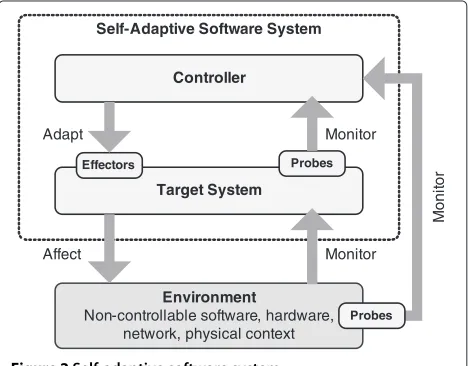
Our approach for robustness evaluation of controllers in a self-adaptive software system considers the model depicted in Figure 2. The environment consists of all non-controllable elements that determine the operating conditions of the system (e.g. hardware, network, physical context, etc.). Regarding the system itself, we distinguish two main subsystems: atarget system, which interacts with the environment by monitoring relevant variables asso-ciated with operating conditions, and a controller that manages the target system, driving adaptation whenever it is required. Concretely, the controller carries out its func-tion by (1) monitoring the target system and its environ-ment by means ofprobesthat provide information about the value of relevant variables, (2) deciding if the current state of the target system and environment demands adap-tation, and if this is the case, (3) applying a sequence of control actions through system-leveleffectors.
In this work, we focus exclusively on the robustness of the controller, i.e. we modify the probes’ inputs into the controller with the intent of evaluating how robust is the controller regarding changes that may affect its inter-face when exceptional input is provided. The controller is considered as a stateful entity, regarding evaluation pur-poses, since for the same input, the controller’s internal state may influence its output. In order to tackle this issue, we consider input mutation during the different operation stages of the controllerato create an appropriate context for evaluating its robustness.
The key elements of our approach are as follows: changeload, which is a set of representative change sce-narios, where changes are based on controller input
Self-Adaptive Software System
Controller
Environment
Non-controllable software, hardware, network, physical context
Target System
Effectors
Adapt
Probes
Monitor
Monitor Affect
M
oni
tor
Probes
mutations;failure mode classification, that characterizes the run-time behaviour of the controller while the target system is running in the presence of the changeload; and robustness tests, the mutation rules that are applied to the input probes into the controller.
In the following, in addition of describing the key ele-ments of our approach, we also present how robustness tests are performed at the controller interface by mutat-ing the inputs provided by the probes. To exemplify the principles of our approach, we have instantiated it into Rainbow [5].
Changeload model
This section describes the proposed model for the changeload, presenting the definitions adopted for the fundamental concepts that form the basis of its structure.
Definition 1(Change type).A change type is a tuple
(src,m,A)that characterizes a change, where
• src identifies the source probe type where a mutation rule is applied.
• m identifies the mutation rule applied on probe input.
• A= a1,. . .,an(possibly empty) is a vector of
attributes that holds specific information about the mutation rule.
Example 1.In Znn.com, consider the change ‘Set an invalid timestamp date on a response time probe (type ClientProxyProbeT)’. A possible change type definition for this would be
invalidDateCPP_CT=(ClientProxyProbeT,TSInvalidDate,date)
Definition 2(Change).Given a set of change types CT, a change is a tuple(ct, srcinst,VA, ti,d)that corresponds
to an instantiation of a change type, where
• ct=(src,m,A)∈CT determines the change type to be instanced as a change.
• srcinst is the probe instance that is the source of change (i.e. in which the input is mutated). • VA= vA1,. . .,vAnis a vector of attribute values
instantiating the attributes inA.
• ti∈R+0 determines the time instant in which the change is triggered.
• d∈R+is the duration associated with the change.
It is worth observing that while some specific changes may be transient, impacting the controller’s input dur-ing a particular amount of time, in the definition above, duration can be considered equal to∞ if the change is permanent.
Example 2.If we consider the change type described in Example 1, a possible instantiation of it could be
(invalidDateCPP_CT,ClientProxyProbe1,2/29/1985, 10, 2)
The systematic identification and classification of change types is fundamental to support the definition of change scenarios, which is discussed in the next paragraphs.
The main base concept in our changeload model is the scenario. A scenario is a postulated sequence of events that captures the state of the system and its environment, system goalsb, and changes affecting all the aforemen-tioned elements. It is defined in terms of state (system and environment) and changes applied to that state.
Definition 3(Scenario).A scenario is a tuple (wl, oc, C), where
• wl represents the workload, that is, the amount and type of work assigned to the system (not necessarily static).
• oc are the operational conditions of the system (including software and hardware resources needed for the system to perform its service).
• C is a set of changes applied to controller input in the presence of the workload and operational conditions.
Based on the definition above, achange scenariois one which includes a non-empty set of changes (C= ∅).
Definition 4 (Changeload).A changeload is a set of change scenarios.
Controller failure modes
The robustness of a controller for a self-adaptive sys-tem can be classified according to an adapted version of the CRASH scale [18], which distinguishes the following failure modes:
1. Catastrophic: the whole controller crashes or becomes corrupted (this might include the OS or machine on which the controller is running). No output is produced.
2. Restart: the controller execution hangs and may not issue any output commands, or send always the same command, within the worst case execution time associated with the adaptation cycle. The controller needs to be externally re-booted.
3. Abort: abnormal behaviour in the controller occurs due to an exception raised at run-time inside of the controller.
5. Hindering: the controller fails to return a correct error code, which may hinder error recovery. The difference between a silent failure and this case is that, here, an error is acknowledged by the controller but the returned error code is incorrect.
In particular, it is worth observing that the tailored ver-sion of the CRASH scale for controllers in self-adaptive software systems includes a specific adaptation which is related with time (2).
Robustness tests
The basis of the proposed approach for evaluating the robustness of controllers for self-adaptive software sys-tems relies on stimulating the interface of the controller, which consists of probes that monitor both the target system and its environment (see Figure 2). For evaluat-ing how robust is the controller, regardevaluat-ing changes that may affect its interface, the probes’ inputs into the con-troller are modified according to a comprehensive set of mutation rules. Moreover, since the inputs of these probes may affect the different stages of a MAPE-K control loop, the evaluation needs to consider the controller as state-ful. Although for evaluating the robustness of a controller we are able to abstract away from the application (target system), we nevertheless use the application to drive the evaluation.
Mutation rules
The set of robustness tests performed is automatically generated by applying a set of predefined mutation rules to the messages sent by probes, which characterizes the monitoring stage of the controller. Although con-crete message formats and additional elements may exist depending on the case, the basic input supplied by probes to the controller typically consists of three basic elements: (1) an identifier of the variable being monitored, (2) the actual value for the variable, and (3) a timestamp that pro-vides a temporal context for the variable being monitored. For example, in the case of Rainbow, the kind of input received by the controller consists of simple messages encoded as text strings with the following format:
[ timestamp ] variable_name : variable_value
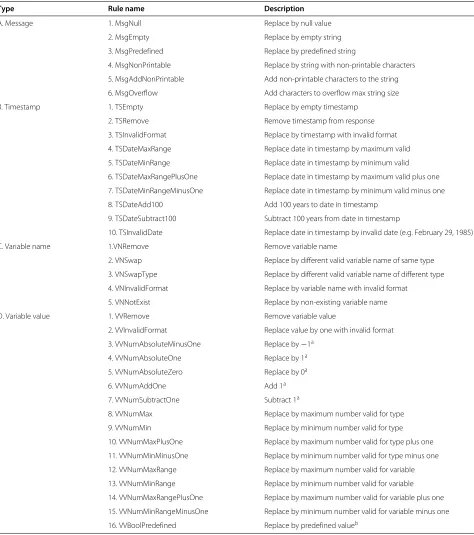
Based on this general description of probe input, we propose a set of rules (Table 1), which have been defined based on previous works on robustness testing [18,20,26], and explore limit conditions that are typically the source of robustness problems.
Probe usage categories
The effect of applying mutation rules on the outputs gen-erated by the probes may manifest in different ways (or not manifest at all) in the controller, depending on its
internal state. This results from the stateful nature of the controller, which may use different inputs and in a dif-ferent way, depending on its operation stage (i.e. analysis, planning, or execution). Changes in the internal operation stage of the controller are also induced by input obtained from probes.
Table 2 distinguishes different probe categories, accord-ing to their use in the different operation stages of the controller. Different robustness issues may arise in the controller, depending on the particular stage/probe in which mutation rules are applied, even if the set of muta-tion rules applied are the same. The same probe can belong to different usage categories and be used during different stages in the controller. We consider the con-troller to be a gray box, while its different operation stages are black boxes on which probe mutation is applied. For the time being, we assume that each of these black boxes are stateless, even if that is not the case as far as the target system is concerned. The different stages in the controller are sequential, while monitoring is transversal to all of them.
Testing procedure
As discussed previously, inputs to the Rainbow controller are delivered with the use of probes, which provide impor-tant system and environment information such as expe-rienced response time, network latency, or server load. Robustness testing focuses on the controller’s input points (i.e. the probe information). Therefore, a complete robust-ness experiment must include a set of tests that focuses precisely on the information provided by each of the input probes.
Figure 3 represents the complete experimental proce-dure and, as we can see in the figure, each experiment includes several tests, each one focusing on a given probe. For each probe (which, at run-time, is continuously deliv-ering information to the controller under test), we apply a single change for each probe data sample. However, we apply (in the subsequent probe data samples) the same change for a given period of time, which potentially gives us the possibility of further disturbing the system under test.
Table 1 Mutation rules for probes
Type Rule name Description
A. Message 1. MsgNull Replace by null value
2. MsgEmpty Replace by empty string
3. MsgPredefined Replace by predefined string
4. MsgNonPrintable Replace by string with non-printable characters
5. MsgAddNonPrintable Add non-printable characters to the string
6. MsgOverflow Add characters to overflow max string size
B. Timestamp 1. TSEmpty Replace by empty timestamp
2. TSRemove Remove timestamp from response
3. TSInvalidFormat Replace by timestamp with invalid format
4. TSDateMaxRange Replace date in timestamp by maximum valid
5. TSDateMinRange Replace date in timestamp by minimum valid
6. TSDateMaxRangePlusOne Replace date in timestamp by maximum valid plus one
7. TSDateMinRangeMinusOne Replace date in timestamp by minimum valid minus one
8. TSDateAdd100 Add 100 years to date in timestamp
9. TSDateSubtract100 Subtract 100 years from date in timestamp
10. TSInvalidDate Replace date in timestamp by invalid date (e.g. February 29, 1985)
C. Variable name 1.VNRemove Remove variable name
2. VNSwap Replace by different valid variable name of same type
3. VNSwapType Replace by different valid variable name of different type
4. VNInvalidFormat Replace by variable name with invalid format
5. VNNotExist Replace by non-existing variable name
D. Variable value 1. VVRemove Remove variable value
2. VVInvalidFormat Replace value by one with invalid format
3. VVNumAbsoluteMinusOne Replace by−1a
4. VVNumAbsoluteOne Replace by 1a
5. VVNumAbsoluteZero Replace by 0a
6. VVNumAddOne Add 1a
7. VVNumSubtractOne Subtract 1a
8. VVNumMax Replace by maximum number valid for type
9. VVNumMin Replace by minimum number valid for type
10. VVNumMaxPlusOne Replace by maximum number valid for type plus one
11. VVNumMinMinusOne Replace by minimum number valid for type minus one
12. VVNumMaxRange Replace by maximum number valid for variable
13. VVNumMinRange Replace by minimum number valid for variable
14. VVNumMaxRangePlusOne Replace by maximum number valid for variable plus one
15. VVNumMinRangeMinusOne Replace by minimum number valid for variable minus one
16. VVBoolPredefined Replace by predefined valueb
aNumber;bBoolean.
previously mentioned. With the controller in the target state, we can start applying the changes (of the same type) specified within the changeload during achange period (see Figure 3) and while the controller is on the target state. This period of time should be set to the typical time required to transition from the target controller state
Table 2 Probe categories
Probe usage category Controller stage Input usage Example Rainbow/Znn.com
Analysis The controller analyzes the current state Anomaly detection Rainbow checks whether the current response time
of the target system for detecting anomalies (through response time probes) in Znn.com is above
and triggering adaptation if needed the maximum acceptable response time threshold
Planning The controller determines if any adaptation Adaptation plan If the maximum response time is above threshold,
plans can be applied to the system and selection Rainbow detects anomaly and determines the best
selects the best alternative adaptation strategy (based on response time and
server fidelity probes)
Execution The controller executes the selected Control action Rainbow executes the selected adaptation strategy
course of action selection for reducing response time (monitors response time,
server fidelity, and server load probes)
in the adaptation strategies’ specification. Theobservation period is composed by the change period and the keep time and is used to register any potential deviations from expected controller behaviour.
Experimental evaluation
The aim of our experiments is to assess the validity of our approach to evaluate controller robustness in self-adaptive systems. In particular, we evaluate the robustness of Rainbow’s controller (i.e.Rainbow master) on an imple-mentation of the Znn.com case study described in the ‘Case study’ section.
The Rainbow framework
In this paper, we focus on Rainbow [5], an architecture-based platform for self-adaptation, which provides a substantial base of reusable infrastructure through cus-tomization, which aims to reduce the cost of self-adaptive system development. Rainbow has distinctive features: an
Figure 3Robustness testing procedure.
explicit architecture model of the target system, a col-lection of adaptation strategies, and utility preferences to guide adaptation.
The framework defined by Rainbow includes mech-anisms for (Figure 4): monitoring a target system and its environment (using the observations for updating the architectural model of the target system), detecting opportunities for improving the system’s QoS, decid-ing the best course of adaptation based on the state of the system, and effecting the most appropriate changes.
Rainbow’s component-and-connector architectural model of the target system is one of the main ele-ments used in its decision-making process, using it to update monitored system information and reason about appropriate adaptation mechanisms for a particular situation.
The main components of the framework are as follows:
• Architecture evaluator: It evaluates the model upon update to ensure that the system is operating within an acceptable range. If the evaluator determines that the system is not operating within the accepted range, it triggers the adaptation.
• Adaptation manager: It chooses a suitable strategy based on the current state of the system (reflected in the architectural model).
• Strategy executor: It executes the strategy chosen by the adaptation manager on the running system via system-level effectors.
• Model manager: It updates the architecture model using the information observed in the system via probes.
Experimental setup
System Layer
Architecture Layer
Target System Target System
Translation Infrastructure
Adaptation Manager
Model Manager Strategy
Executor
System API Probes
Effectors
Architecture Evaluator
(Analyze) (Plan)
(Execute)
(Analyze, Plan, Execute)
Figure 4The Rainbow framework.
database runningmySql v14.14d5.1.61, from which the differ-ent servers extract the contdiffer-ents, andznnproxyis the proxy machine that runs the load balancing software (Apache run-ningmod_proxy_balancer v2.1). The controller is deployed in a separate machine (znnmaster). All machines runDebian Linux v6.0.4 and have 512 MB of memory. Moreover, an addi-tional machineznnclientrunningJMeter v2.5.1generates the traffic during the execution of the system.
To build the changeload used for our experiments, we identified the following:
1. Workload and operating conditions for our change scenarios, which is characteristic of a slashdot-type effect, based on a sample collected by Juric [27], previously used for a general evaluation of the effectiveness of Rainbow in Znn.com [9]. In this case,
scenarios have been scaled down to a duration of 5 min, which is enough to drive the controller through its different operational stages and apply the robustness tests.
2. Sets of probes for the different controller operational stages. The three last columns of Table 3 indicate the set of probes used during the analysis, planning, and execution stages of the controller. This information was identified by inspecting the specification of architecture models and adaptation strategies. Specifically, the use of a probe during the analysis stage can be determined by checking whether the constraints specified for the architecture model are defined over variables updated by a given probe. Moreover, an analogous process can be followed to identify probes used during the planning stage, which
znns 1
znnproxy znnclient
znns 0
znns 3 znns 2
znndb znnmaster
ClientProxyProbe
ServerFidelityProbe ServerLoadProbe
Table 3 Probe use per controller stage and applicable mutation rules for Znn.com
Probe type Description Non-applicable mutation rules Analysis Planning Execution
ClientProxyProbeT Measures experienced response time in proxy A6, D12, D14, D16 x x x
ServerLoadProbeT Measures the load of a given server A1, A6, D3-D16 x x
ServerFidelityProbeT Reports the fidelity level of the contents A1, A6, D16 x x
served from a given server
update information in variables used to specify applicability conditions of adaptation strategies. Finally, probes used during execution are identified by inspecting the predicates included in the code of the adaptation strategy itself.
3. Set of changes to be applied on our set of probes. Table 3 also indicates the set of non-applicable mutation rules to each of the probes, which are determined by the type of probe implemented, as well as the data type and value range of the variables they update. Regarding probe implementation type, probesServerLoadProbeTandServerFidelityProbeTare implemented in Perl, whereas theClientProxyProbeTis implemented in Java. In both cases, the length of strings is unrestrained, therefore mutation rule MsgOverflow(A6) is not applicable to any of the probes. In the particular case of Perl probes, thenulldata type does not exist, disallowing the applicability of mutationMsgNull(A1). Regarding data types, all of the studied probes update numerical variables,
disallowing the applicability of mutation rule VVBoolPredefined(D16). The only exception is the ServerLoadProbeT, which is not associated with a simple data type and reports a message with a custom format in the variable value, therefore preventing the use of mutation rules D3 to D16. Finally, the
variables updated by some of the probes do not have a value range explicitly defined. In the case of probe ClientProxyProbeTthere is an implicit lower bound of zero, due to the semantics of the information contained in the variable (e.g. negative times would make no sense), but there is no upper bound, discarding the use of rules D12 and D14 that involve the maximum value range.
Results and Discussion
Each change scenario of the changeload results from combining the workload and operating conditions with a single change type based on an applicable mutation rule. In our changeload, each mutation rule gives way to up to three change scenarios (i.e. applied during the analysis, planning, and execution stages, respectively), which are triggered at the time instant in which the controller enters the corresponding stage, and their dura-tion is permanent. Overall, we run 209 robustness tests
using our experimental setup (33 × 3 applicable muta-tion rules forClientProxyProbeT, 21×2 applicable mutation rules forServerLoadT, 34×2 applicable mutation rules for ServerFidelityProbeT,).
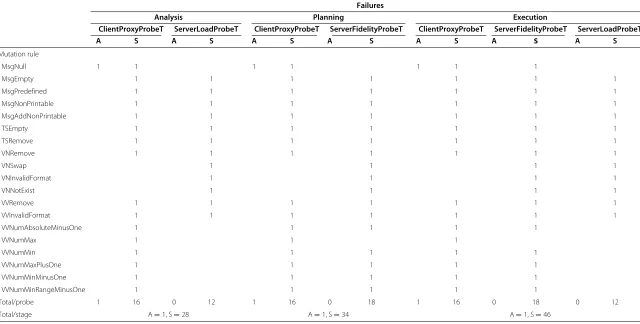
Table 4 details the experimental results obtained from the tests that apply the change scenarios based on each of the identified applicable mutation rules at each one of the controller stages. To begin with, 108 out of the 209 conducted tests uncovered robustness issues (51.6%). Moreover, one of the first observations that can be made is that no catastrophic, restart, nor hindering failures were identified during the tests. Although these types of fail-ures have not been identified during our tests, these are still needed since they portray relevant behaviours of the controller. Specifically, only 2.7% of the issues uncov-ered correspond to abort failures, which only occur on tests based on the mutationMsgNull (in this case, in the ClientProxyProbeT probe type, which is the only one imple-mented in Java). Specifically, this abort case consists of the samejava.lang.NullPointerException, which is unhandled in each of the three stages of the controller during the pars-ing of probe response with a regular expression matcher. It is worth mentioning that additional unhandled excep-tions have been detected during the course of the exper-iments. However, these have not been considered in the results table since they have been originated outside of the controller (concretely, on the response time probe itself ).
Silent failures are by far the most frequent failure type discovered during the tests (97.3%). These mostly cor-respond to incorrect updates (or the lack thereof ) of property values in the architecture model of the target system, which are not acknowledged by the controller. In the case of the probes implemented in Perl (Server-LoadProbeT andServerFidelityProbeT), when incorrect input is received by the controller, the update is ignored in all cases, and the property in the model is not updated. In contrast, in the Java probe (ClientProxyProbeT), properties are updated with clearly incorrect values (such as nega-tive values in the case of theClientProxyProbeT with muta-tions VVNumAbsoluteMinusOne or VVNumMin) or not updated in some other cases (e.g. mutations MsgNonPrintable or VNRemove).
Journal
o
ft
he
Brazilian
C
omputer
Society
2014,
20
:1
Page
11
of
14
Table 4 Robustness issues uncovered by the experiments
Failures
Analysis Planning Execution
ClientProxyProbeT ServerLoadProbeT ClientProxyProbeT ServerFidelityProbeT ClientProxyProbeT ServerFidelityProbeT ServerLoadProbeT
A S A S A S A S A S A S A S
Mutation rule
MsgNull 1 1 1 1 1 1 1
MsgEmpty 1 1 1 1 1 1 1
MsgPredefined 1 1 1 1 1 1 1
MsgNonPrintable 1 1 1 1 1 1 1
MsgAddNonPrintable 1 1 1 1 1 1 1
TSEmpty 1 1 1 1 1 1 1
TSRemove 1 1 1 1 1 1 1
VNRemove 1 1 1 1 1 1 1
VNSwap 1 1 1 1
VNInvalidFormat 1 1 1 1
VNNotExist 1 1 1 1
VVRemove 1 1 1 1 1 1 1
VVInvalidFormat 1 1 1 1 1 1 1
VVNumAbsoluteMinusOne 1 1 1 1 1
VVNumMax 1 1 1
VVNumMin 1 1 1 1 1
VVNumMaxPlusOne 1 1 1 1 1
VVNumMinMinusOne 1 1 1 1 1
VVNumMinRangeMinusOne 1 1 1 1 1
Total/probe 1 16 0 12 1 16 0 18 1 16 0 18 0 12
Total/stage A=1, S=28 A=1, S=34 A=1, S=46
and fourth group in Table 4, respectively) present the highest concentration of silent failures. In contrast, muta-tions that concern timestamps present silent failures only in cases in which the concrete element is removed (muta-tionsTSEmpty andTSRemove). This is a consequence of the way in which the Rainbow master processes inputs from the probes. Messages sent from the probes are parsed in such a way that only the presence of a timestamp in the message is assessed, but its concrete value is not checked syntactically nor semantically. Regarding muta-tions that affect variable names, theClientProxyProbeTprobe shows silent failures only in the case in which the variable name is removed (mutationVNRemove). Again, this happens because only the presence of a variable name in the mes-sage coming from the Java probe is assessed, and further syntactical or semantical checks are not performed on this part of the message. However, this does not prevent the correct update of values in the architectural model of the system inside of the controller in the case of Java probes, which uses a unique probe identifier to update the value in the correct place in spite of incorrect variable names or timestamps in probe input. In contrast, we can observe that further silent failures occur in the case of Perl probes with mutations (VNSwap,VNInvalidFormat, and VNNotEx-ist), since in this case, the variable name in the message is effectively used to carry out the appropriate update in the architecture model.
In spite of the similarity of failure patterns across probes, we have been able to observe that there are slight differences in them, also directly related with their type of implementation: (1) all instances of abort failures are given when mutating the Java probe, and (2) silent failures when mutating Perl probes always stops the updates of property values in the architecture model, in contrast with the Java probe, in which incorrect updates of values in the architectural model can also appear.
It is also worth mentioning that in spite of the sim-ilar failure patterns for the same probe across different controller stages, the specific failure instances discov-ered in the different controller stages are different. An instance of this is the mutation of the Java probe with the MsgNull, which results in the properties of the archi-tecture model being updated withnullvalues in tests con-ducted during the analysis stage. However, in the planning and execution stages, the last valid value on the model becomes frozen when the mutation rule is applied on the probe, and this can lead to completely different effects when considering the ensemble controller plus target system.
Summarizing, although in general terms Rainbow mas-ter is fairly robust, experimental results have shown that our approach has been able to uncover a relevant set of robustness issues in the controller. Although in this
particular case the identified pattern of robustness issues at the different stages of the controller differs only to a limited extent, this can be attributed to the particu-lar architecture of Rainbow, which uses its model man-ager as a safeguard for the logic in the rest of the components used throughout the different operational stages. Moreover, the obtained results align with previous research, which has shown that robustness testing may disclose a small number of different issues, despite of their potentially high relevancy to the particular system being tested [23].
Conclusions
In this paper, we have presented a novel approach for test-ing the robustness of controllers for self-adaptive software systems. The approach consists in mutating the inputs provided by probes to the controller, according to a set of mutation rules and a target system’s changeload, and tak-ing into account the stateful nature of the controller. The proposal also includes an experimental setup and test-ing procedure specific to self-adaptive systems, as well as an adapted version of the CRASH failure scale that char-acterizes the different failure modes of a controller for self-adaptive software systems. We have evaluated the fea-sibility of our approach using Rainbow as a controller, which is based on an architecture-based self-adaptation framework, and in the context of the Znn.com case study, which reproduces the typical infrastructure for a news website.
Concerning future work, there are different lines of research that we intend to exploit based on the ground-work setup by this paper:
• Employ different controllers and additional case studies for assessing our approach in terms of its efficiency in uncovering faults in the controller of a self-adaptive software system
• While the focus of this paper was the evaluation of the controller, there is also the need for considering the self-adaptive system in its entirety, and this would inevitably lead to new challenges, such as the
necessity to consider the full state of the target system when evaluating the robustness of the entire system, i.e. the controller plus the target system • Develop a framework for resilience evaluation of
self-adaptive software systems based on our
technique for evaluating the robustness of controllers. This work will be based upon previous work
conducted on resilience evaluation of self-adaptive software systems [7,16] and will enable us to explore how robustness issues in the controller can influence the resilience of the overall self-adaptive system • Extend our robustness evaluation approach into the
internal components of the controller that
implement the MAPE-K loop. The idea is to test the interfaces between its components, in contrast with just focusing on the interface between the controller and the target system
A long-term goal is to perform the type of evaluation described in this paper at run-time rather than develop-ment time since the structure of a self-adaptive software system is expected to evolve during run-time.
Endnotes
aSpecifically, during analysis, planning, and execution.
Monitoring is transversal to the rest of the activities in the MAPE-K loop.
bFor the sake of simplicity, in this paper, we abstract
away from system goals, which are not required to deal with robustness evaluation of the controller.
Competing interests
The authors declare that they have no competing interests.
Authors’ contributions
All authors read and approved the final manuscript.
Acknowledgements
This research is co-financed by the Foundation for Science and Technology via project CMU-PT/ELE/0030/2009 and by FEDER via the ‘Programa Operacional Factores de Competitividade’ of QREN with COMPETE reference:
FCOMP-01-0124-FEDER-012983.
Author details
1Carnegie Mellon University, Pittsburgh, PA, USA.2University of Kent,
Canterbury, Kent, UK.3CISUC, University of Coimbra, Coimbra, Portugal. 4University of Coimbra, Coimbra, Portugal.
Received: 20 June 2013 Accepted: 7 November 2013 Published: 23 January 2014
References
1. Brun Y, Serugendo GDM, Gacek C, Giese H, Kienle H, Litoiu M, Müller H, Pezzè M, Shaw M (2009) Engineering self-adaptive systems through feedback loops In: Software engineering for self-adaptive systems. Springer-Verlag, Heidelberg, pp 48–70
2. Kephart JO, Chess DM (2003) The vision of autonomic computing. Computer 36: 41–50
3. Laprie JC (2008) From dependability to resilience In: DSN Fast abstracts. IEEE Computer Society
4. Andersson J, de Lemos R, Malek S, Weyns D (2009) Modeling dimensions of self-adaptive software systems In: Software engineering for self-adaptive systems. Springer-Verlag, Heidelberg, pp 27–47
5. Garlan D, Cheng SW, Huang AC, Schmerl BR, Steenkiste P (2004) Rainbow: architecture-based self-adaptation with reusable infrastructure. IEEE Comput 37(10): 46–54
6. Almeida R, Vieira M (2011) Benchmarking the resilience of self-adaptive software systems: perspectives and challenges In: 6th international symposium on software engineering for adaptive and self-managing systems (SEAMS 2011), Honolulu, 23–24 May 2011, pp 190–195 7. Cámara J, de Lemos R, Vieira M, Almeida R, Ventura R (2013)
Architecture-based resilience evaluation for self-adaptive systems. Computing. doi:10.1007/s00607-013-0311-7
8. Cámara J, de Lemos R, Laranjeiro N, Ventura R, Vieira M (2013) Robustness evaluation of controllers in self-adaptive software systems In: 6th Latin American symposium on dependable computing (LADC 2013), Rio de Janeiro, 1–5 Apr 2013, pp 411–420
9. Cheng SW, Garlan D, Schmerl BR (2009) Evaluating the effectiveness of the rainbow self-adaptive system In: 4th international workshop on software engineering for adaptive and self-managing systems (SEAMS 2009), Vancouver, 18-19 May 2009, pp 132–141
10. Cheng BH, de Lemos R, Giese H, Inverardi P, Magee J (2009) Software engineering for self-adaptive systems: a research roadmap. In: Cheng BH, de Lemos R, Giese H, Inverardi P, Magee J (eds) Software engineering for self-adaptive systems. Springer-Verlag, Heidelberg, pp 1–26
11. de Lemos R, Giese H, Müller HA, Shaw M, Andersson J, Litoiu M, Schmerl B, Tamura G, Villegas NM, Vogel T, Weyns D, Baresi L, Becker B, Bencomo N, Brun Y, Cukic B, Desmarais R, Dustdar S, Engels G, Geihs K, Göschka KM, Gorla A, Grassi V, Inverardi P, Karsai G, Kramer J, Lopes A, Magee J, Malek S, Mankovskii S, et al. (2012) Software engineering for self-adaptive systems: a second research roadmap In: Software engineering for self-adaptive systems II Dagstuhl Castle 24–29 October 2010. Lecture notes in computer science, volume 7475. Springer-Verlag, Heidelberg
12. Oreizy P, Gorlick MM, Taylor RN, Heimbigner D, Johnson G, Medvidovic N, Quilici A, Rosenblum DS, Wolf AL (1999) An architecture-based approach to self-adaptive software. IEEE Intell Syst 14: 54–62
13. Gray J (1992) Benchmark handbook: for database and transaction processing systems. Morgan Kaufmann Publishers Inc., San Francisco 14. Kanoun K, Spainhower L (2008) Dependability benchmarking for
computer systems. Wiley-IEEE Computer Society Press, Hoboken, NJ, USA 15. Vieira M, Madeira H (2005) Towards a security benchmark for database
management systems In: Proceedings of the 2005 International conference on dependable systems and networks, DSN ’05, 28 June–1 July 2005, Yokohama, Japan, pp 592–601
16. Cámara J, de Lemos R (2012) Evaluation of resilience in self-adaptive systems using probabilistic model-checking In: 7th international symposium on software engineering for adaptive and self-managing systems (SEAMS 2012), Zürich, 4–5 June 2012, pp 53–62
17. Mukherjee A, Siewiorek D (1997) Measuring software dependability by robustness benchmarking. Trans Softw Eng 23(6): 366–378
18. Koopman P, DeVale J (1999) Comparing the robustness of POSIX operating systems In: Proceedings of the 29th annual international symposium on fault-tolerant computing, FTCS ’99, Madison, 15–18 June 1999, p 30
19. Shelton C, Koopman P, DeVale K (2000) Robustness testing of the microsoft win32 API In: International conference on dependable systems and networks DSN, New York, June 2000, pp 261–270
European dependable computing conference on dependable computing, Prague, 15-17 September 1999, pp 143–160
21. Micskei Z, Majzik I, Tam F (2006) Robustness testing techniques for high availability middleware solutions In: Proceedings of the international workshop on engineering of fault tolerant systems, Luxembourg, 12–14 June 2006
22. Pan J, Koopman P, Siewiorek DP, Huang Y, Gruber R, Jiang ML (2001) Robustness testing and hardening of CORBA ORB implementations In: The 2001 international conference on dependable systems and networks (DSN 2001), Goteborg, 1–4 July 2001, pp 141–150
23. Laranjeiro N, Vieira M, Madeira H (2008) Experimental robustness evaluation of JMS middleware In: IEEE international conference on services computing (SCC 2008), Honolulu, 7–11 July 2008, pp 119–126 24. Cotroneo D, Di Leo D, Natella R, Pietrantuono R (2011) A case study on state-based robustness testing of an operating system for the avionic domain In: Computer safety, reliability, and security. Proceedings 30th international conference, SAFECOMP 2011, Naples, 19–22 Sept 2011 Lecture notes in computer science, vol 6894. Springer, Heidelberg, pp 213–227
25. Salva S, Rabhi I (2010) Stateful web service robustness In: Fifth international conference on internet and web applications and services (ICIW), Barcelona, 9–15 May 2010, pp 167–173
26. Vieira M, Laranjeiro N, Madeira H (2007) Benchmarking the robustness of web services In: 13th IEEE Pacific Rim Dependable Computing
Conference (PRDC 2007), Melbourne, 17–19 December 2007, pp 322–329 27. Juric M (2004) Slashdotting of mjuric/universe. http://www.astro.
princeton.edu/universe/slashdotting/. Accessed 23 May 2013
doi:10.1186/1678-4804-20-1
Cite this article as:Cámaraet al.:Testing the robustness of controllers for
self-adaptive systems.Journal of the Brazilian Computer Society201420:1.
Submit your manuscript to a
journal and benefi t from:
7Convenient online submission 7Rigorous peer review
7Immediate publication on acceptance 7Open access: articles freely available online 7High visibility within the fi eld
7Retaining the copyright to your article