R E S E A R C H
Open Access
Investigations into data published and
consumed on the Web: a systematic mapping
study
Helton Douglas A. dos Santos
1*†, Marcelo Iury S. Oliveira
2,1†, Glória de Fátima A. B. Lima
1,
Karina Moura da Silva
1, Rayelle I. Vera Cruz S. Muniz
1and Bernadette Farias Lóscio
1Abstract
The increasing interest in using the Web as a platform for data sharing has motivated research about publishing and consuming data on the Web. While this subject is gaining importance, up until now, there are not many academic papers reviewing the approaches for publishing and consuming data on the Web. Furthermore, to the best of our knowledge, there is no systematic review of the literature that analyzes this subject. In this article, we conduct a systematic mapping study that aims to provide an overview of the current literature on publishing and consuming data on the Web by conducting a systematic mapping study. This study seeks to function as a snapshot of this subject by (i) identifying and analyzing how data have been published and consumed on the Web, (ii) discovering the benefits and limitations of publishing and consuming data on the Web (iii) analyzing the evolution of research on publishing and consuming data on the Web, and (iv) classifying the studies into categories related to their contribution. Finally, we discuss the results of this study and their implications for research on data on the Web-related subjects.
Keywords: Data on the Web, Data consumption, Data publishing, Systematic mapping
Introduction
The World Wide Web has emerged as an important chan-nel for sharing and exchanging information, which has enabled the publication, propagation, and visualization of data from diverse domains [13]. Its rapid growth has been accompanied by the emergence of new paradigms, which seek to ensure that users can take an effective part in mak-ing use of the Web [88]. In addition, with the advancement of technology, the data produced by society and made available on the Web has grown rapidly [8]. More recently, the increased publication of Open Data, the large volume of data generated by social networks, the Web of Things (WoT) paradigm, and the Open Web Platform (OWP) paradigm have confirmed the potential of the Web as a platform for sharing and exchanging of data [13,30,77].
*Correspondence:[email protected]
†Helton Douglas A. dos Santos and Marcelo Iury S. Oliveira contributed equally to this work.
1Center for Informatics, Federal University of Pernambuco, Av. Prof. Moraes
Rego, 1235 - Cidade Universitária, Recife, PE, Brazil
Full list of author information is available at the end of the article
It is important to note that the interest in publishing and exchanging data on the Web is not new [2,15]. How-ever, due primarily to the flexibility offered by the Web, new challenges need to be addressed in order to ensure its success as a data sharing platform [13]. The litera-ture contains several studies that set out to investigate issues related with the challenge of publishing data on the Web. Some of these studies propose best practices, guidelines, or processes in order to standardize the data publication process (e.g., [62,68,74]). Also, there is con-siderable research in other issues, such as data cataloging (e.g., [16, 108, 110]), data infrastructure services (e.g., [4,50,111]), data integration (e.g., [56]), data linkage and data fusion (e.g., [32,42]), data publishing (e.g., [97]), and data visualization (e.g., [27,78]). Moreover, several stud-ies investigate data consumption problems such as data discovery (e.g., [39,84]), data extraction (e.g., [6,29,71]), and data analysis (e.g., [72,117]). Furthermore, each one of these issues may have multiple research facets.
While the publication and consumption of data on the Web is gaining importance [13], up until now, there
are not many academic papers that reviewed this sub-ject. In particular, currently available studies focus on some specific approaches such as Linked Data reflect-ing only a small fragment of the whole set of options related to the publication and consumption of data on the Web [59].
To the extent of our knowledge, Abiteboul et al. [2] were one of the first to use term data on the Web. Accord-ing to them, data on the Web refers to the use of the Web infrastructure and its set of standards to support data exchange. In particular, they advocate for the use of XML and related standards (e.g., XSLT and XSD) to publish data on the Web. Abiteboul et al. [2] and many other projects conducted at that time led to a significant progress on using Web as a platform to data exchange. In more recent years, the highly development of Web-related technolo-gies opened up various forms of producing, publishing, sharing, and consuming data. In this context, this paper offers a perspective on the contributions on publishing and consuming data on the Web made in the last 11 years. It also describes some of the important bodies of work and outlines’ relevant challenges to current data on the Web research. We note in advance that this is not intended to be a comprehensive survey of all the approaches and best practices used to publish and consume data on the Web, and even though the reference list is long, it is by no means complete.
Therefore, in this article, we provide an overview of the current literature on publishing and consuming data on the Web by conducting a systematic mapping study. Systematic mapping is a protocol-driven methodology for reviewing and synthesizing a research data area [67]. A systematic mapping study typically provides an overview of the research reported in the field and identifies pos-sible issues arising from examining the existing litera-ture. This study seeks to function as a snapshot of the data on the Web publication and consumption by (i) identifying and analyzing how data have been published and consumed on the Web, (ii) discovering the bene-fits and limitations of publishing and consuming data on the Web (iii) analyzing the evolution of research on publishing and consuming data on the Web, and (iv) classifying the studies into categories related to their contribution.
The rest of the work is organized as follows. In the “Theoretical background” section, we discuss the the-oretical background. In the “Related works” section, we present the related works. In the “Research approach” section, we describe the research methodology used in our study. In the “Results” section, we present the result analysis. A discussion about open issues is pre-sented in the “Discussion and research directions” section. Finally, in the “Conclusions” section, we present our conclusions.
Theoretical background
In general, articles on publishing and consuming data on the Web often refer to a set of best practices and approaches closely aligned to the general architecture of the Web [63,75]. In summary, Jacobs and Walsh [63] state that the Web is composed of a set of resources uniquely identified by Uniform Resource Identifiers (URIs), whose representation can be usually retrieved via standardized formats. A resource representation encodes information about the resource, and state is usually typed. HTML, RDF, XML, or CSV are examples of data formats. Agents or users can interact with Web resources using standard-ized protocols, which control the exchange of messages HTTP, FTP, and SOAP, for example. Messages include both data and metadata. The development and use of such standards enable the Web to transcend different technical architectures. It is possible to use generic data browsers to explore the data available on the Web [18], for example. In fact, both humans and machines can gather data from Web.
In particular, data published on the Web deals with specific types of Information Resources1called datasets, which are collections of data, published or curated by a single agent, and available for access or download in one or more formats [76]. A dataset does not have to be available as a downloadable file, but it can be accessed through a Web API or data stream. Moreover, data should also be available in machine-readable for-mats, provided in a convenient form, and offered without technological barriers for data consumers. Therefore, data must be released in formats that reasonably struc-ture the data, but that also allows automated pro-cessing and facilitates machine sorting and searching activities.
In the following, we present relevant aspects related to publishing and consuming of data on the Web.
Data on the Web lifecycle
Möller [82] proposes the Abstract Data Lifecycle Model (ADLM), which is a generic model for lifecycle repre-sentation for data and metadata, establishing a common set of phases, characteristics, and roles. According to ADLM, a lifecycle for data-centric domains must consist of the ontology development, planning, creation, archiv-ing, refinement, publication, access, external use, feed-back, and termination phases. Due to its generic nature, it can be used to construct new data-centric lifecycle models.
However, some ADLM phases are not suitable for all data environments. According to Lóscio et al. [73], the Web Data context does not include ontology devel-opment, archiving, and termination phases. Moreover, Lóscio et al. [73] state that the ontology development is an independent activity and therefore was not included. In a similar way, the archiving and termination phases were not considered because once the data has been published on the Web, it should be always available. In this sense, Fig.1presents a lifecycle for data published and consumed on the Web proposed by Lóscio et al. [73] and based on ADLM model. Although it is a cycle, it is possible that not all steps are followed until a new iteration begins. Thus, even though it is a cycle, this does not mean that the data have to go through the last stage before starting a new iter-ation or that feedback needs to be received just before the producer refines the data. During this process, actors play the role of data producer and consumer, where, in general, the producer is responsible for creating or publishing the data. On the other hand, consumers are responsible for consuming the data, and may also be producers, since they can make improvements to and refine the data in order to publish them again [73].
All phases are briefly described below.
• Planning: Ranges from the intention to publish the data to the selection of the data that will be published [73]. Lóscio et al. [73] points out that it is important to take into account the potential of data usage and, where possible, to ask potential data consumers to identify relevant data.
• Creation: Ranges from data extraction phase to data transformation (i.e., transforming data into
appropriate format for Web publishing). The creation phase also comprises the metadata creation, which will describe the data [73]. It is important to consider publishing in different formats
(distributions), minimizing the need for the transformation of data by consumers [74]. • Publication: Makes data available on the Web in a
form for (re)use by others. It involves the tasks focused on keeping the data accessible. Often, data cataloging tools are used to publish data [73]. To guarantee the appropriate access to metadata, it is advised to provide a suitable search engine to retrieve these data. It also may involve controlling the access to data.
• Access: Consists of the act when users gain access to the data [73].
• Consumption: Comprises series of actions and methods related to the manipulation and analyses of the collected data. In fact, it is the actual use of the data. This stage of the lifecycle is directly related to the data consumer. Among consumers, we can mention from a developer interested in creating an application that makes use of the data, as people interested in transforming the data to generate relevant information, as well as large companies interested in using data to improve their products
and services and , even another system that consumes the data.
• Feedback: Comprises the moment when consumers
should provide comments on the data and metadata used, allowing to identify improvements and corrections in the published data, as well as to maintain a channel of communication between producers and consumers [73].
• Refinement: Comprises all activities related to improvements and updates into published data. It is related to the guarantee of maintenance of the previously published data and that can be realized from the comments offeedback collected in the previous phase. In addition, Lóscio et al. [73] state that refinement can be done either by generating new versions to ensure that the data is not obsolete, by correctly managing the different versions or by providing access to the correct version of the data for consumers.
Data on the Web Ecosystem
The data on the Web Ecosystem may be defined as a set of actors and artifacts involved in producing, distributing, and consuming data by using the Web [75]. An actor can be a user, a system, or a device and can act either as a data producer or as a data consumer. The former deliv-ers and produces data of some type according to specific conditions. The latter consumes (e.g., processes, analyzes, filters, aggregates) data. Both actors interact with each other by exchanging datasets.
Examples of data on the Web ecosystems are Open Gov-ernment Data Initiatives [8]. In these initiatives, govern-ments act as data producer making their data available in machine-readable formats and under open licensing con-ditions that allow the use and redistribution of the data. Entrepreneurs, application developers, or citizens act as data consumers by creating new information products and services, visualizations, and mash-ups that allow to mon-itor the activities of their government, as well as creating tools to make daily life easier. Such available government data have the ability to facilitate networks of collabora-tion and co-creacollabora-tion to produce citizen empowerment as well as promote accountability and other democratic principles.
Producers are responsible for data publication activities, such as defining licenses, choosing formats, and platforms for distribution. Furthermore, they can provide one or more access interfaces to retrieve data. Each interface determines the requirements to be satisfied by data con-sumers in order to successfully use the service, such as parameters, outputs, and operations. Moreover, data con-sumers consume data according to specific requirements, which are the conditions and the capabilities needed to solve a problem or achieve an objective.
In order to consume or produce datasets, consumers and producers, respectively, must coordinate a set of activ-ities, which represent a piece of work that forms one logical step (i.e., operation) within a consumption or pro-duction process. According to Dittrich and Jonscher [41], choosing a particular set of activities may depend on the intended use of the data, the capability of the actor, the characteristics of the data (e.g., alphanumeric data, mul-timedia data; structured, semi-structured, unstructured data), requirements concerning data quality, service per-formance requirements, and the available resources (e.g., human resources, time, money)
In summary, data on the Web Ecosystems rely on a vast and heterogeneous set of actors, each one with dif-ferent properties, capabilities, and expectations. Similarly, datasets are heterogeneous regarding structural (schema), syntactic (format), and semantic (meaning) issues. Actors may produce and consume a dataset using different activ-ities and under different conditions. Also, many of these elements are dynamic and evolve with time. We may con-clude that the data on the Web Ecosystem landscape is one of the distributed, heterogeneous, dynamic, and evolving actors and resources.
The emergence of data on the Web Ecosystems has been driven by several factors, including the emergence of digital technologies and political/institutional initiatives. For instance, the majority of Data Ecosystems have been driven mostly by the open data movement, which calls for free use, reuse, and redistribution of data by anyone [55]. Several governments already launched Open Data Portals to stimulate and promote Open Data production and con-sumption [33]. The technology improvement (e.g., mobile Internet or technology) and technology trends (e.g., social media or mobile apps) also have been driving private and public organizations to publish data as well as to integrate their services with external data.
Related works
There are some studies that analyze the state of the art of some of the approaches used to publish and consume data on the Web. For instance, Bizer [18] presents an overview on the major Linked Data providers and also the few efforts on how to build applications that exploit the Web of Linked Data. In [19], the authors extended [18] anal-ysis by presenting conceptual and technical principles of Linked Data. They also situate these principles within the broader context of related technological developments. Moreover, they also reviewed applications developed to exploit and publish Linked Data. More recently, Bikakis and Sellis [17] describe the major pre-requisites and chal-lenges that should be addressed by up-to-date approaches to exploring and visualizing very large linked datasets.
review some of the recent developments on applying the Linked Data technologies to the Internet of Things. In particular, they focus on the information modeling, ontology design, and processing of semantic data prob-lems. They describe the initial progress and some of the developments. They also discuss the future prospects and challenges of developing efficient semantic-enabled IoT systems. Similarly, Bröring et al. [25] illustrates and ana-lyzes the recent developments on applying Linked Data principles for sensor technologies. Bröring et al. [25] also point out challenges and future topics for research on semantic sensors.
From the Open Data perspective, Zuiderwijk et al. [119] present a survey study on the impediments to using Open Data. According to them, the main Open Data issues are (1) availability and access, (2) discoverability, (3) usability, (4) understandability, (5) quality, (6) linking and combining data, (7) comparability and compatibility, (8) metadata, (9) interaction with the data provider, and (10) opening and uploading. Geiger and Von Lucke [51] also look at the general challenges of Open Data publication. With regard to social aspects, Conradie and Choenni [35] focus on the understanding of how internal processes influence data publishing. They found that data publish-ing costs are still associated in terms of locatpublish-ing data and, in some cases, getting permission to publish data which might prohibit the release of large amounts of data. From the data consumption perspective, Zuiderwijk et al. [118] provide an overview of the barriers that data consumers (citizen)may encounter in using public sector informa-tion, such as lack of knowledge of the data, or no knowl-edge about its existence. Zhang et al. [115] also report various thresholds to the release of data, including the lack of tools for sharing and conflicting data definitions.
As to Open Government Data, Petychakis et al. [94] present a state-of-the-art analysis of open government data infrastructure from a functional, semantic, and tech-nical perspective. The authors focus on the current open government data landscape of European Union coun-tries. Another example is the study [24], which presents a survey of existing Open Government Data platforms, focusing on the technical aspects. The authors took into account features such as standardization, discoverability, and machine readability. According to them, most plat-forms lack of proper standards and Application Program-ming Interfaces (APIs), and there is a significant amount of data published either using non-machine-readable for-mat or in a proprietary forfor-mat [24].
Janssen et al. [64] analyze the Open Data benefits as well as the main barriers faced by Open Data initiatives. They synthesized user experiences with Open Data obtained from interviews and a group session. A large number of benefits of Open Data was identified. In particular, politi-cal and social benefits were viewed as the most important
category. With regard to barriers, the complexity of han-dling the data, the use of Open Data and participation in the Open Data process, the legislation and the qual-ity of information were identified as the main problems. Janssen et al. [64] also analyzed the myths of Open Gov-ernment Data, especially the myth that publicizing data will automatically yield benefits.
These studies focus on analyzing individual projects, applications, or conceptual ideas and specific contexts such as Linked Data and Open Data. There are other approaches to publish data on the Web, such as Big Data [13,20] and Web Semantic Sensor Data [107], and there are specific communities that publish and consume data on the Web without following Linked Data or Open Data principles, such as research data communities [9]. A sys-tematic and holistic review is necessary in order to provide further insights on the current state of research related to publish data on the Web as well as the overall develop-ment of the topic, which can form the basis for shaping future works. To the best of our knowledge, until now, there has been no systematic literature review on data on the Web, in order to map the state of the art, alongside the identification of research gaps and expected benefits.
Research approach
The scientific literature differentiates at least two types of systematic reviews: conventional systematic reviews and mapping studies. Conventional systematic reviews, aggregate results about the effectiveness of a treatment, intervention, or technology and are related to specific research questions (e.g.,Is intervention “I” on population “P” more effective for obtaining outcome “O” in context “C” than comparison treatment “T”?) [93]. Mapping studies aim to identify all research related to a specific topic, i.e., to answer broader questions related to research trends [7]. Typical questions are exploratory, (e.g.,What do we know about topic “T”?).
In this paper, we performed a mapping study with the aim of identifying the scenario in which data on the Web have been published and consumed over the last 11 years as well as of discovering problems, barriers and obstacles faced when publishing and consuming data on the Web.
Research Questions
We used the following Research Question (RQ) to guide our processes for searching and selecting studies: RQ: What has been the scenario of publishing and consuming data on the Web over the last 16 years?
We then used seven specific research questions to guide and structure data extraction, analysis, and the synthesis of all the evidence:
• RQ2: What are the main types of contributions reported by the studies?
• RQ3: What are the characteristics of data published and consumed on the Web?
• RQ4: What methods or procedures have been used for publishing and consuming data on the Web? • RQ5: What tools have been used for publishing and
consuming data on the Web?
• RQ6: What is currently known about the barriers and limitations related to publishing and consuming data on the Web?
• RQ7: What are the main benefits related to publishing and consuming data on the Web?
Inclusion and exclusion criteria
From an initial set of 8740 papers, we selected studies pre-senting concepts, theories, guidelines, discussions, lessons learned, and experience reports on publishing and con-suming data on the Web (inclusion criteria). We excluded papers that fell into any of the following criteria:
1 Paper is not written in English; 2 Paper cannot be accessed on the Web;
3 Paper was not published between 2005 and 2016; 4 Paper is not peer-reviewed work (e.g., invited papers,
keynote speeches, workshop reports, books, theses, and dissertations);
5 Paper is incomplete documents, drafts, slides of presentations, and extended abstracts;
6 Paper addresses other areas besides Computer Science (e.g., social science, health-care, and others); 7 Papers that do not present any type of findings on
publishing and consuming data on the Web.
Data sources and search strategy
The search process combined automatic and manual search to achieve high coverage. The manual search was conducted on journals and conferences (see Table1for a complete list of sources considered in our manual search). In particular, manual searches are important to cover the cases where published papers are available in the man-ual sources but have not yet been indexed by the search engines used in the automatic search. We looked for titles, abstracts, and keywords of all papers in each source used in the manual search, using the same procedure applied to the list of papers returned by the automatic search. The use of manual search is supported in the literature on systematic reviews so as to complement and extend the coverage of automatic searches [67, 93]. The automatic search was performed in five search engines and indexing systems (see Table2for a complete list sources considered in our automatic search).
The search string (see Fig. 2) used in the automatic search consists of the phrase construction “Data on the
Table 1Manual sources
Sources
Journal of Organizational Computing and Electronic Commerce
Journal of Information Technology and Politics
Governance. An International Journal of Policy, Administration and Institutions
Transforming Government: People, Process and Policy
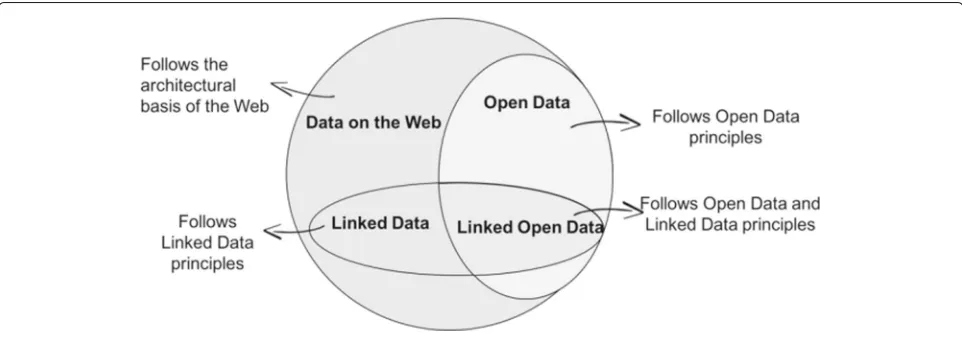
Web” and terms related to contemporary approaches used to publish and consume data on the Web (i.e., Open Data, Linked Data, Open Government Data). In particular, these terms were inspired by the classification proposed by Lóscio et al. [75], which states that Data on the Web can be viewed as a most broad set of data published accord-ing to the Web architecture [75]. Figure3illustrates the relationship between Data on the Web, Open Data, and Linked Data. As we may observe, not all data available on the Web is shared openly nor follow Linked Data princi-ples. In other words, data publishers determine the policy upon which data will be shared.
We also used the predicate, which consists of synonyms of “publication” and “consumption,” and we used wild-card characters to capture the plural and singular forms of the keywords. The query string is intentionally kept sim-ple so that we can extract the maximum number of papers containing the terms. The search string was adapted for each search engine.
We constructed the search string using several itera-tions and pilot tests to ensure that we used a compre-hensive set of synonyms to allow for high coverage while keeping the number of retrieved articles under control. Considering the high number of results from our auto-matic search process (over 8740 articles), we believe that we achieved a reasonable coverage level with our search string in the automatic search.
Selecting studies
Six researchers performed the manual and automatic searches working in partnership on a given engine or set of manual sources. As automatic sources have fea-tures for filtering papers according a date interval, we applied the third exclusion criterion, thereby excluding studies not published between 2005 and 2016. Note that
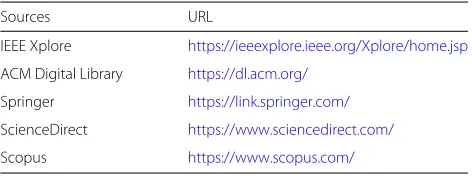
Table 2Automatic sources
Sources URL
IEEE Xplore https://ieeexplore.ieee.org/Xplore/home.jsp
ACM Digital Library https://dl.acm.org/
Springer https://link.springer.com/
ScienceDirect https://www.sciencedirect.com/
Fig. 2Search string. Source: Author
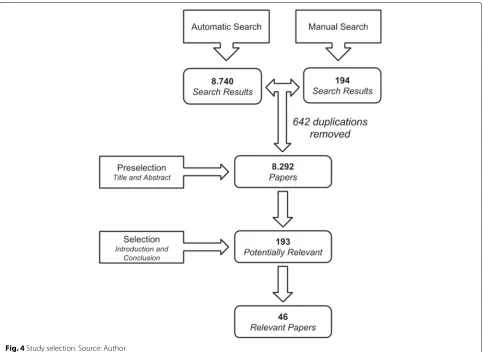
in automatic search, we preferred to opt for a wider search string, a task we gave to the researchers, with a view to reducing the chance of losing relevant articles. Many of these articles were eliminated in the primary selec-tion, where the researchers evaluated the results from the automatic search (n = 8740) and from the man-ual search (n = 194) by looking at the title and abstract and excluding the papers that were either clearly not rel-evant or duplicated ones. This resulted in 193 relrel-evant studies.
The list of 193 potentially relevant studies was ana-lyzed for final selection. All six researchers worked on the selection process. Initially, the 193 papers were divided into subsets of 65, and each subset was assigned to one pair of researchers, there being 3 pairs. In each pair, each researcher worked indepen-dently on analyzing the papers in their assigned set. The researchers applied the inclusion and exclusion criteria (see the “Inclusion and exclusion criteria” section) on the potentially relevant papers after reading the abstract, introduction, and conclusion of each paper. Differences were solved during a consensus meeting. This process selected 46 papers considered relevant for data extrac-tion and analysis (the whole study selecextrac-tion process is described in Fig.4).
Data extraction and data synthesis
Data extraction was carried out guided by an extrac-tion form implemented in MS Excel™. In this step, the 6 researchers were also divided into the previously defined three pairs to independently analyze each paper in order to answer the research questions previously defined. Con-flicts arising from extracting information were discussed and solved in consensus meetings. The results from data extraction were analyzed with support of MS Excel™, which was also used to generate graphics.
In the synthesis of results, we used mind maps, con-structed from the data extracted and made available on the spreadsheet, in order to synthesize and obtain a bet-ter understanding of these data. During this process, the extraction spreadsheet was divided into 6 parts. Each researcher was responsible for synthesizing one part. The parts were coded with respect to the topics or themes addressed. Categories that emerged were combined using constant comparison techniques.
Threats to validity
The most common threats in a systematic mapping are the coverage of the study, possible research biases in the study selection process, and inaccuracies during the phases of data extraction, analysis, and synthesis. These were also
Fig. 4Study selection. Source: Author
the main threats in our study. We tried to minimize them by using well-established guidelines for our research protocol.
The combination of automatic search in the most pop-ular search engines, and manual search in relevant pub-lication venues, improved mapping coverage. However, coverage is an inherent threat to validity in any system-atic review or mapping. In general, it is not possible to reach 100% of coverage, and it is very difficult to estimate reliably the coverage within a literature review.
The data extraction process was carried out by two researchers, and the conflicts were solved by third parties or in consensus meetings. Since the reviewed studies use different terminology, the extraction of data is more prone to errors, especially when ana-lyzing the data extracted in order to answer RQ1. In particular, there are limitations related to using methodologies, techniques or tools, due to the fact that some papers do not mention or describe which were used.
The query string is intentionally kept simple, with broad terms and simple predicate, so we can extract the maxi-mum number of papers containing the terms. However, it is possible that some paper had been eliminated in the pre-selection phase. This problem may have occurred because of the title and abstract of paper do not present a clear mention of Web as the platform for sharing data. In addi-tion, some articles may have focused only on discussing a specific problem related to the data process itself (i.e., data integration) rather than addressing particularities of Web as data sharing platform. On the other hand, there are also studies that report the improvements on their solutions or databases by using Linked Data principles; however, the derived data are not published on the Web. Studies of this type were also eliminated in the selection phase.
Results
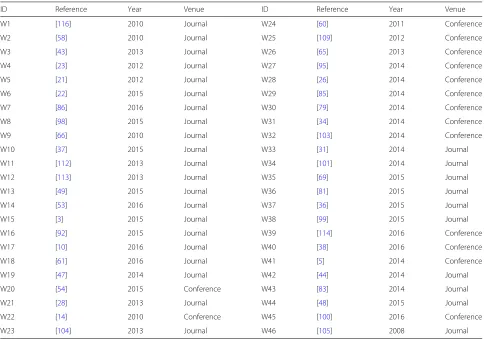
“Research Questions” section based on the selected studies presented in Table3.
How has data on the Web research evolved over recent years?
This section reports both on the descriptive informa-tion, temporal, and geographic distribution of papers and on the methodological issues arising from reviewing the primary studies.
We analyzed the evolution of publications over the years (see Fig.5). [W46] is the first data on the Web study, con-sidering the range of years from 2005 to 2016, and was published by Rajiv C. Shah, Jay P. Kesan, and Andrew Kennis in 2008. They analyze how a city in Massachussets city treated Open Standards for document formats. They developed a number of lessons so that other governments can consider introducing a similar policy. [W7] is the last selected work which presents a framework called LinDA that aims to hide the underlying complexity of Linked Data while maintaining and promoting the inter-linking capabilities enabled by the Linked Data paradigm. This framework allows an ecosystem of Linked Data for the Public Sector to be created. Such ecosystems provide
significant benefits to data consumers, such as increased accessibility and reuse of data, Web-scale identifiers and easy interlinking with datasets of other producers of public data.
We consider that having a total number of 46 arti-cles on such an important research subject is very small. However, the number of studies might increase because we did not consider studies that have been published in 2017. Moreover, with the exception of the decrease in 2011, the average number of publi-cations lightly fluctuates around some mean over the years.
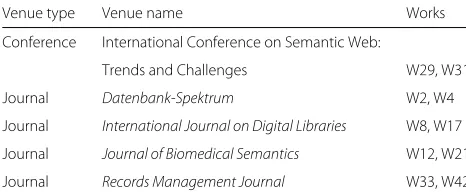
Which publication venues are the main targets?
Table4presents the venues that were used for publishing the studies more than once. Over 67.39% (31 studies) of the papers were published in journals. Fifteen papers were published in conferences and workshops (see Table 3). Forty-one studies are full papers, and four are short papers.
With the exception of Datenbank-Spektrum, Interna-tional Journal on Digital Libraries, Journal of Biomedi-cal Semantics, andRecords Management Journaland the
Table 3Summary of selected papers
ID Reference Year Venue ID Reference Year Venue
W1 [116] 2010 Journal W24 [60] 2011 Conference
W2 [58] 2010 Journal W25 [109] 2012 Conference
W3 [43] 2013 Journal W26 [65] 2013 Conference
W4 [23] 2012 Journal W27 [95] 2014 Conference
W5 [21] 2012 Journal W28 [26] 2014 Conference
W6 [22] 2015 Journal W29 [85] 2014 Conference
W7 [86] 2016 Journal W30 [79] 2014 Conference
W8 [98] 2015 Journal W31 [34] 2014 Conference
W9 [66] 2010 Journal W32 [103] 2014 Conference
W10 [37] 2015 Journal W33 [31] 2014 Journal
W11 [112] 2013 Journal W34 [101] 2014 Journal
W12 [113] 2013 Journal W35 [69] 2015 Journal
W13 [49] 2015 Journal W36 [81] 2015 Journal
W14 [53] 2016 Journal W37 [36] 2015 Journal
W15 [3] 2015 Journal W38 [99] 2015 Journal
W16 [92] 2015 Journal W39 [114] 2016 Conference
W17 [10] 2016 Journal W40 [38] 2016 Conference
W18 [61] 2016 Journal W41 [5] 2014 Conference
W19 [47] 2014 Journal W42 [44] 2014 Journal
W20 [54] 2015 Conference W43 [83] 2014 Journal
W21 [28] 2013 Journal W44 [48] 2015 Journal
W22 [14] 2010 Conference W45 [100] 2016 Conference
Fig. 5Temporal distribution of works over the years. Source: Author
International Conference on Semantic Web: Trends and Challenges that were used as a venue for publishing two studies each, the other venues published only one paper each.
What individuals, organizations, and countries are most active in data on the Web research topic?
In the 46 papers reporting data on the Web, 171 distinct co-authors were identified. The most active researchers are Asunción Gómez-Pérez, Daniel Vila-Suero, Lisa Raymond, María Poveda-Villalón, Spiros Mouzakitis, and Varsha K. Khodiyar each of whom co-authored 2 stud-ies, while all other authors co-authored only 1 study. The authors belonged to 93 distinct organizations (uni-versities, research institutions, and companies) located in 28 different countries. The Faculty Getulio Vargas, National Technical University of Athens, The Campus, Universidad Politécnica de Madrid, and University of Southampton were the most active organizations with 2 studies each, with the exception of the Universidad Politécnica de Madrid which is associated with 4 studies. Finally, the 6 most active countries were China and Japan (2 studies each), Greece, Italy and Netherlands
Table 4Venues used more than once for the publications
Venue type Venue name Works
Conference International Conference on Semantic Web:
Trends and Challenges W29, W31
Journal Datenbank-Spektrum W2, W4
Journal International Journal on Digital Libraries W8, W17
Journal Journal of Biomedical Semantics W12, W21
Journal Records Management Journal W33, W42
(3 studies each), Spain (4 studies), Germany (6 studies), USA (8 studies), and the UK (10 studies).
What are the main types of contributions reported by the studies?
Regarding research question RQ4, we are interested in examining what kind of results the studies are reporting. They were classified based on a taxonomy adapted from [80, 106], which describes the kind of contribution a study makes. Each study can present one or more tributions, which means that it may or may not con-tain features of other contribution types. Hence, the types of contribution were divided into the following categories:
• Analysis: A primary study that analyzes an object of study as regards a structure or taxonomy, a method, a framework, or any set of evaluation criteria;
• Comparative study: A primary study that compares static analysis approaches to identify cases in which the application of one approach is better than another;
• Improve existing tool: A primary study that aims to improve an existing tool;
• Method: A primary study that searches for a general solution for a problem area, such as a process, guidelines, best practices, maturity model, methodology or well-grounded checklists;
• New tool: A primary study that proposes a new tool created or implemented by applying some method or technique, which may be more effective than existing tools or may used in combination with other tools; • Report: A primary study documenting knowledge and
Table5relates the contribution of categories and studies reviewed. The data collected indicate that most contri-butions are analysis (18 papers), the proposal of methods (14 papers) or tools (13 papers), and reporting of studies (10 papers). As to the papers that propose a method, the large majority focus on the data publication problem (12 studies). In particular, 11 papers propose a process, guide-lines, best practices, or some kind of engineering methods and techniques that are to be used to manage a data pub-lication or consumption problem. In addition, 13 studies propose a tool to assist data on The Web practitioners. However, while 6 of the studies present a concrete solution like a platform or framework, 4 remain at the conceptual level as they present a reference architecture. Moreover, 2 papers focus on proposing an improvement of an existing tool. In fact, these papers describe recent developments in adapting an existing solution to address Linked Data principles.
Table 5Contributions of the research studies
Contribution category Works
Analysis studies
Barriers, challenges, and common issues W5, W6, W10, W13, W17, W22, W34, W39
Data model W9
Data on the Web cases W3, W15, W20
Landscape W2, W3, W7, W23,
W26, W33, W37
Method W45
Comparative dtudies
Data legal and political frameworks W16
Methodologies for publication of data W35
Improvement of existing tool
Addressing linked data features W11, W12
Method
Data model W6, W9, W21
Data on the Web engineering process W1, W17, W18, W19, W21, W25, W28, W30, W31, W35, W38, W45
New tool proposal
Architecture W8, W26, W36,
W43
Data consumption tool W4, W21, W29
Platforms and frameworks W14, W22, W24, W36, W40, W44
Reporting works
Linked data experiences W1, W6, W22, W25, W27, W40, W41, W46
Open data experiences W32, W42
The analysis studies focus either on a specific object of study (e.g., the publishing of research data on bio-informatics) or on the landscape about a data on The Web approach. Moreover, 16 of them analyze data publication problems, namely the focus is on the data consumption process (1 study) and 1 study analyzes both publication and consumption issues. In particular, the analysis papers focus on study of the landscape (7 papers) or benefits and barriers about a data on the Web approach (8 papers), data on the Web case (2 papers), on the analysis of a spe-cific method (1 paper) or data model (1 papers), and on the study of best practices (4 papers). There are also stud-ies that report data on the Web initiatives. Seven papers document Linked Data experiences, and 2 papers report Open Data initiatives. Finally, 1 study presents compara-tive documentation of the Open Data legal and political frameworks of Argentina and Brazil, and 1 study makes a comparative study of the existing methodologies and the best practices for publishing open government data.
Overall, the types of contributions of most of the stud-ies are weak: lessons learned, tools, and guidelines as well as examples of overview analysis such as their benefits, limitations, and landscape. Moreover, there are 11 papers that focus on documenting a data on the Web initia-tive/experience. Of the remaining studies, only 16 studies exhibit a stronger contribution type, such as a theory, a framework/method or a model.
What are the characteristics of data published and consumed on the Web?
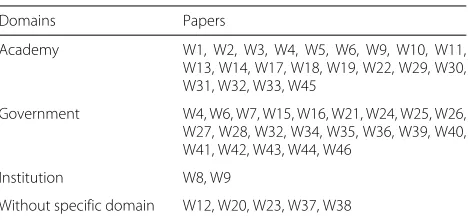
Most of the data published on the Web belong to spe-cific domains. When analyzing the studies, we observed that the vast majority belong to the governmental and aca-demic domain, as shown in Table 6. As a result of the increase in the number of open government data initia-tives, the number of publications involving government data is booming. In all, we have identified 22 papers dealing with government-related data.
The academic domain is producing and making data available. It also consumes data every day. Of the arti-cles selected, 21 of them cover data from the academic
Table 6Data domains
Domains Papers
Academy W1, W2, W3, W4, W5, W6, W9, W10, W11, W13, W14, W17, W18, W19, W22, W29, W30, W31, W32, W33, W45
Government W4, W6, W7, W15, W16, W21, W24, W25, W26, W27, W28, W32, W34, W35, W36, W39, W40, W41, W42, W43, W44, W46
Institution W8, W9
world. An example is paper [W40] which shows an analy-sis of Linked Data practices in education. Another domain found in two papers was the institutional one. Paper [W8] shows a Linked Data architecture proposal to be used in the archives of the Getulio Vargas Foundation. Some papers (W4, W6, W9, and W32) covered more than one domain, others did not determine any particular domain, as described in Table6.
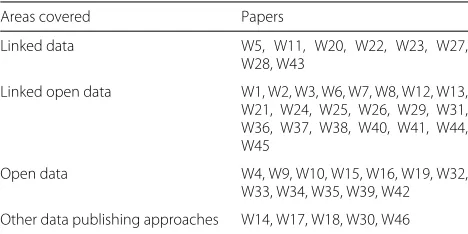
In addition to the data domains, we sought to find out which data publishing approach to made data available on the Web. We identified 12 papers deal only with Open Data, while 8 are dedicated to Linked Data. However, most articles used the Linked Open Data hybrid approach, totaling 21 papers (see Table7).
We identified five papers (W14, W17, W18, W30, and W46) that publish data on the Web, but are not related with Linked Data or Open Data. As a matter of fact, with the exception of W14, the rest of these five papers focus on research data publishing. According to Murphy et al. [87], “Research data publishing is the release of research data, associated metadata, accompanying documentation, and software code [...] for reuse and analysis in such a manner that they can be discovered on the Web and referred to in a unique and persistent way.”
Paper [W14] proposes a collaborative and open database, called OpenTrials, to publish structured data and documents on all clinical trials. Paper [W17] analyzes the current data publishing workflow landscape across disciplines and institutions in order to present the generic components of such workflows, i.e., to provide a reference model for these stakeholders. Despite advocate for nei-ther Open Data nor Linked Data Principles, the authors recommend the use of existing standards for reposito-ries and all parts of the data publishing process, and the development of new standards where necessary. In its turn, [W18] proposes and show examples of changes to the format and peer-review process for journal articles to more robustly link them to data that are only available on request. However, despite data items are closed, the dataset must be public indexed in the Web. Paper [W18] also proposes additional features for data repositories to
Table 7Data publishing approaches
Areas covered Papers
Linked data W5, W11, W20, W22, W23, W27, W28, W43
Linked open data W1, W2, W3, W6, W7, W8, W12, W13, W21, W24, W25, W26, W29, W31, W36, W37, W38, W40, W41, W44, W45
Open data W4, W9, W10, W15, W16, W19, W32, W33, W34, W35, W39, W42
Other data publishing approaches W14, W17, W18, W30, W46
better accommodate non-public clinical datasets. Paper [W30] discusses the facilities approach to managing and publishing research data. Paper [W30] uses the notion of Research Objects, which can be defined as resources that bring together data, methods, and people in scientific investigations.
Paper [W46] chronicles the historic process of Mas-sachusetts Government to adopt open standards to for-mat dataset, spreadsheets, charts, presentations, and word processing documents. However, this paper do not employ the open principles for access, use, or reuse of data.
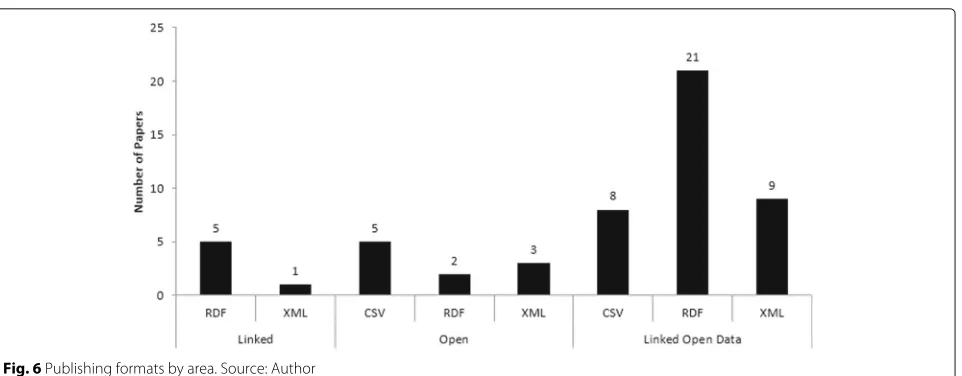
In addition, after analyzing the papers, we verified that the Open Data approach was more used in the papers with a governmental domain, while linked data and linked open data were applied more in the academic domain. Figure6 shows the distribution of papers per approach.
An analysis was also performed on what data mats are used to publish and consume data. Data for-mats are ways to make data available for consumption. There are formats of various types, i.e., those with struc-tured, unstrucstruc-tured, and semi-structured data. Some of these formats are proprietary, such as Microsoft Excel file format (XLS). In this analysis, several types of formats were mentioned, but the Resource Description Frame-work (RDF) format excelled in areas that favor structured and connected data. In the Open Data approach, Comma Separated Value (CSV) is one of the most cited publica-tion formats, as we can see in Fig.6. There are studies that reference more than one data format. For instance, the papers [W6][W31] employ CSV, JavaScript Object Nota-tion (JSON), and RDF formats. Moreover, 13 studies do not specify explicitly a specific data format.
The use of vocabularies when publishing data on the Web is a frequent practice, especially in the context of Linked Data. Vocabularies are important for structuring the data and describing its domains. Each of these vocab-ularies is described by a document that has a URI for each defined resource. In this analysis, 43 different vocab-ularies were cited, such as FOAF1, Data Catalog Vocab-ulary (DCAT)2, Bibliographic Ontology (BIBO)3, Simple Knowledge Organization System (SKOS)4, Vocabulary of Interlinked Datasets (VOID)5, and Geonames6. The most cited in the articles was FOAF, a vocabulary aimed at describing people and their personal relationships, with a total of 6 articles that mentioned it. However, other vocab-ularies have also been highlighted, such as SKOS cited in 5 articles, VoID was cited in 4 articles, and, finally, DCAT was cited in 4 articles (see Table8).
Fig. 6Publishing formats by area. Source: Author
papers analyzed use Linked Data or Linked Open Data approaches. Of the papers reviewed, 18 of them (36.7%) cited SPARQL as a reference language. However, as men-tioned earlier, many of the papers use the CSV, JSON, etc. formats and consequently make these files available for direct download.
What methods or procedures have been used for publishing and consuming data on the Web?
Methodologies for publishing data on the Web are gen-erally used to guide processes for publishing data, as well as provide guidelines and best practices, thus making the craft of the data publisher viable. When analyzing the studies, we found that more than half of the papers, that is, 28 of them (61%) do not mention the use of data pub-lication methodologies in the Web in their studies. In Table9, we can verify that 18 papers (39%) cited the use of methodologies, while 14 used Guidelines, 2 cited or used Best practices, and 4 papers described general methodolo-gies. Some works reference more than one methodology, such as [W1] and [W37].
Of the 14 papers that followed guidelines in their stud-ies, 12 are related to Linked Data principles, created by Berners-Lee, outlining a set of “rules” where Linked Data
Table 8Most cited vocabularies
Vocabularies Papers
BIBO W21, W40
DCAT W31, W36, W38, W45
FOAF W8, W21, W26, W44, W40, W45
GeoNames W26
PROV W8, W41
SKOS W3, W8, W26, W41, W44
VoID W1, W25, W31, W36, W38, W40
publishers must adopt them in the publication process. This shows that a good many of the studies related to pub-lication of Linked Data are applying and following Linked Data principles.
On the other hand, 2 studies cited or made use of Best practices. Paper [W11] describing its research method states that it applied Best practices described by the W3C Health Care and Life Sciences Interest Group in its methodological process. However, paper [W35] is a sur-vey of methodologies and Best practices for publishing open data. Thus, it only cites the existence of Best prac-tices for Publishing Linked Data, which it describes as a methodology widely used in Linked Data and Linked Open Data.
Finally, 4 papers cited the use of general methodolo-gies, that is, they were not classified as guidelines or Best practices. Among these papers, paper [W37] stands out because it makes a comparative study between method-ologies applied in Linked Open Data and Digital Libraries and thus references 12 methodologies, in which 5 guide-lines are included.
What tools have been used for publishing and consuming data on the Web?
Both in publishing and in data consumption on the Web, tools help publishers and data consumers to exercise their roles more quickly and productively. In all, 18 articles cited the use of these tools, some of which mentioned
Table 9Methods and procedures used in the studies
Methods and procedures Papers
Best practices W1, W2, W3, W8, W21,
W24, W25, W26, W27, W28, W37, W40, W44, W45
Guidelines W11, W35
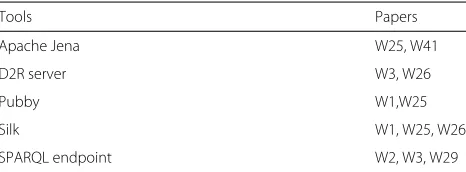
more than one tool in their study. Table10presents the five most cited tools among the 18 papers that clearly used data publishing and consumption tools on the Web.
Apache Jenna1, the open source Java framework for Semantic Web, provides features that make it possible to read and create RDF triples from other formats. Thus, in the context of the lifecycle of data on the Web [73], Apache Jenna covers the creation phase, as it enables data to be created in the appropriate format for publication. In addi-tion, it also reaches the consumption phase, as it makes it possible to read the data.
The D2R Server2is a framework that allows relational databases to be consulted using Semantic Web standards. It rewrites requests in SQL queries. This tool considers, according to the lifecycle of data on the Web [73], the consumption phase, since it allows the consumer to make queries in different ways.
Pubby3 provides Linked Data interfaces for SPARQL endpoints. Thus, like the D2R Server, it also acts in the consumption phase of the data published on the Web, thereby providing better visualizations for Linked Data.
Silk4is an open source framework for integrating het-erogeneous data sources. By using this tool, data publish-ers can establish RDF links from their data sources to other data sources on the Web. Therefore, like Apache Jenna, it also belongs to the data creation phase.
SPARQL Endpoint allows its users to run SPARQL queries on datasets in the Linked Data format. In gen-eral, it is used to conduct more accurate queries, since the user must be proficient in the SPARQL language. Many Web data providers provide this endpoint to con-duct searches on their data. Finally, these tools are part of the consumption phase of the data lifecycle on the Web.
What is currently known about the barriers and limitations related to publishing and consuming data on the Web?
Due to the technological expansion and growth of the Web of data, new challenges are emerging, such as mak-ing data available so that consumers can easily find, access, and use them. Among the 46 papers analyzed, 12 of them did not cite or comment on challenges faced by the com-munity. In our analysis, we found 34 challenges that were cited and reported in the studies, which divided them into problems and barriers. In Table11, we can see the 5 most
Table 10Most widely used tools
Tools Papers
Apache Jena W25, W41
D2R server W3, W26
Pubby W1,W25
Silk W1, W25, W26
SPARQL endpoint W2, W3, W29
Table 11Most cited challenges of publishing and consuming data
Challenges Papers
Data quality problems W2, W22, W33, W37, W42
Data sharing problems W8, W9, W17, W18, W33
Interoperability problems W2, W3, W5, W8, W13, W14, W16, W17, W22, W30, W34, W36, W37
Politic and social barriers W7, W17, W26, W34, W35
Technical barriers W4, W7, W16, W32, W34, W35
cited challenges in the papers. The interoperability was a problem that was most highlighted in our analysis, as it obtained 13 citations from the 34 papers.
Interoperability between datasets is a problem that is especially common when we talk about connected data, but it is also found in other areas. In our analysis, 13 papers cited and described problems with interoperabil-ity (see Table 11). Among the problems, paper [W5] describes there being a large number of entities which have unique access URIs. In addition, the study reports that different RDF graphs are constructed using different vocabularies, which also reflects on a semantic problem of the data. Paper [W3] adds that securing the data for-mat and the compliance of its structure to heterogeneous sources is a major challenge within the Linked Data uni-verse, as is providing the integration of this data with multiple providers [W2] [W17] [W22]. As a solution to this whole context of problems related to interoperabil-ity between connected data, paper [W36] suggests that the data provider must create a common architecture that can be applied to other data platforms, thus allowing the data to be linked. Out of the context of connected data, paper [W16] shows that interoperability issues also exist on accessing open data on the Web.
that the public sector has great difficulty in providing use-ful sites based on their data, thus having a negative impact on their open access initiatives. In addition, paper [W35] shows us that there are issues and challenges related to the technology used, the data formats adopted, and the infrastructure needed for publishing open government data.
The political and social barriers faced by publishers and consumers of data on the Web were cited by 5 papers. Paper [W7] describes that the mindset in the public sector needs to change due to the bureaucracy as well as to the complex legislation that characterizes public services. It also points out that public agencies are prone to adopting new technologies, such as Linked Data, at a much slower pace than private organizations and companies do. Paper [W34] says that there are challenges regarding accessi-bility and the reusaaccessi-bility of public sector information. Paper [W35] has given a more general description and reported that there are indeed challenges related to polit-ical support, as well as to decision-making and to social problems.
In our analysis, 5 papers cited problems with quality of data published on the Web. When we talk about data quality, we are talking about both the dataset and the data itself. It is common to come across challenges or problems with data quality when consuming or search-ing for published data on the Web, whether open or not. For paper [W33], the quality of data in the context of open data publishing is still a challenge. In addition, data quality is undoubtedly a key point in publishing datasets of any Open Data project [W42]. The paper also shows that this problem can only be solved when information is created and that managing data quality after the pro-cess of creation and publication is a rather complex task. Paper [W22] points to the lack of data or incomplete-ness of the data as indicative of the poor quality of the dataset as well as of correctly entered data. As one of the solutions to problems with data quality, paper [W2] mentions that merging data can help resolve data con-flicts as well as quality problems. Paper [W37] reports that the lack of metadata is one of the factors that cause data to be of poor data quality and that is important to have metadata to aid in the management and sharing of published data.
Another challenge cited by 5 papers is the act of shar-ing data through the Web. Accordshar-ing to paper [W9], data sharing is a complex and theoretically challenging objec-tive. Papers [W8], [W18], and [W33] also deal with data sharing and reuse as a new challenge faced by the scientific community. In addition, paper [W17] reports that repos-itories and journals are generally not ready to deal with sensitive data, and it is important that the data sharing mechanism is appropriate to the sensitivity level of such data.
What are the main benefits related to publishing and consuming data on the Web?
In recent years with the growth of data publication on the Web, the benefits for users and publishers have stood out and encouraged stakeholders to exercise new roles on the Web. In this systematic mapping, 28 benefits were identi-fied, such as discovering services, better data quality, bet-ter feedback, improvements in research, efficiency, greabet-ter trust, economic benefits, better public services, sharing, an increase in reproducibility, accountability, visibility, the development of applications, ease in aggregating data, col-laboration, accessibility, reuse, transparency, innovation, openness, easy discovery, and interoperability. Table 12 shows the 6 benefits most cited in the 46 articles, which are discussed below in detail.
Being able to discover data easily is the most cited bene-fit. The process of data discovery relies on searches made by end users and intermediate actors in order to acquire knowledge or develop new solutions. Nowadays, even though the volume of data is increasing exponentially, it is becoming easier to find data on multiple sources on the Web and filter them to one’s purpose. The use of good practices and the growth of Web Semantic have helped data discovery in machine-readable formats, gathered and interpreted automatically [W37], and this has also helped it to discover datasets more easily from different domains, such as government bodies, public companies, private organizations, and in health and scientific matters [W17] [W27]. This benefit collaborates with other benefits, such as better visibility, reuse, and sharing.
Re-using data on the Web is the second benefit most cited in studies. The reuse of data enables the recycling of data that were previously published, aggregating and adding value to them. Reuse of data is a solution for the enormous number of datasets shared on the Web that get lost without being used. This benefit enables new sources to be created by integrating data with other data [W13],
Table 12Most cited benefits of publishing and consuming data
Benefits Papers
Better reuse of data W4, W6, W7, W9, W13, W14, W15, W16, W23, W24, W26, W27, W30, W31, W32, W33, W37, W38, W41, W42, W44, W45
Easy discovery W1, W2, W3, W9, W11, W13, W14, W15, W17, W18, W19, W20, W21, W23, W24, W26, W27, W29, W30, W36, W37, W38, W41, W44, W45
Economic benefits W1, W4, W5, W8, W10, W13, W14, W15, W23, W27, W32, W33, W35, W36, W39, W40
Interoperability W6, W7, W8, W11, W13, W16, W17, W20, W21, W26, W27, W33, W34, W36, W37, W45
it facilitates research [W14] and disseminates Seman-tic Web paradigms [W37] and [W38]. Furthermore, this benefit is reached optimally when legal and technical restrictions are removed, enabling new forms of collabo-ration and innovation, thereby increasing the value of data whenever it is reused and linked to another source [W15]. Social benefits are the third most cited benefits. Social benefits are a group of benefits that improves the inter-action between data handlers and the data itself, through practices and data attributes. Social benefits are data shar-ing, promoting openness, enhanced collaboration [W9], increased visibility, greater visibility [W18], and greater transparency [W13]. These benefits improve the way data consumers, publishers, and intermediaries handle and deal with the data and their products and services. The scientific community, funding agencies, governments, and society are being benefited by these social benefits and increasingly cite them, thus adding value to products and services, roles in science, reproduce research, make data accessible, and advance and accelerate research studies and innovation [W13]. Society’s trust increases when governments are more transparent [W10]. When the data become available, success in using them depends on the social and professional context of its community of users [W9] and the audit tools available for the commu-nity [W16] in order to help their decision-making [W42]. Participation and collaboration from the community help to promote Open Data, governmental transparency and create innovation through public usages [W39]. Study [W6] shows that the effectiveness of aid programs can be improved by providing transparent insight into aid activities.
Interoperability occurs when data systems are able to work together in a transparent way. Interoperability helps to promote transparency, add value, and make data avail-able [W8] and promotes data sharing and the develop-ment of new applications. Interoperability is improved when concepts of the Semantic Web are applied to data on the Web, such as when schemes and vocabularies map concepts and relations [W6] and [W37], and standards are adopted at both the machine-to-machine and data levels [W13]. Also, this benefit enhances when the focus from the systems managing the data is switched onto the data themselves [W37] and the data publishing process follows best practices to help to maintain and sustain data over time [W17].
The economic benefits have grown over the years due to new solutions, with products and services and data being treated as a valuable good. Since the open data move-ment started, many data domains that interest society, organizations, and agencies are being published and are generating new ways of developing products and services. Information extracted from datasets published on the Web are sources of economic indicators for governments,
companies, and society in order to show economic trends and failures that otherwise go unnoticed, and they promote transparency. Also, the spread of economic information influences and educates the community, transforming the way the citizens stands up to government and making it more accountable for its policies and actions [W4]. Innovation, accountability, new business, and new invest-ments are examples of economic benefits generated by data on the Web [W5], [W13], and [W23].
Discussion and research directions
The main goal of this study is to provide an overview of how data are being published or shared on the Web. To do so, a systematic mapping was performed in accordance with the search method described in the “Research approach” section. In addition to addressing relevant research questions that have allowed us to delin-eate an overview of the area, we have also identified some topics that are not addressed in the body of the literature, where many questions were not answered and require fur-ther research. In this section, we discuss the results of this study and their implications for research on data on the Web.
Theoretically, within our research and analysis, we found papers in the literature that report experiences that have occurred within the lifecycle of data on the Web, whether addressing one or more phases. We note that there is a greater interest in exhibiting experiences of pub-lishing data, in different formats, sources, and domains. Few studies took the precaution of detailing the whole process and thus left aside the methods, tools, and pro-cedures they used. Many studies used the Linked Data standards, thereby justifying the high index of using the RDF format (see the “What are the characteristics of data published and consumed on the Web?” section). In this context, we are faced with several problems related to publishing and consuming data. Among these, the search for better interoperability is currently a crucial point in the research conducted on data on the Web, since the discovery and sharing of data in a practical and effi-cient way is the key to fostering the culture of reuse (“What is currently known about the barriers and limitations related to publishing and consuming data on the Web?” section). On the other hand, innumerable benefits brought about both in the publication and consumption phases were identified in the papers analyzed (among which ease of access and discovery of data were the bene-fits with the highest number of citations).
approached in the literature, which include the absence of solutions for monitoring the consumption of the pub-lished data, maturity and governance models, managing data on the Web, data and metadata curation, and Data Ecosystems.
Among the aspects identified, we found that there is a need for additional research and that such research should also consider the lifecycle presented, which thus underpin their studies. In this context, there are impor-tant areas that should be considered in the development and evolution of publishing and consuming data on the Web: Data Ecosystem theory and models, Data on the Web Management System, Monitoring the consumption of data, Metadata Curation, Maturity Models, and Collab-orative refinement of data on the Web. In the following, we present a discussion about these areas.
Data Ecosystem theory and models
The data lifecycle is closely related to the creation of a Data Ecosystem, which relies on a vast and hetero-geneous set of actors (e.g., data consumers and data producers) and resources (e.g., datasets, software, and services), each of which has different properties, qual-ity, and functional requirements (as mentioned in the “Data on the Web Ecosystem” section, Data Ecosys-tems). Being able to effectively organize and categorize the Data Ecosystem will ultimately deliver more intelli-gence to industry, academy, and governments [89, 90]. For instance, traditional retailers, telecoms, banks, and other companies are tailoring their services and products based on knowledge and facts extracted from several data collections available on the Web [70]. Governments are using Open Data collections to promote demo-cratic principles such as transparency, accountability, and responsiveness [50].
However, despite the fact that Data Ecosystems are thus arguably gaining in importance, research on Data Ecosys-tems is still in its preliminary stages. Up until now, not many academic papers related to the Data Ecosystem field have been published. In most cases, they are focused on some component technology that reflects only a small fragment of the whole research area. The same is as true for Data Ecosystems Theory that should provide a conceptual basis for further field research. The terminol-ogy and definitions for Data Ecosystem vary greatly. This diversity poses a pressing problem for the development of a clear understanding about how to exploit the new opportunities and emergent challenges in Data Ecosys-tems. Accurate definitions are required in order to get a mutual understanding of what Data Ecosystems embody.
Moreover, designing, developing, and further maintain-ing systems for supportmaintain-ing Data Ecosystems is challeng-ing. For instance, no one can responsibly consume data without accompanying information that explains how the
data have been created, where it is located, details about the structure and meaning of the data, and how to col-lect, integrate, and analyze the data. A comprehensive and meaningful description of all actors and resources is needed. Models help in understanding the functioning and activities of Data Ecosystems. They also help prac-titioners reduce misunderstandings and have a kind of blueprint for running and managing Data Ecosystems. Data Ecosystem models should support the practitioners and researchers in having a proper idea about the cur-rent state of a Data Ecosystem. They may also help to define strategic planning towards achieving the goals of an ecosystem, such as value creation and new businesses. Hence, a model tends to provide the means for developing a framework to control and manage an ecosystem.
Data on the Web Management System
Generally speaking, having a system for managing data on the Web is a somewhat bold idea, but a much-needed one, since the lifecycle of data is being affected by bad publishing practices. While there are Best practices for publishing data on the Wed [74], many producers still do not have knowledge of them nor they give the attention they should to these practices, which may well lead to future consequences that mainly impact their consumers. A data on the Web Management System would make it easy to define, create, maintain, manipulate, and share datasets on the Web across multiple users and applica-tions. As an alternative for implementing one, it should consist of a collection of services that allow users to share datasets on the Web [91]. There are research studies that target this area, but nothing concrete. Some propose sep-arate services, both for data manipulation and for sharing. Future research could unite all these services into a sin-gle system that is able to perform the whole set of lifecycle activities. There are also activities for which an architec-tural model have not yet been proposed and have not been implemented.
Monitoring the consumption of data
Tracking the use of datasets and applications using this data is still a big challenge. Such information could be very useful for the identification of new datasets as well as for the data quality improvement. Monitoring data consumption, as well as providing effective ways for the consumer to interact with the data publisher, should make it possible to collect information about using and shar-ing data. In this sense, it is crucial to obtain consumers’ feedback in such a structured way that allows identify-ing supposed flaws in the published data, the need to publish new data and to enable classification of data, for example.
![Fig. 1 Data on the Web lifecycle. Adapted from [73]](https://thumb-us.123doks.com/thumbv2/123dok_us/855788.1583201/3.595.58.542.526.715/fig-data-web-lifecycle-adapted.webp)