DOI 10.1007/s13174-011-0049-4
S I : F O M E - T H E F U T U R E O F M I D D L E WA R E
Applying evolutionary computation to mitigate uncertainty
in dynamically-adaptive, high-assurance middleware
Philip K. McKinley·Betty H.C. Cheng· Andres J. Ramirez·Adam C. Jensen
Received: 31 October 2011 / Accepted: 12 November 2011 / Published online: 3 December 2011 © The Brazilian Computer Society 2011
Abstract In this paper, we explore the integration of evolu-tionary computation into the development and run-time sup-port of dynamically-adaptable, high-assurance middleware. The open-ended nature of the evolutionary process has been shown to discover novel solutions to complex engineering problems. In the case of high-assurance adaptive software, however, this search capability must be coupled with rigor-ous development tools and run-time support to ensure that the resulting systems behave in accordance with require-ments. Early investigations are reviewed, and several chal-lenging problems and possible research directions are dis-cussed.
Keywords Middleware·Adaptive software·
High-assurance·Evolutionary computation·Uncertainty
1 Introduction
Increasingly, computer systems need to adapt to their en-vironment as they execute [1]. This need is most apparent in systems that interact with the physical world, such as sensor networks and swarms of autonomous robots. Such
P.K. McKinley (
)·B.H.C. Cheng·A.J. Ramirez·A.C. Jensen Department of Computer Science and Engineering, Michigan State University, 3115 Engineering Building, East Lansing, MI, USAe-mail:[email protected]
B.H.C. Cheng
e-mail:[email protected]
A.J. Ramirez
e-mail:[email protected]
A.C. Jensen
e-mail:[email protected]
systems need to perform complex, distributed tasks despite lossy wireless communication, limited resources, and uncer-tainty in sensing the environment. However, even systems that operate entirely within cyberspace need to account for changing network and load conditions, component failures, and exposure to a wide variety of cyber attacks.
Adynamically adaptive system(DAS) monitors itself and its execution environment at run time. This monitoring en-ables a DAS not only to detect conditions warranting a re-configuration, but also to determine when and how tosafely reconfigure itself in order to deliver acceptable behavior be-fore, during, and after adaptation [2]. Middleware has been shown to be an ideal location for adaptive functionality [3], since in many cases the adaptation can take place “below” the end application.
Within the context of a DAS, uncertainty arises from unanticipated environmental conditions as well as inaccu-racy or imprecision of sensed values. Unfortunately, this un-certainty can compromise the decision-making capabilities of a DAS. Moreover, it is often infeasible for a human to know and/or enumerate all possible combinations of system and environmental conditions that a DAS may encounter [4]. As a result, automated methods are needed to explore this adaptation space, not only during execution, but also dur-ing the early stages of software development, where there is greater flexibility for resolving obstacles that prevent the satisfaction of goals.
ing run-time adaptation; and (2) Run-time support to enable adaptive monitoring of software requirements and environ-mental conditions, effective decision-making in the pres-ence of uncertainty, and dynamic reconfiguration of soft-ware components. In each case, results of preliminary in-vestigations are described, followed by discussion of the remaining challenges and possible directions for future re-search.
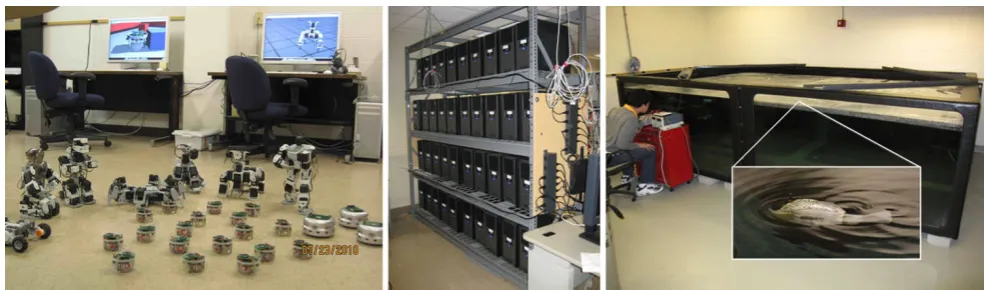
Many of our own research activities have been conducted in the context of robotics. Experiments are conducted on a testbed, called Evolution Park, depicted in Fig. 1. The testbed includes a heterogeneous swarm of mobile robots, parallel computing facilities for evolution runs and physics-based simulations, and a school of robotic fish in a large, custom-built water tank. In addition to the components shown in Fig.1, a 3D printer enables fabrication of robot components that evolve concurrently with their control sys-tems. This infrastructure supports evolution and experimen-tal evaluation of both individual and cooperative behaviors, and is ideal for developing and testing the adaptive software technologies discussed in the remainder of this paper.
2 Background
The research community has responded to the demand for robust computational systems by producing a vari-ety of technologies for developing high-assurance, self-adaptive software. Examples include self-adaptive software mechanisms [3, 7–9]; dynamic service composition [10], software-architecture-based techniques for supporting dy-namic adaptation [11,12]; and requirements-level and for-mal methods-based techniques [13–16].
Despite these advances, however, we are still far from producing software systems that exhibit adaptability, secu-rity, and survival “instincts” analogous to those found in natural organisms. Indeed, many researchers have sought in-spiration from nature to help design resilient computational systems. One approach isbiomimeticdesign, which takes a structure or behavior found in nature and attempts to repli-cate it in an artificial system.
science and engineering domains.
In contrast to these optimization techniques,digital evo-lution[19] is intended to explore the evolutionary process itself. In this method, self-replicating computer programs exist in a user-defined computational environment and are subject to mutations and natural selection. Over generations, these “digital organisms” can evolve to survive, and thrive, under dynamic and adverse conditions. The open-ended na-ture of digital evolution enables biologists to investigate fun-damental questions that are difficult or impossible to study in natural systems [20]. Recently, digital evolution has also been shown to be effective in evolving robust communica-tion protocols [21], in some cases revealing strikingly clever solutions that might otherwise not occur to human design-ers. This topic is discussed later.
Some EC approaches lie on the boundary between har-nessing the power of natural selection and remaining teth-ered to biological principles. For example, neuroevolu-tion [22] is a machine learning method in which GAs are used to train artificial neural networks (ANNs), which in turn can control systems such as robots. ANNs are particu-larly attractive for controllers because the inputs and outputs can directly correspond to sensors and actuators, respec-tively. In evolutionary robotics [23], an artificial genome encodes a robot’s control system and possibly its morphol-ogy. The control program is downloaded into a real or sim-ulated robot, which is then let “loose” in an environment. The fitness of the system is evaluated with respect to per-forming tasks. The most fit individuals in the population are allowed to reproduce, with random mutations and recombi-nation, to form the next generation. This cycle is repeated until a satisfactory solution evolves.
Fig. 1 Components of Evolution Park testbed: (left) collection of ter-restrial microrobots and interactive simulation cluster; (center) rack-mounted parallel computing platform for evolution runs and behavior
analysis; (right) custom-built tank for a school of robotic fish con-structed from electroactive polymer materials
preserved across adaptations. In the following, we discuss several areas where EC can be applied to the development and run-time support of adaptive systems, pointing out di-rections for future research in this exciting area of study.
3 Harnessing evolution in adaptive software
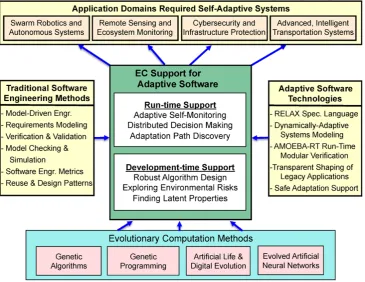
Figure2illustrates the coupling of EC and the engineering of adaptive software. The center box lists the main topics addressed in this paper, where EC methods are integrated into both software development and run-time reconfigura-tion. Each is discussed below. These investigations are sup-ported by a foundation of EC technologies, including tradi-tional methods such as GA/GP [18], digital evolution [19], and neuroevolution [24]. The unique features of these dif-ferent methods can be leveraged at difdif-ferent points in the life-cycle of dynamically-adaptive software.
As indicated by the box on the left, we advocate that such an approach should take advantage of traditional meth-ods for developing high-confidence software, including (a) tools for analyzing evolved state diagrams, (b) model check-ers for verifying adherence to critical system properties, and (c) methods from dynamical system theory to ana-lyze continuous behavior and performance metrics. In ad-dition, as indicated by the box on the right, these meth-ods can directly integrate technologies developed specifi-cally for adaptive software. Examples include the RELAX requirements-specification language, which enables uncer-tainty to be explicitly incorporated into specifications for dynamic adaptation; AMOEBA-RT, a run-time monitoring and verification technique for dynamically adaptive soft-ware; Transparent Shaping, which enables adaptive behavior to be woven into legacy code; and several formal modeling techniques for enabling safe adaptation.
The top of the Fig. 2 identifies several application do-mains where these technologies can be applied. Although
the focus of our own research is primarily on robotics and autonomous systems, evolutionary computation can be in-tegrated into design and run-time reconfiguration of a wide variety of high-assurance adaptive systems, either directly in application code or in supporting middleware platforms.
4 Development-time support
The first area we consider is the application of EC early in the software development process, “proactively” addressing anticipated dynamics and uncertainty in the execution envi-ronment. As DASs increase in complexity and interact with the physical world, it becomes impractical for a human to exhaustively explore the system and environmental condi-tions that may adversely affect operation of the system. EC methods can address this problem in the following ways.
balance multiple conflicting concerns while operating under dynamic and adverse conditions.
Behaviors evolved in Avida, encoded in the genomes of organisms, can be cross-compiled and linked with an exist-ing code base to create images suitable for execution. Previ-ously, we demonstrated this “Avida-to-hardware” process by evolving a phototaxis behavior in Avida, automatically con-verting the code to C, and executing the program on iRobot Create robots. In addition, we can apply rigorous software development techniques to the evolving programs. For ex-ample, we can evaluate genomes using program analysis tools and reverse engineer genomes to formal specifications suitable for model checking.
We have applied Avida to evolve collective communi-cation algorithms for a variety of distributed behaviors, in-cluding synchronization, quorum sensing, constructing net-works, responding to attacks, and reaching consensus [21]. The evolved consensus algorithm [25] is particularly inter-esting because it employs a novel strategy based on proba-bilistic message forwarding. Effectively, the Avida program had “invented” a new, robust algorithm. The scope of future research in this area is nearly unbounded, as such techniques provide a means to discover solutions to complex problems in situations where human intuition may be limited, as well as to optimize those solutions to fit a target platform and environment.
Exploring environmental conditions In addition to apply-ing evolutionary computation todirectly develop solutions
to complex problems, we can also harness its search ca-pabilities to explore conditions a given system might en-counter after deployment. Recently, Ramirez et al. devel-oped LOKI [26], an automated technique for identifying combinations of system and environmental conditions that obstruct system requirements. LOKI leverages the con-cept of novelty search [27], a type of evolutionary algo-rithm where the fitness function is replaced by a domain-independent novelty function that measures the difference between solutions, rewarding solutions different from those previously discovered. Applied to a DAS, LOKIfirst uses a GA to generate sets of conditions. Through a simulation of the system, LOKIthen exposes the DAS to these condi-tions and records how well the DAS satisfies requirements, as captured by a set of utility functions for requirements monitoring. Comparing the differences between values pro-duced by these utility functions enables LOKIto evaluate the behavior of a DAS in response to perceived environmental conditions.
the same vehicle in order to reenter the driving lane. Such behaviors often correlated with high novelty values.
Discovering latent behavior While a requirements viola-tion clearly obstructs a system requirement, complex sys-tems may include latent behaviors, which are unexpected and potentially undesirable, but still satisfy requirements. Furthermore, certain unwanted behaviors may mean that re-quirements need to be modified to explicitly disallow the unwanted behavior. As a proof-of-concept, we developed an automated approach to identify temporal logic properties that describe latent, previously-unknown behaviors in exist-ing UML models. A key component of our approach is an EC-based tool called Marple [28], which leverages natural selection to discover a set of properties covering different regions of the model state space. The discovered properties can be used to refine the models so as to remove unwanted behavior or to explicitly document a desirable property as a required system behavior.
Like LOKI, Marple uses novelty search, in this case to discover a set of properties that describe a UML model. Each individual within Marple represents a property created by instantiating commonly occurring specification patterns in the form of Linear Temporal Logic (LTL). Instantiating a pattern involves replacing the pattern’s placeholders with evolved boolean propositions, where a proposition is created using attribute and operation information from a UML in-stance diagram of the system. Because the propositions can include logical conjunctives and disjunctives, the set of pos-sible propositions is too large for brute force search meth-ods to explore. During the evolutionary process, mutations and crossover produce different LTL properties that might be satisfied by the UML model. Next, the novelty of a prop-erty is assessed using the Spin model checker. If a novel region of the model state space is discovered, then the prop-erty is assigned a higher fitness value and Marple searches the new region more thoroughly. In this way, Marple dis-covers properties that cumulatively describe the behavior of the model. For validation, Marple was applied in an automo-tive industrial case study that identified a set of serious be-havioral errors in a UML model describing four major elec-tronic vehicle subsystems [29]. The errors had not been de-tected through traditional code generation and testing, and in the absence of the Marple tool, they would have been identi-fied during integration testing only after a system prototype had been built.
Key challenges Despite promising results of our early in-vestigations, several important problems need to be ad-dressed to facilitate their adoption by the research and devel-opment communities. First, better tools are needed to bridge the gap between evolved solutions and software engineer-ing methodologies. Specifically, while EC methods are
ca-pable of producing robust algorithms and protocols, trans-lating these into forms amenable to formal analysis is often difficult. Techniques such as neuroevolution produce only weights associate with ANN links. Even when the evolved solution is code, as with Avida, the resulting program is produced by random mutations over evolutionary time. As a result, the encoding of behavior in the genome is often obscure, with code for different functions interwoven with “junk” code left over from earlier generations, making man-ual analysis tedious and time-consuming.
Second, one can envision the integration of LOKI-like functionality as an integral component of the design method-ology. Specifically, the set of behaviors discovered by LOKI can be analyzed to identify (a) elements in the goal model that require new or augmented obstacle mitigations and (b) additional constraints to disallow undesirable latent behav-iors. In the case of autonomous robots, for example, this in-formation could be used to characterize environmental un-certainty and its effect on design considerations, such as physical placement of sensors, the level of redundancy in sensed information, and requirements to conserve energy.
Third, when considering the application of the proposed methods to physical systems, their integration with high-fidelity, physics-based simulators is essential. Only if the simulated environment accurately reflects the real world is it possible to use evolutionary computation to “predict” un-certainty that can arise due to the environmental conditions or malfunction of physical system components. Overcoming this “reality gap” is the subject of considerable research in the evolutionary robotics community.
Finally, thus far we have investigated these methods in stand-alone systems. To make this technology accessible to the development community, we and others need to integrate it into selected middleware platforms and test it on addi-tional real-world applications.
5 Run-time monitoring and reconfiguration
it may also fail to detect events leading to a requirements violation.
We have previously developed Plato-RE [30], a require-ments monitoring system that combines a genetic algorithm with utility functions to enable a DAS to detect possible re-quirements violations while minimizing resource consump-tion. Once utility functions detect a possible requirements violation, Plato-RE exploits the search capability of a GA to generate a new configuration that specifies the monitor-ing frequency for each component and sensor. We evalu-ated Plato-RE by using it to adapt the monitoring behav-ior of a simulated mobile robot. Experimental results show that Plato-RE can detect conditions conducive to a require-ments violation while incurring lower monitoring overhead than the other adaptive monitoring approaches. This flexi-bility enables a DAS to automatically adapt the probing fre-quencies of given sensors in response to changing system and environmental conditions directly affecting the satisfac-tion of its requirements.
Decision making In a DAS, dynamic conditions can trig-ger actions intended to improve performance, conserve en-ergy, or thwart an attack. However, optimizing one system concern may be in conflict with another (e.g., increasing connectivity in a mobile ad hoc network can improve net-work performance and fault tolerance, but could reduce the lifetime of the network by wasting energy). Moreover, such systems must be able to filter an enormous number of in-puts that may affect the decision, which depends not only on the environment and platform capabilities, but also on the application domain and the specific mission being car-ried out. Recently, we have explored the application of EC to decision-making components of adaptive systems. In [31], we demonstrated the ability of a simple GA to support run-time decision making for a high-availability, distributed disk mirroring system. Instead of requiring developers to encode a predetermined set of adaptation strategies at design time to address anticipated reconfiguration scenarios, this system uses a GA to efficiently generate target reconfigurations that not only satisfy high-level directives provided by a system administrator, but also account for current system and envi-ronmental conditions.
neighbors within a limited range. We found that approaches that implicitly reduced entropy, while explicitly addressing self-organization and scalability, were capable of discover-ing behaviors that remained stable even when controlldiscover-ing networks of different sizes than were evaluated during evo-lution. This result suggests that neuroevolution may be a vi-able strategy for discovering controllers for self-organizing multiagent systems.
Finding adaptation paths Once a dynamically adaptive system has detected conditions warranting reconfiguration and decided on a target system configuration, it must fol-low an adaptation path to reach that configuration. Although multiple safe adaptation paths may exist for a given situa-tion, the identification and selection process is nontrivial, as different solutions may represent tradeoffs between recon-figuration costs, performance, and reliability.
Genetic programming can be used to automatically gen-erate safe adaptation paths [33]. Instead of focusing on a single criterion when generating adaptation paths, this ap-proach evolves solutions that balance competing objectives between functional and nonfunctional requirements, such as minimizing reconfiguration costs while maximizing re-configuration performance and reliability. We developed a prototype system,Hermes, for this purpose. Each program evolved by Hermes comprises executable reconfiguration instructions that specify structural and behavioral changes a dynamically adaptive system must perform to safely reach a target reconfiguration. To facilitate the evolution of safe adaptation paths, Hermes is initialized with a set of re-quired reconfiguration instructions derived by performing a component-dependency analysis between the current and target system configurations; all adaptation paths must min-imally have these instructions. Then Hermes uses a GP to gradually transform and improve an adaptation path by adding, removing, replacing, and reordering reconfiguration instructions to better balance competing objectives, while safely reaching the desired target configuration.
manner, the DAS could take into account uncertainty in the sensed data, combining sensor-related utility functions with self-modeling methods previously used in evolutionary robotics. This approach would enable the system to execute simulations of itself at run time and compare the results to the perceived environment, in order to make most effective use of its sensing capabilities while accounting for noise and faulty sensors. Such an approach could potentially be imple-mented within the context of requirements reflection [34], where a DAS is able to look inward during execution and assess its structure and behavior in the context of the system requirements.
Second, self-monitoring and decision making could be extended not only to consider issues such as cost and perfor-mance, but also to mitigate the impact of noise and uncer-tainty in the sensed environment. Like other factors, these is-sues could codified in utility subfunctions, such that the con-figurations found through evolutionary computation would exhibit redundancy to minimize their effect. If noise or a faulty sensor triggers an adaptive response from the system, then the DAS would continue to monitor conditions to deter-mine if it adapted unnecessarily. If so, it would roll back to a previous state, and this experience should be incorporated into future actions.
Finally, the combination of these advances can poten-tially lead to the development of systems that are capable of on-board evolution after deployment. When such a sys-tem encounters unanticipated environmental conditions or component failures, it could evolve new strategies to miti-gate adversity. The system might even maintain a popula-tion of “shadow” controllers evolved in different simulated environments, and which can be activated when similar sit-uations are encountered.
6 Conclusions
In conclusion, evolutionary computation shows promise in supporting the development and run-time support for DASs. Examples include evolution of novel algorithms, character-izing disruptive environmental conditions, discovering po-tentially hazardous latent properties in software models, finding safe configurations and paths leading to them, and decision making in the presence of uncertainty. Encapsulat-ing these capabilities into the middleware layer can reduce the effort required for a developer or application to make use of EC-based methods. Numerous exciting challenges lie ahead for the research community as we attempt to harness this power and integrate it with state-of-the-art software en-gineering technologies, ultimately enabling us to endow ar-tificial systems with the robustness and resiliency of natural organisms.
Further information Studies in harnessing evolution for robust distributed computing and self-adaptive software, along with links to related materials, are described at: http://www.cse.msu.edu/thinktank. Information on the Evo-lution Park testbed is available at:http://www.cse.msu.edu/ evopark.
Acknowledgements This work has been supported in part by NSF grants CNS-1059373, CNS-0915855, CNS-0751155, CCF-0541131, IIP-0700329, CCF-0750787, CCF-0820220, DBI-0939454, CNS-0854931, Army Research Office grant W911NF-08-1-0495, and Ford Motor Company. The authors gratefully acknowledge the other mem-bers of the Software Engineering and Network Systems Laboratory for their contributions to this work.
References
1. McKinley PK, Sadjadi SM, Kasten EP, Cheng BHC (2004) Com-posing adaptive software. IEEE Comput 37(7):56–64
2. Zhang J, Cheng BHC (2006) Model-based development of dy-namically adaptive software. In: Proceedings of the 28th interna-tional conference on software engineering. ACM, New York, pp 371–380 (Distinguished Paper Award)
3. Blair GS, Coulson G, Robin P, Papathomas M (1998) An archi-tecture for next generation middleware. In: Proceedings of the IFIP international conference on distributed systems platforms and open distributed processing (Middleware’98), The Lake District, England, September
4. Whittle J, Sawyer P, Bencomo N, Cheng BHC, Bruel J-M (2009) RELAX: Incorporating uncertainty into the specification of self-adaptive systems. In: Proceedings of the 17th international re-quirements engineering conference (RE ’09), Atlanta, Georgia, USA. IEEE Computer Society, Washington, pp 79–88
5. De Jong KA (2002) Evolutionary computation: a unified ap-proach. MIT Press, Cambridge
6. Awards for human-competitive results produced by genetic and evolutionary computation. Competition held as part of the annual genetic and evolutionary computation conference (GECCO), sponsored by ACM SIGEVO. Results available at http://www.human-competitive.org
7. Schmidt DC, Levine DL, Mungee S (1998) The design of the TAO real-time object request broker. Comput Commun 21:294–324 8. Sadjadi SM (2004) Transparent shaping support for adaptability in
pervasive and autonomic computing. PhD thesis, Michigan State University, East Lansing, Michigan, USA
9. Vanegas R, Zinky JA, Loyall JP, Karr DA, Schantz RE, Bakken DE (1998) QuO’s runtime support for quality of service in dis-tributed objects. In: Proceedings of the IFIP international confer-ence on distributed systems platforms and open distributed pro-cessing (Middleware’98), The Lake District, England, September 10. Mokhtar SB, Georgantas N, Issarny V (2007) COCOA:
COnversation-based service COmposition in pervAsive comput-ing environments with QoS support. J Syst Softw 80(12):1941– 1955
11. Kramer J, Magee J (2007) Self-managed systems: an architec-tural challenge. In: Future of software engineering 2007. IEEE-CS Press, Los Alamitos
May
17. Holland JH (1975) Adaptation in natural and artificial systems: an introductory analysis with applications to biology, control, and artificial intelligence. University of Michigan Press, Ann Arbor 18. Koza JR (2003) Genetic programming IV: routine
human-competitive machine intelligence. Kluwer Academic, Norwell 19. Ofria C, Wilke CO (2004) Avida: a software platform for research
in computational evolutionary biology. J Artif Life 10:191–229 20. Lenski RE, Ofria C, Pennock RT, Adami C (2003) The
evolution-ary origin of complex features. Nature 423:139–144
21. McKinley PK, Cheng BHC, Ofria C, Knoester D, Beckmann B, Goldsby H (2008) Harnessing digital evolution. IEEE Comput. 41 22. Stanley KO, Miikkulainen R (2004) Competitive coevolution through evolutionary complexification. J Artif Intell Res 21:63– 100
23. Floreano D, Husbands P, Nolfi S (2008) Evolutionary robotics. In: Handbook of robotics. Springer, Berlin
24. Miikkulainen R, Stanley KO (2008) Evolving neural networks. In: GECCO ’08: proceedings of the 2008 GECCO conference companion on genetic and evolutionary computation. ACM, New York, pp 2829–2848
25. Knoester DB, McKinley PK (2009) Evolution of probabilistic consensus in digital organisms. In: Proceedings of the third IEEE international conference on self-adaptive and self-organizing sys-tems, San Francisco, California, September
29. Jensen A, Cheng B, Goldsby H, Nelson E (2011) A toolchain for the detection of structural and behavioral latent system proper-ties. In: Proceedings of the ACM/IEEE international conference on model driven engineering languages and systems
30. Ramirez AJ, Cheng BHC, McKinley PK (2010) Adaptive moni-toring of software requirements. In: Proceedings of the first inter-national workshop on requirements at run time, Sydney, Australia, October
31. Ramirez A, Knoester D, Cheng BHC, McKinley PK (2009) Ap-plying genetic algorithms to decision making in autonomic com-puting systems. In: Proceedings of the 6th IEEE international con-ference on autonomic computing and communications, Barcelona, Spain, June. Best Paper Award
32. Knoester DB, McKinley PK (2011) Neuroevolution of controllers for self-organizing mobile ad hoc networks. In: Proceedings of the fifth IEEE international conference on adaptive and self-organizing systems, Ann Arbor, Michigan, October
33. Ramirez AJ, Cheng BHC, McKinley PK, Beckmann BE (2010) Automatically generating adaptive logic to balance non-functional tradeoffs during reconfiguration. In: Proceedings of the 7th inter-national conference on autonomic computing, Washington, DC, June, pp 225–234