DOI 10.1007/s13173-011-0049-z O R I G I N A L PA P E R
Selective local texture features based face recognition with single
sample per class
K. Jaya Priya·R.S. Rajesh
Received: 21 April 2010 / Accepted: 6 November 2011 / Published online: 30 November 2011 © The Brazilian Computer Society 2011
Abstract Local appearance-based methods have been suc-cessfully applied to face recognition and achieved state-of-the-art performance. In this paper we propose a local selec-tive feature extraction approach based on Gabor filters and the Local Binary Pattern (LBP) approach to face recogni-tion. A Gabor filter extracts the textural features from the face image and generates the binary face template using those features. The binary face template acts like a mask to extract the local texture information of the face image us-ing a Local Binary Pattern technique. This selective local texture feature approach uses the histogram-based match-ing for face recognition. This method reduces the computa-tion time considerably. This method also reduces the num-ber of Local Binary Patterns into half compared to the exist-ing LBP method. This proposed approach reduces the com-putation time for the FERET dataset by 45%. Experiments on well-known face databases such as FERET, Yale, Indian Faces and ORL show that this approach obtains consistent and promising results in the scenario of one training sample per person with significant facial variation.
Keywords Face recognition·Local Binary Pattern·Gabor filter·Binary face template·Expression invariant face recognition·Single Sample Problem
K. Jaya Priya (
)Research Scholar, Department of Computer Science, Mother Teresa Women’s University Kodaikanal, Kodaikanal, 624102, India
e-mail:[email protected]
R.S. Rajesh
Department of Computer Science and Engineering, Manonmaniam Sundaranar University, Tirunelveli, 627012, Tamilnadu, India
e-mail:[email protected]
1 Introduction
In recent years, face recognition has received much attention in many areas such as entertainment, information security, law enforcement, and surveillance [36]. Most of the face-recognition methods such as eigenfaces [26], Fisher faces [4] and Laplacian faces [9], nearest feature line-based sub-space analysis, neural networks [14,25], elastic bunch graph matching [30] and kernel methods [33] were initially devel-oped with face images collected under relatively well con-trolled conditions, and in practice they have difficulty in dealing with the range of variation of the appearance that commonly occurs in unconstrained natural images due to illumination, pose, facial expression, ageing and partial oc-clusions. Another most challenging problem for face recog-nition is the so-called Single Sample Problem (SSP), where the training process uses a single sample per subject. In some specific scenarios, such as law enforcement, passport or identification card verification etc., only one image per person is available for training. Some face-recognition al-gorithms [5,6,18,24,25] were proposed to solve the one-sample problem in various process modes. Face-recognition methods are generally divided into two categories: holistic matching methods and local matching methods.
kernel techniques such as kernel PCA [23], kernel LDA [18] etc. are also introduced.
Compared with holistic methods, local methods are more suitable for handling the one-sample problem due to the following observations: Firstly, in local methods, the low-dimensional local feature vectors represent the original face rather than one single full high-dimensional vector. Thus the “curse of dimensionality” is alleviated from the begin-ning. Secondly, local methods offer more flexibility to rec-ognize a face based on its parts; thus the common and class-specific features are easily identified. Thirdly, different fa-cial features improve the classifiers diversity, which is help-ful for face identification. The local matching approaches have shown some promising results in face recognition [1, 2,8,12,13,15–17]. These methods first extract several fa-cial features and then make a comparison on the basis of local statistics for recognition. The comparison of local ap-proaches with global apap-proaches shows that the local sys-tem outperformed the global syssys-tem with 60% [10]. There exist several local appearance-based methods for extracting the most useful features from face images to address face recognition.
The Local Binary Pattern (LBP) method [19] was orig-inally proposed as an image texture descriptor [20], but it also applied on face-recognition application [1]. Face recog-nition using the LBP method [2] provides very good results, both in terms of speed and discrimination performance. More recent work on LBP [28], the Heat Kernel Local Bi-nary Pattern (HKLBP) descriptor, extracts multiscale Heat Kernel Structural Information (HKSI) matrices to capture the intrinsic structural information of the face appearance. Then, the Local Binary Pattern analysis on HKSI matrices provides the HKLBP descriptor for the representation of the face. The feature extraction with LBP is a straightfor-ward (real-time) process. Due to this reason LBP has a posi-tive influence on the processing speed and integration of the method in a new environment. One more benefit of LBP is that it is less sensitive to variations of the illumination of the image. It is also less sensitive to rotation and scaling varia-tions.
A Gabor features-based [16] face representation has at-tained more attention in computer vision, image processing, pattern recognition, and so on. Wenchao et al. [29] present a Local Gabor-based Binary Pattern Histogram Sequence (LGBPHS) [29] for face representation by combining the Gabor and LBP descriptors. This approach much improves LBP’s robustness to illumination changes. The Gabor phase [35] was also used to improve the recognition rate and a typi-cal method [34] of this class is the histogram of Gabor phase patterns (HGPP), which captures the global Gabor phase and local Gabor phase variation.
Gabor filters can exploit salient visual properties such as spatial localization, orientation selectivity, and spatial
frequency characteristics. Due to its great success in face recognition, this paper addresses Gabor features to represent the face in the form of a binary face template. In this pa-per we propose a selective local texture features-based face representation for face recognition with a single sample per class.
The rest of the paper is organized as follows. Section2 gives a brief introduction on LBP and the Gabor filter. Sec-tion3presents the selective local texture features-based face descriptors that are proposed. Experimental results are given in Sect. 4, which compares the performances of the LBP method with the selective local LBP method on the expres-sion, accessories and slightly view-point variant faces of the Yale, ORL and FERET databases. Section5concludes the paper.
2 Outline of LBP and Gabor filter
In this section, we provide a brief review of the Local Binary Pattern and the Gabor filter.
2.1 Local Binary Pattern
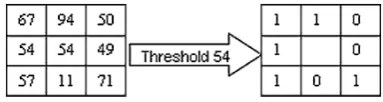
Ojala et al. [19] introduced the Local Binary Pattern opera-tor in 1996 as a means of summarizing the local grey-level structure. The operator takes a local neighborhood around each pixel, thresholds the pixels of the neighborhood at the value of the central pixel and uses the resulting binary-valued image patch as a local image descriptor. It was orig-inally defined for 3×3 neighborhoods, giving 8-bit codes based on the eight pixels around the central one.
Formally, the LBP operator takes the form
LBP(xc, yc)= 7
n=0
2ns(in−ic)
where in this case n runs over the eight neighbors of the central pixelc,icandinare the grey-level values atcandn, ands(u)is 1 ifu≥0 and 0 otherwise. Figure1illustrates the LBP encoding process.
To be able to deal with textures at different scales, the LBP operator was later extended to use circular neighbor-hoods of different sizes. Ahonen et al. [1] introduced a LBP-based method for face recognition [2] that divides the face into a regular grid of cells and finds histograms for the uniform LBPs within each cell. Finally, the cell-level his-tograms concatenation produces a global descriptor vector.
2.2 Gabor filter
A Gabor filter works as a band pass filter for the local spa-tial frequency distribution, achieving an optimal resolution in both the spatial and the frequency domain. The 2D Ga-bor filterψf,θ(x, y)is represented as a complex sinusoidal signal modulated by a Gaussian kernel function as follows:
ϕf,θ(x, y)=exp
−1 2
x2θn
σ2x +
y2θn σ2
y
exp(2f xθn)
xθn yθn =
sinθn cosθn −cosθn sinθn
x y
σx andσy are the standard deviations of the Gaussian en-velope along thex andy dimensions; f is the central fre-quency of the sinusoidal plane wave andθ the orientation. The rotation of thex–y plane by an angleθnwill result in a Gabor filter at the orientationθn. The angleθnis defined by
θn= π p(n−1)
forn=1,2, . . . , pandp∈N, wherepdenotes the number of orientations. The design of the Gabor filters is accom-plished by tuning the filter with a specific band of spatial frequency and orientation by appropriately choosingσxand σy, the radial frequency, f, and the orientation of the fil-ter,θn.
3 Proposed approach
This section describes the proposed selective local texture feature extraction based on the Gabor binary face template.
3.1 Gabor filter-based binary face template creation
In this case, first we make the Gabor representation of a face image. The convolution process of a face image with the Gabor filter provides the Gabor representation of that face. LetI (x, y)be the intensity at the coordinate(x, y)in a grey-scale face image; its convolution with the Gabor filter ψf,θ(x, y)is defined as
gf,θ(X, Y )=I(X, Y )⊗Ψf,θ(X, Y )
where ⊗ denotes the convolution operator. The response to each Gabor kernel filter representation is a complex function with real part{gf,θ(x,y)} and an imaginary part {gf,θ(x, y)}. The magnitude response is expressed as
gf,θ(X, Y ) =
R2g f,θ(x, y)
+F2g
f,θ(x, y)
We generate the binary face template (BFT) from the real part of the complex information of the Gabor representation as
BFT(X, Y )=1 if{gf,θ(X, Y )}>0 BFT(X, Y )=0 if{gf,θ(X, Y )} ≤0
3.2 Selective Local Binary Pattern
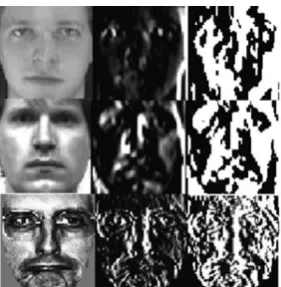
Normally the Local Binary Pattern approach generates the LBP for each pixel of the face image to describe that face. But in this approach it is enough to generate LBP for selec-tive pixels of the face image to represent that face. Figure2 shows the response of the Gabor filter on the image of the face and its corresponding binary face template image.
The response of the Gabor filter for a face image provides the local image features efficiently. On the basis of those local image features, we generate the binary face template. The binary face template clearly describes the region which has more information on the variation of the local texture, which is a feature robust against facial variations. Only for that reason we in our proposed approach use Gabor filters before LBP as an efficient feature selection process for face recognition.
This approach generates the Local Binary Pattern only for the pixel in theI (x, y), which has the value of one in the corresponding BFT(x, y). Due to this, we reduce the num-ber of pattern generations.
The Gabor filter-based selected region of a face gives more unique information about that face. Hence there is no variation in the performance due to the missing pixels. So we probably get a good matching score with less compu-tation overhead. Similar to LBP the feature extraction with this approach is also a straightforward (real-time) process. So there is no need for training.
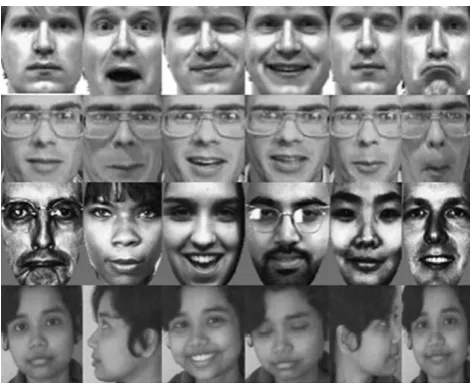
Fig. 3 Some cropped faces used in this experiment 4 Experimental results
This section evaluates the recognition performance of LBP and the selective local feature extraction based on a Gabor filter and LBP on the Single Sample Problem.
We test the proposed approach for face recognition us-ing the Yale [32], ORL [21], Indian Faces [11] and FERET Databases [22].
All images in Yale and ORL are cropped to the size of 64×64 from the middle of the location of the eye. In the training section we are using one frontal image for each sub-ject.
In the Indian Face database images of 60 persons with 10 sample images with different orientations and views are available. The resolution of the images we used in the algo-rithm is 128×128 for computational purpose.
We test the recognition performance of the proposed fea-ture selection approach with the FERET database [22] ac-cording to the standard FERET evaluation protocol, which has exactly defined the gallery and probe sets. In the case of the FERET dataset the images are registered using eye coordinates and cropped with an elliptical mask to exclude the non-face area from the image. After this, we do a grey-level histogram equalization over the non-masked area. In our experiments, we strictly test the methods based on the standard gallery (1 196 images of 1 196 subjects) and ex-pression probe set fb (1 195 images).
Figure 3 shows some sample images for each dataset. The first row shows faces from the Yale database. The sec-ond row shows faces from the ORL database. The third row shows faces from the FERET dataset. The fourth row shows the faces from the Indian Face dataset.
The number of distinct subjects and the number of testing images in the respective databases are shown in Table1.
The Gabor filter used for our approach has single fre-quency (0.2) and single orientation (90θ) with a window
Table 1 Experimental Databases
Face No. of No. of Primary variations
Dataset testing persons testing images in the testing dataset
Yale 15 150 Expression,
Illumination Accessories
ORL 40 252 Expression,
View- point
FERET 1 196 1 195 Expression
Indian 60 600 Expression,
Faces Pose Variation
Fig. 4 Given test image of size (64×64)
size of 5×5 as its parameters. For an efficient represen-tation of the face, first the image is divided intok2regions. In this experiment we divide a face image of the size 64×64 into 82=64 regions. For every region a histogram with all possible labels is constructed. This means that every bin in a histogram represents a pattern and contains the num-ber of appearances of it in the region. The feature vector is then constructed by concatenating the regional histograms to one big histogram. For every region all non-uniform pat-terns (more than two transitions) are labeled with one sin-gle label. This means that every regional histogram con-sists of P (P −1)+3 bins, where P =8. We have P (P−1)bins for the patterns with two transitions, two bins for the patterns with zero transitions and one bin for all non-uniform patterns. The total feature vector for an image con-tainsk2×(P (P −1)+3)bins. So, for an image divided into 64 regions and eight sampling points on the circles, the feature vector has a size of 3776 bins. The LBP code cannot be calculated for the pixels in the area with a dis-tanceRfrom the edges of the image. For anN×Mimage the feature vector is constructed by calculating the LBP code for every pixel(xc, yc)withxc∈ {R+1, . . . , N−R}and yc∈ {R+1, . . . , M−R}.
Table 2 Computation time and number of Local Binary Patterns re-duction by selective local texture features for the face in Fig.4
LBP Selective local
texture features
Number of Local 3 844 1 873
Binary Patterns
Computation time 2.3910 1.953
(Seconds)
Table 3 Overall computation time in seconds for the Yale, ORL, FRET and Indian Face datasets in the training process
LBP Selective Local texture features Yale (15 subjects) 43.2650 13.9060
ORL (40 subjects) 92.6250 28.9220
FERET (1 196 subjects) 8 072.4 5 352.6 Indian Faces (60 subjects) 144.36 85.624
Table 4 Overall reduction of the patterns on LBP operation LBP Selective local Rate
texture features of reduction
Yale 57 660 30 093 52.1904%
ORL 153 760 80 127 52.1117%
FERET 18 987 696 9 492 399 49.9924%
Indian faces 952 560 495 002 51.97%
Fig.4to 1 873. So this approach makes an enormous reduc-tion in computareduc-tion process and time possible. For example the LBP generations for some faces are reduced up to 1 664, 1 687, 1 715 pixels and so on. This face-recognition system is performed with an Intel Pentium(R) D 2.40 GHz CPU and 512 MB RAM with Matlab7.0.
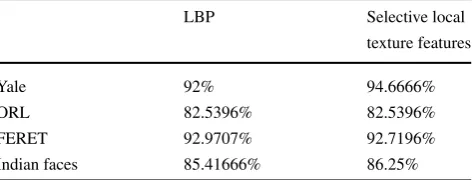
Table3summarizes the overall computation time for the Yale (15 subjects), ORL (40 subjects), FERET (1 196 sub-jects) and Indian Face Dataset (60 subsub-jects), and Table 4 shows the overall pattern reduction for the training process. Table5 summarizes the respective performances of the above described methods based on the expression variant faces with single training image. Table6shows the recog-nition rate obtained whilst using normal/view-point variant faces for the recognition. Table7shows the results obtained whilst using faces with accessories for testing.
Table8 summarizes the recognition rate for the illumi-nation variant faces for testing. Table9 shows the dataset-based recognition rate. In Fig. 5, we plot the cumulative match curves of LBP and the proposed approach on the FERETf bprobe set.
Table 5 Results obtained for expression invariant face recognition with a single sample
LBP Selective local
texture features
Yale 92% 94.6666%
ORL 82.5396% 82.5396%
FERET 92.9707% 92.7196%
Indian faces 85.41666% 86.25%
Table 6 Results obtained for normal and view-point and pose invari-ant face recognition with single sample per class
LBP Selective local
texture features
Yale 100% 100%
ORL 86.7724% 85.1851%
Indian faces 78.7115% 78.1512%
Table 7 Results obtained whilst using faces with accessories for recognition with single sample per class
Methods Yale
LBP 80%
Selective local texture features 86.6666%
Table 8 Results obtained for illumination variant faces with single sample per class
Methods Yale
LBP 93.333%
Selective local texture features 90%
Table 9 Face recognition results based on different databases LBP Selective local texture features
Yale 91% 93%
ORL 85.3175% 84.5238 %
FERET 92.9824% 92.7819%
Indian faces 81.2395% 81.4070%
Fig. 5 Cumulative match curves for the FERETfbprobe set In terms of the recognition rate, the proposed method out-performs LBP with an increase of accuracy of 2.6666% for the Yale (Expression) and 0.83334% for the Indian Face dataset. The recognition accuracy is almost intact for the FERET and ORL datasets.
In the case of a normal face with a slight view-point varia-tion, the recognition rate is similar to LBP in the Yale dataset but slightly down in the ORL and Indian Face datasets due to perspective and view-point variations, which needs some more features to represent the face than the selective fea-tures. This approach outperforms LBP with 6.6667% for ac-cessories (Yale) invariant face recognition. Due to the nature of the Gabor filter, the LBP-based face recognition performs well for the illumination variant faces.
5 Conclusion
In this paper, we have proposed an approach of local selec-tive texture feature-based face recognition using Gabor filter and LBP techniques. First we extracted the facial features using the Gabor filter. Then we encode these features into a binary form to generate a binary face template. The binary face template acts like a mask to extract the local texture in-formation of the face image using a Local Binary Pattern technique. Compared with the conventional LBP method, this kind of feature selection approach reduces the num-ber of Local Binary Patterns to describe the face. The ex-perimental result reveals that the proposed feature selec-tion approach reduces the computaselec-tion time considerably, without affecting the recognition performance. Furthermore, for training we are using only one image per person which makes it useful for practical face-recognition applications.
This paper has also evaluated the performances of the LBP and the selective local texture feature methods in terms of normal, changes in view-point, accessories and facial ex-pressions of the faces of the Yale, ORL, Indian Face and
FERET datasets. The results clearly showed that the selec-tive local featubased face representation attains a good re-sult for the expression and accessories invariant face recog-nition. In future, we can combine this local selective feature-based approach with pose invariant face-recognition ap-proaches to improve the recognition performance with less computation time for the Single Sample Problem.
Acknowledgements The comments and suggestions from the anony-mous reviewers greatly improved this paper. Portions of the research in this paper use the FERET database of facial images collected under the FERET program.
References
1. Ahonen T, Hadid A, Pietikainen M (2004) Face recognition with Local Binary Patterns. In: Proceedings of the 8th European con-ference on computer vision (ECCV ’04), Prague, Czech Republic, May 11–14. vol 1, pp 469–481
2. Ahonen T, Hadid A, Pietikainen M (2006) Face description with Local Binary Patterns: application to face recognition. IEEE Trans Pattern Anal Mach Intell 28(12):2037–2041
3. Bartlett MS, Movellan JR, Sejnowski TJ (2002) Face recogni-tion by independent component analysis. IEEE Trans Neural Netw 13(6):1450–1464
4. Belhumeur PN, Hespanha JP, Kriegman DJ (1997) Eigenfaces vs. Fisherfaces: recognition using class specific linear projection. IEEE Trans Pattern Anal Mach Intell 19(7):711–720
5. Chen S, Liu J, Zhou ZH (2004) Making FLDA applicable to face recognition with one sample per person. Pattern Recognit 37(7):1553–1555
6. Chen S, Zhang D, Zhou ZH (2004) Enhanced (PC) A for face recognition with one training image per person. Pattern Recognit Lett 25(10):1173–1181
7. Etemad K, Chellappa R (1997) Discriminant analysis for recogni-tion of human face images. J Opt Soc Am A 14(8):1724–1733 8. Geng X, Zhou ZH (2006) Image region selection and ensemble
for face recognition. J Comput Sci Technol 21(1):116–125 9. He X, Yan X, Hu Y, Niyogi P, Zhang H (2005) Face
recogni-tion using Laplacian faces. IEEE Trans Pattern Anal Mach Intell 27(3):328–340
10. Heisele P, Ho J, Wu X, Poggio T (2003) Face recognition: component-based versus global approaches. Comput Vis Image Underst 91(1):6–12
11. Face Indian Database (2011)http://viswww.cs.umass.edu/~vidit/ IndianFaceDatabase/
12. Jaya Priya K, Rajesh RS (2010) Dual tree complex wavelet trans-form based face recognition with single view. Ubiquitous Comput Commun J 5(1)
13. Jaya Priya K, Rajesh RS (2010) Local fusion of complex dual-tree wavelet coefficients based face recognition for single sample problem. Proc Comput Sci 2(1):94–100
14. Lawrence S, Lee Giles C, Tsoi A, Back A (1997) Face recogni-tion: a convolutional neural-network approach. IEEE Trans Neural Netw 8(1):98–113
15. Lei Z, Li SZ, Chu R, Zhu X (2007) Face recognition with local Gabor textons. In: Lecture Notes in Computer Science, vol 4642. Springer, Berlin, pp 49–57
16. Liu C, Wechsler H (2002) Gabor feature based classification using the enhanced Fisher linear discriminant model for face recogni-tion. IEEE Trans Image Process 11(4):467–476
18. Mika S, Ratsch G, Weston J, Scholkopf B, Muller KR (1999) Fisher discriminant analysis with kernels. In: Proceedings of Neu-ral Networks for Signal Processing IX, pp 41–48
19. Ojala T, Pietikainen M, Harwood D (1996) A comparative study of texture measures with classification based on feature distributions. Pattern Recognit 29(1):51–59
20. Ojala T, Pietikainen M, Maenpaa T (2010) Multiresolution gray-scale and rotation invariant texture classification with local binary patterns. IEEE Trans Pattern Anal Mach Intell 24(7):971–987 21. ORL (2011) http://www.cl.cam.ac.uk/research/dtg/attarchive/
facedatabase.html
22. Phillips PJ, Wechsler H, Huang J, Rauss PJ (1998) The FERET database and evaluation procedure for face-recognition algo-rithms. Image Vis Comput 16(5):295–306
23. Scholkopf B, Smola A, Muller KR (1999) Nonlinear compo-nent analysis as a kernel eigenvalue problem. Neural Comput 10(5):1299–1319
24. Tan X, Chen S, Zhou ZH, Zhang F (2005) Recognizing partially occluded, expression variant faces from single training image per person with SOM and soft k-NN ensemble. IEEE Trans Neural Netw 16(4):875–886
25. Tan X, Chen S, Zhou ZH, Zhang F (2006) Face recognition from a single image per person: a survey. Pattern Recognit 39(1):1725– 1745
26. Turk M, Pentland A, Neurosci J (1991) Eigenfaces for recognition. J Cogn Neurosci 3(1):71–86
27. Wang X, Tang X (2004) A unified framework for subspace face recognition. IEEE Trans Pattern Anal Mach Intell 26(9):1222– 1228
28. Hu W, Li X, Zhongfei Z, Wang H (2010) Heat kernel based local binary pattern for face representation. IEEE Signal Process Lett 17(3):308–311
29. Zhang W, Shan S, Gao W, Chen X, Zhang H, Wang J (2005) Lo-cal Gabor Binary Pattern Histogram Sequence (LGBPHS): a novel non-statistical model for face representation and recognition. In: Proceedings of the 10th international conference on computer vi-sion, Beijing, China, October 17–21, vol 1, pp 786–791
30. Wiskott L, Fellous MJ, Kruger N, Von der Malsburg C (1997) Face recognition by elastic bunch graph matching. IEEE Trans Pattern Anal Mach Intell 19(7):775–779
31. Xiang C, Fan AX, Lee HT (2006) Face recognition using recursive fisher linear discriminant. IEEE Trans Image Process 15(8):2097– 2105
32. Yale (2011)www.cvc.yale.edu/projects/yalefaces/yalefaces.html
33. Yang J, Frangi F, Yang A, Zhang D, Jin Z (2005) KPCA plus LDA: a complete kernel Fisher discriminant framework for fea-ture extraction and recognition. IEEE Trans Pattern Anal Mach Intell 27(2):230–244
34. Zhang B, Shan S, Chen X, Gao W (2007) Histogram of Gabor phase patterns (hgpp): a novel object representation approach for face recognition. IEEE Trans Image Process 16(1):57–68 35. Zhang B, Shan S, Chen X, Gao W (2009) Are Gabor phases really
useless for face recognition? PAA Pattern Anal Appl 12(3):301– 307