R E S E A R C H
Open Access
Vineland adaptive behavior scales to
identify neurodevelopmental problems in
children with Congenital Hyperinsulinism
(CHI)
Maria Salomon-Estebanez
1,4*†, Zainab Mohamed
2†, Maria Michaelidou
1, Hannah Collins
3, Lindsey Rigby
1,
Mars Skae
1, Raja Padidela
1, Stewart Rust
3, Mark Dunne
4, Karen Cosgrove
4, Indraneel Banerjee
1,4and Jacqueline Nicholson
3Abstract
Background:Congenital Hyperinsulinism (CHI) is a disease of severe hypoglycaemia caused by excess
insulin secretion and associated with adverse neurodevelopment in a third of children. The Vineland Adaptive Behavior Scales Second Edition (VABS-II) is a parent report measure of adaptive functioning that could be used as a developmental screening tool in patients with CHI. We have investigated the
performance of VABS-II as a screening tool to identify developmental delay in a relatively large cohort of children with CHI. VABS-II questionnaires testing communication, daily living skills, social skills, motor skills and behaviour domains were completed by parents of 64 children with CHI, presenting both in the early neonatal period (Early-CHI, n= 48) and later in infancy (Late-CHI, n= 16). Individual and adaptive composite (Total) domain scores were converted to standard deviation scores (SDS). VABS-II scores were tested for correlation with objective developmental assessment reported separately by developmental paediatricians, clinical and educational psychologists. VABS-II scores were also investigated for correlation with the timing of hypoglycaemia, gender and phenotype of CHI.
Results: Median (range) total VABS-II SDS was low in CHI [-0.48 (-3.60, 4.00)] with scores < -2.0 SDS in 9 (12%) children. VABS-II Total scores correctly identified developmental delay diagnosed by objective assessment in the majority [odds ratio (OR) (95% confidence intervals, CI) 0.52 (0.38, 0.73), p< 0.001] with 95% specificity [area under curve (CI) 0.80 (0.68, 0.90), p< 0.001] for cut-off < -2.0 SDS, although with low sensitivity (26%). VABS-II Total scores were inversely correlated (adjusted R2= 0.19, p= 0.001) with age at presentation (p= 0.024) and male gender (p= 0.036), males having lower scores than females in those with Late-CHI [-1.40 (-3.60, 0.87) v 0.20 (-1.07, 1.27), p= 0.014]. The presence of a genetic mutation representing severe CHI also predicted lower scores (R2= 0.19, p= 0.039).
(Continued on next page)
* Correspondence:[email protected]
†Equal contributors
1Department of Paediatric Endocrinology, Royal Manchester Children’s Hospital, Central Manchester University Hospitals, Oxford Road, Manchester M13 9WL, UK
4Faculty of Biology, Medicine and Health, University of Manchester, Oxford Road, Manchester M13 9PL, UK
Full list of author information is available at the end of the article
(Continued from previous page)
Conclusions: The parent report VABS-II is a reliable and specific tool to identify developmental delay in CHI
patients. Male gender, later age at presentation and severity of disease are independent risk factors for lower VABS-II scores.
Keywords: Glucose, Insulin, Vineland, Development, Cognitive assessment, Neurodevelopment,
Developmental delay
Background
Congenital Hyperinsulinism (CHI) is a significant dis-order of hypoglycaemia caused by excessive and un-regulated insulin secretion [1, 2]. CHI usually presents early in the neonatal period (Early-CHI), but later presentation (Late-CHI) is also well recognised [3–5]. A significant proportion of children with Congenital Hyperinsulinism (CHI) have adverse neurodevelopmental abnormalities in spite of im-provements in medical care [3, 4, 6]. Identifying neurodevelopmental outcomes is a priority for chil-dren in follow up care; chilchil-dren with developmental needs may require additional support for physical and learning disabilities. The Vineland Adaptive Behavior Scales II© (VABS-II; Pearson Education Incorporated, San Antonio, Texas) parent report questionnaire is a tool that has been standardised for factors including gender, race, age and parental education, to identify children with developmental delay in the domains of communication, daily living skills, social skills, motor skills and behaviour. VABS-II is useful as an adaptive functioning inventory that could be completed at home without time consuming hospital visits and as-sessments. VABS-II has been used in a few children with CHI [7] but its reliability as a general screening tool to assess developmental delay in this population has not been assessed. VABS-II could be a credible tool to screen for adverse neurodevelopment in chil-dren with CHI, particularly at a younger age before formal time consuming cognitive testing is feasible. In this study, we have investigated the utility of VABS-II questionnaires as a parent report screening tool to identify developmental abnormalities in a relatively large population of children with CHI.
Aims We aimed to
1. investigate performance of VABS-II to identify developmental delay in CHI and
2. identify patient factors correlating with VABS-II scores.
Methods
Parents of a cohort of children with CHI (n= 64), presenting consecutively between 2013 and 2015 to a
specialist CHI treatment centre, completed the VABS-II questionnaire following consent. The diag-nosis and treatment of CHI was based on established criteria and clinical practice [1, 2]. Medical and sur-gical treatment was individualised for each child. Pa-tients’ characteristics and clinical outcome data were obtained from a database of patients. CHI was con-sidered early (Early-CHI) if hypoglycaemia presenta-tion was in the first month of life. Children who presented with hypoglycaemia later than one month had Late-CHI. In such children, neonatal records did not provide evidence for persistent hypoglycaemia. Following hospital discharge, children with Early and Late-CHI were assessed in the outpatient department by the clinical team comprising of clinicians, specialist nurse practitioners, dieticians, speech and language therapists and one clinical psychologist. VABS-II was discussed with parents as a routine screening tool for development after the age of 1 year.
VABS-II is a validated measure of intellectual and developmental functioning, and has been used in chil-dren with neonatal conditions [8], in neurological problems [9] and in children with genetic problems [10]. VABS-II has also been used in a small cohort of children with CHI, but its reliability as a screening tool has not been assessed [7]. Although VABS-II can be applied in children from birth, milder forms of de-velopmental delay may not be apparent until an older age when clear progress in several developmental do-mains is obvious. Therefore, the minimum age for using the VABS-II was chosen at 18 months. No upper limit was specified; however as scores for motor skills in children > 6 years are estimates, ana-lysis of VABS-II scores were run both with and with-out children > 6 years.
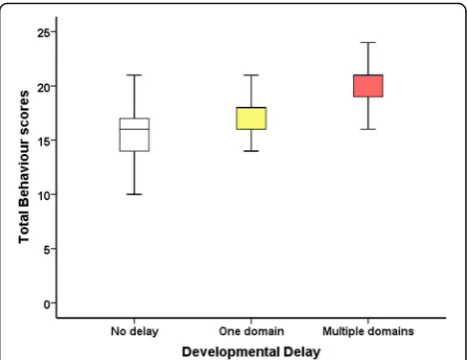
(Total) score. For each VABS-II domain, scores were converted to Standard Deviation Scores (SDS) based on mean (SD) 15 (3). Total VABS-II scores were also converted to Total VABS-II SDS (VABS-II Total) based on mean (SD) 100 (15), (total scores are not additive). For each VABS-II domain and for composite scores, SDS < -2.0 was indicative of significant devel-opmental delay. The Behaviour component of VABS-II was independently scored for internalising, externa-lising and total maladaptive behaviour scores, with raw scores having inverse correlation with behaviour outcomes. High scores corresponded to poor behav-iour outcomes; for total Behavbehav-iour, scores≥20 were considered unsatisfactory.
VABS-II was assessed for repeat variability by com-paring initial report with a second report in a volun-teer group (n= 7) after at least 1 year. The repeat assessment was performed to investigate if VABS-II demonstrated variability in relation to the timing of the test that could affect the interpretation of re-sults. VABS-II was also analysed in a group of chil-dren with idiopathic ketotic hypoglycaemia (IKH) with normal neurodevelopment (n= 9) to assess test per-formance in an alternative condition of hypoglycaemia without significant adverse neurodevelopment.
VABS-II scores were compared with objective de-velopmental assessment performed within 6 months of reporting. This assessment was performed by de-velopmental paediatricians, clinical psychologists and educational psychologists who were unaware of VABS-II performance scores. The parents of chil-dren with CHI were unaware of the VABS-II scores and report until after the objective developmental assessment was performed. However, this testing was not centralised to the CHI centre; instead ob-jective developmental assessment relied on methods specific to the local health authority, and were blinded to the results of VABS-II scores. However, derogation to local services meant that uniformity of formal testing was not maintained although the choice of formal developmental assessment allowed flexible testing in children of all abilities. The following developmental assessments were utilised -Wechsler Preschool and Primary Scale of Intelligence for Children – UK 4th Edition (WPPSI-IV), Wechsler Intelligence Scales for Children, 4th edition (WISC-IV UK), Movement Assessment Bat-tery for Children – UK Second Edition (MAS-2), Bayley Scales of Infant and Toddler Development -Third Edition (Bayley-III) and Griffiths Develop-mental Scales. Objective assessment reports were available in 15 children, 6 from our centre and 9 from elsewhere. In the rest, information describing cognitive and developmental outcomes was obtained
from patient clinical correspondence and reports obtained from community paediatricians and school assessments by educational psychologists. Formal or informal developmental testing was performed inde-pendent of VABS-II testing in all children in the cohort; therefore the study design did not control for the severity of neurodevelopmental outcome. As these tests varied in their reporting styles, no at-tempt was made to achieve uniformity of output, except for recording the presence or absence of delay in one or more domains of childhood devel-opment in the following categories – gross motor, fine motor, social and adaptive, communication and language. Brain neuroimaging was not performed routinely but reserved for clinical need.
VABS-II scores were also investigated for correla-tions with the timing of hypoglycaemia presentation, gender and phenotypes of CHI which included focal (solitary hyperfunctioning lesion in the pancreas), diffuse (hyperfunction in all islets in the pancreas) and transient (resolving hypoglycaemia, not requiring surgical treatment or long term medical therapy) forms, and treatment response. Transient and per-sistent CHI were defined as per previous descrip-tions [3, 11] with persistent forms indicating requirement for medication or need for pancreatic surgery. Genetic mutation status was determined by testing for known genes associated with CHI as pre-viously described using standard methods [11]. Mu-tation status was positive if any pathologic muMu-tation was present, in heterozygous or homozygous form, regardless of the mode of inheritance. CHI gene mu-tation was utilised as a proxy for greater severity, with known genetic forms having a greater require-ment for medical or surgical therapy and less likely to achieve resolution of disease [11]. However, it is accepted that severity can be variable within individ-uals with the same genotype, between heterozygous, homozygous and compound heterozygous mutations and between K-ATP channel genes and non K-ATP channel genes. It is also possible that children with-out genetic mutations may have severe disease. While genetic mutation status is not an ideal sever-ity marker, other markers such glucose infusion rates were not obtainable in patients with mild forms of CHI and those presenting late. We also utilised other severity markers such as response to diazoxide, transient or persistent CHI and requirement for sur-gery, although we accept that such markers are not validated, may be non-concordant, may represent a disproportionately severe end of the spectrum of dis-ease and introduce bias in statistical correlations.
in children with hypoglycaemia not due to CHI. These children presented with ketotic forms of hypoglycaemia in 2014-2015 and underwent investiga-tions to exclude known causes of hypoglycaemia in-cluding CHI. Children who were recruited to the study did not have formal developmental assessment. However they were reviewed by the clinical psycholo-gist who ensured normal neurodevelopment. Their hypoglycaemia was not treated by regular medication/ food supplements but instead emergency hypoglycaemia prevention protocols incorporating additional carbohydrate intake during illness episodes were adopted.
Statistical analysis was performed by SPSS IBM© version 23.0 (IBM, New York, USA). VABS-II SDS between groups were compared by non-parametric tests. For repeat samples, paired tests with unequal variances were utilised. Probability of group member-ship was assessed by odds ratio, while sensitivity and specificity of tests were checked by receiver operating characteristic (ROC) curve analysis. The study was supported by the North West Research Ethics Com-mittee, Project Reference Number 07/H1010/88.
Results
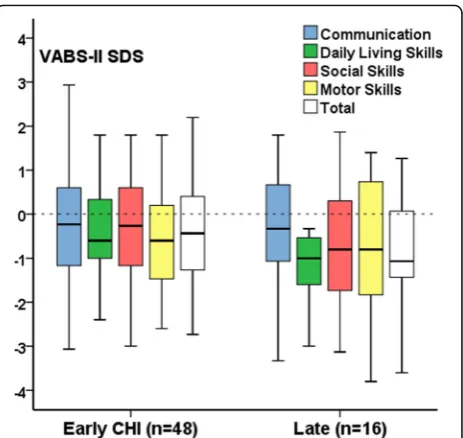
VABS-II scores were completed in 64 (44 males, 69%) children with CHI at median (range) age 4.5 (1.5, 16.8) years, of whom 16 children (25%) were Late-CHI, with presentation at age 0.80 (0.30, 3.50) years. Individual and total VABS-II domain SDS scores (VABS-II scores) were below the expected population mean (range) [0 (-2.0, 2.0)] in the major-ity of patients (n= 41, 64%), with 9 (12%) being less than -2.0. VABS-II scores were as follows: Commu-nication -0.26 (-3.33, 2.93), Daily Living Skills -0.73 (-3.60, 1.80), Social Skills -0.33 (-3.13, 1.87), Motor Skills -0.60 (-3.80, 1.80) and Total -0.48 (-3.60, 4.00). VABS-II scores were higher in Early-CHI than Late-CHI, although not reaching significance [-0.47 (-2.74, 4.00) v -0.70(-3.60, 1.27), p= 0.51] [Fig. 1]. VABS-II scores were in the normal population range [-0.33 (-1.73, 1.13)] for 9 children with IKH, in keeping with prior normal objective developmental assess-ment. VABS-II was repeated in 7 children (age range 3.00 to 9.30 years) with CHI; individual domain and total scores remained similar [paired samples test, p = 0.18 to p= 0.95], suggesting that the VABS-II was valid on repetition without significant deviation with advancing age.
VABS-II scores in CHI correlate with developmental delay VABS-II scores were correlated with developmental delay (affected in at least one developmental domain) identified by objective developmental assessment
[Table 1]. Correlation was also sustained for involve-ment of one or more developmental domains regarded as a yes/no binary variable [odds ratio, OR (confidence interval, CI) 0.28 (0.13, 0.61), p= 0.001]. As motor skills scores were estimated in a group of children > 6 years old (n= 14), the analysis was re-run in the subgroup of children < 6 years old (n= 50) demonstrating a persistent strong correlation with de-velopmental delay [OR (CI) 0.63 (0.44, 0.90), p= 0.012]. Lower VABS-II scores were also more likely in children with seizures at presentation [OR (CI) 0.49 (0.31, 0.76), p= 0.002] and epilepsy [OR (CI) 0.22
Fig. 1VABS-II scores have been expressed as SDS in patients with Early-CHI and Late-Early-CHI for individual and adaptive behaviour composite (Total) domains. The reference line at 0 SDS represents the population mean with values < -2.0 representing significant deviation
Table 1Individual and total VABS-II domain correlations with
developmental delay by objective assessment performed by developmental paediatricians, clinical and educational psychologists
VABS-II domains correlating with developmental delay
Odds ratio
95% Confidence Intervals
pvalue
Total score 0.52 0.38; 0.73 <0.001
Communication 0.46 0.33; 0.65 <0.001
Daily Living Skills 0.63 0.44; 0.89 0.009
Social Skills 0.58 0.43; 0.78 <0.001
Motor Skills 0.54 0.38; 0.78 <0.001
Total Behaviour 1.21 1.04; 1.41 0.013
Externalising Behaviour 1.09 0.94; 1.27 0.251
(0.09, 0.59), p= 0.003], further adding to the strength of association between VABS-II and developmental phenotyping in CHI.
Development was delayed if one or more domains (gross motor, fine motor, social and adaptive, lan-guage and communication) were affected. Total and individual domain VABS-II scores showed higher probability of developmental delay with lower scores. Total Behaviour scores showed a higher probability for higher scores, mainly for internalising behaviour.
Receiver operating characteristic (ROC) curves [area under curve (AUC) (CI) 0.80 (0.68, 0.90), p< 0.001] were used to test sensitivity and specificity of VABS-II Total scores to identify developmental delay. At a VABS-II Total score -1.0 SDS, sensitivity was 63% and specificity was 79%. At a VABS-II Total score -2.0 SDS, sensitivity reduced to 26%, but specificity increased to 95%. Thus, while VABS-II Total scores < -2.0 SDS did not have a high pick up rate, an ac-curate diagnosis of developmental delay was ensured. For internalising behaviour scores, the ROC AUC as-sociating with developmental delay was 0.78 (0.60, 0.95), p= 0.008 with a score of 15 showing sensitivity of 80% and specificity of 95%. With a behaviour score of 20, sensitivity reduced to 50%, but specifi-city increased to 91%. When VABS-II scores were analysed for predictive value for developmental delay in more than one domain [ROC AUC 0.80 (0.67, 0.92), p= 0.001], VABS-II Total score -1.8 SDS yielded sensitivity of 50% and specificity of 92%. Thus VABS-II and behaviour scores had high specifi-city for the diagnosis of developmental delay, with a low yield of undue false positive cases.
VABS-II scores correlate with phenotypes of CHI
(1)Correlations with age and gender:
VABS-II Total scores were negatively correlated with advancing age at presentation of
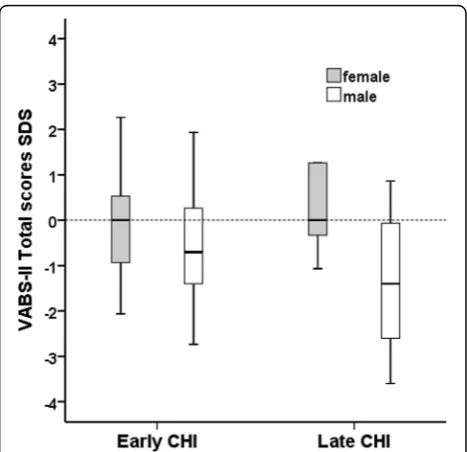
hypoglycaemia [adjusted R2= 0.23, p= 0.018] [Fig. 2]. In linear regression (adjusted R2= 0.19,
p= 0.001), age at presentation (p= 0.024) and male gender (p= 0.036) were independently correlated with lower VABS-II scores. As a group, male scores were lower than females [-0.93 (-3.60, 4.0) v 0.00 (-2.07, 2.27), p= 0.020] regardless of their age. The difference was ob-served mainly within the domains of communi-cation (p= 0.012) and social skills (p= 0.009), but not within daily living skills (p= 0.135) or motor skills (p= 0.187). Within Late-CHI, male scores were lower than females [-1.40
(-3.60,0.87) v +0.20 (-1.07,1.27), p= 0.014]. In analysis of covariance (R2= 0.11, p= 0.011), male
gender demonstrated an additional modest 6.5% effect (p= 0.04) on age at presentation to influ-ence VABS-II Total scores. Therefore males
Fig. 3Clustered box and whisker plots of VABS-II Total scores in Early-CHI and Late-CHI for males (white) and females (grey) show adverse VABS-II scores in males presenting late
presenting late carried higher risk for adverse neurodevelopmental outcomes [Fig. 3].
(2)Linking VABS-II scores to CHI severity:
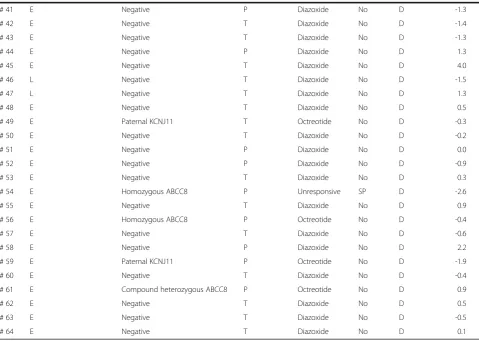
VABS-II scores were analysed for correlation with disease severity. Various phenotypic characteristics describing severity of CHI in our cohort has been provided in Appendix. Carriage of CHI gene mutations serving as a possible proxy for greater severity correlated with lower VABS-II Total scores in analysis of covariance with age at pres-entation as the covariate [adjusted R2= 0.19,
p= 0.039] with a modest effect size of 10%. In keeping with mutation status as a marker of se-verity, responsiveness to diazoxide was also posi-tively correlated with VABS-II, i.e.
unresponsiveness to diazoxide was associated with lower VABS-II Total scores (p= 0.019); however, no significant effects were noted for the following factors: transient or permanent CHI (p= 0.413), focal CHI (p= 0.742) and pancreatic surgery (p= 0.132).
VABS-II Behaviour scores in CHI
There were no differences in maladaptive behaviour scores between males and females for total, externa-lising and internaexterna-lising behaviour scores (p= 0.949, p = 0.288, p= 0.710 respectively). Similarly, no differ-ences in Early-CHI and Late-CHI were observed in total and each behaviour domain (p= 0.226, p= 0.760, p= 0.096). When adjusting for gender, age at presentation did not correlate with behaviour (p= 0.811, p= 0.744, p= 0.561). However, greater total behaviour scores were associated with developmental delay [OR (95%CI) 1.21 (1.04, 1.41), p= 0.013] [Fig. 4], more so for internalising behaviour [OR (95%CI) 1.30 (1.09, 1.55), p= 0.005] than for externa-lising behaviour (p= 0.251). However, the combin-ation of total Vineland scores and total maladaptive behaviour scores (as a composite measure) to predict developmental delay was not additionally informative (p= 0.836). Therefore it follows that total maladap-tive behaviour scores or total VABS-II scores are in-dividually correlated with developmental delay but without additive effects.
Discussion
In this study, we have assessed the reliability of VABS-II as a screening tool for developmental delay in children with CHI. VABS-II and maladaptive be-haviour scores individually correlated with develop-mental delay. VABS-II had high specificity, indicating accuracy of screening investigations for formal
developmental assessments. Male gender and late age of hypoglycaemia presentation were risk factors for lower VABS-II scores. Diazoxide unresponsive-ness and carriage of CHI genetic mutations, proxy markers of severity of CHI, were also associated with lower VABS-II scores.
Although VABS-II is applied widely to children with different conditions, its utility and accuracy in chil-dren with CHI has not been investigated previously. Our study has reviewed the performance of VABS-II in a relatively large cohort of children with the rare disease of CHI, over a two year period and correlated parent reports with objective clinical developmental examination. Further, our study examined VABS-II in IKH, where hypoglycaemia is not usually associated with significant brain injury; as expected VABS-II showed normal variation in IKH individuals. Our study also found consistency in repeating VABS-II in later life, thereby eliminating age dependent bias. The strength of association of VABS-II with develop-mental delay and the observation that a third of children have abnormal neurodevelopment [3] makes a compelling case to use VABS-II routinely in chil-dren with CHI with any clinical concern about neurodevelopment.
Although VABS-II demonstrated strong correlation with developmental delay and had high specificity, formal assessment methods to diagnose developmen-tal delay were not uniform. However as cognitive test-ing ustest-ing inventories such as WISC-IV UK can be time consuming, require trained psychologists and may be unsuitable for younger children, flexibility of objective developmental assessment was inevitable.
Nonetheless, the non-uniformity of formal develop-mental testing remains a weakness, which may ac-count for the skewed sensitivity values of VABS-II. It does reflect the variability that exists within clinical practices, however.
The study design did not specify formal develop-mental testing for all patients. It is possible that more patients who had severe neurodevelopmental delay were tested by formal methods than those with mild delay. However, in those tested formally in our cohort, nearly half were tested routinely. In such patients, testing was not biased by the severity of adverse neurodevelopment. It is possible that the sensitivity of VABS-II for milder adverse neurodeve-lopment is higher than that observed. An important corollary from our observations is the need for a more rigorous test of performance of VABS-II in the detection of milder forms of developmental delay. We recognise that mild abnormalities due to early life hypoglycaemia may not be reversed by early detection by VABS-II; however it is possible that early therapeutic interventions and adaptions in home and learning environments could be bene-ficial. The identification of relatively subtle neuro-developmental abnormalities and interventions on quality of life could be a logical follow on study.
In this study, brain imaging was not performed as routine. Instead brain magnetic resonance imaging was prioritised for clinical need as in a previous ob-servational study [3]. While the absence of brain im-aging could be construed as a weakness in the study design, the value of routine brain imaging, a re-source intense investigation, has not been substanti-ated for neurodevelopmental screening of CHI other than to identify the topography of lesions [12].
VABS-II had high specificity but low sensitivity for developmental delay. Therefore in the context of screening, VABS-II may not be relied upon as a primary tool for developmental referral in CHI. However, in clinical practice, developmental con-cerns are routinely discussed in outpatient follow up, which would obviate the requirement for VABS-II to be a highly sensitive instrument. The clinical suspicion of delayed development could be con-strued as a first line screening test, followed by VABS-II as a next step screening tool. The high specificity of VABS-II in the context of clinical con-cerns should generate sufficient concern to trigger referral for formal developmental assessments.
It is not clear why males with CHI have lower VABS-II scores than females. Frequency of males was greater in our cohort; however, gender as a variable was controlled in analysis at several levels. Our study has raised the interesting question
whether gender difference could be an independent predictor over hypoglycaemic brain injury to cause intellectual disability. This question cannot be an-swered within the remit of our study design and needs to be examined in larger cohorts. Recent ob-servations suggest modulation of sensitivity of arcu-ate nuclei to hypoglycaemia by suprachiasmatic nuclei in male rats [13]; it remains to be seen if similar mechanisms apply to male brains in children with CHI.
Our study shows that children presenting later with CHI have lower VABS-II scores, correlating with adverse developmental outcomes. This obser-vation remains even after adjustment for male gen-der, another risk factor for lower VABS-II scores. CHI usually presents in the neonatal period; it is possible that patients with Late CHI had neonatal hypoglycaemia but that the diagnosis was achieved later. However, examination of neonatal records makes this less likely, although not impossible. A previous observation of later presentation has been associated with long term neurological disabilities [4] suggesting recurrent and unrecognised hypoglycaemia impacting on developmental out-comes. In our cohort, it is likely that recurrent hypoglycaemia was missed prior to the eventual diagnosis of CHI. Such hypoglycaemic episodes could be responsible for greater severity of adverse neurodevelopment in those with Late CHI. The in-verse correlation with age at presentation indicates the need for early recognition and treatment of hypoglycaemia in early life [1, 14]. As expected, diazoxide unresponsive-ness and carriage of genetic mutations, proxy markers of severity of CHI, were associated with lower VABS-II scores. It therefore follows that treatment response and gene mutation testing in the initial phase of clinical man-agement may provide prognostic markers to determine neurodevelopmental trajectories in CHI. It is well recog-nised that patients undergoing pancreatectomy for CHI have a high frequency of neurobehavioural deficits [15]. Our study adds further evidence to the impact of severity phenotyping on long-term outcomes.
Conclusions
Appendix
Table 2Clinical characteristics associated with severity of CHI
Late or Early Presenting Mutation Transient or Persistent
Responsive to Medication
Surgery Focal or Diffuse
Total VABS II SDS
# 1 E Paternal ABCC8 P Unresponsive SP D -0.9
# 2 L Negative P Diazoxide No D -2.6
# 3 L Negative P Diazoxide No D -1.3
# 4 E Compound heterozygous ABCC8 P Unresponsive SP D -0.9
# 5 L Negative P Diazoxide No D -1.1
# 6 L GCK P Diazoxide No D -2.6
# 7 E Negative T Diazoxide No D -1.9
# 8 E Paternal KCNJ11 T Diazoxide No D -1.1
# 9 E Paternal ABCC8 P Unresponsive FL F -2.3
# 10 E Negative P Diazoxide No D -2.5
# 11 E Negative P Diazoxide No D -1.3
# 12 L Negative P Unresponsive SP D -3.6
# 13 E Homozygous ABCC8 P Unresponsive SP D -1.1
# 14 L Negative P Diazoxide No D 0.7
# 15 E Negative T Diazoxide No D 1.9
# 16 E Negative T Diazoxide No D -0.8
# 17 E Negative P Unresponsive SP D 1.1
# 18 E Maternal KCNJ11 T Diazoxide No D -0.4
# 19 L Negative T Diazoxide No D 0.2
# 20 E Negative T Diazoxide No D -0.5
# 21 E Maternal ABCC8 T Diazoxide No D 0.1
# 22 E Paternal ABCC8 T Diazoxide No D -2.1
# 23 E Maternal ABCC8 P Diazoxide No D -1.7
# 24 L Negative P Diazoxide No D -1.4
# 25 E Negative T Glucose No D 0.3
# 26 L Negative P Diazoxide No D -0.3
# 27 E Negative T Diazoxide No D -1.5
# 28 E de novo ABCC8 P Diazoxide No D 2.3
# 29 E Negative T Diazoxide No D -0.8
# 30 L Negative P Diazoxide No D -0.2
# 31 E Negative T Glucose No D -2.1
# 32 L Negative T Diazoxide No D -0.1
# 33 L Paternal ABCC8 T Octreotide No D -1.4
# 34 E Paternal ABCC8 T Octreotide No D -2.7
# 35 L Negative T Diazoxide No D 1.3
# 36 E Maternal ABCC8 T Diazoxide No D 0.0
# 37 L Paternal ABCC8 P Diazoxide FL F 0.9
# 38 E Negative T Diazoxide No D 0.7
# 39 E Negative T Glucose No D 1.4
Abbreviations
AUC:Area under the curve; CHI: Congenital hyperinsulinism; CI: Confidence intervals; IKH: Idiopathic ketotic hypoglycaemia; MAS-2: Movement assessment battery for children–UK Second Edition; OR: Odds ratio; ROC: Receiver operating characteristic; SDS: Standard deviation scores; VABS-II: Vineland adaptive behavior scales, second edition; WISC-IV UK: Wechsler intelligence scales for children, 4th edition; WPPSI-IV: Wechsler preschool and primary scale of intelligence for children–UK 4th Edition
Acknowledgements
The authors are grateful to research nurses and clinical colleagues at Central Manchester University Hospitals NHS Trust and the Manchester Biomedical Research Centre.
Funding
The study received funding from the following sources: National Institute for Health Research, Translational Research Collaboration, NORCHI Charitable Fund, Research and Innovation supporting funds from Central Manchester University Hospitals and University of Manchester and The Million Dollar Bike Fund. KEC was funded by a Research Councils UK Academic Fellowship.
Availability of data and material
All data generated or analysed during this study are included in this published article in the format uploaded.
Authors’contributions
IB, JN and SR conceived and designed the study. MSE, ZM, MM, HC and LR were involved in data collection. MSE, ZM, JN and IB analysed and interpreted the data, including statistical analysis. MS, RP, SR, MD and KC critically revised the manuscript. All authors read and approved the final manuscript.
Competing interests
The authors declare that they have no competing interests.
Consent for publication
Not applicable (no individual patient information disclosed).
Ethics approval and consent to participate
This study was supported by the North West Research Ethics Committee (project reference number: 07/H1010/88) to which parents were consented to participate.
Publisher’s Note
Springer Nature remains neutral with regard to jurisdictional claims in published maps and institutional affiliations.
Table 2Clinical characteristics associated with severity of CHI(Continued)
# 41 E Negative P Diazoxide No D -1.3
# 42 E Negative T Diazoxide No D -1.4
# 43 E Negative T Diazoxide No D -1.3
# 44 E Negative P Diazoxide No D 1.3
# 45 E Negative T Diazoxide No D 4.0
# 46 L Negative T Diazoxide No D -1.5
# 47 L Negative T Diazoxide No D 1.3
# 48 E Negative T Diazoxide No D 0.5
# 49 E Paternal KCNJ11 T Octreotide No D -0.3
# 50 E Negative T Diazoxide No D -0.2
# 51 E Negative P Diazoxide No D 0.0
# 52 E Negative P Diazoxide No D -0.9
# 53 E Negative T Diazoxide No D 0.3
# 54 E Homozygous ABCC8 P Unresponsive SP D -2.6
# 55 E Negative T Diazoxide No D 0.9
# 56 E Homozygous ABCC8 P Octreotide No D -0.4
# 57 E Negative T Diazoxide No D -0.6
# 58 E Negative P Diazoxide No D 2.2
# 59 E Paternal KCNJ11 P Octreotide No D -1.9
# 60 E Negative T Diazoxide No D -0.4
# 61 E Compound heterozygous ABCC8 P Octreotide No D 0.9
# 62 E Negative T Diazoxide No D 0.5
# 63 E Negative T Diazoxide No D -0.5
# 64 E Negative T Diazoxide No D 0.1
Table of clinical descriptors in patients with CHI with time of presentation, genetic status, resolution of hypoglycaemia, response to medication, requirement for pancreatic surgery and Total VABS-II scores
Eearly,Llate,Ttransient,Ppermanent,Ddiffuse,Ffocal,FLfocal lesionectomy,SPsubtotal pancreatectomy All patients on octreotide had previously failed to respond to diazoxide
Author details
1Department of Paediatric Endocrinology, Royal Manchester Children’s Hospital, Central Manchester University Hospitals, Oxford Road, Manchester M13 9WL, UK.2Department of Paediatric Endocrinology and Diabetes, Nottingham Children’s Hospital, Nottingham University Hospitals, Derby Road, Nottingham NG7 2UH, UK.3Paediatric Psychosocial Department, Royal Manchester Children’s Hospital, Central Manchester University Hospitals, Oxford Road, Manchester M13 9WL, UK.4Faculty of Biology, Medicine and Health, University of Manchester, Oxford Road, Manchester M13 9PL, UK.
Received: 5 January 2017 Accepted: 9 May 2017
References
1. Arnoux JB, Verkarre V, Saint-Martin C, Montravers F, Brassier A, Valayannopoulos V, Brunelle F, Fournet JC, Robert JJ, Aigrain Y, et al. Congenital hyperinsulinism: current trends in diagnosis and therapy. Orphanet J Rare Dis. 2012;6:63.
2. Banerjee I, Avatapalle B, Padidela R, Stevens A, Cosgrove K, Clayton P, Dunne M. Integrating genetic and imaging investigations into the clinical management of congenital hyperinsulinism. Clin Endocrinol (Oxf). 2013; 78(6):803–13.
3. Avatapalle HB, Banerjee I, Shah S, Pryce M, Nicholson J, Rigby L, Caine L, Didi M, Skae M, Ehtisham S, et al. Abnormal neurodevelopmental outcomes are common in children with transient congenital hyperinsulinism. Front Endocrinol (Lausanne). 2013;4:60.
4. Meissner T, Wendel U, Burgard P, Schaetzle S, Mayatepek E. Long-term follow-up of 114 patients with congenital hyperinsulinism. Eur J Endocrinol. 2003;149(1):43–51.
5. Touati G, Poggi-Travert F, Ogier De Baulny H, Rahier J, Brunelle F, Nihoul-Fekete C, et al. Long-term treatment of persistent hyperinsulinaemic hypoglycaemia of infancy with diazoxide: a retrospective review of 77 cases and analysis of efficacy-predicting criteria. Eur J Pediatr. 1998;157(8):628–33. 6. Menni F, de Lonlay P, Sevin C, Touati G, Peigne C, Barbier V, Nihoul-Fekete
C, Saudubray JM, Robert JJ. Neurologic outcomes of 90 neonates and infants with persistent hyperinsulinemic hypoglycemia. Pediatrics. 2001; 107(3):476–9.
7. Levy-Shraga Y, Pinhas-Hamiel O, Kraus-Houminer E, Landau H, Mazor-Aronovitch K, Modan-Moses D, Gillis D, Koren I, Dollberg D, Gabis LV. Cognitive and developmental outcome of conservatively treated children with congenital hyperinsulinism. J Pediatr Endocrinol Metab. 2013;26:301–8. 8. Hack M. Consideration of the use of health status, functional outcome, and quality-of-life to monitor neonatal intensive care practice. Pediatrics. 1999; 103(1 Suppl E):319–28.
9. Berg AT, Caplan R, Baca CB, Vickrey BG. Adaptive behavior and later school achievement in children with early-onset epilepsy. Dev Med Child Neurol. 2013;55(7):661–7.
10. Msall ME, Tremont MR. Measuring functional status in children with genetic impairments. Am J Med Genet. 1999;89(2):62–74.
11. Banerjee I, Skae M, Flanagan SE, Rigby L, Patel L, Didi M, Blair J, Ehtisham S, Ellard S, Cosgrove KE, et al. The contribution of rapid KATP channel gene mutation analysis to the clinical management of children with congenital hyperinsulinism. Eur J Endocrinol. 2011;164(5):733–40.
12. Gataullina S, Lonlay PD, Dellatolas G, Valayannapoulos V, Napuri S, Damaj L, Touati G, Altuzarra C, Dulac O, Boddaert N. Topography of brain damage in metabolic hypoglycaemia is determined by age at which hypoglycaemia occurred. Dev Med Child Neurol. 2013;55:162–6.
13. Herrera-Moro Chao D, Leon-Mercado L, Foppen E, Guzman-Ruiz M, Basualdo MC, Escobar C, Buijs RM. The Suprachiasmatic nucleus modulates the sensitivity of Arcuate nucleus to hypoglycemia in the male rat. Endocrinology. 2016;157(9):3439–51.
14. De Leon DD, Stanley CA. Mechanisms of Disease: advances in diagnosis and treatment of hyperinsulinism in neonates. Nat Clin Pract Endocrinol Metab. 2007;3(1):57–68.
15. Lord K, Radcliffe J, Gallagher PR, Adzick NS, Stanley CA, De Leon DD. High risk of diabetes and neurobehavioral deficits in individuals with surgically treated hyperinsulinism. J Clin Endocrinol Metab. 2015;100(11):4133–9.
• We accept pre-submission inquiries
• Our selector tool helps you to find the most relevant journal
• We provide round the clock customer support
• Convenient online submission
• Thorough peer review
• Inclusion in PubMed and all major indexing services
• Maximum visibility for your research
Submit your manuscript at www.biomedcentral.com/submit