R E S E A R C H
Open Access
Visual contour tracking based on
inner-contour model particle filter under complex
background
Songxiao Cao
1*and Xuanyin Wang
2Abstract
In this paper, a novel particle filter–based visual contour tracking method is proposed, which uses inner-contour model to track contour object under complex background. The purpose is to achieve effectiveness and robustness against complex background. To that end, the proposed method first utilized Sobel edge detector to detect the edge information along the normal line of the contour. Then, it sampled the inner part of the normal line to get the local color information, which was then combined with the edge information to construct new normal line likelihood. After that, all the inner color information was used to construct global color likelihood. Finally, the edge information, local color information, and global color information were fused into new observation likelihood. Experimental results showed that the proposed method was robust for contours tracking under complex background, and it was also computationally efficient and can run in real-time completely.
Keywords:Contour tracking, Inner-contour model, B-spline, Particle filter
1 Introduction
Nowadays, the application of visual object tracking is be-coming more and more important in many fields, such as surveillance, robots, and human-computer interfaces [1]. However, it is still a challenging task to achieve reli-able tracking due to cluttered background, occlusion, and different illuminations. To overcome the above-mentioned challenges and achieve robust tracking, a lot of tracking methods have been published during last two decades. Most of these tracking methods use rectangle or other rigid shapes to represent the target, which lose detailed shape and edge information. Furthermore, rect-angle or other rigid shapes contain some background pixels outside the real target region, which will reduce the robustness of tracking. To overcome this problem, some researchers use contours to represent deformable targets [2–5].
1.1 Related work
Most contour tracking methods can be grouped into two categories, parametric active contour [6–8] and geo-metric active contour [5, 9], with different representa-tions of contour curves. In the former, the contour was approximated by an explicit parametric model, typically using a set of control points and B-splines. In the second case, the contour was typically represented by an impli-cit function, as in the level set method. In general, the parametric contour methods were more efficient, and were thus more suitable for real-time contour tracking.
In order to track contours with non-Gaussian and nonlinear state densities in cluttered video sequences, Isard and Blake [6] introduced the CONDENSATION algorithm. They used B-spline to represent object con-tours, and particle filters to track the curve parameters given noisy observations. However, in this work, a very simple measurement term was used. Therefore, this method had difficulties in dealing with complex back-ground clutters. To improve the performance under complex background, several methods were proposed. Li and Zhang [3] proposed Unscented Kalman Particle Fil-ter (UKPF) to construct a new observation model, in which Kalman filter and unscented particle filter were
© The Author(s). 2019Open AccessThis article is distributed under the terms of the Creative Commons Attribution 4.0 International License (http://creativecommons.org/licenses/by/4.0/), which permits unrestricted use, distribution, and reproduction in any medium, provided you give appropriate credit to the original author(s) and the source, provide a link to the Creative Commons license, and indicate if changes were made.
* Correspondence:[email protected]
1College of Metrology and Measurement Engineering, China Jiliang
University, Hangzhou 310018, China
used to adopt sub-optimal proposal distributions. Chen [10] proposed a Multicue Hidden Markov Model Un-scented Particle Filter (MHMM-UPF) for contour detec-tion and tracking based on multiple visual cues in spatial domain and improved the performance by joint prob-ability matching to reduce background clutter. Although these two methods could improve the tracking perform-ance in some simple environments, they still could not deal with the existence of objects that are similar with the target. Another contour tracking strategy is tracking by segmentation, in which the contours are represented with segmentation masks. For instance, Godec [11] pro-posed a Hough Tracking (HT) algorithm, which is one of the state-of-the-art contour tracking algorithms in re-cent years. In this algorithm, the object location was de-termined with the Hough voting technique, and a mask was obtained with the Grab cut algorithm. However, due to its imposing shape constraints, the HT algorithm is very time-consuming, and is not suitable for real-time object tracking.
1.2 Our approach
In contrast to the above methods, a novel multi-feature fusion approach called inner-contour model was pro-posed in this paper. This method fused the color feature with gradient feature to construct a new observation model in the particle filter framework to realize robust contour tracking in cluttered background. The proposed method first utilized Sobel edge detector to detect the edge information along the normal line of the contour. Then, it sampled the inner part of the normal line to get the local color information, which was combined with the edge information to construct new normal line likeli-hood. After that, all the inner color information was
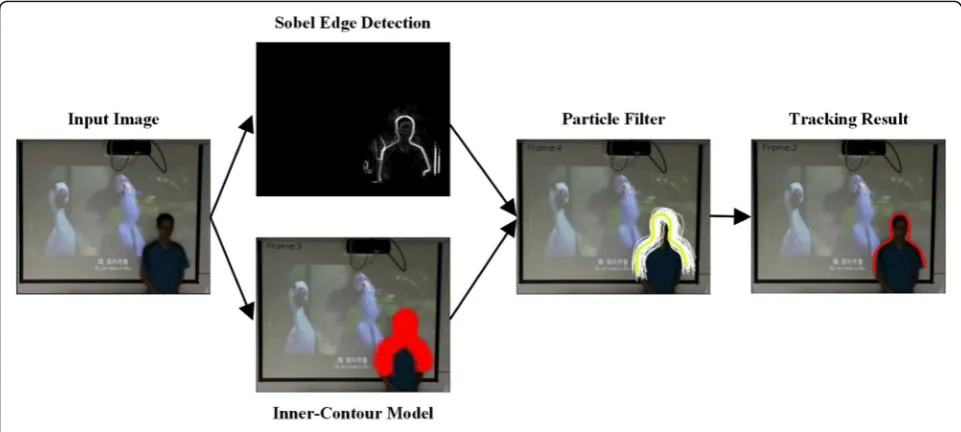
used to construct global color likelihood. Finally, the edge information, local color information, and global color information were fused into new observation likeli-hood. Experimental results showed that the proposed method was robust for contours tracking under complex background, and it was also computationally efficient and can run in real-time completely. The pipeline of the proposed method is shown in Fig.1.
1.3 Paper organization
Section 2 summarizes the relevant methods for visual contour tracking; Section 3 deals with the proposed inner-contour model for visual contour tracking; Section 4 introduces the experimental results and compares them with UKPF [3], MHMM-UPF [10], and HT [11]; and Section 5 outlines the conclusions and suggestions for future research.
2 Visual contours tracking based on particle filter This section briefly overviews the main concepts of the related methods discussed in this paper, including the basic formulae of particle filter for visual tracking and the visual contour observation model for contour ap-pearance representation.
2.1 Particle filter
Particle filter is a Monte Carlo approximation to the op-timal Bayesian filter. It provides robust tracking of mov-ing objects in cluttered environment, especially in the case of nonlinear and non-Gaussian problems where the interest lies in the detection and tracking of moving ob-jects. It is a probabilistic framework for sequentially esti-mating the state of the target, recursively calculating the posterior density p(st|z1 :t) of the current object state st
conditioned on all observations z1 :t= (z1,z2...zt) up to
time t. The posterior density p(st|z1 :t) can be obtained
recursively in two stages: prediction and update, which are, respectively, written as follows:
p sðtjz1:tÞ ¼p zt
jst
ð Þp sðtjz1:t−1Þ
p zð tjz1:t−1Þ
¼kpp zð tjstÞp sðtjz1:t−1Þ ð1Þ
p sðtjz1:t−1Þ ¼
Z
p sðtjst−1Þp sðt−1jz1:t−1Þdst−1 ð2Þ
According to formulas (1) and (2), we obtain the fol-lowing formula:
p sðtjz1:tÞ ¼kpp zð tjstÞ
Z
p sðtjst−1Þp sðt−1jz1:t−1Þdst−1
ð3Þ
where kp is a normalizing constant that is independent
of st, p(zt|st) is the likelihood function, p(st|st−1) is the
dynamic model, and p(st|z1 :t−1) is the temporal prior
overstgiven the prior observations.
The integral in formula (3) has no closed form solu-tion, except in some most basic cases, so the particle fil-ter is used to approximate formula (3) by using a set of weighted particlesfsðiÞt ;w
ðiÞ
t gi¼1; :::;n, and each particle
represents a hypothetical state of the object. Under this representation, formula (3) can be approximated as follows:
p sðtjz1:tÞ≈kpp zð tjstÞ
Xn
i¼1
wð Þt−i1p si ð Þ t jsi
ð Þ t−1
ð4Þ
wherewðiÞt is the weight for particles ðiÞ t .
To implement a standard PF, a state representation st
should be identified, in object tracking, which might in-clude locations, scales, and rotations of the object. More-over, it is necessary to design three distributions: the process dynamical distribution p(st|st−1), which
de-scribes how the object moves between frames; the pro-posal distribution q(st|s1 :t−1,z1 :t), which is sampled
each time the particle distribution updates; and the ob-servation likelihood distribution p(zt|st), which means
how the object appears in the video frame. This paper focuses on this likelihood, and will be discussed in detail in the later sections.
The dynamical distribution p(st|st−1) can usually be
represented as a linear stochastic differential function:
st¼Ast−1þBωt−1 ð5Þ
whereAdefines the deterministic component of the dy-namic model,stis the state vector of timet,ωt−1∈(0, 1)
is the system noise, which is usually an uniformly ran-dom variable or a multivariate Gaussian ranran-dom
variable, and B is the propagation distance, indicating the distance the particles can propagate in the next frame.
2.2 Visual contour observation model
In this paper, the visual contour object was modeled as a B-spline curve and was restricted to a shape space pro-posed by A. Blake and M. Isard [6]. The observation model of the tracking process was based on the model introduced by J. MacCormick [12], and the assumptions and propositions in this reference were adopted as the fundamentals for further derivation. This model can be described briefly as follows.
Giving a candidate contour represented by a B-spline curve, on which a finite number of points are sampled, and then the normal li(i= 1, 2,⋯m) (hereafter called measurement line) to this curve at these points are searched for edge features, all the measurement lines have the same length L. A Sobel edge detector is applied to each measurement line, which is characterized by local maximum. This model made the following hypotheses.
Each feature could correspond to the real edge of the target or clutter feature. The model assumes that all the clutter features are uniformly distributed on the meas-urement line, and only one edge feature can be detected on each measurement line. The numbernof clutter fea-tures can be observed on the measurement line with length L obeys a Poisson law with the densityλ:bL(n) = e−λL(λL)n/n!; there is a fixed possibility q01 that the edge
feature is not detected; the distribution of the distance between edge feature and contour location of the real object is Gaussian, with zero mean and varianceσ2
. Based on these hypotheses, the likelihood of the meas-urement line li can be expressed as (see reference [13]
for details):
piðn;zjv¼vnÞ ¼e−λLλ n
n! q01þ q11
γ Xn
k¼1 1
ffiffiffiffiffiffi
2π
p
δe −ðzik−viÞ
2
2δ2 !
ð6Þ
whereq11= 1−q01. Given that all the observations of them
measurement line li(i= 1, 2,⋯m) are statistically
independ-ent, then the likelihood of the entire contour becomes:
p zð Þ ¼jx Y
m
i¼1
piðn;zjv¼viÞ ð7Þ
3 The proposed method
3.1 Inner-contour model
However, in highly cluttered environment, the tracker will easily drift to the noise edge feature, which leads to the failure of the tracking process. In order to im-prove the robustness of contour tracking, it is neces-sary to introduce other useful features into this model, and naturally fuse all the features to construct new observation likelihood. Inspired by this idea, this paper proposed new observation likelihood which combines the gradient feature and color feature naturally.
To achieve robustness against non-rigidity, rotation, and partial occlusion, the color distribution is a widely used target representation model. In this paper, the color distribution in HSV color space was used to express the color features.
With the contour as the boundary, all the m meas-urement lines li(i= 1, 2,⋯m) can be separated into two parts, the inner part normal lines and the outer part normal lines, as shown in Fig. 2. The inner part reflects some characteristics of the target, while the outer part is often the clutter background, so using the inner part measurement lines can enhance the observation model during the tracking process.
For a single measurement line li, the histogram of
the inner part is hi= {hi, u}u= 1...q, while the
corre-sponding reference histogram is ri= {ri, u}u= 1...q, the
size of both histograms are 1 ×L/2, thus the similarity of the two histograms can be measured by the Bhat-tacharyya distance:
di¼
ffiffiffiffiffiffiffiffiffiffiffiffiffiffiffiffiffiffiffiffi
1−ρ½hi;ri
p
ð8Þ
where ρ½hi;ri ¼
Pq
u¼1
ffiffiffiffiffiffiffiffiffiffiffiffiffi
hi;uri;u
p
is the Bhattacharyya factor. Then, the local color likelihood ofliis:
pi;LCð Þ ¼zjx ffiffiffiffiffiffi1 2π p δLC e− d2 i
2δ2
LC ð9Þ
The new likelihood for the measurement line combine liwith the gradient feature and local color feature can be
written as:
pli ¼piðn;zjv¼vnÞpi;LCð Þzjx ð10Þ
The likelihood of combining the whole contour with all measurement lines turns to be:
p zð Þ ¼jx Y
m
i¼1
pli ð11Þ
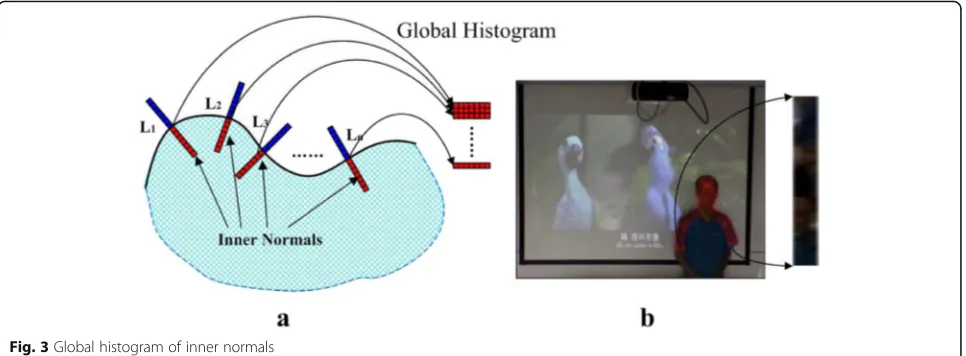
However, only using the local color information of each measurement line cannot provide the overall color distribution information of the contour target. In order to address this problem, all the inner part measurement lines are combined to construct a global color histogram, as shown in Fig.3.
The histogram of all the mmeasurement linesli(i= 1,
2,⋯m) isH= {Hu}u= 1...q, while the corresponding
ref-erence histogram is Q= {Qu}u= 1...q, the size of both
histograms is 1 ×L/2, thus the similarity of the two his-tograms can be measured by Bhattacharyya distance:
Di¼
ffiffiffiffiffiffiffiffiffiffiffiffiffiffiffiffiffiffiffiffiffiffiffi
1−ρ½Hi;Qi
p
ð12Þ
where ρ½Hi;Qi ¼
Pq
u¼1pffiffiffiffiffiffiffiffiffiffiffiffiffiffiffiffiHi;uQi;u is the
Bhattachar-yya factor. Then, the global color likelihood of the con-tour is:
pGCð Þ ¼zjx 1 ffiffiffiffiffiffi 2π p δGC e− D2
2δ2
GC ð13Þ
The final likelihood of the contour, which combines the gradient information, local color information, and global color information, can be expressed as follows:
p zð Þ ¼jx pGCð Þzjx
Ym
i¼1
pLi ð14Þ
4 Results and discussion
4.1 Experiment setting
To demonstrate the effectiveness and robustness of the proposed tracking scheme, seven different color videos were used in our experiments, six of which were ac-quired indoors and outdoors with a SONY CCD camera EX-FCB48, and the rest was acquired from the public tracking dataset by Babenko [14]. These videos con-tained several challenging conditions, such as partial or total occlusion, and similar objects in the background. The contours of the object of basic truth of all tested videos were marked manually frame by frame. For all videos, the target object was manually selected in the first frame.
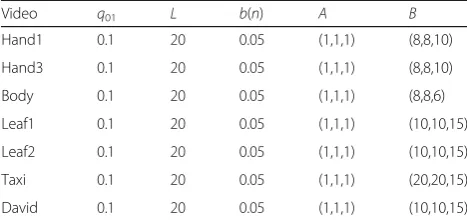
The control points of three particle filter–based rithms (UKPF, MHMM-UPF, and the proposed algo-rithm) were generated randomly according to formula5, and the dynamic parameters used in the formula were listed in Table2.
All the algorithms were implemented in C++ using the OpenCV library and run on a 1.8 GHz Pentium Dual-Core CPU, with 2 Gbyte of DDR memory.
The proposed tracking method was compared with UKPF, MHMM-UPF, and HT algorithms, and the
Fig. 3Global histogram of inner normals
Table 1Test videos information and parameters used in the
experiments
Video Resolution Total frames Number of control points
Hand1 320 × 240 509 13
Hand3 320 × 240 596 15
Body 360 × 288 491 14
Leaf1 320 × 240 147 8
Leaf2 360 × 288 1091 8
Taxi 720 × 576 30 12
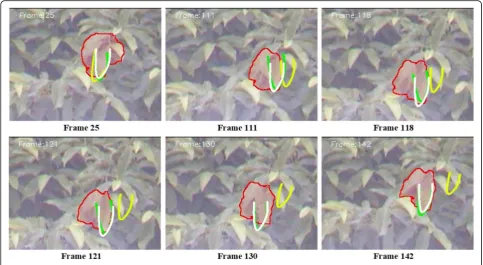
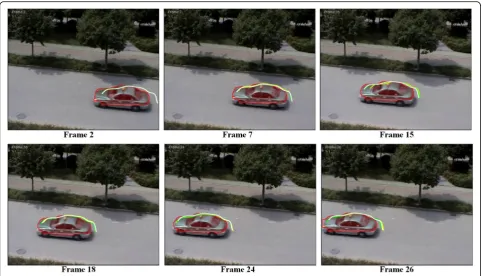
tracking results of each algorithm were marked with dif-ferent colors to demonstrate the differences. The parame-ters used in the experiments are shown in Tables1and2.
In the following section, we first presented all the tracking results of the two algorithms in the same tested video with different color curves, and then gave detailed evaluations and comparisons to demonstrate the effect-iveness of the algorithms.
4.2 Performance and results overview
For comparison, we first implemented all the algorithms separately, and recorded the related data. Then, we re-drew all the curves in the same video with different colors in order to observe the differences between the al-gorithms, as shown in Figs.4,5,6,7,8,9, and10.
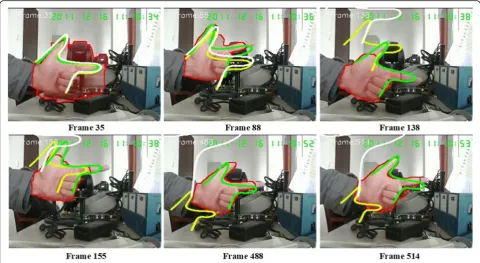
The test videos“Hand1”and“Hand3”were used to test the tracking performance in the scenarios of cluttered background, with abundant edge features and obvious af-fine transformation when the hand was moving. In “Hand1,” due to the existence of collars, cuffs, pockets, and wrinkles in clothes, the edge features of background interference were very noticeable. In “Hand3,” the back-ground was more chaotic and there were many dense edge features, as shown in Fig.5. Therefore, if only edge feature was used for contour tracking, it would be difficult to achieve stable tracking. As shown in the 285th, 361st, and 373rd frames in Fig.4, the 291st, 488th, and 514th frames in Fig.5, the tracking results of the UKPF and MHMM-UPF drifted to the background, while in the previous frames of the tracking result of HT, the contours were not close to the real target, because the HT algorithm needed a progress to segment the target, as shown in the 43rd frame in Fig. 4. When using the proposed inner-contour model, the tracking process was more reliable and robust with the help of local and global color information, as shown by the tracking results of green curves in Figs. 4 and5. At the same time, the algorithm can respond to the affine deformation of the target in time and accurately in the tracking process. In Fig. 4, the target had an obvious movement close to the camera and then far away from the camera, that is, the process of the target from small to large and then to small, and also the process of rotation with large angle, during all these affine transformations.
Table 2Parameter values used in the experiments
Video q01 L b(n) A B
Hand1 0.1 20 0.05 (1,1,1) (8,8,10)
Hand3 0.1 20 0.05 (1,1,1) (8,8,10)
Body 0.1 20 0.05 (1,1,1) (8,8,6)
Leaf1 0.1 20 0.05 (1,1,1) (10,10,15)
Leaf2 0.1 20 0.05 (1,1,1) (10,10,15)
Taxi 0.1 20 0.05 (1,1,1) (20,20,15)
David 0.1 20 0.05 (1,1,1) (10,10,15)
Fig. 5Tracking result of Hand3. Yellow—UKPF, white—MHMM-UPF, red—Hough Tracker, green—proposed method
Fig. 7Tracking result of Leaf1. Yellow—UKPF, white—MHMM-UPF, red—Hough Tracker, green—proposed method
Fig. 9Tracking result of Taxi. Yellow—UKPF, white—MHMM-UPF, red—Hough Tracker, green—proposed method
The proposed method always kept good tracking perform-ance, while the UKPF and MHMM-UPF could not.
The test video“Body” was used to test the robustness and effectiveness of the algorithm in the complex dy-namic backgrounds with similar target interference and occlusion. In the “Body” video, a cartoon movie was al-ways played on the projection screen of the background; therefore, the edge features and color features of the background were changing simultaneously, and another person walked in front of the target, as shown in Fig.6. When only edge feature was used to track human con-tours, it was susceptible to dynamic background and similar target occlusions, resulting in tracking failures, as shown in the 174th, 177th, and 183rd frames of Fig. 6.
When combined with the inner-contour information, because there were significant differences between the clothes worn by the two people, it was easier to distin-guish two different targets, even in the case of partial oc-clusion, so that the target could be accurately tracked. Although the tracking contours of HT were not as ac-curate as the proposed method, the accuracy of the tar-get center positions was the best among all the test algorithms.
The test videos“Leaf1” and“Leaf 2” were used to test the tracking performance when there were a large num-ber of similar targets in the background. These two sets of test videos were the most challenging, because the target to be tracked was a bunch of completely similar
Fig. 11Tracking result of target center of gravity of“Hand1.”Left—horizontal center of gravity; right—vertical center of gravity
leaves, which flutter in the wind, and the system dy-namic model was more complicated, thus it was difficult to achieve stable tracking. As shown in the 118th, 121st, and 130th frames of Fig.7, and the 377th, 411th, and 466th frames in Fig.8, if only the edge information was used, it was easy to track other leaves during intense movement and deformation when the leaves were blown by the wind. When the inner-contour model was adopted, it had better stability under the same condi-tions, which can not only accurately track the position of the target, but also make correct affine changes with the swing and deformation of the leaves. The HT tracker did not perform well in these two test videos because it was hard to segment the real target among so many similar leaves around the target.
The test videos “Taxi” was used to test the tracking performance when the target moved quickly in a sim-ple background, as shown in Fig. 9. In this test, all the algorithms tracked the target well, and the HT tracker performed better than the other three particle filter–based algorithms, because in this simple back-ground, it was relatively easy to segment the real tar-get precisely.
The test video “David” was a well-known video se-quence, which was used to track algorithms to test the robustness when the environment luminance changed significantly. The experimental results showed that, as shown in Fig. 10, the proposed method and HT can track the person well from the first frame to the end, while UKPF and MHMM-UPF lost the targets during the luminance changing.
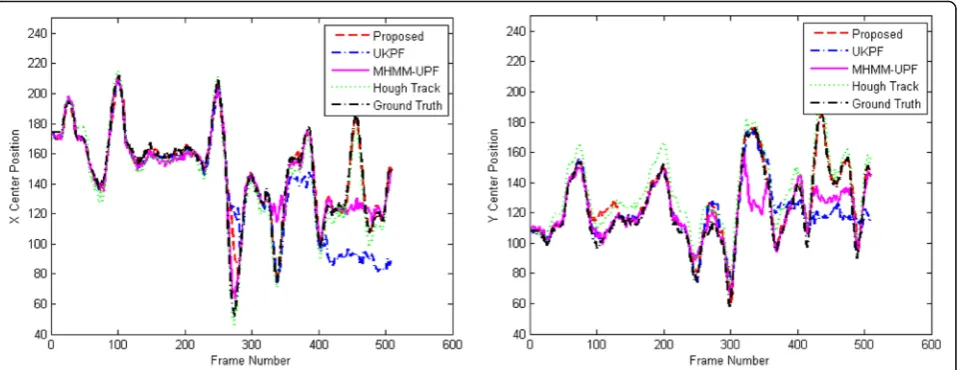
In order to evaluate the tracking performance differ-ences of various algorithms more objectively and accur-ately, the Euclidean distance of the center of gravity coordinates, the Euclidian distance of the control points and the algorithm time were used to evaluate the differ-ence of different tracking algorithms in this paper. The center of gravity coordinate Euclidean distance repre-sented the Euclidean distance between the center of gravity of the target contour calculated by the algorithm and the ground truth, which was used to characterize the accuracy of the overall position of the contour. The average Euclidean distance of the control points repre-sented the average value of the Euclidean distance between each control point of the target contour calcu-lated by the algorithm and the ground truth, which was used to characterize the track location accuracy. The al-gorithm time was a measure of the time spent by each algorithm on tracking different targets. It was used to characterize the execution efficiency and real-time per-formance of the algorithm.
As shown in Fig. 11, the left side represents the dif-ference between the horizontal position and the ground truth of the center of gravity of the tracking
target contour calculated by each algorithm of the “Hand1” video, and the right side represents the dif-ference between the vertical position and the ground truth. Figure 12 shows the Euclidean distance be-tween the center of gravity of the control points and the ground truth of each frame. From these figures, it can be seen that the proposed algorithm performed best among all the tested algorithms.
Table 3Average Euclidean distance using different particle
numbers
Video Number of particles HT UKPF MHMM-UPF Proposed
Hand1 100 12.15 21.86 18.43 9.34
150 20.47 16.94 9.12
200 18.78 15.41 8.67
250 19.01 15.32 9.01
300 18.95 15.33 8.98
Hand3 100 15.78 32.19 24.66 11.63
150 30.84 22.90 10.96
200 25.72 22.37 10.39
250 26.21 22.17 10.15
300 25.34 22.10 10.33
Body 100 4.12 12.77 8.12 5.54
150 11.23 7.95 5.11
200 10.87 7.84 4.82
250 10.96 7.89 4.91
300 11.02 7.83 4.90
Leaf1 100 5.12 12.07 9.34 4.25
150 11.45 9.06 4.10
200 10.56 8.76 4.04
250 10.55 8.12 4.14
300 10.81 8.23 4.12
Leaf2 100 15.74 40.33 33.59 8.67
150 35.54 29.96 7.27
200 30.78 29.07 7.03
250 30.47 29.24 7.13
300 29.87 30.63 7.09
Taxi 100 2.43 7.67 7.12 7.16
150 7.34 6.87 6.76
200 7.23 6.65 6.51
250 7.21 6.53 6.59
300 7.22 6.61 6.55
David 100 10.44 25.45 27.29 11.67
150 23.64 26.43 10.83
200 21.98 25.39 10.01
250 22.01 25.34 10.05
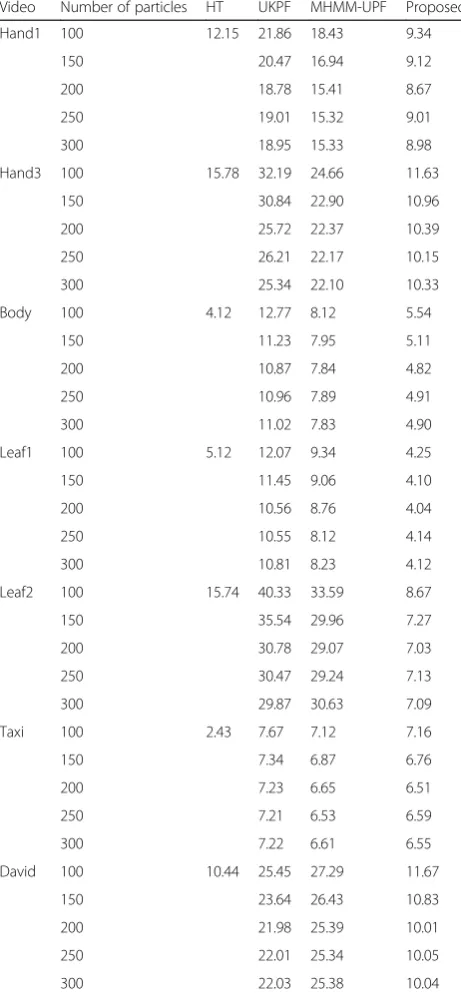
For performance evaluation and comparison, all the three PF-based algorithms (UKPF, MHMM-UPF, and the proposed algorithm) were tested with different num-bers of particles, including 100, 150, 200, 250, and 300, and the tracking results are shown in Table3. It can be found that the tracking performance improves with the increase of the number of particles, and reaches the top when the number of particles is larger than 200.
The experiment result of average Euclidian distance and time consuming of all the test videos can be seen in Table3. In terms of average Euclidean distance, the per-formance of the proposed algorithm and HT tracker was better than that of UKPF and MHMM-UPF, and the average Euclidean distance of the proposed algorithm was the smallest in test videos“Hand1,” “Hand3,” “Leaf1, ” and“Leaf2,” while the performance of HT tracker was better in test videos “Body,” “Taxi,” and “David” than that of the proposed one.
The difference of Euclidean distance between the four algorithms in the test video “Leaf2” was the most obvious, followed by the videos “Hand1”and “Hand3,”
and the "Taxi" tracking was the least. The reason of this phenomenon was, in the leaf contour tracking video, there were a lot of edge information and some similar targets. Meanwhile, the (Pan-Tilt-Zoom) PTZ camera took intense motion in three degrees of free-dom, so when only edge information was used, the calculated weight of each particle may be close in any position, so that the effect of resampling was not obvious, and finally, the target position generated a relatively large deviation. When the color information was introduced, the small difference between the tar-get and the surrounding leaves was used to increase the weight of each particle, and the weight of the edge of the background became smaller. After resam-pling, more particles moved closer to the target leaves; therefore, the tracking position was more ac-curate. In the “Body” video, there were few distinct edge features around the body. The edge features could well distinguish the target and the background, so the difference between the two algorithms was very small.
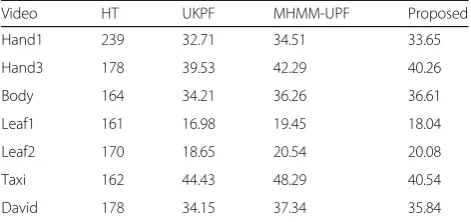
For the perspective of algorithm time-consuming (Table 4), the HT tracker was the most time-consuming one, it took much more time than the other three algorithms due to its complex segment al-gorithm and imposing shape constraints. Among the other three algorithms except HT, the proposed algo-rithm was more time-consuming than UKPF, but less than MHMM-UPF; however the difference was very small, about 1 to 2 ms. At the same time, it can be found that the time consuming of the algorithm in-creased with the increase of the number of control points. The reason was that if only the time
Table 4Time consumption (ms) of tested algorithms
Video HT UKPF MHMM-UPF Proposed
Hand1 239 32.71 34.51 33.65
Hand3 178 39.53 42.29 40.26
Body 164 34.21 36.26 36.61
Leaf1 161 16.98 19.45 18.04
Leaf2 170 18.65 20.54 20.08
Taxi 162 44.43 48.29 40.54
David 178 34.15 37.34 35.84
consumption of coordinate transformation of the con-trol points was considered, the algorithm time would be slightly affected by the number of control points due to the representation of the shape space, and the main influencing factor was the time to draw the B-spline curve. In the case of 50 equal divisions be-tween every two control points, the time to draw the B-spline curve increased approximately linearly with the number of control points, as shown in Fig. 13. In the case of 18 control points (using test video “Hand3”), the average algorithm time was 40.26 ms, and the algorithm time could basically meet the real-time requirements, and the real-real-time performance of the algorithm could be further improved by using some fast spatial-temporal mechanisms and algo-rithms, as mentioned in literatures [15–17].
5 Conclusions
This paper has presented a method of visual contour track-ing based on particle filter for inner-contour model under complex background. This novel method fused the gradient feature, local color feature, and global color feature naturally to achieve robust contour tracking in cluttered environment. Specifically, the proposed algorithm first used Sobel edge de-tector to detect the edge information along the normal lines of the contour, and then sampled the inner part of the nor-mal lines to get the local color information, which was com-bined with the edge information to construct new normal line likelihood. After that, all the inner color information was used to construct global color likelihood. Finally, the edge in-formation, local color information and global color informa-tion are fused together as new observainforma-tion likelihood. The experimental results demonstrated that, compared with gradient-only feature method, the proposed algorithm was effective and robust in dealing with cluttered background, and it was also computationally efficient and could run com-pletely in real time.
The proposed algorithm was inspired by the gradient-only contour tracking method (UKPF) and achieved bet-ter results, and it would be helpful for other tracking methods that needed to consider multi-cues fusing in cluttered background.
Abbreviations
HT:Hough Tracking; MHMM-UPF: Multicue Hidden Markov Model Unscented Particle Filter; UKPF: Unscented Kalman Particle Filter
Acknowledgements
The most heartfelt gratitude to Ke Xiang for his helpful discussion and feedback on the algorithm, as well as Fangge Lu’s for proofreading of English writing.
Authors’contributions
SC implemented the core algorithm, designed all the experiments, addressed the resulting data, and drafted the manuscript. XW participated in the design and construction of the inner-contour model and helped draft the manuscript. All authors have read and approved the final manuscript.
Funding
None
Availability of data and materials
None
Ethics approval and consent to participate
Not applicable
Consent for publication
Not applicable
Competing interests
The authors declare that they have no competing interests.
Author details
1College of Metrology and Measurement Engineering, China Jiliang
University, Hangzhou 310018, China.2State Key Laboratory of Fluid Power
and Mechatronic Systems, Zhejiang University, Hangzhou 310027, China.
Received: 19 February 2019 Accepted: 19 November 2019
References
1. A. Yilmaz, O. Javed, M. Shah, Object tracking: a survey. ACM Comput. Surv.
38(4), 13 (2006)
2. M. Isard, A. Blake, CONDENSATION—conditional density propagation for visual tracking. Int. J. Comput. Vis.29(1), 5–28 (1998)
3. P. Li, T. Zhang, A.E.C. Pece, Visual contour tracking based on particle filters. Image Vis. Comput.21(1), 111–123 (2003)
4. A.W.M. Smeulders et al., Visual tracking: an experimental survey. IEEE Trans. Pattern Anal. Mach. Intell.36(7), 1442–1468 (2014)
5. P. Lv et al., Multiple cues-based active contours for target contour tracking under sophisticated background. Vis. Comput.33(9), 1103–1119 (2016) 6. Isard, M. and A. Blake. Contour tracking by stochastic propagation of
conditional density. in European Conference on Computer Vision. 1996. 7. N. Peterfreund, Robust tracking of position and velocity with Kalman snakes.
Pami22(6), 564–569 (1999)
8. F.Y. Shih, Z. Kai, Locating object contours in complex background using improved snakes. Computer Vision & Image Understanding105(2), 93–98 (2007) 9. Chockalingam, P., N. Pradeep, and S. Birchfield. Adaptive fragments-based
tracking of non-rigid objects using level sets. in IEEE International Conference on Computer Vision. 2009.
10. C. Yunqiang, R. Yong, T.S. Huang, Multicue HMM-UKF for real-time contour tracking. IEEE Trans. Pattern Anal. Mach. Intell.28(9), 1525–1529 (2006) 11. M. Godec, P.M. Roth, H. Bischof, Hough-based tracking of non-rigid objects.
Comput. Vis. Image Underst.117(10), 1245–1256 (2013)
12. MacCormick, J. and A. Blake. A probabilistic exclusion principle for tracking multiple objects. in Proceedings of the Seventh IEEE International Conference on Computer Vision. 1999.
13. J. Maccormick,Stochastic algorithms for visual tracking(2002)
14. Babenko, B., M.H. Yang, and S. Belongie. Visual tracking with online multiple instance learning. in Computer Vision and Pattern Recognition, 2009. CVPR 2009. IEEE Conference on. 2009.
15. Yan, C., et al., Cross-modality bridging and knowledge transferring for image understanding. IEEE Transactions on Multimedia, 2019: p. 1-1.
16. Yan, C., et al., STAT: spatial-temporal attention mechanism for video captioning. IEEE Transactions on Multimedia, 2019: p. 1-1.
17. C. Yan et al., A fast Uyghur text detector for complex background images. IEEE Transactions on Multimedia20(12), 3389–3398 (2018)
Publisher’s Note