R E S E A R C H
Open Access
Towards full network virtualization in
horizontal IaaS federation: security issues
Anant V Nimkar
*and Soumya K Ghosh
Abstract
Horizontal IaaS federation exploits datacenter for federation of IaaS provider by supplying virtual nodes (e.g. virtual machines, virtual switches, and virtual routers) and virtual links. Today’s datacenters for cloud computing do not supply full network virtualization in terms of user-level network management and user-agreed network topology. The datacenters lack the basic security services required for the collocation of tenants’ virtual networks. The network virtualization research projects from academia and industry support full network virtualization but lack the basic security services required for the collocation of tenants’ virtual networks. This paper investigates the security issues in four areas namely, (a) monolithic IaaS cloud, (b) network virtualization research projects, (c) datacenter network virtualization and (d) virtual resources to incorporate full network virtualization environment in horizontal IaaS federation. Further, it presents the security related qualitative comparisons of datacenters, network virtualization research projects and virtual resources to incorporate full network virtualization in horizontal IaaS federation.
Keywords: Cloud computing; Security; Horizontal federation; IaaS
Introduction
The development of cloud computing as conjectured by Celesti et al. [1] is divided into three stages: i) monolithic cloud, ii) vertical federation, and iii) horizontal federa-tion. In the first stage, the full-fledged cloud services are provided by the cloud provider. All the services are pro-prietary and hence all the granular services (e.g. a storage service, computing service etc.) needs to be taken from a single cloud provider. In the vertical federation, most of the cloud providers leverage cloud services from another provider. Currently, the second stage is in transition. The future stage will be the horizontal IaaS federation where cloud providers federate to borrow virtual resources (e.g. virtual machines, virtual nodes and virtual links) from another cloud provider to gain economics of scale. The cloud federation may be economically profitable, since the datacenter utilization is only 5% to 20% of its peak time [2]. This under-utilization can be used by another cloud provider in the federation. The cloud federation also solves the problem of service provider lock-in, unavail-ability of the particular service provider, heterogeneous environment unavailability etc. [3].
*Correspondence: [email protected]
School of Information Technology, IIT Kharagpur, Kharagpur, India
The monolithic IaaS cloud has three limitations namely (a) maximum number of VLANs are limited to 4K because of 12 bits VLAN IDin 802.1Q Ethernet Header [4], (b) no user-agreed network topology at granular level config-ured and (c) the router gives connectivity between clouds (i.e. a singleroute tableis used to manage all networks of a user), or cloud and the Internet. We will use the term minimal network virtualization for the three aforemen-tioned limitations in the monolithic IaaS cloud. The IBM’s TVDc is an example of vertical federation which sup-ports minimal network virtualization [5,6]. In contrast to the minimal network virtualization, thefull network vir-tualizationis an environment in which the connectivity of virtual machines is provided using instances of physi-cal network components (e.g. router and switch). It also will facilitate transparent network management of vir-tual network at a granular level (i.e. virvir-tual switch, virvir-tual router etc.).
Informally, the horizontal IaaS federation provides a federated IaaS cloud service of virtual servers using full network virtualization out of the datacenter. The trans-parent network virtualization in horizontal IaaS federa-tion facilitates the network isolafedera-tion, flexibility in network management, user-level network policy control [7] along
with the advantages of cloud federation mentioned ear-lier. The full network virtualization in horizontal IaaS federation also provides separation of duties (infrastruc-ture provider and service provider etc.), inter-operability between network owners, and portability. Few topology-aware scientific and commercial applications which can be deployed in horizontal IaaS federation are explored in [8] and [9].
There are two major challenges in the development of horizontal IaaS federation. First, the datacenters and vir-tual resources lackfull network virtualizationrequired for the horizontal IaaS federation. The second obstacle in the development is the lack of security provision required for the collocation of tenants’ virtual networks on the dat-acenter. The obstacles demand analysis of the existing network virtualization technologies in different domains for security provision.
In this paper, we have investigated potential areas of network virtualization environment (NVE): a) generic network virtualization, b) the datacenter network virtu-alization, c) network virtualization in monolithic cloud and d) network virtualization in virtual resources. We use the termgeneric network virtualizationto denote the research projects for testing future generation networks from academia and industry. First, we give a qualita-tive comparison of monolithic cloud designs, datacen-ters, network virtualization projects and virtual resources related to security issues. We also give limitations of aforesaid areas to incorporate full network virtualization and security services required for horizontal IaaS federa-tion. Finally, an insight in research directions on security issues is given for the development of horizontal IaaS federation.
The rest of this paper is organized as follows. We first formally re-define horizontal IaaS federation for the inclusion of full server and network virtualization in Section ‘Horizontal IaaS federation’. A hypothetical example of horizontal IaaS federation is also given in Section ‘Horizontal IaaS federation’ to illustrate the rea-sons for the investigation of network virtualization secu-rity. Section ‘Horizontal IaaS federation security issues’ explores the domains for security of horizontal IaaS fed-eration and also gives a list of security requirements for horizontal IaaS federation. Section ‘Monolithic IaaS NVE security’ presents NVE security issues of monolithic cloud and vertical federation. Section ‘Datacenter NVE secu-rity’ and ‘Generic NVE secusecu-rity’ give security issues of datacenter and generic NVE respectively. The security issues of virtual resources related to NVE are presented in Section ‘Virtual resources security’. Finally, a discus-sion on research directions for security in horizontal IaaS federation and concluding remarks are presented in Section ‘Research directions’ and Section ‘Conclusions’ respectively.
Horizontal IaaS federation
In horizontal IaaS federation, the service provider gives service to another cloud calledhome cloud, and the service borrower takes service from another cloud calledforeign cloud. Thehome cloudborrows virtual resources from the foreign cloud either because of virtualization infrastruc-ture saturation inhome cloud, or the economics of scale in cloud federation [10]. The three-phase cross federa-tion [1,10] and mobile-agent based cloud federafedera-tion [3] are examples of the horizontal IaaS federation in which ahome cloudrents virtual machines fromforeign clouds without considering full network virtualization.
The horizontal IaaS federation should provide full network virtualization to its clients to gain advantages mentioned earlier. The existing work on horizontal IaaS federation [1,3,10] incorporates full server virtualization and minimal network virtualization while the application of network virtualization in various domains [11,12] con-centrates on one of the two virtualizations. So, we first investigate the roles in the full server and network virtual-ization; and then formally re-define it for the inclusion of full server and network virtualization.
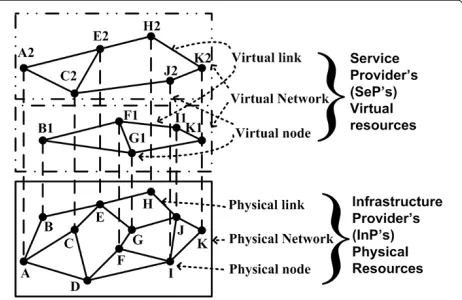
The network virtualization supports existence of multi-ple virtual network infrastructures on the top of physical network infrastructure. The NVE has two roles: service provider (SeP)andinfrastructure provider (InP). The InP owns physical infrastructure and SeP borrows/owns vir-tual infrastructure. Figure 1 shows an example of net-work virtualization environment. The netnet-work topology in plain line rectangle shows the physical infrastruc-ture of InP. The network topologies in single-dot-dash and double-dot-dash line rectangles shows the virtual resources of SePs. The virtual nodes are installed on the physical resources. e.g. the virtual nodes, K1 and K2 are installed on the physical node K. The virtual link may be mapped to any path reachable between two nodes by some virtual network placement algorithm.
The current horizontal IaaS federationecosystem has three key components: Cloud coordinators, Brokers, and an Exchange [13]. The cloud coordinators handle the dat-acenters for exporting market-based cloud services. A cloud coordinator can be cloud provider or consumer in the federation. A Cloud Broker is a mediator between cloud providers and cloud consumers for the federation. A cloud exchange performs match making services for the cloud users.
Thehorizontal IaaS federationwith full server and net-work virtualization must consider at least two roles (viz. network service provider and infrastructure provider) from network virtualization and three roles (viz. a cloud provider, cloud consumer and a broker) from the current horizontal IaaS federationecosystem. So the horizontal IaaS federation ecosystemmust have four roles namely ser-vice provider (SeP), infrastructure provider (InP), broker (Br) and user to incorporate full network virtualization. The horizontal IaaS federation can be formally defined as:
Definition: horizontal IaaS federation The federated cloud service of virtual infrastructures of a set of vir-tual nodes (e.g. virvir-tual switches, virvir-tual routers), virvir-tual links and virtual machines from a set of InPs (a virtual network infrastructure provider) and SePs (a IaaS cloud service provider) with transparent full server and network virtualization.
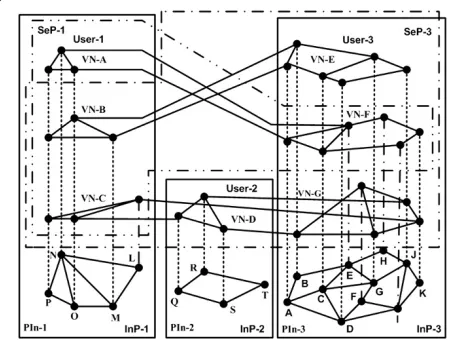
We will use the termfederationto mean horizontal IaaS federation for the sake of brevity from now onward in the paper. We illustrate this definition with the following example. The hypothetical example presented in Figure 2 is inspired by the theoretical development offederation inInterCloud[13] andopen-flowbased network virtual-ization for cloud [14]. The IaaS cloud provider can be
Figure 2Horizontal IaaS federation.The figure shows an example of horizontal IaaS federation and boundary of security control.
InP, or InP as well as SeP in thefederationas shown in Figure 2. The figure shows a federation of three IaaS cloud providers ({InP-1, SeP-1}, {InP-2} and {SeP-3, InP-3}) and three users (User-1, User-2 and User-3). The plain-line rectangles are InP providers. The bottom topologies of plain-line rectangles are physical infrastructure of the InPs. The home cloud {InP-1, SeP-1} has a cloud user, User-1. The home cloud {InP-3, SeP-3} has two cloud users, User-2 and User-3. The home cloud {InP-1, SeP-1} provides a virtual network {VN-A,VN-F} by borrowing a virtual network {VN-F} from foreign cloud {InP-3} to User-1. The home cloud {InP-3,SeP-3} provides virtual networks {VN-C,VN-D,VN-G} and {VN-B,VN-E} by bor-rowing the virtual networks {VN-C,VN-D} and {VN-B} to User-3 and User-2 respectively. The virtual machines are not shown in Figure 2 as the present work is concerned about virtual network infrastructure.
The virtual nodes and links are created by their respec-tive InPs on receiving request from SePs. The virtual resources are managed by the users of SePs. The double-dot-dash and single-double-dot-dash line polygons show the boundary of SeP-1 and SeP-2 control respectively. The management of virtual resources is done by their respec-tive users. In a nutshell, the various functions like vir-tual resource management, control and configuration are cooperatively performed by the three roles of the federa-tion, so it is necessary to consider various security issues for proper functioning of thefederation.
Horizontal IaaS federation security issues
To incorporate full network virtualization in federation ecosystem, the security issues of all constituents in the ecosystem must be investigated. The two components,
Brokers and an Exchange out of three components of
federation system are very similar to any brokered archi-tecture [13] where the service/resources are leased using some kind of negotiation between service consumer and provider through theBrokers andan Exchange. So, the investigation of these two components are omitted.
A detailed discussion on the security requirements of federationecosystem is beyond the scope of current inves-tigation. A few security requirements of the federation are already explored in the constituents of federation ecosys-tem in the literature: (a) cloud security requirements [16], (b) network virtualization security requirements [17], (c) cloud security alliance V3.0[18], and (d) web security sur-vey [19]. So we use following security requirements which are derived and extended from the literature [16-19].
• R1- Layered network architecture in which physical resources are controlled by InPs and virtual resources are transparently controlled by SePs.
• R2- Provide transparent view of virtual network infrastructure with a clear SLA (service level agreement) between SePs, InPs and cloud users.
• R3- Autonomous local identity management for physical resources used by InP.
• R4- Cooperative global identity management for virtual resources used by SeP and cloud users.
• R5- A brokered architecture between Br, InPs, SePs and cloud users for the collaboration of local and global identity management.
• R6- An access control mechanism to create, destroy virtual resources out of physical resources after the negotiation between InPs, SePs and cloud users.
• R7- An access control mechanism to manage and use virtual resources as per SLA between InPs, SePs and cloud users.
• R8- Intra-InP routing protocol with source authentication, operational confidentiality for cloud users within a InP.
• R9- Inter-InP routing protocol with source authentication, operational confidentiality and least information disclosure among InPs.
• R10- Tight collaboration among SePs and InPs in terms of fault handling, configuration, accounting, performance monitoring, trust negotiation and QoS.
Monolithic IaaS NVE security
As monolithic IaaS clouds are proprietary and a few tech-nical documents are publicly available, so only two designs have been selected for the investigation of NVE
secu-rity. AmazonElastic Cloud 2(EC2) [20-22] andGoGrid
[23] are the representatives of the most popular and a randomly selected IaaS cloud provider respectively.
The first representative, EC2 provides minimal network virtualization using either a software or hardware gate-way to facilitate the communication between VPCs or virtual machines. A software gateway usesroute tablesas software virtual routerwhile hardware gateway uses hard-ware router. Cisco integrated service routers and Juniper J-series are examples of software virtual routers. RTX 3000 is an example of hardware router. The EC2 uses
security groups to provide the basic security services among the users. Asecurity groupacts as a virtual firewall to control the traffic allowed that is allowed into a group of virtual machines instances.
The second representative, GoGrid offers limited net-work service using a private switch to each private cloud. GoGrid also makes use of hardware firewall to protect the servers of private clouds. Xu et al. [24] proposed secured wide area networkvirtualization for virtual private cloud using tunnelling.
Datacenter NVE security
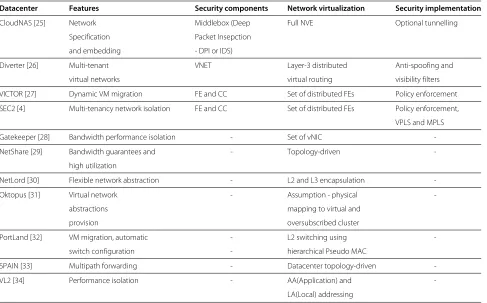
Cloud computing exploits datacenter for the provision of large data storage and network services with highly redun-dant data network and backup power supplies. We have thoroughly gone through the literature to find the limita-tion of NVE and its security services in the datacenters. The main aim of NVE provided in current datacenter is high utilization of its resources and not for any kind of net-work virtualization provision to its user. Md Faizaul Bari et al. [12] reported the survey of datacenter network virtu-alization without any security features. The first four dat-acenters (i.e., CloudNAS, Diverter, VICTOR and SEC2) provide security services in terms ofsecurity components and security implementations as shown in Table 1. The security implementation can be tunnelling, anti-spoofing, policy enforcement and visibility filters. The security com-ponents can be FE (Fowarding Element), CC (Central Controller), DPI or IDS. The CloudNAS supports full network virtualization but optional confidentiality and authentication using tunnelling.
The Diverter provisions network virtualization on the top of customized layer-3 network addressing. Each host has triplet f:s:h address where f is farm of hosts, s is subnet identifier and h is a particular host. The layer-3 triplet addresses are transparent to the tenants. Each host also runs VNET as distributed router in OS kernel-space. The VNET implements anti-spoofing and visibility filters to provide security services to tenants. The anti-spoofing filter prevents a VM impersonation by another VM. The visibility filter contains all network visibility rules to enforce separation between virtual machines. The tenants can use optional tunnelling for confidentiality.
Table 1 Datacenter network virtualization security
Datacenter Features Security components Network virtualization Security implementation
CloudNAS [25] Network Middlebox (Deep Full NVE Optional tunnelling
Specification Packet Insepction
and embedding - DPI or IDS)
Diverter [26] Multi-tenant VNET Layer-3 distributed Anti-spoofing and
virtual networks virtual routing visibility filters
VICTOR [27] Dynamic VM migration FE and CC Set of distributed FEs Policy enforcement
SEC2 [4] Multi-tenancy network isolation FE and CC Set of distributed FEs Policy enforcement,
VPLS and MPLS
Gatekeeper [28] Bandwidth performance isolation - Set of vNIC
-NetShare [29] Bandwidth guarantees and - Topology-driven
-high utilization
NetLord [30] Flexible network abstraction - L2 and L3 encapsulation
-Oktopus [31] Virtual network - Assumption - physical
-abstractions mapping to virtual and
provision oversubscribed cluster
PortLand [32] VM migration, automatic - L2 switching using
-switch configuration - hierarchical Pseudo MAC
SPAIN [33] Multipath forwarding - Datacenter topology-driven
-VL2 [34] Performance isolation - AA(Application) and
-LA(Local) addressing
middleboxes. The remaining seven datacenters propos-als have different aims but do not provide any security features as summarized in Table 1.
Generic NVE security
The existence of virtual network on the top of physi-cal network may appear at any layers of OSI reference model. Consequently, there are mainly four types of net-work virtualization: (a) virtual local area netnet-work (VLAN), (b) virtual private network (VPN), (c) active and pro-grammable network, and (d) overlay networks [11]. Some of the surveyed network virtualization projects using aforementioned types are not useful for the investigation of security issues. So we used three filtering criteria for the survey. The first, VLAN and VPN inherently pro-vides security features to network virtualization environ-ment using segenviron-mentation, isolation, tunnelling, IPSec and VLAN. Second, the main aim of some network virtual-ization projects (e.g. AKARI, CABO, 4WARD, Triology, and Clean-slate) is the design of next generation net-work. They are long-term projects; and are evolving and extending from another network virtualization projects like GENI and VINI. Third, the research in old network virtualization projects namely Genesis (is from Active and programmable network type) has been stopped. So the
network virtualization projects for security investigation after applying the three filtering criteria are GENI, Planet-Lab, UCLP, VINI and X-bone.
As per the security requirements of full network virtualization in federationgiven in Section ‘Horizontal IaaS federation’, we surveyed the network virtualization projects by classifying them under five categories: (a) identity management for resources, (b) authentication and trust management, (c) resource access control, (d) routing security issues; and (e) other security issues.
Identity management for resources
The digital identities for virtual resources in network virtualization environment give a provision of dynamic connectivity between virtual resources. An identity man-agement for resources in network virtualization provides mechanisms for managing and gaining access to the resource’s identity and information across organizational boundaries to SePs and InPs. Yuan et al. [35] classified the identity management models in three categories — isolated, centralized and federated — by considering var-ious attributes. We will consider only four attributes — the number of InPs,the number of SeP,user control over identity, and identities’ storage — as per the
Table 2 Identity management for resources: comparison
Project No. of InPs No. of SePs User control Identity storage
GENI [36] Many One Yes Decentralized
PlanetLab [37] Many One Yes Centralized
UCLP [38] Many Many No Decentralized
X-bone [39] One One No Centralized
NouVeau [40] Many Many - Decentralized
GENI, PlanetLab, UCLP, X-Bone and NouVeau using four attributes mentioned earlier. The roles from the projects are mapped to InP, SeP and cloud user so that it is easier to compare the projects.
The GENI have InPs (called as Aggregates) and SePs
(called as research organizations). The users of research organization (i.e., SeP users) are called principal. The prin-cipal may be a researcher, prinprin-cipal investigator (which is an administrator) and slice admin. The virtual network instance is called slice and consists of objects. The GENI defines identifiers called GENI Global Identifiers (GGID) for all principal and objects in the system. The GENI uses X.509 certificate to represent GGID for authentication. In federated GENI system, an identity of an object in SeP is a union of identities stored across multiple InPs. The database of identity name-space is stored at the research organization’s site and allows control by the principal.
The PlanetLab has three main roles: an owner, a user and PLC (PlanetLab Consortium). The owner (i.e., InP) supply physical nodes to create VMs. A service is installed on PlanetLab by a researcher (i.e., SeP). The PLC is a cen-tralized entity and has mainly two functions: (a) manages physical resource and (b) maintains trust among own-ers and researchown-ers. A slice is a collection of VMs. Each slice is uniquely identified by the hierarchical name where each level has the responsibility to manage and control the resources at that level. The PLC acts as slice authority and maintains state of all slices in the system.
The UCLP is the most promising project forfederation in which the identities of virtual resources (e.g. LightPath,
End2End object) is managed byUCLP Admins(SePs) and
the identities of physical resources are managed by net-work owners(InPs). The UCLP end users cannot control UCLP virtual resources. The UCLP uses decentralized JavaSpace storage for the identities at InPs’ sites. The over-lay manager (SeP as well as InP) in X-bone manages the identity of virtual nodes at central repository. The X-bone user cannot control the identity of the virtual resources.
The NouVeau is an identity management for a abstract
network virtualization model and is similar to UCLP. It is based on three main principles: separation of identity and location, local autonomy, and global identifier space. It also requires special entities called controller and adapters for the managements of identities in SePs and InPs.
Authentication and trust management
A typical identity management has any of the three types of trust relationship between the service provider (SP) and identity provider (IdP) - pairwise, brokered and com-munity trust models [41,42]. In network virtualization, SeP or InP may play a role as IdP and SP. The identity management may have any of the three trust relation-ships between SePs and/or InPs in network virtualization depending on the number of InPs and SePs. The Planet-Lab, UCLP and X-bone uses PKI infrastructure (i.e., com-munity trust) for authentication and trust management between SePs and InPs.
GENI uses a brokered trust model in which four entities namely clearinghouse, aggregates, research organization and researcher form a bilateral automatic trust negotia-tion [43-45] between them. The GENI is a decentralized system in which most of the times, a requester may not be from the same security domain (InP) for the authoriza-tion of resources. So, it uses attribute-based access control (ABAC) in which a request may be granted based on the characteristic of the requester’s attributes. The negotia-tor contacts access medianegotia-tor (i.e., GENI clearinghouse) to start bilateral negotiation (i.e., automatic trust negotia-tion). The negotiation is a sequence of credential exchange starting from non-sensitive credentials between negotia-tors. After successful negotiation, the request is granted to access the resource.
Resource access control
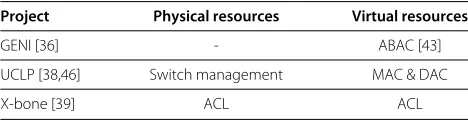
The authorization decision of an entity in a closed and open system about the resources is treated differently. So we divide the access control mechanism in two parts: local access control for a closed system and a global access control for the open system. The local access control per-forms the local authorization decision about the physical resources. The global access control performs the autho-rization decision of distributed virtual resources. We will compare three projects from academics and industry to know the status of resource access control in the net-work virtualization environment. Table 3 shows the access control mechanism used by the different projects.
The network slicesof GENI are created out of physi-cal network of aggregates. The aggregates are strangers to each other, so the GENI uses ABAC in which automatic trust negotiation is performed by exchanging
Table 3 Resource access control for network virtualization projects
Project Physical resources Virtual resources
GENI [36] - ABAC [43]
UCLP [38,46] Switch management MAC & DAC
sensitive credentials. ABAC authorizes the access to
vir-tual resources using attribute acknowledgement (ACK)
policies andtrust-target graph(TTG) protocol. The ACK policy and TTG protocol perform attribute disclosure and resource access decisions respectively using directed graph.
The UCLP satisfies some requirements ofR6 andR7
for physical and virtual network resources. The resource access control for UCLP physical resources is either implemented in the UCLP system, or an intermedi-ate system between the UCLP and switch management.
The UCLP system may use mandatory access control
(MAC) ordiscretionary access control (DAC) for UCLP
virtual resources. The UCLP supports three approaches for access control of UCLP virtual resources. The three approaches are traditional DAC, generic authorization-based distributed DAC and attributed-authorization-based distributed DAC. The first method performs all the evaluation of access and enforcement of policy in a centralized manner. The second method stores authorization information in different domains and performs the authorization process in multiple domains. The third method uses certificate-based system for authorization. The traditional DAC cannot make authorization of users in other domains. The second method is difficult to realize while the third approach is the easiest to implement.
X-bone system uses very simple access control mecha-nism for the authorization using ACL (access control list). It maintains the list of permission on the virtual resources for each user in the system. X-bone first checks the ACL for applicable entry to decide whether the requested oper-ation is authorized based on subject and object identities.
Routing security issues
The user’s virtual infrastructure of the SeP may be installed on an InP or a set of InPs in the federation. Similarly, the InP also collocates virtual networks from different SePs. The nature of the routing protocol used within InP and among InPs are totally different as per the security requirements,R8andR9. The routing protocol within InP for a set of SePs must providehop integrity, origin authenticationandpath validation. The first three parameters are necessary for users’ collocation of virtual networks in a InP. The fourth parameter provides least information disclosure and operational confidentiality of the virtual network installed on multiple InPs. Thehop integrityof a routing protocol refers to the confidentiality between peers. Theorigin authentication is the authen-tication of a router. The path validation refers to the validity and authenticity of a received topological path. Thenumber of tenantsaffects information leakage on the same physical network infrastructure. The routing proto-col among InPs must provide control over theinformation disclosureandrouting basis. Therouting basisshows the
significance of name-space and/or identity used in the routing protocol. Table 4 shows the comparison of rout-ing protocols for all the parameters mentioned above. We have mainly focussed our investigation on the protocols which gives some security features and upcoming virtual network routing.
The three variants of BGP namely S-BGP, IRV, and So-BGP provide security services in terms of -PKI,address attestation(a statement of delegation of identity), a spe-cial SECURITY message, orIRV–Identity Request Server with no provision for information disclosure. The min-imum disclosure routing (MDR), routing on flat label (ROFL) and secure virtual trust routing (SVTR) are the upcoming routing protocols for virtual network in the field offederation. The MDR gives the minimum disclo-sure and operational confidentiality through the extension of Secure Multi-party Computation (SMC). The SMC reveals secret information among multiple parties using their individual secrets. The nodes of ROFL routing guar-antees origin authentication and path validation using self-certification and access control mechanism respec-tively. SVTR is the only protocol that gives provision for multi-tenant collocation usinghop integrity.
Basic security services
The network virtualization projects have components to perform the specific functions related to either manage-ment or security services. Any data traffic — plain or protocol related — transferred in the projects may provide basic security services like authentication, confidentiality etc. Table 5 shows the data traffic among the compo-nent(s) and/or resource(s) of the projects. We will use the convention - “Authentication|Confidentiality|Protocol” for brevity to describe the basic security services. The val-ues for the convention are: A for Authentication, S for Confidentiality, ∼for negation, * for all available proto-cols for data transmission. The communication between the components of GENI, PlanetLab and UCLP is secured and authenticated while X-bone does not use authenti-cated communication. All projects do not provide secured communication between the resources while GENI pro-vides authenticated data transfer between them. X-bone does not provide authenticated communication between resources and components while all other projects pro-vide authenticated communication. All projects propro-vide secured data transfer either optional or compulsory.
Virtual resources security
Table 4 Routing security issues for horizontal IaaS federation
Routing protocol Hop integrity Origin authentication Path validation Information disclosure Routing basis No. of tenants
MDR [47] IPSec - - YES (SMC) Location & identity Single
ROFL [48] - Self certification ACM - Flat-label Single
SVTR [49] Secured - - NO (Privacy of attributes) Flow-level Multiple
S-BGP [50] PKI Address attestation Address attestation - Location & identity Single
IRV [51] Secure transport Source attestation IRV server - Location & identity Single
So-BGP [52] SECURITY message SECURITY message SECURITY message - Location & identity Single
of virtual resources in monolithic IaaS cloud and generic network virtualization.
Virtual routers
The virtualization of software routers calledvirtual soft-ware routers exploits processing power out of physical router or commodity hardware using NICs or NetFPGA. Juniper’sintelligent logical routeron the top of M-Series and T-Series routers are examples of virtual software routers [53]. Theintelligent logical router supports cus-tomized policy control, protocol assignment, configura-tion but no on-the-fly configuraconfigura-tion and administraconfigura-tion. It also does not support source authentication. Most of virtual software routersfrom monolithic cloud including Amazon EC2 useroute tables. Theroute tablemaintains network filtering policy and are managed by VPC network administrator. The EC2 also uses security groups which offer secured virtual network isolation among cloud users.
The router has two modules: control planeand data
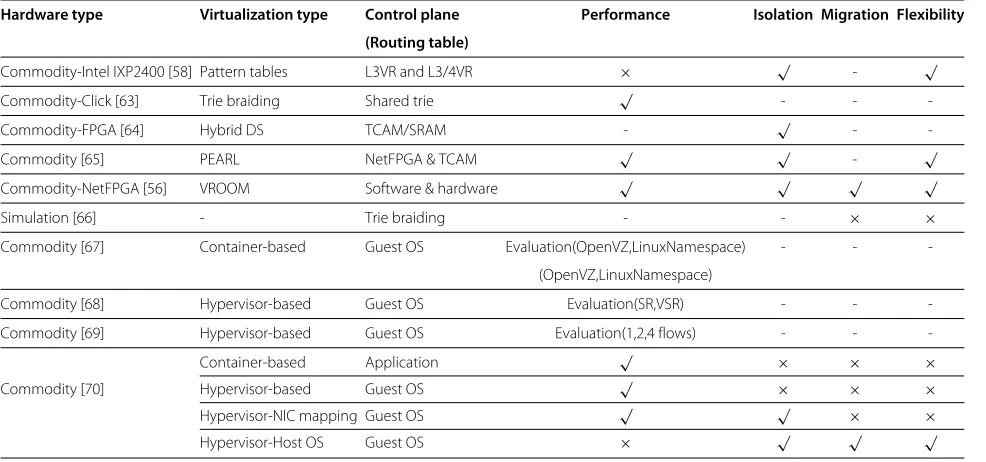
plane. The control plane performs the function of rout-ing and maintains routrout-ing table. The data plane performs the function of packet forwarding. All the router archi-tectures using the combination of data and control plane proposed by Pisa et al. concentrates on performance in terms of delay [54]. The VROOM [55,56] router archi-tecture also concentrates on the performance in terms of delay using control plane virtualization. Table 6 classifies the literature in two areas. First six literatures give the proposal of the router. The remaining gives the perfor-mance evaluation of virtual software routers. It is found that allvirtual software routersprovide physical or logi-cal isolation to improve the performance but no specific security services. Some software routers on commodity
hardware are implemented with general-purpose work-stations [57-62]. The proposals for router design aim at low-cost and moderate-performance solutions and have no security provision.
Virtual switches
The virtual switches can be broadly divided into
hypervisor-based or hardware-based depending on the
location of the implementation of virtual switches. The hypervisor-based virtual switches are typically written entirely in software. The hardware-based virtual switch is partly implemented on special hardware like NIC, NetF-PGA etc. The basis of hypervisor-based virtual switch is Open vSwitch [71]. Open vSwitch resides within the management domain of hypervisor (e.g. Domain-0 in Xen) and provides connectivity between virtual machines and physical interfaces. Open vSwitch uses VLANs and GRE tunnels for secured virtual network and virtual path respectively. It also supports basic ACL.
Hardware-based virtual switch eliminates some limi-tations (like CPU or memory usage) of software-based virtual switch. Two hardware-based virtual switch imple-mentations areVirtual Ethernet Port Aggregator (VEPA) [72] and VNTag [73]. The Virtual Ethernet Port Aggre-gator (VEPA) is a standardization led by HP Extreme, IBM, Brocade and Juniper etc. The VEPA allows traf-fic of VM to exit and re-enter the same port to enable
switching among VMs. The VEPA has MACSecscheme
to provision a secure connection between VEPA and bridges.
Tseng et al. [74] proposed the integration of open-source hypervisor with software-based virtual switch and aims at secure network environment among VMs.
Table 5 Basic security services of network virtualization projects
Project Resource-Component Component-Component Resource-Resources
GENI [36] A| ∼S|SSL A|S|SSL A| ∼S|*
PlanetLab [37] A|S|SSL A|S|SSL ∼A| ∼S|*
UCLP [38] A|S|(SSL/JINI) A|S|(SSL & JINI) ∼A| ∼S|*
X-bone [39] ∼A|(S/∼S)|(UDP/UDP-S/TCP/TCP-SSL) ∼A|S|(UDP-S/TCP-SSL) ∼A| ∼S|*
Table 6 Commodity and physical virtual routers’ control plane properties
Hardware type Virtualization type Control plane Performance Isolation Migration Flexibility
(Routing table)
Commodity-Intel IXP2400 [58] Pattern tables L3VR and L3/4VR × √ - √
Commodity-Click [63] Trie braiding Shared trie √ - -
-Commodity-FPGA [64] Hybrid DS TCAM/SRAM - √ -
-Commodity [65] PEARL NetFPGA & TCAM √ √ - √
Commodity-NetFPGA [56] VROOM Software & hardware √ √ √ √
Simulation [66] - Trie braiding - - × ×
Commodity [67] Container-based Guest OS Evaluation(OpenVZ,LinuxNamespace) - -
-(OpenVZ,LinuxNamespace)
Commodity [68] Hypervisor-based Guest OS Evaluation(SR,VSR) - -
-Commodity [69] Hypervisor-based Guest OS Evaluation(1,2,4 flows) - -
-Container-based Application √ × × ×
Commodity [70] Hypervisor-based Guest OS √ × × ×
Hypervisor-NIC mapping Guest OS √ √ × ×
Hypervisor-Host OS Guest OS × √ √ √
×indicates the property doesn’t exist for the router. √
indicates the property exist for the router.
Luo et al. [75] proposed hardware-based virtual switch using special NIC to provide network connectivity among VMs in the datacenter.
Virtual links
The virtual links can be created using either signalling protocol or encapsulation. The virtual link setup proto-col (VLSP) is an example of signalling protoproto-col to create the virtual links. The encapsulation-based virtual link cre-ation in the literature are Virtual Tunnel (VTun),Layer Two Tunnelling Protocol - V3 (L2TPV3),Generic Routing Encapsulation (GRE)andIP in IP Tunnelling (IIP).
Roland Bless et al. [76] proposed VLSP to create authen-ticated and secured virtual link using NSIS authorization [77] and secured signalling [78] protocols. It also pro-vides QoS as per user’s requirement for link creation. The L2TPV3 [79] encapsulation protocol creates tunnel between nodes at layer 2. It does not inherently provide authentication and encryption but IPSec can be used for security provision. The VTun is a virtual link implemen-tation over various kinds of tunnels (e.g. Ethernet, serial tunnel, pipe tunnel) and; provides security services like authentication, compression and encryption etc. [80]. The GRE [81] encapsulation protocol is used to create a vir-tual link between two nodes using an additional header in the packet calleddelivery headerwithout any security features. The IIP [82] link creation protocol has a packet format consisting of the outer header, security header, original header and IP payload. The security header adds optional security services using IPSec.
Virtual resource migration
As network virtualization is new emerging field, there is few literature on some important field like the migration of virtual router and link etc. Chen et al. uses VROOM [56] router architecture to provide energy-saving IP-WDM network architecture [83] by the process of virtual router migration. All the router architecture proposals and their migration methods using the combination of data and control plane proposed by Pisa et al. concentrates on performance in terms of delay [54]. The full virtual network migration including virtual machines is proposed by Keller et al [84]. All the literature concentrate on vir-tual resource migration without any security concerns. The virtual link migration suggested by Pisa et al does not provide any security services.
Research directions
datacenter NVE security, (c) resource identity manage-ment, (d) resource access control and (e) intra-InP and inter-InP routing.
Router architecture
All the router architectures using the combination of data and control plane concentrates on performance in terms of delay. The control plane as well as data plane virtualization allows best-effort memory utilization but may promote confidentiality threat due to the colloca-tion of multiple SePs’ virtual routers on the same phys-ical router. The software virtual routers on commodity as well as physical router lacks source authentication, remote configuration using SeP’s access control as shown in Table 6. The source authentication, remote configura-tion and access control mechanism are basic requirements (R6-R10) to perform inter-InP and intra-InP routing by thesoftware virtual routers. By adding the above function-ality, we pose few research questions like: What will be the impact on router performance in terms of packet-delay? What is the maximum number of tenants’ virtual soft-ware routers that can coexist on a physical router without degrading the performance? How the router virtualization handles intra-InP and inter-InP routing by considering the collocation of tenants’ virtual networks? How the virtual router migration be handle by this architecture?
Datacenter NVE security
The most promising datacenter network virtualization architecture for thefederationis SEC2 [4] which supports basic security services like source authentication, trans-parent network management etc., but does not support full network virtualization (requirementsR1andR2). The network isolation among customers of CloudNAS can be compromised if hypervisors, switches, or middleboxes are compromised [4]. The customized devices like FEs or CCs may expose MAC address of host and VM [30]. No datacenter supports federation of virtual resources (requirementR10), full NVE (requirementsR1-R2) and resource access control (requirementsR6andR7). All dat-acenter network virtualization projects support minimum security services using VLAN, L2/L3 addressing or spe-cial routing devices (e.g. FE, CC etc.) as shown in Table 1.
The datacenter also do not permit transparent network
management(requirementR2), user-level policy control
and resource access control (requirements R6 and R7)
required for thefederation.
Resource identity management
Table 2 shows that there is no identity management which provides the feature of multiple InPs and SePs (requirementR5), user’s control over identities (require-mentR4) and decentralized storage. We used the generic term user controlto mean various operations on virtual
resources e.g., creation of virtual link, configuration of vir-tual resource etc. The UCLP project shows some potential towards the design of an identity management for feder-ationbut lacks users’ control over identities (requirement
R4). Thefederationrequires federated identity manage-ment, so a trust between InPs and/or SePs must be estab-lished to gain the control over the requested resources automatically on-the-fly. So, the federation needs the identity management with automated trust negotiation
(requirement R10). We must also address the
follow-ing research question related to resource identity man-agement: How to map heterogeneous address space of resources in datacenters to local and global identity name-space?
Resource access control
The trivial resource access control for horizontal IaaS federation requires user-controlled access control
mech-anism (requirement R7) at virtual infrastructure and
mandatory access control (requirement R6) at physical infrastructure. The GENI does not provide any kind of resource access control over the physical resources while virtual resources are managed in terms of Trust-Target
Graph protocol of ABAC (requirement R7). The UCLP
provisions MAC or DAC at virtual infrastructure level but it does not fulfil the requirement at physical level. X-bone uses ACL, a simplest access control manage-ment of resources. Some research questions related to resource access control are: Where should be the place-ment of resource access controls in physical resources? If the location of access control is incontrol planeof phys-ical resource; and distributed among InPs and SePs, how
would they interact? What would be bandwidth-delay
productperformance of physical as well as virtual network infrastructures after deploying resource access controls?
Intra-InP and Inter-InP routing
Keller et al. [85] and Fukushima et al. [47] open up theoret-ical research directions for intra-InP and inter-InP routing respectively. The inter-InP routing should not disclose routing information to InPs other than intended InPs (i.e minimum disclosure) and also provide operational confidentiality in routing process. MDR offers both min-imum disclosure and operational confidentiality among InPs but does not provide other properties mentioned in Table 4. The intra-InP and inter-InP routing should
possess the security requirements, R6and R7with the
consideration of tenants’ virtual network collocation. We pose the following research questions for routing process in the federation by including aforementioned security
requirements: How the router maintains routing table
packets of different virtual networks without exposing or compromising?
Conclusions
With the motivation of adding full network virtualiz-tion in horizontal IaaS federavirtualiz-tion, we investigated net-work virtualization security in four areas: monolithic IaaS cloud, generic network virtualization, datacenter net-work virtualization and virtual resources. We presented the qualitative comparisons ofgeneric network virtualiza-tion projects, datacenters, routing protocols and virtual resources from aforementioned areas. Our qualitative comparisons show the following important insights related to network virtualization and security issues in horizontal IaaS federation. The monolithic IaaS clouds do not support full network virtualization but give minimal network virtualization to offer the connectivity of virtual networks or virtual machines. The simple security ser-vices are offered in terms of VLAN, VPN or tunnelling for the collocation of multiple tenants in monolithic IaaS clouds. The datacenters lack both full network virtualiza-tion and basic security services for the horizontal IaaS federation. The network virtualization projects offer full network virtualization but partial security provisions in terms of one or more services of identity management, resource access control and trust management. The router architectures mostly focus on the performance of virtual software routers and do not add any security features for the collocation of tenants networks. The virtual switches cannot have more than 4K VLANs. This paper shows that the virtual links can be created using either signalling protocol or encapsulation. The encapsulation-based vir-tual link has an extra overhead of encapsulation on the top of L2/L3 protocols but give hop integrity security service. The signalling-based virtual link offers various security services likeorigin authentication,hop integrity andpath validation. The research challenges mentioned in Section ‘Research directions’ are crucial to the success of horizontal IaaS federation in cloud computing.
Competing interests
The authors declare that they have no competing interests.
Authors’ contributions
All the listed authors made substantive intellectual contributions to the research work and manuscript. AVN formally defined the network virtualization for horizontal IaaS federation. He and SKG investigated the domains presented in the manuscript. SKG was responsible for the overall technical approach and edited the paper. Both authors read and approved the final manuscript.
Received: 20 February 2013 Accepted: 15 November 2013 Published: 21 November 2013
References
1. Celesti A, Tusa F, Villari M, Puliafito A (2010) How to enhance cloud architectures to enable cross-federation. In: Cloud Computing (CLOUD), 2010 IEEE 3rd international conference on. IEEE, Miami, pp 337–345 2. Armbrust M, Fox A, Griffith R, Joseph AD, Katz R, Konwinski A, Lee G,
Patterson D, Rabkin A, Stoica I, Zaharia M (2010) A view of cloud
computing. Commun ACM 53(4): 50–58. http://doi.acm.org/10.1145/ 1721654.1721672
3. Zhang Z, Zhang X (2009) Realization of open cloud computing federation based on mobile agent. In: Intelligent computing and intelligent systems, 2009. ICIS 2009. IEEE international conference on, Volume 3. IEEE, Shanghai, pp 642–646
4. Hao F, Lakshman TV, Mukherjee S, Song H (2010) Secure cloud computing with a virtualized network infrastructure. In: Proceedings of the 2nd USENIX conference on Hot topics in cloud computing, HotCloud’10. USENIX Association, Berkeley, pp 16–16. http://dl.acm.org/ citation.cfm?id=1863103.1863119
5. Berger S, Cáceres R, Goldman K, Pendarakis D, Perez R, Rao JR, Rom E, Sailer R, Schildhauer W, Srinivasan D, Tal S, Valdez E (2009) Security for the cloud infrastructure: trusted virtual data center implementation. IBM J Res Dev 53(4): 560–571. http://dl.acm.org/citation.cfm?id=1850659.1850665 6. Berger S, Cáceres R, Pendarakis D, Sailer R, Valdez E, Perez R, Schildhauer
W, Srinivasan D (2008) TVDc: managing security in the trusted virtual datacenter. SIGOPS Oper Syst Rev 42: 40–47. http://doi.acm.org/10.1145/ 1341312.1341321
7. Chowdhury N, Boutaba R (2009) Network virtualization: state of the art and research challenges. Commun Mag IEEE 47(7): 20–26
8. Fan P, Chen Z, Wang J, Zheng Z, Lyu M (2012) Topology-aware deployment of scientific applications in cloud computing. In: Cloud Computing (CLOUD), 2012 IEEE 5th international conference on. IEEE, Honolulu, pp 319–326
9. Chae Y, Merugu S, Zegura E, Bhattacharjee S (2000) Exposing the network: support for topology-sensitive applications. In: Open Architectures and Network Programming, 2000. Proceedings. OPENARCH 2000. 2000 IEEE Third Conference on. IEEE, Tel, Aviv, pp 65–74
10. Celesti A, Tusa F, Villari M, Puliafito A (2010) Three-phase cross-cloud federation model: the cloud SSO authentication. In: Advances in Future Internet (AFIN), 2010 second international conference on. IEEE, Venice, pp 94–101
11. Chowdhury NMK, Boutaba R (2010) A survey of network virtualization. Comput Netw 54(5): 862–876. http://dx.doi.org/10.1016/j.comnet.2009. 10.017
12. Bari M, Boutaba R, Esteves R, Granville L, Podlesny M, Rabbani M, Zhang Q, Zhani M (2012) Data center network virtualization: a survey. Commun Surv Tutorials, IEEE PP(99): 1–20
13. Buyya R, Ranjan R, Calheiros RN (2010) InterCloud: utility-oriented federation of cloud computing environments for scaling of application services. In: Proceedings of the 10th international conference on algorithms and architectures for parallel processing - Volume Part I, ICA3PP’10. Springer-Verlag, Berlin, Heidelberg, pp 13–31. http://dx.doi. org/10.1007/978-3-642-13119-6_2
14. Matias J, Jacob E, Sanchez D, Demchenko Y (2011) An OpenFlow based network virtualization framework for the cloud. In: Cloud Computing Technology and Science (CloudCom), 2011 IEEE Third International Conference on. IEEE, Athens, pp 672–678
15. Vaquero LM, Rodero-Merino L, Morán D (2011) Locking the sky: a survey on IaaS cloud security. Computing 91: 93–118. http://dx.doi.org/10.1007/ s00607-010-0140-x
16. Iankoulova I, Daneva M (2012) Cloud computing security requirements: A systematic review. In: Research Challenges in Information Science (RCIS), 2012 sixth international conference on, pp 1–7
17. Natarajan S, Wolf T (2012) Security issues in network virtualization for the future Internet. In: Computing, Networking and Communications (ICNC), 2012 international conference on, pp 537–543
18. Security Guidance for Critical Areas of Focus in Cloud Computing V3.0, Cloud Security Alliance. Tech. rep. 2011. https://cloudsecurityalliance.org/ guidance/csaguide.v3.0.pdf
19. Rubin A, Geer JDE (1998) A survey of Web security. Computer 31(9): 34–41 20. Onisick J (2012) Access Layer Network Virtualization: VN-Tag and VEPA.
http://wikibon.org/wiki/v/Edge_Virtual_Bridging
21. Amazon Virtual Private Cloud Network - Administrator Guide. Tech. rep. 2012. http://awsdocs.s3.amazonaws.com/VPC/latest/vpc-nag.pdf 22. Amazon Virtual Private Cloud - User Guide. Tech. rep. 2012.
http://awsdocs.s3.amazonaws.com/VPC/latest/vpc-ug.pdf 23. GoGrid - Getting Started Guide L-20121018. Tech. rep. 2012. http://
24. Xu Z, Di S, Zhang W, Cheng L, Wang CL (2011) WAVNet: Wide-area network virtualization technique for virtual private cloud. In: Parallel Processing (ICPP), 2011 international conference on, pp 285–294 25. Benson T, Akella A, Shaikh A, Sahu S (2011) CloudNaaS: a cloud
networking platform for enterprise applications. In: Proceedings of the 2nd ACM symposium on cloud computing, SOCC ’11. ACM, New York, pp 8:1–8:13. http://doi.acm.org/10.1145/2038916.2038924
26. Edwards A, Fischer A, Lain A (2009) Diverter: a new approach to networking within virtualized infrastructures. In: Proceedings of the 1st ACM workshop on Research on enterprise networking, WREN ’09. ACM, New York, pp 103–110. http://doi.acm.org/10.1145/1592681.1592698 27. Hao F, Lakshman TV, Mukherjee S, Song H (2010) Enhancing dynamic cloud-based services using network virtualization. SIGCOMM Comput Commun Rev 40: 67–74. http://doi.acm.org/10.1145/1672308.1672322 28. Rodrigues H, Santos JR, Turner Y, Soares P, Guedes D (2011) Gatekeeper:
supporting bandwidth guarantees for multi-tenant datacenter networks. In: Proceedings of the 3rd conference on I/O virtualization, WIOV’11. USENIX Association, Berkeley, pp 6–6. http://dl.acm.org/citation.cfm?id= 2001555.2001561
29. Lam T, Vahdat A, Radhakrishnan S, Varghese G (2010) NetShare: Virtualizing Data Center Networks across Services. Tech. rep., Microsoft Research Lab. http://research.microsoft.com/apps/video/dl.aspx?id= 132892
30. Mudigonda J, Yalagandula P, Mogul J, Stiekes B, Pouffary Y (2011) NetLord: a scalable multi-tenant network architecture for virtualized datacenters. SIGCOMM Comput Commun Rev 41(4): 62–73. http://doi.acm.org/10.1145/2043164.2018444
31. Ballani H, Costa P, Karagiannis T, Rowstron A (2011) Towards predictable datacenter networks. SIGCOMM Comput Commun Rev 41(4): 242–253. http://doi.acm.org/10.1145/2043164.2018465
32. Niranjan Mysore R, Pamboris A, Farrington N, Huang N, Miri P, Radhakrishnan S, Subramanya V, Vahdat A (2009) PortLand: a scalable fault-tolerant layer 2 data center network fabric. SIGCOMM Comput Commun Rev 39(4): 39–50. http://doi.acm.org/10.1145/1594977.1592575 33. Mudigonda J, Yalagandula P, Al-Fares M, Mogul JC (2010) SPAIN: COTS
data-center Ethernet for multipathing over arbitrary topologies. In: Proceedings of the 7th USENIX conference on Networked systems design and implementation, NSDI’10. USENIX Association, Berkeley, pp 18–18. http://dl.acm.org/citation.cfm?id=1855711.1855729
34. Greenberg A, Hamilton JR, Jain N, Kandula S, Kim C, Lahiri P, Maltz DA, Patel P, Sengupta S (2009) VL2: a scalable and flexible data center network. SIGCOMM Comput Commun Rev 39(4): 51–62. http://doi.acm. org/10.1145/1594977.1592576
35. Cao Y, Yang L (2010) A survey of identity management technology. In: Information Theory and Information Security (ICITIS), 2010 IEEE international conference on. IEEE, Beijing, pp 287–293
36. GENI Security Architecture, Global Environment for Network Innovations. Tech. rep. http://groups.geni.net/geni/attachment/wiki/GENISecurity/ GENI-SEC-ARCH-0.4.pdf
37. Peterson L, Roscoe T, Muir S, Klingaman A (2006) PlanetLab architecture: an overview. Tech. rep., PlanetLab Consortium
38. Hulsebosch B, Groote R, Snijders M (2009) Secure user-controlled lightpath provisioning with user-controlled identity management. In: Proceedings of the 3rd international conference on autonomous infrastructure, management and security: scalability of networks and services, AIMS ’09. Springer-Verlag, Berlin, Heidelberg, pp 1–14. http://dx.doi.org/10.1007/978-3-642-02627-0_1
39. Clem J, MacAlpine T, Badgett B (2003) X-Bone: Automated System for Deployment and Managament of Network Overlays Security Assessment Report. Tech. rep., Information Design Assurance Red Team, Sandia National Laboratories, P. O. Box 5800, Albuquerque, NM 87185-0784, 2003. http://www.isi.edu/xbone/pubs/xbone_security_assessment.pdf 40. Chowdhury N, Zaheer FE, Boutaba R (2009) iMark: An identity
management framework for network virtualization environment. In: Integrated Network Management, 2009. IM ’09. IFIP/IEEE International Symposium on. IEEE, Long Island, pp 335–342
41. Bhargav-Spantzel A, Squicciarini A, Bertino E (2007) Trust negotiation in identity management. Secur Privacy, IEEE 5(2): 55–63
42. Zhang P, Durresi A, Barolli L (2011) Survey of trust management on various networks. In: Complex, Intelligent and Software Intensive Systems
(CISIS), 2011 international conference on. IEEE Computer Society, Seoul, pp 219–226
43. Winsborough W, Jacobs J (2003) Automated trust negotiation technology with attribute-based access control. In: DARPA Information Survivability Conference and Exposition, 2003. Proceedings, Volume 2. IEEE Computer Society, Los Alamitos, pp 60–62
44. Li N, Winsborough W (2002) Towards practical automated trust negotiation. In: Proceedings of the 3rd international workshop on policies for distributed systems and networks (POLICY’02), POLICY ’02. IEEE Computer Society, Washington, p 92. http://dl.acm.org/citation.cfm?id= 863632.883493
45. Winsborough WH, Li N (2002) Protecting sensitive attributes in automated trust negotiation. In: Proceedings of the 2002 ACM workshop on Privacy in the Electronic Society, WPES ’02. ACM, NY, pp 41–51. http://doi.acm.org/10.1145/644527.644532
46. Chen J (2004) UCLP Security. Tech. rep., School of Information Technology and Engineering University of Ottawa. www.uclp.ca/files/ uclp1.x/Report-UCLP-Security.pdf
47. Fukushima M, Hasegawa T, Hasegawa T, Nakao A (2011) Minimum disclosure routing for network virtualization. In: Computer
communications workshops (INFOCOM WKSHPS), 2011 IEEE Conference on. IEEE, Shanghai, pp 858–863
48. Caesar M, Condie T, Kannan J, Lakshminarayanan K, Stoica I (2006) ROFL: routing on flat labels. SIGCOMM Comput Commun Rev 36(4): 363–374. http://doi.acm.org/10.1145/1151659.1159955
49. Huang D, Ata S, Medhi D (2010) Establishing secure virtual trust routing and provisioning domains for future internet. In: Global
telecommunications conference (GLOBECOM 2010), 2010 IEEE. IEEE, Miami, pp 1–6
50. Kent S, Lynn C, Seo K (2000) Secure Border Gateway Protocol (S-BGP). Selected Areas Commun, IEEE J 18(4): 582–592
51. Goodell G, Aiello W, Griffin T, Ioannidis J, McDaniel P, Rubin A (2003) Working around BGP: an incremental approach to improving security and accuracy of interdomain routing. In: In Proc. NDSS. Internet Society, San Diego
52. Ng J (2002) Extensions to BGP to Support Secure Origin BGP (soBGP). Tech. rep., IETF. http://tools.ietf.org/pdf/draft-ng-sobgp-bgp-extensions-00.txt 53. Kolon M (2004) Intelligent Logical Router Service. Tech. rep., Juniper
Networks. http://netscreen.com/solutions/literature/white_papers/ 200097.pdf
54. Pisa P, Fernandes N, Carvalho H, Moreira M, Campista M, Costa L, Duarte O (2010) OpenFlow and Xen-Based Virtual Network Migration. In: Pont A, Pujolle G, Raghavan S (eds) Communications: wireless in developing countries and networks of the future, Volume 327 of IFIP advances in information and communication technology. Springer, Berlin, Heidelberg, pp 170–181. http://dx.doi.org/10.1007/978-3-642-15476-8_17 55. Layer 3 Virtual Switching - Integrated Virtual Routing with Multi-Layer
Switching. Tech. rep., Extreme Networks, Inc 2006. http://www. extremenetworks.com/libraries/whitepapers/WPL3Virtual_1185.pdf 56. Wang Y, Keller E, Biskeborn B, van der Merwe J, Rexford J (2008) Virtual
routers on the move: live router migration as a network-management primitive. SIGCOMM Comput Commun Rev 38(4): 231–242. http://doi.acm.org/10.1145/1402946.1402985
57. Rus A, Barabas M, Boanea G, Dobrota V (2010) Implementation of QoS-Aware virtual routers. In: Electronics and Telecommunications (ISETC), 2010 9th International Symposium on, pp 161–164
58. Comer D, Martynov M (2006) Building experimental virtual routers with network processors. In: Testbeds and Research Infrastructures for the Development of Networks and Communities, 2006. TRIDENTCOM 2006. 2nd International Conference on. IEEE, Barcelona, pp 9–230
59. Bianco A, Birke R, Bolognesi D, Finochietto J, Galante G, Mellia M, Prashant M, Neri F (2005) Click vs. Linux: two efficient open-source IP network stacks for software routers. In: High performance switching and routing, 2005. HPSR. 2005 workshop on. IEEE, Hong Kong, pp 18–23
60. Dobrescu M, Egi N, Argyraki K, Chun BG, Fall K, Iannaccone G, Knies A, Manesh M, Ratnasamy S (2009) RouteBricks: exploiting parallelism to scale software routers. In: Proceedings of the ACM SIGOPS 22nd symposium on Operating systems principles, SOSP ’09. ACM, New York, pp 15–28 61. Karlin S, Peterson L (2001) VERA: an extensible router architecture. In: Open
62. Spalink T, Karlin S, Peterson L, Gottlieb Y (2011) Building a robust software-based router using network processors. SIGOPS Oper Syst Rev 35(5): 216–229. http://doi.acm.org/10.1145/502059.502056
63. Fu J, Rexford J (2008) Efficient IP-address lookup with a shared forwarding table for multiple virtual routers. In: Proceedings of the 2008 ACM CoNEXT Conference, CoNEXT ’08. ACM, New York, pp 21:1–21:12. http:// doi.acm.org/10.1145/1544012.1544033
64. Erdem O, Le H, Prasanna V, Bazlamacci C (2011) Hybrid data structure for IP lookup in virtual routers using FPGAs. In: Application-Specific Systems, Architectures and Processors (ASAP), 2011 IEEE international conference on. IEEE, Santa Monica, pp 95–102
65. Xie G, He P, Guan H, Li Z, Xie Y, Luo L, Zhang J, Wang Y, Salamatian K (2011) PEARL: a programmable virtual router platform. Commun Mag, IEEE 49(7): 71–77
66. Song H, Kodialam M, Hao F, Lakshman T (2010) Building scalable virtual routers with trie braiding. In: INFOCOM, 2010 proceedings IEEE. IEEE, San Diego, pp 1–9
67. Rathore M, Hidell M, Sjodin P (2010) Performance evaluation of open virtual routers. In: GLOBECOM workshops (GC Wkshps), 2010 IEEE. IEEE, Miami, pp 288–293
68. Rojas-Cessa R, Salehin K, Egoh K (2011) Experimental performance evaluation of a virtual software router. In: Local Metropolitan Area Networks (LANMAN), 2011 18th IEEE Workshop on. IEEE, Chapel Hill, pp 1–2
69. Rojas-Cessa R, Salehin K, Egoh K (2012) Evaluation of switching performance of a virtual software router. In: Sarnoff symposium (SARNOFF), 2012 35th IEEE. IEEE, Newark, pp 1–5
70. Bourguiba M, Haddadou K, Pujolle G (2010) Evaluating the forwarding plane performance of the commodity hardware virtual routers. In: Communications and Networking (ComNet), 2010 second international conference on. IEEE, Tozeur, pp 1–8
71. Pfaff B, Koponen T, Amidon K, Casado M, Pettit J, Shenker S (2009) Extending networking into the virtualization layer. In: 8th ACM Workshop on Hot Topics in Networks (HotNets-VIII). ACM SIGCOMM, NY
72. Congdon P (2008) Virtual Ethernet Port Aggregator Standards Body Discussion. http://www.ieee802.org/1/files/public/docs2008/new-congdon-vepa-1108-v01.pdf
73. Pelissier J (2008) VNTag 101. http://www.ieee802.org/1/files/public/ docs2009/new-pelissier-vntag-seminar-0508.pdf
74. Tseng HM, Lee HL, Hu JW, Liu TL, Chang JG, Huang WC (2011) Network virtualization with cloud virtual switch. In: Parallel and Distributed Systems (ICPADS), 2011 IEEE 17th international conference on. IEEE, Tainan, pp 998–1003
75. Luo Y (2010) Network I/O virtualization for cloud computing. IT Prof 12(5): 36–41
76. Bless R, Rohricht M, Werle C (2011) Authenticated setup of virtual links with quality-of-service guarantees. In: Computer Communications and Networks (ICCCN), 2011 proceedings of 20th international conference on. IEEE, Maui, pp 1–8
77. Manner J, Tschofenig H, Bless R, Stiemerling M (2001) Authorization for NSIS Signaling Layer Protocols. RFC5981. Internet Engineering Task Force. https://tools.ietf.org/html/rfc5981
78. Bless R, Röhricht M (2009) Secure signaling in next generation networks with NSIS. In: Proceedings of the 2009 IEEE international conference on Communications, ICC’09. IEEE Press, Piscataway, pp 2156–2161. http://dl. acm.org/citation.cfm?id=1817271.1817673
79. Lau J, Townsley M, Goyret I (2005) Layer Two Tunneling Protocol - Version 3 (L2TPv3). RFC3931. Internet Engineering Task Force. http://www.ietf. org/rfc/rfc3931.txt
80. VTun - Virtual Tunnels over TCP/IP networks. Tech. rep. http://vtun. sourceforge.net/tun/
81. Farinacci D, Li T, Hanks S, Meyer D, Traina P (2000) Generic Routing Encapsulation (GRE). RFC2784. Internet Engineering Task Force. www.ietf. org/rfc/rfc2784.txt
82. Simpson W (1995) IP in IP Tunneling. RFC1853. Internet Engineering Task Force. http://www.ietf.org/rfc/rfc1853.txt
83. Chen X, Phillips C (2012) Virtual router migration and infrastructure sleeping for energy management of IP over WDM networks. In: Telecommunications and Multimedia (TEMU), 2012 International Conference on, pp 31–36
84. Keller E, Ghorbani S, Caesar M, Rexford J (2012) Live migration of an entire network (and its hosts). In: Proceedings of the 11th ACM Workshop on Hot Topics in Networks, HotNets-XI. ACM, New York, pp 109–114. http:// doi.acm.org/10.1145/2390231.2390250
85. Keller E, Lee RB, Rexford J (2009) Accountability in hosted virtual networks. In: Proceedings of the 1st ACM workshop on Virtualized infrastructure systems and architectures, VISA ’09. ACM, New York, pp 29–36. http://doi. acm.org/10.1145/1592648.1592654
doi:10.1186/2192-113X-2-19
Cite this article as:Nimkar and Ghosh:Towards full network virtualization in horizontal IaaS federation: security issues.Journal of Cloud Computing: Advances, Systems and Applications20132:19.
Submit your manuscript to a
journal and benefi t from:
7Convenient online submission
7 Rigorous peer review
7Immediate publication on acceptance
7 Open access: articles freely available online
7High visibility within the fi eld
7 Retaining the copyright to your article