62 Journal of English Language, Literature, and Teaching
Lesson and Forum Modules of http://daviqr.com in the Subject of Discourse Analysis in the Faculty of Teacher Training and Education, UIN Walisongo Semarang
Daviq Rizal, M.Pd.
English Lecturer of FITK, UIN Walisongo Semarang [email protected]
Abstract
Sampai saat ini UIN Walisongo Semarang tidak memiliki sebuah laman berbasis Moodle yaitu sebuah aplikasi hybrid online course
yang diperuntukkan bagi mahasiswa dan dosen. Oleh karena itu, sebuah laman yang beralamatkan http://daviqr.com berbasis model Moodle diciptakan dan dikembangkan. Penelitian ini merupakan penelitian dengan desain Research and Development. Partisipan dalam penelitian ini adalah 90 mahasiswa Pendidikan Bahasa Inggris semester 6, Fakultas Ilmu Tarbiyah dan Keguruan, IAIN Walisongo Semarang yang mengambil mata kuliah Discourse Analysis pada tahun akademik 2015/2016. Instrumen yang digunakan dalam penelitian ini berupa kuesioner dengan model open-ended and
closed-ended questions. Merujuk pada hasil penelitian sebelumnya, siswa
mempunyai ketertarikan tinggi pada forum-forum diskusi online, kuis berbasis daring, dan materi ajar berbasis daring. Mahasiswa berpendapat bahwa konsep modul materi yang terdiri atas materi ajar dan modul forum dapat diimplementasikan untuk pengajaran lainnya. Mereka berpendapat bahwa dosen tidak hanya mengajar dan memberikan materi di ruang kelas, tetapi mereka dapat memberikan kebebasan pada mahasiswa untuk belajar dari sumber materi online. Hal ini dapat membuat hubungan dosen dan siswa menjadi lebih kuat dan dekat.
Kata Kunci: Moodle-based websites, hybrid online courses, discourse analysis, discussion forum, quiz, reading materials
A. Background of the Study
So far UIN Walisongo Semarang has not been ready yet for a Moodle-based website for students and lecturers. Hence, http://daviqr.com/ was created and installed with Moodle 3.0.
There are some main reasons why most students agree that the blended learning course is an interesting course and why they prefer the hybrid online course or the combination between online and traditional classroom. First, the course outline and objectives were made clearly. Second, they learned a lot from this hybrid course. Third, the reading materials were clear and informative. Fourth, the
Journal of English Language, Literature, and Teaching 63 level of this hybrid course is just right. Fifth, the total study load of this hybrid course is in proportion to the number of semester credits is just right. Sixth, the amount of the interaction with other students is a little better. Seventh, the quality of their interaction with other students is a little better. Eighth, the amount of their interaction with the instructor is a little better. Ninth, the quality of their interaction with the instructor is a little better and about the same. Tenth, compared to a face-to-face (traditional) class of equal credits, the workload of this online course is somewhat more (Daviq Rizal, 2015).
Based on the previous research (Daviq Rizal, 2015), students enjoy hybrid online learning. Indeed on average they spent less than three hours on this course including reading materials, online discussions, quizzes, and assignments. However, most students had not enrolled in any classes previously and more female than male participated in the survey. In terms of the components of hybrid online course students like was mostly online discussion forum. What students disliked from blended learning varied. Some students disliked the assignment every week. Also, they had limited time to do the quiz so that they had to rush. Students also expected help from the faculty. Some of them expected more Wifi hot-spots to improve the data connection speed. They expected the faculty to provide many computers and access to the Internet. Mostly, students were complaint about the Internet connection in the faculty. Students thought that the hybrid online courses should continue.
Moreover, based on my last year research on online assessment, most students agreed that the access to online assessment of http://daviqr.com was very good. Besides, the online assessment in quizzes helped students to develop their knowledge and skills in the subject of Discourse Analysis. Moreover, the online discussions helped students to improve their writing and analytical skills. The tests in http://daviqr.com were specified sufficiently for students to know what they had to do for their needs. The answer keys of the quizzes in http://daviqr.com were very helpful to their learning. The relationship between examinations and learning activities was excellent. Appropriateness of assigned materials such as reading materials and teacher presentation to the nature of online assessment was above average. Online assessments in http://daviqr.com made students cheat and not cheat
64 Journal of English Language, Literature, and Teaching
during quizzes and examinations. The duration of the quizzes and tests was very short. The availability of necessary online resources in http://daviqr.com was above average. Honestly interestingly there were 2 students admitted that they cheated their friends’ work during online assessment. However, most students admitted neutral. Online assessment was the same as offline assessment. Compared to other college assessments, the intellectual challenge of the online assessment presented in http://daviqr.com was average. Compared to other college assessments, the amount of efforts required to succeed in this online assessment was average. On average, students spent 31 – 45 minutes on the online assessments. Students overall evaluation of the online assessment in http//:daviqr.com was good.
In brief, the needs of creating Moodle websites for students and lecturers are a must as quick as possible. Besides, the needs for researching such Moodle are an option for English language teachers and lecturers of other subjects.
B. Research Questions
1. How is the creation and development of Lesson and Forum module in Moodle 3.0 of http://daviqr.com in the subject of Discourse Analysis in the Faculty of Teachers Training and Education UIN Walisongo Semarang?
2. How is the implementation of Lesson and Forum module in Moodle 3.0 http://daviqr.com towards students of English Department in the Faculty of Teachers Training and Education UIN Walisongo Semarang?
3. How do students of English Department respond towards the implementation of Lesson and Forum module in Moodle 3.0 http://daviqr.com in the subject of Discourse Analysis in the English Department in the Faculty of Teachers Training and Education UIN Walisongo Semarang ?
C. Objectives of the Study
The objectives of the study are to describe the creation and development of Lesson and Forum module in Moodle 3.0of http://daviqr.com in the subject of Discourse Analysis in the Faculty of Teachers Training and Education UIN Walisongo Semarang, the implementation of Lesson and Forum module in Moodle 3.0 http://daviqr.com towards students of English Department in the Faculty of Teachers Training and Education UIN Walisongo Semarang, and students’
Journal of English Language, Literature, and Teaching 65 responses of English Department respond towards the implementation of Lesson and Forum module in Moodle 3.0 http://daviqr.com in the subject of Discourse Analysis in the English Department in the Faculty of Teachers Training and Education UIN Walisongo Semarang.
D. Limitation of the study
The research is limited to the population of the English Departments students of UIN Walisongo Semarang taking the subject of Discourse Analysis in the academic year of 2015 / 2016 with the researcher.
E. Review of Related Literature 1. Lesson Modules
a. Quiz
Evaluation on students’ performance is a critical part of a learning environment, and assessment is one of the most important activities in education. As lecturers, we can’t tell what’s going on inside students’ heads, so we need a way for them to demonstrate what they comprehend and what they don’t. A well -made test, even a multiple-choice test, can give you valuable information about students’ misconceptions. If the feedback is rapid enough, it can also be a critical tool for students to measure their own performance and help them become more successful.
Moodle’s quiz module is one of the most complex pieces of the system. The community has added a large number of options and tools to the quiz engine, making it extremely flexible. You can create quizzes with different question types, randomly generate quizzes from pools of questions, letting students re-take quizzes multiple times, and get the computer score everything.
These features signal a number of strategies that usually aren’t practical with paper-based testing. It’s hard enough to score one batch of quizzes, and nearly impossible to score it 10 times for each student. When the computer does the work for you, it is not hard to give students a chance to practice taking a test or give frequent small quizzes.
Moodle quizzes contain two major components: the quiz body and the question pools. Quiz bodies act as containers for various types of questions from
66 Journal of English Language, Literature, and Teaching
the question pools. The body is what students see when they take the evaluation. It also defines how the students work with the quiz. The questions in a quiz body can be of any kind, selected manually or at random, and displayed in a set or random order. The question pools can have questions arranged in a manner that makes sense to you. Pools can be reused in multiple quizzes, shared between classes and courses, and even moved between systems (Jason Cole & Helen Foster, 2008, p. 951.
b. Forum Modules
Discussion forums are a powerful communication tool within a blended Moodle course. In discussion forum, there are message boards where the lecturer and his students can post messages to each other while easily keeping track of individual conversations. Forums are the primary tool for online discussion and are the central organizing feature in the hybrid online course.
Forums allow the lecturer and students to communicate with each other at any time, from anywhere with an Internet connection. Students don’t have to be logged in at the same time to communicate with you or their classmates. The technical term for this type of communication is asynchronous or “not at the same time.” Asynchronous communications are contrasted with synchronous forms such as chat rooms, instant messaging, or face-to-face conversations (Jason Cole & Helen Foster, 2008).
Because forums are asynchronous, students can get their time composing replies. They can sketch and redraft until they are pleased with the results instead of feeling under pressure to reply instantly. The asynchronous nature of the forums creates many opportunities for students not only to duplicate the conversations you have in class, but also to produce totally new activities that are difficult in a classroom setting (Jason Cole & Helen Foster, 2008, p. 69).
Forums are obviously powerful learning tools only if students engage with them. However, student participation in forums is rarely as complete as one would hope, without considering the formative benefits that could be gained Thomas (2002, p. 356) found “limited activity in the first weeks”, but increased
Journal of English Language, Literature, and Teaching 67 activity in the final weeks. This, he believed, was due to the participants exploring and becoming familiar with the forum. Schier and Curtin (2009) also found a low initial engagement rate, namely two out of 140. Su et al. (2005) refer to different levels of interaction in learning. Of particular interest in this study is their ‘learner-content’ interaction, where students engage with the problem content, rather than with the tutor or other students. Su et al. (2005) indicate a lack of research into learner-content interaction, and, therefore, a need for more research into engagement within forums, especially in terms of engagement with content of the forum problem. This is supported by Guzdial and Turns (2000, p. 437) who identify “effective discussions as those that are sustained and are focused on topics related to class learning goals.”
c. Grades and Scales
Grades are a necessary tool in modern education (Jason Cole & Helen Foster, 2008). They take a complex task and reduce it to a single measure. Grades can motivate students and they are the primary measure of success in a course. Tracking and calculating grades are serious and tedious tasks. Fortunately, Moodle has a great tool to help.
The Moodle grades area is a stylish tool for tracking student scores in your course. You can use it for scored activities both in the classroom and in Moodle. Moodle introduces a number of useful improvements, including options to assign extra credit, grade on a curve, and exclude a particular score from a student’s total grade.
With the new improvements, you should use the Moodle grade book as your main tool for recording scores and calculating grades. Students will appreciate being able to check their grades at any time and to compare themselves to the class average.
Grades aren’t the only way to provide feedback to students. With Moodle’s scales, you can create lists of non numeric feedback options for assessing student work. Moodle comes with one scale by default, “Separate and Connected ways of knowing,”. You can easily create your own additional scales for feedback options that are meaningful to you and your students (Jason Cole & Helen Foster, 2008, p. 193).
68 Journal of English Language, Literature, and Teaching
d. Assignment
Assignments are an extremely easy method for collecting student work. They are a simple and flexible catch-all for things you want to grade. The assignment module gives you an easy way to let students upload digital content for grading. Students can be asked to submit essays, spreadsheets, presentations, web pages, photographs, or small audio or video clips. Anything they can save on their hard drives can be submitted in response to an assignment.
Assignments don’t have to consist of file uploads. You can create off line assignments they need to complete. Alternatively, you can ask students to answer directly into the assignment itself.
Assignments are a useful tool you can utilize in creative ways to gather more authentic responses from your students than is possible with the quiz engine (Jason Cole & Helen Foster, 2008, p. 123).
2. Discourse Analysis a. Mood Analysis
i. Mood Analysis
In Systemic Functional Linguistic, context of situation is arranged in three categories2. Field refers to what is happening, to the nature of the social action that is taking place. Tenor refers to who is taking part, to the nature of the participants, their statuses and roles. Mode refers to what part of the language is playing.
Furthermore, language has to be analyzed into three metafunctions3. First, it is the interpersonal metafunction to enact relationships. Second, it is the ideational metafunction to represent experiences. Third, it is the textual metafunction to organize texts.
The grammatical system of ‘mood’ is considered to be centrally related to the expression of interpersonal meanings while ‘process type’ is related to the expression of experimental meanings, and ‘theme’ is related to the
2 M. A. K. Halliday and Ruqaiya Hasan, Language, Context, and Text: Aspect of
Language in a Social-Semiotic Perspective, (Victoria: Deakin University, 1989), pg. 12.
3 J. R. Martin and David Rose, Working with Discourse Meaning Beyond The Clause,
Journal of English Language, Literature, and Teaching 69 expression of textual meaning. In the interpersonal metafunction, a clause is analyzed into mood and residue, with the mood element further analyzed into subject and finite. The subject and complement are typically realized by nominal groups. The Finites is realized by the tensed element of the verb. The Predicator is realized by the non-tensed (or nonfinite) element or elements of the verbal group. The adjunct is realized by an adverbial group or prepositional phrase.
Mood element consists of a subject and a finite. Subject is the element in which the clause can be negotiated (Martin et al., 1997, p. 25). The second element of the mood is finite. Finite element is the part of the verbal group. Martin et al. (1997, p. 25) stated that the finite element is one of the small numbers of verbal operators expressing primary tense, modality and polarity4. Finite can also be uttered through the use of modality and polarity. Modality is viewed as the space between “yes” and “no” (Thompson 1996, p. 57). Polarity, as well as modality, is commonly used to encode the writer’s attitudes and judgments (Thompson, 1996, p. 57).
Residue may consist of a predicator, a complement, and an adjunct. The residue is another element, which is realized in interpersonal meaning as a part of the lines which is not included as mood. The second element of Residue, which has been discovered, is complement. According to Thompson (1996, p. 51), a complement is an element in the residue, which typically realized by nominal group, could have been chosen as a subject, but was not. The complements shown in the stories are used to answer the question “is/had what”, “to whom”, and “did to what” (Thompson, 1996, p. 51).
The next residue element is adjuncts. Adjuncts are the element of residue, which have not got a potential of being a subject. Thus, they are commonly performed by an adverbial group or a prepositional phrase. There are five types of adjuncts found in the stories. They are Circumstantial Adjunct, Conjunctive Adjunct, Comment Adjunct, Mood Adjunct, and Continuity Adjunct (Thompson, 1996, p. 51).
70 Journal of English Language, Literature, and Teaching
ii. Constituents of Mood
Eggins noted that mood is an element of the clause, which functions to carry the argument (Eggins, 2004, p. 150). Generally, the constituents of the mood consist of two items, those are subject and finite. Subject is the pivotal participant in the clause, the person or thing. For example: I read a novel. I in this clause is the subject. Finite expresses the process part of the clause that makes it possible to argue about the Subject participant. For example: I read a novel. Read in this clause is the finite.
iii. Constituents of Residue
Residue is the part of the clause, which is somehow less essential to the rest of the clause than the mood component (Eggins, 2004, p. 155). The mood component contained the two constituents of subject and finite. However, the residue component can also contain a number of functional elements.
a. Predicator encodes the action or process involved in the clause. For example:
I am writing a book.
Subject Finite Predicator
Mood Residue
b. Complement is defined as a non-essential participant in the clause, a participant somehow affected by the main argument of the proposition.
I am writing a book.
Subject Finite Predicator Complement
Mood Residue
c. Adjuncts can be defined as clause elements, which contribute some additional information to the clause. There are three main types of Adjuncts:
1) Circumstantial Adjuncts
Circumstantial adjuncts add ideational content to the clause, by expressing some circumstance relating to the process represented in the clause. Circumstantial meanings may refer to:
Journal of English Language, Literature, and Teaching 71 a) Time I read a novel today S F P Compl Adjunct: Circumstantial Mood Residue b) Cause I read a nove l for fun S F P Com pl Adjunct: Circumstantial Mood Residue c) Matter
I read about romance
S F P Adjunct:
Circumstantial
Mood Residue
d) Agent
I read a novel by Andrea Hirata S F P Compl Adjunct:
Circ
Mood Residue
2) Modal Adjuncts
Modal adjuncts are clause constituents, which add interpersonal meanings to the clause. There are four main types of modal adjuncts.
a) Mood Adjuncts
Halliday and Matthiessen (2004, p. 134) expressed that the categories of items can be classified while Mood Adjuncts are expressions of probability (perhaps, maybe, probably); expressions of usuality (sometimes, usually); expressions of intensification or minimization (really, absolutely, just,
72 Journal of English Language, Literature, and Teaching
somewhat); expressions of presumption (evidently, obviously); expressions of inclination (happily, willingly)5.
For example:
Maybe, She Is sick
Adjunct:
Mood S F Compl
Residue Mood Residue
b) Polarity Adjuncts: Yes and No
Yes and No should be analyzed as polarity adjunct when they are standing in for an ellipsed clause. For example:
Are you student? Yes
Adjunct: Polarity Mood
c) Comment Adjuncts
Comment Adjunct function to express an assessment about the clause as a whole. For example:
Luckily, I read a novel Adjunct:
Comment S F P Compl Mood Residue d) Vocative Adjuncts
Vocative Adjuncts function to control the discourse by designating a likely next speaker. For example:
Are you here, George?
F S Adjunct: Circumstantial Adjunct: Vocative Mood Residue 3) Textual Adjuncts
Textual Adjunct are meanings dealth with the organization of the message itself. There are two main types of Textual Adjunct.
5 Suzanne Eggins, An Introduction to Systemic Functional Linguistics, (London and
Journal of English Language, Literature, and Teaching 73 a) Conjunctive Adjuncts are expressed by cohesive conjunctions,
function to provide linking relations between one sentence and another. For example:
Because he has gone Adjunct:
Conjuctive S F P Mood Residue
b) Continuity Adjuncts include the continuative and continuity items, particularly frequent in casual talk, such as well, yea, oh, etc. These Continuity Adjunct do not belong in either the Mood or the Residue. For example:
Yea, I know
Adjunct:
Continuty S F P
Mood Residue
iv. Types of Mood
According to Suzanne Eggins & Diana Slade, there are 5 types of mood6.
1. Declarative
Declarative clause can be identified as a clause, in which the structural element of subject occurs before the finite element of the clause. For example:
I enjoyed the film yesterday S F P Compl Circumstanti al Adjunct Mood: Declarati ve Residue 2. Interrogative
It can be identified as a clause where the finte element occurs before the subject. For example:
6 Suzanne Eggins & Diana Slade, Analysing Casual Conversation, (London and
74 Journal of English Language, Literature, and Teaching
Did you try the steamed buns?
F S P Complement
Mood:
Interrogative Residue
3. WH-Interrogative
WH-interrogatives consist of a WH-question, e.g. who, what, which, when, where, why, how, in what way, for what reason, etc. The purpose of the WH-word is to probe for a missing element of clause structure. For example:
What did you do?
WH-Complement F S P
Residue Mood:
Interrogative Residue 4. Imperative
Imperative typically do not contain the elements of Subject or Finite but consist of only a Predicator. For example:
Close the door!
F P Compl
Mood:
Imperative Residue 5. Exclamative
An exclamative clause is not merely a word or clause produced with an emphatic or surprised intonation. For example:
What a beautiful you are!
WH-Complement S F
Residue Mood
b. Transitivity Analysis
Transitivity and transitivity-related aspects are interesting for linguists of all bents. Transitivity is a verb-based phenomenon in languages that features conceptualization of verbs into different classes, phenomenon of transitivisation
Journal of English Language, Literature, and Teaching 75 and languages on both diachronic and synchronic planes, transitive relation, and behavior of post-verbal nouns. Verbs can be characterized from the perspective of different approaches. Verbs are divided into transitive and intransitive verbs while the intransitive are subdivided into unergative and unaccusative. Verbs can be also personal or impersonal. Personal ones subsume ambitranstivie, transitive and intransitive whereas intransitive can also be transitivised7.
Part of the ideational functions is transitivity. Its function is to represent processes or experiences like actions, events, processes of consciousness and relations that cover all phenomenon that can be expressed by a verb such as events, states or relation. Halliday further explained that processes, which are expressed through language, represent our conception of the world. Transitivity that specifies the different types of processes, are recognized in the language. In this model, the central participant roles are actor and goal. However, transitivity structure can be characterized by agent + process + goal configuration that represents the functions of language. Halliday showed and compared six processes according to the category of meaning, the potential number and nature of participants8. Category Category of meaning Number of inherent participants Nature of the first participant Nature of the second participant Material Doing (doing, happening, doing to/with 1 or 2 Thing (actor) Thing (goal) Existential Being (existence) 1 or 0 Thing or fact (existent) Relational Being (attribute) 1 Thing or fact (carrier) Being (identity) 2 Thing or fact (identified) Thing or fact (identifier)
7 Bilous, Rostyslav, Transitivity Revisited: An Overview of Recent Research and Possible
Solutions, University of Toronto
8 Cunanan, Bonifacio T, Using Transitivity as a Framework in a Stylistic Analysis of Virginia
Woolf’s Old Mrs. Grey in Asian EFL Journal Professional Teaching Article Vol. 54 August 2011, p. 72 - 74
76 Journal of English Language, Literature, and Teaching
Verbal Saying 1 Thing
(Sayer) Mental Sensing (seing, feeling, thinking) 2 Conscious thing (senser) Thing or fact (phenomenon)
Behavioral behaving 1 Conscious
thing (behaver) Table 1 Processes: Categories and Description
In the experiential metafunction, the grammar of the clause was seen as representation. With the clause as exchange, there is one major system of grammatical choice involved in this kind of meaning, the system of transitivity or process type. The transitivity system can be illustrated in the examples below.
Diana gave some blood (material) Diana though she should give blood (mental) Diana said that giving blood is easy (verbal) Diana dreamt of giving blood (behavioral)
Journal of English Language, Literature, and Teaching 77 Figure 6 Transitivity
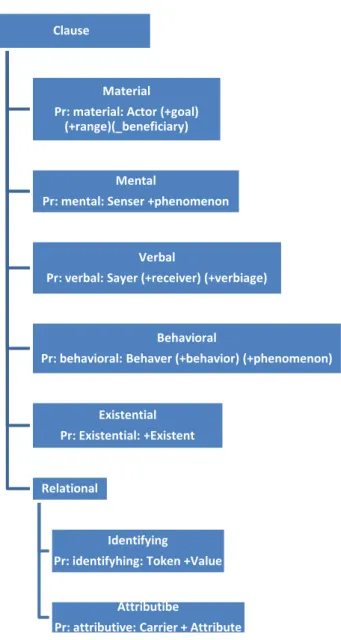
There are two systems: process type system and circumstantial type system. The choice of process involves a particular configuration of participant roles. The choice of a material process involves choosing the associated roles of an actor (obligatory), and optional elements such as goal, range or beneficiary whereas the choice of mental process involves roles such as senser and phenomenon. In this way we have to describe differences between process types and the associated differences in functional participant roles and the possible selection of circumstances. Moreover, to analyze the transitivity structure in a clause, we have to pay attention to three aspects of the clause. First, the process choice is realized in the verbal groups of the clause, i.e. Last year Maria gave
Clause
Material
Pr: material: Actor (+goal) (+range)(_beneficiary)
Mental
Pr: mental: Senser +phenomenon
Verbal
Pr: verbal: Sayer (+receiver) (+verbiage)
Behavioral
Pr: behavioral: Behaver (+behavior) (+phenomenon)
Existential Pr: Existential: +Existent
Relational
Identifying
Pr: identifyhing: Token +Value
Attributibe
78 Journal of English Language, Literature, and Teaching
blood. Second, participants is realized in the nominal groups, i.e. Last year Maria gave blood. Third, the circumstantial meanings are realized through adverbial groups or prepositional phrase, i.e. Last year Maria gave blood.
F. Research Methodology 1. Research Approach
This research is a research and development. Research and development (R&D) is also recognized in Europe as research and technical (or technological) development (RTD), which is a broad term for activities related to the enterprise of corporate or governmental innovation. The activities classified as R&D vary from company to company, but there are two primary models, with an R&D department being either staffed by engineers and tasked with directly developing new products, or staffed with industrial scientists and tasked with applied research in scientific or technological fields which may assist future product development. R&D differs from the vast majority of corporate activities in that it is not often intended to make immediate profit, and generally carries greater risk and an uncertain return on investment.
2. Time and Place
This research was conducted in the academic year of 2014/2015. It will be conducted in some classes: TBI 3A, TBI 3B, TBI 3C of the English Department of IAIN Walisongo Semarang in the academic year 2014/2015 as it has the subject of Discourse Analysis in daviqr.com.
3. Population and Sample a. Population
The population is all third-semester English department students of the Faculty of Teachers' Training and Education, IAIN Walisongo Semarang that takes the subject of Discourse Analysis in the academic year of 2014/2015, which consists of three classes. The number of population is 90 students.
Journal of English Language, Literature, and Teaching 79 b. Sample
As the number of the population is 90, the purposive sampling is used. The sampled participants will be chosen from those, who participate actively in online questionnaires of daviqr.com. Those answering the instruments are only those involved in the questionnaires.
4. Research Instruments
Research is systematic investigation to answer problems. Tuckman (1978, p.1) stated that “research is a systematic attempt to provide answers to questions”. To answer research questions needs research design. Research design is to decide what the research purposes and questions are. Sharan B. Merriam explained that a research design is to assembling, organizing, and integrating information or data and it turns out in a specific way. Nevertheless, Marshall and Rossman (1999, p. 45) called research design as research method. The research design is descriptive. I describe speech functions, responses and move types on the lecturers’ scaffolding talks in the English department classes of IAIN Walisongo Semarang. As qualitative research occurs in the natural setting, I need to go to the site to investigate the situation. Creswell (2003, p. 181) claimed that “qualitatative research takes place in the natural setting. Besides, qualitative research uses interactive and humanistic methods. The involvement of participants is looked for as the methods of data collection are growing.
a. Survey
Survey could be regarded as the method of data collection by asking some questions in writing to the selected participants. The survey was made in according to two types of questions: closed and open questions. There were 78 students participating in the survey or questionnaires.
b. Documentation
Documentation refers to the method where the researcher investigates written object such as student attendance, online reading materials, online discussion forum, scores of quiz and assignment, etc (Akurikunto, p. 158). c. Observation
80 Journal of English Language, Literature, and Teaching
Observation is carried out in the face-to-face classroom and online classroom.
5. Data Collection
Each of the three data collection such as survey, observation and documentation produced different kinds of data. The type of data in the survey was collected through the online survey at http://daviqr.com/. The observation covered the students' participation in the online discussion forum, reading materials and quiz or assignment. The documentation included student attendance in the online and offline class, scores of quizzes and assignments and reading materials of each session.
6. Data Analysis
The survey with closed questions was analyzed based on the percentage. Open questions on the survey, similar to interview in nature, was analyzed in a more detail description. After that, the documentation including the reading materials, scores of quiz, online discussion forum was discussed as well. The documentation completed the data. Afterwards, the analysis of observation was described.
G. Research Findings
1. Creation and development of Lesson and Forum module in Moodle 3.0 of http://daviqr.com in the subject of Discourse Analysis in the Faculty of Teachers Training and Education UIN Walisongo Semarang
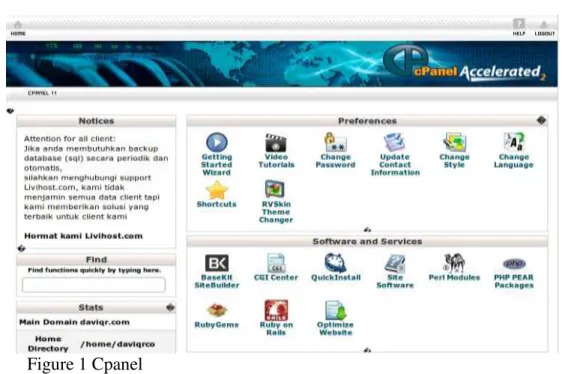
After the domain of daviqr.com was bought, the Moodle was installed in http:/daviqr.com/cpanel. The illustration is shown below. After entering the cpanel, there is a term called Software and Services. The quickinstall must be chosen as it has the software of Moodle.
Journal of English Language, Literature, and Teaching 81 Figure 1 Cpanel
Once e-learning is chosen in /cpanel, Moodle must be chosen as well. After that, click Install Moodle as the illustration below.
Figure 2 Installing Moodle
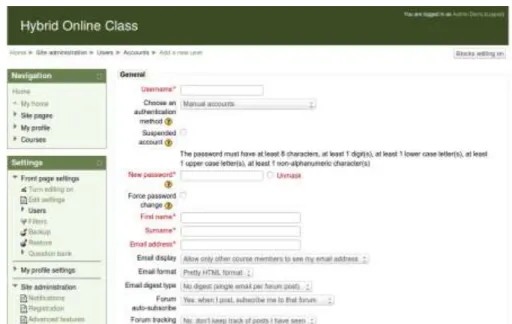
After the Moodle was installed, a new user can be created. Creating a new user is simple by creating a new user accounts in Settings > Site administration > Users > Accounts > Add a new user.
82 Journal of English Language, Literature, and Teaching
Figure 3 Creating username and password for participants
To create a username is quite simple.The user will use this username to log in to the Moodle instance. It needs to be unique. This may be changed. A user's name can only contain alphabetical letters in lowercase, numbers, hyphen '-', underscore '_', period '.', or an at character '@' - unless you enable 'Allow extended characters in usernames'.
Authentication method must be used to check whether the user's specified password is correct. Accounts created by an administrator use the Manual Accounts method, and accounts created by the users themselves using the email sign-up method use the E-mail based self-registration method.
Password creation is subject to the password policy in Site policies. A user can change their password by the Settings block > My Profile settings > Change password link.
After that, First Name must be filled out. The user's first name is displayed along with the last name in messages, forum posts, participants list, reports and anywhere where something about the user is shows on the page. In Surname, the user's surname is displayed along with the first name in messages, forum posts, participants list, reports and anywhere where something about the user is shows on the page.
In Email address, password reset notices, forum digests and other messages are sent to this email address from the Moodle site. In Email display, this setting controls that can see the user's email address. In Email format, this setting can be
Journal of English Language, Literature, and Teaching 83 used such that Moodle will send text-only emails to the user. In Email digest type, this setting set whether the user will receive an email for each new forum post in subscribed forums, or if new posts should be sent once per day in a digest, and which type of digest. No digest (one receives individual emails), Complete (a single digest daily) or Subjects (a single digest daily with only the post topics included).
In Forum auto-subscribe, If a user subscribes to a forum, new posts will be sent in the digest as specified. This setting sets whether a user is automatically subscribed to forums or if a manual click on the subscription button in each forum is required. In User Picture, the user's picture can be displayed next to the user's name next to any content he/she has posted in Moodle activities such as the forum. See User pictures for details.
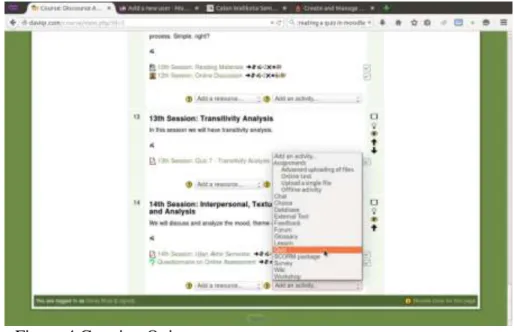
After usernames were created, the quizzes or other tests must be created, too. To create a quiz, first create the quiz shell, then add questions to the shell, either creating them as you go or using existing questions in the course question bank.On the Moodle course home page, in the relevant section, click Add an activity, select Quiz from the drop-down list and click Add.
Figure 4 Creating Quiz
On the Adding a new Quiz page, click Expand all at the upper right of the page. Next, in the General section, enter a Name, and an introductory Description if necessary.
84 Journal of English Language, Literature, and Teaching
close the quiz. Enable and set a Time limit, if using. Select the appropriate option for When time expires. If you are allowing a grace period, Enable and nominate a Submission grace period.
Figure 5 Creating Instruction of Quiz
2. Implementation of Lesson and Forum module in Moodle 3.0 http://daviqr.com towards students of English Department in the Faculty of Teachers Training and Education UIN Walisongo Semarang
Although there were 72 students, who participated in the hybrid online class, there were 72 students, who actively joined the hybrid online course. Most students have already completed online courses before this course.
Just over half of the participants said that the challenges of the online quizzes in http://daviqr.com were average, compared to other college quizzes whereas none of the participants said that the challenges of the online quizzes in http://daviqr.com were much lower, compared to other college quizzes. However, over half of the participants said that the challenges of the online quizzes in http://daviqr.com were average, compared to other college quizzes.
Moreover, the participants already joined online courses, compared to less than one tenth, who said that this is their first time participating in online courses. They agreed that the academic unit of FITK should be very committed to the online assessment. They agree that the Center of Information and Data, UIN Walisongo
Journal of English Language, Literature, and Teaching 85 Semarang must provide e-learning and online assessment. Besides, access to online assessment of http://daviqr.com was very good. Also, the quizzes in the lesson modules of http://daviqr.com often helped them to develop their knowledge and skills in the subject of Discourse Analysis. Moreover, they often joined online discussions in http://daviqr.com in the subject of Discourse Analysis. Besides, the quizzes in http://daviqr.com often helped them to know what they need. Also, they often opened the answer keys of the quizzes in http://daviqr.com. At the same time, the answer keys of the quizzes were very helpful to their learning. In terms of the relationship between quizzes and learning materials, the participants said that the relationship between the two was above average and excellent. Besides, appropriateness of learning modules (learning materials, teacher presentation in the classroom, etc) to the nature of online discussion was above average or excellent. Also, their overall evaluation of the online discussions in http://daviqr.com is good or excellent. Moreover, their overall evaluation of the learning materials in http://daviqr.com is good or excellent. To our surprise, the availability of necessary online resources in http://daviqr.com was excellent or above average. The most interesting fact described from this survey is that the participants admitted that they often cheat their friends’ work during online assessment in http:/daviqr.com. Besides, the duration of the quizzes should be very short. Interestingly, online learning materials in the learning module were better than printed materials in the classroom. Also, the participants admitted that the challenges of the online quizzes in http:/daviqr.com were average, compared to other college quizzes. Besides, the amount of effort required to succeed in this online quizzes was average, compared to other college quizzes. Also the participants said that the challenges of the online quizzes in http://daviqr.com were average, compared to other college quizzes.
3. English Department Students’ Responses towards the implementation of
Lesson and Forum module in Moodle 3.0 http://daviqr.com in the subject of Discourse Analysis in the English Department in the Faculty of Teachers Training and Education UIN Walisongo Semarang
86 Journal of English Language, Literature, and Teaching
waste any paper at all. They can share their opinions with their friends on the forum. Also, they can discuss the materials in the classroom with their friends in the online discussion forum although they do not have time to have face-to-face interaction.
Students are interested in online quizzes because they can compete with their friends in terms of scores or grades. Besides, they can study very hard to compete and they think it is a very challenging activity. Although the duration is short for the quizzes, they try hard to answer them.
Students are not really interested in online reading materials. First, they do not have time to stay in front of computer too much. Second, the reading materials are sometimes unavailable. Third, they need to have internet access to read them. Online reading materials, to students, are completed and innovative although they like printed materials due to comfort.
Students think that the idea of learning modules consisting of reading materials and forum module can be implemented to other lecturers as well. They argue that lecturers do not only teach and give materials in the classroom, but they can also let students learn more materials online and make the relationship between lecturers and students more intense and close.
Finally students suggest that the hybrid online course should be simple and easy. Besides, the internet access should be available in campus. Also, the lecturer should upload all materials in the online course. Moreover, they want more duration for quizzes and also they want punishment and reward strategies for the hybrid online course.
H. Conclusion
Once the domain of daviqr.com and hosting were ready, the hosting must be installed with Moodle. After that, the user creation should be done. Lesson and forum modules were created for the hybrid online course.
In terms of the participation of hybrid online course, most participants already joined online courses, compared to less than one tenth, who said that this is their first time participating in online courses. For the betterment the academic unit of FITK should be very committed to the online assessment and the Center of Information and Data, UIN Walisongo Semarang must provide e-learning and online assessment. Besides, access to online assessment of http://daviqr.com was
Journal of English Language, Literature, and Teaching 87 very good. Also, the quizzes in the lesson modules of http://daviqr.com often helped them to develop their knowledge and skills in the subject of Discourse Analysis. Moreover, they often joined online discussions in http://daviqr.com in the subject of Discourse Analysis. Besides, the quizzes in http://daviqr.com often helped them to know what they need. Also, they often opened the answer keys of the quizzes in http://daviqr.com. At the same time, the answer keys of the quizzes were very helpful to their learning. In terms of the relationship between quizzes and learning materials, the participants said that the relationship between the two was above average and excellent. Besides, appropriateness of learning modules (learning materials, teacher presentation in the classroom, etc) to the nature of online discussion was above average or excellent. Also, their overall evaluation of the online discussions in http://daviqr.com is good or excellent. Moreover, their overall evaluation of the learning materials in http://daviqr.com is good or excellent. To our surprise, the availability of necessary online resources in http://daviqr.com was excellent or above average. The most interesting fact described from this survey is that the participants admitted that they often cheat their friends’ work during online assessment in http:/daviqr.com. Besides, the duration of the quizzes should be very short. Interestingly, online learning materials in the learning module were better than printed materials in the classroom. Also, the participants admitted that the challenges of the online quizzes in http:/daviqr.com were average, compared to other college quizzes. Besides, the amount of effort required to succeed in this online quizzes was average, compared to other college quizzes. Also the participants said that the challenges of the online quizzes in http://daviqr.com were average, compared to other college quizzes.
In terms of students’ responses, students are very interested with online discussion forums because they do not waste any paper at all. They can share their opinions with their friends on the forum. Also, they can discuss the materials in the classroom with their friends in the online discussion forum although they do not have time to have face-to-face interaction.
Students are interested with online quizzes because they can compete with their friends in terms of scores or grades. Besides, they can study very hard to compete and they think it is a very challenging activity. Although the duration is short for the
88 Journal of English Language, Literature, and Teaching quizzes, they try hard to answer them.
Students are not really interested with online reading materials. First, they do not have time to stay in front of computer too much. Second, the reading materials are sometimes unavailable. Third, they need to have internet access to read them. Online reading materials, to students, are completed and innovative although they like printed materials due to comfort.
Students think that the idea of learning modules consisting of reading materials and forum module can be implemented to other lecturers as well. They argue that lecturers do not only teach and give materials in the classroom, but they can also let students learn more materials online and make the relationship between lecturers and students more intense and close.
Finally students suggest that the hybrid online course should be simple and easy. Besides, the internet access should be available in campus. Also, the lecturer should upload all materials in the online course. Moreover, they want more duration for quizzes and also they want punishment and reward strategies for the hybrid online course.
References
Addision, Wesley. 2001. Teaching by Principle: An Interactive Approach to Language Pedagogy. New York:Longman
Anderson, Mark & Kathy Anderson. 2003. Text Types in English 1-2. Australia: Macmillan Education
Araisa, W.P. & Russel, K. M. 2008. Classroom Assessment: Concept and Application. Singapore: McGraw-Hill Company
Araisa, W.P. & Russel, K. M. 2008. Classroom Assessment: Concept and Application. Singapore: McGraw-Hill Company
Bonk, C.J, Kim, K.J & Zeng, T. 2005. Future Directions of Blended Learning in Higher Education and Workplace Settings. San Fransisco: Pfeiffer Publishing
Brown, H.D. 2004, Language Assessment: Principles and Practices. New York: Longman
Journal of English Language, Literature, and Teaching 89 Caladine, Richard. 2008. Enhancing blended learning with Media-Rich Content and
Interactions. New York: Information Science Publishing
Cameron, Lynne. 2001. Teaching Language to Young Learners. Cambridge: Cambridge
Chapelle, Carol A. 2003. English Language Learning and Technology. Amsterdam: John Benjamins Publishing Company
Cole, Jason & Foster, Helen. 2008. Using Moodle: Teaching with the Popular Open Source Course Management System (2nd Edition). USA: O’Reilly Media, Inc
Cole, Jason & Foster, Helen. 2008. Using Moodle: Teaching with the Popular Open Source Course Management System (2nd Edition). USA: O’Reilly Media,
Inc
Dikmenli, Yurdal and Unaldi UE. 2013. The Effect of the Blended Learning Environment and the Application of Virtual Class upon the Achievement and the Attitude against the Geography Course in Mevlana International Journal of Education Vol. 3 (2), 1 August 2013, Available online at http://mije.mevlana.edu.tr/
Federal Public Law 107-110 http://ok.gov/sde/sites/ok.gov.sde/files/Bilingual-DefLEP.pdf
Fraenkle, Jack R. and Norman E. Wallen. 2006. How to Design and Evaluate Research in Education 6th Ed. New York: The McGraw-Hill Companies Garrison, D Randy and Vaughan, Norman D. 2008. Blended Learning in Higher
Education: Framework, Principles and Guidelines. California: Jossey-Bass Graham, Charles R. 2008. Blended Learning Models. Available from http://ebooks.narotama.ac.id/files/Encyclopedia%20of%20Information%20 Science%20and%20Technology%20%282nd%20Edition%29/Blended%20 Learning%20Models.pdf
Grellet, Frangoise. 2001. Developing Reading Skills, UK: Cambridge University Press
Halliday and Matthiessen. 2004. An Introduction of Functional Grammar. London: Oxford University Press
Harmer. 2001. The Practice of English Language Teaching Longman Handbooks for Language Teacher, London: Longman Ninth Impression,
90 Journal of English Language, Literature, and Teaching
Helena Agustien, 2008. Competence, Process, and Assessment Standards available from aguswuryanto.files.wordpress.com/2008/09/helena-standards.ppt Hennings, Dorothy Grant. 1999. Reading with Meaning Strategies for College
Reading. USA: Prentice Hall
Hughes, A. 2003. Testing for Language Teacher: Second Edition. London: Cambridge University Press.
J. B. Heaton. 1975. Writing English Language Test. London: Longman King, Kathleen P. 2009. Blended Learning. USA:Fordham University
Kotzer1, Shulamitand Yossi Elran2. 2006. ‘”1st Moodle Research Conference Heraklion, Crete-Greece, September, 14 - 15, 2012” Davidson Institute of Science Education, Weizmann Institute of Science, Rehovot: Israel in
“Digital Literacies for Learning” by Allan Martin (Editor) and Dan Madigan (Editor), Facet Publishing
Littlejohn, Allison and Pegler, Chris. 2007. Preparing for Blended e-Learning. USA: Routledge
Omaggio, Alice C. 1986. Teaching Language in Context. Massachusetts: Heinle &Heinle Publisher
Rice IV, William H. 2006. Moodle blended learning Course Development. Mumbai : Packt Publishing
Rice IV, William H.2006. Moodle: E-Learning Course Development. UK: Packt Publishing
Richards, Jack C. 2008. Teaching Listening and Speaking: From Theory to Practice. USA: Cambridge University Press
Sandra Fotos and Charles M. Browne. 2004. New Prespectives on CALL for Second Language Classrooms. London: Lawrence Erlabaum Associates
Scovel, Thomas. 2009. Psycholinguistics,New York: Oxford University Press Sharifi, Farzad an (Ed). 2009. English as an International Language Perspectives
and Pedagogical Issues. Canada: Multilingual Matters
Smaldino, Sharon E. et al. 2012. Instructional Technology and Media for earning.Boston: Pearson education, Inc
Stanford, Jeff. 2009. Moodle 1.9 for Second Language Teaching. Mumbai: PACKT Publishing
Journal of English Language, Literature, and Teaching 91 Thorne, Kaye. 2003. Blended Learning: How to Integrate Online and Traditional
Learning. USA: Kogan Page Limited
Tuckman, B.C. 1978. Conducting Educational Research (Second Edition). USA: Harcourt Brace Jovanovich, Inc.
Vaughan, Norman. 2007. Perspective on Blended Learning in Higher Education in International Journal on Elearning. ProQuest
Wilson, Diann and Smilanich, Ellen. 2005. The Other Blended Learning: A Classroom-Centered Approach. California: Pfeiffer