ORIGINAL ARTICLE
Simple and Task-oriented Mirror Therapy for
Upper Extremity Function in Stroke Patients:
A Pilot Study
Young-Rim Paik
a,*, Su-Kyoung Kim
a,b, Jae-Shin Lee
a,b,
Byoung-Jin Jeon
ca
Department of Occupational Therapy, The Graduate School of Public Health and Welfare, Konyang University, Daejeon, Republic of Korea
b
Department of Occupational Therapy, The Konyang University, Daejeon, Republic of Korea c
Department of Occupational Therapy, Kangwon National University, Kangwon, Republic of Korea
Received 30 May 2013; received in revised form 20 November 2013; accepted 10 January 2014
Available online 31 March 2014
KEYWORDS mirror neuron; mirror therapy; stroke; task-oriented approach
Summary Objective/Background:To compare the effects of simple and task-oriented mirror therapies on upper extremity function in stroke patients with hemiplegia.
Methods:A single-subject, reversal (applied behaviour analysis) research design was used, and the study included four patients and two treatments. Treatment 1 involved simple mirror ther-apy that was performed using simple upper limb movements. Treatment 2 involved task-oriented mirror therapy that required each patient to perform functional movements associ-ated with the tasks of daily living. Changes in upper extremity function were assessed during 23 sessions using box and block test, cube carry, and card turning tests. The Fugl-Meyer Assess-ment of upper extremity function was also performed.
Results:The upper extremity function of all patients increased after mirror therapy. However, the improved upper extremity function of the patients undergoing simple mirror therapy was not maintained after the conclusion of the therapy. By contrast, the improved upper extremity function of the patients receiving task-oriented mirror therapy continued to improve, even af-ter therapy cessation.
Conclusion:Task-oriented mirror therapy in stroke patients provided more effective improve-ment in the upper extremity function of the hemiplegic stroke victims.
Copyrightª2014, Elsevier (Singapore) Pte. Ltd. All rights reserved.
Conflicts of interest: All contributing authors declare no conflicts of interest.
* Corresponding author. Department of Occupational Therapy, The Graduate School of Public Health and Welfare, Konyang University, Gasuwon-dong, Seo-gu, Daejeon 302-718, Republic of Korea.
E-mail address:[email protected](Y.-R. Paik). http://dx.doi.org/10.1016/j.hkjot.2014.01.002
1569-1861/Copyrightª2014, Elsevier (Singapore) Pte. Ltd. All rights reserved.
Available online atwww.sciencedirect.com
ScienceDirect
Introduction
Recovery of upper extremity function proceeds most rapidly during the initial 3 months after the stroke, but typically slows after 6 months and reaches a neurological recovery plateau by the end of the 1st year. Even among stroke victims whose neurocognitive function was improved, 55e80% of the victims continued to exhibit upper
extremity disorders (Nakayama, Jørgensen, Raaschou, &
Olsen, 1994). Upper extremity disorders after stroke can
result from weakened or stiff muscles, imbalance, hyper-tonia, and sensory disturbances (Gracies et al., 2000). Because upper extremity tasks, such as reaching, grasping, manipulating, and carrying, require coordination of multi-ple joints and muscles, recovery of each joint function is necessary before full function is restored. The recovery of proximal joint (shoulder and elbow) function often pro-ceeds at a faster rate than that of the distal joints (wrist and hands; Cauraugh, Light, Kim, Thigpen, & Behrmann, 2000). Accordingly, even when patients have regained strength and coordination in their shoulder and elbow joints, the functions of their fingers and hands often have not recovered, which continue to limit the activities of daily living (ADLs; e.g., eating, dressing oneself, and self-management; Cooper, Glendinning, & Vierck, 1993). Therefore, recovery of finger and hand dexterity is a crit-ical component of rehabilitation in chronic hemiplegia pa-tients (Cauraugh et al., 2000).
A relatively simple and cost-effective approach for improving upper extremity function, known as mirror therapy, has shown promise in the treatment of patients with hemiplegia (Stevens & Stoykov, 2003). This type of therapy is based on the principle that visual stimuli, conveyed to the brain through observation of the unaf-fected body part movements, can improve the function of the affected limb. In other words, mirror therapy is a comparative treatment method aimed at improving the function of the affected side by having the patient focus on the movements of the unaffected side (Stevens & Stoykov, 2003). Mirror therapy is an attractive treatment option for clinical practice because it is simple to implement, rela-tively inexpensive, less intimidating for patients, and often equally or more effective than many alternative treatments
(Su¨tbeyaz, Yavuzer, Sezer, & Koseoglu, 2007).
Many recent studies have reported improved limb func-tional improvements after mirror therapy (Toh & Fong,
2013). Yavuzer et al. (2008) found that motor skills
related to hand function were improved more by mirror therapy than by sham therapy in a random crossover study of 36 acute stroke patients. In another study,Stevens and
Stoykov (2003), using the Fugl-Meyer Assessment (FMA),
reported that the active range of motion, speed of move-ment, and hand dexterity increased for two stroke pa-tients, 3e4 weeks after the implementation of mirror
therapy. Similarly, Altschuler et al. (1999) observed that upper extremity function (range of motion, speed of movement, and accuracy) was improved in chronic stroke patients who received mirror therapy.Sathian, Greenspan,
and Wolf (2000)also concluded that mirror therapy
effec-tively increased upper extremity movement and hand strength on the affected side of chronic stroke patients.
However, not all mirror therapy studies involving stroke victims have yielded such encouraging results.Baek (2009)
observed that the positive effects of mirror therapy decreased over time, and that mirror therapy involving the repetition of simple movements produced improvements during the first 4 weeks of treatment, but were followed by a gradual decrease in function as the patients became bored with the movements and began resisting therapy. Based on this observation, mirror therapy programmes that incorporate a variety of functional tasks were proposed to be more effective than those involving only simple move-ments designed to mimic tasks.Yoo (2010) also suggested the use of more functional and task-oriented programmes because simple movements restrict the functional recovery of more complicated movements performed using the upper extremity. This suggestion was also supported byWu,
Trombly, Lin, and Tickle-Degnen (2000)in a task-oriented
exercise programme that involved picking up a coin. These authors observed that treatment was more effective when an actual coin was used rather than when the same motion was performed without a coin.
Although mirror therapy has been shown to improve motor function in stroke patients, differences in study de-signs and tasks have yielded discrepancies in the observed results. Furthermore, studies investigating the use of mirror therapy have compared the results with a control group (individuals not receiving mirror therapy;Baek, 2009), but studies comparing simple and task-oriented mirror thera-pies are lacking. Therefore, this study aimed to compare the effects of simple mirror therapy, involving both simple and task-oriented movements, on the recovery of upper extremity function in hemiplegic stroke patients.
Methods
Patients
The purpose and methods of this study were explained to the four patients, and their written consent was obtained before beginning the study. The study adhered to the principles outlined in the Declaration of Helsinki.
The characteristics of the study patients are shown in
Table 1. The level of ADL function of all the patients
indi-cated that they required mild assistance. With regard to bowel and bladder control, mobility, and getting in and out of bed or chairs, they met the criteria for independent functioning. The patients also met five additional criteria, including the following: (a) they had suffered a stroke more than 6 months before the study; (b) they suffered from chronic hemiplegia, with a slow rate of recovery extending over a period >6 months; (c) their cognition was not compromised and they scored more than 24 on the Mini-Mental State Examination-Korea; and (d) they had no pre-vious exposure to mirror therapy and had normal visual perception.
Intervention
The study patients performed either simple or task-oriented mirror therapy. The mirrors used for therapy
were 3040 cm2and were vertically positioned. For
sim-ple mirror therapy, the patients were asked to conduct five different movements: (a) forearm pronation and supina-tion, (b) wrist flexion and extension, (c) finger flexion and extension, (d) finger numbering, and (e) opposition. These movements were conducted, in order, using the unaffected side, and each movement was repeated 10 times. For task-oriented mirror therapy, the patients were asked to perform ADL movements (grasping and releasing balls, pinching tongs, using a spray bottle, kneading putty, pinching coins, using a spoon, lifting a heavy can, and wiping a table with a towel). Upper extremity function was assessed in all patients using three operational tasks [box block test (BBT), cube carry test, and card turning test]. The patients were asked to perform these in a random order and in the manner they would employ them during a normal daily life (Fig. 1).
Assessment tools
Motor function measurements
Only the upper extremity subtest categories of the FMA were used to assess functional changes in the upper ex-tremities of the patients undergoing mirror therapy. The FMA tool classifies the functional recovery of hemiplegic stroke patients, according to the Brunnstrom recovery process (Trombly & Radomski, 2002), using 50 defined
movements according to the six Brunnstrom recovery pha-ses. The assessment was developed as a tool to evaluate physical functioning (Fugl-Meyer, Jaasko, Leyman, Olsson, & Steglinds, 1975).
Hand function measurements
The BBT was the tool used to measure the changes in hand manipulation recovery at each session. The test involves moving 2.54-cm (1-in.) cubes from one box to another, and is graded based on the number of blocks moved in 1 minute, using each hand (Trombly & Radomski, 2002). The cube carry test, a subtest of the Manual Function Test (MFT), was used to check each patient’s reaching and movement functions at each session. The MFT was developed at the North East (Japan) University to measure upper extremity function and movement in hemiplegic stroke patients. The card turning test is a subtest of the JebseneTaylor Hand
Function Test, and simultaneously measures finger move-ments and forearm pronation/supination. In this study, the test was used to check the upper extremity movement speed for each patient at each session.
Procedure and data analysis
The study used a single-subject, reversal (applied behav-iour analysis) research design, with a total of 23 experi-mental sessions. The sessions were divided into three phases, namely, Baseline 1, intervention, and Baseline 2. During each phase, the patients underwent additional rehabilitation, including regular physical and occupational therapies, and upper extremity function was assessed using three separate testsdthe BBT, cube carry test, and card
turning testdadministered in a random order.
During Baseline 1, the patients did not receive mirror therapy, but the function of the upper extremities was determined, daily, for each treatment for three sessions. The FMA results of the affected upper extremities were also evaluated for each patient before and after Baseline 1. The intervention phase of the study comprised 15 sessions, each occurring daily and lasting for 30 minutes. During this phase, two patients (Patients 1 and 2) received Treatment 1 (simple mirror therapy) and two (Patients 3 and 4) received task-oriented mirror therapy, which involved ADL tasks. During Baseline 2, the upper extremity function of each patient was measured at each of the five sessions. Consis-tent with Baseline 1, patients did not receive mirror
Table 1 Patient Characteristics.
Treatment Patient Sex Age (y) Lesion area Affected side Time since stroke (mo) MMSE-Ka MBIb
Treatment 1c 1 M 38 ICA infarction Right 17 28 88
2 M 60 Multiple infarction Left 55 29 88 Treatment 2d 3 F 43 Haemorrhage in the putamen Left 22 30 90 4 M 39 MCA infarction Right 29 28 88
ICAZinternal carotid artery; MCAZmiddle carotid artery. a Total score of Mini-Mental State Examination-Korea (MMSE-K). b Total score of Modified Barthel Index (MBI).
c Treatment 1: simple mirror therapy. d Treatment 2: task-oriented mirror therapy.
Figure 1 Examples of simple and task-oriented mirror ther-apy. (A) A patient performing a simple mirror therapy move-ment (finger counting). (B) A patient performing an activity of daily living (using a spray bottle) during task-oriented mirror therapy.
therapy, and FMA upper extremity examinations were conducted before and after the five Baseline 2 sessions. We created visual graphs and calculated the average and standard deviation values to describe the functional changes in each patient’s upper extremities.
Results
BBT
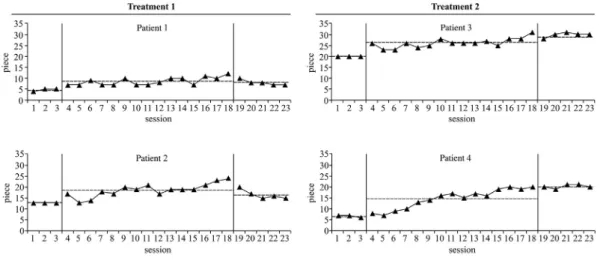
The average BBT scores for Patients 1 and 2, during Baseline 1, were 4.66 and 13.00, respectively. However, these av-erages increased to 8.60 and 18.73 during the intervention phase, but fell slightly to 8.00 and 16.60 during Baseline 2. By contrast, the average scores of Patients 3 and 4 (those receiving task-oriented mirror therapy), during Baseline 1, were 20.00 and 6.66, respectively. The scores increased to 26.13 and 14.66 during the intervention phase, and continued to improve to 29.80 and 20.20, during Baseline 2
(Fig. 2).
Cube carry test
During Baseline 1, both Patients 1 and 2 achieved average scores of 1.00. However, during the intervention phase, these averages increased to 2.20 and 2.53, respectively, before falling slightly to 2.00 and 2.20, during Baseline 2. Again, the average scores of Patients 3 and 4 increased throughout the study. Their average scores at Baseline 1 were 1.00 and 0.00, respectively, and rose to 4.26 and 2.06 after the intervention phase. Their scores continued to increase, reaching 5.00 and 2.60, during Baseline 2 (Fig. 3).
Card turning test
Patients 1 and 2 demonstrated average times of 57.67 and 49.57 seconds, respectively, during Baseline 1. The inter-vention phase reduced these averages to 21.86 and 25.46 seconds, but the average speeds increased during Baseline
2 to 24.57 and 26.44 seconds, respectively, compared with that during the intervention phase. For Patients 3 and 4, the average times during Baseline 1 were 37.85 and 53.37 seconds, respectively. Task-oriented mirror therapy reduced these times to 13.40 and 32.39 seconds, and the times continued to decline, reaching 10.03 and 19.40 sec-onds, during Baseline 2 (Fig. 4).
Upper extremity FMA
The FMA scores indicated that the test patients experi-enced improved upper extremity functioning during the study. Between the initial and final FMA scores, the average score for Treatment 1 patients increased by 14 points, whereas that for the Treatment 2 patients improved by 20.5 points (Fig. 5).
Discussion
Mirror therapy is a treatment method that relies on a pa-tient’s observation of their own movements to visually trigger functional recovery of an affected limb (Su¨tbeyaz
et al., 2007). Although mirror therapy is effective at
improving upper extremity function, relative to control patients (individuals not receiving mirror therapy;Yavuzer
et al., 2008), comparisons between the different mirror
therapy methods are lacking. The present study demon-strated that both simple and task-oriented mirror therapies were effective in helping to restore upper extremity func-tion in stroke patients with chronic hemiplegia. However, patients receiving only 15 sessions of task-oriented mirror therapy continued to improve even after the therapy was stopped, whereas the benefit of simple mirror therapy began to decline.
The improvements in upper limb function observed here are similar to those observed in other studies.Stevens and
Stoykov (2003)reported a 33% improvement in upper
ex-tremity function, based on FMA in two chronic stroke pa-tients receiving combined treatment involving imagination,
Figure 2 The results of the box block test (BBT) for Treatments 1 and 2. For Treatment 1 patients, simple mirror therapy improved upper extremity function, with a slight reduction in BBT score during Baseline 2. However, for Treatment 2 patients, improvements in upper extremity function were seen during the task-oriented mirror therapy and were maintained or further improved during Baseline 2.
movement training, and mirror therapy. In this study, the upper extremity function of stroke patients improved by an average of 21% in patients receiving simple mirror therapy and 31% in patients receiving task-oriented mirror therapy. These results support the conclusions of Stevens and
Stoykov (2003)that observation of normal movement
pro-vides positive visual feedback and improves the function of the affected limb without it actually being moved. Normal movement is thought to be induced as a result of activating the premotor cortex by recalling the proprioception (indi-vidual perception) that was reduced or removed when normal visual feedback was provided.
Lee (2010) used FMA upper extremity assessments to
evaluate the effects of 10 mirror therapy exercises on different parts of the affected upper extremity and
determined that, with the exception of upper extremity coordination, the functions of the shoulder, elbow, fore-arm, wrist, and hand were improved. The present study methods focused on the movement of the distal joints (the hand) of the affected limb rather than the movement of the proximal joints. However, the FMA upper extremity test results demonstrated that mirror therapy also improved the function of the shoulder, elbow, and forearm, in addition to the function of the hand joints. Because of the nature of stroke recovery, the distal joint recovery speed is slower than that of the proximal joint, even when mirror therapy is thought to be focused on the distal joints.
Yoo (2010) suggested that functional improvements in
complex movements are limited if the therapy is focused only on simple movements, such as pronation/supination
Figure 3 The results of the cube carry test for Treatments 1 and 2. In Treatment 1 patients, simple mirror therapy improved the patient’s ability to reach and move the upper extremity, but the score was reduced during Baseline 2. However, for Treatment 2 patients, task-oriented mirror therapy improved the ability to reach and move the upper extremity and this improvement was maintained or increased further during Baseline 2.
Figure 4 The results of the card turning test for Treatments 1 and 2. For Treatment 1 patients, upper extremity movement speed was increased during the simple mirror therapy intervention, but decreased during Baseline 2. However, for Treatment 2 patients, task-oriented mirror therapy increased the speed of upper extremity movement during the intervention phase and this speed was further increased during Baseline 2.
and wrist or finger flexion/extension. The present study results support that conclusion. Here, we observed im-provements in upper extremity function with the applica-tion of simple mirror therapy, but this improvement did not persist through Baseline 2. By contrast, patients receiving task-oriented mirror therapy demonstrated sustained improvement in upper extremity function.
The performance differences between the two groups may also be explained by boredom and the patient’s resistance to therapy during simple mirror therapy. Baek
(2009) determined that treatment effects were reduced
when patients were required to repeat the same simple motions. He observed that, during the first few weeks of his experiment, the therapy had a positive effect as patients concentrated on accomplishing the movements. Over time, the patients became bored with the simple movements and began to resist treatment. In our study, patients receiving simple mirror therapy also lost focus and complained of boredom, whereas the patients receiving task-oriented mirror therapy generally maintained their concentration throughout the therapy and were interested in performing the assigned tasks. Accordingly, upper extremity function (test performance) continued to improve throughout the course of the study in Treatment 2 patients, but declined during Baseline 2 in Treatment 1 patients.
Park (2006) reported that task-oriented practice by
stroke patients resulted in significant improvements in various ADL, including face washing, showering, moving, bowel and bladder control, grooming, and short distance walking. He suggested that a therapy combining a func-tional rehabilitation programme (involving task-oriented practice) with related therapies stimulates neuronal reor-ganization and is more effective than therapy that requires patients to learn only a sequence of simple movements. Task-oriented therapy can improve upper extremity
movement patterns and dexterity as well as manipulation skills (Lee, 2002). Similarly, our study showed that upper extremity functions improved more during task-oriented therapy than during simple mirror therapy. These results also support previous hypotheses suggesting that task-oriented therapy helps the systematization of motor behaviour (Trombly & Radomski, 2002) and is an efficient treatment method (Carr & Shepherd, 2003).
Because both the hands of an individual are connected in time and space (Jackson, Jackson, & Kritikos, 1999), the effect of treatment can be generalized by encouraging the proper use of both hands during task-oriented treatment
(Paik & Kim, 2010). Bilateral movement during the practice
ADL motions is known to improve certain aspects of task performance (e.g., speed, runtime, control of attitude) more than movement of only the affected side (Utley &
Sugden, 1998). Although mirror therapy does not involve
movement of the affected limb, it is thought to have a similar neurological effect and produce benefits similar to those resulting from bilateral movement. The optical illu-sion that the patient is moving the affected side is thought to activate mirror neurons (neurons that trigger when one acts or observes contralateral actions) and induces move-ment of the affected side behind the mirror. Thus, mirror therapy can improve the movement and performance of both hands even though the patient only practices tasks with the unaffected hand (Franz & Packman, 2004), as we observed.
Although this study demonstrated the benefits of task-oriented mirror therapy over simple mirror therapy for hemiplegic stroke patients, it is not without limitations. A multitude of factors may affect the recovery of upper ex-tremity function in stroke patients. Consequently, the small sample size used in this study limits our ability to make general conclusions regarding the efficacy of these methods
Figure 5 Upper extremity Fugl-Meyer Assessment (FMA) results for Treatments 1 and 2. The FMA scores indicated that upper extremity function improved for all test patients. The average scores of Treatment 1 patients increased by 14 points, whereas those of Treatment 2 patients increased by 20.5 points. Thus, task-oriented mirror therapy further improved upper extremity function, compared with simple mirror therapy.
for the rehabilitation of upper limb function. In addition, because this study lacks a follow-up survey, we do not know the long-term effect of this therapy. Future research should use a similar approach to compare the efficacy of simple and task-oriented mirror therapy, and should conduct the studies on larger populations of stroke patients. Further, future studies should also conduct follow-up assessments to determine the long-term effects of these therapies and assess their effects on ADL.
Conclusion
This study compared the effects of two interventions on the recovery of upper extremity function in stroke patients. The study confirmed that the treatment effect was main-tained in patients receiving task-oriented mirror therapy, but not in those receiving simple mirror therapy. Task-oriented mirror therapy is, therefore, proposed to be more effective than simple mirror therapy for promoting recov-ery of upper extremity function in stroke patients.
References
Altschuler, E. L., Wisdom, S. B., Stone, L., Foster, C., Galasko, D., et al. (1999). Rehabilitation of hemiparesis after stroke with a mirror.Lancet, 353, 2035e2036.
Baek, N. Y. (2009).Effects of mirror therapy on hemiplegia in the function of lower extremity. Daegu, South Korea: Department of Physical Therapy, Graduate School of Rehabilitation Science, Daegu University.
Carr, J. H., & Shepherd, R. B. (2003). Stroke rehabilitation. Newton, MA: Butterworth-Heinemann.
Cauraugh, J., Light, K., Kim, S., Thigpen, M., & Behrmann, A. (2000). Chronic motor dysfunction after stroke: recovering wrist and finger extension by electromyography-triggered neuro-muscular stimulation.Stroke, 31, 1360e1364.
Cooper, B. Y., Glendinning, D. S., & Vierck, C. J., Jr. (1993). Finger movement deficits in the stumptail macaque following lesions of the fasciculus cuneatus.Somatosensory and Motor Research, 10, 17e29.
Franz, E. A., & Packman, T. (2004). Fooling the brain into thinking it sees both hands moving enhances bimanual spatial coupling. Experimental Brain Research, 157, 174e180.
Gracies, J. M., Marosszeky, J. E., Renton, R., Sandanam, J., Gandevia, S. C., & Burke, D. (2000). Short-term effects of dy-namic lycra splints on upper limb in hemiplegic patients. Ar-chives of Physical Medicine and Rehabilitation, 81, 1547e1555.
Jackson, G. M., Jackson, S. R., & Kritikos, A. (1999). Attention for action: coordinating bimanual reach-to-grasp movements. British Journal of Psychology, 90, 247e270.
Lee, J. H. (2002).The effect of task-oriented movement therapy on upper motor function, patterns and reorganization of motor
network for stroke patients. Daegu, South Korea: Department of Rehabilitation Science Graduate School, Daegu University. Lee, M. M. (2010).Mirror therapy improves upper-extremity motor
recovery and motor function in acute stroke. Seoul, South Korea: Department of Physical Therapy Graduate School, Sah-myook University.
Nakayama, H., Jørgensen, H. S., Raaschou, H. O., & Olsen, T. S. (1994). Compensation in recovery of upper extremity function after stroke: The Copenhagen Stroke Study.Archives of Physical Medicine and Rehabilitation, 75, 852e857.
Paik, Y. R., & Kim, S. K. (2010). A task-oriented approach consisting of modified constraint-induced movement therapy (m-CIMT) and bimanual activity effects on upper extremity function and activities of daily living (ADL) in stroke patients. Journal of Korean Academy of Occupational Therapy, 18, 79e93.
Park, H. S. (2006). Effects of the group task-related program training on functional independence and quality of life for the CVA patients. Seoul, South Korea: Graduate School of Special Education, Dankook University.
Sathian, K., Greenspan, A. I., & Wolf, S. L. (2000). Doing it with mirrors: a case study of a novel approach to neuro-rehabilitation. Neurorehabilitation and Neural Repair, 14, 73e76.
Stevens, J. A., & Stoykov, M. E. (2003). Using motor imagery in the rehabilitation of hemiparesis.Archives of Physical Medicine and Rehabilitation, 84, 1090e1092.
Su¨tbeyaz, S., Yavuzer, G., Sezer, N., & Koseoglu, B. F. (2007). Mirror therapy enhances lower-extremity motor recovery and motor functioning after stroke: a randomized controlled trial. Archives of Physical Medicine and Rehabilitation, 88, 555e559.
Toh, S. F., & Fong, K. N. (2013). Systematic review on the effec-tiveness of mirror therapy in training upper limb hemiparesis after stroke. Hong Kong Journal of Occupational Therapy, 22(2), 84e95.
Trombly, C. A., & Radomski, M. V. (2002).Occupational therapy for physical dysfunction(5th ed.). Baltimore, MD: Lippincott, Wil-liams and Wilkins.
Utley, A., & Sugden, D. (1998). Interlimb coupling in children with hemiplegic cerebral palsy during reaching and grasping at speed. Developmental Medicine and Child Neurology, 40, 396e404.
Wu, C., Trombly, C. A., Lin, K., & Tickle-Degnen, L. (2000). A ki-nematic study of contextual effects on reaching performance in persons with and without stroke: influence of object availabil-ity. Archives of Physical Medicine and Rehabilitation, 81, 95e101.
Yavuzer, G., Selles, R., Sezer, N., Su¨tbeyaz, S., Bussmann, J. B., Ko¨seoglu, F., et al. (2008). Mirror therapy improves hand func-tion in subacute stroke: a randomized controlled trial.Archives of Physical Medicine and Rehabilitation, 89, 393e398.
Yoo, S. J. (2010).An effect of mirror therapy on upper extremity function and activities of daily living in patients with post-stroke hemiplegia. Daegu, South Korea: Department of Occu-pational Therapy Graduate School of Rehabilitation Science, Daegu University.