Universit
y
of Cap
e
Town
DIFFERENTIATION IN HIGHER EDUCATION:
A CASE STUDY OF LESOTHO
‘MAMTHEMBU
A minor dissertation submitted
MASTERS IN PHILOSOPHY OF EDUCATION (Educational Administration, Planning and Social Policy)
UNIVERSITY OF CAPE TOWN
DIFFERENTIATION IN HIGHER EDUCATION:
A CASE STUDY OF LESOTHO
BY
MAMTHEMBU ‘MAMOCHELE PHENDUKA
PHNMAM001
submitted in partial fulfilmentof the requirements
degree of
MASTERS IN PHILOSOPHY OF EDUCATION (Educational Administration, Planning and Social Policy)
Faculty of the Humanities
UNIVERSITY OF CAPE TOWN
Under the supervision of:
DR. JEANNE GAMBLE
FEBRUARY 2015
DIFFERENTIATION IN HIGHER EDUCATION:
MAMOCHELE PHENDUKA
of the requirements for the award of the
The copyright of this thesis vests in the author. No
quotation from it or information derived from it is to be
published without full acknowledgement of the source.
The thesis is to be used for private study or
non-commercial research purposes only.
Published by the University of Cape Town (UCT) in terms
of the non-exclusive license granted to UCT by the author.
COMPULSORY DECLARATION
This work has not been previously submitted in whole, or in part, for the award of any degree. It is my own work. Each significant contribution to, and quotation in, this dissertation from the work, or works, of other people has been attributed, and has been cited and referenced.
i
DEDICATION
To my dad, Mokhoele Ignatius Napo Rametse, you have been a great encouragement through this project. You will always have a special place in my heart. I love you daddy.
ii
ACKNOWLEDGEMENTS
Firstly, I would like to thank God Almighty for His grace and power and for providing me with strength and hope when I needed them most.
My heartfelt gratitude goes to my endlessly supportive supervisor Dr. Jeanne Gamble, for her guidance and encouragement throughout this strenuous journey. Her ability to pull together bits and pieces of so many disconnected thoughts is highly appreciated.
I would also like to thank the following individuals who supported me in different ways throughout this project:
• The Management and participants from the two institutions who made this study a success
by providing me with all the information which I needed.
• The Management of Lerotholi Polytechnic for giving me the opportunity to further my
studies and providing financial support to my family during this period.
• The Government of Lesotho through the Ministry of Education and Training as well as the
National Manpower Development Secretariat (NMDS) has financed my studies to the end, for that I am grateful.
• My mother, ‘Mamoeti Rametse, together with her children, Napo, Sebabatso, ‘Matefelo,
Kelello and Pusetso who have been my pillars of strength during hard times.
• My husband Ntaeboso Phenduka, my daughter Thandiwe and my sons Mthembu and
Wandile for all their support and understanding even though they were motherless for so long.
• My friends Lintle Mohajana, ‘Maitumeleng Mokhofu, ‘Makekeletso Sehahabane and
‘Maliapa Motseki, for the words of encouragement and psychological support.
• Gorgeous Ladies who have always been there for me.
iii
ABSTRACT
Differentiation has become a crucial policy driver in higher education systems that attempts to respond to global pressures for a highly skilled labour force, employ new technologies and adapt to unpredictable or volatile global product markets and rapid technological change. In order to be globally competitive, nations have to place knowledge production, accumulation, transfer and application at the centre of their national development strategies.
This study investigates the case of Lesotho, a relatively small African country with a colonial past that has left a lasting imprint, both enabling and constraining, on many aspects of its education system. The aim of this explanatory case study was to identify differentiating trends within Lesotho’s higher education system, focusing on two institutional types: the polytechnic and the university. These institutions were investigated at both institutional and programme level.
The research question was “How differentiated is the polytechnic-university binary division in the public sector higher education system in Lesotho?”
The sample for the study comprised two schools and two faculties at the polytechnic and the university respectively. One programme under each school or faculty was investigated.
The findings indicate that the question cannot be answered in a one-dimensional way. At institutional level, the system is vertically differentiated with a blurring of boundaries due to ‘mission stretch’ as a feature of both institutions. At programme level the polytechnic and the university are strongly differentiated in the sense that each institution directs its programmes at a distinctive labour market level. In the engineering field de-differentiation occurs in the sense that there is a labour market preparation dimension in all engineering programmes, regardless of which institution offers the programme. There is a formal articulation route between engineering programmes at the two institutions but students cannot move ‘seamlessly’ from diploma to degree, due to the strong conceptual knowledge base required in the degree programme.
The findings confirm that articulation between programmes is not only an institutional or administrative arrangement. Differences in the substantive knowledge base of types and levels of programmes need to be taken into account in policy deliberations about articulation between the various institutions that make up a country’s higher education system.
iv
ABBREVIATIONS AND ACRONYMS
ADEA Association for the Development of Education in Africa BA Bachelor of Arts
BSC Bachelor of Science
CAPA Commonwealth Association of Polytechnics in Africa CAS Centre for Accounting Studies
CHE Council on Higher Education
CHET Centre for Higher Education Transformation COSC Cambridge Overseas School Certificate CTI Commercial Training Institute
GCSH German Council of Science and Humanities IEMS Institute of Extra Mural Studies
IAU International Universities Association
LGCSE Lesotho General Certificate of Secondary Education LP Lerotholi Polytechnic
MOET Ministry of Education and Training
NMDS National Manpower Development Secretariat NUL National University of Lesotho
SANTED South-Africa-Norway Tertiary Education Development SEM School of Enterprise and Management
SET School of Engineering and Technology SOBE School of the Built Environment SOCE School of Continuing Education
v TTS Technician Training School
UBBS University of Basutoland, Bechuanaland Protectorate and Swaziland UBLS University of Botswana, Lesotho and Swaziland
UNESCO United Nations Educational, Scientific and Cultural Organization UNISA University of South Africa
vi
LIST OF TABLES AND FIGURES
Tables
Table 2.1: Programmes analysed for Curriculum Differentiation...17
Table 3.1: The sample for the study...23
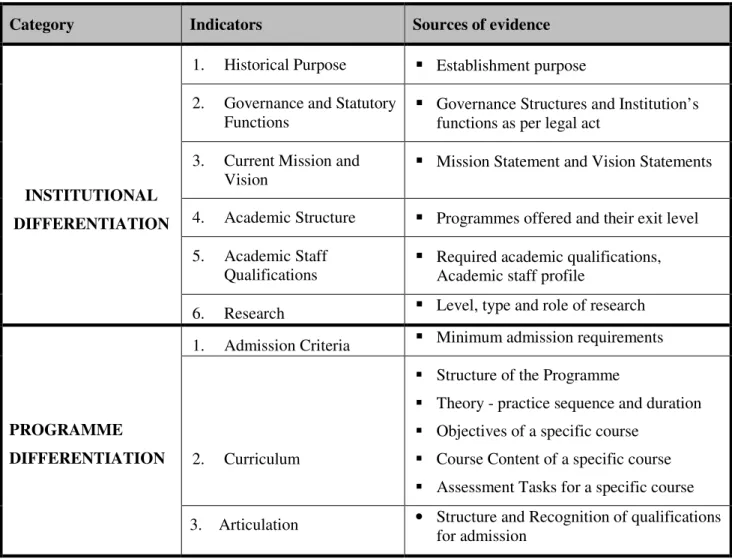
Table 3.2: Indicators of Institutional Differentiation and Programme Differentiation...25
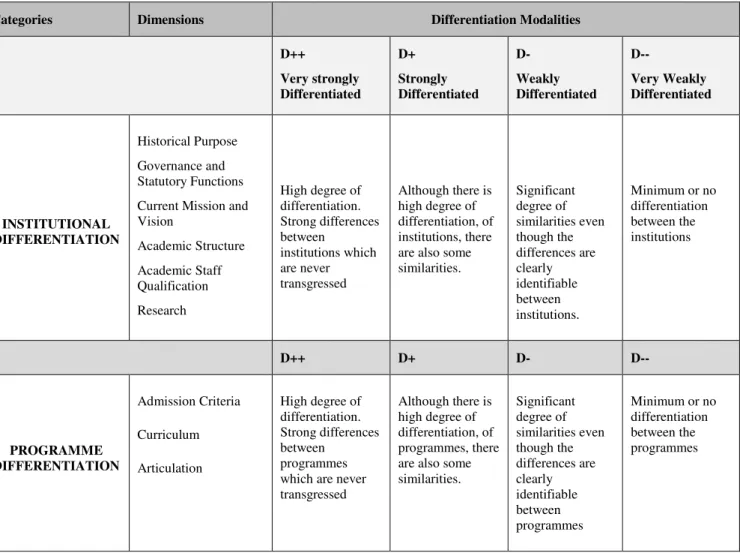
Table 3.3: Differentiation strategies...26
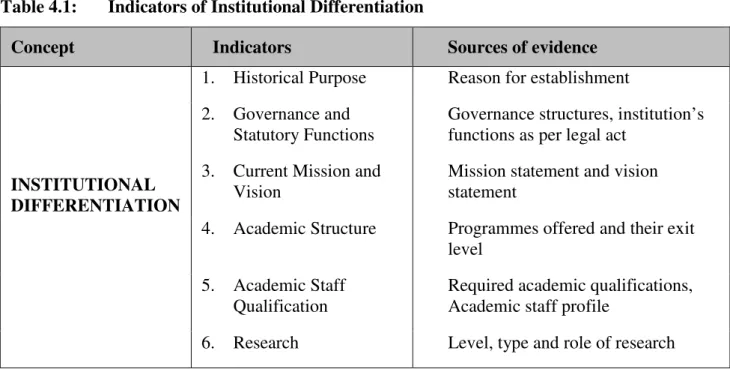
Table 4.1: Indicators of Institutional Differentiation...29
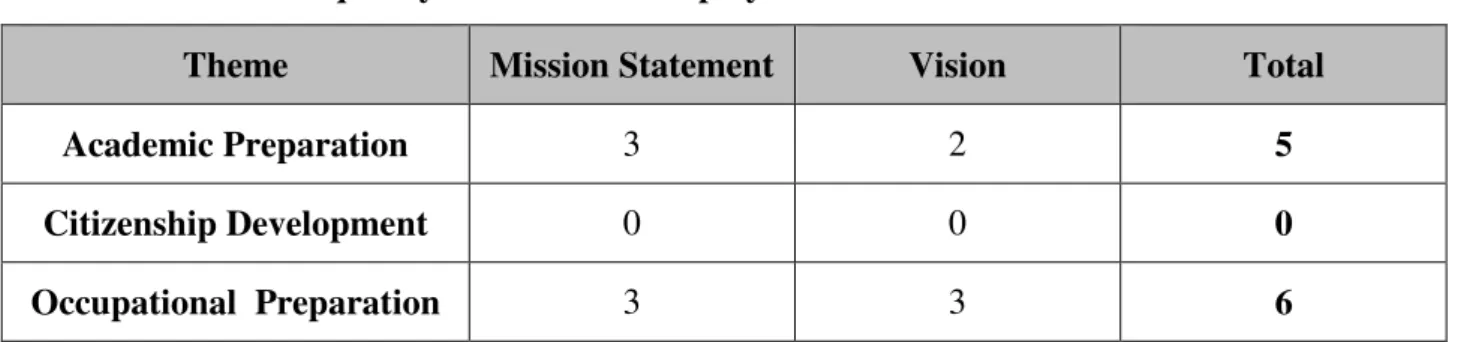
Table 4.2: The frequency of themes in the polytechnic’s mission and vision statements...32
Table 4.3: The polytechnic’s academic structure...33
Table 4.4: Staff qualification at the polytechnic...34
Table 4.5: The frequency of the themes in the university’s mission and vision...39
Table 4.6: The university’s academic structure...40
Table 4.7: Staff qualifications at the university...41
Table 4.8: Journal articles published by interviewees...42
Table 4.9: Differentiation strategies – Institutional Differentiation...44
Table 4.10: A comparative summary – the polytechnic and the university...47
Table 5.1: Indicators of Programme Differentiation...50
Table 5.2: Differentiation strategies – Programme Differentiation...51
Table 5.3: Cambridge Overseas School Certificate grading system...51
Table 5.4: Minimum entry requirements for commerce programmes...52
Table 5.5: Minimum entry requirements for engineering programmes...53
Table 5.6: Programme structure for commerce programmes...55
vii
Table 5.8: Course objectives for Taxation...61
Table 5.9: Course objectives for Control Systems and Digital Control...62
Table 5.10: Course content for Taxation...64
Table 5.11: Course content for Control Systems and Digital Control...65
Table 5.12: Classification of Taxation assessment tasks...66
Table 5.13: Examples of Taxation assessment tasks...67
Table 5.14: Classification of Control Systems and Digital Control assessment tasks...68
Table 5.15: Examples of Control Systems and Digital Control assessment tasks...69
Table 5.16: Summary for the Programme Differentiation findings...72
Table 6.1: Summary of the findings...74
Figures Figure 2.1: Curriculum types in the knowledge-practice curriculum...15
Figure 3.1: A stepwise approach to conceptualise and measure institutional diversity...20
Figure 5.1: Summary of Programme Differentiation presentation...50
Figure 5.2: Theory-Practice relation model for commerce programmes...59
viii
TABLE OF CONTENTS
DEDICATION ... i
ACKNOWLEDGEMENTS... ii
ABSTRACT ... iii
ABBREVIATIONS AND ACRONYMS ... iv
LIST OF TABLES AND FIGURES ... vi
TABLE OF CONTENTS... viii
CHAPTER 1 ... 1
AN INTRODUCTION TO THE STUDY ... 1
1.0 Introduction ... 1
1.1 Background to the study ... 1
1.2 Research Question ... 3
1.3 Organisation of the Study ... 3
CHAPTER 2 ... 5
LITERATURE REVIEW TOWARDS A CONCEPTUAL FRAMEWORK ... 5
2.0 Introduction ... 5
2.1 Globalisation, Knowledge Economy and Higher Education ... 5
2.2 Institutional Differentiation: Concept Definition ... 6
2.2.1 Categories of Differentiation ... 6
2.2.2 Isomorphism and de-differentiation through ‘mission stretch’ ... 8
2.3 Institutional Differentiation: Empirical Studies ... 9
2.3.1 The relation between participation, differentiation and economic development (Pillay, 2010) ... 9
2.3.2 Differentiation and Articulation: Trends in Africa (Ng’ethe et al, 2008) ... 12
2.4 Knowledge Differentiation: Concept Definition ... 14
2.5 Knowledge Differentiation: An Empirical Study ... 17
ix
CHAPTER 3 ... 19
RESEARCH DESIGN ... 19
3.0 Introduction ... 19
3.1 Research Approach... 19
3.1.1 Quantitative and qualitative approaches to the study of higher education differentiation ... 19
3.1.2 Case Study as a Qualitative Research Approach ... 20
3.2 Research Design ... 21
3.2.1 The Empirical Setting ... 21
3.2.2 Sampling ... 22
3.2.3 Gaining Entry and Recruitment of Participants ... 23
3.3 Data Collection ... 24
3.3.1 Data Sources ... 24
3.3.2 Data Types ... 25
3.4 Data Analysis ... 26
3.5 Ethical Considerations ... 27
3.6 Limitations to the Study ... 27
CHAPTER 4 ... 29
INSTITUTIONAL DIFFERENTIATION: A BINARY ANALYSIS ... 29
4.0 Introduction ... 29
4.1 The Polytechnic ... 30
4.1.1 Historical Purpose ... 30
4.1.2 Current Governance and Statutory Functions ... 30
4.1.3 Current Mission and Vision ... 31
4.1.4 The Academic Structure ... 32
4.1.5 Academic Staff Qualifications ... 34
4.1.6 Research ... 35
x
4.2 The University ... 37
4.2.1 Historical Purpose ... 37
4.2.2 Current Governance and Statutory Functions ... 37
4.2.3 Current Mission and Vision ... 38
4.2.4 The Academic Structure ... 39
4.2.4 Academic Staff Qualifications ... 41
4.2.6 Research ... 42
4.2.7 Discussion ... 43
4.4 Analysis of Data ... 44
4.5 Summary of Key Findings ... 47
CHAPTER 5 ... 49
PROGRAMME DIFFERENTIATION ... 49
5.0 Introduction ... 49
5.1 Presentation and Analysis of Data... 51
INDICATOR 1: ADMISSION CRITERIA... 51
INDICATOR 2: CURRICULUM... 54
INDICATOR 3: ARTICULATION ... 70
5.2 Summary of Key Findings ... 71
CHAPTER 6 ... 73
DISCUSSION OF THE FINDINGS ... 73
6.0 Introduction ... 73
6.1 Discussion of Findings ... 75
6.1.1 A Binary System ... 75
6.1.2 Articulation ... 76
6.1.3 Knowledge Production and Dissemination. ... 76
6.2 Conclusion ... 78
xi
REFERENCES ... 80 APPENDICES ... 84
1
CHAPTER 1
AN INTRODUCTION TO THE STUDY
___________________________________________________________________________
1.0 Introduction
The introductory chapter provides a brief overview of Lesotho’s higher education system in order to provide a rationale for the research question about the extent to which the binary institutional division between university and polytechnic study is sufficiently differentiated to provide access to varying types of studentsand satisfy labour market needs for a greater diversity of graduate skills and levels of training. As a citizen of Lesotho, my interest in this question arises out of previous research carried out in African countries, which did not include Lesotho. As will be discussed, the present study wishes to ascertain the extent to which the system in Lesotho confirms trends regarding the weak relation between differentiation and articulation noted in other higher education systems in Africa.
The second part of the chapter provides a brief overview of the organisation of the study.
1.1 Background to the study
Like other African countries, Lesotho’s higher education system faces seemingly irreconcilable challenges. On the one hand, increasing access to higher education is seen as a priority. Only approximately 23,987 Basotho were enrolled at local higher education institutions in 2010/2011, with an unknown number receiving financial assistance through the National Manpower Development Secretariat (NMDS) to pursue their studies at higher education institutions outside the country (Council on Higher Education (CHE), 2010:8). On the other hand the Cambridge Overseas School Certificate (COSC) results, which are used as the main selector for admission of students into higher education institutions, indicate poor performance in Mathematics, Science and English, thus limiting students’ access to higher education institutions as they do not qualify for admission into these institutions. Furthermore, higher education institutions have limited capacity in terms of infrastructure and also offer limited career choices for students (CHE, 2010:13).
In response to the challenges stated above, the Lesotho Education Strategic Plan stipulates that during the Strategic Planning period 2005-2015, the main objectives for the higher education subsector will be:
2
• Increasing access to higher education on an equitable basis.
• Improving the relevance of higher education such that it is responsive to the demands of
the labour market.
• Improving efficiency of higher learning institutions.
• Introducing issues of gender and HIV and AIDS in mainstream higher education
curriculum and activities (Ministry of Education and Training (MOET), 2005:83). When introducing the strategic plan, the Minister of Education and Training indicated that “the envisaged economic development for Lesotho is dependent on the availability of highly skilled manpower” (MOET, 2005:2). Access, relevance and institutional efficiency are viewed as key strategic objectives for promoting social and economic development.
This relation is confirmed by research that suggests strong links between higher education participation rates and a country’s developmental level. Citing Bloom et al (2006), Cloete, Bailey, Pillay, Bunting & Maassen (2011:3) indicate that in several high-income countries, higher education participation rates are more than 50% while for Sub-Saharan Africa, the rates are well below 5%. In Lesotho, figures published by UNESCO in 2009, indicate a participation rate of only 4%, while the 2006 Population & Housing Census yielded a participation rate of 11.1% (CHE, 2012: iv).
Lesotho’s higher education system comprises several public and private sector institutions which offer academic programmes with a minimum duration of two-years as opposed to Technical and Vocational Education and Training Stream. These institutions are responsible to MOET and are regulated by CHE. They prepare students at different levels like certificate, diploma, bachelor degree, associate degree, honours degree and masters degree (CHE, 2010:6).
In the public sector there are three publically-funded autonomous institutions: one polytechnic, one college of education and one university. There are also three college-level institutions which are constituted as departments of government ministries. In the private sector there is one profit-making university and four non-profit making colleges of nursing. (CHE, 2012:17-18).
In general, higher education in Lesotho is offered to those who have at least completed senior secondary education successfully. However, there has been a concern that access to higher education in Lesotho is limited due to limited institutional capacity, poor COSC results and limited career choices for students (CHE, 2010:13). In response to these challenges, one of the aims set out by the higher education policy is, to increase access to higher education on an equitable basis (MOET, 2005:83).
3
1.2 Research Question
This study questions whether the higher education system in Lesotho is sufficiently differentiated to provide access to varying types of students in terms of their academic and social background as well as providing them with different types of skills and knowledge as required by the labour market. Focussing specifically on the university-polytechnic binary in the public sector, the study aims to investigate the following question:
How differentiated is the university-polytechnic binary division in the public sector higher education system in Lesotho?
In addressing this question, the study seeks to contribute to previous research, conducted in twelve selected Sub-Saharan African countries and focussing specifically on the relationship between differentiation and articulation in universities and polytechnics (Ng’ethe, Subotzky & Afeti, 2008). Lesotho was not included in this study, so the results of the current study will show how the binary system in Lesotho compares to other systems in Africa, as well as further afield.
It is hoped that the findings of the study will contribute to the existing literature on differentiation in higher education systems.
1.3 Organisation of the Study
The six chapters in the study are arranged as follows:
Chapter One: An Introduction to the Study
The chapter outlines the purpose and rationale for the research question that drives the study and discusses the chapter structure of the dissertation.
Chapter Two: Literature Review towards a Conceptual Framework
The chapter introduces and discusses the concepts which will guide the study, in a critical manner. It also refers to studies which will provide a framework for comparison with the findings of the study.
4
Chapter Three: Research Design
The procedures undertaken to conduct the study are explained. This entails the instruments used and the sampling techniques as well as data collection and data analysis methods. The limitations of the study are also outlined in this chapter.
Chapter Four: Data Presentation and Analysis – Institutional Differentiation
This is an empirical study reporting chapter. It explores institutional differentiation focusing on the polytechnic and the university in Lesotho.
Chapter Five: Data Presentation and Analysis – Programme Differentiation
This, also, is an empirical study reporting chapter which explores the findings of the previous chapter through programme differentiation.
Chapter Six: Findings and Conclusions
The last chapter presents the overall findings and the conclusions of the study. Conclusions are related back to literature in regard to differentiation in higher education systems, with a specific focus on how the study compares to other countries in Africa.
5
CHAPTER 2
LITERATURE REVIEW TOWARDS A CONCEPTUAL
FRAMEWORK
___________________________________________________________________________
2.0 Introduction
The chapter serves to develop conceptual framework to guide the study. It also refers to studies which will help to make comparison with the findings of the study.
2.1 Globalisation, Knowledge Economy and Higher Education
Over the years, globalisation has shaped the world’s economy, with knowledge and information as the main economic resources (Carnoy & Rhoten, 2002:1). A globalised world requires a highly skilled labour force that employs new technologies and adapts to unpredictable and volatile global product markets as well as rapid technological change (Kraak, 2001:89). For nations to be globally competitive, knowledge production, accumulation, transfer and application needs to be at the core of their national development strategies (Santiago et al, 2008 and World Bank, 1999, 2002, in Cloete et al, 2011:3) and workers in the global labour force are pressurised to constantly upgrade their skills and knowledge (Young & Gamble, 2006:1).
New education and training requirements are central to globalisation (Kraak, 2001:89) and education, particularly higher education, is deemed to contribute significantly towards the production of a competitive national labour force and economic development (Tarabini, 2010:204). During the twentieth century, higher education institutions became the key knowledge-producing institutions in most parts of northern and western Europe and North America. They are viewed as producers of knowledge and knowledgeability. Knowledge comes in the form of scientific results or scientifically trained people who can tackle the challenges of globalisation. Knowledgeability refers to a highly educated, a more rational and a literate population as well as a more skilled and a creative society (Nowotny, Scott and Gibbons, 2001:79).
Contrarily, Wolf (2002:14-15) argues that the link between education and growth is not as straight forward as it seems. While not ruling out the importance of education as well as skills acquired through education to economic growth, she argues that education is often used mainly for ranking, screening and selecting people as staying in education longer indicates possession of qualities
6
which most employers wish for like motivation, perseverance and organisation (Wolf, 2002:30). Wolf warns that, any government which is serious about economic growth has to be careful and discriminating in its education spending (Wolf, 2002:54).
In response to the pressure that globalisation puts on higher education to provide more places, higher education systems have tended to increase the number of higher education institutions in any particular system, as well as access to these institutions. Ng’ethe et al (2008:xvii) and Lolwana (2010:9) note that higher education systems which want to provide increased access and also provide human capital with a mix of skills and knowledge for economic development are characterised by differentiation.
The next section investigates various conceptual dimensions of ‘differentiation’ as key terms that will drive the study as a whole.
2.2 Institutional Differentiation: Concept Definition
2.2.1 Categories of Differentiation
Differentiation and its accompanying concept diversity have been widely discussed in relation to higher education.
Differentiation is viewed as the emergence or coming into existence of new entities in a system
(Rhoades 1983 in Van Vught, 2007:2). It is the emergence of distinct types of higher education institutions that provide different types of skills and knowledge to a wide range of students with various abilities and interests (Ng’ethe et al, 2008:xvii). It refers to an increase in the number of institutions within the same higher education system which may have different functions and structures (Ng’ethe et al, 2008:5).
Two types of differentiation namely vertical and horizontal differentiation have been identified in literature. Vertical differentiation occurs when distinct types of institutions like universities, polytechnics and colleges form part of a single higher education system (Ng’ethe et al, 2008:xvii; also cited in Lolwana, 2010:9). It is further indicated that a vertically differentiated higher education system responds to the labour market needs as it provides a diversified type of graduates (World Bank 2000 in Ng’ethe et al, 2008:7). Horizontal differentiation among institutions occurs when public institutions are complemented by profit or non-profit private institutions of the same category (Clark, 1978:248; Ng’ethe et al, 2008:xvii; also cited in Lolwana, 2010: 9). It is driven by demand for access into higher education (World Bank 2000 in Ng’ethe et al, 2008:7).
7
Diversity indicates the variety of entities within a system (Van Vught, 2007:2) at a specific point in
time (Huisman in Van Vught, 2007:2). According to Trow (1995) in Meek, Goedegebuure and Huisman (2000:3) diversity in higher education has been defined as the existence of distinct forms of post-secondary education, of institutions and groups of institutions within a state or nation that have different and distinctive missions, educate and train for different lives and careers, have different styles of instruction, are organised and funded differently and operate under different laws and relationships to government (Meek et al, 2000:3). Diversity is about the variety of institutions. If a unique institution emerges within a higher education system, it increases diversity. However, if provision and services are duplicated, there is no variety hence no contribution towards diversity. Thus differentiation does not necessarily increase diversity (Ng’ethe et al, 2008:5-6).
Two forms of diversity have been identified in a higher education system, internal diversity which refers to differences within institutions and external diversity which refers to differences between institutions.
According to Van Vught (2007:2) seven categories of diversity which are largely related to external diversity have been identified by Birnbaum (1983). The categories are:
• Systemic diversity is defined as institutional differences within a single higher education
system (Codling and Meek, 2006:36) which relates to institutional type, size and control (Van Vught, 2007:2).
• Structural diversity is institutional differences which result from historical and legal
foundations or the division of labour within the institutions.
• Programmatic diversity is about the degree level, degree area, mission,
comprehensiveness as well as emphasis of programmes and services provided by institutions.
• Procedural diversity expresses how institutions provide teaching, research and services.
• Reputational diversity relates to perceived differences based on status and prestige.
• Constituential diversity is all about differences in students served as well as other
constituencies in the institutions like faculty and administration.
• Values and climate diversity relates to social environment and culture differences (Van
Vught, 2007:2-3).
Even though there is a clear definitional distinction between differentiation and diversity, the terms tend to be used interchangeably in the literature (Ng’ethe et al, 2008:6).
Arguments in support of differentiation have shown that such systems promote positive performance in higher education by increasing the effectiveness of higher education institutions.
8
Differentiated systems are deemed to respond effectively to both students and labour market. Students’ needs are met as the system provides access to students from different educational and social backgrounds and allows multiple entry and exit points. Labour market needs are met in terms of specialisation of labour, which is necessary for economic and social development (Van Vught, 2007:5-6; Meek et al, 2000).
2.2.2 Isomorphism and de-differentiation through ‘mission stretch’
In opposition to arguments in favour of differentiation, there are also studies that assert that higher education systems are, characterised by isomorphism, de-differentiation and decreasing levels of diversity through ‘mission stretch’, thereby creating a tendency towards uniformity (Van Vught, 2007:7; Codling & Meek, 2006:35). De-differentiation refers to disbanding of differences which previously existed within the higher education system (German Council of Science and Humanities (GCSH), 2010:12).
Two oppositional processes contribute towards mission stretch. The first is ‘academic drift’, which refers to the process where polytechnics become more like universities by moving into areas which have been exclusively the responsibility of universities. The opposite process is ‘vocational drift’ which refers to traditional universities shifting towards universities of technology or polytechnics (Codling & Meek, 2006:35).
Codling and Meek’s (2006) study of Australian universities shows that universities exhibit vocational drift by:
• Adopting more applied missions
• Developing active partnerships with industry and the new professions • Offering more qualifications with overt vocational outcomes
• Generating more applied research funded by industry
• Becoming more enabling with their admission policies to encourage non-traditional
learners (Codling & Meek, 2006:41) Universities of Technology exhibit academic drift by:
• Appointing more traditional university trained and experienced academic staff • Adjusting their organisational cultures to be more academic
• Shifting enrolment patterns to include more school leavers • Broadening their research focus and increasing emphasis
9
• Adopting much of the symbolism and nomenclature of the traditional university
(Codling & Meek, 2006:41).
Academic drift is mostly associated with isomorphism which is the imitative and aspirational behaviour of non-university, polytechnic-type institutions (Ng’ethe et al, 2008:6). These institutions adopt similar features to those of the research universities so that they may have higher status and better quality (Ng’ethe et al, 2008:6). According to Van Vught (1992) in Ng’ethe et al (2008:6) this imitative process is called institutional isormorphism.
File and Goedegebuure (2000) in Ng’ethe et al (2008:6) differentiate between two types of isomorphism. Mimetic isomorphism is caused by an institution’s insecurities thus forcing it to imitate more successful institutions. Normative isomorphism is the result of professionalism. Due to shared standards, similarity is encouraged thus leading to similar practices (Ng’ethe et al, 2008:6). Maassen in CHET (2008a:3) confirms dedifferentiating trends in relation to the Norwegian system. In Norway, a college sector was developed, in parallel to universities, to provide professional higher education; thus promoting a highly effective differentiated system. However, the professional education sector was allowed to overlap with the university sector. Colleges were allowed to conduct research, develop doctoral and masters programmes and those colleges that could fulfil specific conditions were allowed to upgrade to university status (CHET, 2008a:3).
2.3 Institutional Differentiation: Empirical Studies
2.3.1 The relation between participation, differentiation and economic
development (Pillay, 2010)
In order to address the challenge of access, it is important to study at how other countries have done it. Pillay (2010) undertook a study aimed to flesh out common themes between higher education and economic development. The study focused on three countries namely, Finland, South Korea and North Carolina. The outcome of the study indicates a close relationship between higher education and economic development (Pillay, 2010:1). One of the factors attributed to this positive relationship is high participation rates coupled with institutional differentiation which was evident in each of the three education systems (Pillay, 2010:27).
10
• Finland: Strong differentiation, strong state involvement and high participation in
a public education system
Finland’s education system, a dual system, comprises of universities and polytechnics which are distributed country wide and hence, provide equitable access to all. Each sector has its own profile. Universities are more academic with a theoretical and research orientation while polytechnics are geared towards the world of work. They also differ in terms of the degree levels and the programmes they offer. Their administration models and their funding models also support each of their respective missions.
The system is characterised by a high participation rate coupled with state funding and planning. There is also the creation of conditions which enable the higher education system to constitute a key component of the regional innovation system and to interact closely with business and industry. System enrolment is driven by student demand and is guided by what the labour market needs. As a result, the graduates produced by the higher education sector match the labour market demand (Pillay, 2010).
• South Korea: Strong differentiation, high state involvement in planning but poor
strategic partnerships in a predominantly private higher education system
In the case of South Korea the higher education system is clearly differentiated between colleges and universities which are mainly in the main cities. Colleges are closely related to employers and prepare middle-level human resource and technicians in a range of fields, while universities are expected to produce high-level skills as well as researchers for the private and public research institutions. The state plays a key planning role in the economy and ensures that the education system develops in line with the human resource requirements of the economy. However, the state’s contribution to the funding of higher education is minimal and the system is predominantly private (Pillay, 2010).
Unlike Finland, the South Korean reforms did not work as anticipated. Due to the massive expansion of the South Korean higher education system, the quality of higher education has been compromised. There is poor strategic partnership and connections between knowledge-producing institutions. The role of universities as creators and disseminators of knowledge is also weak. Diversity and relevance are limited; hence the system does not provide the quality human resources which meet the changing demands
11
of the knowledge-based economy. In South Korea there are highly educated workers, but they do not meet the labour market needs (Pillay, 2010:22).
In response to all these challenges the South Korean government announced a University Restructuring Plan in 2004. The reforms are designed to improve human resource capacity so that it is responsive to the challenges of this increasingly globalised and knowledge based economy. The reforms are related to quality, differentiation and relevance, as well as stimulating research capacity in the universities (Pillay, 2010:23-24).
• North Carolina: University-Community College differentiation
North Carolina’s higher education system includes universities and community colleges which are differentiated to cater for the differing needs of the population and economy. The system consists of public universities and colleges as well as private universities and colleges. There is a linkage between universities and colleges which results in a clear division of roles and articulation. Colleges address challenges of workforce development and provide access to those who cannot make it straight to university. Universities are specialised, especially the public sector. However, they all want to become world-class teaching and research institutions. The government plays an important part with regard to funding and support and providing a powerful sense of the importance of higher education for economic and social development. The engagement between the private sector and higher education institutions is productive and deals with the changing economic conditions (Pillay, 2010:25).
Looking at the three case studies by Pillay (2010), they indicate that all the countries have high participation rates and binary systems with different roles for each type of institutions. However, not all of them have given the expected results. In South Korea unlike in the other two countries, higher education institutions are mainly in the cities with limited state funding and poor relationship between universities and industry. This shows that success does not only lie in increased participation and differentiation alone. There are factors like funding and industry’s labour market needs to be considered (also in Codling & Meek, 2006:42).
12
2.3.2 Differentiation and Articulation: Trends in Africa (Ng’ethe et al, 2008)
Since the study will be focusing at higher education system in Lesotho, it is helpful to consider the trends in some African countries especially the Southern African countries. Although every country is different there are lessons which could be learned from neighbouring countries.
Ng’ethe et al (2008:3) argue that African countries are not likely to become meaningful players in knowledge generation as the key driver of the global economy, if they do not have adequate provision of higher education. Ng’ethe et al (2008) undertook a study to investigate the extent, range and patterns of institutional and programme differentiation as well as articulation among them. The study was meant to inform and support the Working Group on Higher Education (WGHE) of the Association for the Development of Education in Africa (ADEA) to engage more with the non-university component of the higher education sector.
The study analysed non-university institutions in selected countries in Sub-Saharan Africa. Four countries were selected per each region:
• West Africa: Cameroon, Ghana, Nigeria and Senegal • East Africa: Kenya, Rwanda, Tanzania and Uganda
• Southern Africa: Malawi, Mozambique, South Africa and Zambia
The study revealed that in African countries higher education systems are generally differentiated to a varying degree and extent across countries. Though most countries’ systems began as binary, it is only Ghana, Kenya, Malawi and Tanzania which have maintained such systems. Cameroon, Nigeria and Senegal have been classified as differentiated. Uganda has been classified as trinary while Zambia’s system is unitary. Mozambique and Rwanda have semi-differentiated systems. The classification is mainly based on the number of different institutional types that comprise the respective higher education systems.
These differences are viewed as the result of colonial experiences, political economy and post-independence history. Ng’ethe et al (2008:22) shows that the differentiation picture displayed by South African higher education system indicates its apartheid policy legacy. In Nigeria, institutional differentiation displayed is the result of the country’s size, societal complexities and the nature of demand for higher education. They also indicated that smaller countries like Rwanda and Malawi have a less differentiated higher education system.
However the study shows that, the binary boundaries between the universities and non-university institutions are becoming blurred. There are a number of drivers towards this blurring. Universities
13
compete in the offering of market driven programs which are also referred to as income-generating programs. Their objective is to provide skills using pedagogies close to training rather than university pedagogy.
Another factor that causes the blurring of the binary boundary is lack of clear policy demarcating the boundaries between the polytechnics and universities. It promotes academic and vocational drift respectively. Academic drift has been noted in countries like Ghana as polytechnics have aspired for university status. In Nigeria, polytechnics have been allowed to offer degrees while in Kenya polytechnics have been elevated to universities. Vocational drift has been noted in all the systems under study as universities tried to cover up their financial short falls by offering market-driven courses and vocational programs.
In South Africa, the binary divide policy has been described as ambiguous. The system has been restructured into three institutional types, traditional universities, universities of technology and comprehensive universities which offer the mix of traditional university and university of technology programs.
Isomorphism is another contributing factor. In some countries newer universities are copying what the older ones are doing especially in their programme offering. This process has been found to be more likely where there is poor regulation of such intuitions as they are at liberty to do as they wish (Ng’ethe et al, 2008:35).
There has been expansion in most of the higher education systems studied which did not necessarily guarantee differentiation (Ng’ethe et al, 2008:27). Expansion has been a political reaction to public demands for access, rather than being an attempt to produce a well-differentiated higher education system. This resulted in similar programmes being offered, leading to an increase in the number of graduates with similar qualifications as opposed to what the market needs.
In regard to articulation, Ng’ethe et al (2008:36) indicated related information to be limited. They highlighted that all countries acknowledged the need for articulation. However, practice proved otherwise as few countries have shown evidence of articulation.
Senegal and South Africa seem to be the only two countries with a highly articulated higher education systems (Ng’ethe et al, 2008:36). The post apartheid policy in South Africa emphasise equity-driven access, mobility and articulation between universities and universities of technology (Ng’ethe et al, 2008:122). Ghana, South Africa and Uganda are the only three countries which have a unified system oversight body. In Cameroon, Senegal and South Africa, the institutions recognise
14
the qualification structures of others and they also allow student mobility and credit transfer (Ng’ethe et al, 2008:36).
Much as the aim of the study has been to investigate program differentiation Ng’ethe et al
(2008:24) highlighted this could not be achieved as adequate documentation would require different analytical methods as well as detailed content analysis.
The study has shown that much as the policy on differentiation is evident in African countries, factors like policy, the market, and isomorphism promoted de-differentiation. Moreover, expansion has been a response to public demand for access while differentiation has been basically about different types of institutions. This gives a different picture from the one given by Pillay (2010) where expansion has been made as a move to promote economic development.
Other studies have been considered to find out if differentiation or de-differentiation has been promoted in other countries. Pillay’s (2010) study shows that not all the three countries have promoted differentiation successfully. Ng’ethe et al (2008) on the other hand shows that African countries have mostly promoted de-differentiation.
2.4 Knowledge Differentiation: Concept Definition
Historically, the division of knowledge in higher education systems around the world reflects institutional divisions between traditional universities and more technical/technologically orientated institutions such as polytechnics. Referring to comprehensive universities in South Africa, Gibbon (in CHET, 2008b:5-6) describes this as a ‘knowledge divide’. Referring similarly to South Africa, Shay, Oosthuizen, Paxton and Van de Merwe (2011:101) draw a distinction between ‘academic type’ professional and general formative programmes offered by traditional universities, and ‘technikon-type’ programmes which are typically vocational and career-focused.
At one level it is argued that the distinction is more ideological than real. As Gibbons reports:
… there are ideological and status issues around knowledge. Technikon academics say there is little difference between a diploma and a professional degree in engineering, while university academics say there is an ocean between the two (CHET, 2008b:6)
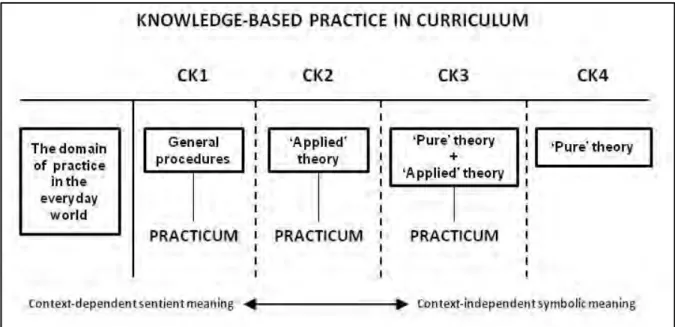
Curriculum theorists explain distinctions between different types of knowledge in a number of ways. Given that professionally-orientated curricula are usually framed in terms of a formal knowledge component and a practical component, Gamble (2009) discusses the relation between knowledge and practice in a curriculum. On the knowledge side she draws a distinction between ‘pure’ and ‘applied’ theoretical knowledge. ‘Pure’ theoretical knowledge takes the connective
15
relation between concepts as the basis of logical reasoning; ‘applied’ theoretical knowledge is operationalised through a step-by- step or sequential logic that relates to the world of practice. On the practical side Gamble (2009) describes three different kinds of practice.
• Doing - as sequential task performance
• Making - as a process of reproduction of products or processes
• Creating - as a process of design and/or innovation of new products or processes
She argues that different forms of knowledge and different forms of practice combine to make up specific types of curricula (Gamble, 2009:18 - 21). This is represented in the diagram that follows.
Figure 2.1: Curriculum types in the knowledge-practice curriculum (Gamble, 2013:215)
Muller (2009:216) differentiates between a curriculum’s conceptual coherence and/or contextual
coherence. Gamble (2009:15) explains the difference between Muller’s concepts as follows:
When a curriculum is conceptually coherent there is an upward or vertical hierarchy of conceptual abstraction, with later concepts dependent on earlier concepts for their meaning. Order or sequence, pacing and progression matter greatly as the knowledge ‘bits’ have to fit together in a time and space not given by a specific context. Logic is thus the key criterion for coherence.
Sequence matters less in a curriculum that seeks contextual coherence. Here each segment or topic is
selected for relevance and coherence to a particular context. The order in which the topics are presented does not really matter, as the key criterion for coherence is adequacy-to-context. Adequacy-to-context is a visible evaluative criterion that announces itself as soon as there is an inadequate fit
between practice and context (Gamble, 2009:15)
Muller (2009:217) further explains that within each occupational field, occupations vary. They have different disciplinary cores in their knowledge bases and so they can be distinguished by whether
16
they have a more conceptual or a more contextual form of practice. But Muller (2009) also argues that:
The knowledge society means that each occupation and its attendant knowledge base will increasingly be under pressure to augment its quantum of conceptual knowledge, to become at least partly mental. This is because generalisable innovation relies on conceptual knowledge, as we saw above, and it is this kind of innovation that the global economy prizes most at all levels of the division of labour (Muller, 2009:219).
Referring specifically to the vocationally-orientated curriculum Barnett (2006:145) points out that vocational education should relate to academic disciplines as well as to professional practice. Using the sociologist Basil Bernstein’s concept of recontextualisation which he describes as referring to ‘the appropriation and transformation of knowledge for various purposes’ Barnett (2006:144) explains how both disciplinary knowledge and situated workplace knowledge have to be re-contextualised to create vocational knowledge. The problem, he argues, is that situated knowledge which is context-dependent does not readily or easily relate to disciplinary knowledge which is context-independent. That is why two independent forms of recontextualisation are required.
Reclassificatory recontextualisation, refers to the process through which disciplinary knowledge is
selected and reorganised for purposes of practical application. This is followed by pedagogic
recontextualisation to make topics ‘teachable’ and ‘learnable’ (Barnett, 2006:147). These two
distinct recontextualising processes, Barnet argues, require tough choices from the designers of vocational learning programmes. What is needed is:
… a degree of insight into the scope and nature of the ‘reservoir’ of disciplinary knowledges on which the particular syllabus has drawn, as well as of some of the realities of the workplace settings to which this (appropriately refashioned) knowledge is deemed to be relevant. This is a considerably more demanding agenda than that which confronts the subject teacher in general education (Barnett, 2006:156).
The above discussion shows how different theorists rewrite the basic distinction between scientific and applied knowledge in the language of curriculum to provide what Shay et al (2011:202) call an ‘academic rationale’ for differences between different types and levels of qualifications, such as certificates diplomas and degrees.
17
2.5 Knowledge Differentiation: An Empirical Study
Knowledge differences between a degree and a diploma in a comprehensive
university in South Africa (Shay et al, 2011)
In a research project funded by the South-Africa-Norway Tertiary Education Development (SANTED) programme which focused on the knowledge relations between undergraduate diplomas and degrees in a comprehensive university, Shay et al (2011) drew on the work of Gamble and Muller (as described above) to develop five curriculum typologies that could be used to analyse the types of knowledge and curriculum coherence of the diploma and degree in four fields of study: Architecture, Chemistry, Building Environment as well as Journalism and Media studies.
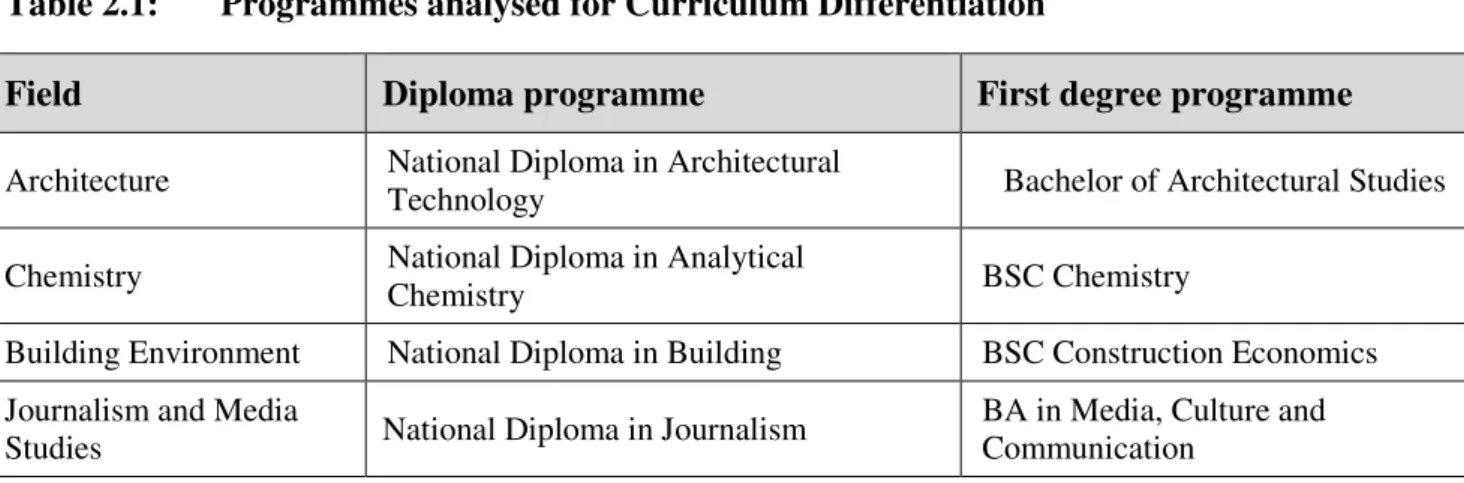
Programmes analysed under each field are presented in tabular form below.
Table 2.1: Programmes analysed for Curriculum Differentiation
Field Diploma programme First degree programme
Architecture National Diploma in Architectural
Technology Bachelor of Architectural Studies
Chemistry National Diploma in Analytical
Chemistry BSC Chemistry
Building Environment National Diploma in Building BSC Construction Economics
Journalism and Media
Studies National Diploma in Journalism
BA in Media, Culture and Communication
Information obtained from Shay et al (2011) Their findings questioned the idea of easy articulation between diploma and degree programmes in the same department; leading them to conclude that:
Contrary to the political ideals of the NQF the prospects of systemic articulation pathways from diplomas to degrees are not very promising ... Given these realities, it may be that at this stage the issue of articulation should not be the key driver for curriculum change for comprehensives. Priority should rather be given to reforms which will, firstly, strengthen differentiation of purpose between the diploma and the degree, and secondly, enable progression particularly at the school-university point
(Shay et al, 2011:119).
At a more general level, they conclude that any debate on differentiation, whether focused at institutional, qualification, programme or curriculum level, needs to take account of knowledge
18
2.6 Conclusion
This chapter makes two contributions to the study as a whole. The first is that it provides a conceptual framework to guide the empirical design of the study. This is discussed in the next chapter where I introduce two main concepts, namely institutional differentiation and programme
differentiation as the anchors of the study. A number of indicator variables are introduced, which
also refer back to the literature reviewed in this chapter.
The second contribution is that the final chapter refers back to the empirical studies discussed in this chapter, to provide a framework for a comparative discussion of the findings.
19
CHAPTER 3
RESEARCH DESIGN
_______________________________________________________________________
3.0 Introduction
In the last chapter I discussed a selection of literature sources related to the study, with particular attention to empirical studies that have investigated higher education differentiation in various countries. In this chapter I explain the procedures undertaken to conduct my own study. I start by briefly discussing quantitative approaches to this type of research before locating my study within a qualitative social research tradition.
3.1 Research Approach
3.1.1 Quantitative and qualitative approaches to the study of higher education
differentiation
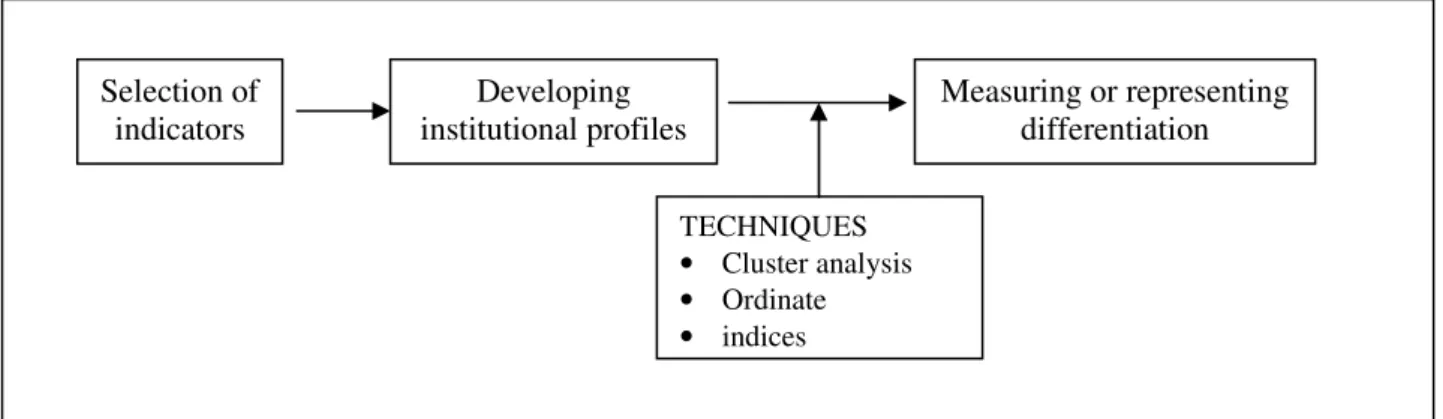
Huisman (2000) argues that theoretical analyses of diversity1 in higher education far outnumber empirical investigations. He therefore puts forward a model for operationalising and measuring diversity in higher education and proposes the following steps:
Selection of meaningful variables (which I will refer to as ‘indicators’ for this study)
• Data gathering on those indicators.
• Development of Institutional profile based on the indicators.
• Application of mathematical-statistical techniques in order to interpret data and results.
Figure 3.1 summarises the process.
1
20
Figure 3.1: A stepwise approach to conceptualise and measure institutional diversity (Huisman, 2000:44).
In quantitative studies, the mathematical-statistical techniques suggested, namely cluster analysis, ordination techniques and the calculation of diversity indices are all termed ‘reduction methods’ intended to reduce many characteristics to a single measure that lead to ‘meaningful, reliable and valid results’ (Huisman, 2000:45).
Requirements of reliability and validity tend to pose challenges for qualitative approaches that value the richness and texture of information obtained from various sources in the research setting, without too great a concern for the generalisability of the findings.
My supervisor and I discussed at length the steps that I should take to ensure that my single country qualitative case study produced findings considered to be reliable, valid and, to some extent, generalisable. I set out these procedures in the sections that follow.
3.1.2 Case Study as a Qualitative Research Approach
Rule & John (2011) define a case study as a ‘systematic and in-depth investigation of a particular
instance in its context, in order to generate knowledge’ (Rule & John 2011:4; original emphasis).
Following Yin’s classification system which distinguishes between three types of case study, namely exploratory, explanatory and descriptive case studies, they view a descriptive case study as a study which presents as complete a description as is possible of a phenomenon, within its context. An exploratory case study lays the basis for further research through examining a phenomenon that has not been investigated before. An explanatory case study attempts to explain what happens in a particular case and why it happens. The aim is often to test existing theory or to generate new theory (Rule & John, 2011:8).
Selection of indicators Developing institutional profiles TECHNIQUES • Cluster analysis • Ordinate • indices Measuring or representing differentiation
21
Rule & John also refer to Robert Stake’s distinction between intrinsic and instrumental case studies (Rule & John, 2011:8). In intrinsic case studies, the case itself is unique or innovative and therefore worth examining in its own right rather than serving as an example of a broader issue. Instrumental case study takes a particular issue as its focus and then selects cases that allow this issue to be studied in depth (Rule & John, 2011:9).
In my research I aim to identify differentiating trends in Lesotho’s higher education system in two ways: firstly, by describing the two cases as fully as possible and, secondly by attempting to interpret or explain some of the reasons for the findings.
While the study is framed conceptually in relation to current literature on this issue, I am particularly interested in two empirical studies of countries elsewhere in Africa, namely a comparative study of twelve African countries entitled, Differentiation and Articulation in Tertiary
Education Systems (Ng’ethe et al, 2008) and a South African study undertaken by the Centre for
Higher Education Transformation, entitled Differentiation in the South African public university
system (Bunting, 2013). I aim to compare the findings of my single-case study to the findings of
both these larger multi-case studies. Confirmation or disconfirmation of trends found in these studies will lend credibility to the findings of the Lesotho study, lend it greater potential for generalisability than would be possible with a single case study.
Using the terms discussed in this section, I would say that my study has a descriptive base, set up in relation to categories of analysis and comparison drawn from the literature and other empirical studies. In that sense it is an explanatory case study. It is instrumental in the sense that the conceptual issue, namely higher education differentiation, came before the selection of the case. I was introduced to the literature in a course on education policy which I attended as part of the taught Masters programme I attended. Class discussion centred mainly round the South African policy terrain and it made me curious about what I could say about my home country, Lesotho. A theoretical orientation (Mouton, 1996:102) therefore preceded selection of the two institutions included in my case study.
3.2 Research Design
3.2.1 The Empirical Setting
The focus of this study is on Lesotho’s higher education public sector where two types of higher education institutions, polytechnic and university are compared. In this section I present a short initial description of each institution, starting with the polytechnic. It must be noted that in Lesotho
22
there is only one polytechnic and one public university hence it will be quite impossible to hide their identity. However, as the interest is on institutional ‘type’ they will be referred to as the polytechnic and the university so as not to draw attention to their actual identities.
The Polytechnic
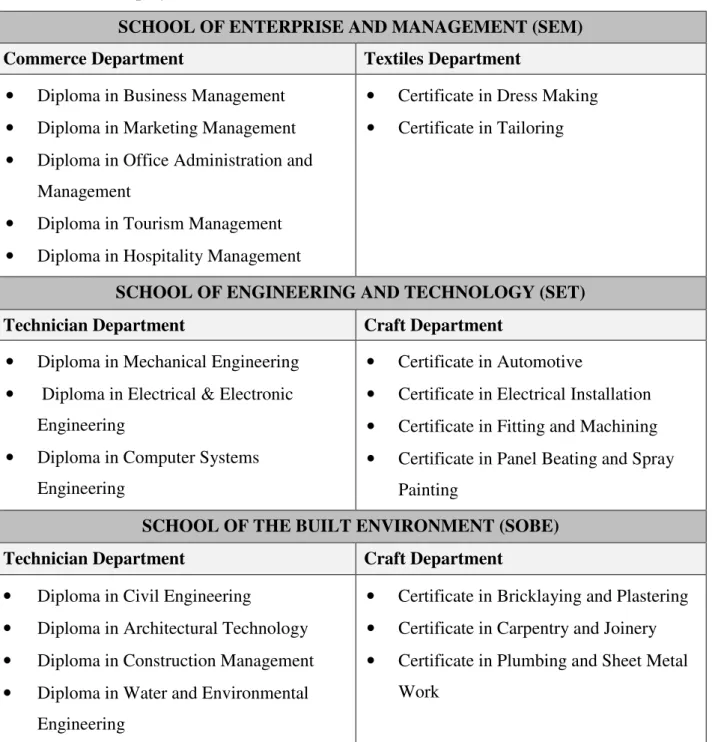
The polytechnic is an autonomous institution situated in the capital city of Lesotho, Maseru. It comprises four schools in which it offers a range of programmes from certificate level to diploma level. The four schools are the School of the Built Environment (SOBE), the School of Engineering and Technology (SET), the School of Enterprise and Management (SEM) and the School of Continuing Education (SOCE). SOBE and SET offer a range of certificate programmes in the craft fields and diploma programmes in the engineering fields. SEM offers a variety of diploma programmes in the commercial field. SOCE2 offers part time and short courses in various fields (Lerotholi Polytechnic, 2013c). The vision of the polytechnic is to become a university of technology (Lerotholi Polytechnic, 2013b).
The University
The university is an autonomous institution situated at the outskirts of the capital city of Lesotho, Maseru. The university offers a variety of programmes across its seven faculties namely, the Faculties of Agriculture, Education, Health Sciences, Humanities, Law, Social Sciences and Science and Technology. It also offers part-time diploma and degree programmes at the Institute of Extra Mural Studies (IEMS) (NUL, 2013). Its vision is to be a leading African university (NUL, 2012:5).
3.2.2 Sampling
Sampling is the selection of participants of the study from the entire population (Mertens, 2010:309). Purposive sampling and convenience sampling are often used to make a selection of participants. In purposive sampling, the researcher picks participants because of specific characteristics that make them holders of information needed for the study (Cohen et al, 2007:114). Opportunity (convenience) sampling refers to selection of participants because they can easily be accessed (Cohen et al, 2007:113-114).
The sample for this study comprises two higher education institutions namely:
• the polytechnic and • the university.
2
23
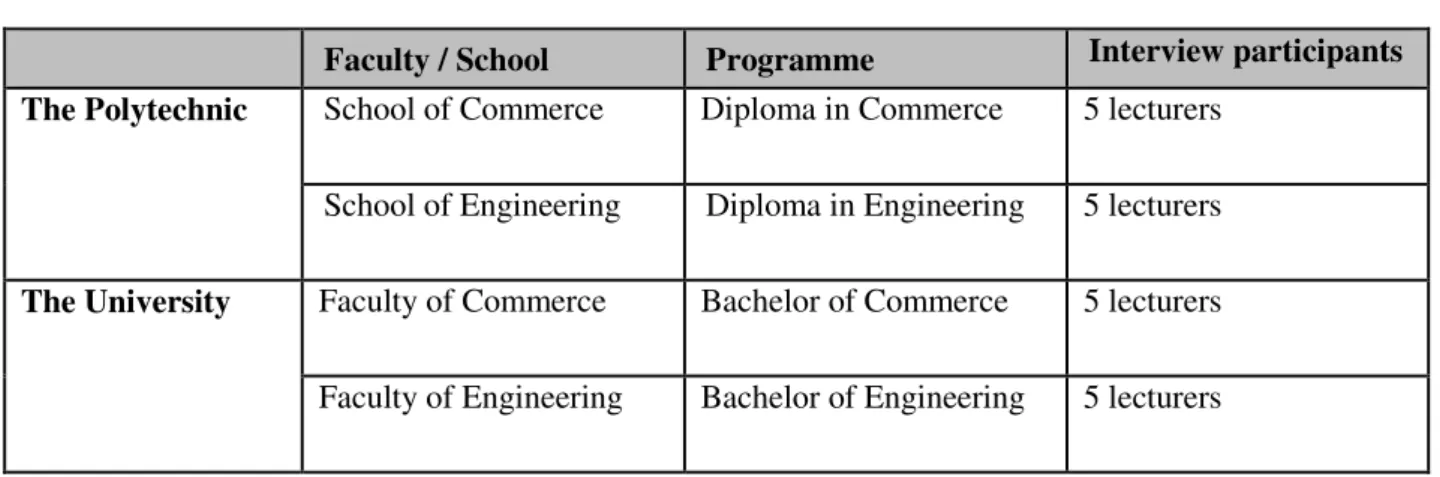
At the polytechnic the study focused on two schools, the School of Commerce and the School of Engineering. One programme was investigated under each School, Diploma in Commerce and Diploma in Engineering respectively. At the university, the study focused on two Faculties namely, the Faculty of Commerce and the Faculty of Engineering. Under each faculty, one programme was investigated, Degree in Commerce and Degree in Engineering respectively. For both institutions, under each programme, five (5) lecturers were interviewed, one of which was at management level. Table 3.1 summarises the sample.
Table 3.1: The sample for the study
Faculty / School Programme Interview participants The Polytechnic School of Commerce Diploma in Commerce 5 lecturers
School of Engineering Diploma in Engineering 5 lecturers
The University Faculty of Commerce Bachelor of Commerce 5 lecturers
Faculty of Engineering Bachelor of Engineering 5 lecturers
The institutions were selected purposively as they are the only institutions of their type in Lesotho.The faculties (schools) and programmes were also chosen purposively as they are related to each other hence could provide necessary information required to answer the research question. The interview participants were selected purposefully and conveniently. The selection was purposeful because they could provide rich information required in relation to the chosen programmes. It was conveniently selected because I interviewed those who were available when I returned to Lesotho for data collection.
3.2.3 Gaining Entry and Recruitment of Participants
In order to gain entry into the two higher education institutions, I obtained permission to gather information and interview participants with a letter of entry that I submitted to the relevant offices at the institutions (Appendix 1 and Appendix 2).When permission was granted, I engaged with the Deans or Heads of Departments who helped me to identify relevant and available lecturers for the study. Once appropriate participants were identified, I approached them individually, explained the purpose of my study and requested them to participate. An information sheet explaining the study and their right to choose either to participate or not to participate was provided (Appendix 3 and
24
Appendix 4). For those who were willing to participate, we agreed on time and venue for interviews.
3.3 Data Collection
3.3.1 Data Sources
Triangulation is a process of checking information from multiple sources or methods in order to establish consistency of evidence (Mertens, 2010:258). In order to increase internal validity and consistency through triangulation, information was gathered from multiple sources: documentary sources and semi-structured interviews. Field work started in July 2013 and was concluded in the third week of September 2013.
• Documentary sources
The documentary sources collected included policy documents relating to higher education institutions in Lesotho like Higher Education Act 2004. It also comprised institutional documents and institutional records which could provide the required information (presented in section 3.6.2). For each institution the documents included: legislation which established the individual institution, the prospectus, strategic plan, course outlines and examination question papers.
• Semi-structured interviews
Semi-structured interview is one of the techniques used to collect data for the study. According to Nieuwenhuis (2010:87) semi-structured interviews are used to support data from other sources. Questions to be answered by participants are prepared in advance and also allow probing and clarification of answers.
Accordingly, semi-structured interviews were used to support data from documentary sources and records. The questions were prearranged for each group that had to be interviewed (Appendix 5 to Appendix 8). Different interview schedules were used for the polytechnic lecturers and management as well as for the university lecturers and management. Interviews were conducted on a one-to-one basis with five (5) participants per programme. The duration of interviews differed from one participant to another, ranging from 45 minutes to one hour.
The interviews were recorded on an electronic device for participants who agreed to be recorded. For those who did not, notes were taken during the interview.