Interpersonal Conflict Behaviour as a Mediator
between Couples' Personalities and their
Relationship Satisfaction:
Application of the Actor-Partner Interdependence
and Gender-Specific Models
Maxwell Blumberg
Department of Psychology Goldsmiths College
September 2006
A thesis submitted to the Faculty of Science of the University of London for the degree of Doctor of Philosophy
For My Parents
Acknowledgements
I would like to express my gratitude to Drs. Martin Davies and Robin Russell for their supervision, wisdom, and support.
I would also like to thank Professor Dave Kenny, Professor Alan Pickering, Viki Cuthbertson, Vicky Barrett, and Andrew Thompson for their valuable input.
Finally, I would also like to say a special thank you to my mother Maureen for those trips to the library in the rain, and for all your love and support. Thank you Mom.
Abstract
Intimate couple relationships are central to human wellbeing and studies have demonstrated strong links between relationship distress and physical, mental, and social problems. Psychologists have therefore researched the determinants of relationship outcomes with a view to developing interventions for the amelioration of relationship distress. This research has suffered from a number of limitations. First, the majority of studies have focused on bivariate associations between relationship outcomes and causal factors. Little is therefore known about the effects of interactions between the well researched factors of personality and conflict behaviour on relationship outcomes. In particular, the extent to which conflict behaviour mediates the association between partners' personalities and their relationship satisfaction is unknown. Second, investigations have seldom accounted for the interdependence of observations typical of intimate
couples. Third, the majority of studies investigating relationship outcomes of heterosexual couples have assumed that effects on relationship outcomes vary by gender without specifically testing this assumption.
This dissertation examined the associations between Five Factor model personality traits, conflict behaviour, and the relationship satisfaction of 234 heterosexual couples drawn from an Internet-based sample of 1122
participants in intimate couple relationships. The following analyses were performed: conflict behaviour and relationship satisfaction; personality and relationship satisfaction; personality and conflict behaviour; and conflict behaviour as a mediator of the effects of personality on relationship
satisfaction. Analyses were based on the Actor-Partner Interdependence and gender-specific models.
The study found that the association between relationship satisfaction and conflict behaviour was larger than that between relationship satisfaction and personality. Furthermore, the effects of actor conflict behaviour were significantly stronger than those of partner conflict behaviour suggesting that an actor-oriented model of relationship outcomes better accounted for the results. The strongest personality correlate of relationship satisfaction was actor agreeableness while actor neuroticism was most strongly associated with conflict behaviour. The effects of personality on relationship satisfaction were almost completely mediated by conflict behaviour with the effects of neuroticism and agreeableness showing the greatest degree of mediation. Finally, minimal support for a gender-specific model was found.
Chapter 1 1.1 1.2
1.3
Chapter 2: 2.1 2.22.2.1
2.2.2
2.2.3
2.2.3.1
2.2.3.2
2.2.3.3
2.2.3.4
2.2.3.5
2.2.4
2.2.4.1
2.2.4.2
2.2.5
2.2.5.1
2.2.5.2
2.2.5.3
Contents
Introduction Contextual background Research problem Research objectives Literature ReviewLiterature Review: Introduction
Relationship satisfaction: An overview Introduction
Definitions
Relationship satisfaction: Causes and correlates Intrapersonal factors
Demographic and socioeconomic factors Dyadic factors
External stressors Interpersonal factors
Theoretical approaches to dyadic research Actor-Partner Interdependence model Gender-specific model
Relationship satisfaction research: Issues Theoretical issues Dimensionality issues Non-uniform assessment 21
24
25
27
28
28
29
30
31
32
32
33
34
34
34
35
36
36
37
39
2.2.5.4
Partner interdependence issues39
2.2.5.5
Sample sizes42
2.2.6
Relationship satisfaction: Summary42
2.3 Conflict behaviours and relationship satisfaction
43
2.3.1
Introduction43
2.3.2
Defining couple conflict behaviour44
2.3.3
Theoretical context45
2.3.4
The assessment of couple conflict behaviour47
2.3.5
Conflict behaviour and relationship satisfaction:51
Research
2.3.5.1
Conflict style51
2.3.5.2
Conflict avoidance and withdrawal56
2.3.5.3
Conflict frequency58
2.3.5.4
Conflict outcome60
2.3.5.5
Summary61
2.3.6
Conflict behaviour research: Issues61
2.3.6.1
Reciprocity between conflict behaviour and satisfaction62
2.3.6.2
Conflict behaviour: Interpersonal versus intrapersonal62
2.3.6.3
Inconsistent findings63
2.3.6.4
The factor structure of conflict behaviour63
2.3.6.5
Small effect size66
2.3.6.6
Limitations of social learning theory67
2.3.7
Conflict behaviour and relationship satisfaction:67
Summary
2.4.1 Introduction 68
2.4.2 Theoretical context 70
2.4.3 Personality and relationship satisfaction: Research 78
2.4.3.1 Introduction 78
2.4.3.2 Actor-Partner Interdependence model 80
2.4.3.3 Gender-specific model 90
2.4.3.4 APIM and gender effects: Combined summary 98
2.4.4 Personality and relationship satisfaction research: Issues 103
2.4.4.1 Controlling for the effects of neuroticism 103
2.4.4.2 Moving beyond the effects of neuroticism 103
2.4.4.3 Testing for partner effects 104
2.4.4.4 Small effect sizes 104
2.4.4.5 Linking personality to relationship outcomes 104
2.4.4.6 Inflexibility of personality traits 105
2.4.5 Personality and relationship satisfaction: Summary 105
2.5 Personality and conflict behaviour 106
2.5.1 Introduction 106
2.5.2 Personality and conflict behaviour: Research 107
2.5.2.1 Actor effects 108
2.5.2.2 Partner effects 111
2.5.3 Gender-specific model 113
2.5.4 Experience of conflict 115
2.5.5 Personality and conflict behaviour research: Issues 116
2.5.6 Personality and conflict behaviour: Summary 116
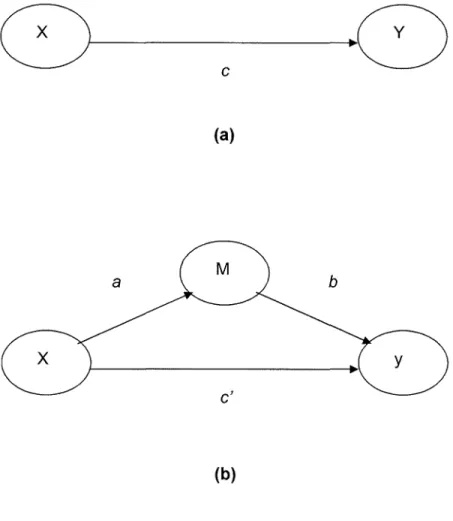
satisfaction: Mediatory associations 2.6.1 Introduction 117 2.6.2 Theoretical context 119 2.6.2.1 Introduction 119 2.6.2.2 Mediation modelling 119 2.6.2.3 Vulnerability-Stress-Adaptation model 124
2.6.3 Mediation research findings 128
2.6.3.1 Partial mediation 128
2.6.3.2 Complete mediation 131
2.6.3.3 No mediation 131
2.6.4 Mediation: Summary 132
2.7 Literature review: Overall conclusions 133
Chapter 3: Current Research
3.1 Introduction 136
3.2 Hypothesis 1: Dyadic interdependence 137
3.3 Hypothesis 2: Conflict behaviour and relationship 138 satisfaction
3.3.1 Actor-Partner Interdependence model 138
3.3.1.1 Hypothesis 2(a): Actor Effects 138
3.3.1.2 Hypothesis 2(b): Partner Effects 138
3.3.2 Hypothesis 2(c): Actor effects versus partner effects 139
3.3.3 Hypothesis 2(d): Gender specificity 139
3.3.4 Hypothesis 2(e): Change in relationship satisfaction 139
3.4.1 3.4.2 3.4.2.1 3.4.2.2 3.4.3 3.4.4 3.4.5 3.4.6 3.4.7 3.4.7.1 3.4.7.2
3.5
3.5.1 3.5.2 3.5.2.1 3.5.2.2 3.5.3 3.5.4 3.5.53.6
3.7
Chapter 4: 4.1 IntroductionActor-Partner Interdependence model Hypothesis 3(a): Actor effects
Hypothesis 3b: Partner effects
Hypothesis 3(c): Actor effects versus partner effects Hypothesis 3(d): Controlling for the effect of neuroticism Hypothesis 3(e): Gender specificity
Hypothesis 3(f): Change in relationship satisfaction Hypothesis 3(g): Homogamy
Hypothesis 3(g)i: Assortative mating
Hypothesis 3(g):ii: Association between assortative mating and relationship satisfaction
Hypothesis 4: Personality and conflict behaviour Introduction
Actor-Partner Interdependence model Hypothesis 4(a): Actor Effects
Hypothesis 4b: Partner Effects
Hypothesis 4(c): Actor effects versus partner effects Hypothesis 4(d): Gender specificity
Hypothesis 4(e): Change in satisfaction Hypothesis 5: Mediation hypotheses Conclusion Method Introduction 140 141 141 143 146 146 147 147 147 147 148 148 148 149 149 151 153 153 154 154 157 158
4.2 Participants 158
4.3 Measures 160
4.3.1 The NEO-FFI Personality Inventory - Revised Form S 160
4.3.2 Conflict behaviour 161 4.3.3 Relationship outcomes 162 4.3.4 Demographic questions 164 4.4 Procedure 164 4.5 Data preparation 166 4.6 Preliminary analyses 166
4.6.1 Conflict behaviour scale creation 167
4.6.2 Relationship satisfaction scale creation 171
4.7 Conclusion 174
Chapter 5: Results
5.1
Introduction 1765.2
Descriptive statistics and intercorrelations 1775.2.1 Demographic descriptive statistics 177
5.2.2 Personality 179
5.2.3 Conflict behaviour 181
5.2.4 Relationship satisfaction 182
5.3
Dyadic interdependence 1835.4
Multilevel Random Coefficient Regression modelling 1845.4.1 Introduction 184
5.4.2 MLM equations 185
5.4.2.2 Level 2 equations 186
5.4.2.3 Combined equation 188
5.4.3 Computations 189
5.5
Model preparation and overview of research analyses 1905.6
Conflict behaviour and relationship satisfaction 1925.6.1 Actor-Partner Interdependence model 192
5.6.2 Comparing actor and partner effects 195
5.6.3 Gender-specific model 196
5.7
Personality and relationship satisfaction 1975.7.1 Actor-Partner Interdependence model 198
5.7.2 Comparing actor and partner effects 202
5.7.3 Gender-specific model 203
5.7.4 Personality similarity and relationship satisfaction 204
5.8
Personality and conflict behaviour 2085.8.1 Actor-Partner Interdependence model 208
5.8.2 Comparing actor and partner effects 211
5.8.3 Gender-specific model 212
5.9
Mediation testing 2165.10
Summary 222 Chapter 6: Discussion 6.1 Introduction 225 6.2 Dyadic interdependence 2256.3 Individual personality traits 226
6.3.2
Actor extraversion228
6.3.3
Actor openness230
6.3.4
Actor agreeableness232
6.3.5
Actor conscientiousness234
6.3.6
Partner neuroticism236
6.3.7
Partner extraversion238
6.3.8
Partner openness239
6.3.9
Partner agreeableness240
6.3.10
Partner conscientiousness241
6.4
Conflict behaviour and relationship satisfaction242
6.4.1
Actor-Partner Interdependence model242
6.4.2
Gender-specific model244
6.5
Personality and relationship satisfaction245
6.5.1
Actor-Partner Interdependence model245
6.5.2
Gender-Specific model246
6.5.3
Homogamy246
6.5.3.1
Partner personality similarity246
6.5.3.2
Assortative mating and relationship satisfaction247
6.5.4
Controlling for the effects of neuroticism247
6.6
Personality and conflict behaviour248
6.6.1
Actor-Partner Interdependence model248
6.6.2
Gender-specific model249
6.7
Mediation effects249
7.1
7.2
7.2.1
7.2.2
7.2.3
7.2.4
7.2.5
7.3
7.4
7.5
7.5.1
7.5.2
7.6
7.6.1
7.6.2
7.6.3
References Appendix A: Introduction Summary of findings Dyadic interdependenceConflict behaviour and relationship satisfaction Personality and relationship satisfaction
Personality and conflict behaviour Mediation
Study strengths Study limitations Implications
Personality and Conflict Behaviour as Correlates of Couple Relationship Satisfaction
Actor-partner effects Future research
Investigate broader conceptions of personality Investigate additional intrapersonal mediators Refine and standardise construct definitions
Examples of research findings from previous investigations
252
252
252
253
253
254
254
255
258
262
262
263
264
264
265
265
267
328
Tables
2.1 Examples of within-dyad partner correlations found by 41 previous research investigations
2.2 APIM associations between FFM actor personality traits 86 and relationship satisfaction
2.3 Examples of two-partner couple research into 89
associations between personality and relationship satisfaction
2.4 Review of gender-specific findings for personality and 91 relationship satisfaction
2.5 Summary of actor-partner and gender-specific 99
associations between personality effects and relationship satisfaction
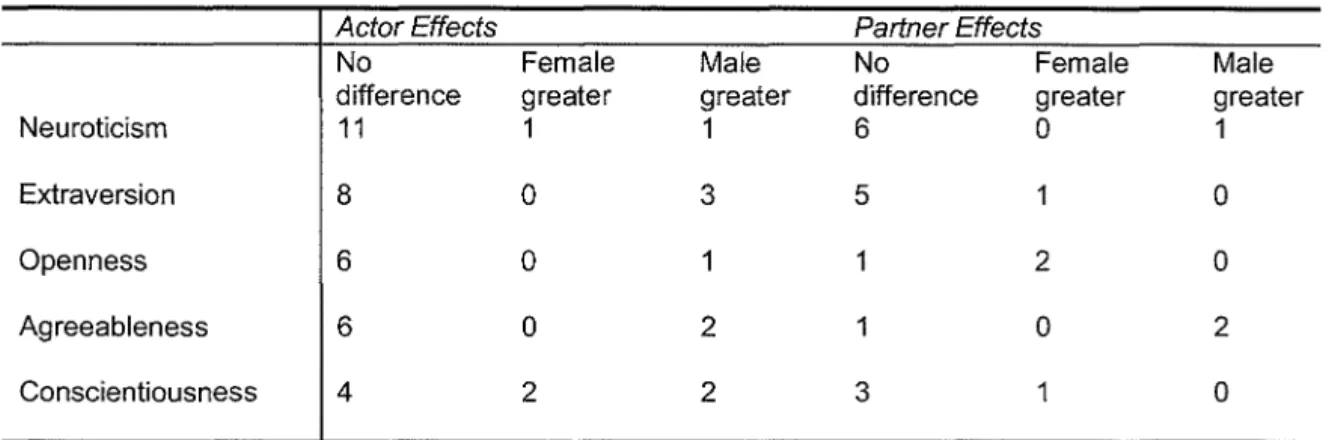
2.6 Summary of actor-partner and gender-specific 116
associations between personality and conflict behaviour
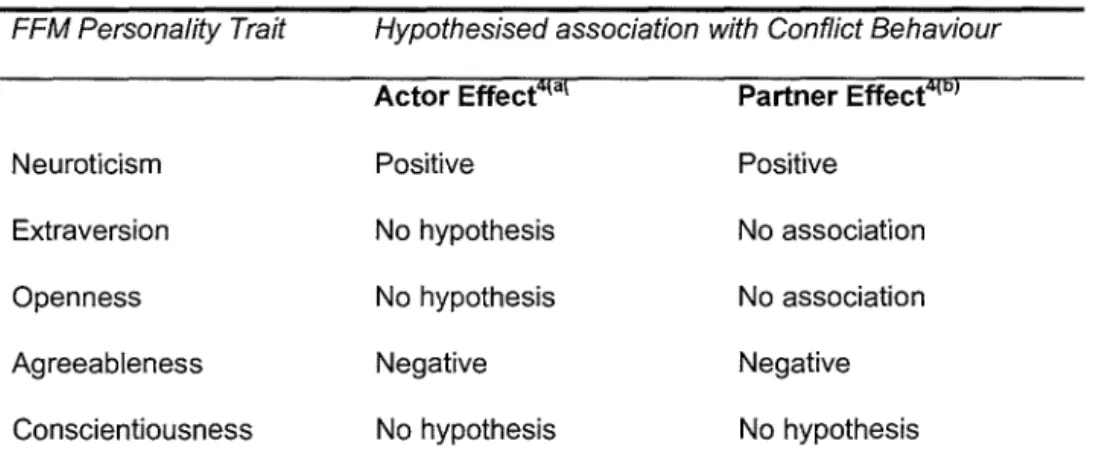
3.1 Hypotheses summary for the actor and partner effects of 141 personality and relationship satisfaction
3.2 Hypotheses summary for the actor and partner effects of 149 personality and conflict behaviour
3.3(a) Hypotheses based on the mediatory associations 155 between actor personality, actor conflict, and relationship
satisfaction
3.3(c) 3.3(d) 4.1 4.2 4.3 4.4 5.1 5.2 5.3 5.4 5.5 5.6 5.7
between actor personality, partner conflict, and relationship satisfaction
Hypotheses based on the mediatory associations between partner personality, actor conflict, and relationship satisfaction
Hypotheses based on the mediatory associations between partner personality, partner conflict, and relationship satisfaction
Individual and couple sample sizes at Times 1 and 2 Factor loadings for conflict behaviour
Current sample and MARQ manual descriptive statistics for female partners
Factor loadings for relationship satisfaction Current sample and NEO-FFI manual descriptive statistics for female and male partners
Current sample and NEO-FFI manual Cronbach alphas Within-individual personality trait correlations
Time 1 and Time 2 conflict behaviour descriptive statistics
Time 1 and Time 2 relationship satisfaction descriptive statistics
Within-dyad partner correlations between conflict behaviour and relationship satisfaction
Zero-order correlations between conflict behaviour and
156 157 160 170 172 174 178 179 180 181 182 184 193
relationship satisfaction
5.8 Multilevel model of relationship satisfaction regressed on 194 actor and partner conflict behaviour
5.9 Multilevel model of relationship satisfaction regressed on 195 the dyadic average and difference in conflict behaviour
5.10 Zero-order correlations between female and male conflict 196 behaviour correlations and relationship satisfaction
5.11 Multilevel model of relationship satisfaction regressed on 197 interactions between gender and conflict behaviour
5.12 Zero-order correlations between actor and partner 198 personality traits and relationship satisfaction
5.13 Multilevel model block analyses of relationship 199 satisfaction regressed on actor and partner personality
5.14 Multilevel model of relationship satisfaction regressed on 201 actor and partner personality (final block)
5.15 Summary of hypotheses and findings for the associations 202 between actor and partner personality and relationship
satisfaction
5.16 Multilevel model of relationship satisfaction regressed on 203 the dyadic average and difference in personality traits
5.17 Zero-order correlations between female and male 204 personality and relationship satisfaction
5.18 Zero-order correlations between partners NEO-FFI trait 205 scores
5.19 Multilevel model of relationship satisfaction regressed on 206 interactions between gender and personality
5.20 MAN OVA analysis of differences between partners' 207 NEO-FFI scores
5.21 Associations between differences in partner personality 208 trait scores and relationship satisfaction
5.22 Actor and partner correlations between personality and 209 conflict behaviour
5.23 Multilevel model block analyses of Time 1 conflict 210 behaviour regressed on actor and partner personality
5.24 Multilevel model of Time 1 conflict behaviour regressed 211 on actor and partner personality
5.25 Summary of hypotheses and findings for the associations 212 between actor and partner personality and Time 1
conflict behaviour
5.26 The effects of dyadic personality average and difference 213 on conflict behaviour
5.27 Zero-order correlations between female and male 214 personality and conflict behaviour
5.28 Multilevel model of conflict behaviour regressed on 215 interactions between gender and personality
5.29 Multilevel model of relationship satisfaction regressed on 218 personality and conflict behaviour
5.30(a) Mediation analysis of actor personality on relationship 220 satisfaction
5.30(b) Mediation analysis of partner personality on relationship 221 satisfaction
A.1 Examples of studies investigating the associations 328 between intrapersonal factors and relationship outcomes
A.2 Examples of studies investigating associations between 330 socioeconomic and demographic factors, and
relationship outcomes
A.3 Examples of studies investigating associations between 331 dyadic factors and relationship outcomes
A.4 Examples of studies investigating associations between 332 external factors and relationship outcomes
A.5 Examples of studies investigating associations between 333 interpersonal factors and relationship outcomes
A.6 Examples of theoretical models used to underpin studies 335 of couple relationships
Figures
2.1 The Actor-Partner Interdependence model 35
2.2 Mediation 120
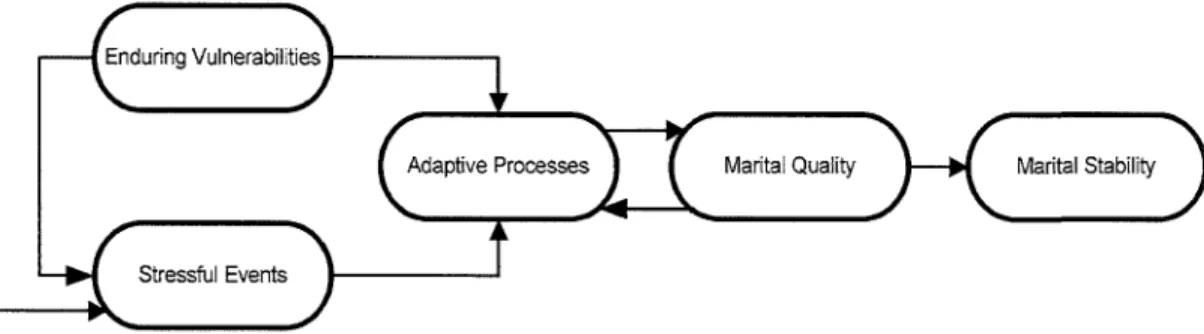
2.3 A Vulnerability-Stress-Adaptation model for couple 125 relationships
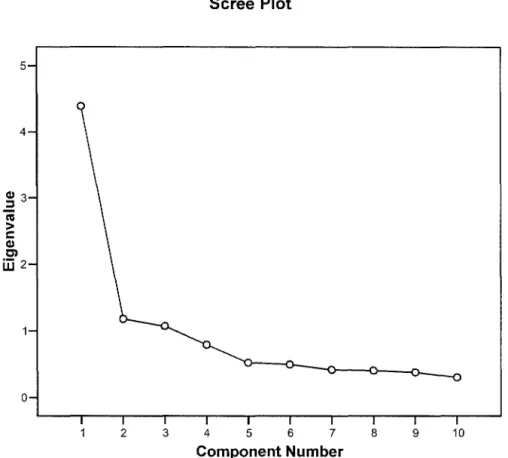
4.1 Scree test for components of conflict behaviour 169
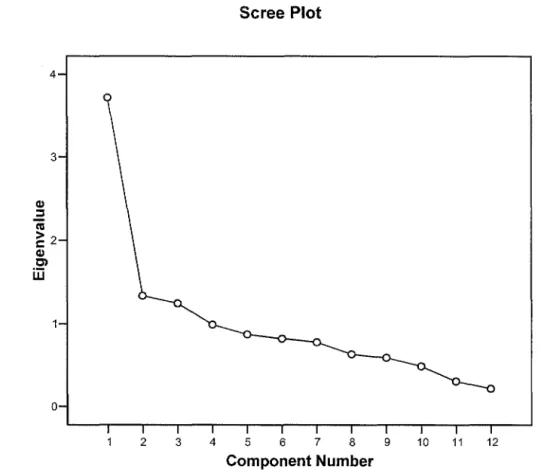
4.2 Scree test for components of relationship satisfaction 173
Thesis Structure
The thesis consists of seven chapters. Chapter one introduces and motivates the current research investigation, and articulates the research objectives. Chapter two reviews the relevant literature in four sections: conflict behaviour and relationship satisfaction; personality and relationship satisfaction; personality and conflict behaviour; and conflict behaviour as a mediator of the effects of personality on relationship satisfaction.
Chapter three documents the research hypotheses, and chapter four describes the methodology used to recruit participants and collect data, and the assessment instruments used. Preliminary factor analyses to create the conflict behaviour and relationship satisfaction scales are performed here.
Chapter five documents the results of the data analyses and chapter six discusses and interprets the current findings in terms of the research
hypotheses and similar investigations. Chapter seven concludes the dissertation and summarises the findings, strengths, limitations, and implications of the research, and offers directions for future research.
CHAPTER 1
Introduction
1.1 Contextual Background
Relationships with others lie at the ve'Y core of human
existence. Humans are conceived within relationships, born into relationships, and live within relationships with others. Each individual's dependence on other people - for the realization of life itself, for survival during one of the longest gestation periods in the animal kingdom, for food and shelter and aid and comfort through the life cycle - is a fundamental fact of human
condition
Berscheid & Peplau (1983, p.1)
Satisfactory intimate couple relationships are central to human existence and overall wellbeing (Baumeister & Leary, 1995; Glenn, 1990; Williams, 2003). In a five-year two-wave panel study of 691 single and
cohabiting respondents, Kamp Dush and Amato (2005) found that individuals in steady satisfactory relationships reported significantly greater wellbeing than those who were single.
Despite the benefits of satisfactory couple relationships, there is evidence of widespread relationship dissatisfaction in Western society. In 2004, for example, the divorce rate per 1000 of the population in England
and Wales was 14.0 representing 153,399 divorces compared to a lower marriage rate of 10.2 per 1000 (Office of National Statistics, 2006a). Furthermore, the total number of divorces in the UK has increased for four successive years (Office of National Statistics, 2006a,b). There is also evidence of relationship distress in the United States where marital
satisfaction, especially among younger couples, is thought to have declined consistently since 1980 (Amato, Johnson, Booth & Rogers, 2003; National Marriage Project, 1999; Rogers & Amato, 1997).
Relationship dissatisfaction has been linked to a wide range of health, economic, and social issues. Health issues include depression, alcoholism, and problems with the cardiovascular and immunological systems (Barnet, Steptoe & Gareis, 2005; Beach, Katz, Kim & Brody, 2003; Bradbury, Rogge & Lawrence, 2001; Kiecolt-Glaser, McGuire, Robles & Glaser, 2002; Spotts et aI., 2005). In economic terms, data from 667 separated females drawn from the European Panel Study (12 countries) revealed that average income per capita declined 42% following separation (Uunk, 2003). Socially, children from parents in distressed relationships are more likely to experience mental problems, educational problems and unemployment in later life than children from well-adjusted families (Fincham, 1998; Grych & Fincham, 2001;
Kiernan, 1996).
In order to ameliorate relationship distress and extend existing knowledge of relationship psychology, a number of theoretical models proposing various determinants of relationship satisfaction have been mooted. These models include interdependence theory (Kelley & Thibaut, 1978; Thibaut & Kelley, 1959), the investment model (Rusbult, 1983), equity
theory (Walster & Walster, 1975), and social learning theory (Jacobson & Margolin, 1979).
An intrapersonal model that has received particular attention since the earliest days of couple research has been that of personality theory (e.g., Terman, Buttenweiser, Ferguson, Johnson
&
Wilson, 1938). In general, the most consistent finding of personality models has been the deleterious effect of neuroticism or trait anxiety on relationship satisfaction (e.g. Barelds, 2005; Donnellan, Conger & Bryant, 2004; Eysenck & Wakefield, 1981; Kelly & Conley, 1987; Robins, Caspi & Moffitt, 2000). There are, however, a number of issues associated with the use of personality as a determinant ofrelationship satisfaction. First, an important objective of contemporary psychology is to explain the mechanisms through which dispositional variables influence social outcomes (Baron & Kenny, 1986; Myers, 2005). The mechanisms through which personality exerts its influence on
relationship satisfaction, however, are not well understood (Auhagen & Hinde, 1997; Donnellan et aI., 2004). Second, personality traits are reasonably stable over the adult life course (Caspi & Herbener, 1990; Jocklin, McGue & Lykken, 1996). On their own they are therefore unlikely to account for the well-documented changes that arise in relationship
satisfaction over the course of couple relationships (e.g. Burgess & Wallin, 1953; Erbert
&
Duck, 1997; Kurdek, 1999a). Finally, there is evidence that the joint effects of intrapersonal factors and interpersonal factors - such as couple communication and conflict behaviours - explain more variance in relationship satisfaction than either of these factors alone (Karney & Bradbury, 1997; Rogge, Bradbury, Hahlweg, Engl & Thurmaier, 2006).In 1995, Karney and Bradbury (1995a) proposed a Vulnerability-Stress-Adaptation (VSA) model of marital outcomes that addresses a number of the above issues. In this model, the effects of partners' enduring vulnerabilities (for example, intrapersonal characteristics such as personality) on
relationship outcomes are mediated by adaptive processes such as behavioural interactions. One adaptive process in particular - conflict behaviour - has been shown to exert significant influence on relationship satisfaction (e.g. Birchler, Weiss & Vincent, 1975; Cramer, 2003a; Gottman & Krokoff, 1989; Heavey, Layne & Christensen, 1993; Jacobson & Weiss, 1978; Kurdek, 1994a; Rands, Levinger & Mellinger, 1981).
1.2 Research Problem
For a variety of reasons, the VSA model has not been adequately tested. First, researchers tend not to combine multiple theoretical paradigms in the same investigation. Therefore, intrapersonal enduring vulnerabilities and interpersonal adaptational processes are seldom investigated using a single sample (Davies, 2004; Gottman, 1994; Karney & Bradbury, 1997; Kurdek, 1991 b). Second, in order to support a mediation hypothesis, a significant association between personality and conflict behaviour must be demonstrated (Baron & Kenny, 1986). Research on associations between personality and conflict behaviour is, however, limited (Asendorpf & Wilpers, 1998; Buss, 1992; Paunonen & Ashton, 2001). Third, many couple
relationship outcome investigations have used data from only one partner thereby restricting possible analysis of interactional adaptive patterns
between the partners. Fourth, many studies that have included both partners in couples used the dyad rather than the individual as the unit of analysis
resulting in an unnecessary loss of information (Donnellan et al. 2004;
Kenny, 1988; Schneewind & Gerhard, 2002). Fifth, an overwhelming majority of studies investigating heterosexual couples have used gender as a key distinguishing variable based on the assumption that couple effects vary by gender without formally testing this assumption (Hyde, 2005). In contrast, Kashy and Kenny (1999) argue that actor-partner distinctions are more important than gender differences, and proposed the Actor-Partner Interdependence Model (APIM) for use in couple research. To date, however, few studies have applied this model and continue to distinguish effects by gender (Barelds, 2005; White, Hendrick & Hendrick, 2004). Finally, most research investigations that have included both partners in couples have used analytical approaches such as ordinary least squares regression and ANOVA that assume independence of observations. Independent observations are an unlikely prospect in intimate couple relationships
(Kenny, 1996a,b) and if not specifically accounted for in statistical analyses, can result in inaccurate significance levels.
The current investigation addresses these issues and seeks to achieve the objectives described in the following section.
1.3 Research Objectives
Working with a sample of intimate heterosexuai couples, the objectives of the current research investigation are:
1) To investigate the associations between the following: a) Conflict behaviour and relationship satisfaction b) Personality and relationship satisfaction
2) To investigate the role of conflict behaviour as a mediator between couples' personalities and their relationship satisfaction.
CHAPTER 2
Literature Review
2.1 Literature Review: Introduction
Amid today's greatly increased alternatives, decreased social constraints, and heightened pair instability ... it matters far more how well two partners are pleased with the quality of their relationship
Levinger (1997, p.3)
Bradbury et al. (2001) argue that "identifying ... the factors that cause variability in relationship quality" (p.62) is a core task of intimate couple research. There are good empirical reasons for assigning a central role to relationship outcomes. First, there is evidence that the amelioration of relationship distress reduces the risk of relationship separation (Kurdek, 1993; Lewis & Spanier, 1979). Second, relationship dissatisfaction has been closely linked to sequelae such as negative physical and emotional states. It is even argued that relationship satisfaction may predict overall wellbeing more strongly than demographic factors such as age, education, and social status (Gagnon, Hersen, Kabacoff & Van Hasselt, 1999; Kurdek, 1991 c, 1993).
Two approaches have been particularly important in explaining variance in relationship satisfaction - the intrapersonal and interpersonal
have long been shown to play significant roles in determining their
relationship satisfaction (e.g. Lewin, 1948; Terman and Buttenweiser, 1935) and various causal paths between personality, conflict behaviour, and relationship outcomes have been proposed. It is hypothesised (and often assumed) that conflict behaviour mediates the association between couples' personalities and their relationship satisfaction (e.g. Bradbury & Fincham, 1988; Huston & Houts, 1998; Karney & Bradbury, 1995a). Few studies, however, have specifically tested this hypothesis by assessing the combined effects of both intrapersonal and interpersonal factors on a single sample.
The current chapter opens with a review of the theory underpinning the construct relationship satisfaction. This is followed by sections reviewing its associations with interpersonal conflict behaviour and personality traits. The literature investigating the association between personality and interpersonal conflict behaviour is then considered as an important component of
mediation testing. The review closes with an overview of mediational research in couple samples.
2.2 Relationship Satisfaction: An Overview
2.2.1
Introduction
This section defines the terms couple relationship and relationship satisfaction in the context of changing social structures and provides a broad overview of factors that have been linked to relationship satisfaction. The section closes with a review of the issues associated with couple research.
2.2.2 Definitions
Prager (2000) proposes four contexts in which couple relationships exist: the individual context including intrapersonal characteristics such as attachment styles and personality traits; the relational context featuring dyadic and interpersonal components such as power, support and conflict behaviour; the social network context which includes people that influence the relationship such as friends, family, and work colleagues; and the
sociocultural context that includes factors such as race, social class, culture, and religion. With so many rapidly changing contexts, the difficulty in defining what is meant by labels like lovers, couples, intimate relationships, or
cohabiting pairs is unsurprising. In fact Levinger (1997) argues that terms like these are merging into a "broadly inclusive label for all sorts of highly
interdependent relationships" (p.2) and are no longer restricted to dating or married couples. In the light of such a broad description, even the view that close relationships must include elements like love, self-disclosure, and affectionate nonverbal communication (Hatfield & Rapson, 1996) may be considered overly restrictive. Similarly, Kelley et al.'s (1983) view that close relationships are those which exhibit "strong, frequent, and diverse
interdependence that lasts over a considerable period of time" (p.38) may be considered too limiting for modern couple relationships.
For the purposes of the current research, a variation of Levinger's (1997) liberal definition will be adopted and couple relationships defined as any form of interdependent relationship between two people where the degree of emotional closeness is sufficient for the partners to consider themselves a couple.
The definition of couple relationship outcomes is equally problematic. The terms relationship satisfaction, relationship adjustment, and relationship quality, for example, are often used interchangeably although some scholars have attributed specific meanings to them. Relationship adjustment refers to an external objective view of relationship success (Erbert & Duck, 1997). Relationship quality is a complex construct incorporating multiple dimensions for evaluating relationships such as relationship satisfaction, integration, disagreements, partner roles, communication and interaction, happiness, adjustment, the degree of relationship stability, commitment, intimacy, and love (Diener, Emmons, Larsen & Griffin, 1985; Fletcher, Simpson & Thomas, 2000; Lewis & Spanier, 1979; Sabatelli, 1988). Issues with multidimensional conceptions of relationship outcomes are discussed in the following section. Relationship satisfaction, the focus of the current investigation, can be defined as the individual's subjective evaluation of relationship success and represents the discrepancy between the perceived and the idealised state of an individual's relationship (Fincham & Linfield, 1997; Hendrick & Hendrick, 1997; Hinde, 1997). More generally, Fincham and Beach (1999) argue that relationship satisfaction is an attitude representing the association between the cognitive representation of the relationship and its summary evaluation. Crosby (1991) argues that subjective definitions of relationship satisfaction are useful in clinical contexts because they facilitate rapid assessment of relationship attitudes.
2.2.3 Relationship Satisfaction: Causes and Correlates
Research into the causes and correlates of relationship satisfaction can be categorised into five broad areas: intrapersonal characteristics,
interpersonal factors, socioeconomic and demographic factors, and dyadic factors (Ayles, 2003; Karney & Bradbury, 1995a).
2.2.3.1 Intrapersonal Factors
Intrapersonal factors are inherent to the individual and include, for example, attachment styles, affect, gender, beliefs, mental health, and
personality traits. Table A.1 (Appendix A) provides examples of intrapersonal factors and studies that have investigated them. The intrapersonal factor personality is a focus of the current research and will be discussed in section 2.4. Some studies have reported that gender is a determinant of relationship satisfaction and that males are generally more satisfied with their
relationships than females (e.g. Schumm, Webb & Bollman, 1998). Kurdek (2005), however, could find few significant differences. Partner attitudes are another example of an intrapersonal characteristic (Fincham, Garnier, Gano-Phillips & Osborne, 1995; Karney, Bradbury, Fincham & Sullivan, 1994). Fincham et al. (1995) showed that viewed as an attitude, relationship satisfaction accessibility was positively associated with increased
relationship stability. Similarly, Bradbury and Fincham (1990) concluded that distressed couples are more likely to make attributions that serve to over-emphasise negative partner events and negate positive partner events leading to decreases in satisfaction. Physiology as an intrapersonal factor has also been researched. In a three year study, Levenson and Gottman (1985), for example, found that increased autonomic activity was associated with declines in relationship satisfaction. These findings should be
considered merely as indicative, however, as the final sample consisted of 19 couples only.
2.2.3.2 Demographic and Socioeconomic Factors
The influence of demographic and socioeconomic factors has also been investigated (see Table A.2. for examples). In general, studies have found associations between relationship dissatisfaction and factors such as occupational status, low education, and low socioeconomic status (Kurdek, 1991a, 1993, 1995b; Newcomb & Bentler, 1981).
2.2.3.3 Dyadic Factors
A number of studies have considered dyad-specific factors (see Table A.3). Studies have shown, for example, that marriage at a young age is generally associated with long-term dissatisfaction (e.g., Eysenck, 1980; Heaton, Albrecht & Martin, 1985).
Another frequently studied dyadic dynamic is the association between relationship duration and changes in relationship satisfaction (e.g. Glenn, 1998; Karney & Bradbury, 1997). Generally, over short durations, satisfaction remains reasonably constant. Smith, Vivian and O'Leary (1990), for example, found that early satisfaction was significantly related to satisfaction 30
months later. The trajectory of relationship change has also been investigated, Kurdek (1999), for example, reported that relationship
satisfaction declines linearly over five years. Over longer periods, however, the trajectory of satisfaction has been shown to vary considerably and findings have been mixed. Burgess and Wallin (1953), in an early study, concluded that satisfaction declines over the marital course and that the steepest declines occur in the early years. Other studies, however, have reported that relationship satisfaction follows a U-shaped curve, starting high
at the outset of the relationship, declining at the birth of children, continuing to decline while the children lived at home, and then increasing once they leave (Anderson, Russell & Schumm, 1983; Blood & Wolfe, 1960; Burr, 1970). Rollins and Cannon (1974) made an effort to quantify the effects of lifecycle on relationship outcome and found that family lifecycle stage accounted for only 8% of the variance in relationship satisfaction. Recent studies (e.g., Glenn, 1998; Vaillant & Vaillant, 1993; Vanlangingham, Johnson & Amato, 2000), however, support the early work of Burgess and Wallin (1953) in that they have been unable to find curvilinear relationships and have concluded that satisfaction declines monotonically over the course of a relationship. In addition, Vanlangingham et al. (2000) acknowledge a cohort effect leading to greater relationship declines in the 1980s relative to the 1990s.
2.2.3.4 External Stressors
Table A.4 provides examples of research into the effects of external stressors including the effects of significant others (e.g. White, 1990) and stressful life events (Cohan & Bradbury, 1997; Williams 1995). Cohan and Bradbury (1997) in a six month study found that the experience of negative events increased the likelihood of negative conflict behaviour in couple relationships. Similarly, dissatisfied couples reported a greater number of stressful events than satisfied couples (Whiffen & Gotlib, 1989).
2.2.3.5 Interpersonal Factors
Finally, the overwhelming majority of couple relationship research has investigated behavioural interactions between the partners (Table A.5). Factors considered include communicative competence, conflict severity, consensus, negativity, and power. Interpersonal conflict is a focus of the current research and will be discussed in section 2.3.
2.2.4 Theoretical Approaches to Dyadic Research
Two conceptual models are relevant in dyadic research, one of which has been used for some time, often inappropriately, and the other more recent.
2.2.4.1 The Actor-Partner Interdependence Model
Until recently, the majority of dyadic research investigations have assumed that outcomes in dyadic research are a function of the individuals' own characteristics. Partner effects have not been considered (e.g., Sotwin, Suss & Shackelford, 1997; Kelly & Conley, 1987; Watson, Hubbard and Wiese, 2000a; White et aI., 2004).
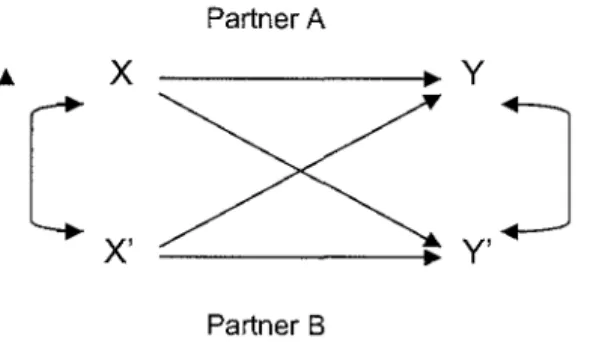
The Actor-Partner Interdependence model (APIM; Kashy & Kenny, 1999; Kenny, 1988, 1996) acknowledges that individuals' relationship outcomes are a function not only of their own characteristics (actor effects), but of their partners' characteristics (partner effects) as well. In Figure 2.1, X and X' are the independent variables (for example, neuroticism) of the partners, and Y and Y' are the dependent variables (relationship outcomes). Y is a function of both X and X', and similarly for Y'. The APIM also accounts for interdependence between the independent and dependent variables.
Partner A
...
X• Y
[
X'
. y,]
Partner B
Figure 2.1 The Actor-Partner Interdependence Model. Horizontal lines are actor effects and diagonal
lines are partner effects (Kenny, 1996a,b, p.434)
Kenny and Cook (1999) define four processes associated with the APIM. Actor-oriented processes occur when the actor effects are significant and the partner effects are not significant; partner-oriented processes occur when the partner effects are significant and the actor effects are not
significant; couple-oriented processes occur when the actor and partner effects are not significantly different; and social comparison processes occur when the actor and partner effects are complementary (that is, the sum of the actor and partner effects is zero).
2.2.4.2 Gender-Specific Model
The gender-specific model in heterosexual dyadic research "predicts that the man's personality will have different effects on the relationship than will the woman's personality" (Robins et aI., 2000, p.252). Until recently, in studies where both partners have been included, this has been the default model (e.g., Botwin et aI., 1997; Bouchard, Lussier & Sabourin, 1999;
Donnellan et aI., 2004; Eysenck & Wakefield, 1981; Gill, Christensen & Fincham, 1999).
Campbell and Kashy (2002) argue that the ability to distinguish partners by gender in heterosexual research leads researchers to assume "that gender is an important factor, and that differences between men and women exist" without formally testing this assumption (Campbell & Kashy, 2002, p.327). Furthermore, attempts to test gender-effect differences are often based on comparison of coefficient sizes even when female and male data have been analysed separately. This is inappropriate as the population parameters may differ by gender.
2.2.5 Relationship Satisfaction Research: Issues
A number of issues are associated with research into the determinants of relationship satisfaction.
2.2.5.1 Theoretical Issues
Fincham, Beach and Kemp-Fincham (1997) echo the sentiment expressed by Bowerman (1964) that close relationship research "is
characterized by a lack of adequate theory" (p.276), and more often than not, studies do not explicate the specific theoretical tenets upon which their hypotheses are based (e.g., Barelds, 2005; Bouchard et aI., 1999; Kelly, Huston & Cate, 1985; Markman, 1991; McGonagle, Kessler & Gotlib, 1993; Nemechek & Olson, 1999; Ting-Toomy, 1983a). Table A.6 documents examples of models that have been applied to relationship research.
This lack of theoretical underpinning has resulted in a proliferation of fragmented and unrelated research investigations resulting in mixed and
ambiguous findings. There is still, for example, little consensus about what factors constitute constructs like conflict behaviour and relationship
satisfaction which in turn limits psychological understanding of relationship outcomes.
2.2.5.2 Dimensionality Issues
The lack of consistent theoretical bases for the evaluation of couple relationships has led to disagreement regarding its dimensionality. The Dyadic Adjustment Scale (DAS; Spanier, 1976), for example, evaluates relationships in terms of four scales: dyadic satisfaction, dyadic consensus, affectional expression, and dyadic cohesion. A number of studies, however, have been unable to replicate this structure and have found only
unidimensional or bidimensional factors (e.g. Norton, 1983; Sharpley & Cross, 1982). Kurdek (1992b) was able to replicate all four scales, but concluded that the only useful one for clinical assessment was dyadic satisfaction. The DAS has also been criticised by Roach, Frazier and Bowden (1981) for its excessive focus on cognitive constructs without sufficient emphasis on the affective dimension. Another popular
multidimensional instrument, the Marital Adjustment Test (MAT; Locke & Wallace, 1959) was factor analysed by Eysenck and Wakefield (1981) yielding four distinct significant components: To Marry or Divorce,
Agreement, Sex and Affection, and Time Together. A similar exercise by Johnson, White, Edwards and Booth (1986), however, revealed only two strongly correlated factors (r = .77) - positive and negative relationship satisfaction. Kimmel and Van Der Feen (1974) concluded that the MAT represents a single factor.
Another criticism of multidimensional relationship evaluation instruments is that the scales are usually correlated to a degree where collinearity
becomes an issue. It is claimed that they are usually tautological and circularly defined in terms of the independent variables that predict them (Fincham, 1998; Johnson et aI., 1986).
In response to these criticisms, a number of unidimensional or global relationship assessment instruments have been developed. Among the most popular are the Quality of Marriage Index (QMI; Norton, 1983), the Kansas Marital Satisfaction Scale (Schumm et aI., 1986), and the Relationship
Assessment Scale (RAS; Hendrick, 1988). These instruments reflect a single construct view of relationship satisfaction, or at most, independent positive and negative attitude scales (Delamater, 2003; Fincham & Bradbury, 1987; Fincham, Stanley & Beach, in press). Norton (1983) argues that
unidimensional scales are more useful clinically because couple relationship evaluation does "not convey a fixed picture of discrete categories ... but suggests a continuum ranging from high to low" (Norton, 1983, p.141). In support of a global scale, Karney and Bradbury (1997) compared the multidimensional MAT and the QMI and found little difference between the slopes and intercepts of the scales. They concluded that a global instrument was more efficient for the assessment of relationship outcomes.
A criticism levelled at global relationship evaluation scales is that they do not usually assess possible causes of (dis)satisfaction such as
personality, interpersonal conflict and demographic variables, and therefore do not provide clinicians with sufficient indication of relationship problem areas (Fruzzetti, 1996; Gottman, 1990). Furthermore, it is argued that
complex relationship attitudes cannot be meaningfully reduced to a single score without significant loss of information (Fincham & Linfield, 1987; Spanier & Lewis, 1980).
It may therefore be concluded that unless the assessment context specifically requires multiple dimensions, global measures are generally indicated. However, in clinical settings, multidimensional instruments may be more useful because they provide a realistic means of assessing a variety of potentially pertinent relationship factors (Christensen, 1998).
2.2.5.3 Non-uniform Assessment
Concern has been expressed about the proliferation of satisfaction scales and measurement instruments in couple research resulting from the lack of definitional and theoretical consistency discussed in this section (Braiker & Kelley, 1979; Burnett, 1987; Roach et aI., 1981; Snyder, 1979). This non-standardisation distorts between-study comparisons and hinders progress in the understanding of couple outcome mechanisms.
2.2.5.4 Partner Interdependence Issues
It is argued that that "couples and families need to be studied as systems" (Raush, Barry, Hertel and Swain, 1974, p.5), a view that reflects a number of relationship theories acknowledging the role of partner
interdependence in determining the relationship satisfaction of each (e.g. Kelley & Thibaut, 1978; Messick & Crook, 1983; Rusbult, Johnson & Morrow, 1986). Kenny (1996, 1998) cites four sources of non-independence in close dyads: compositional effects such as assortative mating where the partners' selection is based on similar attributes; partner effects where the behaviour
of one partner influences the other; mutual influence where partners both influence each other on a particular attribute; and common fate where members of the couple are influenced by the same external factors such as, for example, income.
Yet when studies appearing in five family and couple relationship research journals published between 1994 and 2002 were reviewed, it was found that 70% of the data was based on only one partner "in spite of the fact that a quintessential feature of relationships is that partners' thoughts,
feelings and behaviors are causally connected" (Kashy, Campbell & Harris, in press, p.5).
Another concern linked to partner interdependence follows from the warning that "if observations on two individuals are independent of one another, then knowledge of scores on one individual provides no information whatever about scores on the other individual" (Cohen, Cohen, West and Aiken, 2003, p.536). As Table 2.1 indicates, this is clearly not the case in couple relationships because individuals in the same dyad are likely to be more similar to each other than individuals in different dyads (Hoffman & Gavin, 1998).
The random errors associated with the individual partners are therefore likely to include a constant error component attributable to the dyad. Such observations are therefore not independent and studies that have used traditional analytical techniques such as ordinary least squares regression and ANOVA have violated the independence of random errors assumption (e.g., Botwin et aI., 1997; Bouchard et aI., 1999; Watson, Hubbard & Wiese, 2000b). In addition, Raudenbush and Bryk (2002) note that in distinguishable
dyads, differing variances in partner populations may violate the homogeneity of variance assumption required by these techniques.
Table 2.1
Examples of Within-Dyad Partner Correlations Found by Previous Research Investigations Study Barelds (2005) Karney et al. (1994) Karney et al. (1994) Karney et al. (1994) Kurdek (1995a)
Neyer & Voigt (2004)
Robins et al. (2000)
Russell & Wells (1994b)
Relationship Assessment Instrument ORO MAT KMS OMI KMS German RAS Own instrument Own instrument Within-dyad partner correlations (r) .58 .70 .66 .66 .45 .44 .33 .49
DRQ: Dutch Relationship Questionnaire (Barelds & Luteijn, 2003)
KMS: Kansas Marital Scale (Schumm et aI., 1986)
MAT: Marital Adjustment Test (Locke & Wallace, 1959)
QMI: Quality of Marriage Index (Norton, 1983)
RAS: Relationship Assessment Scale (Hendrick, 1998)
The most serious consequence of incorrectly assuming independence of observations is the unpredictable effect on standard error, bias in tests of significance, and distorted assessment of Type I and Type II errors (8ryk & Raudenbush, 1992).
2.2.5.5 Sample Sizes
Karney and Bradbury (1995a) concluded in their meta-analysis of 115 relationship studies that sample sizes were generally too small to afford the power to detect small or even medium effects. This problem is exacerbated in studies that do not account for partner independence and which base power calculations on the number of individuals in the study rather than the number of dyads, or a function of the two (Kenny, 1995; Kenny & Judd, 1996; Satterthwaite, 1946).
2.2.6 Relationship Satisfaction: Summary
Relationship satisfaction is an important construct in couple outcomes research because of its association with physical and mental health, and general well-being. A fundamental problem when researching the causes and correlates of relationship satisfaction is the lack of theory underpinning many research investigations. Without multivariate, multidisciplinary and multi-paradigm models, the mechanisms leading to changes in satisfaction cannot be understood and only limited variance in satisfaction can be explained.
The following section considers associations between interpersonal conflict behaviours and relationship satisfaction.
2.3 Conflict Behaviours and Relationship Satisfaction
2.3.1 Introduction
Conflict is an inevitable and integral element of intimate couple
relationships (Bolger & Schilling, 1991; Christensen, 1987; Cramer, 2004a; Gottman, 1979; Noller & White, 1990). Some researchers contend that the more intimate the relationship, the greater the inevitability and potential for interpersonal conflict behaviour (Billingham, 1987; Braiker & Kelley, 1979; Rands et aI., 1981).
The centrality of couple conflict behaviour in the psychology of couple dynamics is evidenced by the volume of related literature and the number of psychotherapeutic approaches dedicated to its reduction (e.g., Campbell, Simpson, Boldry & Kashy, 2005; Gottman & Krokoff, 1989; Jacobson & Margolin, 1979; Sillars, Canary & Tafoya, 2004; Snyder & Castellani, 2006; Stanley, Bradbury & Markman, 2000; Stuart, 1969).
The study of conflict behaviour in couple relationships is important not only because of its links to relationship distress, but because negative conflict has been associated with declines in physical and mental health, relationship instability, and physical abuse (Billingham, 1987; Booth, Crouter & Clements, 2001; Buss & Shackelford, 1997; Christensen & Heavy, 1999; Feldman & Ridley, 2000; Johnson & Ferraro, 2000; Rogge & Bradbury, 1999; Straus, 1979; Vivian
&
Heyman, 1996).Yet despite the inevitability of conflict behaviour in couple relationships, scholars argue that it is not the existence of conflict that is threatening; it is the partners' behavioural responses to it that determines relationship
outcomes (Canary & Spitzberg, 1989; Gottman, 1994; Markman, Floyd, Stanley & Storaasli, 1988; Sillars & Weisberg, 1987). Koerner and Jacobson (1994) extend this argument and claim that the management of conflict behaviour is the central task for relationship success, and that relationship distress is a direct result of "couples' aversive and ineffectual response to conflict" (p.208).
The current chapter therefore focuses on the role of conflict behaviour as a correlate of relationship satisfaction. It is relevant to the current
investigation because in order to demonstrate that conflict behaviour mediates the association between a couple's personalities and their
relationship satisfaction, a significant association between conflict behaviour and relationship satisfaction must be demonstrated (Baron & Kenny, 1986; Shrout & Bolger, 2002).
This section will define couple conflict behaviour and discuss theoretical models underpinning its research and assessment. The literature linking conflict behaviours and relationship satisfaction will then be reviewed followed by a discussion of the issues in this area of research.
2.3.2 Defining Couple Conflict Behaviour
As was the case in defining romantic relationship satisfaction,
definitions of conflict behaviour vary to such an extent that Van de Vliert and Euwema (1994) argue that a "Babel-like confusion of tongues exists
regarding the denomination and classification of conflict behaviours" (p.674), a sentiment echoed by many relationship researchers (e.g. Bradbury et aI., 2001; Weiss & Oehle; 1994). Shantz (1987) argues that definitional
inconsistency arises because terms like hostility and disagreement are too broad, too difficult to operationalise, and lead to ambiguity. Canary, Cupach and Messman (1995) suggest that it is because conflict behaviours are studied at multiple levels such as microscopic verbal behaviours, specific conflict episodes, and global conflict tendencies across relationships.
The view favoured by the current research is that conflict arises in romantic relationships when one partner obstructs the personal or relationship goals of the other (Fincham & Beach, 1999; Lewin, 1948). However, other perspectives are also relevant. Holmes and Miller (1976), for example, contend that at least some conflict may reflect the internal state of the individual (autistic conflict) irrespective of actions of a relationship
partner. This actor view of conflict behaviour will also playa role in the current investigation.
2.3.3 Theoretical context
Interpersonal theories are a category of psychological models used to describe and predict interactional behaviour in social contexts. In the context of intimate couple relationships, the behaviourally based social learning theory (SL T) is an important paradigm (Hahlweg & Jacobson, 1984; Hahlweg & Markman, 1988; Jacobson & Margolin, 1979; Stuart, 1969). This is
because a substantial portion of couple research to date has been undertaken by behavioural scientist-practioners involved in assisting distressed couples (Christensen & Heavey, 1999; Markman et a!. 1988; Rusbult & Van Lange, 2003). However, because traditional behavioural models have focused on the behaviour of the individual (e.g. Beck, 1967;
Skinner, 1938) rather than the dyad, supplementary models such as social exchange theory have been introduced to incorporate dyadic interaction.
Social exchange theory is a family of models based on behavioural economics (Braiker & Kelley, 1979; Homans, 1961; Huesmann & Levinger, 1976; Thibaut & Kelley, 1959). The central tenet is that relationship
outcomes are a function of the rewards and costs associated with a relationship as perceived by the relationship partners. Rewards include social assets, and positive cognitions, behaviours, and affect. Costs are associated with social liabilities, and negative cognitions, behaviours, and affect (Rusbult, 1983; Rusbult & Van Lange, 2003). Furthermore, rewards and costs accumulate over the duration of the relationship (cf. Gottman's Balance Model, 1994, 1998). It is cost-reward balance at any time that determines relationship outcomes. Interdependence theory (Kelley &
Thibaut, 1978; Thibaut & Kelley, 1959), an important social exchange model - additionally incorporates partners' expectations. Specifically, it contends that individuals whose actual relationship outcomes in terms of rewards and costs are greater than their expected outcomes are more likely to experience relationship satisfaction.
While social exchange theory focuses on a broad spectrum of interactional relationship behaviours, the application of SL T to romantic relationships is typically restricted to conflict interactions (Gottman, 1979; Jacobson & Margolin, 1979; Stuart, 1969). More specifically SL T posits that conflict behaviour is the most important determinant of relationship
satisfaction, a perspective supported by Clements, Cordova, Markman and Laurenceau (1997) who concluded that "the positive factors that draw people
together are indicative of marital choice, but not marital success. Instead how couples handle differences is the critical factor" (p.352).
Analogous to social exchange theory, rewards in social learning are associated with positive conflict behaviours while costs are associated with negative conflict behaviours. Examples of positive behaviours include constructive conflict resolution styles, infrequent conflict, positive conflict outcomes, and acknowledgment of a partner's perspective. Negative behaviours include frequent, coercive, destructive conflict resolution styles, and an unwillingness to compromise (Canary & Cupach, 1988; Gottman & Levinson, 1992; Heavey et aI., 1993). According to the social learning model, relationship distress occurs when the number of negative conflict behaviours exceeds the positive conflict behaviours. Gottman (1994, 1998) attempted to quantify this association with a 'Balance' or 'Bank Account' model arguing that the ratio of positive to negative behaviours in romantic relationships should be at least five positive to one negative to achieve relationship satisfaction. This is supported by Birchler et al.'s (1975) finding that for non-distressed couples the ratio was 29.66, and for non-distressed couples, 4.30 to 1.00
2.3.4 The Assessment of Couple Conflict Behaviour The assessment of conflict behaviour is often categorised into
laboratory observation and self-report approaches. Observational methods are typically favoured by behaviourally oriented researchers in accordance with the oft-cited argument that "studying what people say about themselves is no substitute for studying how they behave" (Raush et aI., 1974. p.5).
Observational techniques typically involve couples being requested to discuss a contentious relationship issue in a laboratory for between 15 and 60 minutes while their verbal and/or non-verbal behaviours are rated by trained assessors using predefined coding systems (Gottman, 1994). Commonly used coding systems include the Couples Interaction Scoring System (CISS; Gottman, 1979), the Marital Interaction Coding System (MICS; Weiss & Summers, 1983), and the Conflict Coding System (CCS; Sillars, 1986).
In contrast, self-report approaches usually utilise questionnaires (e.g. Straus, Hamby, Boney-McCoy
&
Sugarman, 1996) or diary methods (e.g. Bolger, Davis & Rafaeli, 2003; Feeney 2002) and focus on the partners' feelings, attributions, beliefs, experiences, attitudes, and perceptions of their conflict (Buysse et aI., 2000). Examples of conflict-oriented self-report instruments include the Management of Differences Exercise (Kilmann & Thomas, 1977); the Conflict Tactics Scale (Straus, 1979); the Marital Coping Inventory (Bowman, 1990); and the Conflict Resolution Style Inventory (Kurdek, 1994a).There is some debate about the relative advantages and disadvantages of each approach. Many behavioural psychologists argue that observational approaches can detect non-verbal conflict behaviours unavailable via self-report such as the use of micro-observational techniques for detecting conflict markers such as rapid variation in facial expression (Foster, 1987). They argue that together, observed micro- and macro-observational
(e.g. Floyd & Markman, 1983; Hahlweg, Kaiser, Christensen, Fehm-Wolfsdorf & Groth, 2000; Margolin & Wampold, 1981).
Multiple-rater laboratory observation also helps to obviate common method variance, a problem that leads to inflated correlations when
participants use self-report instruments for more than one variable in a study (Bank, Dishion, Skinner & Patterson, 1990; Canary et aI., 1995).
Observational approaches also suffer from a number of disadvantages. The face validity of laboratory observational techniques for conflict
assessment is unclear because of the uncertainty as to whether what is being observed is actually conflict behaviour or couples feigning these behaviours in an artificial environment (Cramer, 2002a; Resick et aI., 1981). It is also unlikely that conflict tactics such as abuse, violence, and avoidance will be exhibited under laboratory conditions whereas they may be exhibited at home where social demand effects are unlikely to influence conflict behaviours (Vincent, Friedman, Nugent
&
Messerly, 1979). Cramer (2002b)also questions the validity of laboratory observed conflict behaviour in that the limited time usually afforded to couples (often only 15 minutes) may not be sufficient to observe the full range of conflict behaviours generally used, or to reach a typical relationship outcome.
Observational methods are also problematic because of the number of coding systems in use and the difficulties that this creates when attempting inter-study comparisons. Observational techniques are also costly and time consuming, and Gottman and Krokoff (1989) note that one hour of conflict may require up to 24 hours to code. Studies using observational techniques
therefore tend to use small samples and claims about predictive validity may therefore not be accurate (Kurdek, 1994a).
Self-report instruments offer a number of advantages over observational approaches. They are able to access partners' subjective experiences,
attitudes, and interpretation of conflict. They also increase ecological validity in that self-reports facilitate an understanding of conflict behaviour in the natural settings where it occurs as opposed to artificial laboratory
environments. Finally, self-reports are more efficient and cost-effective relative to observational methods (Canary et aI., 1995).
A key disadvantage of self-reports is that as retrospective instruments, they may introduce perceptual and recall bias (Christensen & Nies, 1980; Noller, Feeney, Bonnell & Callan, 1994; Sillars, 1985). Bono, Boles, Judge and Lauver (2002) also found that partners' recall of conflict frequency was a function of their individual personality traits. Self-reports may also suffer from attribution bias in that participants may tend to over estimate the role of their partner's personality in conflict (Sillars, 1985). Gottman et al. (1976) argue that couples in distressed relationships are likely to overestimate the
presence of negative interactions and underestimate positivity by up to 50%. Finally, Markman and Notarius (1987) note that it is unlikely that self-reports are capable of capturing the same levels of conflict granularity as
observational methods.
2.3.4.1 Conflict Assessment Approaches: Summary
Observational and self-report assessment methods each offer unique and complementary perspectives into the assessment of couple conflict
behaviours. Ideally, both methods should be applied in the same study for optimal insight (Donnellan et aI., 2004; McGonagle et aI., 1993; Prins, Foster, Kent & O'Leary, 1979). However, given the extensive resource requirements associated with observational research, self-reports may be more
appropriate for exploratory investigations.
In closing, it is worth noting Heavey, Larson, Zumtobel and
Christensen's (1996) observation that in certain contexts, observational techniques and self-reports provide similar results. If suitable self-report instruments are developed, relationship psychologists may become less reliant on resource-intensive observational approaches.
2.3.5 Conflict Behaviour and Relationship Satisfaction: Research Numerous studies have considered associations between conflict behaviour and intimate couple relationship satisfaction (see Appendix A, Table A.5). This section will review key couple conflict research
investigations using the taxonomy suggested by McGonagle et al. (1993) which is the one used in the current study. The conflict dimensions
considered are conflict style, avoidance of conflict, conflict frequency, and conflict outcomes. These categories are by no means exhaustive, an issue that will be considered further in section 2.3.6.4.
2.3.5.1 Conflict Style
Conflict styles are defined as "individual tendencies to manage conflict episodes [in] a particular way" (Canary et aI., 1995, p.1 0). Many studies have shown that conflict style is an important factor in discriminating between