SOUTHERN NEW HAMPSHIRE UNIVERSITY
MASTER OF SCIENCE I N COMMUNITY ECONOMI CDEVELOPMENT (2005)
PROJECT PROPOSAL FOR SOLID WASTE COLLECTION KAWE COMMUNITY DEVELOPMENT TRUST.
A PROJECT REPORT SUBMITTED IN PARTIAL FULFILMENT OF THE REQUIREMENTS FOR THE DEGREE OF MASTER OF SCIENCE IN COMMUNITY ECONOMIC DEVELOPMENT (MSC - CED ) IN THE
SOUTHERN NEW HAMPSHIRE UNIVERSITY AND TH E OPEN UNIVERSITY OF TANZANIA
SUPERVISOR CERTIFICATION
This i s t o certif y tha t I have gone through the projec t repor t o f Jane K. Mtey title d "PROJECT PROPOSA L FO R SOLI D WAST E COLLECTIO N A T KAW E COMMUNITY" and foun d i t is in a form acceptable for th e partia l fulfillmen t o f th e requirement fo r th e MASTE R O F SCIENC E I N COMMUNIT Y ECONOMI C DEVELOPMENT o f the Souther n New Hampshire University and Ope n University of Tanzania.
Maria Marealle.
NATIONAL HOUSING CORPORATION. DAR ES SALAA M
COPYRIGHT:
All rights reserved. N o part of this work may be reproduced, copie d or transmitted i n any for m o r b y any means electronic o r mechanical, withou t prio r permission o f th e author.
DECLARATION:
I, JAN E K . MTEY, declar e that this project repor t fo r th e fulfillmen t o f Master of Science Degree in Community Economic Development is based on my own efforts and solely done by myself unless where quoted for learning purposes as it has been stated. This work has not been presented at any university or institution for similar purposes.
DEDICATION
I exten d m y appreciatio n t o m y lovel y children , Jennife r an d Kenned y fo r thei r understanding when they missed my foil motherly care when I was busy undergoing my Msc CED course.
I also extend my appreciation to my husband Kassian (with whom we were undergoing the cours e together ) for hi s sincer e suppor t an d encouragemen t apar t from his busy learning schedule.
settlement, whic h hav e a direc t positiv e impac t o n communit y health , creatio n o f employment, income generation and poverty reduction.
The purpose o f this study is to see how a CBO involve the community in the solid waste management project i n order to solve the problem of uncollected waste after th e failure of the municipal council to do so. The study examines the performance o f the existing solid waste collection and disposal practices, community willingness to participate and identifying problem s relatin g t o th e soli d wast e managemen t syste m o f th e Kaw e community. Th e finding s hav e bee n use d i n preparin g a n improve d soli d wast e collection project proposal required by the CBO. The study was carried out in two areas (Ukwamani an d Mzimuni) , wher e Kaw e Communit y Developmen t Trus t a dul y registered CB O is established. Methods used in the study are, questionnaires, interview s and observation. I t has been found that there is illegal dumping of waste; low level of awareness and environmental health related diseases afflict the community. Over 80% of the communit y members accepte d t o participate through paying refuse collectio n fees. The succes s o f communit y base d soli d wast e managemen t projec t depend s o n th e participation o f th e communit y from th e initia l stag e o f designin g th e project , implementation, monitorin g an d evaluation . Solicitin g fund s fo r implementin g th e project is important as well as providing training and sensitization of the community.
AKNOWLEDGEMENT
I am obliged to give my sincere gratitude to all parties who in one way or another were involved i n th e productio n o f th e fina l projec t report , includin g leaders o f Kaw e Community Development Trust who facilitated my work and appropriately responding to the Project Questionnaire.
Also, I would like to thank Mrs. Maria Marealle, my supervisor for her cooperation and guidance at different stages starting from research proposal to the final product. She was persistently providing me support even at times when it meant interfering with her off-duty hours.
ABBREVIATIONS:
CBO Community Based Organization CDS City Development strategy
DCC Dar e s salaam City Council/ Dhaka City corporation EPM Environmental Planning Management
GIS Geographic Information System IDP Integrated development Plan ILO International Labour Organization
IMEP Integrated Metropolitan Environmental Plan JKT Kiswahili translation for National Service
KAWWS Karachi Administration Women's Welfare Society KCDT Kawe Community Development Trust
KEG Kawe Environmental Group
KIMWODA Kinondoni Moscow women development Association MSW Municipal Solid Waste
NGO Non Governmenta l Organization PSC Project Steering Committee REPOA Research on Poverty Alleviation RCC Refuse Collection Charges SDP Sustainable Dar es salam Project SMMEs Small, Micro and Medium Enterprises
SWM Soli d Waste Management UNICEF Unite d Nations Children Fund
UNCHS Unite d Nation Center for Human Settlement
TABLEOF CONTENT S SUPERVISORS CERTIFICATION i COPYRIGHT i i DECLARATION ii i DEDICATION i v ABSTRACT v AKNOWLEDGEMENT vi i ABBREVIATION vii i TABLE OF CONTENTS i x CHAPTER 1 1.0 INTRTODUCTIO N 1 1.1 Introductio n 1
1.2 Backgroun d information of Kawe Community Development Trust. 3 1.2.1 Backgroun d 3 1.2.2 Missio n statement 3 1.2.3 Visio n 4 1.2.4 Objective s 4 1.2.5 Ongoin g programs 5 1.2.6 Activitie s 5 1.3 Proble m statement • • 5
1.5 Researc h Objectives . . 6 1.6 Researc h Questions 6
1.7 Rational e and Significance of the study 7
1.8 Researc h scope and limitations of the study . 8 1.9 Th e assignment 9
CHAPTER II
2.0 LITERATUR E REVIEW 1 0
2.1 Theoretica l Review... 1 0
2.1.1 Conventiona l Approache s t o Plannin g o f SW M of th e Urba n
Environment... 1 0
2.1.2 Alternativ e Approache s t o Plannin g o f SW M o f th e Urba n
Environment 1 4
2.2 Empirica l Review 1 7
2.2.1 Existin g SWM practice in Dar es salaam 1 8
2.2.2 SW M the case of KIMWODA CBO in Kinondoni Hanna Nasif in
Dar es salaam city 2 2
2.2.3 A case study of SWM in Metropolitan Cape town - Sout h Africa 2 8 2.2.4 A case study of SWM in Dhaka city - Bangladesh 3 6 2.2.5 A case study of Karachi Administraton women's welfare society
(KAWWS) - Faisalabad , Pakistan 4 5
2.3 Polic y Review.... 5 0 CHAPTER II I 3.0 RESEARC H METHODOLOGY 5 4 3.1 Introductio n 5 4 3.2 Researc h Design 5 5 3.3 Unit s of inquiry 5 6 3.4 Samplin g Techniques. 5 6
3.5 Dat a collection Methods.. 5 6
3.6 Dat a Analysis Method 5 7
CHAPTER IV
4.0 STUD Y FINDING S AND RECOMMENDATIONS 5 8
4.1 Introductio n 5 8
4.2 Demographi c features 5 8
4.3 Soli d waste management practice in Kawe 5 9
4.3.1 Wast e collection and disposal methods. 6 1
4.3.2 Th e condition of cleanliness 6 2
4.4 Communit y participation 6 2
4.4.1 Leve l of awareness... 6 2
4.4.2 Paymen t for refuse collection fees. 6 5
4.6 Conclusio n and Recommendations. 6 9 4.6.1 Conclusio n . 6 9 4.6.2 Recommandations.... . 7 1 CHAPTER V 5.0 IMPLEMENTATIO N OF ASSIGNMENT 7 4 5.1 Projec t Proposal... 7 6 Bibliography. 9 3 LIST OF TABLES :
Table 1: Categorize d age of respondents... 5 9
Table 2: Participatio n in existing cleaning program. 6 0 Table 3: Wast e collection and disposal methods at Kawe 6 1
Table 4: Conditio n of cleanliness 6 2
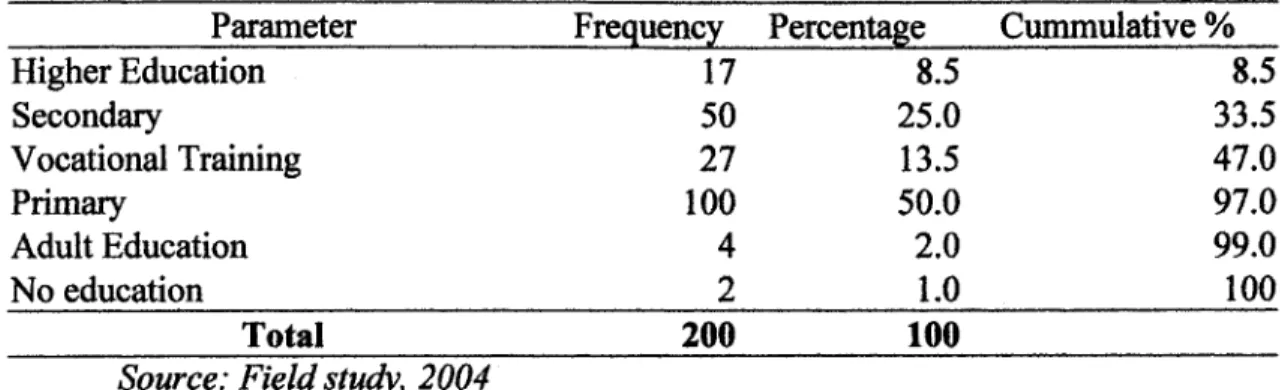
Table 5: Educatio n levels . 6 3
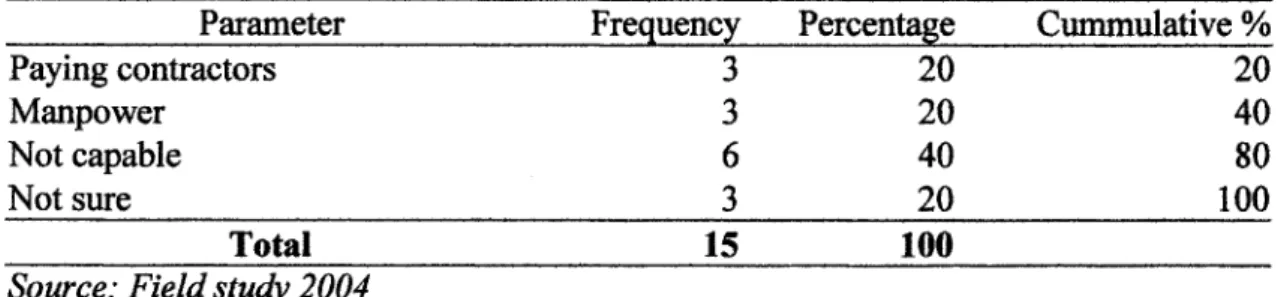
Table 6: Communit y capability on solid waste collection 6 4
Table 7: Read y to participate... 6 4
Table 8: Ho w wil l you participate... 6 6
Table 9: Commo n diseases at Kawe... 6 6
Table 10: Read y to participate now? 6 6
Table 11: Ho w wil l you participate?... 6 7
Table 12: Commo n Diseases at Kawe. 6 8
Table 14: Budge t 8 6
LIST OF FIGURES
Figure 1 Soli d waste management Model before EPM intervention 1 3 Figure 2 Soli d waste management Model after EPM intervention, 1 6
Figure 3 Propose d Project Organization Structure 5 5
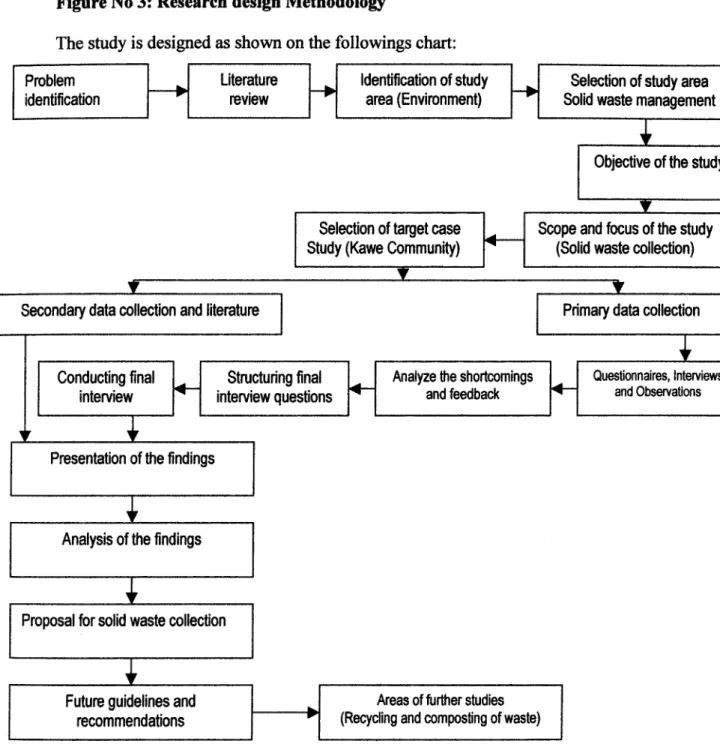
Figure 4 Researc h design Methodology 9 0
APPENDICES:
APPX NO PARTICULAR S
1 Lette r of introduction
2 Acceptanc e letter from KCDT 3 Questionnaire s
4 Th e work plan
CHAPTER I 1.0 INTRODUCTION.
1.1 Introductio n
A commo n proble m amon g Su b Sahara n citie s i s lac k o f appropriat e institutiona l mechanisms to folly address the solid waste management question . Rapid urbanization, abject povert y an d inadequat e managemen t capacit y a t th e municipa l leve l hav e constrained th e abilit y o f citie s t o provid e basi c collectio n and disposa l services , resulting into numerous social and environmental ills. Urbanization and rapid economic growth in the country has resulted into large increase in refuse outpu t
Solid waste management (SWM ) is one of the basic services that are currently receiving wide attentio n i n the urba n agend a o f many developin g countries. Sei k (1997) ha s reported that lack of effective SW M can result in environmental health hazards and has negative impac t o n th e environment . Thi s extends wide r than just th e geographica l boundaries of the town or municipalities.
Inadequate solid waste collection services in unplanned urban settlements are one of the serious problems i n Tanzania. In most case s the majorit y o f the uncollecte d waste i s generated i n the poorer neighborhoods. The city is growing at a rate of 7% per annum and i t i s estimate d tha t about 70 % of the populatio n liv e i n informal or unplanne d settlements (Mbuligwe and Kassenga, 2004). Ther e are several reasons why it is often a low priority to collect solid waste from low-income areas. These include difficult access ,
low socia l status, lack of land tenure, awareness, lack of incentives to collector s and lower value of waste produced. (Adrian Coad, 2003)
According t o Mengisen y E . Kasev a an d Stephe n E . Mbuligw e (2002) , th e curren t amount o f soli d wast e generated i n Dar es Salaam , whic h is the business/economi c capital city of Tanzania, is about 2425 tons per day and the average waste rate is within the range of 0.40 kg per day. The income level is a determining factor for domestic solid waste generatio n rates . Thei r stud y indicate d tha t soli d wast e collection by the cit y municipalities is approximately 10% of the total solid waste generated, while solid waste collection by private contractors i s 24.4%, Collection through recycling is approximated to 5.5% of the total waste generated in the city. This means about 60% of the waste is uncollected most of it being in unplanned and marginal areas such as Kawe.
Furthermore the research found that the privatization of solid waste collection activities has improve d from 10 % to 40 % of the tota l wast e generated i n the cit y daily. The collectors include the individual contractors, Non Governmental Organizations (NGOs) and Communit y Base d Organization s (CBOs ) wh o normall y specializ e i n primar y collection from household to a collection point.
Kawe Community Development Trust (KCDT) is one of the CBOs that were established for, among other things to deal with solid waste problems, the organizatio n which the author is assigned to prepare this proposal.
1.2 Background information of the Kawe Community Development Trust 1.2.1 Backgroun d
Kawe Communit y Developmen t Trus t (KCDT ) i s a registere d communit y base d organization registered o n 6t h February 2002 under the trustees' incorporation ordinance (Cap 375). It has a status of being a non-governmental, non-religious , non-political and non-profit making organization. Its offices are based at plot No 973 KAWEDET House, Old Bagamoyo Road, Kawe area and its address is P.O Box 2522, Dar es salaam. Kawe Community Development Trust covers of two streets, namely, Ukwamani and Mzimuni with a tota l are a o f 2 squar e kilometers . Accordin g t o th e 200 4 census , th e tota l population of the community in Ukwamani is 16,000 people with 1,547 households and Mzimuni Street had 18,500 people with 4,050 households.
Kawe has three organs, namely, the Kawe Elders council, Trustees of Kawe Community Development Trust . Kaw e Elders Counci l i s th e mai n development orga n fo r Kawe residents. The Trustees are the executive committees of Kawe Elders Council.
1.2.2 Missio n Statement.
The organization does not include a mission statement as such but has its vision and objectives clearly stated in its By-laws and brochures:
1.2.3 Visio n
The vision of Kawe Community Development Trust is to establish;
1) A consciou s integrate d communit y wit h capacity fo r self-motivate d development , sustained b y solidarity and spiritual , intellectual, physical, governmental an d legal resources.
2) A sharing ethical community that values mutual support and self-advancement .
3) A community that values and conserves its resources, and has a culture of saving and investing in development.
1.2.4 Objective s
Kawe Community Development Trust has the following objectives;
1) T o promot e solidarit y an d cooperatio n amon g Kaw e resident s fo r communit y development.
2) To initiate and implement community development projects relating to land, housing, health, education, food, clothing, the environment and culture.
3) T o coordinate and evaluate progress in relation to those projects.
4) T o cooperat e with Governmen t an d it s agencie s i n promotin g communit y development in Kawe.
5) T o involv e other institution s an d individuals , both nationa l an d foreign , wh o ar e willing t o cooperat e with Kaw e resident s i n implementin g thei r developmen t projects.
1.2.5 Ongoin g Programs
KCDT is engaged in five main programs. Thes e includes, Community Bank, Education, Kawedet Women Micro Finance, Women Housing and solid waste collection. Healt h is among the fore coming programs.
1.2.6 Activitie s
From th e above-mentione d program s there are fe w activities , which are activ e a t th e moment. These include:
- Communit y Bank: With regard to community banking, activities involve provision of short- term micro-loans service to residents through the Kaya (adjoining households ) - Education : A Preprimary School , namely Waldor f Kindergarten alread y constructe d
and is operating.
- Wome n micro-financing - Wome n housing Project
- Soli d waste collection. It is at the initial take off stage.
1.3 Proble m Statement.
Poor soli d wast e collection and disposa l i s a threat to publi c health an d reduce s th e quality of life for urban residents especially in-unplanned settlements . Kawe area is one of the typical examples o f such settlements. The municipal council has failed to solve the problem of solid waste management in Kawe Mzimuni evidenced by roadside heaps of uncollected waste. The municipal council engaged a private contracto r i n the area who
failed t o provid e the servic e in this unplanned area. Reason s for the failur e include difficult access , low social status, lack of land tenure, awareness, lac k of incentives to collectors and lower value of waste.
1.4 Purpose of the study
To study the existing solid waste management practice s and collect information which will assist in preparing a solid waste collection project proposal required by the CBO.
1.5 Research Objectives
The objectives of the research are:
- To examine the performance of the existing solid waste collection and disposal practices.
- T o establish whether the community is willing to participate and contribute towards solid waste management.
- T o identify an d locate where the problem s are withi n th e soli d wast e managemen t system.
- T o use th e researc h finding s for designing an improved and sustaining solid wast e management project proposal.
1.6 Research Questions
In order to achieve the above objectives, the following questions should be answered; - What are the existing methods practiced in the collection and disposal of solid waste?
- How does the community participate and contribute towards solid waste management? - What are the problems related to the solid waste management system?
- Ho w can the deliver y of an appropriate soli d wast e managemen t servic e should be improved and sustained?
1.7 Rationale and Significance of the study
Provision of basic infrastructure service s to the urban poor and ensuring their right to livelihood and access to resources i s central to the concept of urban sustainability and poverty eradication in developing countries. According to UNCHS (1996 ) one way of estimating the scale of poverty in urban centers is to base it on the number of people who live in poor quality houses or neighborhoods that lack the basic infrastructure service s such as SWM.
Several approache s hav e bee n suggeste d i n orde r t o improv e SW M i n developing countries includin g Tanzania . Chan , (1998 ) ha s reporte d environmenta l awarenes s campaigns throug h mas s media and advertisement s t o promot e publi c awareness on SWM an d other environmenta l issues. In another study , Anjum an d Deshazo, (1996) proposed an approach based on integrating demand-side information into the planning,
Kaseva and Gupta (1996), Seik (1997), and Kaseva (2001), recommended an enhanced solid waste recycling as a sustainable approach towards SW M i n developing countries. One of the SW M approaches adopted by Dar es Salaam City Council is contracting out
waste collectio n and disposa l service s t o privat e soli d wast e collector s and disposal contractors.
The problem o f accumulation of uncollected soli d wast e particularl y in low priorit y areas such as unplanned settlements has contributed to poor sanitation and low qualit y of life. The production of waste in Kawe Mzimuni Street is 17 tons a day but only 3.5 tons per day is collected leaving 80% of the waste uncollected. This situation challenges a CBO lik e KCDT to operate in providing solid waste collection services.
To a large extent th e solid waste collection efficiency depends on the involvement and participation o f th e communitie s themselve s i n supportin g th e whol e concept . Furthermore, i t also depends on the usefu l informatio n and lessons from current best practices in the provision of this important service. Such information and lessons can be obtained only through research and studies; hence a research such as this can assist in the improvement and performance o f solid waste management i n the urban settlements .
1.8 Research scope and limitation of the study.
The study will examine the process of solid waste collection practice at Ukwamani and Mzimuni areas . The sampl e siz e is 20 0 households represente d b y the head s of the households an d community leaders obtaine d through stratified random sampling of the two areas. Equal chances wer e given to the members o f the community from the two streets and also the representation provide s the same community status. Due to limited
resources i n term s o f tim e an d finance the sampl e represent s 18.6 % o f th e tota l households at Kawe. Another limitation is the on going election mood, which sometimes caused doubt to the community members
1.9 The Assignment
Solid waste collection is a priority of the community, which has also got attention of the CBO. A joint needs assessment with the community was not done because of inadequate funds, tim e and logistics. For convenience purposes, questionnaire s metho d was used. This wa s supplemente d with ke y informan t interview s held wit h som e community members an d opinions of the leader s i n the area. The priority of need for solid waste management projec t wa s evidenced from th e needs assessments. SW M i s one of the CBOs ne w program and the activitie s are stil l a t th e initia l stag e organized under a registered group known as Kawe Environmental Group (KEG). M y assignment was to write a proposal, which wil l hel p the CB O in implementing the soli d waste collection project. Also my assignment included offering assistance on important issues required in the process, such as, preparing tender documents for the solid waste collection tender.
CHAPTER II 2.0 LITERATURE REVIEW
The revie w was base d o n empirica l sources , theoretica l reviews and polic y papers , where a number of books, publications, journal articles and Acts have been cited- Also articles (electronic) from different web sites were cited.
2.1 Theoretical Review
Solid Waste Management definition.
This is a term used to refer to the process of cleaning the environment by getting rid of the soli d waste materials. Yhdeg o Ibid, (1985) defines SW M a s the entire process of generating waste, collectin g and transporting waste, storin g waste at transfer stations , street cleaning, disposing waste and waste recovery, recycling and reuse.
Justine Ansch , (2001 ) on his part define s communit y based soli d wast e managemen t projects a s activitie s carried ou t b y member s o f th e communit y to clea n u p thei r neighborhood and or to earn income from solid waste. Examples are collection of solid waste, the sale of recyclable, recycling and composting activities.
2.1.1 Conventiona l Approache s t o Plannin g o f soli d waste management of th e Urban Environment.
In this approach the municipa l councils is the sol e responsible party in managing the solid wastes. They collect the waste from source in the communities, Central Business
District (CBD), industries and institutions and transport i t to the disposal sites. (Mgan a S, 1996)
For centuries, efforts t o address the urban planning and management hav e been guided by conventional approaches (Armstrong , 1987, Mattingly 1988 ; Halla, 1999 , Majani , 2002). I n develope d countrie s mechanism s o f conventiona l approache s hav e successfully tackle d thes e challenge s an d man y evidence s o f suc h successe s ar e remarkable in the United States of America, the United Kingdom, Germany and the rest of Europ e (Halla, 1999,2002) . The same approaches hav e been used to tackle similar challenges in the developin g countries including Tanzania with very little success not able t o provid e significan t solution s t o majo r problem s includin g soli d wast e management.
Management of Municipal Solid Waste (MSW) presents a major challenge for many Sub -Sahara Africa n citie s where rapi d growth, social an d cultura l changes, wid e spread poverty, inadequat e an d wea k loca l governanc e an d limite d financia l resource s al l contribute t o increasin g pollution an d wast e disposa l problems. (Onibokun , 1999 in Karanja e t al) . The inability o f responsible loca l authoritie s to provid e effective and reliable solid waste management services including solid waste disposal (Kalwani ,2003)
Onibokun, (1999) also found that there are several problems related to SWM caused by conventional approaches. Fo r example, inappropriate solid waste management cause s
air, soil and water pollution leading not only to environmental degradation but also to a growing catalogu e o f huma n healt h problems . Irresponsibl e soli d wast e dumpin g contaminates surfac e an d ground water supplies. In industrial and urban areas, washing "away" soli d waste s can clo g drains , creatin g stagnan t water fo r insec t breedin g an d potential for floods in rainy seasons. Uncontrolled burning and irresponsible incineration has a significant influence on air pollution. Organic wastes dumped in landfills generate greenhouse gases, an d untreate d leachat e pollutes surroundin g soi l an d wate r bodie s such as ground water supplies. These environmental problems include only the impact s of solid waste disposal; they exclude the impact of environmental damage resulting from extraction of resources an d processing materials, and the World Bank estimates that 95 percent of a product's environmental impact occurs before it is discarded as solid waste.
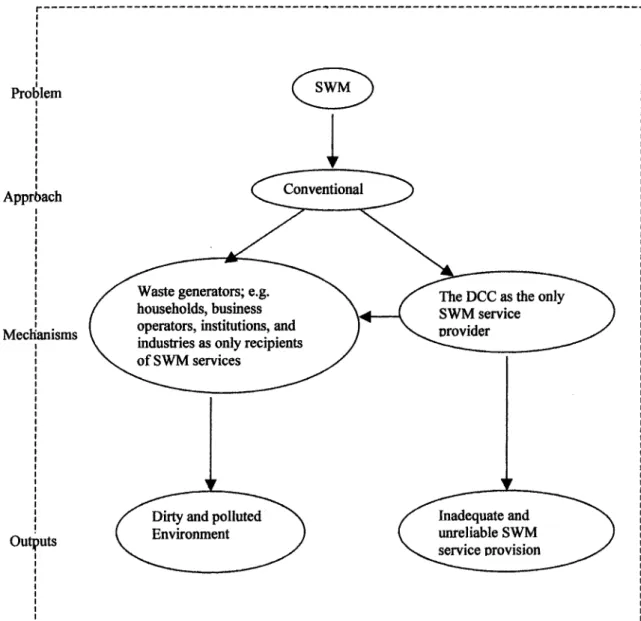
Problems of waste accumulation have become a serious threat to the health situation of many o f its inhabitants . Overall , mechanism s o f conventional approache s have bee n failing t o address urban challenge s (Worl d Ban k 1986 , in Halla 1999:9 4 Worl d Bank 2001:13). According to B. K Majani , (2000) , the failure of the conventional approaches has resulte d int o a set o f complex environmental problems that require more effectiv e approaches to address. The conventional approaches have failed to address problems due to their serious conceptual and practical weaknesses, Halla , (1994). The diagram below illustrates the conventional approach (see figure No 1).
Figure No 1: Soli d waste Management Model before EPM Interventions Problem Approach Mechanisms Outputs L
Source: Samson Elisha, 2003
SWM
Conventional
The DCC as the only SWM service
provider Waste generators; e.g.
households, business operators, institutions, and industries as only recipients of SWM services
Dirty and polluted
Environment Inadequate and unreliable SWM service provision
2.1,2 Alternativ e Approaches to Planning of SWM of the Urban Environment EPM is an alternative approach to urban planning and management, has been introduced in preference of conventional urban development planning and management approache s based on grounds that issues that need to be addressed in cities, as already pointed out, are beyond the competence of only conventional approaches (Majani, 1998) . The aim of EPM i s to enhance the capacity of actors in the public, private and popular sectors to planning and manage the urban environment. In practice however, EPM does not diffe r significantly from the conventional approaches, except that it is flexible and embodies transparence, act s o n priorit y issue s tha t ar e crucia l t o a community , emphasizes partnerships an d th e nee d t o ta p privat e secto r resource s t o provid e public service s (Majani, 2002).
Many countries have thus responded to the problem of urban waste by introducing solid waste managemen t system s tha t encourag e a public / privat e partnership. Communit y groups are encouraged to form associations that deal among other issues with the solid waste management. Private contractors have also been invited to participate.
Solid wast e managemen t i s a publi c servic e an d loca l government s o r respectiv e municipal agencies are basically responsible for its delivery. It is therefore imperative that municipal authorities remain in charge of this task to achieve an overall consistent SWM system on a municipal-wide and regional level. However this does not mean that government authorities have to deliver the actual collection services themselves. In fact,
private enterprise s o r CBO s can , unde r appropriat e conditions , provide soli d wast e collection, transfer, transport , an d disposal services more efficiently an d at lower costs than the public sector (Mgana S, 1996). It is evidenced that communities are more than willing t o provid e for themselve s urba n servic e lik e wast e managemen t whe n loca l authorities are unable to do so (Kim Peter, 1998).
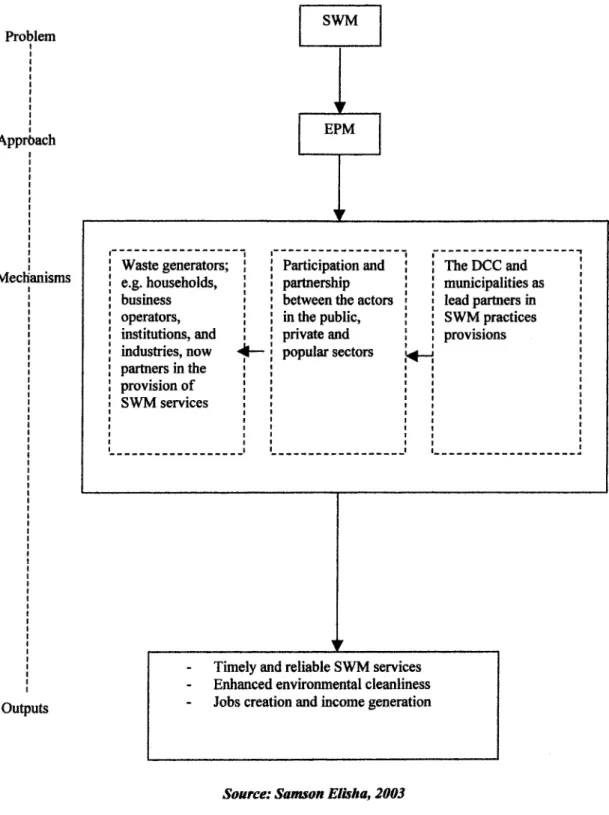
The Government role then shifts to that of facilitator and supervisor of the service. It is undeniable tha t ever y collectio n scheme , includin g non-governmenta l approaches , requires som e support from the municipa l authorities to achieve sustainability. Hence , municipal enterprise s an d organization s mus t b e include d whenever possibl e i n the planning o f such schemes. Th e diagram below illustrates the alternativ e approac h of planning SWM in the urban environment (see figure No 2).
Figure No 2: Solid Waste Management Model after EPM Interventions
Problem
Approach
Mechanisms
Outputs
Source: Samson Elisha, 2003 SWM
EPM
Participation and partnership between the actors in the public, private and popular sectors The DCC and municipalities as lead partners in SWM practices provisions Waste generators; e.g. households, business operators, institutions, and industries, now partners in the provision of SWM services
Timely and reliable SWM services Enhanced environmental cleanliness Jobs creation and income generation
2.2 Empirical Review
Economic development, urbanization and improving living standards i n cities, have led to increase in the quantity and complexity of generated waste. Management of Municipal Solid Waste (MSW) resulting out of rapid urbanization has become a serious concern for government departments, pollution control agencies, regulatory bodies and also public in most o f the developin g countries. Rapi d growt h o f population and industrialization degrades urba n environmen t an d place s seriou s stres s o n natura l resources , whic h undermines equitable and sustainable development. Inefficient management and disposal of solid waste is an obvious cause for degradation of environment in most cities of the developing world . A review of case studie s belo w justifies the situatio n in different developing countries.
These cas e studie s includ e the soli d wast e managemen t i n Da r e s salaa m cit y b y Mbuligwe and Kassenga, (2004) followe d b y a case stud y of KIMWODA a CB O in Kinondoni Hanna Nasif Dar es salaam by B.B.K.Majani, (2000). Experience from other developing countries include case studies of solid waste management i n Cape Town by Fourie F, 2000; A case study of solid waste management i n Dhaka City, Bangladesh by Syed Mohmoo d Anwar , (2005) ; A communit y base d initiative s i n soli d wast e management a t Faisalaba d in Karachi b y Mansoor Ali an d Mariell e Sne l an d a cas e study of solid waste management i n Mumbai (India) by Sarika Kansal (2001)
2.2.1 Existin g solid waste management practices in Dar es Salaam.
In the stud y o f Mbuligwa- and Kassenga in Dar es Salaam , the problem of SWM ha s been addressed throug h the mechanism of both conventional and alternative approache s to urba n plannin g managemen t Th e conventiona l practice s hav e largel y bee n unsuccessful therefore coordinated efforts under EPM practices have been adopted.
(a) The waste stream and waste disposal practices.
The major sourc e o f Dar es Salaa m soli d wast e ca n b e categorize d as ; households , commercial and industrial, institutions and street refuse. In Dar es Salaam city, the waste stream encompassin g al l sources o f waste includes ; self- disposal , discharge, illega l dumping, recycling , collection , an d fina l disposa l a s reporte d b y Mbuligw e an d Kassenga, (2004) . I n th e cas e o f self-disposal , the wast e generate d b y a sourc e i s disposed of by the sourc e itsel f within its premises. Typica l examples of self-disposal methods ar e buryin g of waste i n pits an d burning . Discharge means that th e wast e generated b y a source is given away to a waste collector or discharged at a certain place from where it can be collected by another party . This includes placing the waste at an approved collection point or in a waste collection truck.
Illegal dumping implies that the waste generated by a source is dumped in the vicinity of the source or in a place where such a practice is prohibited, such as at the roadside, in open spaces, in drains, and in valleys. Recycling means the waste generated b y a source is sold or given away for reuse or recycling. Common items for recycling include paper,
plastic, metal and glass. In the case of collection, the waste generated b y a source at a certain place is collected by another part y for transport t o a final disposal place. Some scavenging may take place prior to the collection. Final disposal implies that the waste collection is transported to the official city disposal site.
(b) Waste collection and transportation
The tw o researcher s als o establishe d that , th e existin g syste m o f wast e collection involves collection and transportation of waste from source or intermediate points in the waste strea m to the disposal point. Typically, trucks with a 7 tons capacity and higher are used for long distance transport. Handcart s are used to collect and transport wast e from neighborhoods that are inaccessible by motorized vehicles. The handcarts usually discharge at a point from where DCC trucks pick it for eventual transport to the disposal site. Handcart s ar e als o use d fo r collectio n and transportatio n o f waste t o unofficia l transfer points or illegal disposal sites. In addition to the DCC, there are licensed private contractors who provide solid waste collection services. Large institutions and industries collect and transport their waste to the disposal site on their own or using contractors
Major problem s facin g soli d wast e collectio n and transportatio n service s i n the cit y include inefficiency of the transportatio n syste m du e to frequent vehicle breakdowns; inadequacy o f collection vehicles ; and inaccessibility of some wast e sources , suc h as unplanned undevelope d area s du e t o poo r roa d conditions . Additionally , cre w productivity is low. Furthermore, some private contractors returns from waste collection
services provision ar e non-economi c except i n commercial or industrial areas. Thes e problems are aggravated by nonenforcement o f relevant solid waste management by -laws and regulations by the DCC.
(c) Resource recovery and recycling
Recovery of resources form soli d waste is achieved mainly through recycling, which is mostly practiced by individuals. Kaseva M. E , (2002 ) comment that recycling provides an opportunity to recover some benefits from municipal refuse; particularly in the form of lon g ter m energ y an d resourc e savings . At the sam e tim e whil e wast e disposal prevents environmental degradation and pollution, benefits in terms of energy and useful materials are obtained from what is otherwise unwanted and offensive materials. It is therefore currentl y widely accepted that the sustainable approach to waste management must emphasis waste reduction from the generation point, recycling of the materials and recovery of nutrients, chemicals and energy values of the waste.
Resource recovery takes place to different extents at the source and disposal places, and applies mostly to household and commercial waste. In the case of Dar es Salaam city, Mbuligwe and Kassenga (2004) found that, household waste on site recycling accounts for 11 4 ton s pe r day , whic h i s abou t 8 % o f the tota l househol d wast e generated . Recycling of commercial waste amounts to 1. 2 tons per day. At the sources, the total amount of waste recycled is 115.2 tons per day, of which 99% is household waste, 0.9% is food waste from restaurants an d 0.1% is office waste . At the waste discharge place,
recyclable items are scavenged prior to collection of the waste, for example at markets. The total amount of recycled waste at the discharge point is estimated to be 3.1 tons per day fo r th e whol e city . Durin g collectio n o f wast e befor e subsequen t disposal , recyclables may be taken out of the waste. In this case, sorting takes place as the waste is loaded into collection vehicles. The extent o f recycling at this stage is very small, and this small component is incorporated in recycling at the final disposal place where about 2.1 tons per day of waste is recycled, (Kaseva, 2002)
Waste pape r i s use d b y tw o loca l industries , Kib o Pape r Industrie s an d Tanpac k Industries. Som e amoun t o f pape r i s exporte d t o Keny a fo r recycling , presumabl y because the internal market is still too small for the time being. For scrap metal, there are six larg e industrie s an d a numbe r o f small industries , and al l these use th e bul k of recyclable metal. The reuse rate of glass beverage bottles is very high (99%) because of the deposit system. With respect to broken glass, only one industry, Kioo Ltd, produces bottles ou t o f broken bottles a t a consumption rate of 200 tons pe r month. A higher demand for glass recycling is anticipated in the foreseeable future .
In the stric t sense of the term, treatment of solid waste does not take place in Dar es Salaam city . Furthermore , th e contributio n o f incineration , whic h take s plac e a t hospitals, and composting as wel l a s biogas production to waste disposa l is currently negligible.
2.2.2 Solid waste management, the case study of KJMWODA- CBO in Kinondoni Hanna Nasif - Da r es Salaam city.
There are few literature regardin g successe s an d failure of CBO i s engaged i n solid waste managemen t particularl y in unplanned settlements . Fe w researcher s suc h as Majani, B.B. K (2000 ) hav e trie d t o stud y an d analyze ho w solid wast e ha s been managed. A case stud y wa s undertaken a t one CBO know n as Kinondoni Mosco w Women Developmen t Associatio n (KIMWODA ) situate d a t Kinondoni Hann a Nasif ward in Dar es salaam. Th e CBO is involved wit h soli d waste collectio n in the area since 1994 . The organization serves a population of about 40,000 people organized in about 8,000 households. The ward consists of two portions of settlements, the planned part wit h abou t 15,00 0 people and anothe r part , whic h is undergoing upgrading from unplanned settlement with about 25,000 people.
KIMWODA starte d as a voluntary organization with five women members with twenty women employees organized under a chairperson and both are residents of Hanna Nasif. The organization became a fully contracte d compan y under the mechanism of Dar es salaam Cit y Commissio n in 1998. KIMWODA addresse d th e strategy o f community involvement i n the collectio n o f waste i n unserviced settlements . Sinc e 199 4 th e cleanliness of the Hanna Nasif environment has improved considerably. KIMWODA has also engage d i n practices o f conducting awarenes s campaign s t o the Hanna Nasi f community on the need to have clean environment.
During the study Majani established some findings that were indicating the potentials of community in that area to manag e thei r waste produced and difficulties face d in the process. Some of the remarkable findings were:
(i) Typ e of waste collected and method of collection used;
Most commo n types o f wast e collecte d in Hann a Nasif com e from household s of residential, business and farmer's households. KIMWODA wa s mainly using pushcarts for collectin g waste. They had additional equipment consisting of shovels, brooms, hoes, rakes an d baskets . The y di d no t hav e a truck , bu t occasionall y hires from othe r companies when need arises. KIMWODA collect s waste and piles it at some secondary destinations wher e the y conduc t th e sortin g to recove r certai n materials . Th e most common recovered materials included metal, glass, paper and plastics. The rest of the waste were dumped mainly in areas where the waste constitutes the base materials for repairing road s o r reclaimin g lands , whic h ar e threatene d b y erosio n i n th e neighborhood.
(ii) Incom e distribution pattern:
According t o th e surve y done b y Majani, (2000) , Hanna Nasif are a consists of civil servants (40%) , business includin g informa l secto r (30%) , urban farmer s (15% ) and diplomats (1%). About 45 % of its population earn below the minimu m wage (set a t 30,000shs per month by 2000) and hence reflecting large signs of poverty. He found that only 50% of the households are paying the refuse collectio n charges. It was also noted
that the pattern of solid waste generation follows the income distribution and the type of activity undertaken. The business people mainly produce paper, metal, glass and plastic.
(iii) Waste disposal methods:
Majani foun d that among the residents o f the area, 20% prefer t o bury, burn or dispose the waste within their compounds. Thi s group constitutes abou t 60% of those living in the planned portion of the ward (i.e. 22.5% of the total ward population). The remaining 40% i n the planne d are a (i. e 15 % of total war d population ) hav e relationshi p with KIMWODA to collect the waste from their houses and pay the amount of refuse charg e agreed between them, not necessarily corresponding to that issued by the commission.
Households in the upgrading area have a different pattern. About 50% of those living in this upgrading area (35% of total ward population) have agreements with KIMWODA to collect waste from their houses. Th e remaining 44% (27.5% of total ward population) resort t o thro w thei r produce d wast e i n Msimbaz i valley , o n th e mai n roads , i n surrounding drains and streets in Hanna Nasif area. The percentage of people that does not pay the refuse collectio n charges corresponds very closely with the percentage of the poor people in the area.
(iv) Waste disposal capabilities:
KIMWODA wa s capable of collecting less than 50% of the total 28 tons produced per day and disposes almost none at the official dumpsit e because of transport problem. The
material that is not recovered as " valuable" either stays at the temporary transfer station or is haphazardly dumped along major roads and open spaces where they expect the city commission trucks to haul it. KIMWODA resells at some marginal profit the recovered materials t o middlemen and relevant industries . Thes e operation s t o a great extent , supplements th e apparent losse s suffere d b y the CBO b y reasons o f non-payment of refuse collection charge by the residents.
(v) Introduction of the EPM process strategies:
The researche r foun d that the introduction of the EP M proces s strategie s i n SWM in 1994 has brought a number of institutional changes a t KIMWODA. Th e organization setup has changed from mere collection group to a hierarchy with single stage, in which a chairma n has three specialized operations unde r he r command (collection, sorting , selling). Collection branch has 12 employees, sorting has 5 and selling has 3 people each with a head acting as departmental managers . Ther e are also other community groups including freelanc e scavengers , whic h wor k under the umbrella of KIMWODA. The CBO als o advice s the small scal e producer s o f items manufacture d usin g recovered materials from soli d wast e suc h as smal l kerosen e lamps , knives, metal containers , buckets etc and assist in the marketing of these to local markets.
(vi) Transaction costs:
The transactio n cost s o f solid wast e ar e high . Majan i foun d tha t th e hierarchical transaction cos t i n KIMWODA administratio n is exacerbated b y the operator's low
education and by a virtual lac k of training in solid wast e collection , sortin g and also entrepreneurship. Th e leadership is not equipped with training in legal matters, record keeping and negotiation skills. Resul t in inefficient use o f income derived from their activities because afte r paymen t o f routine obligations, the owner s o f the association divide the remainder among themselves in accordance with their constitution. On the job training skills acquired by the employees are not accompanied by conditions to remain on th e job. The mode o f payment o f salaries i s o n weekly rate outputs tha t are bu t determined basing on a piece rate. The manner in which management reache s decision no single owner may take a decision result to lengthy and denies individua l manage r opportunity to exercise rationality.
He found another impediment to reducing transaction cost. No efforts have been tried by KIMWODA to integrate the cell and Mtaa leaders into the management structur e so that they ac t a s direc t supervisio n of waste collectio n i n their area s of jurisdiction a t an agreed fee.
From the researc h findings , Majani gav e some recommendations tha t he thought may assist Hananasi f community in proper managemen t o f their wastes a t leas t effor t an d financial strain. He recommended that:
(i) Revie w of City commission fixed charge decision:
The decisio n of the commissio n to fix a homogeneou s charg e fo r refus e collectio n pegged on the area gave rise to the temptation to resist paying by many residents which
therefore escalate s the costs of transaction in the economic performance of KIMWODA. He furthe r recommends that it has largely remained the responsibility of KIMWODA to negotiate wit h the residents on the modalities for payment. The remuneration was then pegged on the amount of waste hauled rather than a daily or monthly charge. Because of this form of payment, several households opted to come together and pile their waste in a common area.
The selectiv e process of collecting waste resulted to 50% o f households' deficient of the services. Suc h lack of waste servic e delivery further lead s to pileups of refuse hence provided grounds for the outbreak of diseases like cholera, malaria dysentery etc. and a virtual decrease in productivity by the dirt residents because of ill-health.
(ii) Awareness campaigns:
Failure by the city to conduct public awareness campaigns led to unwillingness of the household to pay for the waste collected services because of lack of enough knowledge on th e need to do so which in turn leads to slackened performance b y the contractor , KIMWODA, to effectively collect the waste. Similarly, lack of adequate supervision by the commissio n on the performanc e o f KIMWODA lead s to haphazard dumpin g and have household discomfort from the wast e pileups . He also recommended awareness creation among residents is best achieved through learning -by- doing .
(iii) Contracts awards:
He recommende d tha t th e decisio n of the commissio n to awar d contract s o f wast e collection to contractors and community organizations without taking into consideration of their origin has resulted into problems of reluctance to pay refuse collectio n fee and the tendency t o haphazardly dump and waste, acts which have partially increased the cost of transaction in the economic exchange of SWM. Th e researcher als o found that most of the city trucks are stil l very busy collecting waste and dispose to the dumpsite showing the city commission is doing the work of contractors.
An important principle in his analysis is the understanding that roles and responsibilities that can be adequately performed by lower level of institution should not be offered for execution by higher-level institutions.
2.2,3 A case study of waste management in Metropolitan Cap e Town
Fourie F (2000) attempted t o she d light on some of the complicate d issues related to solid wast e managemen t i n Cap e Town . H e highlighte d the problem s an d possible solutions to improve and create more sustainable waste management systems.
Cape Town which is a metropolitan city of more than three million people, situated on the southern most tip of Africa, a large percentage o f the population is poor, with many living below the breadline who cannot afford even rudimentary services.
He postulated that it is possible to achieve the goal for Cape Town of being a world class yet an African city , while caring for the needs of all people, and without compromising the environment. He mentioned that it depends on whether the right decisions are made and solutions to the challenge s that face the cit y are adopted i n the shor t term. Public involvements, along with education and information processes, ar e seen as the keys to success of the solid waste system.
During the study various findings were highlighted and recommendations given on how to manage the problem of solid waste, especially in the fast growing cities like Cape Town. These are;
(i) Problems in the field of waste management
The city o f Cape Town has recentl y been forme d ou t o f seven autonomous Council s each with it s ow n administration, leve l o f servic e an d tariff s fo r it s residents . Th e problems in the field o f waste managemen t ar e immense . Fourie, reports tha t there is fragmentation and duplication of services, which results in wastage and places a burden on financial resources . Th e problems ar e exacerbate d b y the fac t o f ever increasing debtors' books , which resulted from unpaid accounts. These arrears are increasing at an alarming rate as a culture o f non-payment prevail s in certain communities within th e city. The resulting lack of funds cause s infrastructural problem s as well as operational and capita l budge t cutbacks . I n additio n t o th e presenc e o f man y bureaucrati c procedures, there is also a lack of performance management an d incentives for staff. H e recommended tha t th e transformatio n o f th e fragmented soli d wast e managemen t
services into optimized customer focused business units is regarded as the most effective way to manage waste in Cape Town.
There are pockets o f excellence in the provision of services including the handling of solid waste. These are overshadowed by areas which are littered and which have become the dumping ground for unscrupulous illegal dumpers. These persons dump their waste at the roadside s o r in any open space in the dea d o f night or even in broad daylight, thereby causin g healt h problem s an d othe r majo r environmenta l problems . I n ever y community there are peopl e who have littl e concern for the stat e of the environment . This i s du e t o ignoranc e o r socia l hardship . Ther e i s littl e forma l environmenta l education on a significant scale for the residents of Cape Town.
The problems associated with illegal dumping and the task of getting all waste into the formal waste stream and upgrading the collection, transfer and disposal facilities coupled with the lack of supporting legislation have resulted in a slow progress towards the goals of waste reduction, minimization and recycling . The waste stream i s mixed and very little pre-sorting takes place on a formal level.
(ii) Structural re-organisation
He found that following the international trend, solid waste management are reorganized into outcome focused, ring fenced business units with an emphasis on the core business of each unit. This resulted in efficient, cost-effective services for all residents, which are
not harnessed b y unnecessary bureaucracy . In the initial study, the trading arm of solid waste, whic h comprises waste transfe r an d disposal, has been identified as an area of progress, which could result in improved internal mechanisms or corporatisation into, for example, a utilit y company . Thi s part o f the servic e i s tariff funde d an d ha s clearly defined customers from both within as well as outside the council.
He confirme d that waste collectio n is receiving attention an d will be subject t o similar studies at a later stage. If the decision-makers favour utility companies, as has been the case in Johannesburg, thes e companies wil l b e registered wit h the counci l as the sole shareholder. Th e adoptio n o f clea r line s o f responsibility, accountability, control of resources linked to performance management an d possible incentive schemes will surely result in greater operational and economic efficiency.
Fouries recommende d tha t th e involvemen t o f communitie s woul d b e encourage d through policies that assist i n the employmen t o f SMMEs (small , micro and medium enterprises). I n addition, policies are investigated that focus on waste management a s a vehicle fo r jo b creation . Entrepreneuria l community-base d collectio n systems hav e already bee n successfull y implemente d i n Cape Town, wher e previousl y unemployed people ar e no w smal l busines s owner s an d employers . Thes e communit y wast e management system s all have a place in the integrated waste management pla n for Cape Town.
(iii) Sustainable and integrated waste management
The developmen t o f sustainabl e environmenta l plan s suc h a s IME P (Integrate d Metropolitan Environmental Programme) is under way which include integrated wast e plans fo r Cap e Town . Al l planning an d operationa l activitie s mus t b e considere d holistically. A City Development Strategy (CDS) for the city as a whole and a council-specific Integrate d Developmen t Pla n (IDP ) are bein g develope d fo r Cap e Tow n t o facilitate overall integration. In order to be sustainable, waste management mus t consider the wast e strea m i n a holistic cradle-to-grave manne r i n order to optimiz e the us e of natural resource s an d reduc e environmenta l impacts . A n integrated approach , whic h combines severa l technique s suc h a s wast e reduction , reuse , recycling , composting , treatment and disposal must be considered.
He declare d that waste generatio n statistic s ar e no w available for the firs t time . It is essential, that this information is transferred int o a dynamic waste informatio n system that can be kept up to date to enable proper planning and continual review. It has been estimated that , on average, eac h resident o f the Cap e generates approximately 1k g of waste per day that requires landfill disposal.
Existing recycling and composting programmes wer e evaluated. Some 6% of domestic waste was recycled. Judging from the waste that goes to landfills, it was estimated that domestic waste recyclin g could be increased to abou t 22% . As a first step, sorting of mixed wast e wa s investigated , but long-ter m plans to encourag e an d phase in source
separation woul d b e pu t i n place. Education and public awareness are considere d a s critical component s i n th e succes s o f th e plan . Wast e managemen t i s generall y considered t o compris e tw o facet s viz . community/logistic s a s wel l a s scientific/engineering.
The cleansing and waste collectio n services ma y be regarde d a s communit y services requiring a logistics approach while the planning and management o f waste transfer and disposal require a scientific/engineering approach.
He recommended that communities should be encouraged to take responsibility for their waste and should be consulted in the preparation of a strategy for cleaning their area. In addition, citizen s wil l b e mad e awar e o f and continuall y reminded o f the aim s and objectives of the waste strateg y implemente d in their area. Information on waste type s and quantities should be made available. The implementation of any strategy can only be successful with the active participation and support of the communities. The public must be involved in the entire process; people must be included early on in the process so that they understand the effects and costs of management o f the wastes that they produce.
There are presently three levels of collection service: rudimentary service , black bags service, and a containerized system. H e insisted that illegal dumpin g in Cape Town must be stopped a s soon as possible. An intensive strategy wa s launched to clean the city, but also to educate and inform the people. This is seen as the corner stone of any
successful strategy ; bylaws should be redrafted t o improve the enforcement o f the laws. The causes o f the underlying problems are established and solutions developed; major cleanups without sustainable results should be discouraged. The first and foremost task is to make all waste enter into the waste stream. Communities will be encouraged to take responsibility throug h prope r campaign s tha t promot e a clea n an d sustainabl e city . Fourie recommends sustainabilit y must be aimed at by implementing integrated wast e management systems , whic h use a mix of alternative solution s that complement each other. A cradle-to-grave approach is needed.
(iv) Recycling and composting
Waste reduction , recycling an d compostin g form majo r component s o f a sustainabl e waste management system . Along with improved standards an d increasing disposal and transport costs , wast e reductio n i s als o becomin g mor e financiall y attractive . Thi s concept include s more tha n just separatin g post-consume r materials ; i t als o includes reuse, re-processin g and re-manufacturing. Recyclin g is also a vehicle of job creation, and a number of operations are being looked at to determine which of them are suitable for the sorting of waste to recover reusable products and raw materials.
Fourie claimed that there are many success stories in school recycling schemes. In some cases, bottle and paper banks situated inconvenient spots als o provide other solutions. These recyclin g centre s are , however , ofte n poorl y sited an d caus e socia l nuisances . Managing these sites presents a challenge. Public pressure force s the cit y to consider
closure of certain drop-off sites because of the social problems they cause. Sites must not be neglected ; instead , the y shoul d b e integrate d int o municipa l programme s wit h appropriate control . Litterbin s must b e availabl e a t eac h site . Organi c material in household waste i n the for m o f green and kitchen waste i s a resource that should be returned to the environment to increase soil integrity and productivity. Composting is a natural way to turn waste into a resource in a controlled way before it is returned to the environment.
In Cape Town, there are three large municipal composting facilities, all of which have been in operation for some two decades. These plants have one thing in common - they were not financially viable and required large subsidies. However, as acceptable landfills are ofte n scarc e nea r area s wher e wast e i s generate d an d transfe r station s ar e implemented t o mov e th e wast e furthe r a-field , a ne w mov e i s evaluate d toward s composting as a cost-effective alternative.
(v) Disposal by landfill
The study of an integrated strategy for the Cape Town have recognized landfill disposal as a n appropriate an d a necessary componen t o f waste managemen t i n South Africa . Landfills mus t b e properl y sited, wel l engineered , an d efficientl y operated , an d th e general effect s o f operations an d the impac t on the environmen t must b e monitored. Thus, landfill s remai n a n importan t componen t o f Cap e Town' s integrate d wast e
management plan . Sinc e landfill s ar e increasingl y situate d i n remot e area s transfe r stations are established.
-2.2.4 A case study of solid waste management in Dhaka City, Bangladesh
On the other hand, Syed Mahmood Anwar (2005) observed that solid waste managemen t has become a monumental challenge in Bangladesh-a country with a population density, which is among the highest in the world, and a country, which is also experiencing the problems of rapid urbanization. The situation of solid waste management i n Dhaka city is inferior. Dhaka City Corporatio n collected only 42 percent soli d wastes among the generated waste s in Dhaka City. Furthermore, some community-based organizations are taking initiatives themselves to manage the rapidly increasing challenge of solid wastes.
Anwar conducted a study at Kalabagan, a neighborhood of Dhaka City. It is located at the middle of the Dhaka City with a mixed land use. There are lacking of waste bins and the wastes are found here and there in the area. In these circumstances, the stud y was looking to how is the solid waste produced in Dhaka City especially in Kalabagan area managed? Ho w the households, the house-to-house wast e collectors , the CB O an d the Dhaka City Corporation (DCC) are participating to the solid waste management process ? How can Geographical Information System (GIS) be used to identify or select suitable location o f communit y wast e collectio n places i n Kalabaga n area? I n hi s stud y h e attempted t o answer the questions and tried to see whether GIS can be a solution to the solid waste management o r not.
The state of Solid Waste Management (SWM) in Dhaka city is a serious concern. On the earlier stud y conducted by Majumdar (1998) it was estimated that as low as only 42 percent of the solid waste generated i n Dhaka city is to be collected by the Dhaka City Corporation (DCC) . Majumda r also reveale d tha t 5 0 percent household s d o no t us e waste bins to throw wastes, rather they throw it either in drain, roadside or in any other improper manner. Beside s the health problem, solid waste blocks the drainage system and create s flooding i n th e street s leadin g toward s mosquitoes , ba d odo r an d inconvenience.
The geographica l and climati c conditio n of Dhaka city i s favorable fo r flood ; hence , solid waste in streets and drains multiplies the impacts and miseries. He observed that rotten and decomposed garbage make neighborhoods filthy, foul smelling and unhealthy. Flies, cockroaches and rodents thriv e in such filth, an d they are the known sources of many diseases. Uncontrolled and open dumping also cause frequent flood s and threaten the contamination of water supply. In consequences, the growing problem of solid waste in Dhaka city is posing increasing threats to the health and well being of its residents.
Kalabagan, a densely populated area with mainly residential land-use, is located in the central part of Dhaka City. As a part of Dhaka city, the picture of waste management is not differen t her e compared with th e othe r parts of the city . B y realizing the overal l waste management situation , it is seems that the actors in Kalabagan as well as in Dhaka city are not doing their job properly. All the households are not members of the house to
house waste collection services. His statement indicates there might be some reason, for why the households regret to receive the service of the CBO. He also identifies that the CBO i s facing difficulties to throw the collected wastes to the community bins, as the bins are located at far distance. It was also pointed out that DCC sometimes do not clear the bins timely and for this reason, the CB O waste collectors cannot thro w the wastes properly.
In addition to the above problem regarding the actor's behaviour, another problem area is regarding to the old technology and method that is exercised by DCC. DCC is running with old and inadequate technology for solid waste management. The working nature of the DC C heavily relie s o n bureaucrati c procedure s us e incompeten t an d backdate d management tools. O n the othe r hand , municipalitie s around th e glob e with a set of efficient managemen t staff , us e moder n technolog y t o tackl e urba n soli d wast e management problems. So, there might be some implications of technology as one of the constraints of the improved and inadequate solid waste management in Dhaka city.
Kalabagan are a i s lackin g community bins whil e there i s n o specifi c rul e regardin g placement o f th e dustbin s o r communit y wast e collectio n place s i n Dhak a cit y Geographical Information System (GIS) could be used in this particular case of problem. GIS tool is applicable in many varieties of areas of urban solid waste concern. The use of GIS is widely applied to design the waste collection routes and distributing the transfe r bins in a community.
In his study, he tried to show how a Geographic Information System (GIS) could be used to fin d ou t o r propos e optimu m location s o f soli d wast e collectio n places i n a neighborhood. The ultimate goal of finding out the suitable location of waste collection places shoul d b e t o improv e th e soli d wast e managemen t syste m o f a community. Whereas, a sustainabl e soli d wast e managemen t syste m depend s highly on ho w th e actors participate . Hi s findings focused o n the applicabilit y of the GI S in the present circumstances from actor's perspective. He also studied the following areas:
(i) How solid waste has been managed
Dhaka City Corporation (DCC) is the primary responsible authority for the solid waste management i n Kalabagan as wel l a s entir e Dhak a city, wherea s CB O name d a s th e Samaj Kalian Parishad is responsible at Kalabagan neighborhood level where a house to house waste collection system is offered. Nevertheless 40.7 percent o f the population is not participatin g t o th e house-to-hous e wast e collectio n system. Peopl e ca n choos e between throwin g the wast e b y themselves t o the wast e bin s or give the waste to th e house-to-house wast e collectors by being a member of house-to-house wast e collection service. H e found that people were not satisfie d with the servic e of the CB O du e to some fe w reason s suc h a s rudenes s o f th e workers , ill-time d wast e collection , and careless waste collection. The unsatisfactory wast e management o f the CB O gives very little improvemen t t o th e overal l waste managemen t o f Kalabagan. Moreover, non-member households are in many cases found throwing the waste in inappropriate manner
in non-designate d places. DCC ha s insufficient legal and institutional strength to deal with the improper waste dumping by the inhabitants.
The CBO is run by the non-professional management. It is found to be more interested in collectin g monthly charge from households rather than to think about the improved and proper management o f waste. In some cases, people become the member of house-to-house waste collection service not for the benefit of proper waste management but to get relieved from the waste burden.
Waste bins are located too far from the houses for most of the Kalabagan area. GI S interpretation shows that, many people do not find a waste bin even within a 400 meters walking distance. This explains the presence of lots of wastes being littered along the streets.
(ii) The perspective of actors of SWM in Kalabagan
Solid Wast e Management (SWM) is a complex task, where the actors should play the role wha t the y ar e supposed t o do in order to manage th e wastes properly . Actor's Perspective requires probing more deeply into the social and cultural discontinuities and ambiguities inherent in the 'battlefields of knowledge' that shaped the relations between local actors. Actor's Perspective theory suggested him to analyze the reasons behind the act, reaction, feelings, and comments of the actors. Thus he could reach at the cause of the solid waste management problem in Kalabagan. After analyzing the context from the
viewpoint of different actors, he managed to see, why they are not participating to the solid waste management properly.
He identifie d fou r majo r categorie s o f actor s i n th e soli d wast e managemen t o f Kalabagan area. The actors included the households, house-to-house waste collectors, CBO officials and the City Corporation officials.
(a) Households
Households pa y a minimu m amoun t t o becom e a membe r of house-to-house wast e collection service. The member households are not satisfied on the house-to-house waste collection service due to some reasons like as untimely waste collection, bad manners of the waste collectors, careles s waste taking. A bulk portio n of households are not the member of house-to-house waste collection, they manage the waste themselves properly or improperly. However, monthly charge is not the prime reason for not being a member of the house-to-house waste collection service. Many believe that if they find a waste bin around them, it could be more effective to manage the waste rather to be a member of house-to-house waste collectio n service . People are aware of the impac t of improper management of waste. In his view, a culture has been developed that people care only a little to throw the wastes properly. They do not care much about self-responsibility for a common goal . On e blames another fo r throwing waste improperly . In fact a t al l the levels among the actors, they blame one another than themselves.
(b) Waste collectors
Waste collectors were not motivated for being responsible to the cleanliness of the street and proper waste management. They were just following the job routine. Consequently, it ends up with dropping of wastes from their cart in many places. In the process some wastes were left a t the doo r of the households. Other factors includ e the traffi c jam, which sometimes makes delay to the waste collection and causes much trouble to dump the collected waste to the bin. Collectors do not find a waste bin at a short distance and the crowd road just makes their job lengthy. They do not get sufficient earnin g by the job. A s a result, they ar e muc h interested t o separat e the recyclabl e items from the wastes rather that to manage the waste carefully, since they can earn some extra cash.
(c) Community Based Organization (CBO)
CBO officials did not control the waste collectors strongly as they knew that they did not pay the m well . But , it i s als o tru e that , th e CB O did not ear n muc h to ru n th e organization in a professional manner. The managers of the CB O hav e their own job apart from the waste management business. So, this volunteer job does not get enough priority to these local managers.
(d) Dhaka City Corporation (DCC)
DCC employees, who are responsible for waste management service, were not working with professional attitude. They would like to see CBO taking the whole work at local level. Note that, they do not have proper guidelines and criteria for selecting CBOs for