i
THE CONTRIBUTION OF STAFF TRAINING AND DEVELOPMENT PROGRAMMES TO EFFECTIVE LIBRARY AND INFORMATION SERVICES IN SELECTED
UNIVERSITY LIBRARIES IN GHANA
BY
MAC-ANTHONY COBBLAH
Submitted in accordance with the requirements for the degree of DOCTOR OF LITERATURE AND PHILOSOPHY
in the subject
INFORMATION SCIENCE
at the
UNIVERSITY OF SOUTH AFRICA, PRETORIA
SUPERVISOR: PROFESSOR TB VAN DER WALT FEBRUARY 2015
ii DECLARATION
I declare that, The contribution of staff training and development programmes to effective library and information services in selected university libraries in Ghana, is my own work and that all the sources that I have used or quoted have been indicated and acknowledged by means of complete references.
……….. ……….
SIGNATURE DATE
iii DEDICATION
This thesis is dedicated to my parents for instilling the importance of hard work and higher education, to my wife who has been a source of motivation and inspiration and to my children- may you be motivated and encouraged to always work hard towards the realisation of your dreams.
iv ACKNOWLEDGEMENT
To God be the Glory
I wish to sincerely thank my supervisor, Professor TB van der Walt for his guidance, encouragement, support and invaluable contributions from the beginning to the completion of this study. My appreciation goes to my sponsor University of South Africa for the financial support and to my employer the Methodist University College Ghana for the opportunity given me to pursue this study. I am grateful to my academic mentors Professor AA. Alemna and Dr FA.Katsriku for their invaluable advice and moral support. I also thank all my colleagues at Methodist University College Ghana especially Ms Victoria Tsedzah, Mrs Evelyn Tetteh, Mr Emmanuel Darkwa, Joycelyn Serwaa Ntiamoah and John Arthur for their various contributions to this work. Special thanks to Mr Adotevi for proof reading the manuscript.
My appreciation also goes to Heads and staff of the five selected university libraries in Ghana, for accepting to participate in the study and providing valuable information. I would also like to thank my family especially my parents Mr Reindolf A. Cobblah and Mrs Alice Adzoa Cobblah for their love, support and prayers throughout my studies. I thank all my brothers and sisters Philip, Samuel, Gertrude and Belinda for their encouragement and support. My special thanks goes to my wife Mrs Patience Portia Cobblah and children Evame, Eyram, Enam and Elise for their understanding, patience and encouragement.
v
I would like to thank everybody who helped to make this thesis possible. Most importantly I would like to thank God Almighty for giving me the strength and wisdom to work towards achieving my goal of obtaining a doctorate degree.
vi ABSTRACT
This study investigated the contribution of staff training and development programmes to effective library and information services in selected university libraries in Ghana. The rationale of the study was to establish the relationship between training and development of library staff and work performance of individual library staff, university libraries and the institutions as a whole, which should reflect in effective and efficient provision of library and information services. The researcher reviewed extensively literature on relevant subject areas related to staff training and development including: the concept of training and development, training needs analysis and assessment, staff training and development, monitoring and evaluation of training, effects of training on job performance, measuring return on investment in training and effectiveness of library and information services.
The researcher adopted a survey research method because of the large geographical areas over which the university libraries are located and therefore dispersed population. The researcher adopted mixed methods research approach and thus data was collected using interviews, observations and questionnaires. The researcher also used a mixed sampling method where the researcher combined both probability and non-probability sampling methods in sampling the population. The population for the study comprised library staff, faculty and students from five selected universities in Ghana. The total population from the five universities was 139,463 based on which a sample of 860 was chosen. Thematic content analysis technique was use to analyse qualitative data, while statistical package for service solution was used to analyse quantitative data.
vii
The main findings of the study were that staff training and development programmes contributed to the improvement of the knowledge, skills, abilities and experiences of library staff in the universities in Ghana, thereby made university library staff in Ghana more effective and efficient in the provision of library and information services to the university community. However staff development practices alone did not contribute to job performance. Staff development practices were supported with human resource management strategies such as rewards, promotions, bonuses, salary increase and other motivational strategies.
Finally the study identified inadequate funding and short falls in the training policies as some of the challenges facing the implementation of staff training and development initiatives in the university libraries in Ghana. It recommends the establishment of training units within the university libraries and adequate budgetary provisions to invest in staff training and development programmes for library staff as well as the adoption of train the trainer concept where staff who participated in training and development programmes are asked to train colleagues and submit a report for the benefit of colleagues as a way of improving staff development practices in the university libraries in Ghana. This study contributes to the existing body of knowledge on staff training and development and work performance in university libraries.
KEY TERMS
Staff Development; University libraries; Academic Library Services; Staff Development Programmes, Staff Training Programmes; Continuing Education, Ghana.
viii
TABLE OF CONTENTS
PAGES
DECLARATION ii
DEDICATION iii
ACKNOWLEDGEMENTS iv
ABSTRACT vi
LIST OF TABLES xix
LIST OF FIGURES xxi
LIST OF CHARTS xxiii
LIST OF APPENDICES xxiv
LIST OF ABBREVIATIONS AND ACRONYMS xxv
CHAPTER 1: Introduction of the Study 1
1.1.Introduction 1
1.2.Background of the Study 1
1.3.Statement of the Problem 6
1.4.Purpose of the Study 7
1.5.Research Objectives 8
1.6.Research Questions 9
1.7.Research Hypotheses 10
1.8.Justification of the Study 10
1.9.Scope/Delimitations of the Study 12
1.10. Limitations of the Study 12
1.11. Originality of the Study 13
1.12. Brief Literature Review 14
1.13. Definition of Key Terms and Concepts 17
1.13.1. Staff Development (SD) 17
1.13.2. Continuous Education (CE) 18
ix
1.13.4. Continuing Professional Education (CPE) 19
1.13.5. Staff Training 20
1.13.6. Training, Development, Learning and Education 20
1.13.6.1. Training 21
1.13.6.2. Development 21
1.13.6.3. Learning 21
1.13.6.4. Education 22
1.13.7. Employee Development (ED) 23
1.13.8. Career Development (CD) 23
1.14. Research Methodology 25
1.14.1. Research Approach 25
1.14.2. Research Design 26
1.14.3. Data Collection Techniques 28
1.14.3.1. Questionnaires 28 1.14.3.2. Interviews 29 1.14.3.3. Observations 31 1.15. Population 32 1.16. Sampling 33 1.16.1. Sampling Size 34 1.17. Data Analysis 36
1.18. Validity and Reliability of Data Collection Instrument 37
1.19. Ethical Considerations 38
1.20. Organisation of the Study 39
1.21. Conclusion 40
CHAPTER 2: Models, Theories and Frameworks that Supports
Staff Development Programmes 41
2.1.Introduction 41
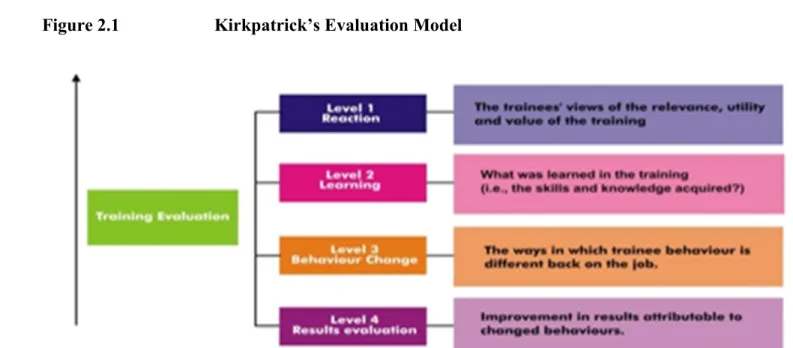
2.2.Kirkpatrick‟s Evaluation Model 44
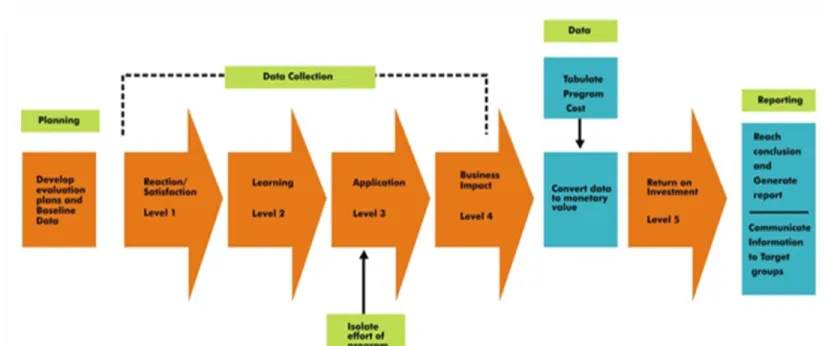
2.3.The Return On Investment (ROI) Process Model 50
x
2.3.2. Collecting Data 53
2.3.3. Isolating the effects of training and development programmes 53
2.3.4. Converting data to monetary value 53
2.3.5. Tabulating the cost of the training and development programme 54
2.3.6. Calculating the Return On Investment 55
2.3.7. Identifying intangible benefits 56
2.3.8. Reporting with impact study 57
2.3.9. The operating standards: guiding principles of ROI process 58
2.4.RPTIM Model for staff development 59
2.5.Theory of change and theory of action in practice 62
2.6.Adult learning theory 66
2.7.Staff development cost model 67
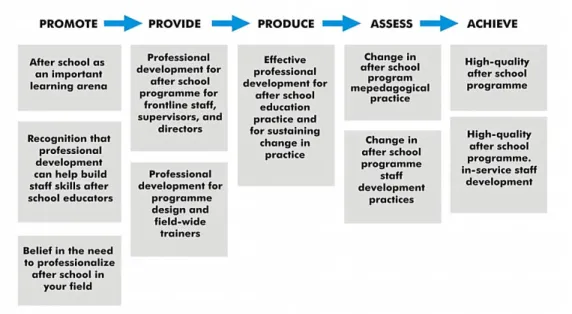
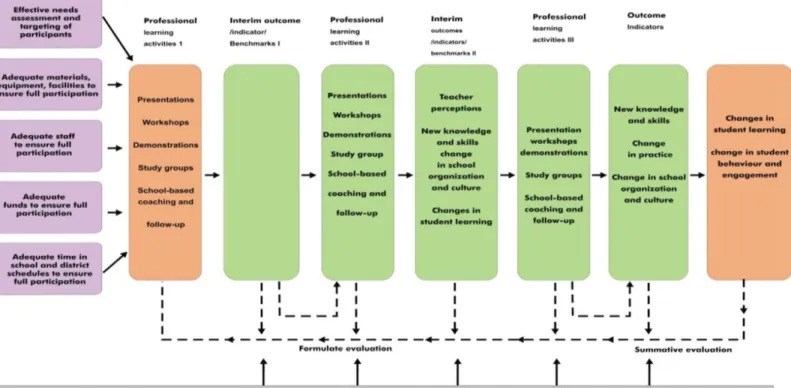
2.8.Professional development logic model 70
2.8.1. Using the logic model to explain the impact of professional
activities on professional development 72
2.9.The Framework for continuing professional development 75
2.10. Framework for evaluating professional development for adult education 85 2.11. Model for evaluating the impact of professional development in eight steps 94
2.12. Career development model 96
2.12.1. Internal and external career movement 97
2.13. Conclusion 98
CHAPTER 3: Literature Review 101
3.1.Introduction 101
3.2.The concept of training and development 101
3.2.1. Difference between training, education, development and learning 103
3.2.2. Training needs analysis/assessment 106
3.3.Staff training and development 115
3.3.1. Purpose of staff development 116
xi
3.3.3. Responsibility for staff training and development 119
3.3.4. Funding of staff training and development programmes 121
3.3.5. Challenges facing staff training and development programmes 123 3.4.Monitoring and evaluation of staff training and development programmes 124 3.5.The effects of staff training and development on job performance 128
3.6.Measuring return on investment 132
3.7.Measuring effective library and information services 137
3.8.Conclusion 143
CHAPTER 4: Background and profiles of institutions and university
libraries in Ghana 145
4.1.Introduction 145
4.2.University of Ghana 145
4.2.1. Colleges 146
4.2.2. Mission statement 147
4.2.3. Associations and Links 148
4.2.4. Staff and Student population 148
4.2.5. The University library 149
4.2.5.1. Mission of the library 149
4.2.5.2. Departments and services 150
4.2.5.3. Collections 151
4.2.5.4. Library staff population 152
4.3.University of Cape Coast 152
4.3.1. Colleges 153
4.3.2. Vision and Mission Statement 153
4.3.3. Staff and Student Population 154
4.3.4. The University library 154
4.3.4.1. Mission of the library 155
4.3.4.2. Departments and services 155
xii
4.3.4.4. Library staff population 156
4.4.University of Education Winneba 156
4.4.1. Vision and Mission Statement 157
4.4.2. Campuses, Colleges, Faculties, Institutes 157
4.4.3. Staff Population 158
4.4.4. The University Library 158
4.4.4.1. Departments and services 159
4.4.4.2. Collections 159
4.4.4.3. Library staff population 159
4.5.Central University College 160
4.5.1. Vision and Mission Statement 161
4.5.2. Faculties and Schools 161
4.5.3. Staff and Student Population 161
4.5.4. The University Library 162
4.5.4.1. Vision and Mission of the library 162
4.5.4.2. Departments and Services 162
4.5.4.3. Collections 163
4.5.4.4. Library staff population 163
4.6.Methodist University College Ghana 164
4.6.1. Mission statement 164
4.6.2. Aims and objectives 165
4.6.3. Campuses and Faculties 165
4.6.4. Staff and Student population 166
4.6.5. The University College library 166
4.6.5.1. Vision and Mission of the library 167
4.6.5.2. Departments and Services 167
4.6.5.3. Collections 168
4.6.5.4. Library Staff Population 168
xiii
CHAPTER 5: Research Methodology 170
5.1.Introduction 170
5.2.Research approach 171
5.2.1. Qualitative research approach 171
5.2.2. Quantitative research approach 174
5.2.3. The difference between qualitative and quantitative approaches 177
5.2.4. Mixed methods research approach 179
5.2.5. Research design 183
5.3.Data collection methods 184
5.3.1. Qualitative data collection instruments 185
5.3.1.1. Interviews 185
5.3.1.2. Observation 187
5.3.2. Quantitative data collection instrument 192
5.3.2.1. Questionnaires 192
5.3.2.2. Pre-testing of questionnaires 196
5.3.2.3. Distribution of questionnaire 198
5.4.Validity and reliability 198
5.5.Data analysis 200
5.5.1. Analysis of qualitative data 201
5.5.1.1. Thematic content analysis technique 201
5.5.2. Quantitative data analysis 204
5.6.Population 204
5.6.1. Table of Population 207
5.7.Sampling 207
5.7.1. Probability sampling 207
5.7.1.1. Systematic random sampling 208
5.7.1.2. Stratified random sampling 209
5.7.2. Non-probability sampling 210
5.7.2.1. Purposive sampling 210
5.7.3. Mixed sampling method 212
xiv
5.7.4.1. Sample size frame 217
5.8.Ethical consideration 218
5.9.Conclusion 221
CHAPTER 6: Presentation of Findings 223
6.1.Introduction 223
6.2.Demographic information on participants 224
6.3.Staff training and development programmes 236
6.3.1. The use of staff training and development programmes
by library staff 238
6.3.2. Contribution of staff training and development programmes
to work performance 240
6.3.3. Relationship between awareness, use and satisfaction with
staff training and development programmes 242
6.3.4. Evaluation of staff training and development policy 243
6.3.5. Training needs analysis 245
6.3.6. Training needs analysis methods 245
6.3.7. Benefits of staff training and development programmes 247 6.3.8. Areas of work that staff development programmes has
benefited library staff 248
6.3.9. Responses from library staff on monitoring and evaluation
of staff training and development programmes 250
6.3.10.When is monitoring and evaluation done? 251
6.3.11.Who is responsible for monitoring and evaluation
of training and development programmes 252
6.4.The use and satisfaction with library services 253
6.4.1. Satisfaction with library services 255
6.4.2. Influence of library services on academic work 257
6.4.3. Specific areas of academic work that are influenced
xv 6.5.Testing of hypotheses 261 6.5.1. Hypothesis one 261 6.5.2. Hypothesis two 264 6.5.3. Hypothesis three 266 6.5.4. Hypothesis four 271
6.6.Assessment of performance of training on library staff work performance 272 6.6.1. Importance of staff training and development programmes 272
6.6.2. Assessment of performance of library staff 274
6.6.3. Return on investment in training 275
6.6.4. Assessment of performance in relation to investment to training 275
6.7.Problems and recommendations 276
6.7.1. Problems/challenges 277
6.7.2. Recommendations 277
6.8.Analysis of interview/observation results 278
6.8.1. Assessment of Staff training and development policy 279
6.8.2. Training needs analysis 281
6.8.3. Staff training and development programmes 283
6.8.4. Criteria for selecting trainees for training 284
6.8.5. Training objectives 284
6.8.6. Monitoring and evaluation of staff training
and development programmes 285
6.8.7. Contribution of staff training and development on staff
work performance 286
6.8.8. Benefits of staff training and development programmes 288
6.8.9. Calculating return on investment in training 288
6.8.10.Challenges with staff training and development programmes 288 6.8.11.Recommendations on how to improve upon library staff
training and development programmes 289
xvi
CHAPTER 7: Interpretation and discussion of findings 292
7.1.Introduction 292
7.2.Demographic information on participants 293
7.2.1. Institutional distribution of participants 293
7.2.2. Age distribution of respondents 294
7.2.3. Tenure of service of faculty and library staff 294
7.2.4. Distribution of faculty respondents 295
7.2.5. Distribution and qualification of library staff 295
7.3.Staff training and development programmes 298
7.3.1. Awareness of staff training and development programmes 299
7.3.2. The use of staff training and development programmes 300
7.3.3. Contribution of staff training and development programmes
to effective library and information services 302
7.3.4. Evaluation of staff training and development policies 304
7.3.5. Training needs analysis/assessment 306
7.3.6. Monitoring and evaluation of staff training and development
programmes 311
7.3.7. The use and satisfaction with library services 313
7.3.8. Influence of library services on academic work 315
7.3.9. Importance of staff training and development programmes 316
7.3.10. Assessment of the performance of library staff 317
7.3.11. Return on investment in training and development
programmes 317 7.4.Testing of hypotheses 319 7.4.1. Hypothesis one 319 7.4.2. Hypothesis two 321 7.4.3. Hypothesis three 322 7.4.4. Hypothesis four 325
7.5.Challenges with staff training and development programme 326
xvii
CHAPTER 8: Summary, conclusions and recommendations 329
8.1.Introduction 329
8.2.Research purpose 329
8.2.1. Research questions 329
8.3.Summary of findings 330
8.3.1. Satisfaction with staff training and development policies 331
8.3.2. Staff training and development programmes 332
8.3.3. Training needs/analysis/assessment 332
8.3.4. Contribution of staff training and development programmes to the individual library staff and institutional work performance in the provision of library and information services 333
8.3.5. Benefits of staff training and development programmes 334
8.3.6. Monitoring and evaluation of training and development
programmes 334
8.3.7. Relationship between staff training and development
and work performance 335
8.3.8. The correlation between the findings and existing literature 336
8.3.9. Contribution of library services to academic work 340
8.3.10. The return on financial investment in staff training
and development 341
8.3.11. The challenges of implementing staff training
and development programmes 342
8.4.Conclusion 343
8.4.1. Conclusion on staff training and development policies 343
8.4.2. Conclusion on staff training and development programmes 344 8.4.3. Conclusion on the contribution of staff training and development
programmes to effective library and information services 344
8.4.4. Conclusion on training needs analysis/assessment 345
8.4.5. Conclusion on monitoring and evaluation of staff training
xviii
8.4.6. Conclusion on the benefits of training and development
programmes to library staff and the institutions 347 8.4.7. Conclusion on influence of effective library and information
services on academic work 347
8.4.8. Conclusion on return on investment in training 348
8.5.Recommendations 348
8.5.1. Recommendations on staff training and development policies 349 8.5.2. Recommendations on staff training and development programmes 350 8.5.3. Recommendations on the contributions of staff training
and development programmes to effective library and information
services 352
8.5.4. Recommendations of training needs analysis/assessment 353
8.5.5. Recommendations on monitoring and evaluation of staff training
and development programmes 353
8.5.6. Recommendations on how university libraries can derive
the full benefits of training and development 355
8.5.7. Recommendation on how to ensure that training and development of library staff promote the work of academic staff/academic
work 355
8.5.8. Recommendation on how to maximise the return on investment
in training 356
8.6.Possible impact of the findings on future staff training and development
programmes 357
8.7.Suggestions for further research 357
8.8.Final conclusion 359
Lists of References 361
xix
LIST OF TABLES
Table 5.1 Table of Population 207
Table 5.2 Sample size frame 217
Table 6.1 Distribution of respondents by institutions 224
Table 6.2 Awareness of staff training and development programmes
by all respondents 237
Table 6.3 The extent of use of staff training and development programmes
by library staff 239
Table 6.4 Contribution of staff training and development programmes
to work performance 241
Table 6.5 Correlation between awareness of staff training and development
programmes use and satisfaction with the programmes 243
Table 6.6 Evaluation of staff training and development policy 244
Table 6.7 The most used methods of training needs analysis 246
Table 6.8 Benefits from staff training and development programmes 247 Table 6.9 Areas of work where staff training programmes has benefited
library staff 249
Table 6.10 Criteria and methods of monitoring and evaluation of staff
training and development programmes 250
Table 6.11 When is the monitoring and evaluation of staff training
and development programme done? 251
Table 6.12 Responsibility for monitoring and evaluation of staff training
and development programmes 252
Table 6.13 The use of library services by faculty and students 254
Table 6.14 Level of satisfaction with library services by faculty and students 256
Table 6.15 Influence of library services on academic work 258
Table 6.16 Specific areas of academic work that are influenced by effective
xx
Table 6.17 Correlation between staff training and development programmes and work output of staff in the provision of effective library and
information services 263
Table 6.18 Performance of library staff who were aware and utilised training and development programmes in the provision of library and
information services 265
Table 6.19 Correlation matrix of awareness of STDP, satisfaction with library services, academic work, benefit to work, contribution to
performance and satisfaction of STDP 267
Table 6.20 Standard multiple regression analysis on relationship between awareness of STDP, satisfaction with library services, academic work, benefit to work, contribution to performance and satisfaction
to STDP 269
Table 6.21 Correlation between performance in the provision of library
xxi
LIST OF FIGURES
Figure 2.1 Kirkpatrick‟s Evaluation Model 45
Figure 2.2 The Return On Investment (ROI) process model 50
Figure 2.3 The RPTIM model for staff development 60
Figure 2.4 Theory of action in practice 64
Figure 2.5 Staff development cost model 68
Figure 2.6 Professional development model 70
Figure 2.7 The logic model for professional development 73
Figure 2.8 Elements of the logic model 74
Figure 2.9 Framework for continuing professional development 76
Figure 2.10 The planning cycle 77
Figure 2.11 Evaluation as part of an on-going professional development
process 86
Figure 2.12 Component of a professional development evaluation framework 90 Figure 2.13 Conceptualisation of the Librarians internal/external career
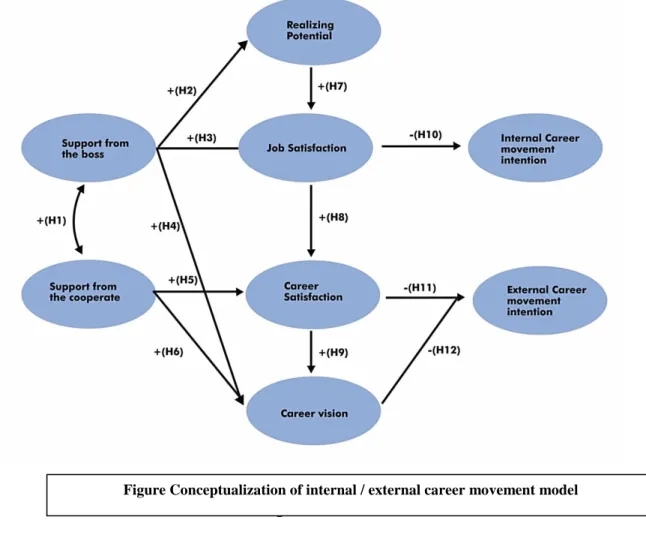
movement model 97
Figure 6.1 Distribution of respondents by institution 225
Figure 6.2 Gender distribution of participants 226
Figure 6.3 Gender distributions of participants by stratum 227
Figure 6.4 Age distribution of participants 228
Figure 6.5 Age distribution of participants by stratum 229
xxii
Figure 6.7 Number of years of service (Tenure) by stratum 230
Figure 6.8 Distribution of library staff 231
Figure 6.9 Academic qualifications of library staff 232
Figure 6.10 Distribution of faculty staff 233
Figure 6.11 Subject areas of faculty staff 234
Figure 6.12 Type of degree pursued by student participants 235
Figure 6.13 Student programme of study 236
Figure 6.14 Response on conduction of training needs analysis 245
Figure 6.15 Rating the importance of staff training and development
programmes to Library Staff 273
Figure 6.16 Assessment of the performance of library staff by faculty staff
and students 274
Figure 6.17 Assessment of the performance of Library Staff in relation
xxiii
LIST OF CHARTS
Charts 1 Distribution of respondents by institution 225
Charts 2 Gender distribution of participants 226
Charts 3 Gender distribution of participants by stratum 227
Charts 4 Age distribution of participants 228
Charts 5 Age distribution of participants by stratum 228
Charts 6 Number of years of service (Tenure) 229
Charts 7 Number of years of service (Tenure) by stratum 230
Charts 8 Distribution of library staff 231
Charts 9 Academic qualification of library staff 232
Charts 10 Distribution of faculty staff 233
Charts 11 Subject areas of faculty staff 234
Charts 12 Type of degree pursue by students participants 235
Charts 13 Students programme of study 236
Charts 14 Response on conducting of training needs analysis 245
Charts 15 Rating the importance of staff training and development
programmes to library staff 273
Charts 16 Assessment of the performance of library staff by faculty staff
and students 274
Charts 17 Assessment of the performance of library staff in relation to return
xxiv
LIST OF APPENDICES
Appendix I Questionnaire for library Staff 401
Appendix II Questionnaire for faculty 414
Appendix III Questionnaire for students 428
Appendix IV Interview schedule for university librarians/Heads of department 441
Appendix V Letter to the university librarians 448
xxv
LIST OF ABBREVIATIONS AND ACRONYMS
AAU – Association of African Universities
ACU – Association of Commonwealth Universities
ANOVA – Analysis of Variance
BA – Bachelor of Arts
BBA – Bachelor of Business Administration
BCR – Benefit Cost Ratio
BEd – Bachelor of Education
BSC – Bachelor of Science
CARLIGH – Consortium of Academic and Research Libraries in Ghana
CAS – Current Awareness Service
CE – Continuous Education
CED – Continuing Education Development
CILIP – Chartered Institute of Library and Information
Professionals
CIPD – Chartered Institute of Personnel Development
CMI – Chartered Management Institute
CPD – Continuing Professional Development
CPE – Continuing Professional Education
CUC – Central University College
HFRP – Harvard Family Research Project
HGSE – Harvard Graduate School of Education
HR – Human Resource
xxvi
IAU – International Association of Universities
ICGC – International Central Gospel Church
ICT – Information Communication Technology
IT – Information Technology
KC – Knowledge Commons
LWU – League of World Universities
MA – Master of Arts
MBA – Master of Business Administration
MPhil – Master of Philosophy
MSc – Master of Science
MSDE – Maryland State Department of Education
MUCG – Methodist University College Ghana
NGO _ Non-Governmental Organisation
NSF – National Service Foundation
OPAC – Open Public Access Catalogue
PNDC – Provisional National Defence Council
QAS – Questions and Answers Service
RC – Research Commons
ROI – Return On Investment
RPTIM – Readiness, Planning, Training, Implementation and Maintenance
SDI – Selective Dissemination of Information
SHS – Senior High School
SPSS – Statistical Package for Service Solution
SSS – Senior Secondary School
xxvii
TCA – Thematic Content Analysis
UCC – University of Cape Coast
UEW – University of Education Winneba
UG – University of Ghana
UGcat – University of Ghana Catalogue
UGLS – University of Ghana Library System
UK – United Kingdom
UNISA – University of South African
1
CHAPTER ONE
INTRODUCTION TO THE STUDY
1.1 Introduction
The central focus of this study was to investigate the contribution of staff training and development policies and programmes to effective delivery of library and information services in the university libraries in Ghana.
This Chapter presents the background to the study. The intent of the Chapter is to set out the nature and scope of the study as well as to outline the structure of the thesis. The Chapter comprises three sections. The first section presents the statement of the problem, research objectives and questions, research hypotheses, justification, and scope and limitations of the study. The second section presents a brief review of existing related literature on the subject. The third section outlines the research methodology for the study as well as the validity and reliability of data collection instruments.
1.2 Background of the Study
The current dynamic changes in social and economic organisations, enabled by advances in information and communication technology, leading to the creation of knowledge based economies and market globalisation has made the development of human resources in organisations a key issue. Knowledge has become the only reliable instrument of
2
gaining a competitive advantage and staff training and development has become the optimal answer to the many business challenges.
Increasingly, high performing organisations are recognising the need to use best training and development practices to enhance their competitive advantage. Staff are now seen not just as employees, but as the organisations greatest asset which when given development opportunities, will deliver services to meet the changing needs of customers (Alan 2009: 1-5).
According to Sardar (2010: 185) training is increasingly considered to be a key function in helping organisations achieve their goals through its staff, as it is becoming more generally accepted that there is a correlation between organisational success and investment in training and development. In theory, the organisational pay-off for trained, satisfied and highly motivated employees is improved job performance and higher productivity which leads to a high level of organisational goals attainment. It is therefore very important for individuals and organisations to receive the full benefits of staff training and development programmes.
Staff training and development can be a means of producing organisational change. The benefits of staff training and development are also evident at several levels for both the individual and the organisation. Effective training can make an individual staff member
3
feel confident in his or her abilities. The feedback an individual staff member receives from competent job performance can also affect a higher level of psychological needs, for example self-esteem. Organisations that invest seriously in the area of staff training and development usually reap the benefits of an enriched working environment with higher level of staff retention as well as increased productivity and performance.
The constantly evolving technological and organizational changes in libraries have dramatically increased the scope of librarians‟ responsibilities. Libraries must therefore make a commitment to answer the need for skills and expanded services with staff development and continuing education (Callahan & Watson 1995: 380). Staff training and development in libraries is therefore intended to strengthen the capabilities of the library to perform its mission more effectively and efficiently in an increasing information technology era. Staff training and development programmes in libraries will also affirm the ability of the individual and the libraries to grow and for each to contribute to the growth of the other (Jurrow 1992: 5).
The training of library staff and the quality of staff are important intangible assets embodied in a library‟s human capital development. Continuous training of library staff is a significant factor in encouraging innovation and creativity and ensuring that the library is the information starting point for its community of users.
4
The objective of staff training and development programmes is to ensure that individual staff members and the organisation maximise the benefits of its investment in the training and development programmes. For individuals and organisations to receive the full benefits of training and development activities there is the need to evaluate training in terms of reaction, learning, behaviour change, results and return on investment to determine the added value to the individual staff and the organisation. Many organisations simply evaluate the effectiveness of training interventions based on the initial reaction of participants. Organisations must ensure that staff training and development programmes are evaluated and staff who benefit from training transferred the newly acquired knowledge, skills, and abilities to the job.
University libraries face new challenges every day, for instance the collection development function of the university libraries now consists of providing knowledge gateways (Ravi 2008:4), modern methods of cataloguing involves attaching appropriate metadata to information objects to ensure that users will readily find the correct information when searching (Dempsey 2006). Despite the popularity of internet and the World Wide Web, users need significant guidance in using electronic resources than they did with the use of print materials (Pantry & Griffiths 2003).
The university libraries therefore require librarians in all areas to possess a greater variety of skills to utilise modern information and communication technologies to expand services and provide adequate resources for the university community. Staff training and
5
development in the university libraries is therefore of utmost importance as it helps to build the capacity of library staff to cope with the current technological and organisational changes taking place in university libraries. University library administrators must therefore recognise that before library staff can contribute effectively to the fulfilment of the library‟s mandate and strategic objectives, staff should be given opportunities to develop their skills, knowledge and abilities through training and development programmes.
University libraries in Ghana have instituted several staff training and development programmes with the goal of developing the capacity of library staff to perform their functions effectively and efficiently for higher productivity. According to Lamptey and Agyen-Gyasi (2010: 20) academic libraries in Ghana will in future need a team of flexible experts with a variety of aptitudes and specialisation who will collaborate as researchers, managers and technologists. They also have to be proactive to help in the fulfilment of the mission of their respective universities. This will make university libraries in Ghana different from what we know.
The staff training and development programmes that have been instituted in the university libraries in Ghana generally include orientation programmes, on-the-job-training, opportunity to attend workshops/seminars/conferences, opportunity to prepare for advancement activities, research and publications, membership of library associations and networks, study leaves, assignments, job rotation etc. However, the extent to which these
6
training and development programmes contribute to the provision of library and information services in the university libraries in Ghana is not known. It is against this background therefore that the need for this study was envisaged.
1.3 Statement of the Problem
Much research has been done on how information technology in particular affects the provision of library and information services in university libraries. However, the invaluable contribution of human resources (information professionals) particularly the effects of staff training and development programmes on work performance of the university library staff in Ghana which should reflect in effective and efficient provisioning of library and information services has not been properly and adequately researched.
University libraries in Ghana like many other organisations face continuous challenges due to rapidly evolving technologies, increased demands from the university communities for multiple new services coupled with shrinking budgets. University libraries are changing in response to changes in the learning and research environment. New technologies are also changing the services that libraries provide for example, online reference and instructions, desktop document delivery and automated self-service systems. Staff training and development programmes have therefore been instituted to help keep library staff up-to-date with these new developments in the field of librarianship.
7
Despite the recognised importance of staff training and development programmes, these libraries have not effectively utilised the full potential of staff training and development programmes neither have they received the full benefits of training and development because most of these training and development programmes are not evaluated to ascertain the extent to which they contribute to improved work performance. As a result the university libraries are still struggling to design and implement automation projects; poor delivery of library services; lack of knowledge in current best practices; poor collection management and the majority of library users are not information literates.
This study, therefore, investigated the contribution of staff training and development programmes to effective library and information services in the university libraries in Ghana and makes detail recommendations on how to improve upon staff training and development and its contribution to library staff efficiency and effectiveness in the provision of library and information services.
1.4 Purpose of the Study
The purpose of this study was to determine in detail staff training and development programmes that were available to the university library staff in Ghana and which of these programmes were contributing to effective job performance in terms of the provision of library and information services to the university community. The rationale was to find ways of improving upon staff training and development programmes or developing better ways of adding value to staff to enable them provide effective library services.
8 1.5 Research Objectives
This research focused on the following objectives:
To examine the effectiveness of staff training and development policies and programmes, instituted in the university libraries in Ghana.
To examine the effectiveness of training needs analysis/assessment on staff development programmes in the university libraries in Ghana.
To examine the effectiveness of the mechanism used for monitoring and evaluation of training and development programmes in the university libraries in Ghana.
To establish how staff training and development programmes have affected both individual library staff and institutional performance in the provisioning of library and information services in the university libraries in Ghana.
To establish if there is any relationships between staff training and development programmes and work performance.
To establish the contribution of effective library and information services on academic work in the universities in Ghana.
To identify the deficiencies and challenges in the implementation of staff training and development policies and programmes.
To make recommendations on how to improve on staff training and development and its contribution to work performance.
9 1.6 Research Questions
Onwuegbuzie and Leech (2006: 475) contend that: research questions in mixed methods studies are vitally important because they, largely dictate the type of research design to be used, the sample size and sampling scheme employed, and the type of data collection instruments administered as well as the data analysis techniques to be used. Research questions are used for obtaining both qualitative and quantitative data (Onwuegbuzie & Leech 2006: 475). The following specific questions served as a guide to the study:
Which staff training and development policies and programmes in place, in the university libraries in Ghana, have been effective?
How has staff training and development programmes affected both individual library staff and institutional performance in the provision of library and information services? Is there a relationship between staff training and development programmes and work
performance?
How does the result of this research correlate with the existing literature from previous studies?
How has effective library and information services contributed to efficient academic work?
Does the financial investment made in library staff training and development result in higher productivity?
What are the deficiencies and challenges in the implementation of staff training and development programmes?
10
How can one use the findings of this research and knowledge generated to improve upon staff training and development practices in the university libraries in Ghana?
1.7 Research Hypotheses
The more effective staff training and development policies/programmes are, the better the work output of library staff in the provision of library and information services will be.
Staff training and development programmes will affect the work performance of both individual library staff and the institution in the provision of library and information services.
There is a relationship between staff training and development programmes and satisfaction with library services and if the work output is better there will be satisfaction with the services.
Effective library and information services will contribute to efficient academic work in the universities in Ghana.
1.8 Justification of the Study
The significance of a study refers to the manner in which the study relates to the long term issues and uses a persuasive rationale to justify the reason for the study (Kothari 2004: 31). The realisation of the importance of staff training and development programmes to work performance make it reasonable for university libraries in Ghana to determine the
11
contribution of staff training and development practices to effective library and information services. This study emphasises the critical role that staff training and development programmes can play in the achievement of organisational goals and objectives. It also highlights the effectiveness or otherwise of staff training and development programmes on work performance, especially in the provision of library and information services. Staff training and development is likely to emerge as a new viable mode of improving work performance. The study establishes the extent to which staff training and development programmes can be adopted to enhance staff work performance in the provision of library and information services.
The study also raises the awareness about the importance of effective staff training and development programmes that will enable library administrators to concentrate efforts on developing these programmes. The result of the study will hopefully help university management including university library administrators to ascertain whether they are getting value for their investment in staff training and development activities. Although this study is confined to a limited geographical and functional area, its outcome may hopefully be applied in the broader context of information science in Ghana and beyond.
Finally, the findings will contribute to the theoretical concepts and knowledge on staff training and development programmes and its effects on work performance in general and in the university libraries in particular.
12 1.9 Scope/Delimitations of the Study
The study focuses on staff training and development in university libraries in Ghana. Five universities namely, University of Ghana, Accra; Methodist University College Ghana, Accra; Central University College, Accra; University of Education Winneba and the University of Cape Coast were involved in the study. The choice of these university libraries was based on staffing, student/faculty strength, availability of a resourceful library and staff development policy/programmes as well as a representation of both public and private universities in Ghana.
The results of the study may represent what pertains in other university libraries in Ghana. The results may therefore be generalised as the prevailing situation in the university libraries in Ghana. Staff training and development programmes in the university libraries are expected to improve staff morale, job satisfaction, competency and productivity.
1.10 Limitations of the Study
The study has some limitations based on the choice of methodology. The first has to do with restriction of existing literature to only what was accessed by the researcher. There exists a literature gap in staff training and development programmes in relation to university libraries. The researcher had difficulties in accessing internally published training reports from the participating institutions. However, the personal relations between
13
the researcher and some of the heads of the five selected university libraries helped to minimise this limitation.
The second limitation was the issue of possible bias regarding the data provided by the respondents. It is very difficult to vouch for the full authenticity of some of the data collected. However, the mixed methods research approach which combines qualitative and quantitative research approaches helped to minimise the bias. The third limitation is that the study was affected by practical research limitations such as lack of full cooperation from senior management and staff of the participating institutions as well as financial and time constraints.
1.11 Originality of the Study
In research, originality starts with the tools, techniques and processes used. The tools refer to the data collection instruments such as questionnaire, interview or observation used for the study. Originality also involves the exploration of the unexplored and the unanticipated. This study is original in the sense that it critically examined and established the effect of the staff training and development programmes on the individual library staff and the institutions as well as its contribution to the provision of effective library and information services.
The originality of the study lies in making a contribution to a knowledge gap in the following ways: carrying out empirical work that has not been done before in Ghana,
14
bringing about a synthesis that has not been made in Ghana, using the already known materials such as previous literature but with a new interpretation, examining and looking at areas that people in the discipline have not looked at before (Dunleavy 2003: 27; Philips 1993).
According to Johnson, Onwuegbuzie and Turner (2007); Neuman (2006: 149) and Patton (2002: 247) the multiple data collection instruments namely; questionnaires, interviews and observation enabled the collection of multiple data using different strategies, approaches and methods in such a way that makes the result original.
1.12 Brief Literature Review
This study builds on previous studies on staff training and development, and continuous education, in university libraries across the world, particularly in the following areas, training needs analysis and assessment, monitoring and evaluation of training, effects of training and development on job performance, measuring return on investment in training and effective library and information services.
Several authors including: Mackenzie and Smith (2012); Fritts and Casey (2010); Kisby and Holler (2009); Weaver, Holland and Tonner (2009); Abba and Dawha (2009); Broady-Preston (2009); Paster (2004); Baldwin, Gibbs and Slough (1997) and Snyder and Sander (1978) investigated staff training and development initiatives and structures put in place in university libraries. Although these authors investigated staff development initiatives,
15
these studies were limited in scope to specific geographical regions and did not adequately establish the contributions of staff training and development programmes on work performance especially in the delivery of library and information services.
Several other studies relevant to the current research include the works of Brewsaugh and Valleroy (2011); Thorton (2010); Kalin (2010); Benn and Moore (2009); Golden (2006); Elaine (2006) and Harvey and Sayer (2009). These studies provide the career development directions for future librarians and the skills needed by the next generation of librarians to enable them perform their duties efficiently.
Furthermore, Varlejs (1987) recommends a broad range of training and development activities for librarians. These include on-the-job-training, orientation, in-service workshops, guest lectures, consultancy works, membership of committees and associations, job rotation, mentoring, research and publications. However these studies did not establish how these training and development programmes/methods have affected staff work performance, especially in the provisioning of library and information services.
Several other authors including Dawo, Simatwa and Okwatch (2012: 316); Kunche et al.
(2011: 1-3); Asare-Bediako (2008: 179) and Rama and Naagurvali (2001: 722) attempted to evaluate the effects of staff training and development programmes on work performance in the library environment. However, these studies did not adequately establish the extent
16
to which staff training and development programmes have contributed to effective library and information services.
The studies of Effah (1998); Lamptey and Agyen-Gyasi (2010); Adanu (2007) and Alemna (2001: 44-47), are closely related to this study. According to Adanu (2007: 1-5) the majority of librarians working in the state owned university libraries in Ghana are aware of continuous professional development programmes. However, they have not taken advantage of these programmes because there are financial constraints in funding continuous professional development programmes in the libraries. Lamptey and Agyen-Gyasi (2010: 1-5) suggest the need to train future librarians in academic libraries in Ghana to meet future job requirements.
To summarise, even though the reviewed literature investigated staff development practices in university libraries the emphasis was not on establishing the contribution of staff development on the provisioning of library and information services to the university community. This study differs from previous studies in the following ways:
It focuses on investigating and establishing the contribution of staff training and development programmes on university library staff and university libraries work performance.
17
It also focuses on establishing the contribution of effective library and information services to academic work
The study also establishes the relationships between staff training and development programmes and work performance.
Finally, this study reviewed a range of literature on the subject area to draw lessons which are relevant to Ghana‟s situation hence making this study different from other studies which have been conducted.
1.13 Definition of Key Terms and Concepts
This section presents the definitions of key terms and concepts applicable to this study.
1.13.1. Staff Development (SD)
According to Webb (1996: 194) staff development involves all activities, actions, processes, policies, programmes and procedures employed to facilitate and support staff so that their performance and potentials may be enhanced and that they may serve their individual and institutional needs.
Creth (1989: 120) defines staff development to include a range of activities designed to provide development programmes for all levels and categories of staff including
18
professional, support, part- time and voluntary employees. It helps to equip the staff with knowledge, skills and attitude required for them to meet their current responsibilities and adapt to future changes. Staff development can therefore be described as a systematically planned, comprehensive set of professional learning opportunities carried out overtime to achieve specific objectives.
1.13.2. Continuous Education (CE)
Dasgupta and Saptathi (2006: 239-246) define continuous education as systematic and continuous schooling and a process of developing human consciousness in all aspects. Similarly, Snyder and Sander (1978: 145) describe continuous education as a learning process that individuals utilise in fulfilling their needs to learn and grow personally and professionally after their preparatory education and work experience.
Varlejs (1987: 362) also describes continuing education in libraries as a process whereby library staff updates their knowledge, broadens their scope or gains a more in depth understanding of some aspects of their profession. It is also the means by which people identify a new career interest and seek the necessary competencies to pursue this new interest. Kigongo-Bukenya (1999: 93) summarises the objectives of continuing education as follows:
To enable staff to perform better in their present positions To equip staff to move to more desirable positions
19
To satisfy staff‟s desires to explore further aspects of the profession.
Continuing education aims at keeping staff up- to-date with knowledge of the information profession and also provides opportunities for professional growth. Continuing education is therefore education provided for adults after they have left a formal education system. It consists typically of short or part-time courses.
1.13.3. Continuing Professional Development (CPD)
Continuing professional development is a continuing and deliberate organisational sponsored process aimed at assisting, encouraging and enabling professionals to improve their knowledge, skills, abilities and competence (Tracey 2004: 540). Continuing professional development is a process of personal growth to improve the capability and realise the full potential of professionals. This can be achieved by obtaining and developing a wide range of knowledge, skills and experience which are not normally required during initial training and routine work and which develop and maintain competence to practice. CPD activities for librarians include all learning activities undertaken after initial qualifications whether provided on-the-job or are provided outside by agencies such as the library schools and associations (Tracey 2004: 540).
1.13.4. Continuing Professional Education (CPE)
Continuous professional education is a life-long process through which individuals update knowledge, skills and attitudes acquired during their education. It is usually self-initiated
20
learning in which individuals assume responsibility for their own development. CPE is not an end in itself, but a means to an end. It is crucial for those professionals who have had the benefit of education, but need to acquire new knowledge. There are a number of reasons why one would undertake continuing professional development or education. These include:
The desire to develop professional knowledge and skills. A condition placed on membership of a professional body. A condition placed on promotion in employment.
To demonstrate professional standing to clients and employers (Tracey 2004: 540).
1.13.5. Staff Training
Staff training is the process of developing the skills, awareness or expertise of staff, and this is important for both professional and non-professional employees. Training may consist of an induction into a system or routine, the organisation of new skills or attitudes, the development of existing skills in order to elevate efficiency, job satisfaction levels, commitment, interchangeably, cooperation, and to facilitate promotion. It is important, therefore, that training be prepared carefully, in response to staff and organisational needs, and its effectiveness be monitored (Prytherch 2000: 733).
1.13.6. Training, Development, Learning and Education
21 1.13.6.1. Training
According to Noe (2008: 3-4), training of employees is a planned effort by a company to facilitate employees learning of job-related competencies including knowledge.
1.13.6.2. Development
Development on the other hand is a formal education, job experiences, relationship and assessment of personality and ability that help employees to perform effectively in their current or future job (Noe 2008: 266).
1.13.6.3. Learning
Learning is defined as a relatively permanent change in behaviour, cognition, or effect that occurs as a result of one‟s interaction with the environment. In other words it is the process by which a new capability is attained or a process within an organisation which results in the capacity for changed performance which can be related to experience rather than motivation (Werner & DeSimone 2006: 77).
Learning can be described as a process of active engagement with experience. It is what people do when they want to make sense of the world. It may involve an increase in skills, knowledge, understanding, values or capacity. Effective learning may lead to change in attitude and behaviour. According to Amstrong (2009: 664) learning is the means by which a person acquires and develops new knowledge, skills, capabilities, behaviour and attitudes. Learning can, therefore, be described as a process whereby individuals acquire knowledge, skills and attitudes through experience, reflection, study or instruction. It is
22
also a continuous process that not only enhances existing capabilities, but also leads to the development of skills, knowledge and attitudes that prepare people for higher- level responsibilities in the future.
1.13.6.4. Education
The British Manpower Services Commission (1981: 17) describes education as activities which aim at developing the knowledge, moral values and understanding required in all aspects of life rather than knowledge and skills relating to only a limited field of activity.
The purpose of education is to provide the conditions essential to young people and adults to develop an understanding of the training and ideas influencing the society in which they live and to enable them to make a contribution to it. It also involves the study of their own cultures and laws of nature as well as the acquisition of linguistics and other skills which are basic to learning, personal development, creativity and communication. Education also contributes to each individual‟s development by facilitating the attainment of mental powers, character and socialisation as well as specific knowledge and skills. Training is a more short-term aid in the process of education which helps individuals to master defined tasks or areas of skills and knowledge to pre- defined standards. Lundy and Cowling (1996: 224) agree that education is the act or process of imparting or acquiring general knowledge, developing the powers of reasoning and judgment and generally preparing for mature life.
23 1.13.7. Employee Development (ED)
Employee development refers to an integrated set of planned programmes provided over a period of time to help assure that all individuals have the competence necessary to perform to their fullest potential in support of the organisational goals (Jacobs &Washington 2010).
As a process, employee development encompasses the learning of all individuals in organisations – including frontline employees, professionals or managers and can be delivered through a range of approaches including, off-the-job and on-the job training programmes. The overall intent of employee development programmes is to provide a systematic path for increasing the employees competence, regardless of whether that increased in competence would be used for doing present or future work (Jacobs & Washington 2010).
1.13.8. Career Development (CD)
Career development can be described as the interaction of psychological, sociological, economic, physical and chance factors that shapes the sequence of jobs, occupations or careers that a person may engage in throughout life. Career development is a major aspect of human development. It covers one‟s entire life span. It also involves a person‟s self-concept, family life and all aspects of one‟s environmental and cultural conditions.
According to Zunker (1994: 3) the terms career development, occupational development and vocational development can be used interchangeably. The author refers to career
24
development as a life-long process of developing beliefs, values, skills, aptitudes, interests, personality characteristics and knowledge of the world of work. Career development can therefore be explained to involve the development of individual needs and goals associated with stages of life and taking career choices that will help the individual to fulfil career goals. Wilding (1989: 899) describes career development in libraries as the acquisition of knowledge and skills that eventually leads to the accrual of additional or different responsibilities and ultimately leads to the achievement of an individual‟s personal development. Career development covers almost the entire life span through which a person develops the capacity to engage in work as part of their total life.
According to Smith (1995: 25) career development goes through the following processes: An employee must assess his/her own career goals and capabilities through internal
needs assessment.
Managers must work with the employees to provide information and assistance in matching personal and organisational concerns.
Employers must work together to develop an action plan for the ownership of the process and take responsibility for the result.
To summarise, career development just like staff development must be a shared responsibility, the employee must determine their career paths in consultation with their supervisors and the employer must support and encourage employees in their career development activities.
25 1.14. Research Methodology
This section describes the research structure, activities and outcomes. It starts with a general overview of the research design, followed by a description of the chosen data collection strategies and finally illustrates, the methodologies used for data analysis as well as validity and reliability instruments.
1.14.1 Research Approach
There are basically three approaches to research namely, qualitative, quantitative and mixed methods. The qualitative research approach tends to apply a more holistic and natural approach to the solution of a problem than quantitative research. Quantitative research however is appropriate where quantifiable measures of variables of interest are possible, where hypothesis can be formulated and tested, and inferences drawn from samples of the population (Connaway & Powell 2010: 77). Rassel and O‟Sullivan (1995:478) describes the quantitative approach as research in which values of variables are characterised by numbers or symbols. It constructs hypotheses and tests them against the hard facts of reality (Leedy 1996: 144).
The mixed method approach is defined as a type of research in which the researcher combines elements of qualitative and quantitative research approaches (for example, the use of qualitative and quantitative viewpoints, data collection, analysis and inference techniques) for the broad purposes of breadth and depth of understanding and corroboration (Johnson & Christensen 2008: 445; Johnson & Onwuegbuzie & Turner 2007: 129; Creswell 2003: 210).