LIBRARY USAGE BY UNIVERSITY ACCOUNTING STUDENTS: A
COMPARISON OF CONTACT AND OPEN DISTANCE LEARNING INSTITUTION IN SOUTH AFRICA
by
SAIDAT ABIOLA FAKOYA-MICHAEL
45287767
Submitted in accordance with the requirements for the degree of
MASTERS OF INFORMATION STUDIES
in the subject
INFORMATION SCIENCE
at the
UNIVERSITY OF SOUTH AFRICA, PRETORIA
Supervisor: Prof Peter Underwood
ii
DEDICATION
This dissertation is dedicated to Almighty God who gave me the grace and strength to
iii
DECLARATION
I declare that that LIBRARY USAGE BY UNIVERSITY ACCOUNTING STUDENTS: A
COMPARISON OF CONVENTIONAL AND OPEN DISTANCE LEARNING INSTITUTIONS IN SOUTH AFRICA is my own work and that all the sources that I have used or quoted have been indicated and acknowledged by means of complete references. I
further declare that I have not previously submitted this work, or part of it, for examination at
UNISA for another qualification or at any other higher education institution.
iv
ACKNOWLEDGEMENT
I appreciate the encouragement and support of my husband Michael, my children, Deborah, Hannah, Michael Jr and Rachel and my sister Kemi for their moral support
and pushing me to finish this work.
I want to thank my supervisor, Professor Emeritus Peter Underwood for his objective guidance and mentoring during this study.
v
ABSTRACT
This study examines the current level of library patronage among accounting students both in
the distance and a contact learning institution in South Africa. There is a relative absence of
studies of academic library usage by accounting students.The low level of library usage, that
is, low level of library visits and poor research skills of undergraduate accounting students has
been attributed to the difficulty in integrating accounting curriculum with information literacy.
However, the challenge facing academic librarians is persuading both academic faculty and
accounting students to integrate information literacy into their curriculum and to convince
individual students to make time in their schedules for library usage. In South Africa, this
problem is compounded when it is a requirement of the accreditation body, The South African
Institute of Chartered Accountants (SAICA), which requires academic departments to integrate
library usage into the accounting curriculum for their programme to be accredited.
The study examines the current level of library patronage among accounting students both in a distance and a contact learning institution in South Africa. The sub-objectives of the study were
to investigate the reasons for low level of library patronage among accounting students in South African Universities; to determine what features would make the use of a library for locating information that is relevant and attractive to university accounting students in a contact and a distance learning institution in South Africa; and to investigate what, if any, improvements to library service can be made to make the use of the library of significant importance.
Using a survey research method that utilises a structured questionnaire, this study gathered data
from a sample of 500 accounting students from a distance and a contact learning institution in
vi finding indicates that as with most accounting students across the world, South African students
are no exception because of the peculiarity and design of their programme curriculum that provides recommended texts for students’ usage. The findings further show that the apathy of
library services patronage among university accounting students in South Africa is exacerbated
by lecturers who seldom give assignments or tasks that require the students to search for
information beyond the recommended textbooks. Findings indicate that the most significant
factor that influences accounting students of universities to patronise library resources are the
expertise and interaction of the library staff. This is supported by the Expectation-Confirmation
Theory framework which posits that patrons will continue to use library services only if their
perceived perception of the usefulness of the services are satisfied. In this case, accounting
students from both institutions examined in this study confirm the Expectation-Confirmation
Theory framework of satisfaction being based on the perception of the library services they
receive. The study recommends that in motivating accounting students to patronise library
services, library management needs to understand the discipline-specific teaching and learning
practices and collaborate with curriculum developers in the accounting discipline to incorporate
the use of library services in their programme. Further study is encouraged to include all
universities that offer accounting programmes in South Africa for a more robust finding.
Keywords: library patronage, University accounting students, information needs.
vii TABLE OF CONTENTS DEDICATION ... ii DECLARATION ... iii ACKNOWLEDGEMENT ... iv ABSTRACT ... v
TABLE OF CONTENTS ... vii
LIST OF TABLES ... xii
LIST OF ABBREVIATIONS ... xv
CHAPTER ONE: GENERAL INTRODUCTION ... 1
1.1. Introduction ... 1
1.2. Research problem... 3
1.3. Research objective ... 4
1.4. Research questions ... 5
1.5. Justification of the study ... 6
1.6. Research methodology ... 7
viii
1.8. Outline of the dissertation ... 8
1.9. Summary of chapter ... 9
CHAPTER TWO: LITERATURE REVIEW ... 10
2.1. Introduction ... 10
2.2. Theoretical framework ... 11
2.2.1. Expectation-confirmation theory in information systems... 12
2.3. Level of library patronage among university students ... 13
2.4. Features of a library system and library patronage ... 16
2.5. Improving satisfaction among library patrons ... 19
2.6. The role of a library in student academic performance ... 23
2.7. Library services and patrons’ satisfaction... 26
2.8. Influence of technology on library patronage ... 29
2.9. Motivating patrons through technology ... 32
2.10. Web 2.0 ... 34
2.11. The influence of social networking tools on patronage ... 35
ix
2.11.2 Twitter ... 36
2.12 Library planning and its influence on patronage ... 37
2.13 Absence of studies of academic library usage by accounting students ... 38
2.14 Summary of chapter ... 39
CHAPTER THREE: RESEARCH METHODOLOGY ... 40
3.1. Introduction ... 40
3.2. Research paradigm ... 40
3.3. Research design and method ... 41
3.4. Research population ... 42
3.5. Research sample... 44
3.6. Data collection ... 45
3.7. Data instrument ... 45
3.8. Data analysis ... 46
3.9. Reliability and validity tests... 47
3.10. Ethical consideration ... 49
x
3.12. Summary of chapter ... 50
CHAPTER FOUR: PRESENTATION OF FINDINGS, INTERPRETATION AND DISCUSSION ... 51
4.1. Introduction ... 51
4.2. Findings of the study ... 51
4.3. Summary Statistics... 54
4.4 Discussion of correlations ... 83
4.5. Discussions ... 89
4.5.1. Implications for the study ... 89
4.6. Summary of the chapter ... 94
CHAPTER FIVE: SUMMARY, CONCLUSION AND RECOMMENDATIONS... 95
5.1. Introduction ... 95
5.2. Summary ... 95
5.3. Major findings ... 97
5.3. Contribution ... 99
xi
5.5. Recommendations ... 101
5.5.1. Further study ... 102
Bibliography ... 103
APPENDIX A: QUESTIONNAIRE... 129
xii
LIST OF TABLES
Table 3. 1: Summary of key aspects of the chapter ... 42
Table 4. 1: Descriptive survey statistics ... 52
Table 4. 2: Level of study of respondents ... 54
Table 4. 3: Mode of study of respondents... 54
Table 4. 4: Institution attended by respondents ... 55
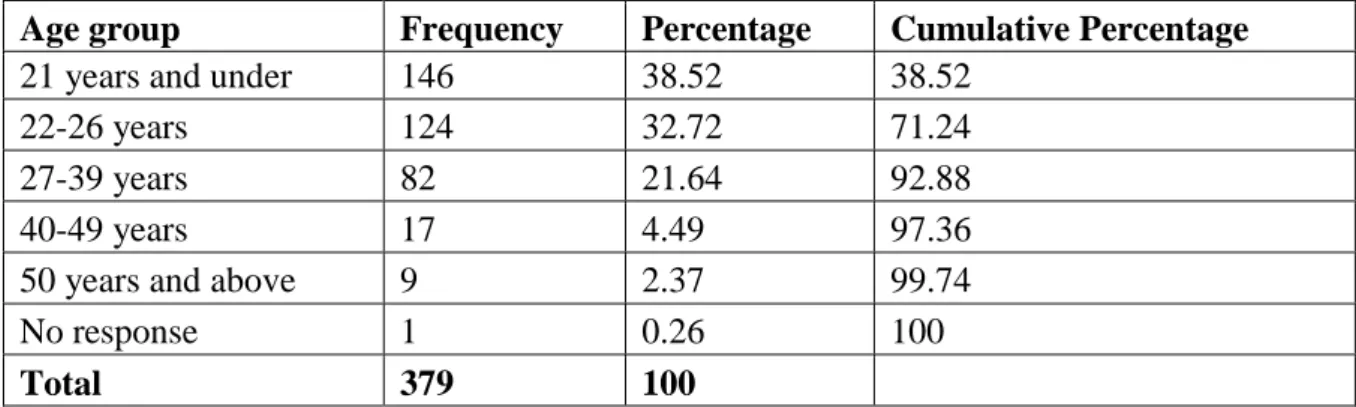
Table 4. 5: Age group of respondents ... 55
Table 4. 6: Gender of respondents ... 56
Table 4. 7: Branch of library used by respondents ... 57
Table 4. 8: Frequency of library visit by respondents ... 57
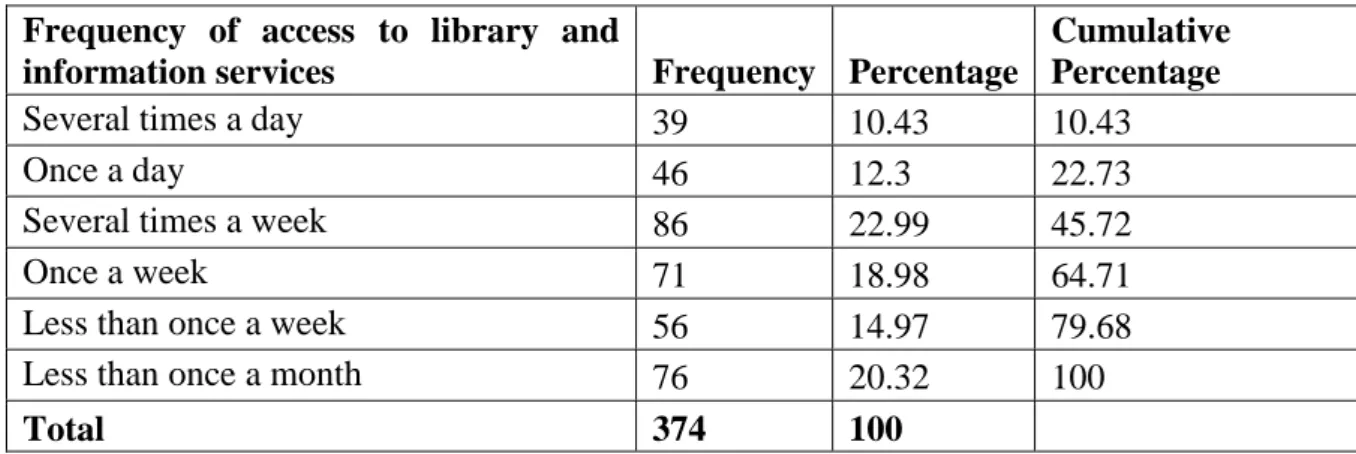
Table 4. 9: Frequency of access to library and information services by respondents ... 58
Table 4. 10: Looked for library material on the shelves by respondents ... 58
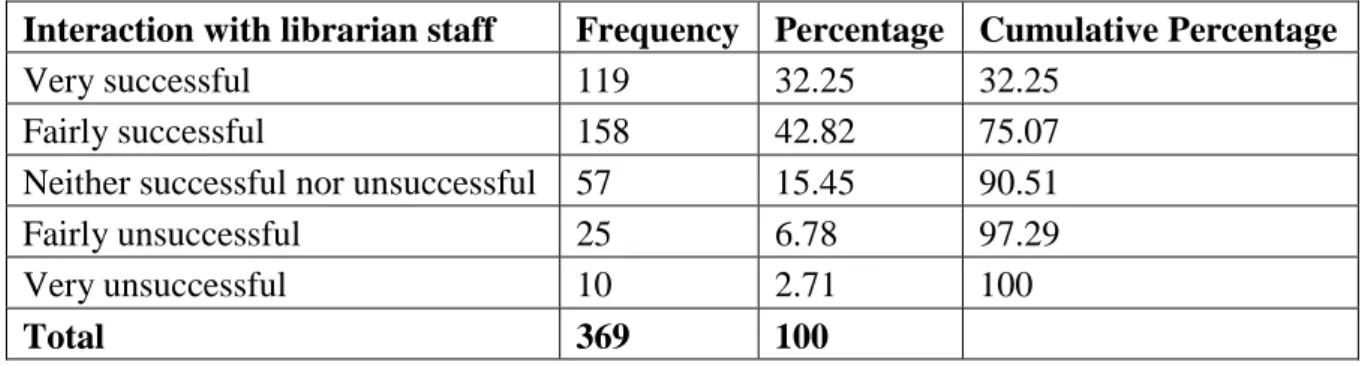
Table 4. 11: Interaction with library staff by respondents ... 59
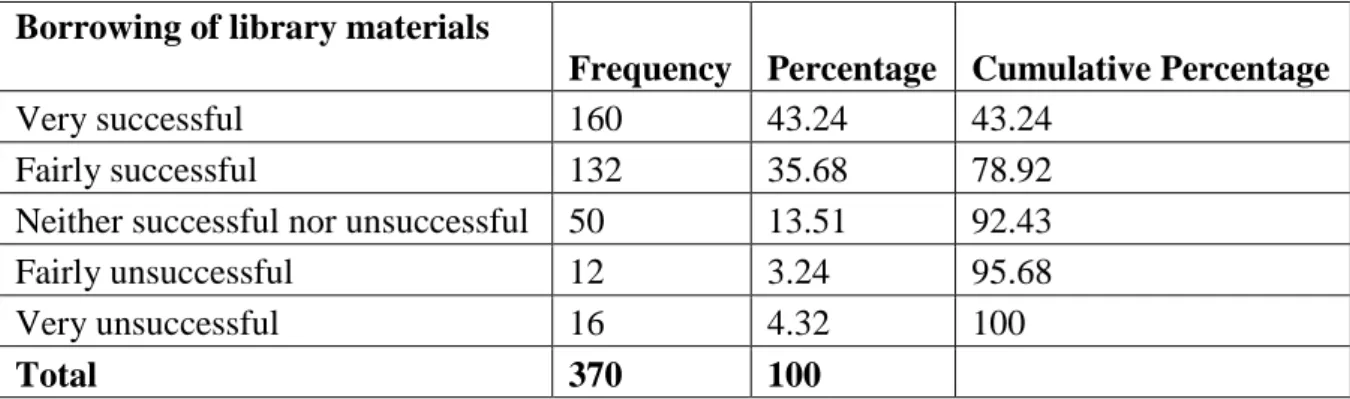
Table 4. 12: Borrowing of library materials by respondents ... 60
Table 4. 13: Use of a computer in the library by respondents ... 60
xiii
Table 4. 15 Made a reservation on the library system by respondents ... 62
Table 4. 16: Renewed a loan on the library system by respondents ... 62
Table 4. 17: Used of electronic journal by respondents ... 63
Table 4. 18: Used of electronic resource (e.g. Web of Knowledge) by respondents ... 64
Table 4. 19: Level of satisfaction with range of books accessed by libraries ... 64
Table 4. 20: Course-related books and texts accessed by respondents ... 65
Table 4. 21: Range of e-books accessed by respondents ... 66
Table 4. 22: Range of print journals accessed by respondents ... 66
Table 4. 23: Range of electronic journals accessed by respondents ... 67
Table 4. 24: Photocopying services used by respondents ... 68
Table 4. 25: Printing services used by respondents ... 68
Table 4. 26: Study facilities (study desk, etc.) used by respondents ... 69
Table 4. 27: Provision of working computers for respondents by the library ... 70
Table 4. 28: Reliability of available computers to the respondents ... 70
Table 4. 29: Library catalogue usage by respondents ... 71
xiv
Table 4. 31: Range of electronic resources (e.g. Web of Knowledge) used by respondents ... 72
Table 4. 32: Adequacy of library opening hours to respondents ... 73
Table 4. 33: Conduciveness of the library environment (noise, heating, ambience, etc.) to respondents ... 74
Table 4. 34: Helpfulness of the library staff to respondents ... 74
Table 4. 35: Perception of the expertise of the library staff by respondents ... 75
Table 4. 36: Overall impression of the library service by respondents ... 75
xv
LIST OF ABBREVIATIONS
CA- Chartered Accountant
CF- Competency Framework
ECT- Expectation-Confirmation Theory
E-LIS- Eprints in Library and Information Science
IS- Information Systems
LIB-LIS- Library and Information Science Source
LIS- Library and Information Science
LISA- Library and Information Science Abstracts
LISTA- Library, Information Science and Technology Abstracts
SAICA- The South African Institute of Chartered Accountants
UL- University of Limpopo
1
CHAPTER ONE: GENERAL INTRODUCTION
1.1. Introduction
Some writers have claimed that a library is an essential part of a university system with the sole
purpose of simplifying and satisfying the information need of its academics (Sheikh, 2014).
Iwhiwhu and Okorodudu (2012) state that libraries are meaningful to improving knowledge
management because of the value of information, quality of information system and library
services provided. Academic libraries are designed to serve the teaching and research needs of
both scholars and students (Serenko, Bontis & Moshonsky 2012). Library services support the
attainment of the university curriculum and the research activities of academics and students
(Lowry, 2012). Adeniran (2011:209) states that academic libraries should strive to support and
grow their user base by focusing on meeting their users’ expectations. In this vein, Bartlett and
Toms (2005) explain that information is used to create knowledge not in the sense of data and
facts but in the form of demonstrations that provide meaning and setting for the purposive
action.
The increasing use of technology as a means of accessing information and the recent shift
towards cooperative learning and group study have changed the way students use academic
libraries and library resources (MacWhinnie 2003:241). The continual changes in information
technology over the last three decades have brought substantial changes in library services and
information seeking behaviour among the public and academic libraries (Salisbury & Griffis,
2014). In helping library users get the best of information service, library resources such as
websites should be sufficiently updated on a regular basis particularly when users study through
2 information is a prerequisite for life-long learning and a basic requirement for the information
society since university students are expected to conduct independent exploration effectively
in diverse disciplines and topics depending on their area of study (Kavulya 2003: 216). As
such, university students should not only master the skill of finding information in print format
or electronic formats but also be able to evaluate and use it competently both in their learning
activities as well as in their later lives (Kavulya 2003). As such, academic libraries need to
work towards demonstrating value and excellence to students while providing students with
superior facilities and support with less cost to the university (Cooke, Norris, Busby, Page,
Franklin, Gadd & Young 2011).
Notwithstanding, in exploring the attitudes and expectations of patrons to e-books in South African universities’ libraries, Kahn and Underwood (2015) explain that even though patrons were eager to use e-books, they are unaware of the extent of its availability, hence, are contended to use it as a convenient alternative to print books. This study investigated the
attitudes of accounting students towards the usage of the academic library by making a
comparative study between conventional (a contact learning institution) and open distance
learning universities. This study used a survey-based approach to investigate library usage and
research expectations by University accounting students based on their perception of
accessibility of the academic library resources of universities in their quest to overcome their
academic challenges in a traditional (a contact learning institution) and open distance learning
universities. The evidence-based approach promotes the collection, interpretation, and
integration of valid-based relevant user-reported, librarian-observed and research-derived
evidence to advance the quality of expert judgement (Lowry, 2012). The findings compare two
3 determine if there is an expectation gap with regards to the library usage by their accounting
students. This comparison reveals the challenges, implications and prospects of accessing
library resources by accounting students in the two selected universities.
1.2. Research problem
Accountancy programmes in South African universities are accredited by the South African
Institute of Chartered Accountants (SAICA) through a guidance document known as
Competency Framework (CF). The theory and the practice which underpins the CF are the
ideas of John Dewey, an American philosopher of education. Dewey believed that knowledge is developing and growing through “experiment” or discovery. The SAICA Competency
Framework provides a set of clear standards within the accountancy profession which include
specific and pervasive competencies (South African Institute of Chartered Accountants
[SAICA], 2011). The CF identifies the competencies which a Chartered Accountant (CA)
should demonstrate at the entry level of the profession to encompass core competencies such
as accounting and external reporting; taxation; management decision-making and control;
strategy, risk management and governance; auditing and assurance; and financial management.
Pervasive skills that are critical at the entry level of the profession include ethics and
professionalism; professional attributes; and personal attributes (South African Institute of
Chartered Accountants [SAICA], 2011). Since the objective of the CF hinges on Dewey’s
approach, SAICA logically requires students to consider the wider significance and
implications of new knowledge about current accounting contexts in order to prepare them for
leadership positions thus aligning to the pervasive skills mentioned earlier. An important
attribute of the pervasive skills requirement is the personal attributes of being able to
4 entails that the new entrant CA should be able to analyse information about the entity’s
performance on a regular basis. One attribute of being able to demonstrate leadership and
initiative is the ability to communicate with internal and external clients to achieve milestones
and objectives. As a life-long learner, the new entrant CA should demonstrate intellectual
ability to apply him/herself at a level that enables life-long learning in the demanding context
in which the CA works (South African Institute of Chartered Accountants [SAICA], 2011).
However, the challenge facing academic librarians is persuading both academic faculty and
accounting students to integrate information literacy into their curriculum and to convince
individual students to make time in their schedules for library usage. In South Africa, this
problem is compounded when it is a requirement of the accreditation body, SAICA, which
requires academic departments to integrate library usage into the accounting curriculum for
their programme to be accredited. The low level of library users and poor research skills of
undergraduate accounting students has been attributed, in a North American environment, to
the difficulty in integrating accounting curriculum to information literacy (Gross, 2005; Lowry,
2012). However, this assertion may, or may not, be the case elsewhere. Hence, this study seeks
to investigate the circumstances in South Africa through a comparative study of the two types
of universities mentioned above.
1.3. Research objective
The purpose of this study was to determine the current level of library patronage among
accounting students both in a distance and a contact learning institution in South Africa. The
5
To investigate the reasons for low level of library patronage among accounting students
in South African Universities.
To determine what features would make the use of a library for locating information that is relevant and attractive to university accounting students in a contact and a
distance learning institution in South Africa.
To investigate what, if any, improvements to library service can be made to make the use of the library of significant importance.
In achieving this objective, the study seeks to investigate the research questions below.
1.4. Research questions
The study posed the following research questions to determine those key variables that attract
or discourage accounting students at universities from patronising library services.
What is the current level of patronage among university accounting students in a contact and a distance learning institution in South Africa?
What are the reasons for low level of library patronage among accounting students in
South African Universities?
What features would be required to make the use of a library for locating information relevant and attractive to university accounting students in a contact and a distance
learning institution in South Africa?
What improvements are required to make the use of the library of significant importance to university accounting students patronise library servicesin a contact and
6 These questions are designed to resolve the research problem identified for this study.
1.5. Justification of the study
The accounting programmes of most universities in South Africa, especially open distance
learning based and contact learning institutions, admit students from a diverse background with
different influencing reasons into accounting programmes (Teferra & Altbachl, 2004).
Different reasons influence a student to choose to study accounting, and these pose different
challenges to the student because of their diverse backgrounds. However, this set of students
encounter different types of challenges in seeking information because of the peculiarity and
demand of their chosen discipline (Simon, 2009). These challenges are made more complex
for this set of students, especially if they have not been exposed to using library services.
Therefore, it has become necessary to encourage this set of students to embrace library
patronage to help them imbibe life-long learning.
Despite the social and economic importance of accounting education and the positive influence
it has on the economy and society, researchers have observed the low level of library usage
among accounting students (Gross, 2005; Lowry, 2012). It is therefore important to investigate
reasons for the low level of library patronage among accounting students in South African
universities. Given the importance and increasing information need of accounting students in
the face of changing economic conditions the world over, SAICA requires academic
institutions to integrate library usage into their accounting curricula and programmes. In
fulfilling these expectations, the library management in these universities plays a vital role to
7 and advancement of students studying accountancy at universities to fulfil their academic and
professional dreams.
Visits to the library by accounting students at universities have become less frequent as
observed by Lowry (2012). Hence, the study investigated patronage of the library by
accounting students in a contact learning institution and open distance learning university.
1.6. Research methodology
This study used a survey to enable the attitudes of a sample of the population of accounting
students at two universities to be gathered and studied. The justification for this design stems
from the economy of the design and ability for a quick turnaround in data collection. The
quantitative research method was adopted. Participants were 250 university accounting
students from the University of South Africa (UNISA), a distance learning institution, and 250
from the University of Limpopo (UL), a contact learning institution. The reason for selecting
these sets of students was to benefit from their experience of a full period of study and assumed experience of academic library use. Moreover, the students included both male and female accounting students from both institutions who are in their second and third years of undergraduate degree and postgraduate students that included those studying for Honours, Masters and Doctoral degrees.Students who are in the higher level of study might have reasons
to have visited the library during their years of study at the institution and will be more disposed
to respond objectively to questions posed. The study used the stratified sampling method. This
method allowed the entire population to be categorised into different subgroups or strata which
enabled the final subjects to be randomly selected from the chosen strata. Moreover, the
8 collection instrument was a structured questionnaire based on the justification that using the
open-ended type of questionnaire might finding in uncontrolled responses that failed to resolve
the research questions. Data was collected simultaneously from respondents of both institutions
using closed-ended structured questionnaires. The data from this survey study entailed
self-administered questionnaire for the two types of institutions selected for the study. A structured
questionnaire was administered during lecture or tutorial sessions after being granted permission for this by university authorities. At the contact university, the questionnaire was
administered during the lecture periods with permission from the lecturer. At the distance
learning institution, questionnaires were administered during weekends atits tutorial venues
both at Sunnyside, Pretoria and Polokwane. In this study, collected data was analysed using
the Stata 12 statistical software using the Kendall’s Tau-b coefficient analysis technique.
1.7. Significance of the study
The study was intended to determine how to encourage accounting students studying at South
African universities to make more purposive use of the institutional academic libraries to
satisfy their information needs. Moreover, the study encourages the development of a more
comprehensive curriculum to incorporate library usage into accountancy studies.
1.8.Outline of the dissertation
Chapter One: This chapter provides a general introduction to the study. It discusses the research
problem, the research questions and objectives, justification of the study, the research
9 Chapter Two: The review of literature is undertaken in this chapter. The theoretical framework
and other relevant literature are discussed here.
Chapter Three: This chapter describes the research methodology adopted in this study. It
provides justification of these approaches, the research paradigm, method, population, sample,
data collection, data instrument and data analysis approach as well as reliability and validity,
ethical consideration and limitation of the study.
Chapter Four: The chapter presents the finding of the study, analysis and interpretation and
discussions.
Chapter Five: Summary, major findings, contribution and study recommendations are
discussed in this chapter.
1.9. Summary of chapter
The chapter introduced the study and provided justification for its significance. The research
problem was identified with appropriate research questions and objectives itemised. The
chapter described the research methodology briefly explaining the rationale for the use of a
survey research design and method. The chapter discussed the significance of the study and
chapter outlines for the rest of the dissertation. The next chapter presents a review of literature
10
CHAPTER TWO: LITERATURE REVIEW
2.1. Introduction
The previous chapter introduced the need to engage in the current study and provided
justification and rationale for it. This chapter reviews related literature on the patronage of
academic libraries by users. The literature search was conducted using terms that include “library patronage”, “library features”, “users’ satisfaction”, “role of academic library”,
“influence of technology in library usage”, “library planning”, and “influence of social
networking tools on library services”. The search was limited to English language (non-English
language sources are excluded) peer-reviewed material over a period of seven years (except
where older sources are relevant to current study) in Library Information Science databases
such as Library and Information Science Abstracts (LISA), Library, Information Science and
Technology Abstracts (LISTA), Library and Information Science Source (LIB-LIS), Eprints in
Library and Information Science (E-LIS) and Google Scholar.
This chapter is subdivided into Section 2.2 that discusses the theoretical framework on which
the study is based. Section 2.3 discusses the level of library patronage among university
students, and Section 2.4 presents features of a library system and library patronage. Section
2.5 discusses improving satisfaction among library patrons, the role of the library in student
academic performance is examined in Section 2.6, while Section 2.7 discusses library services
and patrons’ satisfaction. Section 2.8 reviews the influence of technology on library patronage
and Section 2.9 considers how to motivate patrons through technology. Section 2.10 discusses
the effect of Web 2.0 and Section 2.11 presents the influence of social networking tools on
11 patrons to use library services. The last section discusses the essentials of library planning and
its influence on patronage.
2.2. Theoretical framework
This study focuses on concepts such as library usage, users’ patronage among a defined set of
university students that are either in a contact or distance learning institution. The theory base
for Library and Information Science (LIS) is weak (Poole, 1985; Schrader, 1986), it appears
that much of what is known has not been formally explicated and presented as theory
(Buckland, 2014). The paucity of use of theory in information studies research has made it
difficult to attempt a list of relevant theories suitable to be used as a theoretical framework.
Borrowing from the Expectation-Confirmation Theory (ECT), this study explains that patrons’
satisfaction is linked to continuance intention since satisfaction is a prerequisite to establishing
patron loyalty and continuance usage intention (Shankar, Smith & Rangaswamy, 2003;
Hossain & Quaddus, 2012). The ECT postulates that before any interaction between parties,
there is an expectation. It posits that if such an expectation is met positively, then the expecting
party is satisfied (Jiang & Klein, 2009). However, if that expectation is met negatively, the
party is dissatisfied. Based on this simplicity, the ECT is considered a useful explanatory tool.
For example, for a patron makes use of library services, if service received meets or exceeds his/her expectations, the library patron is satisfied. Moreover, if a library patron’s expectations
are exceeded positively by the services received, the patron is satisfied with the service. However, if the library service fails to meet the patron’s expectations, then the patron is
dissatisfied. The ECT speculates that patrons’ satisfaction is determined by the interaction of
previous expectations and perception of delivery (Jiang & Klein, 2009). ECT can be used to examine reasons for patrons’ satisfaction or dissatisfaction with library services. Additionally,
12 ECT argues that patrons’ decision to frequently use a service (in this study, library services) is
majorly determined by the satisfaction of prior services received (Halilovic & Cicic, 2013).
Consequently, this study seeks to determine what motivates accounting students to patronise
the physical library and library resources. The study uses the ECT, which is widely used to
examine consumer (in this case, library patrons) satisfaction and post-purchase (post-usage)
intention (Hossain & Quaddus, 2012). Hence, ECT is suitable for this study because of its
focus to determine what constitutes satisfaction and dissatisfaction in the level of library
services and patronage among accounting students both in a distance and a contact learning
institution in South Africa.
2.2.1. Expectation-confirmation theory in information systems
The cognitive beliefs and effects that influence a patron’s intention to continue using
information systems (IS) are determined by patrons’ satisfaction and perceived usefulness of
its continued use (Bhattacherjee, 2001; Joo & Choi, 2016). The ECT framework posits that patrons’ satisfaction is determined by interplay between prior expectations and perception of
its delivery (Jiang & Klein, 2009). Brown, Venkatesh and Goyal (2014) argue that the ECT
framework has produced conflicting findings. Although the ECT framework is popular in the
context of marketing research, it has nonetheless been modified by information systems
researchers (Hossain & Quaddus, 2012). Limited studies have adopted the ECT framework to understand users’ continuance intention of using information systems. For instance, Cheng
(2014) adopted the ECT framework to understand users’ continuance intention of using a
national-level digital library system and found that the framework is suitable in library system
research. Also, Lin and Wang (2012) adopted the ECT framework to understand the
13 that could motivate patrons to use information sources, including accessibility, effectiveness,
convenience, quality of resources, quality of service and usability. However, there have been
few studies that used the ECT framework to determine what motivates accounting students of
universities to patronise library resources in a contact and open distance learning institutions.
This study argues that in providing services to clients, it is crucial that service providers
understand the antecedents and the effects on satisfaction, especially in library services.
2.3. Level of library patronage among university students
Academic libraries are significant to higher education institutions to provide support to its curriculum and faculty and student research (SJSU iSchool, 2018). They are necessary because of the emerging knowledge management field to help improve effectiveness (Townley, 2001). However, Gayton (2008) observed the apparent death of academic libraries findinging from the decline in the circulation of print materials, reduction in the use of reference services, and decrease in front desk counts. In addition, Academic libraries are under pressure that is forcing them to develop new resources and service areas to respond and adapt to remain relevant in the face of rapid developments in technology that require changes in scholarly communication, data management, and higher education pedagogy are affecting user expectations (Saunders, 2015). Moreover, Moreover, Saunders (2016) maintains that academic libraries are pressured to demonstrate their value through assessment being a department within higher education institution to support the university’s mission and goals as well as strategic plans. Hence, academic libraries need to live up to its expectation in rendering the required support to its patrons within the university community.
14 Patronage is an essential consideration for library management because it is a critical reflection
of the delivery efficiency and the effectiveness of the total service. Feedback on library services
must be obtained from time to time from users to improve service delivery (Ogunmodede &
Emeahara 2010). Goodall and Pattern (2011) observe that some university students find it
difficult to locate library materials. They note that some students find it difficult to access
materials without the help of library staff. While librarians consider the catalogue as an
essential library tool to access library collections, if library users are less convinced, then it can
become the least used (Catalano, 2013). Also, Sugimoto, Li, Russell, Finlay and Ding (2011)
claim that most university students prefer to access materials using subject location on the shelf.
In contrast, Anderson and May (2010) argue that even though the subject discipline method
enables students easy access to more relevant materials, the limitation is their inability to access
works of interest relating to their subject areas that appear within the literature of other
disciplines.
Reasons for making use of library facilities by students have mostly been linked to preparation
for a test, reading of newspapers and use of online facilities for social media purposes (Jeong 2012). However, Aabø and Audunson (2012) observe that students’ patronage of academic
libraries is at a low ebb. As such, Del Bosque, Leif and Skarl (2012) suggest that academic
libraries need to encourage and promote the use of academic knowledge through
communication with the different patrons by highlighting the acquisition of new sources and
providing current awareness with customised catalogue accesses. Although library patronage
is essential to the continued development of library services, being considerate of current
patron preferences is equally significant to achieve optimal service. In this regard, Nse and
15 expertise in collection development through the usage of paper and electronic resources and
the media by which electronic resources get to users. However, Ogunmodede and Emeahara (2010) caution that care should be taken not to ignore assessing users’ satisfaction because this
can pose a threat to a library’s survival. Moreover, patrons like any other clientele need to be
motivated to patronise library services. Makinde and Makinde (2013) compare how a patron’s
interest in reading books correlates with a patron’s use of library sources in the same way that
motivational factors play a vital role in determining the level of library patronage among
students.
University libraries have an important role to play to increase library patronage among
accounting students by providing required materials both in print and non-print media to meet
the needs of the patron. The degree of library patronage varies between institutions and between
the disciplinary interests of students. For instance, students in the visual science subjects may
not patronise the library as much as those in humanities (Goodall & Pattern 2011). Dadzie
(2005) opines that the value of a library will be enhanced if librarians can determine patronage
level and information types accessed by patrons. Dadzie (2005) also includes librarians’ ability
to assess the different communication tools employed and types of challenges encountered by
patrons when accessing the electronic resource and devising different ways to improve levels
of patronage. The standard of patronage is a major factor in deciding on a strategic approach
to the management of a library. As such, Choy (2011) explains that with a below average level
of patronage, a library will be unable to fulfil its role as a leading cultural, social, and learning
institution in society. This means that libraries should constantly engage with their users to
ensure that library resources, services and facilities continue to be valued and used (Choy,
16 continually share the responsibility of assessing and providing feedback about academic library
services and collections to ensure sustained improvement. Nevertheless, Kwanya, Stilwell and
Underwood (2014) argue that the emerging generation of research and academic library users expect the delivery of user-centred information services through apomediation to the support the role librarians can provide users by bridging the gap when users need help. They maintain that Library 3.0 has the potential to create intelligent libraries that is capable of meeting contemporary information needs of users and enhance the role of librarians as apomediators. However, Dadzie (2007) identifies some constraints that could incumber the smooth implementation of a campus-wide information literacy project in universities to include large student enrolment and lack of collaboration or cooperation among academic departments rolling out these information literacy initiatives. It is, therefore, good practice for librarians to study patrons’ preferences on a regular annual basis. Although it is essential for academic
libraries to improve provisions of library services, patrons also have a responsibility to suggest
areas of improvements to librarians.
2.4. Features of a library system and library patronage
This section discusses the progress of library management software, characteristics and trends
of software such as packages that provide a web interface to make library services attractive to
patrons. There is a comparison between the different electronic systems. Due to the nature of
academically related services furnished by the library, some essential features are required to
make it attractive to patrons such as the location, architectural design, and electronic sources
and shelving arrangements. Tenopir (2011) argues that due to the decrease in resource
allocations to academic libraries, they face the challenge of convincing patrons to see the value
17 two decades has either been a blessing or a curse. This is because the internet has provided
more resources to users without them necessarily having to visit the library and limited the
number of patrons to the library which can, potentially, subscribe to many databases and make
them available to users.
While patronising academic libraries may contribute positively to students’ academic
performance, one cannot be sure that library usage by university students will finding in
improved academic performance (Haddow, 2013). As such, the study of usage patterns will
assist in revealing such aspects as the frequency of visits and preferences of patrons for the
range of services and sources available (Aabø & Audunson, 2012). By this means, it is
necessary to determine those features or characteristics that motivate students to patronise the
library more frequently. According to Kavulya (2003), students who live off campus are more
likely to use library materials and information sources than their counterparts who live on
campus. This implies that a student’s proximity to the physical library is a significant factor of
patronage.
Another essential feature of the library is the availability of electronic sources. Haddow and Joseph (2010) criticise the assertion that a focus of inquiry played a major role in patrons’
decision to use electronic library resources rather than just exploring the internet. They found
that students who have a longer experience of the use of library materials are more likely to be
aware of the range of databases. It is critical therefore to understand the reasons why some
patrons make use of electronic sources (Tenopir 2011). In this regard, Adeniran (2011)
identifies a challenge when using library resources, particularly electronic resources, because
their use is not necessarily straightforward. In contrast, Folb, Wessel and Czechowski (2011)
18 usually findings in thousands of hits, users of the library’s electronic source will need to
identify and select a database and make use of search words. Also, Sun, Chen, Tseng and Tsai
(2011) suggest that the librarian must be trained to assume the role of educating patrons on
how to access library databases to enable easy access to information sources. It is essential for
this study to know whether accounting students at universities have been trained on the use of
databases to search for their information needs.
One significant feature of modern library service is the use of mobile access technologies. In
this regard, Wang, Ke and Lu (2012) reflect that mobile access technologies have been
embraced by both the corporate entities and higher education. Moreover, it appears that more academic libraries are recognising patrons’ demand for inclusion of mobile technologies to
access library sources. Chu and Du (2013) recognise the potential of accessing library sources
through social networks through mediums such as Facebook and Myspace. Also, Ayu and
Abrizah (2011) indicate that in becoming more relevant in a culture where the use of social
media has become much wider, academic libraries now have interactive Facebook pages to
encourage patronage. Also, Sun et al (2011) observe that the availability of mobile access technologies enables patrons to access library services in a unique way that does not require
them to be physically present in a library building. In the same vein, Aharony (2012a) explains
that patrons do not need to be physically present in a library building since they can ask
reference questions, search databases, place inter-library loan requests, and obtain academic
articles using electronic means.
Notwithstanding that in most academic libraries, patrons can access quality material more
easily than they would previously have, there remain challenges relating to user preferences
19 electronic sharing tools have altered the way patrons express demand for library services. As such, librarians find it difficult to cope with changing technology and patrons’ preferences.
However, Sun et al. (2011) question how today’s librarians will be able to cope with the increasing diversity of resources, such as different modes of online bibliographic instruction
and different interfaces for public access to online catalogues. Again, Aharony (2012a)
suggests that the range of services provided by modern library services should satisfy the
diverse needs of users.
Although expectations of social networks are that their use may change the way patrons access
the library, the manner of promoting library services can encourage library patronage. Dickson
and Holley (2010) reiterate that academic library outreach is not uncommon but that such
outreach approach should further encourage increased patronage. Some outreach methods
focused on encouraging library patronage among students and faculty so that these patrons do
not source their information needs elsewhere (Dickson & Holley, 2010). Despite that e‐ resources have facilitated the availability of increased resources to the library at reasonable
costs and time, the expectations of patrons have increased as well (Madhusudhan, 2010). In
contrast, Kim (2011) questions the significance of the huge investment into designing a library
website if patrons do not value such investment as indicated by low usage.
2.5. Improving satisfaction among library patrons
Iyoro, Isiaka and Adesola (2012) indicate that obtaining feedback from library patrons is
critical to improving library services. This means that library patrons should constantly provide
feedback to librarians to improve their services. However, even though a library may be
20 (2013) emphasises the need for librarians to create continued awareness about the type of
services available in their libraries to enable users to make a free choice of the kind of services
and resource they prefer to use. Moreover, Knight (2013) identifies that libraries need to
determine usage statistics through surveys among patrons to help when making acquisition
decisions rather than impulse buying, which assumes knowledge of patrons’ preferences. Nesba (2014) argues that librarians understanding of patrons’ preferences is a critical approach
to meet patrons’ expectation from different perspectives and knowledge structures. As such,
Opoku (2013) suggests that for academic libraries to meet the expectations and preferences of
patrons to get connected and patronise library services, librarians need to undertake quality
improvement. There are important factors that need consideration when trying to improve
library patronage. Some of these factors may include user education and user satisfaction.
The low degree of satisfaction among library patrons relates to poor library service in terms user satisfaction feedback such as the lack of expertise “at the information counter, the lack of efficient reference services, the need for recent periodicals and journals, the lack of photocopy services, the need for a well-organized circulation service, and the lack of functional schedules” as major problems (Niyonsenga & Bizimana,1996; Oukrich & Bouikhalene, 2017). Germano
(2010) suggests that libraries need to improve on their marketing drive to motivate patronage.
Also, Khaola and Mabilikoane (2015) conclude that despite the differences in perceptions of
library service quality and expressed satisfaction among library patrons, it is critical to understand patrons’ expectations and preferences to improve service quality. Moreover,
Ogunmodede and Emeahara (2010) contend that because patrons’ expectations and preferences
are critical to library services, librarians should consider patrons’ feedback on assessment of
21 Hence, Aderibigbe and Ajiboye (2013) propose that to meet the expectations and preferences
of users effectively, librarians need first to determine specific needs of their patrons, and second, determine patrons’ knowledge about how to search and use library resources.
Technological expectations and preferences are critical in attracting patrons to access library
sources in modern times. Verma and Parang (2015) explain that because of the changing
expectations of users regarding information seeking, analysing patrons’ satisfaction is a crucial
essential to evaluate the type of collection and services a library should provide. Moreover, Hussain and Abalkhail (2013) assert that an assessment of the quality of a library’s service
through patrons’ feedback will help librarians to identify areas of improvement. In this regard,
Chandra Mohan Kumar and Dominic (2012) reflect on the complexity of the pressure by
patrons on librarians for better and higher-quality library services which have made librarians to devise better and more efficient means to attract patrons. Although patrons’ satisfaction
depends on the availability of different library sources, the quality of service and
professionalism of librarians will be an added advantage. Despite the conclusion that patrons
will tend to embrace the latest technology (Choy, 2011), librarians need to understand their patrons’ interactions with such technologies and the capacity and capability of library
infrastructure to provide technical support when the need arises. As such, Mirza and Mahmood
(2012) propose the introduction of both online and offline feedback systems to deal with the
challenges of technical issues findinging from the use by patrons. Therefore, it is better to
observe whether accounting students at universities are exposed to both online and offline
feedback systems to deal with challenges arising from their interactions with library
22 Despite the challenges patrons might encounter when using library technologies, Hussain and
Abalkhail (2013) question the ability of libraries to provide quality services without periodic
assessment of patrons’ satisfaction. Likewise, Singh (2013) reflects about patrons’ awareness of the proper utilisation of library resources in the absence of librarians’ better understanding
of user behaviours and needs. As such, a better understanding of patrons’ needs will trigger a
better user-oriented library design that should adapt to patrons’ preferences and expectations.
On the other hand, Choy (2011) reflects that the different options available to new patrons
afford them an atmosphere within which to make decisions based on the quality of library
services provided as well as expediency or other factors. However, Kuo and Zhang (2013) express the need for libraries to conduct studies on users’ satisfaction to assess their perception
on how to improve library services. For libraries to offer functional services that meet patrons’
satisfaction (Verma & Parang, 2015), the perception of patrons of the quality of information,
systems, service, usefulness, ease of use and cognitive absorption are some of the significant
predictors that need to be considered (Masrek & Gaskin, 2015).
The quality of services provided by a library may be used to measure its patrons’ satisfaction
(Kiran, 2010). Cassidy, Britsch, Griffin, Manolovitz, Shen and Turney (2011) indicate that the
main challenge for most librarians is deciding on the appropriate mode of communication to
use when explaining about library services. Cassidy et al (2011) suggest that rather than adapt modern technologies touted in the media, librarians need to adapt their services to the specific
expectations and preferences of their patrons. Maull, Saldivar and Sumner (2012) explain that
for a library to grow, it is necessary to adapt efficient and scalable methods to improve
patronage. In this regard, Kiscaden (2014) evaluates the current information environment with
23 of current information sources relating to a specific discipline. To satisfy patrons’ information
requirements, librarians might need to determine patrons’ ability to access, organise, use, and
search for information (Aderibigbe & Emmanuel, 2012). These will help librarians towards
designing an effective user education system. In this regard, Al‐Maskari and Sanderson (2010) conclude that measuring patrons’ level of satisfaction with library service using different
criteria may be subjective. As such, to have a successful library education programme that satisfies users’ needs, librarians need to understand patrons' preferences and expectations fully.
2.6. The role of a library in student academic performance
While it is important to determine the criteria that can improve patrons’ expectation and preferences, it is pertinent to examine the role of libraries in students’ academic performance.
Having access to library material sources plays a major role in student performance although
these materials come in different formats (Ortlieb, 2014). Students require relevant skills to be
able to access accurate information needed to do well in their various courses (Katz, 2013).
Moreover, libraries need to be able to meet all the preferences of their patrons in whatever
format they desire for them to excel (Chan & Wong, 2013; Hyman, Moser & Segala, 2014).
On the back of current trends in information technology and accessibility, the use of social
platforms is a welcome development (Chu & Du, 2013). A library should meet the different
information needs of its various patrons to retain patronage. As such, information need is a
process where one perceives that there is a gap between the information and knowledge
available to meet specific needs of a patron (Case, 2008). Furthermore, Case (2008) reflects
that there may be an additional gap whereby the individual does not know where and how to obtain relevant and accurate information to satisfy his/her informational needs. Since patrons’
24 need for information is evolving, librarians ought to be aware of this and help to trace library
materials to improve learning (Kuhlthau, 1993; Baby & Kumaravel, 2011).
Information-seeking is a trait of human behaviour conducted using different information
sources (Wilson, 2000; Spink & Cole, 2006; Halder, Ray & Chakrabarty, 2010). However,
different human behaviour patterns are exhibited by patrons when searching for information
relating to their needs because each patron seeks for information for various reasons (Catalano
2013). In this regard, Cole (2011) affirms that information seeking is usually for personal
reasons and patrons search for information in ways that satisfy their needs. Connaway, Dickey
and Radford (2011) argue that individual patrons have the tendency to exhibit certain human
traits by adopting different strategies to meet their information needs. Despite attempts by librarians to understand what human factors determine individual patrons’ information
preferences (Ozoemelem 2009), Johnson and Finlay (2013) question the influence a library environment has on patrons’ ability to retain knowledge. Conversely, Haddow and Joseph
(2010:238) argue that a patron’s frequency of use of a library affects their retention level. On
the other hand, Folb et al (2011) justify that since patrons have preferences for resources in different formats, some patrons would prefer a greater breadth of selection rather than
purposeful duplication of sources in several formats. Nevertheless, Folb et al (2011) suggest that librarians can improve the awareness level of their different collections among patrons
through ongoing publicity.
The rigours of academic study may change the way students’ access information from specific
sources relevant to their needs (Kamei-Hannan, Holbrook & Ricci 2012). Information is
indispensable in decision-making and a key resource for the development of the society. An
25 their academic performance (Alma, Groothoff, Melis-Dankers, Suurmeijer & Van der Mei
2013). Some universities require that their students attend additional classes to learn specialised
skills and competencies to improve their ability to search and evaluate findings. Consequently,
Ogunmodede and Emeahara (2010) emphasise the significance of a pro-active university library to influence students’ academic performance. This has become necessary because
university academic libraries are required to demonstrate their value to the institution through “the impact library usage has on the retention and academic success” of its patrons (Soria,
Fransen & Nackerud, 2013: 147). Haddow (2013) found that students in the later stages of their
studies borrow materials from the library more frequently than new students, but there is no
association between patrons’ socioeconomic background, library use, and retention. In
contrast, Haddow and Joseph (2010) confirm that library usage is linked to retention and that
academic libraries can achieve notable success by focusing on the provision of resources that
meet patrons’ expectation and preferences. In a study by Stone and Ramsden (2013), a
significant correlation was found between library patronage and student accomplishment, but
they cannot conclusively assert that library usage and student accomplishment have a causal
relationship. However, Soria, Fransen and Nackerud (2014) conclude that logging into
databases and using library terminals were actions that are consistently and positively
associated with students' retention.
Determining what information sources to use with a set of students is very crucial to improving
service delivery. The availability of new search services and resources seem to influence the
preferences and expectations of user groups . Evidence by Ratna and Mehra (2015) indicate
that the internet has a significant influence on self-learning of most university students. In this
26 and select relevant subject information among the volume of available information on the
internet is critical. In support, Litt (2013) proposes that for patrons to benefit from the
abundance of information available through internet sources, librarians need to avail
themselves of internet skills to assist patrons with their search. The advent of mobile
technologies has created opportunities for the different types of patrons to access library
sources from remote places. Moreover, Junco and Cotten (2012) explain that the use of
different mobile technologies by patrons to access library resources can create both positive
and adverse effects on student self-centred learning activities. Although Oakleaf (2011)
identifies the library system as crucial to educational attainment, it is still the responsibility of
individual students to define and apply themselves to their core discipline when searching for
information through any library source.
2.7. Library services and patrons’ satisfaction
Despite that personalised services are a necessary motivation for library patronage, linking this
to satisfaction is equally important. Accordingly, Goodall and Pattern (2011) explain that patrons’ satisfaction is directly related to the quality of service. However, they reflect that
achieving excellence and a consistent standard in customer services require objective feedback
from patrons to discover the precise patterns of need. For those students who make use of the
library and course-related information, fewer rely upon interaction with librarians. Roesnita
and Zainab (2005) indicate that most new patrons prefer the use of library electronic sources.
In a situation where only, printed text or material is available, patrons are forced to demand
materials out of necessity (Shabani, Naderikharaji & Reza Abedi, 2011). Stamatoplos and
Mackoy (1998) suggest that patron satisfaction is dependent on their expectation of library service. Such patrons’ expectations may include easy to follow library instructions as well as
27 the willingness of librarians to provide training to patrons with required skills for accessing
library sources. In this regard, Dadzie (2005) observes that though internet usage by patrons
may be on the increase, accessing scholarly databases seems low. The low patronage of
scholarly databases relates to the lack of perceived skill to access these databases.
Erens (1996) observes that library collections are understood by users to be deteriorating thereby making accessibility to important journals increasingly difficult hence, findinging in decreased satisfaction with library services. Meanwhile, Hussain and Abalkhail (2013) indicate
that most users of the library used the circulation service with most research scholars consulting
with librarians to locate reference books for their research activities. In this regard, Okon and
Lawal (2013) opine that even with a variety of available databases in the library, a certain
category of patrons, such as university students, only get to access these databases when writing
a research paper. Similarly, Kumar (2013) observes that most university students use library
internet facilities for their academic needs rather than the variety of databases. As such,
Hamade (2013) suggests that to help students acquire the necessary skill to improve their search
for information and continued lifelong learning, they need training on the use of databases. On
the other hand, Ajagbe, Eluwa, Duncan, Binramliy and Long (2011) emphasise that academic
libraries need to satisfy their customer needs since their users are very demanding and dynamic.
With the growing recognition of the need for lecturers, researchers and students to be able to
locate their information needs through the internet and World Wide Web (www) regardless of
location, academic libraries should endeavour to satisfy each unique need of their patrons. Srot,
Cagran and Grmek (2013) recognise the purpose of academic library services and library
information programmes to include enabling patrons to understand the basis of research.
28 information with the least effort, and in the shortest possible interval, libraries and the systems
that they develop must prepare to organise, and filter, information effectively and efficiently.
Moreover, Stone and Collins (2013) argue it will be good to measure the impact and value that
individual libraries have on their patrons and the community they serve. As such, librarians
are relying on inter‐ library loan the growing use of electronic services rather than purchasing their own materials to meet the information needs of academics has helped to mitigate potentially detrimental effects for research of existing deteriorating collections (Erens, 1996).
Additionally, Wai Fan (2005) suggests that university libraries need to set up electronic resources to easy information gathering for research purposes by subscribing to databases to help researchers improve their research output. Hence, Maull et al (2012) conclude that as library efforts continue to mature, there is a growing need for efficient and accessible
approaches to describe their interest and acceptance, impacting on teacher and student practices
and learning.
In a study by Jaber Hossain and Islam (2012), they indicate that patrons were pleased with the
number of hours that the library opens and considered this as a library service that got their
acceptance and maximum satisfaction. Also, Kiran (2010) found library services to be
satisfactory with a positive impact on teaching, learning and research. A study of service
quality at the Dhaka University Library by Zabed Ahmed and Hossain Shoeb (2009) reports
that service is lagging because service quality did not meet minimum expectation. However, at
Jawaharlal Nehru University, findings by Sahu (2007) indicate that academic library service is
not lacking in quality. The study by Jamali and Sayyadi Tooranloo (2009) reveals that the
importance placed on the various service quality indicators by patrons are not the same, but
29 and Anwar (2006) indicate that patrons were not fully satisfied with the type of services they
get from their academic library, particularly the lack of a conducive academic environment.
The different findings from various studies indicate that there is no one indicator to determine
how satisfied a patron can be.
2.8. Influence of technology on library patronage
The modern age is the technology age. Technology has greatly influenced library services.
Kumar and Mahajan (2015) found that some patrons lack the required skill for searching
materials on library databases due to the inability of librarians to orientate patrons. Cassidy et al (2011) advise that librarians need to include as part of their services training platforms to provide patrons with the necessary skills to improve their database searching. Gurikar and
Mukherjee (2015) explain that the inability of some libraries to provide electronic information
resources and the lack of expertise to resolve complications arising from their use may finding
in a lack of success in attracting patrons. This may mean that automated systems have yet to
be embraced by most libraries. Consequently, Gurikar and Mukherjee (2015) suggest that
because most libraries are still operating from a physical building, they need to embrace a wider
variety of choice for their patrons and ensure that librarians who service them are well trained.
Abubakar and Adetimirin (2015), when describing the importance of e-resources, maintain that
while it is easy to retrieve materials through electronic information resources, librarians still
have the responsibility to ensure that patrons get maximum benefit from their use. Maull et al. (2012) recognise that the different types of automation available in libraries need to match patrons’ information preferences as well as expectations. In contrast, Burhanna, Seeholzer and