University
of
Cape
Town
U
nive
rist
y
o f
C
ap
e
T o
w
n
Exploring Staff Perceptions of why selected
development NPOs are able to deliver effective
services
Ropafadzo Malvin Nhaitayi (NHTROP001)
A minor dissertation submitted in partial fulfillmentof the requirements for the award of the degree of Master of Social Science in Social Policy and Management
Supervisor: Dr. Connie O’Brien
Faculty of the Humanities University of Cape Town
2014
COMPULSORY DECLARATION
This work has not been previously submitted in whole, or in part, for the award of any degree. It is my own work. Each significant contribution to, and quotation in, this dissertation from the work, or works, of other people has been attributed, and has been cited and referenced.
The copyright of this thesis vests in the author. No
quotation from it or information derived from it is to be
published without full acknowledgement of the source.
The thesis is to be used for private study or
non-commercial research purposes only.
Published by the University of Cape Town (UCT) in terms
of the non-exclusive license granted to UCT by the author.
University
Published by the University of Cape Town (UCT) in terms
University
Published by the University of Cape Town (UCT) in terms
of the non-exclusive license granted to UCT by the author.
University
of the non-exclusive license granted to UCT by the author.
of
Published by the University of Cape Town (UCT) in terms
of
Published by the University of Cape Town (UCT) in terms
Cape
quotation from it or information derived from it is to be
Cape
quotation from it or information derived from it is to be
published without full acknowledgement of the source.
Cape
published without full acknowledgement of the source.
The thesis is to be used for private study or
non-Cape
The thesis is to be used for private study or
non-commercial research purposes only.
Cape
commercial research purposes only.
Town
The copyright of this thesis vests in the author. No
Town
The copyright of this thesis vests in the author. No
quotation from it or information derived from it is to be
Town
quotation from it or information derived from it is to be
published without full acknowledgement of the source.
Town
i
Abstract
Nonprofit organisations (NPOs) play an important role in society as they help government in service delivery. In their quest to deliver services, these organisations face insurmountable challenges, including, but not exclusive to inadequate funding and staff shortages. Yet in spite of this, some of these organisations have overcome these challenges, and continued to provide services to communities. This study sought to explore the perceptions of the staff working in development NPOs regarding the reasons they thought their organisations were able to deliver effective services to their beneficiaries. A qualitative research design was adopted as it focuses on the subjective realities of the respondents. A purposive sample of nineteen respondents from four different organisations was drawn up. The criterion for selection was: organisations that had been in existence since 1994; had at least eight staff members; and a Director who had been in charge for at least five years. Data was collected through face to face in-depth interviews that made use of a semi structured interview schedule. The data was analysed using an adaptation of Tesch’s (1990) data analysis model. The findings revealed that financial sustainability as well as good leadership and governance were key components of an NPO’s viability. The research study also showed that these organisations had effective leaders who were visionary, democratic and inspirational, and because of these attributes, their organisations were successful. Another finding was that these organisations had staff who were not only committed and motivated, but were highly qualified. The last finding centred on the need for NPOs to streamline their services, as well as diversifying funding in order to be sustainable. In view of these findings, the researcher suggests that NPOs need to be adaptable, so that they remain relevant. They need to increase their funding streams, as well as investing more time in developing succession plans. These organisations also need to enhance staff retention by increasing staff salaries. Finally, these organisations need to improve on their effectiveness and efficiency.
ii
Acknowledgements
This thesis would not have been possible without the support of a number of people.
Firstly, I would like to thank my supervisor, Dr. Connie O’Brien, who made this research possible through her mentorship, guidance and support. I appreciate her constantly challenging me to do better.
I am deeply indebted to all the respondents who took part in this study, without whom this study would have been impossible. Thank you for giving me your time and valuable insights. I thank my mother, Mrs. Ivy Nhaitayi, most profusely for the sacrifices that she has made so that I could obtain an education. I know that she prayed for me and also helped me practically with the proof reading of my work.
I hope that my sisters, Rumbidzai and Ruvimbo, will be inspired to excel in all that they set their minds to do. I love you both dearly.
To Chipo Mutibvu: “The wind beneath my sails”. Thank you for believing in me when I doubted myself. I love you to the moon and back.
To Dismasi Kawani: Thank you for helping me at a time that I needed assistance. I am forever indebted to you.
To all my friends, thank you for the support and understanding on this journey and for believing in me.
Last but not least, I thank the Almighty God for the gift of my life, for all the blessings bestowed on me. I love you Lord.
iii
Dedication
This dissertation is dedicated to my late father, the Bishop, John Jonas (J.J.) Nhaitayi, who did not live to see me finishing off this work which he inspired me to do. Thank you Dad for the incredible foundation you gave me in life. I am eternally grateful to God for blessing me with such a father.
iv
Table of
Contents
Abstract ... i Acknowledgements ... ii Dedication ... iii Table of Contents ... ivCHAPTER ONE: INTRODUCTION ... 1
1. Introduction ... 1
1.1. Problem context... 1
1.2. Rationale and Significance of the study ... 3
1.3. Research Topic ... 3
1.4. Overall Research aim ... 3
1.5. Research Questions ... 3
1.6. Main Assumptions... 4
1.7. Research Objectives ... 4
1.8. Clarification of Concepts ... 4
1.9. Reflexivity ... 5
1.10. Chapter Outline of Research Report ... 6
1.11. Summary ... 6
CHAPTER TWO: LITERATURE REVIEW ... 7
2. Introduction ... 7
2.1. Relevant NPO legislation ... 7
2.2. Theoretical models / frameworks ... 8
2.2.1. The internal process approach of organisational effectiveness ... 8
2.2.2. Motivational theories ... 9
2.2.3. Leadership Theories ... 10
2.3. Defining the non-profit organisations (NPOs) ... 13
2.4. History of NPOs ... 14
2.5. NPOs in South Africa ... 16
2.6. Types of NPOs with special reference to development NPOs ... 18
2.6.1. Development NPOs and their role in people’s lives ... 19
2.7. Measuring NPO Success ... 20
2.8. Distinction between management and leadership ... 24
2.8.1. NPO leadership and organisational effectiveness ... 25
2.9. Perceptions of leadership ... 28
2.10. NPO viability and sustainability ... 30
2.11. Strategies to ensure continued sustainability ... 33
v
CHAPTER THREE: METHODOLOGY ... 37
3. Introduction………37
3.1. Research Design... 37
3.2. Data collection approach... 38
3.3. Data verification... 41
3.4. Ethical Considerations ... 42
3.5. Limitations of this research study ... 44
3.6. Summary ... 45
CHAPTER FOUR: PRESENTATION AND DISCUSSION OF FINDINGS ... 46
4. Introduction ... 46
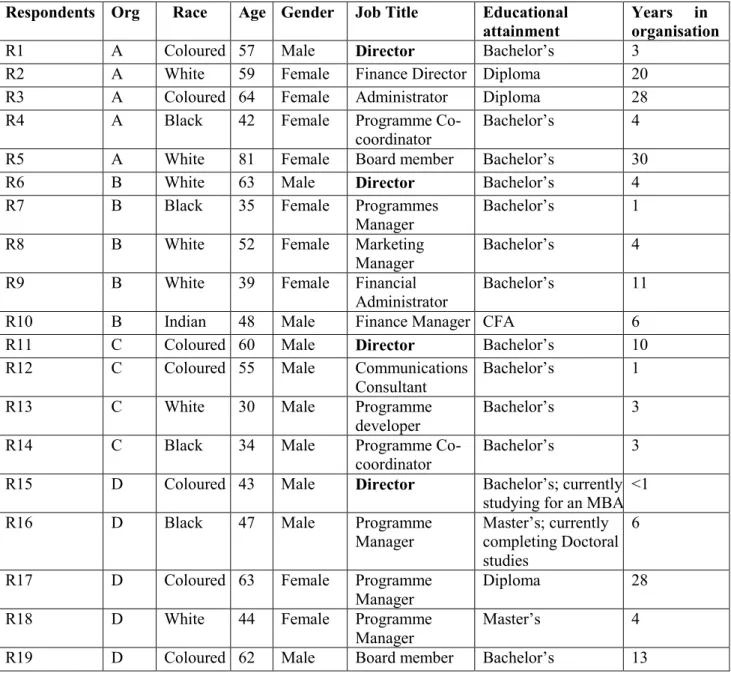
4.1. Profile of respondents ... 47
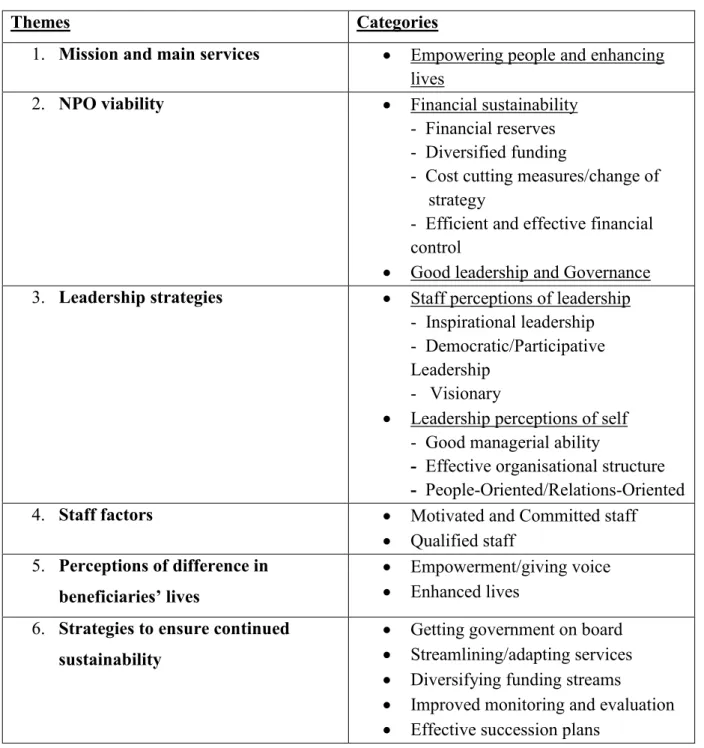
4.2. Framework for analysis... 50
4.3. Presentation and discussion of findings ... 50
4.3.1. Mission and main services ... 51
4.3.2. NPO viability ... 52
4.3.2.1. Financial sustainability ... 52
4.3.2.2. Good Leadership and Governance ... 56
4.3.3. Leadership strategies ... 57
4.3.3.1. Staff perceptions of leadership ... 57
4.3.3.2. Leaders’ self-perception ... 61
4.3.4. Staff factors ... 64
4.3.5. Perceptions of difference in beneficiaries’ lives ... 66
4.3.6. Strategies to ensure continued sustainability ... 68
4.4. Summary ... 72
CHAPTER FIVE: CONCLUSIONS AND RECOMMENDATIONS ... 73
5. Introduction ... 73
5.1. Conclusions ... 74
5.1.1. NPO viability ... 74
5.1.2. Leadership strategies that contributed to effective organisations ... 75
5.1.3. Staff factors that contributed to effective organisations ... 77
5.1.4. Strategies to ensure continued sustainability ... 77
5.2. Recommendations ... 79
5.2.1. Recommendations for further research ... 79
5.2.2. Recommendations for NPOs ... 79
vi
REFERENCES ... 82
Appendix I- Staff interview schedule ... 93
Appendix II- Leadership interview schedule ... 96
Appendix III- Board member interview schedule ... 99
vii
LIST OF TABLES
TABLE 1: Profile of Respondents...…...47 TABLE 2: Framework for analysis………..………….………….…….…….50
1
CHAPTER ONE
:
INTRODUCTION
1.
Introduction
Non-profit organisations (NPOs) play a pivotal role in the society as they can contribute in service delivery areas that government seems unable to fulfill (Wyngaard, 2013; Nel, Binns and Motteux, 2001). According to O’Brien (2007), the South African non-governmental (NGO) sector is involved in various community programmes aimed at providing services as well as mobilizing communities for social change. Despite the crucial role it plays, the NPO sector in South Africa faces various challenges such as inadequate funding and financial controls, shortage of qualified and suitable staff, due to its inability to provide adequate remuneration for services rendered, and the lack of other infrastructural resources forcing it to close down (National Development Agency, 2013). Some NPOs however have managed to address their funding crises through innovative and resilient strategies that have enabled them to further exist, albeit with adaptations to their services (Gebreselassie-Hagos and Smit, 2013). Of special interest to the researcher was the fact that some of these NPOs continue to provide effective services despite a challenging South African context. Hence this research was undertaken to explore possible reasons as to why some NPOs appear to be successful and resilient in the face of all the odds against them.
This chapter will present the problem context; rationale and significance of the research; topic of the research; main research questions; assumptions that underpin these questions; main research objectives; clarification of key concepts; reflexivity and an outline of this research report.
1.1Problem context
This research was carried out in the Western Cape province of South Africa. The Western Cape has approximately 5.8 million people (Statistics South Africa, 2011). The province is considered to be economically quite sound, as its economy grew by 3.6% in 2011 (the second highest growth rate after Gauteng (Statistics South Africa, 2011), despite its high crime rate (City of Cape Town, 2006).
2 There are approximately 100,000 registered non-profit organisations (NPOs) and an estimated 50,000 unregistered NPOs in South Africa (Stuart, 2013). The South African Constitution safeguards a number of socio-economic rights aimed at improving the quality of life of all citizens which are enshrined in the Bill of Rights (Wyngaard, 2013). The non-profit sector in South Africa plays a significant role by helping the government fulfill its constitutional mandate. However, a substantial proportion of such organisations in the sector have closed down in the past year. According to Wyngaard (2013), between October 2012 and February 2013, over 23,000 organisations were deregistered. Some of these organisations have played a key role in service delivery. With increasing service protests about government’s sluggish service delivery in relation to widespread poverty and inequality which has not been sufficiently addressed, this is a cause for alarm (Landman, 2014; Mchunu, 2012). These organisations have been at the forefront of catering for the basic needs of vulnerable communities and groups (Department of Social Development, 2012).
Whilst there is evidence that the Civil Society sector has played a meaningful role in holding Government accountable (Young, 2000), as well as providing services (Wyngaard, 2013) there is a dearth of research with regards to monitoring and evaluation of NPOs in South Africa. Monitoring and evaluation is crucial to ensuring accountability, sustainability and developing better practices based on the experiences of NPOs (Koot, n.d.). According to Werker and Ahmed (2007), the NPO sector appears to be populated by people motivated by altruistic values rather than by financial rewards.
In recent years, the NPO sector has benefited from substantial corporate funds as well as government funding. This meant that fund accountability in relation to efficient service delivery became a focus for assessment for many donors. One has to bear in mind that this sector’s performance and financial management has not always been rigorously evaluated (National Development Agency, 2013). Not many studies have focused on NPOs that are successful with a greater focus having been on those NPOs that were not succeeding (a ‘deficit’ approach). Some of these more successful NPOs have continued in their pursuit of organisational excellence and efficient service delivery. The focus of this study is on such NPOs. This research therefore wants to explore the perceptions of key respondents about key defining features of a successful NPO in relation to: sustainability, leadership strategies and staff factors that contribute to effective service delivery.
3
1.2Rationale and Significance of the study
Some research has been done on challenges facing NPOs in South Africa, and statistics are available of NPOs that have closed down (Wyngaard, 2013; Seabe, 2012; Amandla Development Whitepaper, 2007). However, not much research is available on why NPOs are successful. Hence this research will address the lack of research in this area. Whilst assumptions could be made about good financial and accounting rigour, good leadership and competent staff leading to successful organisations, it is important to explore these assumptions from the perspectives of these personnel. Their ‘voices’ could offer a deeper insight into understanding the factors and dynamics that underpin effective organisations. This limited study which could be seen as a ‘pilot study’ could lead to more extensive mixed methodology approaches at a later stage. The findings from this study could be given to the Western Cape NPO network and to the Social Development Government Department which in turn could influence both practice and policy.
1.3 Research Topic
“Exploring Staff Perceptions of why selected development NPOs are able to deliver effective services.”
1.4 Overall Research aim
To find out the reasons that staff at targeted development NPOs give as to why they consider their NPOs to be effective.
1.5 Research Questions
1) What is the mission and main services of the NPOs? 2) How are these NPOs able to remain viable?
3) What leadership strategies contribute towards NPO effectiveness? 4) What contributing staff factors promote effective service delivery?
5) What kind of difference does the organisation’s services make to the lives of beneficiaries?
6) What kind of strategies are needed to ensure the continued sustainability of the NPOs?
4
1.6 Main Assumptions
The following are some of the main assumptions that underpin this study:
That the mission and services rendered over time will have to adapt to the changing socio –economic environment and that this flexibility and adaptability is important. That remaining viable would depend on a number of factors linked to appropriate
resource related service delivery.
That excellent leadership strategies are needed for successful service delivery. That various staff factors play a key role in effective delivery.
That having a positive influence on the lives of beneficiaries is linked to successful service delivery.
That various strategies are needed in order to ensure the NPOs’ sustainability.
1.7. Research Objectives
1) To find out the mission and the main services rendered by these NPOs. 2) To explore how these NPOs have remained viable.
3) To determine the leadership strategies that could contribute towards NPO effectiveness.
4) To ascertain the contributing staff factors that promote effective service delivery. 5) To explore staff perceptions about the difference their services make to their
beneficiaries.
6) To explore the strategies needed to ensure the continued sustainability of the NPOs.
1.8. Clarification of Concepts
Non-profit organisation (NPO):- “a trust, company or other association of persons, established for a public purpose; and the income and property of which may not be distributable to its members or office-bearers except as reasonable compensation for services rendered” (The South African NPO Act 71, 1997)
Development: - “a process of expanding the real freedoms that people enjoy, by the removal of major sources of unfreedom like poverty, poor economic opportunities as well as systematic social deprivation” (Sen, 1999: 99).
5
Development NPOs: - Are those organisations which are directly involved in improving the wellbeing of certain sectors of society, with support from the state or private donors (Swilling and Russell, 2002).
Effective services: - “the extent to which an organisation is able to fulfill its goals” (Lusthaus et al, 2002, as cited by Chi, Lan and Dorjgotov, 2012, pg. 1018).
Perception: - According to the Oxford dictionary (2010) this refers to “an interpretation or impression based on one's understanding”. For the purposes of this study, perception will also mean the NPO staff’s personal (subjective) feelings and opinions about a topic or phenomena.
Staff: - For purposes of this study, this term will refer to particular personnel in the NPOs i.e. the directors, programme heads, board members, heads of finance departments and those involved in general administrative work.
Leadership: -“is the interpersonal influence exercised in a given situation through the process of communication in order to reach a given goal” (Tannenbaum et al (1970), as cited by Furtado et al (2011: 1048))
Viability: -is “the ability of an organisation to continue to deliver its projects and services and to reach those outcomes outlined in its mission” (Craciun, Lardinois and Atkinson, 2009: 12).
Sustainability: - “the ability of administrators to maintain an organisation over a period of time, with the aim being to ensure that an organisation continues to survive in the future” (Sontag-Padilla, Staplefoote and Gonzalez-Morganti, 2012).
1.9. Reflexivity
I need to say that I am a Zimbabwean student doing my research in a South African context and I had to gain some understanding of the context that I am studying. I was very enthusiastic about doing this research since I thought that it would be addressing a need with regards to a lack of research focusing on successful NPOs.
6 At the same time there was a level of trepidation since this was the first time I would be carrying out a dissertation of this nature. As a novice researcher I felt overwhelmed about firstly obtaining the consent of my participants and secondly, about being able to secure sufficient time in the respondents’ busy schedules to be able to gain rich information. To my dismay I found that it was not easy to secure consent to participate in the study and after many attempts (following several rejections as well some non-committal responses); a solid group of respondents was eventually secured. This attempt to secure respondents lasted at least three months.
There were challenges at each stage of the research journey but supervision proved helpful as I faced the in-depth interviewing and thereafter the laborious task of transcribing. Analysing, presenting and discussing the findings together with putting together writing this research report were some of the final challenges. All in all, I felt that this research journey was worthwhile and am happy that I finally reached the stage of submitting my work for scrutiny.
1.10 Chapter Outline of Research Report
This research report will consist of the following five chapters: Chapter 1 - Introduction
Chapter 2 - Literature review Chapter 3 - Methodology
Chapter 4 - Presentation and Discussion of findings Chapter 5 - Conclusions and Recommendations
1.11 Summary
This chapter has presented an introductory overview of the intended study, giving the reader a clear understanding of the problem context as well as the problem formulation (main questions and research objectives). The rationale and significance of this study was identified and some key concepts were clarified. The researcher highlighted some personal issues under ‘reflexivity’ and closed off this chapter with a rudimentary outline of the research report.
7
CHAPTER TWO: LITERATURE REVIEW
2.
Introduction
This literature review will present the relevant legislated regulations pertaining to NPOs, some theoretical models/frameworks which underpin this study, as well as research studies and literature that pertain to the objectives of this study.
2.1Relevant NPO legislation
The following section will provide an overview of various regulations guiding NPOs.
Registration under the Non-Profit Organisations Act, 1997
The Non-Profit Organisations Act of 1997 (the NPO Act) provides for a voluntary registration facility for non-profit organisations. The Act defines a non-profit organisation as
“a trust, company or other association of persons established for a public purpose and the income and property of which are not distributable to its members or office-bearers except as reasonable compensation for services rendered” (NPO Act, 1997). This also applies to NPOs registering under The Companies Act (2008). The Act stipulates that for an organisation to be registered as an NPO, it must be not for profit; and should have a legal personality distinct from its members (a body corporate); as well as not being part of government (NPO Act, 1997). Under the Non-profit Act (1997), for a company to be registered as an NPO, a founding document or constitution must be made available, which states, among other things, the organisation’s name and objectives, as well as a determination of the organisation’s financial year.
Income Tax Act No. 58, 1962
The Income Tax Act, 1962 law stipulates that organisations classified as public benefit organisations are exempt from paying income taxes. A Public benefit organisation is, “any organisation – (a) which is – (i) a company formed and incorporated under section 21 of the Companies Act, 1973 (Act No. 61 of 1973), or a trust or an association of persons that has been incorporated, formed or established in the Republic; or (ii) any branch within the Republic of any company, association, or trust incorporated, formed or established in terms of the laws of any country other than the Republic that is exempt from tax on income in that other country” (Income Tax Act, 1962). As such, NPOs are entities established for the benefit of the public and are exempt from taxes.
8 However, these entities are mandated to account for their income and expenditure, and as such, they are required to submit their financial statements with their Income Tax return to the Receiver of Revenue on an annual basis.
National Development Agency Act, 1998
The National Development Agency (NDA) is a body established through the passing by Parliament, of the National Development Agency Act. The main objective of the Act is, “to contribute towards the eradication of poverty and its causes by-granting funds to civil society organisations for the purposes of:-
(a) Carrying out projects or programmes aimed at meeting development needs of poor communities; and
(b) Strengthening the institutional capacity of other civil society organisations involved in direct service provision to poor communities” (National Development Agency Act, 1998).
This means that all those organisations which are involved in poverty alleviation, are eligible to apply for funding from the NDA. This would thus apply to all the development NPOs that comprise the study sample for this research
2.2Theoretical models / frameworks
Various theories and models that provide a conceptual framework for this study will now be reviewed.
2.2.1. The internal process approach of organisational effectiveness
Organisational effectiveness is concerned with matters relating to an organisation’s ability to use resources in order to achieve its aims (Ashraf and Kadir, 2012). The internal process approach of organisational effectiveness is deeply rooted in both the systems and human relations model of organisations, where if an individual unit is ineffective, the rest of the organisation will suffer (Ashraf and Kadir, 2012; Glunk and Wilderom, 1996). An organisation is made up of various components or resources as it were: employees, stakeholders, financial resources. It is an organisation’s ability to maximize these resources that lead to organisational effectiveness. According to Ashraf and Kadir (2012), effectiveness means that the organisation is internally healthy, with all internal systems and processes working well.
9 Criteria for smooth internal functioning vary from adaptability, clear, unambiguous communication, a strong corporate climate, as well as a positive work environment (Glunk and Wilderom, 1996). This means that for an organisation to be termed effective it has to consider the external environment and adapt to the needs of that environment.
Ashraf and Kadir (2012) posit that the relationship between members in an effective organisation is based on trust, honesty and goodwill, with a vertical and horizontal flow of information between all the sub–systems. This means that there is a form of symbiotic relationship between the larger organisational system and all its sub-systems. The organisation depends on all the other parts to perform effectively as a whole. For purposes of this study respondents’ perceptions about the effectiveness of the organisation will include a consideration of these factors.
2.2.2. Motivational theories Herzberg’s Two-factor theory
Motivation is about installing a ‘self-propelling generator’ in an employee. Herzberg found that factors that are involved in producing job satisfaction (and motivation) are distinct and separate from the factors that lead to job dissatisfaction (Herzberg, 1987). Herzberg deduced that human beings have two different sets of needs and the different elements of the work situation satisfy or dissatisfy those needs (Lundberg, Gudmundson and Andersson, 2009). Herzberg distinguished between motivators (stemming from the human need to grow psychologically), and hygiene factors (stemming from the human disposition to avoid pain) (Herzberg, 1987). Motivators are those factors that lead to positive satisfaction and are intrinsic conditions of the job like a sense of achievement, recognition and personal growth (Herzberg, 1987). According to Lundberg et al (2009), a lack of these growth factors does not cause dissatisfaction, but simply there is an absence of satisfaction. Hygiene factors are extrinsic to the work itself like company policy, job security, benefits etc., and are such that they do not give positive satisfaction in and of themselves, although if they are absent, dissatisfaction will arise (Herzberg, 1987).
This theory is relevant to the study as it sheds light on employee motivation in the NPO sector. Employees in the NPO sector tend to be motivated by altruism and the nature of their jobs which are service oriented providing the positive satisfaction.
10
McClelland’s Learned needs theory
Unlike Maslow’s clearly defined hierarchy of needs, McClelland (1961), as cited by Robbins (1982), suggests that human needs cannot be purely understood in a linear manner since human beings are driven by three main motivators namely achievement, affiliation and power. One could say that these three motivators drive each person in different degrees regardless of race, culture or gender. This theory suggests that some people may be more motivated by a need for achievement in setting and accomplishing goals, while some others may have a stronger need for affiliation, setting a high value on their relationships in the workplace, whilst others may set a greater premium on exerting control and influencing other people (need for power) (Harrell and Stahl, 1981). Needless to say, most people are driven by all three motivators in different degrees and at different times in their work careers. Thus one could not deduce that NPO employees are not interested in controlling other people or exerting power over them since their altruistic endeavours may well involve elements of hidden power issues. One could well argue that the need to influence the lives of others may be much stronger than the need for increased remuneration since it is well known that the NPO sector attracts people who want to make a difference in the lives of those less fortunate.
2.2.3. Leadership Theories
According to Hellriegel, Jackson and Slocum (2006), a leader is a person in an organisation responsible for organizing, planning and controlling. Numerous leadership theories can be drawn upon. However, for purposes of this study the following three theories will be discussed: Transformational leadership vs. Charismatic leadership, Democratic leadership and Situational leadership.
Transformational leadership vs. Charismatic leadership
According to Burns (1978) as cited by Levine, Muenchen and Brooks (2010), transformational leadership is the two-step process that a leader uses to influence his/her followers: First, a leader attempts to raise the morals, values and ideals of the followers; and second, a leader promotes change in individuals, groups and organisations. To accomplish this change, a leader must foster good relationships with his/her followers as a means to encourage and motivate the followers to perform and excel. What this means is that transformational leaders actively seek and encourage relationships with their subordinates as a close working relationship serves as an impetus for staff to perform better in their jobs.
11 According to Yang (2012), transformational leadership comprises of four components, idealised influence, inspirational motivation, intellectual stimulation and individual consideration. Idealised influence refers to the leader paying attention to his/or her subordinates’ needs so as to inspire trust and confidence from the followers; inspirational motivation happens when the leader entrusts subordinates with challenging work, as well as clearly communicating expectations; and intellectual stimulation happens when the leader fosters creative problem solving from the subordinates; and finally, individualised consideration takes place when the leader pays special attention to the growth of each subordinate by acting as a mentor (Shiva and Suar, 2012). Ideally, such a leader would inspire trust and growth amongst followers who feel that they are taken seriously, that their career paths are being facilitated and that they are encouraged to ‘think out of the box’ and make meaningful contributions to the organisation as a whole.
According to Bennis and Nanus (1985: 3), as cited by Duygulu and Kublay (2010), a transformational leader is “one who commits people to action, who converts followers into leaders, and may convert leaders into agents of change”. This means that while in the beginning the leader acts as a mentor or role model, the subordinates will, after some time begin to exhibit the leader’s traits, thereby becoming leaders themselves. Transformational leadership represents a style whereby the leader values co-operation in the performance of tasks, providing subordinates with the opportunities to learn from shared experiences (Bass, 1985, as cited by Yang, 2012).
Charismatic leadership may or may not closely approximate transformational leadership. According to Cicero and Pierro (2007: 299), charismatic leadership is defined as, “an attribution based on followers’ perception of their leader’s behaviour”. Such leaders are able to formulate and articulate inspirational vision and behaviours that foster an impression of extraordinary vision. In transformational leadership the focus is on the relationship of the leader and the followers with regards to vision, risk-taking, enthusiasm and confidence (Hoyt and Ciulla, 2004, as cited by Levine, Muenchen and Brooks, 2010). Not all leadership in the NPO sector may be transformational but some of the leaders may indeed be charismatic without really turning their followers into leaders or agents of social change. Such charismatic leaders may steer the vision of their organisation single-handedly and when they leave, the organisation may flounder, close down or re-establish itself under new leadership.
12
Democratic Leadership
There are numerous definitions of democratic leadership (Choi, 2007). According to Anderson (1959) as cited by Choi (2007), a democratic leader is one who shares the decision making responsibility with other members. While the final decision rests with the leader, he or she encourages other members of the team to take part in the decision making process (Bhatti et al, 2012). A democratic leader is characterised by being knowledgeable and influential, encouraging, allowing followers to be self-determined, being a good listener and respecting others’ opinions (Kuczmarski and Kuczmarski, 1995). This type of leadership is associated with increased follower productivity, satisfaction, involvement and commitment to work (Choi, 2007). This is supported further by Bhatti et al (2012), who indicate that this type of leadership increases satisfaction in employees, as they would feel more involved in the decision making processes of the organisation. Such democratic leadership may be found in some NPOs which consider themselves to be successful. While it can be argued that including everyone in the decision making process is time consuming, the end result pays dividends in a more committed staff (Bhatti et al, 2012).
Situational Leadership Theory
The situational leadership theory put forth by Hersey and Blanchard (1969), as cited by Furtado et al (2011), proposes that leadership effectiveness depends on the leader's ability to tailor his or her behavior to the demands of the situation, namely, the subordinate's level of maturity. This approach emphasizes the importance of contextual factors that influence leadership processes such as the characteristics of the followers, the nature of the work and type of organisation (Yukl, 2006). This approach posits that successful leaders have the ability to adapt their leadership styles to the changing organisational environment, and that it is the subordinates’ ability, willingness and readiness to perform tasks that will influence a leader’s actions (Silverthorne and Wang, 2012). Successful leaders do not use one leadership style, but will switch between styles, as different situations call for different leadership roles and styles.
This theory emphasises flexibility in leadership style according to the situation (Silverthorne and Wang, 2012). Thus, depending on the followers’ maturity and level of competence, the leader will act accordingly and engage followers with regards to their level of readiness to take on more challenges (Furtado et al, 2011). Thus, it would be interesting to explore whether or not NPO leaders also use aspects of this approach in their leadership.
13 In summary it is clear that the internal processes of an organisation need to be assessed together with leadership characteristics/styles as well as motivational theories that inform the ways that followers behave. By exploring some of these issues in this study one could draw some assumptions about what constitutes ‘success’ in these selected NPOs.
2.3Defining the non-profit organisations (NPOs)
According to Hall (2000: 4), the terms non-profit sector and non-profit organisation refer to
“non-stock corporations and trusts formed for charitable, educational, religious and civic purposes which are exempt from taxation and to which donors can make tax deductible contributions”. The South African NPO Act 71 of 1997 defines an NPO as, “a trust, company or other association of persons, established for a public purpose; and the income and property of which may not be distributable to its members or office-bearers except as reasonable compensation for services rendered” (NPO Act, 1997: 2). Hall (2000: 4) further describes NPOs as, “informal and formal voluntary associations, non-stock corporations, mutual benefit organisations, religious bodies, charitable trusts, as well as other non-proprietary entities”.
Through the NPO sector, people are able to pursue goals that are not primarily driven by remuneration, goals which they freely choose to pursue (Connors, 1980). NPOs form part of the “The Third Sector”, a term that is widely used to describe a host of organisations like charities, self-help groups and social enterprises which do not fall under the auspices of the state or market enterprises (Corry, 2010). According to Ridley- Duff and Seanor (2008) as cited by Corry (2010), Third Sector organisations are established by people on a voluntary basis, so as to pursue social or community goals. Salamon and Anheier (1997: 9) as cited by Corry (2010), posit that Third Sector entities have the following characteristics: they are organised, as they possess some institutional reality; they are private, as they are institutionally separate from government; they are non-profit distributing; they are self-governing; and lastly, they are voluntary, either in conducting their activities or in the management of their affairs.
Another characteristic of NPOs is that they aim to improve the lives and livelihood prospects of disadvantaged people, who are not able to realise their potential or achieve their full rights in society (Dept. of Welfare, 1999).
14 NPOs achieve their aims through a host of activities such as the care and welfare of the disadvantaged, as well as social change and development activities, which are directed either at the concerns or issues which affect the disadvantaged. NPOs play crucial roles in defining which services are to be provided, or they may consult first with beneficiary groups, or provide the services for the funding agencies that define the services (Dept. of Welfare, 1999). These organisations mobilise resources and engage in research to better understand the needs and problems affecting individuals, groups or society as a whole, and then find innovative ways of responding to these problems, while simultaneously mobilizing public awareness and advocating for change or reform (Dept. of Welfare, 1999).
2.4 History of NPOs
According to Sen (1992), voluntarism dates back to the middle ages, but it was only in the 1800s that large scale voluntary efforts began, which focused on social and economic development. The first international non-governmental organisation (NGO) was the Anti-Slavery Society, which was formed in 1839 (Lewis and Kanji, 2009). Pande (1967), as cited by Sen (1992), posits that the first types of voluntary efforts of social development were initiated by Christian missionaries in the early 1810s, and their primary motive was to promote the spread of Christianity, and as such they built schools, colleges and orphanages. These Christian missionaries also initiated rural colonies in the mid-1800s, placing much emphasis on modernization and empowerment.
It is interesting to note that in the West, awareness of international responsibility was born out of the two world wars which devastated countries and impacted on families. The aftermath of these resulted in the founding of institutions like the League of Nations (and its successor, the UN), the Bretton Woods system, and the inter-governmental bodies created for cross border action like the Red Cross and Red Crescent Societies (Eade, 2001).
In the United States of America (USA), NPOs were only differentiated from profit firms over the course of the 19th century, and in the late 1800s, the impetus for the creation of these organisations came from upper class citizens who wanted to control urban environments (DiMaggio and Anheier, 1990). During the so- called “Progressive Era” in the USA, welfare provision shifted from the hands of upper class citizens to professionals. By the 1920s, doctors employed by NPOs dominated discourses on welfare (DiMaggio and Anheier, 1990).
15 By the 1960s, voluntarism had shifted, this time to state provision, with the growth of the “Third Sector”, and by 1975, government had completely replaced private donors as the largest source of NPO revenue (DiMaggio and Anheier, 1990). The history of NPOs in Britain is slightly different from the one in the USA. The history of the non-profit sector in Britain “shows how provision was organized in a liberal, yet traditional class based system”
(Anheier, 2005: 29). In Britain, according to Anheier (2005: 30), the situation changed from “a church dominated system of welfare provision in the 17th and 18th century, to a system in the 19th and early 20th century, where the government and voluntary sector performed separate, but distinct roles. From the 1930s onward, the voluntary sector acted as a complement to public provision, until the ‘Third Way’ approaches of the Labour government gained ground (DiMaggio and Anheier, 1990). The Third Way viewed the market, government and voluntary associations as being in a relationship that could solve social problems. This “Third Way” thinking has largely influenced the welfare discourse and evidence of this can also be seen in South Africa.
According to Young (2000), the relationship between government and the NPO sector can be viewed in three different ways. One line of thinking views NPOs acting as supplementary to government. The premise of this notion is that it is government’s responsibility to meet and satisfy citizens’ needs through the provision of public goods. However, those citizens whose needs remain unmet will have their needs met by the non-profit sector. Another approach would be to view the relationship of government and NPOs as being complementary. This is where governments and NPOs are engaged in a partnership or a contractual relationship, which sees government funding public services, and NPOs delivering the services (Young, 2000). Herman and Renz (2000) posit that NPOs and government are interdependent, as government relies on NPOs to service some needs, while the NPOs require funding from government. Thus through this mutually beneficial relationship, service delivery to communities is being facilitated. Government and NPOs can also be viewed as adversaries, especially when the latter engage in adversarial or advocacy roles. In areas where minority views are not reflected in public policy, the minorities, with the help of NPOs could mobilize themselves to agitate for public services as well as to put pressure on government to meet their needs (Young, 2000).
16
2.5NPOs in South Africa
The South African non-profit sector plays an integral role in helping the government fulfill its constitutional mandate, to such an extent that welfare services in South Africa are delivered by both the state and the NPOs (Wyngaard, 2013; Patel et al, 2012). The South African NPO sector is made up of two parts, the formal welfare sector, which is made up of well-established organisations, partly subsidised by the state, and smaller community based organisations, functioning individually and sometimes in isolation without the necessary resources (Patel et al, 2012). In South Africa, the voluntary sector is a part of civil society, and it is made of NGOs, social movements, community based organisations (CBOs), civics, women’s groups, faith based organisations, and other similar groupings, and these organisations operate independently of the state (Charities Aid Foundation Southern Africa, 2012). The CIVICUS Index Project defines civil society as,
“the sphere of institutions, organisations, networks and individuals…located between the confines of the family, the state and the market, which is bound by a set of shared civic rules, and in which people associate voluntarily to advance common interest” (Camay and Gordon, 2001: 3).
According to Swilling and Russell (2002), defining NPOs in South Africa is difficult, as the term is muddled with some unresolved debate about the notion of the civil society. According to McKendrick (1990), as cited by Patel (2009), in pre-colonial South Africa, society relied on women, mutual aid, and kinship and community support systems to meet human needs. Before colonisation, the indigenous people in the region shared and cared for those within their own communities or tribes (Camay and Gordon, 2001). With the Dutch and British colonialism, the socio-economic organisation of the South African society changed, which resulted in the erosion of traditional African family systems of support (Patel, 2009). Through the British government’s Colonial Development and Welfare Acts, there was a rise in the public welfare administration in South Africa, aimed at caring for the “worthy poor”. Colonial powers had no desire to finance state welfare programmes for Africans, and as a result, government social services for the indigenous population were minimal (Manji and O’Coill, 2002).
The Christian missionaries were instrumental in providing welfare services, with organisations such as the Afrikaans Christelike Vroue Vereniging (ACVV), which was formed in 1904 to respond to the welfare needs of poor white families and orphans.
17 By the 1920s, urban white poverty problems began to receive attention, and after the Carnegie Commission of Enquiry, there was the adoption and implementation of basic welfare provisions (Patel, 2009). When the Nationalist Party came into power, the welfare system was such that it was racially defined, and voluntary organisations were used by the apartheid government to deliver services (Patel, 2009). Racial discrimination and segregation also had a tremendous impact on the evolution of the South African society, as there were huge disparities in financial and human resources available for development infrastructure and services to black communities (Camay and Gordan, 2001). Initially there was restricted political space for black civil society organisations, and as such many black areas were grossly underdeveloped. The growing Anti-Apartheid movement gave rise to progressive organisations intent on changing the status quo. According to Camay and Gordan (2001), civil society organisations which grew out of oppressed and exploited community groups played a major role in the social and political mobilisation against apartheid. Civil society groups played varied roles historically, and during the transition period to a democratic dispensation, they continued to engage and influence the drafting of the new constitution. Civil society groups also played a role in shaping the Truth and Reconciliation Commission (Charities Aid Foundation Southern Africa, 2012).
When the State set out its new economic vision in its Reconstruction and Development Programme (RDP) after the general elections in 1994, NPOs were accorded a central role in promoting the development of the country. The RDP’s priority was meeting the basic needs of people like employment, land, housing, water, electricity, health care, and social welfare, among other things (Visser, 2004). Government’s new strategy framed in the Growth, Employment and Redistribution plan (GEAR) plan also gave a platform for the non-profit sector as a key actor alongside business in dealing with poverty alleviation. However, GEAR was focused on curtailing government expenditure, which led to an increase in poverty (Khamfula, 2004). GEAR seemed to have reversed some of the initial impetus that came from the RDP blueprint as the focus was more on economic growth at the cost of direct poverty alleviation. Although both RDP and GEAR are considered to be ‘developmental’ strategies to address poverty, this could be debated. The South African Government still sought to promote “developmental social welfare” despite the inherent contradictions in its policy framework.
18 Developmental social welfare is defined as a,
“pro-poor strategy promoting participation of the socially excluded in development activities to achieve social and economic justice” (Patel, Schmid, and Hochfeld, 2012).
“The introduction of a developmental social welfare model marked a radical shift in policy that occurred in all sectors of society replacing discriminatory legislation with new and progressive policies” (Patel, 2005: 2). This new approach intended for all population groups to have equal access to needed services, and ensure that those communities that were historically disadvantaged and neglected would be serviced appropriately. However since 1994 to date the inequality index has increased (Hoogeveen and Özler, 2005).
The developmental social welfare approach had another premise that economic development by itself was insufficient to lead people out of poverty, and as such, there was a need for substantial investments in human development which gave people increasing access to education, basic health, shelter and jobs. According to Morris (2000), people’s needs are mostly serviced through associations and organisations that are easily accessible. Thus governments would do well to fund civil society organisations engaged in social development whilst at the same time acknowledging their autonomy as well as their potential to meet people’s needs more effectively at community level (Patel et al, 2012). This ‘developmental approach’ calls for citizen participation in service development and delivery, and as such it advocates for capacity building and social networking, and there is an emphasis on building the livelihood capacities of poor people. (Patel et al, 2012).
2.6Types of NPOs with special reference to development NPOs
Within the NPO sector there are various sub-sectors which include for example: Development and Housing; Education and Research; Environmental Health; Human Rights Advocacy; Religion; and Social Services (Mzini, 2011). According to Dangor (1997) before the advent of democracy, there NPOs, which were welfare oriented and had links with the government; Emergency NPOs, which were founded during the state of emergency (1986-1990), and their activities were mainly political in nature; as well as Transition NPOs, which aimed at strengthening democracy and facilitating development.
19 Post 1996, further developments occurred within the NPO sector which now included community co-operatives, stokvels, survivalist NPOs, oppositional NPOs and development NPOs (Swilling and Russell, 2002). Since this study will be focusing on development NPOs a short overview will be presented in the following section.
2.6.1 Development NPOs and their role in people’s lives
Development NPOs are defined as those organisations which are directly involved in improving the wellbeing of certain sectors of society, with support from the state or private donors (Swilling and Russell, 2002). Such organisations are involved in empowering people to take command of their own lives, through developing a critical awareness of their situations (Townsend, Porter and Mawdsley, 2004). These organisations aid people by giving them the necessary tools to aspire towards their own development; to form lobby groups; to advocate for change in their situations and to contribute to the upliftment of their own communities by working in partnerships with these NPOs. South Africa’s key community development challenge was to overcome the legacy of colonialism and apartheid, which were characterised by segregated settlement patterns and by unequal distribution of resources (Luka and Maistry, 2012). In a bid to improve the lives of its citizens, the government adopted a combination of various community development perspectives which included a basic needs perspective, a social inclusion perspective, an income perspective and a sustainable livelihoods perspective (Luka and Maistry, 2012). One could argue that development NPOs use both a basic needs and a sustainable livelihoods approach which places emphasis on assisting communities through constructing and strengthening appropriate asset bases that will help them cope with their conditions of poverty and hardship (Luka and Maistry, 2012).
Makoba (2002) suggests that these development NPOs work mostly in Third World countries where markets are inaccessible and where governments lack capacity or resources to reach the poor. However in emergent economies (like South Africa) it is clear that development NPOs may also play a crucial complementary role in assisting government. Developing countries are often plagued by serious internal and external constraints with regards to resource provision to the poor and it is this gap that development NPOs can address (Nel, Binns and Motteux, 2001).
20 The NPO sector has made some inroads into improving the quality of life for some of its poverty-trapped citizens but government has to make much more resources available to this sector to ensure sustainability of service delivery where it is most needed. Development NPOs are also known to take the lead in responding appropriately to community problems as they are capable of rapid implementation and are able to customize programmes to address local conditions (Fredericksen and London, 2000). Development NPOs are able to reach out to the poor, empowering them to regain control of their lives (Lewis and Kanji, 2009). Such NPOs adopt a ‘bottom-up” approach that fosters self-reliance among its beneficiaries.
2.7Measuring NPO Success
Today’s organisations face unprecedented challenges when having to assess their performances as they have to take into account multiple factors which affect the organisation internally as well as externally such as economic downturns, financial viability competent workforce, strategic leadership and adaptability to changing contexts. (Bartuševičienė and Šakalytė, 2013). Assessing NPO success is further complicated by the absence of an agreed upon set of criteria that measures NPO success, although effectiveness and efficiency can be measured (this will be discussed later on in this section). In for-profit organisations, assessment is easy due to the efficiency of measures like the profit margin (Vaughan, 2010). A traditional return on investment formula: (total revenues – total expenditure)/ Net assets, has not been applied to NPOs as their humanitarian service goals are much harder to measure. Another complication in assessing the performance of NPOs is that NPO goals are intrinsically linked to donor criteria and not primarily to beneficiary demands (Vaughan, 2010). He who pays the piper calls the tune.
In times of fiscal crisis, the need and demand for health and human services increases, and as revenues shrink, funders tend to invest strategically only in successful organisations (Vaughan, 2010). NPOs are thus faced with the challenges of making efficient use of scarce resources, of being able to adapt and be flexible and satisfy various stakeholders (Ridder, Piening and Baluch, 2012). Such organisations are confronted with the need to demonstrate accountability, comply with funders’ priorities and provide more good quality services against a background of drastic financial setbacks (Ridder et al, 2012).
21 Knowledge of organisational history is important for recognizing patterns in effective management, as well as understanding how those organisations respond to internal and external challenges (Kimberlin, Schwartz and Austin, 2011). Most international non-governmental organisations have firm roots in humanitarian missions and embody a strong volunteer corps. At the same time such organisations are being held accountable according to sound business principles which include professionally managed financial systems and proper accountancy procedures (Jayawickrama, 2011). Bartuševičienė and Šakalytė (2013) indicate that the more successful organisations tend to have strong management and good human resources protocols. In such successful organisations, employees are aware of the performance appraisal systems and know how to achieve excellence in their work (Bartuševičienė and Šakalytė, 2013).
Common measures of organisational performance are effectiveness and efficiency, and these will be discussed in the following sections.
Effectiveness as a measure of organisational success
An organisation’s effectiveness refers to, “the extent to which an organisation is able to fulfill its goals” (Lusthaus et al, 2002, as cited by Chi, Lan and Dorjgotov, 2012: 1018). Organisational effectiveness includes activities like improved innovation and the improved co-ordination of effort (Gold et al, 2001, as cited by Chi et al, 2012). A number of organisations assess their performance in terms of effectiveness, which places emphasis on the attainment of an organisation’s mission, goals and vision (Bartuševičienė and Šakalytė, 2013). An effective organisation can also be seen by its ability to adapt to changes, whether changes to strategy or the organisational structure itself (Chi et al, 2012). Bartuševičienė and Šakalytė (2013), suggest that in order to improve organisational effectiveness, management in the organisation should strive for better communication, leadership, direction, interaction and adaptability to the environment. Owing to the fact that NPOs use public funds, it is most crucial for them to be effective in their operations (Herman and Renz, 2000). According to Sawhill and Williamson (2001), NPOs have turned to traditional business models so as to improve their effectiveness and efficiency, and lessons from the private sector in areas like strategic planning, marketing, finance, information systems and organisational development have proved quite beneficial.
22 In a study on NPOs, respondents perceptions about aspects of NPO success were sought, and most highlighted the following: clear mission focus/ goals; meets clients’/ community’s needs/ cost efficient (good financial management); strong leadership/ board of directors/ governance (Vaughan, 2010).
With regards to the success of an organisation, Fredericksen and London (2000), suggest that the following key areas be considered: leadership and vision; management and planning; anticipating human and financial resource requirements; attracting and retaining qualified staff as well as adequate operational support. The first area is leadership and vision, which includes the presence of a cohesive board of directors, as well as evidence of community participation and support for the leadership. Leadership is crucial as it defines the organisational direction through the mission statement or vision document that outlines the plan of action. Leadership sets the organisational pace, and sets realistic attainable objectives that are connected to organisational excellence. The second measure of an NPO’s success is comprehensive management and planning. The level of support and commitment to planning by leadership in an organisation is an important part in assessing the organisation’s capacity to achieve its goals (Fredericksen and London, 2000). If an organisation is to thrive, there needs to be planning and the development of a shared vision and goals, as well as an accurate assessment of the existing and potential human and fiscal resources. Another measure of a successful NPO is adequate fiscal planning and practice. Fiscal planning hinges on the presence of a formal fiscal system, which includes fundraising and financial tracking and reporting mechanisms (Fredericksen and London, 2000).
A successful organisation is also able to foresee future human and financial resource requirements, and make adjustments or have a plan in place to address these challenges. Good management and planning also entails the ability to adapt to changing events and/ or environmental demands (Fredericksen and London, 2000). Having policies and procedures to routinize operations will further facilitate an organisation’s ability to deliver goods and services (Vaughan, 2010). The ability of an organisation to attract and retain qualified staff is also another measure of success. Such organisations have a core of experienced staff members who may be able to pass on their wisdom to incoming staff members for the betterment of the organisation (Fredericksen and London, 2000). Equipment and space to work in are also essential aspects of how successful an organisation can be.
23 There needs to be adequate physical space for operations and the presence of support equipment. Thus another measure of an NPO’s success is adequate operational support. According to Frederickson and London (2000), staffing, organisational structure and facilities affect capacity for effective action. The size of an organisation in terms of staffing levels versus volunteer levels is important for sustained organisational learning and consistency. However, while NPOs should strive to be effective they should also strive to be efficient.
Efficiency as a measure of organisational success
Other organisations value their performance in terms of their efficiency, which relates to the optimal use of resources to achieve the desired output (Bartuševičienė and Šakalytė, 2013). Efficiency measures the relationship between inputs and outputs, or how inputs have successfully been transformed into output. An organisation should operationalise its short, medium and long term goals into inputs and outputs that can be measured. Efficiency strives for the utilization of one’s available resources for maximum output (Chi et al, 2012). Organisations need to do a cost/benefit analysis. It is imperative that South African NPOs develop clear operationalised input and output indicators so that rigorous programme evaluation and monitoring may be done.
Generally NPOs appear to be more concerned with effectiveness (mostly delivering the right services to the right people) rather than with efficiency (how much those services cost). NPOs need to learn how to balance appropriate relevant output with minimal resources and develop a long term sustainability plan. NPOs that exhibit both effectiveness and efficiency will result in excellent service delivery as there would be high levels of staff morale and commitment (Bartuševičienė and Šakalytė, 2013).
From the preceding discussion, it is evident that leadership is an important factor in organisational success. Leadership is responsible for ensuring: that the goals of the organisation are met; that the organisation’s resources are used for maximum output; that there is sound fiscal planning and practice; that there is adequate operational support as well as that the organisation is able to adapt to new situations. Leadership in general and NPO leadership in particular will be discussed in more detail shortly, but first a distinction between management and leadership, as NPO leaders are expected to exhibit both managerial and leadership qualities.
24
2.8Distinction between management and leadership
Being a successful manager or a great leader are two distinct roles, though both are required of Executive Directors (Carlson and Donohoe, 2010). Leadership has been defined in various ways. According to Tannenbaum et al (1970), as cited by Furtado et al (2011: 1048), leadership “is the interpersonal influence exercised in a given situation through the process of communication in order to reach a given goal”. Miguel et al (2008), define leadership as “a process whose essence lies in the ability to influence subordinates in a non-unidirectional way” (Furtado et al, 2011: 1048). Leaders are agents of change, as the most successful and effective leaders can induce the right amount of change that their organisations can sustain (Powell, 1995). A leader is seen as a strategist, a person of vision, who can inspire others to greatness. Leaders can motivate staff by serving as role models, they can inspire donors to increase funding, leaders build capacity both inside and outside the organisation and they can create learning environments in which people can grow and develop themselves (Carlson and Donohoe, 2010). Such leaders who foster increased organisational learning and are persons of vision are referred to as strategic leaders, as they are able to explore both knowable and unknowable futures (Phipps and Burbach, 2010). A leader has to be farsighted, be able to predict, or at least think about possible future happenings or changes, and then prepare his or her organisation for the change.
Management on the other hand, is seen as a maintenance activity, where it is the manager’s responsibility to ensure organisational efficiency and effectiveness, making sure that the right things happen at the right time (Carlson and Donohoe, 2010). The task of a leader is seen to be different from that of a manager because a leader has to constantly consider the organisational strategy vis-à-vis the external environment, while a manager ensures that the vision is achieved (Phipps and Burbach, 2010).
For the persons at the helm of an NPO, it is of the utmost importance for them to display both leadership and managerial traits. They need to motivate their staff, and become agents of change, while ensuring that the organisation is being effectively and efficiently run.