LITHUANIAN UNIVERSITY OF HEALTH SCIENCES
STUDY AREA: BIOMEDICAL SCIENCES STUDY FIELD: PUBLIC HEALTH
MASTER STUDY PROGRAMME: VETERINARY FOOD SAFETY (State code – 621A64001)
SELF – EVALUATION REPORT
Vice-Rector of Lithuanian University of Health Sciences …...…... Prof. Daiva Rastenytė
Substitute Rector (signature)
(stamp)
Head of the Self-Evaluation Team ……….…...…...…... Prof. Mindaugas Malakauskas (signature)
Kaunas December, 2013
Profile of the Master Study Programme of Veterinary Food Safety
Title of the study programme Veterinary Food Safety
State code 621A64001
Study type University studies
Study cycle Second cycle
Study mode (duration in years) Full-time (2), Part-time (3) The volume of the study programme in credits 120 ECTS
Degree and professional qualification Master of Public Health
Programme started 2008-09-01
Programme language Lithuanian
The Self-Evaluation Group No. Academic title (scientific
degree), name, surname)
Position Phone (office, mobile) E – mail 1. Assoc. Prof. dr. Mindaugas Malakauskas Professor, Head of the Department of Food Safety and
Quality +370 37 362695; +370 618 55450 [email protected] 2. Prof., dr. Albina Aniulienė Professor, Department of Infectious Diseases +370 37 362694 [email protected];
3. Assoc. Prof. dr. Loreta Šernienė
Professor, Department of Food
Safety and Quality
+370 37 362695
4. Assoc. Prof. dr. Vaidas Oberauskas Professor, Department of Anatomy and physiology +370 37 363204 [email protected] 5. Dr. Aistė Kabašinskienė Lecturer, Department of Food
Safety and Quality
+370 37 362695
6. Assoc. Prof. dr. Alvydas Malakauskas Assoc. Professor at the Department of Infectious Diseases +370 37 363559 [email protected] 7. Dr. Alvidas Šarlauskas Lecturer, Department of Food
Safety and Quality
+370 37 362695 [email protected] 8. Erikas Mackevičius Student, Study Program: Veterinary Food Safety +370 68908224 [email protected] 9. Zenonas Stanevičius Deputy director; State Food and Veterinary Service
+370 5 2491618;
Content
1.INTRODUCTION 4
2.ANALYSIS OF THE STUDY PROGRAMME 5
2.1 The Aim and learning outcomes of the study program 5
2.3. The Curriculum Design 8
2.4. Staff of the VFS study programme 11
2.5. Facilities and Study Resources 14
2.6. The Study Process and Its Assessment 16
2.7. Programme Management 21
ANNEXES
1. Links of the subjects learning outcomes with the study program learning outcomes 2. Descriptions of Study Subjects
3. List of the Final Theses of the Last Two Years 4. List of the Academic Staff
1. Introduction
1. Lithuanian University of Health Sciences (LUHS) is the largest institution of health specialists’ education and training in Lithuania. LUHS is a state university – the subject of legal rights - acting as a public institution, which is established on the 30th of June in 2010 by the resolution of Seimas of the Republic of Lithuania. The university was created by merging Kaunas University of Medicine and Lithuanian Veterinary Academy.
2. LUHS has collegial management bodies – University Council (11 members, length of the term – 5 years), University Senate (academic affairs management body formed of 49 scientists, members of administration and students for the period of 5 years), as well as a one-man management body – University Rector elected by the University Council.
3. The LUHS strategy is formed by the University Council and the governing body – the Senate, while the executive functions are attributed to the University Rectorate. Rector manages the University, organizes its activity ensuring implementation of the University‘s strategic activity plan. Rector is assisted by chancellors and pro-rectors. Rector‘s orders are mandatory to all LUHS employees and students.
4. The main academic units of the LUHS structure are – the Medical Academy and the Veterinary Academy. The Medical Academy has 5 faculties: Faculty of Medicine, Faculty of Odontology, Faculty of Pharmacy, Faculty of Nursing, and Faculty of Public Health, whereas the Veterinary Academy has 2 faculties: Faculty of Veterinary Medicine and Faculty of Animal Husbandry. In total there are nearly 880 teachers with PhD degree at the university. Faculties of LUHS are managed by Faculty Council and Dean. The decisions of the Faculty Council are mandatory for the employees and the students of the Faculty. Following the requirements of the LUHS Statute and the decisions of the Faculty Council, the Dean is heading the Faculty and presents accounts on the Faculty’s activity to the Faculty Council. The Dean is a member of the Faculty Council and Rectorate.
5. The current LUHS management structure covers all stages of studies and research. There is a very straight forward decision making structure enabling to follow the quality of the studies.
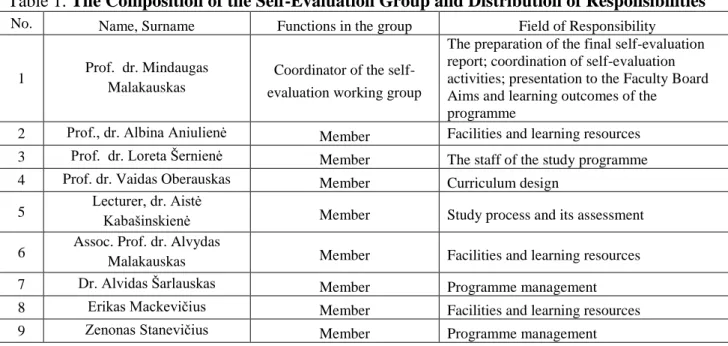
6. On April 17, 2013, the Self-Evaluation Working Group (further SEWG) was formed by the Rector Order’s No.SC-350 (Table 1). The assigned tasks and the responsibilities to self-evaluation working group members were agreed after the discussion among the group members and are listed in the table No.1.
Table 1. The Composition of the Self-Evaluation Group and Distribution of Responsibilities No. Name, Surname Functions in the group Field of Responsibility
1 Prof. dr. Mindaugas Malakauskas
Coordinator of the self-evaluation working group
The preparation of the final self-evaluation report; coordination of self-evaluation activities; presentation to the Faculty Board Aims and learning outcomes of the
programme
2 Prof., dr. Albina Aniulienė Member Facilities and learning resources 3 Prof. dr. Loreta Šernienė Member The staff of the study programme 4 Prof. dr. Vaidas Oberauskas Member Curriculum design
5 Lecturer, dr. Aistė
Kabašinskienė Member Study process and its assessment 6 Assoc. Prof. dr. Alvydas
Malakauskas Member Facilities and learning resources 7 Dr. Alvidas Šarlauskas Member Programme management 8 Erikas Mackevičius Member Facilities and learning resources
7. The self-evaluation of the Master Study Programme of Veterinary Food Safety (further VFS) was performed following the self-evaluation methodology proposed by the Center for Quality Assessment in Higher Education (further CQAHE), and on the basis of the following legal acts of the Republic of Lithuania:
- The Law on Higher Education and Research (Official Gazette of the Republic of Lithuania, 2009, No. 54-2140).
- Description of General Requirements for Master Study Programmes, Order No.V-826 of 3 June 2010 of the Minister of Education and Science (Official Gazette, 2010, No. 67-3375); - The Decree of the Director of the Center for Quality Assessment in Higher Education No.
1-01-162 (2010-12-20) “On the Approval of Techniques for the Evaluation of the Study Programs”.
- The Decree of the Minister of Education and Science of the Republic of Lithuania V-1487 “On the Approval of the Order of External Evaluation and Accreditation of Study
Programs” (Official Gazette of the Republic of Lithuania, 2009, No. 96–4083, 2009, No. 134-5862, 2009, No. 152-6860; 2010, No. 119-6084; 2011, No 16-782).
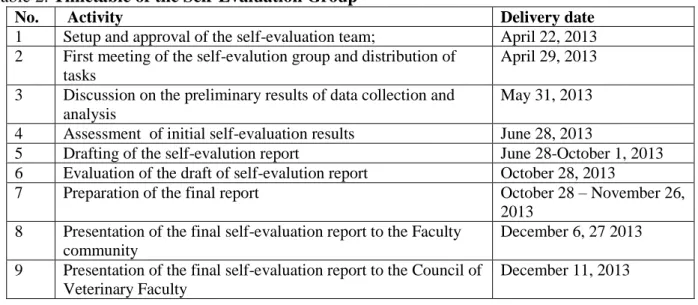
8. The self-evaluation was carried out according to work plan approved by the self-evalution group members: distribution of tasks and responsibilities, collection and analysis of the required data, discussion on the initial results of the self-analysis, drafting of the appropriate parts of the report, preparation of the final self-evaluation report (Table 2).
Table 2. Timetable of the Self-Evaluation Group
No. Activity Delivery date
1 Setup and approval of the self-evaluation team; April 22, 2013 2 First meeting of the self-evalution group and distribution of
tasks
April 29, 2013 3 Discussion on the preliminary results of data collection and
analysis
May 31, 2013 4 Assessment of initial self-evaluation results June 28, 2013
5 Drafting of the self-evalution report June 28-October 1, 2013 6 Evaluation of the draft of self-evalution report October 28, 2013
7 Preparation of the final report October 28 – November 26, 2013
8 Presentation of the final self-evaluation report to the Faculty community
December 6, 27 2013 9 Presentation of the final self-evaluation report to the Council of
Veterinary Faculty
December 11, 2013
9. The external evaluation of the master study program VFS has been carried out only when the program was submitted for the registration to the Center for Quality Assessment in Higher Education in 2008.
2. Analysis of the study programme
2.1 The Aim and learning outcomes of the study program
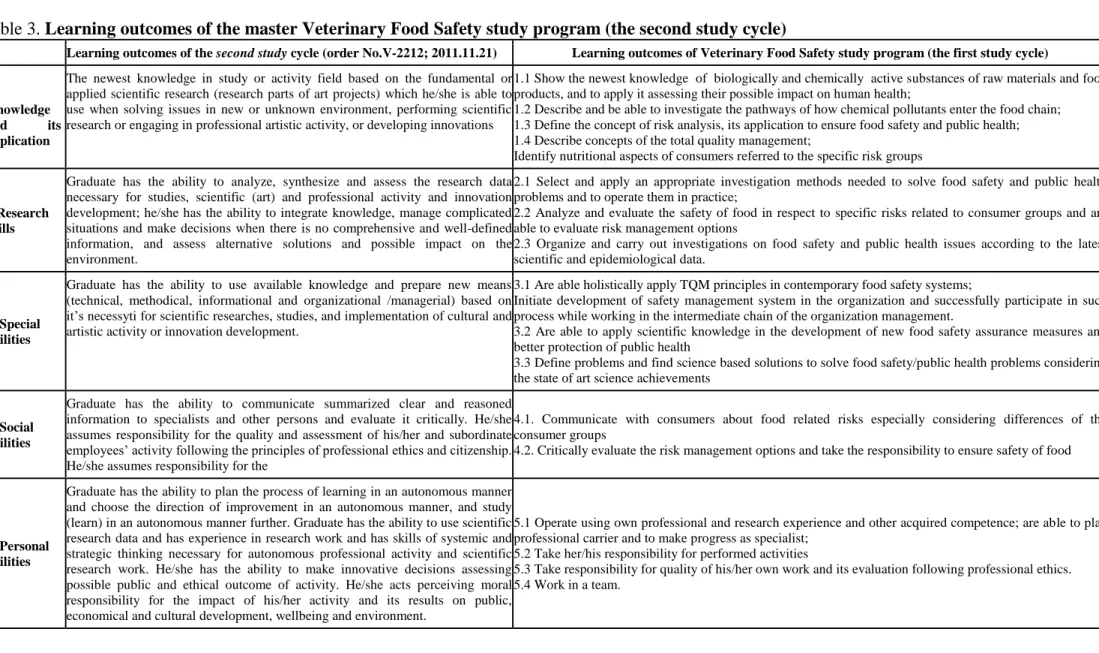
10. The aim of the Master of Veterinary Food Safety (VFS) study program at LUHS is to educate the Public Health specialists able to conduct independent research, provide service for improved public health of society. The aim of the master study program of VFS is implemented through the students achieved learning outcomes summarized in the Table 3. Links of the learning outcomes of subjects with the study program learning outcomes are showed in Annex 1.
11. The aim and learning outcomes of the Master VFS study program are published through the LUHS website1.
1
Table 3. Learning outcomes of the master Veterinary Food Safety study program (the second study cycle)
Learning outcomes of the second study cycle (order No.V-2212; 2011.11.21) Learning outcomes of Veterinary Food Safety study program (the first study cycle)
1.
Knowledge
and its
application
The newest knowledge in study or activity field based on the fundamental or applied scientific research (research parts of art projects) which he/she is able to use when solving issues in new or unknown environment, performing scientific research or engaging in professional artistic activity, or developing innovations
1.1 Show the newest knowledge of biologically and chemically active substances of raw materials and food products, and to apply it assessing their possible impact on human health;
1.2 Describe and be able to investigate the pathways of how chemical pollutants enter the food chain; 1.3 Define the concept of risk analysis, its application to ensure food safety and public health; 1.4 Describe concepts of the total quality management;
Identify nutritional aspects of consumers referred to the specific risk groups
2Research skills
Graduate has the ability to analyze, synthesize and assess the research data necessary for studies, scientific (art) and professional activity and innovation development; he/she has the ability to integrate knowledge, manage complicated situations and make decisions when there is no comprehensive and well-defined information, and assess alternative solutions and possible impact on the environment.
2.1 Select and apply an appropriate investigation methods needed to solve food safety and public health problems and to operate them in practice;
2.2 Analyze and evaluate the safety of food in respect to specific risks related to consumer groups and are able to evaluate risk management options
2.3 Organize and carry out investigations on food safety and public health issues according to the latest scientific and epidemiological data.
3. Special abilities
Graduate has the ability to use available knowledge and prepare new means (technical, methodical, informational and organizational /managerial) based on it’s necessyti for scientific researches, studies, and implementation of cultural and artistic activity or innovation development.
3.1 Are able holistically apply TQM principles in contemporary food safety systems;
Initiate development of safety management system in the organization and successfully participate in such process while working in the intermediate chain of the organization management.
3.2 Are able to apply scientific knowledge in the development of new food safety assurance measures and better protection of public health
3.3 Define problems and find science based solutions to solve food safety/public health problems considering the state of art science achievements
4. Social abilities
Graduate has the ability to communicate summarized clear and reasoned information to specialists and other persons and evaluate it critically. He/she assumes responsibility for the quality and assessment of his/her and subordinate employees’ activity following the principles of professional ethics and citizenship. He/she assumes responsibility for the
4.1. Communicate with consumers about food related risks especially considering differences of the consumer groups
4.2. Critically evaluate the risk management options and take the responsibility to ensure safety of food
5. Personal abilities
Graduate has the ability to plan the process of learning in an autonomous manner and choose the direction of improvement in an autonomous manner, and study (learn) in an autonomous manner further. Graduate has the ability to use scientific research data and has experience in research work and has skills of systemic and strategic thinking necessary for autonomous professional activity and scientific research work. He/she has the ability to make innovative decisions assessing possible public and ethical outcome of activity. He/she acts perceiving moral responsibility for the impact of his/her activity and its results on public, economical and cultural development, wellbeing and environment.
5.1 Operate using own professional and research experience and other acquired competence; are able to plan professional carrier and to make progress as specialist;
5.2 Take her/his responsibility for performed activities
5.3 Take responsibility for quality of his/her own work and its evaluation following professional ethics. 5.4 Work in a team.
This information also is available for public and interested parties through the webpage of the Admission Board2, the official University newspaper and leaflets designed for the secondary school-graduates and public. The objectives and learning outcomes of the particular subjects of VFS program are available through the LUHS Studies information database3. The objectives and learning outcomes are disseminated through the information system “AIKOS”4 administered by the Ministry of Education and Science of the Republic of Lithuania. This source also provides additional information on the format of studies, duration of the studies and awarded degree. Information about the learning outcomes of the study program are also disseminated by making presentations, dissemination of publications and leaflets during various informative events like the Fair of Higher Education Institutions or the Science Days organised each year.
12. Updating of the learning outcomes of the program and the involvement of the social partners. The learning outcomes were revised by the Study Programme Committee (SPC) after discussions and in consultation with stakeholders to ensure quality assurance part (see Section 7. Programme Management). Social partners are also involved in the updating of learning outcomes through their assessment of students practice at the end of the 2nd studies year t. This assessment involves estimation of the practical skills and achievement of the outcomes foreseen in the program.
13. The learning outcomes of the Master VFS program fulfil the requirements described by:
Order of the Minister of Ministry Education and Science No V-826 „General requirements applied for Master Studies Programs; 03.06.2010.
Order of the Minister of Education and Science of the Republic of Lithuania No. V-2212 of 21 November, 2011 „Descriptor of Study Cycles”.
Conformity of the learning outcomes of Master VFS study program to the General requirements5 and the Descriptor of Study Cycles described in the table No. 3.
14. Graduates of Masters VFS study program can work at entities dealing with food safety and public health e.g. State Food and Veterinary Service (SFVS), national Public Health Centers, governmental institutions like ministries, and etc. The Regulation of the European Parliament and of the Council6 refers that Food and feed business operators at all stages of production, processing and distribution within the businesses under their control shall ensure that foods or feeds satisfy the requirements of food law which are relevant to their activities and shall verify that such requirements are met. Therefore the graduates of the study program are potential employees within whole food production chain including primary production, processing, retail and finally education of consumers. On the other hand, the food chain in Lithuania is under control of the SFVS which is currently monitoring more then 24 000 food establishments: 12350 wholesale and retail sale entities, 880 food processing entities, 7600 public catering companies and others. Also SFVS is responsible for the control of trade and production of food supplements and this amounts to more than 1700 control entities. Therefore this situation leads to the demand of specialists with abilities not only to control, but also to analyse current food safety and public health problems and apply necessary measures which are based on the scientific knowledge. All these areas are in tight connections with the learning outcomes described in the Table No. 3.
15. The Master VFS study program is seeking to improve public health through enhanced food safety and therefore differs from the other two master study programs implemented a the Faculty of Public Health: “Public Health” and “Public Health Management”. In the latter two programmes the food safety and public health interactions are not stressed what is obvious after analysis of study plans of these programs78. 2 http://lsmuni.lt/lt/stojantiesiems/lsmu-studiju-programos/magistrantura/ 3 https://lsmusis.lsmuni.lt 4 http://aikos.smm.lt 5 http://www3.lrs.lt/pls/inter3/dokpaieska.showdoc_l?p_id=374821&p_query=&p_tr2= 6
REGULATION (EC) No 178/2002 OF THE EUROPEAN PARLIAMENT AND OF THE COUNCIL of 28 January2002 laying down the general principles and requirements of food law, establishing the European Food SafetyAuthorityand laying down procedures in matters of food safety
7
http://lsmuni.lt/media/dynamic/files/1649/visuomenssveikataiipakopa2013.pdf
8
2.3. The Curriculum Design
16. The Master VFS study program is structured according to the requirements laid down in the Order of the Minister of Ministry Education and Science No V-826 „General requirement applied for Master Studies Programs, 03.06.2010 (further General requirements).
17. The university programme is composed of the following parts based on the General Requirements:
i. study field subjects with focus on research
ii. elective subjects (students acquire an opportunity to improve knowledge in particular areas) iii. practice, designed for the preparation to practical work
iv. Master thesis
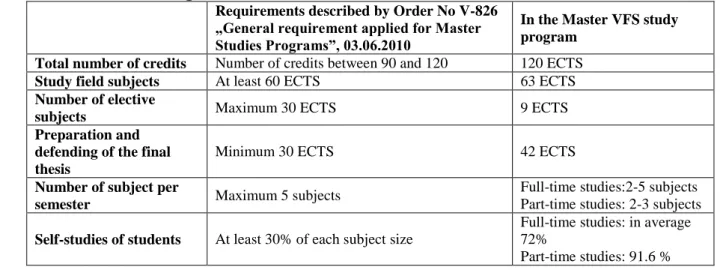
18. The table 4 describes the match of the Master VFS study program to the General requirements
Table 4. Accordance of the Master VFS study program to the General requirement applied for Master Studies Programs
Requirements described by Order No V-826 „General requirement applied for Master Studies Programs”, 03.06.2010
In the Master VFS study program
Total number of credits Number of credits between 90 and 120 120 ECTS
Study field subjects At least 60 ECTS 63 ECTS
Number of elective
subjects Maximum 30 ECTS 9 ECTS
Preparation and defending of the final thesis
Minimum 30 ECTS 42 ECTS
Number of subject per
semester Maximum 5 subjects
Full-time studies:2-5 subjects Part-time studies: 2-3 subjects
Self-studies of students At least 30% of each subject size
Full-time studies: in average 72%
Part-time studies: 91.6 %
19. The consistency of the Master VFS study program subjects is based on logical links and sequence of subject content. The consistency and interface of study subjects allow students to gain regulated knowledge and skills; create optimal conditions for correct understanding and effective grasp of the subjects. Study subjects, their credits, their assignment to a certain period of study programs are presented in Tables 5 (full-time studies) and 6 (part-time studies). The extent of the part-time and full-time studies is the same.
20. The overall content of the study program and the content of individual study subjects are focused on the study programme learning outcomes (Annex 2). The study subjects are comprehensive and mutually reinforcing and ensure complex accessibility of study outcomes. Teaching approaches and competence-building methods depend on a study subject particularity. Various forms of lectures, seminars and practical work are used within each subject to achieve the aim of the study program (Annex 2).
21. Procedure for the preparation, defence and assessment of the final thesis of the Master VFS studies have been approved by the Board of Veterinary Faculty (protocol No 03(37) of 20.10.2011 and updated on 11.12.2013 (protocol No 5). This recommendation is available on LUHS intranet and available for students at any time. In addition Master students can use the textbook as a guide how to prepare the thesis: “Methodological recommendations for the preparation, defending and evaluation of Master thesis of Veterinary Food Safety study program”9 (G. Januškevičienė, A. Januškevičius, 2012).
9
L* PC* I* L PC I L PC I L PC I
hrs. hrs. hrs. ECTS hrs. hrs. hrs. ECTS hrs. hrs. hrs. ECTS hrs. hrs. hrs. ECTS hrs. ECTS
Compulsory S ubjects
Chemical Hazards in Food Chain 20 16 124 6 160 6 Dr. V. Špakauskas, professor
Research M ethodology and Statistical Analysis 34 34 65 5 133 5 Dr. V. Juozaitienė,, professor
Chemical and Biological Active M icrocompounds in
Food (I) 24 44 119 7 187 7 Dr. E. Bartkienė, assoc. prof.
Chemical and Biological Active M icrocompounds in
Food (II) 32 36 92 6 160 6 Dr. A. Stimbirys, assoc. prof.
Economic and M anagement 40 24 123 7 187 7 Dr. R. Giedrikaitė, lecturer
Food Safety and Risk Analysis 14 10 109 5 133 5
Dr. M . M alakauskas, assoc. prof.
Applied Research in Food Science 16 30 87 5 133 5 Dr. E. Bartkienė, assoc. prof.
Total Quality M anagement 44 20 123 7 187 7 Dr. A. Šarlauskas, lecturer
Food Allergy and M alnutrition of People in the Risk
Groups 20 36 104 6 160 6
Dr. R. Ustinavičienė, assoc. prof.
Total for subjects of this part 78 94 308 18 86 70 324 18 80 86 314 18 1440 54 Optional S ubjects
Special Foreign Language (English) 0 60 20 3 80 3 S. Adomaitienė, assistant
Special Foreign Language (German) 0 60 20 3 80 3 V. Janušaitienė, lecturer
Career Implementation 20 20 40 3 80 3 Dr. V. Suveizdis, assoc. prof.
Biotechnology of Animals 44 16 20 3 80 3 Dr. R. Gružauskas, professor
Food Evaluation and Selection (Part 1) 8 52 20 3 80 3 Dr. L. Šernienė, assoc. prof.
Food Evaluation and Selection (Part 2) 20 40 20 3 80 3 Dr. D. Sekmokienė, assoc. prof.
M odern Analytical M ethods and their Application in
Food Industry 30 30 20 3 80 3 Dr. R. Gružauskas, professor
Plant Food Technology to Address Certain Groups of
Population at Risk 14 46 20 3 80 3 Dr. E. Bartkienė, assoc. prof.
Production of Ecological Products and Hazards 30 30 20 3 80 3 Dr. B. Bakutis, professor
Ecosystems and Population’s Health 8 52 20 3 80 3 Dr. A. Kabašinskienė, lecturer
Total for subjects of this part 28 192 100 12 94 86 60 9 52 128 60 9 560 21
Professional Practice 0 0 400 15 400 15
Final Degree Project 240 9 240 9 240 9 400 15 1120 42
3 3 3 240 9
78 94 548 30 86 70 564 30 80 86 554 30 0 0 800 30 3200 120
Total Name of subject
Workload per semester
Pedagogical title and (or) scientific degree and full name of
the subject teacher
I II III IV
I. S pecial education
Workload of optional subjects
Total in the programme Table 5
Table 6
L* PC* I* L PC I L PC I L PC I L PC I L PC I
hrs. hrs. hrs. ECTS hrs. hrs. hrs. ECTS hrs. hrs. hrs. ECTS hrs. hrs. hrs. ECTS hrs. hrs. hrs. ECTS hrs. hrs. hrs. ECTS hrs. ECTS
Compulsory S ubjects
Chemical Hazards in Food Chain 10 6 144 6 160 6 Dr. V. Špakauskas, professor Research M ethodology and Statistical Analysis 9 9 115 5 133 5 Dr. V. Juozaitienė,, professor Chemical and Biological Active M icrocompounds in
Food (I) 10 0 43 2 0 10 124 5 187 7 Dr. E. Bartkienė, assoc. prof.
Chemical and Biological Active M icrocompounds in
Food (II) 10 0 43 2 0 10 97 4 160 6 Dr. A. Stimbirys, assoc. prof.
Economic and M anagement 12 0 41 2 0 4 130 5 187 7 Dr. R. Giedrikaitė, lecturer
Food Safety and Risk Analysis 6 0 47 2 0 10 70 3 133 5
Dr. M . M alakauskas, assoc. prof.
Applied Research in Food Science 8 0 72 3 0 8 45 2 133 5 Dr. E. Bartkienė, assoc. prof. Total Quality M anagement 10 0 70 2 0 8 99 5 187 7 Dr. A. Šarlauskas, lecturer Food Allergy and M alnutrition of People in the Risk
Groups 6 0 21 1 0 12 121 5 160 6
Dr. R. Ustinavičienė, assoc. prof.
Total for subjects of this part 41 15 343 15 10 14 297 12 14 10 216 9 16 18 206 8 0 20 220 10 1440 54
Optional S ubjects
Special Foreign Language (English) 0 16 64 3 80 3 S. Adomaitienė, assistant Special Foreign Language (German) 0 16 64 3 80 3 V. Janušaitienė, lecturer
Career Implementation 6 10 64 3 80 3 Dr. V. Suveizdis, assoc. prof.
Biotechnology of Animals 10 0 16 1 0 6 48 2 80 3 Dr. R. Gružauskas, professor Food Evaluation and Selection (Part 1) 4 12 64 3 80 3 Dr. L. Šernienė, assoc. prof. Food Evaluation and Selection (Part 2) 9 0 17 1 0 9 45 2 80 3 Dr. D. Sekmokienė, assoc. prof. M odern Analytical M ethods and their Application in
Food Industry 6 0 20 1 0 10 44 2 80 3 Dr. R. Gružauskas, professor
Plant Food Technology to Address Certain Groups of
Population at Risk 8 0 19 1 0 8 45 2 80 3 Dr. E. Bartkienė, assoc. prof. Production of Ecological Products and Hazards 10 0 17 1 0 6 47 2 80 3 Dr. B. Bakutis, professor Ecosystems and Population’s Health 8 0 19 1 0 8 45 2 80 3 Dr. A. Kabašinskienė, lecturer
Total for subjects of this part 35 54 309 15 26 25 192 9 0 22 137 6 560 21
Professional Practice 213 8 187 7 400 15
Final Degree Project 80 3 187 7 213 8 293 11 134 5 213 8 1120 42
4 3 2 240 9
41 15 423 22 10 14 484 22 14 10 429 19 16 18 499 19 0 20 567 23 0 0 400 15 3200 120
Pedagogical title and (or) scientific degree and full name of
the subject teacher
I II III IV V VI Total
I. S pecial education
Workload of optional subjects
Name of subject
Workload per semester
22. Students select the topic of the final thesis and the supervisor from the beginning of the studies (within the first month of the studies). The topics for the final thesis are proposed by the teachers of the study program and by students themselves. The topics are given to students through the faculty dean office.
23 Final theses are assessed by the reviewers and final thesis’ defending commission. Reviewers receive coded final thesis. Reviewers are selected in such way, that the topic of final work would be close to the area of reviewer’s research work or his/her competence. Assessment is based on the originality, scope and quality of the accomplished work, author‘s ability to analyze and evaluate the results, to present possessed material at the time of defence and to quality of the answers during the defence.
24. The final thesis assessment commission is formed on the basis of the order issued by the Veterinary Faculty board. Defence commission is drawn from at least 5 members, from specialists competent in their study direction – scholars, practitioners, professionals, representatives of social partners. The chairman of the commission is appointed from the social partners. For the last year, the commission consisted of 7 members.
25. Each member of the commission assesses the work individually and signs on the minutes of the meeting. The commission is introduced with the comments and assessment of the reviewer. If the commission assesses the final work negatively, the student repeatedly submits a corrected or amended final work not sooner than after one year as indicated in the Regulations of LUHS Studies10.
26. Before defence of the final thesis they must be uploaded to Electronic theses and dissertations (ETD) information system11. Only then the final work can be defended in commission.
27. The average marks of the last 2 years defended students final thesis were: in 2012 – 8.6 (7.7 of part-time students), in 2013 – 8.4 (8.2 of part time students) (Annex 3).
2.4. Staff of the VFS study programme
28. The Master VFS study programme is implemented by 31 teachers: 7 professors (22.6%), 10 associated professors (32.3%) and 14 lectors and assistants (45.2%) (Annex 4). All the teachers fulfil the requirements laid down in the job descriptions and the regulations for Public health and Master of Science study programmes. In total 28 (90,4%) of the teachers hold scientific degrees: 36,7% in a scientific direction of veterinary medicine (12B), 19,4% – in animal technology (13B), 12,9% – in public health (10B), 12,9% – in chemistry (03P) and chemical engineering (05T); 9,8% – in other scientific directions (philosophy (01H), mechanical engineering (09T)).
29. Teachers are upgrading their qualification and skills through Lifelong Learning activities (e.g. training course, conferences, research) (Annex 5). Therefore it can be stated that teachers‘ qualification is sufficient to achieve the learning outcomes of the programme described in Table 3 and subjects (Annex 2).
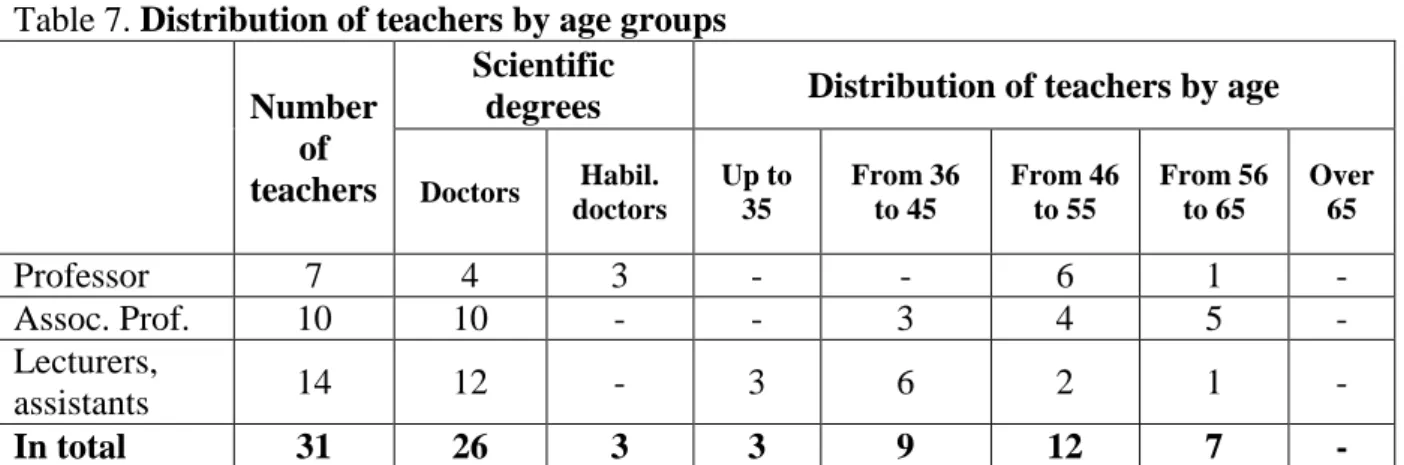
30. Distribution of teachers by age groups and jobs is provided in Table 7. In 2012-2013 study year, a total age average of the programme teachers was 46,9 years (min. 27 – max. 68 years). The group of teachers up to 55 years old makes 76.7 % of all the academic stuff. Professors over 55 years form 23,3% of all teachers. Age average of the Associated Professors is 48,7 years. The number and age average of the teachers with scientific doctor‘s degree but without Assoc. Prof. or Professor pedagogical title reveals the coming generation.
31. Change of the number of the teachers is insignificant (retirement age, postdoc offers). Its impact on the implementation of the study process is not relevant. Over past 5 years, 3 doctor‘s dissertations have been defended, their authors started teachers carriers at the University, they have subjects or parts of the subjects to lead in the programme.
10
http://lsmuni.lt/media/dynamic/files/2356/2013-08-07_1.pdf
11
Table 7. Distribution of teachers by age groups Number
of teachers
Scientific
degrees Distribution of teachers by age
Doctors Habil. doctors Up to 35 From 36 to 45 From 46 to 55 From 56 to 65 Over 65 Professor 7 4 3 - - 6 1 - Assoc. Prof. 10 10 - - 3 4 5 - Lecturers, assistants 14 12 - 3 6 2 1 - In total 31 26 3 3 9 12 7 -
32. Attestations and competitions in 2008.09/2013.06 were attended by 15 teachers involved in the programme. Quite many have started working in higher positions after their successful appearance in the competitions (Table 8).
Table 8. Change in the job positions of teachers
Change of job positions 2008 m. 2009 m. 2010 m. 2011 m. 2012 m.
From assistant to lecturer 1 - - 1 -
From lecturer to assoc. prof. 1 1 1 2 1
From docent to professor - - 7 - -
33. During the period of 2008.09 and 2013.06 there were 29 (93.5%) full-time teachers and 2 (6.5%) – part-time teachers. The proportion between full-time and other teachers is 15:1.
34. In full-time and part-time studies (2010.09-2012.06) altogether there are 209 students under supervision by 31 teachers in VFS study program. The proportion (1:6,7) between the teachers and students in different classes (lectures, laboratory work, etc) in the programme is optimal. Student groups of are of a rational size, up to 20 students in a group. They are formed taking into account the study cycle, subjects of different types, character of the classes. However students have an opportunity to select a supervisor of the final work from 74 teachers involved in the bachelor and master level studies (who teach the subjects of special and the basics of the programme).
35. The average of pedagogical work load of teachers of the Master VFS programme over 2008.09/2013.06 school years is provided in table 9. Most of the teachers are working in this and other study programmes as well, therefore the load of the majority of the teachers in the analysed study programme makes only part (average 33,25%) of their total pedagogical load. Contact work comprises in average 33,36% of the teacher‘s total work load. Half (46.4%) of the contact work load in the Master VFS programme is held by professors.
36. Teachers of the programme are active scientists with their scientific activities related to the modules they teach in this study program.
37. Over the period of 2008.09 - 2013.06 19 teachers of MSc programme have been abroad under the frame of ERASMUS programme and/or different scientific projects. Some of them, e.g. M. Malakauskas (Copenhages University, Denmark), R. Gružauskas (Halle-Vittenburg University, Germany), E. Bartkienė (Jelgava University, Latvia) had close collaboration with foreign universities, regularly delivering lectures and participating in various scientific activities.
6 teachers have been invited from foreign universities in the framework of the project under ERASMUS programme and scientific projects. Lectures have been read by prof. M. Grashorn (University of Hohenheim, Germany), prof. T. Alter, prof. A. Hensel and dr. M. Greiner (Federal Risk Assessment Institute, Germany), assoc. prof. R. Stabler (London school of tropical medicine) and others. The academic staff exchange rate in the programme is 6:1.
Table 9. Average of annual pedagogical load of the teachers inthe MasterVFS full-time study programme in comparison to other study programs
Teachers Average number of direct contact hours Number of
contact hours in other study programmes (h) Lectures (h) Laboratory works/ exercises (h) Number of direct contact hours (h) Professors: General subjects - - - - Special subjects 27 48 75 465 Docents: General subjects 30,2 88,8 119 444,0 Special subjects 45,6 106,4 152 365,2 Other teachers: General subjects 11,8 70,7 82,5 634,3 Special subjects 27,0 51,0 78 348,5 In average 28,32 72,98 101,3 451,4
38. 11 laboratory technicians and senior laboratory technicians, 2 senior engineers for precise installations, 1 computer maintenance specialist participate in the implementation of the programme. One employee of the support staff provides services to 3 MSc teachers, and during laboratory classes 20 students have 1 employe of the support staff.
39. The team of teachers possessing sufficient experience of pedagogical work has been formed in the programme (Table 10). In 2012, 96.8% of teachers had experience of pedagogical work, for 90.3% of them experience was at least 4 years. The teachers of MSc programme issued 10 textbooks.
Table 10. Teachers‘ experience of pedagogical work
Experience of pedagogical work in years
Up to 3 years 4-10 years 11-20 years 21-30 years 31-41 years
Number of teachers 1 13 7 5 4
40. In 5 years, teachers have published 94 research articles in international press of which 61 publications in international journals with impact factor: they make up 64.9% of all the publications publicised by the teachers of the programme. Evaluation of the conformity of scientific publications to the MSc study programme showed that the research results are related to the learning outcomes of the Master VFS programme (Annex 5). Scientists of the programme take part in the EU scientific research, technological development and demonstration activity programme (FP7), are actively involved in the implementation of the European programme for co-operation in the fields of scientific and technical investigations (COST) and take part in various scientific activities financed by the Lithuanian State Science and Studies Foundation (LSSSF) and the Research Council of Lithuania (RCL). For example, during 207-2010 M. Malakauskas was the supervisor of work package of the FP6 project „Biotraceability of undesired microorganisms and their metabolites in the food and feed chain“ (2007-2010, Contract No 036272) and FP7 KBBE.2010.2.6-01 project FOODSEG „Safe Food for Europe – Coordination of research activities and Dissemination of research results of EC funded research on food safety“ (2011-2013). M. Malakauskas supervised the international Project sponsored by BIOMIN Holding GmbH “Effect of probiotics on
Campylobacter spp. in broilers meat” (2009). Teachers of the programme are also taking part in the projects supported by the Recearch Council of Lithuania (RCL) and by the ministries, scientific projects of different institutions of science and studies. For example, M. Malakauskas is leading the research projects „Prevention of Campylobacteriosis by improving quality and safety of food raw materials and food products“ (2011-13, No. SVE-05/2011), „Genetic Yearsinia spp characterisation with PCR based methods“ (LSSSF funded; T-26/2009), „Antimicrobial resistance of Y. enterocolotica strain isolated form pig production chain and human samples (fnded by RCL,
V-279/2011); E. Bartkiene - „Application of solid-state fermentation for development of higher value and safety food products“ (2011-13, No. SVE-11019) and „The possibilities to enrich wheat bread with biological active compounds from flaxseeds“ (2009).
41. Teachers of the program have experience of work in the industry; half of the teachers (48.4%) have close ties with the food industry (they consult, perform investigations and etc, for example, G Januškevičienė advises food enterprises on the systems of Risk Factors Analysis and Critical Control Points, E. Bartkienė - enterprises producing products of plant origin, G. Zaborskienė – meat processing enterprises, A. Stimbirys consults on the questions pertaining to the evaluation of carcass meat). The average of practical work experiance for the VFS programme teachers is 5.0 years.
42. Apart from lecturing, teachers of MSc programme participate inother activities: 58.1% are members of the boards, commissions, committees and representatives of administration). 7 teachers are involved in expert activity. Half of MSc teachers (45.2%) are members of social professional organizations.
43. Master students practice is guided by the Food Safety and Quality Department. Student practice at food and other enterprises is managed by persons responsible for the food safety issues, e.g. managers for the quality and safety. Students carry out inspections, write inspection reports jointly with SFVS inspectors.
44. Experience of the co-ordinator of the study programme. Prof. M. Malakauskas, head of the Food Safety and Quality Department, is the co-ordinator of the study programme. His pedagogical, scientific, managerial and other experience is sufficient for him to be a co-ordinator of the programme (more information is provided in CV, Annex 5).
45. In recent years 1/3 of the Master VFS programme teachers participated in the pedagogical seminars and /or seminars and courses financed by Education Exchanges Support Foundation. Over 2008.09-2013.06, 19 teachers improved their qualification in foreign universities; some of them had close ties of cooperation with Latvian, Danish, German, Turkish and Finish institutions.
2.5. Facilities and Study Resources
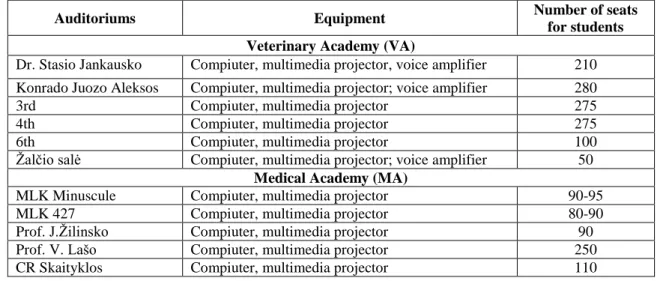
46. There are 6 main auditoriums of different size used for lectures at the Veterinary Academy (Table 11). Additionally auditoriums at the Medical Academy campus could be used for study purposes in case if needed. Students from other study programs are also using these auditoriums, however the number of auditoriums is absolutely sufficient for the training of students of all programmes implemented at the VA campus. Timetables and teaching schedules agreed in advance before September each year.
Table 11. Number of auditoriums and places for students at LUHS used for VFS studies
Auditoriums Equipment Number of seats
for students Veterinary Academy (VA)
Dr. Stasio Jankausko Compiuter, multimedia projector, voice amplifier 210 Konrado Juozo Aleksos Compiuter, multimedia projector; voice amplifier 280
3rd Compiuter, multimedia projector 275
4th Compiuter, multimedia projector 275
6th Compiuter, multimedia projector 100
Žalčio salė Compiuter, multimedia projector; voice amplifier 50
Medical Academy (MA)
MLK Minuscule Compiuter, multimedia projector 90-95
MLK 427 Compiuter, multimedia projector 80-90
Prof. J.Žilinsko Compiuter, multimedia projector 90
Prof. V. Lašo Compiuter, multimedia projector 250
47. Facilities of 8 departments and 1 institute (Food Safety and Quality; Preventive Medicine, Health Management, Environmental and Occupational Medicine, Non-infectious Diseases, Animal Husbandry, Animal Nutrition, Animal Breeding, Institute of Biological Systems and Genetic Research) are used for the realisation of this study program: there are 12 laboratories and 24 study rooms. The majority of them are adjusted to work with groups of 15-25 students. 4 computer classes have been installed with 132 individual work places. Distant Learning Studies Centre is provided with a teaching classroom of 24 seats.
48. Students can improve their practical skills during the professional practices (15 ECTS credits) in the last semester of studies.Practice is supervised by the teachers of the Food Safety and Quality department. Enterprises and establishments must conform to the requirements to become place of practise, i.e. appropriate conditions must be created for the students in order to achieve aims of the practice. This is ensured by the manager of the enterprise accepting a student for practise by signing a trilateral practice agreement and appointing a competent mentor in the enterprise or establishment. The agreement is compulsory for each student and signed by the student, university and by the enterprise accepting a student for practise. Since 2012-2013 study year, practice supervisor (or enterprise) are paid by the LUHS for giving service to perform practice. At the time of their practise, students directly participate in all processes of production, control and evaluation; they have an opportunity to collect information for their final work. As there is over 20 thousand food handling entities in the country, there are no problems for students to find a place for practice with a help of practice coordinator. List of the biggest food producers in Lithuania having signed agreement with LUHS regarding practice is given below (Table 12).
Table 12.
Food entities Agreement No.
ŽŪKB "Krekenavos mėsa" Nr. VKC3-1
JSC "Aconitum" Nr. VKC3-102
AB "Kaft foods Lietuva" Nr. 4/1-09 JSC ''Rokiškio pienas" Nr. 4/1-11 JSC "Rūta" Nr. 4/1-12 SC "Vilnaius paukštynas" Nr. 4/1-14 JSC "Maxima" Nr. 4/1-15 JSC "Biovela" Nr. 4/1-16 JSC "Fazer kepyklos" Nr. 4/2-06 SC "Pieno žvaigždės" Nr. 4/3-03 JSC "Norfos mažmena" Nr. 4/3-05 SC "Stumbras" Nr. 4/3-12 JSC "Arvi kalakutai" Nr. 4/4-11 JSC "Kauno grūdai" Nr. 4/4-13 SE „Pieno tyrimai“ Nr. VKC3-26
49. All students have to carry out their practise by selecting the practice place. Students have always an opportunity to choose the place of practise from the list of enterprises provided by the manager of the Career Centre (before 2013.10.01) or the Practice Administrator from the Dep. of Food Safety and Quality (since 2013.10.01) Students may themselves propose enterprises not included in the list in which they wish to perform practise. Under request of students, they are appointed to the place of practise taking into account the place of their residence, and in case of competition the study marks play a decisive role. The range of the places for practise is broad covering different regions of the country. It has been established that no more than 2 students of the same graduation can perform practise in the same enterprise.
50. Every year the manager of the Career Centre contact have been contacting enterprises and establishments in different cities, towns and regions regarding the opportunity for students to perform practice (since 2014 – this task will be taken by dep. of Food Safety and Quality).
51. The LUHS Library and the Information Center of Health Sciences (address: Eivenių str. 6, Kaunas) was moved to new building in 2007. The new library satisfies highest requirements of students and researchers. The library facilities are available from 7.30 am to 10.30 pm on Monday-Friday, from 10 am to 8 pm on Saturdays, and from 10 am to 5 pm on Sundays. The library visitors may use four reading-rooms, which have 332 places; 56 of them are computerized, three reading rooms for group learning, an eight-place-room with multimedia equipment, a twelve-place-teaching computer class, and the halls for seminars and conferences. Students and academic staff are trained to use data search engines. Computers are up to date and all software is of course legal. There is a wireless internet access, where it is possible to have an internet connection on a personal computer. Books and other sources of information can be borrowed and returned by means of a fully computer-assisted system. The LUHS library subscribes to national and international scientific literature of various research fields. In 2012-2013 the library subscribed to more than 47 databases Annual Reviews, BMj journals, BMj ClinicalEvidence, Cochrane Library, EBSCO Publishing (10 dB), Emerald Management ejournals Collection, Cambridge journals Online, Henry Stewart Talks, LWW/Ovid SP, Md Consult, Natural Medicines Comprehensive database, Nature Publishing Group, OUP: Oxford journals, Oxford Reference Online, PsycARTICLES, SAGE Publications Online, Sciencedirect, Science Online, SpringerLink, Taylor&Francis,Up To date, Wiley Online Library, and others
52. There is various resources at the library e.g. books online, available for our university's students at: http://www.accessmedicine.com. Here are course books of various medical content including public health issues. Log-in from university's computers (library etc.) is direct; access from home computer is possible using the University's Virtual Network. The Virtual Private Network(VPN) is network services, which allow Lithuanian Health Sciences University students to safely connect to the university computer network. After signing up for the VPN, students can browse all the subscribed databases from home computers. The resources of the library are constantly renewed.
53. There are more then 1930 units of different titles books, articles and other reading material related to public health at the Library Central Stock12. Also the Central Library branch at the Veterinary Academy Campus can offer literature for students. Books and other material for studies are purchased according the recommendations of teachers of the study program.
54. Methodological resources are updated each year. In the middle of the study year the need for methodological publications is discussed in the departments, considered at the meeting of the Veterinary Faculty Council resulting in respective publications or additional editions by the publishing division of LUHS. Methodological publications (practices, descriptions of laboratory works required for teaching subjects of the study field) are constantly developed or updated.
2.6. The Study Process and Its Assessment
55. Admission of students to the second level of VFS study program is done in accordance with admission rules approved by the Senate (before 2010.09: Rules of admission to Lithuanian Veterinary Academy), which are approved for each academic year separately13. Students are 12 http://www.lvb.lt/primo_library/libweb/action/search.do?dscnt=0&scp.scps=scope%3A%28LSM01%29%2 Cscope%3A%28KMU03%29%2Cscope%3A%28KMU02%29%2Cscope%3A%28LSMELB%29%2Cscope %3A%28LSMETD%29%2Cscope%3A%28KMU04%29&frbg=&tab=local&dstmp=1386507663156&srt=r ank&ct=sea
13Students’ admission rules, Confirmed by LUHS Senate decision No 27-04, February 15, 2013;
admitted to full-time and part-time (extramural) studies. Full-time study program lasts for 2 years and the part-time program lasts for 3 years.
56. Apply for the VFS Master Studies can persons, who have qualification of Public health bachelor or professional bachelors degree. Persons, who have professional bachelors degree can participate in competition to Master studies only after finishing additional study program, confirmed by University. Persons, who have professional bachelors degree must to finish up to 60 ECTS credits of additional studies for the chosen study course, in that cases when chosen Master study course and the finished first level study course belongs to the same study course group. Persons, who have professional bachelors degree must finish up to 90 credits of additional studies for the chosen study course, confirmed by University in that cases when chosen Master study course and the finished first level study course belongs to different study course group
57. The admission of students is organised according to competitive score, the row is formed in declining order. Competitive score consists of:
– annex of diploma/appendage and academic label (for graduates of additional studies of chosen study course) without professional practical qualification examination or average of final work mark (weigh coefficient is 0.7);
– practical qualification examination of profession or grade of final work (weigh coefficient is 0.3); – the sum of evaluation of scientific work (up to 2 points) and score of motivation conversation (up to 3 points). Commission to evaluate motivation of applicants is formed by order of Rector and consists of not less than of 5 members.
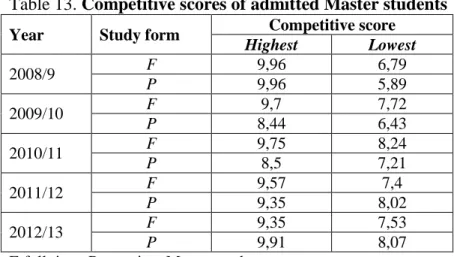
58. During period of 2008.09-2013.06, the highest average of competitive score of full-time Master studies was 9.66 (ranged from 9.35 to 9.96) and the lowest was 7.54 (ranged from 6.79 to 8.24). The highest average of competitive score of part-time Master studies was 9.23 (ranged from 8.44 to9.96) and the lowest was 7.12 (ranged from 5.89 to 8.07) (Table 13)
Table 13. Competitive scores of admitted Master students
Year Study form Competitive score
Highest Lowest 2008/9 F 9,96 6,79 P 9,96 5,89 2009/10 F 9,7 7,72 P 8,44 6,43 2010/11 F 9,75 8,24 P 8,5 7,21 2011/12 F 9,57 7,4 P 9,35 8,02 2012/13 F 9,35 7,53 P 9,91 8,07
F-full time, P-part time Master students
59. Minimal requirements to state-funded and self-paid studies are the same.
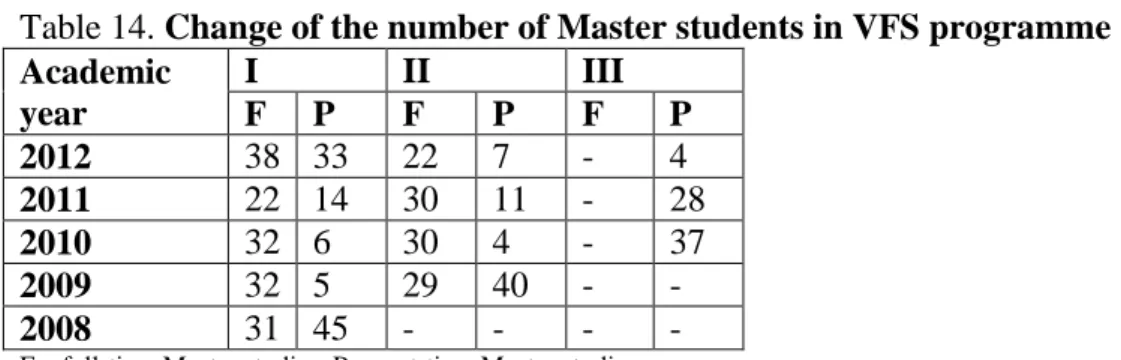
60. During period of 2008.09-2012, in total 258 students (155 to full-time and 103 to part-time studies) were admitted to the VFS Master studies. The highest number (76) of admitted Master students was in 2008, later the number of students decreased almost twice. More students request to study in full-time study form than in part-time studies. Though in the last year number of students, admitted to full-time and part-time studies was similar (38 and 33, respectively) (Table 14).
60. During period of 2008.09-2012, in total 258 students (155 to full-time and 103 to part-time studies) were admitted to the VFS Master studies. The highest number (76) of admitted Master students was in 2008, later the number of students decreased almost twice. More students request to study in full-time study form than in part-time studies. Though in the last year number of students, admitted to full-time and part-time studies was similar (38 and 33, respectively) (Table 14).
Table 14. Change of the number of Master students in VFS programme Academic year I II III F P F P F P 2012 38 33 22 7 - 4 2011 22 14 30 11 - 28 2010 32 6 30 4 - 37 2009 32 5 29 40 - - 2008 31 45 - - - -
F – full-time Master studies, P – part-time Master studies.
61. The majority of Master students are admitted to study in state-funded positions. During 2008-2010 there was only one full-time Master student paying for studies. During 2011-2012 all Master students of full-time studies had state funded positions. Studying in part-time studies, there are 6 self-paid Master students on average annually while the rest are studying in state funded positions.
62. During 2008.09-2013.06 seven full-time and 18 part-time Master students were excluded from the studying list. This is 4.5% and 17.5 % of the total number of students, respectively.
63. During considered period from the Master programme graduated 4 full-time courses and 3 courses of part-time program. In 2012 all entrants of full-time program and in 2013 – 85.7 % of those who were admitted to the first course ended the studies. In 2012 60 % and in 2013 – 66.6 % of those part-time Master students who were admitted to the first course finished the studies.
64. 58.3 % of Master students who stop their studies do this voluntarily, the other 41.6 % were deleted from the students list due to financial debts. Because of difficult financial situation in the families, students begin to work and later fail to combine work and studies. It is especially seen among part-time students. In order to reduce the drop-out of students, they are motivated by consultations, they have rational timetables; in objective serious circumstances another time for clearing-off is appointed, disciplines can be repeated, timetables for having children are prepared, possibilities of taking an academic leave are offered.
65. Timetables of studies for the next year are prepared by Study centre till the 1st of February each year and this is done in cooperation with the Dean of Faculty. The timetables are published on the LUHS website14. Timetables can be changed only after changes of the study plan are approved by the Senate. Timetables or their changes are published in the web site of LUHS not later than 2 weeks before the beginning of the subject.
66. All Master students depending on their academic results have the possibility to apply for the Erasmus exchange (agreements are signed with 15 universities and faculties having similar study programs), for mobility within BOVA academic network of Baltic States and Nordic countries, and for intensive international courses and student exchanges using Nordplus program.However during 2008.09-2013.06 academic years only two students were for 3 months studies period in Boku university in Austria.
67. During 2008-2012 there were no incoming students from foreign universities.
68. Master students can participate in the student scientific activity and take part in the projects and annual students research society conference. However master students are not active and only one in 2011 and 3 in 2013 made presentations at Students research society conference.
69. Master students participate in VA dance collective „Džigūnas“ (2 students), folk ensemble „Kupolė“ (1 student) and chorus „Juventus“ (3 students). Together with these collectives Master students perform not only in festivals of Academy or University, but also in city festivals, events and international festivals.
70. Information for Master students on the programme, its forms, funding, assessment of the achievements, selective subjects, timetables, mobility possibilities and program changes is supplied using different tools. Information is given by several divisions: Study center, Veterinary faculty
14
Dean, program tutor – Department of Food Safety and Quality. For information presentation LUHS internet and intranet (section for Students), direct consulting (Veterinary faculty Dean, division of international affairs, Study center), information boards are used. The main information is placed on the LUHS website including all regulatory documents regarding the studies and academic life. Required information (and urgent information) is passed to the students by an email (each course holds its own email). Supervisors notify and consult students of their group on versatile questions of studies, help them address arising issues and take care of their everyday life. Information is consistent and timely.
71. Master students can find quite a lot of information on potential career opportunities on the website of the LUHS Career Centre. Employers provide job offers during career days or to the Career Centre, dean office or teachers. Meetings for employees and students are organized (in 2012 year there were 5 of such meetings).
72. There are no Master students studying under individual plan in this program, but if necessary, a possibility would be offered. Master students, who have children or face any serious circumstances, may request a free timetable for attending general classes and they may do their practical and laboratory work not necessarily with their group.
73. A Master student who has not passed the exam may retake it two times free of charge. At the end of the semester one week is assigned for passing failed exams and the last week of August to pass any debts which occurred during academic year. If Master students fail to take the exam in a prescribed period of time, they can repeat the subject next year upon paying a fixed fee (Regulation for the first and the second level and integral studies, LUHS, confirmed by Senate decision No 32-3, 07 06 2013). About 80 % of students in this program pass the exams in due time.
74. Psychological support to Master students is usually provided by teachers and employees of the dean office. Majority of the teachers who completed post-graduate studies, have taken the course in psychology. Majority of the teachers are finished 12 hours courses “Psychology of communication” (2011) and 40 hours courses of training of professional competences (2012).
75. Information about Scholarships, benefits, credits available for students is given on the website of LUHS15.
76. Scholarships are granted in accordance with the Regulation of bounty scholarships commitment for the first, the second level and integral studies students16. Since 2009, a scholarship amount of 1.5 basic social benefit (BSI) is allocated for the best students, studying in state funded and self-payed positions for the best attending and studying results. One time bounty scholarships (up to 2 BSI) are awarded once per semester for progressive students in order to stimulate them for the active student, public, organizational, scientific, sports work and reached exceptional results representing University. These scholarships are distributed by students themselves. In case of child birth, death parents or natural disaster, scholarship of 2 BSI can be awarded once per semester. Onetime scholarships can be allocated for students group monitors (0.75 BSI) one time per semester. There are nominal scholarships as well. Disabled students may also receive financial support. In addition, students have the possibility to get credits for living expense and for refunding of study fees. State Study Fund accepts applications for such credits17.
77. The Academy has 4 student hostels which can accommodate 650 students. Every request to live in a hostel is satisfied in accordance with the prescribed procedure. For a number of years, 130 VFS students and Master students live in hostels. Master students of part-time studies can also live in a hostel during the session.
78. The assessment of students’ achievements is directly linked with the study program learning outcomes. The principles of assessment of student achievements, the requirements for the assessment grade are described in the LUHS Study Regulation, confirmed by LUHS Senate
15
http://lsmuni.lt/lt/studentams/parama-studentams/studiju-paskolos/
16
LUHS Senate decision No. 2-09, October 29, 2010;
http://lsmuni.lt/media/dynamic/files/516/lsmu_skatinamuju _stipendiju_skyrimo_nuostatai.pdf
17
decision No. 32-03, June 7, 201318. Also assessment of student achievements is explained in the descriptions of every subject (Annex 2) and obligatory explanation of cumulative assessment formula is set up on the intranet19 in the specific folder of the subject and accessible for students.
79. In the beginning of the subject, students are informed about learning outcomes of the subject and what has to be learned within the subject. Students are informed how many and for what indicators (consistency of theoretical knowledge, activity, independence, practical skills and etc) scores can be received and how many scores must be collected in order to get a desired assessment of the subject. If the aim of the given subject is sufficient level of knowledge and understanding, then general evaluation tests are applied. More complicated tests, usually oral (discussion) tests are applied when students must learn how to apply gained knowledge in the certain situations, analyze and evaluate respective processes. Practical tasks are given when it is necessary to establish whether a student acquired practical skills. Students are assessed by the tasks which reflect those skills. Analytical and collation capacities are checked through writing the papers and executing independent investigative works. If the assessment of the accomplishments of the study subject consists of many different tasks, all of them have an impact on the general outcome of the studies. Therefore by scoring we are seeking for two aims: to evaluate students progress and to evaluate final studying results, which in Study program are described as learning outcomes.
80. For students evaluation 10 marks grading is used, where the lowest positive mark is 5. All subjects and modules are assessed using cumulative grade system. Accumulative part of the grade must be not less than 50 % of final grade. Different evaluation forms are used, e.g. examination, colloquium, defence of practical work, test, which form accumulative mark. Evaluation forms and their content are created by teachers, responsible for the subject or division (department) and inform students before starting teaching the subject. Teachers by starting their subject introduce students with the criteria for assessment of achievements, forms of intermediate clearings, examples of the examination tasks and assessment criteria.
81. Students which are not satisfied with the assessment of their study outcomes may appeal to the Appeals Commission. The commission acts in accordance with the Senate approved procedure for handling student claims and reviewing assessment of the achievements of studies. The procedures have been placed on LUHS internet website and are always easily accessible for students20.
82. Teachers, while presenting for the students their achievements (evaluations of works, marks), provide their comments verbally or in writing. Results of the course or the group are not publicised publicly (can be publicised if students request), usually they are discussed individually with a student or with a group if the task was accomplished by the group of students. Seeking to ensure the quality of studies and to improve a self-analysis system, a systematic student questionnaire system is implemented18. Data from the surveys disclosed that 90 % of the teachers deem to have a good feedback with their students, and 10 % of them would wish to have a better feedback. A new feedback system is launched since 2013.09 study year and the first results will be known at the end of January, 2014.
83. The surveys about graduates’ employment possibilities are carried out annually in accordance to LUHS Rectors’order V-962, 2013 “The order of questioning organisation of LUHS graduates and social partners (employees)”; V-963, 2013 “The order of gathering LUHS graduates agreements for purposes of career evaluation” and LUHS Senate order, No. 37-11, 2013 “The order of LUHS students’, lectors’ and social partners’ opinion analysis”21.
84. The first students of Master VFS study program graduated in 2010.07.During a survey of the graduates, organized by Career Center in 2013, 14 graduates (10 from full-time studies and 4 from part-time studies) were questioned. 84.6 % of questioned graduates started to work soon after finishing studies and now 69.2 % of them continue their career. 15.4 % of graduates didn‘t looked 18 http://lsmuni.lt/media/dynamic/files/2356/2013-08-07_1.pdf 19 https://fc.lsmuni.lt/login/ 20 http://lsmuni.lt/lt/naujienos/naujienos/naujas-lsmu-studiju-reglamentas.html 21 http://lsmuni.lt/media/dynamic/files/2917/nuomones_tyrimas_studentai_destytojai_darbdaviai _tvarka.pdf