PERFORMANCE MANAGEMENT SYSTEM
MANAGERS TRAINING PROGRAM
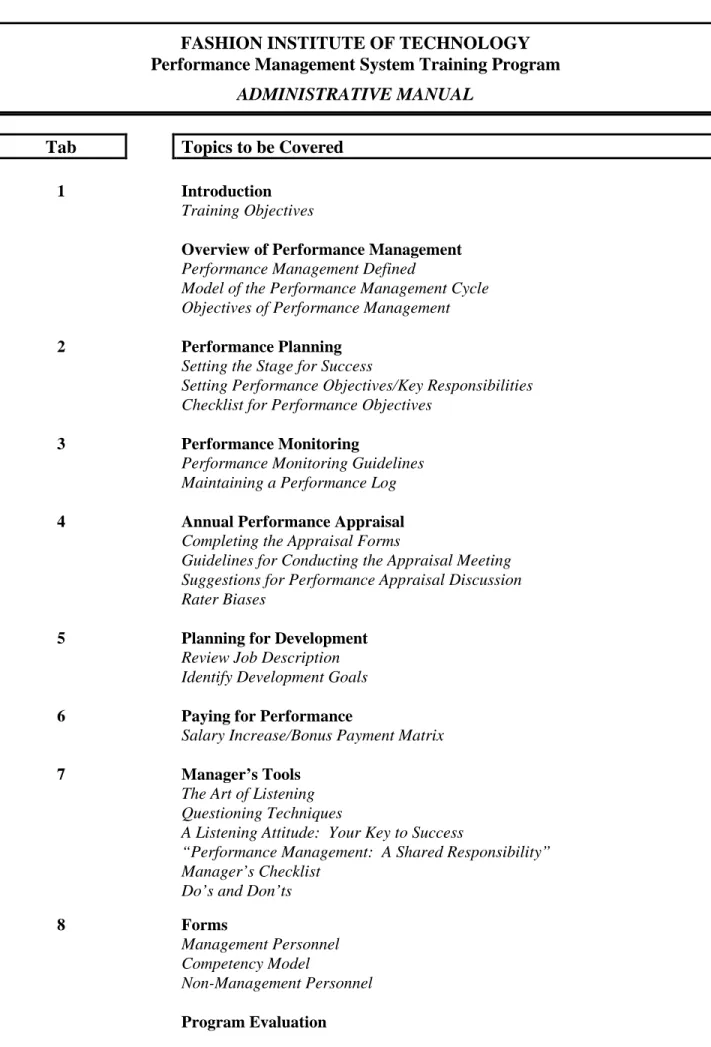
Tab Topics to be Covered
1 Introduction
Training Objectives
Overview of Performance Management
Performance Management Defined
Model of the Performance Management Cycle Objectives of Performance Management
2
3
Performance Planning
Setting the Stage for Success
Setting Performance Objectives/Key Responsibilities Checklist for Performance Objectives
Performance Monitoring
Performance Monitoring Guidelines Maintaining a Performance Log
4 Annual Performance Appraisal
Completing the Appraisal Forms
Guidelines for Conducting the Appraisal Meeting Suggestions for Performance Appraisal Discussion Rater Biases
5 Planning for Development
Review Job Description Identify Development Goals
6 Paying for Performance
Salary Increase/Bonus Payment Matrix
7 Manager’s Tools
The Art of Listening Questioning Techniques
Training Session Objectives
Participants should be able to do the following at the end of the training
session:
1)
Define and view performance appraisal as an ongoing management
process.
2)
Understand the performance appraisal system used by FIT and
explain it to employees.
3)
Use the system to prepare performance appraisals for their staff.
4)
Prepare a written performance appraisal using the criteria from the
appraisal system.
Performance Management Defined
Performance management is a process involving:
planning
monitoring
coaching
making judgments about past performance
identifying ways to improve future performance
enhancing professional capacity
Performance management provides information
that can be used to make decisions about staffing,
professional development and promotion.
Model of the Performance Management Process
Plan Review job description or strategic/ department work plan
Review performance factors or competency model
Establish key responsibilities or performance objectives
Set priorities
Determine feedback frequency
Monitor
Observe performance throughout the year “Check in” to review progress or work status Provide frequent feedback
Keep track of feedback/events
Plan Development
Ιdentify employee strengths and areas to be strengthened
Establish priorities
Plan timetable for implementing
Complete appraisal form and submit for sign-offs If appropriate, include development activities in
following year objectives
Appraise Performance
Compile necessary information and documentation
Request employee to complete self-appraisal Evaluate accomplishments of key
responsibilities or performance objectives Evaluate performance in relation to
performance factors or competencies Conduct appraisal meeting, engaging
employee in discussion of ratings, obstacles, aspirations, etc.
Objectives Of Performance Management
The system is designed to:
1.
Promote a better understanding between the manager and the employee
about performance expectations and the means of achieving them.
2.
Enhance employee morale by giving timely feedback and assistance in
improving performance.
3.
Assess individual performance against performance standards.
4.
Identify and support employee development with a specific action plan.
5.
Motivate and encourage employees to achieve higher levels of
productivity.
The performance management system is a way for managers to establish and
build a process in which their employees learn:
•
What they do well
•
What they can improve, and
Performance Planning
Setting the Stage for Success
Employees want to do their best at work. Defining expectations for
how the job gets done – and how employees will be evaluated – helps
reinforce FIT’s strategic priorities and empowers staff to work more
independently.
1.
Review departmental strategic plan or job description:
Identify performance objectives or key responsibilities to be achieved
during the year
Determine which are most important for personal achievement
2.
Review Performance Planning and Appraisal Form:
Explain performance objectives or key responsibilities
Define expected outcomes that define successful performance
Prioritize the objectives or responsibilities
Establish frequency of feedback (if known)
Identify Competencies or Performance factors that apply to the job
For new employees
:
Set goals related to “learning curve”
Establish timetable for reviews during the first year
For longer-term employees
:
Identify opportunities to expand their capabilities
SETTING PERFORMANCE OBJECTIVES/KEY RESPONSIBILITIES
SECTION OF FORM TOOLS & RESOURCES HOW TO USE THEM Performance
Objectives
Job Description Identify primary responsibilities that best describe the key functions for which the incumbent is accountable.
Strategic Plan/ Department Objectives
Identify any objectives for which the employee will be assigned responsibility (management only).
Previous Year’s Appraisal (For use after 1st year of implementation)
Identify Performance Objectives that may carry over from the previous year, and to establish Development Goals that address performance issues during the previous year.
Expected Outcomes
Performance Objectives from Column #2 of the Performance Planning and Appraisal form (pages 2 and 3)
Define quantitative and qualitative results and outcomes to be achieved. Include necessary interactions with key individuals and target dates.
Priority Definitions of priority rankings
Performance Objectives or Key Responsibilities
Evaluate each Performance Objective or Key Responsibility to determine whether it is:
C-Critical
M-Moderate, or
R- Routine/Episodic
Feedback Frequency Discussion between supervisor and employee
Determine how often progress and results are to be reviewed (if known):
AN- As Needed
W - Weekly
M - Monthly
Q – Quarterly or
SAMPLE PERFORMANCE OBJECTIVE PLANNING WORKSHEET
Performance Objective: Describe one objective for which you (or an employee) are accountable. This should be reflective of a departmental function or FIT’s strategic plan.
Expected Outcome: Briefly describe how successful performance will be measured (i.e., specific actions, increased program results, percentage increase in revenues, timeframes for implementation).
Priority:
Indicate the priority of this objective relative to all objectives for which you (or the employee) are responsible. Priority indicators are C - Critical, M - Moderate or R – Routine/Episodic.
Feedback Frequency:
If possible, describe how often progress toward the achievement of this objective is to be reviewed. Indicators include: AN – As Needed; W – Weekly; M – Monthly; Q – Quarterly or S – Semi-annually.
CHECKLIST FOR PERFORMANCE OBJECTIVES
Is the Performance Objective:_____ Consistent with the responsibilities of the job?
_____ Supportive of FIT’s strategic goals and departmental objectives? _____ Measurable with qualitative or quantitative criteria?
_____ Results-oriented? _____ Specific?
_____ Clearly worded?
_____ Time-binding? (i.e., is there a clearly defined timeframe for achieving results)?
_____ Achievable? (i.e., is it realistic that most people with the proper training and requisite skills could achieve this objective or perform this responsibility?) _____ Challenging? (i.e., does this standard present a challenge to encourage the
employee to perform to his/her highest potential?)
_____ Supported by authority and resources? (i.e., does the employee have the authority to perform the responsibility described and does the employee have the necessary resources to perform the responsibility described?)
Performance Monitoring
Keeping Results on Track
GENERAL GUIDELINES
• Provide employee with regular feedback.
• Direct feedback (positive or negative) is most valuable to employee if given as soon as possible after event.
• Frequent feedback creates an ongoing dialogue; this allows the annual appraisal meeting to become a summary of information accumulated during the year.
• Review any changes in objectives or priorities that may occur during the course of the year and update the Performance Planning and Appraisal Form.
PREPARING DOCUMENTATION OF PERFORMANCE ISSUES
• Be accurate.
• Document facts, not opinions.
• Note only direct observations of actions and results. Do not include hearsay in your documentation.
• Write things down soon after they happen. Do not rely on your memory.
• Include only items related to job performance -- not personality characteristics or traits.
Maintaining A Performance Log
Effective performance management requires that supervisors and employees have regular discussions about performance issues throughout the course of the year. The purpose of this is to:
Acknowledge incidents of good performance;
Correct any issues before they escalate to significant problems; Check progress on meeting objectives;
Review and modify objectives, outcomes or priorities.
To assist supervisors in keeping a record of information related to employee performance issues, a sample Performance Log has been developed for the system. This allows the supervisor to keep track of performance throughout the course of the year so that, when preparing the year-end appraisal, there is appropriate documentation to substantiate the ratings.
A performance log allows the supervisor to note the date of a performance-related incident, nature of the incident and whether or not it was discussed with the employee. In nearly all circumstances, the comments made in the performance log should be discussed with the employee. Exceptions may be anecdotal information that does not require immediate action; however, it could influence future performance.
Annual Performance Appraisal
Assessing Results and Individual Performance Traits
COMPLETING THE APPRAISAL FORMS
1. Provide the employee with a copy of the Performance Planning and Appraisal Form with current objectives and priorities and request that he/she complete a self-appraisal. This should be done at least two weeks before the scheduled appraisal meeting.
2. Review the Performance Objectives established at the beginning of the evaluation period and recorded in the Performance Planning and Appraisal form.
3. Review performance logs and any formal documentation of employee performance (including notes or observations of the employee’s performance, incidents, or achievements, commendations and warnings, that were documented throughout the planning period).
4. Assign a rating to the employee’s performance in relation to each Performance Objective or Key Responsibility according the following scale (which is defined on the Performance Planning and Appraisal form). Provide additional comments that clarify or justify the assigned ratings.
1 Below Standards or Expected Results
2 or 3 Meets Expectations (depending on how fully expectations are met) 4 or 5 Exceeds Expectations (depending on how expectations were exceeded)
5. Rate the employee’s performance in relation to each Performance factor or Competency. If using competencies, rate the employee’s performance in relation to the expected level associated with the job title.
6. Assign a rating that describes how the employee has performed in relation to each Performance factor or Competency:
1 Below Standards or Expected Results 2 or 3 Meets Expectations
4 or 5 Exceeds Expectations
7. Provide specific examples and comments that may be needed to explain why a particular rating was given, particularly for ratings that are “below standards” or “exceeds
The purpose of the appraisal meeting is to discuss performance, review
work priorities, address performance deficiencies and plan for
professional development. Emphasis should be placed on future, not
past, performance. There should be no surprises in the course of the
performance appraisal, since performance issues should be discussed on
an ongoing basis throughout the year.
•
Explain the purpose of the meeting clearly, both when scheduling and at
the outset.
•
Create an atmosphere where the employee is encouraged to talk. Use the
employee’s self-appraisal as a basis for initiating discussion of
performance outcomes and related issues.
•
Establish and maintain rapport. The purpose of the meeting is to engage
in dialogue and build collaboration.
•
Listen and don't interrupt.
•
Avoid confrontation and argument; concentrate on building consensus.
•
Focus on performance outcomes, not personality traits.
•
Focus on the future, not on the past.
•
Emphasize strengths and building professional capacity, as well as areas
that need improvement.
Suggestions for Performance Appraisal Discussion
⇒ COACH ON RESULTS
The emphasis in performance management must remain on "performance." Coaching on results is another way of focusing on the desired outcome, rather than a personality trait or behavior. Remaining impersonal in criticism -- noting, for example, that a production standard has not been met -- is the best way to reach the employee.
⇒ GET DOWN TO SPECIFICS
Employees need concrete information on what is expected from them. Managers should give employees specifics about performance problems, rather than generalized criticism. A performance “log” can serve as a tool to help you do this. Remember that "softening" criticism by being vague or beating around the bush only leads to confusion and misunderstanding.
⇒ DETERMINE CAUSES
Simply reporting that a problem exists and asking what will be done about it eliminates a powerful potential source of information -- what's the cause? Consideration of causes encourages a problem-solving, rather than judging,
atmosphere while uncovering information that may be helpful in solving department-wide problems.
⇒ MAKE IT A TWO-WAY PROCESS
The performance meeting is often thought of as a "telling" process, in which the manager tells his or her subordinate what is wrong. Managers can overcome an employee's reluctance to speak up during the meeting by simply asking questions and listening to the response.
⇒ SET UP AN ACTION PLAN
Deciding on appropriate action flows naturally from discovering the cause of performance shortfalls. The manager and subordinate should consider several
possible actions to correct a problem area or cause; concentrate on one to two specific actions; be specific about who, what, and when; provide for follow up; and put the plan in writing.
⇒ PROVIDE MOTIVATION
Once the necessary actions have been defined, the manager should emphasize the benefits to the subordinate of achieving the necessary results. Benefits may include advancement, pay increases, additional responsibility or status, or simply the sense of a job well done.
RATER BIASES
The performance appraisal process is plagued by pitfalls. Managerial staff conducting appraisals should monitor themselves so they do not fall into the trap presented by one or more of the common pitfalls described below:
“Halo Effect”
This is the tendency of a manager to overrate a favored employee on the basis of:
Past Performance - Good work performed in a previous rating period is assumed to carry over to the current period.
Compatibility - People who please or who are personable are sometimes rated more highly than they deserve.
Recency - A person who does outstanding work immediately prior to the evaluation may be able to offset an entire year of minimal performance.
Longevity - An employee who has been in a position for a significant period of time is assumed to perform well, even though technology and changing strategic directions may have changed some of the fundamental responsibilities of the job.
The One-Asset Person - A person with certain characteristics (i.e. an advanced degree, a glib talker, an impressive appearance) may be rated higher than an excellent worker without these attributes.
The Blind Spot - The manager is blind to certain deficiencies because he or she also possesses them.“Horns Effect”
This is the tendency to rate an employee lower than circumstances warrant. Some causes of this are:
Perfectionism - The boss insists that anything less than perfection at all times is below standards.
Personality Traits - The employee is contrary, or displays personal characteristics that the manager finds irritating.
The oddball effect - The oddball, maverick or non-conformist may get low ratings just because he or she is different.
Guilt by Association - The employee is a member of a weak team, even though he or she performs well as an individual contributor.
Dramatic Effect - Opposite to the “recency effect,” where a recent example of erroneous judgment or poor performance overrides an entire year of good work.Other pitfalls include:
Stereotypes - The manager bases appraisal on fixed conceptions of performance, rather than actual performance. This is typical of inductive (looking for facts to fit a theory) reasoning. Applying objective criteria to performance will discourage stereotyping.
Central Tendency - Rates all employees the same, regardless of individual performance differences.
Leniency Bias - Manager gives employees the “benefit of the doubt,” exaggerating positives and eliminating or overly softening negatives.
Opportunity Bias - This exists when an employee or group of employees is rated higher (or lower) than warranted because of outside circumstances.Planning for Development
Setting the Stage for Future Performance
The steps involved in performance planning include:
Review Position Description
Review the position description with the employee to ensure it accurately reflects current position responsibilities, and determine if any changes are appropriate. Changes in position responsibilities can result from changes in technology, reorganizations, changes in department standards, staff turnover, promotions, job enrichment, etc.
Identify Development Goals
Agree on an action plan to enhance the employee’s abilities to contribute to the work of the organization. These can include:
Formal courses/seminars Special projects
Mentoring activities
Determine appropriate time frames for these to be accomplished and note how they will benefit the employee or the organization.
PAYING FOR PERFORMANCE
Salary Increase / Bonus Payment Matrix
Rationale: By implementing a new performance planning and appraisal system, FIT wishes to more closely link individual performance to desired results, and to provide further opportunities for financial rewards, either in the form of a base salary increase or bonus payment. The system should provide clear parameters for determining such reward.
Step 1 – Base Salary Increases
Based on overall results documented in the annual performance appraisal, FIT would establish annually a grid that identifies the percentage of base salary increases that may be granted to staff.
SAMPLE:
Overall Rating Base Salary Increase Comments
1.0 to 1.74 0% Employment is substandard with
little potential.
1.75 to 2.24 0% - 2% Performance is not quite up to
standards. Determine performance improvement plan and provide base salary increase if performance is satisfactory at the end of the plan period.
2.25 to 3.74 3.0% Performance is satisfactory, meeting
the usual expectations for the job.
3.75 to 4.49 3.0%
(plus potential additional compensation increase)
Performance is above expectations, measured by quality work, level of results and contribution to
organizational success.
4.50 to 5.0 3.0%
(plus potential additional compensation increase)
Performance is significantly beyond expectations, with outstanding level of achievement and results.
Step 2 – Additional Compensation
In addition to the salary increases shown above, the President may grant an additional payment of 1% to 2%, either in the form of a base salary increase or as a bonus payment, to staff who are rated in the top two performance categories with a rating of 3.75 or higher. A bonus payment is typically paid for additional project work, special projects, an outstanding performance achievement or consistent performance excellence.
The Art of Listening
70% of our day is spent listening.
We generally hear only about 25% of what’s been said.
Most of us forget 2/3 of what we hear in moments.
Six steps to being a good listener:
1. Concentrate
Try to eliminate distractions.
Make a conscious effort to be a better listener. Practice listening for specific information.
2. Show interest
Nod your head; say "yes," or "I see."
Look directly at the person, making regular eye contact. Put personal concerns aside.
3. Don't interrupt
Give the speaker ample time to talk.
Don't complete sentences if other person is slow to finish. Allow for pauses in speech.
4. Paraphrase key points
Confirm your understanding in your own words. Provide an opportunity for the speaker to clarify. Demonstrate your sincere desire to get it right.
Questioning Techniques
Different types of questions can be used effectively throughout a performance review meeting to obtain various results. Examples of different questioning techniques are:
Restrictive
These are data collecting questions that tend to elicit brief responses that contain little detail.
“How long have you been with us now?”
“Would you like to find out more about it so that you can make a better choice?”
“Well, have you decided whether you want to go into management, or stay with your job, or maybe try a different type of work?”
Open-ended Questions
At the opposite end of the spectrum is the open-end question. This form of question supplies plenty of latitude for the response, but makes it very difficult for the employee to answer with one or two words.
“Well, that's long enough to give you a good view of your job. How do you feel about your job?”
“What are the things you like best about your job?” “What do you think you wouldn't like?”
“What thought have you given to your future career?” Open-End Problem Questions
A useful variation on asking an open-end question is posing a real or hypothetical problem and asking employees how they would handle it.
“Suppose you were a department manager and you needed to reduce overtime expenses. How would you go about it?”
Probe
Akin to the open-end question is a request to talk about something.
‘Tell me about it.” “Why?”
“What do you mean by that?”
The probe is used in the same way as the open-end question, and it has the same effect. It is saying to the employee, "tell me more," or "keep talking," or "give me some details." It is an encouragement to open up, and places no restrictions on the length of response desired.
Restatement/Paraphrasing
Restatement involves reflecting a previously stated feeling back to the speaker.
“You feel it is difficult to fit returning to school into your schedule right now. Is that right?”
“So what I’m hearing is that you learn best by being “hands-on” and would have liked to participate in that task force rather than just reading the reports. Did I understand you correctly?”
An effective interviewer uses the whole range of question types, mixing them to achieve the objectives chosen at the outset of the review meeting.
LISTENING
A Listening Attitude: Your Key To Success
Listening skill development is an ongoing process. Good listening is a key to success in any business environment. Discovering your attitude about listening is an important first step toward successful listening. Attitudes determine our behaviors. To discover your listening attitudes, complete the following exercise. If a statement describes your listening attitude or behavior, check "Yes," if not, check "No." Be tough-minded.LISTENING ATTITUDES AND BEHAVIORS
YES NO
1. I am interested in many subjects and do not knowingly
tune out dry-sounding information. ___ ___
2. I listen carefully for a speaker's main ideas and
supporting points. ___ ___
3. I take notes during meetings to record key points. ___ ___
4. I am not easily distracted. ___ ___
5. I keep my emotions under control. ___ ___
6. I concentrate carefully and do not fake attention. ___ ___ 1. I wait for the speaker to finish before finally
evaluating the message. ___ ___
8. I respond appropriately with a smile, a nod, or a
word of acknowledgment, as a speaker is talking. ___ ___ 9. I am aware of mannerisms that may distract a speaker
and keep mine under control. ___ ___
LISTENING ATTITUDES AND BEHAVIORS (Continued)
YES NO
11. I refrain from constantly interrupting. ___ ___ 12. I value eye contact and maintain it most of the time. ___ ___ 13. I often restate or paraphrase what the speaker said to
make sure I have the correct meaning. ___ ___
14. I listen for the speaker's emotional meaning as well as
subject matter content. ___ ___
15. I ask questions for clarification. ___ ___
16. I do not finish other people's sentences unless asked to do so. ___ ___
17. When listening on the telephone I keep one hand free to take notes. ___ ___
18. I attempt to set aside my ego and focus on the speaker
rather than on myself. ___ ___
19. I am careful to judge the message rather than the speaker. ___ ___ 20. I am a patient listener most of the time. ___ ___
SOURCE: Crisp Publications
The following scale will help you interpret your present listening skill level based on your current attitudes and behaviors.
Performance Review . . . A Shared Responsibility
Steps in a Review
a. Preparing for the Review
Manager
Employee
Review performance objectives,
competencies or performance factors. X X Review any written records, files or
notes from meetings during the year. X X Ask employee to complete self-appraisal. X X Schedule a time and place for
meeting at least two weeks ahead of
the review. X
b. Conducting the Review
Manager
Employee
Set the proper climate for
discussion. X
Clarify and/or confirm the purpose
of the meeting. X X
Review results and accomplishments over previous period and the status or assessment of performance on
each performance factor. X X
Clarify changes in standards. X X
Give overall evaluation of employee
work performance. X
Develop action plans for performance
Performance Review . . . A Shared Responsibility
Steps in a Review
c. Review follow-up
Manager
Employee
Make notes on how to improve
the next review. X X
Evaluate personal strengths/
weaknesses during the review. X X
Revise performance standards
as necessary. X X
Monitor implementation of any plans agreed upon during
review. X X
Document any additional agreements
made during the review. X
Have employee sign the completed Appraisal, then forward to next level
Manager’s Checklist
The following manager’s checklist summarizes activities and events which occur in conducting an effective annual appraisal meeting.
STEP 1: ADMINISTRATIVE PREPARATION
_______ Review timetable for completing and submitting annual appraisals.
_______ Review employee's records to verify employee's current salary, salary range, date of hire or last merit increase.
_______ Discuss anticipated ratings and unusual performance problems with your manager.
STEP 2: PREPARE FOR THE MEETING
_____ Schedule the appraisal meeting location and mutually agreeable time.
_____ Provide the employee with a copy of the Performance Planning and Appraisal Form with the current performance objectives and priorities and request him or her to complete a self-appraisal.
_____ Gather all documentation about the employee’s responsibilities and performance -- job description, performance notes, self-appraisal and, if appropriate, input from others familiar with the employee’s performance. _____ Review each competency or performance factor and the level of performance
in relation to each.
_____ Using the appraisal form, make notes on outcomes, competencies or
performance factors, changed priorities, strengths the employee can build on, and areas where performance, relationships or methods can be improved.
STEP 3: CONDUCT THE APPRAISAL MEETING
_____ Set the climate for an open/productive exchange of information.
_____ Engage in dialogue with employee regarding progress, accomplishments and problem areas in relation to performance objectives or responsibilities. _____ Be an active listener. Reinforce what you agree with or explain why you
disagree, using specific examples.
_____ Share your documentation and evaluation of the employee’s performance. Add employee input and comments to the appraisal form.
STEP 4: DEVELOPMENT DISCUSSION
_____ Review all skill areas, highlighting strengths and weaknesses.
_____ Reach consensus with the employee on areas that need development and discuss options for improving each.
_____ Summarize the development discussion (options and timetable).
STEP 5: ADMINISTRATIVE FOLLOW-THROUGH
_____ Obtain appropriate signature(s) on the appraisal form.
_____ Encourage the employee to submit any comments regarding progress and the appraisal that should be part of the appraisal records.
_____ Staple completed, signed appraisal form and employee self-appraisal form together and send to Human Resources.
DOs AND DON'Ts FOR
PERFORMANCE MANAGEMENT
DO
1. Give the employee advance notification of the appraisal meeting.
2. Show how previous work planning discussions contributed to your judgment. 3. Be explicit. Cover one thing at a time.
4. Compare actual results to position responsibilities and performance standards.
5. Focus on strengths and a few significant corrective actions.
6. Close the books once a year and do not go over old problems in the new year. 7. Collect the impressions and recommendations of others with whom the
employee works.
8. Develop action plans to correct performance problems.
9. Reinforce what you agree with. Say why you disagree with certain conclusions and discuss.
10. Keep the appraisal open to employee input. Incorporate employee’s feedback into the appraisal document and modify judgments as required.
11. Avoid comments that may violate discrimination laws. 12. Keep written and verbal appraisals consistent.
DON’T
1. Ignore previous work-planning discussions.
2. Make vague, general judgments about the employee. 3. Give the impression that your judgments are fact. 4. Discuss many minor items.
5. Bring up old failures already discussed and corrected.
6. Use your sole judgment in areas where your knowledge is limited. 7. Sit silently while the employee appraises his or her work.
8. Ignore new information introduced by the employee. 9. Let forms drive the process.