UNIVERSAL: e-Learning brokerage service
Sigrun Gunnarsdóttir
*, Saemundur E. Thorsteinsson
*, Ebba Thora Hvannberg
+ *Iceland Telecom
Research Department
E-mail:
[email protected]
, [email protected]
+
University of Iceland
Computer Science Department
E-mail: [email protected]
Abstract
The purpose of this paper is to illustrate the design of a highly flexible, electronic market place for learning resources called UNIVERSAL Brokerage Platform (UBP). Integrating learning resource related data in a semi-automatic way demands a flexible data model. The main components of an educational brokerage platform are learning resources, agents, intellectual property rights, and delivery systems. The paper elaborates on business scenarios of the brokerage service and briefly describes business models for Telcos, mainly Iceland Telecom.
1.
Introduction
In recent years, education has become an object for market trade. The estimated size of the market for Web-based training in Europe is about 5.5 billion US dollars for 2002
[1]
. This market depends ever more on services offered by Telcos. It is therefore our opinion that the educational sector offers good business opportunities for Telcos that they should not miss. The Telcos should not only play the role of network providers, but also act as service providers. The learning services community is user driven to a large extent. The UNIVERSAL project aims at designing and prototyping a brokerage platform for learning resources. In this paper, we will describe the idea behind the UNIVERSAL service, the needs of the users and the technical infrastructure. The last part of the paper is devoted to the business case scenarios of a service like UNIVERSAL focusing on how Telcos can play a role.The UNIVERSAL [2] project has demonstrated the feasibility of an open exchange of learning resources between higher education institutions across Europe. The broker system embraces offers, enquiries, bookings and actual delivery of learning resources.
The aim has been to develop and validate a model and standards that could later be widened to embrace other groups of education institutions and that could be transplanted into the market for training in industry, commerce and government.
The key innovation has been to create and manage an open market of learning resources by introducing a brokerage platform where learning resources are described in a standardised manner. It is a flexible and open inter-organisational information system with integration of various content and delivery systems such as learning management systems, web servers, media streaming servers and video conferencing tools. The system will enable institutions to enrich their curricula with remotely sourced material. It will be compatible with a variety of business models pursued by different institutions, including open universities and alliances between peer institutions.
UNIVERSAL (www.ist-universal.org) is an online brokerage service linking educators and trainers for the exchange and distribution of learning resources. Prototypes of the brokerage service have been developed and evaluated in a laboratory and field trials. There are already three projects planned for the further development of the UNIVERSAL concepts. One of them is ELENA that aims at providing a knowledge portal for higher education institutions, corporations and the public sector. There is considerable focus on developing communities of producers and consumers. The UNIVERSAL consortium is evaluating different business models.
Learning Resource (LR)
A learning resource can be associated with more than one physical resource or a learning object. A learning resource can offer two types of entities, educational material and educational activities.
Educational materialrefer to sharable chunks of reusable learning content such as electronic textbooks, recorded lectures and presentations, case studies, quizzes, lecture notes, problem statements, project assignments, etc., usually available in formats such as text documents, spreadsheets, presentations, audio and video files.
Educational activities, refer to distributed educational and training activities such as lectures, tutoring sessions, synchronous group collaboration with the aid of video-conferencing and complete on-line courses through Learning management systems.
1.1.
The need identified for Universities and Companies
Universities face many challenges, such as global competition. They must cope with high costs while maintaining quality effectiveness and increasing demand for specialisation in the curriculum. To tackle these challenges higher education institutions need to form alliances in order to have access to a broader range of expertise and to be able to offer the latest education material in the rapidly changing scientific environment.
Corporations have recognised that the knowledge of their employees is among their most important assets. Offering the employees the possibility of life-long learning is the only way to retain these assets. This is however quite costly and means must be sought to minimise these costs. Many companies are managing their own knowledge building but costs can be reduced by co-operation.
The UBP (UNIVERSAL Brokerage Platform) supports the whole value chain of exchange between providers and consumers, from the learning resource provision to the delivery of the actual learning resources. The UNIVERSAL service is based on the B2B concept, i.e. learning resources are exchanged between instructors, not from instructors to students.
The benefits for the providers of learning resources are:
• Sharing the creativity of their work with others who might be looking for exactly the kind of learning resources they have created.
• Getting feedback from consumers, which will enable them to enhance the material.
• Gaining reputation in a growing community.
• Getting access to new academic distribution channels. • Encouraging others to put material online from which oneself
might benefit
The benefits for the consumers of Learning Resources are: • Re-using existing material rather than paying the high price of developing it.
• Contributing to the academic community through interaction with other instructors and experts. • Enhancing learning quality.
• Fostering national and international academic alliances and exchanges.
• Finding new partners who share common interest in teaching and research, both locally and internationally. The UBP supports the cataloguing and delivery of both live sessions and packaged content that is accessed on demand. We have talked about the challenges that universities and companies are facing in a changing operational environment. The new environment also offers opportunities e.g. more awareness and demand for mobility of researchers, teachers and specialists. More mobility of people fosters more co-operation and hence the need to exchange learning and research resources on-line.
1.2.
Description of the UNIVERSAL project
The UNIVERSAL European educational consortium is composed of 17 business and engineering schools, research centres and telecom operators. The consortium has the goal of creating a global brokerage platform (UNIVERSAL Brokerage Platform-UBP) for the exchange of educational content between higher education institutions across Europe and elsewhere. The UBP embraces offers, enquiries, bookings and actual delivery of learning resources This product is the result of one of the most ambitious e-Learning projects of the European Commission with a total investment of 5,4 Million Euro, of which 3,075 Million Euros are financed by the EC.
The objectives of the project are mainly twofold. First there are conceptual objectives, which involve developing and testing the concept of an open exchange of course units between teachers and creating a community of producers and consumers. Second, there are technical objectives to find technical solutions to an open, interoperable system of high reliability, security and usability.
Earthquakes under glacier
An Educator in Munich is preparing an “on-campus” course about earthquakes; part of the curriculum is about earthquakes under glaciers. The Professor wants to incorporate newly developed material about this subject. He has knowledge about experts in this area within the University of Iceland that might have a learning resource (LR) accessible on the UBP. He searches the UBP and locates a LR with videos, educational material and few collaborative sessions. This is exactly what the educator in Munich is looking for. He books the LR and uppdates the agenda for his course.
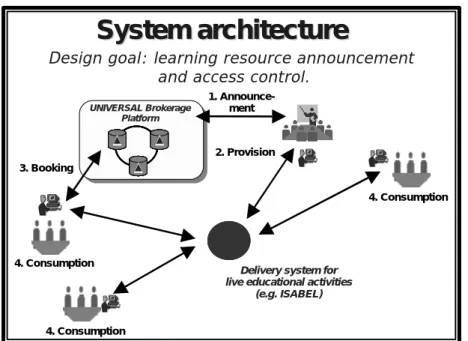
System architecture
System architecture
4. Consumption
Delivery system for live educational activities
(e.g. ISABEL) 2. Provision UNIVERSAL Brokerage Platform 1. Announce-ment 3. Booking 4. Consumption 4. Consumption
Design goal: learning resource announcement and access control.
Figure 1: User roles and interoperability
2.
Universal Brokerage Platform – The concept
UNIVERSAL is a business-to-business service. It is targeting higher education institutions that intend to participate in an exchange of learning resources, but lack the means of defining and effecting exchange relationships. UNIVERSAL is not restricted to a specific type of business model. Hence, the type of exchange relationships might range from free learning resource exchange (among selected members) to complex, commercial contracts.
In a very generic attempt to define an online "broker", it can be described as an on-line entity that offers an attractive electronic marketplace where offer can meet demand. Broker service has two types of users: those who offer their products for sale (providers) and those who buy the products offered (consumers). UNIVERSAL facilitates the exchange of learning resources between organisations whose members are registered users of the service. The organisations may be universities; business schools, training institutes or companies, while the individuals using the services are teachers, researchers or training managers. The technical system that enables the broker service is called UBP.
2.1.
The users
In the service brokerage design phase, the needs of the users, i.e. instructors were emphasised. Although the main customers of the service will be universities, they are not likely to be the best candidates to operate such a service brokerage platform. This presents a business opportunity for Telcos. This is discussed further in chapter 4. “Business scenarios and models”.
Users provide LRs that are described by metadata. In order to provide or book a LR a user must be registered at the UBP. Registered users can review data by means of annotations. However, UNIVERSAL will also have to deal with individuals who are associated with a LR, but are not registered UBP users, such as co-authors, publishers, etc.
2.2.
UBP services
The primary UBP services include inserting and describing LRs, including specifying terms and condition of possible usage, searching LRs, deleting LRs, booking LRs, including making a contract, and retrieving LRs. Further services include evaluating LRs and recording the usage of LRs. Secondary services are administrative ones such as inserting or deleting users, logging in, creating alliances with universities etc.
2.3.
Interfaces to 3rd party developers
One of the goals of UBP is to integrate smoothly with tools of 3rd party developers. Learning Management Systems are already used for course management at Universities. Delivery systems are also used, e.g. video-conferencing for the delivery of live sessions or video players for on-demand content. The aim was to make UBP interoperable with those systems.
UNIVERSAL will offer a fully implemented delivery interface to a restricted set of delivery systems, but is also open to others by providing a generic delivery interface to learning management systems, synchronous collaboration tools and video conferencing systems. UBP requires access to information from these systems for quality assurance of delivery and for tracking the use of the content kept within these systems.
During the project the interfaces for the following delivery systems shown in Table 1 are supported:
Table 1: Delivery systems supported by UBP
Type System
Learning Management Systems: Campus of Europe, IMC's CLIX LMS
Web Server: Perl-CGI Interface
Streaming Audio- and Video: Real Networks Servers (www.real.com) Videoconferencing and Collaborative Work: ISABEL (http://isabel.dit.upm.es/)
2.4.
Universal compatibility and standardisation
The UBP is based on a conceptual separation of content description, content itself, and LR delivery. The UBP interfaces federate commands for associating the geographically dispersed elements: Metadata records storing all the descriptive information for the UNIVERSAL brokerage catalogue are housed on a central UNIVERSAL server; LR content is housed on decentralised servers, and synchronous LRs are provided on the fly via live on-site delivery systems.
The metadata interface is fully XML: RDF-based [3] and compliant to standards such as Dublin Core, vCard, and IEEE LOM / IMS. The metadata records can either be created via the user interface of the UBP or automatically provided by the delivery systems, where the content is stored. In the latter case the user does not have to re-enter metadata such as title, author, description, etc. via the UBP’s user interface, because the UBP takes advantage of the metadata, which is stored on the delivery system.
3.
UNIVERSAL system architecture
The UBP has a classical three-tier architecture as Fig. 2 shows. The first tier implements the presentation part, i.e. the user interface, with Java. The business logic is implemented in the application server with Java servlets that are interpreted by a Java servlet engine, such as Tomcat and a web server. The operating system of the platform is Linux. The third tier implements the database, which is connected with Java Database Connection (JDBC). The database system is Interbase from Borland.
The UBP architecture is XML (Extensible Markup Language) based. The formal presentation of the artefacts is modelled by means of the Resource Description Framework (RDF). The foundation of RDF is a general model to represent the named properties and property values of resources. XML is used to encode the RDF-modelled learning resource metadata on the UNIVERSAL platform. The integration of a wide variety of different learning asset delivery systems that most probably are based on heterogeneous description schemes, demands a metadata approach that is highly flexible and essentially distributed in nature. By using XML, metadata descriptions can easily be understood, reused or
CLIENT CLIENT CLIENT CLIENT Web server Application server Database server Internet Tier 1 Web Client PC + Browser Tier 2
Web Application Server Operating system: Linux Web Server: Apache, Programming Language: Java
Tier 3 Database Server Borland Interbase HTTP(S) JDBC USER USER USER USER UBP
transformed by using standard tools. RDF provides the framework to describe metadata assets in a flexible way, using description elements from a variety of different description schemes. The RDF approach further warrants that metadata can be accessed and searched in a distributed manner.
LR delivery depends on the type of delivery system. Web servers are most often used in UNIVERSAL to deliver packaged LRs (asynchronous delivery). Several plug-ins will be needed to view and consume LRs and increase the functionality of the Web browser. Examples of these are:
• Adobe Acrobat Free Reader - for viewing the documents in PDF. • Power Point Viewer - for viewing Power Point presentations.
To date, the only UBP-compliant delivery system for streaming audio and video is Real Server. The accompanying Real player can be downloaded free of charge.
An ISABEL terminal must be set up in order to participate in a distributed videoconferencing lecture or event. An ISABEL terminal is a PC running ISABEL over Linux. The bandwidth requirements of ISABEL range from 128 kb/s up to 2 Mb/s. Higher bandwidth provides better quality. A bandwidth between 512 kb/s and 2 Mb/s is recommended. The UNIVERSAL platform, Fig. 3 is comprised of various software engines [3] providing services to users and external information systems such as delivery systems and assessment systems. The main system components are the metadata engine, contract engine, delivery engine, user profile engine and finally the administration engine.
The metadata engine facilitates the maintenance of LR related data. The engine interacts with LR providers via a web-based user interface or uses a protocol to exchange data with local learning management systems. The LR metadata engine also facilitates access to the LR repository. Thus, on the one hand the system has to provide flexible search services, allowing users to enter and combine queries like a powerful search engine is doing. On the other hand, it enables users to browse a well-structured directory based on an international taxonomy.
The contract engine is involved in the process of placing offers and requests for LRs, matching offers with requests, and bookings. During these transactions, the system deals with issues such as user authentication, transaction supervision, and possibly in the future even billing.
A thin generic interface layer provides communication functionality between brokerage and delivery systems, like authentication and authorisation services, delivery negotiation and delivery supervision.
The user profile engine is in charge of user administration such as user registration and cancellation. The user engine provides services to other engines (especially the LR metadata engine) in order to maintain user profiles. Enhanced usage logging allows UNIVERSAL to provide a personalised access to its LR repository.
The travel business
Mrs. Berg at the Seashell company in Iceland wants to train her staff in
accommodating tourists from Asia and South-America. Mrs Berg looks up in the UBP for learning resources on cultures in these continents. She finds a learning resource on Asian tourists from one business partner in Europe that she knows and registers it. This is a video that takes one hour. Additionally, she finds a learning resource on culture in South-America. This learning resource is from a university programme in tourism. This learning resource contains text and self-assessment test that Mrs Berg can ask her employees to perform at the end of the lecture. Mrs. Berg uses these two learning resources along with her own lectures and practical assignments. After she has given the short course, she evaluates the two learning resources.
Engines Data Resources
Log Data User Data Learning Resource Metadata Contract Data Assessment Data Assessment Engine Delivery Management Engine Contract Engine Learning Resource Metadata Engine User Profile Engine Administration Engine
User Interface
Finally, the administration engine maintains all logging data and tracks changes in the UNIVERSAL repository. In addition, the administration engine provides platform assessment service Quality characteristics.
The UNIVERSAL project emphasizes the development of a high quality service. Among the quality characteristics that the UNIVERSAL project team has incorporated in the design are openness, security, interoperability and usability[4]. Scalability and performance are also important quality characteristics that have been considered. The XML: RDF approach was chosen in order to ensure openness and flexibility in modelling the artefacts such as LRs, agents, rights, taxonomy, annotations, scheduling data, and delivery systems. Openness is required in order to enable efficient data interchange.
Security is an essential component of a reliable brokerage service. The standard internet-protocols provide no protection for privacy, confidentiality, integrity, or authenticity. Authentication is defined as confirmation that the source of data received is as claimed or that a peer entity in an association is the one claimed. The basic authentication requirements are: 1) Authentication of the brokerage platform - users need to authenticate the UBP to be certain of the identity of the server they are communicating with.
2) Authentication of users - UBP has to authenticate providers and consumers of learning resources. Authentication is the basis for authorisation and control of access to the learning resource/delivery profile database and user database.
4.
Business scenarios and models
As noted earlier, UNIVERSAL is not restricted to one kind of business model, the relationships might be about exchanging LRs freely or be of a strong commercial nature. In this chapter, the business scenarios and models will be discussed.
4.1.
Market for UBP
The market for UBP spans a great part of the educational market as a whole. The consumers of education are people learning at home, at schools/universities or in companies. In the developed countries, expenditure for education is very high. In the corporate environment, there is ever more awareness for the fact that the employees’ skills and capabilities are the most important assets of any company. Studies have shown that companies are spending approximately 1.5% [5] of their turnover for employee education and this is likely to rise. The educational market can be divided into three sectors: business, residential and educational institutions.
The business sector is probably the most lucrative one. Here, telcos have strong long lasting business ties. Adding the UBP to the telco portfolio would help their customers in many ways, including:
• Broadening the educational spectrum available for the companies due to increased range of educators • Utilising cost and time saving telecommunications for education
Telcos can therefore create a win-win situation for themselves and their corporate customers by entering into educational brokerage.
Telcos are also good candidates for serving home-consumers of education. Telcos have a business relationship with most homes, enabling them to easily sell educational services to individuals.
The educational brokerage service for educational institutions is probably the most complex and difficult for telcos to enter. Universities generally have rather distributed governance, the academic freedom of individual professors is important regarding both teaching and research. It is therefore impossible to regard a university as a single entity when marketing educational brokerage services; they have to be sold to professors individually.
There are a number of obstacles impeding telcos entering the educational brokerage market. The main obstacles are probably organisational like management reluctance. Telcos entering this business will have to hire educational experts that have good knowledge of the educational market requirements and would be able to train the marketing people for a new role. Furthermore, telcos would have to have access to a network of educational content providers, e.g. universities, filmmakers, book publishers and companies offering education in specialised fields. Educational brokerage is a complicated service offering which can lead to prohibitive problems when not correctly tackled. It is thus imperative for the telcos to acquire the required expertise from the beginning.
4.2.
General business models for Telcos
In the Telecommunications world, it is often stated that the operators must move their operations upwards in the value chain. There is no profitable future in transporting bits and no sense in leaving the profitable service and content management to others. It thus seems that a service like the UNIVERSAL Brokerage fits well into the new Telco strategy. Telcos have several strengths that enable them to make a profitable business case out of the UNIVERSAL idea. These include:
• Telcos have business relationships with a wide range of companies, institutions and individuals
• Telcos can easily play the role of a business enabler between the education suppliers and consumers • Telcos generally enjoy trust in the marketplace
• Hosting and running the UBP fits well with the operations telcos already perform • Telcos are able to offer turnkey solutions because they possess all resources required • Educational brokerage services require traditional telecommunications services • Educational Brokerage enhances the demand for broadband telecommunications
• Telcos generally have strong international ties, which helps them in their role as educational business enablers. It can therefore be stated that UBP offers Telcos a new opportunity for marketing their traditional services and to enter new areas higher up in the value chain.
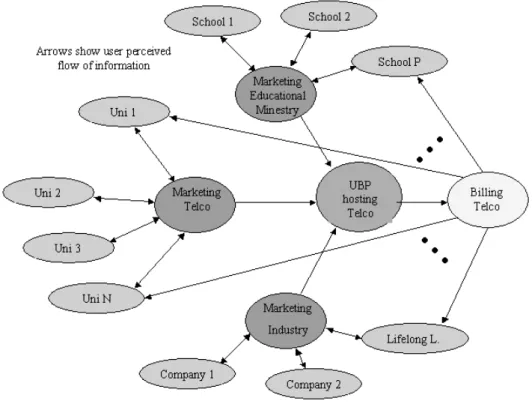
A possible business model for the educational brokerage service is depicted in Fig. 4. The model is comprised of several entities i.e. the brokerage platform and the billing at the telco, the consumers and providers of LRs and the marketing organisation. The model is based on the fact that education takes place in different communities within a society, e.g. the communities of university people, of industrial people, of the health sector etc. The marketing organisations in the model may represent each community. The market for LRs must be based on trust to the entities offering and handling the LRs
and this would be maximised if the marketing organisation belongs to the community. The health sector would for example want to trade LRs through an organisation within that sector rather from some unrelated entity. In some cases however, the telco could play the role of marketing LRs, e.g. in the university arena where there is no other obvious choice. The aim of marketing entity is to increase the number of subscribing organisations, either providers or consumers of LRs, and ensure the specified quality policy.
In Fig. 4 schools, universities and companies are grouped together and each constitutes a community. This could however be otherwise, e.g. companies could be interested in buying LRs from universities. Each community will have their own UBP service. A creation of specialised communities such as one for information technology, genetic research or the health sector, is foreseen. The community could be national, European or World Wide, no limits on possibilities. Before gaining access to the UBP service, each partner needs to sign an agreement with the marketing company of their community and billing information need to be given. When the service is in operation all the usage information are collected within the UBP system and then passed on to the Telcos internal billing system. The Telco sends out the bills and then distributes the income to relevant parties.
4.3.
Driving and hindering factors
Since the commencement of the project in spring 2000, the consortium has identified many hindering factors, the most serious ones are the following:
Ø Lack of management commitment in telcos
Ø Intellectual property rights issues not fully solved yet (see Table 2)
Ø Need for billing service (not implemented yet)
Ø UNIVERSAL may not be a sustainable, long-term initiative Although there are critical hindering factors, there are also success factors.
Table 2 gives an overview of the driving factors of LR brokerage. The first column is the title of the driving and hindering factors, the second column describes the driving factor and the third column suggests how UNIVERSAL meets the driving factor
Table 2: UBP driving and hindering factors
Driving/Hinde
ring factor
Description
UNIVERSAL offers
More offering and quality
Competition leads to higher demand for increased programme offering at universities and more specialisation. Increased competition requires universities to keep up with advances in many subjects that are fast evolving and can lead to more quality of learning resources. Governments and other sponsors demand quality from universities, both in research and teaching. Many universities perform quality assessment for teaching.
Using learning resources for a part of a course can add more specialisation. Publishing LRs leads to reviewing and feedback and thus quality enhancement
More recognition There is more competition for students and faculty members. A university that is well known for research gets more attention. Teaching can play an increased role in students’ selection of universities.
Tutors receive broader audience and promotion in the UNIVERSAL broker. There is not only competition, but also co-operation between universities.
Unification Universities in Europe have in the Bologna agreement made an agreement that unifies the structure and evaluation of the curriculum. The agreement allows students to participate in exchange programmes more easily. Professional societies, e.g. ACM or IEEE define a curriculum or body of
It is easier to define how many credits a learning resource can offer. UNIVERSAL can specify what part of a curriculum a learning resource fulfils.
knowledge.
Mobility There are initiatives to encourage the exchange of teachers and researchers. Personal contacts and meetings foster more co-operation that can occur on-line between visits.
Faster Networks In Europe, there are high bandwidth networks. The national research and educational networks are connected.
The broker uses high bandwidth to deliver audio and video learning resources
Interoperability Industry Standards to offer web services are emerging. They can support interoperability between services. They can support business processes around web services
The broker can take advantages of web services standards so that the broker can interoperate with delivery tools and learning management systems.
Lack of Commitment from Management
There is no reward for providing learning resources on a broker. The University does not have a policy for exchange of learning resources
Intellectual Property Rights / Unwillingness to share
Since teachers and universities consider learning resources valuable and a part of their competitive edge, they will not be willing to share their learning resources.
Perhaps the most serious hindering factor [6].
UNIVERSAL offers three different types of contracts. They differ in the possibilities on how the consumer can use the content. The broker’s architecture allows for counting the access to learning resources so that they can be sold.
It takes time to provide a digital learning resource
In most cases, there is extra effort for the teacher to provide an on-line learning resource. Not all teachers do this by default although it is increasingly common to do so.
UNIVERSAL is developing a best practice guideline to target teachers to provide learning resources.
Quality content “Content is king”. We know that quality content is the most important thing of a successful service. The on-demand content may not be interactive enough. We do not know if it is pedagogically better or worse to offer digital learning resources than person-to-person learning resources.
UNIVERSAL has an assessment engine that allows consumers, i.e. teachers and students to evaluate the content.
5.
Related work
Many project teams or functioning businesses are working on similar products to the UBP. Services like FATHOM
(www.fathom.com) and TRAININGPOINT (www.trainingpoint.org ) are brokering services, but their target audiences
are public users and they only deal with static learning content. Services like HUNGRY MINDS UNIVERSITY (www.hungrymindsuniversity.com), DLCOURSEFINDER (http://www.dlcourcefinder.com) and ED-X (http://www.ed-x.com) only offer the metadata engine but no delivery or administration engine.
Universities such as MIT with their MIT Open courseware (http://web.mit.edu/ocw/) programme can also be considered to be competitors. However, according to the UBP definition they should rather be considered as content providers where their LRs are educational material with no educational activity tied to it.
Today there is no service available on the market that does offer the same service as the UNIVERSAL Brokerage Platform.
6.
Conclusion
The educational market is growing and the authors believe that telcos should seize the opportunity and enter this market not only as network providers, but also as service providers and service integrators. In the business model described in this paper we have also suggested how telcos can play even a bigger part by taking care of marketing for the brokerage of a community. The extra effort in running services like the one described in this paper would not require a big effort on the Telcos part. By offering such a service the Telcos could increase the demand for a high-bandwidth solutions and therefore increase the usage of their core services.
The Universal project ends in December 2002 but there are other projects lined up to use this brokerage service. On the project’s website, http://www.ist-universal.org/ LRs from many educators may be found.
7.
Reference
[1] L. Helljesen and D. DiDuca, EDIN 0069 0902 “Social Impact, Sustainability and Market Implications” EURESCOM Confidential 2000, http://www.eurescom.de/~deliverables/p900-series/p902/TI_2/P902TI_2.doc [2] T. Klobucar , T. Koskinen and B. Simon, “Universal Brokerage Platform for Learning Resources - Technology
White Paper”,
http://www.educanext.org/UNIVERSAL/servlet/Universal;jsessionid=y09chkpiu1?pageID=aboutTechWhitepaper
[3] S. Brantner, T. Enzi , S. Guth, G. Neumann, and B. Simon: “UNIVERSAL - Design and Implementation of a Highly Flexible E-Market Place of Learning Resources”, in Proceedings of the IEEE International Conference on Advanced Learning Technologies. Madison (WI), USA, August, 2001.
[4] Law, L., Hvannberg, E.T, “Complementarity and Convergence of Heuristic Evaluation and Usability Test: A Case Study of UNIVERSAL Brokerage Platform”, Nordichi 2002, October 2002, Aarhus, Denmark
[5] Frosti Sigurjónsson, “Atvinnulíf framtíðarinnar – Ísland alltaf meðal 10 bestu” Viðskiptaþing 2000, URL:
http://www.chamber.is/Starfsemi/V-thing00/Frosti%20Sigurj.PDF (In Icelandic)
[6] C. Twigg, "The Knowledge, Economy and Postsecondary Education: Report of a Workshop," pp. 77-104, National Academy Press, 2002.
![Figure 2: UBP three-tier application structure [2]](https://thumb-us.123doks.com/thumbv2/123dok_us/9692628.2458149/4.892.105.515.537.775/figure-ubp-three-tier-application-structure.webp)
![Figure 3: Universal system Architecture [2]](https://thumb-us.123doks.com/thumbv2/123dok_us/9692628.2458149/5.892.103.496.361.667/figure-universal-system-architecture.webp)