WHEN IS COMPUTERIZED CONTINUOUS AUDITING LESS EFFECTIVE AT DETERRING FRAUD?
by
George C. Gonzalez
B.S. in Accounting, University of Florida, 1980
Submitted to the Graduate Faculty of
Joseph M. Katz Graduate School of Business in partial fulfillment of the requirements for the degree of
Doctor of Philosophy
ii
UNIVERSITY OF PITTSBURGH Joseph M. Katz Graduate School of Business
This dissertation was presented
by
George C. Gonzalez
It was defended on July 17, 2012 and approved by
Jacob G. Birnberg, Professor Emeritus, Katz Graduate School of Business Dennis F. Galletta, Professor, Katz Graduate School of Business
Kevin H. Kim, Associate Professor, School of Education Donald V. Moser, Professor, Katz Graduate School of Business Vicky B. Hoffman (Chair), Professor, Katz Graduate School of Business
iii
Copyright © by George C. Gonzalez 2012
iv
Companies use a variety of techniques to deter fraudulent behavior. This study focuses on the fraud deterrent effect of computerized continuous auditing systems. Although continuous auditing systems are almost always computerized in the natural environment, this study reports the results of two experiments that separately examine the effects of continuous versus periodic auditing and manual versus computerized fraud detection. It also examines the relative effects of human versus computer-mediated communication of the audit findings. Consistent with theory from criminology, information systems, and psychology, I find that the effectiveness of a continuous audit approach depends on the actual probability of fraud detection, and that at low levels of fraud detection a continuous audit is actually less effective than a periodic audit in reducing the perceived opportunity to commit fraud. I find no differences based on whether fraud is detected by a manual or computerized system, but find moderate support that face-to-face communication of audit findings creates more discomfort in a potential fraud perpetrator than does computer-mediated feedback. Contrary to my predictions, I do not find that individuals’ perceptions translate into corresponding effects on actual fraudulent behavior in my study.
WHEN IS COMPUTERIZED CONTINUOUS AUDITING LESS EFFECTIVE AT DETERRING FRAUD?
George C. Gonzalez, PhD University of Pittsburgh, 2012
v
TABLE OF CONTENTS
1.0 INTRODUCTION ... 1
2.0 BACKGROUND AND MOTIVATION ... 4
2.1 THE IMPORTANCE OF FRAUD ... 4
2.2 THE ROLE OF AUDITORS ... 6
2.3 THE FRAUD TRIANGLE ... 7
2.4 EVOLVING AUTOMATION OF AUDIT TECHNIQUES ... 8
2.5 COMPUTERIZED AUDIT RESEARCH ... 12
2.6 DETERRENCE EFFECT OF COMPUTER MONITORING ... 12
2.7 ACCOUNTING STUDIES ON HUMAN-COMPUTER INTERACTION .. 13
2.8 BEHAVIORAL RESEARCH ON CONTINUOUS AUDITING ... 15
3.0 THEORY AND DEVELOPMENT OF HYPOTHESES ... 18
3.1 DEVELOPMENT OF HYPOTHESIS 1 ... 18
3.1.1 Perceived Certainty ... 18
3.1.2 Computer Credibility ... 19
3.1.3 Audit Frequency (Periodic v. Continuous Audit) ... 20
3.2 DEVELOPMENT OF HYPOTHESIS 2 ... 23
vi
3.2.2 System Mode (Human v. Computerized)... 24
3.3 DEVELOPMENT OF HYPOTHESIS 3 ... 25
3.3.1 Computer-Mediated Communication ... 25
3.3.2 Lying in Computer-Mediated Communication ... 26
3.3.3 Communication Feedback Mode (Human v. Computer Feedback) ... 29
4.0 METHOD ... 31
4.1 OVERVIEW ... 31
4.2 EXPERIMENT 1 ... 31
4.2.1 Participants ... 31
4.2.2 Design: Audit Frequency ... 32
4.2.2.1 Task ... 38
4.2.2.2 Parameters ... 40
4.2.2.3 Random Lottery Incentive Mechanism ... 44
4.3 EXPERIMENT 2 ... 46
4.3.1 Participants ... 46
4.3.2 Design: System Mode and Communication Feedback Mode ... 47
4.3.2.1 Task ... 49
4.3.2.2 Parameters ... 50
4.3.2.3 Random Lottery Incentive Mechanism ... 50
5.0 EXPERIMENTAL RESULTS ... 51
5.1 PILOT STUDY ... 51
5.2 EXPERIMENT 1 RESULTS ... 52
vii
6.0 DISCUSSION AND CONCLUSIONS ... 66
APPENDIX A ... 73 APPENDIX B ... 78 APPENDIX C ... 79 APPENDIX D ... 80 APPENDIX E ... 81 BIBLIOGRAPHY ... 84
viii LIST OF TABLES
Table 1 Table Highlighting Cells Examined by Hunton et al. (2008, 2010) ... 16
Table 2 Designs for Experiment 1 and Experiment 2 ... 34
Table 3 Examples, Description of Experiments ... 36
Table 4 Participant Expected Values ... 42
Table 5 Test of H1a... 53
Table 6 Test of H1b ... 56
Table 7 Test of H2a... 59
Table 8 Test of H2b ... 61
Table 9 Test of H3a... 63
ix LIST OF FIGURES
Figure 1 Hypothesized Interaction Effects for Experiment 1 ... 22
Figure 2 Experimental Design for Experiment 1 (H1a and H1b) ... 33
Figure 3 Experimental Design for Experiment 2 (H2a, H2b, H3a, and H3b) ... 48
Figure 4 Graphical Results of H1a ... 54
Figure 5 Graphical Results of H1b ... 57
Figure 6 Graphical Results of H2a ... 60
Figure 7 Graphical Results of H2b ... 62
1
1.0 INTRODUCTION
This study focuses on the fraud deterrent effect of computerized continuous auditing systems. Although continuous auditing systems are almost always computerized in the natural environment, this study uses the comparative advantages of the experimental method to separately examine effects that often co-occur in the real world. In this way, I can determine which aspects of a system are effective at deterring fraud. Specifically, the study examines the relative effectiveness at deterring fraud of a continuous versus periodic auditing system (i.e., audit frequency), a computerized versus manual fraud detection system (i.e., system mode), and whether audit results are communicated by a human in a face-to-face interaction or by a computer (i.e., communication feedback mode). This study also tests whether continuous auditing’s effectiveness as a fraud deterrent depends on the actual fraud detection probability. Most contemporary audit literature assumes that because continuous auditing is a constant, persistent presence, it will always be more of a fraud deterrent than periodic auditing. While continuous auditing could be more effective as a fraud deterrent than periodic auditing when the actual probability of fraud detection is high, I predict that continuous auditing will be less effective than periodic auditing when there is a low actual probability of fraud detection.
Because traditional paper-based audit trails are steadily disappearing and being replaced by digital audit evidence, auditors are increasingly relying on computerized audit techniques to
2
gather digital evidence. Computers are being used by organizations seeking to “do more with less” by reducing staff, including internal audit staff, while attempting to increase audit efficiency through information technology. Although fraud deterrence is a top priority for auditors, firms, and regulators, little is known about computerized continuous auditing’s effects on fraudulent behavior. It is important to understand whether moving from a manual periodic audit environment to a computerized continuous audit environment affects the behavior of auditees, and to determine which aspects of this process influence a potential fraud perpetrator's perceptions and behavior. This study extends the limited prior research in this area.
To answer my research questions, I conduct a two-experiment study in which participants perform an auditable task under different conditions. Participants perform the task for compensation across repeated periods. In some cases, randomly determined, participants can increase their compensation by performing the task fraudulently (i.e., in an opportunistic, dishonest manner) provided this behavior is not detected through an audit. I examine the effect on perceived opportunity to commit fraud and on actual fraud behavior of manipulating the audit frequency, the system mode, the communication feedback mode, and the actual audit detection probability. The intent of varying these factors is to isolate their deterrent effects based on participants’ perceptions of the likelihood that they will be detected behaving fraudulently. In my first experiment I vary the probability of getting audited to examine the interaction between audit frequency and actual detection probability. In the second experiment I hold audit frequency and actual detection probability constant as I observe the deterrent effects of varying the system mode and the communication feedback mode. In all circumstances, when a participant is audited, the fraud is detected, i.e., in this study all audits are 100% successful in detecting fraud and therefore the actual audit detection probability is the same as the probability of being audited.
3
Participants who commit fraud earn additional compensation unless they are audited, in which case their fraud is detected and they pay a penalty which results in negative earnings for the period.
In the next chapter I present the background for my study, including a discussion of fraud, auditing, human-computer interaction and other related issues. In Chapter 3 I discuss theory and develop my hypotheses. I describe my research method in Chapter 4 and the results of my experiments in Chapter 5, then summarize and conclude in Chapter 6.
4
2.0 BACKGROUND AND MOTIVATION
2.1 THE IMPORTANCE OF FRAUD
Fraud is extremely costly. According to the Association of Certified Fraud Examiners (ACFE), the typical organization loses 5% of its annual revenue to fraud (ACFE 2012), which translates to a potential total fraud loss of more than $3.5 trillion worldwide when applied to the estimated 2011 Gross World Product (ACFE 2012). The median loss caused by occupational frauds (i.e., asset misappropriation, financial statement fraud, and corruption) during the two year period from January 2010 to December 2011 was $140,000 per organization (ACFE 2012), and more than one-fifth of those fraud losses were $1 million or more (ACFE 2012).1 Auditors, managers, investors and regulators in businesses and industries of all types are concerned with the risk of fraud, and want to know how to most effectively minimize this risk.
While fraud has likely existed for as long as humans have engaged in transactions with one another, in the last decade it has received a great deal of attention. This attention is due to several key factors. One is the highly publicized fraud scandals at the beginning of the 21st
1
According to the ACFE’s 2012 Report to the Nations, among the three main categories of fraud, the median loss (percentage of cases) during the two-year period ended December 31, 2011 were: (1) asset misappropriation - $120,000 (86.7%); (2) financial statement fraud - $1 million (7.6%); and (3) corruption - $250,000 (33.4%). Note: the sum of percentages exceeds 100% because several cases involved schemes from more than one category. (ACFE 2012)
5
century, particularly those at Enron and Worldcom, which affected millions of investors and employees. Another important factor is the continual rise in use of information technology and the resulting increase in the variety of ways that fraud may be perpetrated. Advances in information technology represent a double-edged sword that simultaneously provides greater fraud-fighting tools while introducing new fraud risks. A complete database search for specific names or keywords among thousands of records can be done in a matter of seconds. Queries can be done on the frequency, dates, and/or times of day that an employee accesses a certain system. The matching of fields among different records, e.g., matching customer ship-to addresses to employee payroll addresses, can be done instantly. These types of data searches serve as fraud detection techniques and, by their known existence on the part of potential fraud perpetrators, as fraud deterrence tools.
On the other hand, technological advances create new types of fraud risk. For example, technology has made it easier for perpetrators to commit document fraud. Many types of documents of value, such as commercial checks, birth certificates, identification cards, licenses, motor vehicle titles, prescriptions, college transcripts, tickets and passes for events, are at risk of being forged (e.g., Zellen 2008). Another example of increased fraud risk spawned by advanced technology is in e-commerce (e.g., Shih et al. 2005). While e-commerce has given merchants access to much greater numbers of markets and customers around the world than they previously had, it has also introduced new fraud risks. One of the fraud risks associated with e-commerce is the risk that hackers will infiltrate a web page that customers use to order products online. A successful hacker could redirect a shipment of product to an alternative address, or gather the customer’s credit card and other personal information and use that information to place fraudulent online orders elsewhere. Fraudsters steal credit card information in a variety of other
6
ways, such as through the use of hand-held credit card skimmers at restaurants and other establishments, and through hidden camera skimming devices at bank ATM machines (e.g., Nussenbaum 2010).
Because of its costliness, the high level of attention it has garnered, and the expanded risks associated with it as a result of technological advances, fraud is an issue of high importance to auditors, managers, investors and regulators.
2.2 THE ROLE OF AUDITORS
Both external auditors and internal auditors are concerned with fraud. External auditors must follow Public Company Accounting Oversight Board (PCAOB) auditing standards (AS) and American Institute of Certified Public Accountants (AICPA) Statement on Auditing Standards (SAS) that require them to consider fraud in performing their audits of public companies.2 Internal auditors, who act as a fraud deterrent and fraud detection mechanism, and are a key component of an internal control system (San Miguel & Govindarajan 1984), are subject to the Institute of Internal Auditors’ (IIA) International Professional Practices Framework (IPPF) standards that refer to fraud.3 In general, both external and internal audit standards require that auditors be aware of fraud risk, incorporate fraud risk assessments into their audit engagements, and develop audit plans in accordance with those assessments.
2
AS Nos. 1, 3, 4, 5, 6 and 7 explicitly mention fraud http://pcaobus.org/Standards/Pages/default.aspx; SAS No. 99 (AICPA 2002) is dedicated exclusively to fraud consideration in the performance of a financial statement audit, and requires brainstorming about fraud risks and potential fraud schemes.
3
7
While external auditors are principally concerned with the detection of fraud that results in materially misstated financial statements (e.g., AICPA 2002), internal auditors typically view fraud risk more broadly and are concerned with fraud risks related to not only financial reporting but also compliance matters and operational effectiveness and efficiency (IIA 2009d). Accordingly, internal auditors generally tend to be equally concerned with fraud in all three of the ACFE’s fraud categories (i.e., asset misappropriation, financial statement fraud and corruption), and engage in both fraud detection and fraud deterrence measures. Thus, this study should be of interest to auditors of all types, but should be of particular interest to internal auditors.
2.3 THE FRAUD TRIANGLE
Often-cited in the fraud literature is the concept of the fraud triangle, which consists of three conditions generally present when fraud occurs: perceived opportunity, incentive/pressure, and attitude/rationalization. Both academic (e.g., Hogan et al. 2008; Wilks and Zimbelman 2004a, 2004b) and practice-oriented (e.g., Wells 2001; Wells 2010) fraud literature use the fraud triangle to conceptualize the factors that are conducive to fraudulent behavior. In addition, the fraud audit standard (SAS No. 99) is based on the fraud triangle.
The fraud triangle is the conceptual framework upon which anti-fraud programs are frequently built. Because organizations usually have more control over the opportunity side of the fraud triangle than the other two sides (e.g., Albrecht et al. 2008; Albrecht et al. 2012; Wells 2010), most anti-fraud controls focus on minimizing fraud opportunities by deterring fraud
8
before the fact and detecting fraud after the fact. Successful fraud deterrence occurs when the potential perpetrator perceives a high certainty that he cannot commit a fraudulent act without it (1) being detected by the system of internal controls and (2) resulting in a penalty that outweighs any perceived potential benefits from the fraud. An example of a fraud deterrence tool that has proven successful for many businesses is the installation of replica (fake) surveillance cameras. The cameras are strategically positioned to give the appearance to customers and/or employees that they are being watched and recorded, thereby creating an (artificially) high probability of detection and deterring potential perpetrators from engaging in fraudulent behavior (e.g., Jans et al. 2010).
2.4 EVOLVING AUTOMATION OF AUDIT TECHNIQUES
The traditional audit is “manual”. It is based on the auditor performing face-to-face interviews, on-site observations, and manual reviews of hard copy (paper-based) audit evidence. A department or business unit within an organization would typically be subject to an audit on a periodic basis unless there was a special need for an immediate audit. An auditee could anticipate a visit from an external or internal auditor and being asked for specific pieces of documentation.
Since the early 1990s, the business environment has gone through substantial changes with the “electronization’’ of business, which has led to accounting systems that are less paper-based (e.g., Flowerday et al. 2006). The modern audit can be characterized as being “computerized,” where digital (electronic) evidence is gathered. Computerized audits, in whole
9
or in part, can be accomplished in many cases without the need for the auditor’s physical presence at the auditee’s office or other transaction source.
The evolution of computerized auditing techniques and the resulting replacement of traditional manual audits with computerized audits represent an evolution from a manual system, in which manually generated data are manually audited, to a computerized system, in which computer-generated data are audited by computer. My dissertation identifies three distinct dimensions of the evolution from manual to automated systems, and separately examines the ramifications of each of the three aspects. One aspect that I examine is whether a computerized system environment affects an auditee’s inclination to commit fraud, as compared to a manual system environment. A second one is the effect of continuous auditing on auditee behavior, as compared to periodic auditing. The third aspect is communication of feedback.
Continuous auditing is a particular type of computerized audit that has gained growing interest. In a continuous audit, software continuously monitors transactions and compares their characteristics to expected results. Continuous auditing differs from traditional, man-powered auditing in several important ways. Continuous auditing (a) is designed to immediately detect and deter problems, rather than to build cumbersome controls to prevent problems; (b) focuses on 100% testing of transactions within selected modules, rather than sampling; and (c) is IT-intensive, rather than labor-intensive (e.g., Hermanson et al. 2006). In a continuous audit any significant discrepancies between transaction results and expected results trigger alarms that the company’s operational managers, auditors, and/or top management can investigate (e.g.,
10
Vasarhelyi et al. 2002).4 These alarms are automated, but the subsequent decisions regarding if and when to “drill down,” or review a greater level of detail on specific items, are made by management/auditors. Only when an alarm is triggered by the system and subsequently pursued by management or an auditor does human intervention occur. The auditee will not be aware of an alarm when it is triggered by the continuous auditing system,5 an aspect of continuous auditing that enhances its fraud deterrent effect.
How does continuous auditing affect a potential fraud perpetrator’s behavior? It seems logical to believe that because of its constant, persistent presence, continuous auditing will decrease a potential fraud perpetrator’s inclination to commit fraud. Continuous auditing has been touted as a powerful anti-fraud tool, as exemplified by the following quotes:
“Continuous auditing/continuous monitoring can become a key component of an effective fraud risk management process to prevent and detect fraud and misconduct.” (KPMG 2010)
“Employee anti-fraud education that … publicizes the use of continuing audit software gives wrongdoers reasons to think twice and reduces over-reliance on internal and external audits.” (Ratley 2011)
Might there be situations, however, when a continuous auditing system may actually increase fraud risk? A continuous audit is an audit by exception. If the continuous auditing system does not produce any exception reports, the underlying accounting/financial information is deemed to be free from material errors, omissions, and fraud (e.g., Chan and Vasarhelyi 2011).
4
Continuous auditing techniques can be performed by management as well as auditors. Some researchers and practitioners distinguish between management-based continuous audits and auditor-based continuous audits by referring to the former as continuous monitoring and the latter as continuous auditing. See footnote 6 for additional commentary on this point.
5
A possible exception to this would be a continuous auditing system designed to have multiple levels of alarms, in which minor or low-level alarms are brought to the attention of auditees to enhance operational efficiencies, and major or high-level alarms are made known to auditors only (e.g., Vasarhelyi and Halper 1989).
11
Therefore, an error, whether intentional or unintentional, that is not caught by a continuous auditing system may have the opposite of the intended effect – it may create the perception in the perpetrator’s mind that s/he can easily get away with fraud. The audit-by-exception nature of continuous auditing, and the risk that all may appear fine when it actually is not, implies the need for “backup” internal audit controls of the traditional human variety. Without effective controls that catch the fraudulent acts missed by the continuous auditing system, might continuous auditing actually result in increased inclination to commit fraud on the part of a perpetrator? This is an important question that I address in my study.
The third aspect of the automated environment that I examine is whether an individual’s ex ante behavior would be affected if that individual knew that feedback about her actions (including errors both intentional and unintentional) would be delivered by computer rather than by a human being. While it is true that the detection of fraudulent behavior, whether that detection is made by human audit or computerized audit, will very likely be communicated to the fraud perpetrator by a human at some point, it is entirely possible that in a computerized environment an error not yet deemed intentional, and therefore not yet deemed to be fraud, could be communicated to the person committing the error by computer rather than face-to-face human communication. Another possibility is that a fraud perpetrator could receive an initial inquiry on his actions by computer rather than directly by a human.
12
2.5 COMPUTERIZED AUDIT RESEARCH
Researchers in accounting and information systems (IS) have examined various aspects of computerized audits (e.g., Vasarhelyi et al. 2002; Flowerday and von Solms 2006; Hermanson et al. 2006; Kuhn and Sutton 2006; Albrecht 2008; Cook and Clements 2009; Kuhn and Sutton 2010). Most of these studies have focused on technological methods and techniques that auditors can use to enhance their audits and that firms can implement to improve their accounting and control systems. Research on computerized continuous auditing, likewise, has concentrated on technological aspects of continuous auditing. So far there has been a lack of studies on the behavioral effects of continuous auditing. Some researchers have called for experimental and empirical studies of such behavioral effects to help us understand the full impact of implementing continuous auditing systems (e.g., Hunton et al. 2004; Kuhn and Sutton 2006; Kuhn and Sutton 2010) and other types of computer monitoring (e.g., D’Arcy et al. 2009).
2.6 DETERRENCE EFFECT OF COMPUTER MONITORING
Computer monitoring is often used by organizations to gain compliance with rules and regulations, e.g., to track employees’ Internet use, to record network activities, or to perform security audits (e.g., Urbaczewski and Jessup 2002). Deterrence theory suggests that computer monitoring increases perceived certainty of sanctions (e.g., Alm and McKee 2006, Wenzel 2004). Past deterrence research has shown that fear of sanctions predicts a reduction in criminal and other deviant behavior (Nagin and Pogarsky 2001). Hence, procedural and technical
13
countermeasures can serve as deterrent mechanisms by increasing the perceived certainty and severity of sanctions for misbehavior (e.g., Straub and Welke 1998).
Active and visible security efforts in the form of computer monitoring are recommended approaches for deterring information systems misuse based on the theoretical perspective of deterrence theory (e.g., Kankanhalli et al. 2003, Straub 1990). User awareness of security countermeasures such as computer monitoring directly impacts perceived certainty of sanctions associated with computer misuse, which in turn directly affects IS misuse intention. Like the effect of surveillance cameras described earlier, users’ awareness of computer monitoring has a significant effect on users’ perceived certainty of sanctions and, as a result, computer monitoring can have an enhanced deterrent effect on computer misuse (e.g., D’arcy et al. 2009).
2.7 ACCOUNTING STUDIES ON HUMAN-COMPUTER INTERACTION
Outside of the continuous auditing realm, there have been a few accounting studies that have looked into electronic versus human interaction in an accounting setting. There is mixed evidence on the issue of which is better, human or electronic interaction. Studies have looked at a variety of tasks, such as audit workpaper preparation (Brazel et al. 2004), audit workpaper review (Bible et al. 2005), and brainstorming of fraud risks (Lynch et al. 2009). Electronic audit reviews have a different effect on both reviewers and preparers than face-to-face reviews. For reviewers, electronic work environments are more cognitively demanding than traditional paper environments and impair reviewers’ ability to identify errors. Auditors have been found to be
14
less effective in analyzing data and making decisions in an electronic environment than in a traditional paper-based environment (Bible et al. 2005).
For preparers, there is a higher sense of accountability in the face-to-face review environment than in the electronic environment. Preparers anticipating a face-to-face review are more effective and less efficient than those anticipating an electronic review (Brazel et al. 2004). The effect of an electronic environment has also been found to have a different effect on auditors’ brainstorming in accordance with SAS No. 99 than a face-to-face environment. Specifically, teams that brainstorm electronically generate a greater number of relevant fraud risks than teams that brainstorm face-to-face (Lynch et al. 2009).
While studies such as the aforementioned have looked at differences in effects on auditors of electronic environments versus face-to-face environments, to my knowledge no accounting studies have comprehensively examined the difference in effect of these alternative environments on auditees in general or, more specifically, potential fraud perpetrators. According to the framework developed by one accounting study (Lynch and Gomaa 2003), the use of information technology in organizations can actually increase fraud risk by decreasing the frequency and intimacy of contact among people in the workplace. Decreased social contact weakens psychological ties among individuals, psychological proximity is weakened by information technology, and consequently an electronic environment increases the likelihood of a potential perpetrator attempting fraud (Lynch and Gomaa 2003).
15
2.8 BEHAVIORAL RESEARCH ON CONTINUOUS AUDITING
Among the few studies to date that have examined the behavioral effects of continuous auditing, two that are particularly pertinent to my study are Hunton et al. (2008) and Hunton et al. (2010). These companion studies delve into the psychological and behavioral effects of continuous auditing in a managerial decision-making context. Hunton et al.’s (2008) experiment examines how managerial decisions are affected by the interaction of monitoring frequency (periodic monitoring versus continuous monitoring) and incentive horizons (long-term versus short-term).6 The professional manager participants in their experiment assumed the role of a manager who had to decide whether to continue a risky project and, if so, at what investment level. Hunton et al. (2008) and Hunton et al. (2010) both use an experimental design in which participants are assigned to either a periodic monitoring condition or a continuous monitoring condition. The periodic monitoring condition is presented as a traditional internal audit by human auditors, in which audits occur on a rotating but unknown (to the auditees) basis. The continuous monitoring condition is described to participants as one in which automated software collects information on a continual basis. The 2 x 2 x 2 table in Table 1 highlights the two cells examined by Hunton et al (2008, 2010).
6
Hunton et al. (2008) distinguish continuous auditing from continuous monitoring in the following way: the former is a subset of the latter. They state that “continuous monitoring provides external auditors, internal auditors, and corporate managers the capability to track, in (near) real time, financial and nonfinancial information flowing through a company's information systems.” While the term continuous monitoring can be used to refer to a process owned and performed by management, continuous auditing is a term more commonly used for an activity performed by auditors, internal or external.
16
Table 1 Table Highlighting Cells Examined by Hunton et al. (2008, 2010)
Hunton et al. (2008) find that, relative to periodic monitoring, continuous monitoring is more effective at decreasing earnings management of discretionary expenditures (a “functional effect”) but also reduces managers' willingness to continue or otherwise increase the investment in a viable but risky project (a “dysfunctional effect”). The subsequent study, Hunton et al. (2010), sought to explain this dysfunctional risk aversion effect triggered by continuous monitoring. In Hunton et al. (2010), the authors replicate their original experiment with the exception that the professional manager-participants, rather than making the decisions themselves, evaluate the decisions of a fictitious manager. They find that, relative to periodic monitoring, continuous monitoring increases managers’ perceived accountability because of managers’ greater perceived need to justify their decisions under a continuous monitoring system. According to the authors, this increased accountability effect of continuous monitoring,
17
coupled with managers’ belief that maintaining the status quo is the easiest decision to defend, explains the reduced risk-taking by managers under continuous monitoring.
Because the Hunton et al.’s (2008, 2010) studies look at two extremes (cells #1 and #4 in Table 1), they examined periodic monitoring by humans versus continuous monitoring by computers, and did not examine the intermediate conditions of periodic monitoring by a computer or continuous monitoring by a human. Because their study simultaneously varied both the audit frequency (periodic versus continuous) and the system mode (human versus computer), it did not fully disentangle the effects of these variables.7 It is possible that, for instance, in addition to the effect of the frequency of the audit (periodic versus continuous), the system mode (computer versus human) could have driven some of their results. Additionally, participants, who volunteered for the study, assumed the role of a manager and indicated what decisions they would make regarding reporting of current expenditures and whether to continue a two-year old investment project. There was no compensation involved in the study, no consequences attached to participants’ decisions, and no task repetition which might have enhanced learning. Therefore, we do not know whether Hunton et al.’s participants’ perceptions would have differed if they had experienced task performance and feedback multiple times, or if their actions had a real economic effect for them.
7
It could be argued that the timing of communication feedback in the Hunton et al. studies also varied. This argument could be made in the sense that under one condition (human/periodic) audit results are communicated to the auditee at the completion of the audit after a lapse of time while under the other condition (computer/continuous) audit results are communicated to the auditee immediately. On the other hand, an opposing argument could be made that in a continuous audit immediate feedback results do, in fact, represent feedback at the time the audit is completed, as is the case in a periodic audit. I take this latter view. I design my experiment in a similar fashion to that of the Hunton et al. studies, i.e., that audit result feedback is communicated to the auditee at the completion of the audit both in a periodic audit as well as in a continuous audit, even if in the continuous audit the communication feedback may seem to be “immediate”.
18
3.0 THEORY AND DEVELOPMENT OF HYPOTHESES
In this chapter, I build on past research and theory to develop three pairs of hypotheses. In each case part “a” of the hypothesis predicts an effect on an individual’s perception of a condition or combination of conditions, and part “b” predicts the behavior that results from that perception.
3.1 DEVELOPMENT OF HYPOTHESIS 1
3.1.1 Perceived Certainty
Perceived certainty is a key element of perceived fraud opportunity. In criminology, deterrence theory emphasizes the important role played by a criminal’s perception of the risk of being caught, i.e., the perceived certainty of sanctions associated with performing a crime (e.g., Erickson et al. 1977; Anderson et al. 1983; Hollinger and Clark 1983). Under deterrence theory, the higher the perceived certainty, the greater the deterrence effect.
Several researchers have confirmed the importance of perceived certainty in computer users’ willingness to violate computer security (e.g., Gopal and Sanders 1997; Straub and Welke 1998; D'Arcy et al. 2009). The seminal study on employee theft (Hollinger and Clark 1983) indicates that among four independent variables – perceived certainty, perceived severity, age
19
and gender - by far the strongest independent variable in predicting theft is the employee’s perceived certainty of being detected. Hollinger and Clark (1983) find that the employee who perceives a low certainty of theft detection is over three and one-half times more likely to steal from his employer than the employee who perceives a high certainty.
3.1.2 Computer Credibility
An important factor in the study of human-computer interaction is how individuals perceive a computer’s ability to perform a task. Computers can be programmed to perform many different kinds of tasks, ranging from the simple to the highly complex: perform rote calculations; sort and summarize data input by a user; act as a decision support system, give expert advice to the user; regulate nuclear power plant operations. How well a computer is perceived to be able to perform a task is referred to as “computer credibility” (e.g., Tseng and Fogg 1999; Galletta et al. 2002; Galletta et al. 2005; Rieh and Danielson 2007).
Credibility results from evaluating multiple dimensions simultaneously, but the two dimensions that are the key components to credibility are "trustworthiness" and "expertise" (e.g., Tseng and Fogg 1999; Galletta et al. 2002). Tseng and Fogg (1999) set forth seven general categories to describe when credibility matters in human-computer interactions, one of which they call “when computers report on work performed”, an example of which would be auditing. Tseng and Fogg (1999) also set forth four types of credibility: presumed; reputed; surface; and experienced. "Presumed credibility" describes how much the perceiver believes someone or something because of general assumptions in the perceiver's mind. "Reputed credibility" describes how much the perceiver believes someone or something because of what third parties
20
have reported. "Surface credibility" describes how much a perceiver believes someone or something based on simple inspection. "Experienced credibility" refers to how much a person believes someone or something based on first-hand experience. The first and fourth of these are pertinent to my study while the other two are not. “Reputed credibility” is not relevant to my study because the auditing system to which the participants are subject is a new one specifically created for the experiment and, hence, third parties will not have had anything to report on the system. “Surface credibility” is also not relevant: participants will not be given any prior opportunity to inspect the auditing system to which they will be subject.
3.1.3 Audit Frequency (Periodic v. Continuous Audit)
Regardless of the system mode, human or computer, a potential perpetrator’s perceived certainty of being detected will logically be related to the frequency of the audit: the more frequent the audit, ceteris paribus, the higher the perceived probability of being detected, i.e., the higher the perceived certainty. The perceived certainty of being detected in a continuous audit is higher than the perceived certainty of being detected in a periodic audit. In the field, if a potential perpetrator is monitored more often and fraud is detected earlier, he will be prevented from continuing the fraud, and as a result a continuous audit environment will result in less perceived fraud opportunity and act as more of a deterrent than a periodic audit environment. Even if the actual chance of being caught is the same, in a continuous and periodic audit environment, the prospect of getting caught earlier, and possibly more frequently, would increase the perpetrator’s perceived certainty of his fraudulent act being detected in a continuous auditing environment.
21
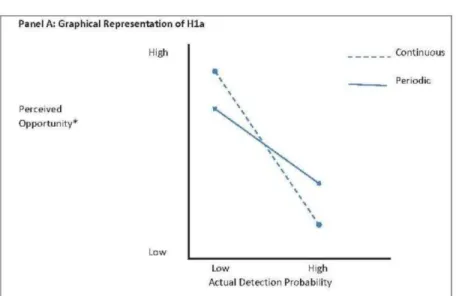
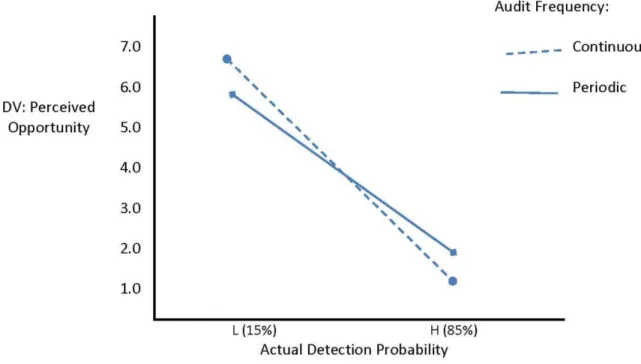
While a continuous audit environment may act as a successful deterrent against some potential fraud perpetrators some of the time, the possibility remains that not all potential fraud perpetrators will be fully dissuaded all of the time. As previously described, experienced credibility emanates from a person having first-hand experience with a computer (Tseng and Fogg 1999). An effective continuous auditing system, i.e., one with a high detection probability, will likely result in high experienced credibility in the mind of the potential fraud perpetrator. Conversely, an ineffective continuous auditing system, i.e., one with a low detection probability, will likely have the opposite effect. If a fraud perpetrator attempts a fraudulent act and, because of a low probability of detection, the continuous audit environment does not detect the fraud, it is likely that the perpetrator will perceive a reduced probability of getting caught. This is analogous to tax audit environments where, because there is a low probability of being audited, successful tax evaders update their perceptions of being detected, and evade taxes more in the future (e.g., Snow and Warren 2007). I predict that audit frequency and actual detection probability will interact and influence, as explained below, both fraud perpetrators’ perceptions about the likelihood of being detected (i.e., their perceived opportunity to commit fraud) and their propensity to commit fraud. Specifically, continuous auditing’s relative effectiveness will depend on the actual probability of fraud detection, as described in the hypotheses that follow. I make separate predictions regarding the effects on participants’ perceptions and their actions. I formally state my first pair of hypotheses next, and illustrate them in Figure 1:
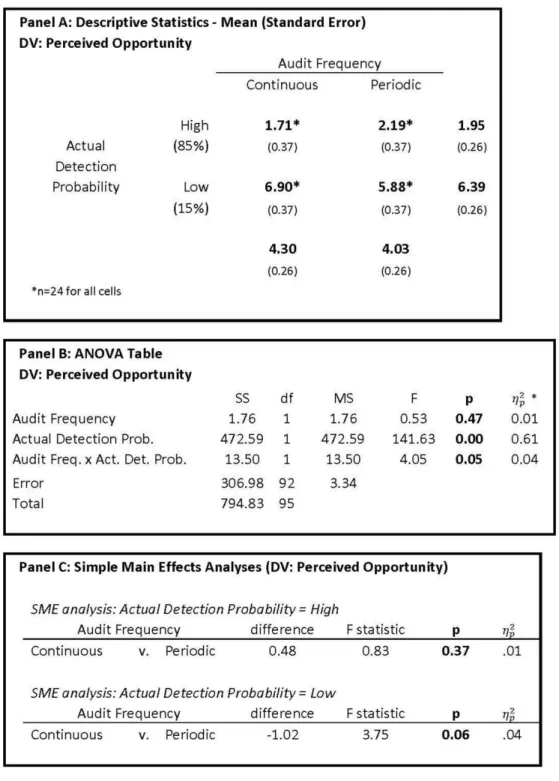
H1a: The effect of Audit Frequency on Perceived Opportunity will depend on the Actual Detection Probability. These two factors will interact such that when there is a high actual probability of fraud detection, a continuous audit environment will create a lower perceived opportunity to commit fraud than a periodic audit environment. However, when there is a low actual probability of fraud detection, a continuous audit environment will create a higher perceived opportunity to commit fraud than a periodic audit environment.
22
H1b: The effect of Audit Frequency on Fraud Percentage will depend on the Actual Detection Probability. These two factors will interact such that when there is a high actual probability of fraud detection, a continuous audit will be more effective at deterring fraud and result in a lower percentage of fraudulent behavior than a periodic audit. However, when there is a low probability of fraud detection, a continuous audit will be less effective at deterring fraud than a periodic audit and will result in a higher percentage of fraudulent behavior.
23
3.2 DEVELOPMENT OF HYPOTHESIS 2
3.2.1 Credibility in Human-Computer Interaction
Several researchers have demonstrated that computers are generally assigned more credibility than humans. Computers have a scientific mystique, considered to be wholly objective and superior to humans in performing tasks. Computers are seen as powerful and sometimes intimidating machines, with superior wisdom to humans in a way that makes them seem faultless (e.g., Sheridan et al. 1983). Computers are “awesome thinking machines” (Pancer et al. 1992). People believe that expert advice given by a computer is more objective and rational than that given by human advisers (e.g., Dijkstra et al. 1998). Under the Tseng and Fogg (1999) model described earlier, a computer derives high computer credibility from a high presumed credibility. People think humans make mistakes and consequently human error is considered a very significant problem for organizations (e.g., Deloitte 2007). Extending this to audit detection, I expect that people perceive higher credibility in computerized audits than in human audits.
Thus, if potential fraud perpetrators perceive higher credibility in computerized audits than in human audits, the higher credibility assigned to computerized audits contributes to those individuals’ perceived certainty of being detected. Although the actual probability of detection may be identical between two types of audits, computerized and human, the perceived certainty of being detected will nevertheless be higher for the computerized audit. In turn, based on deterrence theory as previously described, potential fraud perpetrators’ higher perceived certainty of detection by a computerized audit will result in the computerized audit serving as a greater deterrent than a human audit, ceteris paribus. Therefore, fraud perpetrators will be less
24
willing to attempt fraud in a computerized system environment in which audits are computerized than in a manual system environment in which audits are performed by humans.
While many researchers maintain that people perceive computers to be highly credible, some researchers have argued otherwise. They take the alternate view that, while people have generally held computers in high regard since the inception of their usage, the credibility of at least some computers has declined over time. The argument is that, like many aspects of our human society, computers are facing a credibility crisis (e.g., Rieh and Danielson 2007; Tseng and Fogg 1999), due in part to the popularization of the Internet, the ease with which false information may be disseminated through the Internet, and the fact that many people have become skeptical of what they read on the Internet. Tseng and Fogg (1999, p. 39) note that “If the pendulum swings too far in this direction, computers--especially with respect to Web-based content--could be viewed as among the least credible information sources, rivaling TV infomercials and supermarket tabloids for such dubious distinction.”
3.2.2 System Mode (Human v. Computerized)
The studies that find that people perceive computers to be more credible than humans seem to be those that examine more objective tasks like computerized word processing (Pancer et al. 1992), problem solving by computerized expert systems (Dijkstra et al. 1998), and others such as aircraft control systems (Sheridan et al. 1983). In contrast, the studies that find computers to be less credible appear to be set in more subjective contexts like computers being given the task of making semi- to fully-subjective judgments (e.g., Honaker et al. 1986; Andrews and Gutkin 1991; Lerch 1997) or human-created Web-based information (Tseng and Fogg 1999). Because
25
the setting in this study (i.e., a computerized audit task) is objective in nature it is likely that a potential fraud perpetrator will perceive a computer to be more skillful than a human at performing the task of auditing. Therefore, I predict that the computerized audit in a computerized system will increase perpetrators’ perceived certainty of being detected (i.e., it will reduce their perceived opportunity to commit fraud) as well as their actual fraudulent behavior. This prediction leads to the following pair of hypotheses about participants’ perceptions and actions, respectively:
H2a: When the actual detection probability is held constant, potential fraud perpetrators will have a lower perceived opportunity to commit fraud when audits are performed by a computer in a computerized audit system than when they are performed by a human in a manual system.
H2b: When the actual detection probability is held constant, computerized audits in a computerized system will be more effective at deterring fraud and result in a lower percentage of fraudulent behavior than will be audits performed by humans in a manual audit system.
3.3 DEVELOPMENT OF HYPOTHESIS 3
3.3.1 Computer-Mediated Communication
As previously described, an individual’s perceptions regarding human-computer interaction could be influenced by whether a computer performs a given task, e.g., an audit. Another way that an individual’s perceptions could be influenced is through computer-mediated communication, such as e-mail.
26
Computer-mediated communication differs from direct types of human interaction in several important ways. Computer-mediated communication does not have the aural or visual feedback of face-to-face communication. In face-to-face communication, nonverbal behavior such as head nods, smiles, eye contact, physical distance, and tone of voice, give speakers and listeners information they can use to regulate, modify, and control exchanges. In computer-mediated communication there is no opportunity to hear the other’s voice or to look her in the eye (e.g., Kiesler et al. 1984). Additionally, e-mail and other computer-mediated communication, being asynchronous, allow people time to reflect before responding. This gives a potential liar, or perhaps a potential fraud perpetrator, time to think about how to best conceal his deception. On the other hand, synchronous communication, e.g., face-to-face communication, does not allow a liar the luxury of time to formulate lies (e.g., Whitty and Carville 2008). Individuals may feel more confident that they will get away with lying, or other dishonest behavior, in a computer-mediated communication environment, in which they have time to think about and weave their deception. As discussed earlier, Lynch and Gomaa’s (2003) study suggests that a computerized work environment increases the likelihood that employees will attempt fraud.
3.3.2 Lying in Computer-Mediated Communication
There are four potential theories that would predict that individuals lie more, and otherwise behave more dishonestly, in computer-mediated communication than in direct human interaction: social distance theory, moral disengagement theory, deindividuation, and social identity theory. Social distance theory holds that social distance between people varies depending on the media, and that this distance predicts the extent to which people are willing to
27
behave dishonestly under different communication media. For example, social distance theory predicts that because there is greater space between people when they communicate by telephone than when they engage in face-to-face communication, more people will lie on the telephone than when meeting in person. The theory’s reasoning is based on the fact that lies are likely to make the liar feel uncomfortable and apprehensive (DePaulo and Kashy 1998; Whitty and Carville 2008), and that social distance serves to lessen the liar’s discomfort and apprehension. Therefore, computer-mediated communication (e.g., e-mail) provides greater space between individuals than does telephone, which provides greater space than face-to-face interaction. Accordingly, social distance theory holds that, all else equal, it is easier for a person to lie in computer-mediated communication such as e-mail than in face-to-face conversation. This theory has been confirmed in studies such as one that showed that individuals lie proportionately more on the telephone than in face-to-face communication (Whitty and Carville 2008).
Related to social distance theory is moral disengagement theory, which asserts that one can maintain a set of internal moral standards yet still behave in ways inconsistent with those standards in some situations. According to this theory, people release themselves from guilt and responsibility for deviations from a self-regulatory moral code through several mechanisms, among which are finding psychological ways to distance themselves from the harmful consequences of their actions (Bandura 1999). Hence, individuals contemplating a dishonest act, such as fraud, that runs counter to their moral standards would likely feel greater social distance between themselves and those who would be harmed by their act, and less guilt in performing the dishonest act, when interacting via computer than when interacting in person with another individual.
28
In deindividuation, reduced attention to self and others elicits behavior that is relatively unrestrained and unregulated. Kiesler et al. (1984) note that computer-mediated communication has many of the factors that contribute to deindividuation, including reduced self-regulation and reduced self-awareness, and weakens social influence that is otherwise present in face-to-face interaction. Computer-mediated communication, in comparison to face-to-face communication, reduces feelings of embarrassment, guilt, and empathy for others; produces less social comparison with others; and reduces fears of retribution or rejection. Use of the computer itself has an effect on behavior. The act of using the computer tends to be absorbing and conducive to quick response, which reduces self-awareness and increases the feeling of being submerged in the machine. Thus, computer-mediated communication induces an overall weakening of self-regulation similar to what happens when people become less self-aware and submerged in a group (e.g., Kiesler et al. 1984).
According to social identity theory, people identify with and cooperate with people like themselves. It is useful for predicting behavior in a computerized environment where people may be less willing to cooperate with a computer than with another person because they view a computer as being less like themselves. In an experimental study in which participants faced a prisoner’s dilemma situation with either a human partner or a computer partner with varying humanlike attributes, individuals who played the prisoner’s dilemma game with a partner represented as a computer cooperated less than when they played the game with an actual person (Kiesler et al. 1996).
29
3.3.3 Communication Feedback Mode (Human v. Computer Feedback)
For purposes of this study, it is not important to distinguish among the four theories described above. Rather, what is important is that all four would make the same prediction: individuals lie more, and otherwise behave more dishonestly, in computer-mediated communication than in direct human interaction.
An opposing view regarding the extent to which people are willing to lie in computer-mediated communication is that held by media richness theory (e.g., Hancock et al. 2004), sometimes referred to as information richness theory. Media richness theory maintains that rich media, such as face-to-face communication, has multiple cue systems, immediate feedback, natural language and message personalization, and provides users with more equivocal communication activities According to this view, lying can be considered highly equivocal. When weaving a deceptive story, rich media provides more avenues for the liar to utilize. Face-to-face communication provides the liar flexibility in ways to respond that would not be available in e-mail or other computer-mediated communication.
However, while media richness theory would predict that users would lie more often in a face-to-face environment than in a computerized environment, it does not seem to match my setting. Media richness would be more descriptive in cases where the fraudster could weave a “full story” and use a variety of media to convince the targeted party of the veracity of his lie, and could serve as a good predictor of behavior under such elaborate-story situations. In the current setting, where the fraudster is attempting to hide a straight fact, rather than weave an elaborate story, the other four theories described earlier are much more applicable.
The four theories described in section 3.3.2 would predict that potential fraud perpetrators will be more inclined to attempt fraud when they expect feedback through computer-mediated communication than when they expect face-to-face feedback from a human. This arises, not because of a difference in perpetrators’ perceived probability of detection between the alternative communication feedback systems, but because of a difference in perpetrators’ sense of comfort
30
between having to explain their actions through computer-mediated communication and in a face-to-face conversation with a human. My final pair of hypotheses is formally stated as:
H3a: A potential fraud perpetrator will feel more uncomfortable receiving feedback about having attempted to commit a fraud if that feedback is communicated face-to-face by a human than if the feedback is communicated via computer.
H3b: When feedback regarding a user’s attempted or actual fraud is communicated by computer, potential fraud perpetrators will be more willing to attempt fraud than when feedback is communicated in face-to-face communication. Therefore, the human feedback mode will more effectively deter fraud and result in a lower percentage of fraudulent behavior than will the computer feedback mode.
31 4.0 METHOD
4.1 OVERVIEW
This study is composed of two experiments. Experiment 1 tests the effects of continuous versus periodic auditing, predicted in hypothesis 1 (H1a and H1b). Experiment 2 tests the effects of the computerized versus manual system mode, predicted in hypothesis 2 (H2a and H2b), and the effects of the human versus computer communication feedback mode, predicted in hypothesis 3 (H3a and H3b). In the remainder of this chapter I describe the two experiments)8.
4.2 EXPERIMENT 1
4.2.1 Participants
Participants for my experiments were recruited through the Pittsburgh Experimental Economics Laboratory pool, which is primarily composed of University of Pittsburgh undergraduate and graduate students from a variety of fields of study (e.g., business, economics, humanities,
8
Both experiments were conducted with the approval of University of Pittsburgh’s Institutional Review Board (IRB).
32
psychology) as well as a few Carnegie Mellon University full-time students and a few non-student working individuals. The average age range of participants in Experiment 1 was 20 to 29 years old. I conducted several 90-minute experimental sessions, each of which consisted of 20 periods9, to obtain 24 participants in each of four experimental conditions, for a total of 96 participants. During an experimental session participants interacted only with the auditor; there was no interaction among participants. The ratio of male to female in Experiment 1 was 54:42.10
4.2.2 Design: Audit Frequency
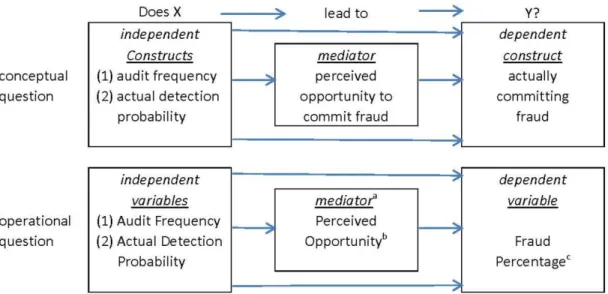
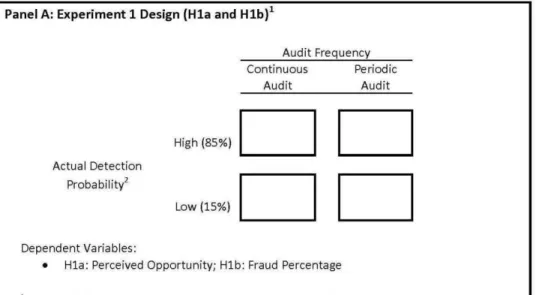
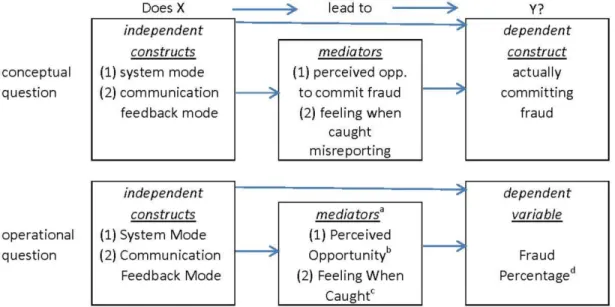
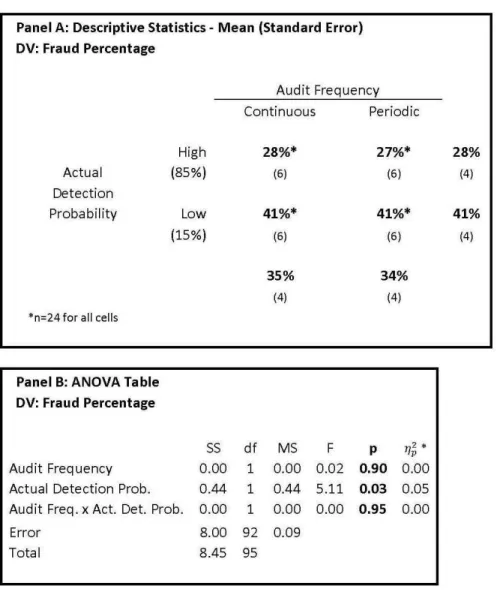
Experiment 1 is a 2 x 2 between-subjects design. It is designed to test H1a and H1b by varying the independent variables Audit Frequency (Periodic, Continuous) and Actual Detection Probability (Low=15%, High=85%).11 Figure 2 portrays the conceptual constructs and corresponding operational variables, and Panel A of Table 2 illustrates the experimental design matrix and the cells tested in Experiment 1.
9
To avoid creating conditions that would be conducive to end-of-game behavior, participants were not informed of the planned number of periods beforehand.
10
Post-experimental statistical analyses showed no significant differences across gender. 11
In pilot study testing I manipulate Actual Detection Probability at three levels (Low=15%, Medium=50% and High=85%) and find that the results for the Medium condition are similar to those for the High condition. Accordingly I eliminated the Medium condition in subsequent experimental sessions and used only the High and Low levels of Actual Detection Probability.
33
Figure 2 Experimental Design for Experiment 1 (H1a and H1b) *
Also see Table 2, Panel A which shows an experimental design matrix that summarizes the operationalization of the cells that are tested in Experiment 1.
34 Table 2 Designs for Experiment 1 and Experiment 2
The dependent variable to test H1a is Perceived Opportunity, and is measured by using participants’ answers to the post-experimental, eleven-point scale question “What do you believe was the likelihood of being audited in any period?” Answers on an 11-point scale range from “no
35
chance of being audited” (0 on the scale) to “very high likelihood of being audited” (10 on the scale). Because Perceived Opportunity to commit fraud is inversely related to the perceived chance of detection measured by the question, the dependent variable Perceived Opportunity is calculated by subtracting the participant’s answer regarding the likelihood of being audited from the highest point on the scale, “10.” For example, if the participant chose “3” as the perceived chance of detection, then Perceived Opportunity was calculated as 10 minus 3, or 7. The dependent variable to test H1b is Fraud Percentage, and is calculated by dividing the number of fraudulent reports submitted by the number of fraudulent reporting opportunities.
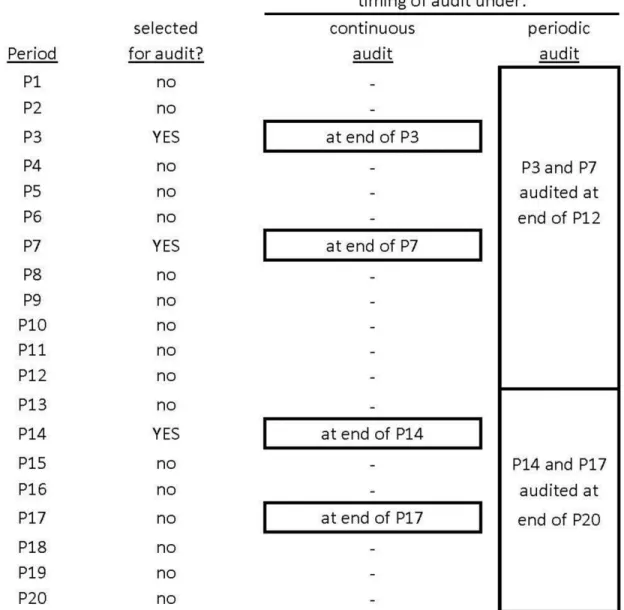
The two levels of Audit Frequency, Periodic Audit and Continuous Audit, differ in the timing of the audit. The difference is that in a Continuous Audit an audit occurs each period, immediately after the performance of the task, whereas in a Periodic Audit an audit occurs after several periods have passed. Panel A of Table 3 illustrates the timing of the audit under each type of audit. Assume that the experiment has twenty periods and that, as a result of random selection based on the Actual Detection Probability, periods 3, 7, 14 and 17 are selected for audit. Further, assume that under the Periodic Audit condition two audits occur, an interim audit at the end of the twelfth period and a second audit at the end of the twentieth period. In other words, in a Continuous Audit, the audit for a selected period is performed immediately upon the task being completed for that period, prior to the start of the subsequent period, whereas in the Periodic Audit condition the periods selected for audit are all audited at the same time.
36 Table 3 Examples, Description of Experiments
37 Table 3 (continued)
Actual Detection Probability is the actual probability of being selected for audit in any one period. Recall that H1a and H1b predict it would interact with Audit Frequency as illustrated in Figure 1. I manipulate Actual Detection Probability at Low (15%) and High (85%) in the experiment as an abstraction of a real world audit environment with design weaknesses that can be exploited by a fraud scheme that would not always be discovered. For example, although continuous auditing in practice is designed to test 100% of transactions, a fraud perpetrator could create a fraud scheme that has not yet been anticipated by auditors. That is, a big concern in companies is that auditors may not have built tests into the continuous auditing system to detect
38
all possible fraud schemes. Hence, depending on the perpetrator’s fraud scheme and the design of the continuous auditing system, the effective detection probability is likely to be less than 100%, and could even approach 0%.
4.2.2.1 Task
My design conforms to the well-established custom in experimental economics type research of having participants perform a relatively simple task repeatedly in multiple periods (see, for example, Kagel and Roth 1995 and Loewenstein 1999). Participants in my experiment perform the same specific task, that of submitting a collections report as described shortly, in multiple periods. All task performance is auditable (i.e., each period can be selected for audit).
Participants assume the role of a company manager who makes collections, retains a portion of those collections, and submits collection reports. In each period of an experimental session, participants prepare and submit reports about which of two items, Item A or Item B, they collect for the period. While the amount collected is identical for Items A and B, the amount participants retain for each of the two items differs, i.e., they retain more when they collect Item B than they do when they collect Item A. Participants’ compensation is based on the reports they submit for each period, adjusted for the results of any audits.
At the beginning of each period participants are informed by computer which item they actually collected in that period. They then prepare and submit via computer an electronic Report Form for the period indicating which item they collected. Audits are performed by a computerized audit program, i.e., an automated computerized auditor performs an audit of an electronic Report Form submitted by the participant. Participants do not know in advance which period(s) will be audited, and they are informed of audit results via computer.
39
In some periods, exogenously determined on a random basis and unknown to participants beforehand, participants can report opportunistically, i.e., report fraudulently, and, as a result, can potentially receive higher compensation than they would by reporting honestly. Such opportunities arise when a participant is informed that s/he collected Item A, the lower-paying item. However, this opportunity also carries risk of detection if a period in which the participant reports fraudulently is randomly selected for audit. If fraudulent behavior is uncovered by the audit, the participant pays a monetary penalty that results in a net loss for the period. The experiment is designed such that all audits are 100% successful, i.e., the audit of any period in which a participant reports fraudulently always reveals the fraud12. Periods are randomly selected for audit and the probability of being audited is a manipulated variable, as explained shortly. Participants are informed of the compensation structure and the payoffs associated with reporting honestly versus reporting fraudulently, but are not informed of the probability of a period being audited13.
Participants can report honestly or dishonestly. For purposes of this study, a false report is deemed a fraudulent act, as it represents an intentionally dishonest act for the purpose of financial gain. This is very similar to what occurs in actual frauds that occur in the workplace, referred to as occupational fraud which is defined as:
12
This is an abstraction from the real world in which audits are not necessarily 100% effective in uncovering fraud when it occurs. In both the real world and in this study the probability of being detected is a combination of the probability of being audited and the probability of the audit successfully detecting fraud, i.e., Prob(detection) = Prob(audit) x Prob(auditor detecting fraud). In my study I assumed the latter probability is 100%, such that Prob(detection) = Prob(audit) x Prob(auditor detecting fraud) = Prob(audit) x 100% = Prob(audit). Hence, in this study audits are exogenously determined at random and unknown to participants before the fact, and are 100% effective. This slight abstraction from the real world allows me to maintain simplicity and control without compromising the strength of the experiment to answer the research questions.
13
In pilot study testing I manipulate the level of information about Actual Detection Probability that I provided to participants at three levels (Actual Probability, Actual Range, No Probability Provided). In my main experiments this level is held constant at No Probability Provided, i.e., participants are not provided with information on the actual detection probability.
40
“the use of one’s occupation for personal enrichment through the deliberate misuse or misapplication of the employing organization’s resources or assets” (ACFE 2012).
Although this study’s experimental setting represents an actual fraud setting in which the perpetrator engages in an intentionally deceptive act for his or her own personal gain, no direct or indirect references to fraud are made during the experiment. Moreover, participants are not encouraged to submit either honest or dishonest reports.
Appendices A through E present the experimental procedures and related forms, including details of the experimental task.
4.2.2.2 Parameters
My experiment incorporates economic incentives designed to elicit “true economic” behavior from the participants (see, for example: Kagel and Roth 1995; Loewenstein 1999). The key economic parameters in the experiment are the following: (1) fixed initial endowment; (2) the monetary payoff for reporting each item type, A and B; (3) the penalty paid for reporting fraudulently and being caught by the auditor; (4) the actual probabilities of collecting items A and B, respectively; (5) the probability of being caught reporting fraudulently, which is equal to the probability of being audited, and (6) the number of periods. In all conditions of both experiments participants are told about the first four of these items, but are not provided information about the actual detection probability or the planned number of periods.14
The values for the economic parameters of my study are as follows: • Fixed initial endowment = $5.00
14
In pilot testing I manipulate the level of information about Actual Detection Probability provided to participants, varying it so that in some conditions participants receive some information, which is explained in subsection 5.1 Pilot Study, but in the full experiments no information about Actual Detection Probability is provided to participants.
41
• Amount retained by participant for reporting the collection of Item A = $0.60 • Amount retained by participant for reporting the collection of Item B = $5.40 • Penalty for being caught reporting fraudulently15 = $7.20
• Probability of collecting Item A = 60% • Probability of collecting Item B = 40%
• Probability of being caught reporting fraudulently = Probability of being audited. In Experiment 1, this was manipulated at 15% and 85%.
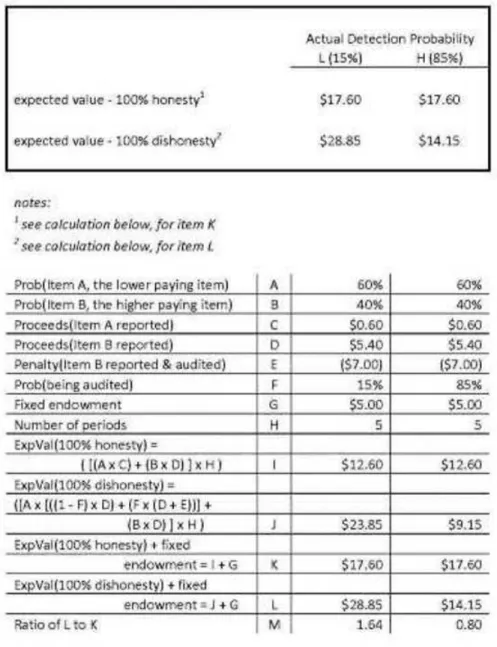
I set the above parameters to create conditions in which participants could expect a reasonable, but unknown, compensation (in the $10 to $25 range) based in part on the choices they made between the less risky option (reporting honestly) and the riskier option (reporting fraudulently). See Table 4 for participants’ expected values when they are 100% honest versus when they are 100% dishonest under alternative Actual Detection Probability levels.
15
A participant would report fraudulently if he collected Item A but reported Item B, thereby retaining the higher amount between the two items. A participant would not have any opportunity to commit fraud, i.e., report fraudulently, if he collected Item B since he would already be receiving the maximum amount between the two items by reporting honestly. For purposes of calculating expected values I assume that in all cases when Item B is collected the participant reports the collection of Item B, because in such case the honest report represents the higher outcome.
42 Table 4 Participant Expected Values
To illustrate, I refer to Panel B of Table 3 which provides an example table of data collected for a hypothetical participant (“Manager # 1”) for the first twenty periods of an experimental session. The column labeled “C” shows the item collected, A or B, that was randomly assigned to the participant, and column D shows the corresponding amount collected, an amount that is the same for items A and B. The next column, E, shows which item, A or B,