This is an Open Access document downloaded from ORCA, Cardiff University's institutional
repository: http://orca.cf.ac.uk/121121/
This is the author’s version of a work that was submitted to / accepted for publication.
Citation for final published version:
Girvan, Carina and Savage, Timothy 2019. Virtual worlds: A new environment for constructionist
learning. Computers in Human Behavior 99 , pp. 396-414. 10.1016/j.chb.2019.03.017 file
Publishers page: http://dx.doi.org/10.1016/j.chb.2019.03.017
<http://dx.doi.org/10.1016/j.chb.2019.03.017>
Please note:
Changes made as a result of publishing processes such as copy-editing, formatting and page
numbers may not be reflected in this version. For the definitive version of this publication, please
refer to the published source. You are advised to consult the publisher’s version if you wish to cite
this paper.
This version is being made available in accordance with publisher policies. See
http://orca.cf.ac.uk/policies.html for usage policies. Copyright and moral rights for publications
made available in ORCA are retained by the copyright holders.
Girvan, C., & Savage, T. (in press). Virtual Worlds: A New Environment for Constructionist Learning. Computers in Human Behavior. https://doi.org/10.1016/j.chb.2019.03.017
Virtual Worlds: A Ne E iro
e t for
Co stru tio ist Lear i g
Abstract
Virtual worlds have the potential to provide a new environment in which to engage learners in constructionist activities. However, they were not designed for education and have features and affordances which are not found in traditional constructionist environments. These may limit the pedagogy in action and/or provide new opportunities with which to transform constructionist pedagogy in practice, but to date there has been no research on these issues. To address this, we explore constructionism in action in the virtual world Second Life. This is the first study to examine the theoretical alignment of pedagogy and technology in practice. An exploratory case study of a purpose-built constructionist learning experience was conducted. The experience was designed based on the theoretical alignment of pedagogy and technology and implemented with 24 postgraduate students over four weeks. Open non-directive interviews, chat logs, constructed a tefa ts, lea e s itte efle tio s a d o se atio s e e olle ted a d a al sed usi g the constant comparative approach. The findings provide insights into how learners engage in
meaningful artefact construction, highlight the role of avatars and draw attention to the importance of the designed space. New opportunities for distributed constructionism are identified. We
conclude that virtual worlds are effective environments for constructionist learning.
Keywords
Constructionism, virtual worlds, pedagogy, constructionist theory, avatars, learning, turtle, scratch, 3D
1. Introduction
Virtual worlds have the potential to provide an exciting environment to engage in transformative constructionist learning activities. With inbuilt construction and programming tools and without the boundaries of gaming environments, learners can engage in a process of bricolage (an incremental process of trying and testing, rather than following a pre-existing design (Papert, 1991)), to construct personally meaningful, shareable 3D artifacts in order to explore, test and extend their
understanding, in situ (Ackerman, 2004) with other learners. Yet there is a paucity of literature on constructionism in virtual worlds.
Constructionism is rarely identified as the pedagogical underpinning for the design of learning experiences in virtual worlds. Responding to the critique by Savin-Baden and others that learning in virtual worlds lacks clear pedagogical underpinning (2008; 2011), there is increasing reference to pedagogical theory within the literature, although it is often unclear how those theories have been used to inform the design of the learning activity. While Livingstone, Scullion & Creechan (2013) suggest that previously reported learning activities could typically be characterized as constructionist as they require learners to create something in the virtual world, it is often not clear how the
We argue that simply creating an object in a virtual world is not a constructionist activity. For example, earlier work by Girvan & Savage (2010) which involved the creation of books by groups of learners as part of a communal constructivist learning activity, required learners to engage in much of the o st u tio of thei a tifa ts outside the i tual o ld, hile thei k o ledge as
constructed within the virtual world. Their final artifacts of knowledge were put on display and shared with subsequent groups but there was no evidence to suggest that learners built and rebuilt their artifacts as their understanding developed, as expected in a constructionist activity. Rather they created and shared their books after they had already collaboratively developed their
understanding and used the books as a medium to communicate their new knowledge, as we would expect in a communal constructivist activity (Holmes et al., 2001).
A notable exception to our critique is the work of Dreher et al. (2009; 2009b) who describe the construction of in-world artifacts through which learners engage in exploring and extending their understanding. However, it is rare for authors to report on how constructionist learning was supported in the design of the learning experience and there is typically no or only a vague indication as to how the specific features of the technology support constructionist learning activities (e.g. Fominykh et al., 2014; Niemeyer & Gerber, 2015; Grivokostopoulou et al., 2016). More recently, Pellas and Peroutseas (2016) provide a detailed account of the design of their
learning activity, building on our previously published work (Girvan, Tangney & Savage, 2013; Girvan, 2014). Underpinned by constructionism, they developed a game-like learning activity within a virtual world to engage high-school students in programming. Blending constructionism with
game-ased lea i g assu es a i i g state hi h i plies a e d to the a ti it . Co st u tio is , however, focuses on exploring, testing and extending understanding through personally meaningful and shareable artefacts and may therefore be considered at odds with game-based, goal-orientated approaches. Another important aspect of the pedagogical theory is that learners should create something personally meaningful through a bricolage approach, yet students in this activity were given a series of closed challenges to complete (to use Scratch 4 OpenSim to create a variety of Greek letters).
While we are starting to see more rigorous accounts of the design of constructionist learning activities in virtual worlds, key features of the pedagogy are still often overlooked. Additionally, we do not see any discussion of the potential impact of the features and perceived educational affordances of the technology on the pedagogy. This is not specific to virtual worlds or
constructionism, however environments which are not purpose built to support constructionist learning, such as virtual worlds, will have features and affordances that provide both opportunities and constraints on the implementation of the pedagogy. These may not be easily recognized as the majority of computer-based, virtual constructionist learning activities (as opposed to physical constructionist tools such as robots) use purpose-built microworld environments (such as Scratch) which are designed with constructionist ideas in mind. The alignment of constructionism with emerging technologies and the identification of how the education affordances of the technology impact on the constructionist pedagogy adds further complexity to attempts to understand the practical implications of using constructionist pedagogical theory in virtual worlds.
Within a virtual world, learners inhabit a shared space and are represented as avatars. While there may be parallels to the physical world regarding the ways in which learners act and interact in the virtual world, we should be curious about the ways in which these and other features and
affordances of the technology transform (or not) the experience of the learner, in both positive and negative ways.
There are questions about the implications of using virtual worlds for constructionist learning in practice. Importantly we need to consider how learners engage with and within the technology, in ways which support or limit constructionist learning. There are no previously reported findings that enhance our understanding of the pedagogy in action within virtual worlds. This includes if and how the features of the pedagogy emerge in practice as learners engage. Existing literature tends to focus on learning outcomes, whether in terms of summative assessment of skills and knowledge, or motivation and engagement. Yet, while we might presume that the pedagogic features will emerge if they are designed for, there is no evidence for this and no understanding of how the perceived affordances of the technology might constrain the pedagogy or provide new opportunities
unavailable in other constructionist environments (whether digital or physical i.e. Scratch and Lego Mindstorms). If we are to support educators, learning technologists and designers to consider and use virtual worlds for constructionist learning activities, or consider and use constructionist theory in the design of learning experiences in virtual worlds; we need to develop an understanding of the pedagogy in action within virtual worlds and use this to advance the theoretical alignment of technology and pedagogy.
Accordingly, the primary aim of the research presented in this paper is to explore constructionism in action in virtual worlds through an exploratory case study. Participants engaged in a learning
experience built upon an understanding and analysis of the alignment between the features of constructionism and the perceived educational affordances of virtual worlds. This research analyses
hethe the pe ei ed edu atio al affo da es o st ai o suppo t the lea e s e pe ie e and whether the proposed alignment of pedagogy and technology is sufficient and purposeful in the light of an authentic implementation.
2. Theoretical Framing
2.1 Constructionism
Constructionism focuses on the active construction of knowledge through the creation of physical artifacts to support learning. By constructing personally meaningful and shareable artefacts, learners are provided with an opportunity actively to explore, test and extend their understanding (Papert, 1991). These artefacts may develop in-situ (Ackerman, 2004) and through a process of bricolage (an incremental process of trying and testing, adding to and taking from the artefact), rather than following a pre-existing design (Papert, ibid).
Some of the most common and well-known constructionist tools are digital (e.g. Turtle Graphics and Scratch). The computer provides access to objects and environments that can support concrete engagement with ideas that would otherwise require formal teaching. Thus, the computer is introduced as a central component of constructionist learning experiences to provide access to materials otherwise unavailable to the learner (Papert, 1980). We suggest that currently, networked
o pute s a d o ile de i es a e a pa t of ost people s e e da li es a d it is the software/hardware and our interactions with, within and through the technology as part of constructionist learning experiences that requires investigation.
Constructionist tools are typically characterized as low-floor (easy to use), high-ceiling (powerful) and designed to support learners engaged in construction, exploration and investigation (Feurzeig, 2007). Objects such as Turtle (physical or on-scree g aphi s p o ide lea e s ith a o je t -to-think- ith Pape t, , allo i g the to ode rapidly, observe, reflect and revise, supporting the idea of exploring, testing and extending understanding through engagement with an object. Turtle Graphics, and more recently Scratch, provide learners with a digital environment within which they
can control and create objects on the screen. The wider the variety of artifacts that can be created in these environments, the more likely they are to reflect the interests and learning preferences of thei use s, thus ide i g the alls ‘es i k et al., a d the efo e the a e o e likel to e personally meaningful.
While constructionism provides a basis for understanding the ways in which materials in the lea e s e i o e t a suppo t lea i g, u like o st u ti is , it also p o ides a edu atio al approach situated in a social context (Kafai & Resnick, 1996; Kafai, 2006; Butler, 2007). The emphasis is therefore not on internal knowledge construction but external representation of that understanding to be shared with others.
Extending the central ideas of constructionism, Resnick (1996) des i es dist i uted
o st u tio is , as the desig a d o st u tio of a tefa ts o e tha o e pe so . D a i g on dist i uted og itio “alo o , , dist i uted o st u tio is fo uses o the use of o pute networks to facilitate interactions between people and in turn, knowledge construction. However, unlike knowledge building, distributed constructionism involves the construction of meaningful artefacts and not just the sharing of information.
Resnick (1996) describes distributed constructionism as taking three forms: discussing constructions, for example on an online forum; sharing constructions, for example uploading an artefact which others can copy and reuse; and collaborating on constructions. These provide opportunities to discuss, share and collaborate on constructions. As with other constructionist activities reported in the literature, distributed constructionism is facilitated by technology. However, by engaging in a
o st u tio ist lea i g e pe ie e the te h olog should e o e i isi le (Papert, 1980s; 1991; Bruckman & Resnick, 1996).
2.2 Virtual worlds
Unlike traditional constructionist environments such as Turtle Graphics, virtual worlds have not been purpose built for learning, let alone for constructionist learning activities. However, they provide an environment which users can create and modify objects through construction and programming tools, and through this they can be appropriated for educational purposes.
Across the literature there are various technologies which are referred to as virtual worlds. Here we follo Gi a s defi itio of i tual o lds as shared, simulated spaces which are inhabited and shaped by their inhabitants who are represented as avatars. These avatars mediate our experience of this space as we move, interact with objects and interact with others, with whom we construct a shared understanding of the world at that time. p. 099).
What makes [virtual worlds] distinct from the material or physical world are the types of experience available for the user afforded by the combination of different technical features, most notably the a ata (Girvan, ibid, p1093). Avatars are one of several features of the technology which give rise to a range of perceived educational affordances, which can provide both opportunities and constraints to learning.
Virtual worlds provide synchronous collaborative social spaces that can be utilised for a range of authentic learning experiences and cater for a range of learners (Gregory et al, 2015). Within higher education, virtual worlds have been applied in virtual lectures, virtual laboratories, virtual field trips, simulations, in-world creations, gaming, assessment and socialisation (Ghanbarzadeh and
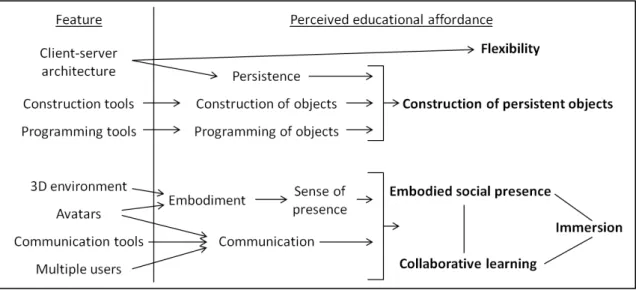
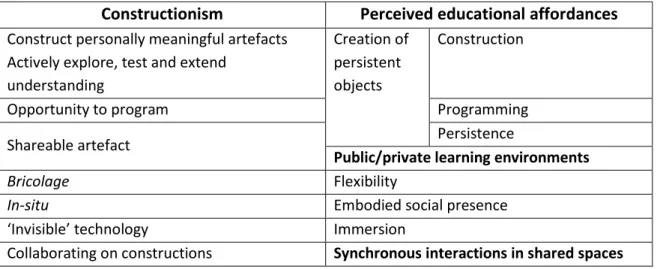
Figure 1 illustrates some of the ways in which the literature identifies features of the technology which give rise to various perceived educational affordances. Combined, these perceived
educational affordances allow other affordances to emerge and these five (represented in bold in Figure 1) are used to align features of the pedagogy and affordances of the technology in 2.3 below.
Figure 1 Features and perceived educational affordances of virtual worlds
How the tools of the virtual world and how the affordances are leveraged by teachers or others who design learning experiences in virtual worlds, and in turn how learners engage with and experience these will vary on an individual basis. Factors beyond the virtual world, whether associated with the individual or the physical learning environment, may or may not have an impact. For example, Warden, Stanworth and Chang (2016) examined the extent to which gaming experience and gender influence the sense of presence in a virtual world learning environment. While their findings revealed no significant impact, Grinber et al. (2014) found that social experiences within the virtual world did have a significant impact on a sense of immersion.
2.3 Theoretical alignment of pedagogy and technology
Constructionism is a potentially appropriate pedagogy for use in virtual worlds because it leverages a wide range of the perceived educational affordances as outlined in Table1.
Table 1 Alignment of perceived educational affordances of virtual worlds and the features of constructionism.
Constructionism Perceived educational affordances Construct personally meaningful artefacts
Actively explore, test and extend understanding
Creation of persistent objects
Construction
Opportunity to program Programming
Shareable artefact Persistence
Bricolage Flexibility
In-situ Embodied social presence
I isi le te h olog Immersion
A constructionist learning experience can leverage the i tual o ld s te h olog to allo the construction of persistent artefacts. In addition, Hoyles et al. (2002) describe the programming of objects as an important aspect of constructionism, which would also utilise the programming aspect of the creation of persistent objects in virtual worlds. The fact that these objects remain in the virtual world (i.e. they persist) when the creator is not there, allows learners to collaborate and share asynchronously. Collaborating on constructions should be supported by providing opportunities for collaborative learning, while embodied social presence (through avatars) may support an in-situ learning experience. The emphasis on bricolage could be supported by the perceived educational affordance of flexibility, allowing learners to construct, reconstruct and start afresh any artifact. Finally, imme sio a suppo t the se se of a i isi le te h olog , this a be particularly likely from the level of engrossment, at which point controls are described as becoming invisible (Brown & Cairns, 2004).
Constructionist environments, such as Scratch, are ofte efe ed to as i o o lds des i ed A ke a a d “t ohe ke as a efull afted a tifi ial setti gs fo eati e e plo atio , p.14). Computer-based microworlds are designed to enhance the most important features of a given phenomenon a d e o e those that ight dist a t the lea e udd i g the out o e (Edwards, 1998). By comparison virtual worlds neither enhance the most important features for learning nor remove the distracting ones. However, they do provide educators with control over aspects of the environment, for example whether gravity is on or off. Consequently, if an educator wishes to provide a construction environment without natural physical laws in Second Life, they can. In contrast to purpose-built microworlds, virtual worlds do not provide learners with low-floor construction or programming tools. Instead the inbuilt tools present the novice with a steep learning curve (Dickey, 2005; Sanchez, 2007; Cheal, 2009) preventing them from easily creating and programming objects; discouraging engagement; and ultimately the ability to construct personally meaningful artefacts, a core feature of constructionism. To address this problem, the authors developed SLurtles (programmable turtle robots) as constructionist objects-to-think-with and build with in the virtual world of Second Life (Girvan, Tangney & Savage, 2013).
SLurtles (Second Life turtles) pay homage to the legacy of Turtle Graphics, except that instead of being programmable objects that create 2 dimensional lines as they move, SLurtles create 3
dimensional, persistent virtual objects within the virtual world of Second Life as they move. SLurtles are programmed using the block-based Scratch 4 Second Life (S4SL) interface, developed by Eric Rosenbaum (2008). The combination of the SLurtle and S4SL provides a user with a low-floor programming and construction tool.
3. Method
3.1 Research design
The aim of this research is to explore constructionism in action in virtual worlds through the analysis of an authentic constructionist learning experience designed based on the alignment of the features of constructionism and the perceived educational affordances of virtual worlds. Specifically, it examines how the features of the pedagogy emerge and how the affordances are perceived by the learners to constrain or support their experience of constructionist learning. This allows us to critique the proposed alignment of technology and pedagogy, identifying implications for both theory and practice.
Learning environments however, whether in the physical or virtual world, are messy places for research and it is this complexity that needs to be captured to address the core aim of developing an understanding of constructionism in action in virtual worlds.
Case studies are particularly powerful for developing an understanding of a phenomenon under study as they provide a rich description for the in-depth exploration of a specific learning activity in action. With the dearth of existing literature and theory in the area, an exploratory case study approach is used to identify and elaborate on key concepts in an otherwise broad field (Yin, 2003; 2009).
3.2 Participants
24 learners participated in a constructionist learning experience using SLurtles over four weeks, as part of a part-time post-graduate course in technology and learning at university. In a face-to-face context, learners were given information about the research, their proposed involvement in it and their right to withdraw. Then they were given an opportunity to ask questions of the researcher and instructor.
19 of the students self-reported having little or no previous programming experience. Only four had experience of using Second Life before the course. They were aged between 24 and 55 and included 15 female and 9 male participants. During the learning activity they were placed in pairs by the instructor. There was 1 all-male pair, 4 all-female pairs and 7 mixed pairs. The 5 learners with previous programming experience were paired with learners who had little or none.
As learners would be participating in the learning activity at distance from one-another and the instructor, using pseudo-anonymous avatars, a key ethical issue was that of identity. The identity of the user behind the avatar could be further complicated by the use of alternative avatars (alts) (Girvan & Savage, 2012). Alts are avatars created by the user in addition to their primary (or
ai a ata . To address this issue, access to the learning environment was limited to one avatar per participant (no alts ), participant and avatar names were held by the instructors and
participants were informed of the risks of sharing an avatar with other people. All 24 learners gave their informed consent. Ethical approval was granted the autho s i stitutio which was also the location of the study.
3.3 Activity design
To interpret the findings presented, and as part of the case study reporting, this section describes the design of the learning experience and how it was informed by constructionist principles of learning.
Activity Design Principles
The theoretical alignment of pedagogy and technology presented in 2.3 was considered and a series of activity design principles for the learning activity identified. For example, the alignment between the constructionist principle of collaboration and the perceived educational affordance of
collaborative learning within virtual worlds led to the design principle that the activity exploring these alignments must include both a reason and an opportunity to collaborate as a fundamental aspect of the experience. Therefore, based on the theoretical alignment of pedagogy and technology presented in 2.3, a series of design principles were identified (Table 2).
Table 2 Design principles
Constructionism Perceived educational affordances
Construct personally meaningful artefacts Actively explore, test and extend understanding
Creation of
persistent objects
Construction (Semi-) open task, using SLurtles and S4SL (to lower barriers to engagement) to construct artefacts.
Opportunity to programme Programming
Shareable artefact Persistence
Bricolage Flexibility Time to engage in an extended
process of construction. In-situ Embodied social presence Shared learning space.
I isi le te hnology Immersion Familiarisation with technology. Collaborating on
constructions
Collaborative learning Reason and opportunity to collaborate.
Context of the Implementation
The learning activity was implemented as part of a module for post-graduate learners on a taught Masters in technology and learning. The course is taken over two years part-time to support the participation of practicing teachers and other professionals. It is underpinned by communal constructivism (Holmes, et al., 2001) and focuses on technology mediated transformative learning experiences (Mezirow, 1996). While the course content has changed over time it broadly introduces learners to pedagogical theories, various technologies, critical reflection, collaboration, design principles and research.
The module for which the learning experience was designed is worth 10 credits and has no formal pre-requisites. Teaching and learning activities center around a mixture of formal lectures (which are kept to a minimum), practical sessions and workshops. The aim of the module is to raise awareness and develop understanding of a number of innovative technologies used in the area of technology and learning through engaging in concrete experiences with these technologies. A typical cohort of learners would include those working in formal K-12 education as teachers and those involved in various roles in other workplaces including instructional designers and trainers.
The learning experience was designed with the course team and implemented in Second Life. The main lecturer on the module is experienced in the implementation of constructionist learning experiences. However, as he had no previous experience of Second Life, the learning experience was designed in keeping with previous constructionist activities that he had run on the course which involved learners engaging with Lego Mindstorms kits to create an interactive robot and the design of games in Scratch.
As part of the module, learners had already been introduced to constructionist theory and the learning experience at the heart of this study was presented to them as an opportunity to experience a constructionist learning activity for themselves. Learners participated in the SLurtle-based learning experience over four weeks as part of their course. The intended outcomes were for learners to (1) experience a constructionist learning activity; and (2) gain an understanding of programming.
The learning activity had four phases; orientation, learning event/workshop, the open task as assessment, and group presentations (Figure 2).
Figure 2. Four Phases of Learning Activity Implementation
Prior to the first learning event, an informal orientation to the virtual world was organized during which learners (at distance and typically from home) created their avatars and joined the course team in the virtual world and navigated to the course island where they completed a number of orientation activities designed to introduce them to movement and camera controls as well as communication tools, in order to familiarize themselves with the technology. From this point onwards, the primary researcher was present at all learning events and supported learners, both face-to-face and online.
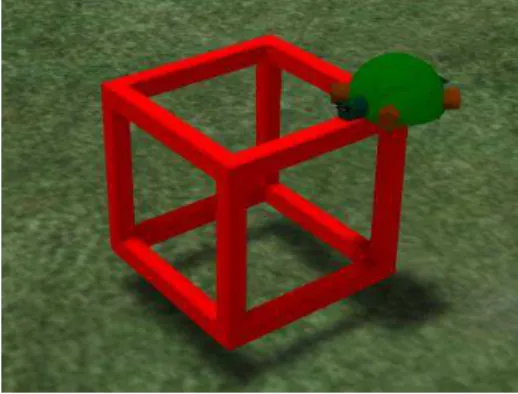
The first structured learning event involved a face-to-face, half-day workshop to introduce learners to SLurtles and S4SL. Following an initial demonstration of SLurtles, learners worked on their own and later in their pairs to program SLurtles to complete a series of increasingly difficult challenges. Having worked out how to program their SLurtle to move forward 1 meter, the challenges required learners to program their SLurtles to create increasingly complex objects in the virtual world (Figure 3) before moving on to programming those objects to be interactive.
Figure 3 Example of the final construction challenge completed, before programming objects to be interactive.
After exploring some of the basic functionality and demonstrate their ability to use SLurtles and S4SL, learners were set an open task to complete as part of their assessment. The task required each pair to collaborate on the creation of an interactive installation; programming SLurtles to create the installation and using S4SL to program the installation to be interactive. After four weeks, the learners presented their installations (their artifacts of learning) and reflections on the experience to the class.
Orientation
•One hour online
•To allow participants to familiarize themselves with the technology •Online, at a distance •Avatar creation •Orientation activities Learning Event/Workshop
•Half day workshop face-to-face •Programming SLurtles using S4SL •Collaborative programming via avatars Open Task Assessment •4 weeks online •Collaborative assignment •Using SLurtles to create an interactive installation Presentation •Face-to-face •Group presentations
There were no formal teaching inputs over the four weeks. Informally groups of learners could meet with one of the instructors in the virtual world to discuss their progress and gain technical support. Due to the al a s o atu e of “e o d Life, lea e s e e a le to e gage i the a tivity at any time or place that suited them. As the learners were only required to attend the institution part-time, this opportunity to collaborate at distance and at a convenient time was important. They could meet face-to-face, online or a combination of these depending on their preferences.
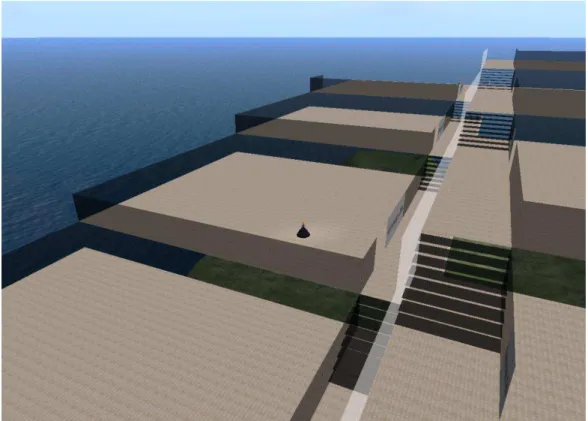
As the lea e s a tifa ts e e to e assessed as pa t of a a edited ou se, ea h pai as p o ided with a discrete learning space with clear boundaries in the form of an empty 40 x 40 meter platform (Figure 4) on the island, in which they were required to create their installation. All the g oup s platforms were adjacent to each other and connected by walkways for those who did not wish to fly. Each platform was bordered by transparent walls to prevent avatars from falling off them as well as allo i g isi ilit i to ea h pai s i stallatio spa e. The ope a d pu li a o g the g oup atu e of the space meant that learners could be influenced by observing artifacts constructed by others (Girvan, 2014) and supporting collaboration and socialization with the wider group. This
combination of a dedicated construction space for each pair alongside their classmates and
completely visible to them provided a publicly accessible, discrete learning space within an access-controlled island allowing only class participants access.
Figure 4 Empty installation spaces with avatar prior to the activity.
Below the platforms were two SLurtle collection points at which learners could choose SLurtles based on the shape of block they wished to create (see Girvan Tangney & Savage, 2013). The initial orientation activities remained on the island, together with spaces designed to facilitate meetings.
3.4 Data collection
Open, non-directive interviews provided the primary source of data for analysis and were
supplemented by screen captures, observational notes, in-world chat logs and the artefacts created by the learners as part of the experience. These supplemental data sets were considered secondary data sources due to issues outlined below, and were used primarily to support or refute emergent findings from the constant comparative analysis of the interviews
An opportunistic sample of 14 took part in one-to-one interviews which were conducted in the weeks following the learning activity in either the virtual world using voice communication or face-to-face and lasted between 30 and 80 minutes. While the mix of medium and location may influence the data collected, some participants were only accessible to the researchers via the virtual world and so these two approaches were used to increase participation. Audio recordings of the interviews were transcribed with names of participants and their avatars anonymised. Seven of the 14
participants interviewed were male and seven female; one was in an male pair, two were in all-female pairs (not from the same pair) and the remaining 11 were in mixed-gender pairs, only one pair of learners both participated in the interviews (and these were the first two interviews to be analyzed); three had previous experience of programming and four had previous experience of Second Life.
Observational notes were made during and immediately after learning events. However, due to the always-on nature of the virtual world and the unrestricted opportunities that learners had to access and participate in the activity (at any time and from any place), it was difficult to observe directly pa ti ipa ts a tio s during the main task. While the e e e oppo tu ities to o se e lea e s avatars and their corresponding in-world actions, these were limited for the same reason. Thus, chat logs of the lea e s te t-based conversations were recorded by the participants themselves.
However, these were limited as not all participants were able to use these tools. Screen capture software was considered, but this required learners to remember to launch the software and record their screens during activities. Additional constraints were the size of files created and the
processing power required both to record and engage with the virtual world. As a result, participant screen capture was not a viable approach on this occasion, although the researchers did use this to
e o d a ti ities f o thei a ata s pe spe ti e hilst i the virtual world.
In addition to observational notes, the final artefacts created by each pair (12), as well as their group (12) and individual (24) written reflections were collected after the class presentation. These were treated as corroboratory data as they were created for a specific purpose (that of assessment) and an intended audience (the course instructor) and therefore would not be without bias (Yin, 2009).
3.5 Data Analysis
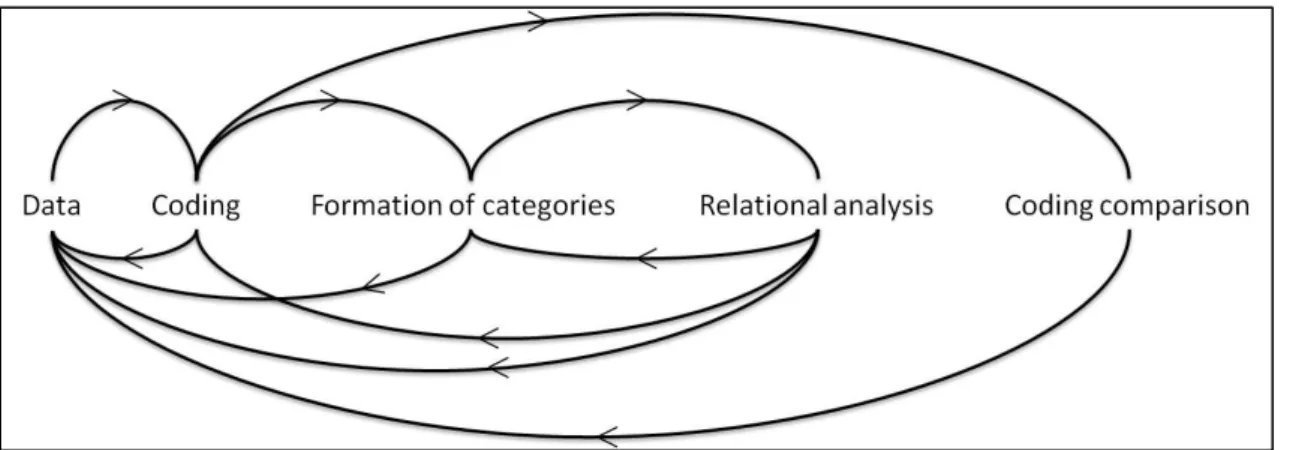
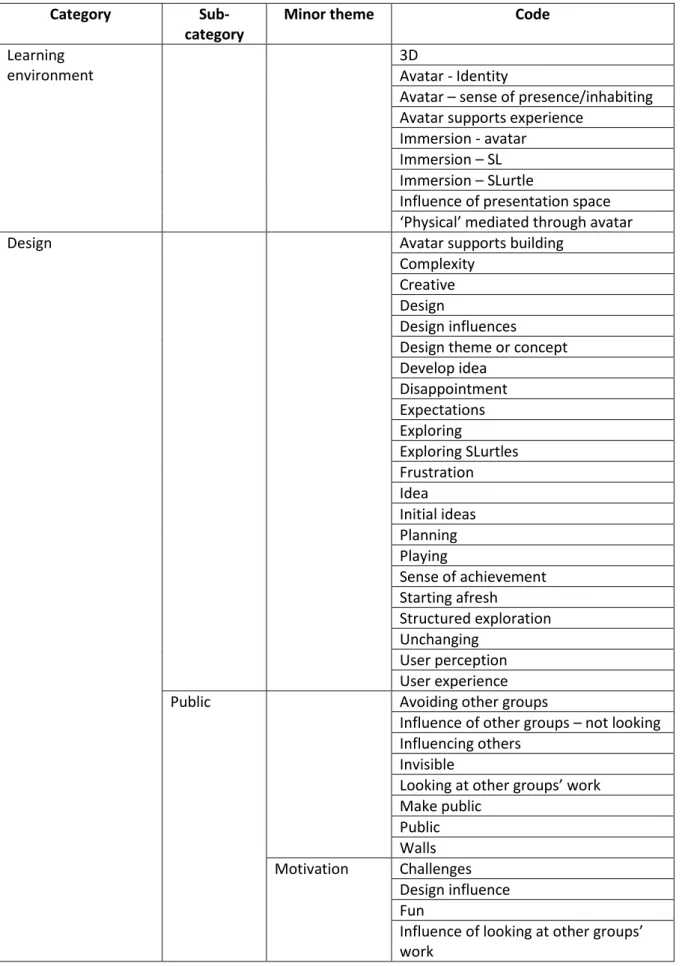
The primary analytic strategy was to develop a case description and, from this, apply the secondary analytic strategy to generate theoretical propositions. To achieve this within an exploratory case study, the constant comparative method was used (Glaser & Strauss, 1967; Merriam, 1998). This analytical method has developed from its original roots within grounded theory through subsequent development and adoption among other types of qualitative research (Boeije, 2002). The process of comparison occurs throughout the whole process of analysis from coding to the forming and delimiting of categories and analyzing the relationships between them. Whilst this is a messy, non-linear process (see Figure 5), for the purposes of clarity the following presents a non-linear description, detailing the analysis process.
Figure 5 The messy process of data analysis (Girvan, Tangney & Savage, 2013).
Data analysis began with the open coding of the first interview. Through analysis of subsequent interviews and comparison with the interviews already analyzed, new codes emerged, some codes became redundant and dimensions began to develop (Creswell, 2003; Cohen, Manion & Morrison, 2007). Emergent findings shaped the flow of the data analysis which included the generation and reduction of codes, formation of tentative categories, relational analysis and internal coding
comparison (illustrated in Figure 5). The analysis was supported using computer assisted qualitative data analysis software (QSR – Nvivo 8).
As the first two interviews were with learners who participated in a pair together, it is perhaps unsurprising that from an initial generation of 74 codes only 25 new codes were generated in the analysis of the second interview. Analysis of subsequent interviews resulted in the generation of up to 63 new codes. Following the apparent saturation of codes in the seventh interview, categories and sub-categories were developed from the original codes through an iterative process which aimed to produce efficient categories: exhaustive, mutually exclusive, sensitizing and conceptually congruent (Merriam, 1998). The remaining interviews were then analyzed for evidence to support or refute the categories and sub-categories, whilst remaining open to emergent codes. Following this, further refinement of the categories took place. This process was repeated using the lea e s reflections, observational notes and artifacts of learning, as secondary data sources to provide supporting or refuting evidence.
The codes within each category and sub-category are presented in the Appendix, however, as the philosophical underpinnings of phenomenology and the constant comparative approach downplay the significance of mathematical interpretation, the numerical coding data was excluded from the study and the interpretations. As Strauss and Corbin note (1998, p. 11) their approach is "a
nonmathematical process of interpretation, carried out for the purpose of discovering concepts and relationships in raw data and then organizing these into a theoretical explanatory scheme."
As a single researcher conducted the analysis, actions were taken to provide an internal validity check on the coding process. After the seventh interview had been coded, a new identifier was created in the QSR – Nvivo file. This allowed the coder to recode the interviews without visibility of the codes from the first coding iteration. Cohe s Kappa al ulatio s e e the u et ee the t o sets of codes to generate a statistical measure of agreement or error between the coding runs. The Kappa result indicated which codes had been used reliably within the interview. For example, the code avatar supports socialising had a Kappa of 1 indicating that the code was applied by the researcher to the same section of text at the start of the data analysis process and at the end. Thus, this code was used reliably. By comparison, the code develop idea had a Kappa of 0.3578,
such codes the breakdown of percentage agreement and disagreement was used to re-examine the esea he s odi g. While Cohe s Kappa oeffi ie t p o ides a i di ato of reliability, it is not sufficient on its own. Thus, the statistical analysis prompted a review of the esea he s use of codes during the coding process which involved reexamining references and identifying overlap between codes resulting in a reduction of codes. Following this process of internal review, the final seven interviews were coded with an improved understanding of how each code should be applied. During the development of a final set of categories, two further tests of validity were used: member checking with two interview participants and peer validation with colleagues.
4. Findings
This study explores Constructionism as a pedagogy in action within virtual worlds, through a purpose designed learning activity. This section presents the findings of the constant comparison analysis, with categories acting as sub-sections: G oup o k , Lea i g e i o e t , Desig a d Lea i g. A fu the atego Thi ki g hi h ostl fo uses o lea e s use of “Lu tles du i g the lea i g activity has previously been reported by the authors (Girvan, Tangney & Savage, 2013). For each category, the relationships within it to and between sub-categories are illustrated to support communication of the findings. Additionally, for transparency, codes within categories are in bold.
4.1 Group work
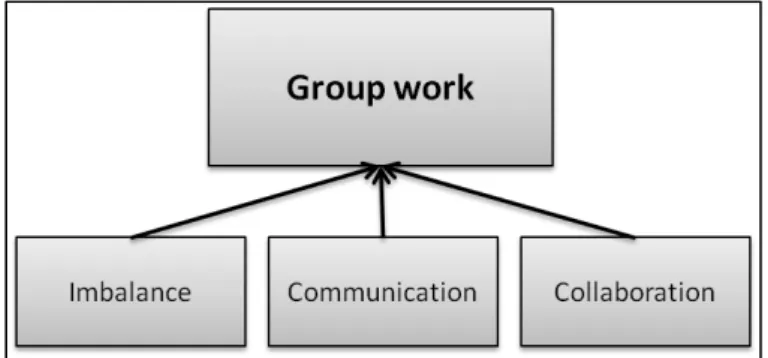
As learners were required to work in pairs on the assignment, it is perhaps unsurprising that G oup Wo k e e ged as a atego . Ho e e , within it there are three key sub-categories: I ala e ;
Co u i atio ; a d Colla o atio Figure 6).
Figure 6. Representation of 'Group work' category
4.1.1 Imbalance
In six of the first seven interviews analyzed, the e as e tio of so e fo of i ala e ithi groups and this was explored in the relational analysis. Learners perceived an imbalance in knowledge of programming between themselves and their partner, often identified through the stronger programmer dominating and increasing independent work. For example, in an individual
efle tio o e pa ti ipa t stated: I think 3a1 at first was a little worried about my knowledge especially as when she arrived into Second Life for our first meeting I had spent a lot of time playing. (3a2 reflective journal entry). The result of a perceived imbalance was a lack of collaboration and communication which often led to a sense of loneliness see I did find it frustrating, I was saying I was lonely over here. (2a1 interview). Interestingly in these situations, both experienced and novice programmers described being limited by their partner.
Learners described recognizing this imbalance and deciding to take action in a number of ways such as insisting on an increase in communication and discussion. With an increase in communication,
collaborationchanged: I suppose then, we kind of did everything together. There was nothing, nobody did one thing on their own then after that. And we kind of learned from each other (3a2 interview). Learners described actively learning from their partner which helped to address the i itial i ala e a d thei g oup ega to work well .
4.1.2 Communication
Communicatio as a i po ta t aspe t of ho g oups o ked togethe : we worked very well together. I think once initially we had the conversation around the different levels, I suppose, of competence in relation to programming, and I suppose my need for him to slow down a bit; once we had that conversation we worked very well together. (3a1 interview)
Across reflections, interviews and chat logs there was evidence of participants using text-based chat, Second Life voice and external tools such as Skype to communicate within the group. While some participants described the text-based chat tools as sufficient for collaboration, others were
f ust ated the : I was trying to explain to her where I thought the code was going wrong, and it was taking so long over, to get the message across. And then also, I felt that the message I was putting across might have seemed like I was telling her, or a bit, if you read the text, you could see it could be, depends on what way the person takes it (3a2 interview). Another participant described the confusion which resulted from the response speed of each participant in the text chat at the sta t of the p oje t: kind of talking about one thing and then going on to the other, just kind of thinking aloud, and what was happening was there was two or three different conversations happening simultaneously, and you were answering one thing and next of all, next they were replying back to what you said two minutes ago (5b1 interview).
Text- ased hat as ofte des i ed as slow . Yet despite this, as discussions began to focus on spe ifi aspe ts of the p oje t, it just got faster (5b1 interview). Whether this was due to familiarity with the technology, the mode of communication or the focus of the task is unclear. In a reflection by one participant it was noted that although they mostly used text-based tools to
o u i ate there are no social or body cues (non-verbal information) to aid understanding. This sometimes can lead to misunderstandings. (3a1 reflection). However, several other participants described the avatars as supporting communication, in the code avatar & communication, by
walking over to an area that kind of indicated what you might be talking about. (2a1 interview) A othe pa ti ipa t stated that it helped that you were looking at somebody face to face, you kind of knew if they had scurried off to the corner that they were sick of listening to you, or you know, that they wanted to do their own thing, so, it was easier to communicate in that sense. I suppose you had a feeling that there was somebody else there (5b1 interview). Others described the avatars as supporting group work by providing a focal point, removing distractions and inhibitions, allowing groups to communicate more easily.
4.1.3 Collaboration
When asked about their collaborative work, learners described working with their partner in Second Life and on their own, depending on personal time commitments. As a result, there was evidence of both synchronous and asynchronous collaboration within groups.
Learners emphasized the importance of discussion for the clear division of tasks and the creation of roles, when preparing to work in Second Life at different times. When working together learners would either: work on individual set tasks, asking their partner for feedback and support; or work on one task together. However, in the latter situation learners described the inability to observe what their partner was doing in S4SL as limiting collaboration and opportunities for peer-learning. As
noted in one reflection: However, in terms of working as a team to create this project SL has had its limitations – we both were unable to show the other what we were doing in terms of sharing the code/actions in real time - there is no shared access to each othe ’s desktops a d e see this as a major limitation in terms of active participation – one at times is going to be an observer but yet not being able to observe what is going on behind the scene. Despite this li itatio , in their reflections many groups described working on programs together.
Collaboration tended to focus on unfamiliar tasks, with both experienced and novice programmers suppo ti g ea h othe : the e e e a solute ases he e I just ould ’t see h so ethi g as ’t working, and erm, then 5b1 would have suggested something that would never have occurred to me, a d it as a tuall uite si ple, ou k o that ki d of a a ? Whe e so eti es ou’ e thi ki g,
ou’ e just thi ki g do the o g oute, a d so e od else, ou k o , a d ag ou a k o it. (5b2 interview).
Except for the initial workshop and preparation of their in-class presentation, many groups met exclusively online. For some, the need for face-to-face collaboration arose from difficulty with the communication tools; the pe issio s s ste ; o the i a ilit to o se e thei pa t e s desktop. I the code avatar supports collaboration, avatars were described by some participants as supporting collaboration at a distance, providing an opportunity to observe: at hi g each other and seeing
hat ou e e doi g ... fl i g up togethe to get a pe spe ti e of the a ea, to sa , oh he e, let’s put the house the e, let’s put the fou tai the e ... A d it as getti g the pe spe ti e togethe , ou k o , f o the sa e a gle (2a1 interview).
4.2 Learning environment and design
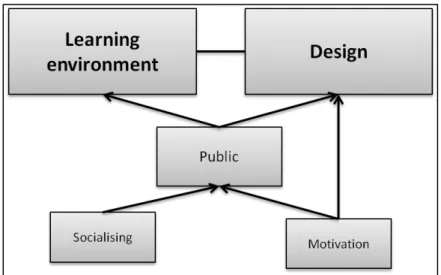
Lea i g e i o e t a d desig d a s atte tio to the elatio ship et ee the i tual
environment and the artefacts created. In Figure 7 they are represented as two categories, however they are not efficient categories as described by Merriam (1998) as they are strongly related and both have the sub- atego of Pu li . As a esult, they have been combined into one category, to be discussed in combination and separately.
Figure 7 Representation of 'Learning environment and design' category.
4.2.1 Learning environment
The learning environment refers to the general features of the technology such as the
representation of three-dimensional space and avatars, as well as the purpose-built platforms for each pair.
Many participants described the three-dimensional environment of Second Life as providing them ith a se se of ei g i a ph si al e i o e t: because it's 3-D, its physical, it's got surroundings to it. (2b1 interview). Avatars were also described as mediating the sense of a physical
e i o e t, ho e e fo so e pa ti ipa ts this as ot the ase: I do prefer to directly experience the objects rather than through an avatar. The physical contact is very important for me and this is something I missed. (3a1 Reflection). These participants also described feeling uncomfortable identifying themselves and others through avatars. However, the majority of interviewees described the avatar as esse tial to the lea i g e pe ie e: If there was no avatar and the two of you logged in ... It would lessen the experience. (1a2 interview).
Avatars supported a sense of immersion within the Second Life environment as well as co-presence with other learners. The sense of co-presence was also supported by the public nature of the lea i g e i o e t hi h allo ed the to e te othe g oups spa es, dis ussed i the su
-atego Pu li (4.2.3). This was you in the same space online. And that distinction of online disappeared. There is somebody here. They are walking up, they are walking in, they are flying, you see them flying over and you know who they are because something has popped up where you just know who they are. So, it did feel rude not to engage in some form of conversation. (2b1 interview). Although all participants had taken part in short activities in Second Life earlier in the course, some described their interaction with SLurtles as resulting in their first experience of immersion in which te h olog e a e i isi le : the Second Life Saturday and the avatar and sitting on benches and the lecture and the voice that was my first immersive experience of the whole thing. And the oddness of it was very distracting. And what was interesting about the SLurtles and engaging with your own scripting control of something was, you're suddenly focused on something inside the environment, where the environment now becomes, goes into your peripheral sort of consciousness. …, that was the moment, where the experience of acting in an avatar's virtual presence I sort of, I got the real deal. (1a2 interview).
While ea h g oups a tefa ts utilized the almost infinite height of the learning spaces, few identified it as a particular advantage or disadvantage in the design process. By comparison, in the code influence of presentation space, the size of the o st u tio spa e did i flue e o st u tio s: the space was very very big, and we did feel like, you feel like you want to fill it, and you can see we put that wall there, erm, just to get the sense of it being filled (2a1 interview).
4.2.2 Design
The design process for the installation began with exploring and generating initial ideas, followed by development, planning and construction. Most groups described returning to each of these stages in the design process several times over the four weeks.
Exploring how to use SLurtles and what could be created with them helped learners to generate ideas. This exploration was supported by the ease with which learners were able to engage in construction through the SLurtles. To support the planning and construction process two groups described using paper and pen to map out their ideas.
The sense of inhabiting the learning space via an avatar was described by several participants as supporting the development of initial ideas, construction and development of the artefacts created by the groups. For example, i o e efle tio a pa ti ipa t oted: It was within the virtual space that we formulated the decision of what to make, something we had struggled to achieve in the offline world. I wondered if being immersed in the virtual space, while contemplating the possibilities, had helped in arriving at this decision. We were now immersed in the space, getting a sense of its
scale and depth, and watching other installations beginning to take shape. I think this helped clarify a few ideas we had brought to the space to discuss and brainstorm. In a manner of speaking, being immersed in the space helped us realise the possi ilities. (4a1 Reflection).
Despite experiencing some frustration with coding, learners expressed an often surprising sense of achievementi thei fi al a tefa t: the sense of achievement at finishing the project is something I underestimated (3a2 reflection). This achievement was attributed to various forms of motivating factors, discussed in the sub- atego of Moti atio (4.2.4), as well as the ease with which they
ould use the “Lu tles: definitely will use it again because it was so great you could actually build stuff like that (1a1 interview). Although one participant expressed disappointmentas It didn't look as perfect as I wanted it to (1a1 interview), she also stated: I think it worked out fantastically .
4.2.3 Public
Pu li is a sub-category of importance to both the learning environment and design. While the island used for the learning experience was a private space to address ethical concerns previously discussed, ea h g oup s platfo as a essi le to e e e e of the class and this influenced both the learning experience and the final designs. For example, several participants stated that they got their ideas for certain aspects of their design from other groups. This is strongly linked to the sub- atego of Moti atio hi h i flue ed the desig of a tefa ts.
Learners were aware that their virtual learning space was a shared space, as noted in one reflection: We were immersed in our own learning and construction, while surrounded by the progress of the learning and construction of others. (5b2 reflection). However, one learner expressed a desire not to see what others were creating. The edge of each space was marked by a semi-transparent wall, designed to prevent avatars falling off their platform whilst allowi g lea e s to ie othe g oups spaces. Yet he des i ed a ti g to e a le to lo k his ie of othe g oups spa es: Partly, I put the poste oa ds up to lo k out, as I all it, Vegas, that’s e t doo . It’s just so us ith so u h going on I felt I had to block it out . But most participants described being able to see into other g oups spa es a i po ta t pa t of the lea i g e pe ie e: made complete and absolute sense that you would have transparent walls because you were building something in a constructionist environment, where, because it's public there is more emphasis on people to actually do it and make it good (2b1 interview).
Most groups were keen to have other groups visit and explore their artefacts. For some this even became an important design consideration: t i g to put otes o oa ds at the a k fo people to see to gi e the ideas of hat to pla , to help the sta t off, if the e e pla ed the pia o efo e (3a2 interview). In addition, by sharing their constructions groups gained feedback on their artefacts from others, while some groups were influenced to further develop their artefacts after they had e plo ed othe g oups a tefa ts.
Within the walls of each platform a gap provided an entry/exit point for avatars travelling to the platfo foot. The desig of se e al g oups a tefa ts i o po ated this gap, pla i g a s ipted doo o el o e at . Ho e e so e pa ti ipa ts, i oth hat logs a d i te ie s, des i ed feeling that this change to the original design of the learning space was detrimental to the otherwise pu li atu e of the lea i g e pe ie e: we noticed some doors going up on the spaces, erm, and
e thought that as uite, I do ’t k o , ell, a it odd to e ho est ... the e al ost see ed to be some sort of guardedness about individual projects, and so doors started to appear across some of the entrances to some of the spaces, and erm, I thought that was funny, I thought it sent out a message (5b2 interview).
Represented as an avatar within the learning environment, learners experienced a sense of presence within a public space. Several participants stated that at times they wished they could be invisible in the lea i g e i o e t: at ti es he ou’ e ki d of u de p essu e it did ’t, it was less
o e ie t that ou ould ’t ake ou self i isi le, just to ki d of sa I’ ot he e. (2a1 interview). Despite this, learners described the presence of avatars as supporting the learning experience. Seeing other avatars in the same space reduced perceptions of loneliness and supported
olla o atio et ee g oups: it helped not knowing you were the only one, you weren't the only one in there. Do you know? And I suppose like you'd see other people there and you could ask other people for help or advice or how to do this or how do you do that? Or vice versa. So it was great, that kind of way (3a2 interview).
4.2.4 Motivation
Knowing that other learners could see and interact with their artefacts throughout the four weeks was an extrinsic motivator which influenced the design process including idea development and construction of the artefact, as noted in one group efle tio : A piano will provide an engaging and fun experience for the user through its interactivity. (3a group reflection). One of these learners pa ti ipati g i the i te ie otes that o seei g othe g oups i stallatio spa es the de ided to add objects to fill theirs, specifically poster boards with simple pieces of music that could be played. Thus, while the overall idea or theme for their space may not have changed, components of the design did, suggesting that the design developed over time.
However, although they had nearly completed before the end of the four weeks, one group wanted to be able to show the class something they would not ha e see p io to thei lass p ese tatio : I don't want to have it completely done until the day before the presentation because I wouldn't want them to go through it. (1a1 interview).
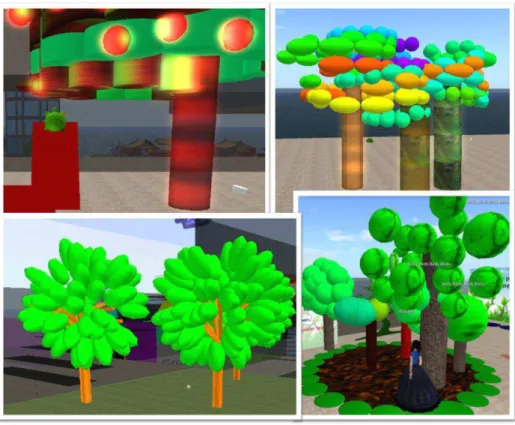
Due to the public nature of the learning enviro e t, lea e s des i ed looki g at othe people’s o k, a d ou ealised, oh, ou a do this as ell, ou k o , o othe people ha e used that so let’s have a go (5b1 interview). This realization influenced the design of several artefacts; yet there was no evidence in the artefacts of simple copying of programs as indicated by the variety of trees created across groups in Figure 8.
Figure 8 A variety of trees found in different installations, created by different participants using SLurtles.
Several participants described in their reflections and interviews, feeling motivated by a sense of fun and excitement. As o e pa ti ipa t oted i thei efle tio : A sense of excitement was definitely a moti ati g fo e (5b2 reflection), while their partner stated in their interview it did ’t a tuall feel like an assignment at times, you kind of felt guilty that you were having, doing this because it felt like fun (5b1 interview).
With a sense of fun came challenges. While several participants described the challenges and sense of satisfaction in programming the SLurtles, one described being challenged by their partner through the construction process: e e jo ed ki d of pushi g, ou k o , ki d of pushing each other on e e ki d of step i it . These challenges were considered valuable and encouraged learners to further develop their existing ideas: so that as a good thi g the , that it did feel like so ethi g that was worth doing because it was fun and it was interesting. So, erm, I think because of that our ideas did develop and we were willing to try new things, whereas if it was something that we found as a ho e to do e just ould ha e left it, a d said OK, e’ e e ough do e to ti k the o es and that’s it. (5b1 interview).
4.2.5 Socializing
The learning environment provided opportunities for learners to socialize. This typically occurred he lea e s isited othe g oups platfo s. Whilst this as des i ed as suppo ti g the lea i g experience, it added pressure for some and others avoided it. This sub-category focuses on the sense of co-presence and the code etiquette, which was a particularly common code across interviews.
Avatars supported work related communication within the group. Across interviews avatars were also described as supporting informal communication between participants. Only one participant des i ed ot o u i ati g ith a ata s othe tha his pa t e : I deliberately stayed away. (1b1 interview). For most participants the avatars supported and encouraged social communication:
they popped up and then I'd go over to them, just quick chitchat, how you getting on, kind of. (2b1 interview).
It is in this informal communication setting in which avatar presence in a space evoked a need to follo a pe ei ed eti uette. “o e pa ti ipa ts e e f ust ated the rudeness of othe s, hilst othe s did ot ish to appea ude: Erm, I, because people type slow. And, you feel like you kind of have to sit there, and kind of pay attention (2a1 interview).
Social interaction, whilst alleviating a sense of loneliness, could add pressure see I did find it f ust ati g, I as sa i g I as lo el o e he e ut a lot of people kept d oppi g i to isit, a d ou’ e kind of trying to get things done, and they would mostly just use the text tool because it was, you know, it was good and it was nice and it was fun, and I wish I had more time to chat, but sometimes
ou felt ude, like ou ould ’t ig o e the te t e ause it as the e, so you had to have a chat, but ou’d e a ful us a d ki d of feel like, go a a . (2a1 interview).
4.3 Learning
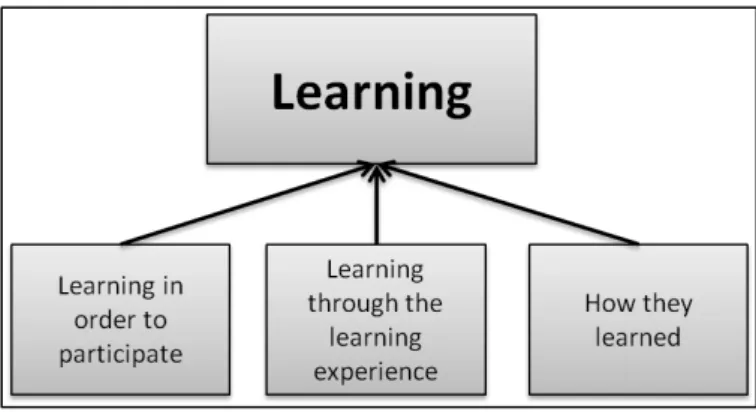
The fi al atego is Lea i g Figure 9). Over the course of the four weeks there were two re-occurring learning episodes identified by the participants: learning for the learning experience; and learning through the learning experience. Within this category how learners gained their new knowledge and understanding is also explored.
Figure 9 Representation of 'Learning' category.
4.3.1 Learning in order to participate
In the first type of learning episode, learning focused on Second Life specific skills necessary to engage in the learning experience. These included how to co t ol a a ata s o e e t a d ho to use the camera controls, which were identified as initial barriers to engagement. However other essential skills were not identified as barriers. These included learning how to program with S4SL, how to create a script in Second Life and import the S4SL script. As described by one participant these e e the e ha i s of usi g “Lu tles.
As they engaged in the learning activity these skills became more familiar as did the virtual
e i o e t: I actually found it quite easy to forget that you were actually, you know, in the zone of a virtual world (5b2 interview). It is interesting to note that while many skills became familiar some learners expressed ongoing frustration with transferring scripts from S4SL to Second Life and back again. This resulted in S4SL being reinstalled as a temporary fix. As a result, it may be suggested that for these learners the software did not become invisible.
4.3.2 Learning through the experience
Having acquired some basic skills during the initial face-to-face workshop sessions, several participants described learning about the potential of S4SL and SLurtles by engaging in the
o st u tio of thei a tefa t, as sho i this efle tio o e t: I believe that I learned much more about the Scratch programe in the first hour of building the first section of our installation than I did during the entire in college lab / lecture sessions. This is not a criticism of the learning
experience delivered during the in college sessions ... Rather, it is an observation into the level and depth of learning that seemed to occur when applying it to a vision (5b2 reflection). Learners described beginning the learning activity (after the face-to-face workshop) by exploring what SLurtles could do.
Learning was typically incremental over the four weeks and illustrated in the developing
installations, some which were made and remade several times. By engaging with SLurtles to create an artefact, learners identified that they had learnt about: reflection and its role in problem solving; programming concepts and processes; 3D graphics; advanced mathematics; themselves as learners, collaborators and teachers; collaborating at distance; and pedagogies introduced on the course, in particular constructio is : the greatest learning experience was the learning in relation to the process; by being an active participant in the process, while exploring the process, and subsequently reflecting upon the entire experience. (5b2 reflection).
They also learned about the artifacts they were creating. As noted in reflections, some groups created unfamiliar objects which they learned about through the construction process: Rega di g the piano both of us would not have been very familiar with the piano and thus learned about the diffe e t ke s a d the positio i g of those ke s. We e e lea ed to pla so e si ple tu es. (3a group reflection).
4.3.3 How they learned
As noted in interviews, the task and having a partner were the two main aspects of the learning expe ie e that suppo ted lea i g: you are there to collaborate on a very challenging operation, which is outside of your comfort zone and in doing that you're going to learn extraordinary things about yourself. By working with other people that will give you a completely new perspective on the task itself. And you yourself, and perhaps learning itself. (1b1 interview).
Those that worked with a partner who had some programming experience described their partner as supporting their learning. For example, havi g somebody there with more knowledge than myself, I suppose to kind of scaffold the learning process (3a1 interview) was noted by several participants as an important aspect of the learning experience.
In groups with no experienced programmer, learne s des i ed thei e pe ie e as better because we were both on equal, equal ground, starting off (5b1 reflection). As a result, they described learning together. Ho e e as oted i I ala e (4.1.1), where there was a knowledge imbalance, groups needed to identify the imbalance before they were able to learn from or with each other.
Visiting other groups learning spaces and interacting with avatars outside their own group was a valuable learning opportunity identified by several participants. Thus, learners were able to explore alternative ideas and were motivated to develop their own artefacts. In general the learning e i o e t as des i ed as suppo ti g lea i g, as illust ated i this efle tio : I felt completely immersed in the virtual world and as a result I constructed knowledge based on my interactions and experiences in the virtual world (conversing with other avatars: exchanging knowledge, interacting with SLurtles and Prims) (3a1 Reflection).
By engaging with SLurtles and engaging in reflection, participants learned programming concepts and processes. In interviews and reflections we find that references coded at exploration were also
often coded at play or fun, whilst testing was linked to frustration and reflection. It is interesting to note that exploring, testing and extending understanding were also closely linked to learners
des i i g the o e e t of “Lu tles, as sho i the follo i g efle tio : The fact that I could get immediate feedback from watching the actions of the SLurtle allowed me to evaluate what the script was doing in comparison to what I wanted to happen. I found this visual feedback allowed for an accelerated understanding of what was happening within the script than if I had to think in the abstract as to what was happening. (5b1 reflection).
One group created a bowling alley as part of their artefact. When clicked a ball would roll towards the pi s, appa e tl k o ki g the o e at hi h poi t a “t ike! essage ould appea . As described by one member of the group this artefact required a lot of problem solving: To actually figure all this out because it was, like, a fair bit of problem solving on it in terms of, like, one we
ould ’t figu e out h the all ould ot go do the full le gth ... a d then we tried, erm, we tried o a ds ith the pi s, ... ut that ould ’t o k e ause the ollide as ith the pi s a d it
as ’t ith the all. “o that’s h hat e had to do as to si ulate the a tual all hitti g the pi s. A d ou ould ’t oti e he ou’ e sta di g he e, that it’s a tuall just ti ed, e , so he the ball would roughly be where the pins were, then they would knock over (5b2 interview).
While some learners identified the use of reflection early on in their problem solving, for others it as a st ateg the lea t to use o e ti e: I wouldn't reflect at all, whereas I think 3a1 would be a much more a reflective person, and I think I got that from her. And then kind of reflected more myself. (3b2 reflection). Partners were also influe tial o lea e s app oa hes to problem solving. Learners described their partner as supporting their thinking process when working on a problem togethe : so eti es ou’ e thi ki g, ou’ e just thi ki g do the o g oute, a d so e od else, you know, can drag you back on it (5b2 interview).
This feedback also helped learners to identify characteristics of the SLurtle they were previously u a a e of: it comes out the middle, so he draws, we wanted to make it .1 wide. But he draws .05 on this side and .05 on that side (3a2 interview). This resulted in several groups using alternative approaches such as pen and paper to plan their designs and programmes rather than rely on a st a t o eptualisatio f o hi h to pla the p og a e: I did the math in my head and talked through it with 3a1 but we never got it right. We were actively experimenting but getting it wrong every time. Finally I took out two pens and a piece of graph paper and 3a1 did the same. (3a2 interview).
While a number of participants noted using a trial and error approach, several learners identified that over the duration of the learning experience their approaches to problem solving changed, as des i ed i o e i te ie : Maybe I do it in a different way, but this taking a step back, looking at things how they work, how... and then thinking, what will we do now as a result of that and why didn't it work, or why did it work and that kind a way of thinking, that methodology of thinking is very good and it was effective (3a2 interview).
There were many observational notes made about the appearance of initial constructions, which were either completely removed or added to throughout the learning experience. Learners used SLurtles to build and rebuild artefacts as they explored and tested their understanding, and this was ide tified se e al pa ti ipa ts as a i po ta t featu e: being able to erase and start all over again is great. (5a1 Refection). Participants used SLurtles to construct objects, however to remove them they used the “e o d Life tools, as illust ated i this e e pt f o a hat log: now to delete my mess... i presume i can select all the blocks using the build button? si . As o je ts e e non-physical they could be created at any height and would stay in that position: at o e stage it e a e
easie to put the “Lu tle up a height a d the e e ute the o a ds a d look at the f o the e. (5b2 interview).
Some, although aware that the objects were intangible, viewed the learning environment and objects as physical: it's not like a website, because it's 3-D, its physical, it's got surroundings to it (2b1 interview). Howe