NATIONAL EDUCATION SECTOR PLAN
2008 – 2017
A STATEMENT
MINISTRY OF EDUCATION, SCIENCE AND
TECHNOLOGY
MALAWI
CONTENTS
TABLE OF CONTENTS ……… i
LIST OF ABBREVIATIONS ………. ii
THE EDUCATION SECTOR’S………. iii
VISION……….. iii
MISSION………... iii
MANDATE………. iii
CORE VALUES……… iii
ACKNOWLEDGEMENTS……….. iv
FOREWORD………. v
PREFACE……….. vi
1.0 PREAMBLE……… 1
2.0 BACKGROUND……… 2
2.1 NATIONAL EDUCATION SECTOR PLAN (2008 -2017)……….. 3
3.0 RATIONALE FOR DEVELOPING THE NATIONAL EDUCATION SECTOR PLAN 4 4.0 EDUCATION SECTOR PRIORITIES BY SUB-SECTOR……….. 5
4.1 BASIC EDUCATION………. 5
4.1.1 EARLY CHILDHOOD DEVELOPMENT………. 5
4.1.2 NON-FORMAL EDUCATION……… 7
4.1.3 PRIMARY EDUCATION……… 10
4.2 SECONDARY EDUCATION……… 15
4.3 TEACHER EDUCATION (PRIMARY AND SECONDARY)……….. 18
4.4 TECHNICAL AND VOCATIONAL TRAINING………. 21
4.5 HIGHER EDUCATION……….. 23
5.0 KEY NESP INDICATORS………. 26
5.1 BASIC EDUCATION (PRIMARY)……… 26
5.2 SECONDARY EDUCATION………. 27
5.3 TEACHER EDUCATION (PRIMARY AND SECONDARY)………. 27
5.4 TECHNICAL AND VOCATIONAL TRAINING………... 27
5.5 HIGHER EDUCATION……… 28
6.0 IMPLEMENTATION……… 28
7.0 FINANCIAL IMPLICATIONS……… 31
APPENDIX………. 38
LIST OF TABLES Table 1: Summary for basic Education Development Plan (Primary)……….. …… 38
Table 2: Summary for Secondary Education Development Plan……….. …… 41
Table 3: Summary for Teacher Education (Primary and Secondary)……… 43
Table 4: Summary for Technical and Vocational Training Development Plan……… 44
LIST OF ABBREVIATIONS
ACE American Council of Education
AIP Annual Implementation Plan
AU African Union
CBCC Community Based Child Care
CBE Complementary Basic Education CDSS Community Day Secondary School
CPDT Continuous Professional Development for Teachers
DCE Domasi College of Education
ECD Early Childhood Development
EFA Education For All
HIV/AIDS Human Immuno Virus/Acquired Immuno-Deficiency Syndrome
IMS Information Management System
IP Investment Programme
IRI Interactive Radio Instructions M and E Monitoring and Evaluation
MANEB Malawi National Examinations Board
MCDECs Malawi College of Distance Education Centres MDGs Millennium Development Goals
MGDS Malawi Growth Development Strategy MIE Malawi Institute of Education
MLS Malawi Library Services
MoEST Ministry of Education, Science and Technology
MoU Memorandum of Understanding
MoWCD Ministry of Women and Child Development MoYDS Ministry of Youth Development and Sports MPRSP Malawi Poverty Reduction Strategic Paper MSCE Malawi School Certificate of Education MTEF Medium Term Expenditure Framework MZUNI Mzuzu University
NALP National Adult Literacy programme NCHE National Council of Higher Education NESP National Education Sector Plan PIF Policy and Investment Framework SADC Southern Africa Development Community SWAp Sector Wide Approaches
TEVET Technical Entrepreneurial and Vocational Education and Training
THE EDUCATION SECTOR’S
VISION
TO BE A CATALYST FOR SOCIO-ECONOMIC DEVELOPMENT AND INDUSTRIAL
GROWTH
MISSION
TO PROVIDE QUALITY AND RELEVANT EDUCATION TO THE MALAWIAN
NATION
MANDATE
TO PROMOTE EDUCATION IN MALAWI IRRESPECTIVE OF RACE, GENDER,
ETHNICITY, RELIGION OR ANY OTHER DISCRIMINATORY CHARACTERISTICS
CORE VALUES
-
PROFESSIONAL
-
MORAL
ACKNOWLEDGEMENTS
The National Education Sector Plan (NESP) - A Statement is the main output of the Ministry of Education Science and Technology and its Cooperating Partners (DfID CIDA, GTZ, JICA, UNICEF, USAID, WFP, UNESCO, World Bank and others). The NESP supports the Government of Malawi’s commitment to the realization of the Malawi Growth Development Strategy (MGDS), and international protocols arising from Education For All (EFA) and Millennium Development Goals (MDGs). The NESP is expected to fit within the overall national development strategy, namely MGDS.
The production of this Plan has been made possible through consultations with a number of bodies including the civil society and stakeholders in education (CSCQBE, DAPP. FAWEMA, LEG, PRISAM, TUM etc). We wish also to acknowledge the contributions of the following Ministries of Women and Child Development, Youth Development and Sports, Finance and Economic Planning and Development and parastatals, such as Malawi National Commission for UNESCO and MANEB. Such consultations were largely in the form of working group membership lead by respective directorates and/or linked institutions of the MoEST and facilitated by cooperating partners active in the education sector. The assistance of other eminent persons who were consulted is also acknowledged. The Director of Education Planning of MoEST, Dr. Augustine F. Kamlongera and the Policy and Planning personnel in the same directorate (Ms. Thoko Banda, Ms. G. Milner, Mr. C. Maleta and Asma Zubairi), guided the development of this Statement. The same Directorate of Education Planning will continue taking a leading role in realizing the Operational Plan. To all who contributed to the realization of this Statement, the MoEST wishes to thank them and encourage them to continue with such a good spirit wherever and whenever duty calls.
The whole exercise had the support and encouragement of the various education officers and Honourable Ministers who held the Education portfolio in the course of developing this NESP.
FOREWORD
Education Planning in Malawi has since independence been guided by plans which have always been linked to Statements of Development Policies. Such an approach has made education meaningful in the course of addressing the national agenda. This Statement as a National Education Sector Plan, in a way, continues with the same approach though it has been broadened to allow all those involved in education irrespective of their institutional set up to operate as a cluster and one force addressing a common challenge and responding to the Malawi Growth Development Strategy and related international protocols such as Education For All and Millennium Development Goals. Thus, it is expected that the coming together of all key players in the education sector will create a synergy which will make a significant difference in Malawi and thereby respond to the national and international aspirations and expectations during the given decade (2008- 2017).
This National Education Sector Plan – Statement sets out the Government’s view of Malawi’s education sector goals, objectives and proposals on how such goals and objectives will be realized over the coming decade (2008-2017). The goals and objectives relate to expanded Equitable Access to education, improved Quality and Relevant education and improved Governance and Management of the same education as three key factors for making a positive difference in education for its citizens and the nation. In turn the intervention in education is expected to lead to the realization of the Malawi Growth Development Strategy as the pillar for all socio-economic and industrial growth for Malawi. The means for realizing the MGDS through education are many and varied, sometimes involving very specific action by the Government through Ministries such as Education, Science and Technology, Women and Child Development and Youth Development and Sports, other times involving direction or support from private individuals or institutions and civil societies. All in all this Statement should be a tool for all who are involved and/or have interest in education.
I am pleased that by using a participatory approach in developing this Statement and synchronizing it with the EFA Plan of Action, the Education sector is ready to embark on a development course that will change the education landscape and own it. Furthermore, it is my hope that all education institutions regardless of their inclination will work together to make the sought difference which all of us are talking about here in Malawi and beyond.
I urge all of you, including myself, to work together in realizing this Plan. Let us all remember that we can only make a difference when we work together for the same cause. As the realization of our past achievements has been possible through cooperative efforts of the Government, donor community, civil society and private sector, I have no doubt that such a co-operation will continue during the implementation of this Plan.
Dr. Bingu Wa Mutharika
PREFACE
The National Education Sector Plan (2008 – 2017), reflects effort by the educationists and those with vested interest to improve the access, equity, quality, relevance, governance and management of education in Malawi, however, it represents only the first stage in a process. Substantial work remains to be done in translating the strategy into an Operational Plan (Action Plan) in line with Annual Implementation Plans and Medium Term Expenditure Framework and then executing the lines of action as implementation programmes. Coordination of this plan will rest with the Ministry of Education, Science and Technology – Education Planning Directorate although the respective ministries administering education issues will continue doing so. It is important to mention that the Ministry of Finance and Department of Human Resource Management and Development under OPC will continue playing their crucial role in the area of finances in relation to Sector Wide Approaches and human resources respectively. Indeed the Ministry of Economic Planning and Development will have an overall responsibility because the programmes in this plan are largely developmental by nature. The Ministry of Education, Science and Technology and the other ministries (Women and Child Development and Youth Development and Sports) have the burden of ensuring that adequate funding, personnel and working modalities are in place to ensure prioritization and implementation.
The plan as a Statement does not attempt to present a detailed and full blown quantified blueprint for action. But it does represent an attempt to lay a distinct path (goals and activities with financial implications) for the five sub-sectors (primary, secondary, technical and vocational training, teacher education and higher education). Although the three other areas, namely Early Childhood Development, Out-of-School Youth and Adult Literacy, have their precise statements (goals, activities and detailed financial implications) in the strategic plans, this sector plan provides a distinct overview of such planning and its financial implication. It will be important, that both the content of this Statement is respected in the action taken by all agencies of Government, cooperating partners and any other stakeholder, and that the NESP is subject to regular and comprehensive review and revision. The NESP will be subject to review on an annual basis through the Joint Sector Review.
Executing the strategies in this plan will place considerable responsibility on the Government, mainly Ministry of Education, Science and Technology and its directorates and related institutions. At times financial and other resources may have been overestimated in this plan. Where such a thing occurs, there will be deliberate effort to ensure that prioritization is understood and respected, and any action plan being adjusted to reflect the reality.
The NESP – A Statement itself has seven sections namely preamble, background, rationale, education sector priorities, key NESP indicators, implementation and financial implications. An Appendix containing Summary tables of the sub-sector development plan is included at the end of the document. The tables give an overall indication of the area of intervention in terms of goals (expected outcomes), strategies, overall activities (expected outputs), indicators of progress, targets by year, and cost factors.
The Ministry of Education, Science and Technology, as part of the education sector, has a mandate to promote quality and relevant education in Malawi. This Plan is a manifestation of this mandate.
Anthony Livuza
1.0 PREAMBLE
The vision for the education sector is to be a catalyst for socio-economic development, industrial growth and instrument for empowering the poor, the weak and voiceless. Education enhances group solidarity, national consciousness and tolerance of diversity (MGDS 2006:50). In essence, the sector wishes to ensure better access and equity, relevance and quality, and good governance and management in all institutions from basic education to higher education.
The mission of education is to provide quality and relevant education to the Malawian nation. Such education should enable people to acquire relevant knowledge, skills, expertise and competencies to perform effectively as citizens, workforce and as leaders of Malawi, thereby reduce poverty amongst the people of Malawi.
In implementing the Vision and Mission, Malawi will make its main Strategic Priority the improvement of quality, equity, relevance, access and efficiency in Basic Education, working to meet the Education for All goals and Millennium Development Goals. Complementing this main priority, Secondary Education will double enrolment during the ten years, while focussing on upgrading quality, and on retention of girls. Access to Technical and Vocational education will expand, and the colleges will be rehabilitated. At the Higher Education level, enrolment in existing public universities will double in ten years, with significantly increased efficiency to minimize costs to the budget, complemented by expansion of private tertiary education. Overall Special Needs Education programmes will feature prominently and HIV/AIDS mitigation and gender equity will be a cross cutting interventions at all levels/sub-sectors during this plan period (2008-2017).
To realize the vision and its mission, and in accordance with these strategic priorities, the education sector has defined three thematic areas of intervention during the ten year period of the current National Education Sector Plan (2008 – 2017), namely:
i. Expand equitable access to education to enable all to benefit,
ii. Improve quality and relevance of education to reduce drop-out and repetition and promote effective learning, and
iii. Improve governance and management of the system to enable more effective and efficient delivery of services.
The National Education Sector Plan (NESP) responds to the three thematic areas through calling for improvements in Early Childhood Development1 (Early Childhood Education), non-formal
education (out-of-school youth and adult literacy) and formal education (primary, secondary, technical and vocational training – tertiary and higher education). Such an approach implies that the plan has to reflect and subsume participation of various public organizations which are responsible for the various domains, namely: Ministries of Women and Child Development, Youth Development and Sports and Education, Science and Technology, statutory bodies (Malawi Institute of Education, Malawi Library Services, Malawi National Examinations Board and the Universities), TEVETA and the non-public and/or private organizations in education. District
1
Refer to Education For All (EFA) Plan for details. All forms of Implementation Plans to be proposed and executed by respective ministries/institutions, namely Ministries of Women and Child Development, Youth Development and Sports and Education, Science and Technology Training.
Assemblies, as service providers at the local level, have a significant role in accordance with the 1998 Local Government Act and Decentralization Policy in translating and delivery of education services at local level.
Implementation of the NESP will be supported by capacity and systems development and by an emerging series of strategies vis a vis policies, which set out the Government of Malawi’s intentions and guidelines for important initiatives, linked to national goals. Implementation of the NESP will also be reviewed and monitored according to outcomes and indicators (at both sectoral and programme level) and the plan itself, as a living document, will be revised and modified according to outputs and outcomes.
2.0 BACKGROUND
The beginning of education planning in Malawi dates back to 1964, at independence, when the Government of Malawi contacted the American Council of Education to conduct a survey and thereafter advance approaches (plans) for attaining certain targets besides stating financial commitments and new projects. The survey’s main objective was to determine Malawi’s education needs for social and economic progress. The survey, which assessed all levels of formal education, influenced the development of Malawi from 1964 until 1972 and subsequent planning exercises up to 1994.
The first formal education plan (1973 - 1980) was intended to provide guidelines for education development on primary, secondary and teacher education although an addendum on technical and vocational training came forth in 1976. Despite not incorporating all sub sectors of the formal education system it provided the first real attempt at planning for the evolution of education system since the introduction of formal education in Malawi during the last quarter of the 19th Century.
Among other objectives, this plan aimed at:
i. Basing educational development, in particular post – primary education, on the needs of labour market,
ii. Align curricula relevance to socio-economic and environmental needs, iii. Maximize utilization efficiency of existing resources and facilities, and iv. Equitably distribute education facilities and resources.
The second education sector development plan (1985 – 1995) incorporated all levels of formal education as well as various parastatal organizations associated with the Ministry of Education, Science and Technology at that time. The overall objective of this plan was to consolidate policies so that a proper balance is maintained in the levels of physical and human resources allocated to all levels of education system. Precisely the plan aimed at:
i. Equalizing educational opportunities, ii. Promoting education systems efficiency, iii. Improving physical and human resources, and
iv. Judiciously utilizing the limited resources to the education sector.
From 1995 to 2005; the Policy and Investment Framework (PIF) has guided the education sector development and Medium Term Expenditure Framework (MTEF). Specifically, the PIF aimed at:
i. Increasing access to educational opportunities for all Malawians at all levels of the system, ii. Ensuring that Malawi's education system does not intensify existing inequalities across social
groups and regions,
iii. Maintaining and improving the quality and relevance of education,
iv. Developing an institutional and financial framework that will sustain Malawian schools and students into the future, and
v. Intensifying financing pathways and strengthening of financial managerial capacity within the education sector and at all levels.
The three stated plans were responding to the Development Policies which the Government of Malawi was pursuing between 1964 and 1994.
In light of emerging issues during the PIF implementation, the document was reviewed in 2001. This led to re - strategizing and introduction of new policy directions to address the emergent issues. The PIF has been implemented in line with national development directions in both the Medium – Term Expenditure (MTEF) and the MPRS.
2.1 NATIONAL EDUCATION SECTOR PLAN (2008 – 2017)
National Education Sector Plan2 (NESP) draws on the first and second education development
plans, PIF and the Long-term Development Perspective for Malawi (Vision 2020). Subsequent to these development policies, it is also drawn from the current medium – term national development strategy (the Malawi Growth and Development Strategy - MGDS). Furthermore, the NESP reflects the Government of Malawi’s commitment to both regional (Southern African Development Community and the African Union) and international (the Millennium Development Goals) targets and priorities, and it incorporates the ideals Education For All (EFA) National Plan of Action3, in
order to respond to the Fast Track Initiative. Consistent to the above and based on the Paris declaration on donor assistance, the NESP paves the way towards a Sector Wide Approach (SWAp) to planning, development and financing of the education sector. In essence, the detailed NESP is the long-term programme from which the MTEFs, District Education Plans (DEPs) and Annual Implementation Plans (AIP) will be drawn.
The NESP operationalizes the MGDS broad educational development priorities, which recognizes education as a catalyst for socio-economic development, industrial growth and an instrument for empowering the poor, the weak and the voiceless. It is also cognizant of the positive role of education in enhancing group solidarity, national consciousness and tolerance of diversity. Furthermore it ratifies the facilitating role of education in the development of a culture of peace, which is conducive and critical for socio-economic, political and industrial development and appraises education as being critical and necessary for economic and industrial growth and development. Precisely the broad national goals in the MGDS are:
2
NESP states specific details and costs for primary, secondary, teacher education (primary and secondary), technical vocational and higher education sub-sectors only.
3
As in footnote 1 the EFA Plan of Action gives comprehensive details and their related costs for early childhood development, primary, out-of school youth and adult literacy as per responsible
i. To equip students with basic knowledge and skills to enable them to function as competent and productive citizens in a free society,
ii. Students with disabilities are able to live an independent and comfortable life,
iii. To provide the academic basis for gainful employment in the informal, private and public sectors, and
iv. Provide high quality professionals in all fields.
As stated earlier in the preamble, the NESP covers Basic Education (Early Childhood Development, out-of-school youth, complementary basic education and adult literacy asnon-formal education and Primary Education), Secondary Education (Open and Distance Education and Formal), Teacher Education Development for Basic and Secondary education; Technical Education and Vocational Training (formal, village polytechnics and distant learning) and higher education (private, public and open universities). Thus it is envisaged that NESP will have a wide coverage in the course of implementation and will involve key players (stakeholders) in the private and public sector.
The NESP forms the basis of all investment (by Government of Malawi and all Development Partners). Decisions about funding for development of the education sector will be based upon this plan. Decisions to adopt new approaches and new interventions will depend upon the evaluations arising from formal review and co-ordinated dialogue mechanisms (the annual joint sector review, incorporating the annual review of the NESP, for example). The NESP programmes may, therefore, be modified in the light of experience and agreed need, but they will nevertheless continue to reflect the co-ordinated, transparent and systematic approach desired by Government. Existing programmes and projects (developed prior to finalising this NESP) which are supported by individual agencies will run their intended courses and evaluations of them will inform the NESP. Once such existing programmes and projects have completed, no separate, freestanding intervention will be developed outside the NESP framework. Development partners will agree a Memorandum of Understanding with the Ministry of Education, Science and Technology, to this end.
3.0 RATIONALE FOR DEVELOPING THE NATIONAL EDUCATION SECTOR PLAN
i. The NESP consolidates education sector development strategies and their policies into one implementable output and results based framework with linkages to existing financing mechanisms and allowance for future reviews of the same. To this effect, the NESP provides a strong basis for a SWAp,
ii. The NESP is comprehensive in scope, as it does cover all levels of education and sub sectors therein for a ten year period (2008-2017),
iii. The NESP provides opportunities for facilitating life-long learning (continuous education), iv. The NESP provides a holistic coverage on dimensions and implementation of international covenants, agreements and protocols on education; to which the Republic of Malawi has adopted through ratification or by virtue of being part of the global economy and international socio – political landscape, and
v. The NESP articulates and ensures the necessary leadership and ownership of and by the Government of Malawi in developing the education sector between 2008 and 2017.
4.0 EDUCATION PRIORITIES BY SUB-SECTOR
It is important to note that implementation will be determined by inter-linkages of activities in relation to priorities and not only thematic areas. In other words implementation will be dictated by the inter-linkages of a number of issues/activities to achieve expected outcomes. Nonetheless, thematic prioritization will guide the entire process of determining expected sequential outcomes over the ten year period of this plan.
4.1 BASIC EDUCATION
Not withstanding the current understanding of basic education to imply only primary education within MoEST and Malawi, globally basic education is for the age range 0 to 16 year olds and it includes pre-school (Early Childhood Development), adult literacy as well as out-of-school youth. Pre-School is for five (5) year olds and below. Primary education is for six (6) to thirteen (13) year olds and it has eight standards. Out-of-school youth education and adult literacy is for those aged fifteen (15) years and above; however, in practice out-of–school youth includes children who could be under primary school. In essence basic education should include the lower level of secondary education in terms of inclusion of 15 and 16 year olds although in this document such an age grouping is under secondary education (Section 4.2).
Pre-school and adult literacy falls under the responsibility of the Ministry of Women and Child Development. Primary education is under the Ministry of Education, Science and Technology. Out-of-school youth education falls under the Ministry of Youth Development and Sports.
4.1.1 EARLY CHILDHOOD DEVELOPMENT
The provision of Early Childhood Development (ECD) is an important pillar to Education for All. There are 6,277 Early Childhood Development (ECD) centres as pre-schools. Only 30 percent of targeted pre-school children attend ECD centres. The majority of these centres are concentrated in urban and semi-urban areas. The major challenges facing the Early Childhood Development sub-sector include:
i. Lack of systematic monitoring and evaluation including Information Management System (IMS) and standard monitoring and evaluation tools,
ii. Poor conditions of ECD centres due to lack of support from government and communities at large and poor coordination of stakeholders,
iii. Lack of integration of special needs in ECD provision,
iv. Poor advocacy for and information on the importance of ECD, v. Lack of community and parental involvement in the provision of ECD, vi. Acute shortage of trained teachers for ECD,
vii. Lack of standard instructional materials such as syllabuses and operational guidelines, and viii. Insufficient public funding for ECD activities.
The Government of Malawi will tackle the challenges raised above through the following priorities and strategies:
PRIORITY 1 - Access and Equity
i. Promote stimulation-learning activities at an early life for all children,
ii. Promote early detection, intervention and inclusion for children with special health and education needs, and
iii. Promote early childhood care for orphans and vulnerable children. PRIORITY 2 – Quality and relevance
i. Improve quality ECD services for children in Malawi, ii. Design a curriculum for children with disabilities, and iii. Improve training of ECD teachers/educators/trainers. PRIORITY 3 – Governance and management
i. Develop ECD data base including on SNE and gender segregation, ii. Strengthen the institutional framework for the delivery of ECD services, iii. Promote the profile of ECD,
iv. Develop an ECD Act,
v. Improve implementation of the ECD policy, and
vi. Provide parental education and support groups on early childhood.
To realise the priorities and strategies, the following guiding principles will be adhered to between 2008 and 2017 for developing and sustaining an effective and efficient ECD:
i. At least 80 percent of children aged 5 years and below will have an opportunity to access ECD by 2017,
ii. The average annual growth of ECD, as a whole, will be 17.5 percent,
iii. The increase coverage of ECD services will be based on the current basis of 84 percent CBCCs, 4 percent day care centres and 12 percent pre-schools,
iv. Each ECD centre will increase the number of minimum classes from two to three in order to curb underage enrolment and prepare five year olds for entry into standard one (primary education) at an appropriate age of six years. Thus, three classrooms will still be levels 1 and 2 although level 2 will have separate classes for ages 4 and 5 with a relatively modified syllabus/course content,
v. Communities, as Community Based Care Centres (CBCC), will be encouraged to establish ECD centres through grants which will be accessible upon meeting minimum standards, vi. Each education district will have an ECD resource centre to offer the necessary services to
CBCCs, and
vii. By 2018, the average care giver to child ratio will be 1:20 and the helper to child ratio will be 1:40.
4.1.2 NON-FORMAL EDUCATION A) Adult Literacy
Adult illiteracy in Malawi remains high, particularly among women and the poor. According to the 2005 Integrated Household Survey, only 64% of adults (15 years and above) were literate. The corresponding literacy rates for male adults and female adults were 76% and 52%, respectively. The link between literacy, development and poverty reduction is that literate people are able to access information pertaining to their development needs from a variety of sources. Literate people understand and easily follow instructions for performing various development activities.
Recognizing the importance of literacy to improve lives of the population, the Government of Malawi established the National Centre for Literacy and Adult Education with the aim of providing literacy to 2.5 million people by the year 1995. However, by 2006 the National Adult Literacy Programme (NALP) had covered just over 860,000 people. NALP also provides continuing education consisting mainly of post-literacy activities to prevent relapsing into illiteracy.
The major challenges facing adult literacy and continuing education in Malawi include:
i. Lack of a comprehensive policy which defines adult literacy and reflects the link between thematic monitoring and evaluation including Information Management System (IMS) and standard monitoring and evaluation tools,
ii. Limited capacity in terms of human and material resources to facilitate adult literacy and continuing education and train and retain sufficient number of adult literacy and continuing education instructors,
iii. Inadequate management which results in poor coordination, poor incentives for instructors and poor funding,
iv. Limited integration of special needs, v. Poor male participation,
vi. Curriculum not up to date, and
vii. Misconception of adult literacy due to poor publicity and advocacy.
The Government of Malawi will tackle the challenges raised above through and under the following priorities and strategies:
PRIORITY 1 – Access and equity
i. Increase equitable access to adult literacy and continuing education activities by men and women, and
ii. Special advocacy activities targeting men and adults with special needs. PRIORITY 2 – Quality and relevance
i. Enhance monitoring and evaluation of adult literacy programmes
ii. Improve the provision of teaching and learning materials for both special needs and other adults,
iii. Promote mother tongue instructions,
iv. Recruit instructors based on defined minimum Government education qualifications and provide relevant training, and
v. Curriculum to adopt REFLECT methodologies. PRIORITY 3 – Governance and management
i. Develop national adult literacy policy, ii. Provide appropriate incentives to instructors,
iii. Strengthen coordination among different committees,
iv. Encourage community leaders to take a role (promote and monitor) in adult literacy, and v. Develop database for adult literacy and continuing education
To realise the priorities and strategies, the following guiding principles will be adhered to between 2008 and 2017 for developing and sustaining an effective and efficient adult literacy:
i. Non-formal basic education includes out-of-school youth and adult literacy,
ii. Development Programmes for adult literacy are aligned with Complementary Basic Education and expected to use primary schools as learning centres. Parallel to the use of schools, there should be 92,000 classes built by 2017,
iii. Female functional literacy programmes will be emphasized to at least bring it to the overall national male literacy rate. Of course, strategies will be designed to attract male participation in adult literacy classes,
iv. A minimum budgetary allocation of 3 percent will be required to make a significant impact of the adult literacy programme,
v. The use of mother tongue will be promoted with the curriculum infusing the REFLECT approach so that the programme is functional, and
vi. Overall, the literacy rate of adults is expected to reaching 5 million adults by 2017. Such improvement will take into account identifying and mainstreaming of adults with special needs not later than 2010.
B) Out-of-School Youth
The provision of non-formal basic education is relatively new in Malawi and it is currently provided in partnership with the Ministry of Youth Development and Sports and Non Governmental Organizations (NGOs). The Ministry of Education, Science and Technology is piloting the implementation of Complementary Basic Education (CBE) in four districts. Out-of-school youth education is aimed at providing essential knowledge, skills and values to promote self-reliance, encourage life long learning and full participation in societal development.
Out-of-school youth programmes target those who dropped out of primary school and those who have never attended school. The course content is equivalent to the first five standards of primary school. Although the programme is relatively not large, it has the following challenges:
i. Lack of advocacy on out-of-school youth education,
iii. Lack of relevant curriculum for out-of-school youth clubs, iv. Poor access for children with special needs, and
v. Weak linkages among youth clubs and between the youth service providers/policy makers. The Government of Malawi will tackle the challenges raised above through and under the following priorities and strategies:
PRIORITY 1 – Access and equity
i. Increase access to education for out of school youth, through such modes as Interactive Radio Instructions (IRI), Complementary basic Education (CBE) and open and distance learning,
ii. Enforce community based rehabilitation programmes run with special needs component by MACOHA, and
iii. Provide an alternative form of education to out of school youth such as Interactive Radio Instructions (IRI) and CBE.
PRIORITY 2 – Quality and relevance
i. Develop a relevant curriculum for out of school youth without losing sight of youth with disabilities, and
ii. Improve the service delivery of out-of-school youth clubs. PRIORITY 3 – Governance and management
i. Strengthen dialogue among youth clubs and between the youth service providers/policy makers.
To realise the priorities and strategies, the following guiding principles will be adhered to between 2008 and 2017 for developing and sustaining an effective and efficient out-of-school youth/complementary basic education:
i. Those younger than 9 should be encouraged to return to primary school as they are not yet old enough to feel too old to enter those classes
ii. Where the 9-17 year olds are not or do not return to normal school they will undertake a three-year CBE course. It is likely that children (the younger age group of 9-13) would have a greater tendency to return to school while for the youths (14-17) the course could be complete in its own right. The feasibility of meeting the needs within the same course of those who want to return to school and those who do not will be established in the pilot. If the numbers out of school in a village are sufficient, it may be possible to establish classes for younger and for older children. Another possibility is differentiation, perhaps in the third year, with a stronger emphasis on prevocational skills for the youths and a retained stronger emphasis on literacy for the younger children.
iii. Those 18 and over fall outside school-age and the remit of the Ministry of Education and are catered for by programmes of adult literacy and income-generation in the Ministry of Women and Child Development,
iv. On average, two years of primary schooling can be covered through one year of complementary basic education. If, however, additional elements such as prevocational skills are included in the complementary curriculum, then progress against the normal curriculum will be a little slower. A three-year course has the advantage of having a shortened time-scale which is likely to be within the vision of those out-of-school who will be interested by this stage in enhanced livelihoods.
v. In order to assure equivalence and the ability of children to re-enter primary school, the curriculum for complementary basic education will have to be matched to a specified number of years of the primary curriculum. It will have to reflect the guidelines laid down in the primary curriculum framework4 and subsequently developed in syllabuses for learning
areas. At the same time, there is a curriculum for technical and vocational education and training which is specified in the Qualifications Framework5. Entry to level 1, the
foundation certificate of this framework, is theoretically open to anyone who attains the prerequisite competences. (In practice, a shortage of places means that a junior certificate after two years of secondary education is needed for admission.) Bearing in mind the fact that parents and young people often have aspirations in the direction of vocational and entrepreneurial training (despite the limited number of job opportunities), it would also make sense for complementary basic education courses to consider inclusion of the preliminary basic competences of the technical-vocational and/or trade test/craftsman qualifications,
vi. The management of complementary education should be considered at national, district and community levels,
vii. Grants to CBEs for the support of orphans. Starting with the support of 20% of CBEs in 2009/10 to 100% of CBEs by 2013/14,
viii. During the first phase there will be in up to 100 learning centres in 2-4 districts between 2006 -2008. The potential beneficiaries are up to 6,000 children who have dropped out of or never attended school. Expansion to new districts will be subject to the interest of existing and additional service providers and through the existence of appropriate demand, ix. Promote life skills programmes, technical-vocational education/training and Behaviour Change Intervention (BCI) to mitigate impact of HIV/AIDS among the out-of-school youth, and
x. Mainstream special needs education and gender in out-of-school youth programmes. Overall, the establishment of 15 Learning Centres in 3 Districts (Ntchisi, Chikwawa and Lilongwe Rural) has already been achieved by 2007/08. Intent is to increase the number of centres by 500 each year. From 2012/13 onwards this will increase by 600 centres every year
4.1.3 PRIMARY EDUCATION
Overall the longest existing structure under basic education and within the entire education sector is primary education. Primary education is the sub-sector which affects the greatest number of people, and which is the basis for all other education. Good primary education is valuable both for those who leave school at the end of primary, and for those who continue their education. Only if the primary sector functions well can students gain the basic knowledge to progress to secondary,
4
Government of Malawi (2004) Primary Education Curriculum and Assessment Framework
5
while research world-wide shows that people who have a good primary education are likely to be more productive in life than those who have not. However, it is the same primary structure which harbours most of the challenges in the entire education system in Malawi due to increasing enrolment without adequate funding and management. Such inadequate funding and management in turn leads to the following challenges:
i. Shortage of qualified primary school teachers, ii. Poor strategic management of teachers, iii. Inadequate and inferior physical infrastructure, iv. Inadequate teaching and learning materials,
v. Poor monitoring and supervisory systems, vi. Poor access for children with special needs,
vii. Poor retention of girls mainly from standards five to eight, viii. Negative impact of HIV/AIDS, and
ix. Poor participation of school committees and their communities in school management (MGDS 2006:50).
In response to the challenges, Malawi is implementing a priority, fast-track programme to strengthen primary education, which will be the base for all other education developments. The programme combines policy measures, quality improvement and investments, through three sets of strategies listed below. Through policy and other measures, Malawi plans to give all children a quality primary education.
The Government of Malawi will tackle the challenges raised above through and under the following priorities and strategies:
PRIORITY 1 - Quality and relevance
i. Improve teaching inputs to facilitate more effective learning and to increase learning achievement, including supply of books and other teaching-learning materials (through programmes now under way), training of teachers, Interactive Radio Instructions (IRI) and Complementary Basic Education,
ii. Reduce class sizes to facilitate more effective learning through progressively recruiting: (a) increased numbers of trained teachers as they become available, and (b) teacher trainees recruited through an urgent programme, who will work as teachers while studying through distance learning. Particular efforts will be made to reduce class size for Standards 1 and 2. For special needs, moving towards the recommended teacher pupils ratio of 1 teacher to 10 pupils in special schools and 1 teacher to 5 pupils in resource centres by the end of the plan period,
iii. Starting through the Primary Curriculum and Assessment Reform programme now under way, enhance the relevance of the primary curriculum and improve delivery by diversifying the modes and methods. Furthermore, develop appropriate tools for special needs such as sign language and braille,
iv. Reinforce inspection and supervision system of primary education, and
v. Introduce appropriate incentives to teachers and supervise their performance, including access to VCT and supporting those positive teachers to mitigate absenteeism and early death.
PRIORITY 2 – Access and equity
i. Increase net enrolment and completion rates, targeting those disadvantaged by gender, poverty, special needs and geographical location,encouraging all children to complete the eight years of primary education,
ii. Improve enrolment, particularly female enrolment, in Standards 5 to 8,
iii. Improve, expand and maximise use of educational infrastructure through rapidly expanding programmes to construct classrooms, school facilities and teachers’ housing in difficult areas, complemented by grants to communities to provide shelters for classes which are temporarily without classrooms,
iv. Optimise private sector participation in basic education, and
v. Strengthen complementary basic educational modalities for learners including Interactive Radio Instructions (IRI), Complementary Basic Education and Open and Distance Learning.
PRIORITY 3 - Governance and Management
i. Mobilise communities to participate in ‘whole-school development’ and management for both normal and special needs pupils,
ii. Ensure appropriate decentralisation of delivery of education services which incorporates processes of planning, budgeting and financing, and monitoring and evaluation (M&E), iii. Introduce policy measures to reduce the size of classes in Standards 1 and 2, to reduce
repetition, drop-out, and enrolment of over- and under-age children, and to encourage promotion between standards, reinforce HIV/AIDS awareness, girls empowerment, safe schools (child friendly schools), and,
iv. Monitor performance and strengthen internal efficiency of sub-sector.
In addition to the fast-track programme, the following guiding principles are critical for the envisaged positive change in primary education between 2008 and 2018:
i. Ratio of pupils to teachers progressing to a 1:60 ratio by 2013/14 and below 1:60 ratio by 2017/18
ii. Percentage of teachers eligible for hardship fund increasing from 15% in 2008/09 to 30% by 2014/15 and staying at 30% thereafter
iii. Transfer of teachers transferred from CDSSs to primary schools starts with 300 in 2008/09 and thereafter 200 teachers
iv. Using Distance Education Teacher Trainees as a measure of reducing the pupil to teacher ratio to 1:60 by 2013/14. Starting with 4,000 temporary (voluntary) teachers in 2008/09 v. Replenishment of textbooks for additional pupils in each Standard at the beginning of the
plan and thereafter replenishment of textbooks every three yearsi
vi. Giving 3 exercise books per subject per child for all standards, 1 slate per child in Standard 1, 3 pencils per child in a year for all children in Standards 1-4 and 3 pens per child in a year for all children in Standards 5-8
vii. The Primary Curriculum Assessment Review (PCAR) curriculum rolled out to all Standards by 2009/10 and taking into account special needs
viii. The Interactive Radio Instruction (IRI) programme rolled out to all schools starting with Standard 1 in 2007/08 and being completely rolled out to all Standards by 2014/15
ix. The Interactive Video Learning (IVL) programme rolled out to 50 schools in 2007/08 and increased to 50 more schools for each year
x. Increasing the number of classrooms operating as double shift from 15.2% of the total in 2007/08, peaking at 20% in 2012/13 and ending with 15% in 2017/18
xi. The number of schools constructed will increase by 50 every year
xii. Number of classrooms to be constructed being 2,930 in 2007/08 and being reduced to 400 by 2017/18
xiii. Provision of grants to communities to erect standard classroom shelters in difficult areas where it will not be possible to immediately build classrooms and follow up in later years to build the classrooms – more information to follow
xiv. Teachers houses – 1,000 constructed every year from 2008/09 until the end of the NESP period in 2017/18
xv. Grants to schools for the support of orphans. Starting with the support of 20% of schools in 2009/10 to 100% of schools by 2013/14
xvi. Support to girls in isolated areas for Standards 6, 7 and 8 in term s of monetary incentives starting in 2009/10
xvii. Establishment of mother groups in all schools to support girl education in primary schools by 2017/18.
xviii. School feeding programmes to benefit 635,000 children from 2008/09 onwards
xix. School Health and Nutrition, including HIV/AIDS programmes, to be provided to all school children in public primary schools
xx. Communities will be strengthened through monetary support and training throughout NESP period through the continued roll-out of the National Strategy for Community Participation and
xxi. Direct grants to enable school based improvement planning and management thereby reinforcing decentralization.
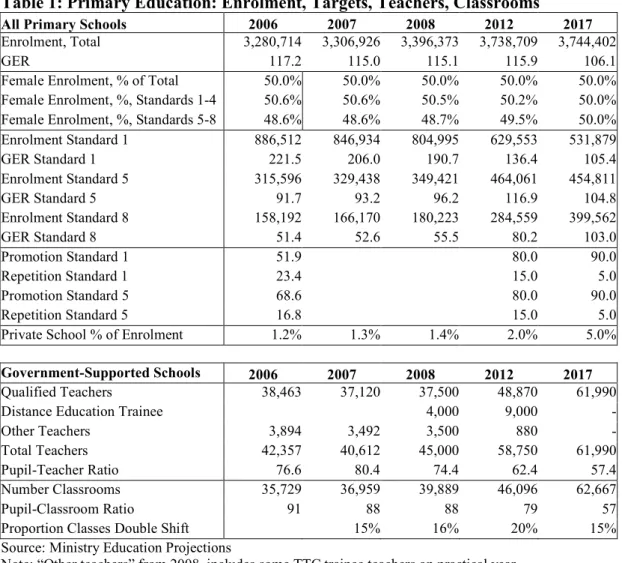
4.1.1 Targets and Projections
Table 1 below shows the changes projected in Primary Education, including enrolment projections, projections of numbers of qualified teachers who will be available, and targets for enrolment, repetition and promotion rates. It is asssumed that the enrolment projects will improve hand in hand with literacy and numeracy rates. Furthermore the end of cycle pass rate will at least be above 80 percent by 2017.
Table 1: Primary Education: Enrolment, Targets, Teachers, Classrooms
All Primary Schools 2006 2007 2008 2012 2017
Enrolment, Total 3,280,714 3,306,926 3,396,373 3,738,709 3,744,402 GER 117.2 115.0 115.1 115.9 106.1 Female Enrolment, % of Total 50.0% 50.0% 50.0% 50.0% 50.0% Female Enrolment, %, Standards 1-4 50.6% 50.6% 50.5% 50.2% 50.0% Female Enrolment, %, Standards 5-8 48.6% 48.6% 48.7% 49.5% 50.0% Enrolment Standard 1 886,512 846,934 804,995 629,553 531,879 GER Standard 1 221.5 206.0 190.7 136.4 105.4 Enrolment Standard 5 315,596 329,438 349,421 464,061 454,811 GER Standard 5 91.7 93.2 96.2 116.9 104.8 Enrolment Standard 8 158,192 166,170 180,223 284,559 399,562 GER Standard 8 51.4 52.6 55.5 80.2 103.0 Promotion Standard 1 51.9 80.0 90.0 Repetition Standard 1 23.4 15.0 5.0 Promotion Standard 5 68.6 80.0 90.0 Repetition Standard 5 16.8 15.0 5.0 Private School % of Enrolment 1.2% 1.3% 1.4% 2.0% 5.0%
Government-Supported Schools 2006 2007 2008 2012 2017
Qualified Teachers 38,463 37,120 37,500 48,870 61,990 Distance Education Trainee 4,000 9,000 - Other Teachers 3,894 3,492 3,500 880 - Total Teachers 42,357 40,612 45,000 58,750 61,990 Pupil-Teacher Ratio 76.6 80.4 74.4 62.4 57.4 Number Classrooms 35,729 36,959 39,889 46,096 62,667 Pupil-Classroom Ratio 91 88 88 79 57 Proportion Classes Double Shift 15% 16% 20% 15% Source: Ministry Education Projections
Note: “Other teachers” from 2008 includes some TTC trainee teachers on practical year The GER by 2017 will be almost equal to the NER.
4.2 SECONDARY EDUCATION
In an evolving and changing world of education, there is no way basic education can be taken as a complete transformer of our society when the world at large is getting more complex and sophisticated. Therefore, secondary education, with a bias towards girls, is:
i. A human right, and important for achieving gender equity,
ii. Important to improving health and life chances of individuals, families, and communities, iii. Important for national development - economic, social, political, and
iv. Necessary for reaching MDGs, EFA and for maintaining UPE
It can be further reflected that the importance of secondary education is due to:
i. The complexities which the world is going through demands more and better education and skills for the young ones, mainly girls, beyond basic learning and knowledge,
ii. Its ability to improving the welfare of the next generation as it offers them an opportunity to delay motherhood/parenthood, and
iii. Its likelihood to be the only turnkey in the quest for qualified human personnel (teachers and other professions) who can make a difference at the basic education level etc.
Overall, in providing secondary education to a progressively growing proportion of the age group, the Government of Malawi intends to prepare students for wage and self-employment in both the formal and informal sector. Furthermore, it is the intent of government to prepare some of these students for tertiary and higher education in various fields. The Ministry recognizes that by improving access and equity, quality and relevance, and governance and management, secondary education will be able to realize the intended goals. Whilst pursuing the normal formal approaches to teaching and learning, the Ministry through its Malawi College of Distance Education will endeavour to increase student enrolment in secondary education by making open and distance learning accessible to all eligible students. Likewise Secondary education will be accessible to adults who want to upgrade their education qualifications through the same open and distance learning.
The secondary education level has a number of challenges which have to be addressed if the system is to improve. In earnest the major challenges to be resolved are the following:
i. Inadequate access to secondary education with emphasis on special needs students, orphans and needy ones,
ii. Inadequate supply of qualified teachers, especially in Community Day Secondary Schools, iii. Inadequate basic infrastructure and teaching and learning materials,
iv. Low funding to the secondary sub-sector, especially CDSS receiving less resources than government and grant secondary schools,
v. Poor retention especially for girls due to long distance to school and unfavourable gender environment among others,
vi. Partial implementation of the curriculum which in turn affects negatively public examination administration and results,
vii. Poor learning achievement with only around 50 percent of students passing end-of-cycle examinations,
viii. Inefficient use of existing resources such as infrastructure, time and staff, ix. Negative impact of HIV/AIDS on teachers and students, and
x. Lack of financial prudence, management and information systems thereby compromising standards.
The Government of Malawi will tackle the challenges raised above through and under the following priorities and strategies:
PRIORITY 1 – Access and equity
i. Increase enrolment and make selection and admission of students more equitable including that of special needs students and OVCs,
ii. Improve, expand and maximize use of educational infrastructure; and where applicable construct hostels for girls and facilities for those with special needs,
iii. Maximize private sector to participate in secondary education,
iv. Rationalise teacher numbers and improve qualified status of secondary teachers, and v. Strengthen complementary secondary education modalities such as open and distance
learning.
PRIORITY 2 – Quality and relevance
i. Improve teaching inputs so as to facilitate more effective learning outcomes, recruiting trained teachers and training those who are not qualified, while making efficient use of the scarce resource of trained, specialist teachers and ensuring that the total number of teachers remains at a cost-efficient level. Furthermore, the current 6,000 primary school teachers will be replaced and/or upgraded,
ii. Introduce appropriate incentives to teachers, require teachers to work a full working week, and supervise their performance,
iii. Strengthen inspection and supervision of secondary education,
iv. Review the curriculum and assessment of secondary school education and take into account special needs, gender matters among others, and
v. Improve the relevance of the secondary curriculum and delivery and enhance HIV/AIDS prevention as part of the course content.
PRIORITY 3 – Governance and management
i. Monitor performance and strengthen internal efficiency of the sub-sector,
ii. Offer support to all teachers and students affected and infected by gender related matters and HIV/AIDS,
iii. Strengthen PTAs and management boards, and iv. Enhancing financial prudence and accountability.
To realise the priorities and strategies, the following guiding principles will be adhered to between 2008 and 2017 for developing and sustaining an effective and efficient secondary education:
ii. Projected rapid increase of enrolment from 50 percent of those eligible for normal public schools, open and distance and private learning to 130 percent,
iii. Construction of appropriate structures for at least 500 current CDSS so that all are approved and functioning in line with expectations of a conventional secondary school, iv. Carry out a Secondary Curriculum and Assessment Review (SCAR) which should be
initiated by 2011 thereby improving availability of teaching and learning materials and relevance,
v. Mainstream special needs in all secondary school programmes,
vi. Increase availability of mathematics and science teachers in all schools by ,
vii. Reduce the teacher to student ratio in line with the maximum 30 teaching hour week per teacher and not lower than 25 teaching hour week,
viii.Provision of at least 75 percent of teachers houses and their equitable deployment mainly in needy rural areas, and
ix. Ensuring improved girls enrolment and retention so that it reaches the same level as that of male students through giving bursaries, construction of hostels, other necessary amenities and reinforcing the re-admission policy.
(See Appendix 2 for activities, timing and cost details) 4.2.1 Targets and Projections
Table 2 below shows the changes projected in Secondary Education, including enrolment projections overall, in Government-supported and private schools, projections of numbers of teachers and classrooms. The projected rapid increase in enrolment (50% increase from 2007 to 2012, and 130% increase from 2007 to 2017) would be obtained by a 30% increase in enrolment in Government-supported schools to 2012 and 90% to 2017, an increase in enrolment in Open Schools from nearly 7,000 in 2007 to 19,000 in 2012 and 34,000 in 2017, and increases in private enrolment of 90% by 2012 and 230% by 2017. Overall, the Government will maintain a 50:50 male to female ratio for secondary school places. Furthermore, it will reinforce automatic promotion, reduce drop out to at most five percent through a number retention mechanisms such bursaries and advocacy campaigns for girls, thereby improve completion rate to 95 percent and learning outcome to at least 95 percent of the students by the end of the plan period,
Table 2. Secondary Education: Enrolment, Targets, Teachers, Classrooms
All Secondary (Public, Private, Open) 2006 2007 2008 2012 2017
Total Enrolment 218,310 210,325 215,613 316,019 486,706 GER 20.5 19.0 19.0 23.5 30.5 Enrolment Government-Supported
Secondary Schools (excluding Open)
161,874 154,636 155,767 202,252 292,024
Enrolment Open Secondary Schools 4,433 6,939 7,546 18,961 34,069 Enrolment Government-Supported
Secondary Schools (including Open)
166,307 161,575 163,314 221,214 326,093
Enrolment Private Secondary Schools 52,003 48,750 52,299 94,806 160,613
Government-Supported Secondary Schools (excluding Open)
Total Teachers Required 7,633 7,475 6,615 5,779 8,344 Qualified Teachers 2,655 2,872 3,050 5,056 8,344 Unqualified Teachers 4,978 4,835 3,565 723 Teachers Open Secondary Schools 348 551 539 1,053 1,703 Total Classrooms Gov't-Supported 3,664 3,754 3,818 4,597 6,348 Classrooms Using Double-Shift 1% 1% 2% 10% 15% Source: Ministry Education Projections
4.3 TEACHER EDUCATION (PRIMARY AND SECONDARY)
The rapid expansion of primary and secondary education has increased greatly the demand for trained primary and secondary teachers. On the hand the supply of trained primary and secondary teachers (from the primary Teacher Training Colleges, and for secondary teachers the Domasi Teacher Training College, and the universities of Malawi and Mzuzu) has not been able to respond to that demand.
It should be borne in mind that teacher education in Malawi addresses two key areas primary and secondary school teacher needs. The secondary school teacher training has two levels a diploma and degree programme. The Government of Malawi intends to increase teacher supply through introduction of distance and parallel modes of training in order to reduce pupil to qualified teacher ratio in basic education; including the secondary sub sector.
The major challenges facing teacher education at both primary and secondary school level are: i. Lack of coherent policies and clear strategies to address overwhelming demand which in
turn has put a strain on and/or compromised both the quantity and quality of primary and secondary school education. Incoherent policies have led to teachers being reluctant to work in areas of greatest need (remote and rural schools) and inadequate teaching time. The above challenges have been compounded by an estimated 6 percent attrition rate of primary school teachers,
ii. The total output has remained at less than 3,000 for primary school teachers and about 400 for secondary school teachers annually. Thus there is still a large need for qualified teachers,
iii. The funding for teaching and learning is inadequate. Infrastructure and other facilities have not been maintained and procurement of what can facilitate effective and efficient training for teachers has not been done. The poor learning environment in colleges impacts
negatively on preparation of teachers and discourages potential teacher learners from enrolling,
iv. Qualified teachers rarely attend professional development courses (Continuous Professional Development - CPD),
v. A significant number of secondary school teachers are under-qualified. The situation is compounded by limited teacher development programmes. Current teacher orientation in the new curriculum has not only been limited in subject coverage but also inadequate in depth. Finally, though there is need for introduction of new subject areas, the colleges do not have capacity to train teachers in these new subjects,
vi. Lack of teacher education co-ordinating bodies mandated to link the Ministry of Education, Science and Technology, universities and colleges in order to produce a qualified, dedicated and flexible teaching force. ,
vii. The problem of co-ordination extends to teacher management. Teachers are prepared by one organisation, posted by another, managed by two others, and potentially disciplined by at least two others. There is a need to ensure clear roles and responsibilities for each organisation and a mechanism for co-ordinating them,
viii. The impact of HIV/AIDS on education staff requires urgent attention. Investments in teacher education and recruitment will continue to be wasted if teachers die after only a few years of service,
ix. Recruitment and deployment of teachers is inefficient and not deliberately targeted for the female teacher trainees. Inefficient deployment results in lower Pupil Teacher Ratios in urban at than rural areas. Too many primary school teachers are deployed in other duties and/or levels through “administrative arrangements”. For example there are almost 1,000 teachers deployed in secondary schools without appropriate qualifications. The lack of female teachers has a detrimental impact on female student. In addition, the dominance and conduct of male teachers are a serious concern in particular in rural areas, and x. Poor inspection of schools and teachers has led to weak supervision of the quality of
teaching and learning, and
xi. Need for qualified special needs teachers and necessary inputs for primary and secondary schools.
The Government of Malawi will tackle the challenges raised above through and under the following priorities and strategies:
PRIORITY 1 – Access and equity
i. Introduction of additional programmes in teacher training institutions at all levels of education to increase capacity including special needs education,
ii. Upgrade under-qualified tutors in primary teacher training institutions to minimum qualification levels so as to enhance lecture/tutorship facilitating skills,
iii. Expansion of teacher student intake in the training colleges for both normal and special needs with emphasis on increased female intake,
iv. Construction and refurbishment of new TTCs, INSET (In-Service Training)-Centres, additional hostels, classrooms, laboratories, staff houses and demonstration schools (classroom and staff houses), and Introduce Distance Teacher Training for trainee teachers (volunteers with appropriate qualifications) work in primary schools, and upgrade the Distance Training for Secondary Teachers, and
v. Strengthening INSET system in secondary for training trainers and unqualified teachers through upper INSET
These strategies will increase primary TTC output from 2,400 in 2007 to about 4,000 by 2012. In the medium term distance training will also add, at most four, thousand trained teachers per year between 2011 and 2015. Although the plan targets 1 teacher to 60 pupils, there will be attempts to improve this ratio so that by the end of the plan period the ideal target of 1 to 40 is not far fetched. Thus, there will be a need to maintain the gained momentum so that improvements are not offset by attrition and ultimately improve teacher to pupil ratio to 1:40 by 2017.
In addition to the Government TTCs, private TTCs will be encouraged and where applicable established in partnership with the Ministry of Education. Such colleges will be part of this National Education Sector Plan. These private colleges will specialize in providing qualified and compassionate teachers for the rural areas of Malawi, with the aim of improving the overall quality of education in primary schools.
PRIORITY 2 – Quality and relevance
i. Upgrading of college lecturers and reinforce their supervision
ii. Review of course content to reflect reforms in primary and secondary education including gender related issues, special needs and HIV/AIDS
iii. Expansion of library capacities in teacher education institutions
iv. Improvement of teaching inputs into vocational training to facilitate more effective learning,
v. Strengthen inspection and supervision of teacher education, and
vi. Introduction of teacher training in primary education at bachelors of education level and institutionalize In-Service training (IN-SET)/Continuous Professional Development for Teachers (CPDT) for primary, secondary and teacher training personnel.
PRIORITY 3 – Governance and management
i. Enhance professional capacity in planning, monitoring and supervision of managers in teacher education institutions for normal and special needs scenarios,
ii. Institutionalize and link teacher education management information systems with overall Education Management Information System,
iii. Instill discipline principles among teacher trainees,
iv. Mitigate HIV/AIDS through awareness and other related support services to staff and students, and
v. Provide infrastructure and utilities in teacher education management to promote effective and efficient management of teacher training institutions.
To realise the priorities and strategies, the following guiding principles will be adhered to between 2008 and 2017 for developing and sustaining an effective and efficient teacher education:
i. Provide in service training to all primary teachers at least one session in every four years throughout the NESP implementation period,