TNM/09/06
International Monetary Fund Fiscal Affairs Department 700 19th Street NW Washington, DC 20431 USA
Budget Classification
Prepared by Davina Jacobs, Jean-Luc Hélis, and Dominique Bouley
Fiscal Affairs Department
INTerNATIoNAl MoNeTAry FUND Fiscal Affairs Department
Budget Classification
Prepared by Davina Jacobs, Jean-luc Hélis, and Dominique Bouley Authorized for distribution by Carlo Cottarelli
December 2009
JEL Classification Numbers: H1, H5, H6, H7
Keywords: budget, budget classification, chart of accounts, government finance statistics, poverty-reducing expenditure, program budgeting, public financial management
Authors’ E-Mail Addresses: [email protected]; [email protected]; [email protected]
DISCLAIMER: This Technical Guidance Note should not be reported as representing the views of the IMF. The views expressed in this Note are those of the authors and do not necessarily
Budget Classification
Prepared by Davina Jacobs, Jean-Luc Hélis, and Dominique Bouley
Why Is a Budget Classification System Important?
I.
Budget classification is one of the fundamental building blocks of a sound budget management system, as it determines the manner in which the budget is recorded, presented and reported, and as such has a direct impact on the transparency and coherence of the budget.
In countries where the budget nomenclature is weak, upgrading the budget classification system should itself be considered a basic step—indeed a precondition—before embarking on other reforms of public financial management (PFM) such as introducing a computerized financial management information system, a medium-term expenditure framework (MTEF), or a results-based budgeting system.
A budget classification system provides a normative framework for both policy decision making and accountability. Classifying expenditures and revenues correctly is important for (1) policy formulation and performance analysis; (2) allocating resources efficiently among sectors; (3) ensuring compliance with the budgetary resources approved by the legislature; and (4) day-to-day
TECHNICAL NoTEs ANd MANUALs
This technical note1 addresses the following main issues: Why is a budget classification system important?
•
What are the main features of a sound budget classification system?
•
How should a budget classification system be structured?
•
What is the relationship between budget classification and the chart of accounts (COA)?
•
What are the preconditions for successful implementation of a new budget classification system?
•
What are likely to be the critical steps and milestones in the reform of budget classification?
•
1 An earlier version of this note was issued as part of a series of technical notes on the IMF’s Public Financial Management
Blog (http://blog-pfm.imf.org). This note has benefited from peer review by present and former Fiscal Affairs Department colleagues including M. Lazare, B. Dorotinsky, R. Allen, A. Khan, I. Lienert, F. Michel, I. Fainboim, and M. Pessoa.
administration of the budget. Once established on a sound basis, a classification scheme should not be substantially changed unless there are strong reasons; a stable classification facilitates both the analysis of trends in fiscal policy over time and intercountry comparisons.
What Are the Main Features of a Sound Budget
II.
Classification System?
In order to meet the requirement of providing accurate information to policymakers, government managers, the legislature, and the broader public, the primary aim of a classification scheme should be to ensure that the budget complies with three key principles of sound budget management:
The principle of comprehensiveness
•
requires that the budget cover all government entities and institutions undertaking government operations, and present a consolidated and complete view of these operations.The principle of unity
•
requires that the budget include all revenues and expenditures of all government entities undertaking government operations. This principle is important to ensure that the budget is effective in constraining total and sectoral government expenditure, and in promoting greater efficiency in the allocation of resources.The principle of internal consistency
•
between different components of the budget requires,in particular, that the current expenditure needed for the operations and maintenance of past investment projects be fully reflected in the budget. Moreover, this principle implies that there should be a unitary budget system in which responsibilities for preparing and executing the budgets for current and capital (or development) spending are consolidated within a single central fiscal agency, usually the ministry of finance.
Different approaches to budgeting often have a strong influence on the structure and organization of the classification system. For example, compliance budgeting focuses on ensuring that the collection and use of resources are consistent with the budget laws, which in turn depend on having an accurate classification of these transactions and the organizations responsible for receiving revenues or incurring expenditures. Policy formulation and allocative efficiency
concerns are the basis of a classification of expenditure by function and program. A detailed classification of programs by activity or output is required if operational performance is being assessed. Fiscal control requires at least an economic classification based on clear concepts (e.g., separating borrowing from receipts). Meeting these different and sometimes conflicting requirements calls for a pragmatic and flexible approach.
A sound system of budget classification should at a minimum comprise a classification of revenues into various categories, and administrative, economic, and functional classifications of expenditures.2 The administrative classification identifies the entity that is responsible for managing the public funds concerned, such as the ministry of education and health or, at a lower level, schools and
hospitals. The economic classification identifies the type of expenditure incurred, for example, salaries, goods and services, transfers and interest payments, or capital spending. The functional classification categorizes expenditure according to the purposes and objectives for which they are intended. All three classifications are essential for users of budget information.
Many countries use additional classification schemes to enhance transparency and accountability and to better manage their finances (for further details, see Section IV below). However, it is necessary to be careful in expanding the different types of classification to be used. Such an expansion could possibly lead to unreliable information, due to the complexity of the budget nomenclature. It also requires more capacity and resources to generate the required information and maintain the system. Some of these analytic needs can be addressed through ad hoc data calls rather than hard-coding them directly into the budget classification.
The following features are considered to be critical to a system of budget classification if it is to generate useful, timely, and reliable information:3
Distinction between administrative and economic classifications.
•
The economic andadministrative classifications provide different kinds of information. The former provides data on types of revenues or expenditures (for example, salaries or goods and services), while the latter provides data on the public sector organizations that incur expenditures or receive revenues. An administrative classification of expenditure is needed to identify responsibilities for the main blocks of public expenditure and for day-to-day administration of the budget. Expenditures may be divided into separate subcategories for each ministry, department, or public entity.
The independence of economic and administrative categories.
•
It is important to thesoundness of a classification system that the economic and administrative categories be independent of each other. For example, the economic classification may be used to indicate whether government receipts derive from tax revenues or the sale of goods or services, but not whether this income should be attributed to a central government ministry or department, or to a subnational entity.4
The use of the functional classification.
•
A “functional” classification organizes governmentactivities according to their broad objectives or purposes (e.g., education, social security, housing, etc.). It is independent of the government’s administrative or organizational structure. Such a classification is especially useful in analyzing the allocation of resources among sectors. It may also be used for tracking poverty-reducing expenditures. A sound and stable functional classification is required to generate the data that are necessary to produce historical surveys
3 In some countries, a distinction between revenues, expenditures, and transactions in financial assets and liabilities
would be also needed. This distinction is important for the purposes of measuring the impact of fiscal policies.
4 In some countries, the budget is implemented through the use of specific projects which, in some cases, may be
financed by donor aid. A project is a single, indivisible activity with a fixed time schedule and a dedicated budget. Some projects are managed through special organizational arrangements and have their own budgets and bank accounts. In such cases, the project could be considered as a subdivision of the spending unit responsible for its management.
and analyses of government spending, and to compare data from different fiscal years. The Classification of the Functions of Government (COFOG) established by the United Nations is a widely accepted international standard in this field (see also Section VI).
Mutual exclusivity.
•
Every line item in a well-designed budget classification system should be independent of all other line items, as explained in the following section.The Structure of a Budget Classification System
III.
The detailed structure of a budget classification system needs to be well designed if meaningful and reliable information is to be extracted and the system is to be capable of modification in the future. These core features are embedded in its coding system. The IMF’s Government Finance Statistics Manual (GFSM 2001) provides a standard framework for developing a new budget classification structure or improving an existing one (see Box 1).5
The GFSM 2001, however, was developed primarily as a statistical reporting framework and is generally not sufficient for the purposes of developing a budget classification system.
It focuses on revenues, and economic and functional reporting for statistical purposes, while a budget classification system is also an instrument of policy formulation, administration of the budget, and accounting. As a result, the classification system for both expenditures and revenues may need to be adapted to meet the needs of budget preparation and execution. Some countries (e.g., Brazil) have developed satisfactory budget classifications, adapted to their needs and constraints, without using the GFS framework.
Classification of Revenues6
Following the GFSM 2001 framework, revenue is classified according to the following categories: (1) taxes, (2) social contributions, (3) grants, and (4) other revenues.For taxes, the classification scheme is determined mainly by the base on which the tax is levied (e.g., income, expenditure, property assets, savings, etc.).
The GFSM 2001 framework allows revenues to be recorded on an accrual basis; that means creating a future claim or entitlement for the government to receive taxes or other types of revenue at the time that activities, transactions, or other events occur. The application of this general rule to the various types of revenue should be indicated in each section of the classification as necessary.7
5 This framework was developed jointly by the IMF, the United Nations (UN), the Organization for Economic
Co-operation and Development (OECD), and the Statistical Office of the European Union (Eurostat). GFSM 2001 also incorporates the Classification of the Functions of Government (COFOG) of the OECD and the UN.
6 The GFSM 2001 classification system for government revenues is presented in Annex II.
Classification of Expenditures
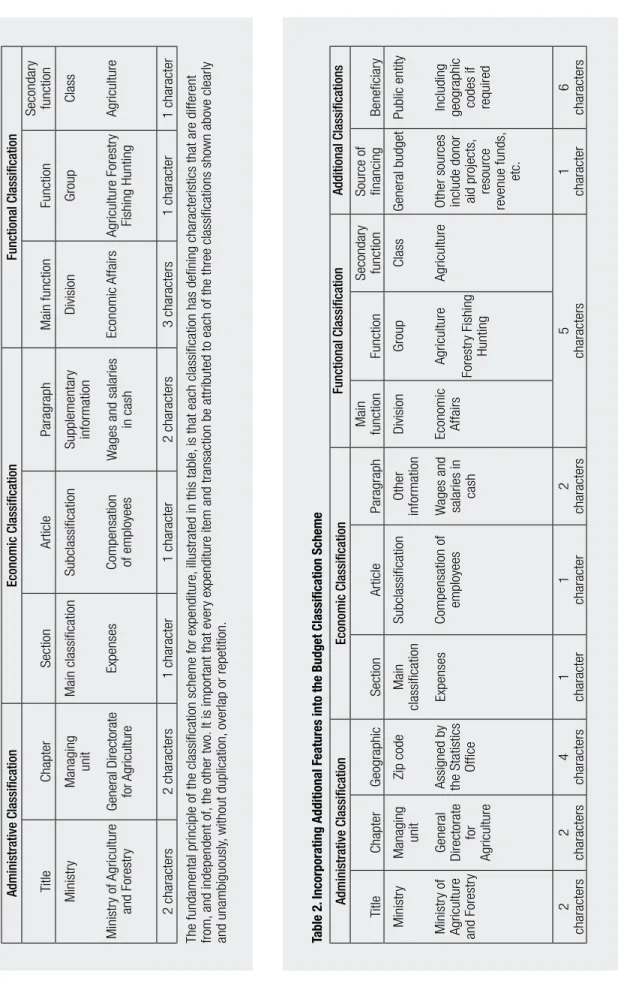
Expenditures are typically recorded against the administrative, economic, and functional classifications. The budget code for each transaction should present, in specific categories, all relevant information regarding that transaction. Table 1 provides an illustrative example
Box 1. Using the Government Finance Statistics Manual (GFSM 2001)
to Design Budget Classifications
The GFSM 2001 provides some specific guidance on certain desirable features of economic and functional classifications:
•
The GFSM 2001 economic classification is presented in Annex III. GFSM 2001 is defined on an accrual basis with a view to creating statistical comparability between fiscal reports and national accounts. However, with the exception of the consumption of fixed capital, the line items in the economic classification of government operations, as presented in GFSM 2001, apply to the cash and the accrual bases equally.1 In a number of cases, the standard GFS tables include netitems. Such items can be sufficient for the purpose of macroeconomic analysis, but not for budget formulation and management. In the government accounts, gross flows should be recorded. Thus, from the policy formulation point of view, the acquisition of financial assets for new policy purposes (e.g. lending to public enterprise) should be separated from the repayments of loans, which are the result of previous policy decisions.
•
The GFSM 2001 functional classification2 corresponds to the United Nations Classification ofthe Functions of Government (COFOG).3 Adopting COFOG instead of a customized classification
presents some advantages. Such an approach is already established and well documented in the GFS manual. It facilitates international comparisons. Many countries may decide, however, to expand the COFOG system to accommodate their actual program structures and deal with specific policy issues. This is recognized in the GFSM 2001.4 In such cases, a mapping table between
COFOG and the functional (and program) classification used in a particular country, or between that country’s organizational classification and COFOG, should be established in order to prepare reports that may be required using the COFOG system.
1 In the GFSM 2001 economic classification, the acquisition of a nonfinancial asset by purchase or barter does not affect net worth, and the transaction is not an expense. It is a transaction in nonfinancial assets. When ownership of an asset is given up without receiving anything of value in return, the net worth of the unit has decreased and the expense is recorded as a type of capital transfer, such as a capital grant.
2 The GFSM 2001 functional classification is presented in Annex IV.
3 The GFSM 2001 functional classification is not limited to expense transactions. Acquisitions of nonfinancial assets can also be classified using the functional classification. In addition, the economic and the functional classification can be cross-classified to show the type of transactions engaged in to carry out a given function. 4 However, this does not mean that it is acceptable for a country to mix up different functions, or misclassify an education function as, for example, immigration, or to create multiple functions to capture what GFSM 2001 considers as a single function.
Table 1. Illustrative Budget Classification Scheme for Expenditures Administr
ative Classification Economic Classification Functional Classification Title Cha pter Section Article Para gra ph Main function Function Secondar y function Ministr y Ministr y of Ag riculture and Forestr y Mana ging unit General Directora te for Ag riculture Main classifica tion Expenses Subclassifica tion Compensa tion of employees Supplementar y inf orma tion W
ages and salaries
in cash Division Economic Af fairs Group Ag riculture Forestr y Fishing Hunting Class Ag riculture 2 characters 2 characters 1 character 1 character 2 characters 3 characters 1 character 1 character
The fundamental principle of the classifica
tion scheme f or expenditure, illustra ted in this ta ble, is tha t each classifica
tion has defining characteristics tha
t are dif
ferent
from,
and independent of,
the other two.
It is important tha
t ever
y expenditure item and transaction be a
ttributed to each of the three classifica
tions shown a bove clearl y and unambiguousl y, without duplica tion, overla p or repetition. Table 2. Incorporating Additional F
eatures into the Budget Classification Scheme
Administr ative Classification Economic Classification Functional Classification Additional Classifications Title Cha pter Geog ra phic Section Article Para gra ph Main function Function Secondar y function Source of financing Beneficiar y Ministr y Ministr y of Ag riculture and Forestr y Mana ging unit General Directora te for Ag riculture Zip code Assigned b y the Sta tistics Office Main classifica tion Expenses Subclassifica tion Compensa tion of employees Other inf orma tion W
ages and salaries in cash Division Economic Affairs
Group Ag riculture Forestr y Fishing Hunting Class Ag riculture
General budget Other sources include donor aid projects,
resource
revenue funds,
etc.
Public entity Including geog
ra phic codes if required 2 characters 2 characters 4 characters 1 character 1 character 2 characters 5 characters 1 character 6 characters
of a classification scheme for expenditures, comprising the three main classifications, eight subclassifications (title, chapter, etc.), and thirteen characters. The names assigned to these subclassifications can differ from one country to another.
Additional Forms of Budget Classification
IV.
In addition to the administrative, economic, and functional classifications, other forms of classification may provide complementary information, in particular:
Classification by
•
geographical location of the administrative unit, taxpayer, or the recipient of government transfers and subsidies;Classification of the
•
beneficiaries of government transfers and subsidies; Classification of the•
sources of financing and counterpart funds used for recording external loans and grants.8Table 2 illustrates the integration of these additional segments in the previous classification scheme, thus creating a code that comprises 24 characters.
Using the Budget Classification Scheme to Track Poverty-Reducing Expenditures
A sound budget classification scheme should make it possible to determine the budget lines affected by poverty-reducing expenditure. In many countries the poverty-reducing strategy program (PRSP) or other government documents define pro-poor expenditures. The task is, therefore, to relate poverty-related spending identified in a PRSP to the government’s existing budget classification scheme, so that timely and periodic accounting reports can be prepared for tracking purposes. Ideally, a program classification should be used for this purpose or, if this is not available, a functional classification (at least to the subfunction level). A challenge to this approach may be the level of detail to which a PRSP identifies spending: in some cases, the spending categories may be too general or broad for the intended purpose (e.g., “primary education” or “improved health”); in other cases, they may be too narrow (e.g., “a new bore-hole in village Y”). Based on the PRSP, pro-poor spending may be identified by using a binary rating system for each transaction (e.g., by assigning the score “0” for nonpoverty-reducing expenditures, and “1” for poverty-reducing expenditures). However, the use of such a system gives only global information. It must be combined with the other classifications in order to give relevant data on poverty-reducing expenditures.
The use of the functional classification has several advantages for tracking poverty-reducing expenditures. Such expenditures can be clearly identified from the budget data, and the links between the PRSP and the annual budget can be analyzed. The identification can be made by using
8 Such a classification has to be used carefully. First, it is contrary to the principle of comprehensiveness (the budget
should present a consolidated picture of revenues and expenditures). Second, its use should not result in imple-menting complex earmarking mechanisms to execute the budget.
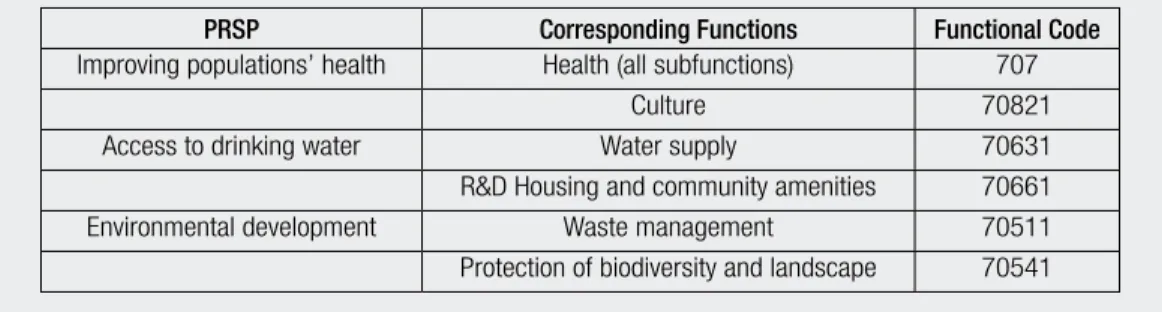
a bridge table that links the data in the PRSP and the functional classification. Table 3 gives an illustrative example of the identification of poverty-reducing expenditures using such an approach.9
Program Classification10
A program is a set of activities that meets specific policy objectives of the government (e.g., preprimary education or the development of crop production). In contrast to a functional classification, a classification by program takes into account the government’s policy objectives and how these policies will be implemented. Programs may be subdivided into homogeneous categories called activities (e.g., the vaccination activity within a disease prevention program), which in turn may encompass a series of related initiatives and projects.
Classifying expenditures by program can serve two purposes: (1) identifying and clarifying the goals and objectives of government spending and (2) monitoring operational performance through performance indicators, which may relate to the inputs, outputs, or outcomes of a particular program.11 A classification by program can contribute to improved transparency and accountability, and help link inputs to objectives or outcomes.
9 In this example, all expenditures in the “health” category are considered to be poverty-reducing (code # 707
in Table 3 above), while for other categories such as “water supply” only the relevant subfunctions are defined as poverty-reducing activities (e.g., “access to drinking water” with code # 70631).
10 See M. Robinson and H. van Eden, 2007, “Program Classification”, in Performance Budgeting: Linking Funding and
Results, ed. by Robinson, pp. 63.
11 Inputs are the resources to produce outputs. They are usually expressed as amounts of expenditure of or
re-sources themselves (e.g. the number of employee/days). Outputs mean the products and services produced directly by a program or activity. Outputs are important, for example, in setting targets for staff to achieve and measuring performance, but do not in themselves indicate the extent to which progress has occurred towards achieving a pro-gram’s ultimate policy objective or purpose. Outcomes represent the economic or social changes brought about by a policy measure, program, or activity. Outcomes are distinct from outputs, which measure the immediate effects of a program or activity. For example, the outcome of a random breath-testing campaign conducted by the police may be a decline in drunk driving, while one of the outputs could be the number of drivers charged with exceeding the legal alcohol limit. See Allen and Tommasi (2001).
Table 3. Example of the Identification of Poverty-Reducing Expenditures
Using a Bridge Table between the PRSP and the GFMS 2001 Functional Classification
PRSP Corresponding Functions Functional Code
Improving populations’ health Health (all subfunctions) 707
Culture 70821
Access to drinking water Water supply 70631 R&D Housing and community amenities 70661 Environmental development Waste management 70511 Protection of biodiversity and landscape 70541
When establishing a program classification, it is important to ensure that (1) clear responsibility for managing the program, and accountability for its results, are allocated to a specific unit and program manager within the ministry or department concerned12 and (2) the requirements for data collection and analysis are kept within reasonable bounds. A programmatic approach has the advantage of encouraging managers in each organization to clearly define their objectives and to consider what results have been achieved. It is thus often linked to the development of a performance-related approach to budgeting. As for the administrative classification, there is no specific international norm for codifying the programs. The program classification depends on the needs in each country.
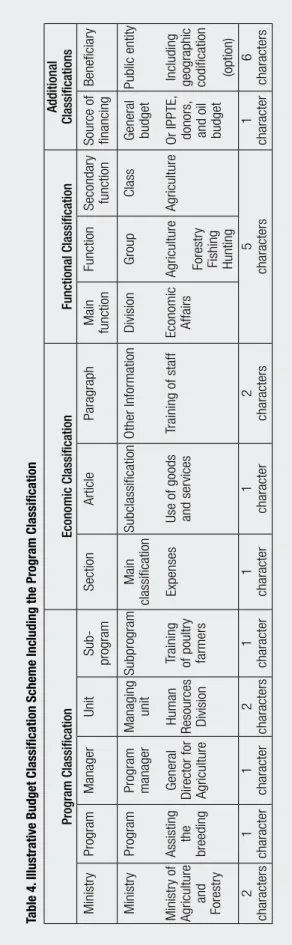
Table 4 gives an illustrative example of a budget classification scheme by program, which replaces the administrative classification shown in Table 2. In this example, each program is assumed to be managed by a specific ministry, which is the easiest way to introduce program budgeting to ensure accountability and to track the relevant expenditures. When a program covers several ministries,13 this approach cannot be used, however, and complex bridge tables are necessary to identify which part of the program each ministry is responsible for.
The Relationship between the Budget and Accounting
V.
Classifications
In most countries, it is generally considered to be good practice for the budget classification and the accounting classification (otherwise known as the financial reporting classification or “chart of accounts”) to be completely integrated.14An integrated budget and accounting classification would incorporate relevant asset and liability accounts. These mainly comprise financial accounts— recording government operations with the central bank, commercial banks, and other financial entities—and suspense accounts. Such an approach is used in particular in the Anglophone countries, where the chart of accounts (COA)is a coding framework for recording budgetary and financial data in the government accounts.15 An example of such an approach is illustrated in Annex I.16
12 This may in turn require a revision of the administrative structure of ministries, which is often quite difficult to
implement.
13 Establishing programs covering several ministries is generally not advisable.
14 The budget classification refers to all coding schemes that are used to define both revenue and expenditure
transactions at budget planning, budget approval, and budget execution. The budget classification, at some level of aggregation, is used to present the budget to the parliament for approval and, once approved, provides the legal expenditure limit, in the case of appropriations, and the approved plan in the case of revenues. The accounting clas-sification (or financial reporting clasclas-sification) is the chart of accounts that is used for administrating, recording, and reporting on financial transactions.
15 This approach has also been used in countries such as Brazil and Mozambique for example.
16 See also A. Khan and S. Mayes, 2009, “Transition to Accrual Accounting”, IMF Technical Notes and Manuals. This
Table 4.
Illustrative Budget Classification Scheme Inc
luding the Program Classification
Prog ram Classification Economic Classification Functional Classification Additional Classifications Ministr y Prog ram Mana ger Unit Sub-prog ram Section Article Para gra ph Main function Function Secondar y function Source of financing Beneficiar y Ministr y Ministr y of Ag
riculture and Forestr
y
Prog
ram
Assisting the breeding
Prog ram mana ger General Director f or Ag riculture Mana ging unit Human Resources Division Subprog ram Training of poultr y farmers Main classifica tion Expenses Subclassifica tion
Use of goods and ser
vices Other Inf orma tion Training of staf f
Division Economic Affairs
Group Ag riculture Forestr y Fishing Hunting Class Ag riculture
General budget Or IPPTE, donors, and oil budget Public entity Including geog
ra phic codifica tion (option) 2 characters 1 character 1 character 2 characters 1 character 1 character 1 character 2 characters 5 characters 1 character 6 characters
In some countries, however, the accounting and budgeting classifications are entirely separate,17 or only partially integrated.18 In particular, they can differ in terms of structure and information content. In such cases, the absence of one-to-one correspondence between entries (or transactions) recorded against the budget and accounting classifications generates a loss of information. It is then impossible to identify with certainty the accounting implications of a given budgetary operation; and reciprocally, identical accounting transactions may not reflect systematically equivalent budgetary operations.
In practice, this issue can be solved in many different ways, including the following:
Implementing a central database for recording budgetary and accounting transactions, so
•
that any entry in the budgetary classification is systematically associated with an entry in the accounts.
Introducing a separate presentation in the accounting classification to ensure the proper
•
recording of budgetary transactions (through a specific class of operations).19
Harmonizing the structure and coverage of both classifications, and developing bridge tables
•
between them.20
Preconditions for the Successful Implementation of a
VI.
New Budget Classification
Political Ownership
Without commitment and leadership at a high political level, it is unlikely that the reform will be successfully implemented. The support of the legislature is also desirable, not only to ensure passage of any new financial management regulations that may be required to implement the reform, but also to endorse and utilize the changed budget presentation and financial reporting that will follow.
Technical Capacity
Building capacity to implement the reform is another critical success factor.If the finance ministry has insufficient skilled and trained staff and other resources, a new budget nomenclature is unlikely to be effective. Strengthened capacity within the budget departments of line ministries and other budgetary institutions (e.g., the treasury, the external audit authority, and the national
17 This is the case in Mexico, for example.
18 In Francophone countries, the integration between the budget classification and the plan compatible has been
limited to the economic classification (with revenue and expenditure classes).
19 In France, for example, specific classes of auxiliary accounts were used until recently to ensure the link between
accounting transactions and budgetary line items.
professional accounting bodies) is also an essential requirement. Outside consultants may be used to supplement in-house resources to develop the new systems and procedures, but are not a substitute for building adequate internal capacity.
IT Systems
Although a modern budget classification scheme can be implemented manually, in practice it is preferable to make use of an electronic system(which does not need to be sophisticated). Computer processing of budgetary transactions permits a reclassification of entries according to the main classification schemes, and strengthens functionality in areas such as administrative accounting and reporting. In many countries, a revision of the budget classification has been introduced as part of the development of an integrated and automated financial management information system (IFMIS).
Critical Steps and Milestones in the Budget Classification
VII.
Reform Process
Depending on the scope of the reform, and the conditions prevailing in a country, a reform of the budget classification can be a lengthy process, in particular to achieve full integration of the budget classification and the COA. Changes are likely to be required in the legal and regulatory framework for the budget, the government’s financial management and information system, and training and outreach programs to raise awareness and upgrade the skills of staff in the ministry of finance and other government entities.
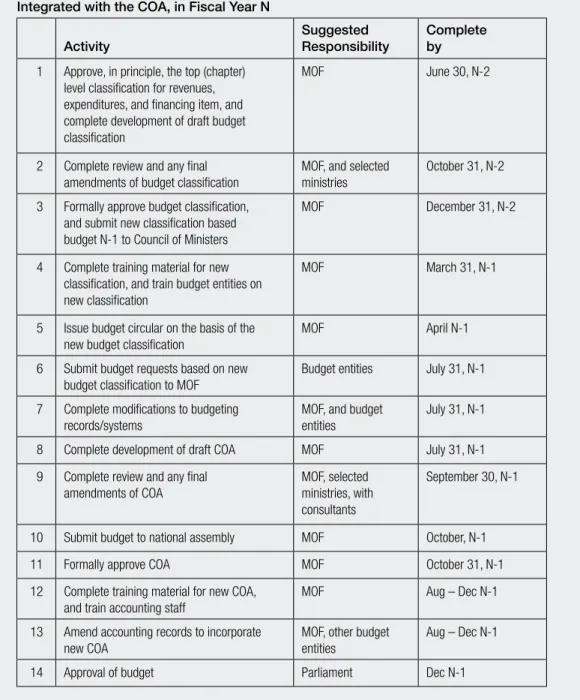
An illustrative timetable for introducing a new budget classification scheme is shown in Table 5. Sufficient time should be allowed for making preparations and implementing the various steps. In most countries, work on preparing the new classification should be completed at least six months before the start of the budget year and, in the case of the COA, at least two months before its implementation.21
A transitional period of sufficient length should be allowed before the new classification system is fully operational,so that (1) the new system can be reviewed by key stakeholders, such as line ministries, the external audit authority, and the legislature; (2) operational guidelines can be developed and training performed for staff in line ministries, local budget institutions, and other entities involved in the reform; and (3) the legal framework can be amended, if necessary. Transfer of knowledge and ownership are key elements if the new classification is to be used as a foundation for preparing and executing the budget.
21 Table 5 is based on FAD’s experience of assisting countries in their introduction of a new budget classification
Table 5. Suggested Timetable for Implementing a New Budget Classification, Integrated with the COA, in Fiscal Year N
Activity
Suggested Responsibility
Complete by
1 Approve, in principle, the top (chapter) level classification for revenues, expenditures, and financing item, and complete development of draft budget classification
MOF June 30, N-2
2 Complete review and any final amendments of budget classification
MOF, and selected ministries
October 31, N-2 3 Formally approve budget classification,
and submit new classification based budget N-1 to Council of Ministers
MOF December 31, N-2
4 Complete training material for new classification, and train budget entities on new classification
MOF March 31, N-1
5 Issue budget circular on the basis of the new budget classification
MOF April N-1 6 Submit budget requests based on new
budget classification to MOF
Budget entities July 31, N-1 7 Complete modifications to budgeting
records/systems
MOF, and budget entities
July 31, N-1 8 Complete development of draft COA MOF July 31, N-1 9 Complete review and any final
amendments of COA
MOF, selected ministries, with consultants
September 30, N-1
10 Submit budget to national assembly MOF October, N-1 11 Formally approve COA MOF October 31, N-1 12 Complete training material for new COA,
and train accounting staff
MOF Aug – Dec N-1 13 Amend accounting records to incorporate
new COA
MOF, other budget entities
Aug – Dec N-1 14 Approval of budget Parliament Dec N-1
References
Ahmad, Ehtisham, Maria Albino-War, and Raju Singh, 2006, “Subnational Public Financial Management: The Public Financial Management Process” (Washington: International Monetary Fund).
Allen, Richard and Daniel Tommasi (ed.), 2001, Managing Public Expenditure: A Reference Book for Transition Countries, SIGMA.
Bouley, Dominique, 2004, Les défis techniques du suivi des dépenses de réduction de la pauvreté dans les pays francophones, Reflets et perspectives de la vie économique, (2004-1), tome XLIII, De Boeck University.
International Monetary Fund, 2001, Government Finance Statistics Manual (Washington: International Monetary Fund).
Khan, Abdul and Stephen Mayes, 2009, “Transition to Accrual Accounting,” IMF Technical Notes and Manuals (Washington: International Monetary Fund).
Lienert, Ian, 2003, “A Comparison between Two Public Expenditure Management Systems in Africa,” IMF Working Paper 03/2 (Washington: International Monetary Fund).
Potter, Barry H. and Jack Diamond, 1999, Guidelines for Public Expenditure Management
(Washington: International Monetary Fund).
Robinson, Marc (ed.), 2007, Performance Budgeting: Linking Funding and Results (Washington: International Monetary Fund).
ANNEX I. Example of a Chart of Accounts (COA) for Expenditur
e, Integrating the Budget Classification
22
22 In this example, the first four columns r
epr
esent the budget classification, and the COA comprises this information and the final column (financial transactions).
Administr ative classification Economic classification Functional classification Additional classifications Financial classification Title Cha pter Section Article Para gra ph Main function Function Secondar y function Source of financing Beneficiar y
Financial and suspense accounts (mainl
y) Ministr y: Ministr y of Ag
riculture and Forestr
y Mana ging unit: (Directora te, project) General Directora te for Ag riculture Main classifica tion Expenses Subclassifica tion Compensa tion of employees Other inf orma tion W
ages and salaries in cash Division Economic Affairs
Group Ag riculture Forestr y Fishing Hunting Class Ag riculture
General budget Or HIPC,
donors,
and
oil budget
Public entity Including geog
ra
phic
codifica
tion
(option)
Bank account Treasur
y account a t the Central Bank 2 characters 2 characters 1 character 1 character 2 characters 2 character 1 character 1 character 1 character 6 characters 4 characters
ANNEX II. GFSM 2001—Classification of Revenue
Revenue
11 Taxes
111 Taxes on income, profits, and capital gains 1111 Payable by individuals
1112 Payable by corporations and other enterprises
1113 Unallocable
112 Taxes on payroll and workforce 113 Taxes on property
1131 Recurrent taxes on immovable property 1132 Recurrent taxes on net wealth 1133 Estate, inheritance, and gift taxes 1134 Taxes on financial and capital transactions 1135 Other nonrecurrent taxes on property 1136 Other recurrent taxes on property 114 Taxes on goods and services 1141 General taxes on goods and services 11411 Value-added taxes
11412 Sales taxes
11413 Turnover and other general taxes on goods and services
1142 Excises
1143 Profits of fiscal monopolies 1144 Taxes on specific services
1145 Taxes on use of goods and on permission to use goods or perform activities
11451 Motor vehicle taxes
11452 Other taxes on use of goods and on permission to use goods or perform activities 1146 Other taxes on goods and services
115 Taxes on international trade and transactions 1151 Customs and other import duties
1152 Taxes on exports
1153 Profits of export or import monopolies 1154 Exchange profits
1155 Exchange taxes
1156 Other taxes on international trade and transactions
116 Other taxes
1161 Payable solely by business 1162 Payable by other than business or
unidentifiable
12 Social contributions
121 Social security contributions 1211 Employee contributions 1212 Employer contributions
1213 Self-employed or nonemployed contributions 1214 Unallocable contributions
122 Other social contributions 1221 Employee contributions 1222 Employer contributions 1223 Imputed contributions
13 Grants
131 From foreign governments 1311 Current
1312 Capital
132 From international organizations 1321 Current
1322 Capital
133 From other general government units 1331 Current 1332 Capital 14 Other revenue 141 Property income 1411 Interest 1412 Dividends
1413 Withdrawals from income of quasi-corporations
1414 Property income attributed to insurance policyholders
1415 Rent
142 Sales of goods and services 1421 Sales by market establishments 1422 Administrative fees
1423 Incidental sales by nonmarket establishments 1424 Imputed sales of goods and services 143 Fines, penalties, and forfeits 144 Voluntary transfers other than grants 1441 Current
1442 Capital
ANNEX III. GFSM 2001—Economic Classification of Expense
Expense 21 Compensation of employees
211 Wages and salaries 2111 Wages and salaries in cash 2112 Wages and salaries in kind 212 Social contributions 2121 Actual social contributions 2122 Imputed social contributions
22 Use of goods and services 23 Consumption of fixed capital 24 Interest
241 To nonresidents
242 To residents other than general government 243 To other general government units
25 Subsidies
251 To public corporations
2511 To nonfinancial public corporations 2512 To financial public corporations 252 To private enterprises
2521 To nonfinancial private enterprises 2522 To financial private enterprises
26 Grants 261 To foreign governments 2611 Current 2612 Capital 262 To international organizations 2621 Current 2622 Capital
263 To other general government units 2631 Current
2632 Capital
27 Social benefits
271 Social security benefits 2711 Social security benefits in cash 2712 Social security benefits in kind 272 Social assistance benefits 2721 Social assistance benefits in cash 2722 Social assistance benefits in kind 273 Employer social benefits
2731 Employer social benefits in cash 2732 Employer social benefits in kind
28 Other expense
281 Property expense other than interest 2811 Dividends (public corporations only) 2812 Withdrawals from income of
quasi-corporations (public quasi-corporations only) 2813 Property expense attributed to insurance
policyholders 2814 Rent
282 Miscellaneous other expense 2821 Current
ANNEX IV. GFSM 2001—Classification of Expense by Function
of Government
23Total outlays
701 General public services
7011 Executive and legislative organs, financial and fiscal affairs, external affairs
7012 Foreign economic aid 7013 General services 7014 Basic research
7015 R&D1 General public services 7016 General public services n.e.c.2 7017 Public debt transactions
7018 Transfers of a general character between different levels of government
702 Defense
7021 Military defense 7022 Civil defense 7023 Foreign military aid 7024 R&D Defense 7025 Defense n.e.c.
703 Public order and safety
7031 Police services 7032 Fire protection services 7033 Law courts
7034 Prisons
7035 R&D Public order and safety 7036 Public order and safety n.e.c.
704 Economic affairs
7041 General economic, commercial, and labor affairs
7042 Agriculture, forestry, fishing, and hunting 7043 Fuel and energy
7044 Mining, manufacturing, and construction 7045 Transport
7046 Communication 7047 Other industries 7048 R&D Economic affairs 7049 Economic affairs n.e.c. 705 Environmental protection 7051 Waste management 7052 Waste water management 7053 Pollution abatement
7054 Protection of biodiversity and landscape 7055 R&D Environmental protection
7056 Environmental protection n.e.c.
706 Housing and community amenities 7061 Housing development
7062 Community development 7063 Water supply
7064 Street lighting
7065 R&D Housing and community amenities 7066 Housing and community amenities n.e.c.
707 Health
7071 Medical products, appliances, and equipment
7072 Outpatient services 7073 Hospital services 7074 Public health services 7075 R&D Health
7076 Health n.e.c.
708 Recreation, culture, and religion
7081 Recreational and sporting services 7082 Cultural services
7083 Broadcasting and publishing services 7084 Religious and other community services 7085 R&D Recreation, culture, and religion 7086 Recreation, culture, and religion n.e.c.
709 Education
7091 Pre-primary and primary education 7092 Secondary education
7093 Postsecondary nontertiary education 7094 Tertiary education
7095 Education not definable by level 7096 Subsidiary services to education 7097 R&D Education
7098 Education n.e.c.
710 Social protection
7101 Sickness and disability 7102 Old age
7103 Survivors
7104 Family and children 7105 Unemployment 7106 Housing
7107 Social exclusion n.e.c. 7108 R&D Social protection 7109 Social protection n.e.c. 1 R&D = Research and development.
2 n.e.c. = not elsewhere classified.
TNM/09/06
International Monetary Fund Fiscal Affairs Department 700 19th Street NW Washington, DC 20431 USA
Budget Classification
Prepared by Davina Jacobs, Jean-Luc Hélis, and Dominique Bouley
Fiscal Affairs Department