Efficient GPU Hardware Transactional Memory through
Early Conflict Resolution
Sui Chen and Lu Peng
Division of Electrical & Computer Engineering, Louisiana State University
{csui1,lpeng}@lsu.edu
ABSTRACT
It has been proposed that Transactional Memory be added to Graphics Processing Units (GPUs) in recent years. One proposed hardware design, Warp TM, can scale to 1000s of concurrent transactions. As a programming method that can atomicize an arbitrary number of memory access locations and greatly reduce the efforts to program parallel applica-tions, transactional memory handles the complexity of inter-thread synchronization. However, when thousands of trans-actions run concurrently on a GPU, conflicts and resource contentions arise, causing performance loss.
In this paper, we identify and analyze the cause of con-flicts and contentions and propose two enhancements that try to resolve conflicts early: (1) Early-Abort global conflict res-olution that allows conflicts to be detected before they reach the Commit Units so that contention in the Commit Units is reduced and (2) Pause-and-Go execution scheme that re-duces the chance of conflict and the performance penalty of re-executing long transactions. These two enhancements are enabled by a single hardware modification. Our evaluation shows the combination of the two enhancements greatly im-proves overall execution speed while reducing energy con-sumption.
1.
INTRODUCTION
GPUs are designed for throughput-oriented computing us-ing large numbers of light-weight parallel threads [12]. For this purpose, they are constructed with compute units that can house large numbers of resident threads and a deeply pipelined memory subsystem that can handle a large number of parallel memory accesses. The GPU is becoming more versatile with its feature set enriching ever since compute acceleration programming models such as CUDA [1] and OpenCL [3] were introduced: features like atomic opera-tions and support for recursion have enabled the construction of programs involving more complicated inter-thread coop-eration. The collection of lock-free data structures [16] and programming libraries keeps expanding as well.
Correct and efficient implementation of synchronization methods in parallel programs that can scale up well is not a trivial task. While accessing a few hash tables may re-quire only a single fine-grained word-based lock, writing a concurrent red-black tree [13] is much more difficult. As such, transactional memory (TM) [8] has gained attention as a way to confront the challenges in the development of paral-lel programs, because it allows all read/write operations in a
transaction to complete atomically as a whole, relieving the programmer of having to tackle fine-grained locks for per-formance and correctness. While most research efforts have focused on TM support on multi-core processors [17] and hardware TM support has begun entering commodity CPUs [4], both software and hardware transactional memory sys-tems have been proposed for GPUs as well. One of such proposal is named “Kilo TM” [6], followed by its successor “Warp TM” [7].
Like ordinary GPU programs, GPU hardware transactional memory also faces the challenge of resource contention. As the high amount of concurrency on GPUs puts great pressure on the memory subsystem, a programmer needs to spend great amounts of effort in optimizing the memory access pattern of the program in question, otherwise the program would not scale well and even increasing the number of con-current threads would harm performance [20]. The same phenomenon is also observed in Kilo TM and Warp TM, where having too many concurrent transactions may increase conflicts and resource contention, resulting in decreased per-formance.
In this paper, we analyzed the performance penalty result-ing from conflict and contention with benchmarks runnresult-ing on Warp TM. Our analysis leads to two enhancements that can lead to performance improvement on top of Warp TM:
• Early-Abort global conflict resolution: Conflicting addresses are made accessible from the SIMT cores so that resolution of certain types of conflict can be done on the cores, reducing contention at the Commit Units and the interconnection network, and
• Pause-and-Go execution scheme: Running transac-tions are stalled when a conflict is likely to happen, which protects the work the transaction has done so far from being wasted.
According to our experimental results, the two approaches result in an overall speedup of up to 1.41x compared to Warp TM at an average power consumption of 0.8x. Further, the enhancements used in this paper may be applied on top of various TM implementations because its correctness is guar-anteed by the underlying TM implementation.
We make the following contributions in this paper: 1. We analyze the performance overhead of conflicts in
transactional memory on GPUs.
2. We study GPU TM programs with short-running and long-running transactions.
3. We propose a simple hardware modification for reduc-ing conflict and contention.
4. We propose two enhancements which may be used on GPU TM systems with various underlying implemen-tations.
2.
BACKGROUND
2.1
Transactional Memory
Transactional memory (TM) [8] is a technology that al-lows the programmer to mark code regions as “transactions” that satisfy serializability and atomicity. It may be viewed as a generalized version of the atomic compare-and-swap struction, which can operate on an arbitrary set of data in-stead of just one machine word.
The lifetime of a transaction consists of four major states: 1) executing, where it performs speculative read/write op-erations that constitute a transaction, 2) committing, where it is being checked against other committing transactions to see if data hazards exist, 3) aborted, where a transaction fails conflict detection and is aborted, with its speculative execu-tion squashed, and 4) committed, where a transacexecu-tion passes conflict detection and its speculative results written to the memory.
Transactional memory systems fall into distinct subregions of the design space [5]. Design choice can be made on when conflict detection is performed. An eager TM system per-forms conflict detection during execution while a lazy one does it in the commit stage. Another choice can be made on where to store versioning meta-data. The meta-data may reside on the memory side in the form of ownership records, which are mapped to parts of the memory, such as locks as-sociated with machine words [24] or objects [9] [10]. The meta-data may also reside on the thread side in the form of read/write logs, a buffer that keeps the speculative read/write values in a transaction.
Both hardware-based and software-based transactional mem-ory systems have been proposed for GPU systems. Both have to take into account the characteristics of the GPU in order to be efficient. We will be discussing and improv-ing on a hardware-based TM system, Warp TM[7] (which is built on Kilo TM [6]) in this paper.
2.2
Kilo TM
Kilo TM [6] is a hardware-based GPU transactional mem-ory system, which features value-based validation and lazy version management, thus allowing the programmer to write weakly-isolated transactions in GPU kernel code. It is based on an algorithm similar to RingSTM [18].
In the base algorithm, the life time of transactions can be divided into execution and commit. During execution, the transactional loads and stores performed are buffered in read- and write-logs. During commit, the logs are trans-ferred to the Commit Units in the memory partitions for conflict detection and resolution. Conflicts between com-mitting transactions are detected using an algorithm simi-lar to RingSTM [18], with transactions claiming entries in a
ring buffer and committing in a global order. To speed up committing, the validation step is performed in two stages. The first stage involves probabilistically detecting overlap between the signatures of read- and write-sets encoded with bloom filters, which is also called hazard detection. The second stage isvalue-based validationand it is needed only when hazard exists and is responsible for resolving false haz-ards.
The Kilo TM design introduces new hardware units and new hardware features to enable the operation of transac-tional memory. The execution stage of transactions takes place in the SIMT cores. The load/store units are responsible for maintaining the read- and write-logs for transactions that are being executed. The SIMT stack is extended to handle transactional code blocks. The commit stage takes place in the Commit Units, which implements the ring buffers, bloom filter-based signatures and valid-based validation. The Com-mit Units are located in the memory partitions. The entire address space is divided into disjoint sets, each of which is managed by one Commit Unit. As such, the implementation is a distributed algorithm which involves multiple Commit Units, and a protocol that aggregates and broadcasts vali-dation results between the Commit Units and SIMT cores. At the beginning of a commit, the transactional log walk-ers transfer the logs to the Commit Units. When validation results are computed, they are sent back to the originating SIMT cores.
2.3
Warp TM
Derived from Kilo TM, Warp TM [7] introduces the im-portant concept ofwarp-level transaction management, based on the fact that threads in GPU are executed in lock-step, re-ferred by NVidia as “warps”. This is reflected in various aspects of the design of the GPU hardware. As a result it is advantageous to handle the threads in a warp as a single entity.
Based on this, Warp TM implemented two optimizations. First, scalar protocol messages in Kilo TM are superseded by coalesced protocol messages in Warp TM. Second, conflicts within a warp are resolved prior to the transfer of read/write sets for global commit and validation. This can reduce con-tention and delay at the Commit Units, improve performance and reduce energy consumption.
3.
CONFLICT AND CONTENTION
REDUC-TION
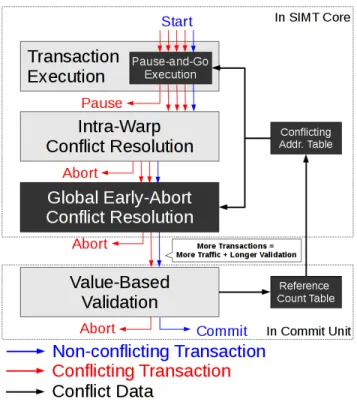
In this section, we list the conflict types in a way that is relevant to the GPU architecture in question. Because of the GPU architecture, certain types of conflict can be resolved at the SIMT cores. The others have to travel through the Commit Units, as illustrated in Figure 1. So, more conflicts resolved on the core side means fewer transactions need to reach the Commit Unit for conflict resolution. Here we give types of conflicts and indicate the opportunities.
3.1
Spatial and Temporal Types of Conflict
Spatial: A conflict between two simultaneously running transactions in the GPU transactional memory may span across different levels of thread hierarchies, as illustrated in Figure 1. Depending on the location of the transactions in a conflict
Figure 1: Spatial and Temporal Types of Conflict in a GPU TM and the resolution flow of conflicts (end of ar-row = resolved). Pause-and-Go and Early-Abort Global Conflict Detection are added in this paper to resolve more conflicts before they reach for the Commit Unit.
pair there exist three non-overlapping spatial types: Type 1 (intra-warp), Type 2 (inter-warp, but in the same block), and Type 3 (inter-block).
Since the shared memory is the “most recent common ancestor” in the memory hierarchy accessible to threads in the same block, Type 1 conflicts can be resolved within the SIMT core using the shared memory, as is described as Intra-warp Conflict Resolutionin Warp TM. Type 2 conflicts, how-ever, are not handled by warp-level conflict detection due to the overhead of increased complexity and the rarity of Type 2 conflicts. Type 3 conflicts involve global read/write sets so they cannot be resolved in the core.
The detection of both Type 2 and 3 conflicts needs to be done in one level higher in the memory hierarchy which is the off-chip DRAM partitions, the “most recent common an-cestor” in the memory hierarchy accessible to threads in dif-ferent blocks.
One transaction may be involved in more than one type of conflict with other transactions, but all transactions can-not commit if one conflicts with any committing transaction at all. Performance improvement can come from resolving Types 2 and 3 conflicts at the SIMT core in addition to Type 1.
Temporal: For transactions not executing in lock-step, they must overlap both temporally and spatially to conflict with each other. Recall that the two steps in the life time of a transaction are execution and commit. Depending on the step the transactions in a pair are in, there exist three non-overlapping temporal types: Type 1 (committing and com-mitting), Type 2 (committing and executing) and Type 3 (ex-ecuting and ex(ex-ecuting). All 3 types of conflicts must be re-solved at the Commit Unit with one exception that read-only
Figure 2: Transaction Flowchart
transactions may self-abort when it failsTemporal Conflict Detection[6] because only the Commit Unit has the infor-mation needed for conflict resolution.
To summarize, the more conflicts resolved before a run-ning transaction reaches the Commit Unit, the less contention there will be in the entire system. In this paper we propose two new approaches that resolve conflicts of Spatial Type 3 (inter-block) and of Temporal Type 2. The approaches are enabled by modifying existing hardware that makes conflict data available in the SIMT cores illustrated in Figure 2. The two approaches are:
• Early-Abort global conflict resolutionresolves con-flicts between transactions about to commit and the ones already committing. Similar to intra-warp con-flict detection, it reduces the number of transaction reach-ing the Commit Unit and saves validation cost.
• Pause-and-Go execution schemeresolves conflicts be-tween executing transactions and committing transac-tions by temporarily stalling transactransac-tions that are about to execute load/store instructions that may result in a conflict. It reduces the incidence of conflicts.
The result is fewer conflicts, less resource pressure on the Commit Unit, and better overall performance. Both ap-proaches are enabled by the hardware modification described in Section 4.
3.2
Concerns over Correctness
It is of utmost importance for a transactional memory sys-tem to guarantee the correct execution of transactions. In this paper, correctness is guaranteed by the last step in the trans-action execution flow, value-based validation. Early-Abort can only abort transactions selectively and never commits
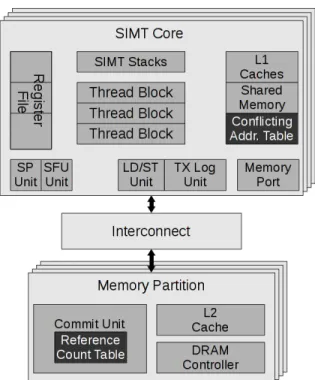
Figure 3: The TM-enabled GPU architecture. The Con-flict Address Table and the Reference Count Table are added in this paper.
the write sets to the memory; Pause-and-Go does not abort any transaction so it does not cause inconsistency. More specifically, what may happen when a false positive or a false negative occurs is:
• If a non-conflicting transaction is aborted, its work up to the commit point is wasted and it will restart from the beginning of the transaction.
• If a conflicting transaction is not identified in Pause-and-Go or Early-Abort, it will eventually be aborted at the Commit Unit. This is the same expected behavior as in Warp TM.
Another potential problem that TM systems may encounter is livelocks, which are caused by transactions repeatedly abort-ing another. Similar symptoms are named by Bobba [5] as
Friendly Fire and Dueling Upgrades. Pause-and-Go and Early-Abort do not introduce such “pathologies” because only committing transactions are allowed to abort execut-ing transactions but not the other way around, resultexecut-ing in an implicit conflict management policy that gives priority to committing transactions. Therefore, a pair of transactions could not repeatedly abort each other.
4.
HARDWARE MODIFICATIONS TO WARP
TM
The modified hardware is depicted in Figure 3. It consists of two address-indexed lookup tables. The per-SIMT-core Conflict Address Table (CAT) maps addresses to two bits indicating whether a word is written or read by committing transactions. The per-Commit-Unit Reference Count Table
Figure 4: The Conflicting Address Table (CAT) in SIMT cores and the Reference Count Table (RCT) in Commit Units, and the operations related to the two tables on the Warp TM protocol message time line.
(RCT) maps addresses to the number of readers and writers. The Commit Unit maintains the Reference Count Table as it processes committing transactions. The Conflicting Address Tables on the cores are updated through the interconnection network.
When a transaction is executing, the SIMT core tries to resolve conflicts early utilizing the Conflicting Address Ta-ble.
4.1
Maintaining the Reference Count Table and
the Conflict Address Table
When a transaction starts committing, it will potentially be involved in conflict with all other committing and running transactions over the addresses in its read and write sets. To detect conflict between a committing transaction and a run-ning transaction, the read/write logs of the committing trans-action have to be made visible to the SIMT cores. The two tables work in conjunction to achieve this goal.
The Reference Count Table in a Commit Unit keeps the number of readers and writers. It is updated when commit-ting transactions are processed.
When log transfer is completed, read/write addresses reach the Commit Units. The read addresses are being appended to the ring buffer as well as the validation queue and are pre-pared for value-based validation. The write addresses are inserted into the Last Writer History Table, which is also an address-indexed lookup table. At these two points, the
reader/writer count of an address is incremented for each ad-dress appearing in the read/write set.
As the Commit Unit receives validation reply from the L2 cache, it checks the value of each of the words in the read set. If all values in the read set match the values in the memory, the transaction passes value-based validation. If any address does not match, the transaction fails validation. Whether the outcome of the transaction is, the addresses will not be used by the transaction anymore. So, when the out-come is known, the Commit Unit traverses the read/write logs and decrements the reference counts.
The core-side Conflict Address Tables reflect which ad-dresses are being referenced in the Commit Unit. Every time addresses are inserted into or removed from the per-Commit-Unit Reference Count Table, a message is sent from the Commit Unit to notify all the SIMT cores of the change in the address set. The message consists of a series of en-tries, each of which contain the word addresses, a read/write bit and an add/remove bit. Since the words are aligned to a multiple of 4 bytes, the two least significant bits in the addresses are always zero. Thus, each entry can be made ex-actly 4 bytes long. When the SIMT cores receive the packets, they update the Conflict Address Tables accordingly. Figure 4 gives a visual description of the two tables and how they are updated.
4.2
Table Size Limit
When the Reference Count Table is full, new entries will be simply ignored. The Conflict Address Tables will not be updated in this case, either.
Opportunity for reducing contention may be missed when the tables are full, but the correctness of transactions will not be affected since the correctness is guaranteed by the TM implementation in the value-based validation stage.
4.3
Early-Abort Utilizing the Conflicting
Ad-dress Table
Early-Abort (EA) tries to detect Spatial Type 3 (inter-block conflict) conflicts at the intra-warp conflict resolution stage and abort the conflicting transactions. By avoiding sending the read/write sets of the conflicting transactions to the Com-mit Unit, Early-Abort reduces the resource contention in the Commit Unit.
This step requires matching the read/write sets of the threads in a warp with the addresses in the CAT. The match is imple-mented by performing a table look-up during the log scan-ning process. Assuming a 4-port L1 cache, the lookup takes up to 8 cycles for a warp with 32 active threads. The match overlaps with the mark-and-checkIntra-Warp Conflict Res-olutionstep. When a transaction reads/writes an address in the CAT, it is considered likely to be in conflict with another committing transaction and is aborted (except for read-read transactions.) After this step, the transactions in a warp are free of Spatial Type 1 (intra-warp) conflicts with reduced Spatial Type 3 (inter-block) conflicts.
4.4
Pause-and-Go Execution
Certain transactional applications contain very long trans-actions or large read/write sets and may encounter conflict over only a small fraction of the read/write sets, resulting
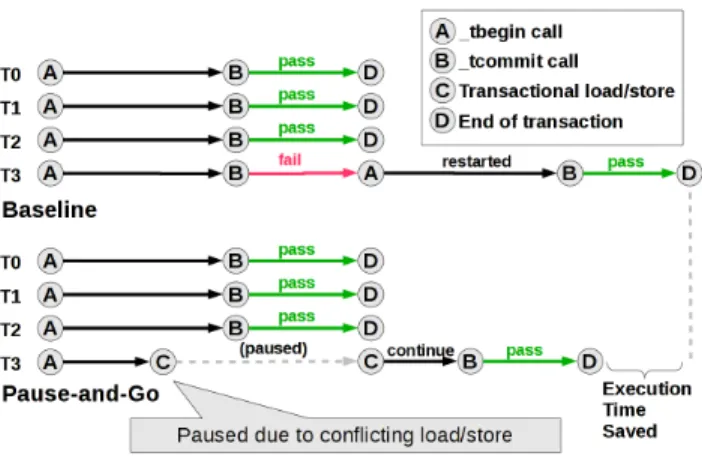
Figure 5: Pause-and-Go execution scheme showing two warps of 4 transactions committing, one of which fails validation.
in most of the work being wasted. Pause-and-Go execution takes a more “gentle” approach to such conflicting transac-tions, trying to avoid aborting the entire transaction while resolving the conflicts. This approach is similar to Stag-gered Transactions [23] proposed for CPU-based transac-tional memory systems, where critical regions are serialized to avoid completely aborting transactions.
At each load/store instruction, the read/write addresses for a warp are checked against the Conflict Address Table, which may take up to 8 cycles with a 4-port L1 cache. A thread that is likely to conflict is temporarily “paused”. The remaining threads will continue executing and attempt to commit. When the attempt is completed, the control flow will return to the paused threads.
By pausing a potentially conflicting transaction before the commit stage, the “paused” thread can simply avoid the con-flict without having to restart execution. Restarting a trans-action is costly especially for long transtrans-actions. Figure 5 il-lustrates one case where Pause-and-Go avoids wasting work done by an otherwise aborted transaction.
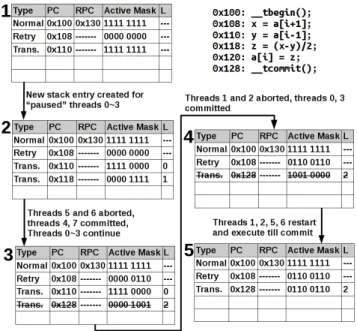
In order to correctly recover the transactional logs upon the resume of paused transactions, the Log Index (L col-umn) is added to the SIMT stack. The Pause-and-Go execu-tion scheme revolves around the SIMT stack and the trans-actional logs.
SIMT Stack: Pause-and-Go execution introduces new SIMT stack states. Figure 6 describes how they are main-tained. In 1, transactions start, with one Retryentry and oneTransentry pushed onto the SIMT stack. The threads execute the instruction at 0x110, which performs a transac-tional load. The addresses loaded by threads 0-3 exist in the Conflicting Address Table, so they are “paused” and will not continue executing with threads 4-7 for this commit at-tempt. This results in the SIMT stack configuration in 2, where twoTransentries exist on the top of the stack. The top of stack which represents threads 4-7 attempt to com-mit, but only threads 4 and 7 passed validation. Bits 5 and 6 are set on theRetryentry. The top of stackTransentry is popped from the stack, and theTransentry representing the previously paused threads 0-3 becomes the top of stack. Threads 0-3 execute and attempt to commit, but only threads
Figure 6: SIMT Stack handling in “Pause-and-Go” exe-cution scheme.
Figure 7: Transactional logs (left) and SIMT stack (right) after three rounds of “pause.”
0 and 3 passed validation. Bits 1 and 2 are set on theRetry
entry and results in the stack configuration in4. After the
Transentry is popped from the stack, theRetryentry be-comes the top. After that, execution flow is identical to what is expected in the original Kilo TM and Warp TM, where the
Retryentry is copied to create a newTransentry.
Branch divergence inside paused threads is also handled in exactly the same way as in Kilo TM and Warp TM.
Transactional logs:When a warp is being executed, the Log Index in its corresponding SIMT stack entry is kept in sync with the log pointer of its transactional log walker, as illustrated in Figure 7. To back up the transactional logs for the paused transactions, the log pointer is stored in the Log Index field for the newly createdTransSIMT stack entry. To resume the transactional logs, the log pointer is simply reset to the value in the Log Index field in the SIMT stack when the paused transactions resume.
The reason backup and restore can be done with just mod-ifying the log pointer is because a log entry represents all the transactions in a warp, including inactive ones, for which the entries contain zeroes. The logs are then interleaved into a linear buffer. As a result, the log entries of paused trans-actions will not get overwritten by other active transtrans-actions,
Table 1: GPGPU-Sim Configuration
GPU
SIMT Cores 15
SIMD Width 16 x 2
Warps/Threads per Core 48 warps×32 = 1536 threads Memory Partitions 6
Core/Interconnect/Memory clock 1400/1400/924 MHz Warp Scheduler Count 2 per core
Warp Scheduler Policy Greedy-then-oldest
L1 Data Cache per Core 60KB / 48KB, 128B line, 6-way (Not caching global accesses) Shared Memory per Core 16KB
L2 Cache for all Cores 128KB×6 partition = 768KB Interconnect Topology 1 Crossbar per direction
Interconnect Bandwidth 32B/cycle = 288GB/s per direction Interconnect Latency 5 cycles to traverse
DRAM Scheduler Out-of-order, FR-FCFS DRAM Scheduler Queue Size 16
DRAM Return Queue Size 116
DRAM Timing Hynix H5GQ1H24AFR Min. L2 Latency 330 Compute cycles
Warp TM
Commit Unit Clock 700 MHz
Validation/Commit BW 1 Word per cycle per CU Concurrency Control 2 Warps per core
(960 concurrent Txns) Intra-Warp CD Resources 4KB Shared memory per warp Intra-Warp CD Mechanism 2-Phase Parallel Conflict Resolution TCD Last Written Time Table 16KB (2048 entries in 4 sub arrays) TCD Detection Granularity 128 Byte
Contention Reduction
Conflict Address Table per Core 12KB (3072 entries) Reference Count Table per CU 15KB (3072 entries)
and restoring the log state only includes changing the log pointer.
5.
INTEGRATING WITH WARP TM
As Figure 2 shows, Early-Abort global conflict resolution (EA) and Pause-and-Go (PG) execution scheme are added to the transactional execution flow. Due to the fact that the Reference Count Tables are only updated when a transac-tion starts committing and the existence of delay in passing message from the Commit Units to the SIMT cores, EA and PG may cause false positives in aborting or pausing trans-actions. As is discussed in Section 3.2, the correctness of transactions will be guaranteed by the TM and therefore not affected. Together they constitute a hierarchical validation scheme similar to Warp TM and the GPU STM[24].
The two approaches proposed in this paper can achieve performance improvement regardless of the number of con-current transactions per SIMT core.
The Reference Count Tables in the Commit Units may be constructed via minor modifications on the Last Write History Table. The Conflicting Address Tables in the SIMT cores may be constructed with the same hardware as the L1 cache and the Shared Memory. For a fair comparison, we give the baseline GPU of our comparison extra L1 cache with the size of the Conflict Address Table (extra 12 KB), as described in Table 1.
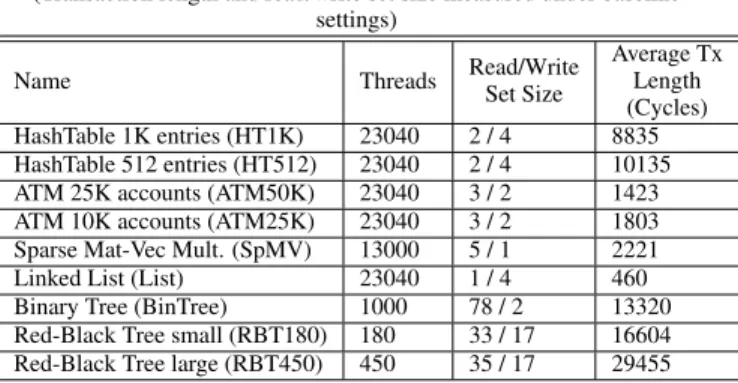
Table 2: Benchmark Properties
(Transaction length and read/write set size measured under baseline settings)
Name Threads Read/WriteSet Size
Average Tx Length (Cycles) HashTable 1K entries (HT1K) 23040 2 / 4 8835 HashTable 512 entries (HT512) 23040 2 / 4 10135 ATM 25K accounts (ATM50K) 23040 3 / 2 1423 ATM 10K accounts (ATM25K) 23040 3 / 2 1803 Sparse Mat-Vec Mult. (SpMV) 13000 5 / 1 2221 Linked List (List) 23040 1 / 4 460 Binary Tree (BinTree) 1000 78 / 2 13320 Red-Black Tree small (RBT180) 180 33 / 17 16604 Red-Black Tree large (RBT450) 450 35 / 17 29455
We extend the Warp TM hardware platform using GPGPU-Sim 3.2.1 [2]. It simulates a device similar to NVidia GTX 480 (Fermi). Table 1 summarizes the key architectural pa-rameters. The following benchmarks are used in our evalua-tion:
Hash Tableis a benchmark used in Kilo TM, where each thread inserts into a hash table, each being a linked list. In this paper we use table sizes 1024 and 512 to create higher contention workloads.
Bank Account (ATM)is a benchmark used in Kilo TM, where each thread performs bank transactions between two out of a fixed number of accounts. In this paper we consider 25K and 10K accounts.
SpMVis a program that multiplies a vector and a sparse matrix represented in the Yale format. Transactions are used to update the destination vector.
Listis based on theListRelbenchmark from DSTM2 [10]. The task of each thread is to insert a node into a linked list. Each thread first finds the insertion point in non-transactional code, then performs the insertion with a trans-action.
BinTreeis a generic binary search tree. The tree is pro-grammed in a way similar to List, where each transaction first finds the insertion point in non-transactional mode and then performs the insertion with a transaction.
RBTreeis a port of the red-black tree implementation in the RSTM [15] test suite. Each thread performs an insertion into the red-black tree with a transaction.
Table 2 summarizes the benchmarks. The benchmarks differ in transaction length, read/write set size, contention rate and working set size. This allows us to evaluate the early conflict resolution approaches in a wide range of situations.
We used GPUWattch [14] to estimate the average dynamic power consumed by each benchmark with the two proposed approaches added to Warp TM. This includes the lookup and maintenance of the Reference Count Tables and the Con-flicting Address Tables, as well as the extra interconnection traffic required to update the Conflicting Address Table. We then multiply the average power by the execution time to obtain the total energy needed to execute each benchmark.
7.
EXPERIMENTAL RESULTS
In this section, we analyze the performance improvements resulting from the proposed enhancements, Early-Abort (EA)
Figure 9: Normalized Energy Consumption. The lower the better.
Figure 10: Overall Number of Aborted Transactions.
and Pause-and-Go (PG) and compare the results with the baseline.
7.1
Performance and Power Consumption
Figure 8 and 9 shows the overall running time breakdown of the benchmarks and the overall energy consumption. Over-all, the proposed approaches yielded a speedup of 1.41x (an average of 0.71x running time) compared to baseline Warp TM. On average, enabling both approaches yielded higher performance improvement than using either approach alone. The average energy consumption has also decreased due to the decrease in execution time. On average the energy con-sumption is 0.8x compared to the baseline Warp TM.
A closer look at the benchmarks suggest that the Early-Abort (EA) yields greater performance improvement than Pause-and-Go (PG) for Hashtable (HT1K and HT512), Bank Account (ATM25K and ATM10K) and SpMV; Pause-and-Go performs better on Binary Tree (BinT) and Red-Black Tree (RBT450 and RBT180).
The running time result shows that Hashtable (HT1K and HT512), Bank Account (ATM25K and ATM10K) and SpMV spend a significant amount of time in the Commit Unit and they perform better with Early-Abort. Since Early-Abort
Figure 8: Overall Running Time and Per-Transaction Breakdown, where GM stands for Geometric Mean of all bench-marks. The lower the bar, the faster.
reduces the number of conflicting transactions entering the Commit Unit, transactions in these benchmarks can commit faster.
On the contrary, some of the benchmarks benefit more from Pause-and-Go and their running times are mainly spent in the SIMT core.
The aforementioned results are caused by multiple rea-sons including the average transaction length, types of con-flict between the transactions, running time breakdown and the degree of branch divergence in each of the benchmarks.
7.2
Performance Improvement from Reduced
Commit Unit Contention
For Hashtable (HT1K and HT512), Bank Transfer (ATM25K and ATM10K) and SpMV, we can see a correlation between the reduced number of transactions aborted at the Commit Unit (Figure 10) and the improved overall performance (Fig-ure 8).
The reason behind the correlation is two-fold:
• First, aborting conflict transactions at the SIMT core side prevents resource contention at the Commit Unit, which makes committing faster;
• Second, due to the shortened delay, the SIMT core can complete committing the current warp and switch to other warps more quickly.
The correlation between the load on Commit Unit and overall performance is most obvious in Hashtable (HT1K and HT512): the ratio between aborts at the SIMT core and Commit Unit has shifted dramatically. With Early-Abort en-abled, more than half of the transactional aborts occur in the SIMT cores. This means there were many conflict pairs that fall into the Type 2 (inter-warp) and 3 (inter-core)
cat-Figure 11: Overall Breakdown of types of conflict be-tween all running transactions, counted in pairs of trans-actions, by whether read/write addresses overlap.
egories that were not resolved by intra-warp conflict resolu-tion alone, but are resolved by Early-Abort global conflict resolution. As a result, despite the higher number of cu-mulative aborts, the transactions are able to complete faster because the Commit Units are less congested.
Figure 11 shows that in Hashtable (HT1K and HT512), Bank Account (ATM25K and ATM10K) and SpMV, more than half of the conflicts between transactions are of Type 3. Most of the conflicts can be detected by Early-Abort in the SIMT core, but would have to go through the Commit Unit in Warp TM with only intra-warp conflict resolution en-abled. On the other hand, enabling Pause-and-Go execution scheme reduces the overall number of aborts and amount of
Figure 12: Average transaction length in cycles.
Hashtable insertion kernel: __tbegin();
int hash = key, pool_slot = tid+1
BaseEntry *base = &g_hashtable->mValues[hash]; tTableEntry *ent = &g_entrypool[pool_slot]; ent->mKey = key;
ent->mValue = value; ent->mNext = base->mIndex;
g_hashtable->mValues[hash].mIndex = pool_slot; __tcommit();
Binary tree insertion kernel: __tbegin();
while (true) {
if (val < curr->val) { if (curr->left == NULL)
curr->left = my; break; else curr = curr->left; } else {
if (curr->right == NULL) curr->right = my; break; else curr = curr->right; } }
__tcommit();
Figure 13: Transactional code regions in Hashtable and Binary Tree.
conflicts most of the time.
7.3
Performance Improvement from Reduced
Aborts
For List, Binary Tree (BinT) and Red-Black Tree (RBT450 and RBT180), Pause-and-Go execution scheme achieves sim-ilar or greater performance improvement than Early-Abort does. This is because of the following two reasons:
• The three benchmarks spend a significant portion of time in transaction execution, rather than in the Com-mit Unit. Thus, the speedup from reduced transaction re-execution becomes more significant. Figure 10 sug-gests that the absolute number of aborts are always re-duced when Pause-and-Go is activated.
• The three benchmarks are inherently more divergent than Hashtable, ATM and SpMV, so branch divergence
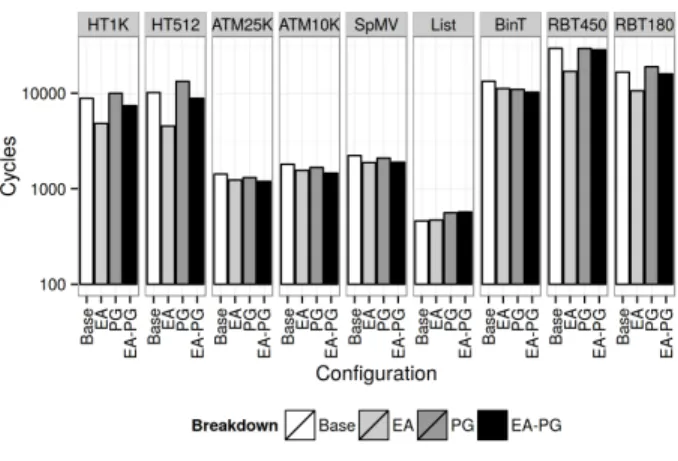
resulted from Pause-and-Go gets amortized with diver-gence, and do not affect the overall speedup much. With fewer transactions aborted (Figure 10) and no signif-icant increase in average transaction execution length (Fig-ure 12), the time spent on re-execution is decreased, result-ing in overall speedup for List, Binary Tree and Red-Black Tree.
Figure 13 shows the transactional part of Hashtable and Binary Tree. The Hashtable kernel does not have any if
statements, so each thread executes the same code path. For Binary Tree, the data affects the code path executed by the threads in a warp and can cause branch divergence. This means that the length of transactions in Binary Tree is vari-able and can be much longer than that of a Hashtvari-able even if the average transaction length is similar, making re-execution more costly. Also, the performance penalty caused by branch divergence resulting from pausing threads is less significant in Binary Tree. This can be justified by Figure 12, as the number of cycle per transaction for Binary Tree actually de-creased.
In contrast, branch divergence induced by Pause-and-Go could cause transactions to run longer for HashTable. Ap-plying either Early-Abort or Pause-and-Go reduces aborts at the Commit Unit to the same level for HashTable, but due to the longer average transaction length, Pause-and-Go does not deliver as much performance improvement as Early-Abort.
7.4
Combining Early-Abort and
Pause-and-Go Execution Scheme
According to the experimental results we can observe the following:
• Enabling both approaches yields a greater performance improvement in Hashtable (HT1K and HT512), Bank Account (ATM25K and ATM10K) and SpMV than en-abling either approach individually.
In these applications, the number of aborts at the Com-mit Unit is fewer than when enabling either approach individually.
• Enabling both approaches in List gives the same im-provement as enabling Pause-and-Go alone does. In fact, Early-Abort is never triggered in this benchmark.
• Enabling both approaches in Red-Black Tree (RBT450 and RBT180) is not as good as enabling only Pause-and-Go.
The reason is, when Early-Abort and Pause-and-Go are enabled simultaneously, performance penalty resulting from false positives would arise (non-conflicting trans-actions are wrongly aborted at the SIMT core). The penalty is re-execution which could be expensive, so the result is less optimal than when using Pause-and-Go alone.
Therefore, we can devise the following rules for applying either or both early conflict resolution approaches:
• If the benchmark consists of large read/write sets (Red-black tree, Binary Tree), apply Pause-and-Go execu-tion scheme;
Figure 14: Sensitivity of Relative Speedup to Table Sizes.
• If the benchmark consists of mostly Type 1 conflicts and almost no conflicts of other 2 Types (example: List, Binary Tree), apply Pause-and-Go execution scheme;
• If the benchmark consists of considerable amounts of Type 3 and 2 conflicts, apply Early-Abort; further, if it consists of short transactions with small read/write sets, apply both Pause-and-Go and Early-Abort.
7.5
Sensitivity to Table Size
We vary the size of the Reference Count Table and the Conflicting Address Table and see how the performance im-provement from applying either or both early conflict resolu-tion methods changes. The sizes are varied from 10 through 100000. The results for HT1K, ATM10K, SpMV, List, BinT and RBT450 are shown in Figure 14.
Overall, for all benchmarks except List, a larger table size gives greater performance improvement. Increase of speedup slows down after the table size exceeds around 1000 for SpMV and RBT450 or around 3000 for HT1K and ATM10K. This means the table size of 3000 is enough for tracking all the addresses touched by the concurrent transactions. For List, a very small table size (say 10) performs as well as a large table.
7.6
Interconnection Network Delay and
Traf-fic
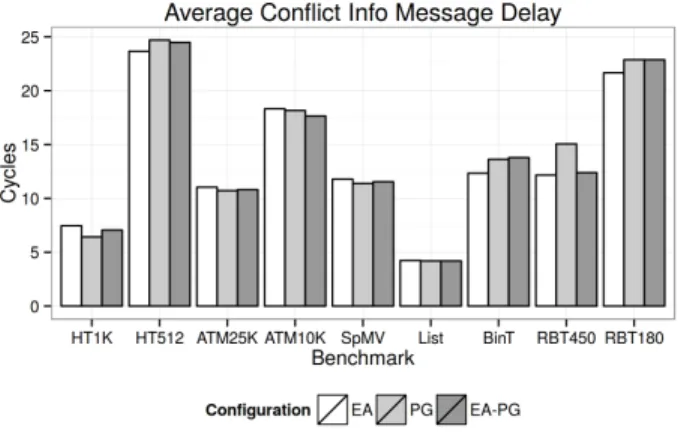
Early-Abort and Pause-and-Go relies on passing of con-flict address information from the Commit Units to the SIMT cores. For the benchmarks we used in this paper, it takes 5 to 25 cycles for the conflict address messages to travel from the
Figure 15: Average message delay between the Commit Unit and the SIMT cores.
Commit Units to the SIMT cores, as is shown in Figure 15. The results indicate that the delays are not directly related to the speedup.
Depending on the benchmark, the ratio between the extra traffic and the original traffic ranges from less than 1% (in Binary Tree) to around 20% (in HT 1K). The size of the extra traffic is on par with the transferred logs.
8.
RELATED WORK
There are other proposals for GPU transactional memory other than Warp TM and Kilo TM. Various software-based
implementations exist that can perform as well as CPU coun-terparts. Efforts have gone into various aspects concerning the design of GPU TMs: Xu et al. [24] proposed GPU-STM with encounter-time lock sorting to avoid deadlocks. Holey et al. [11] explored eager/pessimistic conflict detection on read/write operations.
Waliullah et al. pointed out that conflicts in hardware TM systems cause performance losses due to aborts and extra communication [21]. Their work introduced a new cache miss state that can help eliminate conflicts. With a similar goal, our two approaches aim at reducing aborts and com-munication between the core and the Commit Units.
There exist various proposals for accelerating transactional memory using hardware mechanisms. Wang et al. proposed TCache [22] which caches the shadow copy of transactional blocks, thus accelerating the re-execution for restarted trans-actions. Stipic et al. [19] proposed GTags, a hardware mech-anism for fast access to transactional meta-data needed for conflict detection. Like both of these mechanisms, the Early-Abort approach also shortens the time needed to decide when to abort a transaction, thus accelerating transactions.
Xiang et al. proposed Staggered Transactions [23] that puts a thread into wait mode when a data conflict is likely to happen, rather than abort the thread eagerly. In their work, threads decide when to pause themselves by accessing locks using non-transactional loads/stores in a transaction. Pause-and-Go execution scheme shares the same philosophy but pauses threads from the warp scheduler’s point of view, not from the scalar threads’ point of view, due to the difference between GPU and CPU architectures.
9.
CONCLUSION
We proposed two early conflict resolution methods, Early-Abort and Pause-and-Go execution scheme, for GPU hard-ware transactional memory systems. Our approaches are based on making conflict information available to the SIMT cores for early conflict resolution, shortening the time re-quired to abort conflicting transactions and enabling pausing a transaction to avoid performing a conflicting load/store. Our evaluation showed the approaches reduced conflicts and Commit Unit contention, resulting in an average of 1.41x speedup at 0.8x energy consumption.
This paper demonstrates the effectiveness of utilizing in-formation regarding conflicting transactions to resolve con-flicts early. This insight may be gradually incorporated into future development of contention management and conflict resolution techniques on future transactional memory sys-tems involving GPUs.
10.
REFERENCES
[1] “About CUDA,” https://developer.nvidia.com/about-cuda. [2] “GPGPU-Sim 3.2.1 with Warp TM,”
http://www.ece.ubc.ca/~wwlfung/code/kilotm-gpgpu_sim.tgz. [3] “OpenCL. The open standard for parallel programming of
heterogeneous systems.” https://www.khronos.org/opencl/. [4] “Chapter 8, Intel Transactional Synchronization Extensions,” inIntel
Architecture Instruction Set Extensions Programming Reference, 2012.
[5] J. Bobba, K. E. Moore, H. Volos, L. Yen, M. D. Hill, M. M. Swift, and D. A. Wood, “Performance Pathologies in Hardware
Transactional Memory,” inProceedings of the 34th International Symposium on Computer Architecture (ISCA), 2007.
[6] W. Fung, I. Singh, A. Brownsword, and T. M. Aamodt, “Hardware transactional memory for GPU architectures,” inProceedings of the 44th International Symposium on Microarchitecture(MICRO), 2011. [7] W. Fung and T. Aamodt, “Energy efficient GPU transactional
memory via space-time optimizations,” inProceedings of the 46th International Symposium on Microarchitecture (MICRO), 2013. [8] M. Herlihy, J. Eliot, and B. Moss, “Transactional Memory:
Architectural Support For Lock-free Data Structures,” inProceedings of the 20th Annual International Symposium on Computer
Architecture (ISCA), 1993.
[9] M. Herlihy and V. Luchangco, “Software Transactional Memory for Dynamic-Sized Data Structures,” inProceedings of the 22th Symposium on Principles of Distributed Computing (PODC), 2003. [10] M. Herlihy, V. Luchangco, and M. Moir, “A Flexible Framework for
Implementing Software Transactional Memory,” inProceedings of the 21th ACM SIGPLAN Conference on Object-Oriented Programing, Systems, Languages, and Applications (OOPSLA), 2006.
[11] A. Holey and A. Zhai, “Lightweight Software Transactions on GPUs,” inProceedings of the 43rd International Conference on Parallel Processing (ICPP), 2014.
[12] S. Keckler, W. Dally, B. Khailany, M. Garland, and D. Glasco, “GPUs and the Future of Parallel Computing,”Micro, IEEE, vol. 31, no. 5, pp. 7–17, Sept 2011.
[13] J. H. Kim, H. Cameron, and P. Graham, “Lock-Free Red-Black Trees Using CAS,” 2011.
[14] J. Leng, T. Hetherington, A. ElTantawy, S. Gilani, N. S. Kim, T. M. Aamodt, and V. J. Reddi, “GPUWattch: Enabling Energy
Optimizations in GPGPUs,” inProceedings of the 40th International Symposium on Computer Architecture (ISCA), 2013.
[15] V. J. Marathe, M. F. Spear, C. Heriot, A. Acharya, D. Eisenstat, W. N. S. III, and M. L. Scott, “Lowering the overhead of nonblocking software transactional memory,” Technical Report 893, Dept. of Computer Science, University of Rochester, 2006.
[16] P. Misra and M. Chaudhuri, “Performance Evaluation of Concurrent Lock-Free Data Structures on GPUs,” inProceedings of the 18th International Conference on Parallel and Distributed Systems (ICPADS), 2012.
[17] A. Shriraman, S. Dwarkadas, and M. L. Scott, “Flexible Decoupled Transactional Memory Support,” inProceedings of the 34th International Symposium on Computer Architecture (ISCA), 2007. [18] M. F. Spear, M. M. Michael, and C. von Praun, “RingSTM: Scalable
Transactions with a Single Atomic Instruction,” inProceedings of the 20th International Symposium on Parallel Algorithms and
Architectures (SPAA), 2008.
[19] S. Stipic, S. Tomic, F. Zyulkyarov, A. Cristal, O. Unsal, and M. Valero, “TagTM - accelerating STMs with hardware tags for fast meta-data access,” inProceedings of Design, Automation Test in Europe Conference Exhibition (DATE), March 2012.
[20] V. Volkov, “Better performance at lower occupancy,” inGPU Technology Conference (GTC), 2010.
[21] M. Waliullah and P. Stenstrom, “Classification and Elimination of Conflicts in Hardware Transactional Memory Systems,” in
Proceedings of the 23rd International Symposium on Computer Architecture and High Performance Computing (SBAC-PAD), 2011. [22] S. Wang, D. Wu, Z. Pang, W. Tang, and X. Yang, “Lowering the
Overhead of Hybrid Transactional Memory with Transact Cache,” in
Proceedings of the 9th International Conference for Young Computer Scientists (ICYCS), 2008.
[23] L. Xiang and M. L. Scott, “Conflict Reduction in Hardware Transactions Using Advisory Locks,” inProceedings of the 27th International Symposium on Parallelism in Algorithms and Architectures (SPAA), 2015.
[24] Y. Xu, R. Wang, N. Goswami, and T. Li, “Software Transactional Memory for GPU Architectures,”Proceedings of the International Symposium on Code Generation and Optimization (CGO), 2014.