Paper
Copyright
© Commonwealth of Australia 2010
This resource is protected by copyright. Apart from any use as permitted under the Copyright Act 1968, and those explicitly granted below, all other rights are reserved.
With the exception of the Commonwealth Coat of Arms and except where otherwise noted, all material presented in this training packageis provided under a Creative Commons Attribution-No Derivative Works 3.0 Australia licence
http://creativecommons.org/licenses/by-nd/3.0/au/legalcode. The terms under which the Coat of Arms can be used are detailed on the It's an Honour website http://www.itsanhonour.gov.au/coat-arms/.
For the avoidance of doubt, this means this licence only applies to material as set out in this training package. You must include the following link: http://creativecommons.org/licenses/by-nd/3.0/au/legalcode when re-using or distributing this work so that it is clear to others that the Creative Commons licence applies to this copyright material. The details of the relevant licence conditions are available on the Creative Commons website (accessible using the links provided) as is the full legal code for the CC BY-ND 3.0 AU licence
http://creativecommons.org/licenses/by-nd/3.0/au/legalcode.
Any reference to, reuse or distribution of all or part of this training package must be attributed in the following way: Australian Attorney-General‟s Department, AVERT Family Violence: Collaborative Responses in the Family Law System.
Contact us
Inquiries regarding the licence and any use of this resource are welcome at: Assistant Secretary
Family Law Branch
Attorney-General‟s Department 3-5 National Circuit
Barton ACT 2600
Disclaimer
The information presented and opinions expressed herein are those of the authors and do not necessarily represent the views of the Australian Government.
Acknowledgements
This paper has been co-authored by the Australian Domestic and Family Violence
Clearinghouse (ADFVC) within the Centre for Gender-Related Violence Studies, University of New South Wales and the Australian Institute of Social Relations (AISR) Relationships Australia (SA).
With special thanks to Karen Wilcox for initial compilation.
0
Table of Contents
Introduction ... 1
A note on terminology ... 1
Purpose ... 1
Overview of legal responses to family violence ... 3
Summary of Key Legal Responses to Family Violence ... 5
Criminal law ... 5
Protection Orders ... 5
Table 1: State and Territory Domestic Violence Protection Orders ... 6
Family Law Act (1975) ... 8
Family law parenting orders ... 9
Injunctions under the Family Law Act ... 10
Table 2: Family Law Act 1975: family violence provisions ... 11
Child protection law ... 12
Table 3: State/Territory child protection legislation and responsible departments ... 13
Mandatory Reporting ... 13
Table 4: Mandatory Reporting Requirements in Australian States and Territories ... 15
Criminal injuries compensation ... 20
Table 5: Legislation governing victim compensation across Australia... 21
Some considerations for an optimum legal response to family violence ... 21
Issue One: Policing and criminal justice responses ... 21
Issue Two: Family violence in Indigenous communities ... 23
Issue Three: Ongoing contact with perpetrators through parenting arrangements ... 24
Issue Four: Child abuse and family violence ... 24
Issue Five: Exclusion orders ... 26
Issue Six: Victim diversity, disability and legal disadvantage ... 26
Issue Seven: Victims‟ compensation issues ... 27
Issue Eight: Specialist courts ... 27
Issue Nine: Perpetrator programs and therapeutic jurisprudence ... 28
Issue Ten: Multi-disciplinary practices ... 29
Key players in the legal system ... 30
States and Territories ... 30
Commonwealth ... 31
Glossary ... 32
1
Introduction
A note on terminology
Because this resource is designed for people working within the family law system, family violence is the chosen term throughout. It is a term that incorporates a broad range of intimate relationships in which abuse might be perpetrated and it is the preferred term of Indigenous communities. Family violence also makes explicit the relationship between family violence and its implications for children in the family. Domestic violence is a term that has been widely used in the literature in this field and is therefore used in relevant contexts and quotations. The phrase domestic and family violence is also used as it is the term used in legislation in some states and by some commentators.
Purpose
The legal system provides a major component of Australia‟s response to family violence, structuring and delimiting a range of possible interventions. A raft of recent enquiries and reports attests to a vital and ongoing engagement in honing this response (for example ALRC 2010; AIFS 2009; Chisholm 2009; NCRVWC 2009). Most states and territories have engaged in reviews of their legal systems and developed strategies for supporting „joined-up‟ services within and between relevant sectors. There is a desire to refine and improve the manner in which the legislative framework assists practitioners to work collaboratively, to not only recognise and address violence but also identify risk and prevent future abuse.
Four key areas of law comprise Australia‟s legal framework for dealing with family violence and family safety. These are:
Criminal law
Protection order law Child protection law, and Family law.
Each of the states and territories within Australia has its own specific laws and systems to address family violence, thus creating a diversity of legal pathways across the country. Even within a particular jurisdiction, responses are not necessarily unified, since there are separate laws for overlapping areas of concern. When the federal family law system is added to the equation, the picture for victims of family violence and their children can become confusing, such that it has been said that dealing with this system can feel like „wading through molasses‟ (Lee-Ross, 2009). It is intended that by increasing the awareness and understanding of
professionals whose work is related to this field, smoother and more timely access to the protections of the law can be provided.
2
The purpose of this paper therefore, is to provide readers with an understanding of the legal frameworks currently in operation and invite considerations for good practice and ongoing development.
To achieve this, the paper will:
Provide a brief overview of the main legal systems that can assist victims of family violence to stay safe
Canvass some of the issues and difficulties which arise when these laws are used Outline some of the interactions between protection orders, parenting orders and
injunctions under Commonwealth family law
Provide guidance to professionals on how the Family Law Act 1975 deals with family violence and its relevant legislative obligations.
Because this paper targets a wide-ranging audience, it is expected that some readers will skip parts where they have prior knowledge. For those needing more comprehensive information, the bibliography provides further reading. A glossary of key terms is provided to assist in understanding the information and issues canvassed.
3
Overview of legal responses to family violence
Many forms of family violence are criminal offences. For victims, child witnesses and extended family members, family violence may cause death, serious physical and psychological injury and/or long term mental health issues. Family violence can be a major factor underpinning social problems such as homelessness, substance use, suicide and offending among both victims and children who live with the violence1. In some communities and in some age groups it has been found to be the main cause of mortality and morbidity (Victorian Health Promotion, 2004). With this level of impact on individual and community safety, family violence has been identified as a subject for serious legal and criminal justice intervention.
The legal system is therefore central to the community and government‟s means of
addressing family violence in terms of prevention and redress. There is no national legislation specifically targeting family violence, but there are eight separate State and Territory
legislative schemes which enable victims of family violence to obtain protection through the police and the courts. In addition, some Commonwealth laws make family violence provisions. The interaction of these various systems of law and the policy and practice frameworks in which they operate can have a major effect on the safety and future wellbeing of victims and their children.
Particular areas of law that have developed a response to family violence include2: Criminal law: such as the laws of assault and stalking (State/Territory)
Protection orders (State/Territory)
Family law: parenting orders and injunctions which must attend to safety from family violence as one of the key considerations in determining children‟s best interests (Commonwealth)
Child protection law: which recognises abuse specifically directed towards children and also the serious impact of living with family violence upon children (State/Territory)
Criminal injuries compensation legislation: which provides avenues for victims to seek compensation (State/Territory)
1
For detailed information about the effects of family violence, refer to the AVERT Paper Dimensions, Dynamics and Impactof Family Violence that is part of this resource package.
2
In addition to these 5 key areas, some aspects of immigration law make reference to family violence. At the time of writing, an inquiry is being conducted by the Australian Law Reform Commission into the treatment of family violence within Commonwealth law. This inquiry will provide a perspective on immigration law. For further information visit: www.alrc.gov.au/inquiries
4
The various areas of law canvassed above present a complex and overlapping range of legal interventions that can be used in order to address the needs of people experiencing family violence. Understanding the interactions between each jurisdiction and the specific effects of legal processes and decisions on the lives of individuals involved, is critical in navigating safe pathways. Timely and appropriate legal responses offer an important mechanism for
prevention of harm and this diverse and complex mix can provide people with a range of significant powers. However, if not managed well, there is a real potential for nullifying protections and even the creation of greater risk (FLC 2009; Nicholson 2000). Some
commentators have warned that complexity and inconsistency allow victims and children to „fall between the gaps‟, where each jurisdiction believes another will respond to safety issues (Nicholson 1996). One of the key challenges for those working in the Family Law system, therefore, is to ensure coherent and consistent responses that are mindful of this broader picture, outside of the single issue before them.
In addition, legal responses are but one part of a community response to family violence. Although they may provide mechanisms for some protection they do not necessarily offer a complete and adequate solution in themselves. Many victims of family violence never seek legal intervention and many others have been dissatisfied with the way in which the law and the criminal justice system have responded to their needs (Hunter 2008). Non-legal services have a significant role to play in supporting safety and wellbeing and should be considered as important resources. Those working within the Family Law system can draw upon the
expertise of these external services to jointly create safe and lasting solutions for families at risk. Holistic and multidisciplinary thinking are tools for enabling „joined up‟ practice, including collaboration, referral and an integrated approach.
One of the ways to reduce inconsistency or contradictions in the application of laws is to adopt common principles to provide a framework for assessing the impact of legal actions and outcomes. Over several decades of practice in various western legal systems some key principles have been outlined in the widely supported „Duluth model‟ (Pence 1997). The model defines family violence broadly to include social, emotional and financial abuse as well as physical harm and is underscored by three principles of reducing risk, increasing safety and ensuring perpetrator accountability. A key aim is to ensure that public intervention in family violence cases must: protect victims from ongoing abuse; hold perpetrators and intervening practitioners accountable for victim safety; offer offenders an opportunity to change and; ensure due process for offenders. The focus of action is to stop the violence, rather than repair or end interpersonal relationships. The model also advocates inter-agency
collaboration, bringing together justice and human service interventions for optimum effect.
Examining legal responses to family violence through this lens can assist practitioners to address the difficulties for victims which arise from potentially contradictory legal responses. It can also assist in addressing the diverse and complex needs of communities and individual victims.
5
Summary of Key Legal Responses to Family Violence
Criminal lawMany types of family violence constitute criminal offences under State and Territory legislation enabling them to be addressed through police investigation and often, involvement with the criminal justice system. The main types of violence which are the subject of a criminal law response include:
sexual assault physical assault threats to kill
kidnapping or depriving liberty harm to pets
child abuse property damage stalking.
The particular legal proceedings will vary across states and territories and local, specialist advice is therefore required to engage these avenues of response.
Protection Orders
Protection from family violence is available through State and Territory protection order laws that are a key element of strategies for prevention of future harm. The laws provide for the making of orders known variously as Domestic Violence Orders, Apprehended Domestic Violence Orders, Intervention Orders, or Restraining Orders. These orders may be registered across borders within Australia and offer protection through restraining the behaviour of an individual towards one or several victims. Protection orders can be as flexible or rigid as required to suit individual cases. In all states and territories the orders have a degree of open-endedness in relation to the conditions that can be placed. In addition, some states and territories have developed their protection orders to direct particular actions or behaviours and not simply prevent or disallow behaviours. Contravening an order constitutes a criminal offence.
In Australia, there has been a strong reliance on protection orders rather than criminal legal responses to family violence. However, the fact that a protection order exists does not mean a person who has committed an offence (for example assault against a family member) cannot be dealt with using the criminal process. Protection orders may be used in addition to, rather than as a substitute for, criminal law responses.
6
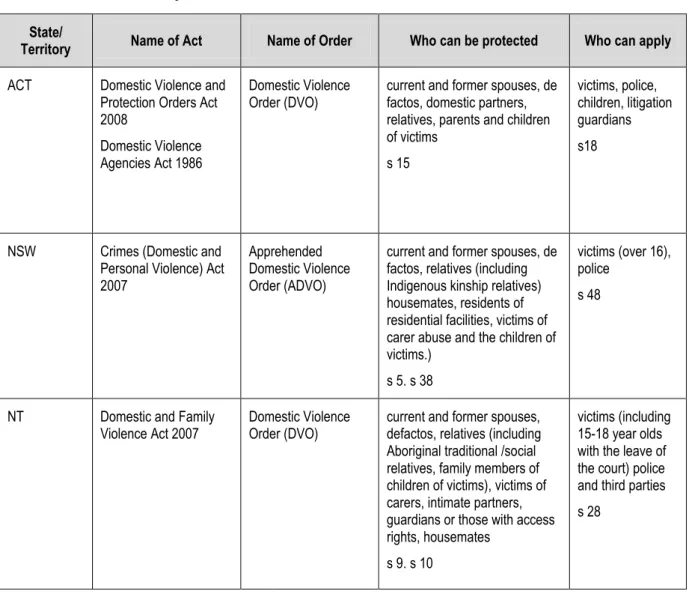
Table 1 provides a brief summary of protection orders currently available across Australia3.
Table 1: State and Territory Domestic Violence Protection Orders
State/
Territory Name of Act Name of Order Who can be protected Who can apply ACT Domestic Violence and
Protection Orders Act 2008
Domestic Violence Agencies Act 1986
Domestic Violence Order (DVO)
current and former spouses, de factos, domestic partners, relatives, parents and children of victims s 15 victims, police, children, litigation guardians s18
NSW Crimes (Domestic and Personal Violence) Act 2007
Apprehended Domestic Violence Order (ADVO)
current and former spouses, de factos, relatives (including Indigenous kinship relatives) housemates, residents of residential facilities, victims of carer abuse and the children of victims.)
s 5. s 38
victims (over 16), police
s 48
NT Domestic and Family
Violence Act 2007 Domestic Violence Order (DVO) current and former spouses, defactos, relatives (including Aboriginal traditional /social relatives, family members of children of victims), victims of carers, intimate partners, guardians or those with access rights, housemates
s 9. s 10
victims (including 15-18 year olds with the leave of the court) police and third parties s 28
3
This summary table is presented for illustration only and should not be taken as legal advice in relation to the use of protection orders. For consistency and brevity the word „victim‟ is used although actual terms vary across states and territories. Some jurisdictions include personal, workplace, misconduct and other restraining orders in their family violence legislation. All Australian states and territories (once the new SA Act commences) provide for protection order applications from same sex couples. All jurisdictions also provide protection for currently or
7
State/
Territory Name of Act Name of Order Who can be protected Who can apply QLD Domestic and Family
Violence Protection Act 1989 (Under review at time of writing)
Domestic Violence
Order (DVO) current or former spouse (including de facto and biological parents of a child) family, those in interpersonal relationships and informal carers. Orders can also be made to protect children, relatives or associates of victims. ss 11A-12D. s15 victims, police or a person authorised in writing to apply on their behalf. s 14 SA Intervention Orders (Prevention of Abuse) Bill 2009 (At September 2010 this bill has not yet become an Act) Domestic Violence Act 1994 Also Summary Procedure Act 1921 Intervention Order Domestic Violence Restraining Order (DVRO)
no relationship restrictions - any suspected victim or any child who may be exposed to the effects of abuse
s 7 (2009 Bill)
current or former spouse, de facto and children of the victim or defendant
s3 (1994 Act)
victim, police, child (over 14) or parent/guardian person with whom child resides (on behalf of child) s7. s16 (1994 Act) victim, police, authorised representative, parent/ guardian or person child lives with, child protection authorities (through the Minister), s 20 (2009 Act) TAS Family Violence Act
2004
Family Violence Order (FVO)
Police Family Violence Order (PFVO)
spouses, de-factos and significant relationships, as defined by Relationships Act 2003 s 15. s 4. s 7 victims, police, children (capable of understanding proceedings) and other third parties (with the leave of the court) s15
8
State/
Territory Name of Act Name of Order Who can be protected Who can apply VIC Family Violence
Protection Act 2008 Magistrates‟ Courts Act 2004
Family Violence Intervention Order (FVIO)
current or former spouses, de factos, family members (including children and victims of carer abuse) and domestic partners ss 8 – 10. s 47 victims (including children exposed to violence if over 14) police, or third parties with the written consent of the victim s 45
WA Restraining Orders Act
1997 Domestic Violence Restraining Order (DVRO)
current or former spouses, de factos intimate partners and relatives, including children exposed to violence. Relatives of victims may also apply for protection
s 4. s 11B
victims, police and parents, guardian or child protection on behalf of children s18
Family Law Act (1975)
Commonwealth family law is primarily set out in the Family Law Act 1975, the Family Law Regulations 1984 and the Marriage Act 1961. The Family Court of Australia, the Federal Magistrates Court and state courts of summary jurisdiction, exercise jurisdiction under the Family Law Act and the Family Law Regulations.
Australia‟s family law system encourages separated parents to agree on arrangements for their children without going to court. To this end, the Family Law Act 1975 requires parties to participate in family dispute resolution (FDR) before attending court, unless one of a number of specified exceptions can be applied. Exceptions to the requirement for FDR exist in circumstances where the parties are able to reach their own agreement, where a matter is urgent, where it is impractical to conduct FDR or where there is family violence or child abuse or a threat of these.
The Family Law Act promotes the best interests of the child as the paramount consideration in parenting disputes. To reinforce this principle the Act focuses on the rights of children and the responsibilities that each parent has towards their children, rather than on parental rights. In particular the Act aims to ensure that children can enjoy a meaningful relationship with each of their parents and that they are protected from harm. The Family Law Act does not contain any presumptions in relation to gender. In family law proceedings the courts‟ central concern is the best interests of children.
9
In determining what is in the best interests of the child the court can consider any incident of family violence or a family violence order concerning the child or a member of the child‟s family. The court is also required to ensure, to the greatest extent possible, that any parenting order it makes is consistent with existing family violence orders and does not expose a person to an unacceptable risk of family violence. The court may include in the order any measures that it considers necessary to ensure the safety of those affected by the order.
The Family Court has published „Best Practice Principles‟, which set out procedural details to assist the court in dealing specifically with family violence “… in furtherance of the
commitment of the Family Court to protecting children and parents from harm resulting from family violence and abuse...” (Family Court of Australia 2009b p ii).
Family law parenting orders
The Family Law Act contains many provisions which relate to its responsibility to protect children from family violence when making orders for post-separation parenting arrangements. These include provisions which:
Place safety from violence as a principle to be applied by the courts in making decisions Place protection from family violence, including exposure to family violence, as a primary
consideration in determining the child‟s best interests
Specify the existence of a protection order as a factor that must be considered in determining a child‟s best interests
Require parents to inform the court of any relevant state or territory protection orders or child protection orders in place
Ensure that any Family Law Act orders made have regard to State and Territory
protection orders and do not expose a person to an unacceptable risk of family violence, where this is consistent with the best interests of children
Ensure formal notification to the court of the existence of child abuse or family violence, in the form of specific documents to be lodged with the initial application for parenting
orders. These are known in the family law system as „Form 4 Notice of Child Abuse or Family Violence‟.
The Act also contains a „rebuttable presumption‟ of equal shared parental responsibility. In other words, equal shared parental responsibility is assumed, unless contested. Family violence is a potential ground for rebutting the presumption, as is an inability for the parties to communicate or to resolve conflict.
Mediation, case-conferencing and other alternative dispute resolution processes must be considered before parties can apply to courts for family law determinations relating to children. In other words the parties must have attempted to reach an agreement with professional assistance prior to entering the court process and must provide a formal certificate to prove
10
this. An exemption from this requirement is available in cases where there is family violence, on the grounds that the processes of mediation and negotiation may place victims at risk. In practice, many victims choose to have matters dealt with outside of the courts and access mediation to resolve disagreements. Thus mediators and dispute resolution practitioners play an increasingly important role under the law in identifying and responding to family violence to enable applications for exemption or in resolving disputes outside of court. They are critical in facilitating responses that offer protection from harm and enhance safety of children and adult victims alike.
Injunctions under the Family Law Act
If a matter does proceed to court, injunctions can be issued by the Family Court, Federal Magistrates Court or Local Courts exercising the jurisdiction of the Family Law Act. These are specific orders to direct or restrain the behaviour of a party. Injunctions aimed at the
protection of children can be made under s 68B of the Act. Injunctions can also be made under s 114 of the Act to ensure personal protection, or to exclude a party from a place of residence or work. Both of these types of injunctions are accompanied by a power of arrest where the breach involves causing or threatening to cause bodily harm, or harassment, molesting and stalking. The key provisions of the Family Law Act which relate to family violence are summarised in Table 2.
11
Table 2: Family Law Act 1975: family violence provisions
Section of
the FLA 1975 Provisions
4 Defines family violence as: 'conduct, whether actual or threatened, by a person towards, or towards the property of, a member of the person's family that causes that or any other member of the person's family reasonably to fear for, or reasonably to be apprehensive about, his or her personal well-being or safety.'
10D 10H
Provides exceptions to confidentiality of communications where the disclosure is necessary to prevent: risk of harm to a child, or the likelihood of acts of violence, or threats to life or health of a person (applies to family counsellors and family dispute resolution practitioners).
43(ca) Principles: requires a court to have regard to the need to protect individuals from family violence in circumstances of family violence.
60B Specifies one object of Part VII as “protecting children from physical or psychological harm from being subjected to, or exposed to, abuse, neglect or family violence”.
60CC Outlines primary and additional considerations in determining a child‟s best interests. Primary considerations:
The need to protect a child from harms caused by exposure to abuse or family violence The benefit to the child of having a meaningful relationship with both parents.
Various additional considerations include:
The existence of a final or contested protection order
The existence of family violence involving a child or the child‟s family member.
60CF Deals with informing a court of relevant State and Territory protection orders.
60CG Provides that a court also must to the extent possible in addressing the child‟s best interests, ensure consistency of any parenting order with any protection order made and not expose a person to an unacceptable risk of family violence.
60J Outlines the possibility of obtaining an exemption from the requirement to attend dispute resolution in circumstances involving child abuse or family violence. States that application for orders may not be delayed by the requirement for information about services and options to be provided by a counsellor or FDRP, where the delay would increase the risk of child abuse or family violence.
12
Section of
the FLA 1975 Provisions
60K Requires a court to take „prompt action‟ in cases where a person applies for parenting orders and files a Form 4 (Notice of Child Abuse or Family Violence) alleging „as a consideration that is relevant to whether the court should grant or refuse the application‟ that:
There has been abuse of the child by one of the parties, or
Risk of such abuse if there were to be a delay in applying for the order, or There has been or is a risk of family violence by one of the parties.
60I(9) Outlines certificates of exemption from family dispute resolution where there is child abuse or family violence.
61DA Indicates that a presumption of equal shared parental responsibility does not apply where there are reasonable grounds of family violence.
68B Injunctions under the Act for the welfare of a child, including for personal protection of the child or protection of person with parental responsibility/care of the child
Division 11
(s68N-s68T) Provisions for addressing inconsistencies between orders for spending time with children and any State family violence orders, so as to ensure parenting orders do not expose people to family violence. These provisions require the court to specify the inconsistencies, explain them to the parties and outline details of contact arrangements.
Note: 68Q invalidates protection orders to the extent they are inconsistent with orders of the Family Courts and 68R provides State and Territory courts with the power to amend family law orders, while making or varying protection orders
69ZW Provides the court with the power to order reports from State and Territory agencies in relation to child abuse or family violence.
114 Provides for protective injunctions, including injunctions excluding a party from the home or workplace
Child protection law
In all states and territories, there is a separate statutory and administrative framework to protect children from harm. These are known as child protection systems. Table 3 outlines the current State and Territory laws and child protection authorities.
13
Table 3: State/Territory child protection legislation and responsible departments
State/Territory Act Department Website
ACT Children and Young People Act 2008
Disability, Housing and Community Services - Office for Children, Youth and Family Support
http://www.dhcs.act.gov.au/o cyfs
NSW Children and Young Person‟s (Care and Protection) Act 1998
Community Services http://www.community.nsw.go v.au
SA Children‟s Protection
Act 1993 Families and Communities - Families SA Division http://www.dfc.sa.gov.au/pub VIC Children, Youth and
Families Act 2005
Human Services - Children, Youth and
Families Division http://www.cyf.vic.gov.au/chil
d-protection-family-services/home
NT Community Welfare Act
1983 Health and Families http://www.health.nt.gov.au/Children_Youth_and_Famili es/Child_Protection/Sexual_ Offences_Involving_Children /index.aspx WA Children and Community Services Act 2004
Child Protection http://www.community.wa.go
v.au/DCP
QLD Child Protection Act 1999
Commission for Children and Young People and Child Guardian Act 2004
Communities - Child Safety Services http://www.childsafety.qld.go v.au
TAS Children, Young Persons and their Families Act 1997
Health & Human Services – Child
Protection Services http://www.dhhs.tas.gov.au
Mandatory Reporting
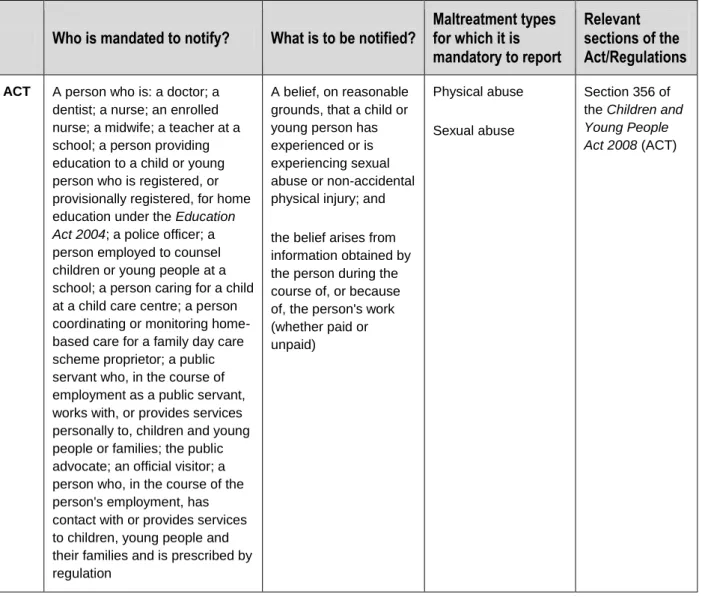
In all states and territories, many professionals in contact with children are required by law to report child abuse. This is known as „mandatory reporting‟ or „mandatory notification‟. Typically the requirement applies to people working in health, legal, childcare and educational services. Table 4 lists mandatory reporting laws in all states and territories.
14
In addition to this State and Territory legislation there is a statutory obligation under the Family Law Act for court staff, registrars, family dispute resolution practitioners, court counsellors, family consultants, arbitrators, lawyers and Independent Children‟s Lawyers (ICLs) to notify child protection authorities where they have reasonable grounds for suspecting a child has been abused or is at risk of abuse. Abuse is defined as an assault, a sexual assault or the use of a child as a sexual object. Staff may also choose to make a notification where the concern relates to ill treatment rather than abuse and they will still be protected from civil, criminal or professional liability. Other provisions in the Act permit family counsellors, FDR practitioners and family consultants to disclose otherwise confidential communications where there may be risk in relation to child abuse or family violence. It is critical for practitioners to understand the parameters of confidentiality and exercise options to engage in collaborative practice and sharing information appropriately, in the interest of child and victim safety.
The protection of children and adolescents from abuse and neglect is primarily a responsibility of State and Territory governments and is implemented through various child protection agencies. Table 2 lists the relevant laws and responsible agencies. Different terms for child abuse are used in different jurisdictions; however, all essentially refer to physical, sexual and emotional abuse or harm and neglect of children. In some States and Territories, exposing children to family violence officially constitutes child abuse. Differences in child protection legislation across States and Territories affect processes of notification, reporting,
investigation and substantiation as indicated in Tables 1 and 2. A major challenge for child protection authorities is the volume of notifications and limited resources to respond to children at risk. Where a direct intervention by such an authority is not possible, other
professionals within the family law system can seek child protection workers‟ advice and work in a collaborative manner to support child safety.
The harm caused to children living with family violence overlaps both protection order laws and child protection laws. Some protection order laws define exposure to violence as a form of abuse and direct the courts to include children living with adult victims of family violence on their orders. Child protection law has also attempted to recognise the long and short term harms to children of exposure to family violence, with some requiring mandatory notification of family violence. Professional and community understanding that exposure to family violence constitutes child abuse has been strengthened by research over the last decade that
demonstrates the significant, harmful effects of family violence upon child witnesses (Laing 2000b; McIntosh 2000, 2009). However, if responsibility for intervention is left solely with child protection services it may work against fully integrated practice and ignores the possible limitations on the capacity of child protection systems to respond.
Mandatory reporting for adult family violence is also required in the Northern Territory. It is now an offence in the NT if an adult does not report to a police officer where they believe that another person has caused or will cause harm, or that someone‟s life or safety is under imminent threat. This law applies to all adults. A provision for mandatory reporting of family violence in relation to adult victims is also contained within Tasmanian law.
15
Table 4: Mandatory Reporting Requirements in Australian States and Territories4
Who is mandated to notify? What is to be notified? Maltreatment types for which it is mandatory to report
Relevant sections of the Act/Regulations
ACT A person who is: a doctor; a dentist; a nurse; an enrolled nurse; a midwife; a teacher at a school; a person providing education to a child or young person who is registered, or provisionally registered, for home education under the Education Act 2004; a police officer; a person employed to counsel children or young people at a school; a person caring for a child at a child care centre; a person coordinating or monitoring home-based care for a family day care scheme proprietor; a public servant who, in the course of employment as a public servant, works with, or provides services personally to, children and young people or families; the public advocate; an official visitor; a person who, in the course of the person's employment, has contact with or provides services to children, young people and their families and is prescribed by regulation
A belief, on reasonable grounds, that a child or young person has experienced or is experiencing sexual abuse or non-accidental physical injury; and
the belief arises from information obtained by the person during the course of, or because of, the person's work (whether paid or unpaid)
Physical abuse
Sexual abuse
Section 356 of the Children and Young People Act 2008 (ACT)
4
This table is reproduced with permission from the Australian Institute of Family Studies, National Child Protection Clearinghouse (AIFS 2010). It provides an overview of who is legally mandated to report suspected child
16
Who is mandated to notify? What is to be notified? Maltreatment types for which it is mandatory to report
Relevant sections of the Act/Regulations
NSW A person who, in the course of his or her professional work or other paid employment delivers health care, welfare, education, children's services, residential services or law enforcement, wholly or partly, to children; and
a person who holds a management position in an organisation, the duties of which include direct responsibility for, or direct supervision of, the
provision of health care, welfare, education, children's services, residential services or law enforcement, wholly or partly, to children
Reasonable grounds to suspect that a child is at risk of significant harm; and
those grounds arise during the course of or from the person's work
Physical abuse Sexual abuse Emotional/psychologic al abuse Neglect Exposure to family violence Sections 23 and 27 of the Children and Young Persons (Care and Protection) Act 1998 (NSW)
NT Any person with reasonable grounds
A belief on reasonable grounds that a child has been or is likely to be a victim of a sexual offence; or otherwise has suffered or is likely to suffer harm or exploitation Physical abuse Sexual abuse Emotional/psychologic al abuse Neglect Exposure to physical violence (e.g. a child witnessing violence between parents at home) Sections 15 and 26 of the Care and Protection of Children Act 2007 (NT)
Registered health professionals Reasonable grounds to believe a child aged 14 or 15 years has been or is likely to be a victim of a sexual offence and the age difference between the child and offender is greater than 2 years
Sexual abuse Section 26 of the
Care and Protection of Children Act 2007 (NT)
17
Who is mandated to notify? What is to be notified? Maltreatment types for which it is mandatory to report
Relevant sections of the Act/Regulations
Qld An authorised officer, employee of the Department of
Communities (Child Safety Services), a person employed in a departmental care service or licensed care service
Awareness or
reasonable suspicion of harm caused to a child placed in the care of an entity conducting a departmental care service or a licensee Physical abuse Sexual abuse or exploitation Emotional/psychologic al abuse Neglect Section 148 of the Child Protection Act 1999 (Qld)
A doctor or registered nurse (Public Health Act 2005, s158)
Awareness or reasonable suspicion during the practice of his or her profession of harm or risk of harm
Sections 191-192 and 158 of the
Public Health Act 2005 (Qld)
The Commissioner for Children and Young People
A child who is in need of protection under s10 of the Child Protection Act (i.e. has suffered or is at unacceptable risk of suffering harm and does not have a parent able and willing to protect them)
Section 20 of the
Commission for Children Young People and Child Guardian Act 2000 (Qld)
SA Doctors; pharmacists; registered or enrolled nurses; dentists; psychologists; police officers; community corrections officers; social workers; teachers; family day care providers;
employees/volunteers in a government department, agency or instrumentality, or a local government or non-government agency that provides health, welfare, education, sporting or recreational, child care or residential services wholly or partly for children; ministers of religion (with the exception of disclosures made in the confessional); employees or volunteers in a religious or spiritual organisations
Reasonable grounds that a child has been or is being abused or neglected; and
the suspicion is formed in the course of the person's work (whether paid or voluntary) or carrying out official duties Physical abuse Sexual abuse Emotional/psychologic al abuse Neglect Section 11 of the Children's Protection Act 1993 (SA)
18
Who is mandated to notify? What is to be notified? Maltreatment types for which it is mandatory to report
Relevant sections of the Act/Regulations
Tas. Registered medical practitioners; nurses; dentists, dental therapists or dental hygienists; registered psychologists; police officers; probation officers; principals and teachers in any educational institution; persons who provide child care or a child care service for fee or reward; persons concerned in the management of a child care service licensed under the Child Care Act 2001; any other person who is employed or engaged as an employee for, of, or in, or who is a volunteer in, a government agency that provides health, welfare, education, child care or residential services wholly or partly for children, and an organisation that receives any funding from the Crown for the provision of such services; and any other person of a class determined by the Minister by notice in the Gazette to be prescribed persons
A belief, suspicion, reasonable grounds or knowledge that:
a child has been or is being abused or neglected or is an affected child within the meaning of the Family Violence Act 2004; or
there is a reasonable likelihood of a child being killed or abused or neglected by a person with whom the child resides Physical abuse Sexual abuse Emotional/psychologic al abuse Neglect Exposure to family violence Sections 13 and 14 of the Children, Young Persons and Their Families Act 1997 (Tas.)
Vic. Registered medical practitioners, registered nurses, a person registered as a techer under the
Education, Training and Reform Act 2006 or teachers granted permission to teach under that Act, principals of government or non-government schools, and members of the police force
Belief on reasonable grounds that a child is in need of protection on a ground referred to in Section 162(c) or 162(d), formed in the course of practising his or her office, position or employment Physical abuse Sexual abuse Sections 182(1) a-e, 184 and 162 c-d of the Children, Youth and Families Act 2005 (Vic.)
19
Who is mandated to notify? What is to be notified? Maltreatment types for which it is mandatory to report
Relevant sections of the Act/Regulations
WA Court personnel; family counsellors; family dispute resolution practitioners, arbitrators or legal practitioners representing the child's interests
Reasonable grounds for suspecting that a child has been: abused, or is at risk of being abused; ill treated, or is at risk of being ill treated; or exposed or subjected to behaviour that psychologically harms the child. Physical abuse Sexual abuse Emotional/psychologic al abuse Neglect Section 160 of the Western Australia Family Court Act 1997 (WA);
Licensed providers of child care or outside-school-hours care services Allegations of abuse, neglect or assault, including sexual assault, of an enrolled child during a care session
Physical abuse
Sexual abuse
Neglect
Regulation 20 of the Child Care Services Regulations 2006; Regulation 19 of the Child Care Services (Family Day Care) Regulations 2006; Regulation 20 of the Child Care Services (Outside School Hours Family Day Care) Regulations 2006; Regulation 21 of the Child Care Services (Outside School Hours Care) Regulations 2006
Doctors; nurses and midwives; teachers; and police officers
Belief on reasonable grounds that child sexual abuse has occurred or is occurring
Sexual abuse Section 124B of the Children and Community Services Act 2004 (WA)
20
Where there are allegations of serious physical abuse or sexual assault against children, the Family Court processes matters through its Magellan case management program. This gives judges a tight rein on proceedings, fast-tracks decisions and provides children with an
Independent Children‟s Lawyer (ICL). Child protection authorities are critical partners in the Magellan program which seeks to engage a multidisciplinary case management approach. (Further information about Magellan case management is provided in the Multi-disciplinary Collaboration Paper of this resource package).
Criminal injuries compensation
Victims of family violence may be eligible for financial compensation for harms suffered as a result of the abuse. State and Territory laws exist to allow victims of a criminal offence to apply for compensation for loss or injury resulting from the offence. These laws establish what are known as „victim compensation‟ or „criminal injuries compensation‟ schemes. Some schemes award victims a lump sum payment, while others reimburse the expenses of victims in relation to their injuries, such as dental costs, medical costs, and counselling services.
Many family violence victims sustain enormous losses arising from their physical injuries, post-trauma mental health issues, relocation expenses, interruption to income and extra costs to meet the needs of children affected by the violence. The benefits ascribed to financial compensation are both practical and symbolic. Compensation awards can address some of the direct financial impact of crime on victims, such as medical costs or loss of income, loss of opportunities for education, reasonable living conditions or travel (Freckelton, 2001, p. 96). In addition to these practical benefits, there can be therapeutic benefits of receiving
compensation. At its best, the compensation process may help to restore the victim‟s sense of control, validate their experiences of trauma and thereby assist with the recovery process. For some victims, the award of compensation may actually enable them to leave an abusive relationship (Freckelton, 2001, p. 98).
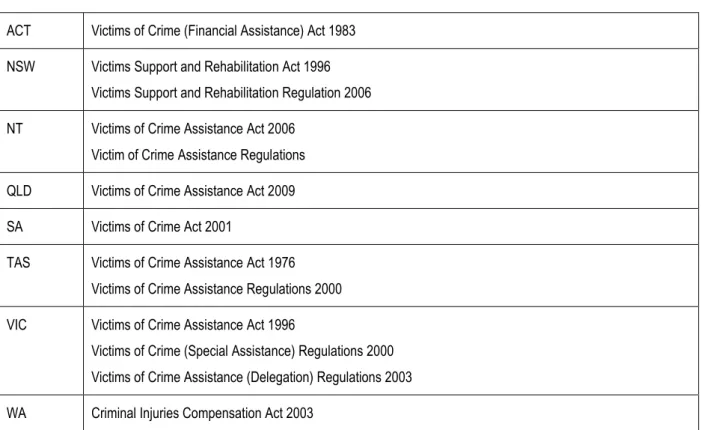
A range of compensation schemes operates across Australia and in some States and Territories „ex gratia‟ payments are also an option for applicants who might otherwise not be eligible. Table 5 provides details of relevant laws.
21
Table 5: Legislation governing victim compensation across Australia5
ACT Victims of Crime (Financial Assistance) Act 1983 NSW Victims Support and Rehabilitation Act 1996
Victims Support and Rehabilitation Regulation 2006 NT Victims of Crime Assistance Act 2006
Victim of Crime Assistance Regulations QLD Victims of Crime Assistance Act 2009 SA Victims of Crime Act 2001
TAS Victims of Crime Assistance Act 1976 Victims of Crime Assistance Regulations 2000 VIC Victims of Crime Assistance Act 1996
Victims of Crime (Special Assistance) Regulations 2000 Victims of Crime Assistance (Delegation) Regulations 2003 WA Criminal Injuries Compensation Act 2003
Some considerations for an optimum legal response to family violence
Issue One: Policing and criminal justice responsesA number of strategies have been developed within the criminal justice system to enhance its response to family violence and to ensure alertness to potential problems in administering just and safe outcomes. These have included:
„Pro-arrest‟ Policies
Several police services have developed practice rules for operational police which prioritise safety and ensure a serious level of response. As part of this, some jurisdictions have adopted a practice whereby police are directed to make arrests where they suspect crimes have been committed, rather than opt for no arrest or depend on the victim to press charges.
5
22
„Evidence-based‟ Prosecutions
Emphasis is placed on evidence collection by police. This effectively removes the burden of prosecution from the victim and places it more appropriately with the state. Evidence-led
prosecution is supported by appropriate, thorough collection of evidence at the crime scene, so that victim evidence is less critical.
Adoption of „Duluth‟ principles
Practices that prioritise safety and managing risk, through collaborative and holistic processes (cited in Department of Justice, 2009 p. 29). (For more on Duluth refer to the AVERT Paper Dimensions, Dynamics and Impact)
Use of validated risk assessment tools at incident level
These are used to screen for family violence and assess level of risk. In some cases they have been shared across disciplines to support seamless and timely responses.
Professional collaboration and enquiry
Police, prosecutions and child protection services work together with court support and counselling services to focus on pro-arrest and pro-prosecution outcomes. Information is shared and integrated responses are provided.
Victim support services
Adequate emotional and practical support can have a positive impact on reducing the
reluctance of victims to give evidence or proceed with their protection order matters. In some courts, these services have Indigenous or culturally and linguistically diverse (CALD) workers to specifically support victims from these communities. In some States and Territories,
restrictions on cross-examination by abusers, special evidentiary provisions and limitations on evidence presented by children further support victims of family violence to continue with otherwise stressful proceedings.
Addressing the issue of victim arrest
Because criminal justice is incident-focused, victims of family violence are sometimes arrested at the scene of a disturbance, particularly where they have fought back at their assailant. These „victim arrests‟ or „dual arrests‟ are of concern to family violence professionals and policy makers who note the immediate and ongoing risks this may bring for the safety of victims and their children (Braaf and Sneddon 2007). In order to address these concerns, the notion of „primary aggressor‟ has been proposed whereby police consider a range of factors such as the history of violence, seriousness of offence, whether a person was defending themselves and who called the police, in order to identify the person predominantly using violence and threats to control another.
23
Understanding victim breaches of protection orders.
Victims can be charged with „aiding and abetting‟ a breach of a protection order if they have initiated or allowed contact with perpetrators. There are complex reasons why some victims may make contact with perpetrators following separation, including fear of greater violence or concern for the perpetrator (refer to the AVERT Paper Prevention Strategies for more
discussion of this). Compliance with parenting orders can also appear to conflict with protection orders and create difficulties of this nature (NCRVWC, 2009). Greater
understanding of these complexities and collaboration with victim support services assists in ensuring appropriate legal responses to these situations.
Professional training and education
Many jurisdictions and agencies have implemented professional education strategies to increase the skills and knowledge of their workforce regarding the mechanisms of power and control used by abusers; the impacts on family violence victims‟ presentation and capacity to participate in legal proceedings; and available resources. This enables more effective
responses and greater collaboration through the increased use of referrals and specialist advice.
Issue Two: Family violence in Indigenous communities
The statistics on Indigenous family violence rates are disturbingly high and parallel inequalities seen in other health indicators. A 2009 government report noted for the year 2006-07 that Indigenous females and males were respectively 35.1 and 21.4 times more likely to be hospitalised due to family violence-related assaults, than non-Indigenous females and males. (SCRGSP 2009 p4.131).
There are particular concerns for Indigenous communities in accessing and using criminal justice responses to family violence. In addition to cultural and language barriers that may prevent an understanding of the system or confidence in legal processes, there may be an active choice to avoid pursuing legal pathways. Indigenous victims may feel that perpetrators should be diverted from custody for a number of reasons, including the potential for family and community breakdown and anxieties regarding possible deaths in custody.
Providing culturally sensitive legal services and information to communities about the process and consequences of applying for protection orders can assist victims to engage positively with the legal system. Ensuring police have knowledge about the context of family violence within Indigenous communities, particular patterns of control, levels of fear and intimidation and the way in which self-defence occurs, can also support effective responses.
Alternative models for responding to crime generally in Indigenous communities have emerged in recent decades. One such approach is known as „restorative justice‟. This strategy involves bringing together a victim and offender in a formal structured way, in order to address needs for healing and enhance perpetrator responsibility, by exposing offenders to
24
community reprobation (Centre for Restorative Justice 2010). Circle sentencing is another model which has been used within the mainstream criminal justice system as a sentencing alternative for Indigenous offenders. This involves offenders being presented to a „circle‟ of elders or respected community members, usually alongside a magistrate. The circle then determines effective sentencing, which might include attendance at a healing program or specific means of reparation. Victims may be present and sometimes support people or elders (Faulkner, 2009).
Restorative justice strategies raise concerns for some regarding safety within family violence situations. High levels of fear and certain patterns of control by the perpetrator (including the use of apology) may undermine the victim‟s ability to participate effectively. Bringing the parties together may provide an opportunity for re-victimisation and ongoing abuse (Stubbs 2007; Southwell 2003). In addition, community responses to family violence are sometimes victim-blaming and cannot necessarily be relied upon to support restorative justice aims (Cook, Daly & Stubbs 2006). For these reasons caution is advocated in the use of such approaches where family violence is an issue. However, Indigenous communities‟ access to the criminal justice system is an essential component of providing safety to victims and tailored access and equity strategies are required.
Issue Three: Ongoing contact with perpetrators through family law parenting arrangements
The Family Law Act clearly recognises that situations where there is family violence warrant special and informed consideration. In particular, arrangements and orders for post-separation parenting which lead to ongoing contact between victims and perpetrators of family violence necessitate individual tailoring and review, to ensure safety for all concerned. Contact arrangements can be used by perpetrators to harass or further abuse their victims and in these cases children may continue to experience the detrimental effects of witnessing family violence specifically through the arrangements (Bancroft & Silverman 2002; Kaye, Stubbs & Tolmie 2003; McInnes 2004). In addition, where there is parental conflict within a shared care arrangement, children‟s development is negatively affected (McIntosh, 2000, 2009). These findings do not point to a problem with shared care „per se‟ but do alert practitioners to the presence of post-separation violence or acrimonious or hostile relationships between parents, as indicators of concern for children‟s wellbeing. The presumption of shared parental
responsibility and directions to professionals to raise shared care options within the Family Law Act necessitate careful risk assessment when family violence is an issue.
Issue Four: Child abuse and family violence
The intersection of child abuse and family violence law and practice, raises three key issues when considering safety:
The co-morbidity of family violence and child abuse
25
The separation of parent (FV victim) safety from the wellbeing of children.
There is a well-established research base suggesting the „co-morbidity‟ of child abuse and family violence (Goddard and Hiller 1992; Stanley and Goddard 2003; Taft, Hegarty and Feder 2006; Jouriles et al. 2009; Goddard and Bedi 2009). In other words, families where children are abused or are at risk often also experience family violence.
In addition, a substantial body of evidence has shown that exposure to family violence itself (sometimes referred to as witnessing violence) has significant harmful effects on children, including small babies. These effects are emotional, psychological, developmental and cognitive. All aspects of the child‟s development, wellbeing and identity are affected (McIntosh, 2000; Laing, 2000b). The long term psychological damage for children living in fear, and also with the fear of their primary attachment figure, makes family violence a child protection issue.
Thirdly, the notion that children‟s wellbeing can be separated from the safety of their primary care giver can be problematic. The safety of the non-violent parent is linked to the wellbeing of children (Kaspiew et al. 2009) and this must be taken into account when considering the best interests of the child.
Advice and reports from child protection authorities are not always made available to those working in the family law system so that complete information is not shared. This can expose children to significant risk. In circumstances where child abuse is not disclosed or fully
understood, parenting orders may require children to spend time with their abuser, even when expressing significant distress at handover time. The adult victim of family violence may be blamed for the child‟s response and must tread a difficult line between supporting the relationship with the other parent and protecting the child from distress or harm. An audit of the Armadale Domestic Violence Intervention Program (ADVIP) in WA sheds light on the institutional silos and viewpoints which can lead to these problematic outcomes, whereby victims are blamed for ongoing exposure to abuse by the perpetrator (Johnson & Sullivan, 2008; Davies & Krane, 2006). The ADVIP Audit report is an invaluable resource for all professionals interested in improving system responses (Pence et al. 2007).
Principles and policies which recognise that the safety of the non-violent parent is essential to the safety of the child can go some way to assisting various legal systems to address these difficulties. The Queensland government has introduced such principles to govern its response to child safety (Department of Child Safety 2006, p. 6). In addition collaborative models of practice and information sharing ensure comprehensive understanding and informed
responses. The Magellan case management program which has been adopted by the Family Court to assist in dealing with child abuse allegations is one such example that provides structures and processes for increased information sharing. In Western Australia, the Columbus Project also demonstrates some success in addressing gaps between systems dealing with children‟s needs where there is family violence or abuse (Pike and Murphy, 2006).
26
Issue Five: Exclusion orders
Family violence is a leading cause of homelessness for women and children (Australian Government Homelessness Taskforce, 2008). One of the key legal interventions to address this issue is the inclusion of special conditions on protection orders which enable victims to stay in their homes, whilst perpetrators are removed - either for a short „cooling off‟ period, or through a provision on a longer term order. Protection orders with these provisions are often known as „exclusion‟ or „ouster‟ orders.
All States and Territories allow for exclusion orders. In addition, some States and Territories now provide for court-ordered changes to residential tenancy agreements, which assist where victims have shared rental accommodation with defendants who are the leaseholders.
Tenancy sustainability is particularly an issue in Indigenous remote communities, where there is up to 80% rental occupancy (Cora, 2010).
However, exclusion orders are not the solution for all victims. For some victims of family violence, remaining in the relationship is desirable or necessary (for financial or other reasons), so protection from future violence is best provided by a „basic‟ protection order prohibiting future violent conduct, but permitting ongoing contact. This can be accompanied, in some States and Territories by a police-issued „cooling-off‟ order which enables the offender to be removed for a short period of time.
For other victims of family violence at high risk, safety can only be found by escaping and ensuring the offender does not know their whereabouts.
Consideration of options for exclusion orders; basic protection orders or accessing alternative safe accommodation must take account of the particular circumstances of each case. Raising awareness of these options and facilitating access to such pathways is an important part of a response that aims to support the best interests of the children.
Issue Six: Victim diversity, disability and legal disadvantage
Marginalised populations such as culturally diverse groups, refugees, Indigenous people, gay men and lesbians, people with disabilities, or people in rural and remote communities can face significant barriers to accessing legal services. These include issues with interpreters,
language and cultural barriers, lack of nearby services, difficulties with physical access, discrimination and racism. These issues and more have been canvassed in the AVERT Paper Responding to Diversity in this package. In particular however, the increased vulnerability of people with disabilities requires special emphasis. People living with physical or mental disabilities or with children with disabilities face a „triple disadvantage‟ when family violence is occurring. Jennings (2003) notes that women with disabilities are more likely to face abuse and violence than others, yet find it harder to access services and legal interventions. In addition, many have received their disabilities through the injuries sustained during abusive attacks (Olle 2006). Such injuries can be severe – brain injury, quadriplegia, extensive burn injuries. Children with disabilities are also at much higher risk of both physical and emotional
27
abuse than non-disabled children. The reasons for this have been summarised by Briggs and Hawkins, who argue that „children with disabilities are targeted for victimisation because they are the least knowledgeable, the least assertive, the least valued and the least protected members of society‟ (Briggs & Hawkins, 1997, p.155). Attention to the special needs of diverse populations and in particular families where there is disability is a core element of a best practice approach.
Issue Seven: Victims’ compensation issues
Financial compensation for victims of family violence may not always be easy to access and could, under some circumstances, compromise safety. Apart from lack of awareness of compensation schemes, common issues which inhibit disclosure of family violence (including fear, shame and lack of validation) may impact on the victims‟ willingness to apply. General barriers to accessing legal support, as noted previously, may also be a problem. Further, some victims are reluctant to claim compensation as it may expose them to additional violence from abusers who become aware of the claim and harass them for money (Barrett Meyering, 2010). Barrett Meyering argues that the „stranger violence‟ model which underpins most compensation schemes (with the exception of Queensland) leads to many requirements that discriminate against victims of family violence. These include: how the schemes define a „crime‟ and subsequent „injury‟; reporting requirements; successful conviction of an offence; notions of contributory conduct; particular perspectives on the victims relationship to the offender; and time limitations for claims.
Another difficulty arises in relation to debt recovery or restitution components of victim compensation, whereby some of the costs of compensation are claimed from the abuser. While this may promote perpetrator accountability, there can be unintended consequences for family violence victims who may be forced to confront the perpetrator or be at risk of further abuse incited by the debt recovery process. Other forms of harassment, such as withdrawal of child support may also result (Barrett Meyering, 2010).
Queensland has attempted to address some of these difficulties with its new administrative response to victims‟ financial needs, based on repayment of actual expenses and outlays, rather than compensation for injuries. In addition, the scheme, known as Victim Assist in Queensland, provides a more timely and expedited response than is often possible through legal processes.
The option of applying for compensation may not be widely known or understood. Raising awareness of this, whilst being mindful of possible complications and concerns, ensures victims have access to the full breadth of legal options available to them.
Issue Eight: Specialist courts
Specialist family violence courts have been introduced in some jurisdictions in Australia. The features of these vary but where they work well, they have the advantage of a specially trained magistrate, a discrete family or domestic violence list, safe rooms for victims, specialist
28
support workers, legal representatives and prosecutors and, importantly, a cross-jurisdictional capacity which enables the judicial officer to deal with all matters arising from the violence. Model specialist courts also sit within a multi-agency framework for responding to the varying needs of victims and their children (Stewart, 2010). For example, Victoria‟s specialist
Magistrates‟ Court pilot, the Family Violence Court Division, can decide on matters relating to protection orders, criminal charges, victim compensation and family law for the one family. This provides an opportunity for the court to address inconsistent outcomes, such as those which arise when there is a conflict between state protection orders and federal family law decisions. Specialist courts may not function effectively however, where they are not supported by adequate resourcing, are not located within a multi-agency system where information can be shared and monitoring is possible, or where the focus of the court shifts significantly from victim safety to a therapeutic focus on perpetrators (Stewart 2010). The primacy of victim safety underpins child wellbeing and effective outcomes for the family. Issue Nine: Perpetrator programs and therapeutic jurisprudence
Programs for perpetrators of family violence may assist in the prevention of future violence as well as promote perpetrator accountability. In Indigenous communities, perpetrator programs may also be seen as a means of addressing the community-wide harm caused by family violence. Programs can be voluntary, or mandated as a sentencing option, probation and parole condition or included as a condition on a protection order in some jurisdictions or courts.
Programs for perpetrators vary – some are based on behavioural change, others on
therapeutic healing or emotional control, still others on education to challenge attitudes and assumptions about power and gender. In Indigenous communities some programs have focused on building „strong men‟ of culture. Engaging perpetrators and offering opportunities for behavioural change is likely to be an important component in victim and child safety, however models of intervention are still in the early stages of implementation and the effectiveness of such programs requires further research. (Refer to the AVERT Paper Prevention Strategies in this package for a detailed discussion of perpetrator programs). In concert with perpetrator accountability and recovery approaches, some judicial
administrators have been keen to introduce therapeutic jurisprudence, focusing on the psychological and therapeutic role that courts can play in dealing with offenders and victims alike. This refers not only to the option of mandating, recommending or referring to „treatment‟ programs, but also to the effects on recovery or change of a) legal decisions and b) the
manner in which the legal system and legal professionals engage with individuals. Therapeutic jurisprudence underpins many „problem-solving‟ courts, such as drug-courts or some
specialist family and domestic violence courts. Once again, principles of children‟s best interests, victim safety and perpetrator accountability provide a framework to support the success of such approaches.