Internet
of
Things
Data
Contextualisation
for
Scalable
Information
Processing,
Security,
and
Privacy
Athesis submittedinfulfilment ofthe requirementsfor thedegree of Doctorof Philosophy
Ali
Yavari
Masterof Communication SystemsfromKTH RoyalInstitute ofTechnology Bachelorof InformationTechnology Engineeringfrom IAU
School of Science
Collegeof Science,Engineeringand Health RMITUniversity
Declaration
Icertify thatexcept where dueacknowledgementhas beenmade, the workis that of the authoralone;theworkhasnotbeensubmittedpreviously,inwholeorinpart,toqualifyfor any other academic award; the content of the thesis is the result of work which has been carriedoutsince the officialcommencement date of the approvedresearch program; any editorialwork, paid orunpaid, carriedout bya third party isacknowledged; and, ethics proceduresandguidelineshavebeenfollowed.IacknowledgethesupportIhavereceivedfor my research through the provision of an Australian Government Research Training ProgramScholarship.
Ali Yavari
School of Science RMIT University 15 March2019
Abstract
The Internet of Things (IoT) interconnects billions of sensors and other devices (i.e.,things) via the internet, enabling novel services and products that are becoming increasingly important for industry, government, education and society in general. It is estimated that by 2025, the number of IoT devices will exceed 50 billion, which is seven times the estimated human population at that time. With such a tremendous increase in the number of IoT devices, the data they generate is also increasing exponentially and needs to be analysed and secured more efficiently. This gives rise to what is appearing to be the most significant challenge for the IoT: Novel, scalable solutions are required to analyse and secure the extraordinary amount of data generated by tens of billions of IoT devices. Currently, no solutions exist in the literature that provide scalable and secure IoT scale data processing.
In this thesis, a novel scalable approach is proposed for processing and securing IoT scale data, which we refer to as contextualisation. The contextualisation solution aims to exclude irrelevant IoT data from processing and address data analysis and security considerations via the use of contextual information. More specifically, contextualisation can effectively reduce the volume, velocity and variety of data that needs to be processed and secured in IoT applications. This contextualisation-based data reduction can subsequently provide IoT applications with the scalability needed for IoT scale knowledge extraction and information security. IoT scale applications, such as smart parking or smart healthcare systems, can benefit from the proposed method, which improves the scalability of data processing as well as the security and privacy of data.
The main contributions of this thesis are: 1) An introduction to context and contextual-isation for IoT applications; 2) a contextualcontextual-isation methodology for IoT-based applications that is modelled around observation, orientation, decision and action loops; 3) a collection of
contextualisation techniques and a corresponding software platform for IoT data processing (referred to as contextualisation-as-a-service or ConTaaS) that enables highly scalable data analysis, security and privacy solutions; and 4) an evaluation of ConTaaS in several IoT applications to demonstrate that our contextualisation techniques permit data analysis, security and privacy solutions to remain linear , even in situations where the number of IoT data points increases exponentially.
Acknowledgements
Completion of this thesis was made possible by the support and collaboration of several people. I would like to express my special appreciation and thanks to my supervisor, Professor Dimitrios Georgakopoulos, for his continuous support during my PhD study, his patience, inspiration and immense knowledge. His supervision helped me to learn new things throughout my research and the writing of this thesis. I would like to thank Professor Timos Sellis for making me passionate about this PhD study, introducing Dimitrios to me, co-supervising my PhD, and for his continuous support and mentorship during my research. I also express my gratitude to Professor Heinrich Schmidts for ,co-supervising my PhD, and his inspirational feedback and wonderful ideas that extended my research. A special thanks to my co-supervisors who supported me during my PhD study, including Professor Arkady Zaslavsky, Professor Xun Yi and Dr Surya Nepal. I would like to express my sincere gratitude to Dr Prem Jayaraman and the other collaborators on my publications for everything I have learned from them.
Thank you to my friends and colleagues at RMIT University for making my PhD journey enjoyable. Thanks to Jesse for always distracting me by having irrelevant answers to my relevant questions. Thanks to Marco for all the gelati and picanhas. Special thanks to Josip for proofreading this thesis and taking responsibility for its English and grammar issues.
I would like to acknowledge Farhad for introducing me to the Computer Engineering world by helping me learning my first programming language and for all his unforgettable support.
Last but not least, a very special thanks to my parents, Zohre and Hamid, for their unconditional help, for motivating me to study, for their endless kindness, and for making me what I am. Thanks also to Sadra and Hoda for being my favourite siblings.
Credits
Portions of the material in this thesis have previously appeared in the following peer-reviewed publications:
– Ali Yavari, Prem Prakash Jayaraman, Dimitrios Georgakopoulos, and Surya Nepal. “ConTaaS: An Approach to Internet-Scale Contextualisation for Developing Efficient
Internet of Things Applications.” In Proceedings of the 50th Hawaii International Conference on System Sciences. pp. 5932-5940. 2017. [IBM/ISSIP Best Paper Award]
– Ali Yavari, Prem Prakash Jayaraman, and Dimitrios Georgakopoulos. “Contextu-alised service delivery in the internet of things: Parking recommender for smart cities.” In Internet of Things (WF-IoT), 2016 IEEE 3rd World Forum on, pp. 454-459. IEEE, 2016.
– Ali Yavari, Arezou Soltani Panah, Dimitrios Georgakopoulos, Prem Prakash Jayara-man, and Ron van Schyndel. “Scalable role-based data disclosure control for the internet of things.” In Distributed Computing Systems (ICDCS), 2017 IEEE 37th International Conference on, pp. 2226-2233. IEEE, 2017.
– Dimitrios Georgakopoulos, Ali Yavari, Prem Prakash Jayaraman, and Rajiv Ranjan. “Towards a RISC Framework for Efficient Contextualisation in the IoT.” In Distributed
Computing Systems (ICDCS), 2017 IEEE 37th International Conference on, pp. 1993-1996. IEEE, 2017.
– Arezou Soltani Panah, Ali Yavari, Ron van Schyndel, Dimitrios Georgakopoulos, and Xun Yi. “Context-driven Granular Disclosure Control for Internet of Things Applications.” IEEE Transactions on Big Data (2017).
– Prem Prakash Jayaraman, Ali Yavari, Dimitrios Georgakopoulos, Ahsan Morshed, and Arkady Zaslavsky. “Internet of things platform for smart farming: Experiences and lessons learnt.” Sensors 16, no. 11 (2016): 1884.
– Prem Prakash Jayaraman, Xuechao Yang, Ali Yavari, Dimitrios Georgakopoulos, and Xun Yi. “Privacy preserving Internet of Things: From privacy techniques to a blueprint architecture and efficient implementation.” Future Generation Computer Systems 76 (2017): 540-549.
– Tejal Shah, Ali Yavari, Karan Mitra, Saguna Saguna, Prem Prakash Jayaraman, Fethi Rabhi, and Rajiv Ranjan. “Remote health care cyber-physical system: quality of service (QoS) challenges and opportunities.” IET Cyber-Physical Systems: Theory & Applications 1, no. 1 (2016): 40-48.
– Reza Soltanpoor and Ali Yavari. “CoALA: Contextualization Framework for Smart Learning Analytics.” In Distributed Computing Systems Workshops (ICDCSW), 2017 IEEE 37th International Conference on, pp. 226-231. IEEE, 2017.
Contents
1 Introduction 1
1.1 Research Questions . . . 3
1.2 Methodology . . . 4
1.3 Contributions . . . 4
2 Background and Related Work 8 2.1 Challenges for Internet of Things Contextualisation . . . 8
2.1.1 Heterogeneity of Sensor Data and Semantic Approaches . . . 8
2.1.2 The Variety of Context Notions . . . 9
2.1.3 Querying Sensor Data . . . 10
2.2 Contextualisation in the Literature . . . 11
2.2.1 Identification of Related Work . . . 11
2.2.2 Primary Studies . . . 13
2.2.3 Definitions of Terms for the Review of Related Work . . . 25
2.2.4 Systematic Literature Review Outcome . . . 27
2.3 Scalable Security and Privacy in Internet of Things . . . 28
2.3.1 Existing Techniques for Protecting Privacy-sensitive Data in Internet of Things . . . 30
3 Contextualisation 34 3.1 Internet of Things Data Contextualisation . . . 34
3.1.1 Definitions . . . 35
3.1.2 Contextual Operations . . . 37
4 Contextualisation for Scalable Data Processing in the Internet of Things 45
4.1 Development of a Scalable Parking Recommender . . . 47
4.2 Evaluation Dataset for the Scalable Parking Recommender . . . 51
4.3 Performance and Scalability Evaluation of the Scalable Parking Recommender . . 52
4.4 Parking Recommenders in the Literature . . . 55
5 Contextualisation for Scalable Security and Privacy in Internet of Things 58 5.1 Contextualisation-based Scalable Access Control for the Internet of Things . . . . 58
5.1.1 Contextualised Role-based Data Disclosure Control . . . 60
5.1.1.1 Controlling IoT Data Disclosure . . . 60
5.1.1.2 Role-based Disclosure Privilege Model . . . 60
5.1.1.3 Conceptual Architecture for Role-based Disclosure . . . 62
5.1.1.4 Modelling and Querying Data for Role-based Disclosure . . . . 63
5.1.1.5 Digital Watermarking . . . 63
5.1.1.6 Watermark as a Service . . . 65
5.1.1.7 Data Obfuscation . . . 67
5.1.1.8 Data Delivery . . . 69
5.1.2 Use Case . . . 71
5.1.2.1 Evaluation Test-bed and Dataset . . . 72
5.1.3 Evaluation . . . 72
5.2 Contextualisation-based Scalable Privacy Preservation for the Internet of Things . 73 5.2.1 Multi-stage Privacy Preservation Framework . . . 76
5.2.1.1 Multi-stage Privacy Protection . . . 76
5.2.1.2 Dynamic Obfuscation . . . 79
5.2.2 IoT Data Challenge . . . 80
5.2.3 Disclosure Rules . . . 81
5.2.4 Rule Indexing Model . . . 82
5.2.4.1 Security Service . . . 83
5.2.5 Case Study: Smart Vehicles . . . 84
5.2.5.1 System Overview . . . 85
5.2.5.2 Data Model . . . 86
5.2.5.3 Spatio-temporal Granularities and Disclosure Rules . . . 86
5.2.5.5 Preliminaries . . . 89 5.2.5.6 Privacy Preserving Data Collection-Spatial Cloaking . . . 91 5.2.5.7 Privacy Preserving Data Storage-Temporal Cloaking . . . 93 5.2.5.8 Privacy Preserving Data Dissemination-Dynamic Obfuscation . 94 5.2.6 Performance Evaluation . . . 95 5.2.6.1 Discussion . . . 97
6 Conclusion 100
6.1 Future Research . . . 104
Glossary
AALFI Ambient Assisted Living Flexible Interface
ABE Attribute Based Encryption
ACE Application Context Engine
ACI Application Context ID
ADL Activities of Daily Living
API Application Programming Interface
AR Augmented Reality
BSN Body Sensor Network
CBD Central Business District
CID Context ID
CoMon Cooperative Context Monitoring System
ConTaaS Contextualisation-as-a-Service
CPU Central Processing Unit
DAC Discretionary Access Control
DCCI Decentralised Checking of Context Inconsistency
DCE Data Context Engine
DCI Data Context Identifier
DDP Disclosure Decision Point
DES Data Encryption Standard
DL Description Logic
DLFSR Dynamic Linear Feedback Shift Register
DOG Domain Ontology Graph
EAT Effective Assertional Triple
ECC Elliptic Curve Cryptography
FDAC Fine-grained Distributed Access Control
FOL First-order Logic
FPGA Field-Programmable Gate Array
GPS Global Positioning System
GRBAC Generalised Role-based Access Control
HBAS Home and Building Automation System
HDP Hierarchical Dirichlet Processes
IBE Identity Based Encryption
ICT Information and Communications Technology
ID Identification
IoT Internet of Things
IRI Internationalised Resource Identifier
KMS Key Management System
LBAC Lattice-Based Access Control
LC Linear Complexity
LFSR Linear Feedback Shift Register
LoCCAM Loosely Coupled Context Acquisition Middleware
LSB Least Significant Bits
MAS Multi-Agent System
MQ Multivariate-Quadratic
MRI Mapped Rule Index
OF Obfuscation Function
OODA Observation, Orientation, Decision, and Action
OSGi Open Service Gateway Initiative
OWL Web Ontology Language
PKC Public Key Cryptography
PN Pseudo Noise
POI Point of Interest
PSN Personal Social Network
PSS Personal Smart Space
RAM Random-Access Memory
RBAC Role-Based Access Control
RDF Resource Description Framework
RFID Radio-Frequency Identification
RQ Research Question
SCIMS Social Context Information Management System
SKC Secret Key Cryptosystem
SLR Systematic Literature Review
SPARQL SPARQL Protocol and RDF Query Language
SQL Structured Query Language
SS Spread Spectrum
SSL Secure Sockets Layer
SSN Semantic Sensor Network
SVM Support Vector Machine
SWE Sensor Web Enablement
SWRL Semantic Web Rule Language
TIF Transfer Inference Forest
TLS Transport Layer Security
TRN Truly Random Number
UTM Universal Transverse Mercator
VID Virtual Identity
VM Vector Machine
CHAPTER
1
Introduction
The Internet of Things (IoT) currently incorporates approximately 15 billion IoT devices, and there are estimates this will grow to 50+ billion by 2020 [1]. IoT devices produce a tremendous amount of data, which we refer to as IoT data. IoT data underpins the development of IoT applications that support many novel products and services that aim to make cities, healthcare, manufacturing (Industry 4.0), energy generation and distribution, and agriculture more data-driven and, therefore, ‘smarter’.
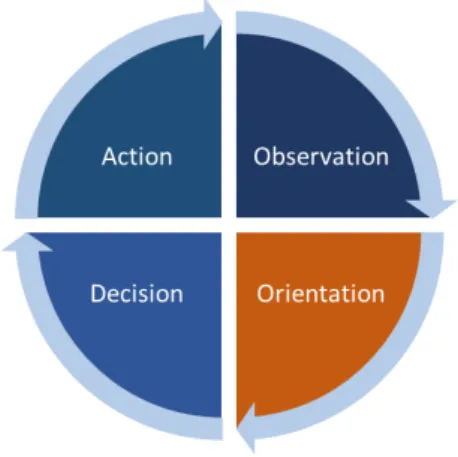
Many IoT applications typically follow the Observation, Orientation, Decision, and Ac-tion (OODA) loop paradigm [2]. To explain this further, consider an IoT-based applicaAc-tion for a smart city that, among other services, finds and recommends parking spaces to drivers who commute to work. At the observation phase this application collects a variety of data that include (1) streamed IoT data from traffic, parking, roadside, and public transport sensors, (2) stored data such as schedules from public transport databases, and (3) real-time IoT data such as location and navigation information from the vehicles and mobile phones of participating drivers. The orientation phase of the parking recommendation service involves contextualising all such information to recommend a specific parking spot to each driver or car. The first step of contextualisation involves filtering out all the IoT data that do not relate to parking recommendation before any further data processing takes place. The next step in the parking-finding orientation involves aggregating the destinations
of the drivers/vehicles and all the remaining IoT parking-related information. The final orientation step correlates the preferences of the driver, such as parking cost and distance from their destination, to a recommendation. Each driver selects a recommendation from those provided, which is set as their destination in their navigation system. Many other IoT applications and related services have some form of OODA loop in their data processing logic.
There are many existing research solutions for context management and contextualisa-tion that can be broadly classified as database techniques, semantic web and rule-based context management approaches, and machine learning and data science-based contex-tualisation methods. However, most of the existing contexcontex-tualisation approaches are incompatible as they consider different notions of context and propose heterogeneous and incompatible contextualisation techniques. Furthermore, none of these existing approaches can support data processing at the scale of the IoT, as most are highly inefficient from scalability and performance perspectives.
Another related concern in many IoT applications [3] is how to keep the data collected from the IoT private. Examples of sensitive IoT data include the physiological data collected by wearable or attached bio-medical sensors, and location data collected by the Global Positioning System (GPS) and mobile phones. Disclosure of such data creates opportunities for criminal activity and can result in loss of property, serious harm or even death. Thus, despite its benefits, the IoT presents significant security and privacy challenges, which are exacerbated by the unprecedented scale of IoT devices [4] and the amount of data they generate. Traditionally, such security issues have been addressed with the aid of encryption and privacy preservation techniques. However, IoT devices are extremely limited in computational power and memory resources and therefore these techniques add further data processing challenges [5].
The main aim of this thesis is to propose novel, real-time, IoT contextualisation techniques that use contextual information to significantly speed up the processing of IoT data for data analysis purposes. Furthermore, this thesis will also propose a novel combination of contextualisation and watermarking techniques that provide for both highly
scalable and lightweight role-based access control and data obfuscation techniques to secure IoT data and the privacy of users of the IoT ecosystem.
1.1
Research Questions
The Research Question (RQ)s covered in this thesis are of two main categories:
• Category 1: How can contextualisation improve performance and scalability in IoT data processing?
RQ1 : How can we characterise the performance and scalability of existing techniques and algorithms that use context in the analysis of IoT scale data?
RQ1 will review the scalability and performance of the techniques and algo-rithms investigated in Section 2.2.
• Category 2: How can we utilise contextualisation to improve scalability, security, and privacy in IoT applications?
RQ2 : How can we perform scalable and performance oriented contextualisation of IoT data?
For RQ2, we propose a scalable and performance oriented contextualisation technique that can be applied to IoT scale data.
RQ3 : How can we design a sensor cloud solution for contextualisation of IoT data? We aim to explore how we can design an architecture for the proposed contex-tualisation technique that will be deployed in the cloud environment.
RQ4 : Can we implement and demonstrate the proposed model by developing a proof-of-concept implementation, and validate its scalability and performance through experiments?
We will discuss how we can implement the architecture proposed in RQ3. Further, we will run several experiments to evaluate the scalability and perfor-mance of the proposed technique.
RQ5 : How we can utilise contextualisation to improve the security and privacy of IoT Scale data?
We will investigate how the proposed contextualisation technique can be applied to IoT scale data to improve security and privacy.
1.2
Methodology
For RQ1, we develop a Systematic Literature Review (SLR) methodology in Section 2.2 to investigate research papers covering data processing approaches that consider context. The SLR outcome including the research gaps and challenges identified, is presented in Section 2.2.4. For RQ2, we propose an IoT data contextualisation technique and describe relevant definitions and contextual operations in Section 3.1. We have described a scalable contextualisation architecture (ConTaaS) for IoT data processing in a cloud environment in Section 3.2 to cover RQ3. Later in Section 4.1, we describe the implementation of Contextualisation-as-a-Service (ConTaaS) for IoT data processing in a scalable parking recommender use-case scenario for RQ4. For RQ5, we introduce a novel scalable data obfuscation technique that combines contextualisation with digital watermarking based on the disclosure privilege of matching roles in Section 5.1. Finally, in Section 5.2, we propose a scalable and context-aware granular obfuscation technique for preserving privacy of spatial-temporal IoT scale data.
1.3
Contributions
The main contributions of this thesis are of three main categories:
1. Contextualisation for Scalable Data Processing and Analysis (Chapter 4)
• Systematic literature review of state-of-the-art research publications related to IoT contextualisation.
To consider relevant published papers that discuss contextualisation aspects, we developed a novel systematic literature review methodology that based on
the impact of existing publications. The selected studies have been investigated based on the literature review methodology described in Section 2.2 .
• Design of a scalable contextualisation architecture for IoT data processing (ConTaaS).
Although contextualisation can be viewed as a subclass of data analytics, many of the latest high-performance processing techniques for Big Data, such as MapReduce [6], are not ideal for IoT contextualisation because they fall short in supporting the incremental data processing requirements of contextualisation, and the near real-time requirements of many IoT applications. In order to facilitate IoT scale data contextualisation, a novel and innovative architecture is designed to support high-performance and scalable contextualisation in real-time (Chapter 3). This will include formal definitions for IoT contextualisation, de-sign of the high performance and real-time contextualisation operators utilising prime factorisation, and implementation of ConTaaS design.
• Cloud-based implementation of ConTaaS that utilises commercially available cloud infrastructure services.
ConTaaS architecture has been implemented in the Amazon Web Services EC2 cloud infrastructure [7]. This implementation applies the proposed contextuali-sation and IoT data processing approach proposed in this thesis to a ‘Smart City’ application referred to as Smart Parking Recommender (Section 4.1). This implementation is able to represent and contextualise data from IoT devices and provides an efficient way to for IoT applications to query contextualised IoT data.
• Experimental evaluation of the proposed contextualisation technique.
The contextualisation technique proposed in this thesis is evaluated in terms of query processing time in an experimental scenario (Section 4.3). In this experiment we consider thousands of cars searching for parking spots in Mel-bourne. We utilise a dataset provided by the City of Melbourne augmented with a synthetic dataset of parking sizes and descriptions. The contextualisation
computation remains linear even in situations where the number of IoT data points (i.e., cars) increases exponentially.
2. Contextualisation for Scalable Security (Chapter 5)
• Introduction of a novel scalable data obfuscation technique that combines con-textualisation with digital watermarking based on the disclosure privilege of matching roles.
In this thesis a lightweight yet highly scalable data obfuscation technique is proposed that combines contextualisation with digital watermarking based on the disclosure privilege of matching roles to govern access to IoT data. A digital watermarking technique is used to control perturbation of sensitive data enabling legitimate users to de-obfuscate perturbed data. The proposed technique utilises ConTaaS (Section 3.2) to achieve real-time aggregation and filtering of IoT data for a large number of designated users to enhance the scalability. ConTaaS contextualises sensitive data to reduce data size prior to data obfuscation. Re-versibility of the obfuscated data is also provided to users with the appropriate disclosure privileges. Therefore, only the perturbed versions of the original data are available to the public as described in Section 5.1.
• Experimental evaluation of the proposed contextualisation for scalable security. We evaluate the performance of the scalable data obfuscation technique with over 15 days worth of patient data. In this experiment, we compare the query processing time in a healthcare-related use-case. The experimental data presented in Section 5.1.3 demonstrate that the proposed technique is effective and lightweight and can make data processing 160 times faster, on average, than not using contextualisation.
3. Contextualisation for Scalable Privacy (Chapter 5)
• Proposing a scalable and context-aware granular obfuscation technique for spatial-temporal data.
of compromising privacy before obfuscation takes effect. Therefore, privacy enforcement should be deployed at earlier stages. Additionally, classical privacy treatments are too restrictive for the IoT, where coarser or finer data details may be required by different applications. In this thesis, a framework for privacy preservation in IoT environments is proposed that is capable of multi-granular obfuscation by enforcing context-aware disclosure policies (Section 5.2).
• Experimental evaluation of the proposed scalable and context-aware granular obfuscation technique.
In Section 5.2.6, we evaluate the performance of the proposed context-aware granular obfuscation technique in a smart vehicle use-case scenario. For this purpose, a large-scale urban vehicular mobility dataset is used, which contains car traffic trajectories for the city of Cologne [8]. The performance of the proposed technique is investigated in terms of the processing time required to retrieve trajectories. This includes the time required for reversing the privacy transformations and obfuscation. The proposed technique significantly outper-forms its encryption counterpart in terms of response time and data protection at the sensor and database levels. The evaluation presented in Section 5.2.6 shows that our novel technique can preserve privacy nine times faster than the most common encryption algorithms.
CHAPTER
2
Background and Related Work
In this chapter, we describe the background and related work information related to this thesis. Particularly, in Section 2.1 we have explained challenges for IoT contextualisation, in Section 2.2 we have explained the systematic literature review for IoT contextualisation, and in Section 2.3 we provide a literature review of IoT security and privacy.
2.1
Challenges for Internet of Things Contextualisation
This section provides a background to IoT contextualisation. More specifically Section 2.1.1 introduces heterogeneity in sensor data and semantic approaches, Section 2.1.2 discusses current notions for ‘context’ in respect to general contextualisation, while Section 2.1.3 involves the querying of sensor data.
2.1.1 Heterogeneity of Sensor Data and Semantic Approaches
Heterogeneity makes contextualisation more difficult, so homogeneous sensor data can help with IoT contextualisation. Over the past 10-15 years, sensors have been used in several different areas, such as environmental monitoring, traffic control and healthcare. Sensors are typically small devices capable of sensing, storing and transmitting data, as well as being actuated over wired and wireless networks. One of the main challenges in sensor networks
is in transforming data from heterogeneous sensing devices manufactured by different vendors for different applications into homogeneous, discoverable and usable information presented in human- and machine-readable forms. There have been several recent efforts to tackle this challenge through metadata tagging or semantic annotation of sensor data [9, 10, 11]. While metadata can be any sort of informal information attached to data, semantically annotated data is associated with ontologies [12] that expressively and formally define and describe the type, properties and interrelationships of the data. Semantically annotated data is not only more understandable but can also be used for reasoning and to deduce new knowledge and, subsequently, to increase the expressiveness of the data. The Sensor Web Enablement (SWE) [13] standard from the Open Geo-spatial Consortium is an international effort to standardise all types of sensors, transducers and sensor data repositories that are accessible and discoverable via the internet. SWE consists of the following: 1) Sensor Model Language, which includes a standard model and an Extensible Markup Language (XML) Schema [14] for describing sensor characteristics, specifications and capabilities, such as their location. 2) The Observation and Measurements standard model and schema for describing observations and measurements from sensors and sensor networks. 3) The Observation interface for entering queries and retrieving observation and sensory data. SWE standards and XML schema are able to describe sensor data and observations with metadata to some extent, but they do not support the semantic reasoning, abstraction and classification provided by semantic technologies. The Semantic Sensor Network (SSN) [15] adds semantics describing sensors and sensor networks. The SSN ontology is compatible with SWE and extends semantic support for SWE. The SSN ontology expressively represents sensors and observations of the environment.
2.1.2 The Variety of Context Notions
Context, in IoT contextualisation, is shared among different applications. On the other hand, there should be a clear boundary to distinguish data from context. Much of the related work has attempted to define and use context in developing a wide range of intelligent applications ranging from mobile computing to artificial intelligence [16, 17, 18].
Context has been introduced in the literature by several researchers. The most common definition in the literature is by Dey et al. [16], who define context as “any information that can be used to characterise the situation of an entity”, where “an entity is a person, place, or object that is considered relevant to the interaction between a user and an application, including the user and applications themselves.” While this definition is sufficient for some of the related work, it does not necessarily capture context from the perspective of the IoT or other large-scale and multi-application environments. Moreover, there is no clear separation between data and context in this definition. Context in the IoT is closely aligned with the notion of context in context-aware computing, due to the fact that context-aware computing and the IoT have similarities in terms of data. However, they do not have the same scales and processing demands.
2.1.3 Querying Sensor Data
Contextualisation often requires the querying of context and sensor data that is maintained in a specific data model. For example, if sensor and context data are managed by a relational database, the relational database model and Structured Query Language (SQL) [19] constrain the contextualisation that can be achieved. Relational databases require sophisticated resources to deal with complex queries. Moreover, relational databases cannot easily adapt their schema to accommodate contextual changes. Non-relational databases (also referred to as noSQL or nonSQL) provide data models that are more suitable for Big Data and distributed and scalable data storage [20]]; however, the data models and query processing capabilities they provide are heterogeneous/nonstandard. The Resource Description Framework (RDF) [21] provides a more powerful and standardised data model than SQL and noSQL databases, but query processing is complex and limited in scalability. Therefore, the management of contextual data (often referred to ascontextual information) is a challenge.
2.2
Contextualisation in the Literature
In this section we provide a SLR of existing context and contextualisation techniques. SLR is a well-defined and established methodology for identifying, analysing, and interpreting all the available evidence that is (to a reasonable degree) related to a specific research question, and doing so in a way that is unbiased. SLR contrasts with expert review based on an ad-hoc selection of literature related to a specific subject [22, 23].The research contributions that presented in this thesis include the SLR presented in this chapter, which is based on a specific sequence of tasks adapted from [22].
2.2.1 Identification of Related Work
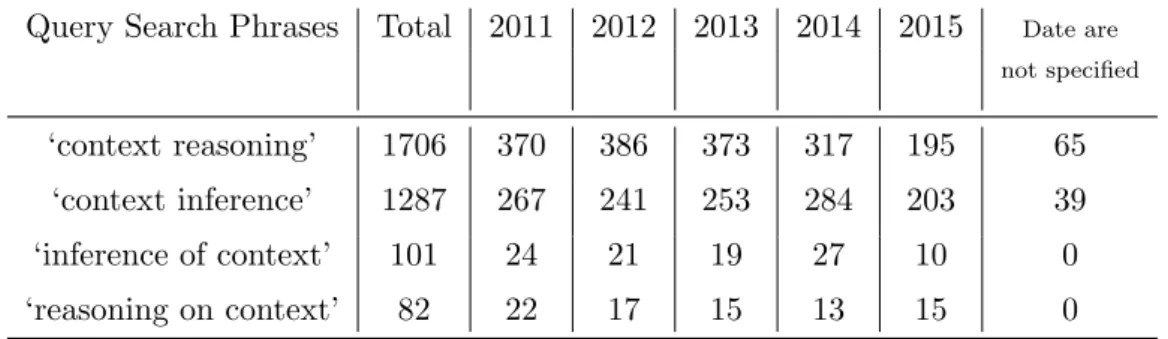
To find and review existing publications that discuss contextualisation, we searched Google Scholar (scholar.google.com) for relevant publications, of which we found over 30001. In particular, we organised our searches into four sets according to the search phrases listed in Table 2.1. This table also shows the total number of publications found by each query, and the number of such publications per year.
Table 2.1: Publications related to each search phrase.
Query Search Phrases Total 2011 2012 2013 2014 2015 Date are not specified
‘context reasoning’ 1706 370 386 373 317 195 65
‘context inference’ 1287 267 241 253 284 203 39
‘inference of context’ 101 24 21 19 27 10 0
‘reasoning on context’ 82 22 17 15 13 15 0
Next, we reduced these four set of related publications to the most relevant one via the following publication selection process:
1. Removal of duplicates
Related publications that included more than one of the search phrases in Table 2.1
were included in more than one of the four result sets. Such duplicates were removed.
2. Removal of articles by publishers lacking an excellent reputation
Therefore, we only considered publications from well-known publishers, including Elsevier 2, IEEE 3, ACM4, and Springer 5.
3. Removal of articles based on secondary and tertiary studies (surveys)
Publications can be classified as primary, secondary or tertiary studies. Primary studies are normal research publications that include research contributions. A study that reviews primary studies on a specific research topic is a secondary study [22]. Tertiary studies review other reviews. Therefore, in this step, we removed all publications that were secondary or tertiary studies (e.g., with the word ‘survey’ in the title).
4. Removal of articles that had never been cited
This step allowed us to consider citations as a metric of the research impact of a publication. Therefore, we did not consider papers without any citations.
5. Focus on articles with the highest research impact
To select the highest impact publications we utilised the µj value [Equation 2.1]
proposed for primary studies. In this equation, αi is the number of citations of each
paper ipublished in yearj, andnj is the total number of related papers published
in that particular year. To select the highest impact research papers we set nj to be
our set of publications after step 4, and j for the past five years.
µj = Pnj i=1αi nj (2.1)
6. Manual filtering of the remaining papers
Finally, the last selection phase was to exclude papers that were not relevant to this
2 www.elsevier.com 3www.ieee.org 4 www.acm.org 5 www.springer.com
thesis, such as papers from disciplines other than computer science and engineering (e.g.,context in social science).
Figure 2.1 shows the number of papers remaining after each step of the selection process.
Figure 2.1: Literature selection process.
2.2.2 Primary Studies
In this section, we summarise the contributions of related publications (mainly highly-relevant primary studies with high research impacts, as discussed in Section 2.1).
• Baladron et al. [24], presented a converged framework for context management as a driver for service adaptation in the future internet. It allows integration, monitoring and control of heterogeneous sensors and devices under a single context-aware service manager (i.e., a service manager that utilises contextual information and provides contextualisation techniques). This module can use clustering algorithms to take advantage of user histories for inference and prediction of missing contexts.
• Roussaki et al. [25], presented a context management architecture suitable for pervasive services combined with social networking and explored its value to users all over the world. They presented the first results from their work in SOCIETIES , a European Information and Communications Technology (ICT) research project that aims to bring together pervasive computing and social networking paradigms.
• Lee et al. [26], presented the implementation of MobiCon: a practical context-monitoring middleware for context-aware application development. This middleware mediates context-aware applications (i.e., an application that can utilise contextual
information to deliver services) and personal sensor networks, offering Application Programming Interface (API)s as well as run-time environments for applications. The system guarantees accurate context recognition (i.e., a process that identifies user and application contextual information from sensor data) by means of five modules, namely, context processor, sensor manager, resource coordinator, application broker and sensor broker. Some requirements for the system are high-rate data acquisition from multiple sensors, feature extraction and context recognition with large amounts of context data, along with intermediate transmission of results. MobiCon supports multiple applications and can adapt to sensor availability.
• Okeyo et al. [27], described an integrated architecture that combines ontological and temporal knowledge representation formalism for composite activity recognition. They also presented models, methods and algorithms that are capable of supporting the recognition of simple and composite activities. In this paper, contextual user data was analysed to recognise users’ ongoing activities. They claimed that the paper presents the first effort to use a purely knowledge-driven approach that addresses temporal representation as well as reasoning requirements to recognise both simple and composite activities.
• Yndurain et al. [28], presented an architecture that enables search engines to take into account contextual information to enhance the search results. They proposed a technique to adapt the queries to deal with signals and produce intermediate context states. They experimented with the use of heuristic rules for contextual reasoning. They propose that, in the future, search engines must become more context-aware.
• Rodriguez et al. [29], presented a fuzzy ontology that aims to solve the limitations of other ontology-based activity recognition techniques in dealing with imprecision and uncertainty, as well as vague or incomplete data. The proposed approach is incremental and allows different levels of granularity that, as they state, allows behavioural abstraction and more accurate recognition. In their fuzzy ontology, rules
can be established to recognise human behaviour using a sequence of observations, a behaviour specification structure and handling of uncertainty.
• Roy et al. [30], proposed a framework for sensor networks that fuses data from multiple sensors and uses the context state to support context-aware services that handle ambiguity by reasoning efficiently about the state. The focus is on considering the computational aspects of data related to sensors and providing context-aware services. The main goals of the work are to construct a framework that can deal with information redundancy and guarantees an application’s quality in terms of contextual bounds. They proposed a system that includes dynamic Bayesian net-work techniques and uses sensor data to derive context states via a fusion process. They also used reasoning techniques from information theory to determine optimal contextual attribute values and minimise state ambiguity. They proposed an indica-tor, the Quality of Context (QoC), to evaluate the framework and used Sun Small Programmable Object Technology (SunSPOT) to build a system and validate their proposal.
propose a framework for sensor networks that fuses data from sensors and uses the context state to support context-aware services that handle ambiguity by reasoning efficiently about the state. Focus is set on considering the computational aspects of data related to sensors and providing context-aware services. The main goals of the work are to construct a framework that can deal with information redundancy and guarantees an application’s quality in terms of context bounds. They propose a system that includes dynamic Bayesian Network techniques and uses the data from sensors to derive context states by means of a fusion process. They also use reasoning techniques from information theory to select context attributes’ optimal values and minimise state ambiguity. They proposed an indicator, the QoC, to evaluate the framework and used Sun Small Programmable Object Technology to build a system and validate their proposal.
context awareness (which is a technology that automatically provides a service based on the contextual information) in distributed and ubiquitous environments. The middleware is a system that can distribute and manage situational information in mobile nodes using mobile devices in distributed and ubiquitous environments. The system shares service contents through interactive middleware through publication. Their proposal aims to unify and share multiple middleware modules to lay the foundation for providing extended functions to applications using services to improving performance.
• Rahman et al. [32], presented SenseFace, a framework to create a personal social network that offers personalised and context-specific interaction with different services and communities of interest. SenseFace provides the following features: 1) It is capable of extracting the user’s personal social network from the internet; 2) it extracts content from Body Sensor Network (BSN) and Personal Social Network (PSN); 3) it extracts context information from the BSN and PSN and creates context primitives; 4) it combines the generated context primitives that define a user’s context; 5) it employs a novel ubiquity stack that maps each user’s context to a subset of services and social ties; and 6) it dynamically assigns a priority to each service so that the visualisation maintains a layout of each service based on its earned credit.
• Martin et al. [33] explored the use of smartphones for activity recognition. They studied how to approach the building of an activity recognition system through continuous background execution in a smartphone. The architecture they proposed is an embedded, stand-alone, physical activity estimation approach that uses the sensing, processing and storage capabilities of devices in order to estimate significant movements or postures (e.g. walking at slow, normal and rushing paces, running, sitting, standing, etc.). They demonstrated the feasibility of the system by 1) collecting an activity dataset of 16 individuals, and 2) training a set of classifiers (Na¨ıve Bayes, decision table and decision tree) working on different selections of sensor data. They measured the accuracy, computational cost and memory fingerprint of
their classification system.
• Kabir et al. [34], presented a Social Context Information Management System (SCIMS) to support the development of applications utilising social information. They proposed an ontology-based model for representing and storing both people-and object-centric relationships people-and used these to compute the status information of SCIMS users. Based on information acquired from various sources, SCIMS derives a rich social context. The system uses Facebook, LinkedIn, Twitter and Google Calen-dar to acquire users’ social context information (i.e., social roles, social relationships and status) and provides rich semantic support for representing and inferring from such contexts. They propose a way to preserve privacy by allowing users to adjust the granularity of information stored.
• Rossi et al. [35], presented a real-time ambient sound recognition system for smart-phones called AmbientSense. They described the design, implementation and evalua-tion of the system. The system samples ambient sound data, extracts features from the data and produces a context recognition result by means of a Support Vector Machine (SVM) classifier using auditory scene models. There is a training phase for creating models based on an audio data training set. The recognition stage is implemented in two modes: autonomous mode and server mode. In server mode, classification is performed by transmitting features to a server and then receiving the resulting class. Both modes of operation were evaluated with a set of 23 daily life ambient sound classes in terms of recognition performance, phone CPU load and recognition delay.
• Meditskos et al. [36], proposed a hybrid framework (SP-ACT) for complex activity recognition via a semantics solution that utilises Web Ontology Language (OWL), SPARQL Protocol and RDF Query Language (SPARQL) for recognition of complex activities. Ontologies provide a common vocabulary for representing activity-related contextual information and SPARQL rules derive high-level activity interpretations. The temporal relations among activities are handled by SPARQL functions and the
derivation of new composite activities exploits the native capabilities of SPARQL to update the underlying activity model.
• Papadopoulou et al. [37], proposed the idea of a Personal Smart Space (PSS), which is a set of devices connected using peer-to-peer connections, and described the interactions that may occur among them. They presented an architecture for the PSS that includes several layers and blocks that structure the management of information from the device level to actions at the environment level. They claim that the PSS approach easily separates the personalisation needs of the user from the control of the devices.
• Okeyo et al. [38], presented an approach to dynamic sensor data segmentation, which is where sensor data streams are segmented into fragments, each of which can be mapped to an activity description. They used this approach for knowledge-driven activity recognition that is capable of continuous real-time operation. The main contributions of this work are: 1) A sensor data segmentation model was proposed based on time windows that is applicable to a wide range of activity recognition scenarios; 2) description of mechanisms for the dynamic manipulation of model parameters, such as the setting, shrinking and expansion of the time window; 3) incorporation of the data segmentation method into an ontology-based technique for activity recognition; 4) evaluation of the performance of the proposal in real-time activity recognition; 5) implementation of a prototype system to evaluate the above that consists of a synthetic Activities of Daily Living (ADL) data generator, an ADL ontology, a sensor data simulator for ADL data playback and a real-time activity recognition system. This evaluation method utilised accuracy as its main metric and the results demonstrated the feasibility of this approach.
• Wei et al. [39], explored an approach that uses a middleware system, called CAMPUS, to automatically perform context-aware adaptation of decisions at run time. CAMPUS utilises semantic technologies to dynamically make adaptation decisions based on contextual information. They also proposed a new programming model based on
compositional adaptation for constructing context-aware applications and facilitating adaptation decisions. CAMPUS formulates a comprehensive ontology-based model that allows the capture of important concepts and relationships between entities, which are necessary for automated context-aware adaptation decisions. Based on these ontologies, the CAMPUS employs Description Logic (DL) and First-order Logic (FOL) to infer and make context-aware adaptation decisions automatically.
• Boytsov and Zaslavsky [40], proposed, developed and evaluated a technique for formal verification of context models and situations. Situations, in this context model, include dependencies among situations as well as situation definitions in terms of context features . The paper demonstrated that the definitions complied with the expected properties and provided a complete set of counterexamples that illustrated situation inconsistency.
• Carreira et al. [41], proposed a prototype system that uses context information to automatically detect and solve conflict situations in Home and Building Automation System (HBAS). The contributions of this work include the following: 1) a conflict taxonomy that includes a formal representation of intelligent environment conditions and components, and 2) a foundation for systems capable of automatic conflict detection and resolution. The research also included an investigation of the nature of classification of conflicts in home automation, a model that allows specification of the intelligent environment components that can cause conflicts, and a prototype system that can analyse the environment, detect the existence of conflicts and determine whether they can be resolved.
• Yuan and Herbert [42], presented a fuzzy-based context modelling and reasoning framework for a proposed pervasive healthcare architecture referred to as CARA. The reasoning component of CARA fuses physiological, behavioural and environmental information to support home healthcare monitoring. CARA also provides more accurate emergency situation detection via incorporation of real-world environmental data to supplement medical sensor data. The paper also presented some details of
the CARA architecture, including its remote monitoring, data and video review, and healthcare reasoning components.
• Lee et al. [43], presents Cooperative Context Monitoring System (CoMon) for addressing the high-energy usage problem in mobile content management that occurs when context information is shared among mobile users. Their solution includes techniques for continuity-aware co-operator detection and benefit-aware negotiation. According to their estimations and tests, the monitoring system enables mobile applications to monitor the environment with much lower energy consumption than other techniques.
• Nath [44], presents a middleware system for efficient and continuous sensing of the contexts of mobile phone users. The proposed middleware dynamically learns rules about the relationships among various context attributes using a novel technique for association rule mining. The rules learned are exploited for optimising inference caching and speculative sensing. Inference caching allows the middleware to infer one context attribute from another already-known attribute without requiring any sensor data. Speculative sensing enables the middleware to occasionally infer the value of an expensive attribute by sensing cheaper attributes.
• Ha et al. [45], described an assistive system based on Google Glass devices for users in cognitive decline (e.g., those with Alzheimer’s disease or mild cognitive impairment) and survivors of stroke. They described the architecture of the system, which is called Gabriel, and presented a prototype implementation. Google Glass devices are used to perform first-person image capture, sensing, processing and communication. The main system architecture characteristics include being multi-tiered, offering low end-to-end latency bounds on computing-intensive actions, taking into account the limited battery capacities and processing capabilities of these devices, support for Vector Machine (VM)-based extensibility for customisation, and graceful degradation of offload services in case of network failure and unavailability.
• Mehrotra et al. [46], proposed a middleware system solution called SenSocial that builds and binds social and physical context data streams for applications. SenSocial performs remote management of streams and filters their data to refine contextual (physical and social) data streams. Next, it separates and delivers relevant parts of such context data to various apps as they require. SenSocial offers privacy manage-ment functionality that allows the developer to manage the type and granularity of sensed contextual data that is stored and shared. It is also able to manage the sampling of users’ physical contexts once an online social network action is detected and pairs the sensed physical context with the social network information.
• Motik et al. [47], described a knowledge management system that supports context-aware applications called Delta-Reasoner. This system uses RDF as the data model and OWL for semantically representing background knowledge. It uses incremental reasoning for dealing with changes in reading calculations from the sensors. Delta-Reasoner is part of the Intelligent Mobile Platform, a system that exploits semantic technologies to represent different situations and related applications.
• Maia et al. [48], presented a context management middleware system for the An-droid platform called Loosely Coupled Context Acquisition Middleware (LoCCAM). LoCCAM provides self-adaptive gathering of contextual information from nearby devices. The context management component of LoCCAM is built as an extension of the Open Service Gateway Initiative (OSGi) framework [49], with the feature of dynamic reconfiguration of the acquisition layer during application execution. LoCCAM employs a model for publication and notification of contextual information based on tuple spaces.
• Xu et al. [50], explored the feasibility of inferring a user’s inputs on the touchscreen of a smartphone using the data collected from motion sensors. They show that there are unique patterns of tap events (in terms of changes in acceleration) and that statistical approaches can be used to detect the occurrence of tapping. Similarly, they showed that there is a correlation between the tap position and the gesture change
(as detected by the orientation sensor) during a tap event. They also designed what they called a TapLogger, which is a Trojan horse application that utilises observed sensor data to secretly log users’ touchscreen inputs.
• Wei and Jin [51], presented a context-aware service discovery architecture for the IoT that aimed to provide an efficient infrastructure to support smart service provisioning. An ontology-based model that utilises Dynamic Bayesian Network (DBN) was pro-posed to handle uncertain and temporal contexts. They also examined the function of context and relations with entities in the IoT. To achieve this, they used DBN to obtain high-level contexts from low-level time-series data streams by reasoning about these contexts.
• Liu et al. [52], ] presented an ontology learning model called Domain Ontology Graph (DOG). This model 1) supports the definition of ontology graphs that provide knowledge conceptualisation, and 2) supports the ontology learning process that guides semiautomatic domain ontology learning and generates corresponding ontology graphs. Two kinds of ontological operations are introduced in this paper: document ontology graph generation and ontology-graph-based text classification.
• Chon et al. [53], proposed a method for the autonomous construction of a Point of Interest (POI) map called LifeMap, which includes a service that provides information about various locations without needing a centralised server. LifeMap exploits onboard accelerometers and electronic compasses to track the locations of mobile device users. It incorporates a room-level, fingerprint-based, place-learning technique that generates logical locations from the properties of Wi-Fi radio signals. The paper also presented an implementation of the system on Android phones and validated its practical usage in everyday life.
• Zhu et al. [54], proposed an authorable (able to generate Augmented Reality (AR) content) and context-aware system for assisting maintenance technicians. This system, called ACARS, enables AR developers to create contextual information for maintenance purposes via a 2D desktop user interface. Existing authoring tools
for maintenance tasks are unidirectional but are not context-aware, so proving this combination is a significant contribution. ACARS consists of context management, AR visualisation, database, offline authoring and on-site authoring components. The context management module collects contexts from user inputs and sensors, infers new contexts and transmits all the contexts to an AR-based visualisation module.
• Choi et al. [55], proposed a dynamic access control model they called Onto-ACM. Onto-ACM provides ontology reasoning and semantic analysis for managing the security level required to access resources. Onto-ACM offers a mechanism that can prevent misuse of access rights by dynamically changing the permissions of any user role based on context information.
• Zhang et al. [56], proposed a scheme of Decentralised Checking of Context Inconsis-tency (DCCI) in pervasive computing environments. They claimed that DCCI is the first scheme in pervasive computing environments that is capable of checking context inconsistency in a fully distributed manner. Their solution for doing this builds a shortcut structure that aims to reduce the communication overhead and improve the checking accuracy by exploiting a preference-based locality.
• Okeyo et al. [57], presented a hybrid knowledge-driven approach to composite activity modelling that combines ontological and temporal modelling. This approach enhances ontology-based activity models with qualitative temporal information based on Allen’s temporal logic [58]. The paper proposed 1) ontological modelling constructors describing composite activities, and 2) temporal modelling operators. These provide for the modelling of both static and dynamic characteristics of activities. The paper used these modelling approaches to demonstrate several composite activity models. Finally, a set of inference rules was proposed to achieve composite activity recognition.
• Coradeschi et al. [59], presented a system called GiraffPlus, consisting of a network of home sensors that collects vital sign measurements such as weight, blood pressure, blood glucose, environmental signals from smoke sensors, temperature sensors, fall sensors, etc. This information is then processed by a context recognition system
that recognises activities, monitors health and assesses wellbeing. GiraffPlus can subsequently trigger alarms or reminders to its users or their caregivers. A telepresence robot, the Giraff robot, is part of the proposed solution. This robot can be moved around the home by somebody else controlling it over the internet. It is equipped with a video camera, display, microphone, speakers and touchscreen, and can be used for information collection and communication.
• Ju et al. [60], proposed a coordinated sensing flow execution engine, referred to as Symphoney, for concurrent sensing applications. Symphoney supports frame externalisation that identifies semantic structures embedded in sensor data streams. Symphoney also provides a data flow programming model via an XML interface. It supports developers by giving them tools to flexibly compose customised sensing flows. This allows rapid prototyping of complex sensing flows, reducing the time and effort needed.
• Nguyen et al. [61], proposed a framework for discovering latent patterns that employs Hierarchical Dirichlet Processes (HDP). Latent patterns are relations amongst contexts that are hidden inside the data and that are not easily inferred. HDP is a hierarchical Bayesian non-parametric model mainly used for the purpose of modelling grouped data. The paper includes results of an experiment with users from the authors’ lab. These experiments show that data can be represented and learned with HDP and these can find parameter clusters that are similar to those yielded by other methods that search for latent patterns.
• Zaslavsky et al. [62],presented CAROMM, a mobile data stream mining system that aims to provide improved scalability of mobile data collection and run-time analytics (on-the-move mining). The paper shows that CAROMM is capable of collecting and processing data from a large number of mobile devices. The key component of this work is CAROMM’s data analysis-cluster engine, which provides the mobile data analytics functionality and related scalability.
• Sudhana et al. [63], proposed an ontology for a context-aware adaptive e-learning application that delivers learning material by taking into account the context of the e-learner. In this work, context is modelled as ontological profiles. The paper describes alternative categorisation approaches for contextual information in the e-learning domain based on learner perspective-based context acquisition. The paper also proposed an architecture model for a context-aware e-learning application.
• Liu et al. [64], presented an Incremental and Distributed Inference Method (IDIM) for large-scale ontologies (incremental RDF datasets) that utilise MapReduce [6]. This solution works by constructing a Transfer Inference Forest (TIF) and Effective Assertional Triple (EAT). These help reduce the required storage and simplify the reasoning process required. These, in turn, allow users to execute their query more efficiently (other related work requires computing and searching over the entire RDF closure).
• McNaull et al. [65], proposed an Ambient Assisted Living Flexible Interface (AALFI) that is controlled by a Multi-Agent System (MAS). This solution aims to provide help to older people so they can continue living in their own home for longer. This research provides such support via an adaptive multi-modal interface that is driven and updated by a MAS and complements the current support offered by the NOCTURNAL project [66] by providing interaction through visual and auditory modalities. The users are provided with advice that is based on criteria such as the quality of sleep during the night and possible breaches of safety during the day. These help its user to carry out corrective measures and/or seek further assistance. Interactions are personalised to support each user’s needs and are either visual or auditory.
2.2.3 Definitions of Terms for the Review of Related Work
• Contextual Operations -These are the operations that utilise context information and perform IoT data contextualisation. They include the following:
– Filter: Operations that only allow certain information to pass through them;
– Aggregate: Operations that compute a single value from a collection of values by using mathematical operations such as averaging or summarising;
– Infer: Operations that deduce new information by reasoning on the data.
• Techniques - This includes any algorithms for the above and other contextual information.
• System - This includes the implementation, architecture and APIs:
– API and Software tools: Any external data communication with other services or applications;
– Implementation and architecture: Include the architecture and implementations described in the papers.
• Semantics - This includes the use of semantic-based models and techniques for defining and utilising content and performing contextualisation:
– Ontology: Specified ontologies that have been used in the paper;
– Context: The definition or description of the context used in the paper;
– Context Attributes: Context attributes described in the paper;
– Context Reasoning: Deduction of context based on available information;
– Context Model: Describes how the context data is structured.
• Evaluation - This includes evaluations of techniques and systems for contextualisa-tion:
– Evaluation Definition: Evaluation of the contribution of the paper;
– Evaluation Parameters: Parameter used for evaluation of the paper’s contribu-tion.
• Big Data and IoT - This includes specific references and solutions for Big Data and the IoT:
– Big Data: Any reference to Big Data and its definitions;
– Big Data Parameters (3V): Investigation of main Big Data parameters including volume, variety, and velocity;
– Internet of Things: discussion or contribution related to the IoT.
2.2.4 Systematic Literature Review Outcome
This section presents the conclusion of the SLR.
To assess the related work summarised in Section 2.2.2, we consider the contextualisation operations in the literature review. The majority of the related work proposes reasoning and inferring operations for context and contextualisation. Filtering operations are encountered in a few publications [54, 46, 32, 26]. However, they do not necessarily describe if or how context is utilised in the filtering operation. Furthermore, we could not find any systematic description of filtering and aggregating operations or a comprehensive description of contextualisation operations in any of the related works.
Related work that explores the semantic aspect of context and contextualisation lacks any clear definition of context and provides no clear boundaries between sensor data, application data and context (or contextual information). In addition, definitions ofcontext are typically application specific. Similarly, the majority of related work defines ontology by themselves or they are not using any formally defined ontologies. Furthermore, there are no common methods of using ontologies.
Related work does not provide a common evaluation methodology, and there is no common framework for the performance evaluation of the provided contextualisation solutions. Furthermore, the scalability of such contextualisation solutions is not considered in most of the papers. Finally, no related work has demonstrated scalable and/or near real-time IoT data processing in applications involving context and contextualisation.
No related work has investigated and provided solutions for dealing with high-volume, -velocity and -variety sensor data, which remain a challenge in IoT and related Big Data
applications. In fact, most related work does not consider the IoT at all. There were a few papers that mention applications and services using sensors but these are not involved any internet-related issues and, hence, are not necessarily IoT applications.
Finally, there is no generic cloud solution for using context and contextualisation in the IoT and related Big Data applications.
2.3
Scalable Security and Privacy in Internet of Things
Typical security threats that can compromise IoT applications include eavesdropping, impersonation, modification and data breaches. Moreover, to protect the privacy-sensitive data of individual IoT devices, e.g. in the case of healthcare applications, it is important to provide privacy-aware access to data without exposing the actual data. The IoT is an important new internet technology with great potential for developing smart buildings and cities, assisted living and healthcare, precision agriculture and environmental monitoring, manufacturing, and security and defence. IoT systems and their applications must deal with malicious disclosure and attacks and provide mechanisms that protect sensitive data such as patients’ physiological data, energy consumption data from smart meters, and the locations of mobile users. Existing techniques for protecting privacy-sensitive data in the IoT include the following.
There are several aspects of the IoT that present security and privacy problems, including IoT device communications, constrained resources (e.g., limited battery life), variety (e.g., different types of devices made by multiple manufacturers), and scale (billions of devices) [67]. Among the plethora of recent research solutions [68, 69, 70, 71, 72] for protecting sensitive IoT data, some related research (e.g., [73, 68, 70]) focuses on security and privacy preservation policies while others (e.g., [68, 69, 71, 72]) focus on encryption and the design of privacy preserved frameworks for the IoT [74]. Although most proposed techniques can ensure security and privacy, their ability to scale up to support millions of IoT devices and their data has not been validated.
Ensuring the scalability of privacy-preservation solutions for millions of IoT devices is a significant problem. The solution proposed in this section couples watermarking with contextualisation to protect the privacy of a virtually unlimited number of IoT data points. As noted earlier, there are clear parallels between the disclosure technique proposed in this thesis and access control, and there has been a considerable volume of research on developing both access and disclosure control methods.
The most common access control mechanisms are Discretionary Access Control (DAC), Lattice-Based Access Control (LBAC), and Role-Based Access Control (RBAC) [75]. DAC is discretionary in the sense that the owner of the requested resource controls the access to that resource. Each access request is checked against the specified authorisations. If there exists an authorisation stating that the user can access the resource in a specific mode (read or write), access is granted, otherwise it is denied. LBAC enforces unidirectional information flow via a predefined lattice of security labels that are associated with every resource and user in the system. RBAC determines the access level via the role abstraction, rather than simply by the identity or clearance of the requester. In this model, a role is a semantic construct, which is often a representation of a job in an organisation.
In an IoT setting where both data and access control policies can change rapidly, the above access models cannot deal with such frequent changes. To deal with such changes, another trend in research enriches access polices with contextual information. For instance, several extensions to the basic RBAC model have been proposed to incorporate context variables such as the Generalised Role-based Access Control (GRBAC) model [76]. GRBAC introduces environmental information such as temperature or location to activate roles based on the value of conditions in the environment where the request was made. A similar context-aware RBAC model has been proposed for health-care applications [77], where the contextual information invokes the relevant access policies for a specific role. A major deficiency of these approaches is that data access is either granted or denied.
In order to provide flexibility for situations where different data granularities are needed, disclosure control methods are advantageous. Existing disclosure control techniques are divided into identity and data disclosure control. Identity-based disclosure techniques, such
as k-anonymity and l-diversity or pseudonymity, attempt to detach or replace identifiers from data, whereas the latter techniques protect the data itself. In this section, we discuss only data disclosure control techniques. A comprehensive review of identity disclosure control techniques was conducted by Aggarwal and Philip [78].
Common techniques for data disclosure control include generalisation and suppression, data swapping and noise addition. Data generalisation attempts to prevent data linkages for the privacy preservation of published datasets. An example would be replacing an exact date of birth with only the year. Suppression techniques can be viewed as the ultimate form of generalisation since no information is released. Unfortunately, these techniques cause information loss and, also, are not appropriate for real-time applications because of the complexity of the required calculations.
The watermarking aspect of the technique we propose in Section 5.1 is similar to a noise addition technique, as digital watermarking techniques are used to obfuscate sensitive data. In contrast to noise addition techniques, this technique is reversible which enables tuning of the obfuscation parameters based on the access privilege of the users.
Achieving multi-granular disclosure requires the use of obfuscation techniques. Data obfuscation, in this case, involves generalising or degrading sensitive data to establish the desired level of granularity for disclosure. Existing obfuscation techniques include data randomisation, data anonymisation, random sampling, or data swapping [5]. For instance, Mivule [79] investigated techniques for adding noise to sensitive data, including additive noise, multiplicative noise, logari