Culminating Projects in English
5-2020
Let’s Talk: A Study of Dialogic Feedback in a First-Year
Let’s Talk: A Study of Dialogic Feedback in a First-Year
Composition Classroom
Composition Classroom
Jenna SaundersFollow this and additional works at: https://repository.stcloudstate.edu/engl_etds
Recommended Citation Recommended Citation
Saunders, Jenna, "Let’s Talk: A Study of Dialogic Feedback in a First-Year Composition Classroom" (2020). Culminating Projects in English. 158.
https://repository.stcloudstate.edu/engl_etds/158
This Thesis is brought to you for free and open access by theRepository at St. Cloud State. It has been accepted for inclusion in Culminating Projects in English by an authorized administrator of theRepository at St. Cloud State. For more information, please contact [email protected].
Jenna M. Saunders
A Thesis
Submitted to the Graduate Faculty of St. Cloud State University in Partial Fulfilment of the Requirements
For the Degree of Master of Arts
in English: Rhetoric and Writing
May, 2020
Thesis Committee: Sharon Cogdill, Chairperson
Matthew Barton Michael Dando
Abstract
Feedback is vital to first-year composition (FYC) students’ learning because students use feedback to gain an understanding of the progress they have made as academic writers and the steps they might take to further said progress. Academia has a long history of conversations on best feedback practices and continues to identify strengths and weaknesses of various feedback models. Dialogic feedback, a method of feedback in which the student actively participates in discussion with their instructor, emerges from these conversations as a feedback model that is potentially better for student learning. The dialogic feedback model merits further study, particularly in relation to how FYC students engage with and react to the dialogic feedback process. Exploring dialogic feedback from the perspective of FYC students is an important area of study, as the students’ actions during the process and feelings about the process offer insight into the effectiveness of the feedback model. Studying how FYC students engage with and react to a dialogic feedback model reveals that FYC students are capable of undertaking an active role in the feedback process, as they can successfully recognize and discuss important concerns in their own writings, if they are sufficiently prepared to engage in these conversations. The students’ active role also allows them to exercise self-regulation and agency, which develops both valuable skills. Furthermore, dialogic feedback makes students feel good about themselves and their writing, which is important, as a relationship exists between how students’ feel about the feedback given to them and whether they feel they belong at their educational institution. These FYC students value feedback models that evoke positive feelings and that offer them sufficient and timely feedback. This evidence suggests that dialogic feedback is an effective feedback model for FYC students.
Keywords: dialogic feedback, first-year composition, feedback models, dialogic feedback models, academic writing
Table of Contents
Page
List of Figures ……… 5
Chapter I. Introduction ………. 6
Considering the Identity of the New Teacher ……… 6
II. Literature Review ……… 10
What is Dialogic Feedback? ………. 12
What Does Dialogic Feedback Do? ……….. 17
III. Methods ……… 27
Study Purpose and Research Questions ………. 27
Participants ……… 28 Study Procedure ……… 29 Materials ……… 47 Analysis ………. 48 IV. Results ………. 56 Student Engagement ……….. 56 Student Reaction ……… 81
V. Implications and Discussion ……… 89
Student Engagement ……….. 89
Student Reaction ……… 96
Chapter Page
Conclusion ………. 103
References ………. 106
Appendix ………... 108
IRB Protocol Form ……… 108
Recruitment Script ………. 119
Informed Consent Forms ………... 120
List of Figures
Figure Page
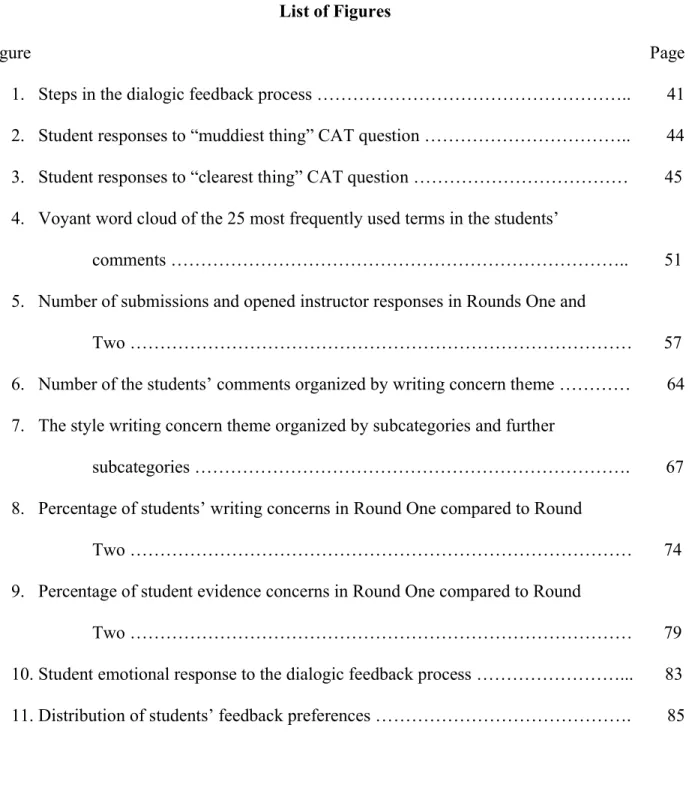
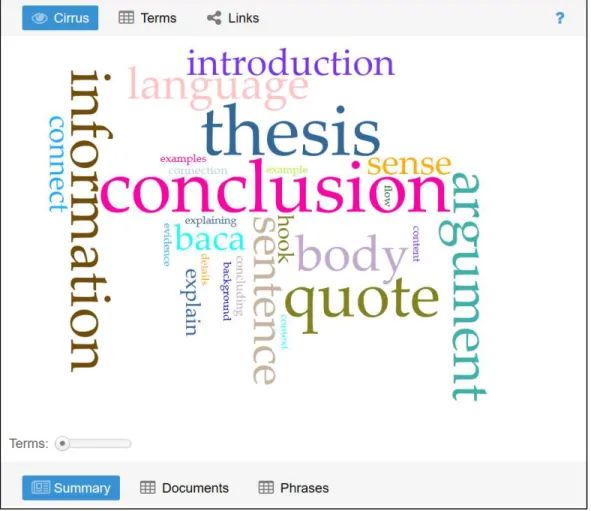
1. Steps in the dialogic feedback process ……….. 41 2. Student responses to “muddiest thing” CAT question ……….. 44 3. Student responses to “clearest thing” CAT question ……… 45 4. Voyant word cloud of the 25 most frequently used terms in the students’
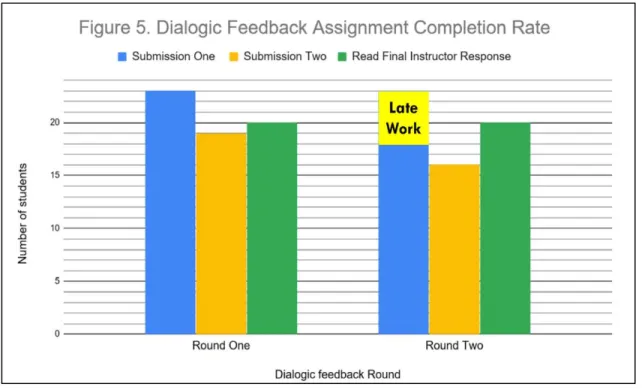
comments ……….. 51 5. Number of submissions and opened instructor responses in Rounds One and
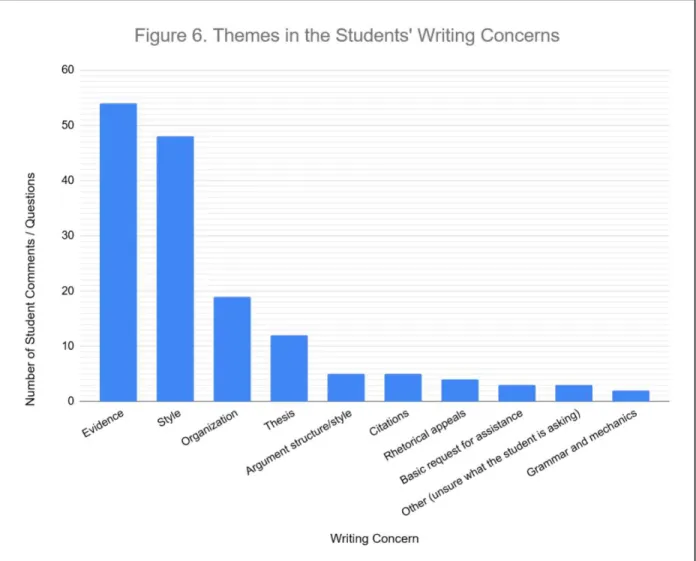
Two ……… 57 6. Number of the students’ comments organized by writing concern theme ………… 64 7. The style writing concern theme organized by subcategories and further
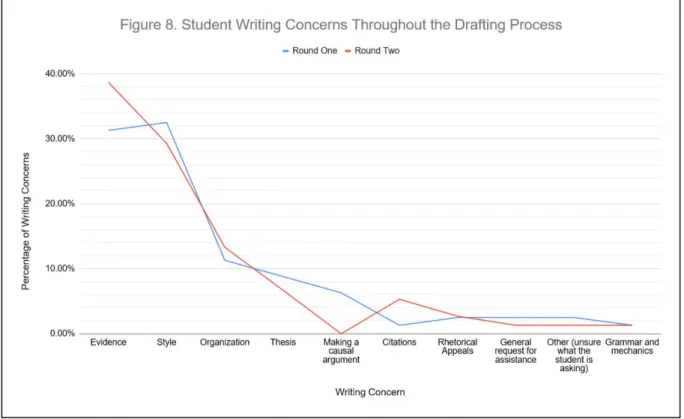
subcategories ………. 67 8. Percentage of students’ writing concerns in Round One compared to Round
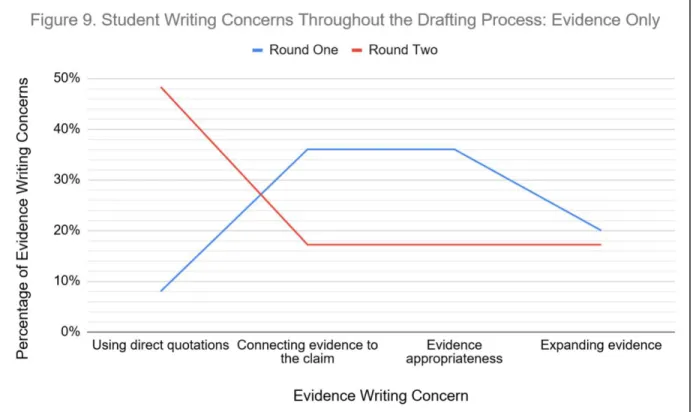
Two ……… 74 9. Percentage of student evidence concerns in Round One compared to Round
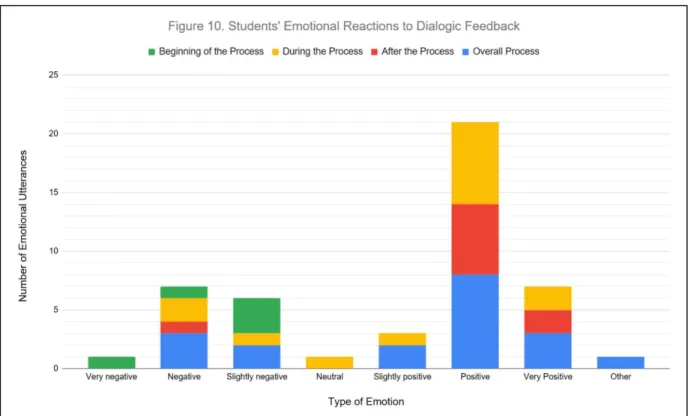
Two ……… 79 10.Student emotional response to the dialogic feedback process ………... 83 11.Distribution of students’ feedback preferences ………. 85
Chapter I: Introduction Considering the Identity of the New Teacher
The identity of the new teacher lives in a crowded, curious, and unsure place. For a new teacher, every lesson brings a curiosity about what happens in and around the classroom space, but it also brings an uncertainty about the events and experiences that occur in the classroom between both the instructor and the students and the students themselves. New teachers have no tried-and-true methods to lean on and little lived experience to ground decision making in. Instead of the confidence that experience brings, the new teacher has the examples of the professionals around them, the advice of those professionals, the readings and pedagogies they have both been given and have sought out, and a willingness to throw ideas at the wall until something sticks. Yet, the examples and the advice, the readings and the pedagogies, the throwing and the sometimes sticking is at risk of amounting to little if these experiences are not tracked and meaning is not made from them. Thus, in order to make intentional and thoughtful meaning from classroom events and experiences, all new teachers should, at some point, begin to shift their mindset from thinking as someone who is merely curious to thinking as someone who pursues curiosity. The instructor who pursues curiosity is the teacher-researcher.
Glenda Bissex (1986) proclaims that the teacher-researcher is “an observer, a questioner, a learner, and a more complete teacher” (p. 483). Thus, Bissex’s teacher-researcher is called to adopt a mindset that notices the complexities of the classroom ecosystem, the purposefulness of good curriculum, and the intricate and personal process that is learning. Adopting the mindset Bissex describes does not mean the teacher-researcher fully understands how these components of education are functioning within their classroom. Rather, it means the teacher-researcher is
curious about these components and takes action to achieve a better understanding of them. The teacher-researcher begins “with a wondering to pursue,” which means that the teacher-researcher wants to explore questions and curiosities (p. 482). Within their pursuit of questions and
curiosities, the teacher-researcher continuously reconsiders both what they have been told about teaching and what they think they know about teaching. The teacher-researcher looks and relooks, considers and reconsiders, until they reach a moment in which they can make a supported teaching decision and can argue the validity of the supported decision. To adopt the teacher-researcher mindset, the new teacher must continue to throw ideas at the wall, but now, they must try to ask themselves what they are throwing, why they are throwing it, and what it might mean if it sticks.
In an attempt to adopt the teacher-researcher mindset and bring intentionality to my own teaching, I am pursuing classroom research in the first-year composition (FYC) classroom that I teach as a graduate teaching assistant. As a graduate teaching assistant, I operate in the dual role of new teacher and graduate student, and both roles are steeped in the learning process. This learning process is what has spurred an investigation into feedback practices in the FYC classroom, as I have continuously found myself struggling to provide the students I teach with appropriate, effective, and timely feedback and, at the same time, have come to understand feedback as an integral and vital aspect of helping students learn. Feedback is vital to student learning because students use feedback to gain an understanding of the progress they have made in their writing and the steps they might take to further that progress. Watching students develop as writers from the direct feedback given to them and experiencing my own growth as a writer
through the feedback given to me has only deepened this understanding of feedback’s significance to the composition classroom.
However, providing appropriate, effective, and timely feedback proves incredibly challenging, and the conversations in academic scholarship recognize that providing feedback can be challenging for instructors at all levels of academia and at all experience levels. As a new teacher, one of the challenges with providing students with feedback stems from the fact that I can only utilize the methods that I have both been taught and have noticed as a student. The primary feedback method that I have been taught and have noticed as a student involves an instructor reading and analyzing a student’s writing and providing commentary in order to help the student identify weaknesses and make revisions. Although before approaching feedback practices from the mindset of the teacher-researcher this method was unnamed, I can now name this method as the monologic feedback model, which refers to instructor commentary that is understood as input from the instructor to the student (Ajjawi & Boud, 2015). Monologic feedback, however, is not the only method through which instructors can provide their students with feedback, and furthermore, monologic feedback is potentially not the most effective method through which to provide students with feedback. Although numerous methods for providing students with feedback exist, dialogic feedback, which understands feedback as a collective experience in which the instructor and the students work together to discuss writing weaknesses and plan revisions, emerges from the current scholarship as a method that is potentially better for supporting students. Thus, my desire to both make supported teaching decisions and improve the method through which I provide students with feedback drives this classroom research study on dialogic feedback in a FYC classroom.
By detailing this research process from its conceptualization to its conclusion from the perspective of the new teacher, this classroom research project on implementing a dialogic feedback model in a FYC classroom contributes knowledge to both academia’s long history of conversations on best feedback practices and academia’s need to continuously teach new teachers about teaching. Exploring dialogic feedback in a FYC classroom is important, as
feedback helps students learn to improve their writing and helping students learn to improve their writing is the composition teacher’s job. Thus, research contributing to the academic
conversation on feedback practices is a consistent necessity. Furthermore, detailing the research process as a new teacher is also important, as all new teachers reach a place in their learning process in which they are ready to make some of their own, supported teaching decisions but, perhaps, feel unsure about the somewhat daunting, but certainly important, process of classroom research. Thus, this project aims to speak from the perspective of a new teacher to other new teachers by dividing this research project into four areas of conversation: one, reviewing the already existing literature; two, explaining the study’s methods; three, exploring the results of the study; and four, discussing the study’s implications.
Chapter II: Literature Review
The current research on what dialogic feedback is and what it potentially does for student learning emerges from academic scholarship that has long explored the purpose of instructor commentary and the teacher’s role in supporting that purpose. According to scholars Robert J. Connors and Andrea A. Lunsford (1993), theories on the purpose of teacher commentary have shifted fairly drastically over the course of 100 years. Their historical analysis found that in the 1880s composition scholars widely accepted the idea that the teacher’s job was to evaluate student work. Thus, actual commentary on writing was minimal and focused mostly on
mechanical issues. The emphasis at this time was on providing students with a grade. From about 1900 to 1925, different rating scales were created to evaluate students’ work in what was
supposed to be an organized and systematic fashion. Connors and Lunsford note that many of these scales demonstrate early attempts at judging the rhetorical effectiveness of student writing, but these scales were in no way equivalent to the rhetorical commentary that instructors would compose on student writings decades later.
After 1925, instructors started to move away from rating scales and towards discussions on how to create commentary that could help students understand the rhetorical effectiveness of their writing but that did not evaluate the students’ writing at the same time. Between 1925 and the mid-1940s, the teacher’s role could be described as that of a supporter rather than of an evaluator of correctness. In this time, scholarship worked to highlight techniques for instructors to approach correctness from a place of optimism and support, but by the late 1940s, the
emphasis on correctness began to draw criticism. The rise of communication studies helped prompt scholars to argue that the purpose of instructor commentary was to provide students with
an honest reader reaction. At the time, the idea that instructors should position themselves as the audience of student writing was radical. Connors and Lunsford name John Fleece’s 1951
argument for why writing instructors should position themselves as the true audience of student writing as central to this revolutionary movement. Fleece’s argument acknowledges that writing teachers are technically already the audience of student writing, and therefore, teachers should position themselves as such and then comment on the content of student writing from that perspective. Fleece argues that commenting in such a manner will strengthen the relationship in which the teacher fills the role of the “real” reader. Fleece’s idea led to instructors composing “long and personal comments” on their students’ writing that, for many years, were assumed to be effective in helping students understand their own writing (p. 204). Eventually, though, the assumption that instructor commentary was effective by default would be explored and criticized.
The 1980s mark a clear moment in the history of academic scholarship on teacher
commentary where scholars still identify the teacher’s role as the reader of student work but now question how successful the teacher is at fulfilling that role (Sommers, 1982; Robertson, 1986). At this time, evidence emerged showing that teacher commentary was often vague (Sommers, 1982; Robertson, 1986), tended to distract students from their own writing purposes (Sommers, 1982), and potentially came off as cold and unfeeling to students (Robertson, 1986). Scholars began providing suggestions for how instructors could create commentary that was specific, appropriate, and personal (Sommers, 1982; Robertson, 1986; Connors & Lunsford, 1993). Scholars also began to suggest that involving the students in the commentary process would remedy many of the previously identified issues (Charles, 1990; Cresswell, 2000). Dialogic
feedback is one of the ideas that eventually emerged from this questioning of the effectiveness of instructor commentary.
Reviewing the historical context situates dialogic feedback as a discussion that emerges from a larger conversation on instructor commentary. The dialogic feedback discussion can then be divided into two important conversations: what is dialogic feedback, including defining the term, understanding its various models, and recognizing its necessary conditions; and what does dialogic feedback do, including valuing student intentions and writing concerns, supporting students in enacting feedback, recognizing the impact of student emotions, considering time, and promoting students’ self-regulation and agency.
What is Dialogic Feedback?
Although the current scholarship on dialogic feedback tends not to point to a singular, unified definition of the term, the scholars who discuss dialogic feedback describe processes with similar characteristics. Anna Steen-Utheim and Anne Line Wittek (2017) explain dialogic
feedback as a type of discussion that emphasizes student learning in which students learn “about and from” feedback while making their own meaning through interpretation (p. 4). Their
explanation is grounded largely in David Carless’s 2012 definition that explains dialogic feedback as a series of
interactive exchanges in which interpretations are shared, meanings negotiated and
expectations clarified … Dialogic feedback is facilitated when teachers and students enter into trusting relationships in which there are ample opportunities for interaction about learning and around notions of quality. (p. 90)
The idea that dialogic feedback is a meaning-making process, in which the instructor partners with the students as they make their own meaning, is further supported by Rola Ajjawi and David Boud’s scholarship (2015). The scholars describe dialogic feedback as a “social act” that supports students in developing their ability to “monitor, evaluate, and regulate their [own] learning” (p. 2). The description provided by Ajjawi and Boud frames dialogic feedback as a collective experience that works not only to improve the students’ ability to engage with the assignment but also to improve learner autonomy.
Furthermore, Steen-Utheim and Wittek (2017) recognize a difference between standard dialogue and dialogic encounters. Any conversation can be a dialogue, but only the
conversations that frame meaning making as an intentional and purposeful act can be considered dialogic. Through intentionality, dialogic encounters generate opportunities for students to transform their ideas that exist as internal utterances into concrete, observable writing that exists outside of themselves. Since the students’ ideas become both external and concrete through the dialogic encounter, the students and the instructor become collaborators, as both the students and the instructor have access to the students’ ideas. In their collaboration, the students engage in their own meaning making by reshaping, reacting to, and teasing apart their ideas, and the instructor supports the students in this process by encouraging and redirecting them when necessary. Although the difference Steen-Utheim and Wittek describe between dialogue and dialogic is a seemingly small distinction, their argument is important, as it allows scholars to acknowledge that while all dialogic encounters are a dialogue, not all dialogues are dialogic.
Although the dialogic feedback characteristics described by these scholars are certainly similar, the structure of a dialogic feedback model can vary widely, and the current scholarship
describes a broad range of dialogic feedback models. For instance, instructors can structure the dialogic feedback model as a verbal dialogue (Steen-Utheim & Wittek, 2017) or a written dialogue (Charles, 1990; Cresswell, 2000; Bardine & Fulton, 2008; Parrott & Cherry, 2014; Ajjawi & Boud, 2015). Instructors might weave dialogic encounters throughout an entire assignment (Charles, 1990; Cresswell, 2000; Parrott & Cherry, 2014), or they might plan for their dialogic encounter to occur at the end of an assignment (Steen-Utheim & Wittek, 2017; Bardine & Fulton, 2008; Ajjawi & Boud, 2015). Instructors might also create a reflective writing assignment during the process to deepen the students’ understandings of the dialogic experience and their writing process in which the students respond to questions about the writing process, the feedback exchange, and the essay itself (Bardine & Fulton, 2008; Parrott & Cherry, 2014; Ajjawi & Boud, 2015). Thus, while the major characteristics of dialogic feedback are consistent, the variety of dialogic feedback structures offer instructors a number of potential dialogic
feedback models to implement in their classrooms.
A number of scholars also argue that certain conditions should be established by the instructor before the students can successfully engage with a dialogic feedback model
(Cresswell, 2000; Bardine & Fulton, 2008; Parrott & Cherry, 2014; Carless, 2012; Steen-Utheim & Wittek, 2017). Although what constitutes as “successful engagement” varies from scholar to scholar, one might identify success by describing the degree to which students are willing and able to discuss relevant global writing concerns in their dialogic encounter (Cresswell, 2000; Bardine & Fulton, 2008). In “Self-monitoring in Student Writing: Developing Learner
Responsibility,” Andy Cresswell found that, without sufficient preparation, his students’ writing concerns tended to revolve around lower order concerns, such as grammar and mechanics, and
therefore, he suggests that students be given some kind of preparation to help them discuss relevant global writing concerns. Cresswell found that preparatory instruction helps students to focus on higher order concerns (HOC), such as content and organization, in the revision process, and develops students’ ability to articulate their writing concerns in the dialogic feedback
process. Moreover, both Bryan Anthony Bardine and Anthony Fulton (2008) and Heather Macpherson Parrott and Elizabeth Cherry (2014) further support the idea that students better engage in the dialogic feedback process with some preparation. In both works, the scholars argue that students are more successful in dialogic feedback experiences if they have the opportunity to participate in the dialogic experience on multiple occasions throughout the semester. Thus, preparation and repetition are conditions that aid in the implementation of dialogic feedback in the classroom.
Another condition that is necessary for the implementation of dialogic feedback in the classroom is trust between the students and the instructor. In “Trust and its Role in Facilitating Dialogic Feedback,” Carless defines trust as “one’s willingness to be vulnerable to another based on an investment of faith that the other is open, reliable, honest, benevolent and competent” (2012, p. 91). His definition implies that the students’ sense of trust can be measured both by how vulnerable they can be with their instructor and by the type of characteristics they ascribe to their instructor. Since dialogic feedback requires a certain level of vulnerability, as students might feel negative emotions, such as anxiety, during the feedback process, trust between the students and the instructor is instrumental. If the students believe their instructor is a respectful and knowledgeable contributor to their dialogue, they can trust their instructor and can be vulnerable with their instructor. If students cannot trust their instructor during this vulnerable
time, they might shut down or reject the assignment. Thus, the absence of trust “seriously constrain[s]” the students’ ability to learn from dialogic feedback (Carless, 2012, p. 90).
Steen-Utheim and Wittek (2017) enrich Carless’s argument for establishing trusting relationships with their discussion on power in the classroom. The two scholars argue that the instructor must be willing to reduce the power imbalance that exists between the students and the teacher. Although a power differential will always exist between instructors and students, as instructors possess the power to evaluate the students’ work, reducing the power differential is essential for facilitating dialogic feedback. If the imbalance is not reduced, the students might recognize the instructor’s contributions to the dialogue as a threat and be unable to experience the vulnerability this meaning-making process requires. Likewise, the instructor may not recognize the students’ contributions as valid, which would erase the students’ voices from the dialogic encounter. Instructors might reduce this power differential by first recognizing the relationship between power and agency, which “refers to the capacity of individuals to act independently and to make their own free choices” (Bhaskar, 2011, p. 8). Power and agency are related, as students cannot exercise their ability to make and enact choices without first feeling empowered enough to act independently. Thus, instructors must begin by helping the students recognize their already existing agency, as they might not realize they have their own agency in their learning environment, and although instructors cannot give students agency, they can evoke the students’ agency by creating opportunities for the students to use their agency, which then empowers the students in their learning environment. The act of bringing the arguments made by Carless and Steen-Utheim and Wittek together presents trust, vulnerability, power, and agency as intertwined concepts, in which both the establishment of trust and of students’ power and agency
can lead to the students allowing for the necessary feelings of vulnerability during the dialogic feedback exchange. Therefore, instructors must set conditions in both the classroom itself and their interactions with the students that help establish trusting relationships and help reduce the existing power imbalance.
What Does Dialogic Feedback Do?
No matter how instructors decide to structure the dialogic feedback model or how
instructors decide to set classroom conditions for its potential success, they tend to argue that, in general, dialogic feedback furthers student learning in a number of ways. Their conversations often contrast dialogic feedback with its assumed opposite, monologic feedback. The structure of monologic feedback has a one-way relationship, and because monologic feedback has a one-way relationship and dialogic feedback has a two-way relationship, the two types of feedback are often contrasted in scholarship. Academics contrast these two types of feedback in order to demonstrate that dialogic feedback is “better” than monologic feedback for student learning, and they engage in this comparison by focusing on five areas of conversation.
Area One: valuing student intentions and writing concerns. Scholars who are
interested in dialogic feedback often argue that good feedback should know, consider, and value the students’ writing intentions and writing concerns (Charles, 1990; Cresswell, 2000; Bardine & Fulton, 2008; Parrott & Cherry, 2014). Maggie Charles (1990) recognizes that students
sometimes struggle to convey their writing intentions in their essays. She acknowledges that students might not have the skills to accurately convey their writing intentions to others, and therefore, they might need an opportunity outside of their essays to discuss the ideas they want to convey but that might not be apparent to a reader. They need an opportunity to explain,
articulate, and define the intentions they have for their ideas. When students do not have this opportunity, their instructor can easily misunderstand the ideas presented in the essay and craft feedback that is ultimately misguided because of their misunderstanding. Charles argues that misguided feedback is problematic because the students might read the misguided feedback and consider it completely irrelevant.
Charles also recognizes that writing instructors and their students might very well have “mismatched” writing concerns (p. 287). By “mismatched,” Charles means that the instructor might have one set of concerns that they believe to be most important to identify, but the students might have a completely different set of concerns that they have questions about. If the students do not have opportunities to call attention to their own writing concerns, the instructor does not know to discuss the concerns with the students. By not discussing the students’ writing concerns, the instructor might make the students feel that their questions have been ignored or that their questions are unimportant. Thus, good feedback should have some type of system to balance the time devoted to discussing both the students’ and the instructor’s writing concerns.
Rosalyn H. Zigmond’s 2012 research study on how writing students “perceive” the commentary given to them by instructors shows evidence for Charles’s argument (p. 111). Zigmond surveyed the approximately 200 students in her undergraduate writing courses and found that, while 43% of her students agreed with most, if not all, of her commentary on their writing, 23% of the students disagreed with the commentary all together. Her work lends credence to Charles’s (1990) argument that instructors need to know more about the students’ ideas and the students’ concerns in order to create meaningful commentary that is valued by the students. Dialogic feedback thus becomes a potential solution to these problems because the
nature of a dialogue does create these opportunities for students to both explain their writing intentions and discuss their own writing concerns (Charles, 1990; Cresswell, 2000; Bardine & Fulton, 2008; Parrott & Cherry, 2014).
Area Two: supporting students in enacting feedback. Additionally, scholars who argue in support of dialogic feedback tend to argue that good feedback should support students in their efforts to enact the revisions suggested to them in the feedback process (Ajjawi & Boud, 2015; Nicol & Macfarlane-Dick, 2006). Ajjawi and Boud (2015) argue that because monologic feedback shapes feedback as “telling,” monologic feedback does not guarantee students will read, comprehend, or enact the feedback given to them by their instructor (p. 3). Furthermore, David J. Nicol and Debra Macfarlane-Dick (2006) describe a false assumption that the
instructor’s messages are effortlessly decoded by the students and that the students are able to put the decoded messages into action without issue. Zigmond’s (2012) study supports these claims; she also found that 24% of her undergraduate writing students did not know how to enact the written commentary she provided for them and wanted more explanation of her comments.
All five scholars thus acknowledge that students might be unable to enact feedback in their own writing without further assistance and support. Because monologic feedback is a one-way “telling,” the student cannot ask for support in enacting the feedback (Ajjawi & Boud, 2015, p. 111). Dialogic feedback, on the other hand, can provide this support because it creates a two-way relationship, which encourages the students to both voice their intentions and concerns and ask for support and clarification.
Area Three: recognizing the impact of student emotions. A third area of conversation deals with the relationship between the students’ emotions and learning. Nicol and
Macfarlane-Dick (2006) argue that current research reveals a relationship between feedback and whether the students feel positively or negatively about themselves and the writing they have created. One study that demonstrates the existence of this relationship is Sam Shields’s 2015 investigation into the emotional reactions that feedback can evoke in students. Shields conducted “24
semi-structured interviews” with first-year undergraduate writing students (p. 4). His research found connections between the emotions evoked by feedback and the students’ previous educational experiences, the level of significance they connect to the feedback, and how they associate the feedback to their confidence in their abilities as students. Moreover, his most substantial finding was that students use feedback to affirm whether or not they belong in their current educational setting. Positive feedback, which can evoke confidence, tells students that they belong, and negative feedback, which can evoke self-blame, tells students that they do not belong at their school. The students who draw these connections are mistakenly understanding the commentary on their writing as commentary on themselves as learners and as people. Therefore, the emotions created during this time have a huge impact on students’ feelings of self-confidence and their ability to learn from the feedback.
Nicol and Macfarlane-Dick (2006) argue that the monologic feedback model does not consider the implications of research like Shields’s study. However, dialogic feedback might better consider the relationship that feedback has with emotion. In a 2017 ethnographic research study, Steen-Utheim and Witteck analyzed dialogic feedback that was structured as oral
communications conducted in a private room with only the student and instructor present. They determined that the feedback they observed provided the students with emotional support, opportunities to express themselves, and the oppertunity to grow as individual learners. Thus,
research shows that dialogic feedback might better consider the relationship feedback has with students’ emotions.
Area Four: considering time. A fourth and practical area of conversation brought up by numerous scholars is that of time (Sommers, 1982; Connors & Lunsford, 1993; Charles, 1990; Nicol & Macfarlane-Dick, 2006; Zigmond, 2012). In 1982, Sommers writes that “[m]ore than any other enterprise in the teaching of writing, responding to and commenting on student writing consumes the largest proportion of our time” (p. 148). Her statement, which has been echoed by others for decades, argues that the composition of feedback on students’ papers is more time consuming than grading, lesson planning, or any other responsibility held by writing teachers. Considering the amount of time that it takes for instructors to compose commentary on students’ writing highlights two realities about feedback and student learning. The first is that instructors, at all levels of academia, are overworked. Even though instructors care about supporting their students and their students’ learning processes, the reality is that each day has only so many hours. Thus, numerous scholars have joined the hunt for feedback that both supports student learning and can be composed by instructors in a timely fashion, and yet, despite how important this question is, there does not seem to be a definitive answer for just how time-consuming dialogic feedback is for instructors. Charles (1990) argues that dialogic feedback takes no more time than monologic feedback, but other scholarship seems not to address this aspect of the conversation.
The second reality about feedback and student learning is that students value and benefit from timely feedback, which, here, refers to feedback that is provided relatively quickly after the student submits the assignment in question. Grant Wiggins (2012) argues that timely feedback is
one of the seven keys to effective feedback, and Shields (2015) found a relationship between timely feedback and anxiety. Shields determined that students identified feelings of anxiety between the time that they submitted an assignment and the time that they received feedback.1
These feelings of anxiety then affected how the students adjusted to college life and affected whether they felt they belonged in college. This research highlights a real need for types of feedback that fit into the instructor’s schedule and that can be returned to the students relatively quickly.
Area Five: promoting students’ self-regulation and agency. The last area of conversation is concerned with the relationship that feedback can have with how students develop self-regulation and agency, which is the area most frequently discussed by scholars. Self-regulation, which is a process in which students establish their own learning and, then, control their behaviors in order to meet their learning goals, involves the students using the assignment itself, the context of the classroom, and the teacher’s expectations to establish their goals and perform their behaviors (Nicol & Macfarlane-Dick, 2006). Within the self-regulation process, the students are continuously providing themselves with internal feedback by comparing where they are in their work to where they want to be in their work, which allows the students to begin adjusting goals, understandings, and behaviors. Agency, which involves making and acting upon decisions, can be further developed when instructors place students in environments where they are prompted to exercise their already existing agency (Klemenčič, 2015). By exercising their already existing agency, students further develop agency through practice and experience.
1 Shields (2015) found that students were more anxious as they waited for feedback if they were waiting for feedback on the first assignment of their collegiate experience.
Thus, self-regulation and agency can be understood as intertwined and related concepts, as the learning opportunities in which students act independently, and thus develop agency, are also the learning opportunities in which students are prompted to examine their own learning behaviors and, thus, develop self-regulation.
Scholars argue that good feedback can be the learning opportunity that provides students with the chance to act independently and examine their own learning. Good feedback can prompt students to make and shift goals, reconsider their own ideas, and make progress on their
assignment (Charles, 1990; Cresswell, 2000; Nicol & Macfarlane-Dick, 2006; Ajjawi & Boud, 2015; Steen-Utheim & Wittek, 2017). Good feedback can position students to actively engage in the conversations about their work, and these conversations can provide ample opportunities for students to negotiate meanings, expectations, and goals. Ajjawi and Boud provide evidence to support the idea that the dialogic feedback model is one of these good feedback models. In their 2015 research study into the interactions between students and tutors in an online medical education certificate program, they determine that dialogic feedback supports student learning and assists students in developing self-regulation.
To understand how and why monologic feedback is not one of these good feedback models, as it does not provide students with these learning opportunities, one might turn to Paulo Freire’s (1970) Pedagogy of the Oppressed. In Pedagogy of the Oppressed, Freire describes curriculum that prompts students to undertake passive roles in their own learning as following the banking model of education. According to Freire, under the banking model of education, teachers are subjects. A subject is capable of and responsible for action. On the contrary, students are objects under the banking model of education. An object is not capable of or responsible for
action. An object is capable of and responsible for only receiving actions put on to them by a subject. Freire argues that under the banking model education has “become an act of depositing” (p. 244). By “act of depositing,” Freire means that education under the banking model is
grounded in the belief that good teachers give students information and that good students receive and store the information given to them by their teachers. Thus, the model discourages students from engaging in meaning making and from exploring their creativity because both the act of personal meaning making and the act of exploring one’s creativity require action, which objects are not capable of. Since monologic feedback assigns the student the role of “information receiver,” one can argue that it follows the banking model of education and that the feedback model cannot provide students with important opportunities to develop self-regulation and agency.
Because the dialogic feedback model frames feedback as a collaborative dialogue, dialogic feedback falls, not under the banking model, as monologic feedback does, but under what Freire (1970) calls problem-posing education. Problem-posing education rejects the understanding of teachers as subjects and students as objects and, instead, sees teachers and students as beings who act together in order to create knowledge. Freire writes,
[t]hrough dialogue, the teacher-of-the-students and the students-of-the-teacher cease to exist and a new term emerges: teacher-student with students-teachers. The teacher is no longer merely the-one-who-teaches, but one who is himself taught in dialogue with the students, who in turn while being taught also teach. They become jointly responsible for a process in which all grow. (1970, p. 249)
Freire is essentially arguing that active communication allows power to blur, which in turn blurs the role of the instructor and of the student. He argues that the instructor takes on some of the students’ role by listening and learning from the students, and the students take on some of the instructor’s role by sharing their thoughts and ideas with the instructor. Because of this merging of roles and responsibilities, the students and the instructor become partners, and they share in the learning process. Dialogic feedback, with its communication-focused characteristics, falls under this problem-posing model.
It is important to recognize that the power structure Freire implies does not accurately describe how power operates in the class that I teach, as my position as a graduate teaching assistant and as a new teacher complicates the teacher-subject and student-object relationship. This position creates a gap between how Freire describes power and how I experience the power of the instructor. Both my instructor power and my conceptualization of my instructor power are neither what Freire describes nor how my own students understand the power of the instructor, as, although I do possess power as the evaluator of student work, I cannot ignore, forget, or separate myself from my status as a beginner, as a teacher who is constantly learning so much about what it means to teach. The graduate teaching assistant and the new teacher always operate in the dual role of the student and the teacher. Recognizing the dual role is essential for
understanding how power, which seeps into everything, operates in the class that I teach. Furthermore, this recognition is essential for understanding how power is complex and
situational. Thus, the feedback models implemented in the class that I teach are tied, not to the power structure implied by Freire, but to a power structure complexified by this dual role. The monologic and dialogic feedback model implemented in this class will be inherently
complexified because the class is both taught by a new teacher and taken by FYC students, who are generally experiencing the challenges of college writing for the first time. Thus, the
Chapter III: Methods Study Purpose and Research Questions
The current scholarship seems to support the hypothesis that dialogic feedback is a better feedback model than monologic feedback. The scholars indicate that good feedback needs to serve students in five different areas, including giving them an opportunity to express and clarify their writing concerns and intentions (Charles, 1990), supporting them in understanding and enacting revisions (Ajjawi & Boud, 2015; Nicol & Macfarlane-Dick, 2006), making them feel positive about themselves as learners (Nicol & Macfarlane-Dick, 2006; Shields, 2015), offering them feedback in a timely manner (Wiggins, 2012; Shields, 2015), and prompting them to act independently (Charles, 1990; Cresswell, 2000; Nicol & Macfarlane-Dick, 2006; Ajjawi & Boud, 2015; Steen-Utheim & Wittek, 2017). Therefore, it is important to understand how FYC students engage with a dialogic feedback model, as their engagement reveals three aspects of dialogic feedback for composition instructors to consider: one, what FYC students need from the structure of a dialogic feedback model; two, how successful prepared FYC students are in
participating in a dialogic feedback experience; and three, the ways in which dialogic feedback both allows and prompts students to exercise their own self-regulation and agency. Furthermore, understanding how FYC students react to a dialogic feedback model is important, as their reactions reveal three additional aspects of dialogic feedback for composition instructors to consider: one, what the students’ value in a feedback model; two, what the students believe the dialogic feedback model offers them; and three, how the dialogic feedback model impacts the students’ emotions.
Considering student engagement and student reaction together reveals what the dialogic feedback process is like from the perspective of a student, which is important because the
ultimate purpose of writing feedback is to offer students information that they can use to improve their writing. Thus, because feedback is for students, their actions during the process and their feelings about the process are of the utmost importance for understanding the effectiveness of a feedback model. With this importance in mind, three primary research questions direct this study:
1. What themes emerge when students identify their own writing concerns? 2. Do the writing concerns students identify shift throughout the drafting process?
3. How do students react to a dialogic feedback experience, especially when they contrast the experience with a monologic feedback experience?
Participants
After the study received exempt review status from the Institutional Review Board (IRB), the 24 undergraduate students learned about the research study being conducted in their
classroom (see Appendix for IRB protocol form). Since the objective of the course is to introduce students to the theory, principles, and processes of effective written communication typically encountered in college courses, the class is primarily designed for FYC students. Of the 24 students enrolled in the class, 10 are freshman, 4 are sophomores, 2 are seniors, and 8 are Post-Secondary Education Option students (PSEO), who are high school students who take college courses for both high school and college credit. In the class, 22 students are domestic students and 2 students are international students. Of the 24 students in the class, 8 consented to participate in this research study. In keeping with IRB standards, the work completed by the
eight consenting students has been stripped of all identifiable information, and the eight students are referred to using pseudonyms.
Study Procedure
Recruitment. The students learned about the nature and the purpose of the classroom research study at the beginning of the semester via a recruitment script, and they considered participating in the study (see Appendix for the recruitment script). In keeping with IRB standards, the students learned that their participation was completely voluntary and that all of their information would remain confidential should they choose to participate. The students accessed the appropriate informed consent forms and had one week to decide whether they wished to participate (see Appendix for the informed consent forms). After considering
participation, the consenting students gave their forms to my faculty mentor. Asking my faculty mentor to collect the students’ informed consent forms allowed me to remain unaware of who consent to participate in the study until after all the students received grades for the assignments associated with the study, thus minimizing the possibility of unfair grading practices. The six-week study began in the third six-week of the academic semester and was conducted in two phases: Phase One and Phase Two.
Phase One. Phase One occurred over three weeks and provided the students with a monologic feedback experience. Phase One had the following structure:
1. The students wrote a short essay, which we informally referred to as Essay One, that explored the literacy narrative of poet Jimmy Santiago Baca (see Appendix for the “Unit 1: Jimmy Santiago Baca’s Causal Argument Essay” assignment sheet). The assignment required the students to explore Baca’s literacy narrative in the form of a causal
argument, and the students needed to cite from both an excerpt from Baca’s memoir and a documentary on his life in order to support their argument. The students both read the excerpt from the memoir and watched the documentary in class in the weeks before being assigned the essay.
2. The students had five days to compose a first draft of their essays. The students submitted their first drafts as Word documents to our course’s D2L Brightspace (D2L) page.2
3. The students received feedback on Essay One that followed a monologic feedback model. Each student received three comments through Word’s Comments feature: one comment that highlighted a writing strength and two comments that highlighted an area for
improvement. The students received this monologic feedback two days after they submitted their first drafts.
4. The students engaged in an in-class peer review of a classmate’s draft. The students followed a handout containing sixteen questions that focused on the content,
organization, and style of their peer’s essay.
5. The students revised their draft and submitted a final draft for evaluation.
6. The students composed a short reflective essay in which they explained their writing process, described how they reacted to the written comments on their draft, and outlined how they implemented aspects of those comments in their essay (see Appendix for the “Unit 1: Reflection One” assignment sheet). The reflection gave the students an
oppertunity to critique the effectiveness of monologic feedback and gave them a chance
to ask any additional questions that had not been addressed through either the monologic feedback process or the class’s lectures and activities.
Three Purposes of Phase One. The most obvious purpose of Phase One was to provide the students with a monologic feedback experience so that they could later compare monologic feedback to dialogic feedback. However, Phase One had two other purposes that are not obvious in the discussion of the structure of Phase One. Because the current scholarship advocates for instructors to both prepare their students for engaging in dialogic feedback (Cresswell, 2000) and establish trusting relationships with their students (Carless, 2012), classroom activities and interactions occurred during Phase One that intended to establish the two conditions. It is important to further explore both student preparation and the process of establishing trusting relationships, as the structure of Phase One does not clearly show the classroom activities and interactions that contributed to these conditions.
Cresswell (2000) identifies three major concepts that instructors should teach their students in order to prepare them to engage in a dialogic feedback experience: one, the value of global writing concerns; two, the importance of revisions between drafts; and three, the idea that the writing process is recursive. The first lesson that introduced the students to the value of global writing concerns was a lesson that is informally referred to as the Orange Activity. The Orange Activity is essentially a brief lecture on the difference between HOC and lower order writing concerns (LOC) in which the differences are illustrated through a metaphor about
for oranges in the supermarket.3 The students, as expected, primarily spoke about looking at the
orange’s skin in order to determine if they wanted to buy it or not. After establishing that the orange’s skin is important for buying an orange, the students had to discuss how they eat the orange.4 They, unsurprisingly, explained that they peel the orange’s skin and section apart the
individual fruit slices. The students seemed to find the entire discussion amusing, and they quickly caught on to the fact that the discussion was not truly about buying and eating oranges. The Orange Activity established that, although the orange’s skin is important because it attracts the buyer to the orange, the orange’s fruit is substantially more important because the buyer consumes the orange’s fruit.
In the orange metaphor, the orange’s skin represents LOC and the actual fruit represents HOC. Through the Orange Activity, the students acknowledged that there are writing concerns that one can consider to be the fruit of the essay, and there are writing concerns that one can consider to be the skin of the essay. Both parts of the orange are important to the buyer, just as both types of writing concerns affect the experiences of the reader, yet it is the orange’s fruit that will sustain and nourish the buyer, just as it is the HOC that will interest and challenge the reader. The class made a list of HOC and of LOC, which allowed them to have discussions about where each concern belonged and also gave them an opportunity to continue practicing with composition terminology. The Orange Activity was a valuable early lesson in HOC and LOC
3 In an effort to create a fun and memorable atmosphere, the students also got to eat mandarin oranges during the lesson.
4 The students also answered a question about whether they ever eat the orange’s skin. They shook their heads, and a few of them even cracked a smile!
because the students could refer to the discussion and the lists throughout the rest of the semester.
In addition to the Orange Activity, the students learned about the value of global writing concerns through peer review and the essay’s grading rubric. Peer review reinforced the value of global writing concerns because the peer review questions focused on the content, organization, and style of their peer’s essay, and the students were specifically instructed to wait to comment on concerns like formatting and mechanics until after they addressed the HOC. Giving the students concrete instructions and explaining the assignment expectations clearly helped them to analyze their peer’s draft. Part of the purpose of peer review is to allow the students to practice analyzing a similar essay so that they are more prepared to analyze their own essay later. The peer review experience helps the students learn how to prioritize HOC in the revision of their own draft. Moreover, the essay’s grading rubric further highlighted the value of global writing concerns by assigning higher point values to the HOC than the LOC. Although the essay’s grading rubric is not a classroom lesson or activity, the reality of an evaluation is a powerful motivator for the students. Thus, while lessons like the Orange Activity and the peer review taught the students about the difference between HOC and LOC and the value of global writing concerns, materials like the grading rubric motivated the students to take these lessons seriously and encouraged them to focus on these lessons as they revised their work.
Phase One also introduced the students to the importance of revisions between drafts (Cresswell, 2000). A revision policy outlined in the course policy statement was an early indication for the students that revising between drafts is important, as the policy requires the students to revise between drafts in order to successfully complete the class. The revision policy
requires that the students submit all the drafts for a single writing assignment in order to receive a grade on their final draft. Failure to submit even one draft automatically results in a zero on their final draft. Additionally, the policy requires that each draft submission be a revised version of the previous draft, which requires the students to demonstrate that they engaged in the revision process. The revision policy is meant to both motivate the students to revise their work and show them that engaging in the revision process is a valuable use of their time. The course policy motivates the students in a similar manner as the essay’s grading rubric because both deal with the realities of an evaluation. Although explaining this course policy is generally enough to motivate most students to engage in the revision process, this semester the students also had the opportunity to explore Word’s Compare function as a class, which allows a user to compare two drafts. The software highlights the differences between the drafts so that the user understands and remembers the changes they made. Showing the students Word’s Compare function both helped them understand that this course policy is taken seriously, as all drafts are processed through Compare before evaluation, and gave them a tool to use themselves to observe their revision choices.5
Furthermore, the students engaged in lessons and activities to help them understand the importance of revisions between drafts. These lessons and activities reinforced the course policy and gave the students tools to support their attempts to revise between drafts. Some of these lessons showed the students a specific writing concern that they could address in revision. The
5 This was both the first semester that I explained Compare to students and the first semester that all the students submitted all required drafts. Although the high submission rate is likely due to a number of combined factors, at the time of the discussion some of the students expressed their surprise that such a tool existed and that it would be used to review their work. Their responses seem to suggest that the conversation was at least helpful in showing them that a reliable system is in place to police the policy.
lessons taught the students about the specific writing concern and gave them the oppertunity to attempt revising the writing concern in class so that they could receive support from others in the room. Lessons like the ones described in this section provided the class with an opportunity to discuss the value of revisions between drafts and provided the students with specific tools with which to approach these revisions. Other activities asked the students to reflect upon how their writing changed between drafts. These reflective writing assignments asked the students to explain both their writing process and if they thought their writing improved between drafts. The reflective writing assignments gave the students the oppertunity to acknowledge to themselves that engaging in the revision process helped improve their writing.
Because Cresswell’s (2000) final suggestion for preparing the students to engage in dialogue is that the students learn that writing is a recursive process, Phase One included discussions about what the writing process is. In order to better understand what the writing process is, the students read and discussed “Why Teach Writing?” by Sharon Crowley and George Redman. Crowley and Redman’s 1975 article6 promotes the idea of process writing and
contrasts the idea of process writing with the idea of product writing. In the article, the scholars argue that when writing instructors teach their students that the purpose of a writing assignment is to produce a specific product, the students cannot develop an intellectual or emotional
connection to their writing, which prevents them from developing a distinct and meaningful voice. Crowley and Redman argue that these students tend to produce writing that feels detached and that is of poor quality. The scholars also introduce and define terminology that is useful for
6 Although the intended audience of Crowley and Redman’s (1975) article is composition scholars and teachers, the article is written in such a manner that a FYC student can understand the argument with instructor support.
discussing the idea of writing as a process. In particular, the terms invention, which means “having something to say,” and expression, which means “saying it so that it has meaning for others,” are helpful for identifying both the purposes of brainstorming and drafting and the purpose of revising for an audience (p. 279). Exposing the students to “Why Teach Writing?” allowed them to further understand the value of the writing process and gave them a common vocabulary to utilize in describing the writing process.7
The purposes of the various lessons explored in this section were to both prepare the students to engage in a dialogic feedback experience and meet the standards set by Cresswell (2000). However, another aspect of preparing the students for a dialogic feedback experience that Cresswell does not explicitly discuss is the process through which the students are taught what dialogic feedback is and through which they learn what actions they will take in the
dialogic feedback experience. FYC students need concrete instructions and clear expectations in order to understand and complete assignments, especially when the assignment is an entirely new experience, which, for some of the students, dialogic feedback might be. Although the students had an assignment sheet that covered both what dialogic feedback is and what they are expected to do during the process, any instructor knows that there will always be those students who either forget to refer to the assignment sheet or find it unnecessary to refer to the assignment sheet (see Appendix for the “Unit 1: Dialogic Feedback for Essay Two” assignment sheet). Thus, in order to expose the students to this information through an additional avenue, the students both
7 In addition to acting as an avenue through which to discuss the writing process and composition terminology, Crowley and Redman’s (1975) article was also an avenue through which to discuss the rhetorical situation. These conversations allowed the class to both better understand the situation that the reading exists in, which helps them comprehend Crowley and Redman’s argument, and better understand the rhetorical situation, which is a rhetorical concept we return to throughout the semester.
listened to and took notes during a five to ten-minute lecture about the dialogic feedback assignment. The lecture contained a PowerPoint presentation based largely on Charles’s 1990 “Responding to Problems in Written English Using a Student Self-Monitoring Technique” and Carless’s 2012 “Trust and its Role in Dialogic Feedback.” The students learned about Charles’s article because her dialogic feedback model is similar to the model the students would be following in their own dialogic feedback experience, and they learned about Carless’s article because he provides a fairly concrete and approachable definition for what dialogic feedback is. This lesson was designed as a PowerPoint presentation because PowerPoints have a visual component, and thus, the students got to see a chart of the steps in the dialogic feedback model. The assignment sheet alone would not have provided the students with these visuals. Thus, the purpose of having both a PowerPoint presentation and an assignment sheet was to make the students feel prepared for the dialogic feedback experience.
The third and final purpose of Phase One was to establish trusting relationships within the classroom. Carless (2012) argues both that trust must be established as a classroom condition and identifies the three specific types of trust that he argues most impact the facilitation of the
dialogic feedback process. Phase One hoped to establish each of the three types of trust with the students. First, Phase One needed to establish frequency of communication (Carless, 2012). Frequency of communication is a type of trust that is established through repeated and regular interactions. Thus, this type of trust demonstrates that time is a crucial ingredient for those who hope to establish trusting relationships. In fact, one might think of frequency of communication as the foundation of all trust. Although Phase One itself lasted only three weeks, the class was two weeks into the academic semester when Phase One began. Therefore, the class had five
weeks to regularly amass frequency of communication trust. During those five weeks, the class met a total of nine times, and in those nine meetings, the students learned what to expect from their classroom interactions. Time and regular interactions then created a sturdy base that supported Carless’s remaining two types of trust, competence trust and communication trust.
Competence trust refers to one’s “ability to carry out a task efficiently and effectively” (Carless, 2012, p. 92). Carless’s definition indicates that, within the classroom, the students must be able to trust that the instructor is a knowledgeable and capable professional. Phase One, therefore, provided opportunities for the students to have their instructor expectations met. At the beginning of the semester, the students completed an in-class reflective writing assignment in which they detailed their expectations and assumptions for the class. The majority of students described how they expect instructors to answer their questions, have a positive attitude, respond to their emails within the same day, be understanding, and return grades quickly. Although how each individual student conceptualizes these expectations certainly varies, the expectations identified by the students demonstrate that competence trust can be established through relatively small and routine activities. Thus, competence trust is established when the instructor
demonstrates their ability to teach the course content and manage the affairs of their classroom. Further examples of relatively small and routine tasks that demonstrate these abilities include lecturing on course content, assisting the students in locating and using course materials, and beginning and ending class on time. Although these actions might sound mundane or expected, they are important in working towards Carless’s definition of competence trust. Phase One provided ample opportunities to complete tasks like the ones identified above, thus Phase One built competence trust in the classroom.
Carless’s (2012) third type of trust is communication trust, and it is described last because it can be established on only the backs of frequency of communication and competence trust. Communication trust refers to one’s “willingness to share information, tell the truth, admit mistakes, maintain confidentiality, give and receive feedback, and speak with good purpose” (p. 92). Traits like empathy and respect are central to establishing communication trust, and
communication trust can be established if the students have opportunities to express their thoughts and ideas and if the instructor respects and seriously considers the students’ ideas. When the instructor respects the students’ ideas, the students learn they are safe in their
communications with their instructor. Phase One tried to establish communication trust through small and large group in-class discussions and through the one-on-one interactions that occurred in either a face-to-face setting, such as when the students asked a question after class, or in an online setting, such as when the students sent emails asking questions. Therefore, by the time the class progressed into Phase Two, trusting relationships were beginning to form in the classroom, and ideally, these conditions prepared the students for the dialogic feedback experience in Phase Two.
Phase Two. Phase Two occurred over the course of three weeks and provided the students with a dialogic feedback experience. Phase Two had the following structure:
1. All the students wrote an essay, which we informally referred to as Essay Two, on the impact that language has had on their own lives (see Appendix for the “Unit 1: Personal Causal Argument Essay assignment sheet). Essay Two was also structured as a causal argument, and the students needed to draw on the readings that they read earlier in the semester to support their argument.
2. For one week, the students composed a first draft of their essays.
3. The students used class time to analyze their first draft for areas of concern and to compose a minimum of three questions or comments on their own work.
4. In keeping with the dialogic feedback model, I answered the students’ questions and comments. The responses aimed to continue the conversations the students started by either asking the students a question about their writing that they could then respond to or providing them with a specific writing task they could complete. The students received this response two days after they submitted their initial set of comments and questions. 5. The students reviewed the response in class and answered the questions posed to them or
completed the writing task they were instructed to try. The students uploaded their work for review.
6. The students received a final response to their work. The dialogic feedback process for the students’ first drafts occurred over the course of five days and contained four conversation exchanges.8 We referred to this part of the dialogic feedback process as
Round One.
7. The students revised their first draft and submitted a second draft.
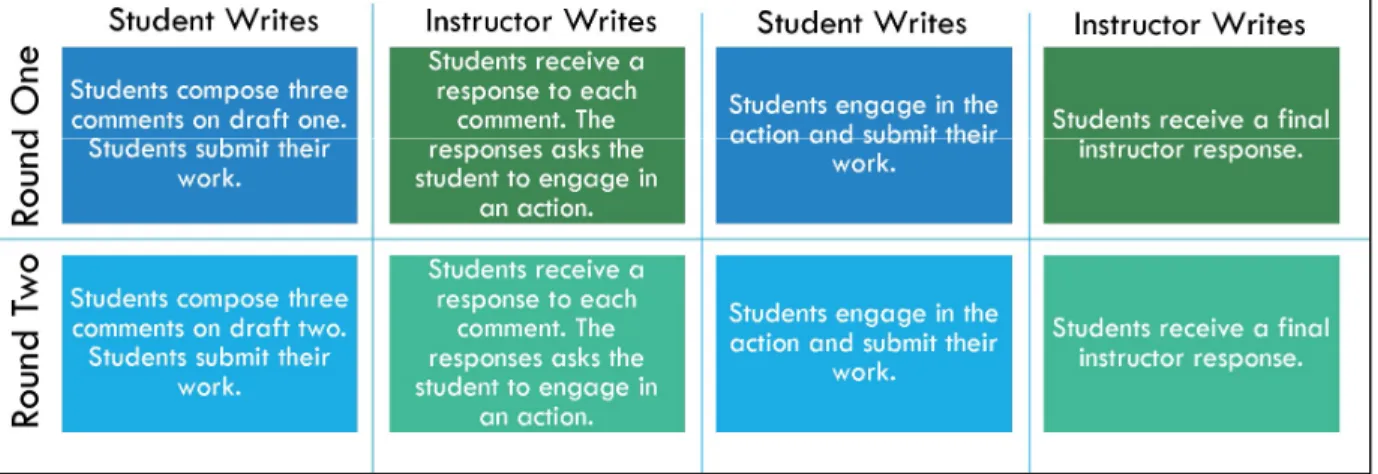
8. We repeated the entire dialogic feedback experience for the second draft. The dialogic feedback process for the second draft also lasted one week, and we referred to this part of the process as Round Two (see Figure 1 for a visual representation of both rounds of the dialogic feedback process).
9. The students engaged in an in-class peer review of a classmate’s second draft. The students followed another peer review handout that prompted them to focus their peer review on the content, organization, and style of their peer’s essay. The peer review process was the same as the peer review process for the essay in Phase One, but the questions were slightly different to account both for the essay’s different content and for the new skills the students learned between the first and second essays.
10.The students revised their second draft and submitted a final draft for evaluation. 11.The students composed a short reflective essay in which they responded to questions
about the writing process, the dialogic feedback process, their personal reactions to the dialogic feedback process, and the differences between their experiences writing an essay in Phase One and in Phase Two (see Appendix for the “ Unit 1: Reflection Two”
assignment sheet).