East Tennessee State University
Digital Commons @ East
Tennessee State University
Electronic Theses and Dissertations Student Works
12-2017
Teacher Perceptions of Using Positive Behavior
Interventions and Supports as Behavioral
Interventions in a Pre-K-5 Elementary School: A
Phenomenological Study
Meghann Roberts-Clawson
East Tennessee State University
Follow this and additional works at:https://dc.etsu.edu/etd
Part of theElementary Education Commons
This Dissertation - Open Access is brought to you for free and open access by the Student Works at Digital Commons @ East Tennessee State University. It has been accepted for inclusion in Electronic Theses and Dissertations by an authorized administrator of Digital Commons @ East Tennessee State University. For more information, please [email protected].
Recommended Citation
Roberts-Clawson, Meghann, "Teacher Perceptions of Using Positive Behavior Interventions and Supports as Behavioral Interventions in a Pre-K-5 Elementary School: A Phenomenological Study" (2017).Electronic Theses and Dissertations.Paper 3331.
Teacher Perceptions of Using Positive Behavior Interventions and Supports as Behavioral Interventions in a Pre-K-5 Elementary School: A Phenomenological Study
A dissertation
presented to
the faculty of the Department of Educational Leadership and Policy Analysis
East Tennessee State University
In partial fulfillment
of the requirements for the degree
Doctor of Education in Educational Leadership
by
Meghann E. Roberts-Clawson
December 2017
Dr. Pamela Scott, Chair
Dr. Bill Flora
Dr. Virginia Foley
Dr. Stephanie Tweed
Keywords: Positive Behavior Interventions and Supports, Behavioral Interventions, Social Validity, Sustainability
ABSTRACT
Teachers’ Perceptions of Using Positive Behavior Interventions and Supports as Behavioral
Interventions in a Pre-K-5 Elementary School: A Phenomenological Study
by
Meghann E. Roberts-Clawson
This qualitative study addresses teacher perceptions of using positive behavior interventions and
supports (PBIS) as positive behavioral interventions. This phenomenological study was
conducted within a Pre-K-5 elementary school in northwestern North Carolina. In order to
collect qualitative data, personal individualized interviews were conducted from a purposeful
sample of teachers in the school who have experience implementing more intensive positive
behavioral interventions.
By analyzing data derived from the interviews and classroom and individualized documentation, the researcher was able to identify themes such as teachers’ perceptions in regards to using PBIS
as a behavioral intervention. Themes elaborating on the ways that teachers implement PBIS in
their classroom as well as the most consistently used elements of the PBIS framework also
emerged from this study.
Findings from this study will be useful in helping to implement the PBIS framework to fidelity
teachers that join the staff as well as veteran teachers who are struggling with individual students’ behavior.
DEDICATION
This dissertation is dedicated to the loved ones watching from above, who I know are
more proud than anyone! Thank you to my beloved grandparents who all valued education and
the places it will take you. This is for my sweet family who have never stopped believing in me, even when I didn’t believe in myself.
ACKNOWLEDGEMENTS
I have been blessed throughout this entire process with a very large support system, and thankfully, where the Lord guides, he provides. All God’s blessings come in his time, but I am
blessed with the most amazingly supportive family, friends, and coworkers that anyone could ask for. Luckily, these people never questioned when I couldn’t make plans, didn’t answer the
phone, and most importantly, didn’t cook dinner.
Joshua Clawson, you’re a saint; thank you for giving 150% to make sure this ship stayed
afloat while I chased my dreams. To my beloved parents who taught my brother and me to be compassionate, never let anything stand in the way of your dreams, and to respect all of God’s
creatures. No matter what I have done, you never thought my dreams were too big; you will
always be my biggest cheerleaders. Mom taught me to always take care of others, while Dad
taught me the value of building relationships in a school building. It is because of you that I am
who I am today.
To my family (both blood and chosen): words can never express all that you mean to me. Your love and unwavering encouragement didn’t go unnoticed.
I want to acknowledge and thank the members of my committee, Dr. Bill Flora, Dr.
Virginia Foley, and Dr. Stephanie Tweed. I appreciate your guidance and support through this
process. Dr. Pamela Scott, thank you for taking me under your wing at the beginning of this
TABLE OF CONTENTS Page ABSTRACT ...2 DEDICATION ...4 ACKNOWLEDGEMENTS ...5 Chapter 1. INTRODUCTION ...11
Statements of the Problem ...14
Purpose of the Study ...15
Significance of the Study ...15
Research Questions ...16
Limitations and Delimitations ...17
Definition of Terms ...18
Overview of the Study ...19
2. REVIEW OF LITERATURE ...21
Introduction ...21
History of PBIS ...21
PBIS Connections to Behavioral Theories ...23
Social Learning Theory ...23
7
Psychological Development ...25
Emotional Development ...26
Hierarchy of Needs ...26
Social Development Theory ...27
The PBIS Intervention Model ...28
Increased Need for Behavioral Intervention in Schools ...28
What is PBIS? ...30
Support for PBIS as a Behavioral Intervention ...33
PBIS and Support for Academics ...39
Tier I Interventions ...41
Tier II Interventions ...43
Tier III Interventions ...45
Importance of Social Validity ...46
Perceptions of PBIS...47 Rewards ...51 Facilitators ...52 Barriers ...55 2. RESEARCH METHODOLOGY ...58 Introduction ...58 Research Questions ...58
Phenomeology ...60
Role of the Researcher ...60
Ethical Considerations ...62
Setting ...62
Population ...63
Sampling Strategy ...63
Sample ...64
Data Collection Procedures ...65
Data Analysis ...67
Measures of Rigor ...68
Summary ...70
4. ANALYSIS OF THE DATA ...71
Introduction ...71 Data Collection ...72 Participants ...73 Interview Results ...74 Research Question 1 ...74 Research Question 2 ...75 Research Question 3 ...76 Research Question 4 ...77
9 Research Question 5 ...78 Research Question 6 ...79 Research Question 7 ...81 Research Question 8 ...82 Research Question 9 ...83 Emergent Themes ...84
Teacher Perceptions are that PBIS is Effective at Decreasing Negative Student Behavior...84
Importance of Relationships in PBIS ...85
Consistency in Practice ...86
Student Centered Interventions ...88
Perceptions are that PBIS is Not Effective for All Students ...90
PBIS has a Positive Impact on Academics ...93
Summary of Data Analysis ...93
5. SUMMARY, CONCLUSIONS, AND RECOMMENDATIONS ...95
Introduction ...95
Conclusions ...95
Theme 1: Teacher Perceptions are that PBIS is Effective at Decreasing Negative Student Behavior ...96
Theme 2: Importance of Relationships in PBIS ...97
Theme 4: Interventions Should be Individualized ...99
Theme 5: Teacher Perceptions are that PBIS is Not Effective for All Students ...100
Theme 6: PBIS has a Positive Impact on Academics ...101
Recommendations for Further Practice ...102
Recommendations for Future Research ...103
Concluding Summary ...104
REFERENCES ...107
APPENDICES: Interview Protocol ...128
CHAPTER 1 INTRODUCTION
It is the general consensus among the American public that student behavior is out of
control and is getting increasingly more troublesome (Simonsen, Sugai, & Negron, 2008).
Traditionally, punishment has been seen as the most effective and time efficient approach to
rectifying problem behavior (Swain-Bradway, Swoszoski, Boden, & Sprauge, 2013). When
schools set rules and they are broken, they often respond by “getting tougher”, investing in security and punitive type punishments such as “zero tolerance” policies that have not been
shown to have a positive impact on student behavior (Skiba & Peterson, 2000).
According to teachers, there has been an increase in negative student behavior which they
attribute to the implementation of the No Child Left Behind Act of 2001 (NCLB) (US
Department of Education, 2011), the reauthorization of the IDEA (2004), along with changes in
curriculum and standardized testing (Hunter et al., 2015; Scott & Cooper, 2013; Sugai, Lewis-
Palmer, & Hagan, 1998). The NCLB gave federal money to all public schools throughout the
country, however, these schools were required to measure up to certain standards. The goal of
NCLB was to ensure that all students would be proficient in math and reading, while their
schools were responsible for having effective classroom management strategies in place to deal
with problem behaviors (No Child Left Behind Act, 2001). According to an article in Education
USA (2011), public schools around the United States are caught in the throws between providing the “free appropriate public education” (Office for Civil Rights, 2007) that all students deserve
and obtaining the funding and resources to accomplish this task. Due to budget cuts and teacher
shortages in highly qualified areas, general education teachers are being asked to do more than
2012). Classroom sizes and stress levels increased, making it a challenging environment for
teachers to control behaviors and maintain appropriate and supportive learning environments (Cregor, 2008). As students’ inappropriate behaviors have escalated, it has required educators to
adapt their teaching strategies to address these challenges, maintaining a positive classroom to
ensure learning is taking place (Walker, 1993).
Research has shown a relationship between behavior issues and academic achievement
(Akey, 2006; Flynt, 2008; Wexler, 1992). Any educator can testify to the impact that negative
behavior has on the amount and quality of instruction taking place in the classroom, which has
an impact on the academic outcome for all students (Kagan & Kagan, 2009; Scott & Barrett,
2003; Wexler, 1992).
“It is estimated that approximately 10% of children and adolescents in the United States
suffer from some form of mental illness that significantly impairs their ability to function in everyday settings” (Burns et al., 1995; Shaffer et al., 1996). According to a study done by the
Surgeon General on mental health in 1999, there are 6 to 9 million youth with emotional
problems who are not receiving the help that they need (U.S. Department of Health and Human
Services, 1999). Burns et al. (1995) and Leaf et al. (1996) reported a large discrepancy between
students who need services and those that are actually obtaining help; 16% of youth are receiving
services, 75% of which are received at school because schools have constant contact with youth
(Adelman & Taylor, 1999; Weist, 1997). This accessibility creates the perfect environment to
prevent, identify, and implement interventions that may develop into more serious issues later in
life (Weist, 1999). According to McIntosh, Horner, et al. (2008), 10.3% of 16 to 24 year olds
these kids at higher risk of poor adult outcomes such as lower income, unemployment, and cost
taxpayers billions of dollars in assistance, crime prevention and prosecution.
Being cognizant of the demands to meet standards both with academics and behaviors,
multi-tiered systems of support (MTSS) was developed. MTSS was implemented to be the
overseeing body of both response to intervention (RtI) for academics and positive behavior
interventions and support (PBIS), dealing with behaviors (Harlacher, Sakelaris, & Kattelman,
2013; Hunter et al., 2015). The PBIS framework is a “proactive, system-level approach that enables schools to effectively and efficiently support student behavior” (Simonsen et al., 2008).
As this is a framework, it can be tailor-made for individual schools by having them to select
specific outcomes, data, practices, and systems that are important for their population. When
schools implement SWPBS (School-wide Positive Behavior Supports), research has shown
decreases in the instances of negative behavior as measured by office discipline referrals (ODR)
(Bohannon et al., 2006; Bradshaw, Reinke, Brown, Bevans, & Leaf, 2008; Kelm, McIntosh, &
Cooley, 2014; Scott & Barrett, 2004; Swain-Bradway et al., 2013). Along with a diminishing
number of negative behavioral instances, studies have shown an increase in instructional time,
which helps to support students academically (Feuerborn, Wallace, & Tyre, 2013; Lassen, Steele
& Sailor, 2006; Luiselli, Putnam, Handler, & Feinberg, 2005).
Unlike punitive discipline methods that have been historically used in education (Maag,
2001), using PBIS, educators do not procrastinate while a child continues to struggle. Teachers
begin implementing the framework on the first day of school and use these ideals in every area
of the school all throughout the school day for every student. SWPBS uses a three-tier approach to support behavior management to “(a) proactively address the social behavior needs of all
2002; Sugai et al., 2000; Walker et al., 1996). The first tier is designed to be the core behavior
instruction for all students throughout the school. Students who are not able to demonstrate
desired behaviors are then referred to the PBIS team to be moved in to the secondary or tertiary
tiers to receive more intensive behavioral instruction.
Statement of the Problem
All around the country, more than 18,000 school systems have adopted the PBIS
framework to attempt to implement more positive behavior interventions as opposed to punitive
methods that have been used previously (Swain-Bradway et al., 2013). The problem with this
shift is that many initiatives such as these come from a top-down approach. Educators will tell
you that new initiatives are implemented, thousands of dollars are spent on training, they spend
hours in meetings, and then there is no follow through. Teachers begin to be skeptical of
changes, which creates issues with social validity (Datnow, 2005). In order to sustain any sort of
project, it is pivotal that administrators and classroom teachers are on board (Feuerborn & Chinn,
2012; McIntosh et al., 2014). When educational initiatives are not implemented to fidelity,
educators do not obtain the results they have hoped, letting programs and frameworks, such as
PBIS, dwindle and eventually become one of the many proposals that are eventually abandoned
(Adelman & Taylor, 2007; Hieneman, Dunlap, & Kincaid, 2005; Kok, 2014; Marchant, Heath, &
Miramontes, 2012).
Extensive research studies on the PBIS framework are all positive to show that the
framework is effective. However, it is important to the researcher to look beyond these findings for the overall school population, to find teachers’ perspectives of the effectiveness both of the
framework and individual tier II and III interventions. Although it is teachers who ultimately implement the framework, it is student and educators’ perceptions of PBIS that ultimately define
whether the program is accepted, effective, and sustained (Frey, Park, Browne-Ferrigno, &
Korfhage, 2010; Kok, 2014). Teachers are the most powerful tool in the educational system
(Steinbrecher, McKeown, & Walther-Thomas, 2013), so it is important that we not only help to
educate them on how to implement this framework to fidelity, but we get their perspective to
better support them in this transition.
Purpose of the Study
The purpose of this phenomenological study is to investigate elementary school teacher
perceptions of using positive behavior interventions and support as behavior interventions in one
Pre-K-5 school in rural Northwestern North Carolina.
Significance of the Study
This research study is significant as it helps to fortify the body of knowledge available
pertaining to using positive behavior interventions as behavior interventions. The research
findings will supplement our knowledge of educational research on using positive behavior
interventions and teacher perceptions of using the PBIS framework as a means of increasing
desired behaviors. The importance of this study is to explore teachers’ perceptions regarding
using more positive discipline methods within their classrooms along with which interventions
they have found success using with students who struggle to show behavioral progress with only
tier I interventions. This study demonstrates the need for more scholarly research on systemic
challenges to implementing new educational initiatives in the classroom with increasing
academic demands. It also calls for more research regarding the amount of time lost to dealing
with problematic behaviors and the effects on standardized test scores. This study not only looks at teachers’ perception of positive behavior interventions, it also gives their beliefs regarding
challenges to implementing the framework. As many school districts across the US are shifting
to this sort of mentality regarding classroom management, this information could be useful in
helping to support schools as they adopt this type of educational initiative and can be used for
training purposes.
Another significance from this study is that it may serve to exercise the need for reform
of teacher training and preparations in the area of classroom management strategies as well as
basic knowledge of how to implement the PBIS framework into their future classrooms.
Teachers have always expressed a need for more training on classroom management, but being
cognizant of the demands of educators and this nationwide shift to more positive disciplinary
methods, teacher education programs could use this research to help better prepare teachers for
what is to come upon graduation.
Research Questions
This research will be driven by the following general questions:
1. What are elementary school teacher perceptions regarding the value of using PBIS as
behavioral interventions?
2. What are elementary school teacher perceptions of challenges of using PBIS as
behavioral interventions?
3. Which behavioral intervention(s) has shown to be the most successful in elementary
classrooms?
4. Which behavioral intervention(s) has shown to be the least successful in elementary
Limitations and Delimitations
Although the researcher has already developed strong rapport with individuals working in
the school in question, this could also create bias in their answers, as they may not feel
comfortable sharing how they truly feel about behavior interventions. For this reason, the
researcher will not be the one actually conducting these personal and group interviews. The
proxy interviewer will be the one conducting interviews and taking notes on discussion.
As with any study, there are limitations to the findings. For this study, the limitations
include sample size and method. McMillan and Schumacher (2014) stated that sample size
should be related to the needs of the study, which are extensive, rich descriptions of the
phenomenon. This study is also only conducted in one school because although using PBIS as
behavioral interventions is a district-wide initiative, each school is in a different stage of
implementation. These results are not generalizable to any other population because of the
qualitative nature of the study.
For this study, the researcher sought to examine elementary school teachers’ perceptions
of using positive behavior interventions and supports as behavioral interventions. The
purposeful sample of teachers included teachers who currently have students in tier II or III, or
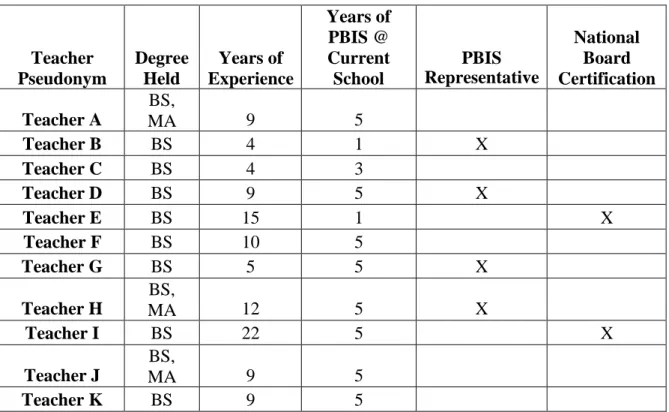
have had them since adopting the PBIS framework. Although the sample included 11 Pre-K-5
teachers, coincidentally, these teachers came from grades kindergarten thru third grade. There
are also teachers who have never referred a student to the PBIS team for any sort of intensive
behavior modifications. There could be a number of reasons that no interventions are
documented above the third grade, however, in a research study by Pas, Waasdorp, and
the same interventions as lower grades. The researchers believed that there was a developmental
expectation that lower grades teachers would help to teach behaviors.
This study was delimited to a sample population of elementary teachers who have
experience implementing intensive positive behavior interventions in one Pre-K-5 elementary
school in Northwestern North Carolina. Even though there are additional classroom teachers
within this school who would be available to give data on using PBIS, the selected sample could
best contribute information to assist in understanding teacher perspectives. This information will
be used to help formulate an essence of experience of the phenomenon of their shared
experiences regarding students with increased need for behavior interventions and its
effectiveness.
Definition of Terms
The following terms are defined below in the interest of better understanding the purpose of this
study.
1. Functional Behavior Assessment (FBA)- Assess the relationship between a
behavior and the surrounding environment to create effective intervention plans
(Scott & Cooper, 2013)
2. Office Discipline Referral (ODR)— A process in which the student is referred to the
school office to meet with an administrator due to the severity of behaviors
3. PBIS, also known as PBS or SWPBIS- “A broad range of systemic and
individualized strategies for achieving important social and learning outcomes in
school communities while preventing problem behavior. The key attributes for PBIS
include preventive activities, data-based decision making, and a problem solving orientation” (Ohio Department of Education, 2015, p.1)
4. SET- An assessment tool “designed to assess and evaluate the critical features of
school-wide effective behavior support across each academic school year” (Sugai,
Lewis-Palmer, Todd, & Horner, 2005, p.1)
5. Social Validity- The measure of how well a social program is accepted by those who
will benefit from it (Marchant et al., 2012). Wolf (1978) first introduced this idea as a measure of three areas: “(a) the social significance of identified treatment goals, (b)
the social appropriateness to procedures utilized in achieving treatment goals, and (c)
the social importance of research effects and outcomes”.
6. Sustainability- “A practice’s potential for durable implementation with high fidelity
when considering features of the practice, its implementation, and the context of
implementation (McIntosh et al., 2013)
Overview of the Study
The aim of this study was to further explore elementary school teachers’ perceptions
towards using positive behavior interventions as intervention strategies in one rural Pre-K-5
elementary school in Northwestern North Carolina. The researcher analyzed weekly documents
and conducted individual interviews and group discussions to write a collective narrative of their
attitudes towards the effectiveness of the PBIS framework as well as individual behavior interventions. The central question of this research, “What are teachers’ perceptions of using
positive behavior interventions and support as behavior interventions?” will permit the chance
for the participants to give the researcher a deeper, in-depth description of the underlying
phenomenon in the study.
This study includes a total of five chapters. Chapter 1 presents a need for this research
questions, defines significant terms to understand the research, and reviews any limitations and
delimitations of the study. Chapter 2 exhibits an extensive list of scholarly research on the topic
broken down into themes which help to support the study. Chapter 3 holds the researcher’s
rigorous plan to complete the study along with methodology and design. Chapter 4 gives the research findings including the researcher’s interpretation of the qualitative data and the coding
that is done to help organize the data. Chapter 5 will summarize the findings of the study along
CHAPTER 2
REVIEW OF LITERATURE
Introduction
This dissertation aims to inform you about positive behavior interventions and supports
(PBIS) including a collective background history, an explanation of the framework, current
perceptions of PBIS, and the importance of social validity.
While PBIS has paralleled research findings from the fathers of educational psychology,
there is still much to be learned about it. Eliminating punitive disciplinary methods and starting
to utilize more positive behavioral interventions is the current shift in in the United States in a
wide range of educational settings (Swain-Bradway et al., 2013). There is a plethora of research
to show all of the positive effects that this framework has had on students in various educational
levels and settings, however, in order to achieve these effects, staff buy-in is pivotal. Research
shows that in order to sustain initiatives such as PBIS, it is important to get the perspectives of
your stakeholders (Hineman, Dunlap, & Kincaid, 2005; Kok, 2014; Miramontes, Marchant,
Heath, & Fischer, 2011; Schwartz & Baer, 1991).
History of PBIS
In the 1980s, teachers expressed a need for effective behavior interventions with students
struggling with various behavior disorders (Gresham, 1991; Sugai & Horner, 1999; Sugai &
Simonsen, 2012; Walker et al., 1996). Researchers from the University of Oregon conducted a
series of research studies to evaluate current behavior programs to collect data on
effectiveness. This information was used to drive decisions about developing a more proactive
professional development for educators, centered on a team of stakeholders, who would help
assess student needs and implement interventions to increase student outcomes (Biglan, 1995; Colvin, Kame’enui, & Sugai, 1993; Horner, Sugai, & Anderson, 2010; Lewis & Sugai, 1999;
Mayer, 1995; Sugai & Horner, 2002; Sugai & Simonsen, 2012). During the 1990s waves of
change came through education, furthering the need for the implementation of a more positive
behavior intervention system. During this time, nationwide grant was offered to establish what is
now known as the National Center on Positive Behavioral Interventions and Supports, which
would help to streamline assistance to schools based on research findings to help support
students with behavioral disorders. This honor was given to researchers from the University of
Oregon, along with a partnership with Kansas, Kentucky, Missouri, and South Florida (Sugai et
al., 2000; Sugai & Simonsen, 2012). For many years, special education teachers had been using
behavior interventions for students with special needs, however, it was not until this time that
there was a need presented for a program to meet the needs of all students. It was at this time,
the Center on Positive Behavior Interventions and Supports and the Positive Behavioral
Interventions and Support (PBIS) framework (Sugai & Simonsen, 2012) was developed.
Although the idea of the PBIS framework is a relatively new topic, the ideations which
help to found it date back almost a century, paralleling all of the educational and behaviorist
theories that were taught in an educational psychology course as part of new teacher
PBIS Connections to Behavioral Theories
Social Learning Theory
Bandura (1977) conducted research known as the “Social Learning Theory”, which states
that “new patterns of behavior can be acquired through direct experience or by observing the
behavior of others”. These actions are solidified by what sorts of rewards or punishment follow
immediately after the action. People learn expect that certain actions will give them predictable
outcomes based on past observations or experiences and the anticipated consequences. Future
consequences can be used as motivators for current behavior much in the same way a child’s
behavior could be affected by a consequence that follows. Social learning theory is reflected in
current research on the implementation of PBIS by Bosworth and Judkins (2014), where they
stress the importance of practicing appropriate behaviors in the same manner that academic skills
are retaught. These expectations should be taught within the first two weeks of the school year
through live demonstrations of the expected outcomes with role plays and discussions. These
should be revisited after long breaks, transition times, or times of heightened excitement
(Bosworth & Judkins, 2014). Teachers have seen the benefit, first hand, of role playing and
modeling behaviors for students, which is aligned with Bandura’s Social Learning Theory, which
states that people learn from each other through observation, imitation and modeling (Bandura,
1977).
B.F. Skinner (1974) introduced the notion of behaviorist principles, otherwise known as
operant conditioning which is defined by reinforcers or punishments. Operant conditioning is a
process in which both humans and animals learn how to behave to obtain the things they desire,
while refraining from being punished (Staddon & Niv, 2008). Put in the scope of practice of the
behavior, finds appropriate interventions, and helps to show the staff processes they should go
through to help take care of the issue (Bosworth & Judkins, 2014; Lewis & Sugai,
1999). Although teachers have mentioned needing more training in the area of classroom
management (Maag, 2002; Thompson & Webber, 2010), this notion of proactively handling students’ behaviors has been around since the early days of Skinner’s research. Skinner defined
a reinforcer as what precedes a response, which will change the probability of that same event
occurring again. These reinforcers are then categorized into consumables (food), manipulatives
(toys), visual/auditory (“good work”), social stimuli (praise), or tokens (tickets) (Lefraincois,
2006). Maag (1996) discussed how teachers ignore children who are behaving the way we
expect, and then give negative attention to those who are behaving inappropriately. Regardless,
to a child who is exhibiting attention-seeking behaviors, any sort of attention can prove to be a
powerful reinforcer. Punishment, adding a negative stimulus or taking away a positive one, does
not decrease the likelihood of a behavior not occurring again; giving a positive reinforcement
when a child demonstrates desired behavior, however, increases the probability that the behavior
will happen again (Lefrancois, 2006; Skinner, 1974).
Cognitive Development
Piaget (1932) developed four different cognitive developmental stages that address children’s intelligence and ability to reason through issues. These cognitive stages occur during
specific age ranges: Sensorimotor, Preoperational, Concrete Operational, and Formal
Operational. Students in elementary school, between the ages of 5 and 11, would match up with Piaget’s Preoperational Stage (between the ages of 2 and 7) and Concrete Operational Stage
development reveal that students in these age ranges are “capable of understanding their actions and make behavioral decisions based on their understanding” (Crowder, 2008; Piaget, 1932).
In the Preoperational Stage, children use symbolic functioning where they learn the use
of mental symbol with words or pictures. Students have trouble understanding concrete logic
and cannot mentally manipulate information; they struggle to see things from another point of
view. Students do learn reversibility to work with numbers and classification where they are
able to classify objects based on their appearance or other characteristics. Students become more
flexible in their ability to reason, but still struggle to solve abstract problems. It is not until
students enter the final stage, Concrete Operational, that they begin to understand their own
behaviors and the sources that help them act appropriately, making adjustments to keep problems
from occurring (Crowder, 2008; Piaget, 1932). Punitive classroom management tactics are
unsuccessful because students will be in different cognitive stages, and some may never reach
the final stage.
Psychosocial Development
Erikson (1950) created eight categories from his psychosocial stages, each building on
one another, which required children to successfully complete the previous stage. Elementary
school students fall into stage 3, the Initiative vs. Guilt stage, and stage 4, the Industry vs.
Inferiority stage. In Initiative vs. Guilt, younger students are very imaginative, playing with
others, and make decisions. These students become more independent, however, students who
are not capable of playing with others are likely to feel guilty, which restricts their growth
In the Industry vs. Inferiority stage, older students begin to develop a deeper meaning of
self-accomplishment as they learn to follow established rules, develop peer relationships, and
experience academic success (Crowder, 2008; Piaget, 1934).
Emotional Development
Goleman (1995) added the perspective of emotional intelligence to this background of children’s development. Emotional intelligence encompasses the ability to recognize and
manage one’s emotions as well as the emotions of others, learning to be intrinsically motivated
and learn to manage relationships. Parents are originally responsible for teaching these
emotional lessons from infancy until they reach school age. Being able to recognize emotions
help students in a variety of ways (Crowder, 2008; Goleman, 1996). As children develop their
emotional intelligence, they also strengthen their ability to manage their emotions. Building
interpersonal relationships with teachers, other peers, and family is perhaps the most important
social skill a student possesses. Emotional development of students in lower grades is
demonstrated by displaying their ability to effectively self-motivate, showing sensitivity to the
feelings of others, and building strong interpersonal relationships, which has been linked to
fewer discipline problems at school.
Hierarchy of Needs
Maslow (1954) developed the Hierarchy of Needs based on an extensive body of research
dealing with human motivation, specifically based on deficiency and growth needs. Within each
level of deficiency needs, every lower level will supersede all the following levels; once an individual’s needs have been satisfied, another deficiency will be detected. The four levels in
Maslow’s theory are: (1) physiological: hunger, thirst, comfort; (2) security: safety; (3)
belongingness: love, acceptance; (4) esteem: to be successful, gain approval and recognition.
While there is no empirical evidence to support Maslow’s works, it is widely
accepted. A child who is hungry, sleepy, stressed, or does not have a positive emotional
connection will be unable to learn because these children’s brains will emit chemicals that inhibit
their learning until these needs are taken care of (TLL Educational Services, 2012). As children
will act in a way that helps them get their needs met, this is support for children to develop
personal connections with positive role models at school (Crowder, 2008).
Social Development Theory
Vygotsky posed the idea of the Social Development Theory (1978) that takes children’s
mental age into account when looking at their ability to learn. His theory of cognitive
development is closely aligned with the work of Bandura on the social learning theory (Bandura, 1977) and Piaget’s stages of cognitive development (Piaget, 1934). “The problems encountered
in the psychological analysis of teaching cannot be correctly resolved or even formulated without
addressing the relation between learning and development in school-age children” (Vygotsky,
1978). Children with equal levels of mental development demonstrate varying levels of
competence when their learning was assisted by a teacher, which is known as the zone of proximal development. This is known as “the distance between the actual development level as
determined by independent problem solving and the level of potential development as
determined through problem solving under adult guidance or in collaboration with more capable peers” (Vygotsky, 1978).
Although you can compare two students who have equal chronological ages, these
children have come from different backgrounds and shared differing experiences. Vygotksy (1978) stated that children’s learning begins far before coming to school, which causes some
differences in their actual developmental level, the tasks that they can successfully achieve
unassisted. This idea applies not only to academic learning, but also to social skills and
behavioral concepts in schools. There are varying reasons as to why this happens, but some
children have either attended pre-schools or have parents who have been working with students
prior to entering school. Just as students come to school with varying knowledge of academic
concepts, this rings true for behavior, social skills and coping strategies. Some children come to
school, from the beginning, with serious behavior problems that were established long before
they got their start in education (Lewis, Sugai, & Colvin, 1998; Tobin & Sugai, 2005). Schools
are becoming increasingly responsible for teaching students desired behaviors in the classroom
in order to decrease problem behavior and help support academic achievement.
The PBIS Intervention Model
Increased Need for Behavioral Interventions in Schools
“Teachers are one of the strongest factors in effective education systems” (Steinbrecher et
al., 2013, p.1), so teacher preparation programs have tailored their programs to effectively educate these teachers in supporting students’ learning. The notion of behavioral interventions
are nothing new for special education teachers, as they have been using them for students with
special needs for years. It was not until the development of the PBIS (pbis.org, 2017) framework
that general education teachers saw the benefit and also began to implement these practices into
their classrooms. Scholars have found that educators can misinterpret behaviors because their
Gage, & Sugai, 2012). Algozzine, Christian, Marr, McClanahan, and White (2008) reported that
students with disabilities did not show a dramatically increased rate of problem behavior as
compared to general education students, however, it was not until the last decade that special
education students had been mainstreamed into the general education classroom (Steinbrecher et
al., 2013). According to The Condition of Education (NCEE, 2011), special education students
who spend more than 80% of the school day in the general education classroom has increased
from 46% in 1998-1999 to 58% in the 2008-2009 school year. Given the decrease in highly
qualified special education teachers and the increasing number of special education students
(Steinbrecher et al., 2013), the responsibility for educating these students is being shared by
special and general education teachers. Federal mandates such as the No Child Left Behind Act
of 2001, which requires that all students be proficient in reading and mathematics (US
Department of Education, 2011), the reauthorization of the IDEA (2004), along with changes in
curriculum, have accounted for counted changes in the behavior of students (Hunter et al., 2015;
Scott & Cooper, 2013; Sugai et al., 1998).
Educators have often rated their ability to effectively handle problem behaviors as their
biggest area of deficit. As there has been an increase in behavior issues with the mounting
number of special education students being mainstreamed into general education classrooms,
teachers have had to assume greater responsibility in trying to teach all students. Teachers have
expressed worries about the amount of training they receive to deal with behavior issues
(Feuerborn et al., 2013; Hemmeter, Santos, & Ostrosky, 2008), and are now more reserved about their ability to meet everyone’s individual needs (Brownell, Adams, Sindelar, Waldron, &
Vanhover, 2006; Cheney et al., 2010; Rosenzweig, 2009). Even one disruptive student impedes other students’ ability to learn, but also takes the teacher’s focus off of the entire classroom
(DuPaul, McGoey, Eckert, & Van Brakle, 2001). Dealing with these never-ended behaviors take
a toll on teachers, wearing them down, causing stress, and increase their chances for burnout
(Clunies-Ross, Little, Kienhuis, 2008; Lochman, Powell, Clanton & McElroy, 2006; Robbins,
2011).
To help support these teachers’ concerns over the increasing instructional challenges,
multi-tiered systems of support (MTSS) were established (Harlacher et al., 2013; Hunter et al., 2015). “MTSS uses evidence-based techniques that provide varying levels of intensity to
increase the achievement of all students (Harlacher et al., 2013, Hunter et al., 2015). The purpose of MTSS is to address students’ struggles, both with academia or behavior, in a
proactive manner. MTSS is the umbrella to two high-profile models, response to intervention
(RtI) (Brown-Chidsey & Steege, 2005; Hunter et al., 2015), dealing more with academic issues,
and positive behavior interventions and supports (PBIS), dealing with behaviors.
What is PBIS?
“Positive behavior support is an application of a behaviorally-based systems approach to
enhance the capacity of schools, families, and communities to design effective environments that
improve the link between research-validated practices and the environments in which teaching and learning occurs” (pbis.org, 2017, para. 1). This framework is an evidence-based multi-tier
system to proactively address inappropriate behavior by teaching and reinforcing appropriate
behavior (Bradshaw, Mitchell & Leaf, 2010; Horner et al., 2009; Scott & Cooper, 2013 Hunter et
al., 2015; OSEP, n.d., Sugai & Horner, 2006). PBIS is a continuum of academic and behavior
support that is comprised of three tiers of intervention; tier 1-primary prevention for everyone;
tier 2-secondary prevention for targeted groups; and tier 3-tertiary prevention for more intensive,
Model is made up of five core components: (a) statement of purpose; (b) school-wide
expectations; (c) procedures for teaching expectations; (d) continuum of procedures for
encouragement; (f) procedures for using data to monitor impact (Coffey & Horner, 2012; Lewis
& Sugai, 1999). There is a positive correlation between the intensity of behavior support
necessary for a student and the increases in the behavior needs and challenges (Walker et al.,
1996) because students who are unsuccessful with universal services are then referred to the
PBIS team to receive more individualized and intensive interventions.
Teams including behavior specialists and administrators are in charge of overseeing the
core elements of PBIS and help to provide training and policy support for (a) initial
implementation phase, (b) active application, (c) and sustaining the core elements (Horner,
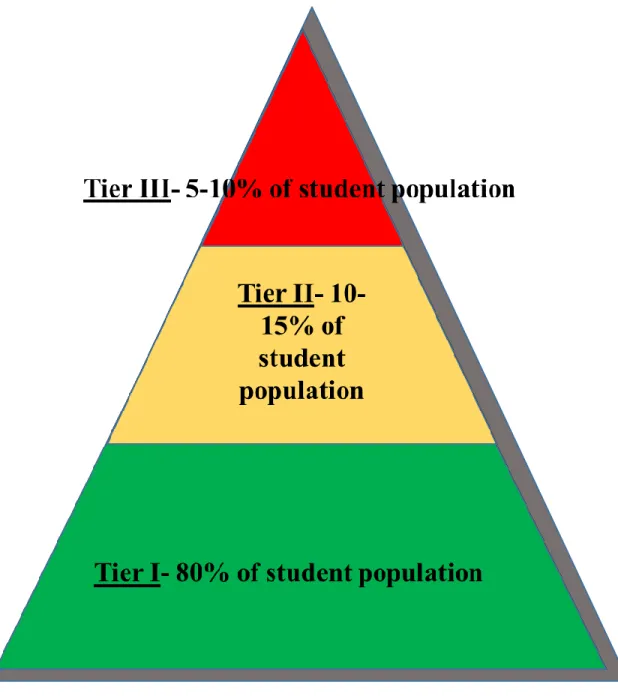
Sugai, & Lewis, 2015; Sugai & Horner, 2010). The information shown in Figure 1, as
referenced by pbis.org (2002), depicts a layout of the continuum of behavioral support. Each
subsequent tier is layered with increased interventions, building from the previous tier.
Following the introduction and reauthorization of the Individuals with Disabilities Act (1997),
there was a nation-wide increase in the utilization of PBIS. It was originally established to assist
students with Behavior Disorders, however the focus was then spread to the general education population (Sugai & Simonsen, 2012). “PBIS is defined as a framework for enhancing the
adoption and implementation of a continuum of evidence-based interventions to achieve
academically and behaviorally important outcomes for all students” (Sugai & Simonsen, 2000,
para. 2). Early research that was conducted by some of the founders from the University of
Oregon found evidence to support the need for a more preventative, research-based, school-wide
practice. This framework would use a team to help teach explicit social skills in a variety of
data to measure student outcomes (Colvin et al., 1993; Horner, Sugai, & Anderson, 2010; Lewis
& Sugai, 1999; Sugai & Horner, 2002; Sugai & Simonsen, 2012).
Positive behavior interventions provide schools with an alternative discipline rather than
suspension. Although these do result in safer school climates, they do not show sustainable
change in behaviors and often have long-term negative impact on both the student and school
(Brusnahan & Gatti, 2008; Kohn, 1996; Tillery, Varjas, Meyer, & Collins, 2010). This positive
support system do not focus on the individual student and their behaviors, yet they allow
administration to focus on the overarching school climate and negative behaviors on a large
scale. This allows schools to create a more positive and safe learning environment (Brusnahan &
Gatti, 2008).
The PBIS framework is implemented with all students, showing a decrease in negative
and disruptive behavior (Bohannon et al., 2006; Bradshaw et al., 2008; Kelm et al., 2014; Scott
& Barrett, 2004; Swain-Bradway et al., 2013). This allows teachers to provide more
individualized instruction to students who need help reaching desired levels of positive behavior
Figure 1. PBIS Model. (pbis.org, 2017).
Support for PBIS as a Behavioral Intervention
Even though PBIS as a behavioral intervention model is a newer concept, there is a
wealth of research on various topics about its effectiveness. It is estimated that 1% to 7% of
students have chronic behavior issues (Sugai et al., 2000), however, PBIS has consistently shown
positive results for reducing behavior problems overall (Carr et al., 1999; Marquis et al., 2000;
currently being implemented in over 18,000 schools nation-wide which are showing positive
results in the public school system as well as alternative educational settings such as alternative
schools, residential settings, and juvenile justice facilities. Because studies have shown that
students with untreated behavior issues often experience problems later in life (Sprague &
Walker, 2000; Tobin & Sugai, 1999), it is important that these behaviors are addressed as early
as possible (Forness et al., 2000). Bradshaw, Waasdorp, & Leaf (2012) stated, “A child who
displays disruptive and aggressive behavior during their elementary school years is at a much
higher risk for academic problems, being placed into a special education setting, school dropout,
future substance abuse issues, and a list of antisocial behavior”.
“Most experts in the field agree that school-wide PBS is in its infancy (Dunlap, 2006;
Safran & Oswald, 2003). However, the early results of positive behavior interventions
implemented at the indicated level has a plethora of growing support for the effectiveness of the
PBIS framework to help support students who are struggling with behavior (Lewis-Palmer et al.,
1999; Safran & Oswald, 2003; Sugai et al., 2000; Turnbull et al., 2002). Sugai and Horner
(2002) stated that when PBIS is “well implemented, it can enable most students to behave well”. Safran and Oswald (2003) stated that a universal PBIS program that uses various
measures to collect data, utilizes direct observations, gauges teachers’ ratings, and consumer
inventories, have resulted in extremely positive results for students across the grade span
(Gottfredson et al., 1993; Nelson et al., 1996; Safran & Oswald, 2003). Walker et al. (1996)
discussed the efforts that schools make to integrate all the services needed to meet the needs of
children with antisocial and violent behaviors. Schools represent the most stable, consistent,
predictable, prosocial environment for students for many students on a daily basis. Paralleling
Maslow (1954), the schools provide students with a lot of these basic needs and model these
desired behaviors by using a proactive, positive discipline approach in order to increase their
cognitive development.
With a rising issue of violent behaviors that are affecting schools, homes, and
communities, interventions must be well planned and supported by everyone
involved. Behavioral support systems must be proactive, instructional, sustained, and
comprehensive are necessary to meet the needs of students who demonstrate negative behaviors. Students with severe behavior issues are most often times “referred to and access
services well after the point where their problems can be successfully remediated” (Walker et al.,
1996). Gorman-Smith et al. (2007) discusses the effectiveness of the School and Families
Educating Children intervention due to their early intervention time which has been successful in
reducing antisocial behavior. These behavioral issues included aggression, academic failure,
and low social competence. By identifying these children earlier on, schools can have a much
bigger impact, because as shown in Walker and Severson (1992), behavioral interventions show
a significant decrease in effectiveness after students reach the third grade. The effects of a
school-wide positive behavior interventions and support system shows the strongest positive
effects with students who were first exposed to the program upon entering kindergarten
(Bradshaw et al., 2012).
Thompson and Webber (2010) conducted a study at a public day school for children with
disabilities using universal PBIS interventions as behavior support. Their sample consisted of 20
middle school students, however, only 10 of these students wound up completing the study
because of some students being integrated back into the regular classroom because there was
the study demonstrated improvement in their behavior and showed more stabilized behavior
patterns during the intervention.
Johnson (2016) reported that a teacher’s behavior management style is predictive of their
ability to implement PBIS to fidelity. The researcher referenced three types of management
styles: interventionist (high teacher control), non-interventionist (high student control), and
interactionalist (shared teacher and student control). They found based on their data that it was “reasonable to conclude that an overall non-interventionist or interactionalist style would have a
higher possibility of fidelity than an interventionist.
CI-CO, or Check, Connect, and Expect (CCE) Program as it was named in their study, is
supported by countless research studies over a 15 year period, showing the benefits of using daily progress reports to increase students’ behavior (Davies & McLaughlin, 1989; Fairchild,
1987; Long & Edwards, 1994). Cheney et al. (2010) conducted a study over the course of 2
years in 18 urban schools with a diverse population, finding that this secondary intervention was
effective with greater than 84% of the student population.
Nelson et al. (1996) piloted a universal approach included developing concise behavioral
expectations for different locations and time periods throughout the school day. After
conducting the Devereaux Behavior Rating Scale-School Form, results showed improvements in targeted students’ behavior and academics.
Tobin and Sugai conducted a research study on all kindergarten, first grade, and second
grade students in seven schools, for a total of 1066 students. The results indicated that school-
wide PBIS is an effective intervention, especially when staff is trying to increase self-
interventions, so it was important to adjust the amount of intervention time that students were
receiving (Tobin & Sugai, 2005). They found that the majority of students were successful with
only primary interventions because 60% of participants did not require any more intensive
services and the classroom management strategies were sufficient. 35% of students required
some sort of additional support, either secondary or tertiary, meanwhile there was 5% who
needed additional support, but time and resources did not allow. 27% of students were involved
in CI-CO and 63% were getting support from tier III interventions.
In a study conducted by Wood, Ferro, Umbreit, and Liaupsin (2011), using FBAs with three preschool children with special education needs, produced “dramatic improvements in the
students’ behavior”. The children’s on-task behavior was increased when the intervention was
implemented to fidelity and was decreased when it was implemented incorrectly. All three
students saw dramatic increases in the percentage of time that they spent on-task. Teachers
assessed antecedents to the problem behavior and taught students a replacement behavior. This
intervention was effective not only at school with teachers, but also with family members at
home.
A sample of 12,344 elementary school children from 37 elementary schools were
assessed about their behavior issues and prosocial behavior. After implementing SWPBIS
(school wide PBIS), there were significant effects on the students’ behavior problems,
concentration, social-emotional functioning, and abilities to use prosocial behavior. These
students were found to be more on-task and were 33% less likely to receive an ODR than
students in the comparison schools in the study. The results showed that there were much
stronger effects for students who were first exposed to the framework in kindergarten and
A study conducted by Scott and Barrett (2004) found a negative trend between the
frequency of behavior incidents and the amount of time that schools have been participating in
SWPBIS. This study took place over 3 years; there were 608 ODRs during the baseline year,
108 in year 1 of implementation and 46 in year 2. Translating these figures into time, the
researchers estimated 10 minutes for processing time for each referral, dedicating 6,080 minutes
during baseline, 1,080 during year 1, and only 460 minutes during year 2. That is a savings of
10.4 days in year 1 and 11.7 days in year 2. When looking at instructional time that is lost for
disruptive behavior and ODRs, based on 20 minutes, decreased from 12,160 during baseline to
2,160 during year 1 and 920 in year 2.
Similarly, Kelm et al. (2014) found that ODRs were reduced from 518 to 252. This
constituted a large savings in instructional time. Saving 266 ODRs represented an estimated
3,990 minutes of staff time, or eight hour working days. For students, this equaled 7,980
minutes or seventeen 6 hour days where they were not being sent outside the classroom.
Miramontes et al. (2011) studied the social validity of PBIS and found overall positive results
from all stakeholder groups. Administrators were the most positive of all groups. 100% agree
that PBIS was worth the time and effort and the majority also agreed that they would recommend
to other educators. They strongly agreed that the program had improved school outcomes and
had increased their knowledge and problem solving strategies. Teachers were also in agreeance
that there was a positive impact on their school, the program was worth the time and effort, and
they would recommend the program to other educators. 6.9% of respondents disagreed that the
progress monitoring procedures were practical, 10% disagreed that the program was easy to
were satisfied with the program and 100% agreed that it had made a positive impact. 95.2%
agreed that it was worth the time and effort and would recommend to other educators.
Lewis et al. (1998) studied the effects of a social skill instruction program and direct
interventions on problem behaviors in an elementary school. These interventions were found to
moderately decrease negative behaviors overall in areas such as lunch, recess, and
transition. These effects were maintained up to three months out of the school year. While the
interventions were not able to completely do away with the negative behaviors, the levels and
frequency was reduced. Most of the problem behavior was attributed to the actions of a select
few students, which was consistent with findings of Sugai and Horner (1994) who said that the
majority of behavior problems come from 5 to 7% of the school population.
PBIS and Support for Academics
Behavior and academics go hand-in-hand; often it is hard to tell if a behavior issue has
caused an academic issue, or if the academic issue is causing the prevalence of the behavior issue
(Putnam, Horner, & Algazzine, 2006; Siegel, 2008). Research has been found to show that
students who display serious problem behaviors also experience a large academic deficit as
compared to other children, which are constant throughout time (Putnam et al., 2006; Siegel,
2008). Studies have shown academic and behavior issues as a strong predictor of high school dropout (Tobin & Sugai, 1999). Students who don’t complete high school, wind up costing
taxpayers billions of dollars in welfare, unemployment, crime prevention, and
prosecution. Students who drop out of high school are more likely to experience unemployment
and have lower incomes. Each added year of secondary education reduces public welfare
With less time having to go to managing negative and disruptive behaviors in the classroom,
teachers have more time for direct instruction (Scott & Barrett, 2004). The amount of instruction
time has a highly positive correlation with student academic achievement. In a study of 6
classrooms who implemented positive behavior interventions, students’ rate of on-task behavior
increased by 24%, which supports research that shows that student academic engagement
increases academic success (Putnam et al., 2006).
One study, conducted in Maryland, where SWPBIS was shown to be implemented to fidelity was linked to “improved organizational health”, “improved academic outcomes”, and
“reductions in office discipline referrals” (Bradshaw, Leaf, & Debnam, 2007; Horner & Sugai,
2007; Siegel, 2008) and “reductions in teacher and student-reported incidents of bullying
behavior” (Fallon et al., 2012).
Kelm et al. (2014) found overwhelming support for PBIS as it applies to academics. They
used FSA scores for Grade 4 and 7 students in a school using PBIS and compared to other
schools in the district. For Grade 4 students, there was a 44% increase in reading scores from the
previous year, 56% increase in writing and a 25% increase in math scores. Other fourth grade
classrooms saw a 3% drop in reading, 1% increase in writing, and 8% in math. Seventh grade students saw 9% increase in reading compared with the district’s 7% and 35% increase in math
scores compared to 4% in the district. The Grade 7 writing scores dropped 7%, however, the
district saw a 21% decrease overall.
A potential explanation of nonresponse to Tier I interventions is due to academic deficits (McIntosh, Sadler, & Brown, 2012). In Grade 3, the educational focus is shifted from “learning
to read” to “reading to learn” where their school day becomes flooded with reading, which can
al., 2008). There has even been research to suggest that academic interventions can help to
improve behavior (Sugai & Horner, 1999). McIntosh, Horner, et al (2008) assessed DIBELS ISF
score in kindergarten and correlated its effect on behavior to attempt to predict ODRs in the last
year of elementary school. They found that the “phonological awareness and rapid letter-naming skills predicted unique variance in behavior outcomes” (McIntosh, Sadler, and Cooley (2012).
“Numbered Heads Together” (Kagan & Kagan, 2009) is an examples of a primary tier
intervention that has been found to have great success. A study was conducted on the effects of
on-task behavior and math quiz scores on Numbered Heads Together (NHT), on four different
students with behavioral disorders in a self-contained classroom, both with and without
incentives. NHT with incentives was found to increase on-task behavior rates to 94% and math
quiz scores to 80%, while the standard method generated 76% on-task behavior and an average
of 64% on math quizzes. Existing practices that teachers were already using were only effective
in keeping students on task 48% of the time and achieving 26% on their math quiz. It is an
alternative method to question students, both simultaneously and collaboratively, in discussions
around grade level content. The teacher asks a question; each child shares their response among
a small, homogeneous group and a group response is generated. Only one random teach member will be selected to share the group’s response. This strategy is proactive at decreasing negative
behavior because it increases active student engagement, works on peer relationships, and helps
to support student learning (Kagan & Kagan, 2009).
Tier I Interventions
Tier 1, or primary, PBIS interventions are considered to be the basic behavioral core
instruction which is applied schoolwide to decrease problem behaviors (Cheney et al., 2010;
four different elements: (a) defined and measureable results, (b) collect data to drive decision-
making, (c) research and adopt evidence-based practices, (d) find ways to implement the
framework to fidelity (Sugai & Horner, 2001; Tobin & Sugai, 2005). Taken from School
Climate and Discipline: Going to Scale ( Sugai & Horner, 2001), as cited by Tobin & Sugai (2005), “Schools that adopt a school-wide PBS (positive behavior system) approach have the
following features:
An agenda of primary prevention has priority and is visible school-wide.
All students and staff members are taught the school-wide expectations and received
regular and frequent opportunities to practice them and to be positively acknowledged
when they use them.
A majority (>80%) of students, staff and families can state the school-wide positive
expectations and give a specific behavioral example for each.
Positive school-wide behavioral expectations are defined, taught, and encouraged for all
students using a range of positive and negative examples.
Most contacts between teachers and students are prosocial (positive and preventive)
rather than corrective and punishing (i.e., 5-8 positives for every negative interaction).
A full continuum of PBS is available for all students at the school and district levels.
Behaviorally competent personnel are readily available.
A function-based approach serves as the foundation for addressing problem behaviors.
All staff members actively participate in the implementation of school-wide PBS
Accurate and consistent implementation of PBS practices by all staff members is
emphasized.
The school administrator is an active participant and leader in the PBS effort.
A school-wide leadership team guides the systemic adoption and sustained use of
research-validated practices.
• School data are review at least monthly to guide decision making and planning”.
Lewis and Sugai (1999) explained that if all schools would take a more proactive
approach to teaching their students consistent routines and expectations, and open student and
staff communication was established, then students would likely demonstrate more desired
behaviors. When positive behavior interventions are universally designed to be applied school-
wide, positive effects will be achieved even for individuals who have severe behavioral issues
(Horner, 2000).
Tier II Interventions
Because there is such an emphasis placed on relationships, mentors are chosen based on
who the child has a close, positive relationship with. Richards (2006) found that students rated
having a positive relationship with their teacher as the number one factor in that student being
able to succeed. Before a student can be taught any actual knowledge, a positive relationship
must be formed (Bell, 2003). It has been found that 40-60% of students become increasingly
disengaged as they move through elementary school to middle and high school (Klem &
Connell, 2003), with research that attributes this to the lack of connection with positive adults.
skills that a student can have (Crowder, 2008; Goleman, 1996) and can be achieved through
some of these secondary interventions.
Crone, Horner, and Hawkins (2004) developed a secondary intervention that is widely
used for students who do not respond to the primary prevention, school-wide PBIS entitled,
Check-In-Check-Out (CI-CO). This intervention has been shown to benefit students by
increasing their academic engagement and successfully decreasing the number of office
discipline referrals (ODRs) (Hawken & Horner, 2003; March & Horner, 2002; Tobin & Sugai,
2005). CI-CO is effective because it is (a) readily available, (b) increases positive contact with
adults, (c) monitoring and frequent feedback, and (d) increased communication between home
and school support systems (Cheney et al., 2010; Tobin & Sugai, 2005).
Each morning the student will check-in with a CI-CO coach or mentor who will
determine if they have all the materials needed for the day and decide whether the child is
prepared to go to class. The mentor offers words of encouragement and helps child work on their specific goal for the day, typically taking around 5 minutes. The child’s teacher will
monitor their behavior and will rate them so their mentor can see if they have met his or her
goal. At the end of the school day, the child will return to their mentor to share their chart and
reflect on the positives of the day, and what they can attempt to do a better job of the following
day. The child will then take this form home to their parents to be signed so they can be aware of how their child’s day has gone. The child’s mentor will log the student’s progress to make
decisions about continuing, strengthening, or discontinuing the intervention over time (Cheney et
Tier III Interventions
Individual student supports are developed for those students who struggle with serious
and chronic behavior issues that require most intensive and individualized instruction (Lewis &
Sugai, 1999; Safran & Oswald, 2003; Turnbull et al., 2002). The reauthorization of IDEA
(2004) was legislation that required school systems to conduct functional behavioral assessments
(FBA) to support students with academic and behavioral issues (Scott & Cooper, 2013; Sugai et
al., 1998) as well as those whose problem behavior could put them at risk of being placed in a
special education program (Kennedy et al., 2001; Safran & Oswald, 2003). Through various research articles and studies, FBA’s have proven effective for any student who is struggling to
conform to the social demands of schools. A FBA is a tertiary behavioral intervention that is used to identify the function of child’s challenging behavior to enable support personnel to
develop more individualized interventions to support the student (Crone & Horner, 2003; Sugai, 1998; Sugai et al., 2000, Tobin & Sugai, 2005). This assessment allows adults to enter a child’s
perspective to respectfully develop individualized interventions that will help to decrease negative behaviors. FBA’s give teachers the ability to teach students ways of getting positive
consequences with a replacement behavior (Tobin & Sugai, 2005).
The steps to completing a FBA include: (1) defining the problem in its context, (2)
determining the function of the behavior, (3) teaching the student a replacement behavior, (4) facilitate student success, (5) evaluate (Scott & Cooper, 2013). The framework’s procedures
place emphasis on assessing a student prior to implementation of an intervention, manipulating
different antecedents to attempt to reduce the likelihood of a problem behavior, developing new