Hardware Design for MAC Computation
Robert K¨uennemann and Hamed Nemati Helmholtz Center for Information Security (CISPA) {robert.kuennemann, hamed.nemati}@cispa.saarland
Abstract We study the verification of security properties at the state machine level of a minimalistic device, called the MAC-in-the-Box (MITB). This device computes a message authentication code based on the SHA-3 hash function and a key that is stored on device, but never output directly. It is designed for secure password storage, but may also be used for secure key-exchange and second-factor authentication. We formally verify, in the HOL4 theorem prover, that no outside observer can distin-guish this device from an ideal functionality that provides only access to a hashing oracle. Furthermore, we propose protocols for the MITB’s use in password storage, key-exchange and second-factor authentication, and formally show that it improves resistance against host-compromise in these three application scenarios.
1
Introduction
Practically all large providers of communication and banking services employ cryptographic hardware in their critical infrastructure. This ranges from ex-pensive hardware security modules, used in the web’s public-key infrastructure and the banking network, to low-cost devices like smart cards, used in mobile communication and health care. Their purpose is to separate and encapsulate sensitive cryptographic operations in a device that is (a) designed for secur-ity and (b) small enough to be audited. By encapsulating sensitive information within these small, purportedly secure devices, the surrounding system can ex-ploit the flexibility of general-purpose operating systems to interoperate with its complex environment.
Despite this simplicity, and even despite their ubiquity — it is estimated that there are at least 30 billion smart cards in circulation [31] — the formal verific-ation of security properties in cryptographic hardware designs (i.e., at the state machine level) has received little attention. So far, formal verification focused on functional correctness, i.e., the correctness w.r.t. the mathematical description of the algorithm, while the security of the algorithm was (hopefully) shown in a pen-and-paper proof. Historically, this was due to a lack of support for reasoning over probabilistic systems. Over the last years, this support was continuously im-proved with standalone proof assistants [6], as well as frameworks for Coq [6, 34] and Isabelle/HOL [4, 30]. They were successfully used to show security proper-ties for mathematical algorithms and even for software implementations, but not
for hardware, due to their focus on probabilistic programs. By contrast, hard-ware is typically verified in higher-order logic, using mathematical functions to model its components [12].
In this work, we demonstrate the practicability of traditional hardware veri-fication techniques for providing strong security guarantees, even when prob-abilistic reasoning is not available.1 We develop a minimalistic device for the computation of message authentication codes (MACs) based on the recently standardized SHA-3 hash function. We call itMAC-in-the-box (MITB).
This device stores and protects a user-generated key. We can show that this minimalistic device provides strong guarantees such as confidentiality and un-predictability, given the usual assumption that the hash function behaves like a so-calledrandom oracle. This holds even if its computing environment is under attack: In HOL4, we formally verify that, to any outside observer, the informa-tion gathered by an active attacker capable of compromising the MITB’s host is limited by the information that can be gained from accessing a hashing oracle. In the random oracle model, this provides the desired guarantees by construction. This case study in security hardware design also shows the potential of formal analysis of hardware in the security setting: the verification helped us to identify three bugs in the early design of the MITB. We elaborate on these discovered issues in Sec. 7.
Despite its minimalism, the MITB can be used for various applications, e.g., establishment of secure channels and second-factor authentication. Its main ap-plication is to secure password databases. Password databases are frequently targeted to expose millions of passwords and exploit their reuse on other web pages. The MITB is initialized with a cryptographic key and stores a MAC of the password instead of the password itself. Even if this MAC is leaked, it is neither possible to recover the password from it, nor to guess popular passwords (‘12345’) without online access to the MITB. We formalize the password stor-age protocol, and protocols for two further applications, showing their security against host compromise in the symbolic model. Proof scripts and case studies are available online (https://bit.ly/2TLpClW).
Paper organization: In Sec. 2, we discuss related work on formally verified cryp-tographic implementations. In Sec. 3 we introduce the MITB. We define the security goal in Sec. 4. Sec. 5 to 7 describe the formalization of the MITB, the threat model and the proof. Before we conclude, we outline three applications where the MITB improves the security after host compromise in Sec. 8.
2
Related work
There are various approaches to support cryptographic reasoning in mainstream theorem provers. The most important aspects here are reasoning about outcome
1
We verify the MITB at the state machine level. Proof-producing synthesis (e.g. [38]) can be used to refine this to the gate-level for future work.
Absorbing phase Squeezing phase m0 cbits rbits f m1 f m2 f m3 f z0 f
Figure 1. Sponge construction as in SHA-3 (adapted from [24]). The final output consists of the firstnbits ofz0.
distributions of random processes described in terms of simple probabilistic pro-gramming languages, and reasoning about their runtime. Both CertiCrypt [5] and Verypto [4] were the pioneers in this regard, providing a deep embedding in Coq and Isabelle, respectively. EasyCrypt [6] is CertiCrypt’s successor and provides better automation by calling external SMT solvers. It is essentially a theorem prover on its own,but unlike Coq, Isabelle or HOL-4, it does not strive to have a small trusted kernel that tactics derive from— a trade-off to speed up development. It is sometimes unsound [41], and sometimes the built-in tactics are just not expressive enough to prove properties that should follow from the semantics [27]. More recent approaches prefer a (semi-) shallow embedding to make it easier to use the theorem prover’s libraries and reasoning infrastruc-ture. The Foundational Cryptography Framework (FCF) extends Coq’s built-in functional language Gallina with probabilistic semantics [34]. CryptoHOL [30] provides a shallow embedding in Isabelle/HOL. All of these approaches have not been designed to reason about hardware designs, which are typically described in terms of higher-order functions [12]. We side-step the need for probabilistic reasoning in this work and exemplify that, for some cases, it is possible to de-scribe and prove cryptographic properties like secrecy with standard techniques. While FCF and CryptoHOL would certainly be useful to formalize surround-ing protocols ussurround-ing the MITB, they currently both have drawbacks preventsurround-ing that use. FCF’s probabilistic semantics do not allow for recursions or exceptions, which would be used for modeling network routing and communication between the MITB and the protocol using it. CryptoHOL cannot express polynomial run-time, which is a prerequisite to formalizing the threat model.
To our knowledge, all approaches for formal verification on the hardware level were showing the correctness w.r.t. a functional specification, i.e., in absence of an adversary [18, 20]. There are, however, formalized proofs for implementa-tions written in C, e.g., for the random number generator HMAC-DRBG [42] and the HMAC construction in OpenSSL [7], and even for an x86-64 imple-mentation of SHA-3 [2]. This line of work separates the probabilistic reasoning about the cryptographic algorithm from the correctness of its implementation in presence of an adversary. Almeida et al. [2], e.g., use Easycrypt to show the indistinguishability of the Sponge construction from a random oracle, and the Jasmin framework [1] to show the correctness, as well as the side-channel
res-1 1 r dlog2re 1 n MITB(r, c, n)f skip inp move inp block inp size inp ready out digest out
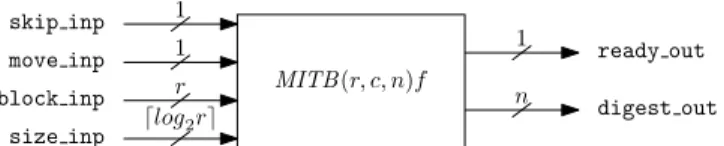
Figure 2.MITB: Inputs and Outputs
istance, of a highly-optimized implementation. Our main result (Theorem 1) categorizes as a correctness result, in the sense that it talks about equivalences modulo abstraction, however, our verification objective is not a straight-forward implementation of SHA-3, i.e., with the same or a similar interface, but a hard-ware design that uses SHA-3 to achieve higher-level properties. Furthermore, our goals are orthogonal: first, we want guarantees for a hardware design, not a software implementation. Second, we want to demonstrate how probabilistic reasoning can be avoided and traditional theorem provers be used.
Existing work on cryptographic hardware like the TPM [16, 15, 37], hardware security modules [17, 11, 26, 35, 14] or authentication tokens [28, 23] operate on the specification level, abstracting cryptographic bitstrings using a term algebra. Implementation-specific aspects like the complicated state-machine needed to correctly apply padding or the low-level access available to an adversary after compromise are not represented in these models.
3
Hardware design
The MITB is a standalone device that computes a MAC using the Keccak
family of hash functions [9], which NIST standardized as SHA-3 [19]. A nice feature of SHA-3 is that it can serve as a message authentication code (MAC) by simply prepending a secret key to the message, i.e., the function:
mac(k, m)··=SHA3(kkm)
is a valid MAC [8]. MACs operate as follows: to ensure the integrity of a message m, one computesmac(k, m) and attaches it to the message. The communication partner, who also knowsk, can recompute this function and compare the result to the MAC received. If the result is the same, the communication partner can be sure the message was created by a party that knows k (typically either the sender or the receiver himself) and thatmwas not modified in transit. Previous hash functions like SHA-1, SHA-2 and MD5 were vulnerable to length-extension attacks and thus required more complicated constructions like HMAC to serve as MACs. (Cryptographic) hash functions themselves are functions that are difficult to invert and are resistant to collision attacks. In contrast to unforgeability, the main property of a MAC, it is difficult to formalize these properties, hence hash functions are often abstracted in terms of random oracles. A random oracle is a randomly chosen function from {0,1}∗ → {0,1}n where n is the length of the
hash, i.e., each new input appears to be freshly sampled, but the function itself is deterministic.
Ready
start Absorbing AbsorbEnd10S1
AbsorbEnd110S1 AbsorbEnd0S1 Move Inputk l Inputb l,l=r Inputb l,l≤r−4 Inputb l l =r−3 l=r−2 l=r −1 Inputb l
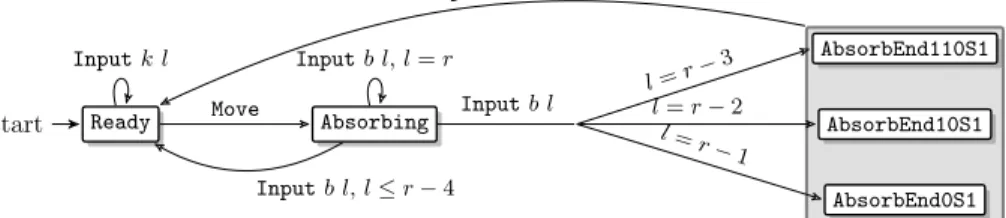
Figure 3. State transition diagram. Not shown: (a)Skip preserves state. (b) In any absorbing state, Move returns to Ready, but resets volatile memory to 0r+c. Here,k andbare input blocks andlrepresent input size.
The sponge construction SHA-3 is based on the ‘sponge construction’ in which an arbitrary length message is iteratively ‘absorbed’ into a finite state (see Figure 1). The number of iterations depends on the length of the message. Once all message blocks have been absorbed, the resulting state can be ‘squeezed’ to extract a digest. In general, this squeezing can be used to derive a digest of any desired length, however, all instances of fixed-length SHA-3 require only a single squeeze operation.
SHA-3 defines four instances of this construction, but recommends only one (the others are for testing and light-weight hashing). This instance is defined by a bitrate of r = 576, a capacity of c = 1024 and an output size n= 512 < r, i.e., the number of bits to which the output is truncated. The state of the SHA-3 sponge algorithm thus consists of r+c = 1600 bits. Initially, the state is 0r+c, i.e. each of the 1600 state bits is 0. In each iteration, a state permutation
f :Zr2+c →Z
r+c
2 is applied on the state. A detailed formal specification off is not given here;f is treated as an uninterpreted parameter in the specification and proofs. That is, we do not make any assumptions about f itself other than that the sponge construction withf can be abstracted by a random oracle. The attacker can computef on inputs of her choice.
By itself, the sponge construction is only defined for input sizes that are multiples of r. Therefore, a 10∗1 padding is used, i.e., a bitstring with 1 at the beginning and end, and sufficiently many 0s in between. In addition, the SHA-3 specification requires two bits 01 to be added to distinguish fixed-length SHA-3 from its variable-length siblings SHAKE-128 and SHAKE-256. Hence any messagemis padded to a multiple ofrbits by appending at least four bits: first 011, then sufficiently many (|m|+ 4 modr) zeroes, and finally a trailing 1. An empty message, e.g., is padded to a block 0110r−41.
State machine The MITB computesmac(k, m), but keepsksecret. It provides two operations: overwritingk(reading is not possible by an outsider), and com-putingmac(k, m) for a givenm. As we detail in Section 8, this functionality by itself is sufficient to improve the resilience of password databases, secure channel establishment and two-factor authentication against host compromise. Asmcan
be arbitrarily long, the device operates in a blockwise fashion, absorbing 512 bits per call. Each full block is applied to the current state. If the user indicates an input of shorter length, a padding is applied and the operation finalized. Only if the padding was correctly applied, the state may be output.
The MITB has two 1-bit control inputs skip_inp and move_inp, two data inputsblock_inpandsize_inp, a 1-bit control outputready_outand a data out-putdigest_out. It is parametrized on three numbers (r, c, n) and a permutation functionf. These are part of theKeccakspecification. An actual device would be manufactured with specific values for the parameters, and we require that 4< r, 0< c andn≤r.
The inputblock_inpisr-bits wide and the outputdigest_outisn-bits wide. The input size_inp has sufficient bits to represent a number of sizer or less. For convenience, it is modeled as a number rather than a bitstring. The truth valuesT,Fmodel bits 1, 0, respectively. The MITB runs continuously after being switched on. It is implemented as a state machine using combinational logic and registers (see Section 5). All a user can observe (assuming tamper-resistant man-ufacture) are the sequences of values appearing on the outputs ready_out and digest_out, which depend on the values input viaskip_inp,move_inp,block_inp and size_inp. From a user’s point of view, the MITB can be in either of two states: Ready or Absorbing. It powers up into state Ready. The 1-bit output ready_out indicates whether the state is Ready (ready_out=T) or in some ab-sorbing state (ready_out=F).
The inputskip_inp‘freezes’ the MITB: holding itTstops the state changing on successive cycles. If skip_inp is F, then input move_inp causes the state to change on the next cycle; in particular it is used to signal that MITB should start absorbing a message. In the state machine, this is represented as a transition Move, no matter what valuesblock_inpandsize_inphave. If bothmove_inpand skip_inp areF, we consider this as a transitionInput block_inp size_inp.
MITB has a permanent memory for holding an r-bit secret key. The key can be set or changed by holding both skip_inp and move_inp F in the Ready state. The data being input onblock_inpthen overwrites the stored key. In the Absorbing state, if both move_inp and skip_inp are F, we absorb block_inp to compute the MAC in a blockwise fashion. Depending on the message length, the padding might cause the message to extend to another block, in which case this additional block needs to be absorbed. As described in the previous section, the padding adds at least four bits, so a message that is 1, 2 or 3 bits short to the block length needs to have an extra block for the parts of the padding. Thus the need for three states that finalize the padding block. E.g., if the message is two bits short, i.e., size_inp is r−2 in Absorbing, then 01 is appended to the last block before absorbing it, and MITB moves into state AbsorbEnd10S1 (the ‘S’ can be read as ‘∗’). There, a block 10r−21 is absorbed (inputsblock_inp and size_inp are ignored) before moving toReady in the next cycle. Note that Absorbingalso moves back toReady ifsize_inp≤r−4.
The main correctness property of the device is that if the specified protocol is used to input a message, then its MAC will appear ondigest_out. The main
security property is that no matter what inputs are supplied, the secret key cannot be revealed nor any other information than a valid MAC. In particular, no chain of inputs can leak parts of the state of the sponge construction before the padding has been completed.
MAC computation protocol The MAC ofm, i.e., the SHA-3 hash of kkm, is computed as follows:
1. If ready_out = 0, i.e., the device is not in Ready state, transition to the Ready state using Move, i.e., by inputtingF on skip_inp and T onmove_inp (block_inpandsize_inpare ignored during this step).
2. The device is put intoAbsorbingstate using anotherMove.
3. The user splits minto a sequence of blocks, m=b1kb2k · · · kbn−1kbn, such
that all blocks except the last one arer-bits wide, i.e.,|bi|=rfor 1≤i < n
and|bn|< r. Ifrdivides exactly into |m|, thenbn is taken to be the empty
block (so|bn|= 0).
4. Starting on the next cycle, and continuing for n cycles, the user performs transitionsInputbi |bi|, i.e., inputsFon both move_inpand skip_inp,bi on
block_inpand|bi|onsize_inp, where 1≤i≤n. During this timeFwill be
output onready_out.
5. After inputtingbn, the user keeps inputtingFonskip_inp andmove_inpfor
one more cycle untilready_outbecomesT. On the cycle when this happens, the hash of kkn will appear on digest_out. The number of cycles taken depends on |bn|. If |bn| ≤ r−4 then ready_outwill become T on the cycle
afterbn is input. Ifr−4<|bn|< r, thenready_outwill become Tthe cycle
afterbn is input.
Key update protocol The key is updated to valuekin two steps. 1. Exactly as step 1 in the MAC computation protocol.
2. Perform transitions Input k 576 by setting bothmove_inp and skip_inp to F,block_inpto kandsize_inpto 576.
4
Security goals
The MITB is designed to protect password databases in case of a server breach, but can be used for many other different applications (see Section 8). We assume that an attacker may eventually gain control over this server, in which case the secrecy of the key should be preserved, but the attacker can compute MACs of her choice, re-set the key or send arbitrary other commands to the MITB. Before the attacker gains control, she shall not be able to compute or predict MACs.
Real-world / Ideal-world formulation Complex cryptographic properties are often formulated using the real-world / ideal-world paradigm. The real world describes how the cryptographic primitive or protocol interacts with the ad-versary, i.e., the threat model. The ideal world describes an idealised setup that provides the necessary guarantees by construction. In the case of signa-tures, e.g., all signatures are created by a central authority that keeps a list of message-signature pairs, so only message-signature pairs that it constructed itself are accepted, thus providing unforgeability by construction. Or, for encryption schemes, it outputs random bitstrings instead of a ciphertexts, thus providing confidentiality by construction. If it is not possible to distinguish both worlds, then the real-world scenario must be sufficiently close to the ideal world that it can be considered secure.
In our case, the real world consists of the MITB in communication with some environment, e.g., one of the applications in Section 8. The environment uses the protocol from Section 3 to compute a MAC or update the key, but can also bypass this protocol by declaring the host computer corrupted. In this case, the environment’s inputs are directly transferred to the MITB.
The ideal world is specified by a simple machine that (a) stores or overwrites a keyk; (b) for every MAC request m, calls a hash oracle withkkm. (c) If the environment declares the host system corrupted, the attacker can do nothing more than to continue to query this oracle, in particular, she does not get access tok. Our security result in Theorem 1 can thus be informally stated as follows:
For all parametersr,c andnsuch thatr >4,c >0andn≤r, and any sequence of inputs i, the sequence of outputs obtained by sending i to the real-world is equal to the sequence of outputs obtained by sending ito the ideal-world.
Hash functions and the random oracle model So far, a security defini-tion for cryptographic hash funcdefini-tions that is both formal and directly applies to real-life hash functions has not been found. Properties like collision resist-ance postulate that there is no known adversary that can provoke a collision, but fundamentally, there are adversaries that can create collisions, due to the pigeonhole principle. We cannot formally reason about all known algorithms.
In cryptographic proofs, hash functions are thus usually abstracted using random oracles (ROs). A RO has two properties: First, when queried for a new bitstring m, RO draws a bitstring from the uniform distribution of bitstrings of length n. Second, ifm was queried before, the RO responds with the same bitstring as before. Since hash functions are deterministic, a RO can be distin-guished from any fixed hash function. Cryptographic results, e.g., indifferenti-ability [8] or PRF security [21] hence consider a sponge construction that calls an oracle to evaluate a randomly chosen permutation (and/or a keyed variant of the construction [21]). But in SHA-3, the permutation is public and fixed.
Theorem 1complementsthese result. It relates the MITB to the ideal world with the sponge construction for an arbitrary, but fixed permutation. Indifferen-tiability relates the ideal world with a randomized sponge construction (keyed
or with a randomly chosen permutation) to the ideal world with a random or-acle, within certain bounds on the adversary’s running time and the number of oracle queries. Observe, however, that the step from the deterministic sponge construction (with a fixed permutation) to the randomised construction used in cryptographic proofs remains a heuristic; it is (provably) incorrect.
Guarantees provided by construction Once we (heuristically) instantiate the hash function in the ideal world with a randomly chosen hash function, as in the RO model,2 we obtain a very clear interpretation of the guarantees that the ideal world we previously described provides.
1. Confidentiality: The output contains neither information about k, nor the messagem(as it is merely a randomly chosen bitstring).
2. Unpredictability:The MAC computation yields unpredictable values for each kand m, as long as (k, m) were not queried before (as the result is chosen freshly).
3. Determinism: If (k, m) were previously queried, the MAC will be the same (as the RO is deterministic andkkmconstitutes the query). This guarantees that a MAC can be verified later.
4. Resistance against compromise:The above guarantees hold even if the host system is compromised.
These guarantees go beyond the guarantees of message authentication codes (which are allowed to leak information about the authenticated message) or hash functions (which may leak information about the hashed message, but can be forged by everyone). We have designed the functionality specifically to suit secure password storage, our main application.
5
Formalising the MITB
We base the MITB’s definition on the function MITB_FUN, which specifies the behaviour abstractly.MITB_FUNtakes an abstract states ∈Sand an inputi, and
returns the next state. The abstract states=hcntl,pmem,vmemiconsists of the value of the control registercntl∈ {Ready,Absorbing,AbsorbEnd(0S1|10S1|110S1)}) and a permanent (pmem) and volatile (vmem) memory, which are both bit-strings of lengthr+c. The control flags correspond to the states described in Section 3. An input i can either beMove, Skip or Input bk len, where bk is a bitstring of size r and len corresponds to the number of bits of bk that constitutes the in-put block (thuslen≤r). The bitstringbk and numberlenrepresent inputs on block_inpandsize_inp.
The definition of MITB_FUN uses ML-style pattern matching. Due to lack of space we skip presenting MITB_FUN’s formal definition here (see Appendix C). However, its possible transitions are depicted in Figure 3. The most complex
2
A randomly chosen hash function or an oracle that samples random hash values on demand are equivalent formulations of the RO model.
MITB f (cntl,pmem,vmem) (skip,move,block,size) =
MITB FUN f (cntl,pmem,vmem) (ifskip=TthenSkip
else ifmove=TthenMove
else ifsize ≤ rthen
Inputblock size else Skip)
Figure 4.Definition of MITB function.
MITB STEP f s i =
let(cntl0,pmem0,vmem0) = MITB f s i;
digest =
(ifcntl0=Ready
then(T,(r − 1><0)vmem0) else(F,ZERO))
in ((cntl0,pmem0,vmem0),digest)
Figure 5.Definition of step function.
part ofMITB_FUNspecifies the state transition corresponding to absorbing a block. What happens depends on the input length. The complexity here is due to the padding applied by the devices, as described in Section 3. If the block length is less or equal to r−4, e.g. 0, the device applies the padding and sets cntl
to Ready. If the last block is one bit short of being a full block (len = r−1) then one bit of padding is added and the device enters an absorbing state with
cntl = AbsorbEnd0S1. On the next cycle, the remaining padding (i.e. r−1 zeros and a finalT ) is added and the permutationf is applied tovmem before transitioning back to the ready state. Similar steps are taken if the input block length is equal to r−2 orr−3. When the block size is exactly r, the device starts absorbing a non-final block, which is done by: (i) appending zero to it, (ii) XOR-ing the result with the current value of the volatile memoryvmem, (iii) applying theKeccak permutationf to the result of the XOR-ing, and finally, (iv) updating the volatile memory with the result of applying the functionf.
Figure 4 shows the definition of the function MITB which decodes the inputs into abstract commandsSkip,MoveandInput and callsMITB_FUN.
We also define astep function (Figure 5) which yields the next state of the system. The step function behaves like the MITB, but defines the output, too. The step function takes a permutationf, the current state of the MITB, denoted as s, and the inputi= (skip_inp,move_inp,block_inp,size_inp). It returns the next state of the MITB together with an output. The returned output depends on the value of cntl in that cycle. In the definition, (h ><l)w represents the HOL4bit extraction function for input wordw, andhandl are the upper and lower bound for the number of extracted bits, respectively.
6
Formalizing security
We define the security of the MITB in terms of a functionality, an idealized specification of both the functional correctness of the device, and the information the adversary can learn from it. The popular ‘universal composability’ framework defines how the MITB ought to relate to this functionality.
Z
π
A
Z
F
S
≈ · adversarial pos. · protocol positionFigure 6.π(perfectly) emulatesF iff, for allA, there existsSsuch that for allZ, the lhs network is indistinguishable (or instead: identical) from the rhs.
6.1 Universal composability
Our security definition follows the real-world/ideal-world paradigm, which can be generalized into a security notion calledemulation.3Emulation provides prop-erties similar to refinement and entails a property calleduniversal composability. Canetti introduced universal composability (UC) in a framework that goes by the same name [13], but there are several variations of it [22, 29]. If a protocol or cryptographic primitiveπUC emulates an ‘ideal-world’ systemF (called the functionality), thenπprovides universal composability w.r.t.F. This means that for the analysis of any higher-level systemρthat usesπ, it is sufficient to analyze the more abstract and thus simpler system whereρinteracts withF instead — even if multiple copies of πrun in parallel.
To formulate the security property, we formalize UC’s communication frame-work andperfect emulation, the strongest variant of their refinement notion. We did not seek to prove that UC emulation implies universal composability.
The real world is characterized by the protocol π communicating on two interfaces, the honest and the adversarial interface. The honest interface provides inputs, possibly from higher level protocols. A secure channel protocol like TLS, e.g., receives the instruction ‘PartyA requests sendingmto PartyB’ and may later output ‘PartyB receivedmfrom A’. The adversarial interface models the network: all network communication, e.g., the encrypted TLS records, is sent to and received from anadversary A. The attacker can hence eavesdrop messages, but also drop or modify them.
In theideal world, the functionality F receives the same high-level instruc-tions on the honest interface.4 Ideally, the messages on the network provide no useful information for the adversary. However, often enough this is impossible; encryption, e.g., reveals the length of the plain text. Therefore, the functional-ity makes this so-called leakage explicit by outputting, e.g., the length of the plaintext on the adversarial interface. To show that the network traffic leaks no information besidesF’s output on the dishonest interface, most emulation proofs construct a simulatorSthat imitatesA’s behavior using only this intended leak-age. Thus, to an outsider, no matter what inputs the protocol receives, for every attackerA there should be a simulatorS such thatπinteracting withA is
in-3
Also called ‘realization’ [13]. 4
distinguishable from F interacting withS. The comparison assures correctness (as any difference between the honest protocol and the ideal functionality on the honest interface can be observed) and confidentiality up to the leakage inF (if the adversary can learn something that the simulator cannot reproduce from the input provided by F, then there would not be a simulator that achieves indis-tinguishability). The inputs to the protocol can come from a high-level protocol using it (e.g., a p2p system using TLS for communication between peers), and are abstracted as a Turing Machine Z. In the real world, Z interacts with π (on the honest interface) and withA(on the adversarial interface). In the ideal world,Z interacts withF andS.
It was shown5that for any environmentZ and adversaryAthat are success-ful in distinguishing real world and ideal world, a new environment Z0 can be constructed that simulates A and only relies on a special attackerAd, the
so-calleddummy adversary. The dummy adversary only forwards messages between Z0 andπ. Thus, in practice, one shows the existence of a simulatorS such that for all environmentsZ,πandAd are indistinguishable fromF andS.
We formalize the communication structure in UC as follows. A message data-type indicates the routing for messages between the protocol position (occupied byπin real world,F in the ideal world), the adversary position (occupied byAd
in the real word, S in the ideal world) and the environment position (occupied byZ in both cases).
Message=EnvtoPofα|EnvtoAofβ|PtoEnvofγ|PtoAofδ|AtoEnvofη|AtoPofφ Initially, the environment sends a message of type EnvtoP or EnvtoA to either the adversary or the protocol. The function ROUTE p a, for a protocol step function p and an adversary step function a, expects the previous state of p and a and a value of typeMessage to be routed. It computes the next state of the protocol and adversary and the next message to be routed. If the message matches EnvtoP or AtoP, the protocol step function is applied, the protocol’s state updated, and the output converted into typeMessage, e.g.:
ROUTE p a ((state_p,state_a),EnvtoP m) = (let(state_p_n,out) = p state_p(EnvtoPm)
in((state_p_n,state_a),Proto Wrapperout))
The wrapper Proto Wrapper transforms a datatype for protocol output into Message, i.e., values that match eitherPtoEnv or PtoA. This ensures that the protocol cannot send messages that appear to originate from the adversary, and vice versa. Messages addressing the adversary are handled analogously.
Before the environment is addressed again, there can be additional routing steps between the protocol and the adversary. Messages to the environment, however, terminate a routing step and are returned. We will later restrict the communication to three routing steps before the environment is again in control, 5 This simplification was proven sound for the UC framework [13], GNUC frame-work [22] and the IITM frameframe-work [29], so for brevity, we will assume it part of the definition.
which is sufficient for our case (otherwise, a routing error is produced).
ROUTEp a((state_p,state_a),PtoEnvm) = ((state_p,state_a),PtoEnvm) Note that the scheduling model of UC gives control to the party that received a message. More elaborate scheduling mechanisms are modeled by including scheduling requests to the adversary in the protocol.
In UC, the environment is a Turing Machine, however, in this work, we consider the strongest notion of emulation, called perfect emulation. Here, the sequence of messages the environment receives is the same (rather than indistin-guishable to all polynomial time environments). We, furthermore, do not assume any runtime bounds on the participants.6 This simplifies the analysis: We can model the set of environments as the set of input sequences and consider all other participants in terms of mathematical functions, and thus avoid probabil-istic reasoning altogether. This is sufficient for the MITB because it is entirely deterministic, due to the key being generated outside the device and the de-terministic nature of the hash function. We hence define (EXEC p a), again on protocol and adversary step functionspanda, that applies a sequence of inputs i to an initial protocol and adversary state s= (sa, sp) until one of these two
parties outputs a message addressed to the environment.
We define a single execution step from the perspective of the environment as follows, where ROUTE THREEis just the threefold composition ofROUTE.
EXEC STEP p a ((state_p,state_a),input) = (let
((state_p_n,state_a_n),out) = ROUTE THREE p a
((state_p,state_a),ENV WRAPPER input) in
((state_p_n,state_a_n), GAME OUT WRAPPER out))
The environment is fully described by the sequence of inputs it sends to the protocol or the adversary, hence we define an execution as follows:
EXEC p a s[] = []
EXECp a s(i::il) = (let(s0,out) =EXEC STEPp a(s,i)in(s0,out) ::EXECp a s0il)
6.2 Security definition
The real world The environmentZ communicates with parties that compute MACs using the MITB via a library, as well as an attacker, who can take control over the machine the MITB is attached to and thus bypass this library. The attacker also communicates with Z and can thus provide Z with information
6
This is w.l.o.g. for all participants except for the simulator, which, however, is obvious to run in polynomial time in our case.
that allows it to distinguish real world and ideal world. As the attacker is in-stantiated with the dummy attacker, which is defined as follows, Z can access the adversarial interface, in this case the MITB, via this indirection.
DUMMY ADV v0 (EnvtoA m) = (0,Adv toP m)
DUMMY ADV v1 (PtoA m) = (0,Adv toEnv m)
For messages from the environment,PROTOmodels the protocols for MAC computation and key updates we defined in Section 3 (see Appendix A for the precise modeling).
The ideal world In the ideal world, Z receives ‘correct’ output for whatever message it inputs. ‘Correct’ means the following: given a message (SetKey, k), it storesk. For any subsequent message (Mac, m), it outputsH(k||m), whereHis a hash function. The function (FMACH s) describes the output and next state of the ideal-world functionality in state s, parametrized with the hash functionH to represent the hashing oracleH. The only state thatFMACholds is the stored keykand the corruption status (Tiff corrupted).
FMAC H (K0,F) (EnvtoP (SetKey k)) = ((k,F),Proto toEnv 0w)
FMAC H (K0,F) (EnvtoP (Mac m)) =
((K0,F),Proto toEnv (H (word to bits K0 k m)))
After the corruption signal was received (and forwarded to the adversary), FMACresponds to oracle queries, computingH(kkm):
FMAC H (K0,F) (EnvtoP Corrupt) = ((K0,T),Proto toA WasCorrupted)
FMAC H (K0,T) (AtoP CorruptACK) = ((K0,T),Proto toEnv 0w)
FMAC H (K0,T) (AtoP (OracleQuery m)) =
((K0,T), Proto toA(OracleResponse(H (word to bits K0 k m))))
The responses on the attacker interface formalize that the attacker does not receive information beyond the ability to compute MACs: Via the adversarial interface ofFMAC, the simulator has access to the hash functionH, but not to the MITB. Note that, in contrast to the real world,FMACnotifies the simulator that it was corrupted, so the simulator knows whether it has to deny or simulate direct access to the MITB. After corruption, all honest queries are ignored:
FMAC H (K0,T) (EnvtoP (SetKey v16)) = ((K0,T),Proto toEnv 0w)
FMAC H (K0,T) (EnvtoP (Mac v17)) = ((K0,T),Proto toEnv 0w)
Our main result is that, no matter which inputs the environment sends, the outputs are the same. In the next section, we will define a simulator SIMthat mimics the behavior of the MITB with access only to the hashing oracle provided byFMAC. We establish its existence by constructing it so that:
Theorem 1. For all parametersr,c andn such that r >4,c > 0 and n≤r and permutations f : {0,1}r+c → {0,1}r+c, if the protocol and dummy
ad-versary, as well as the functionality FMAC and the simulator are in their re-spective initial states s and s0, then, for any sequence of inputs i, the out-put sequences tracereal = EXEC (PROTO (MITB STEP f)) DUMMY ADV s i, and
Note thatf is a free variable in this theorem, and can stand for any permuta-tion. The function (Hashf 0) formalizes the sponge construction with permuta-tionf and initial state 0r+c, including the SHA-3 padding and the truncation to
nbits. For lack of space, we will not elaborate on its formalization. The protocol, which is parametric in the MITB step function, is instantiated withMITB STEP from Section 5, which itself is parametric in the underlying permutationf.
7
Proof overview
We proceed to outline the proof of Theorem 1. To this end, we first present the simulator and the relational invariant used to characterize possible states that the system can enter at runtime.
SIM mitbf f (Absorbing,vmem,m,F,c) (EnvtoA(F,F,inp,inp_size)) = if inp_size > r
then ((Absorbing,vmem,m,F,c),AtoEnv(F,ZERO)) else if inp_size = r
then((Absorbing,ZERO,m ||w2binp,F,c), AtoEnv(F,ZERO)) else if inp_size ≤ r − 4
then if inp_size = 0
then((Absorbing,vmem,[ ],F,c),AtoP(OracleQuerym)) else ((Absorbing,vmem, [ ],F,c),
AtoP(OracleQuery(m ||TAKE7inp_size(w2b8((inp_size−1><0) inp)))))
else
(letstate=ifinp_size=r−1thenAbsorbEnd110S1
else if inp_size = r − 2thenAbsorbEnd10S1
else AbsorbEnd0S1
in
((state,ZERO, m||TAKEinp_size(
w2b((inp_size − 1><0)inp)),F,c), AtoEnv(F,ZERO))))
The simulator pretends to be the attacker from the real world, i.e., the dummy adversary. It simulates the information the functionality outputs in the ideal world, in particular the MITB’s output after corruption. To imitate the MITB, without knowing the last key that was stored, the simulator uses the oracleH(kkm), whereHis a hash function and||denotes the bit-string concat-enation function. The simulatorSIMignores queries until the variablecorrupted is set. Afterwards, it parses each message m sent by the environment into an input (skip_inp,move_inp,block_inp,size_inp)∈B×B× {0,1}r×
Nr. We
for-mulate the behavior of SIMfor the case whereCorrupt=Tas a function on its state (cntl,vmem,m,overwt,s)∈ {Ready,Absorbing,AbsorbEnd(0S1|10S1|110S1)} ×{0,1}n×{0,1}∗×
B×Sand the input (skip_inp,move_inp,block_inp,size_inp).
7
The functionTAKEi lreturns the first ielements of the listl. 8
The output of the function is a new state, and the simulated output of the MITB, i.e., (ready_out,digest_out) ∈ B× {0,1}n. Due to lack of space, the detailed
definition of SIMis included in Appendix B.
Here, we only present an extract from SIM’s definition to show challenges involved in its formalization. The most interesting part of SIM’s definition is how it acts as a buffer between the environment, which may successively send message blocks to be MACed, and the hashing oracle, which expects a single oracle query.
In this case, depending on the input size, the simulator has to match the MITB’s behavior: If the input size is greater than r the simulator, like the MITB, skips this input and its state remains unchanged. When the input size is equal tor, the simulator adds the full block to its buffer m. If the input size is between 0 andr−4, the simulator adds the corresponding prefix of the input block to the buffer, and queries the oracle. If the input size is between r−3 andr−1, the appropriateAbsorbEnd(0S1|10S1|110S1) needs to be selected, as the MITB will not be able to output the MAC before yet another input is given. After sending the oracle query, the simulator awaitsFMAC’s response.
SIM mitbf f (−,vmem,m,F,c)
(PtoA (OracleResponse hashValue)) =
((Ready,hashValue,[ ],F,c),AtoEnv (T,hashValue))
To prove emulation, we define an invariant which restricts valid states of the system. The invariant has three parts, each relating specific parts of real and ideal world states. The first part of the invariant relates the permanent and volatile memory in the real world to the key and the messages received so far in the real world, in case the MITB was corrupted. For the given keykin the real world, the permanent memory should always bef(0c||k). The volatile memory
should be the result of absorbing, but not yet padding, the messages buffered bySIMaccording to the specification of the sponge construction. Depending on the simulated control state, the length of the buffered messages should be off by 1,2,3 or 0 from a multiple of the block length and, inReady-state, the firstnbit of the volatile memory should equal the previous response from the hashing oracle. The case where the key was overwritten is an exception: now the simulator can execute the step function itself, without the oracle. In this case, the volatile and permanent memory of the MITB and the simulated counterpart have to match. Besides the memory invariant, the invariant consists of two other properties. (i) The corruption status in real and ideal world correspond. (ii) If the real world is corrupted, the control state of the MITB simulated by SIM and the actual MITB in the real world correspond. The proof of Theorem 1 proceeds by induction on the length of the inputi. The base case (i= [ ]) holds trivially. In the inductive step, we first prove that the starting states satisfy the constraints of the invariant. Then we show that, given the same input, a single step by the real and ideal worlds preserves the relational invariant. From that, we follow that the output in the successor state must be the same in both worlds. Tab. 1 gives details on the specification and proof size.
Table 1.Size of formal proof in lines of code (loc).
definitions (loc) theorems incl. proofs (loc)
universal composability 137 —
sponge construction 58 512
MITB 547 1962
Intuitively, the existence of the simulator shows that all outputs of the MITB are hashes of correctly padded messages, and therefore non-revealing. The con-struction of the simulator pointed us to the need of an extra absorbing state — our initial design trusted the library to remember to request a final block. Later, we incorporated the two bits that are meant to distinguish SHA-3 from the SHAKE family, hoping the proof would not be affected. On the contrary, it required the introduction of another two absorbing states, which manifested in the impossibility of proving the memory invariant with only one absorbing state. Finally, failed attempts in showing the state invariant indicated the need for an initialization procedure in MAC computation protocol (as well as the key update protocol), to ensure that the device is indeed inReadystate. These three flaws, which we discovered early on, while proving emulation of the ideal func-tionality, seem to be stereotypical flaws when designing hardware for a hostile environment. None of them would have been discovered by tests for functional correctness.
8
Applications
We propose three applications for the MITB. Each provides improved resilience against host compromise. All properties we mention have been verified using off-the-shelf protocol verification tools. As protocols are notorious for their com-plex interleaving of a possibly unbounded number of small programs running in concurrency, these are the right tool for the job, as they have a large degree of automation. These tools operate in the symbolic model, where cryptographic outputs are abstracted using a term algebra, e.g., a MAC is a term of form mac(k, m), wheremacis a function symbol, andk, mthemselves are terms. The MITB is reflected in these models by the simple fact that the term k used in the key-position remains secret even if the attacker gains control over its host system. (See Appendix D for the models.)
Secure password storage: All businesses that store password data need to secure these password databases for the case where they get stolen. To store passwords securely, the MITB is initialized with a fresh key during set-up, then used to compute MACs on the hashed and salted password. We used ProVerif’s diff-equivalence [10] to show strong secrecy, i.e., resistance against offline pass-word guessing. The verification takes less than a second for an unbounded
num-ber of passwords9. Furthermore, the MITB could replace the YubiHSM, which costs about $ 650,10 in an even more elaborate password storage scheme by Almeshekah et. al.
Establishing a secure channel: The MITB can harden a variation of the signed Diffie-Hellman key-exchange protocol, which is used, e.g., in TLS and IPsec. Due to the MITB, this protocol providesperfect forward secrecy (even if the adversary gains control over one of the MITBs, all session keys established prior to this event remain secret) and post-compromise security (even if the adversary temporarily gains control over one of the MITBs, once the participants come together and set up a new key, future session keys will again remain secure.) Using the tamarin/SAPIC [36, 25] toolchain, we establish both properties for an unbounded number of sessions. The proof terminates in 1516s.13
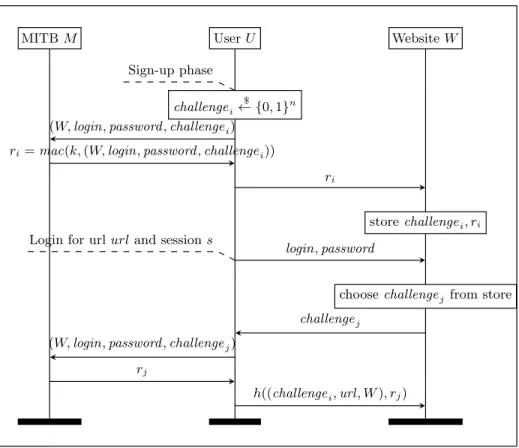
Two-factor authentication: We demonstrate that the MITB is compatible with the FIDO standard for universal 2nd factor authentication [40] (see Figure 7 in Appendix D ). With tamarin/SAPIC, we establish perfect forward security and post-compromise security for authentication, i.e., the property that any successful login on the web server was initiated by the user. The proof terminates within 9s.13
9
Conclusion
With the MAC-in-the-box we presented the first full-fledged formal security ar-gument for a hardware design. Despite its simplicity, the device has various applications. It also demonstrates that interactive theorem provers, which have an excellent track record for hardware verification, can in some cases be directly applied to the analysis of cryptographic constructions — even if support for probabilistic reasoning is missing or insufficient.
Our technique applies when common abstractions in cryptography are heur-istics rather than mathematically valid simplifications. Examples are random oracles for hash functions, or pseudorandom functions for block ciphers. Designs based on these primitives essentially argue that they provide proper access to these abstractions. For cases where this property holds unconditionally, our ap-proach has advantages over cryptographic frameworks that come with additional proof obligations, or are not available for the theorem prover of choice.
Acknowledgements
This project was Graham Steel’s and Michael J. C. Gordon’s idea, who both supported it in its early stages. A substantial part of the MITB’s formalisa-tion was contributed by Mike, who this paper is dedicated to. The first author
9
Computed on a MacBook Pro with 3,1GHz Intel i7 and 16GB RAM.
10Pessl et al. estimate a SHA-3 implementation on an RFID token to cost about $ 0.05 [33]. As the MITB’s state machine and key storage do not fundamentally add to that, production cost will likely be dominated by the bus technology, e.g., USB.
is grateful for his guidance and his kindness in difficult times. This work was carried out in the framework of the French-German-Center for Cybersecurity, a collaboration of CISPA and LORIA. The second author is supported by the German Federal Ministry of Education and Research (BMBF) through funding for the CISPA-Stanford Center for Cybersecurity (FKZ: 16KIS0762).
References
1. Almeida, J.B., Barbosa, M., Barthe, G., Blot, A., Gr´egoire, B., Laporte, V., Oli-veira, T., Pacheco, H., Schmidt, B., and Strub, P.: Jasmin: High-Assurance and High-Speed Cryptography. In: Proceedings of the 2017 ACM SIGSAC Conference on Computer and Communications Security, CCS 2017, Dallas, TX, USA, October 30 - November 03, 2017, pp. 1807–1823. ACM (2017)
2. Almeida, J.B., Baritel-Ruet, C., Barbosa, M., Barthe, G., Dupressoir, F., Gr´egoire, B., Laporte, V., Oliveira, T., Stoughton, A., and Strub, P.: Machine-Checked Proofs for Cryptographic Standards: Indifferentiability of Sponge and Secure High-Assurance Implementations of SHA-3. In: Proceedings of the 2019 ACM SIGSAC Conference on Computer and Communications Security, CCS 2019, London, UK, November 11-15, 2019, pp. 1607–1622. ACM (2019)
3. Almeshekah, M.H., Gutierrez, C.N., Atallah, M.J., and Spafford, E.H.: Ersatzpass-words: Ending password cracking and detecting password leakage. In: Proceedings of the 31st Annual Computer Security Applications Conference, pp. 311–320 (2015) 4. Backes, M., Berg, M., and Unruh, D.: A Formal Language for Cryptographic Pseudocode. In: Logic for Programming, Artificial Intelligence, and Reasoning, 15th International Conference, LPAR 2008, Doha, Qatar, November 22-27, 2008. Proceedings. LNCS, pp. 353–376. Springer, Heidelberg (2008)
5. Barthe, G., Gr´egoire, B., and B´eguelin, S.Z.: Formal certification of code-based cryptographic proofs. In: Proceedings of the 36th ACM SIGPLAN-SIGACT Sym-posium on Principles of Programming Languages, POPL 2009, Savannah, GA, USA, January 21-23, 2009, pp. 90–101. ACM (2009)
6. Barthe, G., Gr´egoire, B., Heraud, S., and Zanella B´eguelin, S.: Computer-Aided Se-curity Proofs for the Working Cryptographer. In: Advances in Cryptology, pp. 71– 90. Springer (2011)
7. Beringer, L., Petcher, A., Katherine, Q.Y., and Appel, A.W.: Verified Correctness and Security of OpenSSL HMAC. In: USENIX Security Symposium, pp. 207–221 (2015)
8. Bertoni, G., Daemen, J., Peeters, M., and Assche, G.V.: On the Indifferentiability of the Sponge Construction. In: Advances in Cryptology - EUROCRYPT 2008, 27th Annual International Conference on the Theory and Applications of Cryptographic Techniques, Istanbul, Turkey, April 13-17, 2008. Proceedings. LNCS, pp. 181–197. Springer, Heidelberg (2008)
9. Bertoni, G., Daemen, J., Peeters, M., and Assche, G.V.:Online Keccak specifica-tions, (2009).http://keccak.noekeon.org/. 2009.
10. Blanchet, B., Abadi, M., and Fournet, C.: Automated Verification of Selected Equivalences for Security Protocols. In: Symposium on Logic in Computer Sci-ence (LICS’05), pp. 331–340. IEEE Comp. Soc. (2005)
11. Bortolozzo, M., Centenaro, M., Focardi, R., and Steel, G.: Attacking and Fixing PKCS#11 Security Tokens. In: 17th ACM Conference on Computer and Commu-nications Security (CCS’10), pp. 260–269. ACM (2010)
12. Camilleri, A., Gordon, M., and Melham, T.: Hardware verification using higher-order logic. Tech. rep., University of Cambridge, Computer Laboratory (1986) 13. Canetti, R.: Universally Composable Security: A New Paradigm for Cryptographic
Protocols. In: Foundations of Computer Science, pp. 136–145. IEEE Computer Society (2001)
14. Dax, A., Tangermann, S., K¨unnemann, R., and Backes, M.: How to wrap it up -A formally verified proposal for the use of authenticated wrapping in PKCS#11. In: Computer Security Foundations Symposium (2019)
15. Delaune, S., Kremer, S., Ryan, M.D., and Steel, G.: Formal analysis of proto-cols based on TPM state registers. In: 24th IEEE Computer Security Foundations Symposium (CSF’11), pp. 66–82. IEEE Comp. Soc. (2011)
16. Delaune, S., Kremer, S., Ryan, M., and Steel, G.: A Formal Analysis of Authentic-ation in the TPM. In: Formal Aspects of Security and Trust, pp. 111–125. Springer Berlin Heidelberg(2011)
17. Delaune, S., Kremer, S., and Steel, G.: Formal Analysis of PKCS#11 and Propri-etary Extensions. Journal of Computer Security 18(6), 1211–1245 (2010)
18. Deschamps, J.-P.: Hardware Implementation of Finite-Field Arithmetic. McGraw-Hill, Inc. (2009)
19. Dworkin, M.J.: SHA-3 standard: Permutation-based hash and extendable-output functions. Tech. rep., (2015)
20. Erk¨ok, L., Carlsson, M., and Wick, A.: Hardware/software co-verification of crypto-graphic algorithms using cryptol. In: Formal Methods in Computer-Aided Design, 2009. FMCAD 2009, pp. 188–191 (2009)
21. Gaˇzi, P., Pietrzak, K., and Tessaro, S.: The exact PRF security of truncation: Tight bounds for keyed sponges and truncated CBC. In: Annual Cryptology Conference, pp. 368–387 (2015)
22. Hofheinz, D., and Shoup, V.:GNUC: A New Universal Composability Framework, Cryptology ePrint Archive (2011).http://eprint.iacr.org/. 2011.
23. Jacomme, C., and Kremer, S.: An Extensive Formal Analysis of Multi-factor Au-thentication Protocols. In: 31st IEEE Computer Security Foundations Symposium, CSF 2018, Oxford, United Kingdom, July 9-12, 2018, pp. 1–15. IEEE Computer Society (2018)
24. Jean, J.:TikZ for Cryptographers,https://www.iacr.org/authors/tikz/(2016). 2016.
25. Kremer, S., and K¨unnemann, R.: Automated analysis of security protocols with global state. Journal of Computer Security (2016)
26. Kremer, S., K¨unnemann, R., and Steel, G.: Universally Composable Key-Management. In: European Symposium on Research in Computer Security, pp. 327–344. Springer (2013)
27. K¨unnemann, R., Dupressoir, F., and Unruh, D.: Equivalence between while-loops w/ 1:1 mapping, (2015). http://lists.gforge.inria.fr/pipermail/easycrypt-club/2015-March/000292.html. Thread on the Easycrypt-club mailing list. 2015. 28. K¨unnemann, R., and Steel, G.: YubiSecure? Formal Security Analysis Results for the Yubikey and YubiHSM. In: Proc. 8th Workshop on Security and Trust Man-agement (STM’12). LNCS, pp. 257–272. Springer, Heidelberg (2012)
29. K¨usters, R., and Tuengerthal, M.: The IITM Model: a Simple and Expressive Model for Universal Composability. Tech. rep. 2013/025, Cryptology ePrint Archive (2013)
30. Lochbihler, A.: Probabilistic Functions and Cryptographic Oracles in Higher Order Logic. In: Programming Languages and Systems, pp. 503–531. Springer Berlin Heidelberg (2016)
31. NV, G.: Smart card basics – A short guide (2019),https://www.gemalto.com/ companyinfo/smart-cards-basics.
32. Paulson, L.C.: The Inductive Approach to Verifying Cryptographic Protocols. Journal of Computer Security 6(1-2), 85–128 (1998)
33. Pessl, P., and Hutter, M.: Pushing the Limits of SHA-3 Hardware Implementations to Fit on RFID. In: Cryptographic Hardware and Embedded Systems - CHES 2013 - 15th International Workshop, Santa Barbara, CA, USA, August 20-23, 2013. Proceedings. LNCS, pp. 126–141. Springer, Heidelberg (2013)
34. Petcher, A., and Morrisett, G.: The Foundational Cryptography Framework. In: Proc. of 4th International Conference on Principles of Security and Trust (POST’15), pp. 53–72 (2015)
35. Scerri, G., and Stanley-Oakes, R.: Analysis of Key Wrapping APIs: Generic Policies, Computational Security. In: 29th Computer Security Foundations Symposium, pp. 281–295. IEEE Computer Society (2016)
36. Schmidt, B., Meier, S., Cremers, C., and Basin, D.: The TAMARIN Prover for the Symbolic Analysis of Security Protocols. In: 25th International Conference on Computer Aided Verification (CAV’13). LNCS, pp. 696–701. Springer, Heidelberg (2013)
37. Shao, J., Qin, Y., Feng, D., and Wang, W.: Formal Analysis of Enhanced Author-ization in the TPM 2.0. In: 10th ACM Symposium on Information, Computer and Communications Security (ASIA CCS ’15), pp. 273–284. ACM (2015)
38. Slind, K., Owens, S., Iyoda, J., and Gordon, M.: Proof Producing Synthesis of Arithmetic and Cryptographic Hardware. Form. Asp. Comput. 19(3), 343–362 (2007)
39. Solar Designer: Password hashing at scale, (2012).http://www.openwall.com/ presentations/YaC2012-Password-Hashing-At-Scale/. Slides for a talk at YaC 2012 (see Slide 9). 2012.
40. Srinivas, S., Balfanz, D., Tiffany, E., Alliance, F., and Czeskis, A.: Universal 2nd factor (U2F) overview. FIDO Alliance Proposed Standard (2015)
41. Unruh, D.:Unsoundness in definition of ‘glob M’, (2014).https://www.easycrypt. info/trac/ticket/17132. Easycrypt Bug #17132. 2014.
42. Ye, K.Q., Green, M., Sanguansin, N., Beringer, L., Petcher, A., and Appel, A.W.: Verified Correctness and Security of mbedTLS HMAC-DRBG. In: Proceedings of the 2017 ACM SIGSAC Conference on Computer and Communications Security. CCS ’17, pp. 2007–2020. ACM (2017)
A
Details on the real-word protocol definition
For messages from the environment, PROTO def models the protocol for MAC computation we defined in Section 3.
PROTO mitbf (s,F) (EnvtoP (Mac m)) = (let
(s0,rdy0,dig0) =
RunMITB mitbf s [(T,F,ZERO,0)] ; (sr,rdyr,digr) =
if rdy0 ⇐⇒ F then
RunMITB mitbf s0 [(F,T,ZERO,0)]
else (s0,rdy0,dig0) ; (ss,rdys,digest) =
RunMITB mitbf sr ((F,T,ZERO,0) ::
PROCESS MESSAGE LIST (Split (dimindex (:ς)) m)) ; (sq,rdyq,digq) =
RunMITB mitbf ss
[(F,T,ZERO,0); (F,T,ZERO,0)] in
((sq,F),Proto toEnv digest))
Similarly, to insert a new key, the MITB is first brought intoReadystate, and then the key is input.
PROTO mitbf (s,F) (EnvtoP (SetKey k)) = (let
(s1,rdy1,dig1) = mitbf (s,T,F,ZERO,0)
in
if rdy1 ⇐⇒ F then (let
(s2,rdy2,dig2) =mitbf(s1,F,T,ZERO,0) ; (s3,rdy3,dig3) = mitbf (s2,F,F,k,dimindex (:ς)) in ((s3,F),Proto toEnv 0w)) else (let (s2,rdy2,dig2) = mitbf (s1,F,F,k,dimindex (:ς)) in ((s2,F),Proto toEnv 0w)))
Besides the state of the MITB, the protocol stores a boolean corruption state. The environment can signal that the host computer was corrupted, to switch its
state fromFtoT.
PROTOmitbf (s,F) (EnvtoP Corrupt) = ((s,T),Proto toEnv0w)
From now on, all adversarial inputs are forwarded to the MITB. PROTO mitbf (s,T) (AtoP i) =
(let
(s_next,rdy,dig) = mitbf (s,i) in
((s_next,T),Proto toA (rdy,dig)))
All other queries are ignored, e.g., honest queries after corruption or adversarial queries before corruption.
B
Simulator Formalization
In what follows we present SIM’s formal definition. The simulator SIMignores queries until the variablecorrupted is set. Afterwards, it parses each messagem sent by the environment into an input (skip_inp,move_inp,block_inp,size_inp)∈
B×B× {0,1}r×Nr. The purpose of the simulator is to imitate the MITB, for
this SIMuses the oracle H(kkm). The output of SIMis a new state, and the simulated output of the MITB, that is (ready_out,digest_out)∈B× {0,1}n.
WhenSkip is set to true, if the simulator is in the ready state the content of volatile memory is sent out and in all the other cases the simulator’s state remains unchanged. IfMoveis set to true and when the simulator is in the ready state it will move to absorbing state. However, if the control register is set to other control-states the simulator outputs zero and moves to ready state.
SIM mitbf f (T,Ready,vm,m,F,c) (EnvtoA (T,v0,v1,v2)) =
((T,Ready,vm,m,F,c),Adv toEnv (T,vm)) SIM mitbf f (T,Absorbing,vm,m,F,c)
(EnvtoA (T,v3,v4,v5)) =
((T,Absorbing,vm,m,F,c),Adv toEnv (F,ZERO)) SIM mitbf f (T,Ready,vm,m,F,c)
(EnvtoA (F,T,v15,v16)) =
((T,Absorbing,vm,[],F,c),Adv toEnv (F,ZERO)) SIM mitbf f (T,Absorbing,vm,m,F,c)
(EnvtoA (F,T,v17,v18)) =
More interesting part of theSIM’s definition is when the simulator is in the absorbing state and receives some input.
SIM mitbf f (Absorbing,vmem,m,F,c) (EnvtoA(F,F,inp,inp_size)) = if inp_size > r
then ((Absorbing,vmem,m,F,c),AtoEnv(F,ZERO)) else if inp_size = r
then((Absorbing,ZERO,m ||w2binp,F,c), AtoEnv(F,ZERO)) else if inp_size ≤ r − 4
then if inp_size = 0
then((Absorbing,vmem,[ ],F,c),AtoP(OracleQuerym)) else ((Absorbing,vmem, [ ],F,c),
AtoP(OracleQuery(m ||TAKE11inp
_size(w2b12((inp
_size−1><0) inp))))) else
(letstate=ifinp_size=r−1thenAbsorbEnd110S1
else if inp_size = r − 2thenAbsorbEnd10S1
else AbsorbEnd0S1
in
((state,ZERO, m||TAKEinp_size(
w2b((inp_size − 1><0)inp)),F,c), AtoEnv(F,ZERO))))
What happens in this case depends on the input size. When the size of the input message is greater than r−4 the simulator behaves like it is in theSkipstate; that is, simulator’s state remains unchanged. When the input size is equal to r the simulator adds the full block to its bufferm, and if the input size is 0 or less than equal to r−4 the simulator queries the oracle and proceeds only when it receives theFMAC’s response:
SIM mitbf f (−,vmem,m,F,c)
(PtoA (OracleResponse hashValue)) =
((Ready,hashValue,[ ],F,c),AtoEnv (T,hashValue))
Finally, if the input size is greater thanr−4 and less than equal tor−1 part of the input is taken and the simulator enters the correspondingAbsorbEnd(0S1|10S1| 110S1) state, in which depending on the size of the input either the simulator queries the oracle or it behaves like it is in theSkipstate.
In the AbsorbEnd(0S1|10S1|110S1) state depending on the size of the input either the simulator queries the oracle or it behaves like it is in theSkip state. For example the following snippet shows what happens when the simulator is theAbsorbEnd0S1state. Similar things also happens in statesAbsorbEnd10S1and AbsorbEnd110S1.
` SIM mitbf f (T,AbsorbEnd0S1,vm,m,F,c) (EnvtoA (F,F,inp,inp_size)) =
if inp_size ≤ dimindex (:ς) then ((T,AbsorbEnd0S1,vm,[],F,c),
Adv toP (OracleQuery m)) else ((T,AbsorbEnd0S1,vm,m,F,c),
Adv toEnv (F,ZERO))
Note that in the definition above,dimindex(: ς) is the HOL4 function that returns the cardinality of the type (:ς).
If FMAC is corrupted, the adversary is able to overwrite the key. In this case the simulator can skip querying the oracle and directly use the MITB for simulation. After the key was overwritten, the MITB can be simulated using MITB STEP.
SIM mitbf f (T,Ready,vm,m,F,c) (EnvtoA (F,F,inp,inp_size)) = if inp_size ≤ dimindex (:ς) then
(let
s = (Ready,f (ZERO @@ inp),ZERO) in
((T,Ready,vm,m,T,s),Adv toEnv (T,ZERO))) else ((T,Ready,vm,m,F,c),Adv toEnv(T,vm)) SIM mitbf f (T,Ready,vm,m,T,s) (EnvtoA i) =
(let
(s_next,rdy,dig) = mitbf f (s,i) in
((T,Ready,vm,m,T,s_next),Adv toEnv(rdy,dig))) Where ‘@@’ is the word concatenation function.
C
MITB Formalization
We base the MITB’s definition on a curried function MITB_FUN, which specifies the behaviour abstractly.MITB_FUNuses ML-style pattern matching and there are separate equations for the various combinations of values ofcntland the input i. In what follows we try to briefly explain some of these equations. The first case is whenSkipappears in the input. In this case, the state stays the same:
MITB FUN f (cntl,pmem,vmem) Skip = (cntl,pmem,vmem)
Starting in the ready state (i.e.cntl=Ready), if the input is set toInputkey len then the permanent memory pmem is set to f (ZERO@@key), the volatile memoryvmemis set toZERO, and the state remains ready. However, if the input isMovethen the next state is absorbing (cntl=Absorbing) with the permanent
memory unchanged and the volatile memory set to the value of the permanent memory:
MITB FUN f (Ready,pmem,vmem) (Input key len) = (Ready,f (ZERO @@ key),ZERO) MITB FUN f (Ready,pmem,vmem) Move
= (Absorbing,pmem,pmem)
Furthermore, following cases specify what happens if Move is input whilst ab-sorbing. In this case, the volatile memory is reset to zeros and the device returns to the ready state:
MITB FUNf (Absorbing,pmem,vmem)Move = (Ready,pmem,ZERO)
MITB FUNf (AbsorbEnd(0S1|10S1|110S1),
pmem,vmem)Move= (Ready,pmem,ZERO)
The most complex part ofMITB_FUNspecifies the state transition corresponding to absorbing a block. What happens depends on the input length. The complexity here is due to the padding applied by the devices, as described in Section 3. If the block length is zero or it is less than equal to r−4 the device applies padding and enters to the state of ready. The only difference is that when the block length is zero full-padding needs to be applied (cf. Section 3). If the last block is one bit short of being a full block of lengthr(len=r−1) then one bit is added and the device enters the state of absorbing withcntl=AbsorbEnd0S1, and on the next cycle the remaining padding (i.e.,r−1 zeros and a final T) is added and the permutation f will be applied before transitioning back to the ready state:
(Ready,pmem,f (vmem ⊕ ZERO @@ INT MINw))
WhereINT MINw expresses the 0∗1 block. Similar steps also taken if the input
block length is equal tor−2 orr−3. However, when the block size is exactlyr, the device start absorption of a non-final block, which is done by: (i) appending zero to it, (ii) XOR-ing the result with the current value of the volatile memory
vmem, (iii) applying the Keccak permutationf to the result of the XOR-ing, and finally (iv) updating the volatile memory with the result of applying the function f. Also, note that if the condition of the last conditional expression does not hold then the state stays the same (i.e. behave likeSkip):
MITB FUNf (Absorbing,pmem,vmem) (Inputblk len) = (let apply x = f (vmem ⊕ ZERO @@ x) ;
g len = (len − 1 >< 0) blk
&& SHA3 APPEND ZERO WORD len k SHA3 APPEND ONE WORD len k PAD WORD (len + 2) ; r = dimindex (:ς)
in
if len = 0 then (Ready,pmem,
apply
(SHA3 APPEND ZERO WORD len && SHA3 APPEND ONE WORD len k PAD WORD (len + 2)))
else if len ≤ r − 4
then (Ready,pmem,apply (g len)) else if len = r − 3
then (AbsorbEnd0S1,pmem,apply (g len)) else if len = r − 2
then (AbsorbEnd10S1,pmem,apply (g len)) else if len = r − 1
then
(AbsorbEnd110S1,pmem, apply
((len − 1 >< 0) blk
&&SHA3 APPEND ZERO WORDlen)) else iflen = r then(Absorbing,pmem,apply blk) else (Absorbing,pmem,vmem))
The following auxiliary functions are used in the definition of MITB_FUN: (i) SHA3 APPEND ZERO WORD, which returns a word that is one except at the position given as parameter, (ii) SHA3 APPEND ONE WORD, which returns a word that is zero expect at the position given as parameter plus 1, and (iii) the padding function PAD WORD. Moreover, (h ><l) w represents the HOL4 bit extraction function for input word w, andhand l are the upper and lower bound respectively for the number of extracted bits.
Based on theMITB_FUN’s definition, we then define the function MITB which is similar toMITB_FUNexcept that it decodes the inputs into abstract commands Skip, MoveandInputbk len.
MITB f (cntl,pmem,vmem) (skip,move,block,size) = MITB FUN f (cntl,pmem,vmem)
(ifskip=TthenSkip
else ifmove=TthenMove
else ifsize ≤ rthen
Inputblock size else Skip)
Then we proceed to define astep function which yields the next state of the system. The step function behaves like the MITB, but defines the output, too. It takes a permutationf, current state of the MITB denoted ass, and the input i = (skip_inp,move_inp,block_inp,size_inp) and returns the next state of the MITB together whit an output. It’s output depends on the state that the device enters in the next cycle.
MITB STEP f s i =
let(cntl0,pmem0,vmem0) = MITB f s i; digest =
(ifcntl0=Ready
then(T,(r − 1><0)vmem0) else(F,ZERO))
in ((cntl0,pmem0,vmem0),digest)
D
Applications
Due to the simplicity of its design and the absence of a random number generator, the MITB is incredibly cheap to produce. Its main use is secure password storage, but it is amenable to many applications. For each of the applications below, we formulate improved resilience against host-compromise in terms of application-specific properties like password security against offline attacks or perfect forward security.
All properties we mention have been verified using off-the-shelf protocol veri-fication tools. These tools operate in the symbolic model, where cryptographic outputs are abstracted using a term algebra. E.g., in the following examples, a MAC is a term of form mac(k, m), where mac is a function symbol, and k, m themselves are terms. In the symbolic model, the adversary’s deductive capabil-ities are modelled as a set of deduction rules or, equivalently, as a set of equations that induces an equivalence relation among terms. As usual, the properties of a MAC are modelled by theabsence of a deduction rule that deconstructs, i.e., al-lows the deduction of subterms of, terms of formmac(k, m). This reflects that (a) that MACs do not expose the MACed message or key, (b) MACs are determin-istic and may leak whether two equivalent messages were MACed with the same key (as there is no random value represented in this term, except for the keyk) and (c) if the key is known, MACs can be verified by recomputing the term (given
![Figure 1. Sponge construction as in SHA-3 (adapted from [24]). The final output consists of the first n bits of z 0 .](https://thumb-us.123doks.com/thumbv2/123dok_us/611393.2573259/3.918.211.721.172.276/figure-sponge-construction-sha-adapted-final-output-consists.webp)