R. Haghshenas,1 Matthew J. O’Rourke,1 and Garnet Kin-Lic Chan1 1
Division of Chemistry and Chemical Engineering,
California Institute of Technology, Pasadena, California 91125, USA
We propose a simple algorithm to convert a projected entangled pair state (PEPS) into a canon-ical form, analogous to the well-known canoncanon-ical form of a matrix product state. Our approach is based on a variational gauging ansatz for the QR tensor decomposition of PEPS columns into a matrix product operator and a finite depth circuit of unitaries and isometries. We describe a practical initialization scheme that leads to rapid convergence in the QR optimization. We ex-plore the performance and stability of the variational gauging algorithm in norm calculations for the transverse-field Ising and Heisenberg models on a square lattice. We also demonstrate energy optimization within the PEPS canonical form for the transverse-field Ising model. We expect this canonical form to open up improved analytical and numerical approaches for PEPS.
PACS numbers: 75.40.Mg, 75.10.Jm, 75.10.Kt, 02.70.-c
Introduction—Tensor network states (TNS)1–5 are
widely used as variational wave functions to approximate low-energy states of quantum many-body systems6,7. Their power arises from their ability to efficiently cap-ture global behaviors of quantum correlations in the sys-tem, as described by entanglement area laws8,9. As a consequence, the global wave function is encoded in local tensors with finite bond dimension. A concrete example is the matrix product state (MPS)10–13, a class of tensor-network states that capture the area law in 1D, and which underlie the success of the density matrix renormalization group (DMRG)1,2.
The local tensors in a TNS are not uniquely defined and contain redundant parameters known as a local gauge. In MPS, such gauges can be fixed by bringing the MPS into a canonical form where all tensors but one are isometric13. The canonical form is simple to com-pute through QR decompositions, and has many appli-cations, such as in defining optimal local truncations13,14, the DMRG algorithm, constructing the tangent space of excitations15–18, and providing a framework to charac-terize phases19,20.
Projected entangled pair states (PEPS)7,21–23 are higher-dimensional generalizations of MPS with analo-gous area laws. The PEPS has widely been used as a variational ansatz to explore physical properties of quan-tum many-body systems24–30. It has already been ob-served that partially fixing the gauge of local tensors can dramatically improve the efficiency and stability of PEPS algorithms31–34. However, unlike in MPS, computing a fully canonical form for a PEPS remains a challenge.
Here, we introduce a gauging variational ansatz that efficiently brings a PEPS wave function into a full canon-ical form in direct analogy with that of an MPS. To do so, we re-express the columns of the PEPS as a QR ten-sor product, whereQis an isometric column tensor and R is a matrix product operator (MPO). We show that Qcan be compactly parametrized by a finite-depth cir-cuit of block isometries and unitaries that can be deter-mined by variational optimization. After transforming all columns but one (a central column) to be
isomet-ric, we obtain the (column) canonical form of the PEPS, where part of the entanglement in the environment is transferred to the central column. We explore the stabil-ity and performance of the QR decomposition and PEPS canonical representation in calculating the norm in the 2D transverse-field Ising (ITF) and Heisenberg models on a square lattice. We analyze the behavior of imaginary-time energy optimization in the canonical PEPS form in the context of the ground-state of the transverse-field Ising model.
PEPS definition and background.—A PEPS is a TNS
defined by a set of local tensors{Asi
i } connected by vir-tual bonds along the bonds of the physical lattice. The bond dimension of the virtual bonds is denotedD, which controls the number of parameters (or, more physically, the amount of entanglement in the wavefunction) and hence the accuracy of the ansatz. The physical indices si encode the local physical Hilbert space of dimension d. A PEPS wave function |Ψi on the lx×ly = 4×4 square lattice with open boundary conditions is depicted in Fig. 1(a), |Ψi=X {si} F(As1 1 , A s2 2 ,· · ·, A sl×l l×l)|s1, s2· · ·, sl×li (1)
whereF denotes tensor contraction of the virtual bonds. The tensor contraction in Eq. (1) is invariant under in-sertion of a gauge matrix and its inverseG,G−1between two tensors (along with a virtual bond). In an MPS, the canonical form at site i is defined as the choice of gauges such that the environment tensorGi (constructed by partial norm-contraction over all sites excepti) is the identity tensor Gi=F Y j6=i Ej =1 (2) withEj =PsjA sj† j A sj
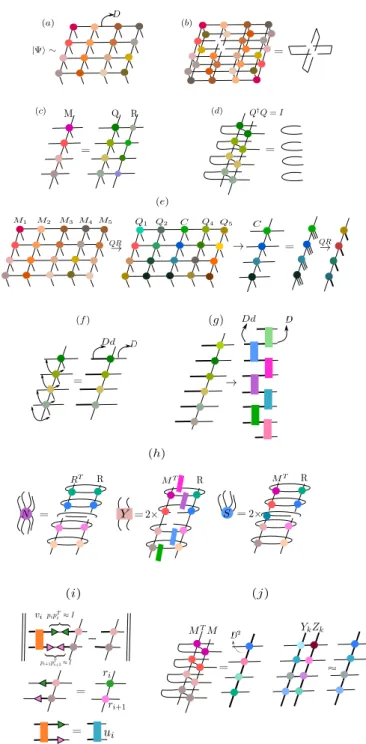
j . By ensuring that the PEPS ten-sors satisfy Eq. (2), it also defines an analogous canonical form for a PEPS, depicted in Fig. 1(b). In the case of an
MPS, we can convert an arbitrary MPS into canonical form by sequential QR (LQ) decompositions of tensors to the left (right) of sitei, Asj
j →Q sj j Rj (A sj j →LjQ sj j ) whereQjis orthogonal in the sensePsjQ
sj† j Q sj j =1(for LQ,P sjQ sj j Q sj†
j =1). For simplicity, we henceforth do not distinguish between QR and LQ, with the choice im-plicit from the diagrammatic representation. Rj is then absorbed into the adjacent tensor for the subsequent QR decomposition until the full canonical form is reached.
PEPS canonical form and column QR ansatz—To
sim-ilarly canonicalize a PEPS, we sequentially decompose the PEPS columns, denoted M (composed of tensors
{mi}), as a QR tensor contraction, where the column ten-sor Qis isometric, satisfying Q†Q=1, see Fig. 1(c, d). The gauge column tensorR (composed of tensors{ri}) is an MPO acting on the horizontal virtual bonds. Once all columns (around a central column) are decomposed to be isometric, the central columnC can be viewed as an MPS by grouping the horizontal bonds with the physical bonds. This central column can then be canonicalized around a chosen site using the MPS canonicalization al-gorithm above, to yield a complete PEPS canonicaliza-tion (Fig. 1(e)). Note that the PEPS canonicalizacanonicaliza-tion condition around a site (Fig. 1(b)) does not itself specify that columns to the left and right of the central column separately contract to the identity; the conditions we im-pose are thus sufficient and convenient when canonicaliz-ing a PEPS, but are more constrained than the necessary conditions for Fig. 1(b).
To explicitly carry out the QR decomposition, we first rewriteM and thusQas MPOs by fusing physical bonds with the left virtual bonds (Fig. 1(f)). Then, to explic-itly enforce the isometric constraint onQ, we write it as a finite depth-ncircuit of block-sizelisometries and uni-taries{ui}, where the isometries appear in the edge layer of the circuit (Fig. 1(g))35,36. The layer depth and block size control the distribution of entanglement between Q and R. In practice, to obtain a faithful QR decomposi-tion we have found it sufficient to usen= 2, increasingl if necessary.
To determine the tensors in the QR ansatz, we minimize the distance (cost function) F =k M −
Q({ui})R({ri}) k with respect to {ui, ri} (k · k is the Hilbert-Schmidt norm) using standard tensor network techniques37–39. We optimize the tensors one at a time and sweep until convergence. The cost function depends quadratically on{ri}, i.e. F =ri†N ri−Sri+const, which is explicitly minimized by solving the linear equation N ri0 =S (which can be solved iteratively with a method such as conjugate gradient, with a cost ofO(D8) per it-eration). To update the isometric/unitary tensors {ui}, we observe that the cost function only depends linearly on them due to cancellations, i.e. F=u†iY + const, thus the optimal solution is given byu0
i=−V U†, whereV,U appear in the singular value decompositionY =U sV†37. The tensor network diagrams of tensorsN,S andY ap-pear in Fig. 1(h).
FIG. 1. (Color online) (a) Tensor-network representation of the PEPS |Ψi on a 4×4 square lattice with open bound-ary conditions. (b) A PEPS canonicalized up to a single site, hence the environment around that site contracts to identi-ties. (c) A decomposition of a bulk columnM ≈QR, where (d) tensorQ is isometric, i.e. Q†Q=1. (e) The graphical representation of steps based on our QR scheme to bring a PEPS into canonical form. Note in a final step (not shown), MPS canonicalization is used on the central columnC. (f) The tensor Q is reshaped into an MPO by fusing the vir-tual bond and physical bond as shown by arrows. The thick virtual bonds have bond dimension Dd. (g) The isometric tensorQ is parameterized by a finite depth circuit of l-site isometries/unitaries{ui}. (h) Tensor-network representation of environment tensorsN,S andY appearing in the QR op-timization procedure. (i) The local distance (cost function) used to obtain a good initial guess for local tensorsui,riand
ri+1. The cost function is minimized with respect to tensors
pi, pi+1 and vi, which are used to build ui, ri and ri+1 as depicted. (j) The graphical representation ofM†M andYkZk
10-12 10-11 10-10 10-9 10-8 10-7 10-6 10-5 1 2 3 4 5 6 F λ D=2, l=2 D=2, l=4 D=4, l=4 D=4, l=2 1×10⁻⁵ 1×10⁻⁴ 2×10⁻⁴ 5 10 15l 20 25 30 y D=2, l=2 D=2, l=4 D=3, l=2 D=3, l=4
FIG. 2. (Color online) Accuracy of the variational ansatz for QR decomposition of a single bulk column. (a) The relative distanceFas a function of transverse Ising fieldλ, for a single bulk column with ly = 16, and for given values of bond
di-mensionDand block sizelused inQ. The distanceF rapidly decreases with increasingl, as more entanglement is included in theQ circuit. (b) The relative distance as a function of PEPS column lengthlyfor different block sizesl. The error
of the variational ansatz increases linearly with the lengthly.
To accelerate the QR optimization (and to avoid local minima) we start with a good initial guess for {ui, ri}. We have used two techniques. The first uses a local pro-jective truncation on the tensors{mi} to initialize {ui} and {ri}. To this end, we contract an approximate res-olution of the identity (i.e. 1D ≈pip†i where pi is a lo-cal isometry) and a unitaryvi into two adjacent tensors mi, mi+1 and optimize pi, pi+1 and vi to minimize the local cost function shown in Fig. 1(i). Once we have the optimized tensorspi, pi+1andvi, we construct a guess for ri, ri+1 and ui as shown in Fig. 1(i). This initialization is purely local but in practice, we find that it performs well.
A second strategy is based on an accurate estimate of the {ri} tensors using a Schulz iteration for the matrix square-root40. Note that R is formally the square root of M†M, due to the isometric property ofQ. We thus rewriteM†M as an MPO as in Fig. 1(j). Then, starting from Y0=M†M and Z0 =1, the coupled Schulz itera-tion,Yk+1 = 12Yk(31−ZkYk), Zk+1 = 12(31−ZkYk)Zk, givesYk→∞=R and Zk→∞ =R−1. The vertical bond
dimension ofYk andZk increases with each MPO multi-plication (Fig. 1(j)) thus we perform MPO compression after each iteration (viewing the MPO as an MPS). The finalYk (R) is compressed back to vertical bond dimen-sion D. Also, since Zk approximates R−1 which may have arbitrarily large norm, we regularize the iteration using M†M → M†M +δI, where δ is a small number (∼ 10−6). The Schulz iteration converges rapidly (see SM) and we use this accurately estimatedRto initialize the optimization of the tensors in Qwith respect to the cost function F. Although computing the Schulz itera-tion is more expensive than the local initializaitera-tion, we expect it to be better when canonicalizing PEPS with more entanglement. 10-10 10-9 10-8 10-7 10-6 10-5 10-4 10-3 10-2 10-1 1 2 3 4 5 6 Δ λ D=2, l=2, 12×12 D=2, l=4, 12×12 D=3, l=4, 12×12 D=2, l=4, 8×8 D=3, l=2, 12×12 10-6 10-5 10-4 10-3 10-2 -10 -5 0 5 10 position x λ=2.00, l=2 λ=3.05, l=2 λ=3.05, l=4 λ=2.00, l=4
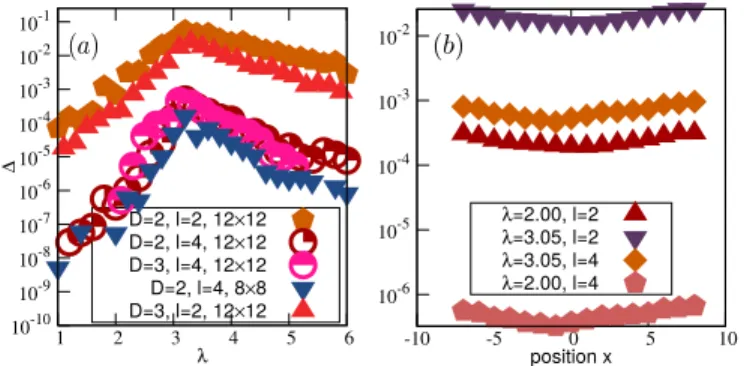
FIG. 3. (Color online) (a) The relative error of the norm contraction ∆ =N−Nb
Nb as a function of transvaerse Ising field
λ. Nb is a reference norm obtained by boundary method
contraction. For the norm computed via the canonical form, we useDc= 4D. (b) ∆ as a function of column positionxin
the PEPS for different values ofλ. The bond dimensions are
D= 3,Dc= 12, and the lattice size is 16×16.
PEPS canonicalization sweep, cost, and truncations— To canonicalize all columns M[1]M[2]. . . M[lx] in the
PEPS, we sweep over all the columns in a prescribed order (say from left to right) and compute the QR de-composition to each. For a single PEPS column of bond dimensionD and ann= 2,l= 2 QR ansatz, the cost of the QR optimization isO(lyD8) (using the iterative cost of solving for{ri}). After the column has been converted to QR form, we then absorb theR gauge into the neigh-boringM column, creating a combined column with an increased vertical bond dimension ofD2. To leading or-der, the cost of decomposing this by QR optimization is alsoO(lyD8). Thus the cost of the full canonicalization sweep over columns isO(lxlyD8).
The above sweep leaves the PEPS in the form Q[1]Q[2]. . . R[lx−1]M[lx]. We can absorb the final gauge
into the last PEPS column to make a (rightmost) central column, giving the left canonical form of the PEPS, Q[1]Q[2]. . . C[lx]. Note that canonicalization
re-distributes entanglement in the PEPS. The above cen-tral columnC has a formal bond dimensionD2, which we truncate to Dc > D (with cost O(lyD8)) to reflect the fact thatC must now carry some entanglement that was originally stored in the environment around it. We can perform this column truncation as an MPS trunca-tion with enlarged physical bond dimensionD2d, as the surrounding columns have been canonicalized. Note that an analogous role to Dc is played by χ in PEPS con-traction algorithms33,41,42, but hereD
c is an (auxiliary) bond dimension for a single PEPS layer, rather than for a double layer, thus we expectDc< χ, or potentially even Dc ∝D leading to a reduction of computational cost as found in single-layer PEPS algorithms43,44. Finally, the process of compressing the final columnC from bond di-mensionD2→Dcimmediately leaves the central column canonicalized up to a single site, as in Fig. 1(b). Shifting this central site along the column can then be done with
subleading cost to the preceding compression steps. We now discuss the cost to convert between differ-ent column canonical forms, which is important to al-gorithms such as energy optimization. For example, con-sider moving the central column fromlxtolx−1. First, we perform a QR approximation, C[lx] →R[lx]Q[lx]. Then,
we absorb Q[lx−1] into the gauge R[lx] to form the
cen-tral column, Q[lx−1]R[lx] → C[lx−1], which we truncate
to vertical bond dimension Dc. For n = 2, l = 2, Q is an MPO with vertical bond dimension D2, thus this appears to be an expensive bond truncation from D3 → D
c. (Using sequential SVD on the MPS bonds, the cost is O(lyD11) +O(lyD8Dc). If we instead con-sider direct minimization|| |φi − |ψi||(the cost typically reported in boundary PEPS algorithms) where |φi and
|ψiare MPSs with physical bond dimensiondD2and vir-tual bond dimensionsD3 andD
C respectively, then the cost isO(lyD8Dc) +O(lyD5Dc2)).
The formally large bond dimension of Q is primarily an artifact of expressing the isometric constraint in terms of gates. However, we can use the QR ansatz structure to reduce the cost of this step, by absorbing and trun-cating first the column of isometries, then the column of unitaries. (In both these truncations, the surrounding columns are canonical, and thus each can be performed as an MPS truncation). With this technique, the cost to move the central column isO(lyD4D4c) +O(lyD6D2c) and
O(lyD4D4c)+O(lyD4D3c) (respectively for truncating the column of isometries and unitaries by using direct mini-mization). For explicit SVD truncation, the leading term is still O(lyD11), although its prefactor and subleading terms are smaller.
From the above, we see that in computing the canoni-cal form, and in moving the central column, there are two potential sources of error that must be controlled. The first is the error of the QR approximation error, con-trolled by the finite-depth/block-size (n, l) of {ui} and the vertical MPO bond dimensionD ofR. The second is theabsorption error, that arises from the truncated verti-cal bond dimensionDcof the central column. Note that because the canonicalized PEPS has some bonds with different dimension to that in the original PEPS, care must be taken when comparing the cost of canonical and non-canonical PEPS algorithms.
Accuracy of QR ansatz—To assess the accuracy of the QR ansatz, we first study its performance for a single PEPS column. As our initial state, we use the (ap-proximate) ground-state of the spin-1
2 ITF model on the square lattice (additional results for the Heisenberg model are in the SM). The ITF model is defined by
HITF=−X hiji
σizσzj−λX i
σx,
whereσαare the Pauli matrices. This model has a critical point at λc ≈ 3.05. Our initial PEPS is constructed from the bulk tensors of an infinite PEPS ground-state45 (optimized with a full-update scheme31,42and a 2×2 unit
cell) that is repeated periodically across the finite PEPS lattice.
We measure the accuracy of the QR ansatz by the value of its optimization cost functionF. Here, the parameter controlling the accuracy is the block size l of the iso-metric/unitary circuit (the number of layers is kept as n= 2, and the vertical bond dimension of R is kept as D). In Fig. 2(a), we show the plot of the distance F versus ITF magnetic fieldλ. As expected, when the sys-tem is close to criticality, the accuracy is reduced as the ground state becomes more entangled. Increasing l in-creases the disentangling effect of the unitaries, and the accuracy increases rapidly (we conjecture exponentially withl), especially far from criticality.
Next, we investigate the QR accuracy as a function of system sizely. As shown in Fig. 2(b), the relative error in F increases linearly with system size, although the slope shows a rapid decay with the isometry/unitary block size l. Thus, the variational gauging ansatz introduces a con-stant error per lattice site, consistent with a fidelity that goes likee−ly ∼1−l
y.
Accuracy of PEPS canonical form— We next
investi-gate the accuracy and stability of the full PEPS canon-ical form constructed from a sweep of the QR approx-imation and absorption steps across the columns. We estimate the faithfulness of the canonical form from the norm contractionN =hΨ|Ψi, and we use Dc = 4D in the absorption step. We compute the norm in the canon-ical form using only the central columnCsince all other columns contract exactly to the identity. The relative error of norm contraction is then defined as ∆ =N −Nb
Nb ,
where the reference value Nb is obtained using an ac-curate boundary contraction of the original (uncanoni-calized) PEPS keeping a large boundary auxiliary bond dimension6,22,46. In Figs. 3(a, b), we show a plot of the relative error ∆ as a function of ITF magnetic field λ (using the same approximate ground-state as above) and central column position. Similarly to the single column results above, the accuracy of the full canonical form de-pends on the correlation length of the model, and the canonicalization error decreases rapidly (exponentially) as the block sizel is increased.
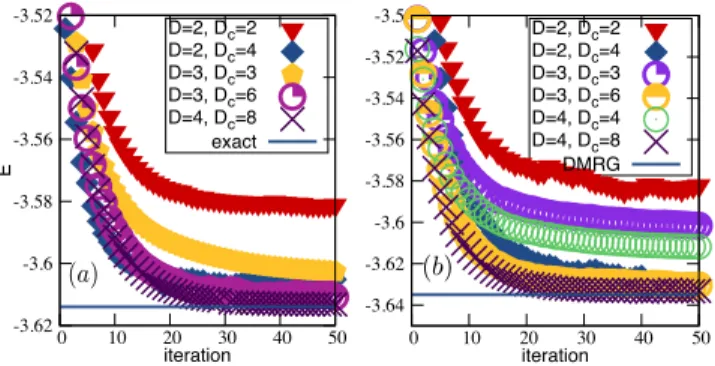
Energy optimization in canonical form—A natural ap-plication of the PEPS canonical form is to ground-state energy optimization, which mimics the use of the MPS canonical form in energy optimization. To show this, we perform imaginary time evolution on the ITF model, which we carry out with a sequence of gates e−τ h on the horizontal and vertical bonds6,33. Evolution on a column of vertical bonds is conveniently carried out on the central column C of a canonical PEPS with bond dimension Dc, where it reduces to an MPS imaginary time evolution followed by an MPS truncation with an enlarged physical bond dimension D2d. Evolution on a column of horizontal bonds can be carried out using a column canonical PEPS (analogous to the two-site MPS canonical form) where there are two central columns, and columns to the left and right of these two
-3.62 -3.6 -3.58 -3.56 -3.54 -3.52 0 10 20 30 40 50 E iteration D=2, Dc=2 D=2, Dc=4 D=3, Dc=3 D=3, Dc=6 D=4, Dc=8 exact -3.64 -3.62 -3.6 -3.58 -3.56 -3.54 -3.52 -3.5 0 10 20 30 40 50 iteration D=2, Dc=2 D=2, Dc=4 D=3, Dc=3 D=3, Dc=6 D=4, Dc=4 D=4, Dc=8 DMRG
FIG. 4. (Color online) Imaginary time energy optimization based on the PEPS canonical form. The canonical PEPS energy of the ITF model as a function of imaginary time sweep for (a) 4×4 and (b) 8×8 lattices with fieldλ= 3.5. The horizonatal DMRG line is the result of a converged 2D DMRG calculation and can be taken to be numerically exact.
are isometric tensors Q, thus reducing the optimization problem to one of a PEPS with only two columns. In this case, rather than canonicalizing the remaining envi-ronment around the bond in the two column PEPS, we contract it exactly, which is straightforward. Since there are only two columns, these can be reduced to an MPS with enlarged vertical bond dimension D2D
c and phys-ical bond dimension D2d2. In Fig. 4(a, b) we show the energy as a function of the number of full imaginary time sweeps for the ITF model at field strengthλ= 3.5 com-pared to a near-exact DMRG result. Note that both D (which controls the dimension ofQandR) andDc (ver-tical bond dimension of the central column) affect the final converged energy; in this setting, increasingDc has a larger effect than increasing D. The relative error of the energy per site reached for the largest bond dimen-sionD = 4, Dc= 8 for both lattice sizes is on the order of 10−4.
Conclusions—In conclusion, we have described a pro-cedure to convert a PEPS into a canonical form analo-gous to that of an MPS where all columns but one are isometric, by sequentially decomposing columns through a variational QR ansatz. We find that the canonical-ization is stable and can be carried out with a small and controllable error. Canonicalization redistributes en-tanglement in the PEPS, resulting in a central column with increased bond dimension. Our procedure intro-duces the possibility to formulate canonical PEPS algo-rithms which make explicit use of an isometric environ-ment, which we demonstrated in an imaginary time opti-mization of the ground-state energy. However, the redis-tribution of bond dimensions in the canonical form makes the comparison between canonical and standard PEPS algorithms quite subtle. The QR ansatz we use also sug-gests an alternative strategy of directly optimizing the underlying network of isometries and unitaries, without explicitly converting into the standard PEPS column-row form. Future investigations will focus on more detailed analysis of these and other algorithms as well as the gen-eral representational power of canonicalized PEPS.
Note: As this manuscript was prepared for submission, we were notified of Ref. 47. In that work, the authors similarly pursue a full canonicalization of a PEPS, but use a different set of isometric conditions on theQtensors which are more constrained than the ones that we use. Further work is needed to understand the relationship between these techniques.
ACKNOWLEDGMENTS
Primary support for this work was from MURI FA9550-18-1-0095. Some of code used to test energy op-timization was based on work supported by the US Na-tional Science Foundation (NSF) via grant CHE-1665333. MJO acknowledges a US NSF Graduate Research Fellow-ship via grant DEG-1745301. GKC acknowledges sup-port from the Simons Foundation.
1 S. R. White, Phys. Rev. Lett.69, 2863 (1992). 2
S. R. White, Physical Review B48, 10345 (1993). 3
G. Vidal, Physical review letters99, 220405 (2007). 4 H. J. Changlani, J. M. Kinder, C. J. Umrigar, and G.
K.-L. Chan, Physical Review B80, 245116 (2009). 5
F. Mezzacapo, N. Schuch, M. Boninsegni, and J. I. Cirac, New Journal of Physics11, 083026 (2009).
6
F. Verstraete, V. Murg, and J. Cirac, Advances in Physics 57, 143 (2008), http://dx.doi.org/10.1080/14789940801912366.
7
R. Orus, Annals of Physics349, 117 (2014). 8
P. Calabrese and J. Cardy, Journal of Statistical Mechan-ics: Theory and Experiment2004, P06002 (2004). 9 G. Vidal, J. I. Latorre, E. Rico, and A. Kitaev, Phys. Rev.
Lett.90, 227902 (2003).
10 S. ¨Ostlund and S. Rommer, Physical review letters 75, 3537 (1995).
11
M. Fannes, B. Nachtergaele, and R. F. Werner, Commu-nications in mathematical physics144, 443 (1992). 12
M. Fannes, B. Nachtergaele, and R. Werner, Journal of functional analysis120, 511 (1994).
13 U. Schollw¨ock, Annals of Physics326, 96 (2011), january 2011 Special Issue.
14
U. Schollw¨ock, Rev. Mod. Phys.77, 259 (2005).
15 J. J. Dorando, J. Hachmann, and G. K.-L. Chan, The Journal of chemical physics130, 184111 (2009).
16
J. Haegeman, J. I. Cirac, T. J. Osborne, I. Piˇzorn, H. Ver-schelde, and F. Verstraete, Physical review letters 107, 070601 (2011).
17
N. Nakatani, S. Wouters, D. Van Neck, and G. K.-L. Chan, The Journal of chemical physics140, 024108 (2014).
18
L. Vanderstraeten, M. Mari¨en, F. Verstraete, and J. Haegeman, Phys. Rev. B92, 201111 (2015).
19 F. Pollmann and A. M. Turner, Phys. Rev. B86, 125441 (2012).
20 C.-Y. Huang, X. Chen, and F. Pollmann, Phys. Rev. B 90, 045142 (2014).
21
T. Nishino and K. Okunishi, Journal of the Physical Soci-ety of Japan65, 891 (1996).
22 F. Verstraete and J. I. Cirac, arXiv preprint cond-mat/0407066 (2004).
23
F. Verstraete, M. M. Wolf, D. Perez-Garcia, and J. I. Cirac, Physical review letters96, 220601 (2006).
24
V. Murg, F. Verstraete, and J. I. Cirac, Phys. Rev. B79, 195119 (2009).
25 L. Wang, Z.-C. Gu, F. Verstraete, and X.-G. Wen, Phys. Rev. B94, 075143 (2016).
26
W.-Y. Liu, S. Dong, C. Wang, Y. Han, H. An, G.-C. Guo, and L. He, Phys. Rev. B98, 241109 (2018).
27 B.-X. Zheng, C.-M. Chung, P. Corboz, G. Ehlers, M.-P. Qin, R. M. Noack, H. Shi, S. R. White, S. Zhang, and G. K.-L. Chan, Science358, 1155 (2017).
28 R. Haghshenas, W.-W. Lan, S.-S. Gong, and D. N. Sheng, Phys. Rev. B97, 184436 (2018).
29
R. Haghshenas and D. N. Sheng, Phys. Rev. B97, 174408 (2018).
30
M. J. O’Rourke, Z. Li, and G. K.-L. Chan, Phys. Rev. B
98, 205127 (2018).
31 H. N. Phien, I. P. McCulloch, and G. Vidal, Phys. Rev. B91, 115137 (2015).
32
H. N. Phien, J. A. Bengua, H. D. Tuan, P. Corboz, and R. Or´us, Phys. Rev. B92, 035142 (2015).
33 M. Lubasch, J. I. Cirac, and M.-C. Ba˜nuls, Phys. Rev. B 90, 064425 (2014).
34 G. Evenbly, Phys. Rev. B98, 085155 (2018).
35 F. Pollmann, V. Khemani, J. I. Cirac, and S. L. Sondhi, Phys. Rev. B94, 041116 (2016).
36
T. B. Wahl, A. Pal, and S. H. Simon, Phys. Rev. X7, 021018 (2017).
37
G. Evenbly and G. Vidal, Phys. Rev. B79, 144108 (2009). 38
G. Evenbly, Phys. Rev. B95, 045117 (2017).
39 Y.-J. Kao, Y.-D. Hsieh, and P. Chen, Journal of Physics: Conference Series640, 012040 (2015).
40
N. J. Higham, Numerical Algorithms15, 227 (1997). 41 P. Corboz, J. Jordan, and G. Vidal, Phys. Rev. B 82,
245119 (2010). 42
P. Corboz, R. Or´us, B. Bauer, and G. Vidal, Phys. Rev. B81, 165104 (2010).
43 I. Piˇzorn, L. Wang, and F. Verstraete, Phys. Rev. A83, 052321 (2011).
44
Z. Y. Xie, H. J. Liao, R. Z. Huang, H. D. Xie, J. Chen, Z. Y. Liu, and T. Xiang, Phys. Rev. B96, 045128 (2017). 45
J. Jordan, R. Or´us, G. Vidal, F. Verstraete, and J. I. Cirac, Phys. Rev. Lett.101, 250602 (2008).
46 M. Lubasch, J. I. Cirac, and M.-C. Banuls, New Journal of Physics16, 033014 (2014).
47
M. P. Zaletel and F. Pollmann, arXiv preprint arXiv:1902.05100 (2019).
I. SUPPLEMENTARY MATERIAL
A. Schultz algorithm
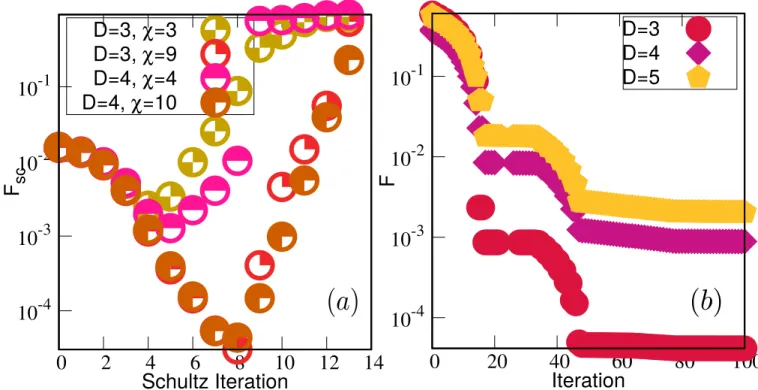
Here, we provide further information regarding the accuracy of the Schulz iteration. We show this by evaluating the distance FSC =k M†M −R2 k as a function of the Schulz iteration. The MPO compression (see Fig. 1(j)) is controlled by a bond dimensionχ(in the final iteration in the canonicalization algorithm, this is always set toD). In Fig. 5(a), we show how the accuracy of the Schulz iteration depends onχfor different initial bond dimensionsD for the ITF model at magnetic fieldλ= 2.0. The regularization parameter is always set toδ∼10−6.
B. Results for 2D Heisenberg model
The 2D Heisenberg model is defined by
HHeisenberg=X
hi,ji Si·Sj,
whereSi≡(σx, σy, σz) andσαare the Pauli matrices. Here we give additional results for the QR optimization. We have plotted the relative distanceF versus iteration number for a single bulk column withly = 10 in Fig. 5(b). Note we have set the block sizel= 2. The relative error of the norm contraction ∆ is similar to that of the ITF model at the critical point (∼10−2) for a lattice of size 10×10.
10
-4
10
-3
10
-2
10
-1
0
2
4
6
8
10 12 14
F
sc
Schultz Iteration
D=3,
χ
=3
D=3,
χ
=9
D=4,
χ
=4
D=4,
χ
=10
10
-4
10
-3
10
-2
10
-1
0
20
40
60
80
100
F
Iteration
D=3
D=4
D=5
FIG. 5. (Color online) (a) The distanceFSCas a function of Schulz iteration for a single bulk column withly= 16 at magnetic
fieldλ= 2.0. (b) The relative distanceF of Heisenberg model versus iteration number of the QR optimization for a single bulk column withly= 10 and with different bond dimensionsD.