2017
Racializing Experiences of Foreign-Born and
Ethnically Diverse Black Male Engineering
Graduate Students: Implications for Student Affairs
Practice, Policy, and Research
Brian A. Burt
Iowa State University, [email protected]
Alexander Knight
Iowa State UniversityJustin Roberson
Iowa State UniversityFollow this and additional works at:
http://lib.dr.iastate.edu/edu_pubs
Part of the
Bilingual, Multilingual, and Multicultural Education Commons
,
Educational
Assessment, Evaluation, and Research Commons
,
Educational Leadership Commons
,
Higher
Education Commons
, and the
International and Comparative Education Commons
This Article is brought to you for free and open access by the School of Education at Iowa State University Digital Repository. It has been accepted for inclusion in Education Publications by an authorized administrator of Iowa State University Digital Repository. For more information, please contact
Recommended Citation
Burt, Brian A.; Knight, Alexander; and Roberson, Justin, "Racializing Experiences of Foreign-Born and Ethnically Diverse Black Male Engineering Graduate Students: Implications for Student Affairs Practice, Policy, and Research" (2017).Education Publications. 60. http://lib.dr.iastate.edu/edu_pubs/60
Male Engineering Graduate Students: Implications for Student Affairs
Practice, Policy, and Research
Abstract
Despite a growing body of work on the experiences of Black collegians, the higher education knowledge base lacks scholarship focused on Black men in graduate programs who are foreign-born and/or identify ethnically as other than African American. In this article, we provide a domain-specific investigation (i.e., based on students’ field of study), centering on nine Black men in engineering graduate programs. Three themes emerged regarding students’ racialized experiences and effects of racialization: (1) racialization as a
transitional process; (2) cultural identity (dis)integrity; and (3) racialized imposter syndrome. We conclude with implications for developing and implementing promising practices and activities that aid students throughout graduate school. Such targeted efforts might also improve the likelihood of students remaining in the engineering workforce.
Disciplines
Bilingual, Multilingual, and Multicultural Education | Educational Assessment, Evaluation, and Research | Educational Leadership | Higher Education | International and Comparative Education
Comments
This is an article fromJournal of International Students, 2017 7(4); 925-943. Doi:10.5281/zenodo.1029487. Posted with permission.
Creative Commons License
This work is licensed under aCreative Commons Attribution-No Derivative Works 3.0 License.
925
ISSN: 2162-3104 Print/ ISSN: 2166-3750 Online Volume 7, Issue 4 (2017), pp. 925-943 © Journal of International Students
http://jistudents.org/ doi: 10.5281/zenodo.1029487
Racializing Experiences of Foreign-Born and
Ethnically Diverse Black Male Engineering
Graduate Students: Implications for Student Affairs
Practice, Policy, and Research
Brian A. BurtIowa State University, USA Alexander Knight Iowa State University, USA
Justin Roberson Iowa State University, USA
ABSTRACT
Despite a growing body of work on the experiences of Black collegians, the higher education knowledge base lacks scholarship focused on Black men in graduate programs who are foreign-born and/or identify ethnically as other than African American. In this article, we provide a domain-specific investigation (i.e., based on students’ field of study), centering on nine Black men in engineering graduate programs. Three themes emerged regarding students’ racialized experiences and effects of racialization: (1) racialization as a transitional process; (2) cultural identity (dis)integrity; and (3) racialized imposter syndrome. We conclude with implications for developing and implementing promising practices and activities that aid students throughout graduate school. Such targeted efforts might also improve the likelihood of students remaining in the engineering workforce.
Keywords: Black males, foreign-born, graduate students, engineering, racialized experiences
926
S
everal efforts have been made to mitigate the effects race has on Black students’ educational outcomes (e.g., Meyerhoff Program (Maton & Hrabowski, 2004); the PROMISE Program (Carter-Veale et al., 2016)). Yet, Black students continue to report that the college environment fosters hostility and isolation. Assuming that all Black students experience racism in the same way leads educators and student affairs professionals to overlook opportunities to support students both personally and academically. When college community members (e.g., educators, student affairs professionals, peers) fail to dismantle the monolithic Black male mystique (the assumption that all Black men are the same) (Burt, forthcoming), and by default perpetuate that assumption (Dancy, 2014; Dancy & Brown, 2008), all Black students do not get adequately served. While there is a small but growing body of work on the experiences of those who are foreign-born and those who identify with ethnicities other than African American (Fries-Britt, George Mwangi, & Peralta, 2014; George Mwangi, Fries-Britt, Peralta, & Daoud, 2016; George Mwangi, 2014; Griffin, Cunningham, & George Mwangi, 2016), the higher education knowledge base lacks scholarship focused on such students in graduate programs. A domain-specific investigation (i.e., based on students’ field of study) centering on Black men who are foreign-born and/or hold ethnic identities other than African American in engineering graduate programs would provide educators and student affairs practitioners with information to help develop and implement better practices to aid students throughout graduate school. Such targeted efforts might also improve the likelihood of those students making it to, as well as remaining in, the engineering workforce. In this article, we explore the lived experiences of nine foreign-born and/or ethnically diverse Black male graduate students in engineering. We investigate their racialized experiences and how racialization influences their educational pathways, and trace their perspectives on their long-term participation in engineering. We conclude with recommendations for educators and student affairs practitioners committed to improving the plight of foreign-born students.LITERATURE REVIEW
Literature related to the experiences of foreign-born Black men in engineering graduate programs is lacking. Thus, to begin this discussion, we first situate their experiences in the broader international student landscape.
927
According to the Institute of International Education (IIE), between 2006 and 2016, there has been a 50% increase in the number of international students enrolled in United States (U.S.) colleges and universities (IIE, 2016), from 564,766, or nearly 2.8% of enrolled students in 2006, to 1,043,839, or 5% of enrolled students in 2016. These statistics highlight a steady growth in international student numbers that is likely to continue. International students benefit from the strong academic programs at U.S colleges and universities (Lee, 2015) and tend to be stellar students who contribute to the U.S. knowledge economy both during school and after graduating (Cantwell & Lee, 2010). Thus, international student enrollment in U.S. schools is mutually beneficial. Yet, despite their invaluable contributions to U.S. classrooms, laboratories, and scientific discoveries, international students face a myriad of adversities (Lee, 2015; Renn & Reason, 2012; Yao, 2016). Those most commonly discussed include issues with cultural adaptation, language barriers, and finances (Lee, 2015; Sherry, Thomas, & Chui, 2010).
Some might argue that to cope with the challenges of transitioning into U.S. educational institutions, international students should assimilate to U.S. norms and values. However, pressures to assimilate pose psychological challenges (Chen, 1999; Constantine, Anderson, Berkel, Caldwell, & Utsey, 2005; Lee, 2015; Yao, 2016). Further, encouraging students to adopt practices of cultural departure via assimilation is not conducive to their academic achievement. Tierney (1999) argues that achievement occurs when one’s culture is treated as an asset; he rejects the idea that institutions should press international students to assimilate to U.S. educational culture.
International students of color face additional barriers related to intersections of nationality and race. When enrolled in U.S. colleges and universities, they find themselves in new cultural contexts and racial climates (Constantine et al., 2005; Fries-Britt et al., 2014; George Mwangi et al., 2016; Massey, Mooney, & Torres, 2007; Nadal et al., 2014). In a study of 24 Black undergraduate and graduate students in physics, George Mwangi et al. (2016) report that foreign-born and native-born Black students described having different educational experiences. They found students’ perceived differences in experiences to be a function of intersections of race and nationality. Similarly, Griffin et al.’s (2016) study of 43 Black immigrant and native Black undergraduate students found that Black immigrant and native-born Black students perceived campus racial climates differently. Both groups recognized that racialized experiences
928
occurred, but their views on these experiences varied by race and nationality.
Across the growing corpus of scholarship on international students of color, there is a commonality: international students of color appear to share a minoritized identity with native-born students of color (Fries-Britt et al., 2016). However, the cultural barriers that distinguish foreign-born from native-born students of color need to be understood (Griffin et al., 2016).
THEORETICAL FRAMEWORK
To better understand how foreign-born students and/or those who identify ethnically as other than African American become racialized and make sense of their racialized experiences, we apply tenets of Critical Race Theory (CRT). CRT aims to illuminate and transform power relations surrounding race and racism (Delgado & Stefancic, 2012; Ladson-Billings 1998; Solórzano, Ceja, & Yosso, 2000; Tate, 1997). CRT originated in the Critical Legal Studies movement, which aimed to examine and deconstruct power dynamics and structures ingrained in U.S. legal statutes. These power dynamics were theorized to be at the root of the dramatic inequities experienced by communities of color during all stages of legal proceedings. This movement spread to other disciplines, where power dynamics surrounding race and racism could be analyzed and deconstructed. This focus on the effects of race in all aspects of society became what scholars now recognize as CRT. While we acknowledge various conceptualizations of CRT tenets, there are two tenets (based on Delgado and Stefancic’s 2001 conceptualization) most germane to our study. One is “racial realism,” which acknowledges that race is a social construct, and that it produces a hierarchy with distributed advantages. The second tenet is “essentialism/anti-essentialism,” or the understanding that while oppression has essential moving parts, there are nuanced experiences based on identity; thus oppression is intersectional, not monolithic. In combination, these two tenets were useful in making sense of the varied ways Black men from foreign-born and ethnically diverse backgrounds experienced racialization in their engineering graduate programs.
CRT recognizes that race and racism are real phenomena. “Racialization” is a social process of entering into spaces based on the historical legacy of race and racism in the U.S. (Shams, 2015). Utilizing CRT, the following research questions guide this article: (1) What are the racializing experiences of Black male engineering graduate students who are
929
foreign-born and/or identify ethnically as other than African American? (2) What effects do racialization and changes in racial context have on students’ transitional and educational experiences?
METHOD Participants
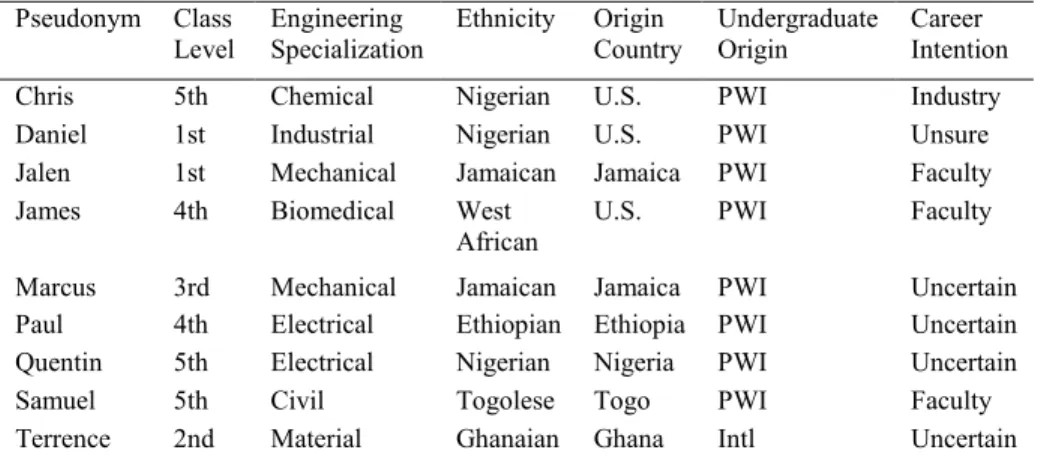
This article originates from a larger study of the experiences of 32 Black men in engineering graduate programs at predominantly White institutions. To address this article’s research questions, however, we focus exclusively on participants who self-identified as foreign-born and/or identified ethnically as other than African American (e.g., Nigerian, Jamaican, Ghanaian). Table 1 includes participants’ pseudonyms and demographic information. We acknowledge that there can be multiple realities based on individuals’ lived experiences, rather than a singular “truth” (Creswell, 2013; Merriam & Tisdell, 2016). Thus, we do not suggest that the men in this study are representative of all Black men in engineering graduate programs who are foreign-born or hold ethnically diverse identities.
Table 1: Demographic Data for Study Participants
Pseudonym Class
Level Engineering Specialization Ethnicity Origin Country Undergraduate Origin Career Intention Chris 5th Chemical Nigerian U.S. PWI Industry Daniel 1st Industrial Nigerian U.S. PWI Unsure Jalen 1st Mechanical Jamaican Jamaica PWI Faculty James 4th Biomedical West
African
U.S. PWI Faculty
Marcus 3rd Mechanical Jamaican Jamaica PWI Uncertain Paul 4th Electrical Ethiopian Ethiopia PWI Uncertain Quentin 5th Electrical Nigerian Nigeria PWI Uncertain
Samuel 5th Civil Togolese Togo PWI Faculty
Terrence 2nd Material Ghanaian Ghana Intl Uncertain Note. “Class Level” refers to the number of years a student has been in graduate school. “Undergraduate Origin” refers to the designation of students’ undergraduate institution: Predominantly White Institution (PWI) or an International institution (Intl).
930
Data Collection Procedures
Data were collected by the principal investigator (the first author) between 2010 and 2016 at three Midwestern institutions that belong to the Association of American Universities (AAU), which represents the leading research universities in North America. Each school of engineering in this study is ranked in the top 60 (US News and World Reports), which suggests that the students in the sample are among the most talented and most likely to succeed and persist. In addition, each institution offers similar programs and services: advising and counseling (generally related to academic transitions, intercultural communication, student safety, and crisis intervention); cultural immersion trips; and, immigration and compliance support. Further, the Black graduate student population at each institution was less than 5%.
Participants were contacted based on recommendations by institutional insiders: administrators, peers, or students who had already agreed to participate. After granting consent, participants completed an eight-item demographic form before responding to semi-structured one-on-one interviews conducted by the principal investigator. Interviews ranged from one hour to more than two hours and were audio recorded and transcribed verbatim to capture participants’ vernacular.
Data Analysis
The principal investigator first open coded transcripts to identify small chunks of text that explained the experiences of Black men in engineering graduate programs (Merriam & Tisdell, 2013). Then, the research team (all authors of this study) reread the transcripts of participants who identified as foreign-born and/or ethnically other than African American. During this second reading, we focused on these students’ racialized experiences, identifying passages where they described their initial understandings of race in the U.S. context, how race and racism manifested in their educational communities (e.g., campus, college of engineering, department, research groups), and how they traversed these hostile experiences. Finally, we categorized the identified passages into themes that explain students’ racialized experiences and the effects of racialization on their experiences in engineering.
Several steps were taken to ensure the trustworthiness of the findings (Creswell, 2013; Merriam & Tisdell, 2016). First, the same interview protocol was used across participants and institutions. This protocol allowed for general consistency in the questions asked, but also
931
afforded opportunities to probe more deeply into participants’ lived experiences. Second, to establish rapport, the protocol was designed to be general at first before probing into more sensitive questions. This allowed participants to view the exchange as a conversation, rather than an interview, which resulted in longer interviews and richer data than anticipated. Third, all transcripts were checked against the audio recordings to ensure accuracy and ensured that what participants said was captured in the ways they intended. When questions arose, we revisited the transcripts and audio recordings to verify students’ meanings; it was important to hear participants’ speaking, inflection, and at times sounds of pain to fully understand the experiences they conveyed. Fourth, the researchers engaged in several conversations during data analysis to provide checks to early and ongoing interpretations of the data; codes and themes were negotiated until consensus was achieved. Finally, throughout the research process, memos tracked procedural decisions, potential relationships between interviews, research questions, and prior research.
We were reflexive regarding how potential positionalities and subjectivities might affect our interpretations of data (Cooper, Jackson, Azmita, & Lopez, 1998). For example, the principal investigator is a Black (African American) man and faculty member in the social sciences (not engineering). The second and third authors are White and Black (African American) men, respectively, graduate students also in social science. We discussed instances when our interpretations were influenced by our own social identities (e.g., native-born, African American or White, intersections of gender and race within a U.S. context). As examples of our discussions, we pondered why participants struggled with transitions, how their challenges differed, and why they did not draw more on support from their Black male peers. Through our discussions, we tried to control our biases and assumptions (Peshkin, 1988).
FINDINGS
Three themes emerged that explain students’ racialized educational experiences: (1) racialization as a transitional process; (2) cultural identity (dis)integrity; and (3) racialized imposter syndrome. While we discuss these themes independently for the purpose of clarity, it should be noted that they often intersect.
932
Racialization as an Ongoing Transitional Process
To convey experiences of racialization, participants highlighted both their prior cultural contexts and their perceptions of the current climate in the U.S. Understanding students’ prior cultural environments contextualizes their perceptions of Blackness and the societal expectations that come along with their experiences. Chris, a fifth-year doctoral candidate in chemical engineering from Nigeria, reflected on his decision to pursue education: “From talking with fellow Nigerian friends that I have there [in Nigeria], it’s like, getting an advanced degree is…expected.” In Chris’s experience, part of his ethnic and cultural heritage included pursuing and achieving academic excellence. Like Chris, Marcus, a third-year doctoral student in mechanical engineering from Jamaica, reflected on early influences toward education broadly and engineering specifically: “I didn’t have any engineering role models. But when I looked around me…I saw Black people in power.” Unlike Chris, Marcus did not recall conversations with peers about pursuing an education. However, he did not describe that as a deficit because the people from his culture whom he did see were in positions of power. Education, for Marcus, became the mechanism by which to achieve power to give back to his community in ways demonstrated by his hometown models.
Students’ transitions included adjusting to a new cultural environment. Several reflected on their transitions, which highlighted their perceptions of racialization. Samuel, a fifth-year doctoral candidate in civil engineering from Togo, stated:
When I go somewhere here – the U.S. is a country of White and Black. When I go somewhere and then I see people that look like me, I feel more comfortable when there are more of us – at least five to six. I feel more comfortable, compared to [when I’m around] my White counterparts.
Paul, a fourth-year doctoral candidate in electrical engineering from Ethiopia, also commented on his perceptions of race:
I am Ethiopian. I have my brothers, and we are all Black, right. The problem there is a completely different problem [than here in the U.S.]. There you don’t have access. Here you have access but the things that happened in the past are still you know dragging you down in a way.
In this comparison, Paul highlights his historical knowledge of race and racism in the U.S. From a CRT perspective, Paul’s comment illustrates how essentialism works to oppress Black people. He acknowledges that both
933
Ethiopians and African Americans are oppressed, but delineates how their oppression is differently enacted. In addition, both Samuel’s and Paul’s accounts reflect on the tenet of racial realism. Their interactions with others provide examples of racialization occurring, and both describe how the construct of race is a real phenomenon. Further, they indicate that there are differences across races (Samuel) and within race (Paul).
Language barriers are a consistent concern raised by international students (Lee, 2015; Renn & Reason, 2012; Yao, 2016). For those whose first language is not English, there may be challenges in effectively engaging in two-way communication, as well as personal frustration and stigma. Both experiences are racialized because these students feel “othered” in comparison to native-born students, and/or those for whom English is their primary language. Some described challenges with language as a racializing factor in their transitions. Marcus mentioned, “I guess I took it for granted…just being able to run, play certain jokes or being able to talk patois.” He described the common – yet taken-for-granted – experience of speaking his native dialect called “patois,” showing that language not only plays a role in communication, it also promotes cultural bonding. An absence of cultural bonding contributed to Marcus’s racialization; he realized that he was different and that people spoke in cultural ways different from his own. Chris also explained how ways of communicating made him feel different in the U.S. context: “When I tried to understand what people were saying, I didn’t really pick it up. Or I was a slow talker and they were talking fast.” Here, we see Chris comparing the way he speaks (“I was a slow talker”) to others, and internalizing his communication style as a form of deficit. These findings highlight how language influences students’ perceptions of what is acceptable. It also implicitly – or perhaps even explicitly, depending on a student’s experience – reinforces that their differences may be perceived as less than desirable.
Cultural Identity (Dis)integrity
Participants’ descriptions of their transitions revealed several tensions. Some wanted to better understand and adapt to African American cultural norms. Others, however, were not interested in adapting if it meant simultaneously losing their own cultural norms and values. We refer to these tensions as “cultural identity (dis)integrity” to denote participants’ attempts to reconcile “Blackness” in different cultural contexts.
Marcus shared how his transition was influenced by his comfort with interacting with people outside of his nationality:
934
I’ve always had the comfort of being around Caribbean people. Being around other Jamaicans who talk like me – you know – look like me, act like me, so I can like, let loose. But now I am kind of in a different area, with a different set of people now. So you know – that’s been…a social adjustment.
Marcus recognized that there are differences between the Caribbean/Jamaican people he was used to and those in the U.S. Samuel similarly shared: “People from my country, we just get together and then do things. But here, I don't have that. The food that I eat, my roommate, they are from a different country.” For Marcus, Samuel, and others, it was uncomfortable not having peers who shared similar cultural ways of being. To be clear, Marcus did not say he could not relate to African Americans as a member of the larger Black diaspora. But he did say he was able to feel most comfortable with people who shared his ethnicity and cultural background. It is these subtle differences that racialized students and reminded them that they were different (a different kind of Black individual than African Americans in the U.S.).
Chris, too, mentioned examples of how African Americans were different from people from Nigeria. These differences contributed to the recognition that he “[has] stereotypes about African Americans.” He described various ways he perceived Nigerian culture to be different from that of his African American peers:
There were certain brands I wouldn’t wear, that kind of thing. They would go to certain events I didn’t do a lot of – so more being not used to those kinds of things, I felt that I couldn’t really fit in. Not that I didn’t really fit in, but I didn’t really get involved because…I wasn’t use to those things so I didn’t do it. So I think that…reinforced that these people, African Americans, act a different way than when I was growing up. So, it’s just too much for me to change the way I am to do what they do.
Chris’s quotation above is complex. Most apparent is his discussion of the different styles of dress and social expectations (i.e., attending social functions) that reminded him that his perceptions of Black maleness were different than those of his African American peers. At the conclusion of his quotation, we see cultural agency whereby Chris determines not to change to fit in with his new context. Despite these differences, he makes it plain that to some extent, he is still a part of the larger Black population (i.e., “Not
935
that I didn’t really fit in”). The tension displayed here (i.e., being a part of the Black community, yet refusing to fully adapt to African American norms) is illustrative of Chris’s cultural identity (dis)integrity.
Not all students responded to tensions like Chris. To address the differences in his cultural identity, Quentin, a fifth-year doctoral candidate in electrical engineering from Nigeria, suggested, “I should really sit back and understand how people who look like me here are treated so I don’t do things that make me look out of place.” Quentin not only recognized that he behaved differently than his native-born Black peers, he also began thinking about how to adapt his behaviors (i.e., how to act like an African American) to fit in. Or rather, so he would not stand out (i.e., continue to feel othered). Drawing on CRT is helpful in making sense of students’ voices. Through an anti-essentialism lens, we see how some struggled to negotiate between maintaining their culture or adopting U.S. culture, as if adopting a U.S. culture were a key to success.
Racialized Imposter Syndrome
The concept of “impostor syndrome” refers to psychological feelings of inadequacy or inferiority to those around one (Clance, 1985; McGee et al., 2016). The effects of imposter syndrome can include emotional instability, performance anxiety, burnout, and lack of confidence. Participants described stressors in navigating graduate school. In addition to some feeling as if they did not belong in the Black community, several described feeling like they did not belong in their classes, departments, nor field of study. Marcus explained how his course taking and interactions with class peers made him question “am I really good enough.” While imposter syndrome is not uncommon in U.S. higher education (Clance, 1985; McGee et al., 2016), it is compounded and complicated by race, racism, and racializing experiences, particularly when students transition to a new cultural environment. Part of students feeling like they did not belong related to their racial and ethnic underrepresentation, as Samuel indicated, “I don't see a lot of people of color in my field.”
Students felt like imposters not only in the classroom, but also during interactions with others in the engineering community. For example, Quentin discussed feeling like an outsider:
When you walk into a place, let’s say a meeting, and someone feels like “Oh, you don’t be – you’re Black, but you’re here?” There’s always that odd feeling that just
936
because you’re Black, that you’re really not supposed to be an engineer. That’s something that really needs to change.
Quentin’s words describe a typical racialized experience among our participants. Paul similarly mentioned, “When I meet someone, the chance of them – you know guessing that I am a Ph.D. student in engineering is zero.” Many described being questioned about their legitimacy as graduate students in engineering. There was no subtlety in their understanding that such comments were racialized. These frequent comments, or puzzled looks, made students feel as if they did not belong in engineering. Racial realism acknowledges that hierarchies are by-products of race and racism. Participants were consistently othered in engineering, based on race, which led to a heightened sense of imposter syndrome. To mitigate these feelings, students like Jalen, a first-year doctoral student in mechanical engineering from Jamaica, described how they dealt with feeling like imposters: “[I have to] stand out…to break the glass ceiling.” This finding may relate to what Fries-Britt and Turner (2001) refers to as the “proving process”: the phenomenon of high-achieving students of color feeling obligated to prove they are good enough in predominantly White educational spaces.
DISCUSSION AND IMPLICATIONS
The goal of this study was to provide empirical evidence to aid educators and student affairs practitioners in creating promising practices for the success of Black men in engineering graduate studies who identify as foreign born and/or hold ethnic identities other than African American. Using tenets of CRT (racial realism and essentialism/anti-essentialism), we explored the experiences of students to better understand the effects of racialization and change of racial context on their educational experiences. The findings indicate that students’ racialization was pre-existing. Before they entered graduate school, they had already experienced racialization (our data do not pinpoint when the racialization began, or the circumstances that facilitated it). Our data also indicate that students experienced present and ongoing racialization in their educational environments.
Based on our findings, experiencing racialization and cultural dissonance seemed inevitable for these participants. All participants acknowledged U.S. norms and values, and ideas about what it meant to be Black in the U.S. Most germane to this study’s focus, however, was how they made sense of the differences of their Blackness and maleness in the U.S. versus in their home country. We liken this internal conflict to
937
struggling to interpret a compass. “True north” (i.e., what it means to be Black and male) is different in the U.S. than in their home country, and/or according to ethnic norms that guide their worldview. Some experienced an internal conflict regarding whether or not to adapt to U.S. norms and values; others deemed it necessary to reject notions of a monolithic U.S. Black male image imposed upon them. Both options appeared to be coping strategies to make sense of racialized experiences in graduate school.
Our findings, however, provide more nuance to existing discourse on imposter syndrome. While participants acknowledged general feelings of “not being good enough,” they also expressed comparisons to African American peers, which at times exacerbated feelings of imposter syndrome. This finding contributes to existing conversations about within-group experiences that intensify Black foreign-born students’ feelings of otherness (Griffin et al., 2016).
Based on our findings, we suggest several directions for promising practices, policy, and future research. Because students experience ongoing racialization, there are opportunities for student affairs practitioners working in orientation programs to design more expansive services. Specifically, orientation services at the graduate level are often one-stop-shops, where students receive a day of sessions targeted towards their transition. We suggest that orientation programs take a more sustained approach to account for students’ ongoing needs during their transition. With an expanded vision, targeted programming could last from one to two years, and be attuned to students’ transitions and not solely to their matriculation.
To address students’ cultural (dis)integrity, we offer recommendations for orientation staff, international programming offices, counselors, and advisors of foreign-born Black men (both advisors in international programming offices and academic advisors). To be clear, we value the existing work of international programming offices (where they exist, and if they do not exist, we suggest their creation). Further, we encourage these offices (in conjunction with orientation services) to continue offering informational sessions pertaining to immigration, visas, and other regulatory policies. However, we suggest a more expansive menu. Sessions could include conversations with foreign-born students about the cultural (dis)integrity they will likely experience to help them realize that they may experience disequilibrium and that such discomfort does not mean they need to reject their ethnic cultural norms and values. This messaging should take place early in students’ matriculation, and frequently, to help with ongoing transitional needs and feelings of imposter syndrome. To
938
accomplish this promising practice, program staff, counselors, and academic advisors should not over rely on referring students to campus affinity organizations (i.e., referring a Nigerian student to the Black Cultural Center, the African Student Association, or to a Nigerian campus colleague). Instead, educators and student affairs practitioners should be trained in strengthening cultural integrity. Such training would be framed from a strengths-based perspective that helps students understand that what they are experiencing is normal and that they already possess a host of valuable assets (Tierney, 1999).
Related to policy, a major challenge for this study was deciding who is – or should be – included in the descriptor “foreign-born” (George Mwangi, 2014). Educators and student affairs practitioners should continue to complicate this label. While it is necessary to design classifications to help with policy creation and implementation, labels of convenience do not necessarily capture the complexities of students’ racial and ethnic identities. Thus, while some foreign-born Black male students may be getting served through international programming offices, first-generation U.S. citizens who still identify with an ethnicity other than African American may be further marginalized and isolated during graduate school.
Finally, it is important to reiterate that this article represents the experiences of nine graduate students at three institutions in the field of engineering. Attempts to generalize our findings could be damaging to other students. Thus, Black male students should be asked directly what their needs are and which services and resources would best facilitate their success (Burt, forthcoming; Burt et al., 2016), rather than solely consulting with fellow program staff. The participants in this study made it clear that they are rarely – if ever – asked about their experiences within their colleges of engineering. Their responses might be surprising, and might sound like an indictment of unsuccessful current practices. Additionally, if asked for their input, students will expect to see resulting changes. If no changes are made, they may be reluctant to share their experiences in the future. However, honest feedback put to good use would serve them, their peers, and future generations of Black male foreign-born students.
Our study was not without limitations. First, students’ experiences vary due to a host of factors (e.g., institutions they attend, engineering specializations and the norms and values of their home departments, and differences in students’ ethnicities). For example, a student with a Nigerian background may interpret – and thus, make sense of – his racialized experiences differently than a student with a Jamaican background. Also, as
939
previously noted, it was challenging to determine who was considered foreign-born and native-born. For instance, some students were born outside of the U.S. but lived most of their lives here, (e.g., attended elementary, middle, high school, undergraduate studies). By some designations, these students are still considered “foreign-born.” Others may have been born in the U.S. but strongly identify with (and practice the customs and traditions) of their parents’ ethnic culture. We used a dichotomous labeling system. A more narrowly defined system (for example, visa-holding foreign-born international students, immigrants, U.S. citizens, and permanent residents) may tease out these differences and result in more nuanced results. Future research should also consider how many years a student has spent in the U.S., although that data point should not be used to determine a student’s level of acculturation.
Given these limitations, a number of critical research questions remain. Specifically, more information is needed on the origins of students’ interest in engineering (or STEM more broadly); how one’s ethnic background informs one’s approach to education; the relationship between ethnic background and persistence strategies; and interpretations of societal and local racial incidents and their implications for students’ persistence. When comparing and contrasting, however, we do not promote positioning native-born and African American students as the standard to foreign-born and ethnically diverse Black students as within-group neo-minorities. Such an approach is divisive and could lead to further marginalization and isolation of Black students. We encourage scholars, educators, and student affairs practitioners to begin asking these complicated questions. We emphasize the importance of foregrounding students’ foreign and native-born statuses (for example, not assuming that all Black students are the same). More nuanced analyses will provide better understandings of similarities and differences between Black male foreign-born and native-born students’ educational experiences. Additionally, for a more expansive view of “Blackness,” future research might consider the work of BlackCrit, which focuses on specific ways that Black bodies become marginalized, and the ways that marginalization shapes Black people’s lived experiences. BlackCrit would provide a lens through which to study “Blackness and the Black condition” (Dumas & Ross, 2016, p. 417). Such a framework could be useful in thinking about Black within-group racialized experiences.
As educators and student affairs professionals, we must acknowledge how our colleges and universities, including the people within these communities, operate as systems of power and oppression. One way
940
this happens is through the development and implementation of well-intentioned “catch-all” policies and programs aimed at assisting Black men in engineering graduate studies that may not be appropriate for all Black male students. Based on the present findings, it is clear that educators and student affairs practitioners must resist pressing foreign-born students, and those who identify as other than African American, to adapt (i.e., assimilate) to U.S. cultural norms and traditions. While students need to become knowledgeable about U.S. customs for the purpose of successful navigation, expecting them to reject their own customs and traditions (which are the values that assisted them with successful admission to college in the first place) may be detrimental to their interest in STEM, and perhaps more important, to their personhood. Instead, we must become equipped with knowledge of who our students are, including the unique social identities and the characteristics they bring with them to college.
REFERENCES
Burt, B. A. (forthcoming) Demystifying the monolithic Black male mystique: Advancing a research agenda on Black men in engineering graduate programs. In P. Felder, M. Barker, & M. Gasman (Eds.) SANKOFA: Exploring the racial and cultural implications for doctoral education from the African American perspective. Albany, NY: SUNY Press.
Burt, B. A., McKen, A., Burkhart, J., Hormell, J., & Knight, A. (2016). Racial microaggressions within the advisor-advisee relationship: Implications for engineering research, policy, and practice. American Society for Engineering Education (ASEE) conference proceeding.
Cantwell, B., & Lee, J. J. (2010). Unseen workers in the academic factory: Perceptions of neo-racism among international postdocs in the US and UK. Harvard Education Review, 80(4), 490-517.
Carter-Veale, W. Y., Tull, R. G., Rutledge, J. C., & Joseph, L. N. (2016). The dissertation house model: Doctoral student experiences coping and writing in a shared knowledge community. CBE-Life Sciences Education, 15(3), 1-12.
Chen, C. P. (1999). Common stressors among international college students: Research and counseling implications. Journal of College Counseling, 2(1), 49-65.
Clance, P. R. (1985). The imposter phenomenon: When success makes you feel like a fake. Toronto: Bantam.
Constantine, M. G., Anderson, G. M., Berkel, L. A., Caldwell, L. D., & Utsey, S. O. (2005). Examining the cultural adjustment experiences of African
941
international college students: A qualitative analysis. Journal of Counseling Psychology, 52(1), 57-66.
Cooper, C. R., Jackson, J. F., Azmita, M., & Lopez, E. (1998). Multiple selves, multiple worlds: Three useful strategies for research with ethnic minority youth on identity, relationships, and opportunity structures. In V. C. McLoyd & L. Steinberg (Eds.), Studying minority adolescents: Conceptual, methodological, and theoretical issues (pp. 111-125). Mahwah, NJ: Lawrence Erlbaum Associates.
Creswell, J. W. (2013). Qualitative inquiry and research design: Choosing among five traditions. (3rd ed.). Thousand Oaks, CA: Sage Publications.
Dancy, T. E. II. (2014) (Un)doing hegemony in education: Disrupting school-to-prison pipelines for Black males. Equity & Excellence in Education, 47(4), 476-493.
Dancy, T. E. II, & Brown, M. C. II. (2008). Unintended consequences: African American male educational attainment and collegiate perceptions after Brown v. Board of Education. American Behavioral Scientist, 51(7), 984-1003.
Delgado, R., & Stefancic, J. (2012). Critical race theory: An introduction. New York, NY: NYU Press.
Dumas, M. J. & Ross, K. M. (2016). “Be real black for me”: Imagining BlackCrit in education. Urban Education, 51(4), 415–442.
Fries-Britt, S., & Turner, B. (2001). Facing stereotypes: A case study of Black students on a White campus. Journal of College Student Development, 42(5), 420-429.
Fries-Britt, S. R., George Mwangi, C. A., & Peralta, A. M. (2014). Learning race in a U.S. context: An emerging framework on the perceptions of race among foreign-born students of color. Journal of Diversity in Higher Education, 7(1), 1-13.
George Mwangi, C. A., Fries-Britt, S. R., Peralta, A. M., & Daoud, N. (2016). Examining intraracial dynamics and engagement between native-born and foreign-born Black collegians in STEM. Journal of Black Studies, 47(7), 773-794.
George Mwangi, C. A. (2014). Complicating Blackness: Black immigrants racial positioning in U.S. higher education. Journal of Critical Thought and Praxis, 3(2), 1-27.
Griffin, K. A., Cunningham, E. L., & George Mwangi, C. A. (2016). Defining diversity: Ethnic differences in Black students’ perceptions of racial climate. Journal of Diversity in Higher Education, 9(1), 34-49.
Institute of International Education (IIE) (2016). http://www.iie.org/Services/Project-Atlas/United-States/International-Students-In-US#.WNju5TvytPZ. Retrieved: March 27, 2017.
942
Ladson-Billings, G. (1998). Just what is critical race theory and what’s it doing in a nice field like education? International Journal of Qualitative Studies in Education, 11, 7-24.
Lee, J. J. (2015). Engaging international students. In S. J. Quaye & S. R. Harper (Eds.), Student engagement in higher education: Theoretical perspectives and practical approaches for diverse populations, (pp. 105-120). Routledge: New York, NY.
Massey, D. S., Mooney, M., Torres, K. C., & Charles, C. Z. (2007). Black immigrants and Black natives attending selective colleges and universities
in the United States. American Journal of Education,113(2), 243-271.
Maton, K. I., & Hrabowski, F. A. III. (2004). Increasing the number of African American PhDs in the sciences and engineering. American Psychologist, 59(6), 547-556.
McGee, E. O., White, D. T., Jenkins, A. T., Houston, S., Bentley, L. C., Smith, W. J., & Robinson, W. H. (2016). Black engineering students’ motivation for PhD attainment: Passion plus purpose. Journal for Multicultural Education, 10(2), 167-193.
Merriam, S. B., & Tisdell, E.J. (2016). Qualitative research: A guide to design and implementation (4th ed.). San Francisco: Jossey-Bass.
Nadal, K. L., Wong, Y., Griffin, K. E., Davidoff, K., & Sriken, J. (2014). The adverse impact of racial microaggressions on college students' self-esteem. Journal of College Student Development, 55(5), 461-474.
Peshkin, A. (1988). In search of subjectivity. One’s own. Educational Researcher, 17(7), 17-21.
Renn, K. A. & Reason, R. D. (2012). College students in the United States: Characteristics, experiences, and outcomes. San Francisco, CA: Jossey-Bass.
Shams, T. (2015). The declining significance of race or the persistent racialization of Blacks? A conceptual, empirical, and methodological review of today’s race debate in America. Journal of Black Studies, 46(3), 282-296.
Solórzano, D., Ceja, M., & Yosso, T. (2000). Critical race theory, racial microaggressions, and campus racial climate: The experiences of African American college students. The Journal of Negro Education, 69(1/2), 60-73.
Sherry, M., Thomas, P., & Chui, W. H. (2010). International students: A vulnerable student population. Higher Education, 60, 33-46.
Tate, W. F. (1997). Critical race theory and education: History, theory, and implications. Review of Research in Education, 22, 195-247.
Tierney, W. G. (1999). Models of minority college-going and retention: Cultural integrity versus cultural suicide. Journal of Negro Education, 68(1), 80-91. Yao, C. W. (2016). Unfulfilled expectations: Influence of Chinese international students’ roommate relationships on sense of belonging. Journal of International Students, 6(3), 762-778.
943
BRIAN A. BURT, PhD, is Assistant Professor of Higher Education at Iowa State University. His research interests include learning and achievement of underrepresented graduate students of color in STEM fields. Email: [email protected]
ALEXANDER KNIGHT is a recent graduate of the Student Affairs program at Iowa State University. He served as a graduate assistant in the International Students and Scholars Office, tasked with planning International Student Orientation. Email: [email protected]
JUSTIN ROBERSON is a Master’s student in the Student Affairs in Higher Education Program at Iowa State University. He is interested in researching how black men navigate predominantly white spaces and the manifestation of resilience against oppression. Email: [email protected]
Manuscript submitted: April 1, 2017 Manuscript revised: June 21, 2017 Accepted for publication: August 1, 2017