Vol.6 •2012 • No.1 • pp.25–39
Application of Fuzzy Based VIKOR Approach for
Multi-Attribute Group Decision Making (MAGDM):
A Case Study in Supplier Selection
Chitrasen Samantra
?, Saurav Datta
?, Siba Sankar Mahapatra
?Abstract. In today’s competitive global markets, selection of a potential supplier plays an important role to cut production costs as well as material costs of the company. This leads to successful survival and sustainability in a competitive marketplace. Therefore, evaluation and selection of an appropriate supplier has become an important part of supply chain management. The nature of the supplier selection process is a complex multi-attribute group decision making (MAGDM) problem which deals with both quantitative and qualitative factors may be conflicting in nature as well as contain incomplete and uncertain information. In order to solve such a kind of MAGDM problems, the development of an effective supplier selection model is evidently desirable. In this paper, an application of the VIKOR method combined with fuzzy logic has been used to solve supplier selection problems with confliting and non-commensurable (different units) criteria, assuming that compromising is acceptable for conflict resolution. The decision maker wants a solution, which must be closest to the ideal, and the alternatives are evaluated according to all established criteria. Linguistic values are used to assess the ratings and weights for the conflicting factors. These linguistic ratings can be expressed in triangular fuzzy numbers. Then, a hierarchy MAGDM model based on fuzzy sets theory and the VIKOR method has been proposed to deal with the supplier selection problems in the supply chain system. A case study has been illustrated as an application of the proposed model.
Keywords: Supplier selection; MAGDM, Fuzzy set theory; VIKOR method
Mathematics Subject Classification: 62C86 – Decision theory and fuzziness, 90B50 – Man-agement decision making, 90B06 – Transportation, logistics
Revised: May 28, 2012
1. INTRODUCTION
In today’s’ competitive business scenario, supplier selection has become a major con-cern for every organizations. Supplier selection requires a wide conceptual and exper-imental framework to be carried out by the purchasing managers in a supply chain
?Department of Mechanical Engineering; National Institute of Technology, Rourkela-769008; E-mail: {chitramech4u, sdattaju, mahaptrass2003}@gmail.com; Communicating author: [email protected]
management. Therefore, it is considered to be one of the most important responsi-bilities in the philosophy of any organizational purchase management. In literature survey, an extensive work was found to be made by previous researchers in the area of supplier selection and they have solved a variety of supplier selection problems using different multi-criteria decision making (MCDM) methods like Performance Value Analysis (PVA), Analytical Hierarchy Process (AHP), Analytical Network Process (ANP), Fuzzy logic, and TOPSIS approach. Apart from this, some hybrid and in-novative approaches such as AHP-LP, ANP-TOPSIS and fuzzy-QFD are also being used to find a more precise decision towards the selection of a best alternative supplier from among a set of feasible alternatives.
But, this is still limited to an extent because as there are many multi-attribute group decision making (MAGDM) methods which may yield very different results when they are applied on exactly the same data. MAGDM problems are one of the important phases of the multi-criteria decision making (MCDM) process in which three or more decision makers have been grouped together for ranking and select-ing the best alternative in the decision makselect-ing process. The literature depicts some extensive work has been made in the MCDM area as follows.
Roodhooft and Konings (1996) proposed an Activity Based Costing (ABC) ap-proach for vendor selection and evaluation. This system helped to compute the total cost caused by the supplier in the production process, thereby increasing the objectiv-ity in the selection process. Weberet al.(1998) developed a theory and methodology of non-cooperative negotiation strategies for vendor selection. Ghodsypour and ÓBrien (1998) proposed an integration of the Analytical Hierarchy Process and Linear Pro-gramming (AHP-LP) to consider both tangible and intangible factors in selecting the best vendor. Altinoz and Winchester (2001) focused on the implementation of rule-based supplier selection methodology using fuzzy logic concepts. Tsai et al. (2003) applied grey relational analysis to the vendor selection model. Overall performance for each candidate vendor was evaluated; based on that, an optimum decision was taken. Kumar et al. (2004) developed a fuzzy goal programming approach to deal with the effect of vagueness and imprecision statement in the objectives of the ven-dor selection process and also highlighted how the quota allocation of venven-dors was changed with the uncertainty.
Saghafian and Hejazi (2005) presented a modified Fuzzy TOPSIS Technique (Or-der Performance by Similarity to Ideal Solution) for the Multi-Criteria Decision Mak-ing (MCDM) problem when there was a group of decision makers. Kubat and Yuce (2006) applied an integrated Fuzzy AHP and Genetic Algorithm (GA) approach to select the best supplier among the set of multiple suppliers deals with both subjective and objective criteria. Bashiri and Badri (2011) presented a new group decision mak-ing tool when decision data were not crisp and the decision maker wanted to rank the alternatives during the fuzzy interactive linear programming process. Because of the existence of linguistic terms in the decision matrix and the weight of each criterion which could be expressed in trapezoidal fuzzy numbers; an interactive method was proposed for ranking an alternative with the best weight for each criterion. Sanayei (2008) proposed an integrated approach of the multi-attribute utility theory (MAUT) and linear programming (LP) for rating and choosing the best suppliers and defining
the optimum order quantities among selected ones in order to maximize total additive utility. Shahanaghi and Yazdian (2009) proposed the fuzzy group TOPSIS approach to make more realistic decisions for vendor selection in a fuzzy multi-criteria decision making environment.
From the literature review, it has been observed that, choosing a suitable and efficient methodology to solve a multi-criteria decision making problem and selecting the best alternative is a great challenge to researchers as well as management practi-tioners due to the existence of conflicting and non-commensurable criteria associated with the supplier selection problem. The selection is based on a group of decision mak-ing processes which is involved with uncertainty and imperfect information processmak-ing to some extent, such as randomicity and fuzzy (Wu and Liu, 2011).
In order to tackle this kind of uncertainty in the decision-making process, in the present work, a fuzzy based VIKOR approach has been attempted to evaluate the best supplier under multi- criteria decision making situations. The concept of fuzzy set theory has been applied in this paper to express decision-makers viewpoint in linguistic terms to overcome uncertainty on the estimation of qualitative factors. Linguistic judgment has been transformed to a corresponding fuzzy number. Then, a hierarchy MCDM model based on fuzzy sets theory and VIKOR has been used to deal with a supplier selection problem. The VIKOR method, a recently introduced new MCDM method developed to solve multiple criteria decision making (MCDM) problems with conflicting and non-commensurable criteria, may provide the basis for developing supplier selection models that can effectively deal with the characteristics of this problem (Opricovic, 1998).
Opricovic and Tzeng (2004) conducted a comparative analysis of VIKOR and TOPSIS, based on an aggregating function representing closeness to the reference point and provide the compromise solution by MCDM methods. Huanget al., (2009) developed a VIKOR model for MCDM which was used to determine the prefer-ence ranking from a set of alternatives in the presprefer-ence of conflicting criteria. Chang (2010) proposed a modified VIKOR method to solve multiple criteria decision making (MCDM) problems with contradicting and non-commensurable criteria. Moeinzadeh and Hajfathaliha (2010) presented a supply chain risk assessment approach based on the analytic network process (ANP) and VIKOR method under the fuzzy environment where vagueness and subjectivity were handled with linguistic terms parameterized by triangular fuzzy numbers. Sanayei et al.(2010) studied a group decision making process for supplier selection with the VIKOR method under a fuzzy environment.
They selected a most suitable supplier, out of a set of five suppliers associated with multi-conflicting criteria and the evaluation process was carried out using trape-zoidal fuzzy membership functions. Kuo and Liang (2011) proposed an effective ap-proach by combining VIKOR with GRA techniques for evaluating the service quality of Northeast-Asian international airports by conducting customer surveys under fuzzy environment. This model was solved by an effective algorithm, which incorporated the decision-makers attitude and/or preference for customers’ assessments on the weights and performance ratings of each criterion.
2. INTRODUCTION TO VIKOR METHOD
The Serbian name VIKOR stands for ‘VlseKriterijumska Optimizacija I Kompromisno Resenje’, means multi-criteria optimization and compromise solution was developed by Opricovic in last 1998 (Opricovic and Tzeng 2004). This method concentrates on ranking and selecting the best from a set of alternatives, which are associated with multi-conflicting criteria. Moreover, it makes it easy for the decision makers to reach the final decision by finding the compromise solution (closest to the ideal) of a problem. The basic principle of VIKOR is determining the positive-ideal solution as well as the negative-ideal solution in the first place (Wu and Liu, 2011). The positive-ideal solution is the best value of alternatives under the measurement criteria, and the negative -ideal solution is the worst value of alternatives under measurement criteria. In the end, arrange the precedence of the schemes based on the closeness of the alternatives assessed value to the ideal scheme. Therefore, the VIKOR method is popularly known as a multi-criteria decision making method based on the ideal point technique (Opricovic and Tzeng 2007).
For compromise ranking of multi-criteria measurement, VIKOR adopted a fol-lowing form of LP-metric aggregate function (Yu, 1973):
LP i= n X j=1 h wj fj∗−fij / fj∗−fj−Pi 1/P , (1)
Here, 1¬P ¬ ∞;j = 1, ..., n,with respect to criteria and the variable i= 1, ..., m,
represent the number of alternatives such as A1,A2,...Am. For alternative Ai, the
evaluated value of thejth criterion is denoted byfij, andnis the number of criteria.
The measure LP i shows the distance between alternative Ai and the positive-ideal
solution. Within the VIKOR methodL1i(asSi in Eq. (4)) andL∞i (asRiin Eq. (5))
has been used to formulate the ranking measure. The value obtained by minimum
Siis with a maximum group utility (‘majority’ rule) and the solution obtained by
minimum Riis with a minimum individual regret of the ‘opponent’ (Sanayei et al.
2010). Then, the compromise ranking algorithm of the traditional VIKOR method has the following steps (Chang, 2010):
Step 1. Compute the positive-ideal solutions (best) value f∗
j and negative-ideal
so-lutions (worst) valuefj− for all criterion ratings.
fj∗= max i=1,...,mfij, j∈C1 min i=1,...,mfij, J ∈C2 (2) fj−= min i=1,...,mfij, j ∈C1 max i=1,...,mfij, J ∈C2 (3)
Here, j = 1, ..., n and C1 is a benefit type criteria set, C2 is a cost type criteria set.
Step 2. Compute the values of Si and Ri (i= 1, ..., m),by using the relations: Si= n X j=1 wj fj∗−fij fj∗−fj− , (4) Ri= max j=1,...,n wj fj∗−fij fj∗−f − j . (5)
Here, Si is the aggregated value of ithalternatives with a maximum group
utility and Ri is the aggregated value ofith alternatives with a minimum
individual regret of ‘opponent’.wjis the fuzzy weighted average of each
cri-terion.
Step 3. Compute the valuesQifori= 1, ..., mwith the relation,
Qi=ν(Si−S∗) S−−S∗+ (1−ν) (Ri−R∗) R−−R∗ (6) Here, S∗ = min i=1,...,mSi, S − = max i=1,...,mSi, R ∗ = min i=1,...,mRi, R − = max i=1,...,mRi
and ν is a weight for the strategy of maximum group utility, and ν =0.5 where as 1−ν is the weight of individual regret. The compromise can be selected with ‘voting by majority’ (ν>0 .5), with ‘consensus’ (ν= 0.5), with ‘veto’ (ν <0 .5).
Step 4. Rank the alternatives by sorting eachS, R,andQvalues in ascending order.
Step 5. If the following two conditions are satisfied simultaneously, then the scheme with minimum value of Q in ranking is considered the optimal compromise solution. Such as,
C1. The alternative Q A(1)
has anacceptable advantage; in other words,
QA(2)−QA(1)1/(m−1).
Where,A(2) is the alternative with the second position in the ranking list by andmis the number of alternatives.
C2. The alternativeQ A(1)isstable within the decision making process; in other words, it is also best ranked inSi andRi.
If condition C1 is not satisfied, that meansQ A(m)
−Q A(1)
<1/(m−1), then alternatives A(1),A(2). . . .A(m)all are the same compromise solution, there is no comparative advantage of A(1) from others. But for the case of maximum value, the corresponding alternative is the compromise (closeness) solution. If condition C2 is not satisfied, the stability in decision making is deficient while A(1) has a comparative advantage. Therefore, A(1) and
A(2)has the same compromise solution.
Step 6. Select the best alternative by choosingQ A(m)
as a best compromise solu-tion with the minimum value ofQiand must have to satisfy with the above
3. ELEMENTS OF FUZZY SET THEORY
Usually, it is very difficult to solve the problems due to the involvement of the subjec-tivity and uncertainty situation in the multi-criteria decision making process. More-over, decision makers are frequently faced with confusions, and difficulties while deal-ing with this kind of decision makdeal-ing process. To overcome this vagueness, ambiguity and subjectivity of the human judgment process, fuzzy set theory has been intro-duced (Zadeh, 1965). Decision makers express their opinions in terms of linguistic scales. Linguistic data’s are converted into fuzzy numbers with the help of different membership functions. Then, it becomes easy to solve multi-criteria decision making problems. Therefore, fuzzy set theory has become a helpful tool for mechanizing hu-man activities with uncertainty-based information. This theory is incorporated with a paper because vagueness kind information related parameters present in this supplier selection problem.
Fuzzy number: Fuzzy numbers are a fuzzy subset of real numbers, and represent the expansion of the idea of a confidence interval (Zadeh, 1965). LetAbe the classical set of objects (e.g. universe), whose elements are denoted byX. The crisp value of a statement can be given by the membership function asµAfrom X to{0, 1},
µA(X) =
(
1, if X ∈A,
0, otherwise (7)
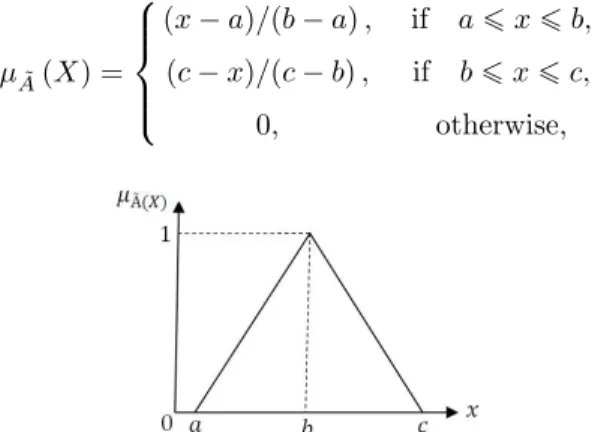
Here, {0, 1} is called an evaluation set and it is permitted to be a real interval [0, 1] for the continuous mapping membership function. ˜A is called a fuzzy set and the function value µA˜(X) is termed as the degree of membership of X in ˜A. Fuzzy membership function has more types. But, in this paper a triangular fuzzy member-ship function has been used as shown in Figure 1 and the triangular fuzzy number,
˜
A= (a, b, c) can be defined as:
µA˜(X) = (x−a)/(b−a), if a¬x¬b, (c−x)/(c−b), if b¬x¬c, 0, otherwise, (8)
Fig. 1.Membership function of the triangular fuzzy number.
Based on the extension principle, the fuzzy sum ⊕and fuzzy subtraction Θ of any two triangular fuzzy numbers are also triangular fuzzy numbers; but the multi-plication ⊗ of any two triangular fuzzy numbers is only an approximate triangular
fuzzy number (Zadeh, 1975). Let’s have a two positive triangular fuzzy numbers, such as ˜A1 = (a1,b1, c1), and ˜A2 = (a2, b2, c2), and a positive real number r= (r, r, r), some algebraic operations can be expressed as follows:
˜ A1⊕A˜2 = (a1+a2, b1+b2, c1+c2), (9) ˜ A1ΘA˜2 = (a1−a2, b1−b2, c1−c2) (10) ˜ A1⊗A˜2 = (a1a2, b1b2, c1c2), (11) r ⊗A˜1 = (ra1, rb1, rc1), (12) ˜ A1∅A˜2 = (a1/c2, b1/b2, c1/a2). (13) The operations of∨(max) and∧(min)are defined as:
˜
A1(∨) ˜A2= (a1∨a2, b1∨b2, c1∨c2), (14) ˜
A1(∧) ˜A2= (a1∧a2, b1∧b2, c1∧c2), (15) Here,r > 0,anda1, b1, c1> 0,
Also, the crisp value of a triangular fuzzy number setA1 can be determined by defuzzification which locates the Best Non-fuzzy Performance (BNP) value. Thus, the BNP values of a fuzzy number are calculated by using the center of area (COA) method as follows: (Moeinzadeh and Hajfathaliha, 2010)
BNPi=
[(c−a) + (b−a)]
3 +a, ∀i (16)
4. METHODOLOGY ADOPTED
Based on the concept of fuzzy set theory and VIKOR method, the proposed fuzzy VIKOR method has been applied to find the best compromise solution under the multi-person multi-criteria decision making supplier selection problem. Usually, deci-sion making problems are dealing with some alternatives which can be ranked, with respect to distinct criteria. Ratings of the alternatives and the weights of each crite-rion are the two most significant data which can affect the results of decision making problems. Therefore, the proposed methodology has been used here, to calculate the definite weight of criteria and ranking of the alternatives. In this paper, the impor-tance weights of various criteria and ratings of qualitative criteria are measured as linguistic variables because linguistic assessment can only have the capability to ap-proximate the subjective judgment through a decision maker’s opinion. Moreover, linear triangular membership functions are considered for capturing the vagueness of these linguistic assessments. The proposed algorithm consists of the following steps:
Step 1. Make a list of feasible alternatives, find the evaluation criteria, and con-stitute a group of decision makers. Suppose, there are k decision mak-ers (Dt, t= 1, ..., k), who are responsible for assessing m alternatives
(Ai, i= 1, ..., m), with respect to the importance of each of thencriteria,
Step 2. Identify appropriate linguistic variables and their positive triangular fuzzy numbers.Linguistic variables are used to calculate the importance weights of criteria and the ratings of the alternatives with respect to distinct criteria. For example, linguistic variable “Very High (VH)” which can be defined by a triangular fuzzy number (0.75; 1; 1).
Step 3. Construct a fuzzy decision matrix by pulling the decision makers’ opinions to get the aggregated fuzzy weight of the criteria, and the aggregated fuzzy rating of alternatives. Let k is the number of decision makers in a group and, the aggregated fuzzy weight ( ˜wj) with respect to each criterion can be
calculated as (Chen, 2000): ˜
wj =
1
k[ ˜wj1⊕w˜j2⊕....⊕w˜jk]. (17)
And also the aggregated fuzzy ratings (˜xij) of alternatives with respect to
each criterion can be calculated as: ˜
xij =
1
k[˜xij1⊕x˜ij2⊕....⊕˜xijk]. (18)
In the supplier selection problem, the value of aggregated weights and ratings are expressed in matrix format as follows:
˜ D= ˜ x11 x˜12 · · · x˜1n ˜ x21 x˜22 · · · x˜2n .. . ... · · · ... ˜ xm1 x˜m2· · ·x˜mn ,W˜ = ˜ w1w˜2· · ·w˜n ,
i= 1, ..., m for alternatives, andj = 1, ..., n,for criteria
Step 4. Defuzzify the fuzzy decision matrix and fuzzy weight of each criterion in to crisp values using the relation BNPi based on the COA defuzzification
method proposed in section 3 (Relation 16).
Step 5. Determine best crisp value fj∗
and worst crisp value fj−
for all criterion ratings, (j= 1, ..., n) by using the relations:
fj∗ = max i x˜ij, f − j = min i x˜ij, (19)
Step 6. Compute the valuesSiandRi using the relations (4), (5) respectively.
Step 7. Compute the valuesQiusing the relation (6) described in section 2.
Step 8. Rank the alternatives by sorting eachS, R,andQvalues in ascending order.
Step 9. Select the best alternatives as a compromise solution by referring step 5 of section 2.
5. CASE STUDY
Supplier selection is an important part of the business as well as a production strat-egy for industrial organizations. Selection of best supplier enhances the quality and
economic growth of enterprise but, still it is a difficult task to select an appropriate supplier. Therefore, the proposed model has been used to evaluate and select the most suitable supplier of a computer manufacturing industry in the southern part of India. The proposed supplier selection approach has been made in the following steps:
Step 1. Some key components and accessories of computers have to be purchased for the production of new company products. Therefore, the company needs to select a suitable supplier. There are five suppliers such as, S1, S2, S3, S4,and S5participating in the selection process. These are the six qualitative criteria used to evaluate the suppliers:
C1: On time delivery of goods, C2: Quality of products,
C3: Response to correspondence, C4: Flexibility,
C5: Services contract performance, C6: Cost/Price.
Three decision makers D1, D2 and D3 have been grouped to resolve the problems of the entire selection process.
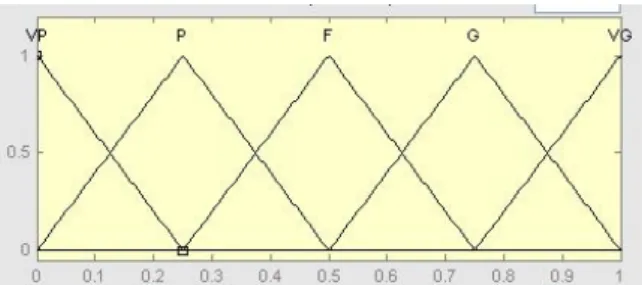
Step 2. Decision makers have been using the five linguistic variables for weighting as shown in Figure 2 and also five linguistic variables for rating of suppliers which are shown in Figure 3. The corresponding fuzzy numbers of linguistic variables for weights and ratings are shown in Table 1 and Table 2, respec-tively. Then, the decision makers use the linguistic weighting variables to assess the importance weight of each criterion as shown in Table 3. Also, they have used the linguistic ratings to rate the alternatives presented in Table 4. Next, the calculated fuzzy numbers of importance weights and rat-ings are tabulated in Table 5 and 6, respectively.
Fig. 2. Linguistic variables for importance weight of each criteria.
Table 1.Linguistic variables for weights. Very Low (VL) (0, 0, 0.25) Low (L) (0, 0.25, 0.5) Medium (M) (0.25, 0.5, 0.75) High (H) (0.5, 0.75, 1) Very High (VH) (0.75, 1, 1)
Table 2.Linguistic variables for ratings.
Very Poor (VP) (0, 0, 0.25) Poor (P) (0, 0.25, 0.5)
Fair (F) (0.25, 0.5, 0.75) Good (G) (0.5, 0.75, 1) Very Good (VG) (0.75, 1, 1)
Table 3.Importance weight of criteria from three decision makers.
Criteria Decision makers (DMs).
D1 D2 D3 C1 VH H VH C2 H VH H C3 M VH VH C4 VH M M C5 H M H C6 VH VH VH
Table 4.Ratings of five suppliers under each criterion in terms of linguistic variables determined by DMs. DMs Suppliers Criteria C1 C2 C3 C4 C5 C6 D1 S1 F VG F G G VG S2 G VG G F G VG S3 VG G F G F F S4 VG F G G P VG S5 VG G F F G G D2 S1 G F F F G G S2 F VG F G G G S3 F G G VG F VG S4 VG G F G G VG S5 F G F G VG VG D3 S1 F G F G VG VG S2 VG G G F F F S3 F F VG G G G S4 G F G G P F S5 VG VG G G F G
Table 5.Importance weights of criteria in terms of fuzzy numbers for each criterion.
C1 C2 C3 C4 C5 C6
D1 (0.75,1.00,1.00) (0.50,0.75,1.00) (0.25,0.50,0.75) (0.75,1.00,1.00) (0.50,0.75,1.00) (0.75,1.00,1.00)
D2 (0.50,0.75,1.00) (0.75,1.00,1.00) (0.75,1.00,1.00) (0.25,0.50,0.75) (0.25,0.50,0.75) (0.75,1.00,1.00)
D3 (0.75,1.00,1.00) (0.50,0.75,1.00) (0.75,1.00,1.00) (0.25,0.50,0.75) (0.50,0.75,1.00) (0.75,1.00,1.00)
Table 6.Rating of each supplier under each criterion in terms of fuzzy numbers.
Supplier S1 Criteria C1 C2 C3 C4 C5 C6 D1 (0.25,0.50,0.75) (0.75,1.00,1.00) (0.25,0.5,0.75) (0.50,0.75,1.00) (0.50,0.75,1.00) (0.75,1.00,1.00) D2 (0.50,0.75,1.00) (0.25,0.50,0.75) (0.25,0.5,0.75) (0.25,0.50,0.75) (0.50,0.75,1.00) (0.50,0.75,1.00) D3 (0.25,0.50,0.75) (0.50,0.75,1.00) (0.25,0.5,0.75) (0.50,0.75,1.00) (0.75,1.00,1.00) (0.75,1.00,1.00) S2 D1 (0.50,0.75,1.00) (0.75,1.00,1.00) (0.50,0.75,1.00) (0.25,0.50,0.75) (0.50,0.75,1.00) (0.75,1.00,1.00) D2 (0.25,0.50,0.75) (0.75,1.00,1.00) (0.25,0.50,0.75) (0.50,0.75,1.00) (0.50,0.75,1.00) (0.50,0.75,1.00) D3 (0.75,1.00,1.00) (0.50,0.75,1.00) (0.50,0.75,1.00) (0.25,0.50,0.75) (0.25,0.50,0.75) (0.25,0.50,0.75) S3 D1 (0.75,1.00,1.00) (0.50,0.75,1.00) (0.25,0.50,0.75) (0.50,0.75,1.00) (0.25,0.50,0.75) (0.25,0.50,0.75) D2 (0.25,0.50,0.75) (0.50,0.75,1.00) (0.50,0.75,1.00) (0.75,1.00,1.00) (0.25,0.50,0.75) (0.75,1.00,1.00) D3 (0.25,0.50,0.75) (0.25,0.50,0.75) (0.75,1.00,1.00) (0.50,0.75,1.00) (0.50,0.75,1.00) (0.50,0.75,1.00) S4 D1 (0.75,1.00,1.00) (0.25,0.50,0.75) (0.50,0.75,1.00) (0.50,0.75,1.00) (0.00,0.25,0.50) (0.75,1.00,1.00) D2 (0.75,1.00,1.00) (0.50,0.75,1.00) (0.25,0.50,0.75) (0.50,0.75,1.00) (0.50,0.75,1.00) (0.75,1.00,1.00) D3 (0.50,0.75,1.00) (0.25,0.50,0.75) (0.5,0.75,1.00) (0.50,0.75,1.00) (0.00,0.25,0.50) (0.25,0.50,0.75) S5 D1 (0.75,1.00,1.00) (0.50,0.75,1.00) (0.25,0.50,0.75) (0.25,0.50,0.75) (0.50,0.75,1.00) (0.50,0.75,1.00) D2 (0.25,0.50,0.75) (0.50,0.75,1.00) (0.25,0.50,0.75) (0.50,0.75,1.00) (0.75,1.00,1.00) (0.75,1.00,1.00) D3 (0.75,1.00,1.00) (0.75,1.00,1.00) (0.50,0.75,1.00) (0.50,0.75,1.00) (0.25,0.50,0.75) (0.50,0.75,1.00)
Step 3. The aggregated fuzzy weight ( ˜wj) of each criterion and aggregated fuzzy
ratings (˜xij) of each criterion with respect to the suppliers are calculated
by using the relation (17) and (18), respectively. Then, construct a fuzzy decision matrix by putting these aforesaid data and shown in Table 7.
Table 7. Fuzzy decision matrix.
Criteria. C1 C2 C3 C4 C5 C6 Weight (0.67,0.92,1.00) (0.58,0.83,1.00) (0.58,0.83,0.92) (0.42,0.67,0.83) (0.42,0.67,0.92) (0.75,1.00,1.00) S1 (0.33,0.58,0.83) (0.50,0.75,0.92) (0.25,0.50,0.75) (0.42,0.67,0.92) (0.58,0.83,1.00) (0.67,0.92,1.00) S2 (0.50,0.75,0.92) (0.67,0.92,1.00) (0.42,0.67,0.92) (0.33,0.58,0.83) (0.42,0.67,0.92) (0.50,0.75,0.92) S3 (0.42,0.67,0.83) (0.42,0.67,0.92) (0.50,0.75,0.92) (0.58,0.83,1.00) (0.33,0.58,0.83) (0.50,0.75,0.92) S4 (0.67,0.92,1.00) (0.33,0.58,0.83) (0.42,0.67,0.92) (0.50,0.75,1.00) (0.16,0.42,0.67) (0.58,0.83,0.92) S5 (0.58,0.83,0.92) (0.58,0.83,1.00) (0.33,0.58,0.83) (0.42,0.67,0.92) (0.50,0.75,0.92) (0.58,0.83,1.00)
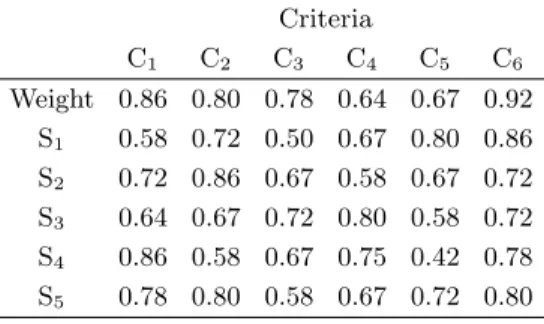
Step 4. Compute the crisp values of decision matrix and weight of each criterion and presented in Table 8.
Table 8.Crisp values for decision matrix and weight of each criterion.
Criteria C1 C2 C3 C4 C5 C6 Weight 0.86 0.80 0.78 0.64 0.67 0.92 S1 0.58 0.72 0.50 0.67 0.80 0.86 S2 0.72 0.86 0.67 0.58 0.67 0.72 S3 0.64 0.67 0.72 0.80 0.58 0.72 S4 0.86 0.58 0.67 0.75 0.42 0.78 S5 0.78 0.80 0.58 0.67 0.72 0.80
Step 5. These are the best and worst values of all criterion ratings listed below:
f1∗= 0.86, f2∗= 0.86, f3∗= 0.72, f4∗= 0.80, f5∗= 0.80, f6∗= 0.86
f1−= 0.58, f2−= 0.58, f3−= 0.50, f4−= 0.58, f5−= 0.42, f6−= 0.72
Step 6. Compute the values of S, R and Q for all suppliers and presented in Table 9.
Table 9.The values of S, R and Q for all suppliers. Suppliers S1 S2 S3 S4 S5 S 2.42 2.40 2.52 2.32 1.83 R 0.86 0.92 0.92 0.80 0.39 Q 0.87 0.91 1.00 0.74 0.00
Table 10.The ranking of the suppliers by S, R and Q in ascending order.
Ranking suppliers
1 2 3 4 5
By S S5 S4 S2 S1 S3 By R S5 S4 S1 S2 S3 By Q S5 S4 S1 S2 S3
Step 8. From Table 9, it has been shown that the suppliers S5is best ranked by Q and also both C1and C2conditions are satisfied, means(QS4−QS5) (5−11)and S5is best ranked by R and S also. Therefore, S5is the best selected supplier for the best compromise solution.
6. CONCLUSION
Supplier selection is a part of supply chain management which is used in the upstream of the production process and affecting all the areas of an organization. In this paper an efficient method has been proposed to solve the supplier selection problem and select the best supplier through a multi criteria group decision making process under a fuzzy environment. In a decision making process, the decision makers are unable to express their opinions exactly in numerical values due to imprecision in the sub-jective judgment of decision-makers. In order to deal with such problems fuzzy set theory has been implemented and the evaluations are expressed in linguistic terms. In this research a new MDCM approach, VIKOR under a fuzzy environment has been implemented to deal with both qualitative and quantitative criteria and a suitable supplier has been selected successfully. The outranking order of suppliers and rating of suppliers can easily be determined by using this method. Finally, the proposed method has been seemed simple, flexible and systematic approach and can be applied in different types of decision making problems.
ACKNOWLEDGEMENTS
The author takes the prerogative through this opportunity to express his sincere thanks and gratitude to the Chief Editor, Prof. Kaczmarczyk, and learned reviewers for their valuable comments and suggestions for the improvement and betterment of this paper.
REFERENCES
Altinoz, C. & Winchester, S.C. (2001). A Fuzzy Approach to Supplier Selection.Journal of Textile Institute92(2), 155–167.
Bashiri, M. & Badri, H. (2011), A group decision making procedure for fuzzy interactive linear assignment programming,Expert Syst. Appl.38(5), 5561–5568.
Chang, C.-L. (2010), A modified vikor method for multiple criteria analysis,Environmental Monitoring and Assessment168, 339–344.
Chen, C.-T. (2000), Extensions of the topsis for group decision-making under fuzzy environ-ment,Fuzzy Sets and Systems114(1), 1–9.
Ghodsypour, S. & OBrien, C. (1998), A decision support system for supplier selection using an integrated analytic hierarchy process and linear programming,International Journal of Production Economics56–57(1), 199–212.
Huang, J.J., Tzeng, G.H., & Liu, H.H. (2009), A Revised VIKOR Model for Multiple Criteria Decision Making - The Perspective of Regret Theory,inY. Shi et al. (Eds.) MCDM 2009,
Communications in Computer and Information Science35(1), 761–768, Springer-Verlag Berlin Heidelberg.
Kubat, C., & Yuce, B. (2006), Supplier Selection with Genetic Algorithm and Fuzzy AHP,
Proceedings of 5th International Symposium on Intelligent Manufacturing Systems, May 29–31, 1382–1401.
Kumar, M., Vrat, P. & Shankar, R. (2004), A fuzzy goal programming approach for vendor selection problem in a supply chain,Comput. Ind. Eng.46(1), 69–85.
Kuo, M.-S. & Liang, G.-S. (2011), Combining vikor with gra techniques to evaluate service quality of airports under fuzzy environment,Expert Syst. Appl.38(3), 1304–1312. Moeinzadeh, P. & Hajfathaliha, A. (2010), A combined fuzzy decision making approach
to supply chain risk assessment, International Journal of Human and Social Sciences 5(13), 859–875.
Opricovic, S. (1998),Multi-criteria optimization of civil engineering systems, Faculty of Civil Engineering, Belgrade.
Opricovic, S. & Tzeng, G.-H. (2004), Compromise solution by mcdm methods: A comparative analysis of vikor and topsis,European Journal of Operational Research156(2), 445–455. Opricovic, S. & Tzeng, G.-H. (2007), Extended vikor method in comparison with outranking
methods,European Journal of Operational Research178(2), 514–529.
Park, J. H., Cho, H. J. & Kwun, Y. C. (2011), Extension of the vikor method for group decision making with interval-valued intuitionistic fuzzy information,Fuzzy Optimization and Decision Making10(3), 233–253.
Roodhooft, F. & Konings, J. (1997), Vendor selection and evaluation an activity based costing approach,European Journal of Operational Research96(1), 97–102.
Saghafian, S. & Hejazi, S. R. (2005), Multi-criteria group decision making using a modified fuzzy topsis procedure,inProceedings of the International Conference on Computational Intelligence for Modelling, Control and Automation and International Conference on In-telligent Agents, Web Technologies and Internet Commerce Vol-2 (CIMCA-IAWTIC06) – Volume 02, CIMCA 05, IEEE Computer Society, Washington, DC, USA, 215–221. Sanayei, A., Farid Mousavi, S. & Yazdankhah, A. (2010), Group decision making process for
supplier selection with vikor under fuzzy environment,Expert Systems with Applications 37(1), 24–30.
Sanayei, A., Mousavi, S. F., Abdi, M. & Mohaghar, A. (2008), An integrated group decision-making process for supplier selection and order allocation using multi-attribute utility theory and linear programming,Journal of the Franklin Institute345(7), 731–747.
Shahanaghi, K., Yazdian, S. A. (2009), Vendor Selection Using a New Fuzzy Group TOPSIS Approach,Journal of Uncertain Systems3(3), 221–231.
Tsai, C.H., Chang, C.L., & Chen, L. (2003), Applying Grey Relational Analysis to the Vendor Evaluation Model,International Journal of the Computer, the Internet and Management 11(3), 45–53.
Weber, C. A., Current, J. R. & Desai, A. (1998), Non-cooperative negotiation strategies for vendor selection,European Journal of Operational Research108(1), 208–223.
Wu, M., Liu, Z. J. (2011), The supplier selection application based on two methods: VIKOR algorithm with entropy method and Fuzzy TOPSIS with vague sets method, Interna-tional Journal of Management Science and Engineering Management6(2), 936–946. Yu, P. (1973), A class of solutions for group decision problems, Management Science
19(8), 936–946.
Zadeh, L. (1965), Fuzzy sets,Information and Control8(3), 338–353.
Zadeh, L. (1975), The concept of a linguistic variable and its application to approximate reasoning,Information Sciences8(3), 199–249.