DESIGNING A FRAMEWORK FOR THE ADVANCEMENT OF
LECTURER CAPACITY IN DEVELOPING GRADUATE ATTRIBUTES
AT A TECHNICAL AND VOCATIONAL EDUCATION AND
TRAINING COLLEGE
By
Kheza Jonas Pitso (B.A; PGCE; BPsych; MEd.)
Submitted in the fulfilment of the requirements of the Degree
PHILOSOPHIAE DOCTOR (Psychology of Education)
In the
DEPARTMENT PSYCHOLOGY OF EDUCATION OF THE FACULTY OF HUMANITIES
at the
Central University of Technology, Free State
SUPERVISOR : Prof. Gregory Alexander CO-SUPERVISOR : Prof. Sheila Matoti
ACKNOWLEDGEMENTS
I would like to express my heartfelt appreciation and gratitude to the following people for their invaluable contribution towards the success of this study.
• The almighty God who has given me strength and an opportunity to complete this
study.
• My supervisor, Professor G. Alexander and co- supervisor, Professor Matoti, for their
exceptional support, persistent guidance and expert advice.
• My parents for their good support and constant encouragement. Thank you so
much.
• My son, Bokang Bitterbos (Kheza), for the unconditional love. I love you.
• My entire family, for being available when I needed help and advice. I really
appreciate you.
• Members of Executive Management of Goldfields TVET College.
• Ms. Mokoena and the team of Career Guidance Officers
• All my friends and colleagues for having stood by me and offering all sorts of help
whenever it was needed.
• All lecturers and students who participated in this study, for their time in providing
information that is relevant to this study.
• The student support team, for your endless encouragement and unwavering support.
DEDICATION
I want to dedicate this dissertation to the following people.
• My late father, in recognition of his empowering efforts that improved my attitude
towards studying and offering support in times of need.
• My mother, in recognition of her endless support throughout my studies.
• My son Bokang Bitterbos (Kheza).
• My brothers and sisters, for their outstanding emotional, moral support and
DECLARATION
I declare that the dissertation hereby submitted by me for Ph.D. (Psychology of Education) at the Central University of Technology, Free State is my own independent work and has not previously been submitted by me at another university/faculty. I further more cede copyright of the dissertation in favour of the Central University of Technology, Free State.
………. Pitso Kheza
……….. DATE
ABSTRACT
The Technical and Vocational Education and Training (TVET) sector in South Africa fulfils a crucial role in skilling and preparing youth and school leavers for the world of work and the industry. Both TVET colleges and the industry are therefore critical in developing the competencies they both deem necessary for graduates. These competencies, also framed as Graduate Attributes, are perceived to be the most important indicator of the success of TVET colleges and the subsequent quality of education on offer at these institutions of higher learning. Graduate Attributes are the qualities, skills and understandings a university or college community agrees its students should develop during their time at the institution- these competencies should prepare students for unknown industrial challenges and enable them to cope with whatever demand of the labour market. With the latter said in mind, the aim of this study was directed at designing a framework for the advancement of lecturer capacity in developing the Graduate Attributes needed for the TVET sector of South Africa, more specifically for a TVET college in the Free State province. This mixed methods study was compounded in the theories of Constructivism, Human Capital and Employability theory. The population of the study was the lecturers, students and management, attached to the identified college. Quantitative data emanating from 2000 questionnaires, ascertained students’ perceptions of Graduate Attributes. Qualitative data emerging from the ten focus group interviews held with students and lecturers, respectively and a semi- structured personal interview conducted with an executive staff member, attempted to determine the level of support rendered to lecturers in producing ‘well-attributed’ students and also investigated the manner in which Graduate Attributes are possibly embedded into the curriculum. The findings of this study revealed that there’s an urgent need to improve lecturers’ qualifications and competencies to deal with current and future challenges of the curriculum and the demands of the industry. Equally important to this study, is the need for staff training and capacity in the development of Graduates Attributes, as well as in curriculum matters. It also emerged that curriculum re-evaluation could potentially contribute in fostering improved employability and productivity of TVET college graduates. The study recommends that TVET colleges, such as Goldfields TVET college, needs to prioritise lecturer development, ranging from continuous professional training to qualification improvement. It is also
recommended that the industry needs to be given space in the TVET sector as to assist with the conceptualisation and development of Graduates Attributes for the world of work.
Key words: Graduate Attributes; Lecturer Capacity; Technical, Vocational, Education & Training; World of Work and Framework.
Table of Contents
ACKNOWLEDGEMENTS ... i
DEDICATION ... ii
DECLARATION ... iii
ABSTRACT ... iv
LIST OF TABLESLIST OF TABLES ... xiv
LIST OF FIGURES ... xv
LIST OF ANNEXURES ... xvi
CHAPTER 1 INTRODUCTION AND BACKGROUND TO THE STUDY ... 1
1.1. INTRODUCTION ... 1
1.2. BACKGROUND TO THE STUDY ... 2
1.3. RATIONALE OF THE STUDY ... 4
1.4. PROBLEM STATEMENT ... 4
1.5. AIMS OF THE RESEARCH ... 7
1.5.1. General aim ... 7
1.5.2. Specific objectives ... 7
1.6. CONCEPTUAL FRAMEWORK ... 8
1.6.1. Employability Theory... 8
1.6.2. Human capital theory ... 9
1.6.3. Constructivism ... 10
1.7. RESEARCH DESIGN AND METHODOLOGY ... 10
1.7.1. Mixed-method research ... 11
1.7.2. Case Study ... 12
1.7.3. Data gathering tools ... 14
1.8. POPULATION AND SAMPLING ... 16
1.9.1. Thematic Analysis ... 17
1.9.2. Descriptive statistics ... 18
1.10. LITERATURE STUDY ... 18
1.11. ETHICAL CONSIDERATIONS ... 19
1.12. SIGNIFICANCE OF THE STUDY ... 20
1.13. STRUCTURE OF THE RESEARCH REPORT ... 21
1.14. CONCLUSION ... 22
CHAPTER 2 CONCEPTUALISATION AND DEVELOPMENT OF THE
GRADUATE ATTRIBUTES: THEIR RELEVANCE FOR THE SOUTH
AFRICAN TVET CONTEXT... 23
2.1. INTRODUCTION ... 23
2.2. THEORETICAL AND CONCEPTUAL FRAMEWORK ... 23
Social Constructivism ... 24
Human Capital Theory ... 27
Employability Theory... 30
2.3. TVET COLLEGES OVERVIEW- INTERNATIONAL PERSPECTIVES ... 31
Indian TVET System ... 32
Korean TVET system ... 33
2.4. African Perspective on TVET ... 34
Vision of the African Union ... 34
African Strategy Mission for TVET ... 35
2.5. The current era of TVET colleges in South Africa ... 36
South African TVET System ... 37
The current context of TVET colleges in South Africa ... 38
The Role of TVET Colleges in the development of South Africa ... 40
Expansion of TVET in South Africa ... 40
2.6. PROBLEMS IN DEFINING THE GRADUATE ATTRIBUTES FOR THE SOUTH AFRICAN TVET CONTEXT ... 42
2.7. WHAT IS THE GRADUATE ATTRIBUTES THEN? ... 43
2.8. GRADUATE ATTRIBUTES DEVELOPMENT DURING COLLEGE STUDIES ... 45
2.9. CONCEPTUALISING THE GRADUATE ATTRIBUTES IN TVET ... 47
Teaching and Learning of the Graduate Attributes ... 49
2.10. GRADUATE ATTRIBUTES IN INDUSTRY/WORKPLACE ... 50
2.11. GRADUATE ATTRIBUTES PROCESSES’ GUIDING LAWS ... 53
The Green and White Papers for Post-School Education and Training ... 53
National Skills Development Strategy III (2010) ... 55
Reconstruction and Development Plan (1994) ... 56
2.12. POLICIES PERTAINING SPECIFICALLY TO THE GRADUATE ATTRIBUTES ... 56
2.13. THE GRADUATE ATTRIBUTES AS A POLICY MATTER ... 57
2.14. CONCLUSION ... 59
CHAPTER 3 GRADUATE ATTRIBUTES IN TVET COLLEGES AND THE
ROLES OF STAKEHOLDERS ... 60
3.1 INTRODUCTION ... 60
3.2 THE NEED TO IMPROVE TVET GRADUATE OUTPUT ... 61
3.3 THE ROLE OF TVET COLLEGES IN DEVELOPING THE GRADUATE ATTRIBUTES ... 63
3.4 THE ROLE OF LECTURERS IN DEVELOPING THE GRADUATE ATTRIBUTES ... 65
3.5 THE ESSENCE OF LECTURERS’ QUALIFICATIONS ... 67
3.6 THE NEED TO IMPROVE LECTURER QUALIFICATIONS AND TRAINING ... 70
3.7 TVET LECTURER DEVELOPMENT FRAMEWORK ... 72
3.7.1 Policy on Professional Qualifications for Lecturers in Technical and Vocational Education and Training ... 72
3.8 LECTURER CONCEPTIONS AND REFINEMENT OF THE GRADUATE ATTRIBUTES ... 74
3.8.1 Refinement Guidelines and Procedures ... 74
3.8.2 Lecturer Conceptions of the Graduate Attributes ... 76
3.9 STANDARDS FOR LECTURER/TEACHER COMPETENCE IN THE GRADUATE ATTRIBUTES ASSESSMENT ... 78
3.9.1 Choice of the Graduate Attributes assessment methods ... 78
3.9.2 Development of the Graduate Attributes assessment methods ... 79
3.9.4 Usage of assessment results ... 79
3.9.5 Development of grading procedures ... 80
3.9.6 Communication of assessment results ... 80
3.9.7 Recognition of inappropriate assessment methods... 80
3.10 LECTURER COMPETENCIES AND IMPLICATIONS OF THE GRADUATE ATTRIBUTES ... 81
3.11 THE CHALLENGES FOR ECONOMIC DEVELOPMENT: THE ROLE OF THE TVET SECTOR ... 86
3.11.1Unemployment ... 86
3.11.2Poverty ... 88
3.12 THE ROLE OF INDUSTRY IN THE DEVELOPMENT OF GRADUATE ATTRIBUTES ... 90
3.13 LABOUR MARKET INVOLVEMENT RATIONALE ... 92
3.14 COLLEGE-INDUSTRY COLLABORATION EXPERIENCES ... 96
3.15 THE ROLE OF GOVERNMENT IN TVET COLLEGES IN SOUTH AFRICA 97 3.16 HIGHER EDUCATION AND TRAINING’S CONTRIBUTION TO THE DEVELOPMENT OF THE GRADUATE ATTRIBUTES (SOUTH AFRICA) ... 98
3.17 SOUTH AFRICAN LEGISLATIVE MATTERS ... 102
3.17.1Continuing Education and Training Act, 2006 (Act No. 16 of 2006) ... 102
3.17.2White paper for post-school Education and Training ... 102
3.17.3The Skills Development Act, 1998 (Act No. 97 of 1998) ... 103
3.17.4National Strategic Outcome Orientated Goals ... 104
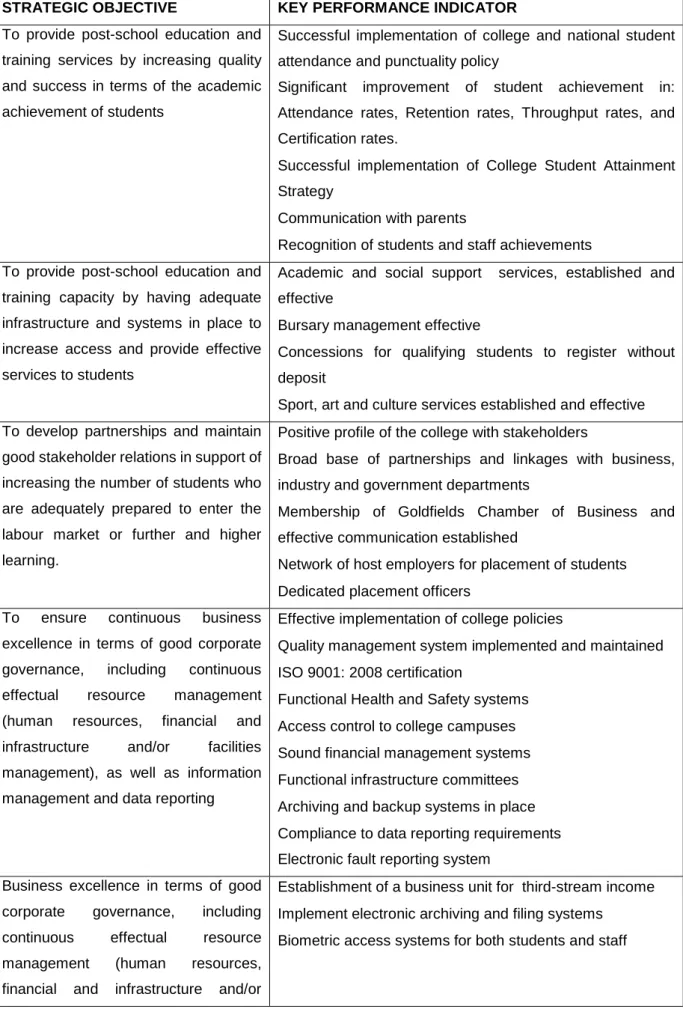
3.18 THE TVET SECTOR’S STRATEGIC OBJECTIVES ... 104
3.19 INTERNATIONAL BENCHMARKS ON TVET ATTRIBUTES ... 106
3.19.1Singaporean Graduate Attributes ... 106
3.19.2Malaysian Graduate Attributes ... 108
3.19.3Australian Graduate Attributes ... 109
3.19.4German Graduate Attributes ... 110
3.20 CONCLUSION ... 111
4.1. INTRODUCTION ... 112
4.2. PURPOSE OF EMPIRICAL RESEARCH... 112
4.2.1. Preparing for the Empirical Study ... 113
4.2.2. Permission ... 113
4.3. PARTICIPATORY APPROACH ... 113
4.4. CASE STUDY DESIGN ... 114
4.4.1. Advantages of case study ... 115
4.4.1.1. Studies the immediate context ... 115
4.4.1.2. Allows for Qualitative and Quantitative data analyses ... 115
4.4.1.3. Explanation of real-life situations ... 115
4.4.2. Disadvantages of the case study ... 116
4.4.2.1. Little base for generalisation ... 116
4.4.2.2. Too long ... 116
4.5. MIXED METHODS ... 116
4.5.1. Qualitative Approach ... 117
4.5.2. Quantitative Approach ... 118
4.6. POPULATION AND SAMPLING ... 119
4.6.1. Population ... 119
4.6.2. Sampling ... 120
4.7. ROLE OF THE RESEARCHER ... 124
4.8. DATA COLLECTION STRATEGIES ... 126
4.8.1. The Qualitative Research Instruments ... 130
4.9. PILOT STUDY ... 135
4.10. TECHNIQUES USED FOR DATA ANALYSIS ... 136
4.10.1. Data analysis techniques for the qualitative data ... 137
4.10.2. Data analysis techniques for the quantitative data ... 139
4.11. VERIFICATION OF THE QUALITATIVE STUDY ... 141
4.11.1. Introduction ... 141
4.11.3. Credibility ... 143
4.11.4. Transferability ... 143
4.11.5. Dependability ... 144
4.11.6. Conformability ... 144
4.12. ETHICAL ISSUES ... 144
4.12.1. What are ethical issues? ... 144
4.12.2. Ethical principles and guidelines ... 145
4.13. CONCLUSION ... 149
CHAPTER 5 PRESENTATION, ANALYSIS AND DISCUSSION OF
DATA ... 150
5.1. INTRODUCTION ... 150
5.2. PRESENTATION, ANALYSIS AND DISCUSSION OF QUANTITATIVE DATA ... 150
5.2.1. Biographical Data of Student participants ... 150
5.2.2. Graduate Attributes ... 154
5.3. PRESENTATION, ANALYSIS AND DISCUSSION OF QUALITATIVE DATA ... 168
5.3.1. Interpretations emanating from Question 1 ... 171
5.4. EMPIRICAL RESULTS (LECTURERS) ... 195
5.4.2. Interpretations emanating from Question 2 ... 204
5.4.3. Interpretations emanating from Question 3 ... 207
5.4.4. Interpretations emanating from Question 4 ... 209
5.4.5. Interpretations emanating from Question 5 ... 211
5.5. REFLECTIVE OVERVIEW OF WORKSHOP ENGAGEMENT WITH TVET LECTURERS (Information-sharing seminar) ... 213
5.5.1. Introduction ... 213
5.5.2. The general overview of the Graduate Attributes ... 215
5.5.3. The Graduate Attributes’ congruence with skills development ... 218
5.5.4. Lecturer Perceptions of the Graduate Attributes ... 221
5.5.6. Possible Solutions to the Graduate Attributes Development ... 229
5.5.7. The role of assessment in the development of the Graduate Attributes ... 232
5.5.8. The Student Support Services ... 234
5.6. Conclusion ... 235
CHAPTER 6 DISCUSSION OF FINDINGS, RECOMMENDATIONS AND
CONCLUSION ... 237
6.1. INTRODUCTION ... 237
6.2. RESEARCH FINDINGS ... 237
6.2.1. Findings from the students’ biographical data ... 238
6.2.2. What does the concept “Graduate Attributes” mean? ... 240
6.2.3. Characteristics of the Graduate Attributes ... 243
6.2.4. What should the Graduate Attributes at TVET colleges entail? ... 244
6.2.5. What should be the role of TVET colleges in developing the Graduate Attributes? ... 245
6.2.6. In what ways could the Graduate Attributes be developed? ... 246
6.2.7. Whose responsibility should it be to develop the Graduate Attributes? ... 251
6.3. SYNTHESIS OF FINDINGS (TRIANGULATION BETWEEN THE QUANTITATIVE AND QUALITATIVE DATA) ... 253
6.3.1. The Development of the Graduate Attributes ... 253
6.3.2. The Graduate Attributes at TVET college level ... 254
6.3.3. Perceptions of students on the Graduate Attributes... 255
6.4. RECOMMENDATIONS ... 256
6.4.1. Graduate Attributes should be promoted at TVET college level... 256
6.4.2. Student Support Services at TVET sector level ... 257
6.4.3. Partnerships needed for the development of the Graduate Attributes ... 257
6.4.4. Student-centered counselling ... 258
6.4.5. Training and development ... 258
6.4.6. Student involvement ... 259
6.4.8. ADDITIONAL RECOMMENDATIONS ... 260
6.5. LIMITATIONS OF THE RESEARCH PROJECT ... 261
6.6. RECOMMENDATIONS FOR FURTHER RESEARCH ... 261
6.7. CONCLUSION ... 262
CHAPTER 7 PROPOSED FRAMEWORK FOR THE DEVELOPMENT OF
THE GRADUATE ATTRIBUTES ... 263
7.1. INTRODUCTION ... 263
7.2. PURPOSE OF THE FRAMEWORK ... 264
7.3. DISCUSSION OF THE FRAMEWORK FOR ADVANCEMENT OF LECTURER CAPACITY ... 267
7.3.1. Policy conceptualisation ... 267
7.3.2. Embedding Graduate Attributes into the curriculum... 267
7.3.3. Holistic Development of TVET lecturers ... 268
7.3.4. Advancement of teaching, learning and curriculum management ... 269
7.3.5. Placement in industry ... 269
7.3.6. Curriculum planning and re-evaluation ... 271
7.4. LIST OF GRADUATE ATTRIBUTES IDENTIFIED FOR THE IMPLEMENTATION AT GOLDFIELDS TVET COLLEGE ... 271
7.5. Explanation of lecturers’ guidelines for Graduate Attributes implementation ... 274
LIST OF TABLES
Table 2.1 Graduate Attributes forIndustry………..……...51
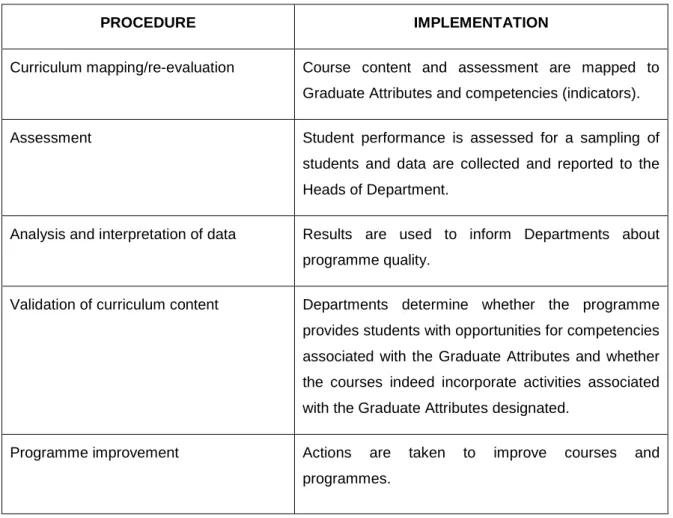
Table 3.1 Refinement of the Graduate Attributes Process and Procedure………...75
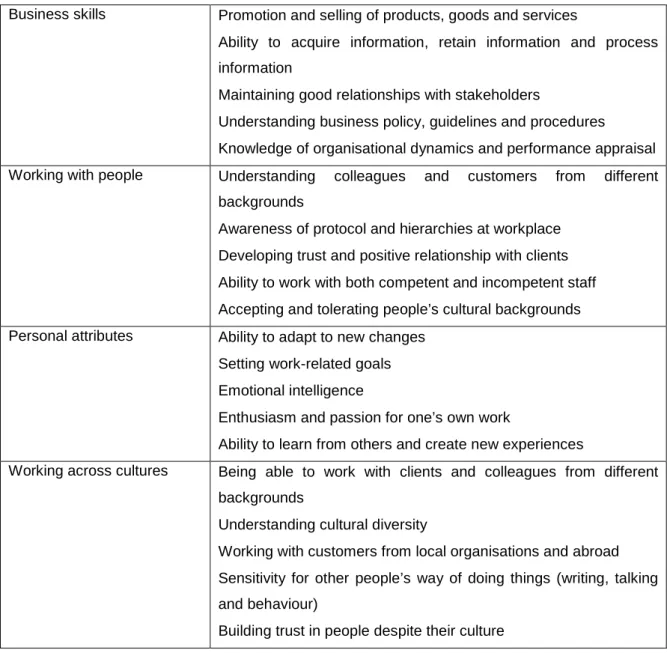
Table 3.2 Employers’ list of important Graduate Attributes………...94
Table 3.3 The TVET sector’s Strategic Objectives……….105
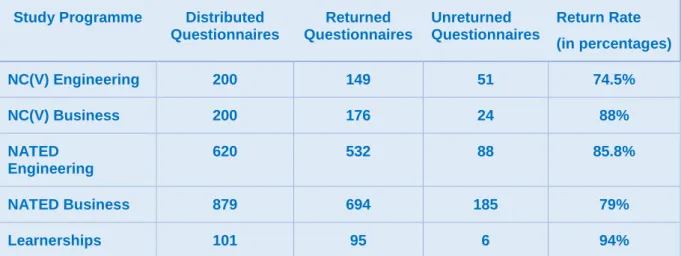
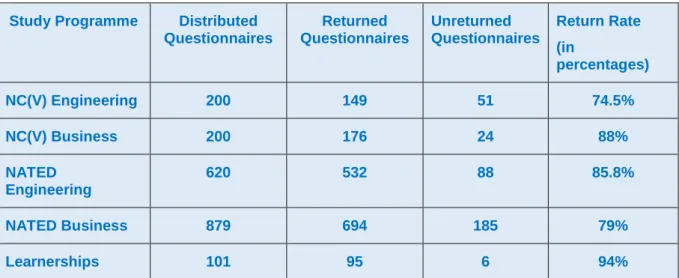
Table 4.1 Questionnaire distribution and return rate from study programmes……..121
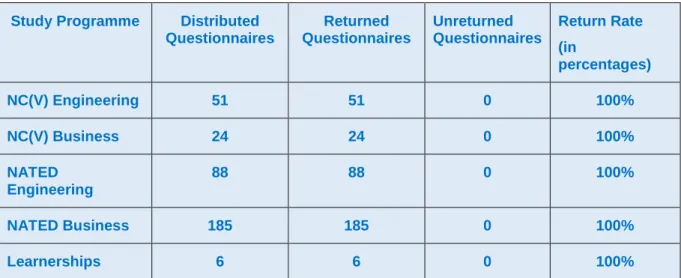
Table 4.2 Questionnaire redistribution and return rate from study programmes…...122
Table 4.3 Total number of Questionnaires of the second distribution……….123
Table 4.4 Sample size(s) for a given population/universe (n) (Sekaran in Kivido, 2006)……….…123
Table 4.5 Strategies for ensuring trustworthiness in qualitative research………..…143
Table 5.1 Sample Profile of Participants………..151
Table 5.2 Gender of respondents by programme (N=2000)……….153
Table 5.3 Age of Respondents by Programme (N=2000)……….…153
Table 5.4 Scale that rated the statements………...…162
Table 5.5 General Attributes………..163
Table 5.6 Academic Attributes………...164
Table 5.7 Workplace Attributes and Knowledge Application………...….165
Table 5.8 Personal Attributes………..…..166
Table 5.9 Entrepreneurship Attributes……….…….167
Table 5.10 Main categories and subcategories indicating the students’ understanding of the concept Graduate Attributes………...172
Table 5.11 The biography of Focus Group Interview Participants at Goldfields TVET College………...197
Table 5.12 Main categories and subcategories indicating the students’ understanding of the concept Graduate Attributes……….…….198
Table 5.13 The biography of Workshop Participants at Goldfields TVET College…..214
Table 5.14 Lecturer Perceptions of the Graduate Attributes………...221
Table 7.1 Objectives and the key performance indicators for the development of the Graduate Attributes……….266
LIST OF FIGURES
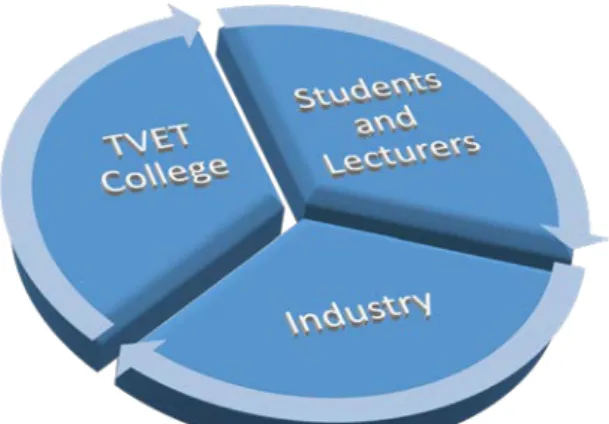
Figure 3.1 Schooling supply of students to Higher Education……….………….87 Figure 3.2 Threefold Stream for Students, Institution and Industry……….91 Figure 5.1 Students’ Perceptions of what the Graduate Attributes entail (N=2000)...154 Figure 5.2 Students’ Perceptions of the Graduate Attributes development at a
college (N=2000)………..………..156 Figure 5.3 Students’ Perceptions of who should be responsible for the Graduate
Attributes (N=2000)………..…..158 Figure 5.4 Attributes considered the most important………..…….160 Figure 7.1 Framework for the advancement of lecturer capacity in developing the
Graduate Attributes………....265 Figure 7.2 The exposition of the suggested guidelines for the possible
LIST OF ANNEXURES
Annexure A Letter asking permission for conducting research
Annexure B Letter of permission granted for conducting research
Annexure C Students’ Questionnaire
Annexure D Schedules for Students’ Focus Group Interviews Annexure E Schedules for Lecturers’ Focus Group Interviews Annexure F Invitation to Lecturers’ Workshop
Annexure G Attendance Register for Lecturers’ Workshop
Annexure H Request to students to participate in a study questionnaire Annexure I Student’s consent to participate in the study questionnaires Annexure J Request to students to participate in the focus group interview Annexure K Student’s consent to participate in the study’s focus group interview Annexure L Notice to lecturers to participate in a workshop
Annexure M Lecturer’s consent to participate in the workshop
Annexure N Request to Executive Manager to participate in a semi-structured interview
Annexure O Executive Manager’s consent to participate in the study’s focus group interview
Annexure P Research Questions
Annexure Q Request to lecturers to participate in the focus group interview Annexure R Lecturer’s consent to participate in the study’s focus group interview
CHAPTER 1
INTRODUCTION AND BACKGROUND TO THE STUDY
1.1. INTRODUCTION
The purpose of the TVET colleges (formerly known as Further Education and Training [FET] colleges) in South Africa is to train school leavers at various levels, providing them with the skills, knowledge and attitudes necessary for employment in the labour market (HRDC, 2014). This role of the South African TVET colleges resembles the role of TVET Colleges internationally, which is to offer education that exposes their students to modern technologies and related sciences, and promotes the acquisition of practical skills, attitudes, understandings and knowledge relating to the various sectors of the economy (Yusuff & Soyemi, 2012). These institutions of higher learning primarily provide training for multiple skills in various occupations (e.g. Engineering and Business Studies), required to develop the economy (DHET: White Paper, 2013).
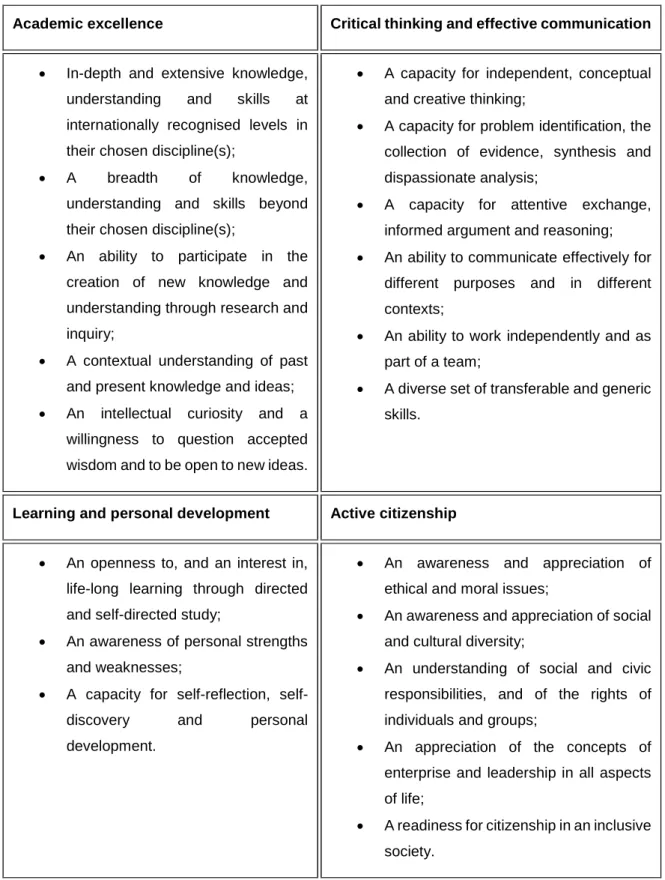
The most important indicator of the success of a college is the quality of the education offered and consequently, the success in producing students with the Graduate Attributes. The Graduate Attributes are the qualities, skills and understandings a university or college community agrees its students should develop, during their time with the institution. These attributes include but go beyond the disciplinary expertise or technical knowledge that has traditionally formed the core of most university courses. They are qualities that also prepare graduates as agents for social good in an unknown future (Bowden, Hart, King, Trigwell & Watts, 2000). According to Barrie (2004) the Graduate Attributes are the skills, knowledge and abilities of university or college graduates, which go beyond disciplinary content knowledge, and are applicable to a range of contexts. Furthermore, Barrie (2004) and Bridgstock (2009) assert that well attributed graduates will be lifelong learners, leaders who exercise their civic responsibilities. Thus, they will be committed to and capable of continuous learning and reflection for furthering their understanding of the world and their place in it. However, there is a general and substantiated view that many students demonstrate a lack of preparedness for higher education (Rowe & Melvyn, 2012).
This is evidenced in the National Benchmark Tests, as well as the role that system differentiation might have to play in addressing under-preparedness.
The importance of the Graduate Attributes is increasingly recognised internationally in higher education and by industry, government, and accredited bodies. However, integrating the development of the Graduate Attributes, such as critical thinking and critical reflection, has proved challenging in business education (Treleavent & Voola, 2008). This has prompted a continuous debate regarding the nature and desirability of the Graduate Attributes driven partly by stakeholder expectations that institutions of higher learning will prepare employees for the knowledge economy and partly by higher education academics and learning specialists (Green, Hammer & Star, 2009).
In the context of African countries, including South Africa, the identification of the Graduate Attributes within the academic programmes, should be shown in the planning, implementation and evaluation of the curriculum (Moalusi, Oladiran & Uziak, 2012). This has compelled the TVET colleges to engage with the graduate employability debate by adjusting curricula to meet the requirements of an ever-changing employer market. This came as a result of the increasing concerns about graduate employability in South Africa and the pressure on higher education to clearly demonstrate the benefits that result from the public funds it consumes. The emphasis, therefore, is on the delivery of graduates who are perceived as competent and employable within their disciplinary field (Jonck, 2014).
1.2. BACKGROUND TO THE STUDY
The TVET colleges are expected to produce well-attributed graduates who are competent to meet the manpower demands in all sectors of the South African economy (Mahadea & Simson, 2010). These institutions offer a variety of programmes (occupational, technical and vocational) with different exit levels, with each programme level accord based on the principle of substantial equivalence (Gewer, 2010). This means that the programmes do not have identical content and outcome, yet are expected to produce graduates with approximately similar characteristics.
In the context of TVET sector, the Graduate Attributes are led by the Academic and Student Support Departments. The Academic Department frames these attributes within teaching, learning and curriculum management, which later produces the learning outcomes (Ahmad, 2009). In the Student Support Department of the TVET colleges in South Africa, the focus is on capacitating students with life skills and improving the quality of teaching and learning through assistive programmes. These qualities are embedded in all the aspects of curriculum alignment that flow from them, which means that all teaching, learning and assessment aim to develop different, appropriate attributes in students, thus providing them with opportunities to both acquire and develop the relevant knowledge, skills and dispositions related to their field of study and practice (Shields & Johnson, 2008). In the context of South Africa, the colleges also cover aspects, such as lifelong learning, leadership and civic responsibility, so that students may lead responsible lives upon the conferral of their qualifications by the colleges (Rowe & Melvyn, 2012). The anticipation is that these attributes will be visible in the students’ areas of expertise, as well as going beyond to the everyday lives of the students (Noor, 2011).
The Graduate Attributes are broadly understood to speak to what employers and the world of work beyond the college expect of graduates in terms of knowledge, skills and attitudes or dispositions, as well as higher education’s role and purpose in preparing college graduates for the workplace and its expectations (Bester, 2014). This requires teaching and learning to be congruent with the expectations of employers and their evaluation of the quality of graduates produced by Technical and Vocational education institutions (Mager & Spronken-Smith, 2014). The attributes gained by the students should be able to isolate them from the entire population of people who might otherwise not have had exposure to technical and vocational education and training (Jackson, 2012).
The aforementioned, which happens in other South African colleges, overlaps into the TVET College identified. As is the case at other colleges, it offers different academic programmes with different content and outcomes. This difference in learning outcomes propels difference in the lecturers’ understanding of the Graduate Attributes.
1.3. RATIONALE OF THE STUDY
The rationale of the study is the redefining of the notion of the Graduate Attributes, in order to align the responsibilities of technical and vocational education with the possibilities of new and changing forms of labour and the application of knowledge. This situation needs to be improved because, in the context of South Africa, there appears to be a mismatch between higher learning outcomes and the expectations of the corporate world and industry. This research study has attempted to align the outcomes of a TVET college’s curriculum with the expectations of industry, so that the students’ competencies correspond with the manpower demands of South Africa. Overall, it is intended to benefit both graduates and industry. Industry should have the will to interact with lecturers regarding the attributes they expect from student, thus strengthening the relationship between the colleges and industry. This study envisages the development of these Graduate Attributes by higher education institutions in varying programmes, so that they may synchronise with the needs and expectations of employers and, at the same time, with the apparent demands of the rapidly changing world of work.
1.4. PROBLEM STATEMENT
Despite the fact that the Graduate Attributes have been the centre of discussion in higher education institutions in many countries over a number of decades, several authors, such as Chan (2011), Barrie, Hughes and Smith (2009) and Radloff, De la Harpe, Scoufis, Dalton, Thomas and Lawson (2009) argue that the Graduate Attributes are largely invisible in most higher education programmes, due to academics’ general lack of engagement with the attributes in question. These arguments indicate that it is important to investigate, firstly, what is meant by the Graduate Attributes in higher education curricula. Secondly, it is to gain a better understanding of how these Graduate Attributes are in fact embedded in curricula through teaching practice, all with a view to equipping graduates for the challenges of the world of work in a modern society (Bester, 2014).
Hager and Holland (2008) indicate that a prompt focus on developing the Graduate Attributes could possibly address the mismatch of what higher education provides and what industry expects. Furthermore, Dall’Alba (2009) indicates that the current manner of educating professionals is very limited in scope and not adequate for preparing students for the challenges of professional practice. She suggests a number of key curriculum design principles for education professionals, including the integration of knowledge and skills; overcoming a theory-practice gap in the curriculum; preparing professionals for the challenges of contemporary practice; and promoting the development of professional ways of being.
The focus in South Africa is on two main issues: what employers expect; and their evaluation of what they currently get (Bester, 2014). Griesel and Parker (2009) assert that although employers value the conceptual foundation, knowledge and the intellectual approach to tasks produced by higher education, there is a real need to address existing knowledge, skills and ability gaps between employer expectations and higher education outcomes, such as being experienced in TVET colleges in South Africa. Higher education should thus, take its rightful place in producing thinking, responsive and intellectually well-grounded individuals who are flexible and can readily adapt to new demands and challenges (Griesel & Parker, 2009).
The institutions of learning have described the generic qualities and skills possessed by their graduates to articulate the standards of education they offer to their students. However, there seems to be a continued lack of a theoretical and conceptual base on these widely spoken-about Graduate Attributes, together with being characterised by plurality and different perspectives (Barrie, 2004). The lecturers themselves, as personnel responsible for the development of these attributes, have different understandings of the nature of student generic attributes and the academic processes required to lead the development of these outcomes. Stakeholders in the institutes of higher learning differ as well, in terms of conceptions of the Graduate Attributes phenomenon. There is also a great variance in academics’ and TVET college lecturers’ understanding of the nature of the attributes, despite an agreement
The Graduate Attributes revolve around teaching and learning, as well as the effective management of the curriculum and are made explicit within curriculum content (Sorin, Errington, Ireland, Nickson & Caltabiano, 2012). To respond promptly to the Graduate Attributes requirements, TVET lecturers in South Africa may require a fundamental understanding of teaching towards these attributes. Kindley (2002) agrees to this by asserting that there is a transition in knowledge acquisition from the more traditional forms of knowledge acquisition, to more fluid ones, in which learners assess situations and react appropriately. Norton, Taylor, Stewart, Blackburn, Jinks, and Razdar (2012) indicates that as new knowledge about teaching and learning emerges, new types of expertise are required by educators, thus making teaching a dynamic profession. For this reason, there might be a need to develop teachers/lecturers, in terms of the Graduate Attributes, to better cope with the transition.
The status quo in research concerning the Graduate Attributes at other colleges reiterates the circumstances the researcher has identified at the TVET college under study in the Free State Province of South Africa The phenomenon of the Graduate Attributes has been a matter of much recent discontent and debate at this college as is the case in many higher education institutions. Thus, this college seems to have an urgent need for new, efficient and effective ways of judging, developing and implementing the Graduate Attributes within curricula and other programmes of this institution.
Therefore, in responding to the above said issue, the main research question of this study is:
How is lecturer capacity advanced regarding the development of Graduate Attributes at colleges for Technical and Vocational Education and Training?
The related sub-questions that will further provide direction to this investigation are:
• What is meant by the Graduate Attributes and what should they entail at TVET
• What are the perceptions of students and lecturers regarding the development of the Graduate Attributes for subjects taught by them?
• Do lecturers have the required competencies, skills and experience base in
developing the Graduate Attributes for their subjects?
• Which roles and responsibilities should college management fulfil in supporting
the development of the Graduate Attributes?
• How can lecturers be supported in the development of the Graduate Attributes at
TVET college level?
1.5. AIMS OF THE RESEARCH 1.5.1. General aim
The general aim of this research is to establish a framework for the advancement of lecturer capacity in developing the Graduate Attributes for a Technical and Vocational Education and Training College in the Free State Province.
1.5.2. Specific objectives
The following secondary aims also guided the research project:
• To determine what is entailed in the Graduate Attributes at Technical and Vocational
Education colleges.
• To ascertain the perceptions of students and lecturers regarding the
development of the Graduate Attributes for subjects taught.
• To investigate whether lecturers have the required competencies, skills and
experience base for developing the Graduate Attributes in their subjects?
• To determine the roles and responsibilities TVET college management should
fulfil in supporting the development of the Graduate Attributes.
• To establish a framework for the development of the Graduate Attributes at a
1.6. CONCEPTUAL FRAMEWORK
There are a number of theories and models for educational practice that provide base features addressing how students develop and learn. These theories and models are based on certain paradigms from which they are developed.
The conceptual framework was intended to offer a logical structure that identifies and constructs the epistemological and ontological overview and approach to the Graduate Attributes. In the present study, conceptual framework provides a synthesis of literature on how the theories and models are conceptualised to explain the phenomenon of Graduate Attributes. It provides the researcher’s understanding of how the different variables of the study connect with each other. It maps the actions required, thus drawing the implementation plan for the course of study. The conceptual framework of the current study is embedded in a theoretical framework, which draws support from time-tested theories that embody the findings of many researchers on why and how a particular phenomenon (Graduate Attributes) occur.
1.6.1. Employability Theory
There are factors influencing graduate employability (e.g. flexibility and responsiveness) (Bester, 2014) and employability, in turn, influences interaction with industry to ultimately impact employment outcomes (Archer & Chetty, 2013). There are assumptions in this regard, that the qualities that would enable an undergraduate to successfully complete a degree would also equip her/him to be successful in her/his subsequent career.
For this conceptual framework the researcher will employ the USEM model (Yorke & Knight, 2004).
U : Understanding (of discipline and professional expertise);
S : Skillful (ability to apply acquired knowledge in a particular context);
E : Efficacious (believing in oneself, self-worth and personal identity); and
The theory of employability connects with the current study as it promotes the production of skills needed by industry. Moreover, the theory does not only assert to the preparedness of students for employment, but to their success throughout their careers in industry (Archer & Chetty, 2013). It is the employability theory that promotes the working relationships between the colleges and industry, so that the college curriculum is kept abreast of the continuously changing trends in industry (Pool & Sewell, 2007).
1.6.2. Human capital theory
Employability is centred on theories of human development or capabilities theory and human capital theory (Jonck, 2014). The human capital theory, which has been chosen for the current study, emphasises growth in the stock of human capital. This growth is essential for economic growth; thus, employability of students is associated with the human capital theories of innovation and economic performance (Zaman,
2012).Van Lottum and Van Zanden (2011) argue that the human capital should be
concerned with the development of skills the labour force possesses. The skills should entail capacities that go beyond just improving the economy (Almendarez, 2011). The theory argues in favour of transforming people to act as a resource or an asset.
Given relevance of the human capital theory, it will be used as the second theoretical paradigm for this study. The theory is more applicable in the context of developing countries (Adawo, 2011), which is the case of South Africa, where education is a high priority. Furthermore, the theory is applicable to the current study through its fundamental assertions of developing students for all contexts in life (Davidson, 2014). The theory is concerned with the provision of formal education by the college. This is viewed in light of investing in student potential, which proponents of human capital theory have considered as equally or even more worthwhile than that of
1.6.3. Constructivism
Constructivism is a philosophy of information acquisition based on the idea that knowledge is constructed through individual interactions with the environment and all that is at the individual’s disposal (Beneš, 2011). Constructivism is twofold in nature: (i) cognitive constructivism; and (ii) social constructivism (Powell & Kalina, 2009) (Kalpana, 2014). For this study, social constructivism will be utilised.
Social constructivism is applicable in this study because it promotes interaction among the TVET college students as the basis for information. It suggests that knowledge is not an attribute of an individual, but is mutually built and constructed (Gauvain, 2008). As the students of the identified college interact with the Graduate Attributes through curriculum, extra-curricular and co-curricular activities, students will also get an opportunity to share their views and thus generate a shared understanding relating to the concept.
While cognitive constructivism asserts that students assimilate new information to existing knowledge to enable themselves to make the appropriate modifications to their existing intellectual framework to accommodate that information (O'Hare, Lu,, Houston, Bookheimer & Sowell, 2008), the social constructivism examines the knowledge and understanding of the world that are developed jointly by individuals (Amineh & Asl, 2015). This theory assumes that understanding, significance, and meaning are developed in coordination with other human beings (Leeds-Hurwitz, 2009).
1.7. RESEARCH DESIGN AND METHODOLOGY
Research design is a detailed description of the procedures for conducting a study (McMillan & Schumacher, 2010). The purpose of the research design in the current study is also used to specify a plan for generating empirical evidence that will be used to answer the research questions. A case study design, framed in a mixed-method research mixed-methodology was used for the purpose of this study.
1.7.1. Mixed-method research
The method that the researcher used in this study is called mixed method (concurrent triangulation design). Mixed method is a type of research in which a researcher combines elements of qualitative and quantitative research approaches for the broad purposes of breadth and depth of understanding and corroboration (Johnson, Onwuegbuzie & Turner, 2007). Stuckey (2013) asserts that these designs involve the collection, analysis, and integration of quantitative and qualitative data in a single or multiphase study. Hennik, Hutter and Bailey (2011) define mixed-method research as “the class of research where the researcher mixes or combines quantitative and qualitative research techniques, methods, approaches, concepts, or language into a singlestudy”.
In this concurrent triangulation design (also called integrative or convergent design), the researcher in the current study, simultaneously gathered both quantitative and qualitative data, merged them, using both quantitative and qualitative data analysis methods, and then interpreted the results together, so as to provide a better understanding of a phenomenon of interest (McMillan & Schumacher, 2010).
In the context of the current study, the researcher gathered data from the questionnaire and focus group interviews employed with the students; and semi-structured interviews with TVET lectures and members of management, to arrive at convergent findings for this specific study.
1.7.1.1. Quantitative approach
Quantitative research is the systematic empirical investigation of observable phenomena via statistical, mathematical or computational techniques (Given, 2008). The quantitative approach in the current study maximized objectivity by using
numbers and statistics. In this approach, non-experimental design was undertaken
to describe phenomena and examine the relationships between different phenomena without any direct manipulation of conditions that were experienced by the research participants (McMillan & Schumacher, 2010). The researcher conducted a survey through administering a questionnaire which probed various student participants’
perceptions on the phenomenon of the Graduate Attributes. These questionnaires were distributed to lectures, students and members of management attached to the specific TVET college (Goldfields TVET), used as case study for the aim of this study.
1.7.1.2. Qualitative approach
Denzin and Lincoln (2005) further define qualitative as the word that signifies that emphasis is placed on the processes and meaning and not accurately scrutinising or measuring in terms of quantity, amount, magnitude or frequency. The qualitative approach in the present study was concerned with the understanding of the social phenomenon relating to the research participants' v i e w s , e x p e r i e n c e s a n d perspectives on the phenomenon of the Graduate Attributes (McMillan & Schumacher, 2010).
1.7.2. Case Study
McMillan and Schumacher (2010) describe a case study as a scrutiny and an in-depth analysis of a single entity. Creswell (2013) refers to it as a microscopic view of a unique system. Baxter and Jack (2008) argue that case study research is more than simply conducting research on a single individual or situation. They further opine that this approach has the potential to deal with simple and complex situations, thus enabling the researcher to answer “how” and “why” type questions, while taking into consideration how a phenomenon is influenced by the context within which it is situated.
Stake (2008) distinguishes between intrinsic case (case focused) and instrumental case (theme-based study). The researcher used an instrumental case which provided insight into the Graduate Attributes at a college for technical and vocational education and training. The latter process required an exploration of the phenomenon (Graduate Attributes) in question within its context, using a variety of data sources. This ensured that the issue was not explored through one lens, but rather through a variety of lenses which allowed for multiple facets of the
phenomenon to be revealed and understood.
In this case study, the researcher explored the TVET College concerned, in all possible spheres on the phenomenon of the Graduate Attributes. The initial focus of this study ascertained the perceptions of students with regard to the Graduate Attributes, and how students found these attributes embedded in the curriculum. The researcher gathered these data on students’ perceptions through focus group interviews.
The lectures were interviewed through semi-structured interviews. The intention of the researcher in this regard, was to determine how lecturers experienced the notion of the Graduate Attributes and the challenges they faced in transferring such skills to the students. These lecturers are in charge in teaching attributes that are entailed in the curriculum.
Furthermore, the staff of the Student Support Services Department (as it relates to Goldfields TVET college), also have the objectives of: (i) improving the quality of teaching and learning; and (ii) capacitating students with accredited programmes and life skills. These support staff research participants contributed to the research project via their input through semi-structured interviews and a workshop session. Academic support and other assistive services they render to the students were scrutinised in order to check how they contribute to the development and implementation of the Graduate Attributes.
Members of senior management provided an account of how the Graduate Attributes are incorporated into the policy framework and consequently, the support they offer. The members of management participated in the study and contributed with regard to curriculum re-evaluation, staff training and funding, so as to support the development of the Graduate Attributes.
In addition, the study was executed as a participatory research. The participatory research method was used in the current study for planning and conducting the research process for TVET college students and lecturers whose perceptions of the Graduate Attributes were probed. Since participatory research is an approach to
research that emphasises participation and action, it highlights collective inquiry and experimentation grounded in experience and social history (Chambers, 2008). Chevalier and Buckles (2013) postulate that the three components of participatory research are: participation; action; and research. In this regard, the researcher integrated these three basic aspects of participatory research into the study of the Graduate Attributes.
1.7.3. Data gathering tools
1.7.3.1. Interviews
Roller and Lavrakas (2015) regard the objective of interviewing as not to answer questions, and not to evaluate, as the term is commonly used. An interest in understanding the experience of different people and the meaning they make of that experience is the basis of interviewing.
• Focus group interviews
Focus group interviews were held with students and lecturing staff. The researcher conducted interviews with five focus groups of students. The total number of students who formed part of the focus group interviews was 25 in total. The researcher tape-recorded the focus group interviews and transcribed the data. The intention with the focus group interviews with students was to gather data pertaining to their perceptions of the Graduate Attributes and how they thought they should be embedded in the curriculum.
Another set of focus group interviews was also held with lecturers and 25 lecturers were interviewed. Lecturer participants were allowed to interact with the Graduate Attributes in question. The intention of the focus group interviews with this group was to assess how they embed the Graduate Attributes in the curriculum; and to determine how these services contribute to the development of the Graduate Attributes.
• Semi-structured interview
A semi-structured interview is a data collection method in which an interviewer asks questions to elicit self-reports of opinions, attitudes, values, beliefs or behaviours ( Stuckey, 2013). The response format is open-ended; that is, there is no fixed response to the question, thus differing from a more structured interview. In a semi-structured interview a list of options can be provided, from which the respondent can choose to guide the interview process. In a structured interview the categories or topics in which information is gathered are already determined.
In this study, the researcher conducted a semi-structured interview with a member of the Executive Management about the development of the Graduate Attributes at the TVET College. This interview was held on a one-on-one basis. This is because it would have been difficult to conduct focus group interviews with all the Executive Managers, as many have commitments that cause their schedule to be somewhat unpredictable.
The rationale for the semi-structured interview with the Executive Manager was to determine how management supports the lecturers to embed the Graduate Attributes in the curriculum, and how they provide possible solutions to the challenges the lecturers face. The researcher had a one-on-one semi-structured interview with the Executive manager. This interview was tape-recorded and transcribed into a Microsoft document for analysis.
The motive behind using the semi-structured interview approach was that the structured questions were followed by clarifying open or unstructured questions. The open questions facilitated further explanations and understandings of the responses to the structured questions.
1.7.3.2. Questionnaires
A questionnaire is a set of carefully designed questions given in exactly the same form to a group of people, in order to collect data about some topic(s) in which the researcher is interested (McLean, 2006). Questionnaires are used in a wide range
of settings to gather information about the opinions and behaviour of individuals. For the purpose of this study, the questionnaires were given to all participants who had been selected by means of purposive sampling.
The questionnaires were distributed to the students of the identified college (Goldfields TVET). All the students who were selected for the interviews were given the questionnaires in order to respond to matters pertaining to the Graduate Attributes. The Coltech system, which is used by the identified college in the Free State Province, stores students and lecturers’ data. The list of all the students who filled in the questionnaires was extracted from the Coltech system.
1.7.3.3. Information sharing sessions, workshops and seminars
• Information sharing sessions
In the current study, an information sharing session was held with lecturers from the different faculties of the Goldfields TVET College. This session was conducted on a day when lecturers had fewer administrative tasks to fulfil (during a test week). The intention of this session was to get lecturers together to discuss possible ways of developing a framework, as well as possible ways of implementing the Graduate Attributes at a college. This process allowed lecturers to exchange ideas and seek common ground on the notion of the Graduate Attributes. The researcher facilitated this two-day workshop on the Graduate Attributes for lecturers. Some experts were invited to talk about the notion at hand and share ideas and understanding with the lecturers.
1.8. POPULATION AND SAMPLING
The target populations f o r th is re sea rch we re the students and lecturers of the identified college in the district of Lejweleputswa in the Free State Province (Goldfields TVET College).
research (Greenbank, 2003). This involves a strategy for choosing a group of participants to participate in a research study. For the present study, purposive stratified sampling was used to identify the participants for this research project. According to Tongco (2007), the purposive sampling technique, also called judgment sampling, is the deliberate choice of informants due to the qualities the informants possess. A purposive sample is selected based on the knowledge of a population and the purpose of the study. The participants are selected because of some characteristic that is of interest to the researcher (Teddlie & Yu, 2007).
As a result of this purposive sampling, the study comprised 25 lecturers who were interviewed through semi-structured interviews. The lecturers were subjected to focus group interviews. The students whom formed part of the focus group interviews were 25 in total and represented the different faculties at the Goldfields TVET College.
1.9. DATA ANALYSIS
Data analysis is the act of transforming data with the aim of extracting useful information and facilitating conclusions (Roller & Lavrakas, 2015). The transcripts of
the recordings of interviews are carefully scrutinised and analysed.
1.9.1. Thematic Analysis
Thematic Analysis was used in the current study to analyse the qualitative data. The rationale behind choosing thematic analysis was the intention to analyse the classifications and present themes that emerged from the data. According to Alhojailan (2012), thematic analysis illustrates the data in a much more detailed manner and deals with diverse phenomena through interpretations.
Blacker (2009) argues that thematic analysis provides a systematic element to data analysis and allows the researcher to associate an analysis of the frequency of a theme with one of the whole content. This method of analysis goes beyond counting explicit words or phrases, and focuses on identifying and describing both implicit and explicit ideas (McNiff, 2010).
1.9.2. Descriptive statistics
Descriptive statistics were used to analyse the quantitative data. Descriptive statistics provide simplified summaries about the chosen sample and about the observations done within a particular setting (McMillan & Schumacher, 2010). These summaries may sometimes become the fundamental base for the initial description of the data as part of the extensive statistical analysis, or they may be sufficient in and of themselves for a particular investigation.
The descriptive statistics group the data extracted from the investigation. Once the data are grouped, different statistical measures are used to analyse the data and draw conclusions. For the current study, the following statistical measures of descriptive analysis were used:
• Measures of Central tendency;
• Measures of Variability;
• Measures of Divergence from Normality; and
• Measures of Probability.
The results of the two sets of data were the analyses which were compared for similarities and differences. After the triangulation of the findings, they were subjected to the participants’ validation. The participants’ validation in this research project entailed going back to the participants with the results to refine them with the participants, in light of their initial responses (Stuckey, 2013).
1.10. LITERATURE STUDY
The Graduate Attributes are particularly difficult to define and consequently, difficult to implement (Green, Hammer & Star, 2009). They are described and defined differently in various education systems and a bewildering array of terms has emerged as a result (Barrier, 2006). The lecturers responsible for them do not hold similar conceptions, thus creating a challenge for lecturers in devising a course that
achieves an appropriate balance of technical discipline, knowledge and skills (Senini & Nouwens, 2004).
Similar to the case of lecturers, the institutions of higher education and training at large, hold different conceptions of the phenomenon of the Graduate Attributes; thus, the base can be unclear conceptually and theoretically (Barrier, 2004). This conceptual confusion has over a long time, derailed the development of these attributes, despite the fact that they still require institutional and policy change implementation (Green, Hammer & Star, 2009).
A number of higher education institutions have battled with curriculum re-evaluation in order to incorporate the Graduate Attributes into teaching programmes. This said, some lecturers still perceive the development of such attributes as part of co-curricular activities, not part of curriculum itself; therefore, not part of their teaching responsibilities (Moalusi, Oladiran & Uziak, 2012). This provokes contentious ideas, with some authors arguing that it is through teaching, learning and effective management of the curriculum that the Graduate Attributes are acquired (Rowe, 2012). Others argue that these attributes develop when students are exposed to and engage with realistic and relevant experiences that demand the interaction and practice of these skills (Lowe & Marshall, 2004). Scholars have differed on whether the Graduate Attributes are outcomes of a specific course, or if they are derived from the total effect of professional experience (Wells, 2003). While the possessions of generic or job-specific skills are necessary, they are not sufficient for effective professional performance (Scott & Yates, 2001).
1.11. ETHICAL CONSIDERATIONS
A letter was written to the principal/campus manager to obtain permission to carry out the investigation. The academic staff was involved in assisting the researcher with administrative issues and to make appointments with the selected students.
The key ethical principles that were followed in the planning and execution of the project included the following:
• Voluntary participation
The researcher had to ensure that no participant was coerced into participating in the research. This was done by stating clearly upfront to the participants that their participation was voluntary. All participants were also informed that they had the right to declare their unwillingness to participate.
• Informed consent
The research participants were fully informed about the procedures and processes involved in the research. They were also requested to give their consent to participate, if they were willing to take part in the project.
• Confidentiality
The researcher guaranteed absolute confidentiality about the involvement of the participants and their perceptions. This meant that the contributions of participants and the outcome of the project were safeguarded. All information and data gathered from the participants were kept confidential.
• Anonymity
The participants were not asked to identify themselves before, during and after the investigation. This essentially means that the participants would remain anonymous throughout the study. Clearly, the anonymity standard is a strong guarantee of privacy.
1.12. SIGNIFICANCE OF THE STUDY
The results of this study, although limited, could assist lecturers in understanding and developing suitable Graduate Attributes for the TVET colleges’ populations. This study is significant because of its intentions to contribute to the limited existing body of knowledge by developing a TVET framework for the Graduate
Attributes. The study also attempted to address critical issues pertaining to the Graduate Attributes.
The project will investigate lecturer capacity concerning the development of the Graduate Attributes, in order to give recommendations for improving teaching, learning and management of the curriculum at a TVET college in the Free State Province of South Africa. An assessment of lecturers’ approach to teaching formed an integral part of understanding their current academic results and throughput rates. The lecturers, who experience challenges i n achieving their targets in terms of results, could be assisted and the framework for the development of attributes will be given to lecturers to enable them to develop and implement the Graduate Attributes. This might, in turn, lead to the implementation of mechanisms for the development of the Graduate Attributes at TVET colleges, nationally.
1.13. STRUCTURE OF THE RESEARCH REPORT
Chapter 1: Introduction, orientation, statement of the problem and clarification of
concepts
Chapter 2: The development of the Graduate Attributes at colleges (Literature Study)
Chapter 3: Enhancing lecturer capacity in developing the Graduate Attributes
(Literature Study)
Chapter 4: Research design and methodology Chapter 5: Empirical research
Chapter 6: Findings, conclusions and recommendations
1.14. CONCLUSION
The aim of this chapter was to introduce the significance, aim and the problem statement of the research project. The following chapter will outline the literature review on the Graduate Attributes at colleges for Technical and Vocational Education and Training.
CHAPTER 2
CONCEPTUALISATION AND DEVELOPMENT OF THE GRADUATE
ATTRIBUTES: THEIR RELEVANCE FOR THE SOUTH AFRICAN
TVET CONTEXT
2.1. INTRODUCTION
This chapter is aimed at providing an overview of the existing body of knowledge with regard to the notion of the Graduate Attributes within the setting of TVET (Technical, Vocational and Training) colleges and other institutions of higher learning, across the globe and particularly, in South Africa. The chapter elaborates on the theories that the researcher used as lenses to view the notion of graduate attributes at various institutions of higher learning.
2.2. THEORETICAL AND CONCEPTUAL FRAMEWORK
An eclectic mix of theories (Constructivism, Employability theory and Human Capital theory) will be used to conceptualise thinking, discourse and the understanding of lecturer capacity around the development of the Graduate Attributes for the TVET sector of South Africa. The theory of Social Constructivism states that knowledge evolves through the process of the social negotiation and evaluation of the viability of individual understanding (Amineh & Asl, 2015). It is for this reason that the theory is applicable in the context of understanding the Graduate Attributes in the TVET sector, where education is of high priority (Karacasulu & Uzgören, 2007). This theory is well synchronised with Human Capital Theory and Employability theory in this study of graduate attributes. These theories are relevant and applicable for understanding and advancing the educational, professional and pedagogical competencies of lecturers and students’ learning repertoires (Mays, 2015).
Social Constructivism
The first theory that underpins the theoretical framework of the study is Social Constructivism. This theory serves as a useful theoretical framework as it allows a necessary qualitative analysis to reveal insights on how people interact with the world (Creswell, 2013). Accordingly, the theory asserts that in the current study of the advancement of lecturer capacity in developing the Graduate Attributes at a TVET
college in South Africa, the research participants’ ideas coincided with their
experiences, whilst the researcher was enabled to build on the aspect of socio-cultural awareness, a key point in the identity construction of lecturers (McKinley, 2015).
The study of the Graduate Attributes mainly requires the interaction of both students and lecturers who have encountered and gathered experience of people within an environment of a selected case. Social Constructivism, in its social forms, suggests that students have to be actively involved in a joint enterprise with the teacher in the construction of new meanings (Atherton, 2013). The Social Constructivist theory to learning puts strong emphasis on how meanings and understandings grow out of social encounters (Sthapornnanon, Sakulbumrungsil, Theeraroungchaisri & Watcharadamrongkun, 2009). In this sense, the Graduate Attributes study fits into the constructivist framework. The knowledge raised by Social Constructivism positions students and lecturers as the active producers of information and meanings (Kim, 2008). The role of the researcher is therefore, to enter into a discussion with the students, lecturers and relevant stakeholders in an attempt to extract their understanding and meaning of the learnt content.
Several authors, such as Barrie, Hughes and Smith (2009), Nicol (2010) and McCabe (2010) conceptualise the development of the Graduate Attributes as a process that occurs through social and environmental interactions, and emphasis that knowledge exchange between students and lecturers occurs in a mutually created social context. Through the Graduate Attributes, students learn concepts or construct meaning about ideas through their interaction with others in a particular environment; they further make an analysis and interpretation of that world by actively constructing meaning (Thomas, Menon, Boruff, Rodriguez & Ahmed, 2014). Students gain
knowledge and information through participating in activities in their environment and
in their exposure to the world (Öztürk, 2009).
There are perceptions about the relationship between culture and learning. Culture influences the perceptions of students in the TVET college environment (Farland-Smith, 2009), which in turn, influence the way information is acquired, processed and organised (Romanelli, Bird & Ryan, 2009). This relationship between culture and learning is part of the college setting (Thomas & Brown, 2011), and students are most likely to influence the research process, particularly with regard to this study. As a theory of interaction, Social Constructivism emphasises the importance of culture and socialisation in the cognitive development of individuals (Kutay, Howard-Wagner, Riley & Mooney, 2012). From the process of upbringing in humans, the family enculturation, institutions of learning and professional interactions, individuals acquire the cognitive tools and knowledge shared by the community (Abdullah, 2009). The cognitive tools individuals acquire from the community should therefore allow them to construct new knowledge based on knowledge previously acquired or learnt (Collet & Green, 2017).
The knowledge produced through the Graduate Attributes includes attributes in the curriculum (Wallenborn & Heyneman, 2009); the perceptions of various stakeholders concerning the Graduate Attributes; policy development; and pedagogic discourse (Hill,Walkington & France 2016). The use of this knowledge and the processing of such information within TVET institutions are perceived as an active learning process (Collet & Green, 2017). This is due to the fact that knowledge is not an inert object that an individual receives and sent away with, but is understood to be a fluid set of understandings shaped by those who produce it and those who use it. Social Constructivism extends into these social settings, wherein individuals and groups construct knowledge and information for one another (Atherton, 2013). This is a collaborative creation of a small culture of shared artefacts and shared meanings (Thomas & Brown, 2011). When an individual is immersed within a culture, he or she is much more likely to learn in a continuous manner (Farland-Smith, 2009). Social Constructivism is relevant in this study of the Graduate Attributes because it is regarded as a sociological theory of knowledge that focuses on how individuals come to construct and apply knowledge in socially mediated and constructed educational
contexts (Kutay et al., 2012). The fundamental premise of this theory is that knowledge is a human construct and that the learner is an active participant in the
learning process (Thomas et al., 2014).
Social Constructivism allows students who are the recipients of the Graduate Attributes to make reality out of the entire process (Amineh & Asl, 2015). Wallenborn and Heyneman (2009) state that the students create this reality by giving meaning to what they are being exposed to, from curriculum content; co-curricular and extra-curricular activities; student support services; life skills programmes; and workplace-based experience. In other words, reality about the development of the Graduate Attributes will be constructed through a student’s active experience of them (Bester, 2014).
The theory of Social Constructivism further insists that students produce knowledge and meaning based on their experiences. Moreover, it asserts that cognitive concepts, such as accommodation and assimilation facilitate the construction of an individual’s new knowledge acquisition. Through assimilation, students incorporate new college experiences into their old life experiences (Abrahamson, 2011). This process then enables college students to develop new outlooks; channel them to
rethink what were once misunderstandings; evaluate what is important; and
ultimately alter their perceptions (Skolnik, 2012). On the other hand, accommodation
refers to the students’ reframing of their acquired new experiences into the mental capacity they also possess (Ginsberg & Schulte, 2008).
In designing the suggested framework for the advancement of lecturer capacity for the development of the Graduate Attributes at the Goldfields TVET College in South Africa, the researcher aimed at giving students an opportunity to narrate their college experiences at TVET level. Thus, the students and lecturers, in the process, might be able to develop the skills and confidence to analyse the world around them and create solutions for a modern society. Social Constructivism encourages students’ exposure to learnt contents and their continuous interaction with what is at hand. Öztürk (2009) states that the theory allows students to rely not only on a particular individual for the production of information, but if exposed to various learning activities, may create their own reality.