programme when learning Euclidean Geometry
by
Gezahegn Haile Godebo
Student Number: 214578033
A thesis submitted in fulfilment of the requirements for the degree of
Master of Education
(Mathematics Education)
In the School of Education (Edgewood campus)
University of KwaZulu-Natal
Supervisor: Dr Jayaluxmi Naidoo
Co-Supervisor: Mrs Eshara Dowlath
I
DECLARATION
I, Gezahegn Haile Godebo, declare that1. The research reported in this thesis, except where otherwise indicated, is my original work.
2. This thesis has not been submitted for any degree or at any other university. 3. This thesis does not contain other persons’ data, pictures, graphs or other
information, unless specifically acknowledged as being sourced from other persons.
4. This thesis does not contain other persons’ writing, unless specifically acknowledged as being sourced from other researchers. Where other written sources have been quoted, then:
4.1Their words have been re-written but the general information attributed to them has been referenced.
Where their exact words have been used, their writing has been placed inside quotation marks, and referenced.
5. This thesis does not contain text, graphics or tables copied and pasted from the internet, unless specifically acknowledged, and the source being detailed in the thesis and in the references.
Gezahegn Haile Godebo (student number: 214578033) Date 11/03/19
Dr Jayaluxmi Naidoo Date
11/03/19 Mrs Eshara Dowlath Date
11/03/19
II
DEDICATION
To my wife Yemsirach T. Godebo, with love, for without her understanding, support and prayer, this would not have been possible.
III
ACKNOWLEDGEMENTS
I thank the Almighty God for giving me wisdom, strength, courage and determination to pursue and complete this study.
I would like to express my sincere gratitude to my supervisor
Dr. Jayaluxmi Naidoo
for her steady guidance, constructive comments and advice, insight and great patience throughout this research study.Likewise, I would like to express my sincere gratitude and appreciation to my co-supervisor
Mrs. Eshara Dowlath
for her assistance in critical reading the last draft.I would like to express my sincere gratitude and appreciation to Angela Bryan and Leela Reddy for their assistance in editing the last draft.
I would like to thank the following individuals for their valuable contribution to help make this study a success:
• My lovely wife Yemisrach for her genuine support, understanding and encouragement throughout the study.
• The learners and management of Thornwood Secondary school, for being cooperative and participating in the study.
Acknowledgement is expressed to my brothers, my sister, my mom and my dad for believing in me and understanding the value of education.
IV
ABSTRACT
The GeoGebra programme is a free computer application programme that provides an algebra view, Geometry view, spreadsheet view and an input bar. This study explored how the GeoGebra programme contributed to learners’ learning and understanding of Euclidean Geometry. The research focused on participants’ experiences as they used the GeoGebra programme to support their understanding of Euclidean Geometry. It highlighted learners’ perspectives on the role of the GeoGebra programme in supporting an exploration of Euclidean Geometry in particular and mathematical ideas in general. The focus of the study was to explore the way in which the GeoGebra programme is used, as a learning tool and mediating artefact in the learning of Euclidean Geometry in Grade 11 Mathematics. This study also aimed to explore learners’ experiences and perceptions when the GeoGebra programme is used to support the learning of Grade 11 Euclidean Geometry. The main research questions that guided this study focused on how learners used the GeoGebra programme Euclidean Geometry to support their understanding and why the GeoGebra programme is used in the way that it is when learning Grade 11 Euclidean Geometry.
The study is rooted within a Constructivist view of learning and mediated learning and the approach used is a case study. The research was carried out in a public school that involved 16 learners. Data was generated by using tasks, lesson observations and interviews.
Based on a qualitative analysis of the data generated, the findings indicate that the introduction of the GeoGebra programme did have an influence on the learning practice in three dimensions, namely: (1) the GeoGebra programme provided a medium for visualisation that linked the development of mathematical ideas and concepts through computer-based learning, (2) the GeoGebra programme created an independent constructive learning environment and (3) the utilisation of the GeoGebra programme as a learning tool enhanced learners’ conceptual understanding of Euclidean Geometry understanding.
V TABLE OF CONTENT Declaration... i Dedication ... ii Abstract ... iv Table of content ... v
List of tables and tables of figures ... x
Abbreviations ... xii
CHAPTER ONE ... 1
Introduction and background ... 1
1.1 Introduction ... 1
1.2 Background to the study ... 1
1.3 Rationale and motivation of the study ... 3
1.4 Focus of the study ... 6
1.5 Research questions ... 6
1.6 Significance of the study ... 7
1.7 Description of key terms ... 8
1.7.1 Euclidean Geometry ... 8
1.7.2 The GeoGebra programme ... 8
1.7.3 Mathematics ... 9
1.7.4 Learning ... 9
1.7.5 Traditional learning ... 10
1.8 The outline of the main study ... 10
CHAPTER TWO ... 11
Review of related literature... 11
2.1 Introduction ... 11
2.2 Exploring the use of technology based tools in Mathematics education ... 12
VI
2.4 The role of technology in the l earning of Mathematics ... 14
2.5 Euclidean Geometry content in South African Schools’ Mathematics Curriculum ... 16 2.5.1 stage 1: visualisation ... 18 2.5.2 Level 2: Analysis ... 18 2.5.3 Level 3: Abstraction/ordering ... 18 2.5.4 Level 4: Deduction ... 19 2.5.5 Level 5: Rigour... 19
2.6 The use of technology for Mathematics learning ... 23
2.6.1 Dynamic Geometry programme ... 23
2.6.2 The GeoGebra programme ... 23
2.6.3 The GeoGebra programme supports visual learning ... 24
2.7Integrating educational technology into a Mathematics lesson ... 27
2.8 The GeoGebra programme supports discovery learning ... 29
2.9 Learners’ engagement and achievement using the GeoGebra programme ... 29
2.10 Teachers’ perceptions and attitudes about the use of technology in the classroom ... 31
2.11 Exploring the relationship between the use of the GeoGebra programme and learners’ Mathematics achievement ... 33
2.12 Difficulties in use of the GeoGebra programme in Mathematics classrooms ... 34
2.13 Conclusion ... 34
CHAPTER THREE ... 37
Theoretical Framework ... 37
3.1 Introduction ... 37
3.2 Constructivism ... 37
3.3 The Constructivist perspective ... 38
3.4 The Constructivist approach ... 40
3.5 Constructivism and the use of technology in the learning of Mathematics ... 41
3.6 Constructivism and mathematics learning ... 42
3.7 Constructivism and the Curriculum Assessment Policy Statement (caps) ... 44
3.8 Conclusion ... 45
VII
Research methodology ... 45
4.1 Introduction ... 45
4.2 The term research means ... 46
4.3 The research design ... 46
4.4 The research approach ... 47
4.5 Population and sampling ... 48
4.6 The brief description of the study ... 49
4.7 Exploring the researcher’s philosophical position in the study ... 50
4.8 Research instruments ... 52
4.8.1 Pre-task and post-task developed using Euclidean Geometry ... 52
4.8.2. Structured observation schedule ... 53
4.8.3 Semi-structured interviews ... 54
4.9 Data generation procedures ... 56
4.10 Methodological norm ... 57
4.10.1. Reliability ... 57
4.10.1.1 Reliability of the interviews ... 58
4.10.1.2. Reliability of observation schedule ... 58
4.11. Validity of the pre-task and post-task ... 58
4.12 Triangulation ... 58
4.13 Data analysis ... 59
4.14 Research ethics ... 61
4.15 Trustworthiness /credibility /validity /reliability ... 63
4.15.1 Credibility... 63
4.15.2 Transferability ... 64
4.15.3 Dependability ... 65
4.16 Conclusion ... 66
CHAPTER FIVE ... 67
Findings, analysis and interpretation ... 67
5.2 Data generation strategies ... 68
VIII
5.3.1 Incorporating the GeoGebra programme into Euclidean Geometry learning 69
5.3.2 Using the GeoGebra programme to promote learners’ understanding of
Euclidean Geometry ... 74
5.3.3 The use of the GeoGebra programme to promote learners’ achievement in Euclidean Geometry ... 75
5.3.3.1 Exploring learner performance on the pre-task ... 76
5.3.3.2 Exploring learner performance on the post-task ... 77
5.4 Learners’ experiences and perceptions of the use of the GeoGebra programme as a learning tool ... 86
5.4.1 Learners’ attitudes towards mathematics while engaging with the GeoGebra programme ... 87
5.4.2. Learners’ interest towards learning Euclidean Geometry with the use of the GeoGebra programme ... 90
5.4.3 Incorporation of the GeoGebra programme enhances learners’ attention ... 92
5.4.3 The GeoGebra programme empowered self-regulated and independent learning. ... 93
5.4.4 Integrating the GeoGebra programme with Euclidean Geometry activities enhances visualisation ... 95
5.4.5 The use of the GeoGebra programme stimulated practical learning ... 98
5.5 Conclusion ... 99
CHAPTER SIX ... 101
Summary of the study findings, implications, limitations and conclusion ... 101
6.1 Introduction ... 101
6.2 Summary of the study findings... 101
6.3 Recommendations based on the findings ... 108
6.3.1 Recommendations for practice ... 108
6.3.2 Recommendation for educators ... 109
IX
6.3.4 Recommendations for possible future studies... 110
6.4Limitations of the study ... 111
6.5 Concluding remarks ... 111
REFERENCES ... 112
Appendix I: Confirmations of language editing ... 121
Appendix II: Turnitin report ... 124
Appendix III: Permission letter by school to conduct research ... 125
Appendix IV: Participants consent form ... 126
Appendix V: Parental consent form ... 128
X
LIST OF TABLES AND TABLES OF FIGURES
LIST OF TABLES
Table Description
Page
Number
Table 2.1 Classification of teaching methods according to the learners’ role in the educational process
14 Table 2.2 Content / skills coverage: Number of subtopics in NCS and CAPS 22 Table 2.3 Weighting per topic by percentage of marks 22 Table 5.4 Illustrates the processes that were followed to generate data
from the participants in order to answer the research questions
69 Table 5.5 Summary of correct responses obtained during the traditional
lesson
77 Table 5.6 Summary of correct responses obtained when teaching using the
GeoGebra programme
79
TABLE OF FIGURES
Figure
Description
Page Number
Figure 2.1 A diagram showing the Van Hiele Theory hierarchy 18 Figure 2.2 A diagram showing a Learning Cone of experience 26 Figure 5.3 A diagram showing an activity given to learners 71 Figure 5.4 A diagram showing learners interacting with each other when
solving the activity based on circle Geometry
71 Figure 5.5 A diagram showing learners verifying the perpendicular chord
theorem while using the GeoGebra programme
72 Figure 5.6 Diagram showing an activity to verify the supplementary angles
theorem with the GeoGebra programme.
73 Figure 5.7 A diagram showing a snapshot of the GeoGebra programme
used to sketch and verify the cyclic quadrilateral ABCD.
74 Figure 5.8 A diagram showing learners’ interaction in order to verify the
cyclic quadrilateral theorem.
XI
Figure 5.9 A diagram showingNdelany’s response to question 1 in the post-task.
81 Figure 5.10 A diagram showing Ndelany’s response to question 1 in the
pre-task.
82 Figure 5.11 A diagram showing Daisy’s response to question 4 in the
post-task.
83 Figure 5.12 A diagram showing Daisy’s response to question 3 in the
post-task.
84 Figure 5.13 A diagram showing Thula’s response to question 5 in the
pre-task.
85 Figure 5.14 A diagram showing the traditional chalk and talk class
learning structure.
86 Figure 5.15 A diagram showing Thula’s response to question 6 in the
post-task.
87 Figure 5.16 A diagram showing learners’ active learning. 90 Figure 5.17 A diagram showing learners doing the class activity within a
group.
93 Figure 5.18 A diagram showing learners attentively working while using the
GeoGebra programme.
94 Figure 5.19 A diagram showing learners doing the class activity
independently.
95 Figure 5.20 A diagram showing the suggested approach for teaching
XII
ABBREVIATIONS
ARCS: Attention Relevance Confidence and Satisfaction CAPS: Curriculum and Assessment Policy Statement DOE: Department of EducationFET: Further Education and Training NCS: National Curriculum Statement
1
CHAPTER ONE
INTRODUCTION AND BACKGROUND
1.1 INTRODUCTION
This study sought to explore learners’ experiences, perceptions and understanding in Euclidean Geometry, when they were exposed to the GeoGebra programme-based learning environment. The major focus of this chapter will be to formulate the problem of the study by providing a description of the study background, rationale, and focus of the study. Further, the research questions that guided the study, as well as the structure of the thesis will be outlined.
1.2 BACKGROUND TO THE STUDY
Learners’ poor performance in Mathematics has been a foremost challenge facing the South African basic education system (Chimuka, 2017). The Department of Basic Education experts have repeatedly reviewed “the curriculum in general and the Mathematics curriculum in particular for various reasons, but learners’ mathematics poor performance in South Africa has yet to compare favourably to international standards” (Chimuka, 2017,p.1)
The South African school curriculum, in particular the secondary school Mathematics curriculum, has undertaken extensive changes since 1994. Chimuka (2017, p.65) claimed that “the democratic government of South Africa has issued several curriculum-related reforms intended to democratise education and eliminate inequalities established by the apartheid education system.” Moodley (2013) stated that, since 1994, the curriculum change applied in South Africa has passed through three major phases. Moodley (2013, p.29) argued that “the first phase involved the cleansing of the curriculum of its racist and sexist elements in the immediate aftermath of the democratic elections.” The second phase, according to Moodley (2013), was “the employment of outcomes-based education (OBE) through Curriculum 2005 (C2005) while the third phase involved the review of C2005, culminating in the creation of the Revised Curriculum Statement” (Moodley, 2013). So far, the education curriculum in South Africa has gone through a fourth transformation (Chimuka, 2017). The National Curriculum Statement (NCS) of 2002, revised in 2009, has been phased out to make way for the Curriculum and Assessment Policy Statement (CAPS) of 2012. “These changes, while they are to all intents and purposes desirable, have inevitably brought with them a number of pedagogical and
2
instructional challenges” (Chimuka, 2017, p.1). In the NCS, the Mathematics Grade 12 examination consisted of three papers (Papers 1, 2 and 3) of which Papers 1 and 2 were compulsory for all learners while Paper 3 was optional (Department of Basic Education, 2012). The “topics in Paper 3 were optional topics, hence, they were not taught in many schools because learners had not registered for Paper 3” (Chimuka, 2017, p.2.)
In the CAPS Mathematics curriculum, some of the NCS optional topics were integrated into either Paper 1 or Paper 2 so that two Papers, compulsory for all Grade 12 learners were set while Paper 3 was cancelled. Some of the topics that have been integrated into Papers 1 and 2 of the new CAPS Mathematics curriculum for the Further Education and Training band (FET) (Grades 10–12) are Euclidean Geometry, Descriptive Statistics and Interpretation, Probability, and Bivariate Data which are highly demanding topics. The inclusion of Paper 3’s content into Papers 1 and 2 was a curriculum change of great magnitude for both teachers and learners. In South Africa, Euclidean Geometry has some impact on learners’ poor performance (Department of Basic Education, 2012). Geometry involves two (2D) and three dimension (3D) problems and also forms part of coordinate geometry and trigonometry. The DOE (2016) cited “many learners were struggling in Euclidean Geometry and that learners did not show the construction on their sketches nor did they state in which constituted a breakdown in the proof.” The National Basic Education (2012, p.78) report cited “learners struggling in 2D and 3D, and that insufficient development in spatial perception, further showed that learners lack deeper conceptual understanding.” This is due to the traditional approach of Mathematics learning that is stimulus-response based. Stimulus-response means “frequent repetition of a little thinking based on learnt rule or procedure” (Suppes, 1969). Again when the traditional approach is used it leads to compartmentalisation and subsequently learners not being able to integrate concepts into other topics. Malan, Ndlovu & Engelbrecht (2014, p.9) claim that “the reason for poor performance of learners is linear justification, where learners cannot reverse their thinking.” According to Farrajallah (2016, p.58) Mathematics learning “requires learners to apply the principle of individualisation so that they can reflect better on concept understanding.” This study seeks to find an alternative way of curbing poor understanding of Euclidean Geometry concepts in Mathematics (Horzum & Ünlü, 2017).
3
Thus, learning within the GeoGebra programme may be able to empower learners’ ability in Mathematics. Therefore, “integrating GeoGebra into these courses may bridge the gap between learners’ understanding and Euclidean Geometry learning.” Farrajallah (2016) stated that “visual media contributes to learners’ Geometry achievement and facilitates their active involvement.” Murni, Sariyasa, and Ardana (2017) claim that visualisation is fundamental to the discovery learning process in Geometry and deploying spatial images. Many studies reported that the incorporation of dynamic Geometry software, such as the GeoGebra programme into the learning of Euclidean systems, is more effective in inspiring learners for enquiry learning than being passive knowledge recipient only from their teacher” (Kösa, 2016; Murni et al., 2017; Williams, Charles-Ogan, & Adesope, 2017). In addition, Mathematics Education researchers “provided evidence that the effective use of GeoGebra had a positive impact on learners’ conceptual understanding and performances in a wide variety of Mathematics topics including Geometry” (Samru,2015, p19). Therefore, the aim of this study is to fill the gap in the literature and to examine the use of the GeoGebra programme on learner’s Euclidean Geometry learning.
This study sought to explore Grade 11 learners’ use of the GeoGebra programme when learning Euclidean Geometry. The essence was to explore the level of learning occurring in Euclidean Geometry when learners use the GeoGebra programme in the classroom. The study was conducted at Thornwood Secondary school which is a public school situated in the Pinetown District within KwaZulu-Natal, South Africa. The participants in this study were learners who were doing Mathematics in Grade 11.
1.3 RATIONALE AND MOTIVATION OF THE STUDY
The researcher has been involved with FET Mathematics teaching for more than 10 years. Through interaction with learners in the teaching and learning process, the researcher experienced that learners’ perceptions were that Mathematics should be memorised. The learners’ perceptions are that they should be given notes and a few examples so that they can memorise the content. The researcher in this study experienced that learners could not explain why they are doing certain algorithms in a specific way. Learners’ responses in explaining their methodology are, “My teacher taught me to do it in this way.”
4
For obscure reasons, “the teaching of Mathematics in most schools in South Africa is often done through traditional instruction where learners are positioned as passive recipients of knowledge” (Mutodi & Ngirande, 2014). According to Pfeiffer (2017) only a marginal group learn Mathematics in the current traditional teaching approach. If only the marginal groups are learning Mathematics by chalk and talk, then the usual traditional teaching approach should be changed. Gono (2016, p.176) argued that it is common for Mathematics teachers, especially from “middle primary years onwards, to demonstrate specific procedures to their learners, supplemented by repetitious practice of similarly constructed examples; the intention of which is to develop procedural fluency.” Mosia (2016) argued that the traditional ‘chalk and talk’ learning can become both tiresome and restrictive for learners. Learners must have a sense why Mathematics works in a specific way and they must be able to talk and share their ideas. Horzum and Ünlü (2017) argued that poor achieving learners can easily “lose confidence in their ability, and that they can also develop poor attitudes to learning and to school.” This may result in such learners not participating in the classroom and losing interest in Mathematics. Tatar (2013) argued that “teachers can be more effective when they provide explicit guidance accompanied with practice and feedback.” This study therefore utilised pre-designed activities with an active learning approach and with the traditional ‘chalk and talk’ approach of teaching. The “conceptions, attitudes, and expectations of the learners regarding Mathematics and Mathematics teaching have been considered to be a very significant factor underlying their school experience and achievement” (Leikin & Zaslavsky, 2013). These conceptions determine the way learners approach Mathematics tasks, in many cases leading them into non-effective routes. According to Mosia (2016) learners have been found to hold a strong procedural and rule-oriented view of Mathematics and to assume that mathematical questions should be quickly solvable in just a few steps, the goal just being to get right answers. For them, the role of the learner is to receive mathematical knowledge and to be able to demonstrate so; the role of the teacher is to transmit this knowledge and to ascertain that learners acquired it (Mutodi & Ngirande, 2014). Such conceptions may prevent the learners from understanding that there are alternative strategies and approaches to many mathematical problems, different ways of defining concepts, and even different constructions due to different starting points” (Gono, 2016, p.89). They may approach the tasks in the mathematical class with a very narrow frame of mind that keeps them from developing personal means and build confidence in dealing with mathematical ideas.
5
Research by Mosese (2017), Shadaan and Eu (2014) and Perry and Steck (2015) show that Mathematics lessons can be made more stimulating if technology is introduced. Bist (2017, p.40) also supports the “contention that there is a lack of Mathematics interventions” that focus on the use of technology in the teaching and learning of Mathematics. The researcher therefore used the GeoGebra programme as a tool for teaching and learning because of the lack of adequate research done with Mathematics intervention with technology, especially with GeoGebra in South Africa.
Strimel and Grubbs (2016, P. 28) put forward the argument that in “this technologically advanced era it would seem natural to question whether ‘relatively accessible and affordable technologies can contribute towards addressing the poor quality of teaching and learning.” Our learners are born in a technological era and enjoy the rapidly increasing availability of technology. Teachers can make use of technology to create a learning environment where learners can enjoy and explore Euclidean Geometry. The user can create with the GeoGebra programme, in less time, the same number of activities as done with pencil and paper which gives learners more time to investigate and create more activities to do more investigations. Therefore, learners who do not use technology such as the GeoGebra programme are missing out on exploring and investigating various activities. Khobo (2015, p.39) argued that “learners should be allowed to find their own levels and explore the paths leading there with as much and little guidance as each particular case requires.” Discovery for them must be enjoyable and learning by reinvention can possibly motivate learners (Strimel & Grubbs, 2016).
Learners should be exposed to a “learning environment in which they construct mathematical knowledge and have possibilities of coming to higher levels of comprehension” (Tatar, 2013). Teachers can design activities in such a way that learners can use technology to help them understand mathematical concepts better. Consequently, this study deployed a constructive active learning approach with the GeoGebra programme.
Thus, the use of a technological programme, such as GeoGebra, for the learners’ learning of Euclidean Geometry in Grade 11 Mathematics may act as a positive stimulus to learners’ learning of the concepts.
6
1.4 FOCUS OF THE STUDY
In this study the traditional way of learning of Euclidean Geometry was supplemented by a new approach, which is the use of the GeoGebra programme in the classroom when learning Euclidean Geometry contents. It was assumed that a new approach could bring about positive changes to the learning of Euclidean Geometry concepts. Unlike the traditional way of learning of Euclidean Geometry, the GeoGebra programme integrated teaching and learning approach was believed to provide more contributions in increasing learners’ participation in whole class discussions, interactions and arguments on theory construction, and in developing conceptual understanding and problem- solving strategies (Ocal, 2017).
Given the strong correlation between traditional learning and the new GeoGebra integrated learning approach, the purpose of the study was to explore the way in which the GeoGebra programme is used, as a learning tool and mediating artefact in the learning of Euclidean Geometry in Grade 11 Mathematics. It also aims to explore learners’ experiences and perceptions when the GeoGebra programme is used to support the learning of Grade 11 Euclidean Geometry learning.
The effective role of the GeoGebra programme based lessons on learners’ learning experiences was assumed to be associated with the aspects of motivation, interactions and discussions, learner-centred learning, conceptual understanding and problem solving strategies (Saldana, 2013). The research questions were developed based on these aspects. Therefore, each of the research questions below represents one of the aspects.
1.5 RESEARCH QUESTIONS
Questions to be answered in the study:1. How can the GeoGebra programme be used in the learning of Grade 11 Euclidean Geometry?
2. Why is the GeoGebra programme used in the way that it is when learning Grade 11 Euclidean Geometry?
7
1.6 SIGNIFICANCE OF THE STUDY
Improving Mathematics learning in secondary schools is a contemporary problem to which practical solutions are yet to be found. This study has sought to contribute in this regard by exploring alternative learning methods, especially for topics traditionally regarded as problematic for learners, such as Euclidean Geometry.
“Learning Geometry is not easy and some research found that a number of learners fail to develop adequate understanding of Geometry concepts” (Shadaan & Eu, 2014; Tsiteisia, 2014). The lack of “understanding of Geometry concepts may often discourage learners and thus it leads them to poor learning in Geometry” (Mosia, 2016, p.59).
Learners make use of the GeoGebra programme, as it is learner-friendly, will guide them to develop a Constructivist learning approach, and is likely to expose learners to explore other approaches towards Euclidean Geometry learning.
Some studies noted that the use of the GeoGebra programme for learning Euclidean Geometry assists the learners to develop their talents in conceptual understanding (Chimuka, 2017; Gweshe, 2014; Mosia, 2016; Shadaan & Eu, 2014). By using the GeoGebra programme learners begin the process of concrete learning in the classroom, which they will be able to transfer to industrial practical problem-solving in their future endeavours. Mosese (2017, p.78) argued that “using technology for learning of Geometry can result in a positive effect in today’s world, in areas such as technological systems of communication, construction, manufacturing and transportation.”
Kösa (2016, p.456) argued that there is a “growing belief among Mathematics teachers that the GeoGebra programme has the potential to transform Mathematics education.” Consequently, this study aimed to add to the list of research on the use of the GeoGebra programme when learning Euclidean Geometry, especially within the South African context.
The study may serve as a guide to Mathematics learners in finding alternative and/or supplementary ways of learning Euclidean Geometry. Since many learners are not motivated to learn Euclidean Geometry in Mathematics, this study could help the Mathematics education
8
community and other stakeholders within Mathematics education in South Africa (Mosia, 2016).
There is a need to understand how the use of the GeoGebra programme contributes to learning Euclidean Geometry theorems in Grade 11 Mathematics.
1.7 DESCRIPTION OF KEY TERMS
1.7.1 Euclidean GeometryGeometry (originally from Greek word, geo = earth; metria = measure) arose as the field of knowledge dealing with spatial relationships (Luneta, 2014). Geometry is “the branch of Mathematics that is concerned with the properties and relationships of points, lines, angles, curves, surfaces, and solids” (Mukiri, 2016, p.124).Geometry was revolutionised by the Greek mathematician Euclid, who introduced mathematical rigour about the axiomatic methods still in use today.Oladosu (2014) said Euclid entered as one of the greatest of all mathematicians and he is often referred to as the father of Geometry. The standard Geometry mostly taught in school is Euclidean Geometry. Euclidean Geometry is sometimes termed to be “the Elements” from Euclid’s famous book (Mosia, 2016). Euclid based his approach upon axioms (statements) that could be accepted as truths, as a result he termed postulates. Mukiri (2016) claimed that though some of “these postulates are self-explanatory, Euclid operated upon the principle that no axiom could be accepted without proof.” Euclid included common words points and lines to cover up semantic errors. As a result he built the theory of plane Geometry that has shaped Mathematics, science and philosophy.
1.7.2 The GeoGebra programme
The “GeoGebra programme is as an open-source dynamic Mathematics programme that incorporates Geometry, algebra and calculus into a single and open-source package” (Gerry, 2017, p.53). A dynamic Geometry programme is a computer programme for interactive creation and manipulation of geometric constructions. A characteristic feature of such programmes is that they build a geometric model of objects, such as points, lines, circles, etc., together with the dependencies that may relate the objects to each other. The user can manipulate “the model by moving some of its parts, and the programme accordingly – and instantly – changes the other parts, so that the constraints are preserved” (Ozcakir, 2013, p.56).
9
This “free dynamic Geometry, algebra, and calculus programme was developed for both teachers and learners to make the teaching and learning of Mathematics more effective and permanent” (Shadaan and Eu, 2014, p.8). The GeoGebra programme may be defined as “an effective and important tool in establishing a relationship between Geometry and algebra concepts in school Mathematics since it proved its capability and potential in Mathematics education” (Kutluca, 2013). The GeoGebra programme may be used with learners ranging from elementary level to college level, aged from 10 to 18, beginning with simple constructions of diagrams up to complex Geometry problems. The learners can explore Mathematics alone or in groups while the teacher is a guide in the background and provides support when needed. “The learners’ results of their experiments with the GeoGebra programme constitute “the basis for discussions in the class so that teachers can have more time to concentrate on fundamental ideas and mathematical reasoning (Abu, 2013, p.21).
1.7.3 Mathematics
Mathematicsis a language that makes use of symbols and notations for describing algebraic, geometric and graphical relationships. It is a human activity that involves observing, representing and investigating patterns, relationships in physical and social phenomena and between mathematical objects themselves (Mosese 2017). It helps to develop mental processes that enhance logical and critical thinking, accuracy and problem solving that will contribute to decision-making. Mathematical problem- solving enables learners to understand the world (physical, economic and social) around them and most mathematical problems are enhanced by learners thinking more creatively (Mosese, 2017).
According to Wiersum (2014) Mathematics is an important applied subject in real life that deals with the logic of shape, quantity and arrangement. This study gives insights according to Leikin and Zaslavsky (2013) for learners to obtain all the necessary skills and knowledge of Euclidean Geometry in Mathematics that will help them in the real world and as an abstract science of numbers, quantity, shape, change and other properties.
1.7.4 Learning
Learning is the act of “acquiring new, or modifying and reinforcing existing knowledge, behaviours, skills, values, or preferences and may involve synthesizing different types of information” (Shadaan & Eu, 2014, p.3).
According to Leikin and Zaslavsky (2013), learning is the act, process or experience of gaining knowledge or skills and can be done in different ways for example, a learner may learn in
10
groups, by doing simulation and presenting, also regarded as a process of getting knowledge and finding out about something. Learning is “the lifelong process of transforming information and experience into knowledge, skill, behaviours and attitude” (Barhoumi, 2015). In this study, learning can be done in different ways, for example, through mediating with the GeoGebra programme and through cooperating with peers and teacher while using the GeoGebra programme in the classroom.
1.7.5 Traditional learning
The “traditional learning is a learning approach in which the learners’ focus is on what the teacher says and what she/he writes on the chalkboard” (Gweshe, 2014, p.48). In most cases, the teacher speaks from the front of the class, explaining, guiding, controlling and deciding what learners must do, and occasionally writes notes, diagrams and questions on the chalkboard. “Learners are often seated in rows and are expected to pay attention and follow instructions. The traditional method of instruction is largely teacher-centred (teacher conveys what she/he knows to learners)” (Mosia, 2016, p.58)
1.8 THE OUTLINE OF THE MAIN STUDY
This study is organized into six chapters.Chapter One starts with an introduction which discusses background to the study, rationale, focus of the study, and significance of the study, and description of key terms. The introduction also clarifies what is entailed in each chapter.
Chapter Two provides the related literature documenting previous research findings about how learners learn Euclidean Geometry concepts. The literature review includes discussions related to the technology based tools in the Mathematics education, learning Mathematics using technology, the role of technology in the learning of Mathematics, Euclidean Geometry in the Mathematics curriculum, using a dynamic programme, the GeoGebra programme for Mathematics learning, integrating technology into Mathematics lessons. Also included is how the GeoGebra programme supports discovery learning, learner engagement and achievement using the GeoGebra programme, teachers’ perceptions and attitude with the use of technology in the classroom, GeoGebra’s influence on learners’ achievement in Mathematics, and the challenges of using the GeoGebra programme in the Mathematics classroom. Chapter Two also presents types of studies and findings related to Euclidean Geometry.
11
Chapter Three presents the theoretical perspectives that frame the study. This includes a discussion of Constructivists’ views of learning, meaning making and perspectives of Geometry and its learning.
Chapter Four describes the research method and processes. It also discusses the research design, research approach, population and sampling, the brief description of the study, the researcher’s philosophical position in the study, research instruments, data generation procedures, data analysis, research ethics, and trustworthiness i,e credibility, validity & reliability that were acknowledged in the current study.
Chapter Five discusses the in depth data analysis which provides a comprehensive discussion of the techniques used to analyse the data. Chapter Five also discusses the questions that participants were asked and the responses obtained.
Lastly, Chapter Six constitutes the discussion of the results and conclusions made based on the findings of the study. Chapter Six also discusses how the research questions were answered in the current study. The main findings are also presented. The discussion of results is presented in terms of the research questions and the theoretical framework of the study.
CHAPTER TWO
REVIEW OF RELATED LITERATURE
2.1 INTRODUCTION
In this chapter, I review the literature in the areas of the integration of technology in Mathematics Education. More specifically, I review themes related to the integration of
12
technology, specifically the GeoGebra programme, in Grade 11 Mathematics. This section highlights the review of literatures in the broad area of technology in education and I consider the role it has in the classroom in today. I also highlight research about how effective the introduction of educational-based technology can be in the learning environment. Next, I review research findings on the significance and challenges associated with technology integration.
I then focus on looking at current research regarding the role that technology plays in the Grade 11 Mathematics classroom. Finally, I focus on the use of the GeoGebra programme when learning Grade 11 Euclidean Geometry in Mathematics.
2.2 EXPLORING THE USE OF TECHNOLOGY BASED TOOLS IN
MATHEMATICS EDUCATION
In order to explore how technology is used in learning Mathematics and what factors contribute as barriers for the integration of technology in learners’ practice, one must have appropriate knowledge about the term technology. Educational technology may comprise traditional and modern technology, such as overhead projectors and basic hand held calculators as well as newer technology, such as data projectors, electronic interactive white boards, and computer software (Jones, Torres, & Arminio, 2014). Furthermore, Vasquez (2015) stated that educational technology comprises the awareness of the latest media whereby course material can be conveyed as well as multimedia representation that ties learning styles and learners’ experiences.
The Association for Education Communication and Technology in the United States of America is concerned with standardising definitions of technology (Jones et al., 2014). However, according to (Gerry, 2016, p.28) “technology is the study and ethical practice of facilitating learning and improving performance by creating, using and managing appropriate technological processes.” However, Davies and Hughes (2014) claim that technology facilitates learning implying that it provides arrangement of resources and tools in such a way that learning is meaningful instead of superficial.
The South African White paper on e-Education (Lichtman,2014) , defines technology as the combination of hardware and software and communication, allowing the processing, handling and exchanging of data information and knowledge, thereby increasing what is humanly
13
possible. This study uses the term technology to illustrate the educational technology as the combination of hardware and software used by learners for learning Mathematics.
2.3 LEARNING MATHEMATICS THROUGH THE USE OF
TECHNOLOGY
In the previous section the term technology was discussed and this section looks at the learning of Mathematics using technology. The use of technology in education endorsed by the South African Department of Education: Learning using technology is questionable. Supporting learners to a national-state curriculum goal is a vital aspect required in the teaching learning environment. It must however, be very thoughtfully selected and integrated into educational planning and management (DoE, 2004). Looking at the technologies used in the education system endorsed by the South African Department of Education, the teaching and learning approaches have been applied so far in education should be investigated to integrate technology appropriately for learning (Lichtman, 2014).
.
Educational methods or approaches refer to a coordination of approaches of educational cooperation between teachers to learners and learners to learners, with learners constructing new knowledge and skill while concurrently improving their cognitive skill (Cunska and Savicka, 2012).
A learner’s role in the learning process can be categorised as (a) passive, (b) active and (c) interactive (Mosia, 2016) and it is summarised in Table 2.1 together with the main teaching methods associated with each role.
Table 2.1 Classifications of teaching methods according to the learners’ role in the teaching and learning process. Adapted from Cunka & Savicka (2012, p.1488)
Approaches Explanation The teaching approaches Applied Passive Learners are seen as not co-operative
educational “objects” that need to understand the learning material.
“Lectures, reading demonstrations, learners’ answers, in front of the class.”
14
Active Learners are seen as educational “subjects” and they are exposed to tasks which give them to be investigative. The learners are seen as active participants in dialogues in the classroom.
“Creative tasks, dialogue with the teacher.”
Interactive “All learners as well as the teacher are involved in the educational process. The teacher is only the organiser (or facilitator) of educational process who provides a qualitative educational environment.”
“Interactive educational methods such as projects, problems, discussions and games.”
A cooperative approach could be more easily adopted with the introduction of technology creating opportunities for learners, for instance making conjectures about Euclidean Geometry properties for themselves when using the GeoGebra programme. As stated byCunka & Savicka (2012) with the arrival of technology our attention should be paid to the paradigm of a modern pedagogy-learner who is in the centre of a practical education process, and can learn independently or in a group in a suitable place, at a suitable time and speed.
2.4 THE ROLE OF TECHNOLOGY IN THE LEARNING OF
MATHEMATICS
The use of educational technology programmes in the Mathematics classroom may create the appropriate learning environment. However, it is very important to find an appropriate programme which is compatible with the intended learning area. In Mathematics education, content specific technology tools include computer algebra systems, dynamic geometry environments, interactive applets, handheld computation, data collection, analysis devices, and computer-based applications (Fahlgren, 2015). These educational-technology programmes can enable learners to explore the properties of Euclidean Geometry in Mathematics. According to Ozcakir (2013) content neutral technology programmes include communication and collaboration tools and web-based digital media. These educational technology programmes create an environment for the learners to interact and to deduce their conclusions from what they had experienced during the course of their learning (Wah, 2015).
15
In 2013, the Van Meter Community School in Iowa implemented a one-to-one laptop programme for the learners who are in Grades 6-12. They also enacted a strong technology focus throughout the district. After the implementation of this programme, the school management had identified the critical change brought to the school with regard to learners’ behaviour, creative learning and co-operation in the education process. Learners are being allowed to develop their abilities and strengths by doing activities in which they are passionate. The school had reported that due to the introduction of one-to-one laptop programme learners became independent explorers of their studies (Brinkmann & Kvale, 2014).
The implementation of one-to-one laptop at the Van Meter Community School created an opportunity for learners to browse, virtual reality programmes, Prezi software slideshows, YouTube videos, and reading and writing blogs. According to the reports from the school, one of the Grade 6 learners expressed her appreciation how she was excited and enjoyed using the laptop for her learning. The learners’ excitement during their study illustrated that the implementation of educational–technology created an environment for learners’ engagement towards their learning. The use of this technology created vibrant exposure for them to be investigative and self-explorative. They are using technology to interact and exchange ideas, research independently, adapt to new situations, and take ownership over their own learning ( Brinkmann and Kvale, 2014).
Vasque (2015) claimed that technology has an important part to support in the learning of Geometry, particularly Euclidean Geometry. This view is also reverberated by the Department of Education, Symon and Cassell (2012) and Adams and Lawrence (2014) recommend that the subject teachers should introduce educational technologies for learners to develop some models using technology. This approach may assist them to demonstrate the knowledge they have gained through the learning process. In line with the DBE’s views on technology, the current study is going to explore Grade 11 learners’ use of the GeoGebra programme when learning Euclidean Geometry.
Similarly, Molnar (2016) claimed that computer programmes have graphic animation and computing capabilities that enhance imitations and visualisation. These important capabilities were tested by determining whether there was a significant difference in the average pre-task and post-task performance of learners who were learning Euclidean Geometry using a
16
computer programme and those who learnt without computer technology support (Mthethwa, 2015). It was further argued that the positive impact of technology in the learning environment provides learners with greater access to a massive range of information and resources, thus empowering them to become free mediator learners, able to create meaningful personalised learning experiences outside the traditional classroom (Abramovich, 2013). Similarly, technological assisted learning environments can situate learning in authentic contexts and support the construction of knowledge by providing models, coaching, and support for collaboration (Zengin & Tatar, 2017).
According to Holloway and Jefferson (2013) an integrated system of geometrical knowledge in Mathematics is a result of insights and conceptual experiences. It is my view that solving Euclidean Geometry problems while interacting with the GeoGebra programme would provide learners with such kinds of experiences, necessary for the development of an integrated system of Euclidean Geometry learning. Furthermore, as learners worked with the computer programme and with each other in connecting already existing geometric knowledge to new and to prior knowledge, their conceptual understanding and adaptive reasoning elements of Mathematical skill are expected to develop (Zengin and Tatar, 2017).
Ramani and Patadia (2012) claim that the GeoGebra programme assisted learning may be used as a complement to outdated learning. It is my belief that the GeoGebra programme may became essential in the South African township schools which are overcrowded, and teachers have time constraints for one -on- one learner attention (Pfeiffer, 2017). Therefore, this study is to explore the significant impact on learners’ learning brought forward after the implementation of the GeoGebra programme in learning Euclidean Geometry.
2.5 EUCLIDEAN GEOMETRY CONTENT IN SOUTH AFRICAN
SCHOOLS’ MATHEMATICS CURRICULUM
The Curriculum and Assessment Policy Statement of Basic Education of South Africa (CAPS, 2010) states that Grade 11 learners who study Mathematics are expected to cover Euclidean Geometry within the last three weeks of the 2nd term (approximately 15 hours), and revise theorems and axioms learnt in the previous Grades. According to Mthethwa (2015) there are four examinable theorems as proofs and learners are required to master the remaining theorems with respect to their applications in Grade 11 and Grade 12.
17
Perry and Steck (2015) claim that Euclidean Geometry provides numerous benefits for those who will be joining engineering as a career. However, learners in South Africa particularly in public schools do not like Geometry related topics (Ramatlapana, 2017). The learners lack of interest towards Euclidean Geometry learning stems from teachers’ traditional ‘chalk and talk’ teaching approach (Gweshe 2014). The traditional teaching approach does not expose learners to an opportunity to construct their knowledge during the course of Mathematics learning (Abu, 2013). Learners are often observed writing stipulated principles and procedures regularly from the blackboard with the result that they always wanted to use the same allegory which is given by their teacher to solve geometric problems (Pfeiffer, 2017). The learners are expected to reach a single answer only using the provided procedure by their teacher. If the given algorism is not assisting them to solve the problems, they simple give up. Ultimately many learners collide into the Geometry fence in the schools and ultimately develop lack of self-confidence to continue their Mathematics journey (Horzum & Ünlü, 2017). The Euclidean Geometry is similarly described as a strong blockage for learners who aim to continue their studies in tertiary education. (Mthethwa, 2015).
In South Africa, Euclidean Geometry has had some impact on learners’ poor performance (KwaZulu-Natal Department of Basic Education, 2016). Geometric thinking needs development and understanding as suggested by the Van Hieles’ levels (Leendertz, Blignaut, Blignaut, Els, & Ellis, 2013). The Van Hiele theory illustrates that learners must pass five learning stages when exposed to Euclidean Geometry learning, namely visualisation, analysis, abstraction, deduction and rigour (Chimuka,2017) as illustrated in Figure 2.1.
18
Figure 2.1: A diagram showing the Van Hiele Theory hierarchy Adapted from Alfred Chimuka 2017, p.11
2.5.1 Stage 1: Visualisation
The Van Hiele Theory claims that the visualisation stage is when learners identify the geometrical figures by viewpoint only, often by associating them to an identified geometric pattern. In this stage the characteristics of a geometrical diagram are apparent. Learners simply visualise geometrical shapes, however they cannot accurately establish the appropriate characteristics of the geometrical diagrams. During the stage of visualisation, learners can deduce knowledge from their perceptions and experiences (Chimuka, 2017).
2.5.2 Level 2: Analysis
A learner reaching this stage of analysis is capable of categorising every aspect of the particular geometrical shapes with their characteristics to differentiate one geometrical object from another. At the analysis stage, learners can deduce general principles from the properties of geometric shapes. Though learners may identify the names of the geometrical shapes, they might not establish the mathematical relationships of the geometrical figures. When describing an object, a learner working at this level might list all the properties she/he knows, but does not make connections between figures (Kekan, 2016). According to Chimuka (2017) the properties are realised as separate entities independent of one another. For instance, a particular geometric square figure can be described in the following manner: all the four sides are equal, and all the interior angles are also equal in size, but learners might not at this stage realise that a square is a typical rectangle. In Euclidean Geometry, there are two theorems considered as two separate theorems, however, the two theorems infer one another: (i) the theorem states that the angle subtended at the centre is twice that subtended at the circumference, and (ii) the theorem that states that, the angle subtended by the diameter is a right angle.
2.5.3 Level 3: Abstraction/Ordering
Hank (2016) described the term abstraction as an idea or principle considered or discussed in a purely theoretical way without reference to actual examples and instances. Kenkan (2016) states that “at these levels are able to identify relationships between properties and figures. They can describe and provide informal opinions to rationalise their thought. For instance, in Euclidean Geometry theorems, learners managed to categorise that the two theorems, the angle
19
subtended at the centre is twice that subtended at the circumference, and the angle subtended by the diameter is a right angle, implying one another
The key cognitive activity at this stage is ordering (sequencing) (Chimuka, 2017). Reasonable inferences and conclusions of learners’ argumentations, such as squares being a type of rectangle, are understood. The role and significance of formal deduction, however, is not understood. Akgul (2014) shows that at this level, logical implications and class inclusions are understood. For example, in an equilateral triangle, all sides are equal, implies that all angles are equal.
2.5.4 Level 4: Deduction
According to Chimuka (2017) deduction is the stage of processing reasons by which one concludes something from known facts or circumstances. Deduction importantly illustrates that the stage whereby, learners can synthesise proofs with an appropriate Euclidean Geometry theorem reason to illustrate their claims (Akgul, 2014; Kekana, 2016; VanHiele, 1957). According to Chimuka (2017) the higher-order Euclidean Geometry theorems or proofs in South African secondary school Mathematics can be attempted by learners operating at the deductive level, for example, proof of theorems such as: The angle between the tangent to a circle and a chord drawn from point of contact is equal to an angle in the alternate segment. 2.5.5 Level 5: Rigour
The last stage, is rigour. Learners at this stage recognise the prescribed features of deductive reasoning, i.e formulating the similarities as well as differences between geometrical concepts. For example, it is stated that in proving Euclidean Geometry theorems, learners require the whole set of skills, such as statement of what is to be proved, construction of additional lines (abstraction) and statement of implied or given theorems. The learners know how to utilise the indirect proof and proof by contra-positive methods (Kekana, 2016). The theory as propounded by the Van Hiele’s theory was meant to be categorised, the implication being that a learner may not work out with appropriate understanding on one stage without having to pass through the stepwise hierarchical stages.
For this reason, the learning environment created by the teacher can provide experiences that help learners to progress from the visualisation stage to the rigour stage, hence the use of the
20
GeoGebra programme for Euclidean Geometry content learning may create a similar situation for learners.
In the learning of Euclidean Geometry, it has been often understood that learners still lack the cognitive and process abilities in the entire understanding of Euclidean Geometry (Akgul, 2014). Learners appear to confront a difficulty in applying the Euclidean Geometry concepts when they come to solve the geometrical problems provided for them. Therefore, the teaching approach has to expose learners to the learning environment which can manipulate and provide visual learning. This insight is supported by research (Farrajallah, 2016) whereby “learners faced challenges in studying Euclidean Geometry and many struggle to grasp the concepts and required knowledge” (Yildiz and Baltaci, 2016 ).
Moodley (2013) stated that a computer-generated programme can assist in Euclidean Geometry learning, because it facilitates an active interactive manipulation of geometric figures. A learner can move, relate or stretch the figure, and observe what properties stay the same. Therefore, visualisation could be core to the learning process in Euclidean Geometry and manipulating spatial images. Wilmot and Schafer (2015) claim that multiple representations enhance conceptual understanding. The GeoGebra programme may supplement good and effective learning. Farrajallah (2016) claimed that the GeoGebra programme is a powerful tool that supports visual learning in classrooms. However, to maximise the use of the GeoGebra programme, it must be well aligned with NCS and CAPS ideologies. The teacher’s role as a facilitator, should thus always guide learners and serve to help clarify misconceptions. Learners are technologically enthusiastic and seek improvement as an essential part of their lives and thrive on technology-based learning. Learners’ expectations include flexibility, self-discovery, instant feedback, collaborative learning and a digital approach that, incidentally, is highly entrenched within the GeoGebra programme (Vasque, 2015). It prepares learners for their higher education and in turn for their careers in the future (Olivier, 2014).
Various studies noted that the incorporation of dynamic Geometry computer programmes, such as “the GeoGebra programme into the learning of Euclidean Geometry, is more effective than the outdated learning in stimulating learners’ geometrical thinking skills” (Bist, 2017, p.345). According to Arbain and Shukor (2015) the GeoGebra programme improves learners’ learning of Geometry concepts as they query more and form estimations. Furthermore, Bhagat and Yen-Chang (2015) stated that the GeoGebra programme with its structural dynamism allows
21
learners to engage with visual representations of geometric structures and gives learners opportunities to discover constraints, abstracts as well as construct their own structures. Ozcakir (2013) also informed that visual media contributes to learners’ Geometry learning and facilitates their active involvement.
Euclidean Geometry in Grade 11 Mathematics is an important section which requires rigorous attention in respect of the performance of learners. The current study aimed to investigate how the use of the GeoGebra programme works in terms of supporting learners’ poor understanding of Euclidean Geometry concepts as an alternative learning platform. Vasque (2015, p.31) claims that the GeoGebra programme with its attributes in terms of visualisation may assist in improving learners’ understanding of these Euclidean Geometry concepts in Mathematics.
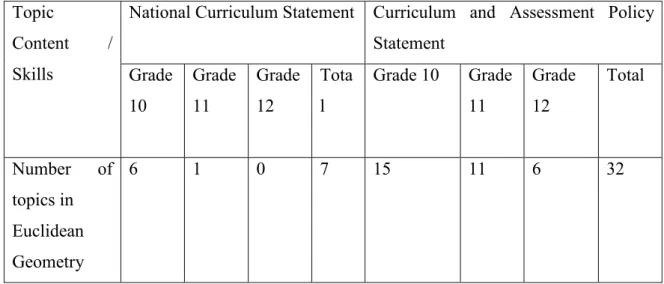
Table 2.2 Content / skills coverage: Number of subtopics in NCS and CAPS. Adapted from (Mthethwa, 2015, p.24)
Topic
Content / Skills
National Curriculum Statement Curriculum and Assessment Policy Statement Grade 10 Grade 11 Grade 12 Tota l Grade 10 Grade 11 Grade 12 Total Number of topics in Euclidean Geometry 6 1 0 7 15 11 6 32
Table 2.2 shows that the Euclidean Geometry content coverage increases in the Mathematics curriculum. There were some aspects of Euclidean Geometry in NCS, but those introduced in CAPS seem to be revised and with a higher level of demand. This means that CAPS is
22
significantly more demanding (DoE, 2011). Therefore, exposing learners within the GeoGebra programme might enhance learners’ constructive learning to understand Euclidean Geometry concepts better.
Table 2.3 Weighting per topic by percentage of marks. Adapted from (DBE, 2011, p.10) Topics NCS (Percentage of marks) CAPS (Percentage of marks)
Grad e 10 Grade 11 Grade 12 Total Grade 10 Grade 11 Grade 12 Total Algebra 12.5 8.3 6.7 8.8 15.0 15.0 8.3 12.5 Euclidean Geometry 5.0 3.3 0 2.5 15.0 16.7 16.7 16.3 Trigonometry 12.5 16.7 20.0 16.9 20.0 16.7 13.3 16.3 Table 2.3 shows the three topics which are given higher emphasis in the CAPS than in the NCS which are highly demanding topics. In pacing, CAPS requires high and fast pacing as compared to NCS, and the pedagogical approach to CAPS leans more to a higher cognitive demand. According to Mthethwa (2015) the Euclidean Geometry in CAPS is deemed to be considerably more challenging than the NCS, since the CAPS content exceeds that of the NCS in both breadth and depth.
Table 2.3 clearly shows that on the content base, the subtopics of Euclidean Geometry have increased from a total of 7 in NCS to 32 in CAPS. There was an increase of 8 subtopics for both Grades 10 and 11, from 6 subtopics to 15 subtopics and 1 subtopic to 11 subtopics respectively (DBE, 2011). Subsequently, the highly demanding Euclidean Geometry section needs some sort of intervention. As a result this study proposes the utilisation of the GeoGebra programme as a learning manipulative to facilitate learners’ constructive learning ultimately to conquer this highly demanding Euclidean Geometry section.
The current study seeks to address the alternative learning ways for learners to perform better in highly demanding topics, especially in Euclidean Geometry which has relatively more marks allocated (See Table 2.3). Therefore, it is very important to look at the uses of some dynamic Geometry programmes in respect to supporting Mathematics learning, in particular Euclidean
23
Geometry learning. In the following section the researcher will ascertain the use of the Dynamic Geometry programme on Euclidean Geometry.
2.6 THE USE OF TECHNOLOGY FOR MATHEMATICS LEARNING
2.6.1 Dynamic Geometry programmeThe first programme to be developed was the Geometer Supposer by Judah Schwartz and Michal Yerushalmy (Doolittle, 2014). It contained three different programmes; triangles, quadrilaterals and circles. Supposer’s key features were to formulate geometrical figures by repeating drawings exploiting different beginning points.
An interactive Geometry programme like CABRI Geometry and Geometers’ Sketchpad were developed independently around the same time (Pfeiffer, 2017). The first free Dynamic Geometry programme environment is WinGeon developed by Rick Parris with two versions: one for two dimensions (2D) and the other for three dimensions (3D) (Gerry, 2016; İçel, 2013). The mentioned interactive programme options, although useful in improving the understanding of Geometry concepts, are not easily accessible to the learning community of public schools as they are not free (Kekana, 2016).
2.6.2 The GeoGebra programme
GeoGebra is a dynamic Mathematics programme that was created by a mathematician Markus Hohenwarter while doing his Master’s degree at the University of Salzburg in 2002 (Giurgiules & Mion, 2015). According to Vasque (2015) the GeoGebra programme is an open source dynamic Mathematics programme which aims to merge a dynamic geometric programme and computer algebra system in order to have a single software package that accommodates for algebra, calculus, as well as Geometry. The GeoGebra programme could be downloaded from the GeoGebra website at http://www.geogebra.org (Ocal, 2017). The GeoGebra programme is very popular worldwide. To cater to a broader range of learners in the world the GeoGebra programme has been translated into many official languages and official GeoGebra website visitors have also greatly increased (Vasque, 2015).
The GeoGebra programme is a programme that is based on global Mathematics standards which support the curriculum. It was designed in a way that enables learners to develop a deep understanding of the mathematical theories through the practical application, and the
self-24
discovery of the concepts (Kosa, 2016). The programme is composed of a set of toolbars that provide an active learning feature in which the learner can easily access and construct the geometrical figures. This unique feature of the GeoGebra programme enables learners to construct the geometry figures and then to establish Euclidean Geometry proofs with appropriate reasons (Farrajallah, 2016). Exposing learners to the GeoGebra programme based Euclidean Geometry learning environment may meaningfully engage learners towards constructive learning.
2.6.3 The GeoGebra programme supports visual learning
Most of the study findings indicated that visual learning is an important form of learning as it includes five different skills; observation, recognition, interpretation, perception, and self-expression (Vasque, 2015). Exposing learners to a visual learning environment creates an opportunity for them to view and analyse the geometry concepts. The visual learning might support higher degree recall. The learners being able to recall the geometric properties may lead them to develop comprehensive understanding of Euclidean Geometry. Learners being engaged in the visual learning classroom may analyse, make conjectures, and express ideas to others by sketching or drawing images (Bist, 2017). Most importantly, the visual learning attracts learners’ attention and interest. Researchers agreed that engaging learners in their learning is the hardest job to do, particularly towards Mathematics. The use of visual teaching and learning aids might assist the teaching and learning process to be the most interactive. (Bansilal, 2015; Kutluca, 2013; Yildiz & Baltaci, 2016) .
For instance, Robert Gagne exclusively illustrated how the learning goal could be achieved. His work on Conditions of Learning Theory includes “conditions of learning, association learning, five categories of learning outcomes and nine events of instruction” (Edgars, 1969). His learning theory particularly emphasises what and how to teach. (Mosia, 2016). Gagne believed that nine steps should be followed for true learning to happen. According to his nine hierarchical learning steps, the first step of learning is paying attention. In order to entice learners to be hooked to the teaching and learning process, the lessons should be supplemented with the visual learning aids. (Cole, 1985) .
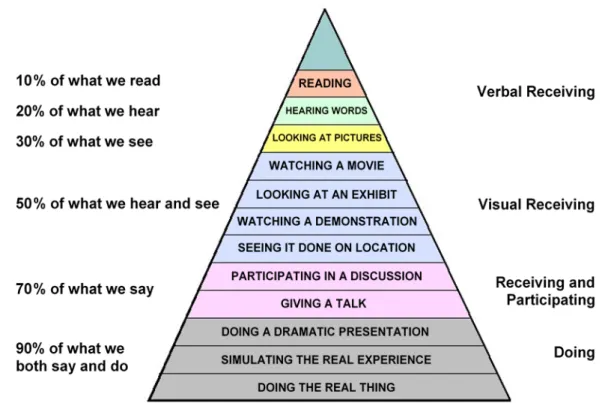
The figure 2.2 clearly illustrates that learners can remember 50 percent of what they see. Learners can remember only 20 percent of what they hear. Therefore, the incorporation of the
25
GeoGebra programme as a learning programme into Euclidean Geometry learning might facilitate an environment for visual learning. Most importantly, learners remember 90 percent of what they do. The tasks designed for the current study mainly focused on a learner- centred approach. That means they will do the given tasks on the computer screen and they can see their work (Kutluca, 2014). This theory was developed as a result of Edgar Dale’s research in the 1960s that “learners retain more information by what they do as opposed to what they hear, read, or observe” (Anderson, 2013, p.35).
Figure 2.2: A diagram showing the Learning Cone of experience adapted from (Anderson, 2013, p.35)
Hence, exposing learners to a visual learning environment is one of the key aspects to be considered while someone designs the lesson plan. As long as the learning environment supports learners engagement within visual learning, half percentage (50%) of the lesson being taught will be remembered by the learners (Luneta, 2014). Meanwhile, using the GeoGebra programme in the Mathematics classroom inspires learners to do their tasks on the computer screen. The aim of the current study is to create an environment for learners that will assist them to understand the learning material, not to memorise it (DBE, 2011). Once the learners see visually projected geometrical diagrams on the computer screen, they can easily start to think about the properties and relationships of geometrical objects. Therefore, visual learning aids are very important tools of learning to illustrate theoretically abstract lesson contents (Farrajallah, 2016). Hence, visual learning computer programmes may encourage learners to
26
think critically from what they observe and may help them to develop better visual learning skill.
Farrajallah (2016) also emphasises that mental images enable learners to interact with mathematical concepts. Furthermore, Naidoo (2012) stated that the visual image is a symbolic demonstration of the visual appearance of an object. Visuals help to break down abstract Mathematics concepts leading to better understanding and comprehension and advanced mathematical skills (Kosa, 2016).
According to Shadaan and Eu (2014) visual learning based computer programmes can increase the learning potential of all learners along with their ability to acquire and communicate mathematical concepts According to Tsiteisia (2014) learners who were engaged in the visual learning medium developed a higher level of inquiry learning interest in the classroom. Some researchers also in this regard indicate that that visual learning programme, particularly the GeoGebra programme advances the concrete understanding of learners in Euclidean Geometry (Farrajallah, 2016; Khobo, 2015; Kösa, 2016; Molnar, 2016). For instance, a s