University of Pennsylvania
ScholarlyCommons
Statistics Papers
Wharton Faculty Research
2016
Fast Bayesian Factor Analysis via Automatic
Rotations to Sparsity
Veronika Ročková
Edward I. George
University of PennsylvaniaFollow this and additional works at:
https://repository.upenn.edu/statistics_papers
Part of the
Business Analytics Commons
,
Management Sciences and Quantitative Methods
Commons
, and the
Statistics and Probability Commons
This paper is posted at ScholarlyCommons.https://repository.upenn.edu/statistics_papers/645
For more information, please [email protected].
Recommended Citation
Ročková, V., & George, E. I. (2016). Fast Bayesian Factor Analysis via Automatic Rotations to Sparsity.Journal of the American Statistical Association, 111(516), 1608-1622.http://dx.doi.org/10.1080/01621459.2015.1100620
Fast Bayesian Factor Analysis via Automatic Rotations to Sparsity
Abstract
Rotational post hoc transformations have traditionally played a key role in enhancing the interpretability of factor analysis. Regularization methods also serve to achieve this goal by prioritizing sparse loading matrices. In this work, we bridge these two paradigms with a unifying Bayesian framework. Our approach deploys
intermediatefactor rotations throughout the learning process, greatly enhancing the effectiveness of sparsity inducing priors. These automatic rotations to sparsity are embedded within a PXL-EM algorithm, a Bayesian variant of parameter-expanded EM for posterior mode detection. By iterating between soft-thresholding of small factor loadings and transformations of the factor basis, we obtain (a) dramatic accelerations, (b) robustness against poor initializations, and (c) better oriented sparse solutions. To avoid the prespecification of the factor cardinality, we extend the loading matrix to have infinitely many columns with the Indian buffet process (IBP) prior. The factor dimensionality is learned from the posterior, which is shown to concentrate on sparse matrices. Our deployment of PXL-EM performs a dynamic posterior exploration, outputting a solution path indexed by a sequence of spike-and-slab priors. For accurate recovery of the factor loadings, we deploy the spike-and-slab LASSO prior, a two-component refinement of the Laplace prior. A companion criterion, motivated as an integral lower bound, is provided to effectively select the best recovery. The potential of the proposed procedure is demonstrated on both simulated and real high-dimensional data, which would render posterior simulation impractical. Supplementary materials for this article are available online.
Keywords
EM algorithm, factor rotations, parameter expansion, sparsity, spike-and-slab LASSO
Disciplines
Fast Bayesian Factor Analysis via
Automatic Rotations to Sparsity
by
Veronika Roˇckov´a and Edward I. George 1
The University of Pennsylvania
August 30, 2014
Abstract
Rotational transformations have traditionally played a key role in enhancing the interpretability of factor analysis via post-hoc modifications of the model orientation. Here, we propose a uni-fied Bayesian approach that incorporates factor rotations within the model fitting process, greatly enhancing the effectiveness of sparsity inducing priors. These automatic transformations are em-bedded within a new PXL-EM algorithm, a Bayesian variant of parameter-expanded EM for fast posterior mode detection. By iterating between soft-thresholding of small factor loadings and trans-formations of the factor basis, we obtain dramatic accelerations yielding convergence towards better oriented sparse solutions. For accurate recovery and estimation of factor loadings, we propose a spike-and-slab LASSO prior, a two-component refinement of the Laplace prior. Our approach is au-tomatic, because it does not require any pre-specification of the factor dimension. This assumption is avoided by introducing infinitely many factors with the Indian Buffet Process (IBP) prior. The specification of identifiability constraints is also completely avoided. The PXL-EM, made available by the stick-breaking IBP representation, capitalizes on the very fast LASSO implementations and converges quickly. Dynamic posterior exploration over a sequence of spike-and-slab priors is seen to facilitate the search for a global posterior mode. For mode selection, we propose a criterion based on an integral lower bound to the marginal likelihood. The potential of the proposed procedure is demonstrated on both simulated and real high-dimensional data, which would render posterior simulation impractical.
Keywords: Indian Buffet Process; Infinite-dimensional Factor Analysis; Factor Rotation; PXL-EM; Spike-and-slab LASSO.
1
Veronika Roˇckov´a is a postdoctoral researcher at the Department of Statistics, University of Pennsylvania,
Philadel-phia, PA, 19104, [email protected]. Edward I. George is Professor of Statistics, Department of Statistics, University of Pennsylvania, Philadelphia, PA, 19104, [email protected].
1
Bayesian Factor Analysis Revisited
Latent factor models aim to find regularities in the variation among multiple responses, and relate these to a set of hidden causes. This is typically done within a regression framework through a linear superposition of unobserved factors. The traditional setup for factor analysis consists of an n×G
matrix Y = [y1, . . . ,yn]0 of n independent G-dimensional vector observations. For a fixed factor dimensionK, the generic factor model is of the form
f(yi|ωi,B,Σ)
ind
∼ NG(Bωi,Σ), ωi ∼ NK(0,IK), (1.1)
for 1≤i≤n, whereΣ=diag{σ2
j}Gj=1 is a diagonal matrix of unknown positive scalars,ωi∈RKis the
ith realization of the unobserved latent factors, and B ∈ RG×K is the matrix of factor loadings that
weight the contributions of the individual factors. Marginally, f(yi |B,Σ) =NG(0,BB0+Σ),1 ≤
i≤n, a decomposition which uses at mostG×K parameters instead ofG(G+ 1)/2 parameters in the unconstrained covariance matrix. Note that we have omitted an intercept term, assuming throughout that the responses have been centered.
Fundamentally a multivariate regression with unobserved regressors, factor analysis is made more more challenging by the uncertainty surrounding the number and orientation of the regressors. A per-sistent difficulty associated with the factor model (1.1) has been thatB is unidentified. In particular, any orthogonal transformation of the loading matrix and latent factors Bωi = (BP)(P0ωi) yields
exactly the same distribution forY. Although identifiability is not needed for prediction or estimation of the marginal covariance matrix, non-sparse orientations diminish the potential for interpretability, our principal focus here.
The main thrust of this paper is the development of a Bayesian approach for factor analysis that can automatically identify interpretable factor orientations with a fast deterministic implementation. Our approach does not make use of any of the usual identifiability constraints on the allocation of the zero elements of B, such as lower-triangular forms (Lopes and West, 2004) and their generalizations (Fr¨uhwirth-Schnatter and Lopes, 2009). Nor do we require prespecification of the factor cardinality
K. Instead, the loading matrix B is extended to include infinitely many columns, where the number of “effective” factors remains finite with probability one.
Our approach begins with a prior on the individual elements in B = {βjk}G,
∞
j,k=1 that induces posterior zeroes with high-probability. Traditionally, this entails some variant of a spike-and-slab prior that naturally segregates important coefficients from coefficients that are ignorable (George and McCulloch, 1993; West, 2003; Carvalho et al., 2008; Rai and Daum´e, 2008; Knowles and Ghahramani, 2011). The specification of such priors is facilitated by the introduction of a latent binary allocation matrix Γ = {γjk}G,
∞
factor. Given eachγjk ∈ {0,1}for whetherβjk should be ignored, a particularly appealing
spike-and-slab variant has been
π(βjk|γjk, λ1) = (1−γjk)δ0(βjk) +γjkφ(βjk|λ1), (1.2) where δ0(·) is the “spike distribution” (atom at zero) and φ(· |λ1) is the absolutely continuous “slab distribution” with exponential tails or heavier, indexed by a hyper-parameter λ1. Coupled with a suitable beta-Bernoulli prior on the binary indicators γjk, the point-mass generative model (1.2) has
been shown to yield optimal rates of posterior concentration, both in linear regression (Castillo and van der Vaart, 2012; Castillo et al., 2014) and covariance matrix estimation (Pati et al., 2014). This “methodological ideal”, despite being amenable to posterior simulation, poses serious computational challenges in high-dimensional data. These challenges are even more pronounced with the infinite factor models considered here, where a major difficulty is finding highly probable zero allocation patterns within infinite loading matrices.
We will address this challenge by developing a tractable inferential procedure that does not rely on posterior simulation and thereby is ideally suited for high-dimensional data. At the heart of our approach is a novel spike-and-slab LASSO (SSL) prior, a feasible continuous relaxation of its limiting special case (1.2). Such relaxations transform the obstinate combinatorial problem into one of optimization in continuous systems, permitting the use of EM algorithms (Dempster et al., 1977), a strategy we pursue here. The SSL prior will be coupled with the Indian Buffet Process (IBP) prior, which defines a prior distribution on the allocation patterns of active elements within the infinite loading matrix. Our EM algorithm capitalizes on the stick-breaking representation of the IBP, which induces increasing shrinkage of higher-ordered factor loadings.
The indeterminacy of (1.1) due to rotational invariance is ameliorated with the SSL prior, which anchors on sparse representations. This prior automatically promotes rotations with many zero load-ings by creating ridge-lines of posterior probability along coordinate axes, thereby radically reducing the posterior multimodality. Whereas empirical averages resulting from posterior simulation may ag-gregate probability mass from multiple modes and are non-sparse, our EM algorithm yields sparse modal estimates with exact zeroes in the loading matrix.
The search for promising sparse factor orientations is greatly enhanced with data augmentation by expanding the likelihood with an auxiliary transformation matrix (Liu et al., 1998). Exploiting the rotational invariance of the factor model, we propose a PXL-EM (parameter expanded likelihood EM) algorithm that automatically rotates the loading matrix as a part of the estimation process, gearing the EM trajectory along the orbits of equal likelihood. The SSL prior then guides the selection from the many possible likelihood maximizers. Moreover, the PXL-EM algorithm is far more robust against poor initializations, converging dramatically faster than the parent EM algorithm and inducing
orthogonal latent factor featurizations.
As with many other sparse factor analyzers (Knowles and Ghahramani, 2011; Fr¨uhwirth-Schnatter and Lopes, 2009; Carvalho et al., 2008), the number of factors will be inferred through the estimated patterns of sparsity. In over-parametrized models with many redundant factors, this can be hampered by the phenomenon of factor splitting, i.e. the smearing of factor loadings across multiple correlated factors. Such factor splitting is dramatically reduced in our approach, because the IBP construction prioritizes lower indexed loadings and the PXL-EM rotates towards independent factors.
To facilitate the search for a global maximum we implement dynamic posterior exploration, a sequential reinitialization along a ladder of increasing spike penalties. Posterior modes will be evaluated by a criterion motivated as an integral lower bound to a posterior probability of the implied sparsity pattern.
The paper is structured as follows. Section 2 introduces our hierarchical prior formulation for infinite factor loading matrices, establishing some of its appealing theoretical properties. Section 3 develops the construction of our basic EM algorithm, which serves as a basis for the PXL-EM algorithm presented in Section 4. Section 5 describes the dynamic posterior exploration strategy for PXL-EM deployment, demonstrating its effectiveness on simulated data. Section 6 derives and illustrates our criterion for factor model comparison. Sections 7 and 8 present applications of our approach on real data. Section 9 concludes with a discussion.
2
Infinite Factor Model with Spike-and-Slab LASSO
The cornerstone of our Bayesian approach is a hierarchically structured prior on infinite-dimensional loading matrices, based on the spike-and-slab LASSO prior of Rockova and George (2014b). For each loading βjk, we consider a continuous relaxation of (1.2) with two Laplace components: a slab
component with a common penalty λ1, and a spike component with a penaltyλ0k that is potentially
unique to thekth factor. More formally,
π(βjk|γjk, λ0k, λ1) = (1−γjk)φ(βjk|λ0k) +γjkφ(βjk|λ1), (2.1) where φ(β|λ) = λ2 exp{−λ|β|} is a Laplace prior with mean 0 and variance 2/λ2 and λ0k >> λ1 > 0, k= 1, . . .∞. The prior (2.1) will be further denoted asSSL(λ0k, λ1). Coupled with a prior onγjk,
this mixture prior induces a variant of “selective shrinkage” (Ishwaran and Rao, 2005) that adaptively segregates the active coefficients from the ignorable via differential soft-thresholding. The coefficients
βjk with active selection indicators (γjk = 1) are left relatively unaffected by keeping the slab penalty
spike penaltyλ0k be substantially larger thanλ1. The point-mass prior (1.2) is obtained as a limiting special case of (2.1) when λ0k→ ∞.
Despite its continuity at the origin, theSSL(λ0k, λ1) mixture prior thresholds smallerβjk to exact
zeroes, aligning posterior modes along the coordinate axes. This is in sharp contrast to existing spike-and-slab priors with continuous Gaussian spike distributions (George and McCulloch, 1993; Rockova and George, 2014a), whose non-sparse posterior modes must be thresholded for variable selection. The exact sparsity of the posterior modes here will be crucial for anchoring interpretable factor orientations.
For the diagonal elements of Σ, we assume independent inverse gamma priors
σ12, . . . , σ2Giid∼IG(η/2, ηξ/2) (2.2)
with the relatively noninfluential choice η= 1 and ξ= 1.
The prior construction is completed with the specification of a prior distribution over the feature allocation matrix Γ = {γjk}G,j,k∞=1. As with similar sparse infinite factor analyzers (Knowles and Ghahramani, 2011; Rai and Daum´e, 2008), we consider the Indian Buffet Process (IBP) prior of Griffiths and Ghahramani (2005), which defines an exchangeable distribution over equivalence classes [Γ] of infinite-dimensional binary matrices. Formally, the IBP with intensity parameterα >0 arises from the beta-Bernoulli prior
π(γjk|θk)ind∼ Bernoulli(θk), (2.3) π(θk) ind ∼ Bα K,1 ,
by integrating out theθk’s and by taking the limitK → ∞ (Griffiths and Ghahramani, 2011). Each
equivalence class [Γ] contains all matricesΓwith the same left-ordered form, obtained by ordering the columns from left to right by their binary numbers. Marginally,
π([Γ]) = α K+ Q2G−1 h=1 Kh! exp (−αHG) K+ Y k=1 (G− |γk|)! (|γk| −1)! G! , (2.4) where |γk| = PG
j=1γjk, HN = PNj=11j is the N-th harmonic number, K
+ is the number of active factors, i.e. K+ = P
kI(|γk|>0), and Kh is the number of columns γk expressing the same binary
number h. Proceeding marginally over θk lends itself naturally to a Gibbs sampler (Knowles and
Ghahramani, 2011; Rai and Daum´e, 2008). However, to obtain an EM algorithm, we will instead proceed conditionally on a particular ordering of the θk’s. We will capitalize on the following
stick-breaking representation of the IBP (Teh et al., 2007).
Theorem 2.1. (Teh et al., 2007)) Let θ(1) > θ(2) > ... > θ(K) be a decreasing ordering of θ = (θ1, . . . , θK)0, where each θk
iid ∼ B α
K,1
stick-breaking law θ(k)= k Y l=1 νl, where νl iid ∼ B(α,1). (2.5)
Remark 2.1. Unlike the stick-breaking construction for the Dirichlet process prior, here we recurse on the length of the remaining piece of the stick rather than the discarded piece.
Remark 2.2. The implicit ordering θ(1) > θ(2) > ... > θ(K) induces a soft identifiability constraint
against the permutational invariance of the factor model.
To sum up, our hierarchical prior Πλ0k(B) on infinite factor loading matrices B ∈R
G×∞ is: π(βjk|γjk)∼SSL(λ0k, λ1), γjk|θ(k)∼Bernoulli[θ(k)], θ(k)= k Y l=1 νl, νl iid ∼ B(α,1). (2.6)
The representation (2.5) naturally provides a truncated stick-breaking approximation to the IBP under which θ(k) = 0 for all k > K?. By choosing K? suitably large, and also assuming β
jk = 0 for
all k > K?, this approximation will play a key role in the implementation of our EM algorithm. The next section summarizes some of the properties of Πλ0k(B), which justify its use as an implicit prior
on the marginal covariance matrix and also establish a suitable lower bound onK?.
2.1 Properties of the Prior
When dealing with infinite-dimensional loading matrices, the implied marginal covariance matrix
Λ=BB0+Σneeds to have all entries finite with probability one (Bhattacharya and Dunson, 2011). This property would be guaranteed under the point-mass prior Π∞(B), where the underlying IBP
process places zero probability on allocation matrices with bounded effective dimensionK+ (Griffiths and Ghahramani, 2011). In the next theorem, we show that this property continues to hold for the continuous relaxation Πλ0k(B) withλ0k<∞.
Theorem 2.2. Let Πλ0k(B) denote the prior distribution (2.6)on a loading matrix B with infinitely many columns. Assuming k/λ0k=O(1), we have
max 1≤j≤G ∞ X k=1 βjk2 ! <∞ Πλ0k-almost surely. (2.7)
Proof. Appendix (Section 10.1).
Remark 2.3. The statement (2.7)is equivalent to claiming that entries inBB0 are finite,Πλ0k-almost surely.
In our EM implementation, we will be relying on the truncated approximation to B, setting all loadings βjk indexed by k > K? to zero. The truncated loading matrix BK
?
yields a marginal covariance matrix ΛK? = BK
?
BK?0 +Σ, which can be made arbitrarily close to Λ by considering
K? large enough. The closeness of such approximation will be measured in the sup-norm metric
d∞(Λ,ΛK ?
) = max1≤j,m≤G|Λjk−Λ?mk|. In the next theorem we derive a lower bound on the order
of the approximation K? so that d∞(Λ,ΛK ?
) < εwith large probability. There we will assume that the spike penalties increase exponentially, i.e. λ20k = (1/a)k, where 0 < a <1. This assumption can be relaxed, as noted at the end of this section.
Theorem 2.3. Assume λ20k= (1/a)k with 0< a <1. Then for anyε >0, we have
P(d∞(Λ,ΛK ?
)≤ε)>1−ε, whenever K? > maxnloghεe
2(1−a)
i
/log(a); loghλ21eε
2 (1−µ)
i
/log(µ)o, where µ = 1+αα and εe=
ε[1−(1−ε)1/G].
Proof. Appendix (Section 10.2).
Remark 2.4. Theorem 2.3 shows that higher K? values are needed when the reciprocal penalty decay rate a and/or the mean breaking fractionµ= 1+αα are closer to one.
Remark 2.5. As an aside, it also follows from the proof of Theorem 2.3 (equation (10.1)) that the probability P(d∞(Λ,ΛK
?
)≤ε) converges to one exponentially fast with K?.
Theorem 2.3 can be further extended to show that the prior Πλ0k(B) places positive probability in
an arbitrarily small neighborhood around any covariance matrix, and hence the posterior distribution ofΩis weakly consistent. According to Bhattacharya and Dunson (2011) (proof of Proposition 2 and Theorem 2), it suffices to show that the prior concentrates enough probability in a Frobenius-norm neighborhood around any true loading matrixB0. This result is summarized in the next theorem.
Theorem 2.4. Let B0 denote any (G× ∞) loading matrix with K+ <∞ nonzero columns and let
BεF(B0)be anε-neighborhood ofB0under the Frobenious norm. Assumeλ20k= (1/a)k with0< a <1.
Then Πλ0k
BεF(B0)>0 for any ε >0.
Proof. Follows directly from Theorem 2.3 and the proof of Proposition 2 of Bhattacharya and Dunson (2011).
Pati et al. (2014) studied prior distributions that yield the optimal rate of concentration of the posterior measures around any true covariance matrix in operator norm, when the dimensionG=Gn
can be much larger than the sample sizen. The authors considered a variant of the point-mass mixture prior Π∞(B) and showed that it leads to consistent covariance estimation in high-dimensional settings,
where the posterior concentrates at a rate that is minimax up to a factor of √logn (Theorem 5.1 of Pati et al. (2014)). This result was shown for a slightly different hierarchical model for the binary allocations. First, the effective factor dimension K+ is picked from a distributionπK+, which decays
exponentially, i.e. πK+(K+ > k) ≤ exp(−C k) for some C > 0. Second, each binary indicator
is sampled from a Bernoulli prior with a common inclusion probability θ arising from a beta prior B(1, K0nGn+ 1) with expectation 1/(2 +K0nGn), where K0n is the true factor dimension.
The IBP prior instead uses factor-specific inclusion probabilities θ(1) > θ(2) > . . . obtained as a limit of ordered sequences of K independent beta random variables with expectation 1/(1 +K/α), when K → ∞. The stick-breaking law then yields E[θ(k)] = 1+11/αk. The parallel between the IBP and the prior of Pati et al. (2014) is instructive for choosing a suitable intensity parameter α. Selecting α ∝ 1/G leads to an IBP formulation that is more closely related to a prior yielding the desired theoretical properties. Moreover, in the next theorem we show that for suchα, the IBP process induces an implicit prior distribution onK+, which also decays exponentially.
Theorem 2.5. Let [Γ] be distributed according to the IBP prior (2.4) with an intensity 0 < α ≤1. Let K+ denote the effective factor dimension, that is the largest index K+∈N, so thatγjk = 0for all
k > K+, j= 1, . . . , G. Then P(K+> k)<2 G(α+ 1) +4 3 exp −(k+ 1) log α+ 1 α
Proof. Appendix (Section 10.3).
The properties discussed in Theorems 2.2, 2.3 and 2.4 were studied under the assumption of increasing shrinkage for higher-indexed factors, i.e. λ20k= (1/a)k,0< a <1. The discussed guarantees will continue to hold also assuming λ01 =· · · = λ0K? and λ0k = ∞ when k > K? for some suitable K?, i.e. K? ≥ K+. This more practical variant of our prior Π
λ0k(B) will be used throughout our
simulated examples and for the data analysis.
3
The EM Approach to Bayesian Factor Analysis
We will leverage the resemblance between factor analysis and multivariate regression, and implement a sparse variant of the EM algorithm for probabilistic principal components (Tipping and Bishop, 1999). We will capitalize on EMVS, a fast method for posterior model mode detection in linear regression under spike-and-slab priors (Rockova and George, 2014a). To simplify notation, throughout the section we will denote the truncated approximationBK? byB, for some pre-specifiedK?. Similarly,θ will be the finite vector of ordered inclusion probabilitiesθ= (θ1, . . . , θK?)0 andλ0k=λ0 fork= 1, . . . , K?.
Letting ∆ = (B,Σ,θ), the goal of the proposed algorithm will be to find parameter values ∆b
This task would be trivial if we knew the hidden factors Ω= [ω1, . . . ,ωn]0 and the latent allocation
matrix Γ. In that case the estimates would be obtained as a unique solution to a series of penalized linear regressions. On the other hand, if∆were known, then Γ andΩ could be easily inferred. This “chicken-and-egg” problem can be resolved iteratively by alternating between two steps. Given∆(m)
at themthiteration, the E-step computes expected sufficient statistics of hidden/missing data (Γ,Ω). The M-step then follows to find the a-posteriori most likely ∆(m+1), given the expected sufficient statistics. These two steps form the basis of a vanilla EM algorithm with a guaranteed monotone convergence to at least a local posterior mode.
More formally, the EM algorithm locates modes ofπ(∆|Y) iteratively by maximizing the expected logarithm of the augmented posterior. Given an initialization∆(0), the (m+ 1)st step of the algorithm outputs∆(m+1)= arg max∆Q(∆), where
Q(∆) =EΓ,Ω|Y,∆(m)[logπ(∆,Γ,Ω|Y)], (3.1)
withEΓ,Ω|Y,∆(m)(·) denoting the conditional expectation given the observed data and current
param-eter estimates at the mth iteration. Note that we have parametrized our posterior in terms of the ordered inclusion probabilitiesθ rather than the breaking fractions ν. These can be recovered using the stick-breaking relationshipνk=θ(k)/θ(k−1). This parametrization yields a feasible M-step, as will be seen below.
We now take a closer look at the objective function (3.1). For notational convenience, let hXi denote the conditional expectationEΓ,Ω|Y,∆(m)(X). As a consequence of the hierarchical separation
of model parameters, (B,Σ) andθ are conditionally independent given (Ω,Γ). Thereby
Q(∆) =Q1(B,Σ) +Q2(θ),
where Q1(B,Σ) =hlogπ(B,Σ,Ω,Γ|Y)i and Q2(θ) =hlogπ(θ,Γ|Y)i. The functionQ2(θ) can be further simplified by noting that the latent indicators γjk enter linearly and thereby can be directly
replaced by their expectationshγjki, yieldingQ2(θ) = logπ(hΓi |θ) + logπ(θ). The termQ1(B,Σ) is
also linear inΓ, but involves quadratic termsωiω0i, namely
Q1(B,Σ) =C− 1 2 n X i=1 (yi−Bhωii)0Σ−1(yi−Bhωii) +tr B0Σ−1B(hωiω0ii − hωiihωii0) − G X j=1 K? X k=1 |βjk|(λ1hγjki+λ0(1− hγjki))− n+ 1 2 G X j=1 logσj2− G X j=1 1 2σ2 j , (3.2)
where C is a constant not involving ∆. The E-step entails the computation of both first and second conditional moments of the latent factors. The updates are summarized below.
3.1 The E-step
The conditional posterior mean vectorhωii is obtained as a solution to a ridge-penalized regression of
Σ(m)−1/2yi on Σ(m)−1/2B(m). This yields hΩ0i= B(m)0Σ(m)−1B(m)+ IK? −1 B(m)0Σ(m)−1Y0. (3.3) The conditional second moments are then obtained from hωiω0ii = M +hωiihωii0, where M =
B(m)0Σ(m)−1B(m)+ IK?
−1
is the conditional covariance matrix of the latent factors, which does not depend oni. We note in passing that the covariance matrix M can be regarded as a kernel of a smoothing penalty.
The E-step then proceeds by updating the expectation of the binary allocationsΓ. The entries can be updated individually by noting that conditionally on∆(m), theγjk’s are independent. The model
hierarchy separates the indicators from the data through the factor loadings so that π(Γ|∆,Y) =
π(Γ|∆) does not depend onY. This leads to rapidly computable updates
hγjki ≡P γjk = 1|∆(m) = θ (m) k φ(β (m) jk |λ1) θk(m)φ(βjk(m)|λ1) + (1−θ(km))φ(β(jkm)|λ0) . (3.4)
As shown in the next section, the conditional inclusion probabilities hγjki serve as adaptive mixing
proportions between spike and slab penalties, determining the amount of shrinkage of the associated
βjk’s.
3.2 The M-step
Once the latent sufficient statistics have been updated, the M-step consists of maximizing (3.1) with respect to the unknown parameters∆. Due to the separability of (B,Σ) andθ, these groups of param-eters can be optimized independently. The next theorem explains how Q1(B,Σ) can be interpreted as a log-posterior arising from a series of independent penalized regressions, facilitating the exposition of the M-step. First, let us denote Y = [y1, . . . ,yG], hΩi = [hω1i, . . . ,hωni]0 and let β1, . . . ,βG be
the columns of B0.
Theorem 3.1. Denote by Ye =
Y
0K?×K?
!
∈R(n+K?)×G a zero-augmented data matrix with column
vectors ey1, . . . ,yeG. Let Ωe = hΩi √ nML ! ∈R(n+K?)×G
, where ML is the lower Cholesky factor of M.
Then Q1(B,Σ) = G X j=1 Qj(βj, σj), (3.5)
where Qj(βj, σj) =− 1 2σj2||ey j− e Ωβj||2− K? X k=1 |βjk|λjk− n+ 1 2 logσ 2 j − 1 2σj2 (3.6) with λjk =hγjkiλ1+ (1− hγjki)λ0.
Proof. The statement follows by rearranging the terms in the first row of (3.2). Namely, in the likeli-hood term we replace the row summation by a column summation. Then, we rewriten2 tr(B0Σ−1BM) =
PG
j=1 2nσ2
j
β0jM βj. This quadratic penalty can be embedded within the likelihood term by augmenting the data rows as stated in the theorem.
Remark 3.1. The proof of Theorem 3.1 explains why M can be regarded as a kernel of a Markov
Random Field smoothing prior, penalizing linear combinations of loadings associated with correlated factors.
Based on the previous theorem, each β(jm+1) (the jth row of the matrixB(m+1)) can be obtained by deploying an “adaptive LASSO” computation (Zou, 2006) with a responseye
j
and augmented data matrix Ωe. Each coefficient βjk is associated with a unique penalty parameter 2σ
(m)
j λjk, which is
proportional toλjk, an adaptive convex combination of the spike and slab LASSO penalties. Notably,
each λjk yields a “self-adaptive” penalty, informed by the data through the most recent β
(m)
jk at the
mth iteration.
The computation is made feasible with the very fast LASSO implementations (Friedman et al., 2010), which scale very well with both K? and n. First, the data matrix is reweighted by a vector (1/λj1, . . . ,1/λjK?)0 and a standard LASSO computation is carried out with a penalty 2σ(m)
j . The
resulting estimate is again reweighted by 1/λjk (Zou, 2006), yielding β
(m+1)
j . Note that the updates
β(jm+1)(j= 1, . . . , G) are obtained conditionally onΣ(m)and are independent of each other, permitting the use of distributed computing. This step is followed by a closed form updateΣ(m+1)withσj(m+1)2=
1
n+1(||y
j− e
Ωβ(jm+1)||2+ 1), conditionally on the newB(m+1). Despite proceeding conditionally in the M-step, monotone convergence is still guaranteed (Meng and Rubin, 1993).
Now we continue with the update of the ordered inclusion probabilities θ from the stick-breaking construction. To motivate the benefits of parametrization based onθ, let us for a moment assume that we are actually treating the breaking fractions ν as the parameters of interest. The corresponding objective function Q? 2(ν) = logπ(hΓi | ν) + logπ(ν) is Q?2(ν) = G X j=1 K? X k=1 ( hγjki k X l=1 logνl+ (1− hγjki) log 1− k Y l=1 νl !) + (α−1) K? X k=1 log(νk), (3.7)
a nonlinear function that is difficult to optimize. Instead, we use the stick-breaking law and plug
νk=θ(k)/θ(k−1) into (3.7). The objective function then becomes
Q2(θ) = G X j=1 K? X k=1
[hγjkilogθk+ (1− hγjki) log(1−θk)] + (α−1) logθK?, (3.8)
whose maximum θ(m+1) can be found by solving a linear program with a series of constraints
θk−θk−1 ≤0, k= 2, . . . , K?, 0≤θk≤1, k= 1, . . . , K?.
Had we assumed the finite beta-Bernoulli prior (2.3), the update of the (unordered) occurrence prob-abilities would simply become θk(m)=
PG
j=1hγjki+a−1 a+b+G−2 .
Note that the the ordering constraint here induces increasing shrinkage of higher-indexed factor loadings, thereby controlling the growth of the effective factor cardinality.
4
Rotational Ambiguity and Parameter Expansion
The EM algorithm outlined in the previous section is prone to entrapment in local modes in the vicinity of initialization. This local convergence issue is exacerbated by the rotational ambiguity of the likelihood, which induces highly multimodal posteriors, and by strong couplings between the updates of loadings and factors. These couplings cement the initial factor orientation, which may be suboptimal, and affect the speed of convergence with zigzagging update trajectories. These issues can be alleviated with additional augmentation in the parameter space that can dramatically accelerate the convergence (Liu et al., 1998; van Dyk and Meng, 2010, 2001; Liu and Wu, 1999; Lewandowski et al., 1999). By embedding the complete data model within a larger model with extra parameters, we derive a variant of a parameter expanded EM algorithm (PX-EM by Liu et al. (1998)). This enhancement performs an “automatic rotation to sparsity”, gearing the algorithm towards orientations which best match the prior assumptions of independent latent components and sparse loadings. A key to our approach is to employ the parameter expansion only on the likelihood portion of the posterior, while using the SSL prior to guide the algorithm towards sparse factor orientations. We refer to our variant as parameter-expanded-likelihood EM (PXL-EM).
Our PXL-EM algorithm is obtained with the following parameter expanded version of (1.1)
yi|ωi,B,Σ,A
ind
∼ NG(BA−L1ωi,Σ), ωi|A∼ NK(0,A) (4.1)
for 1≤i≤n, whereALdenotes the lower Cholesky factor ofA, the newly introduced parameter. The
from the marginal distributionf(yi|B,Σ,A) =NG(0,BB0+Σ),1≤i≤n, which does not depend on A. Although A is indeterminate from the observed data, it can be identified with the complete data. Note that the original factor model is preserved at the null value A0= IK.
To exploit the invariance of the parameter expanded likelihood, we impose the SSL prior (2.6) on
B? =BA−L1 rather than onB. That is,
βjk? |γjk ind ∼ SSL(λ0k, λ1), γjk|θ(k) ind ∼ Bernoulli[θ(k)], θ(k) = k Y l=1 νl, νl iid ∼ B(α,1), (4.2)
where theβjk? ’s are the transformed elements ofB?. This yields an implicit prior on B that depends on AL and therefore is not transformation invariant, a crucial property for anchoring sparse factor
orientations. The original factor loadings B can be recovered from (B?,A) through the reduction functionB =B?AL. The prior (2.2) onΣremains unchanged.
As the EM algorithm from Section 3, PXL-EM also targets (local) maxima of the posteriorπ(∆|Y) implied by (1.1) and (2.1), but does so in a very different way. PXL-EM proceeds indirectly in terms of the parameter expanded posteriorπ(∆?|Y) indexed by∆? = (B?,Σ,θ,A) and implied by (4.1) and (4.2). By iteratively optimizing the conditional expectation of the augmented log posterior logπ(∆?,Ω,Γ|Y), PXL-EM yields a path in the expanded parameter space. This sequence corre-sponds to a trajectory in the original parameter space through the reduction functionB =B?AL. At
convergence, this trajectory yields a local mode ofπ(∆|Y) (as shown in Theorem 4.1). Importantly, the E-step of PXL-EM is taken with respect to the conditional distribution of Ω and Γ under the
original model governed by B and A0, rather than under the expanded model governed by B∗ and
A. Such anchoring by the E-step is crucial and its implications are discussed later in this section. The PXL-EM can lead to very different trajectories, with an M-step that updates A together with the remaining parameters. Recall that A indexes continuous transformations yielding the same marginal likelihood. Adding this extra dimension, each mode of the original posterior π(∆|Y) corresponds to a curve in the expanded posterior π(∆? |Y), indexed by A. These ridge-lines of accumulated probability, or orbits of equal likelihood, serve as a bridges connecting remote posterior modes. These are likely to be located along coordinate axes due to the SSL prior. By updatingAand using the reduction function, the PXL-EM trajectory is geared along the orbits, taking greater steps and accelerating convergence.
More formally, the PXL-EM traverses the expanded parameter space and generates a trajec-tory {∆?(1),∆?(2), . . .}, where ∆?(m) = (B?(m),Σ(m),θ(m),A(m)). This trajectory corresponds to a sequence {∆(1),∆(2), . . .} in the reduced parameter space, where ∆(m) = (B(m),Σ(m),θ(m)) and
outputs an update ∆?(m+1)= arg max∆?Qpx(∆?), where Qpx(∆?) =EΩ,Γ|Y,∆(m),A
0logπ(∆
?,Ω,Γ|Y). (4.3)
Each such computation is facilitated by the separability ofQpx with respect to (B?,Σ), θ and A, a consequence of the hierarchical structure of the Bayesian model. Thus we can write
Qpx(∆?) =Cpx+Qpx1 (B?,Σ) +Qpx2 (θ) +Qpx3 (A). (4.4) The function Qpx1 is given by Q1 in (3.5), Qpx2 is given by Q2 in (3.8) and
Qpx3 (A) =−1 2 n X i=1 tr[A−1EΩ|∆(m),A 0(ωiω 0 i)]− n 2log|A|. (4.5)
Recall that the expectation in (4.3) is taken with respect to the conditional distribution of Ω
and Γ under the original model governed by ∆(m) and A0. Formally, the calculations remain the same as before (Section 3.1). However, the update B(m)=B?(m)A(Lm) is now used throughout these expressions. The implications of this substitution are discussed in Examples 4.1 and 4.2 later in this section.
Conditionally on the imputed latent data, the M-step is then performed by maximizing Qpx(∆?)
over ∆? in the augmented space. The updates of (B?(m+1),Σ(m+1)) and θ(m+1) are obtained by maximizing (3.5) and (3.8) as described in Section 3.2. The update ofA(m+1), obtained by maximizing (4.5), requires only a fast simple operation,
A(m+1) = max A=A0,A≥0 Qpx3 (A) = 1 n n X i=1 EΩ|Y,∆(m),A 0(ωiω 0 i) = 1 nhΩ 0Ωi= 1 nhΩi 0hΩi+M. (4.6)
The new coefficient updates in the reduced parameter space are then obtained by the following step
B(m+1) =B?(m+1)A(Lm+1), a “rotation” along an orbit of equal likelihood. The additional computa-tional cost is rather small because the transformations are performed in the lower-dimensional latent subspace.
The following theorem shows that PXL-EM and EM from Section 3 have the same fixed points.
Theorem 4.1. A value (∆M AP,A0) is a fixed point of the PXL-EM algorithm.
Proof. The proof is analogous to the one of Liu et al. (1998) for PX-EM.
Remark 4.1. According to the theorem, A(m+1) ≈ A0 near convergence, where PXL-EM
approxi-mately corresponds to the traditional EM algorithm. Equation (4.6)then yields 1nhΩ0Ωi ≈IK, implying
that PXL-EM is ultimately enforcing an implicit identifiability constraint based on orthogonal features
e
Remark 4.2. AlthoughALis not strictly a rotation matrix in the sense of being orthonormal, we will
refer to its action of changing the factor model orientation as the “rotation by AL”. From the polar
decomposition ofAL=U P, transformation byALis the composition of a rotation represented by the
orthogonal matrixU =AL(A0LAL)−1/2, and a dilation represented by the symmetric matrixP. Thus,
when we refer to the “rotation” byAL, what is meant is the rotational aspect of AL contained within
U. The result of applying the sequence of affine transformations AL throughout the computation will
be referred to as a “rotation to sparsity”. At convergence, these transformations are likely to yield better oriented sparse representations.
Remark 4.3. Instead of AL, we could as well deploy the square root A1/2. We have chosenAL due
to its lower-triangular structure, whose benefits will be highlighted in Example 4.2.
To sum up, the default EM algorithm proceeds by findingB(m)at the M-step, and then using that
B(m) for the next E-step. In contrast, the PXL-EM algorithm finds B?(m) at the M-step, but then uses the value of B(m) =B?(m)A(Lm) for the next E-step. Each transformation B(m) = B?(m)A(Lm)
decouples the most recent updates of the latent factors and factor loadings, enabling the EM trajectory to escape the attraction of suboptimal orientations. In this, the “rotation” induced by A(Lm) plays a crucial role for the detection of sparse representations which are tied to the orientation of the factors. In the following two intentionally simple examples, we convey the intuition of entries in A as penalties that encourage featurizations with fewer and more informative factors. The first example describes the scaling aspect of the transformation byAL, assumingAL is diagonal.
Example 4.1. (Diagonal A) We show that for A = diag{α1, . . . , αK}, each αk plays a role of a
penalty parameter, determining the size of new features as well as the amount of shrinkage. This is seen from the E-step, which (a) creates new featureshΩi, (b) determines penalties for variable selection hΓi, (c) creates a smoothing penalty matrix Cov(ωi |B,Σ). Here is how inserting B instead of B?
affects these three steps. For simplicity, assume Σ= IK, B?
0
B? = IK and θ = (0.5, . . . ,0.5)0. From
(3.3), the update of latent features is
EΩ|Y,B(Ω0) =A−L1(IK+A −1)−1B?0Y0 = diag √ αk 1 +αk B?0Y0. (4.7)
Note that (4.7) with αk = 1 (k = 1, . . . , K) corresponds to no parameter expansion. The function
f(α) =
√
α
1+α steeply increases up to its maximum at α = 1 and then slowly decreases. Before the
convergence (which corresponds to αk ≈ 1), PXL-EM performs shrinkage of features, which is more
dramatic if the kth variance αk is close to zero. Regarding the Markov-field kernel smoothing penalty,
the coordinates with higher variances αk are penalized less. This is seen from Cov(ωi |B,Σ) =
selection penalty mixing weightshΓi. Here EΓ|B,θ(γjk) = 1 +λ0 λ1 exp −|βjk? |αk(λ0−λ1) −1 .
This probability is exponentially increasing in αk. Higher variances αk > 1 increase the inclusion
probability as compared to no parameter expansion αk = 1. The coefficients of the newly created
features with largerαk are more likely to be selected.
The next example illustrates the rotational aspect of AL, where the off-diagonal elements perform
linear aggregation.
Example 4.2. (Unit lower-triangular AL) Suppose that A = (αjk)Kj,k=1 with αjk = min{j, k}. This
matrix has a unit-lower-triangular Cholesky factor with entries AL
jk = I(j ≥ k). For Σ = IK and
B?0B? = IK, we have again EΩ|Y,B(Ω0) =A−L1(IK+A
−1)−1B?0
Y0, where now the matrixA−L1(IK+
A−1)−1 has positive elements in the upper triangle and negative elements in the lower triangle. The first feature thus aggregates information from all the columnsY B?, whereas the last feature correlates negatively with all but the last column. The variable selection indicators are computed for linear aggregates of the coefficientsB?, as determined by the entires AL, i.e.
EΓ|B,θ(γjk) = 1 + λ0 λ1 exp − K? X l≥k |βjl?|(λ0−λ1) −1 ,
whereθ= (0.5, . . . ,0.5)0. The lower ordered inclusion indicators are likely to be higher since they aggre-gate more coefficients, a consequence of the lower-triangular formAL. As a result, lower ordered new
features are more likely to be selected. The smoothness penalty matrixCov(ωi|B,Σ) = (A0LAL+IK)−1
has increasing values on the diagonal and all the off-diagonal elements are negative. The quadratic penalty β0jCov(ωi|B,Σ)βj thus forces the loadings to be similar (due to the positive covariances
be-tween the factors as given in A), where the penalty is stronger between coefficients of higher-ordered factors.
Further insight into the role of the matrix AL can be gained by recasting the LASSO penalized
likelihood in the M-step of PXL-EM in terms of the original model parameters B = B?AL. From
(3.6), the PXL M-step yields
β?j(m+1)= arg max β?j ( −||eyj−Ωβe ?j||2−2σ (m)2 j K? X k=1 |βjk? |λjk ) ,
solutions become β(jm+1) = arg max βj −||yej−(ΩAe 0−1 L )βj||2−2σ (m)2 j K? X k=1 K? X l≥k (A−L1)lkβjl λjk . (4.8)
Thus, the β(jm+1) are solutions to modified penalized regressions of eyj on ΩAe
0−1
L under a series of
linear constraints. HereA−L1 serves to “rotate” the factor basis. The linear constraints are a bit more general than those in the fused LASSO (Tibshirani et al., 2005), since they involve linear combinations determined byA−L1, which is not required to be a banded diagonal matrix. This illustrates how PXL-EM cycles through “rotations” of the factor basis and sparsification by soft-thresholding.
The PXL-EM algorithm outlined in this section can be regarded as a one-step-late PX-EM (van Dyk and Tang, 2003) or more generally as a one-step-late EM (Green, 1990). The PXL-EM differs from the traditional PX-EM of Liu et al. (1998) by not requiring the SSL prior be invariant under transformations AL. PXL-EM purposefully leaves only the likelihood invariant, offering (a)
tremen-dous accelerations without sacrificing the computational simplicity, (b) automatic rotation to sparsity and (c) robustness against poor initializations. The price we pay is the guarantee of monotone con-vergence. Let (∆(m),A0) be an update of ∆? at the mth iteration. It follows from the information inequality, that for any ∆= (B,Σ,θ), where B=B?AL,
logπ(∆|Y)−logπ(∆(m)|Y)≥Qpx(∆?|∆(m),A0)−Qpx(∆(m)|∆(m),A0) +EΓ|∆(m),A 0log π(B?AL) π(B?) . (4.9)
Whereas ∆?(m+1) = arg maxQpx(∆?) increases the Qpx function, the log prior ratio evaluated at
(B?(m+1),A(m+1)) is generally not positive. van Dyk and Tang (2003) proposed a simple adjustment to monotonize their one-step-late PX-EM, where the new proposal B(m+1) =B?(m+1)A(Lm+1) is only accepted when the value of the right hand side of (4.9) is positive. Otherwise, the classical EM step is performed withB(m+1)=B?(m+1)A0. Although this adjustment guarantees the convergence towards the nearest stationary point (Wu, 1983), poor initializations may gear the monotone trajectories towards peripheral modes. It may therefore be beneficial to perform the first couple of iterations according to PXL-EM to escape such initializations, not necessarily improving on the value of the objective, and then to switch to EM or to the monotone adjustment. Monitoring the criterion (6.6) throughout the iterations, we can track the steps in the trajectory that are guaranteed to be monotone. If convergent, PXL-EM converges no slower than EM algorithm (Green, 1990) and the accelerations are dramatic, as will be illustrated in the next section.
The EM acceleration with parameter expansion is related to the general framework of parameter expanded variational Bayes (VB) methods (Qi and Jaakkola, 2006), whose variants were implemented
for factor analysis by Luttinen and Ilin (2010). The main difference here is that we use a parameteri-zation that completely separates the update of auxiliary and model parameters, while breaking up the dependence between factors and loadings. PXL-EM yields transformations that accelerate the conver-gence towards sparse modes of the actual posterior, not only its lower bound. Parameter expansion has already proven useful in accelerating convergence of sampling procedures, generally (Liu and Wu, 1999) and in factor analysis (Ghosh and Dunson, 2009). What we have considered here is an expansion by a full prior factor covariance matrix, not only its diagonal, to obtain even faster accelerations (Liu et al., 1998).
4.1 Anchoring Factor Rotation: A Synthetic Example
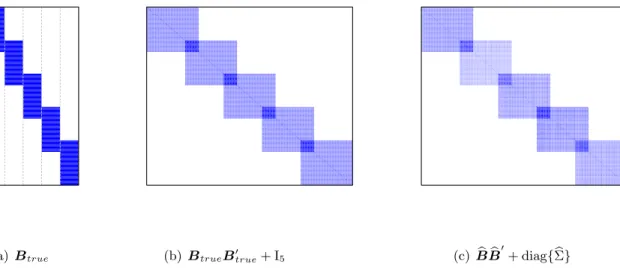
To illustrate the effectiveness of the symbiosis between factor model “rotations” and the spike-and-slab LASSO soft-thresholding, we generated a dataset from model (1.1) with n= 100 observations,
G = 1 956 responses and Ktrue = 5 factors. The true loading matrix Btrue (Figure 1 left) has a
block-diagonal pattern of nonzero elements Γtrue with overlapping response-factor allocations, where P
jγjktrue= 500 and P
jγjktrueγjktrue+1 = 136 is the size of the overlap. We setbjktrue =γjktrueandΣtrue= IG.
The implied covariance matrix is again block-diagonal (Figure 1 middle). For the EM and PXL-EM factor model explorations, we use λ0k = λ0, as advocated at the end of the Section 2.1. We set
λ1 = 0.001, λ0 = 20, α = 1/G and K? = 20. The slab penalty λ1 was set small to ameliorate bias in estimation. The spike penalty λ0 was set much larger to improve the accuracy of recovery. Its tuning will be addressed in the next section. All the entries in the initialization B(0) were sampled independently from the standard normal distribution,Σ(0)= IG and θ(0)(k)= 0.5, k= 1, . . . , K?.
We compared the EM and PXL-EM implementations with regard to the number of iterations to convergence and the accurateness of the recovery of the loading matrix. Convergence was claimed whenever d∞(B?(m+1),B?(m)) < 0.05 in the PXL-EM and d∞(B(m+1),B(m)) < 0.05 in the EM
algorithm.
The results without parameter expansion were rather disappointing. Figure 2 depicts four snap-shots of the EM trajectory, from the initialization to the 100thiteration. The plot depicts heat-maps of |B(m)|(a matrix of absolute values ofB(m)) form∈ {0,1,10,100}, where the blank entries correspond to zeroes. The EM algorithm did not converge even after 100 iterations, where the recovered factor allocation pattern is nowhere close to the generating truth. On the other hand, parameter expansion fared superbly. Figure 3 shows snapshots of |B?(m)|for the PXL-EM trajectory atm∈ {0,1,10,23}, where convergence was achieved after merely 23 iterations. Even at the first iteration, PXL-EM began to gravitate towards a sparser and more structured solution. At convergence, PXL-EM recovers the true pattern of nonzero elements in the loading matrix (up to a permutation) with merely 2 false
positives and 2 false negative. In addition, we obtain a rather accurate estimate of the marginal covariance matrix (Figure 1(c)). This estimate will be compared with the solution obtained using a one-component Laplace prior in the next section.
The PXL-EM is seen to be robust against poor initializations. After repeating the experiment with different random starting locationsB(0) sampled element-wise from Gaussian distributions with larger variances, PXL-EM yielded almost identical loading matrices, again with only a few false positives and negatives. The computing time required for one iteration of PXL-EM was between 3-4 seconds in R without parallelization on a 1.7 GHz machine.
Given the vastness of the posterior with its intricate multimodality, and the arbitrariness of the initialization, the results of this experiment are very encouraging. There are some lingering issues, such as the selection of the penalty parameterλ0. We shall show in the next section, that the selection is avoided with a sequential deployment of PXL-EM over a sequence of increasing λ0 values. The larger λ0, the closer we are to the methodological ideal, and so large values that are practically indistinguishable from the limiting case are preferred.
5
Dynamic Posterior Exploration
Under our hierarchical SSL prior withλ0k=λ0, the character of the posterior landscape is regulated by the two penalty parametersλ0 >> λ1, which determine the degree of multi-modality and spikiness. In the context of simple linear regression, Y ∼ Nn(Xβ,In),β= (β1, . . . , βp)0, the posterior distribution
True Factor Loadings
(a)Btrue
Theoretical Covariance Matrix
(b) BtrueB0true+ I5
Estimated Covariance Matrix
(c)BbBb
0
+ diag{Σb}
Figure 1: The true pattern of nonzero values in the loading matrix (left), a heat-map of the theoretical covariance matrixBtrueB0true+ I5 (middle), estimated covariance matrix (right).
Initialization: B_0 Iteration 1 Iteration 10 Iteration 100
Figure 2: A trajectory of the EM algorithm, convergence not achieved even after 100 iterations Initialization: B_0 Iteration 1 Iteration 10 Iteration 23 (Convergence)
Iteration 16 (Convergence) (a)λ0 = 5 Iteration 28 (Convergence) (b) λ0= 10 Iteration 23 (Convergence) (c)λ0= 20 Iteration 61 (Convergence) (d) λ0= 30
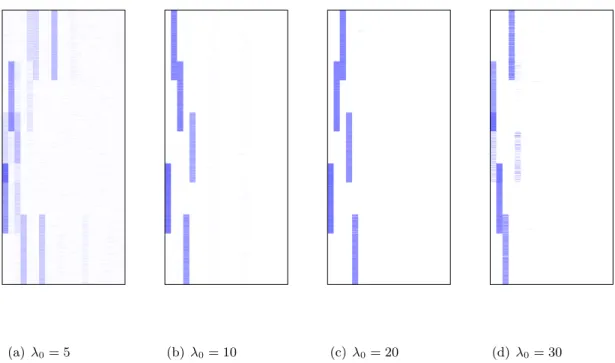
Figure 4: Recovered loading matrices of PXL-EM for different values of λ0. The computations are independent, each initialized at the same B(0) used in the previous section.
induced by the SSL prior on βwill be unimodal as longλ0 and λ1 are not too different.
Theorem 5.1. Assume p < n and denote by λmin the minimal eigen-value of n−1X0X. Then for
a given θ∈ (0,1)the posterior distribution arising from a θ-weighted spike-and-slab LASSO mixture prior with penalties λ0 and λ1 has a unique mode, whenever
(λ0−λ1)2 ≤4λmin. (5.1)
Proof. Shown by Rockova and George (2014b).
Remark 5.1. Under the PXL-EM regime, the estimated features Ωe are nearly orthogonal as the
algorithm converges. This is the most ideal scenario in the light of this theorem, whereλmin(Ωe)≈1.
Priors with large differences (λ0−λ1), however, induce posteriors with many isolated sharp spikes, a difficult environment for the EM trajectories to move around. The effect of this phenomenon is illustrated in Figure 4, where the PXL-EM algorithm was run for a series of spike penalties λ0 ∈
I ={5,10,20,30} using the same initialization and tuning as in the previous section. Clearly, larger penalties λ0 are needed to shrink the redundant coefficients to zero. However, as λ0 approaches the methodological ideal (λ0 → ∞), it becomes increasingly more difficult to find the optimal solution.
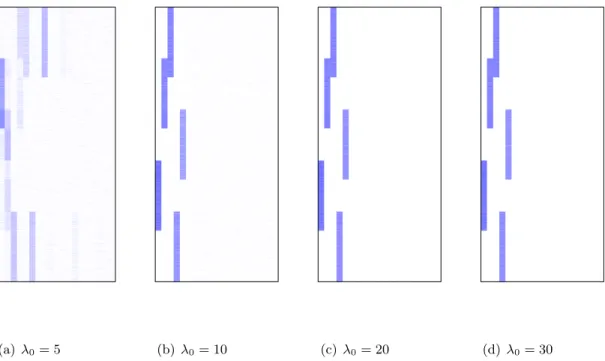
Iteration 16 (Convergence) (a)λ0 = 5 Iteration 15 (Convergence) (b) λ0= 10 Iteration 14 (Convergence) (c)λ0= 20 Iteration 9 (Convergence) (d) λ0= 30
Figure 5: Recovered loading matrices of PXL-EM for different values of λ0. The first computation (λ0 = 5) initialized atβ(0) from the previous section, then reinitialized sequentially.
In order to facilitate the search for the global maximum in the multimodal landscape, we build on ideas from the deterministic annealing EM algorithm proposed by Ueda and Nakano (1998). The idea there is to sequentially initialize the EM calculation at optima of a series of modified posteriors, each raised to a power 1/t, an inverse temperature parameter. By starting with a high temperature
t1 >>1, where the tempered posterior is nearly unimodal, and continuing along a temperature ladder
t1 > t2 >· · ·> tT = 1 by sequentially reinitializing computations atti with the solutions obtained at
ti−1, this algorithm is apt to be more successful in finding higher posterior modes. This approach was
successfully implemented by Rockova and George (2014a) in the EMVS method for variable selection in linear regression and by Yoshida and West (2010) in the variational Bayesian approach to graphical factor model. Here, we pursue a different strategy, sharing conceptual similarities with deterministic annealing, to mitigate the multimodality associated with the variable selection priors.
We will regard λ0 as an analogue of the inverse temperature parameter, where small values (in the range suggested by Theorem 5.1) yield unimodal posteriors (in linear regression). The solutions obtained for these less interesting parameter pairs (λ0, λ1) can be used as warm starts for more interesting choices (λ0, λ1), where λ0 >> λ1. By keeping the slab variance steady and gradually increasing the spike variance λ0 over a ladder of valuesλ0 ∈ I = {λ10 < λ20 <· · · < λL0}, we perform
a “dynamic posterior exploration”, sequentially reinitializing the calculations along the solution path. Accelerated dynamic posterior exploration is obtained by reinitializing only the loading matrix B, using the sameΣ(0) andθ(0) as initial values throughout the solution path. This strategy was applied on our example with λ0 ∈ I ={5,10,20,30} (Figure 5). Compared to Figure 4, fewer iterations are needed while factor splitting is reduced at λ0 = 30, evidently a result of the reinitialization at the mode with λ0 = 20. The solution stabilizes after a certain valueλ0, where further increase ofλ0 did not impact the solution. Thus, the obtained solution for sufficiently large λ0, if a global maximum, can be regarded as an approximation to the MAP estimator under the point-mass prior.
Finally, we explored what would happen if we instead used the one-component Laplace prior obtained byλ0 =λ1. With the absence of a slab distribution, this would correspond to a LASSO-like solution path, but with automatic transformations due to the PXL-EM algorithm. We performed the PXL-EM computation with sequential initialization for the one-component Laplace prior (λ0 = λ1) assuming λ0 ∈ I = {0.1,5,10,20} (Figure 6). In contrast to the SSL implementation above with
λ0>> λ1, it was necessary to begin withλ0 =λ1= 0.1. In terms of identifying the nonzero loadings, PXL-EM with the one-component Laplace prior did reasonably well, generating 45 false positives in the best case where λ0 =λ1 = 20. On this example, the PXL-EM implementation of a l1-penalized likelihood method dramatically enhances the sparsity recovery over existing sparse PCA techniques, which do not alter the factor orientation throughout the computation (Witten and Hastie, 2009). However, the estimates of the non-zero loadings were quite poor as is evidenced by Figure 7, which compares the estimated entries in the marginal covariance matrix obtained with the one-component Laplace and the SSL priors. Whereas the SSL prior achieves great accuracy in both recovery and estimation, the one-component Laplace prior must sacrifice unbiasedness to improve recovery.
6
Factor Mode Evaluation
The PXL-EM algorithm in concert with dynamic posterior exploration rapidly elicits a sequence of loading matrices {Bbλ0 :λ0 ∈I} of varying factor cardinality and sparsity. Each such Bbλ0 yields an
estimateΓbλ0 of the feature allocation matrixΓ, wherebγijλ0 =I(βbijλ0 6= 0). The matrixΓcan be regarded
as a set of constraints imposed on the factor model, restricting the placement of nonzero values, both inB andΛ=BB0+Σ. EachΓbλ0 provides an estimate of the effective factor dimension, the number
of free parameters and the allocation of response-factor couplings. AssumingΓ is left-ordered (i.e. the columns sorted by their binary numbers) to guarantee uniqueness,Γ can be thought of as a “model” index, although not a model per se.
Iteration 8 (Convergence) (a)λ0=λ1 = 0.1 Iteration 10 (Convergence) (b) λ0=λ1= 5 Iteration 5 (Convergence) (c)λ0=λ1= 10 Iteration 13 (Convergence) (d) λ0=λ1= 20
Figure 6: PXL-EM algorithm with sequential reinitialization along the solution path with one-component Laplace prior.
the posterior model probability
π(Γ|Y)∝π(Y |Γ)π(Γ). (6.1)
Whereas the continuous relaxation Πλ0(B) was useful for model exploration, the point-mass mixture
prior Π∞(B) will be of interest for model evaluation. Unfortunately, computing the marginal likelihood π(Y |Γ) under these priors is hampered because tractable closed forms are unavailable and Monte Carlo integration would be impractical. Instead, we replaceπ(Y |Γ) in (6.1) by a surrogate function, which can be interpreted as an integral lower bound to the marginal likelihood (Minka, 2001).
Schematically, the lower bound integration is as follows (Minka, 2001). We begin with the particular integral form for the marginal likelihood
π(Y |Γ) =
Z
Ω
π(Y,Ω|Γ)dπ(Ω), (6.2)
for which analytical evaluation is intractable. We proceed to find an approximation to (6.2) by lower-bounding the integrand
π(Y,Ω|Γ)≥gΓ(Ω,φ),∀(Ω,φ), (6.3)
so thatGΓ(φ) =
R
ΩgΓ(Ω,φ)dΩis easily integrable. The functionGΓ(φ)≤π(Y |Γ) then constitutes
0 2 4 6 8 10 12 0 2 4 6 8 10 12 ωij true ωij
Estimated Covariances: One−component Laplace
0 2 4 6 8 10 12 0 2 4 6 8 10 12 ωij true ωij
Estimated Covariances: Two−component Laplace
Figure 7: Estimated covariances: LASSO prior vs spike-and-slab LASSO prior
into a problem of optimization, where we search forφb = arg maxφGΓ(φ) to obtain the tightest bound.
In our context, a lower bound that satisfies (6.3) is
gΓ(Ω,φ) =C π(Y,Ω,φ|Γ), where φ= (B,Σ), (6.4)
and C= 1/maxφ,Ω[π(B,Σ|Y,Ω,Γ)]. This yields the closed form integral bound
GΓ(φ) =C π(B|Γ)π(Σ)(2π)−nG/2|Ψ|n/2exp(−0.5 n X i=1 tr(Ψyiy0i), (6.5) whereΨ= (BB0+Σ)−1.
By treating GΓ(φ) as the “complete-data” likelihood, findingφb = arg maxφ R
Ωπ(Y,Ω,φ|Γ)dΩ
can be carried out with an EM algorithm. In particular, we can directly use the EM steps derived in Section 3, but now with Γ no longer treated as missing. As would be done in a confirmatory factor analysis, the calculations are now conditional on the particular Γ of interest. The EM calculations here are also in principle performed assuming λ0 =∞. As a practical matter, this will be equivalent to setting λ0 equal to a very large number (λ0 = 1 000 in our examples). Thus, our EM procedure has two regimens: (a) exploration regime assuming λ0 <∞ and treatingΓ as missing to find Γb, (b)
evaluation regime assuming λ0 → ∞ and fixing Γ =Γb. The evaluation regime can be initialized at
the output values (Bbλ0,Σbλ0,bθλ0) from the exploratory run.
The surrogate criterion (6.5) is fundamentally the height of the posterior mode π(φb|Y,Γ) under
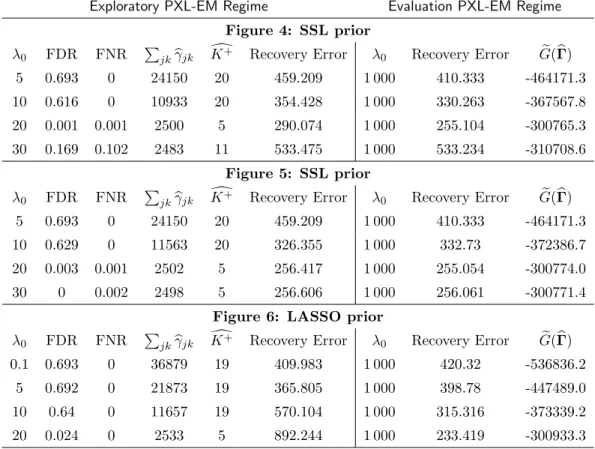
Exploratory PXL-EM Regime Evaluation PXL-EM Regime Figure 4: SSL prior λ0 FDR FNR Pjkbγjk Kd + Recovery Error λ 0 Recovery Error Ge(Γb) 5 0.693 0 24150 20 459.209 1 000 410.333 -464171.3 10 0.616 0 10933 20 354.428 1 000 330.263 -367567.8 20 0.001 0.001 2500 5 290.074 1 000 255.104 -300765.3 30 0.169 0.102 2483 11 533.475 1 000 533.234 -310708.6 Figure 5: SSL prior λ0 FDR FNR Pjkbγjk Kd + Recovery Error λ 0 Recovery Error Ge(Γb) 5 0.693 0 24150 20 459.209 1 000 410.333 -464171.3 10 0.629 0 11563 20 326.355 1 000 332.73 -372386.7 20 0.003 0.001 2502 5 256.417 1 000 255.054 -300774.0 30 0 0.002 2498 5 256.606 1 000 256.061 -300771.4
Figure 6: LASSO prior
λ0 FDR FNR Pjkbγjk Kd + Recovery Error λ 0 Recovery Error Ge(Γb) 0.1 0.693 0 36879 19 409.983 1 000 420.32 -536836.2 5 0.692 0 21873 19 365.805 1 000 398.78 -447489.0 10 0.64 0 11657 19 570.104 1 000 315.316 -373339.2 20 0.024 0 2533 5 892.244 1 000 233.419 -300933.3
Table 1: Table summarizes the quality of the reconstruction of the marginal covariance matrix Λ, namely (a) FDR, (b) FNR, (c) the estimated number of nonzero loadings, (d) the estimated effective factor cardinality, (d) the Frobenius normdF(Λb,Λ0) (Recovery Error). The recovery error is computed
twice, once after the exploratory run of the PXL-EM algorithm (λ0 < ∞) and after the evaluation run (λ0 ≈ ∞). The evaluation is runalways with the SSL prior. For the exploration, we used both the SSL prior as well as the LASSO (one-component Laplace) prior.
posterior model probability, the function
e
G(Γ) =GΓ(φb)π(Γ), (6.6)
is a practical criterion that can discriminate well between candidate models.
Using the sequential initialization from previous section, we hope to improve upon this criterion at every step, until some sufficiently large value λ0 which is practically indistinguishable from the limiting case. The stabilization of this criterion will be then indication, that no further increase inλ0 is needed. We now illustrate the use of this criterion on our models from from Section 5.
We computed the Ge(Γ) criterion for all the models discovered with the PXL-EM algorithm, both
also evaluated the quality of the reconstructed marginal covariance matrix, namely the (a) the propor-tion of falsely identified nonzero values (FDR), (b) the proporpropor-tion of falsely non-identified nonzeroes (FNR), (c) the estimated number of nonzero loadings, (d) the estimated effective factor cardinality, (d) the Frobenius normdF(Λb,Λ0) (Recovery Error). The recovery error is computed twice, once after
the exploratory run of the PXL-EM algorithm (λ0<∞) and then after the evaluation run of the EM algorithm (λ0 ≈ ∞). The exploration was performed both using the SSL prior (Figures 4 and 5) as well as the one-component Laplace (LASSO) prior (Figure 6). The evaluation is runalways with the SSL prior.
The results indicate that the criterionGe(Γ) is higher for models with fewer false negative/positive
discoveries and effectively discriminates the models with the best reconstruction properties. It is worth noting that the output from the exploratory run is greatly refined with the point-mass SSL prior (λ0≈ ∞), reducing the reconstruction error. This is particularly evident for the one-component LASSO prior, which achieves good reconstruction properties (estimating the pattern of sparsity) for larger penalty values, at the expense of sacrificing the recovery of the coefficients (Figure 7).
Importantly, the sequential initialization of SSL (Figure 5) results in the stabilization of the esti-mated loading pattern and thereby the criterion (6.6). This is an indication that further increase in
λ0 may not dramatically change the result and that the output obtained with such large λ0 is ready for interpretation.
Lastly, to see how our approach would fare in the presence of no signal, a similar simulated ex-periment was conducted with Btrue =0G×K?. The randomly initiated dynamic posterior exploration
soon yielded the null model Bb =Btrue, where the criterionGe(Γ) was also the highest. Our approach
did not find a signal where there was none.
7
Kendall’s Applicant Data
We first illustrate our method on a familiar dataset analysed previously by multiple authors including (Kendall, 1975; Rowe, 2003; Fr¨uhwirth-Schnatter and Lopes, 2009). The data consists of scores on a ten-point scale involving 15 characteristics ofn= 48 applicants for a certain job. Kendall extracts four factors on the basis of a principal component analysis with 4 eigenvalues greater than one, accounting for 81.5% of explained variance.
After centering the scores, we run our PXL-EM algorithm assumingK? = 10,λ1= 0.001, α= 1/15. For factor model exploration with sequential reinitialization, we consider a random starting pointB(0)
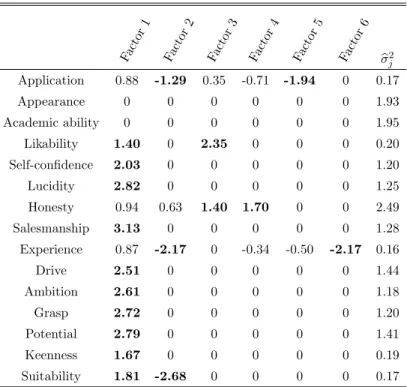
(standard Gaussian entries) and a tempering scheduleλ0∈I ={1,2, . . . ,50}. We used a convergence margin ε = 0.01. We report a model obtained with λ0 = 50, confirmed by the highest value of (6.6), which yielded Kd+= 6 factors. The associated loading matrix together with estimated residual
Factor 1 Factor 2 Factor 3 Factor 4 Factor 5 Factor 6 b σ2 j Application 0.88 -1.29 0.35 -0.71 -1.94 0 0.17 Appearance 0 0 0 0 0 0 1.93 Academic ability 0 0 0 0 0 0 1.95 Likability 1.40 0 2.35 0 0 0 0.20 Self-confidence 2.03 0 0 0 0 0 1.20 Lucidity 2.82 0 0 0 0 0 1.25 Honesty 0.94 0.63 1.40 1.70 0 0 2.49 Salesmanship 3.13 0 0 0 0 0 1.28 Experience 0.87 -2.17 0 -0.34 -0.50 -2.17 0.16 Drive 2.51 0 0 0 0 0 1.44 Ambition 2.61 0 0 0 0 0 1.18 Grasp 2.72 0 0 0 0 0 1.20 Potential 2.79 0 0 0 0 0 1.41 Keenness 1.67 0 0 0 0 0 0.19 Suitability 1.81 -2.68 0 0 0 0 0.17
Table 2: Kendall’s data: estimated loading matrix and residual variance parameters, in bold are loading estimates that are greater than one in absolute value
variances is displayed in Table 2.
The loading matrix can be naturally interpreted as follows. Factor 1 is a “success precursor”, involving abilities such as self-confidence, drive, ambition, and lucidity. A similar factor was found also by Fr¨uhwirth-Schnatter and Lopes (2009) (Factor 3) and by Kendall (1975) (Factor 1). The Factor 2 can be interpreted as experience (Factor 2 of Kendall (1975) and Factor 1 of Fr¨uhwirth-Schnatter and Lopes (2009)). The Factor 3 can be interpreted as a general likability of a person (Factor 3 in Kendall (1975)).
8
The AGEMAP Data
We further illustrate our approach on a high-dimensional dataset extracted from AGEMAP (Atlas of Gene Expression in Mouse Aging Project) database of Zahn and et al. (2007), which catalogs age-related changes in gene expression in mice. Included in the experiment were mice of ages 1, 6, 16, and 24 months, with ten mice per age cohort (five mice of each sex). For each of these 40 mice, 16 tissues were dissected and tissue-specific microarrays were prepared. From each microarray, values from 8 932 probes were obtained. The collection of standardized measurements is available online