TOWARDS REFERENCE MODELS FOR
REQUIREMENTS TRACEABILITY
Bala Ramesh
Department of Computer Information Systems, Georgia State University Atlanta, GA 30303, USA
[email protected] Matthias Jarke
Informatik V, RWTH Aachen Ahornstr. 55, 52074 Aachen, Germany
May 1999
Requirements traceability is intended to ensure continued alignment between stakeholder requirements and system evolution. To be useful, traces must be organized according to some modeling framework. Indeed, several such frameworks have been proposed, mostly based on theoretical considerations or analysis of other literature. This paper, in contrast, follows an empirical approach. Focus groups and interviews conducted in 26 major software development organizations demonstrate a wide range of traceability practices with distinct low-end and high-end users of traceability. From these observations, reference models comprising the most important kinds of traceability links for various development tasks have been synthesized. The resulting models have been validated in case studies and are incorporated in a number of commercial traceability tools. The discussion of the link types and their usage in practice has implications for the design of next-generation traceability methods and tools.
This work was supported in part by grants from the Office of Naval Research, the European Commission (ESPRIT project 21.903 CREWS), the Deutsche Forschungsgemeinschaft under project Ja445/5-1 (PRIME), and by a cooperation grant on empirical and formal methods for requirements traceability, jointly funded by the German DAAD and the US National Science Foundation.
1. INTRODUCTION
Reference models are prototypical models of some application domain, usually organized according to some underlying basic metamodel. The purpose of reference models is to reduce significantly the task of creating application-specific models and systems : the user selects relevant parts of the reference model, adapts them to the problem at hand, and configures an overall solution from these adapted parts. Since the analysis of a domain can take an enormous effort when started from scratch, the use of reference models has been reported to save up to 80% in development costs for systems in standardized domains (Scheer 1994). Not surprisingly, reference models have become highly successful in many industries, the best-known example being the SAP approach.
Not every domain is sufficiently standardized to allow for a reference model of the final product – the system to be built. Moreover, approaches like the one followed by SAP are not necessarily supportive of change, especially when this change goes beyond the initially covered domain. However, at least experience on how to get to the product should be reused (Dhar and Jarke 1985). This leads to the idea of reference models for capturing the development process itself, not to be confused with prescriptive software process models (Finkelstein et al. 1994).
The process of developing reference models is arduous. The traditional normative computer science approach of imposing such models on developers is long known to have failed in most cases. Reference models are therefore an abstraction of best practice, condensed from numerous case studies over an extended period of time, followed by more case studies to refine and evaluate the proposed reference model. There is nothing provably correct about reference models; they derive their relevance from the slice of practice they cover. Nevertheless, by formalizing a reference model in an appropriate mathematical framework, at least a number of elementary desirable properties can be ensured.
1.1 Why Reference Models for Traceability?
Our interest is the development of reference models for requirements traceability. Summarizing several earlier views and perspectives, Gotel and Finkelstein (1994) define requirements traceability as “the ability to describe and follow the life of a requirement, in both a forward and backward direction, i.e. from its origins, through its development and specification, to its subsequent deployment and use, and through periods of on-going refinement and iteration in any of these phases”. The importance of requirements traceability is highlighted by the fact that, for example, the US Department of Defense spends about 4% of its IT costs on traceability – often without getting an adequate value for this money, as traceability in many organizations is haphazard, the standards provide little guidance, and the models and mechanisms vary to a large degree and are often poorly understood. Not surprisingly, the market for requirements traceability tools is booming, even though current tools support only rather simple traceability models and services.
Previous models of requirements traceability focus on different aspects of requirements traceability. Version and configuration management systems focus on the SOURCE aspect (i.e., physical artifacts where traceability information is maintained), emphasizing the document management role of traceability (Rose et al. 1991, Conradi and Westfechtel 1998). The source aspect remains important: only trace objects available in persistent sources actually constitute long-term traceability, so traceability methods and tools have to make traces persistent reliably and at acceptable cost.
Studies at the management level usually focus on the STAKEHOLDER aspect (i.e., agents involved in the management of traceability). A good example is the work of Yu and
Mylopoulos (1994) who use dependencies between stakeholders as a starting point for driving and documenting requirements processes. The roles of stakeholders with respect to objects are emphasized in Gotel’s thesis work on contribution structures (Gotel and Finkelstein 1995). Her empirical study shows the practical value of using a rich system of stakeholder roles in documenting the creation of requirements (Gotel and Finkelstein 1997); our longitudinal case study (Ramesh et al. 1997) shows that also the different usage roles are important in designing and implementing traceability systems. Summarizing, the stakeholder aspect becomes more important as the duration and complexity of projects grow.
Despite the importance of considering physical trace management and stakeholder roles, current practice shows that the efficiency and effectiveness of traceability support is largely determined by the system of OBJECT types and traceability link types offered. This is not only important for fine-grained change management, but also has repercussions for the two other aspects, i.e. for source management and stakeholder dependencies (Pohl et al. 1997). In this paper, we therefore focus on the analysis of object types and trace link types used in current practice, and organize our reference models around them. However, after presenting the models, we shall discuss their embedding with the stakeholder and source management aspects, including the implications for tool design drawn from our studies.
1.2 Research Overview
Our own efforts to develop a reference model of traceability were driven by experiences with the deployment of REMAP, a model for design rationale and dependency management we developed in the late 1980’s (Dhar and Jarke 1988, Ramesh and Dhar 1992). The development of this model was guided by experiments with experienced software engineers, and it has in fact served as a starting point for several commercial tool developments including the KBSA environment by Anderson Consulting and the SLATE tool by TD Technologies. Despite this apparent success, some users of REMAP pointed out that it was too complex for some usage situations, even though each of its features was needed sometimes. The informal feedback gained in these discussions was that a broad variety of traceability strategies is practiced in industry and the existing models are too simple and/or too rigid to deal with this variety.
In 1992, we therefore embarked on a two-pronged strategy. In the European NATURE project, we began to develop model-driven approaches to process guidance and traceability that would provide the technical means for dealing with a wide spectrum of traceability techniques. As a starting point for this activity, we developed a basic traceability framework that has become known as “the three dimensions of requirements engineering” (Jarke and Pohl 1993, Pohl 1994). In (Pohl 1996), this framework was elaborated by a set of 18 types of traceability links found in the literature, and by the RSM model which synthesizes the objects to be traced from 21 international software engineering standards. In (Dömges and Pohl 1998, Pohl et al. 1999), the resulting process-integrated tool environments are discussed.
In parallel, we began a four-year series of empirical studies with American software development organizations, with the goal of
• capturing the current and desired practice in requirements traceability
• developing and validating reference models which could guide an improved practice
• assessing the impact of good traceability on the software development and maintenance process.
This paper presents the reference models together with their grounding in the empirical studies, and relates the findings to requirements for future traceability mechanisms. Companion papers discuss the organizational factors that guide the selection user organizations make
traceability, based on a two-year case study in one specific organization (Ramesh et al. 1997). In section 2, we describe the design of the empirical studies, starting from a brief survey of traceability uses reported in the literature. Section 3 presents the first group of results, a simple meta model according to which traceability schemes can be organized. The studies show that there is a clear distinction between low-end and high-end users of traceability representing very simple and very comprehensive traceability practices (explained in detail in Section 2.5.2). Therefore, sections 4 and 5 describe low-end and high-end reference models separately, and indicate ways how to migrate from one to the other. Section 6 contains a fairly detailed example on use of high-end models for supporting a large system-engineering project.
Sections 7 and 8 discuss the implications of our results. In section 7, we define four basic categories of traceability link types and show how they map to the concrete link types in the reference models; by discussing available support for each link type, we relate our results to existing research. In section 8, general conclusions concerning the functionality of traceability tools are drawn; the application of these conclusions is demonstrated by another case study, the development of the Design Rationale tool within the KBSA ADM system of Andersen Consulting. Section 9 summarizes our results.
2. Empirical Studies
In this section, we describe the empirical studies used for defining, validating and applying the reference models.
2.1 Background: Definitions and Uses of Traceability
Requirements traceability has been identified in the literature as a quality factor - a characteristic a system should possess and include as a non-functional requirement (Roetzheim 1991) Many standards governing the development of systems for the U.S. Government (e.g., MIL-STD-2167-A and MIL-STD-498 which replaces it (DoD, 1988)) require the development of requirements traceability documents.
Edwards and Howell (1991) define traceability as a technique used to "provide a relationship between the requirements, the design, and the final implementation of the system". Palmer (1997) states that "traceability gives essential assistance in understanding the relationships that exist within and across software requirements, design and implementation". These relationships allow designers to show that the design meets the requirements and help early recognition of those requirements not satisfied by the design. Palmer states that traceability helps acertain "how and why system development products satisfy stakeholder requirements". Hamilton and Beeby (1991) view traceability as the ability to “discover the history of every feature of a system” so that the impacts of changes in requirements can be identified. Greenspan and McGowan (1978) state that the ability to allow changes to any artifacts -- requirements, specification, implementation-- to be traced throughout the system is an important property of any systems description technique. In short, requirements traceability is a characteristic of a system in which the requirements are clearly linked to their sources and to the artifacts created during the system development life cycle based on these requirements.
Many different stakeholders -- project sponsors, project managers, analysts, designers, maintainers, and end users -- are involved in the system development life cycle. The traceability needs of these stakeholders differ due to differences in their goals and priorities, and many problems of traceability stem from these differences in interest and understanding (Ramesh and Edwards 1993).
Stehle (1990) identifies some criteria from the perspective of managing a system development effort. Traceability helps promote a contractor and contracted method of
working, demonstrate that each requirement has been satisfied. Further, it helps ensure that each component of the system satisfies a requirement to ward off ‘gold-plating’ (Wright 1991), i.e. the addition of expensive and unnecessary features to a system.
In requirements engineering, a major challenge is the linking of rationales and sources to the requirements. Traceability facilitates communication between those involved in the project to alleviate these problems. Requirements management can be facilitated by capturing information necessary to understand requirements evolution and verification (Fiksel 1992).
During design, traceability allows designers and maintainers to keep track of what happens when a change request is implemented before a system is redesigned (Edwards and Howell 1991). Traceability is helpful if it can link designs to justifications, important decisions and assumptions behind them and the contexts in which design solutions are arrived at (Smithers et al. 1991).
Systems evolution requires a better understanding of the requirements which can only be achieved by tracing back to their sources (Pinheiro and Goguen 1996). Traceability provides the ability to cross-reference items in the requirements specifications with items in the design specifications (Dorfman and Thayer 1990). Therefore, with complete traceability, more accurate costs and schedules of changes can be determined rather than depending on the engineer or programmer to know all the areas effected by these changes.
Last not least, test procedures, if traceable to requirements or designs, can be modified when errors are discovered (Brown 1987).
2.2 Motivation and Overall Study Design
As a consequence of these different uses and perspectives on traceability, there are wide variations in the format and content of traceability information across different system development efforts. Even though some detailed proposals for traceability frameworks have been made (Gotel and Finkelstein 1995, Pohl 1996), the current literature and the standards do not provide detailed guidelines on what types of information must be captured and used in what contexts. Though a variety of tools used in the industry provide mechanisms to represent various types of linkages between system components, the interpretation of the meanings of such linkages is left to the user. Thus, there is a clear need for the development of reference models, and guidelines for their use in software development activities. A comprehensive scheme, based on such models can help ensure that traceability is maintained through all phases of the systems development process, from the requirements as stated or contracted by the customer, through analysis, design, implementation, testing and operationalization of the product. This step, from the generic link types to their usage in typical development tasks as encoded in a reference model, requires empirical analysis.
As discussed earlier, providing traceability of requirements to their sources and the outputs of the system development process can be along several dimensions. Different stakeholders contribute to the capture and use of traceability information, often with different perspectives. For example, the types of links of interest to an end user may be different from those of interest to a system designer. An end user may be interested in the answer to the following question: what are the system components that are affected by a requirement? A systems designer may, in addition, be interested in the answer to the following: why and how are the components affected by a requirement?
Further, the semantics of a given linkage as viewed by different stakeholders may differ. For instance, consider the following relationship maintained in a traceability table:
REQUIREMENTLINKED-TODESIGN object. An end user may view the relationship as a means to identify a design component that is generated by a requirement. A designer may view the same
object. The semantics or the meaning attributed to a linkage is guided by the reasoning that the user will be performing with the linkage. While the end user may be interested in just the connectivity information, the designer may be interested in the repercussions of changes in the solutions with the relaxation of the constraint (or redefinition of a requirement).
We conducted several empirical studies that capture the information needs (with respect to traceability) of different stakeholders involved in the software development process. Data collection methods included evaluation of major traceability tools, structured interviews with practitioners, focus groups involving the various stakeholders, and an in-depth case study of traceability practice in one organization. Due to the elaborate preparation required to assemble experienced practitioners in their organizational settings for these empirical studies, data collection spanned a period of over three years. Subsequently, the models have been used and incorporated in a number of prototypical and commercial tools.
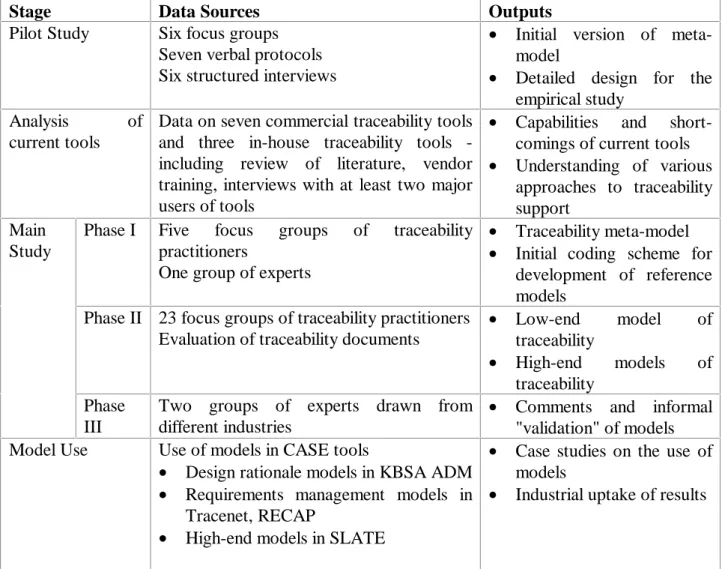
Table 1 summarizes the various steps in our data collection and analysis steps and identifies the major outputs of these phases. Each of these steps will be described in the following subsections.
Stage Data Sources Outputs
Pilot Study Six focus groups Seven verbal protocols Six structured interviews
• Initial version of meta-model
• Detailed design for the empirical study
Analysis of
current tools
Data on seven commercial traceability tools and three inhouse traceability tools -including review of literature, vendor training, interviews with at least two major users of tools
• Capabilities and short-comings of current tools • Understanding of various
approaches to traceability support
Phase I Five focus groups of traceability practitioners
One group of experts
• Traceability meta-model • Initial coding scheme for
development of reference models
Phase II 23 focus groups of traceability practitioners Evaluation of traceability documents
• Low-end model of traceability • High-end models of traceability Main Study Phase III
Two groups of experts drawn from different industries
• Comments and informal "validation" of models Model Use Use of models in CASE tools
• Design rationale models in KBSA ADM • Requirements management models in
Tracenet, RECAP
• High-end models in SLATE
• Case studies on the use of models
• Industrial uptake of results
Table 1: Summary of data collection and analysis
2.3 Pilot Study
The pilot study determined the appropriateness of the various data collection approaches and guided the development of relevant instruments, such as a questionnaire for
structured interviews and focus groups. It involved focus groups for idea generation, protocol analysis to study problem-solving behavior, and structured interviews to evaluate the initial results.
A focus group is a semi-structured exchange among a small group of people conducted with a clear agenda. This technique is the most commonly used qualitative data collection methodology used in market research (Templeton 1987).
Protocol analysis is commonly used in building expert systems. The thought process of subjects is captured through think-aloud verbal protocols. The protocols are recorded as subjects think through a problem and verbalize their thoughts. The recorded protocols are analyzed to capture knowledge elements and operators that characterize the problem solving behavior. In our context, the knowledge elements provide insights into the relationships or linkages and the operators provide insights into the reasoning performed with the relationships. Structured interviews were designed to provide further insights into the nature of the traceability links, as well as potential areas for providing support by explicit representation of these relationships. Further, various types of reasoning performed by the stakeholders were identified such that mechanisms can be developed to aid the tasks of design and maintenance based on the nature of the relationships and the perceived areas of potential benefits.
The pilot study involved 58 master’s students in information technology at a graduate university. Many subjects had extensive experience in domains such as ship building and aviation maintenance where traceability is widely practiced. The participants had also completed a comprehensive project involving the analysis and design of a segment of a large-scale, real life system.
Six focus groups, consisting of eight to ten subjects each, were conducted. The discussion was moderated to discuss definitions, need for traceability from different stakeholder perspectives, the issues involved in creating a comprehensive traceability practice. Seven subjects participated in the protocol analysis phase of the project. Think aloud protocols of subjects involved in defining traceability links (among requirements, design elements and implementation) in projects they had participated in were collected. Six subjects participated in structured interviews where the results developed from the above data collection sessions were reviewed and elaborated.
Besides the development of initial versions of our meta-model, the primary outcome of the pilot study was the development of a detailed design for the empirical study. Focus groups and structured interviews were identified as the primary methods for data collection during the subsequent phases. The importance of incorporating both contributors and users of traceability information in the study was also highlighted.
No Area of Business Stakeholders
involved in study Project Size (cost, number of requirements) Traceability focus 1 Computer Hardware, System Integration system engineers project manager quality assurance, system analysts over 1 million lines Requirements management, Satisfying requirements, Contract compliance,
Project monitoring and control, Rationale, Change control 2 US Government System Development Organization project sponsors project manager lead system engineers multi--billion dollar Rationale, Project monitoring, Satisfying requirements, Resource management 3 US Government System Development Project Management project sponsor, contractor engineers, several hundred million dollars Standards compliance, project tracking and control, resource management,
No Area of Business Stakeholders involved in study Project Size (cost, number of requirements) Traceability focus
Organization system analysts change control 4 US Government System Development Organization systems analysts, project sponsors 1400 requirements requirements evolution, standards compliance 5 US Government System Testing Organization test engineers, manager, contractor engineers 1300 requirements satisfaction of requirements, standards compliance, development of appropriate verification procedures 6 System Integration system engineers,
test engineers, maintenance engineers over 100 million dollars satisfaction of requirements, inter-component dependencies, development of appropriate verification procedures, rationale
7 Pharmaceuticals system engineers, maintenance engineers
over 1000 requirements
satisfaction of requirements, rationale, quality assurance, requirements allocation 8 Utility project manager,
system engineers, maintenance engineers approx. 15 million dollars satisfying requirements, change control,
project tracking and monitoring, compliance with regulations 9 Telecommunications project manager
system engineers, test engineer 6000 requirements satisfying requirements, quality assurance,
project tracking and monitoring 10 Aerospace project lead
engineer, system engineer several hundred million dollars requirements allocation, requirements management (evolution), requirements rationale 11 Aerospace system engineers,
maintenance engineer over 5000 requirements requirements allocation, design rationale, component dependencies, resource monitoring 12 Electronics system engineers,
project manager, maintenance engineers multi-million dollars quality assurance, satisfying requirements, standards compliance, design rationale 13 Defense Contractor, System Integrator
system engineers over 25 million dollars
requirements allocation, satisfaction of requirements,
requirement management (evolution) 14 Electronics system engineers 600
requirements satisfaction of requirements 15 Contractor for Financial Services system engineers 500 requirements satisfaction of requirements 16 Govt. contractor system engineers 900
requirements satisfaction of requirements, contract compliance 17 Govt. project Management organization project managers, systems analysts over 100 million dollars
project tracking and control, contracts compliance, standards compliance, resource management 18 Govt. project sponsor project sponsors
project manager system analysts
over 150 million dollars
development of requirements compliance with standards, mission/organizational needs, project costing/estimating 19 Automobile system engineers, multi-million requirements allocation,
No Area of Business Stakeholders involved in study Project Size (cost, number of requirements) Traceability focus maintenance engineers
dollars satisfaction of requirements, resource monitoring, rationale 20 Electronics test engineers,
project manager, systems analyst 1300 requiements satisfaction of requirements, development of appropriate verification procedure
21 Govt. contractor system engineers 400
requirements development of traceabilitiy documents required by sponsor (requirements-test matrix) 22 Contract Software Developer system engineers 1700 requirements development of allocation and test matrices 23 Government Contracting Organization contract specialists, project manager over 10,000 requirements contract compliance, standards compliance,
project monitoring and control 24 Contract software Development and Maintenance Maintenance engineers 800 requirements requirements satisfaction, test plan development 25 Aerospace Configuration management personnel, quality assurance, system engineers 8000 requirements requirements evolution, system /component evolution, requirements satisfaction
26 Telecommunications system engineers, systems analysts 6000 requirements development of requirements, requirements rationale, project costing/estimating
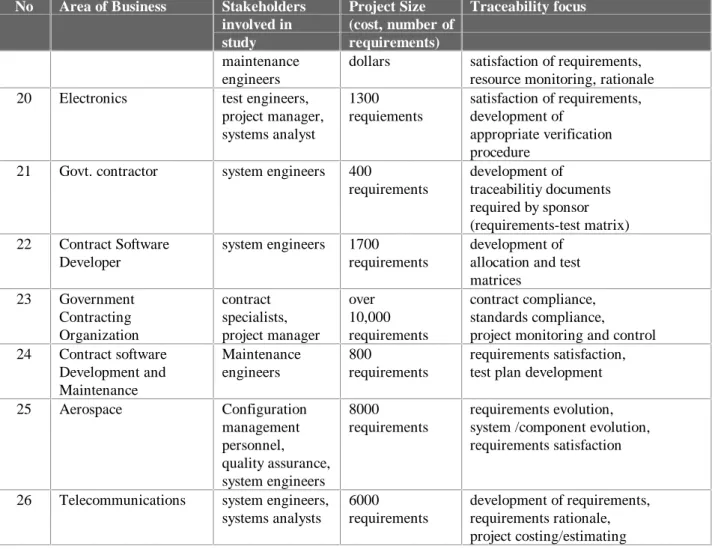
Table 2: Organizations involved in focus groups and interviews
2.4 Analysis of Current Tools
As a first step towards developing a clear understanding of the current practice of traceability, a detailed study of the capabilities of major tools that support traceability was undertaken. All leading case tools on the market were included in the study. These include DOORS, Marconi RTM, Teamwork/RQT, RDD-100, SLATE, RTS, and Requirements Tracer. Three CASE tools developed by system engineering organizations for in-house use were also studied. The study included a detailed review of vendor provided literature, participation in vendor provided training (ranging from 1 to five days) on the tools, and interviews with at least two major users of each of the tools. It provided clear understanding of the capabilities of current tools, the areas of traceability supported by each tool, and shortcomings of the different approaches to traceability supported by them, which was very valuable in the design of focus groups and interviews. The details of the tool analysis are not reported here, as they were subsumed by a later survey of traceability tools, conducted by the International Council on Systems Engineering (see www.incose.org/workgrps /tools/tooltax.html) and extended in (Dömges and Pohl 1998).
2.5 Main Study
The main part of the study comprised 30 focus group discussions in 26 organizations. They were conducted in a wide variety of industries, including defense, government, aerospace, hardware development, pharmaceuticals, utility, system integration, electronics, and telecommunications. Table 2 gives an overview of the organizations involved. Whenever feasible, participants representing different user and consumer perspectives were included. On average the focus groups consisted of five participants. As in the pilot study, focus groups were followed up with selected structured interviews.
The participants had experience in several key areas of systems development including project management, software engineering training, requirements management, software testing, system integration, configuration management, procurement, development support, software quality assurance, systems analysis, maintenance, software implementation. The participants had an average of 15.5 years experience in systems development.
2.5.1 Phase I
The focus groups were conducted in two phases. In Phase I, building on results of the pilot study, data from five focus groups involving thirty participants were used in developing a traceability meta-model. The meta-model defines the language in which traceability reference models are described. It provides the primitives to represent different traceability linkages among the various objects produced during systems development. It further represents the agents involved in the systems development process as well as the sources in which traceability information is captured. The meta-model is discussed in Section 4. The meta-model was checked for plausibility and terminology by a group of experts drawn from different industries and stakeholder groups.
An important outcome of this study is also the identification of various types of traceability information and the development of an initial scheme for encoding reference models from data collected in subsequent phases.
2.5.2 Phase II
The second phase involved the development of reference models of traceability practice. Data from 23 focus groups were used in the development and classification of traceability links representing current practice and ideal practice.
Issues addressed in the focus groups
Each focus group started with clarifications on the definitions and terms used. This included the identification of the various stakeholders involved in traceability, the system lifecycle phases covered in the project being discussed, the system components to which traceability is intended, and the various views on traceability.
The focus group participants were then asked to discuss their current traceability practice as well as desired traceability practice. To achieve comprehensive understanding of the current and desired practices, participants were asked to elaborate their ideas from two different perspectives:
• user perspective: What types of traceability information is needed and is useful at different phases of the system development process? How is this information captured and by whom and at what phase of the system development life cycle? What are the costs associated with the capture of this information?
• provider perspective: What types of traceability information does each stakeholder capture? in what phase of the lifecycle and how is it used and by who and when? What are the benefits associated with the capture of this information?
Wherever available, the participants were asked to answer these questions with specific reference to the reports and documents produced in the organization.
The next part of each focus group was devoted to a discussion of the different types of traceability links used in that organization:
1. How are the various traceability relationships identified in the traceability documents? 2. How are the traceability relationships created/defined and prioritized? Who are the
stakeholders involved in managing these links?
3. How are the traceability links maintained, reviewed, updated or changed, by whom and during which activities?
4. What are the mechanisms for defining the semantics of these links and maintaining this? 5. What are the uses of each type of traceability link identified?
6. What are the issues that facilitate or impede the implementation of traceability?
Each focus group session lasted between 1.5 - 2.5 hours. All sessions were audio or video taped for further analysis. When this was prohibited by security or confidentiality concerns, a scribe documented the discussions.
During the focus groups, a deeper understanding of the different types of traceability links discussed in the literature was developed. The usage of these link types in practice was gradually encoded in reference models for the major uses of traceability, as discussed below in section 5.
High-end and Low-end Users
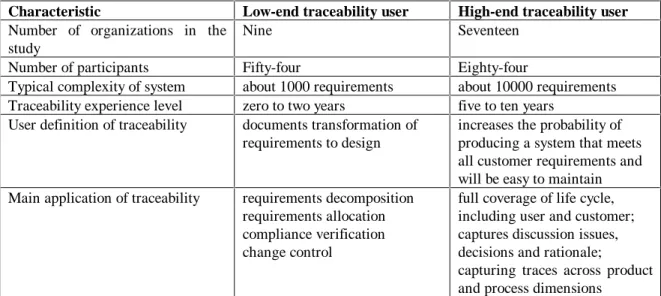
It quickly became apparent that the participants in our study could be categorized into two distinct groups with respect to their traceability practice. We refer to them as low-end and high-end traceability users.
Characteristic Low-end traceability user High-end traceability user
Number of organizations in the study
Nine Seventeen
Number of participants Fifty-four Eighty-four
Typical complexity of system about 1000 requirements about 10000 requirements Traceability experience level zero to two years five to ten years
User definition of traceability documents transformation of requirements to design
increases the probability of producing a system that meets all customer requirements and will be easy to maintain Main application of traceability requirements decomposition
requirements allocation compliance verification change control
full coverage of life cycle, including user and customer; captures discussion issues, decisions and rationale;
capturing traces across product and process dimensions
The characteristics of both groups are summarized in Table 3. The representation of the two groups in our empirical study is also discussed in this table. Briefly, low-end users with just a few years of traceability experience see it simply as a mandate from the project sponsors or for compliance with standards. In contrast, experienced high-end users are experiencing traceability as a major opportunity for customer satisfaction and knowledge creation throughout the systems lifecycle. The perceived importance of traceability grows with system complexity. As the following sections will show, the reference models used for low-end and high-end traceability users differ substantially. However, it should be noted that even an organization with predominantly low-end practice may have "mature" traceability practice in some areas and vice-versa.
Development of reference models
The analysis of the data followed standard procedures used in qualitative research that employ focus groups and interviews. The data was analyzed using a form of content analysis (Eisenhardt, 1989) where the data is categorized into concepts. The primary concepts in our study are the various types of traceability links used in current and ideal practice. The results presented in this paper are based on a "qualitative or ethnographic summary’’ (Morgan, 1988) and rely on direct quotations from the data. As suggested in Morgan (1988), the analysis was done in two phases. During Phase I, a detailed examination of the data from five focus groups provided the initial categories and concepts along which the data was coded. This scheme was developed iteratively so that it was sufficient to explain the data. The scheme from this study was used in the analysis of data from Phase II to identity and refine components of traceability models. Triangulation (Eisenhardt, 1988) across multiple data sources (multiple participants that represent different stakeholder perspectives from each organization) and across data collection methods (focus groups, interviews and review of traceability documents) helped confirm the findings. Each concept represented in the reference models presented in Section 5 was included only when is observed in practice (as reported as current practice in focus group discussions and/or structured interviews and/or represented in traceability documents) and identified by others as a part of desired practice. Each traceability information in the high-end models is in either use or considered desired practice by at least six organizations in our study.
We have developed two sets of models: The low-end models describe the current practice in low-end organizations. The reference models for high-end users in different systems development activities represent the best practices in the industry.
2.5.3 Phase III
The reference models developed from phase II were presented to two groups of experts for comments and feedback. These two groups were composed of experienced traceability users drawn from different industry groups. The two groups provided informal "validation" of the models presented here and further provided suggestions on the implementation of the models in system engineering environments.
2.6 Model Use in Tools
Based on the suggestions received from the experts and our analysis of the current traceability tools, we identified characteristics of system engineering environments for the implementation of the traceability reference models (cf. sections 7 and 8). To develop and adapt reference models, the software information system requires support for specialization and instantiation, applied both to nodes and links.
In order to ensure formal consistency of the proposed models, and to be able to demonstrate them to users and tool vendors, the meta model and the reference models were first encoded in ConceptBase (Jarke et al. 1995), a knowledge-based meta database management system based on the Telos language (Mylopoulos et al. 1990). We shall use ConceptBase screenshots to show the reference models in Sections 4 and 5.
For initial validation, a ConceptBase prototype of an early submodel was included in the concept demonstrator of the Knowledge-Based Software Assistant (KBSA) project. Demonstrations of these prototypes, together with their empirical grounding, led to the adoption of our reference models in several commercial traceability tools:
• The traceability scheme of SLATE, a leading system engineering tool, is architected around earlier versions of the models presented here.
• The design rationale models presented here are the primary components of the Knowledge Based Software Assistant tools Concept Demo and ADM created by Andersen Consulting on behalf of the U.S. Air Force
• The models have been incorporated in the Tracenet tool that supports the capture of traceability across multiple environments
• The models have been tailored and used in a large commercial and a government system engineering organization (Ramesh et al, 1997). The models have also been tailored to support traceability to formal specifications in a model management system (Ramesh 1997).
Though a detailed discussion of the experiences from these implementations is beyond the scope of this paper, they seem to provide strong evidence of usability and scalability of the models in real-life system engineering. We present two case studies in sections 6 and 8.
3. A Simple Meta Model of Requirements Traceability
In the next three sections, we present the reference models resulting from our studies. We assume that our traceability reference models will be implemented in some trace repository (manual or computerized). It is widely accepted that such a repository will comprise at least three layers (for details, see e.g. Bernstein et al. 1999, Constantopoulos et al. 1995, Jarke et al. 1994, Pohl 1996):
• the meta model defining the language in which traceability models can be defined
• a set of reference traceability models which can be customized within the scope defined by the meta model
• a (possibly distributed) database of actual traces, recorded under the chosen models.
We adopt the convention that we denote node metaclasses (e.g., STAKEHOLDER) by
small bold caps, and their instances (e.g., CUSTOMER) by non-bold small caps. Similarly, link metaclasses (e.g., TRACES-TO) are denoted by bold italics, specific link types by standard italics
(e.g., REFINES).
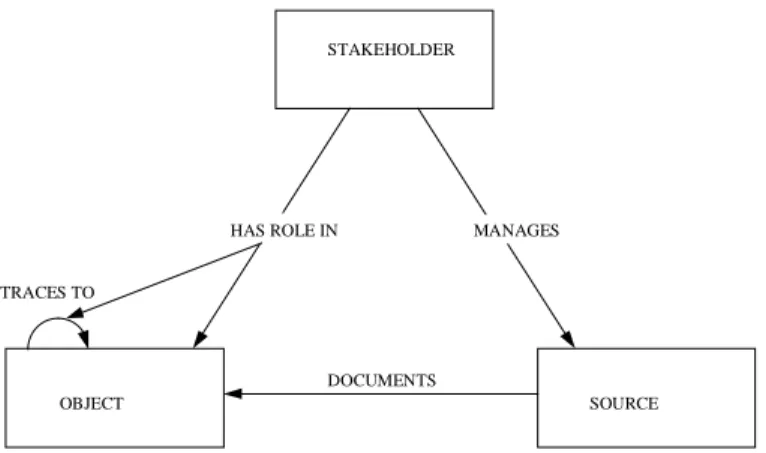
The practitioners and focus groups in phase I of the Main Study) confirmed that the most essential aspects of traceability can be captured in the very simple meta model shown in Figure 1 which thus provides the basic language primitives for categorizing and describing traceability models in more detail.
OBJECT SOURCE STAKEHOLDER
DOCUMENTS TRACES TO
HAS ROLE IN MANAGES
Figure 1: Traceability Meta Model
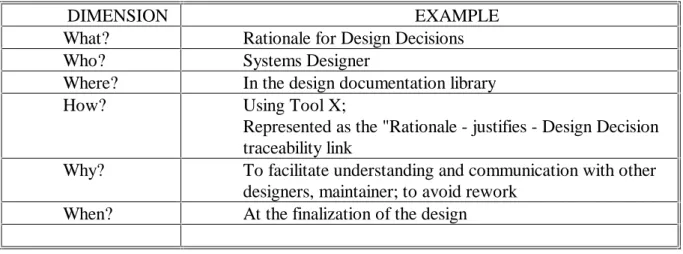
Each entity and link in the meta-model can be specialized and instantiated to create organization or project specific traceability models. The meta-model can be used to represent the following dimensions of traceability information (cf. Table 4):
1. What information is represented - including salient attributes or characteristics of the
information?
In the model, OBJECTS represent the inputs and outputs of the system development
process. Examples of various types of OBJECTS include REQUIREMENTS, ASSUMPTIONS, DESIGNS, SYSTEM COMPONENTS, DECISIONS, RATIONALE, ALTERNATIVES, CRITICAL
SUCCESS FACTORS, etc. These represent the major conceptual elements among which
traceability is maintained during the various life cycle stages. OBJECTS are created by various organizational tasks. Examples of tasks include systems analysis and design activities. This information can be represented as an attribute of OBJECTS.
Traceability across various OBJECTS is represented by the TRACES-TO links. For example,
a DEPENDS-ON link between two objects (a REQUIREMENT and an ASSUMPTION) can be
represented as a specialization of this TRACES-TO link.
2. Who are the STAKEHOLDERS that play different roles in the creation, maintenance and use of various OBJECTS and traceability links across them?
In the model, STAKEHOLDERS represent the agents involved in the system development
and maintenance life cycle activities. Examples of STAKEHOLDERS include the project managers, systems analysts, designer etc. These STAKEHOLDERS act in different roles or
capacities in the establishment and use of the various conceptual OBJECTS and traceability
links.
3. Where it is represented - in terms of sources that “document" traceability information?
All OBJECTS are documented by SOURCES, which may be physical media such as documents or intangible things such as references to people or undocumented policies and procedures. Examples of SOURCES include REQUIREMENT SPECIFICATION DOCUMENTS,
MEETING MINUTES, DESIGN DOCUMENTS, MEMORANDA, TELEPHONE CALLS AS WELL AS REFERENCES TO VARIOUS STAKEHOLDERS USING THEIR PHONE NUMBERS, E-MAIL ADDRESS
etc. STAKEHOLDERS manage the SOURCES; i.e., they create, maintain and use them.
4. How this information is represented - both by formal and informal means and how it relates
to other components of traceability?
The sources, as mentioned above, can be physical or intangible. Further, they can be represented at different levels of formality. Some sources such as requirements specifications may be text documents, whereas others design documents may be represented in multiple formats such as graphics and text.
5. Why a certain conceptual OBJECT was created, modified or evolved?
The rationale behind the creation, modification and evolution of various conceptual
OBJECTS can be represented as a specialization of the meta-class OBJECT. Then, it can
then be linked to the conceptual object (using a specialization of the traces-to link). More complex models of rationale, such as the Issue Based Information Systems framework which include issues, alternatives and arguments supporting and opposing them can also be represented as specialization of the OBJECT-TRACESTO-OBJECT relationship in our model.
6. When this information was captured, modified and evolved?
Relevant temporal information about the any of the entities or links in our model can be represented as their attributes. For example, the frequency or the time / duration at which a requirement or design was created, reviewed, modified or justified by a specific rationale can be represented with this scheme.
DIMENSION EXAMPLE
What? Rationale for Design Decisions
Who? Systems Designer
Where? In the design documentation library
How? Using Tool X;
Represented as the "Rationale - justifies - Design Decision traceability link
Why? To facilitate understanding and communication with other designers, maintainer; to avoid rework
When? At the finalization of the design
Table 4: Traceability Dimensions - An example
The three nodes of the meta model correspond roughly to the three dimensions of requirements engineering proposed by (Pohl 1994) in that they cover the aspects of understanding (objects), agreement (stakeholders), and physical representation (sources). However, note that we are not discussing the requirements process per se, but the creation and usage of traces.
4. Low-End Use of Traceability
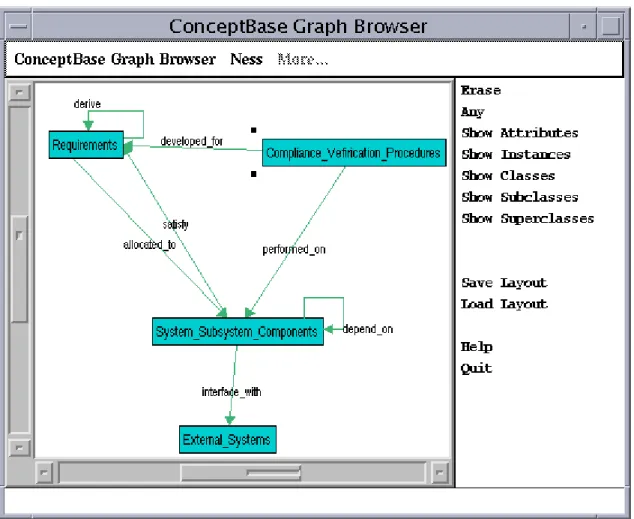
A model of the typical low end user’s traceability efforts is provided in Figure 2. The names of objects and links presented here are our interpretations (validated by the expert groups) of what was observed in practice. Many organizations simply use traceability tables to link various components of information without explicit identification of the semantics of such relationships. Low-end users created traceability links to model requirement dependencies, allocation of requirements to system components, compliance verification, and change control. For the following, recall that we denote traceability linkages by italic small-caps (LINKAGES),
while components that they link are indicated with uppercase letters (OBJECTS). For every link in the model an inverse may be defined.
Figure 2: Low End Traceabilty Model
Typical low end users viewed requirements traceability as providing a link from initial
REQUIREMENTS to the actual system COMPONENTS that satisfy those requirements. However,
first, the higher level requirements must be decomposed to a more refined level. During this recursive process, lower level REQUIREMENTS are DERIVED from higher level system
REQUIREMENTS. (“often derived requirements are the problem; you don’t know why and how they got there.. want to make sure that every low level requirement is tied to the bigger level specification”) 1. Typically, this information is captured in a relational data base, and used in the form of a traceability matrix.
1 This is a direct quote from a subject participating in a focus group or interview. Henceforth, all quotes from a subject will be italicized and included within quotation marks, but no specific reference will be made.
Original and derived REQUIREMENTS are ALLOCATED TO system COMPONENTS (“We
want to track which component will take care of what requirement by creating an allocation table”). An allocation table is the common mechanism used to maintain this information. This simple two way mapping between requirements and system components is usually used also to ensure that there are COMPONENTS in the system that SATISFY all REQUIREMENTS (“when you want to know which part of the system satisfies what requirement, you can go to the allocation table to identify it. Whether the does indeed or not is another matter - for testing to worry about”).
By capturing which components satisfy various requirements and which requirements are mapped to different components, the designer is able to verify that all requirements are addressed by the system.
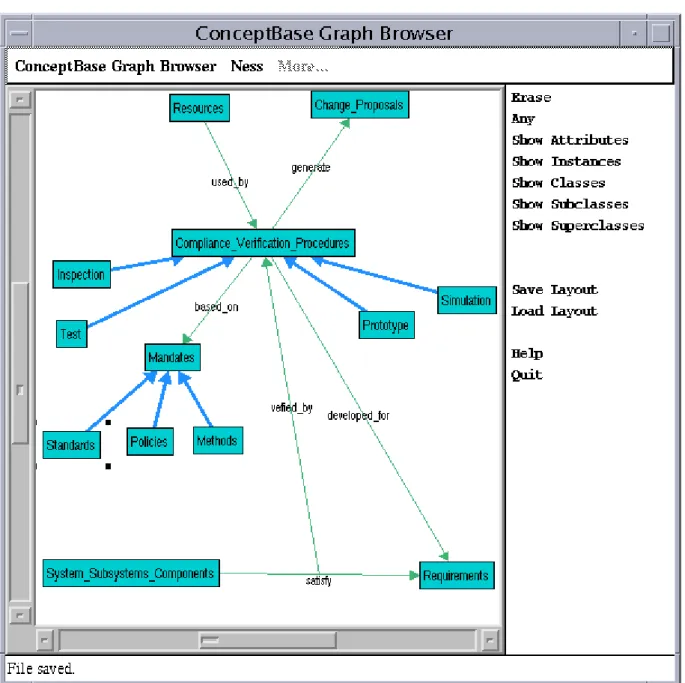
In the Compliance Verification phase of systems development, low end users use the requirements database, which contains the most current version of the system's validated requirements, to develop the system COMPLIANCE VERIFICATION PROCEDURES (CVPs) such as
tests or simulations. CVPs developed for each REQUIREMENT is usually maintained in a REQUIREMENTS-and-TESTS traceability matrix. (“A matrix showing the tests to requirements is very important to make sure all requirements are adequately taken care of”).
If a change should occur in the requirements then the traceability links could identify the CVPs that must be modified or redeveloped. CVPs are PERFORMED on the system
components verifying that the component satisfies the requirements. Results of the tests are used to verify that the system works and that it meets all of the requirements. (“Tests performed indicate whether we indeed achieved success in implementing goals and satisfied the requirements”). A system COMPONENT may DEPEND on others and may also INTERFACE
with EXTERNAL SYSTEMS. This information is used in evaluating how a requirement is satisfied by a system component.
Low-end users lacked especially in the area of capturing rationale. In requirements management, for example, information concerning requirement issues, how they are resolved, and the rationale for the decisions are seldom captured. Likewise, similar information is absent in the design and implementation phases (“often we have no idea who made these decisions, and how they impact the rest of the effort. Simply trying to do these at the end of the project or after the fact doesn’t work. Often the people who worked on it are gone without a trace of what happened. .. not disciplined enough to document these .. with all the demands on the team”).
5. High-End Use of Traceability
High-end users of traceability employ much richer traceability schemes than low-end users, and also use traceability information in much richer ways. We have, therefore, segregated the high-end model into three parts for clarity: Requirements Management, Design Allocation, and Compliance Verification. In addition, Rationale Management now takes center stage.
5.1 Requirements Management Submodel
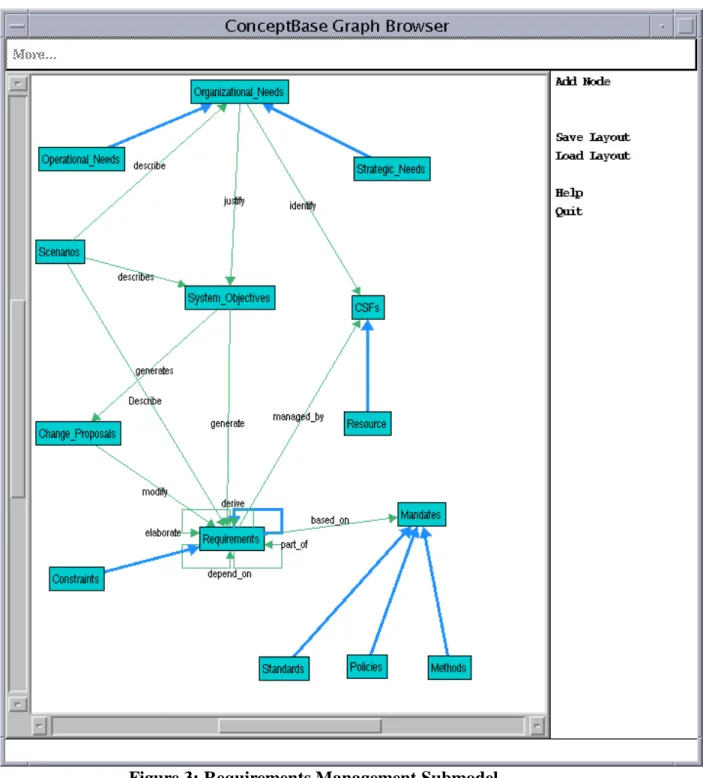
Traceability, when implemented correctly, would greatly benefit requirements management facilitating requirements understanding, capture, tracking and verification. The following is a discussion of the Requirements Management model presented in Figure 3.
Systems are built to primarily satisfy ORGANIZATIONAL NEEDS. These needs may either
be long term STRATEGIC NEEDS or more immediate OPERATIONAL NEEDS, as denoted by the
IS-A hierarchy (shown as thick lines in Figures 3 – 6). These two needs supporteach other and are often detailed in SCENARIOSDESCRIBING the intended use or purpose of the system. (“We build the system obviously to satisfy some long term or operational goals of our sponsors. In our environment, these are clearly stated in the mission needs statement - MNS - operational requirements document - ORD- two important documents to work within any effort. Obviously, these are at a very high level .. laying out the goals”).
Figure 3: Requirements Management Submodel
The objectives that the system is trying to meet, SYSTEM OBJECTIVES, must be
ORD”). Stakeholders such as customer, program manager, program sponsor, etc. specify the
SYSTEM-OBJECTIVES. The REQUIREMENTS for the system are GENERATED from these SYSTEM OBJECTIVES (“The high level goals are after all too vague to be called requirements - for contracting. Specific, detailed requirements have to be developed to proceed further”).
Due to the large number of requirements associated with complex systems, it is important to determine those factors that are critical to the success of the project, and to manage requirements based on how they contribute to these factors. The stakeholders involved in the identification of the ORGANIZATIONAL NEEDS also IDENTIFY these CRITICAL SUCCESS FACTORS (CSF) ("Stakeholders have some issues or values like, no mistakes or system errors, performance is the most important thing, the power requirements are the most critical item in this area"). RESOURCES such as Cost, Time, Weight, Voltage, etc. are examples of CSFs. ("A lot of decisions have been made...because of cost and weight, mostly cost.") ("It will be a combination of technical and cost trades."). REQUIREMENTS for the system are
MANAGED (budgeted, monitored, tracked etc.) by these CSFs. For example, the mission
criticality (a CSF) of requirements could be used in classifying and monitoring requirements.
Similarly, CSFs such as weight in an aerospace system or the total cost of development can be used in tracking and monitoring requirements. As part of the negotiation process among stakeholders, many tradeoffs are made in deciding the scope and functionality of the system depending on their impact on CSFs ("Typically we enter into a complex negotiation process of
what’s in scope, what’s out of scope, what’s affordable, what’s not affordable. And I believe this is where traceability earns its keep"). Such decisions determine, among many things, whether requirements identified initially are feasible, cost effective, or desirable.
Not all requirements are equal in significance or criticality; requirements may be traced through the lifecycle at different levels of granularity or detail in order to optimize on resources spent. It may be unnecessary or even undesirable, considering the overhead involved in maintaining traceability, to maintain linkages between every requirement and every output created during the systems design process. The CSFs may be used in deciding when it is
essential to trace requirements in detail and when fine grained traceability is less important ("...just try to get as much traceability information for the critical requirements, and not as much for the requirements that may not be as important"). REQUIREMENTS can be traced throughout the lifecycle to provide stakeholders with a view to understand and evaluate whether the system supports these CSFs ("...the smaller subset is the driving, high risk set of
requirements that merit more visibility in the tracking of the program...we have an attribute of a requirement that we call technical performance measure (TPM). Is it high risk, do we want to put a TPM against this requirement? The TPMs are all programmed, tracking, giving them higher visibility to see how we’re doing"). Further, requirements may also be based on
STANDARDS, POLICIES AND PROCEDURES. Maintaining the links between requirements and the sources and the requirements willl help understand and correctly interpret them.
CONSTRAINTS may be treated as a type of REQUIREMENT (denoted by IS-A link). Several
focus groups stated how constraints become hard requirements because they set limits within which the system is to be developed (“Systems are designed and decisions made with constraints considered”).
5.1.1 Evolution
One of the biggest challenges in managing large, complex systems is due to the way requirements are constantly evolving and changing. Each focus group noted that in order to accurately reflect this volatility, a requirements traceability scheme should help document and understand the evolution of requirements. Two major sources of changes are: 1) the need to
Section 6.4), and 2) changes in ORGANIZATIONAL NEEDS. Various stakeholders modify SYSTEM OBJECTIVES based on changed ORGANIZATIONAL NEEDS, leading to changes in REQUIREMENTS.
In projects with very long life cycles, such as military applications, not only is the nature of systems requirements dynamic, but even the ORGANIZATIONAL NEEDS (mission and operational) and the SYSTEM OBJECTIVES keep evolving (“Systems that were considered successful during the cold war era are no longer considered useful as strategic and mission needs are evolving rapidly”). It is not possible, however, to abandon all investments in such systems and develop new systems to meet current needs. The lack of comprehensive traceability is a primary reason for the inability to identify components that are linked to various objectives and modify them to meet the current requirements (“we can’t clearly figure out which part of the system we can retain and which part is no longer relevant.. we don’t have the traceability details for these systems any more”).
Traceability links are needed among REQUIREMENTS that get specified at different levels of detail as they evolve through the various stages of the development lifecycle. The recursive links among REQUIREMENTS shown in our model are useful in providing a historical
record of requirements evolution and in mapping a REQUIREMENT back to its sources, thereby facilitating a complete understanding of where a requirement comes from.
5.1.2 Derived Requirements
Lower level REQUIREMENTS are DERIVED from higher level REQUIREMENTS, usually based on assumptions made by stakeholders. Derived requirements need to be tracked carefully as they are likely to be a major source of conflicts and issues, and are subject to changes as assumptions behind them are often unrecorded. Requirements that are derived "create a collection of requirements at a different level” of detail. Traceability helps clearly identify derived requirements that “partially satisfy the originating requirement” (“We find things in requirements documents which most people didn’t know where they came from. Then we will figure out that someone created these consolidating or clarifying other requirements. We now have a policy to identify - and before that - agree on these derived requirements. There is lot of room for problems when we go from customer given requirements to lower levels based on our interpretations. We try to document these also in as much detail or at least know who is responsible”). Further, this traceability information is useful in managing the "explosion" in the number of requirements ("...if you can start with 30 pages of requirements, top level, then you can go to your prime item development specifications and you could consider those requirements derived from those 30 pages, but then you have those second and third generation... derived requirements between those ...you have an explosion of derived requirements and relationships").
Some REQUIREMENTS are ELABORATED by others, providing further explanation or clarification. This added detail assists in understanding the assumptions behind requirements as well as how they are interpreted. ("Sometimes you add requirements really because you find them unclear. They are refined, and become more specific in detail then in fact are more demanding than the original requirement might have been").
REQUIREMENTS also DEPEND-ON others. For example, a requirement to use a specific
software platform may depend on a requirement to use a specific hardware platform. Identifying these dependencies is important, especially when requirements change, so that the impact of the change on the entire system can be determined (“different people and teams work on different parts of requirements, some even from other parts of the organization or sub-contractors. It is when it is difficult to trace whose part affects which other. After all are part of the same system. We get into major problems down the line when we are unable to figure out these connections”).
Complex requirements are often broken down into their components, identifying simpler requirements that form a PART-OF them. These links help in understanding how various
pieces of a requirement fit together and are especially important on large, complex systems whose requirements may contain several interdependent parts. (“we split a requirement to deal with different aspects .. like functionality”). IS-A links between requirements show the parent/child hierarchical relationships. ("Higher levels of requirements are just abstractions of lower levels.") ("Initially its a top-down, hierarchical decomposition starting with the most general goals of the customer, flowing down to a set of systems performance requirements...you now can have children with multiple parents, whereas originally we were probably looking at children with a single parent."). IS-A hierarchies can be used to show the
relationship between requirements specified for an entire class of hardware to be used and those for a specific type of hardware component.
5.2 Rationale Sub-Model
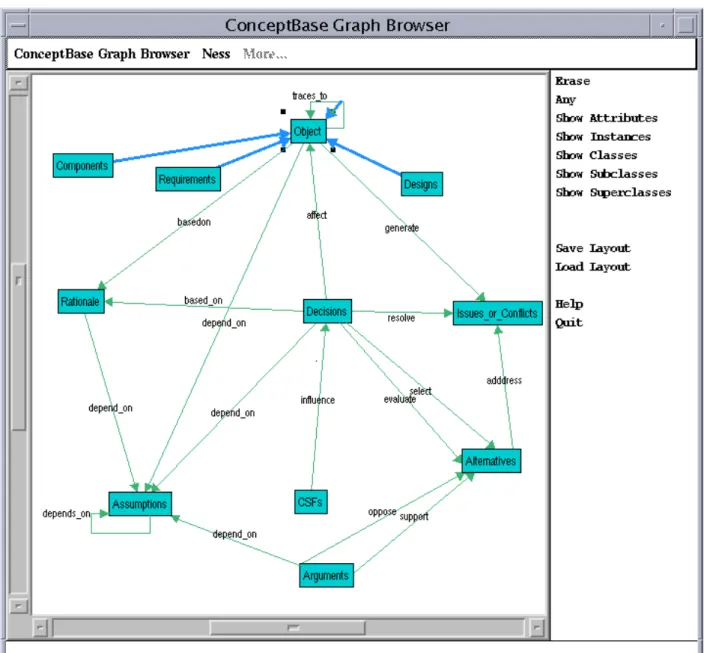
The following is a discussion of the Rationale sub-model presented in Figure 4. The specification, elaboration, decomposition, derivation and modification of OBJECTS such as REQUIREMENTS, DESIGNS ETC. GENERATE (or lead to) ISSUES or CONFLICTS, often due to the differing interpretations, assumptions, interests, viewpoints, experience and objectives of the stakeholders. Information about how decisions are made to resolve these ISSUES must be
maintained throughout the system lifecycle to ensure that customer requirements are understood and satisfied ("Traceability pays for itself by making sure you understand how the requirement is interpreted, how its being implemented, what were the issues that were considered in the design to satisfy that"). These DECISIONS, in turn, may AFFECT REQUIREMENTS.
Various ALTERNATIVES that address the resolution of ISSUES are considered (“We want everyone to know what the options are, why we are picking one versus another. They can immediately see if these decisions will affect their parts and this feedback is important in making the right decisions. Getting a resolution through this process is also helpful in bringing everyone on board and on the same sheet of music”). ARGUMENTS for and against each ALTERNATIVE may be proposed.The DECISION to SELECT one or more ALTERNATIVES is often INFLUENCED by the CSFs (“All parties understand the various possibilities and why one
looks better than others in terms of what is critical for the project”).
A common observation made by most focus groups is that seldom such detailed information on all the ALTERNATIVES considered, the ARGUMENTS supporting and opposing these alternatives and the assumptions behind this decisions is explicitly recorded. Most often only the chosen alternative is well documented and the discarded ones are not recorded. With evolving requirements, availability of such information may help avoid expensive rework ("We debated that for two weeks now. Why was it thrown out years ago when we got one camp arguing to put it back in and another to keep it out. And if we could have gone back and assessed why we made that decision two years ago it would have saved us a lot of time").
Often, the capture of rationale at the detail described above is impractical due to overhead involved in capture and due to the lack of tools to facilitate it. However, simple descriptions of rationale on which REQUIREMENTS OR DESIGNS are based may be recorded along with the assumptions behind them. Further, ASSUMPTIONS underlying the various
components of the deliberation are also recorded (“We record the rationale as simple notes.. and add specifically any assumptions we have made. It is useful to keep track of these assumptions as clearly as possible for these are the most likely candidates for changed requirements”). We return to this issue in section 8.5.
Figure 4: Rationale Submodel
Over the lifecycle of large projects, requirements, assumptions, etc. change. Further, such projects also experience personnel turnover. If detailed rationale is not maintained, these changes lead to a lot of rework ("We already looked at that tradeoff, that approach, but the person who did it - the analysis - is leaving and the person that reviewed it is gone, so we churn the whole thing again”. "This is a lengthy look at all these issues with a lot of people that contribute to, touch, change, add, use this information.”).
During the systems development process different stakeholders often bring different interpretations of requirements and their origins. For example, even when two different stakeholders review the same origins of a REQUIREMENT (say, a standard) they may interpret it
differently. Often the difference in interpretation is the cause of conflicts between stakeholders, even in a cooperative setting. ("You can look at a given set of requirements and they might be meaningless if you don’t really know what the customer needs because you can interpret them wrong, or at least two or three different ways.") .
Another reason to have detailed rationale is to provide accountability. Information about how the requirements and design have evolved, what changes have been made, why and how they were made, and the status of their development is extremely helpful to those
stakeholders that were not involved in creating the requirement ("If you don’t have traceability to the rationale, it is impossible to understand many low level requirements.. They may have made sense to the person who evaluated the options and not for others”).
5.3 Design/Allocation
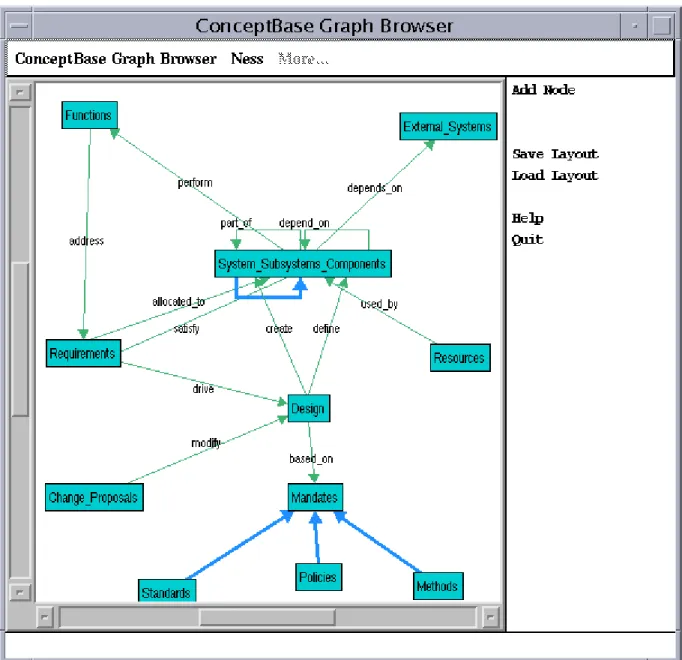
We use the term design to refer to any activity that creates artifacts, including implementation. In Figure 5, REQUIREMENTS DRIVE DESIGN, that are often BASED ON MANDATES such as STANDARDS OR POLICIES OR METHODS that govern the system development
activity (“we have to follow military standards and policies to make sure we are compliant”).
Figure 5: Design Allocation Submodel
SYSTEM/SUBSYSTEM/COMPONENT (hereafter referred to as COMPONENTS) are the building blocks of the system. They are DEFINED or CREATED by the DESIGN process. REQUIREMENTS are ALLOCATED to COMPONENTS that are supposed to satisfy them. The