Electronic supplementary information for:
Ubiquitous Magneto-Mechano-Electric Generator
By Jungho Ryu1,7*,Ju-Eun Kang1,2, Yuan Zhou3, Si-Young Choi4,7, Woon-Ha Yoon1, Dong-Soo Park1,7, Jong-Jin Choi1, Byung-Dong Hahn1,7, Cheol-Woo Ahn1, Jong-Woo Kim1,
Yang-Do Kim2, Shashank Priya3, Seung Yong Lee5,8, Seongsu Jeong9, and Dae-Yong Jeong*6
1
Functional Ceramics Group, Korea Institute of Materials Science (KIMS), Changwon, Gyeongnam 641–831, Republic of Korea. [email protected]
2
School of Materials Science and Engineering, Pusan National University, Busan 609-735, Republic of Korea.
3
Bio-inspired Materials and Devices Laboratory (BMDL), Center for Energy Harvesting Materials and Systems (CEHMS), Virginia Tech, Virginia 24061, USA
4
Advanced Characterization and Analysis Group, Korea Institute of Materials Science, Changwon 641-831, Korea
5
Center for Materials Architecturing, Korea Institute of Science and Technology, Seoul 136-791, Korea
6
Department of Materials Science & Engineering, Inha University, Incheon 402-751, Korea. [email protected]
7
Department of Materials Science and Engineering, Korea University of Science and Technology (UST), Daejeon 305-350, Korea
Electronic Supplementary Material (ESI) for Energy & Environmental Science. This journal is © The Royal Society of Chemistry 2015
8
Department of Nanomaterials Science and Engineering, Korea University of Science and Technology (UST), Daejeon 305-350, Korea
9
Department of Electrical Engineering, Changwon National University, Changwon 641-773, Korea
This PDF file includes:
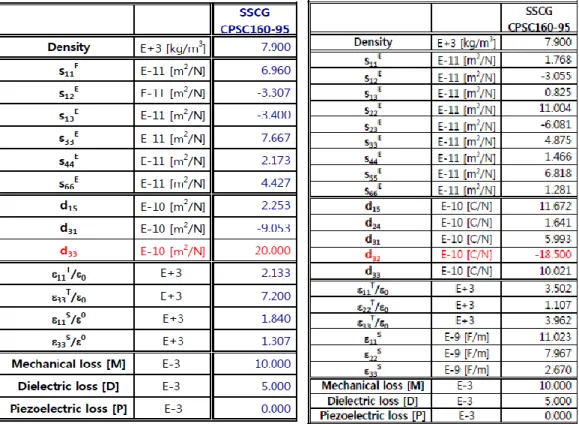
Table ESI 1: Electro-mechanical properties of piezoelectric single crystal isotropic <001> cut, and anisotropic <011> cut.
Figure ESI 1 to ESI 5
- Enlarged schematic illustration and optical micrograph of SFC structure
- Schematic diagram and photo of magnetoelectric property measurement system. - Magnetic field sensitivity of ME laminate with anisotropic <011>- d32 mode SFC.
- Anti-resonance tuning of MME generator.
- Driving of wireless sensor network module by MME generator.
Other supplementary information for this manuscript
Video S1: powering 35 high intensity LEDs by MME generator under 5 Oe at 60 Hz magnetic field
Video S2: MME harvesting from electric power cable for 7.5 kW vacuum pump.
Video S3: Driving of wireless sensor network module by MME generator under 7 Oe at 60 Hz magnetic field
Table ESI 1. Electro-mechanical properties of piezoelectric single crystal used for ME laminate composites and MME generators
Figure ESI 1. (a) Enlarged schematic illustration of SFC structure, (b) photo of the single crystal fibers before laminating, and (c) magnified photo of (b).
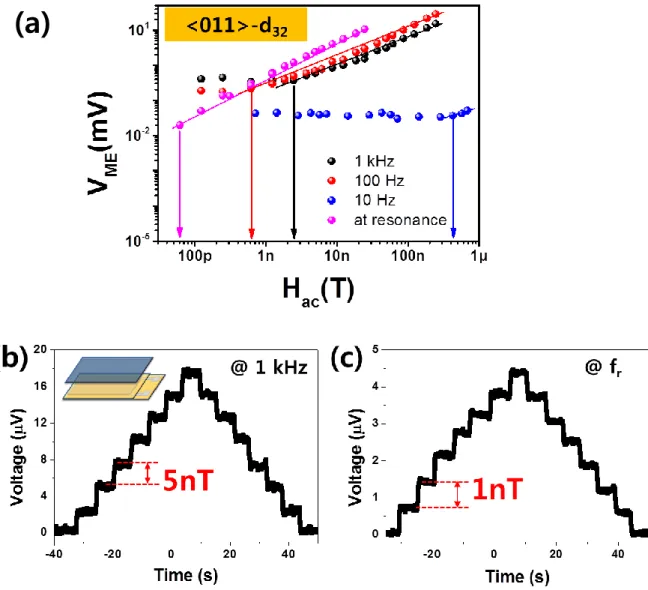
Figure ESI 3. Magnetic field sensitivity of ME laminate composite with anisotropic <011>-d32 mode SFC. (a) shows the AC magnetic field sensitivity of the ME laminate composite
with anisotropic <011>-d32 mode SFC. It showed remarkable AC magnetic field sensitivity
(<60 pT) at its resonance mode (~1.7 kHz) without any external DC bias field. Though the sensitivity of the laminate degraded at its off-resonance frequency band, it kept as low as nT range. (b) and (c) represent the time based voltage read with Lock-In amplifier according to the stepped AC magnetic field change. By changing 5 nT and 1 nT at 1 kHz and 1.7 kHz (resonance frequency), ME laminate composite with anisotropic <011>-d32 mode SFC
generated clear step-like output signal.
(a)
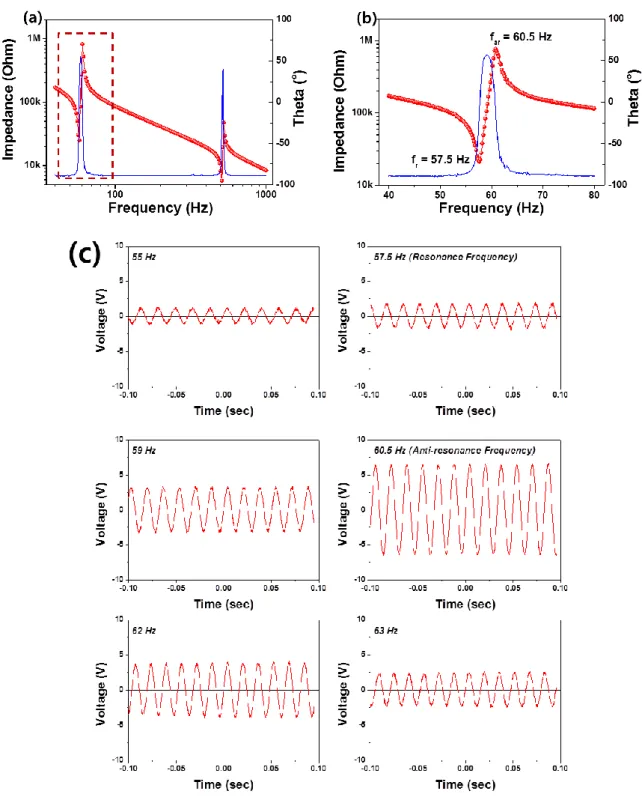
Figure ESI 4. Frequency tuning of MME generator. In one end clamped cantilever structure, the resonance frequencies can be tuned by adjusting the length of the cantilever, weight or position of proof mass. For the MME generator in this study, we fixed other parameters except the position of proof mass. (a) shows electric impedance changes of the frequency tuned MME generator as a function of driving frequency. Two electromechanical resonance peaks were observed at around 60 Hz, and 500 Hz, which correspond to 1st bending and 1st transverse modes, respectively. Since MME generator can draw out maximum voltage at its
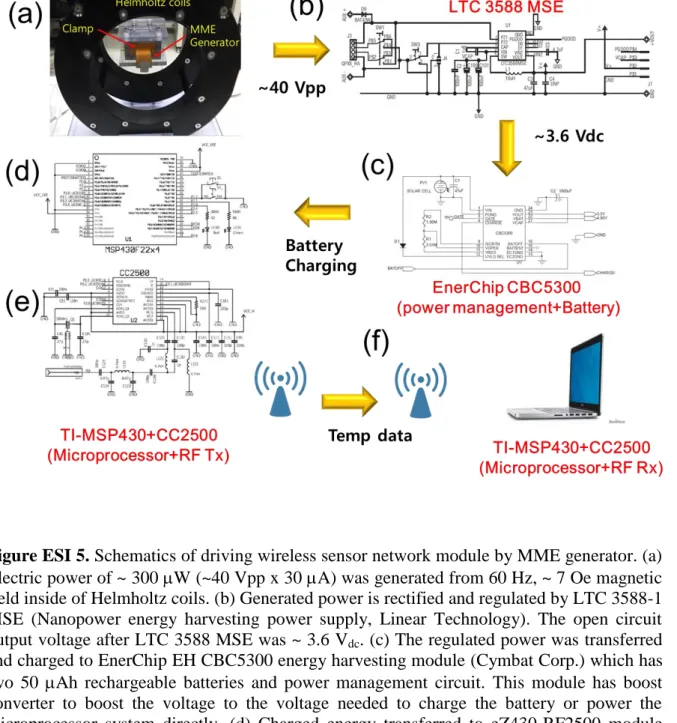
Figure ESI 5. Schematics of driving wireless sensor network module by MME generator. (a) Electric power of ~ 300 W (~40 Vpp x 30 A) was generated from 60 Hz, ~ 7 Oe magnetic field inside of Helmholtz coils. (b) Generated power is rectified and regulated by LTC 3588-1 MSE (Nanopower energy harvesting power supply, Linear Technology). The open circuit output voltage after LTC 3588 MSE was ~ 3.6 Vdc. (c) The regulated power was transferred
and charged to EnerChip EH CBC5300 energy harvesting module (Cymbat Corp.) which has two 50 Ah rechargeable batteries and power management circuit. This module has boost converter to boost the voltage to the voltage needed to charge the battery or power the microprocessor system directly. (d) Charged energy transferred to eZ430-RF2500 module (Texas instruments) which consist of MSP430F2274 microcontroller and (e) CC2500 2.4 GHz wireless transceiver. (f) The integrated temperature sensor in MSP430 microcontroller and RF signal strength indicator were used to monitor the environment and the monitored data were wirelessly transferred to PC by using the same MSP430F2274 and CC2500 RF 2.4 GHz receiver module in every 5 ~ 10 sec. All the detailed information about each circuit modules used in this work can be downloaded from each manufacturers’ website.