Simulate Grid Resource Trading via Cognitive Agent: A Case Study
Yuhui Qiu
Faculty of Computer and Information Science
Southwest University, Chonqing, China
[email protected]
Zhixing Huang
Faculty of Computer and Information Science
Southwest University, Chonqing, China
[email protected]
Abstract
In this paper, we explore the market-based grid resource trading system from the social perspective and the collab-orative computing perspective. We firstly introduce a novel framework to simulate the trading system of the grid com-puting resources, then we give a case study based on this framework. In the case study, an evolutionary dynamics of the resource reservation game is played by agents on the network. We study the evolution of the system with cogni-tive agents: Study the evolution dynamics of system with agents can automatic adapt to their environment, they can exchange private information and learn experiences from each other. Finally, after analyzing the experiment results, some critical issues about designing the market-based trad-ing system are discussed.
1
Introduction
Grid Computing has emerged as a new paradigm for next-generation computing. It supports the creation of virtual organizations and enterprizes that enable the shar-ing, exchange, selection, and aggregation of geographically distributed heterogenous resources for solving large-scale problems in science, engineering, and commerce. Grid Computing and also Peer-to-Peer Computing promises a flexible infrastructure for complex, dynamic and distributed resource sharing. In spite of a number of advantages in Grid computing, resource management and scheduling in such environments continues to be a challenging and complex undertaking. The future interconnect environment must ab-sorb AI and distributed systems, inherit the advantages of the Web, Semantic Web, Grid and P2P technologies, and go beyond their scope with new principles [9].
In recent years, distributed computational economy [13] has been recognized as an effective metaphor for the man-agement of Grid resources, as it: enables the regulation of supply and demand for resources, provides economic incen-tive for grid service providers, and motivates the grid
ser-vice consumers to trade off between deadline, budget, and the required level of quality-of-service. However, within these fields, numerous economical questions have to be solved, for example the evolutional behavior of resources to grid users while assuring some specific quality of ser-vice for all users. In some recent practice of using market-based methods for resource allocation. Although there are some prefect theory results in Game Theory, Economics, etc, when we deployed microeconomic in the real in re-source allocator system, the user strategic behavior has been observed [5]. These behavior will change what the system should to be [3].
Many researchers adopt Agent-based Computational Economics (ACE) models to understand and analyze those complex economic systems. The social behavior considera-tion in multi-agent systems (e.g., cooperaconsidera-tion, competiconsidera-tion, proactiveness) has been recognized as a new dimension for enriching the autonomy of the coordination infrastructures. In this paper, we explore the market-based grid resource trading system from different perspective: the social or be-haviorial perspective (Social Intelligence) and the collabo-rative computing perspective (Grid Intelligence) [16]. The remainder of this paper is structured as follows. In sec-tion 2, the ACE-based Grid Resource trading Frame used in this paper are proposed, and the model of small world is briefly introduced. In section 3, we analyze a resource trading case in which user agent reserve their computing service through participating in multiple sequential English auction, two novel risk-based heuristic bidding strategies also have been proposed in this section. In section 4, our model are evaluated through three experiments. Finally, in section 5 we present the conclusions and future work.
2
Grid Resource Trading Simulation
Frame-work
In recent years, distributed computational economy has been recognized as an effective metaphor for the manage-ment of Grid resources. C. Kenyon [4] proposed a archi-tecture which meets the needs for grid resource
commer-cialization. he pointed out that three necessary components: Value Expression, Value Translation and Value enforcement should be included in grid resource commercialization ar-chitecture. In this section, we propose a more concrete source trading simulation framework with five layer which also meets these needs.
Resource Layer:The basic information of the resources or the services been provided in the System is described in this layer. The basic information of the resource such as type, number, state, price and the service starting time, should be clearly depicted. Usually, the resources in the computing grid environment could be CPU, memory, disk, network bandwidth and the software licence. Furthermore, it also could be the Virtual Resources which combined the multiple concrete physic resources in the system.
Allocation Mechanism Layer: This layer includes the allocation or scheduling mechanisms of the resources. These mechanisms not only could be traditional queue-based allocation or scheduling methods, such as First Come First Serve, Shortest Job First, Highest Priority First, Pro-portional Based, etc., and these mechanisms also could be market-based allocation methods, For example, the alloca-tion methods based on English aucalloca-tion, Vickrey aucalloca-tion and combinatorial auction, and so on. The allocation mecha-nism of the resources is specified by the owner of the re-source, the resource user couldn’t change these method. In addition, it has been strongly recommended that the function of advance reservation [7] should be supported in the allocation and scheduling mechanisms, and are cur-rently being added to some test-bed of grid toolkit, such as Nimrod-G [13], etc.
Competitive Policy Layer: For the inherent dynam-ics and complex characteristdynam-ics of the Grid resources, the competition strategies of the resources in Grid environment seems to be more complexity than in traditional central-ized systems. It needs user carefully compares and se-lects the candidates of the service provider and then par-ticipates the completion of selected resource. When failure of the completion is taken place, user should repeat those operations. There are many possible strategies for compet-ing these resource, especially for market-based allocation methods, such as Best-response strategy, Greedy strategy, Threshold strategy etc. We assume that most of the compet-itive policies in this layer could be provided by the service provider or the third-parties, user can freely selects the com-petitive strategy from this layer.
Adaptive Layer: The main function designed in this layer is to help user adapt the system’s dynamics, it in-cludes sense the change of environment, adjust the param-eters of the competitive policies, save and analyze the his-torical data. For the dynamics of the environments, fixed competitive strategies are not always suitable, they should be adjusted according the change of the environment. For
example, in the market-based resource allocation system, combined with the predication of the price of the resource, most of these strategy can improve their performance. The methods which are adopted in Hybrid Intelligent System also could be used in this layer to improve the performance of the competitor. For comparing the influence of different learning methods, we assumed that the machine learning algorithms used in this lager are restricted in learning algo-rithms for single agent, in another words, these algoalgo-rithms can only use the user local information or global informa-tion published by the system. And there is no cooperainforma-tion between users in this layer.
Interaction Layer: The Interaction (user agent) layer include two parts of contents. On the one hand, it response to capture the needs of the user, such the deadline, budget, quality of service (QoS), and the preference between these attributes. On the other hand, this layer also includes the interaction between the different users, we could model the interaction between different users as the multi-agent co-operative learning. The interactive methods adapted in this framework which are differed from the traditional Agent-Oriented Computing which use global information to im-plement the cooperation between multi-agent. In the com-plex enjoinment, nobody can know all the information in the system, especially when some of the information are private.
To model the users’ interaction in these complex envi-ronment, many researchers adopt Agent-based Computa-tional Economics (ACE) [6] models to understand and an-alyze complex economic systems. L. Tesfatsion [10] de-fines Agent-based Computational Economics as the compu-tational study of economies modeled as evolving systems of autonomous interacting agents. Starting from initial condi-tions, specified by the modeler, the computational economy evolves over time as its constituent agents repeatedly inter-act with each other and learn from these interinter-actions.
In the studies in the ACE, the small world network has been widely used. Following an important body of litera-ture in the field of socio-psychology and sociometrics initi-ated by Milgram [14]. The small world networks have been found in many areas so far [8], such as the knowledge, inno-vation diffusion processes, market organization etc. Small world can be viewed as a suitable model to simulate the in-teraction between humans, and it also can be used to study the emergence phenomena of the interaction between intel-ligent agents in the grid.
3
Trading Simulation: A Case Study
In this section, we specifically consider a special case study of resource advance reservation through user agents bid in multiple overlapping English auctions. As be noted
in GRAAP-WG1, the state of advance reservation has nine different states. For simplicity, in this paper we only con-sider the following three most important states: Requested, Declined, Booked.
• Requested: A user has requested a set of resources for a reservation. If the reservation accepted, it goes to being booked. Otherwise, it becomes declined. • Declined: The reservation is not successfully allocated
for some reason.
• Booked: A reservation has been made, and will be honored by the scheduler. From here, the reservation can become active.
That is, the booked reservation can not be altered or be can-celled.
3.1
Resources Provider
Suppose there are R resource/service providers willing to provide computation service, the services of the providers are homogenous. Suppose each service provider owns a computation pool with the capacitycj, and computation ser-vice can be started at timesj. Each service provider has its lowest pricerjfor providing service (also call reserve price) and the minimal increase of the priceλj in the auction. If one agent’s bid to the service providerjis the highest bid in the lastlj rounds, the agentiwill win this auction and the request of resource reservation is booked. As we have men-tioned before, the agent’s task size and the service’s new start time are announced by provider and can be known by all the user agents. The services are reserved through auc-tions, and each service provider runs one auction indepen-dently.
3.2
Allocation Mechanism
Now, we briefly introduce the variant of ascending auc-tion protocol which is different from the standard ascending auction [12] for the general continuous resource reservation protocol. In detail, we consider a multiple sequential En-glish auction market, where each auction is given a start and an active bidding lasting time that may overlap with other auctions. We assume that English auctions work according to the following principles:
The auctions proceed in rounds. Each auction admin-istrate the price of the service. We don’t assume that the different auctions’ rounds are synchronized, that is, all auc-tions move from one round to the next simultaneously. In
1Advance Reservation State of the Art: Grid Resource
Al-location Agreement Protocol Working Group, URL http://www.fz-juelich.de/zam/RD/coop/ggf/graap/graap-wg.html.
each round, after all the user agents propose their bids, the service provider will select the highest bidding agent as the active one, and then it will update its current price. If there are more than one highest bidding, the service provider ran-domly selects one as theactiveagent. If the request of the user agent is declined, the agent isinactive. If the agenti’s bidding to the service providerjand is active in the lastlj round, the agentiwill win this auction and the request of resource reservation is booked. The service provider will reset the service price to its’reserve price, and update the start time of the next service, and then a new auction turn will begin.
Though simultaneous ascending auction protocol does not include announcements of bidder identities, the task size of the active agent will be announced by the auctioneer, and the number of user agents remaining in the system can be known by everyone.
3.3
Bidding Strategies
In each round, the user agent considers bidding if and only if it is not holding an active bid in an auction or it has not already obtained the service. If user agent i is inac-tive, the user agent will choose the service provider which it will request to and then decide whether or not to propose the next bid in this server. As we note below, each service provider has its reserve price, and the valid bids to the ser-vice providerjmust be increased byλj.
In contrast to the stand-alone English auction, there is nodominant strategythat can be exploited in the multiple auction context [1] and there did not exist Nash equilibrium in even in the very simple scheduling problems [12]. So in this auction-based resource reservation model, the heuristic strategies are adapted. In addition, we make a distinction between the bidding strategies. If the agent’s strategy can predict the prices of the next k turns of the auctions, we call the strategy levelkstrategy. And more specifically, if the agent takes into consideration all the future turns of the auctions, we call this strategy level∗strategy.
A key component of the successful strategy is able to make predictions about the likely closing prices of the var-ious auctions, so that the agent can determine whether is should place a bid at current moment or whether is should be delay because better deals may subsequently become available. In [17], we propose two heuristic bidding strate-gies based on fixed price predication function, although these strategies can outperform above three strategies in most cases, however, it could be improved as following modifications.
We defineφ ∈ [−1,+∞)to limit the maximum abso-lute gradient and avoid the target price updating excessively with respect to change in the risk factorγi.
εi=(n(t)−(n(t)n(tk))(n(t−1)2k)−1)×φ×γi (1) We use the following equation to predicate the closing price of the nextkturn in the same server.
pj(tk) =rj+(pj(tk)−rn(t)j)(n(tk)−1) ×(1 +εi) (2) In these equations, pj(t) is the current price and n(t) is the current number of agent who are participating in the auctions at the current time t. Moreover, pj(tk) is the predication of the price on server j and n(tk) is the number of agents remaining in the system at the time oftk,
tk < tandn(tk) ∈ [1, n(t)−1]. For example, suppose the number of agents currently in the system is nand the current auction will be closed soon. If we want to predict the likely closing price pj of the service j in the next turn, conservatively, we say the number of active agent remaining in the system will ben−1. Through comparing the utilities of the current turn and the utilities of the future turns, the agents can make decisions on when and which auction they will bid to.
Intuitionally, we can see that if there is only one user agent in the system, the price of the service on server j
will fall down close to the server’s reserve price. But as the number of agents increases, the competition of the service becomes severe, and the price of the service will increase.
RB-Greedy(1) strategy: unless the agent is active in some auction, based on Equation 2, the agent decides to bid in whichever auction currently has the highest evaluation, or decides not to bid if there exists a higher expected evalu-ation in the next turn than the current highest evaluevalu-ation.
RB-Greedy(∗)strategy: If the agent knows the average size of agents’ tasks, it can use the following equation to predicate its task end time.
eij =sj+tj cj + ¯t× ¯ t×(n(tk)−1) cj (3) Forn(tk)∈[1, n(t)−1], based on Equation 2 and Equa-tion 3, the agent can predicate the maximum utility by com-paring different utilities. Unless the agent is active in some auction, the agent decides to bid in whichever auction cur-rently with the highest evaluation, or decides not to bid if there exists a higher expected evaluation in future turns than the current highest evaluation. It indicates in the complex scenarios that the highest level of the strategy is not cer-tainly with the best performance.
3.4
The Adaptive Layer
In the adaptive layer, the user agent uses a set of learn-ing rule to update its risk factor to better fit prevaillearn-ing
mar-ket conditions. Specifically, a learning algorithm is used to increase or decrease the risk factor. The Risk-Based strat-egy can risk-seeking that is the trader tries to achieve high profit but has a correspondingly lower probability of trans-acting), or risk-averse, which trades-off lower profit for a higher probability of transacting. The risk-neutral strategy is considers a bid or ask that maximizes its expected profit. Risk-Based strategy is flexible in that it can very its risk attitude depending on the prevailing market conditions, to remain competitive.
We adapt the user agent’s risk attitude by gradually changing its risk factor to a desired risk factor.ηwas chosen based on simulation result. Specifically,
γ(t+ 1) =γ(t) +β∗η, η={−0.05,0.05} (4) Whereβ ∈ (0,1) is the learning rate of the algorithm and influences the moving rate of the bidding price. And the learning rules for user agent is that: when a reserva-tion transacreserva-tion price isp, if current trade price is lower that user’s predicate price agent increase its risk factor else agent decrease its risk factor.
The role of the risk model is to generate the target prices given the user risk attitude, which is defined by its risk fac-tor. If the target price equal to the transaction price implies that the user is risk-neutral. When a user agent adopts a risk-seeking attitude, it considers a target price that is be-low the transaction price, in order to obtain a higher profit margin. Conversely, a risk-averse attitude implies that the user place bids above actual trading price.
3.5
User Agent
Suppose there are N user agents, each agent with one task to fulfill before the deadline. Furthermore, we assume that agentihas a budgetmi, the size of the task of agentiis
tiand the deadline of the taskdi. The information of agents’ task size, deadline and budget are private information, and the distributions of these information are all unknown to the agents. Suppose the current price of the servicejispj, so the cost of user agent is:bij =tipj/cj. And, if the agenti’s task running on serverjstarts atsij, the end time of the task iseij =sij+ti/cj. The utility of agent is related to the cost of fulfilling the task and the task’s end time. In this paper, we use a constant elasticity of substitution (CES) function to present user agent’s utilityuij. Ifdi≥eijandmi≥bij,
uij =Ai(δi1(di−eij)ρi+δi2(mi−bij)ρi)1/ρi (5) otherwise, uij = 0. So the agents must make trade-offs between the task finish time and the cost of the execution. The satisfaction of the user agent is defined as follows:
In addition, we adopt the small world network to model the interaction between the user agent. We suppose user agents are randomly or regularly located in the small world net-work according to their initial bidding strategies. The user agent can learn the successful experiences from his neigh-bors. Here, the experience restricts the type and the pa-rameter of bidding strategy, other private information of the neighborhood will not be shared. The user agent can select the strategy of his neighbors with the highest accumulated satisfaction, and the user decide whether to change his bid-ding strategies with a fixed probability. The accumulated satisfactionϑis defined in following equation andτ is the learning rate.
ϑi(t) = (1−τ)∗θi(t) +τ∗ϑi(t−1); (7) Because interactions between parts of a dynamic system are the source of both complexity and emergence. In next section, we will study the evolution dynamics of this trading system.
4
Experiment Analysis
In this section, we process the experiment in two per-spectives. The first one is from traditional non-cooperative perspective that means user can not learn experience from their neighbors, and the second one from cooperative per-spective, but as we above-mentioned the interaction are hap-pened locally.
4.1
Experiment Setup
In the next section, we will investigate several bidding strategies to resource advance reservation. For simplicity, we assume that all the user agent with same utility function, andδi1 = 1,δi2 = 1,Ai = 1,ρi = 2,li = 10,ti = 10, di = 10, mi = 10; and we also assume that cj = 10,
lj= 10,λj= 0.5.
4.2
Experiment 1
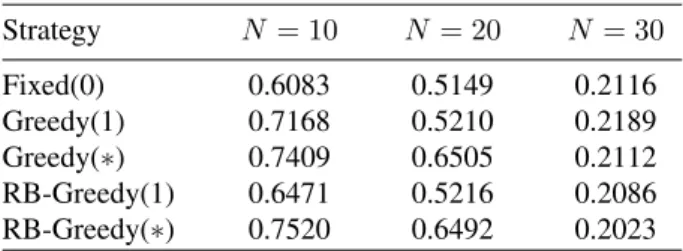
In this experiment, we assume that the number of server
M = 2, in the Table 1 and Table 2 we list the average sat-isfaction and the average cost of each type when the total user agent number isN = 10,20,30, represents the situa-tion when the supply is bigger, equal, and smaller than the demands individually.
From the Table 1 and Table 2 we can see Greedy(∗) and RB-Greedy(∗) strategies can obtain a higher satisfac-tion with the lowest price through price predicasatisfac-tion.
Table 1. The Average Satisfaction in Experi-ment 1 Strategy N = 10 N= 20 N = 30 Fixed(0) 0.6083 0.5149 0.2116 Greedy(1) 0.7168 0.5210 0.2189 Greedy(∗) 0.7409 0.6505 0.2112 RB-Greedy(1) 0.6471 0.5216 0.2086 RB-Greedy(∗) 0.7520 0.6492 0.2023
Table 2. The Average Cost in Experiment 1
Strategy N = 10 N= 20 N = 30 Fixed(0) 8.6000 9.2000 10 Greedy(1) 3.7500 8.3250 10 Greedy(∗) 1.0000 1.0000 10 RB-Greedy(1) 8.2500 8.4000 10 RB-Greedy(∗) 1.0000 1.0000 10
4.3
Experiment 2
Our experiments are performed as follows. All of the agents are located on a network, and we assume that user agent could change his bidding strategy when all the auction are closed, we call it is one generation. And10%of agents change their strategy stochastically according to their gain earned in each generation. The new strategy is generated as a copy from the agent gained the highest satisfaction in the neighborhoods.
In this experiment, we consider two distinct scenarios: sufficient and insufficient resources. WhenN <= 20, the resources are sufficient, user agents can improve their sat-isfaction and decrease the trading cost even through local interaction. In this scenario, the bidding strategies will con-verge to RB-Greedy(*) or Greedy(*). Experiment results showed that all the resource were traded near the lowest price even the resource were sold by auction. However, when N > 20, the resources is insufficient, the bidding strategy will not converge. Even Fixed(0) and Greedy(1) can perform well in this scenario, the agents are bidding with the highest cost, or else they will lost the opportunity of reserve the service. Low level strategies survive after the evolution of the game.
From the experiments we study some important factors which influence the outcome of the auction. First of all, the user bidding strategies play the most important role in the auctions. However, when users begin to cooperate, besides users’ bidding strategies, the users’ utility functions (budget and deadline) become the critical factor which determine the final price of the auctions.
Other factors such as the winner lasting time, the min-imal increment price of the auctions, and the parameters of the small world, etc., will also affect the results of the auctions. Due to the space limitation, part of the detailed discussion we demonstrated in another paper [18].
5
Conclusion and Future Work
In this paper, we explore the market-based grid resource trade system from the social perspective and the collabo-rative computing perspective. We firstly propose a novel framework to simulate the trading system of the grid com-puting resources, and then we give a case study based on this framework. In the case study, an evolutionary dynam-ics of the resource reservation game played by agents on the network. We study the evolution of the system with cogni-tive agents: Study the evolution dynamics of system with agents can automatic adapt to their environment, they can exchange private information and learn experiences from each other.
After analyzing the experiment results, we can see that the human factors such as bidding strategy, utility function, etc. and societal issues interaction method will influence the performance of the trading system. So those aspects and other socio-economics aspects such as user true require-ment, intersection between the physical world and the dig-ital, collaboration and community should be taken into fu-ture investigation when we want to design and implement the economic-based resource management systems.
References
[1] A. Byde, C. Preist, N. R Jennings: Decision Proce-dures for Multiple Auctions. Proc. of the first Inter-national Joint Conference on Autonomous Agents and Multi-Agents System, pp. 613-620, 2002.
[2] A. Galstyan, K. Czajkowski, and K. Lerman: Re-source Allocation in the Grid Using Reinforcement Learning.Proc. of the International Conference on Au-tonomous Agents and Multi-Agent Systems AAMAS-03, New York, NY. 2003.
[3] B. Leloup. Dynamic Pricing on Agent-based Mar-kets with Local Interactions.Electronic Commerce Re-search and Applications, 2003.
[4] C. Kenyon, G. Cheliotis. Grid Resource Commercial-ization: Economic Engineering and Delivery Scenarios. Kluwer Press, 2004.
[5] C. Ng, P. Buonadonna, B. N. Chun, A. C. Snoeren, A. Vahdat. Addressing strategic behavior in a deployed mi-croeconomic resource allocator.In 3rd Workshop on the Economics of Peer to Peer Systems, August 2005.
[6] D. Phan: From Agent-Based Computational Eco-nomics towards Cognitive EcoEco-nomics, Cognitive Eco-nomics, Bourgine P. , Nadal J. P. eds., Springer Verlag, pp. 371-398, 2004.
[7] G. Cheloitis, C. Kneyon and R. Buyya: 10 Lessons from Finance for Commercial Sharing of IT Resources,
Peer-to-Peer Computing: The Evolution of a Disruptive Technology, IRM Press, Hershey, PA, USA, 2004. [8] H. Zhuge. The Knowledge Grid. World Scientific
Pub-lishing Co., 2004.
[9] H. Zhuge. The Future Interconnection Environment, IEEE Computer, 38 (4) (2005) 27-33.
[10] L. Tesfatsion: Agent-Based Computational Eco-nomics: Growing Economies from the Bottom Up,Artificial Life, Volume 8, Number 1, pp.55-82, 2002.
[11] M. He, N. R. Jennings and A. Prugel-Bennett: An Adaptive Bidding Agent for Multiple English auctions: A Neuro-Fuzzy Approach.Proc. IEEE Conf. on Fuzzy Systems, Budapest, Hungary. 2004.
[12] M. P. Wellman, W. E. Walsh, P. R. Wurman and J. K. Mackie-Mason: Auction protocols for decentralized scheduling.Game and Economic Behavior. 2001. [13] R. Buyya, D. Abramson, J. Giddy and H. Stockinger:
Economic Models for Resource Management and Scheduling in Grid Computing,The Journal of Concur-rency and Computation, Volume 14, Issue 13-15, Wiley Press, USA, 2002.
[14] S. Milgram: The Small-World Problem; Psychology Today, 1 may p. 62-67. 1967.
[15] W. Smith, I. Froster and V. Taylor: Scheduling with Advanced Reservations, Proc. of the IPDPS Confer-ence, May, 2000.
[16] W. K. Cheung, J. M. Liu: On Knowledge Grid and In-telligence: A Survey.Computational Intelligence, Vol-ume 21, Number 2, 2005.
[17] Z. X. Huang, Y. H. Qiu: A Comparison of Advance Resource Reservation Bidding Strategies in Sequential Ascending Auctions, Web Technologies Research and Development, Springer, 2005.
[18] Z. X. Huang, Y. H. Qiu: Resource Reservation Game in Small World. Fifth International Joint Conference on Autonomous Agents And Multiagent Systems (AA-MAS 2006), Workshop on Emergent Intelligence on Networked Agents, May 8-12, 2006, Hakodate, Japan.