Facolt`
a di Scienze Matematiche Fisiche e Naturali
Corso di Laurea Specialistica in Informatica
Tesi di Laurea
Security protocol verification by means of
symbolic model checking.
Candidato Giacomo Baldi
Relatori Prof. Gianluigi Ferrari Dott. Andrea Bracciali Dott. Emilio Tuosto
Controrelatore Prof. Pierpaolo Degano
1 Introduction 5
1.1 Security protocol analysis . . . 6
1.2 Formal verification techniques . . . 7
1.3 ASPASyA: A symbolic model checker . . . . 8
1.4 Chapters description . . . 9 2 Security Protocols 11 2.1 Cryptography . . . 11 2.2 Protocol specification . . . 12 2.3 Security properties . . . 13 2.4 Intruder model . . . 13 3 Formal Framework 15 3.1 The cIP calculus . . . 15
3.2 PLlogic . . . 18
4 ASPASyA: Architecture and Data Structures 21 4.1 Architecture . . . 21
4.2 Choosing the language . . . 22
4.3 Representing configurations . . . 23
5 ASPASyA: A Symbolic Model Checking Algorithm 27 5.1 Reduction steps . . . 27
5.2 Two optimisations . . . 29
5.3 Joining principals . . . 30
5.3.1 Controlling the state explosion . . . 31
5.4 Representing formulae . . . 32
5.5 Constraint systems . . . 33
5.6 Formula satisfaction . . . 33
5.7 Mixing all together . . . 34
5.8 Performance issues . . . 36
6 ASPASyA: A Verification Methodology 39 6.1 Finding attacks withASPASyA . . . 40
6.1.1 Needham-Schroeder protocol . . . 40
6.1.2 Verifying the Needham-Schroeder protocol . . . 41
6.1.3 KSL . . . 42
6.1.4 Verifying KSL key exchange part . . . 43
7 ASPASyAat Work 49
7.1 Needham-Schroeder and KSL protocols . . . 49
7.2 ISO symmetric key two-pass unilateral authentication protocol . . . 50
7.3 Yahalom protocol . . . 51
7.4 Carlsen protocol . . . 52
7.5 Needham-Schroeder signature protocol . . . 53
7.6 Denning-Sacco key distribution protocol . . . 55
7.7 Beller-Yacobi protocol . . . 56
7.8 Bilateral key exchange protocol . . . 58
8 ASPASyAand Friends 61 8.1 Symbolic model checkers . . . 61
8.1.1 STA: Symbolic Trace Analyser . . . 61
8.1.2 TRUST . . . 62
8.1.3 PCS . . . 62
8.2 Summing up . . . 63
8.3 Other tools . . . 64
8.3.1 Finite state model checkers . . . 64
8.3.2 A theorem prover . . . 64 8.3.3 A static analyser . . . 64 9 User Manual 67 9.1 UsingASPASyA . . . 67 9.2 Specifying templates . . . 68 9.3 A verification session . . . 69 10 Conclusions 73 10.1 Future work . . . 74 Bibliography 75
Introduction
Since from the birth of the Internet, it has been necessary to achievesecurecommunications among the net end-points. Indeed, users of distributed systems send their private informa-tion across a public channel, exposing their data to the risk of being stolen, modified or compromised. Security in distributed systems is not only related to secrecy or integrity of the data, but also to properties of the interaction between participants to the protocol (also calledprincipals). For instance, it is necessary to enable two or more users willing to start a communication, to be able to determine each other identity by means ofauthentication
mechanisms. Recently, due to the growth of electronic commercial transactions, more com-plex desired interaction properties are needed. For instance, to ensure that no parties can get advantages on the others involved in the protocol,fairness in digital contract signing is required.
Protocol verification is not only a fascinating theoretical problem but it is also a prob-lem of practical importance: Security protocols allow for secure communications that are an essential feature of many distributed application. Nowadays electronic commerce and com-mercial transactions are carried over through the network and more and more enterprises are introducing their business into the Internet. Moreover, the new and flourishing field of mobile applications is requesting security protocols to suit their needs. Protocol certification is therefore a critical task that must ensure the safety of the interaction environments on which much of the world economy and inter-communication depends.
Security protocols have been developed to provide secure communications. In general, a protocol is the definition of the format and the order of pieces of information exchanged among principals such that, at the end of the protocol, a desired property holds. Protocols rely oncryptography to give principals the capability to transmit encoded information that can be decoded and accessed by the designated receivers only. Cryptography has provided numerous algorithms of data encryption suited for different tasks (e.g. symmetric and asymmetric cryptosystems), which in turn have been used in many different protocols.
Protocols can be attacked by hostile entities, usually calledintruders, which manage to subvert the aims of the protocol, making “honest” principals believe that a certain property holds when it does not. For instance, an attack is performed on a protocol that guarantees authentication, if an intruder can behave under someone else identity without making aware of it other principals. Even well-designed encryption systems do not guarantee the absence of flaws that are not inherent to the cryptographic algorithms, but to the mechanism of the protocol itself. If a protocol is not adequately verified against these situations, then security failures are possible.
The design of cryptographic protocols is hence a complex and difficult task. Indeed, in order to define a robust and correct protocol one has to find a “winning strategy” against an hostile intruder that can alter information flowing through the network at will. Such security flaws can be difficult to discover and generally counter-intuitive. Moreover, protocol
verification is a hard problem because, even if protocols are “small” objects consisting of few message exchanges, they give rise to a large number of possible interactions. The attacker can also interfere with exchanged data in many different way. These observations motivate a consistent interest for formal and possibly automated verification methodologies.
1.1
Security protocol analysis
In the analysis of a cryptographic protocol, one is interested in discovering errors which are caused by:
• Flaws or peculiarities of the used cryptosystem, • bad definition of the interactions between principals.
In this thesis we are interested in the second type of faults that are not necessarily dependent on the underlying cryptographic mechanisms.
Traditionally, cryptographic protocols have been verified using informal and intuitive techniques. This approach is not satisfactory because in such analysis many subtleties are not taken into consideration, preventing security errors to be discovered. For instance, the public-key authentication protocol of Needham and Schroeder [33] was considered secure for over a decade but, after a formal verification, a mis-functioning has been exposed [28]. This highlights the fact that, even for simple protocols, an informal analysis may be too error-prone to be reliable.
Formal analysis of protocols is a complex task and is usually performed in two steps: • The behaviour of principals is formalised by means of a suitable framework, and • a formal representation of the security property to check is given.
Modeling protocol semantics is challenging because principals act in a hostile environ-ment. Indeed, a good model must formalise to some extent the intruder’s capabilities, which are typically rich enough to make informal verification unfeasible. Moreover, the model must abstract from the details of the data exchanged (which in real protocols are strings of bits) without loosing peculiar features that can be exploited for some kind of attacks. Finally, protocols are meant to run in a distributed and concurrent environment and it is possible that different executions of the same protocol are running at the same time with principals playing different roles in different runs. Such situations are difficult to be modeled correctly, because the number of possible interactions between principals and intruders is very large.
Property formalisation is also hard because it implies the clear understanding of protocol requirements and goals, which in general are not precisely stated in the protocol specifica-tion. Moreover, the intuitive idea of the security property usually contains assumptions on the principal behaviour or intruder capabilities that are not made explicit in the specifica-tion. Obviously, the lack of such assumptions can make the verification process pointless. Some security properties may be very complex because they involve conditions on the be-haviour of a principal with respect to another one and to data exchanged between them, like authentication (i.e. being able to recognise the real identity of the other principals). Adding the fact that the properties predicate about a complex distributed system, their formalisation becomes harder. Indeed, a property specified with respect to the interaction among a certain number of principals, may be non pertinent when more than two principals are involved.
Formal methods can simplify the task of security protocol design and verification in several ways:
• they clearly identify the properties a protocol has to satisfy and the assumptions on the environment under which they hold;
• they can provide insights on the potential weaknesses of protocols; • they provide tools both for specification and verification.
Section 1.2 will overview some of the most known formal verification techniques and will discuss how they work.
1.2
Formal verification techniques
The general problem of the correctness of a security protocol is undecidable. This result, presented in [16], stems from three sources of infiniteness:
(i) Principals and intruders can have the computational power of a Turing machine that can present a non terminating behaviour,
(ii) there can be arbitrary many sessions of the same protocol which can be interleaved in an arbitrary way,
(iii) the intruder can send to a principal waiting for some data, an infinite number of different messages.
Despite these limitations, there exist many different techniques to achieve correctness results under weaker but reasonable assumptions. We can identify three main approaches: Theorem proving, static analysis, and model checking.
Theorem provingis based on logic and type theories. Generally speaking, the principal behaviour is formalised as a set of clauses representing statements on principal data and a set of inference rules to capture message exchange mechanisms. Properties are also formalised as clauses predicating on the intruder capabilities. The verification process includes a deduction phase that builds a model with a finite number of rules of inference that grow in a controlled manner. Verification is reduced to check if the desired properties belongs to the model, i.e. it can be deduced from the initial assumptions. Theorem proving can discover flaws of protocols with an unbounded number of principal instances and arbitrary complex data. The big drawback is that the procedure is in general semi-decidable. Indeed, termination depend on policies for rule application and protocol characteristics. Hence, if an attack exists, the verification terminates in a finite time, otherwise it might not halt. Therefore theorem provers are often semiautomatic and they require human intervention. Moreover, only the existence of an attack is reported and there is no feedback on how it is performed. However, there are some classes of interesting protocols for which theorem proving procedure always terminate (finite models). Theorem provers have been developed for protocol verification by Paulson [35] and by Blanchet [4].
Static analysishas been traditionally used to verify properties of programs. In general, static analysis techniques are based on an approximation of the system to be verified, on which it is easier and faster to check a property that hence is proven true regardless of the actual data flowing through the system. Recently, in [7, 5], static analysis techniques have been applied to protocol analysis. Principals are represented as processes of a suit-ablecalculus running in a distributed environment. Security properties are embodied into the principal descriptions by means ofannotations. Each annotation is placed in protocol control points and restricts the type of data that is allowed to flow through them. Static analysis computes sets of data that can flow through each control point, and property ver-ification is reduced to check whether they contain data that violates annotations. Other similar approaches are based on type inference as in [22]. Static analysis techniques are very efficient and can prove correctness of protocols with unbounded instances. On the contrary,
false errors can be found, because computed sets of data are indeed super-sets of the data that actually flows. Moreover, as in theorem proving, no counterexample is given and the specification of annotations is a task that requires a strong expertise.
Model checkingis an automatic technique that have been used for the verification of finite state machines. It is also well suited for verifying security protocols, and is based on building a finite model of the environment and checking that a desired property holds in that model. Traditionally models are transition systems and properties are expressed in some modal logic. The property to be verified is checked on each generated state until a state violating the property is found. Due to its finiteness, model checking cannot be used to verify protocols with unbounded number of instances. Moreover some limitations must be imposed on messages to keep finite the number of traces.
Usually, in model checking security protocols, principals are represented as concurrent processes gathered in an hostile environment, that capture thestate notion, on which tran-sition rules are defined. The trantran-sition system representing all the possible executions (also called traces) of the protocol is required to be finite. Properties are expressed by means of a suitable logic and are checked for satisfability in every state of the system. The com-putation starts from an initial state and, by applying the transition rules, it generates the whole state space. Recently in [24], in order to cope with arbitrary complex messages,
symbolic techniques have been introduced to allow the verification of infinite state systems. The basic idea of symbolic techniques is to avoid the explicit representation of all principal communication, grouping them together when possible. Indeed, it is possible to represent an infinite set of transitions, relative to an infinite set of arbitrary complex messages, by means of a single transition labeled with a characterization of such set. Hence, a symbolic state represents an infinite set of concrete states that can be obtained by instantiating symbolic messages in the symbolic state. Since model checking deals with protocol traces, whenever an attack is found a counterexample can be reported, giving much insight on what has gone wrong. Another advantage of model checking is that it can be fully automated and requires not much domain knowledge to be applied successfully. The main drawback is the state space explosion problem. Indeed, since the number of traces can be very large, due to prin-cipal action interleaving and number of possible messages, the resulting transition system becomes very big even for a small number of principal instances. Bounding the instances of principals, the problem becomes decidable even if NP-Complete [37]. Indeed, the main challenge in model checking is the development of efficient and smart data structure to han-dle large state spaces. Recently, some effort has been spent on trying to show under what circumstances checking the protocol with a finite number of instances, may be sufficient to prove correctness [29] in the unbound case.
1.3
A
SPAS
y
A
: A symbolic model checker
In this thesis we present ASPASyA which is an Automatic tool for Security Protocol
Analysis based on aSymbolic model checkingApproach. ASPASyAis based on the theo-retical work presented in [10, 41], that introduces cIP, a formal calculus for the modeling of cryptographic agent interactions in open systems together with the PLlogic for the speci-fication of security properties and a symbolic semantics for the generation of the symbolic state space. The aim of our tool is twofold:
(i) To develop a usable and flexible tool that supports a methodology for incremental analysis based on successive refinements of protocol assumptions, and
(ii) to implement an efficient model checker by adding user-guided pruning mechanism to the standard algorithm, to reduce the state space size.
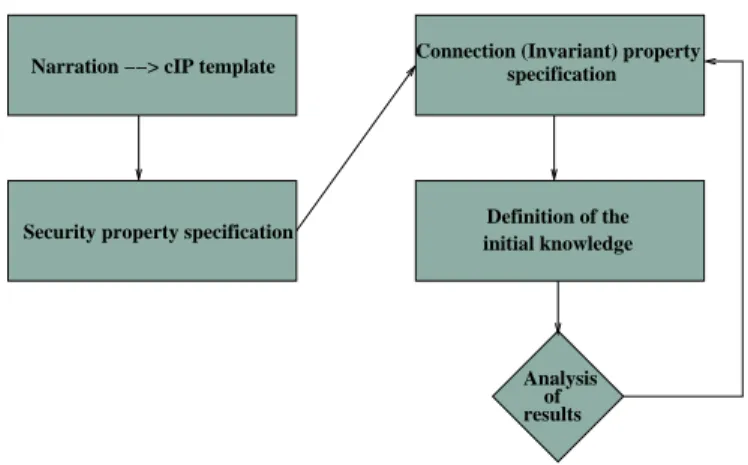
Regarding (i), we developed a verification methodology which tries to simplify the precise formalisation of the informal protocol specification. This can be done by an incremental
process during which protocol assumptions are refined by the analysis of verification results. Moreover, it is possible to tune the search, and hence the accuracy of the verification, by defining the power of the intruders and the kind of connections between principals. The former is done by specifying the information known by the intruder before the protocol starts (i.e. previously exchanged messages, stolen secrets, etc.), whereas the latter is realised by constraining the kind of possible connections between principals, hence pruning the state space. It is important to note that the ease of use and the high degree of automation are features provided by ASPASyA. Indeed, the application of the methodology requires the specification of the protocol and the security property, whereas the verification process is fully automatic, greatly reducing human interaction. To remark this point we will show in the following howASPASyAcan report some attacks recently discovered by means of static analysis techniques (as presented in [6]) in the Beller-Yacobi protocol [3].
cIP principals canjoina session of a protocol andconnect themselves to other instances as specified in [10, 41]. We extended this approach by adding a mechanism to constraint the possible ways principals can connect with each other. As it will be shown , this has a great impact in terms of efficiency because specifying constraints on the joining of principals greatly limits the number of states generated by the operational semantics. This mechanism not only enhances the performance of ASPASyA but also enables the user to perform search on portions of the entire state space, allowing for an easier analysis of results. Another important aspect ofASPASyAis its modular architecture. Indeed, it has been developed for the Profundis1project, having in mind interoperability with other tools and, most important,
future expansions to add new functionalities.
We performed numerous tests onASPASyAby applying the verification methodology to some well-known protocols, which will be illustrated together with performance measurement in the following.
1.4
Chapters description
This thesis is organised as follows:
• In chapter 2, we present in more details security protocols. We introduce the commonly used informal specification for the the description of protocols and interesting security properties. We finally report a widely accepted modelisation of the intruder capabilities in the hostile environment of the network presented in [19].
• In chapter 3, we sketch the theoretical work in [10, 41], introducing the cIP calculus and the logic for property specification.
• In chapter 4, we start the presentation of ASPASyA by giving an overview of its modular architecture and of its basic modules.
• In chapter 5, we continue the description of the more complex modules and func-tionalities ofASPASyAand we introduce a symbolic verification algorithm. We also describe the constrained join mechanism and its effects on the verification procedure. • In chapter 6, we outline the methodology by applying it to some well-known protocols,
illustrating the benefits of our approach.
• In chapter 7, we report a library of protocols with the corresponding translation from their informal specification in our framework, and the relative verification results. • In chapter 8, we make a comparison betweenASPASyAand other similar tools. • In chapter 9, we report the user manual containing the description ofASPASyAusage. 1Refer towww.it.uu.se/profundis/for more information.
• In chapter 10, we sum up our results and present future lines of development. • In the appendix we report the source code ofASPASyAwith comments for the most
Security Protocols
This section briefly reviews some elementary notions on cryptography, protocol specification, security properties and the attacker model. Its main purpose is to introduce notation and terminology. We refer to [38, 30] for a comprehensive introduction to this field.
2.1
Cryptography
Security protocols have been used to protect “sensible” information in a scenario where two (or more) partners (sometimes calledprincipals) communicate by exchanging messages through “public channels”. Usually, the word “sensible” means information that should be kept secret or non-modifiable (e.g. a credit card number, an encryption key, etc.). The aim of a protocol is to grant that no malicious participants (usually calledintrudersorattackers) will ever be able to disclose or modify sensible information. Certification (specification and verification) of security protocols requires a careful definition of:
• the underlying assumptions adopted in the algorithms used to encrypt/decrypt mes-sages,
• the hypothesis on the capabilities of malicious participants to interfere with the com-munications.
Cryptography is used to hide the sensible information contained in messages flowing through the public channel. Anintelligible messagem, is referred to as plaintext (or data-gram). By ’intelligible’ we mean that the representation of the information denoted by m
is public domain knowledge. Viceversa, an unintelligible form of m is said ciphertext (or
cryptogram).
The process of assigning a ciphertext to a plaintext is called encryption; encryption is parameterised with respect to an encryption key. Given a ciphertext, the operation that reconstructs the plaintext form is calleddecryption; as for encryption, decryption has a de-cryption keyas parameter. Hereafter,{m}k denotes the cryptogram obtained by encrypting
messagem with keyk, while m, ndenotes the pair made of messagesm and n. Given k,
decryption extractsmfrom{m}k.
Crypto-systems can besymmetricorasymmetric. The former (also known asprivate key crypto-systems) are characterized by the fact that encryption and decryption keys are the same. Indeed two principals, sayAandB, can encrypt/decrypt data if they share a keyk. It is usually assumed thatkis known only byAandB and other principals may acquirekonly ifA orB explicitly send it. Asymmetric (a.k.a. public key) cryptography is characterized by the fact that encryption and decryption keys differ each other. Each principalA has a
its public keyA+ is publicly available and may be used by any other principal to encrypt
messages intended for A. Such cryptograms may be decrypted only using the private key
A− that onlyAowns.
We will refer tosymmetric andasymmetric cryptosystems. The robustness of a system relies on the security of various levels of its architecture and their relationships. For the sake of protocol certification, at cryptographic level, the standard working assumption is the so-called perfect encryption hypothesis stating that a cryptogram can be decrypted only using its decryption key and that secrets cannot be guessed, no matter how much information is possessed 1.
2.2
Protocol specification
Asecurity protocolmay be intuitively thought of as a finite sequence of messages between two or more participants. There is a great variety of specifications mechanisms of protocols and their properties. Some protocols are informally specified mixing natural language and ad hoc notation (for instance, SSL [21], SSH [44], IKE [23] are specified in this style). Protocols are usually presented as a list of message exchanges (also callednarration description) written as:
(n) A→B: m.
The intended meaning of this notation is: “at then-th stepAsends messagemtoB” where
A and B represent two principals of the protocol. Typically A is the initiator, B is the
responder, S is a third-part (usually trusted) server andI denotes the intruder.
Example 2.1 In this style we can give the informal specification of the Wide Mouthed Frog (WMF) protocol [11]. The intent of WMF protocol is to letAsend a fresh 2session keykab
toB through a trusted server S. BothAandB share two private keys withS (kas andkbs,
respectively). The WMF protocol is:
(1) A → S : A,{Ta, B, kab} kas
(2) S → B : {Ts, A, kab} kbs.
First, A encrypts for S the identity of B, the session key kab and a fresh time-stamp Ta
intended to be used only for a session of the protocol; such names are called nonces. By the perfect encryption hypothesis, Ta andkab cannot be “guessed” by any other participant of
the protocol. Then, S forwardskab and the identity of the initiator to B; freshness ofkab is
witnesses by Ts, a nonce generated by S.
A sequence of message exchanges is not a complete specification for security protocols. For instance, the narration in Example 2.1 do not specifies whether or not onlyA, B andS
are the only principals that knowkab. Informal specification does not represent with enough
details common situations: For instance, referring to [11], a protocol may have multiple simultaneous runs and a principal may play different roles in different runs. Moreover data sent across the network are strings of bits and it may be possible that a principal does not recognize the shape of the received message or implicitly assumes that the received data have a given form. Indeed, this is a source for protocol type flaws. To cope with this problem it is usually assumed that “messages are typed”, namely, they contains enough information for a principal to recognise their shape.
1Such hypothesis is not completely realistic; indeed, under it,cryptoanalysis attackscannot be captured.
Cryptoanalytic attacks are performed by collecting a great number of cryptograms and then analyzing them for deducing cryptographic keys. However, realistic keys cannot be deduced in polynomial time by intruders that have a given computational capacity.
2A key is fresh when is generated by a principal and exchanged in the same execution of the protocol.
Moreover it is assumed that the key has never been used in any previous run of the protocol. Key kab
is called asession key because it will be used to encrypt messages exchanged betweenAand Bafter the execution of the protocol.
2.3
Security properties
Many security properties can be stated for a given protocol. We mainly focus onintegrity,
secrecy andauthentication. Intuitively, a protocol guarantees integrity if, once a datum has been provided, it cannot be altered by any intruder. A protocol guarantees secrecy over a set of data if it is not possible that an intruder will get such data. A protocol guarantees authentication of a userAto a userB if, after running the protocol,B maysafely assume that A was involved in the protocol run. Secrecy and authentication are closely related. Indeed, before sending secrets toB, A should be sure that he is effectively “speaking” to
B. Viceversa, authentication is normally achieved through exchange of some data that the protocol ensure to be created by the intended partner and nobody else.
If secret information must be communicated in an untrusted environment, the protocol must ensure at least that possible eavesdroppers cannot understand them (secrecy), that the partner in the communication is really the intended one (authentication) and that the messages are really forged by the intended participant (message integrity). Secrecy, authen-tication and integrity are the “elementary” properties that protocols aim at guaranteeing.
Security properties are not uniformly stated and defined. The kind of a property and its adequacy depend on applications. For instance, in an electronic commerce application properties likefairnessornon-repudiationare requested together with secrecy, integrity and authentication. A mandatory feature of a voting system is, for example,anonymity.
Example 2.2 Let us consider again the WMF protocol specification (Example 2.1). A possible requirement of the protocol is the secrecy ofkab, namely, in every session, the value
of kab must be known only by the principals playing the roles of A and B andS. Another
requirement is that the protocol guarantees the authenticitykab, i.e., in every session where B receives the message from S, he must be ensured that, in the same session, (i) A has createdkab and (ii) thatA asked S to forward the key toB.
2.4
Intruder model
A formal framework for protocol analysis must declare which assumptions are made on the intruder. The Dolev-Yao model [20] is a widely accepted model. It describes an active intruder as a “principal” that can
• receive and store any transmitted message; • hide a message;
• decompose messages into parts; • forge messages using known data.
The only limitation for intruders imposed by the Dolev-Yao model is the assumption of the perfect encryption hypothesis. Recently in [36] it has been shown that the Dolev-Yao intruder, enhanced with the capability of guessing a decryption key with a negligible prob-ability, is as powerful as the original one. The model also assumes that intruders can have some private data, namely information which has not been generated by regular principals, and can “remember” data exchanged in previous runs of the protocols. In particular, an intruder can record all exchanged messages and use them later to attack the protocol.
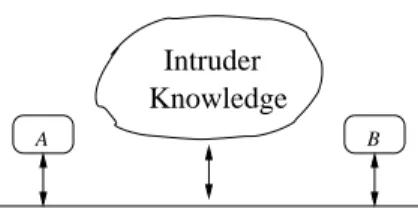
Since an intruder´a la Dolev-Yao can intercept any communication, it can be formalised as the execution environment which behaves as the “adversary” of “honest” principals. The environment collects all the sent messages and manipulate them when a principal is waiting for some data.
Intruder Knowledge
B A
Figure 2.1: A graphical representation of the Dolev-Yao intruder
LetN =No∪Np be a countable set of names, whereNo is the set of nonces andNpis
the set of principal names; we assume thatNo∩Np=∅. LetKbe a set of keys that contains
both symmetric and asymmetric keys and such thatK∩N =∅. As usual, we assume that keys are not complex terms, like tuples, but just atomic terms.
Amessage is a term defined as follows:
M ::= N | K | M, M | {M}K.
A message may be a name (i.e. a nonce or a principal name), a key (symmetric or not), the pairing of two messages or the encryption of a message We let m, n, ... to range over M, whileλranges overK,λ− denotes the inverse key ofλ, namely,λ−=λifλis a symmetric
key, while λ− =A− ifλ=A+ and λ− =A+ if λ=A−. A message may be a name (i.e.
a nonce or a principal name), a key (symmetric or not), the pairing of two messages or the encryption of a message.
The Dolev-Yao intruder is characterised by a set of messages κ, called the intruder knowledge, and the actions that the intruder can perform on the elements ofκ. Basically, an intruder can pair known messages, split pairs and encrypt/decrypt cryptograms if the corresponding keys can be deduced byκ. We write κ . mto denote that datumm can be deduced by means of a finite sequence of such actions from messages in κ. The operator .
defines the (infinite) set of messages that an intruder can use for attacking a protocol.
Example 2.3 Consider the knowledge κ= {{A−}
k, {m}A+, k}, we show how k .{m}k
with the following deduction tree:
κ .{A−}k κ . k (1) κ . A− κ .{m} A+ (2) κ . m κ . k (3) κ .{m}k
where(1)and(2)are decryption by means of a known key (κ . k, namelyk∈κ), and(3)is
encryption.
In [15] decidability of .has been proved for private key cryptography; decidability of.for public key cryptography has been proved in [10, 41].
Formal Framework
In order to make this thesis as self-contained as possible, this chapter borrows from [10, 41] the approach to certification of security protocols that is based on symbolic state space exploration and model checking. We briefly sketch the formal framework and refer the reader to [10, 41] for further details.
3.1
The cIP calculus
This section presents the main features of thecryptographic interaction pattern(cIP) calculus and theprotocol logic(PL) introduced in [10, 41] to specify and prove properties of security protocols. Apart from constituting the theoretical background ofASPASyA, cIP calculus andPLlogic fix some design choices of the symbolic model checking that are necessary for describing our tool.
The cIP calculus is a name-passing process calculus in the style of the π-calculus [32] with cryptographic primitives. A cIP process is written as A= ( ˜4 X)[E] where A is the process identity, ˜X are theopen variables and Eis a sequence of actions. To illustrate the main features of cIP we consider the WMF protocol.
Example 3.1 Principals of the WMF protocol are described by the following cIP terms:
A =4 (x, s)[out(A,{Ta, x, kab} s)],
S =4 (u, ak, v, bk)[in(u,{?t, v,?r}ak).out({Ts, u, r}bk)], B =4 (z)[in({?y,?q,?w}z)].
Each process has an identity (e.g. A,S,B) and a sequence of input/output actions; a list of open variables preceeds the actions. Open variables are a distinguished feature of cIP that (together with thejoin operation) provides an explicit mechanisms for sharing names/keys. Open variables bind the free occurrences of variables in the communication actions, likex
inA. The occurrences of the variablesy,q andwinB arebound. Binding occurrences are marked by ’ ?’, like ?r in S, which binds the following occurrence of r. A datum d of an action is a message (as defined in section 2.4) where variables can appear.
In Example 3.1 the open variablexparameterises the identity of the responder, while s
andz are the variables which should be instatiated with keys shared amongAand S and
B andS respectively. The serverS has four open variables: uandak are reserved for the identity and symmetric key of the initiator, whereasv andbkare used for the identity and the symmetric key of the responder.
Aninstance of principal A4= ( ˜X)[E] is a process obtained by indexing all the variables (open or not) and all the names inEwith a natural numberi >0. Instances run incontexts, i.e. (possibly empty) sets of instances where computation takes place and new instances may be dynamically added. Many instances of the same principal may (non-deterministically) join the context modeling the execution of more sessions of the protocol. The join operation defines how a principal instance can enter a (running) context by connecting open variables for asymmetric keys to principal names and open variables for symmetric keys to keysK so that they are appropriately shared. Connected variables are no longer open.
We say that a contextC has cardinalitynif it containsninstances of principals. We use ov(C) to indicate the set of open variable of contextC.
Definition 3.1 (Join) LetAn 4= ( ˜Xn)[En]be an instance,Cbe a context of cardinalityn−1
andγ be a partial mapping whose domain isov(C)∪X˜n. Moreover, for eachx∈ov(C)∪X˜n, γ(x) is either inK or inNp depending whetherx is a variable for a symmetric key or for
a principal. The join operation is defined as: join(An, γ,C) = ( ˜Xn−dom(γ))[Enγ] ∪
[
( ˜Y)[E0]∈C
( ˜Y −dom(γ))[E0
γ].
Example 3.2 Consider the cIP template for the WMF protocol (Example 3.1). When B
joins the context containing Aand S, a possible result of the join operation is given by the following context (for simplicity we ignore indexes):
A 4= (x)[out(A,{Ta, kas, kab
}kas)], S 4= ()[in(A,{?t, B,?r}kas).out({Ts, A, r}kbs)], B 4= ()[in({?y,?q,?w}kbs)]. It is obtained using γ= z, bk 7→ kbs s, ak 7→ kas v 7→ B, u 7→ A
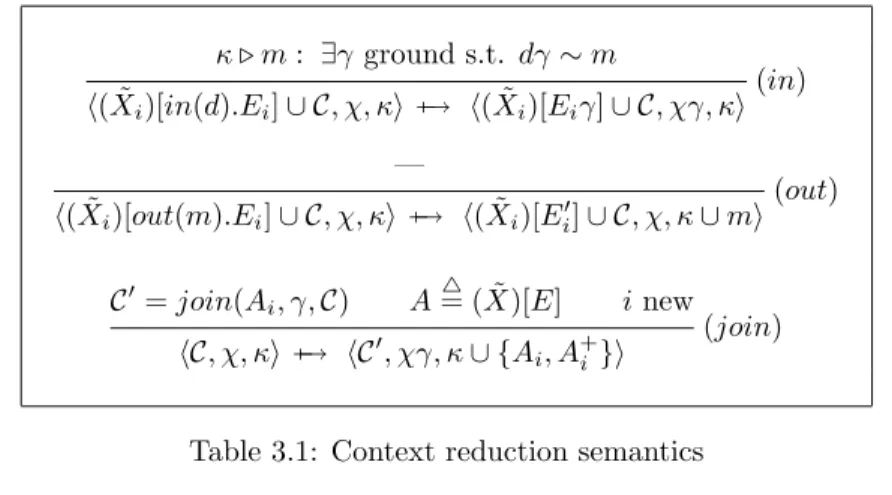
The concrete semantics of cIP is defined as a reduction relation on configurations, re-ported in table 3.1, which formalizes the behaviour of the Dolev-Yao intruder. Indeed, configurations are tripleshC, χ, κiwhere:
• Cis a context,
• χis a set of variable bindings that keeps track of the assignments of the variables due to communications and join executions
• andκ, the intruder knowledge, contains the names of instances that joined the context, the data sent along the public channel, and the optional initial knowledge of the intruder.
Relation−7→ models both communications and the possible evolutions of a context due to the joining of new instances. Communications embody encryption and decryption mech-anisms and take place by means of pattern matching, indicated as∼.
Example 3.3 The ’in’ action of principal B in Example 3.2 waits for a triple encrypted with kbs, the symmetric key which B shares with S. When such a message arrives the elements of the triple are assigned to the corresponding variables. Message {Ts, A, kab}
kbs
is a possible matching message for{?y,?q,?w}kbs, since the sent message is encrypted with
the complementary key (namely the same) of the one used to encrypt the input message. The pattern matching give rise to the substitution γ={y 7→Ts, q7→A, w7→kab}.
κ . m: ∃γground s.t. dγ ∼m (in) h( ˜Xi)[in(d).Ei]∪ C, χ, κi −7→ h( ˜Xi)[Eiγ]∪ C, χγ, κi — (out) h( ˜Xi)[out(m).Ei]∪ C, χ, κi −7→ h( ˜Xi)[Ei0]∪ C, χ, κ∪mi C0=join(A i, γ,C) A= ( ˜4 X)[E] inew (join) hC, χ, κi −7→ hC0, χγ, κ∪ {Ai, A+i }i
Table 3.1: Context reduction semantics
κ . m: ∃γ symbolic s.t. dγ∼symm
(insym)
h( ˜Xi)[in(d).Ei]∪ C, χ, κi −7→sym h( ˜Xi)[Eiγ]∪ Cγ, χγ, κγi
Table 3.2: Modified input rule
As we can see from Example 3.3, the matching relation (∼) in the case of symmetric keys simply reduces to require that the encryption keys are equal. For instance,{B, kab, Ta}
kas
matches itself. In the case of asymmetric keys there is a match when cryptograms are encrypted with complementary keys1(e.g.
{A}B− ∼ {A}B+). A datumdmatches a message mif, and only if, there exists a substitutionγover the variables occurring indsuch thatdγ
is ground anddγ∼m.
Notice that the premise of rule (in) requires the existence of a message m which is derivable fromκ, and of a ground substitutionγ, such that mmatches the datum dthat a principal is waiting to receive. The set of such messages (and hence substitutions) may be infinite, leading to a non effective and incomplete verification procedure. Symbolic tech-niques, introduced recently in [24], provide a powerful mechanism to tackle the problem of infinite branching. Whenever an infinite set of messages can be generated for a binding variablex, we use thesymbolic variable x(κ). This amounts to say that x can assume any messagemsuch thatκ . m. The value ofx(κ) will be possibly set by matching later actions. The semantic rules are then redefined to include symbolic variables; we report the mod-ified (in) rule in Table 3.2. In the symbolic (insym) rule, we requireγto be a symbolic
sub-stitution (i.e. a subsub-stitution that contains assignments involving symbolic variables) such thatdγ symbolically matchesm(∼sym). The number of such substitutions is finite;
more-over, symbolic substitutions are applied to the whole configuration components. Indeed, in the symbolic semantics, contexts and knowledges may also contain symbolic variables that must be instantiated with values determined during previous applications of the symbolic transitions rules. In [10, 41] terminating procedures are introduced to calculate symbolic substitutions required by the premises of semantics rules, in order to make the verification process effective.
The symbolic reduction semantics give rise to symbolic traces, where a trace t is a sequence of configurations Γ1,Γ2, . . . ,Γn such that Γi−7→sym Γi+1 for 0 < i < n. When
principals in the final configuration Γn have fired all their actions, we say that Γn is a
terminalconfiguration andtis aterminaltrace. Security properties are checked on terminal configurations only; in [10, 41] terminal configurations are models for attacks: This approach characterize those attacks where he intruder is able to deceive principals without being 1In cIP asymmetric keys are represented as principal names decorated with + for public keys and−for
detected. In [10, 41] it has been shown that the symbolic verification procedure is sound, namely if an attack is symbolically found, than at least one correspondent concrete trace exists. Moreover, the verification procedure is also complete (up to the number of principal instances involved) in the sense that the for every concrete trace t there exist a symbolic tracetsthat “contains”t (i.e. there exists a substitutionγ such thattsγ=t).
3.2
PL
logic
Security properties are expressed as formulae of thePLlogic (Protocol Logic) that allows one to relate values and variables, and assertions on membership of messages to the intruder’s knowledgeκ.
Definition 3.2 (PL – Syntax) A formula of the logicPL is defined as follows:
φ, ψ ::= δ∈K | δ=σ | ∀A.i:φ | ¬φ | φ∧ψ
δ, σ ::= d | xi | I
where d is a datum that does not contain any binding occurrence, and I is a distinguished constant representing the intruder name.
Operators ¬ and ∧ are the usual boolean operators2. The symbol K is used to represent
the knowledge of the intruder. Formulaδ∈K states the derivability ofδ from K, whereas
δ =σ tests for equality of data. Definition 3.2 introduces quantification over instances of roles. Variables are therefore indexed (e.g. xi) and indexes are “typed” by principal names.
For instance, the proposition∀A.i:φis read as “for all instances ofA,φholds”, andimay occur in φ. Among the possible values that can be expressed in PL formulae there is the distinguished constant I that denotes the intruder’s identity. This permits us to express propositions where the identity of the principals is not necessarily a “regular” role.
InPLintegrity can be expressed by fixing some values (e.g. xi=δ), secrecy is handled
by values thatκmay derive (e.g. d∈K), and authentication is expressed as relations among principals’ variables and communicated messages.
Example 3.4 A property that the WMF protocol should satisfy is the secrecy of the session key kab, unless it is really intended for I:
∀A.i:xi 6=I→kabi6∈K,
that captures the intuitive secrecy property above.
Formulae are verified with respect to a given (terminating) context of a computation which keeps trace of all the principal instances that participated in the session. Notation
κ|=χ φ indicates that κ, under the variable assignment χ, is a model of the formulaφ; κ
and φare relative to a final configuration of a terminal trace. We define models forclosed
PL-formulae. Letχbe a ground substitution for variablesX. Amodel for a closed formula
φis a pairhκ, χisuch thatκ|=χφcan be proved by the following rules:
i=j (=1) κ|=χAi=Aj xiχ=δχ (=2) κ|=χ xi=δ κ . δχ (∈) κ|=χδ∈K κ6|=χ φ (¬) κ|=χ¬φ κ|=χφ κ|=χψ (∧) κ|=χφ∧ψ κ|=χ φ[Aj/α] for allAj:κ . Aj (∀). κ|=χ ∀A.α:φ
2Derived relations6= and6∈, logical connectors→and∨, or existential quantifier∃are defined as usual
Rule (=1) says thathκ, χiis a model of equalityAi=Aj whether the instances are exactly
the same instance. Rule (=2) says that hκ, χi is a model of Ai = δ whether the value
associate byχto variablexof instanceAi, i.e.xiχequals the valueδχ. Rule (∈) establishes
that κ|=χ δ ∈Kwhenever δχcan be constructed from the decomposition set of κ. Rules
(¬) and (∧) are straightforward. In ∀Aα:.φthe universal quantifier ranges over the finite set of instances of role A. Quantifiers are solved by mapping variables indexes to actual instances. In order to prove thathκ, χiis a model for a formula∀A.α:φ, it is necessary to show thathκ, χi is a model for any formula obtained by substitutingAj forαin φ, where Aj is any instance of Adeducible fromκ, that participate in the protocol execution.
Notice that ifχandχ0 differ only on variables not appearing inφ, thenκ|=
χ φ⇔κ|=χ0
φ. Hence, we can only consider finite assignments over the variables ofφ.
Example 3.5 Let us consider the following authentication property, relative to the WMF protocol
ψ= ∀B.j:∃S.l:∃A.i:
(vl=Bj∧ ul=Ai∧ xi=Bj)→
(tl=Tia∧ yj=Tls∧ wj=kabi∧qj=Ai)
The formula states that, whenever B terminates, a server S and an initiator A (that aimed at interacting with B through S , i.e. xi =Bj) have also took part to the session.
In this case, the nonce received by S is the one generated by A (tl=Tia), while B receives
the nonce generated byS (yj=Tls). Finally, the session key received byS must be the key
associated toTa byA (w
j=kabi).
Assume κ1 ={A, B, S, I,{Ta, B, kab}
k,{Ts, A, kab}k}, as the intruder knowledge and,
referring to Example 3.2, γ= z, bk 7→ kbs s, ak 7→ kas v 7→ B, u, q 7→ A, r, w7→ kab t, y7→ Ta
as the set of variable bindings (we ignore indexes for clarity). We show that the final con-figurationh{()[],()[],()[]}, κ1, γidoes not yield a model of ψ. We rewriteψ according to the (∀) rule expanding quantifiers and obtaining
ψ0 = (v=B∧u=A∧x=B)→(t=Ta
∧y=Ts
∧w=kab∧q=A)
Under mapping γ, we can see that the antecedent of ψ0 holds while the consequent is false
due to the equalityy=Ts. Indeed,γ(y) =Ta
6
=Ts, henceκ1
A
SPAS
y
A
: Architecture and
Data Structures
This chapter shows how the symbolic model has been exploited as a basis for the design and development of an effective and usable verification toolkit calledASPASyA. We will focus on architectural issues and design aspects to highlight the problems we encountered while implementing the symbolic model. ASPASyAhas a modular architecture, where each module encapsulates a single aspect of the symbolic model. We will describe the functionality of all the modules and their most important implementation details.
4.1
Architecture
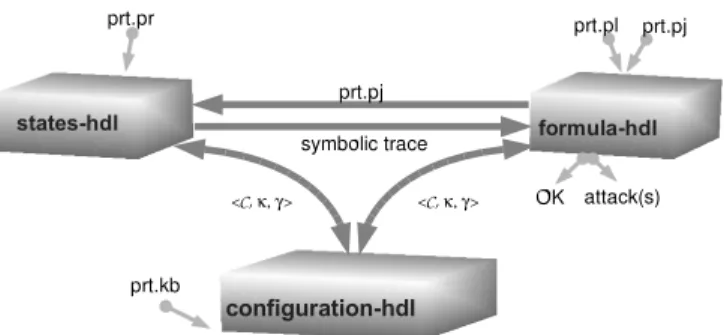
The architecture of ASPASyA is displayed in Figure 4.1 and it is made of three main parts. Incoming arrows indicate input data whereas outcoming arrows indicate outputs. The moduleconfiguration-hdlmanages cIP configurations (and, therefore, PLmodels)
Figure 4.1: ASPASyAarchitecture and consists of three components:
• contextthat represents the running principal instances,
• knowledgethat manages the set of messages in the configurations, and • assignmentsthat handles variable substitutions.
The modulestates-hdlimplements the state space generation and contains components: • stepthat returns the next configuration given the current one, and
• jointhat handles the introduction of new principals in the configuration.
Finally, given a terminal configuration provided by states-hdl,formula-hdlimplements the check ofPLformulae. In order to check formulae it might be necessary to solve systems of symbolic constraints, as clarified in Section 5.5. The components of formula-hdlare:
• logicthat transforms aPLformula into an equivalent normalised formula, • verifierthat checks whether the given configuration is a model for the formula, • csolverthat collects constraints on symbolic variables and resolves equality/inequality
of symbolic messages.
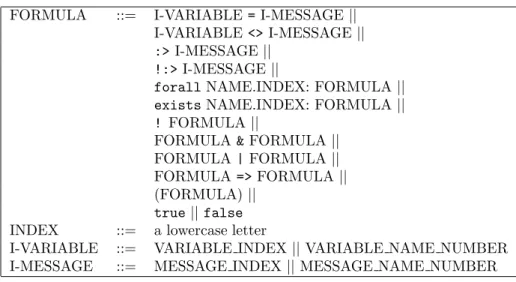
In a verification session, the user provides the cIP specification of the protocol (file
prt.pr) equipped with the connection formula (fileprt.pj) and thePLformula expressing the security property (file prt.pl). Connection formulae will be described in details in Section 5.3.1 and 6.1, but intuitively they are mechanisms to constraint the way principals can join a configuration, by specifying relations among open variables. An initial knowledge (fileprt.kb) and the maximum number of instances that can join a context can be specified, as well.
Modulesstepand joinask to configuration-hdlfor the current configuration and, according to cIP symbolic semantics and to connection formula, a new configuration is produced and returned back to configuration-hdl. Iterating this process, states-hdl
eventually receives a terminal configuration and forwards the correspondingPL(symbolic) model toverifierthat together withcsolverchecks for the validity of (the normalisation of) prt.pl. Modules verifierand csolverreturnOKwhen the formula holds, otherwise they yield the (possible) attack(s).
4.2
Choosing the language
The first choice to face when developing a piece of software is which language to use for the implementation. In general, there are some aspects related to programming languages to focus on:
• The expressive power, which is related to the level of the language. • The efficiency of the object code.
While a low-level language might be suitable to write hardware drivers, it may be less suitable for high level programming. A language abstracting away from machine-dependent issues is the language of choice. Moreover model checking is a heavy computational task, so having efficient and fast compiled code is an important feature of the language.
Usually debugging of a model checker is hard because even small tests generate a space state too big to be checked by hand; so the presence of powerful debuggers, precise profilers, code browsers and parser generators is of some moment.
Following this observations, we adopted the declarative languageocaml1(v3.06) because not only it fulfills all the features highlighted before, but also offers:
• Mechanisms of modules parameterisation, which greatly enhances developing speed and code reuse;
• an efficient garbage collector for automatic memory management;
• sum types and a pattern matching mechanism that represent a main feature in declar-ative programming;
• native and efficient support for useful data structures such as polymorphic types; • functional and imperative styles that can be mixed to get the best of the two
ap-proaches;
• cross-platform compilation.
Finally,ocamlis quite widespread and the current release comes out from years of develop-ment at INRIA2. In the following sections we highlight some aspects of ocaml which are a
key mechanisms inASPASyAimplementation.
Data types The language allows the definition of new types applying operators to prim-itive types3 . For our purposes, the most important operators are cartesian product and
disjoint union. Cartesian product allows the creation of tuples of values while disjoint union allows the definition ofsum types. Indeed, a sum type is the disjoint union of sets of values where, to distinguish each set, a constructor is given, which not only constructs values of the new type, but also allows access to them by means of pattern matching.
Example 4.1 Using sum types one can recursively define cIP messages:
type message =
| SKey of string∗int
| PKey of string∗int
| Crypt of message∗message
| Var of string∗int . . .
A value of type message can be a symmetric key, identified by the constructorSKeyand parameterised with a cartesian product of a string (the key name) and an index relating the key with the principal owning it. Moreover a message can be a private key (PKey), a cryptogram (Crypt), a variable (Var) and so on, using a new constructor for every disjoint set of data. Values of type message are generated by applying constructors to data values. For example, SKey(‘k’,1), is the representation of the symmetric key k belonging to principal 1. Moreover,Crypt(Var(‘x’,2), SKey(‘k’,1))represents {x2}k1. Data structures ocamlhas a native support for lists. We use them as building blocks for defining trees, hash tables and incremental data structures with little programming effort and achieving high efficiency. Indeed, anocamllist is implemented as a linked list so that, when a new element is added, there is no content duplication but a mere pointer redirection. Therefore usingocaml it is not necessary to code dynamic incremental structures by hand, because they are already present in the run-time support.
4.3
Representing configurations
The cIP semantics is given in terms of configuration reduction, so we recognised a configura-tion as the basic building block and implemented it first. A configuraconfigura-tion is a triplehC, χ, κi whereCis a set of principal instances,χa variable substitution andκis the representation of the intruder knowledge about exchanged messages. Principal processes, variable substi-tutions and intruder knowledge heavily rely upon messages. The definition of messages as a sum type (Example 4.1) allows us to implement the action matching mechanism of the cIP semantics in terms of ocaml(efficient) pattern matching.
2INRIA is the French national institute for research in computer science and control. Refer to
http://inria.fr for general information and to http://cristal.inria.fr/ for ocaml specific informa-tion.
Principal representation
Principals can be represented as sum types as well:
type process =
| Input of message∗process
| Output of message∗process
| Parallel of process∗process
| Sum of process∗process
| Nil
The definition of a process is straightforward and allows for the construction of parallel composition (Parallel) and non deterministic choice (Sum) of processes.
Not all constructable messages and processes have an associated semantics (e.g. cryp-tograms with non atomic keys) so we need to provide some methods to check for syntactic validity of an expression. More precisely we have to check that:
• Principals are closed;
• a variable must appear as bound only once in a process; • each principal action must contain a valid message.
Some of this points are realised statically in the cIP parser, while others (as the correctness of messages) must be dynamically checked at run-time.
Acontext is represented as a list of principal instances.
Variable substitutions
Particular attention is required for representing variable substitutions. A substitution is a mapping from a set of variables to a set of messages. Substitution application tomchanges the occurrences of variables inmaccording to the mapping. Substitutions are necessary in various cases:
• The intruder has to find a variable substitution to match principal actions, • formula verification give rise to substitutions,
• substitutions have to be composed and are applied to configurations.
The representation of substitutions has been a crucial point in the realisation ofASPASyA. It has been defined as a functional type4 whose values can be hence applied to messages. The information about variable assignments is stored in a table; with this representation, composition of substitutions reduces to merging of tables (exploitingocamlmechanisms for incremental structures). Given a messagem its structure is analysed by recursive pattern matching and each time a variable is found, a table look-up is performed. When composing two substitutions, recent assignments are stored in the top of the table to reduce the list traversal time.
Intruder knowledge
The knowledge structure has to perform two main tasks: (i) It represents what the intruder knows about a trace, and (ii) is used to forge messages that must be sent to principals.
4A functional type ist→t0
and represent functions fromttot0
The knowledge of the intruder is naturally represented as a list of messages but to realise (ii) we need some more work. The intruder has the power to forge new messages from existing ones, either pairing or unpairing5 them or encrypting cryptograms, or decrypting
cryptograms when the correct key is known. Every message added to κ is decomposed in atomic messages (i.e. keys, names, cryptograms whose decrypting key is unknown) by repeated application of the unpairing/decrypting rule as follows:
add(m,κ) match m with
key k: κ=κ∪ {k}; for each {l}k∈κ do add(l,κ− {l}k)
name n: κ=κ∪ {n}
pair (s, r): add(s,κ); add(r,κ)
{l}k: if k∈κ then add(l,κ) else κ=κ∪ {m}
This computation is performed once for every added message and it is particularly useful to check for derivability of a messagem. Indeed, in a so structuredκ, derivability ofm is reduced to checking membership of atomic components ofminκ. In pseudocode:
is-derivable(m,κ) match m with
key k:k∈κ
name n:n∈κ
pair (s, r):is-derivable(s,κ) ∧ is-derivable(r,κ)
{l}k:(k∈κ∧is-derivable(l,κ))∨m∈κ
An identification number (kId) is assigned to each instance of the knowledge and pointers to knowledges are stored in a hash table indexed bykIdvalues. Knowledges can be accessed in constant time usingkIdas a search key. The usefulness of the hash table will be explained in section 5.1.
5This means that if the intruder knows a messagem, he can forge an infinite set of messages. Indeed
A
SPAS
y
A
: A Symbolic Model
Checking Algorithm
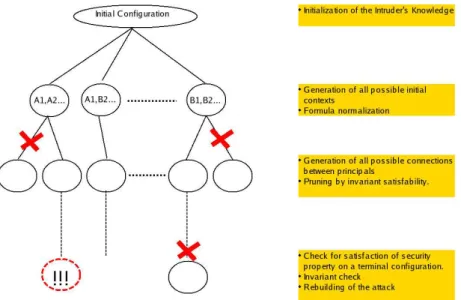
ASPASyA implements the reduction relation−7→prescribed by the cIP semantics, in two separated modules: stepandjoin. The construction of the state space begins in thejoin
module by adding different several instances of principals to the empty configuration. Next,
stepis in charge of generating the entire state space for every initial configuration built by the joinmodule. Due to the definition of −7→, the resulting state space is a tree of configurations and a trace is a path from a leaf to the root. ASPASyA also implements a second aspect of the formal framework, namely, protocol properties. They are specified usingPL logic and checked for satisfability against configurations. This is reflected in the architecture of ASPASyAby the presence of the modules aimed at representing formulae (logic), handling verification (verifier) and resolting constraint systems (csolver).
The rest of the section describes the implementation of these modules, focusing on the model checking algorithms and their implementation.
5.1
Reduction steps
We start by considering thestepmodule. Given a configurationhC, χ, κi,stepis in charge of applying (in) and (out) rules of cIP semantics, to generate a new configuration. We can highlight three crucial points:
• Find principal actions ready to be fired, • execute a principal action,
• generate a new configuration.
The first step is straightforward and realised with the analysis of the principal process structure. Every action to be fired is then processed according to the semantics given in Table 3.1. For an output action we have to consume the action, modify the context, and update the intruder knowledge with the sent message.
If we consider an input action in(d), things become more difficult. The intruder can send a messagem provided that a substitutionγ such thatdγ ∼m andκ . mexists. For every matching message we generate a new configuration, updating the context and the knowledge with the composition of the corresponding γ and χ. Difficulties arise because the intruder can generate a possibly infinite set of messages in response to a single input action. As an example consider in(?x), the action of a principal waiting for a datum to store in x. Every possible message derivable from κ can be sent and, if κ is not empty,
an infinite braching of possible configuration is introduced. Indeed, an infinite number of different substitutions (and hence configurations) can be generated. In order to face with this problem cIP has been equipped with a symbolic semantics. The formal tool for facing the infinite branching problem is constituted bysymbolic variables (cfr. Chapter 3). The representation of symbolic variables is obtained by extending normal variables (see Example 4.1) with some parameters:
• An integer representing the identification number ofκ;
• a field containing information about type. Indeed, the evolution of the computation will possibly impose restrictions on the set of values for a symbolic variable x(κ). Restrictions are useful in trying to reduce the amount of generated substitutions for an action matching, and they will be described in section 5.2.
Example 5.1 Symbolic variables are represented adding a new constructor to message def-inition (Example 4.1), namely SVar. Suppose we have the symbolic variable x(κ)belonging to principalA2andkId(κ) = 1whose internal representation isSVar(‘x’,2,1,Gen), where
Genis the “type” of data represented by x. Refer to Section 5.2 for details.
Symbolic step
ASPASyAimplements a symbolic matching mechanism (introduced in [10, 41]) that, given a datum d and a knowledge κ , yields a symbolic substitution γ and a message m such that κ . m and mγ ∼dγ. The calculation of a substitution γ for a datum d is based on a procedure defined by structural induction on data. The procedure introduced in [10, 41] handles many details of message matching. However, we are interested in giving a general idea of the mechanism, hence we show a simplified version. When the intruder has to derive a message matchingd, some interesting cases arise:
1. dis a binding variable ?x. This case is handled by the substitutionx →x(κ) withκ
representing the current knowledge. 2. dis a cryptogram{d0}
k and the intruder knows the key needed to decrypt (κ . k−1).
The intruder can generate a message matchingdif he is able to matchd0.
3. d is a cryptogram {d0}
k that the intruder can not decrypt. The intruder cannot
know the structure ofd0 directly. It might be the case that one or more “potentially
matching” cryptograms belong toκ, independently of whether or not the keyk is in
κ. The symbolic matching procedure scans κfor such cryptograms and, if possible, returns a matching substitution.
4. dis a cryptogram{d0}
x(κold). This case considers cryptograms where the encryption
key is the symbolic variablex(κold) referring to a former intruder knowledgeκold, that
contains a finite number of keys. Hence the intruder can assign to x(κold) a value
chosen among a finite number of possible values. The rest of the matching procedure is handled as in case (2)
Notice that the access to former knowledge is performed efficiently by a look-up in a hash table of knowledge pointers as specified in Section 4.3.
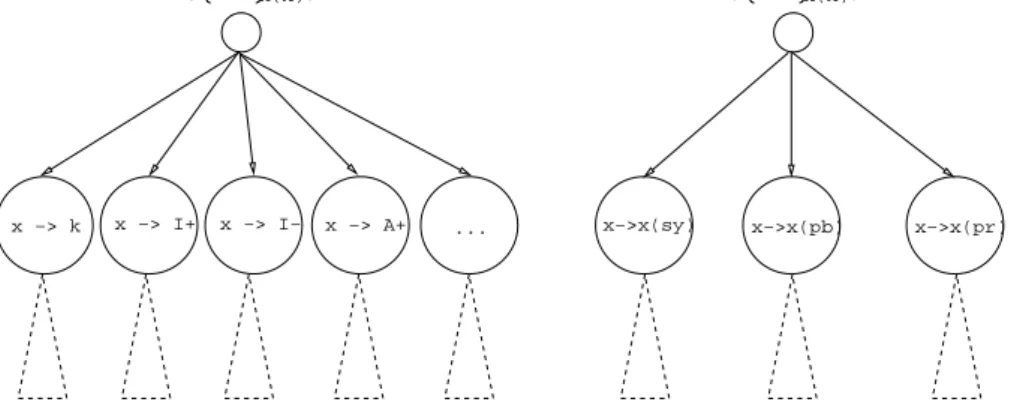
Example 5.2 As an example consider the principal A4= ()[in(?x).in({na}x)] that waits
for a datum and then for a cryptogram containing a nonce, encrypted with x. After that the intruder matches the first action, applying case (1), Ais reduced to[in({na}x(κ))]. The
intruder knows thatx(κ)is used as a key, so every generated substitutionγ(finite in number) will contain an assignment such thatx(κ)7→λ, where λis one of the keys inκ, as specified
for (4). Suppose κ = {k, I+, I−, na} then the symbolic matching procedure generates the
three substitutions γ1 = {x(κ) 7→ k}, γ2 = {x(κ) 7→ I+
}, γ3 = {x(κ) 7→ I−} such that
{na}x(κ)γ1∼k, {na}x(κ)γ2∼I+ and{na}x(κ)γ3∼I−.
Symbolic matching is the core of the reduction step procedure which is reported in the following pseudocode:
single-step(hC, χ, κi)
R=∅
A=set of processes in C ready to fire an action for each a∈A do match a with in(d).P: Γ = symbolic-match(d,κ) for each γ∈Γ do R=R∪ {h(C− {a})∪P γ, χγ, κi} out(d).P: Γ = symbolic-match(d,κ) for each γ∈Γ do R=R∪ {h(C− {a})∪P γ, χγ, κ∪dγi} return R
The return value of single-stepis the set of configurations resulting from one step of symbolic reduction. More precisely,Ris a stack of configurations; single-stepis invoked on every element inRto build the state space.
Configurations are heavily used in state space generation because, as we can see from
single-step, every action of the intruder modifies the context. In general the reduction semantics always modifies the current configuration acting on the context, the variable substitution χ and the knowledgeκ. Exploitingocamllists, each of this structures is im-plemented incrementally, storing only the differences between a configuration and the ones obtained from it.
5.2
Two optimisations
The iteration of single-stepbuilds the whole state space. Even for small protocols, the state space generated is large due to the explosion caused by action interleavings. Pruning strategies are needed to shrink the state space as much as possible.
First, as proved in [10, 41], output of regular principals can be anticipated without any loss of significant traces. The intruder modeled is hence “eager” since he “learns” as much as possible from messages sent by regular principals. When all output messages have been collected, the intruder tries to generate messages for the waiting principals. This observation allows us to limit the dimension of state space without cutting off traces that lead to attacks. Intuitively, since the knowledge of the intruder increases monotonically, observing more data sent by the principals, can only increase the “power” of the intruder. Therefore, single-stephas been modified in the implementation, to generate only those traces where output actions are fired in advance with respect to the input ones. More precisely, whenever we have to generate the successors of a configuration we check if it contains output actions. In such a case, we have only one successor which is the state obtained by performing all the output actions at once. Otherwise, we have a finite number of successors for each input action.
The second source of state explosion is the large number of possible substitutions gener-ated by the intruder to match a single input action. For example, when the intruder knows