Deutsches Forschungszentrum f ¨ur K ¨unstliche Intelligenz GmbH
Technical
Memo
TM-98-01Bottleneck Analysis as a Heuristic for
Self-Adaption in Multi-Agent Societies
Christian Gerber
January 1998
Deutsches Forschungszentrum f ¨ur K ¨unstliche Intelligenz GmbH Postfach 20 80 67608 Kaiserslautern, FRG Tel.: + 49 (631) 205-3211 Fax: + 49 (631) 205-3210 E-Mail: [email protected] Stuhlsatzenhausweg 3 66123 Saarbr¨ucken, FRG Tel.: + 49 (681) 302-5252 Fax: + 49 (681) 302-5341 E-Mail: [email protected] WWW: http://www.dfki.de
Deutsches Forschungszentrum f ¨ur K ¨unstliche Intelligenz
DFKI GmbH
German Research Center for Artificial Intelligence
Founded in 1988, DFKI today is one of the largest nonprofit contract research institutes in the field of innovative software technology based on Artificial Intelligence (AI) methods. DFKI is focusing on the complete cycle of innovation — from world-class basic research and tech-nology development through leading-edge demonstrators and prototypes to product functions and commercialization.
Based in Kaiserslautern and Saarbr ¨ucken, the German Research Center for Artificial Intelli-gence ranks among the important “Centers of Excellence” worldwide.
An important element of DFKI’s mission is to move innovations as quickly as possible from the lab into the marketplace. Only by maintaining research projects at the forefront of science can DFKI have the strength to meet its technology transfer goals.
DFKI has about 115 full-time employees, including 95 research scientists with advanced de-grees. There are also around 120 part-time research assistants.
Revenues for DFKI were about 24 million DM in 1997, half from government contract work and half from commercial clients. The annual increase in contracts from commercial clients was greater than 37% during the last three years.
At DFKI, all work is organized in the form of clearly focused research or development projects with planned deliverables, various milestones, and a duration from several months up to three years.
DFKI benefits from interaction with the faculty of the Universities of Saarbr ¨ucken and Kaisers-lautern and in turn provides opportunities for research and Ph.D. thesis supervision to students from these universities, which have an outstanding reputation in Computer Science.
The key directors of DFKI are Prof. Wolfgang Wahlster (CEO) and Dr. Walter Olthoff (CFO).
DFKI’s six research departments are directed by internationally recognized research scien-tists:
Information Management and Document Analysis (Director: Prof. A. Dengel) Intelligent Visualization and Simulation Systems (Director: Prof. H. Hagen) Deduction and Multiagent Systems (Director: Prof. J. Siekmann)
Programming Systems (Director: Prof. G. Smolka) Language Technology (Director: Prof. H. Uszkoreit) Intelligent User Interfaces (Director: Prof. W. Wahlster)
In this series, DFKI publishes research reports, technical memos, documents (eg. workshop proceedings), and final project reports. The aim is to make new results, ideas, and software available as quickly as possible.
Prof. Wolfgang Wahlster Director
Bottleneck Analysis as a Heuristic for Self-Adaption in Multi-Agent Societies
Christian Gerber
This work has been supported by Siemens AG Germany.
c Deutsches Forschungszentrum f ¨ur K ¨unstliche Intelligenz 1998
This work may not be copied or reproduced in whole or part for any commercial purpose. Permission to copy in whole or part without payment of fee is granted for nonprofit educational and research purposes provided that all such whole or partial copies include the following: a notice that such copying is by per-mission of the Deutsche Forschungszentrum f ¨ur K ¨unstliche Intelligenz, Kaiserslautern, Federal Republic of Germany; an acknowledgement of the authors and individual contributors to the work; all applicable portions of this copyright notice. Copying, reproducing, or republishing for any other purpose shall require a licence with payment of fee to Deutsches Forschungszentrum f ¨ur K ¨unstliche Intelligenz.
Self-Adaption in Multi-Agent Societies
Christian Gerber
German Research Center for Articial Intelligence (DFKI)
Stuhlsatzenhausweg 3, 66123 Saarbrucken, Germany
[email protected]
January 1998
Abstract
In this paper, we describe an approach to achieve dynamic adaption of an articial agent society to environment changes. Such changes cause sub-optimalities in the agent society design, leading to overloaded or un-derloaded agents or agent groups in the society. Our approach provides a mechanism to reveal these sub-optimalities by integrating bottleneck anal-ysis to structural self-adaption in a generic multi-agent framework which allows to incorporate agents of any architecture.
1 Introduction
During recent years, due to advances in the theory of multi-agent systems, but also due to the explosion of hardware power, more and more complex multi-agent systems can be realized. This movement induces the need to introduce structures into such large systems which do not violate the paradigm of agent autonomy since this paradigm has been proven, tried and tested.
Introducing a structure to a group of agents that pursue a common goal, leads to the denition of quantities such as the size of the group, distribution of specialized agents, command structures, types of communication protocols, etc. (see Ger97] for an overview.) However, for the sake of agent autonomy, the agents' reasoning processes should be left untouched.
As multi-agent systems are usably intended to operate for a rather long period of time (sometimes even ad innitum), a system which was originally adjusted to work at a high performance level may lose its performance as the environment
changes. Therefore, an automated self-adaption mechanism which reorganizes the system is of great value. An approach uniting macro-level (i.e., society) aspects and micro-level (i.e., individual) issues can be found in GJ97]. To achieve higher performance, heuristics can be integrated to such a mechanism. In this paper, we demonstrate how to incorporate bottleneck analysis as a heuristic.
Traditional bottleneck analysis approaches try to derive a rather abstract math-ematical model of a complex technical system and the work ow within that system. Usually, a directed graph is used to represent such a system: atomic system components are expressed by nodes work ow is represented by arcs. Operations Research methods can then be applied on that model in order to detect local overloads.
Such an approach can easily be used to analyze a multi-agent society by interpret-ing agents as nodes, agent cooperation for achievinterpret-ing a common goal as arcs in the graph and agent actions as work load transitions. However, this kind of approach has some drawbacks: Only agent overloads can be detected underloads leading to waste of agent power remain uncovered. Furthermore, this approach bases on estimation of the system's behavior: faulty estimations may lead to inaccu-rate system modications. Therefore, we propose a new approach to incorpoinaccu-rate bottleneck analysis to a agent society self-adaption mechanism: for multi-agent systems we do not need to built up a mathematical model of the system, we can collect bottleneck data directly from the agents representing components or component groups.
This paper is structured as follows: In Section 2 we briey present basics about bottleneck analysis. Section 3 gives an overview over the underlying principles of the multi-agent framework in use, SIF (Social Interaction Framework, FGLS98]). In the subsequent section we describe relevant features of a mechanism to be used for self-adaption on the macro level (i.e., the level of agent societies). Section 5 is the main part of this paper: here we integrate the concepts presented in the three previous sections: We show how bottleneck analysis can be incorporated to a self-adaption mechanism based on SIF. In Section 6 we instantiate these generic ideas in a concrete application. Finally, Section 7 gives a conclusion and points to future work.
2 Bottleneck Analysis
Bottleneck analysis is becoming an increasingly important means for optimization of very complex technical systems. Bottlenecks, i.e., unbalanced structures occur if the system was congured using false behavior estimations. Both, local over-or underloaded entities in the system reduce overall perfover-ormance as overloaded units cause delays, while underloaded units could have been used elsewhere.
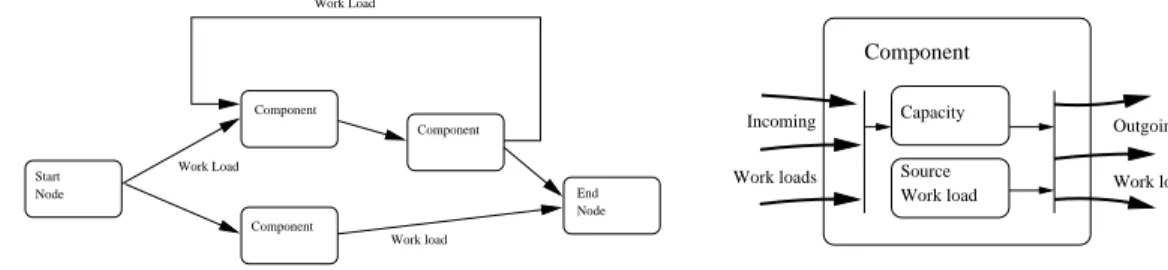
Node Component Component Component End Node Start Work load Work Load Work Load Capacity Source Work load Component Outgoing Work loads Incoming Work loads
Figure 1: System Model and Component Model
Bottleneck analysis provides an assessment method for units in such technical systems: a unit is characterized on a rather high level of abstraction by only re-garding its input/output behavior. The system is represented as a directed graph its nodes coincide with system components, arcs represent the work ow. In gen-eral, two additional nodes are introduced: a start and end node, representing the beginning and the end of the work ow. Figure 1a shows a simple example. Arcs are labeled with work load values. Such a value represents the pass-through of load per time unit. Each component is labeled with a capacity value, a source work load and a transition function (see Figure 1b). The capacity is a measure of pass-through, limiting the processing of incoming work loads. It has to be regarded as an upper threshold of work load to be processed without leading to delays. A unit's source work load constitutes work load that originates from that particular unit, i.e., that did not emerge from other factors. The eect of work load (incoming as well as new source load) on a component results in a reduction of capacity and of new work load leaving the unit, determined by the transition function.
The transition function has to compute
the contribution of the various incoming loads to capacity consumption, the contribution of the new produced work load to capacity consumption, the total capacity consumption and the throttling of incoming work load (i.e., the overload), should the situation arise,
and the outgoing work load depending on the above quantities.
In a traditional approach, a bottleneck is regarded as a location of overload within a system structure. Real bottlenecks are usually distinguished from hidden ones: Real bottlenecks occur if the capacity of a unit is smaller than the work load it has to cope with. A hidden bottleneck is an imbalance that is currently not aecting the system's overall performance, but which will do so if other, real bottlenecks are removed. Goal of bottleneck analysis is the detection and removal of bottlenecks.
By characterizing the work ow in a fashion described above, a mathematical model of the system is put up. Network ow algorithms developed in Operations Research can then be applied to that model in order to detect bottlenecks. Such an approach can be easily adapted to detect sub-optimalities within a society of articial agents. However, it has some severe drawbacks:
Only overloaded units can be found. Underloaded components cannot be detected their unused work power is lost.
Work load and capacities have to be estimated for the mathematical model of the system. If these estimations are incorrect, no mechanism can nd real bottlenecks.
In traditional bottleneck analysis, work load and capacity are not considered variable over time. In such cases of variations, average values are taken or the procedure has to be rerun for each variation.
Similarly, the analysis has to be repeated after each system modication due to detection of real bottlenecks in order to nd hidden ones.
For these reasons, we propose a dierent approach to bottleneck analysis in soci-eties of articial agents: We do not estimate work load and capacities for building up a mathematical model, but make direct use of the multi-agent system architec-ture which provides us with information about agents' work load. The bottleneck detection and system adaption mechanism is directly integrated into the system architecture allowing dynamic adaption to situation changes. We will present that mechanism in detail in Section 5, after having proposed the basic mecha-nism of SIF and a self-adaption mechamecha-nism for agent societies in the next two sections.
3
SIF|an Eector-Medium-Sensor Framework
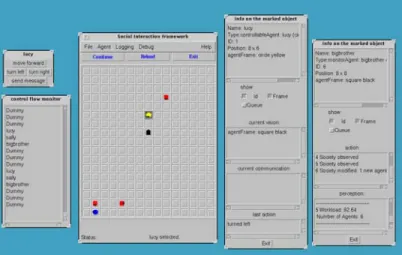
The MAS simulation environment SIF FGLS98]), (Figure 2) has been developed inJava
TM for the study of social interaction between articial agents of arbitrary
architectures.1 SIF's underlying basic mechanism is a so-called
Eector-Medium-Sensor (EMS) architecture based on Russell and Norwig's denition of an agent in RN95].
An agent is anything that can be viewed as perceiving its envi-ronment through sensors and acting upon that envienvi-ronment through eectors.
1If perception, communication and action of some agent architecture is not directly
compat-ible toSIF, a simple wrapper object has to be written as an interface.
Figure 2: The Social Interaction Framework (SIF)
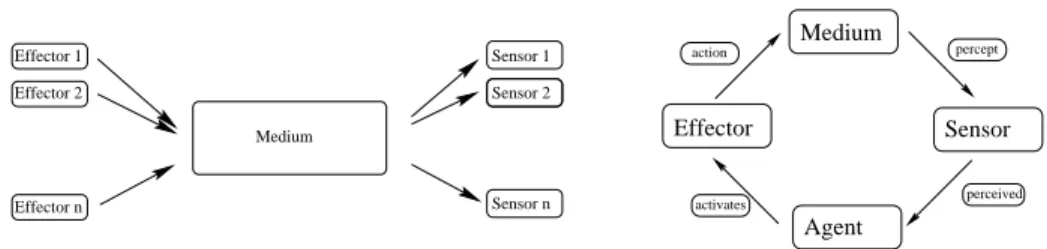
The central component of the architecture is the medium. Eectors emit actions to the medium, which in turn sends the eect of that actions as percepts to sensors. Figure 3a shows the correlations.
Agents are entities equipped with eectors and sensors in order to emit actions to and receive percepts from the world server, an instantiation of the medium, representing the environment. Hence, agents perceive other agents' actions not directly the world server \lters" the eects of actions by computing the local perspectives of perceiving agents. The world server sends these perspectives as percepts to the sensors of perceiving agents. Perception ranges can be installed: a percept is only received by a sensor if the emitter happens to be in the perception range of that sensor. Figure 3b visualizes the information ow. Similarly, agents communicate only via the world server, not directly with each other. They receive communication acts as percepts which might be blurred.
In order to le all incoming percepts, agents and media must have an event queue at their disposal: incoming percepts are stored there and dispatched sequen-tially. However, for performance reasons, communication percepts are treated with higher priority. Therefore, an additional communication queue is intro-duced. Due to the generic layout, any type of agent can be connected to the world server, ranging from to simple Java
TM objects to sophisticated
InteR-RaPagents Mul96].
Sensor 2 Sensor n Sensor 1 Effector n Effector 2 Effector 1 Medium Medium Sensor Agent activates action percept perceived Effector
Figure 3: Sensor-Medium-Eector Model and Information Flow
4 A Self-Adaption Scheme for Agent Societies
In this section, we briey point out the architecture of our self-adaption mecha-nism for a group of agents. A detailed description can be found in GJ97]. The key idea is to control a society of still autonomous agents on a meta-level through structurization and organization. None of the agents' object-level tasks will be addressed by the adaption mechanism.
In RW91], Russell and Wefald argue that an approximation of optimal behavior cannot be reached in a domain-independent manner without solving the higher-order problem of additionally approximating the optimal agent program. This justies the use of meta-reasoning in the single-agent case.
Unfortunately, in the multi-agent case, complexity of the object-level (i.e., com-bining all perception histories and producing reasonable, simultaneous decisions) is intractable for a one-stage meta-level reasoning. We therefore propose a multi-staged resource adaption/meta-reasoning mechanism: The agent society, agent groups and subgroups all are represented explicitly by monitor agents whose tasks is to optimize the structure of the represented society, groups or subgroups. This multi-staged meta-level reasoning enables us to overcome complexity explosion mentioned above.
We regard the task to adapt the structure of a group or society of articial agents to the current environment as an optimization problem by characterizing a search space and an objective function to be optimized. The objective function has to denote the current system's performance while a multi-dimensional search space must describe the system's set of possible congurations. With regard to the application, the objective function has to be dened depending on several factors the application designer has to combine, such as operating time, quality of the result, etc. Each modiable property of the system reects one dimension of the search space. The search space dimensions can be derived from scalable principles of a multi-agent application: Structural principles are for instance
number of agents in the group,
number of specialists for certain tasks, 6
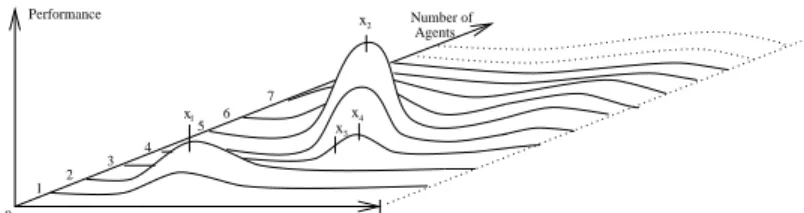
Performance 0 Agents Number of 1 2 3 6 7 4 5 2 4 1 3 x x x1 x Group Diversity
Figure 4: A Simple Example of a Performance Relation organizational formof the group,
migration, i.e., distribution of agents over the net, etc.
Communication principles (for details see FMP+97]) can be expressed through
introduction of communication channelsbetween subunits or even between agents belonging to a common subunit,
usage of dierent communication protocolsleading to dierent communica-tion complexities,
assignment of communication roles to agentsleading to rankings inside sub-units, etc.
Agent architecture principlesare explicit resource distribution among the various agent modules (see GJ97] for a unied approach based on resource distribution management). In this work we focus on the rst two principles: communication principles and, mainly, on agent group structure principles, as they are more independent from the chosen agent architecture.
Figure 4 shows a simple, two-dimensional example: here performance of a group depends only on its diversity and the number of agent members. Number of agents is represented by a discrete dimension, whose domain ranges from 0 to possibly innity. Group Diversity is modeled as a continuous dimension, its do-main ranging from 0 (i.e., all agents have identical characteristics) to 1 (i.e., their traits vary greatly).
As global optimality can hardly be achieved in a reasonable amount of time, but may be lost very easily, we incorporate a mechanism for achieving and maintain-ing relative high performance durmaintain-ing the complete run of an application. This mechanism bases on the local search method for nding local optima.
1. The application designer produces an initial model of the application by in-stantiating scalable parameters: a start point in the search space is dened. 2. The system is run over a pre-dened time period t the average system
performance is measured, based on an evaluation of the objective function described above.
3. The direction to move in the search space and the size of the step are determined (see details in Section 5.2). That step is performed by the monitor agent that recongures its group.
4. If system performance has improved after the time period t, a further step
in that direction is taken and step 4 is repeated. 5. Otherwise the step is undone and step 3 is repeated. In the above example a starting point may be x
3. A maximal performance gain
will be achieved by increasing the group diversity: x
4 may be achieved. By
increasing the number of agents to ve, the optimal conguration x
2 will be
found.
Of course, the nature of the environment may change (e.g., a new type of specialist is introduced) leading to adjustments of the formal search space and the current position (here a new dimension Number of agents of the new type is added the value of the current position on that dimension is 0.) In order to overcome some local minima, random jumps may additionally be performed from time to time - similar to the Simulated Annealing technique KGV83] if performance increase is not measured, that jump is undone again.
Obviously, in this approach the autonomy of member agents is partially traded for more central control leading to a general behavior which is more oriented towards the overall goal of the society. Depending on the application domain, the competences of the monitor agent may be set dierently the resulting society can vary from a loosely moderated group up to a hierarchical structure. However, in any case, members of such a controlled society still are agents that make independent local decisions based on their architecture (which can be reactive, deliberative, BDI-oriented, etc.) Therefore, this approach does not violate the core of the paradigm of agent autonomy.
Member Agent Member Agent World Server Monitor Agent .. . action society-observing information request percept Member Agent Member Agent World Server Monitor Agent .. . answer request action percept society Member Agent Member Agent World Server Monitor Agent .. . action society-modifying modifications
Figure 5: Control and Information Flow
5 Integration of Bottleneck Analysis into a
Self-Adaption Mechanism
For the realization of the above algorithm two issues must be addressed: How to control the group structure and How to perform a local step (step 3 in the algorithm). We will now address these issues.
5.1 Control in Structured Agent Groups
In contrast to other group formation and adaption approaches (e.g.,DP95]), once created, agent groups and societies are represented explicitly by a monitor agent. Such a representative of an agent group or society can be society members or additional agents whose sole functionality is to monitor. In this section, we describe in detail how a monitor agent controls its group or society by detecting bottlenecks.
Just like any other agent in the SIF framework, a monitor agent interacts with its environment (including other agents) via sensors and eectors: Its sensors receive percepts from the world server its eectors emit actions whose eects on the environment are computed by the world server. The monitor agent is equipped with the group structure adaption mechanism described in the previous section.
However, the monitor agent needs special sensors and eectors: From time to time
Deltat, it has the goal to monitor the structure of the agent group it is
responsi-ble for. It therefore emits a society-observing action, triggering the world server to determine the current society status (i.e., number of agents, their structure etc.) and the average system performance since the last system reconguration. Furthermore, all members of the group receive via their communication sensors information-request percepts requesting information on their goal queues (if ex-isting), communication queues and percept queues. (Figure 5a). By dening the perception range of that communication sensors appropriately, it can be realized generically that only agents receive that request which are members of the group the monitor agent represents.
The agents in question emit the requested pieces of information through perform-ing an answer-request action. Once all answers have been collected (or timed out), the world server sends that data as a society percept to the monitor agent (Figure 5b). The monitor agent in turn, uses the collected data to compute the next local step in the search space (i.e., the modications in the society conguration). The monitor agent emits an society-modifying action (containing instructions how to modify the group) to the world server which commits the modications, or computes impacts on the society respectively, as it cannot be guaranteed that all actions are committed successfully. (Figure 5c). Additionally, over time the group constellation may change due to external reasons. Therefore, in order to get correct information on the society situation, the monitor agent needs to per-form a new society-observing action the next time that group has to be controlled. This procedure is repeated until the application is terminated.
At rst glance, this approach may occur to be rather centralistic, since the mon-itor agent is the only unit that makes structural decisions. However, it has to be noted that only structural decisions are found by the monitor agents object-level decisions are still made by the member agents. Furthermore, at a more detailed look, this method can be seen as a variation of the Contract Net Protocol (CNP), a well-known decision nding procedure in Distributed Problem Solving which could also be used in this setting. In both cases, a central unit (here the monitor agent) has to solve a problem and announces it to a set of agents (here members of the group). However, instead of collecting the members' evaluations of the problem based on their local proles (i.e., their bids for organizing the society according to their local preferences), in our case the monitor agent collects these proles in order to get a more global prole enabling it to nd a better solution.
5.2 Performing a Local Step
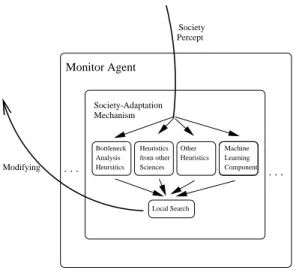
In the model above the monitor agent has to apply a local step in the search space described in Section 4. Obviously, pure uninformed search will lead in step 3 to a random choice of direction in case a new step is not taken in the same direction as the previous one. However, in such cases, heuristics can be incorporated to determine the next step. Figure 6 shows the incorporation of heuristics: they can be gained from sciences such as social psychology (see for instance Nas88]) and management theory (see e.g., Fre95] about the optimal size and structure of a group to perform a certain task), but also from the design of computer players in real time computer strategy games. Furthermore, a learning component (based on reinforcement learning of the decision making history, see Mit97] for an overview) may be employed in order to draw conclusions about the usefulness of previous modications. In this paper, however, we focus on heuristics that can be gained from data collected from world server and member agents.
Local Search Monitor Agent . . . . . . Mechanism Society-Adaptation Bottleneck Analysis Heursitics Heuristics Sciences from other Other Heuristics Learning Component Machine Society Percept Society Modifying Action
Figure 6: Control Mechanism Components
It is the nature of a heuristic to give a rough guideline or indication to nd faster a better solution. Depending on the application, such a guideline needs not to be exact or correct for all cases. Additionally, an indication may be interpreted in dierent ways leading to dierent suggestions what step to perform next. The following observations are modeled to heuristics in that sense: If there is no other indication to decide between several choices, relying on one of these heuristics prevents from making a random choice. Furthermore, note that these heuristics are kept generic on purpose, since our approach is designed to be integrated into a framework of heterogenous agents.
The size of member agent goal queues (if existing) indicates their work load: A very large goal queue may be a sign that more agents are needed that are specialized on achieving that type of goals. On the other hand, if the queue is only lled sparsely, the work of this agent may be done more eciently by another agent of the same type (provided there are some), considering the fact that an idle agent still consumes time and space resources. This may therefore be an indication to delete that particular agent.
The size of agent communication queues can be used to validate the use-fulness of the chosen type of communication protocol: a too large queue reveals that currently applied communication protocols are too complex as they are leading to an overload. On the other hand, an almost empty communication queue is a sign for an underload: a more complex commu-nication protocol that might lead to better results could be used without reducing overall performance.
Furthermore, an analysis of agent communication queues in terms of the distance of communication partners in a network and of communication complexity can be used to decide when to employ agent migration: If com-plex protocols are pursued over a long distance, it may become more ecient to send the agent over the net and let it perform communication locally. Depending on the communication language used between agents, the type of communication acts found in communication queues gives also hints about the optimal structure: hierarchies or other social structures of a group may speed up cooperation as cooperation roles are already pre-dened. If an agent emits many command communication acts such as request and often refuses requests from other agents, a more hierarchical structure may be introduced, giving this agent a high position.
All these observations can be used as heuristics to enable a monitor agent to approximate optimal structure and communication patterns in an agent group.
6 Application: The Colonization Scenario
In this section, we show how the concepts presented above can be applied in a concrete multi-agent application.
6.1 General Properties
In the colonization scenario a collection of agents are exposed to an unknown environment in order to build up and to live in colonies (which could be placed on the North American continent in a colonization simulation of the recent centuries, as well as on unknown planets in a simulation of future outer space missions.) The environment oers raw material sources of various kinds. Colonist agents have to process them in order to produce groceries to be consumed and to build up settlements, means of transportation, etc. The environment may also provide threats to colonists, e.g., natural disasters may occur or predators may exist. En-vironment and predators are also modeled as agents which allows us to interpret the scenario as a zero-sum game: agents, including the environment representa-tive, process goods which are transferred from agent to agent as a result of actions. No goods are introduced or taken away from the system. For instance, food pro-duction is a good transfer from the environment agent to farming agents. By setting an initial raw material supply of the environment rather low, a shortage of goods can be simulated on the other hand, to simulate regenerating sources of raw material, the initial value can be set very high.
Colonist and predator individuals have unique skills to perform certain jobs they have some sort of \life energy", ranging from 0 (the agent is dead) up to 100 (the agent is perfectly healthy). Any activity an agent performs results in energy loss. The agents' main goal is to keep their life energy as high as possible. Increasing energy is achieved by consuming food. Specialization and cooperation between agents is reasonable because the process of producing food can hardly be achieved solitary, not only for colonist agents, but also for predators. Besides their \ordi-nary" actions such as communication actions, move actions, various subtypes of collect-raw-material, process-raw-material or consume-food actions, agents have found-group, join-group, or leave-group actions at their disposals. So if, accord-ing to their architecture, agents are enabled to reason over their next actions, processes of group formation and development can be realized canonically.
6.2 The Self-Adaption Mechanism
Agent groups are explicitly represented by a monitor agent. Agents groups again can cluster to larger units which again are represented explicitly. Persistent goal of agent groups or societies is to grow as strong as possible, i.e., to consist of as many members as possible that can achieve their main goals as well as possible. Groups and societies are represented explicitly by (monitor) agents. The main goal of a group (i.e., the objective of the corresponding monitor agent) is to gain as much control over food as possible in order to enable the survival of group members. Hence, the monitor agent representing a group must reason on the number of group members, type of agents, patterns of command in the group, etc., (all scalable quantities enumerated in Section 4) to optimize the group composition. The system is initialized with a society conguration the user has inserted prior to the run of the simulation. All member agents perform their tasks, i.e., they collect and process raw material, consume food etc. After a time interval t,
the monitor agent performs an information-request action in order to receive information about the food stock and the number and status of the member agents.
The monitor agent now computes a local step in the conguration space tak-ing into consideration the dierence in the food stock, the previous move and the heuristics about the agent event queues just as described in the previous sections. For instance, if the food stock has increased and the previous society modication was the hiring of more specialist of a certain type, say farmers, then the group representative now also tries to hire more farmers. If, on the other hand, the food stock had decreased, the monitor agent tries to undo the previous action (here, to re the additional farmers). If furthermore for instance, the agents' communication queues are packed, the monitor agent changes the communica-tion protocol between members to a simple one (e.g., from an complex auccommunica-tion
mechanism to Contract Net Protocol). These modications are performed by emitting a society-modifying action to the world server.
As agents can decide, whether or not to join or leave a certain groups, the outcome of a group modication process is hardly predictable. This is in particular true for cases in which a group representative chooses to enlarge its group: there may be no agent of the wanted type available or they may refuse to join the group. Therefore, the representative cannot be sure that all of his society modifying actions have been performed successfully. This justies the presented approach in Section 5, always to perform a observing action before a new society-modifying action.
So, not only group formation evolves naturally from goal optimization, but also agent characteristics such as selshness, social behavior or solitary behavior, con-cepts well studied but mostly represented in an explicit manner. Furthermore, agent groups and subgroups can be characterized by propagating member char-acteristics.
7 Conclusion and Future Work
In this paper, we have presented an approach to incorporate bottleneck analysis to a mechanism that enables self-adaption of a society of articial agents without giving up the paradigm of agent autonomy. In detail, our approach makes use of analyzing event queues that agents and world server process during the run of an application. We have demonstrated how society structure control is integrated naturally into the layout of the generic agent framework SIF enabling the use of agents of any architecture. In particular, we have introduced monitor agents in order to represent agent groups and society explicitly and we have shown how these agents can perceive and modify the society. For the sake of clarication, we have presented a simulation scenario of behavior of human societies, the colonization scenario where these concepts can be used canonically.
Future work will concentrate on the introduction of a machine learning component to this approach, mentioned in Section 5, and of further validating this approach by introducing several societies competing against each other. These societies have dierent policies to operate, some might simulate communist policies, others might simulate market oriented policies, some may have the adaption mechanism at their disposal, others may not. The goal then is compare society policies on an abstract level, similar to the comparison of the iterated prisoners' dilemma problem in Axe84].
Acknowledgments
We would like to thank the members of the MAS group at DFKI and to Donald Steiner at Siemens AG for fruitful discussions. In particular, the self-adaption mechanism has been derived under continuous discussions with Christoph G. Jung. SIF was developed in cooperation with Petra Funk, Jurgen Lind, and Michael Schillo.
References
Axe84] R. Axelrod. The Evolution of Cooperation. Basic Books, 1984. DP95] J. Doran and M. Palmer. Articial Societies, chapter The EOS
project: integrating two models of Palaeolihic social change, pages 103 {125. VCL Press, 1995.
FGLS98] P. Funk, C. Gerber, J. Lind, and M. Schillo. Social Interaction Framework|A Generic Testbed for Social Agents. Research Report, German Research Center for Articial Intelligence, 1998. To Appear. FMP+97] K. Fischer, J.P. Muller, M. Pischel, C. Gerber, and B. Chaib-draa. A
Simulation Approach based on Negotiation and Cooperation between Agents: A Case Study. Submitted to: ACM Transaction on Modeling and Computer Simulation: Special Issue on Simulation of Scalable Systems, 1997.
Fre95] E. Frese. Grundlagen der Organisation. Gabler Verlag, 6th edition, 1995.
Ger97] C. Gerber. An Articial Agent Society is more than a Collection of \Social" Agents. In Socially Intelligent Agents - Papers from the 1997 AAAI Fall Symposium. Technical Report FS-97-02, AAAI, 1997. GJ97] C. Gerber and C. Jung. Towards the Bounded Optimal Agent
So-ciety. In Distributed Cognitive Systems: Proceedings of the VKS'97 Workshop. Dokument D-97-08, DFKI GmbH, 1997.
KGV83] S. Kirkpatrick, C. Gelatt, and M. Vecchi. Optimalization by simulated annealing. Science, 220:671, 1983.
Mit97] T. Mitchel. Machine Learning. Mc Graw Hill, 1997.
Mul96] J. P. Muller. An Architecture for Dynamically Interacting Agents. PhD thesis, Universitat des Saarlandes, Saarbrucken, 1996.
Nas88] D. Nasser. How to run a focus group. Public Relations Journal, 44:33{ 34, 1988.
RN95] S. Russell and P. Norvig. Articial Intelligence: A Modern Approach. Prentice Hall, 1995.
RW91] S J. Russell and E. Wefald. Do the Right Thing. MIT Press, 1991.
Bottlenec k Anal ysis as a Heuristic for Self-Adaption in Multi-Ag ent Societies Christian Gerber