DEPARTMENT OF MANAGEMENT, AARHUS UNIVERSITY
GLOBAL BUSINESS MODELS
The incubator model as entry mode
Author: Christine Luise LauthStudent ID: cl87612
M.Sc. in International Business Advisor: Morten Rask
Characters (incl. figures): 124.345 JUNE 2015
1 | P a g e
A
BSTRACTInternationalization is an ever-important issue in today’s business environment and for a small econ-omy like the Danish, it is vital for our small- and medium-sized enterprises to expand beyond the do-mestic market. There are a number of approaches to this, one of them being the incubator model of-fered by the Trade Council of Denmark. This thesis sets out to investigate further how the incubator model helps Danish companies in their internationalization process.
The theoretical background has its roots in entry mode literature and research on global business mod-els and how these two academic disciplines link together. Looking into the existing literature it becomes clear that the incubator model does not fit into already existing frameworks as it represents a very unique configuration in terms of risk, control and flexibility compared to traditional entry modes. To understand how the incubator model helps Danish companies in their internationalization process, Danish incubator companies residing at the Trade Council in Atlanta have been taken in as the real-life cases of this thesis. Initially the interviews with Danish managers in the US confirmed a lot of the bene-fits associated with the incubator model but digging a little deeper, and analyzing the firms’ current positions in the market, showed that the incubator model can only do so much. Especially in the early start-up phase the incubator can prove very helpful for a Danish company, but based on the analysis conducted in this thesis there is a great risk of facing governance issues caused by locus and modus dimensions.
The thesis contributes to the existing research by suggesting a conceptual framework for how desired risk profile, choice of entry mode and business model elements link together. Furthermore, the thesis suggests that in order to fully exploit the potential of the incubator model companies need to be aware of the pitfalls associated with this entry mode to avoid ending up in a low commitment mode. To reap the benefits of the incubator model sufficient resources and support from headquarters need to be dedicated to the local market.
2 | P a g e
T
ABLE OF CONTENTSPart I: Introductory Section... 5
1.1 Introduction ... 5
1.2 Problem Statement ... 6
1.3 Structure ... 7
1.4 Understanding the Basic Concepts ... 8
1.5 Philosophy of Science and Methodology... 11
1.5.1 Multiple Case Study ... 11
1.5.2 Semi-Structured Interview ... 12
1.5.3 Élite Interview ... 13
1.5.4 Observation Study ... 13
1.5.5 Limitations of the Study ... 14
1.6 Analytical Lenses... 15
1.6.1 Critique of the Learning Perspective ... 16
1.7 Summing Up Part I ... 17
PART II: Entry Modes and Business Model ... 19
2.1 A Static Approach ... 19
2.2 The Learning Perspective ... 19
2.3 Classic Configuration of Entry Modes ... 20
2.4 Value Chain Perspective ... 22
2.5 The Incubator as an Entry Mode ... 24
2.6 Summing Up ... 26
Part III: Business Model Innovation and Choice of Entry Mode ... 29
3.1 A Transformational Approach ... 29
3.2 Business Model Innovation... 29
3.3 Choice of Entry Mode ... 32
3.3.1 Modus View ... 32
3 | P a g e
3.3.3 Summing Up ... 36
3.4 What is the Trigger Point?... 36
Part IV: Danish Incubators Clients ... 39
4.1 Trade Council of Denmark in Atlanta ... 39
4.1.1 The Incubator Facilities in Atlanta ... 40
4.1.2 Regus ... 41 4.2 Presentation of Cases ... 41 4.2.1 Cabinplant ... 42 4.2.2 JBS ... 42 4.2.3 Team Online ... 43 4.2.4 Trade Commissioner ... 43 4.3 Analysis ... 44
4.3.1 Risk Profile and Choice of Entry Mode... 44
4.3.2 Content, Focus and Structure ... 46
4.3.3 Locus, Modus and Governance ... 47
4.3.4 What’s Next ... 53
Part V: Conclusion & Implications ... 56
5.1 Conclusion ... 56
5.2 Managerial Implications ... 57
5.3 Further Research ... 57
6. References ... 60
7. Appendices ... 63
Appendix 1: Interview Guide – Incubator Clients ... 63
Appendix 2: Interview Guide – Trade Commissioner ... 64
Appendix 3: The Virtual Office Solution ... 65
4 | P a g e
PART
I:
I
NTRODUCTORY
S
ECTION
The aim of Part I is to introduce the starting point of this thesis, present the problem statement and the relevant research questions as well as establish an understanding of the author’s intentions with the
5 | P a g e
P
ARTI:
I
NTRODUCTORYS
ECTION1.1
I
NTRODUCTIONBusiness models are essential to any business, well-established or new start-ups alike, as managers are forced to carefully think about their business – how the different parts of the business combined make a whole, and how value is created for the customer (Magretta, 2002). Although a number of researchers have dealt with the issue of business models there is a lack of literature more specifically investigating global business models, taking into account the numerous differences that still exist between markets (Onetti et al., 2012; Rask, 2014; Zott et al., 2011). Companies that internationalize and move beyond their domestic market face the challenge of transferring their business model to a foreign market where the domestic business model may no longer be sufficient.
The starting point of this thesis is the work of Rask (2014) who investigates internationalization through business model innovation. Global business model innovation is closely linked to choice of entry mode and focuses on two decisions; modus, i.e. whether to handle activities in-house or through third parties, and locus, i.e. where to locate activities (Onetti et al., 2012). Traditionally entry modes can be divided into three groups: export, contractual and hierarchical modes (Hollensen, 2012; Root, 1987). Each of these represents a configuration and trade-off between control, resource commitment and risk. There is, however, an option that does not fit perfectly in any of these categories, when deciding what entry mode to access a new market through, namely the incubator model, which will be the focus point of this thesis. Rask’s (2014) research focuses on the link between internationalization and business model innovation and presents four types of global business models accounting for both the modus and locus aspects of the decision making. This thesis aims to go one step further and specifically inves-tigate how the incubator model facilitates internationalization.
What is the relevance of studying business models and entry modes in the same thesis one might ask. Business models and business model innovation are some of the areas where companies can often achieve great benefits for their overall business very cost efficiently (Zott & Amit, 2012). In today’s business environment many companies have already made a great effort to look at traditional innova-tions and cost savings and therefore focus is now shifting to business model innovation (Zott & Amit, 2012). The other part of this thesis, entry modes, finds its legitimacy as a relevant topic in the light of globalization and companies internationalizing their activities. We already see a great amount of litera-ture dealing with the internationalization of firms and it is therefore important to not fall in the trap of researching further just for the sake of it rather than actually contributing with new findings (Shaver,
6 | P a g e
2013). As we do not currently see much research on the link between business models and entry modes this thesis will claim to go beyond what is already seen in existing entry mode literature.
To support the theoretical foundation empirical data will be gathered through interviews with Danish companies in the US that have used the incubator model as their entry mode to the US market. It is no secret that choosing the US as a market to focus on was very much sparked by personal experience and interest. That being said, the US is an interesting market to look into for a number of reasons. First of all the US is Denmark’s largest non-European trading partner with exports for 2015 estimated to DKK 45 billion (Eksportrådet, 2014). Second, the Danish government has launched their “Growth via Ex-port” strategy where USA is a special focus area along with Germany and Japan (Udenrigsministeriet - Eksportrådet, 2014). Finally, the ongoing negotiations of the Transatlantic Trade and Investment Part-nership (TTIP) concerning a bilateral trade agreement between the US and the EU makes the American market very relevant and current to look further into (Børsen, 2015). As majority of Danish companies are small- and medium-sized enterprises (SMEs) (European Commission, 2013), the US might seem like a big mouthful to take on and any research that contributes to the existing knowledge on market entry can therefore prove very valuable and useful in practice.
1.2
P
ROBLEMS
TATEMENTThe considerations presented in the introduction have formed the basis for the following problem statement:
How does using the incubator model as an entry mode facilitate the internationalization of Danish companies?
In order to sufficiently investigate the problem statement, a number of research questions have been formed:
How are business models and entry modes defined and conceptualized in literature in rela-tion to internarela-tionalizarela-tion?
What is the link between business models and entry modes?
How does the incubator model as an entry mode differ from more traditional approaches to market entry?
How do Danish incubator companies in the US perceive the benefits of the incubator model?
7 | P a g e
The three first questions will be answered through thorough research of existing literature and will sult in a conceptual model of the linkages between entry modes and business models. The fourth re-search question will be answered using primary data from interviews carried out with representatives from Danish companies currently running their US operations from the Trade Council’s incubator fa-cilities in Atlanta. Overall the aim of the problem statement and related research questions is to provide a sound theoretical as well as practical representation of the topic. The thesis aims at contributing to the limited literature on global business models, in particular the incubator model, but also sets out to con-tribute with knowledge that is in fact useful for Danish companies looking to internationalize using the incubator model.
1.3
S
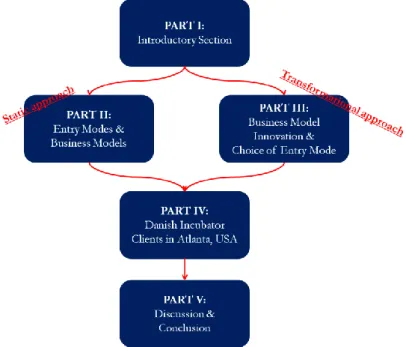
TRUCTUREThis thesis consists of five parts that link together as illustrated:
FIGURE 1: STRUCTURE OF THE THESIS. OWN DEVELOPMENT
Part I is an introductory section that will present the problem statement and corresponding research questions but an equally important function of this part is to provide an outline for the methodological considerations behind the thesis as well as provide an introduction to the basic concepts and main re-search that form the basis for the theoretical parts of the thesis.
Part II will provide a theoretical foundation for the main concepts, entry modes and business models. It will clarify how the concepts are linked together and also what the relevance of linking them is. Part
8 | P a g e
II takes a static approach to the theoretical concepts. The literature in this part takes a starting point in some of the work that is considered more traditional.
Part III will continue along the lines of part II, but will take a transformational approach to the theory. The central issues here are therefore business model innovation and the choice of entry mode. Part III sets out to challenge and build on the existing research within entry modes and business model. The main literary sources for this part are of more recent date to support the aim of going one step further than much of the traditional literature in the field.
Part IV focuses on Danish incubator clients at the Trade Council in Atlanta. This part sets out to put the theoretical discussions of parts II and III in the context of real life and the actual internationaliza-tion of Danish companies entering the US market. An analysis will be made to investigate how the in-cubator model has facilitated the internationalization of the case companies.
Part V will tie up the ends and discuss the findings of the prior four parts. This last part will present the findings and answer the problem statement and research questions. Part V will also present mana-gerial implications as well as make suggestions for further research. Following this section references and appendices are found.
1.4
U
NDERSTANDING THEB
ASICC
ONCEPTSBusiness model is a term widely used but the understanding of the concept in this thesis is that busi-ness models explain how companies do busibusi-ness and how value is created and captured, or in other words how a company’s value proposition is brought to their customers (Demil & Lecocq, 2010; Zott et al., 2011). In more common language this means that a business model should identify how a com-pany’s products or services are transformed into actual value.
In the field of business models there is a wide range of literature, a lot of it not accounting for the issue of internationalization of companies (Onetti et al., 2012). Therefore this thesis will primarily deal with the research of authors that do in fact consider internationalization as a relevant factor in relation to business models. One of the main pieces of literature will be the work of Zott & Amit (2010) and their activity-system approach to business models. Overall their research is about how activities are to be linked together and organized, and who is to perform them – the company itself internally or external partners. They work with the elements content – what activities to include in a business model, structure – how are the activities linked, and finally governance – who performs the activities (Zott & Amit, 2010). This is an utmost relevant discussion in relation to entry modes as entry modes address the very similar
9 | P a g e
issues and provide a recipe for how activities are to be organized and who handles what when entering a new market. Presented graphically the elements are:
FIGURE 2: DESIGN ELEMENTS OF BUSINESS MODELS. ZOTT & AMIT (2010)
The elements of Zott & Amit’s (2010) work mentioned above are referred to as design elements. Linked to this is another set of parameters, design themes, that deal with the sources of an activity system’s value creation (Zott & Amit, 2010). For this discussion concerning business models and entry modes, the design elements, i.e. content, structure and governance, are what is really interesting as this is where the building blocks of a business model can link together with elements of an entry mode.
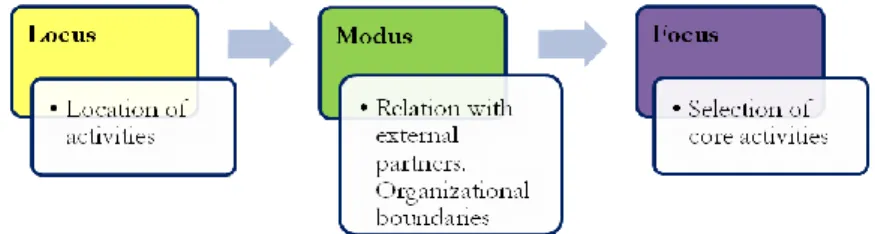
A somewhat similar line of thought related to business models is taken up by Onetti et al. (2012) who also work with a three-dimensional approach. The three dimensions they work with are locus, i.e. the location of activities, modus, i.e. relationships with other actors and the issue of where to draw organiza-tional boundaries, and finally focus, i.e. what selected activities the firm should focus on as core activities (Onetti et al., 2012):
FIGURE 3: LOCUS, MODUS AND FOCUS DIMENSIONS. ONETTI ET AL. (2012)
Especially the locus and modus dimensions will be of great importance in relation to entry modes, something Rask (2014) also points out in his research, which will be presented in more detail in Part III. The choice of entry mode is closely tied up to the decisions about locus and modus – i.e where are the different activities of the firm to be located (locus) and who will manage them as well as how are they to be carried out (modus) (Rask, 2014).
Working with entry modes it is of course also necessary with an understanding of the term. A generic definition of the term entry mode is “an institutional arrangement necessary for the entry of a com-pany’s products, technology and human capital into a foreign country/market” (Hollensen, 2012, p.
10 | P a g e
216). As with business models there are many approaches to the topic of entry modes, one of them also being an activity perspective. This is the work of Andersen (2006) who thinks of entry modes as a bun-dle of activities:
FIGURE 4: THE INTERMEDIARY AS AN ACTIVITY BUNDLE. ANDERSEN (2006)
The illustration neatly shows how the chosen entry mode is to serve as a type of mediator that will re-duce the complexity of moving from one market to another. From this perspective the different entry modes are basically different bundles of activities that can be combined in various ways to achieve the smoothest market entry. Andersen’s (2006) research revolves around the penetration of the internet, and how it serves as a mediator, reducing complexity in the internationalization process. A similar dis-cussion will be carried out in this thesis where it is suggested that the incubator model as an entry mode may take on a similar role in reducing the complexity when companies decide to internationalize. This brings us to a final important concept to understand, namely the incubator model. Briefly de-scribed the export incubator is an entry mode that has been designed by the Danish Trade Council as one of their many offerings to help Danish companies enter foreign markets (Rask & Bøllingtoft, 2008). The basic setup is that companies rent office facilities, have access to assistance and local net-works and are therefore able to enter a new market with a different risk/commitment profile than tradi-tional literature on entry modes suggests (Hollensen, 2012; Root, 1987). The incubator model will be dealt with in detail in section 2.5 but the term will appear throughout the thesis and this basic under-standing of it is therefore necessary.
With these important terms defined and the boundaries of the literature on business models outlined, the next section will provide some insight into the methodological considerations that form the base of this thesis. As this thesis aims to take a somewhat practical real-world approach to the issues discussed
11 | P a g e
the choices made regarding philosophy of science and methodology are to serve as a guideline to heighten the overall level of the thesis and to ensure a sound approach to the empirical data collection.
1.5
P
HILOSOPHY OFS
CIENCE ANDM
ETHODOLOGYAn important part of this thesis is the collection and analysis of empirical data, as an essential part of answering the problem statement is to investigate real life and how the incubator model is used by Danish companies. In order to select an appropriate research method it is therefore necessary to define what paradigm the research is conducted within. The work takes a social constructivist view of the world, meaning that the world we live in is not an independent objective reality but rather a continuous creation by us through communication and interaction (Hirtle, 1996). As a researcher this also means that it is impossible to objectively observe as the researcher’s interaction with the environment will also influence the social construction of reality. Focusing on an international business environment it makes particular sense to take a social constructivist approach as the belief is that different traditions, norms and cultures will play a role in how reality is created (Hirtle, 1996).
Continuing along this line of thought means taking the actors view on creating knowledge. According to the actors view the object of social science is reality as a social construction and can therefore not be analyzed using the same tools as when working under the analytical or systems view (Arbnor & Bjerke, 2009). Social reality must be described and understood by the researcher. Therefore a qualitative re-search approach will be most appropriate as it allows the rere-searcher to go in-depth with select cases and get a thorough understanding of their particular circumstances (Flick, 2009). Investigating a company’s choice of business model and choice of entry mode to a new market can be quite sensitive topics as they are really at the core of decision making when starting up a new subsidiary or launching operations in a new market. Furthermore, different companies may have very different reasons for their choices in business model and entry mode and a qualitative study will provide the tools to understand this reason-ing in depth.
1.5.1 MULTIPLE CASE STUDY
Working with case studies also means making a choice about whether to do a single or a multiple case study and deciding whether single or multiple levels of analysis will sufficiently answer the problem statement and research questions (Yin, 1994).
12 | P a g e
FIGURE 5: BASIC CASE STUDY DESIGNS. SOURCE: YIN (1994)
For the purpose of this thesis a multiple-case embedded design has been selected as it is relevant to include a number of companies to increase the sample size and thereby strengthen the findings from the research. In addition to analyzing the Danish companies, the buyers of services, an analysis of the Trade Council will also be included in the case study, the suppliers of services. Multiple case studies are often considered more reliable than single case studies as they allow for replication and thereby add to the validity of the study (Yin, 1994)
A case study is a very appropriate approach for this thesis as it allows for a combination of data collec-tion methods such as interviews, secondary data and observacollec-tions – methods that will be introduced in the following parts (Eisenhardt, 1998).
1.5.2 SEMI-STRUCTURED INTERVIEW
To obtain the relevant data from the interviews conducted, a semi-structured interview was selected as the most optimal approach. The semi-structured interview allows the interviewer to steer the conversa-tion and ensure that certain themes are uncovered but still provides enough freedom and flexibility for the interviewee to speak freely and impact on the content of the interview (Gillham, 2009). The semi-structured interview was also selected as this allows for the same interview approach and question structure for all interviewees, which adds to the validity of the study (Gillham, 2009). The questions have been constructed openly and general enough to be used for all the interviews with Danish compa-nies, regardless of their size, industry etc.
Interviews with native Danish speakers have been carried out in Danish to make the respondents feel as comfortable as possible and thereby giving them the chance to talk and express themselves freely. All direct quotations have been approved by the interviewees to increase validity (Gillham, 2009).
The interviews were recorded to ensure proper documentation. The President of North America for Team Online did not wish to have the interview recorded and a summary of the interview was there-fore created shortly after the interview to make sure important details were not forgotten. This also means that in the analysis of the interview data no direct quotes are found from this interview. As a help in analyzing the interview data from the recorded interviews, everything was transcribed. Gillham
13 | P a g e
(2009) sets forth a number of rules for transcription. Overall these rules were followed, however, with minor deviations due to the circumstances surrounding the interview. These deviations, such as not transcribing immediately after conducting the interview, are not believed to have a significant impact on the quality of the data though.
The interview guide for the semi-structured interviews with incubators can be found in appendix 1. 1.5.3 ÉLITE INTERVIEW
A slightly different interview approach was used for the interviews conducted with the Trade Commis-sioner of the Trade Council of Atlanta. The interview was still planned in a semi-structured frame but as this interview was carried out by virtue of the Trade Commissioner’s position, the purpose of the interview was to allow him to take that expert role and partially establish the basic facts of the incubator model, partially give his professional opinion and views on the issues discussed. As a subcategory to the élite interview “the expert administrator” is found (Gillham, 2009). This type of interview is carried out with senior level of an administration, which must be said to be the case here. Interviewing people in a senior administrative position often means that the interviewee will have concerns in terms of policy, finance, public image etc. depending on their field (Gillham, 2009). One can only assume that this con-cern will be very much true in the case of this interview as well, as the Trade Commissioner is part of a bigger system, namely the Foreign Ministry, where you have to balance a dual role of on one hand hav-ing to live up to budgets and policies set forth by management in Denmark, sellhav-ing the Trade Council’s services to reach their goals, and on the other hand live up to the promises made to clients in the local market and act as their ambassadors.
The interview guide for the élite interviews can be found in appendix 2. 1.5.4 OBSERVATION STUDY
Part of the interest for this thesis topic was sparked during a one-year internship at the Trade Council in Atlanta where I firsthand observed and experienced the basics of the incubator model and connected with both colleagues at the Trade Council as well as the Danish incubators running their US businesses from the incubator facilities in Atlanta. A full year working in this environment of course also means acquiring a lot of knowledge, both tacit and explicit that will be used to a greater or lesser extent throughout this thesis. Although not purposively planned as a research strategy this can be classified as a participant observation study where the researcher becomes a participant in the environment and thereby gets access to both the field and relevant persons (Flick, 2009). Another element of a partici-pant observation study is that the observation should move in a direction that is increasingly focused
14 | P a g e
on the aspects that are relevant for the research questions (Flick, 2009). Although maybe unintention-ally as a start, this has also been the case during the course of my internship in Atlanta. With the overall problem statement and corresponding research questions in mind, much attention was given to issues related to the incubator model and finally resulted in concrete interviews with the incubator companies. 1.5.5 LIMITATIONS OF THE STUDY
Any scientific approach will have its strong suits and weaknesses and the same of course also goes for a qualitative study. The main challenge for qualitative studies is their generalisability as sample sizes are often small and findings are much more context sensitive than is the case with quantitative research (Flick, 2009). In relation to the research conducted for this thesis there are some concrete issues regard-ing the validity that need to be addressed.
For the line of interviews there was only one interviewer present as this was what circumstances al-lowed. In general it adds to validity to have more than one researcher present during interviews as this means two observers to confirm that what is heard and seen is in fact what the interviewee communi-cated (Eisenhardt, 1998). Furthermore, having an extra researcher to support the primary interviewer is a great help in terms of making notes during the interview where the primary interviewer has to focus on the interviewee and directing the interview. Finally a support interviewer can help ensure that all topics planned in the interview guide where in fact covered. As the situation did not allow for an extra researcher the interviewees have been presented with the direct quotations for them to approve to in-crease the validity of the interviews (Gillham, 2009).
In terms of the observations made it is also important to keep in mind that this has not been a pur-posive observation study but rather a matter of just being part of an office and the environment sur-rounding it. A strict scientific approach has not been followed, nor have the results of the observations made been recorded in a sound scientific way. This is, however, not seen as a major issue for the overall validity of the thesis, as the knowledge obtained from the observations serve more as a support to the primary data gathered through the interviews.
Finally one could argue that a higher degree of triangulation could be necessary to increase the validity of the results. This could be in terms of including more respondents from different locations around the world but it could also have been a matter of including quantitative research methods to support the qualitative methods used (Flick, 2009). For the scope of the thesis this has, however, not been pri-oritized.
15 | P a g e
1.6
A
NALYTICALL
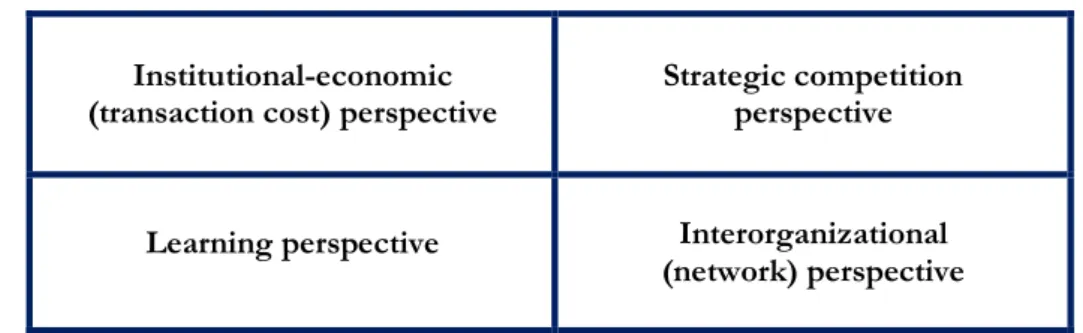
ENSESHaving defined the overall paradigm for philosophy of science and appropriate research methods is important for any type of research. Working with entry modes another essential element is making a distinct choice for which analytical lenses are used to analyze theory and data, as there are fundamen-tally different takes on the topic (Rask, Strandskov, & Håkonsson, 2008).
The four perspectives are:
Institutional-economic
(transaction cost) perspective Strategic competition perspective
Learning perspective Interorganizational (network) perspective FIGURE 6: INTERNATIONALIZATION PERSPECTIVES. SOURCE: RASK ET AL. (2008)
A run-through of the specifics of the different perspectives is not the goal of this section and is consid-ered basic knowledge within the field of International Business. What is more interesting is the choice of analytical lenses for this particular thesis and the reasoning behind.
Based on the responses of the interviewees and keeping the problem statement in mind, narrows this discussion down to two perspectives, namely the learning perspective and the network perspective. Analyzing the incubator model from the learning perspective one would focus on how it is possible to speed up the learning process or even jumping to a higher level of experience through the knowledge accumulated by the Trade Council and other incubators that a company will have direct access to by becoming an incubator themselves. Following the network perspective one would instead argue that being an incubator gives you access to certain networks in the new market that will help facilitate the internationalization process and entry to the market. In this case the rationale behind being an incuba-tor would be quick access to networks that could otherwise have taken a long time to become a mem-ber of, and it could even mean getting access to networks that were otherwise unobtainable.
As the above section shows valid arguments can be made for both perspectives, but the series of inter-views revealed a common response from interviewees, namely that their experience was that the incu-bator model helps skip some steps of learning by drawing on others’ previous experience. Therefore the learning perspective is seen as the most useful analytical approach and will serve as a fundamental assumption of this thesis.
16 | P a g e
The learning perspective originates from the research of Johanson & Wiedersheim-Paul (1975) on four Swedish companies that led to their introduction of the establishment chain. The perspective has since then been further developed by Johanson & Vahlne (1977, 2009). How it applies in relation to entry modes and business models will be dealt with in a lot further detail in Parts II and III.
1.6.1 CRITIQUE OF THE LEARNING PERSPECTIVE
Each of these theoretical perspectives gives us a helping hand towards how to understand and analyze the internationalization patterns of companies. As with most other theoretical approaches these differ-ent perspectives are not perfect and all have pitfalls. For the learning perspective the main issue is that companies do not always follow the prescribed stages of the establishment chain, but rather skip some levels and jump to a higher stage of internationalization (Rask et al., 2008). This is also known as leap-frogging:
FIGURE 7: LEAPFROGGING. SOURCE: (BUCKLEY, 2012)
Although slightly comically presented figure 7 illustrates leapfrogging. In their revisited work on the Uppsala model, Johanson & Vahlne (2009) deal with this issue as there is a general tendency for inter-nationalization to happen at a faster pace than was the case when the original Uppsala model was in-troduced and with the occurrence of the internet, e-commerce and Born Globals. Johanson & Vahlne (2009) also agree with critics that there has been a change in the international business environment and that this is the cause of changes in company behaviour in relation to internationalization.
Bringing in the incubator model in this equation certainly also challenges the original reasoning behind the establishment chain and the notion that internationalization is a slow moving process. As one will understand after reading this thesis the incubator model has the potential to significantly speed up the internationalization process and provide a much steeper learning curve, allowing companies to gather valuable experience at a much faster pace than through traditional entry modes.
With these comments made it is still very relevant to take the learning perspective approach to interna-tionalization and the basic idea behind the establishment chain is also very useful still in terms of dis-cussion firms’ internationalization.
17 | P a g e
1.7
S
UMMINGU
PP
ARTI
Part I has provided a sound basis for the theoretical choices made in this thesis both in terms of the literature used as well as how the empirical data has been gathered. One can see this part as a type of guiding map that will ensure that the rest of the thesis works towards the overall goal of answering the problem statement and that there is coherence between the different sections and between the different empirical and theoretical choices.
Part II will dig in a little deeper and investigate the two core concepts of this thesis, namely entry modes and business models and why these are relevant to link together.
18 | P a g e
PART
II:
E
NTRY
M
ODES AND
B
USINESS
M
ODELS
The aim of Part II is to contribute to answering several research questions by investigating the existing literature on the concepts of entry modes and business. This part will take a static approach to the
19 | P a g e
PART
II:
E
NTRYM
ODES ANDB
USINESSM
ODEL2.1
A
S
TATICA
PPROACHA central part of the problem statement of this thesis is to understand how entry modes and business models are linked and related to each other. This section will therefore investigate important literature within both fields, but more importantly show the relation between concepts. Both entry mode and business model literature have static and dynamic aspects and as this section will be somewhat descrip-tive, trying to answer “what” the concepts are, the static aspects will be in play. The incubator model will also be introduced to show where it fits in with the existing literature in the field.
According to Demil & Lecocq (2010) a static approach to business models means treating the business model as a type of blueprint for the coherence between core business model components. The purpose of this blueprint is to enable description and classification of the business model (Demil & Lecocq, 2010). Taking the static approach to business models is a managerial tool that is great for understanding and analyzing business models. For entry modes a static approach means looking at the firm at a given time in their internationalization process – i.e. at a stage where they are not moving from one stage of internationalization to the next. As this section will show, most entry mode models present an array of options for how to enter a new market, that typically depend on various factors as well as the experi-ence and resources of the company.
2.2
T
HEL
EARNINGP
ERSPECTIVEConsidering the initial choice of using the learning perspective as the analytical lenses of this thesis, there is no way around the work of Johanson & Vahlne (1977) when talking about entry modes. Based on the 1975 study by Johanson & Wiedersheim-Paul, who introduced the establishment chain and de-scribed how the internationalization of firms happens in incremental steps as companies gain more experience in a foreign market, Johanson & Vahlne (1977) further develop the concept of the stages model and establishment chain:
20 | P a g e
FIGURE 8: STAGES MODEL. BASED ON JOHANSON & WIEDERSHEIM-PAUL (1975)
The basic theory is still that firms internationalize in incremental steps as knowledge and experience in a market increases. Central to the learning perspective of the firm’s internationalization is that risk of market entry to a foreign market is reduced as the firm increases their knowledge (Johanson & Vahlne, 1977). Built in this theory about entry modes one also finds information about Zott & Amit’s (2010) elements of a business model. Following this path through internationalization the basic export option means having a business model where an external partner governs international activities. As we move further along the establishment chain the business model will also change to internalize more and more of the activities related to the foreign market, and will give a different configuration of the governance dimension than the original starting point. Similarly we can say that modus is significantly affected as we move from basic export to for example wholly-owned operations. It is again a matter of who han-dles the different activities, and at the different stages of internationalization different actors will be involved. Locus is also affected as this establishment chain shows that it matters where the activities are located – either home or away. For the learning perspective the locus dimension becomes particularly important as the firm gradually acquires more experience and over time internationalize in multiple markets, meaning that activities may also be dispersed over several geographical locations.
2.3
C
LASSICC
ONFIGURATION OFE
NTRYM
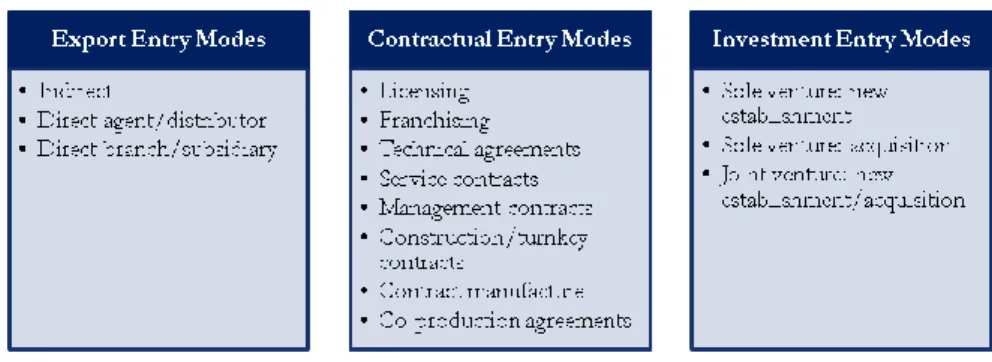
ODESMoving further along in the line of literature we find Root (1987) who is known within the field of In-ternational Business for his classification of entry modes into the overall categories, export entry modes, contractual entry modes and investment entry modes:
21 | P a g e
FIGURE 9: ENTRY MODES. BASED ON ROOT (1987)
Export entry modes are distinct in the sense that the company’s product is manufactured outside the target market and then transferred to it, which means that export is limited to physical products (Root, 1987). Under the overall category of export entry modes different subcategories are found, where indi-rect export means using an intermediary who will do the actual exporting of goods as opposed to diindi-rect export where no home country intermediaries are used. Direct agent or distributor exporting is where the company will make use of an intermediary in the new market. Finally there is the option for the company to set up their own operating units in the target market where products are then exported from the home market to the target market, but where the company still handles marketing activities in the target market themselves from a local branch (Root, 1987). The decision to go with one or the other export entry mode is very much a decision about what governance structure the company sees fit. Contractual entry modes are “long-term non-equity associations between an international company and an entity in a foreign target country that involve the transfer of technology or human skills from the former to the latter” (Root, 1987). These types of entry modes differ from the other two categories in Root’s model as they are primarily about the transfer of knowledge, skills and know-how as opposed to physical products (although contractual entry modes can also lead to exporting of products), and there is no joint equity between the partnering companies (Root, 1987). Modus becomes a very impor-tant dimension for these types of entry modes as having clearly defined organizational boundaries is necessary when entering into a cooperation where the governance structure of the firm’s activities will change. In this case it is also relevant to discuss focus and content, as an important decision for the firm revolves around what their core activities are (there may be a wish to manage these internally), and what activities are of less importance and can therefore be handled by a third party.
The final category, investment entry modes, are as the name indicates, about a company investing in manufacturing plants or other production units in the target market (Root, 1987). A clear distinction is to be made between operations that are solely owned, and thereby fully controlled, by the company and a joint venture that will be a collaboration between companies where ownership and control are shared
22 | P a g e
(Root, 1987). Modus and focus will again be key considerations as a successful joint venture for exam-ple, will depend on creating a governance structure where the core competencies of both partners are exploited, which also means identifying a partner that can complement the company’s own skill set and assets.
According to Root’s (1987) research the choice of entry mode is a decision influenced by both external and internal factors. External factors include the market, production and the environment whereas in-ternal factors are made up by product factors and a resource/commitment assessment (Root, 1987). This is yet another strong link to business models and an example of how governance of activities as well modus and locus dimensions are central elements to entry modes.
2.4
V
ALUEC
HAINP
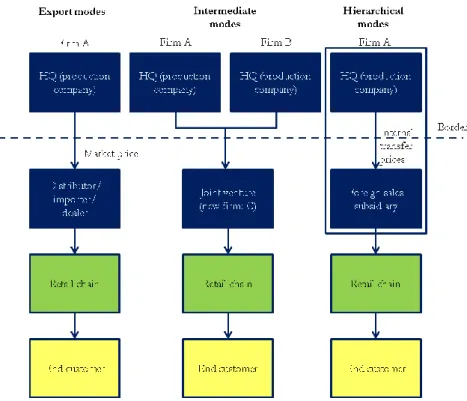
ERSPECTIVEHollensen is a more recent contributor to entry mode literature and presents a slightly different ap-proach to the topic as he takes a value chain perspective when presenting different choices of entry modes. Like Root (1987), Hollensen (2012) also uses the three overall categories export modes, inter-mediate modes and hierarchical modes to classify entry modes:
23 | P a g e
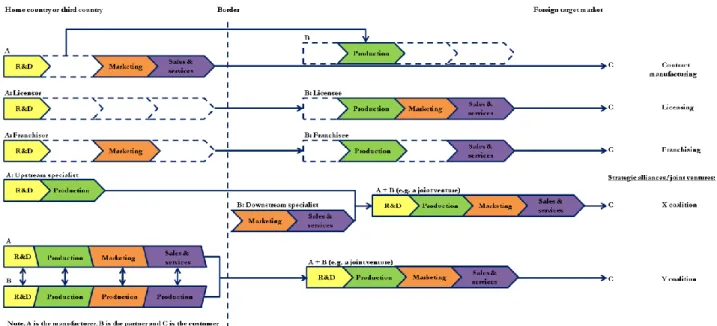
To illustrate how the value chain is used to show difference in various entry modes we can take a look at the intermediate entry modes as presented by Hollensen (2012) where it becomes very clear visually how different entry modes will lead to different configurations of the value chain:
FIGURE 11: INTERMEDIATE ENTRY MODES. HOLLENSEN (2012), P. 245
This visualization underlines the importance of governance of activities as well as locus and modus. The dotted border line shows that it does indeed matter where activities are located. The different choices of entry modes show how activities can be governed in various ways, and that the structure can be different from one entry mode to the next.
Taking licensing and franchising as examples, licensing presents a business model where focus and lo-cus decisions have caused R&D to remain in the home country whereas the remaining parts of the value chain have been moved to the foreign market to be governed by a third party, thereby also bring-ing in the modus decision. A different business model is brought in play with franchisbring-ing where some of the same locus, focus, modus decisions have been made, but where marketing is governed from the home country.
According to Hollensen (2012) four groups of factors are relevant when choosing an entry mode: in-ternal factors (firm size, international experience, product/service), exin-ternal factors(psychic distance, country risk, market size etc.), desired mode characteristics (risk, control, flexibility) and transaction-specific behaviour (tacit nature of know-how). The different factors will speak in favour of increasing or decreasing internalization. As some of these factors will sometimes be conflicting and a lot of the
24 | P a g e
data needed to make the decision often unavailable it is difficult to make a completely accurate assess-ment (Hollensen, 2012).
2.5
T
HEI
NCUBATOR AS ANE
NTRYM
ODEAs mentioned briefly in the introduction to this thesis the incubator model is designed by the Danish Trade Council as a way to help Danish companies expand beyond domestic borders and international-ize. It is an offer directed at small- and medium-sized enterprises as these make up a large part of the Danish corporate world, and companies of this size are believed to not always have sufficient resources to internationalize to the same extent as large corporations, and it is therefore part of the overall strat-egy of the Danish Foreign Ministry to offer solutions that will help promote export.
The incubator model is found in two versions – a full office solution and a virtual solution (appendices 3 and 4). The centre of attention for the purpose of this thesis will be the full office solution but the virtual needs mentioning as well. The incubator model was first introduced by the Trade Council in Atlanta in 2001 and encompasses complete office infrastructure for the incubator clients – furniture, phones, conference and meeting facilities and support staff such as a receptionist to answer the phones with the company’s own greeting (Rask & Bøllingtoft, 2008). For the virtual solution the physical facili-ties are not part of the offering, but the phone services and having an address in the selected market are.
Part of the rent that is paid for the full office solution includes a number of consultancy hours that the company can use for minor tasks or market research. Usually the incubator companies will also use the assistance and network of the Trade Council to handle the formal procedure of setting up a subsidiary or registering business activities in the relevant market.
The rationale behind the incubator model is that it provides fast and easy physical presence in a market for Danish companies expanding abroad (Rask & Bøllingtoft, 2008). This setup helps reduce initial risk and allows companies to focus on establishing their presence in the market and carrying out their strat-egy for the company’s internationalization rather than spending time and resources on searching for office facilities, reliable partners etc. Furthermore, the incubator setup allows for a quick exit from the market in question should the business not develop as hoped and planned for (Rask & Bøllingtoft, 2008). Finally, renting incubator facilities also gives access to a network of other incubator companies, which can provide benefits such as knowledge sharing on both a personal and professional level. Com-panies in similar industries or facing similar challenges in the new market can share experience and thereby speed up their own learning process (and potentially enter into collaboration if their
prod-25 | P a g e
ucts/services are complementary), but can also benefit greatly on a personal level by learning from each other when it comes to all the elements that follow with living in a different country from home. This includes both formal procedures for becoming part of a new society, such as registering with local au-thorities, getting a driver’s license, bank account etc., but can also be a matter of learning how to act in a new culture.
Maybe even more so than with the traditional entry modes, it is relevant to discuss business models in relation to the incubator. All of Zott & Amit’s (2010) elements of the business model activity system (structure, content, governance) are relevant here. For many companies reality of the incubator model is that it will serve as a sales subsidiary but without the ties of ownership, and a decision therefore has to be made about the different elements of the activity system:
Content: What activities are necessary and should be part of the incubator
Structure: How are the activities linked in the new market, but also how are they linked to the domestic operations
Governance: Who is to handle selected activities and where, how much is the company to keep internally and how much should be handled by external partners with local knowledge and expertise
Locus, when using Onetti et al.’s (2012) terminology is an obvious dimension to bring in as the incuba-tor facilities offered by the Trade Council are located outside Denmark. Modus and focus are also es-sential dimensions with the same reasoning why content and governance are important.
As the empirical research in Part IV will support, the incubator model can serve different purposes for different companies and in different markets. Certain industries or markets may be more governed or regulated by local authorities where the Trade Council and the Embassies can provide diplomatic assis-tance by using the Danish Coat of Arms and diplomat relations. Other industries or markets may not be in need of such diplomatic attention but the choice of the incubator facilities is merely a matter of establishing physical presence in the market.
What is interesting about the incubator is that it is an entry mode provided by a third party, the Trade Council, who also has a business model. This means that somehow these two business models have to click together for the setup to work. One might argue that other entry modes are also provided by ex-ternal partners, but the argument made here is that for traditional entry modes only elements are pro-vided by external partners as it will often be a choice between internalization or externalization. When it
26 | P a g e
comes to the incubator model the whole setup is provided by a third party, and then there is still the decision to make regarding what activities to handle internally in the firm and what activities to out-source to external partners (e.g. contacts provided by the Trade Council). In fact it could be said that the incubator is a new type of intermediate entry mode. Just like Andersen (2006) presented his re-search on how the internet serves as a mediator that speeds up the internationalization process, which in return created a new set of hybrid entry modes, one can argue that the incubator facilities offered by the Trade Council do the same and is a hybrid entry mode relative to traditional forms of market entry.
2.6
S
UMMINGU
PThis section has reviewed some of the significant research in the field of entry modes and has proven how business models, from an activity system perspective, are closely linked to entry modes, especially in modus and locus dimensions. The incubator model has also been introduced as a new type of entry mode that offers a new unique alternative to already existing entry modes and is presented as a mode where content, structure and governance are important elements. All these links between business models and entry modes can be conceptualized in this model:
FIGURE 12: CONCEPTUAL MODEL BASED ON ZOTT & AMIT (2010) AND ONETTI ET AL. (2012)
Assuming that the starting point is making a choice of entry mode, this choice will lead to a certain configuration of structure, governance and content. As these elements are closely linked to locus, focus and modus dimensions these too will be influenced. This conceptualization must be said to be some-what of an approximation of how the different elements are linked together as it can certainly be ar-gued that they are even closer intertwined than this representation is evidence of. An example is the locus, focus and modus dimensions of Onetti et al. (2012) where entry modes are said to belong under the locus and modus of business models. Regardless of this consideration we continue forward with the conceptualization as is, as sound arguments can also be set forth of how choice of entry mode will in-fluence the configuration of the business model both in relation to the work of Zott & Amit (2010) as well as the work of Onetti et al. (2012).
Choice of entry mode Structure Governance Content Locus Focus Modus
27 | P a g e
One thing is knowing what the different options are when it comes to entry modes and different con-figurations of business models, but then follows the question of how to change an existing business model and how to make the actual choice of entry mode. These issues are central to Part III.
28 | P a g e
PART
III:
B
USINESS
M
ODEL
I
NNOVATION AND
C
HOICE OF
E
NTRY
M
ODE
The aim of Part III is to contribute to answering the research questions from a transformational point of view and thereby complement the static approach of Part II. This part will further develop the
29 | P a g e
P
ARTIII:
B
USINESSM
ODELI
NNOVATION ANDC
HOICE OFE
NTRYM
ODE3.1
A
T
RANSFORMATIONALA
PPROACHPart II provided a sound understanding of the concepts entry modes and business models and high-lighted how these are tied together and how different authors within business model research contrib-ute to further the understanding of this link. This part sets out to go one step further and understand how the choice of entry mode is related to changing an existing business model through business model innovation.
As change is of the essence here, it only makes sense to take a transformational approach to business models in this section. An important aspect of the transformational approach is that it allows for a business model to adapt to the environment, meaning that moving from the domestic to a foreign mar-ket one can change the current business model, for example through choice of entry mode (Demil & Lecocq, 2010). Another important aspect of Demil & Lecocq’s (2010) work is that they have a Penro-sian view of the business model. This means that the firm can be viewed as a bundle of resources – either internal in the company or external from the market – and that these resources can influence each other and make a unique configuration for the company, something that will also have an impact on the overall performance of the company (Demil & Lecocq, 2010). Taking a Penrosian view of the firm fits well in line with the overall thoughts behind the learning perspective as resources are believed to be better exploited as more knowledge within the firm and managers accumulate. Treating the firm as a bundle of resources also works well along the lines of Zott & Amit (2010) and their view of the business model in an activity system where activities can be bundled in various configurations, where activities also influence each other. The keyword for changing how activities are linked and resources bundled, and for linking business models with entry modes, is business model innovation, as this next section will prove.
3.2
B
USINESSM
ODELI
NNOVATIONCommon for the work of both Zott & Amit (2010) and Demil & Lecocq (2010) is the view that a busi-ness model can be developed and changed and that this busibusi-ness model innovation can reap higher benefits for the company. In a very basic definition, business model innovation is the creation or rein-vention of the business itself (Rask, 2014). Building on their 2010-article Zott & Amit (2012) extend their business model research on the activity system perspective to investigate business model innova-tion. According to them, business model innovation can happen by adding new activities, linking
activi-30 | P a g e
ties in a new way, or changing one or more parties that perform the activities (Zott & Amit, 2012). They claim that business model innovation is relevant for companies to understand as this is a way of rede-veloping the core business, rather than merely focusing on product or process innovation to achieve growth (Zott & Amit, 2012). Part of the reason why companies need to focus elsewhere for optimiza-tion of their business is that operaoptimiza-tions have been at the centre of attenoptimiza-tion for a number of years and the benefits of continuing with this focus will therefore be minimal, whereas business model innovation has much greater potential (Zott & Amit, 2012). For companies in an internationalization process it will be particularly relevant to turn towards business model innovation when looking at entering new mar-kets.
This is what Rask (2014) has done in his research concerning how companies internationalize through business model innovation. The rationale behind taking a business model innovation approach to in-ternationalization is that moving from the domestic market to a foreign market brings with it a whole new context in terms of clients, competitors, sourcing and a much more complex decision making about resource and activity allocation (Rask, 2014).
Taking a look at what happens when a company advances in their internationalization process under the learning perspective, as a consequence of acquired knowledge and experience, it is a very dynamic process of innovating the current business model. Johanson & Vahlne (1977) explain it using their state and change model:
FIGURE 13: THE BASIC MECHANISM OF INTERNATIONALIZATION. JOHANSON & VAHLNE (1977)
The state aspects are to the left, market knowledge and market commitment, and the change aspects to the right, commitment decisions and current activities. In its very basic understanding knowledge about the foreign market and experience obtained through current business activities will push forward inter-nationalization and further commitment in the target market (Johanson & Vahlne, 1977). This is an ongoing process and as a company becomes more and more established in one market, the next step will be to move on to establishing operations in other markets, thereby leading to this incremental in-ternationalization (Johanson & Vahlne, 1977). Looking at the state and change aspects in relation to the incubator model, it is particularly market knowledge that reaps the benefits. With immediate access to
31 | P a g e
increased market knowledge the whole dynamics of the internationalization process are changed as this kickstarts the ongoing process of learning and committing resources to the market.
An important factor in increasing market knowledge and thereby market commitment is psychic dis-tance, i.e. how foreign the target market compares to the domestic market on a number of factors such as language, education, business practices, culture, and industrial development (Johanson & Vahlne, 1977). According to this theory firms will internationalize to markets with a smaller psychic distance as a start, as risk is perceived to be smaller here, and then gradually move to markets that have a bigger psychic distance as the company gains more knowledge and experience, which are believed to be con-tributing factors to risk reduction (Johanson & Vahlne, 1977). This continuous development of knowl-edge and experience will also lead to a continuous business model innovation, something that is very well aligned with Rask’s (2014) conceptualization of internationalization through business model inno-vation:
FIGURE 14: INTERNATIONALIZATION THROUGH BUSINESS MODEL INNOVATION. RASK (2014)
Behind this model lies an assumption that companies cannot internationalize in a way where they move directly from the 1st to the 4th quadrant. In order to reach a semi-global business model a company must go through either an export- or import-based business model in quadrant 2 and 3, to gradually
32 | P a g e
develop their international operations. The model brings forth an important element, namely that busi-ness models can be innovated both in an upstream and downstream direction.
Discussing Rask’s (2014) model in the context of this thesis it is relevant to consider whether leapfrog-ging is an issue in terms of the model’s applicability to real life. Although maybe not as often as leap-frogging occurring in the establishment chain, one could imaging companies going directly from a do-mestic-based business model to a semi-global business model using the incubator model to skip some of the traditional steps as the incubator model allows for immediate presence in a market without a large investment. The incubator model also allows for a company to simultaneously outsource produc-tion to one market while setting up one or several sales subsidiaries in other markets by making use of the Trade Council’s facilities for the sales function, thereby jumping to a semi-global business model or at least significantly speeding up the process of going through an import-based business model first. For the case companies in Part IV of this thesis, however, it seems that they have in fact followed one of the paths suggested by Rask’s (2014) model namely an export-based business model where the incu-bator functions as a sales subsidiary. In order to talk global business models it is of course also very necessary to understand how the actual choice of entry mode is made, which the following section will shed light on.
3.3
C
HOICE OFE
NTRYM
ODE3.3.1 MODUS VIEW
Choice of entry mode is traditionally approached from a modus view (Rask, 2014). This involves a trade off between control, risk and resource commitment and a chosen entry mode will result in a cer-tain risk profile. Root’s (1987) work revolves very much around this trade off between risk and control and the different choices of entry mode can be placed in relation to each other on a risk-control scale that is to be understood as a kind of stage model (however, not to be confused with Johanson & Vahlne’s (1977) stages model) representing the evolution of a company’s decision on entry mode (Root, 1987):
33 | P a g e
FIGURE 15: STAGES OF INTERNATIONALIZATION. ROOT (1987)
Root’s entry mode model focuses around the basic premises that companies will internationalize when they are unable to achieve their strategic objectives in the domestic market and that they will increas-ingly choose entry modes that provide greater control, paying the price of a higher level of resource commitment, which in return will lead to greater risk in the target market (Root, 1987).
As figure 15 illustrates placing the incubator model in Root’s control-risk framework shows how it pre-sents a unique configuration compared to the traditional entry modes as enables companies to enter a market with a low-risk, high-control profile. Furthermore, the issue of leapfrogging is again worth men-tioning as Root’s work suggests that over time companies will increase commitment to a market, thereby also increasing risk. Using the incubator model allows for a much higher level of market com-mitment at an early stage of internationalization and at a lower risk level.
Hollensen (2012) also works with the trade off between risk and control by looking at how the different entry modes go from complete externalization to complete internalization:
34 | P a g e
FIGURE 16: CLASSIFICATION OF MARKET ENTRY MODES. HOLLENSEN (2012), P. 217
The classification of the different entry modes’ risk profiles match very well with Root’s (1987) re-search. Again one can place the incubator model in relation to traditional entry modes on Hollensen’s scale a unique configuration is the result as is depicted in figure 16. The incubator model actually pro-vides the same level of integration in the market as one of Hollensen’s hierarchical entry modes but with the risk profile of an export entry mode.
Bringing together the positioning of the incubator model in relation to these well-established models one can summarize the risk profile as follows:
FIGURE 17: RISK PROFILE OF THE INCUBATOR MODEL. OWN DEVELOPMENT
Using this model as an entry mode presents little risk as initial costs are kept relatively low, no invest-ment is needed as rent is just paid on a monthly basis and access to the Trade Council’s network
re-Risk Low No initial investment Monthlyrent Reducedsearch costs Control High Fullownership fromHQ-no sharedequity Very limited contractual agreement Flexibility High Easytopullout
ofthemarket Capacityallowing, addstaffmembers
Easyreductionof staff
35 | P a g e
duces search costs when looking for partners to help handle the administrative requirements of market entry and gives some level of certainty that the selected partners will perform their job to a satisfactory level. Control is high as there is no shared equity with any partner and HQ in the domestic market can therefore maintain full ownership themselves. This is a strength as the incubator facilities are often used in the very initial phase of entering a new market where important decisions are to be made about the future strategy in the particular market and often a close dialogue between HQ and the foreign opera-tion is needed. Furthermore, the contractual agreement between the incubator company and the Trade Council will be very limited and only revolves around a period of resignation for both parties. This also leads to the final factor, flexibility, which is high. If things do not work out as planned, it is quick, easy and inexpensive for the company to pull out. It might also be the case that there is a need to up- or downscale the size of the staff employed in the local market, which can also be done very easily (capac-ity allowing).
This wraps up the review of the modus view’s influence on choice of entry mode. On the other side of making the choice is the locus view, which the following section will take a closer look at.
3.3.2 LOCUS VIEW
Including locus decisions in choice of entry mode is a logical step as locus is about where to locate the different activities of the company (Onetti et al., 2012). In traditional entry mode literature locus has not been a very central issue but with global value chains and the opportunity to innovate the business model both up- and downstream it is of great importance to also consider locus. In relation to Rask’s (2014) conceptualization of internationalization through business model innovation an important factor is looking at domestic versus globalized markets and production respectively. If a company ends up having a semi-global business model this also means adapting a multi-localization strategy, placing locus at the heart of entry mode choice (Onetti et al., 2012; Rask, 2014).
Similarly Hollensen’s (2012) value chain approach to entry modes provides a good foundation for un-derstanding the importance of locus. Taking the incubator model as the example the localization of activities could look like this:
36 | P a g e
Although the incubator is flexible enough to present different options to different companies this seems to be a reasonable setup for an imagined sales subsidiary where R&D and production still takes place in the home market whereas marketing activities and sales have been relocated to the foreign market in order to allow for local adaptation. Placing this configuration in Rask’s (2014) model of global business models (figure 14) it is equal to an export-based business model where the business model innovation has happened downstream in the globalized market. Thinking logically about a firm’s internationalization process this seems quite reasonable that many companies using the incubator facili-ties will go through this type of business model innovation as this requires far fewer resources than for instance setting up production facilities abroad as could be the case with an import-based business model.
3.3.3 SUMMING UP
This section has shown how the basis for choice of entry mode is made up of modus and locus deci-sions. Traditionally modus has been the strongest determining factor as it involves a trade off of risk, control and resource commitment, something which will often be of high importance to a company when entering a new market. It is, however important not to neglect the locus dimension in choice of entry mode, especially in a business environment where both markets and production can be global-ized, potentially leading to a semi-globalized business model with activities widely dispersed geographi-cally.
3.4
W
HAT IS THET
RIGGERP
OINT?
The final, but maybe most important, question in this discussion is what then triggers the decision-making process and what elements take a leading role in influencing the remaining elements. In section II it was argued that choice of entry mode will influence structure, content and governance and thereby also locus, modus and focus. But is this really the correct way of viewing things? Rask’s (2014) concep-tualization of internationalization through business model innovation certainly challenges this percep-tion. According to Rask’s (2014) framework the business model takes the lead on what entry modes are available. For example having an export-based business model means that a company will choose either direct international sales, direct export through agents or establishing a sales subsidiary abroad.
Following the initial line of thought, that entry modes are the starting point and will result in a certain risk-control configuration, companies have to be very careful in choice of entry mode to ensure that the outcome presents itself as a risk profile and a resource commitment that the company is willing to and capable of working with.