Internet gambling and risk-taking among students:
An exploratory study
JESSICA MCBRIDE* and JEFFREY DEREVENSKY
International Centre for Youth Gambling Studies and High-Risk Behaviors, McGill University, Montreal, Canada (Received: March 12, 2012; revised manuscript received: May 20, 2012; accepted: May 21, 2012)
Background and aims:Internet gambling is undergoing a massive worldwide expansion. The relationship between the convenience, anonymity, and the 24-hour availability of Internet gambling and problem gambling in young peo-ple presents a serious concern. This study explored general gambling behavior, including Internet gambling (with and without money), problem gambling, and risk-approach motivation in a sample of university students aged 18 to 20 years.Methods:University undergraduates (N= 465) in two urban universities completed in-class paper-and-pen-cil questionnaires concerning Internet gambling, risk taking, and a checklist of the DSM-IV criteria for problem gam-bling.Results:Overall, 8.0% of participants reported past-year gambling for money on the Internet, with signifi-cantly higher rates among males (11.8%) than females (0.6%). Based on DSM-IV criteria, 3.7% of respondents were classified as problem gamblers (i.e., endorsed 3 or more items). There were higher rates of problem gambling among those who had gambled on the Internet, and students who had gambled on the Internet had higher risk-approach scores.Conclusions:The results of this study suggest that students who have gambled on the Internet have greater risk-taking motivation than students who have not gambled online, and those classified as problem gamblers have greater risk-taking motivation than non-gamblers. Results also suggest both higher risk taking scores and classifica-tion as a high risk-taker predict online gambling. Gambling on the Internet may be harmful for some individuals; young males, those with high risk-approach motivation, and, most certainly, those already exhibiting problem gam-bling behaviors.
Keywords:Internet gambling, university students, problem gambling, risk-taking, practice sites
INTRODUCTION
Since governments began to relax gambling legislation in the 1980s, many young people today have lived their entire lives within the context of commercialized gambling (McMillen, 2003; Rose, 2010). As such, they have grown up in an era where gambling is not only normalized, it is mar-keted as a form of recreation and entertainment. In North America youth can begin gambling legally as early as 18 years old, depending on the type of gambling activity and ju-risdiction (in some juju-risdictions the legal age is 21). Age 18 to 25 has been proposed as a unique period of development, distinct from both adolescence and adulthood, referred to as emerging adulthood (Arnett, 2000, 2004). Some researchers report that this period represents a stage where youth, as a group, exhibit a disproportional amount of reckless behav-ior, sensation seeking, and risk taking (Arnett, 1992, 2000, 2007; Bradley & Wildman, 2002; Duangpatra, Bradley & Glendon, 2009; LaBrie, Shaffer, LaPlante & Wechsler, 2003; Nelson & Barry, 2005; Worthy, Jonkman & Blinn-Pike, 2010). Most studies of risk and college students involve sexual behavior, driving, and alcohol and/or drug abuse (Bradley & Wildman, 2002; Duangpatra et al., 2009; Ravert et al., 2009; Schulenberg & Zarrett, 2006); despite its normalization, gambling can be considered a high-risk ac-tivity (LaBrie et al., 2003; Stuhldreher, Stuhldreher & For-rest, 2007; Worthy et al., 2010).
Reported prevalence rates of gambling among college students vary considerably. While some researchers suggest college and university students may be at heightened risk for developing gambling problems (Engwall, Hunter &
Steinberg, 2004; Neighbors, Lostutter, Cronce & Larimer, 2002; Platz, Knapp & Crossman, 2005; Volberg, 2002), oth-ers report no increase in gambling behavior (LaBrie et al., 2003). Nonetheless, by all indications a significant number of college students report gambling; 67%–76% of college students have gambled in their lifetime (Engwall et al., 2004; Kerber, 2005; Platz et al., 2005; Stuhldreher et al., 2007) and from 42%–92% of students report gambling dur-ing the past year (Burger, Dahlgren & MacDonald, 2006; Ellenbogen, Jacobs, Derevensky, Gupta & Paskus, 2008; Huang, Jacobs, Derevensky, Gupta & Paskus, 2007a; LaBrie et al., 2003; Weinstock, Whelan, Meyers & Watson, 2007). Rates for problem gambling among college students range from 2–9% for at-risk to 1–5% for probable pathologi-cal gamblers (Burger et al., 2006; Ellenbogen et al., 2008; Engwall et al., 2004; Lesieur et al., 1991; Neighbors et al., 2002; Rockey Jr., Beason, Howington, Rockey & Gilbert, 2005; Skitch & Hodgins, 2005; Weinstock et al., 2007; Win-ters, Bengston, Door & Stinchfield, 1998; Wong, Chan, Tai & Tao, 2008), with rates up to 15% for student athletes (Kerber, 2005) and 11% for students in Las Vegas (Platz et al., 2005). Blinn-Pike, Worthy and Jonkman’s (2007) meta-analysis suggested that the percentage of disordered gamblers (i.e., endorsing 5 or more items on the South Oaks Gambling Screen) (Lesieur & Blume, 1987) among college students in North America was 7.89%.
DOI: 10.1556/JBA.1.2012.2.2
* Corresponding author: Jessica McBride, MA; International Centre for Youth Gambling Studies and High-Risk Behaviors, McGill Uni-versity; 3724 McTavish Street, Montreal, QC, H3A 1Y2, Canada; Phone: 954-990-8539; E-mail: [email protected]
Internet gambling
To date, research on the impact of Internet gambling on the development and maintenance of problem gambling, in ei-ther adults or youth, is in its infancy. Early studies of online gambling among college students reported varying preva-lence rates from 2%–4%, with prevapreva-lence as high as 10% among college student athletes (Jones, 2003; Kerber, 2005; LaBrie et al., 2003; Welte, Barnes, Tidwell & Hoffman, 2009). Griffiths and Barnes (2008) and Petry and Weinstock (2007) reported, respectively, that 22% of students (ages 18–52) and 23% of college undergraduates had gambled on the Internet at least once in their lifetime. Results from the second British Gambling Prevalence Survey (2006–2007) revealed that 6% of the sample (N = 9,003, ages 16 and older) had gambled on Internet, and that prevalence of Internet gambling was the highest among the 16 to 24 and 24 to 34 age groups (Griffiths, Wardle, Orford, Sproston & Erens, 2009) and more recently evidence by Romer (2010) and Shead, Derevensky and Paskus (in press) has shown a shifting pattern of gambling behavior, reporting a significant rise in Internet wagering among college students. While this research contributes to our understanding of online gam-bling, some limitations of the previous studies include using self-selecting samples (Griffiths & Barnes, 2008) or samples that may not be representative of college students in general (Kerber, 2005; Petry & Weinstock, 2007), use of lifetime problem gambling scores which may or may not represent current problems (Kerber, 2005; Petry & Weinstock, 2007), or including one question about gambling in a study of Internet use in general (Jones, 2003).
Although current evidence suggests that only a very small percentage of Internet gamblers gamble purely online (Wood & Williams, 2011), research focusing on Internet gambling hints that the Internet may be a medium particu-larly favored by those with serious gambling problems (Griffiths & Barnes, 2008; Griffiths et al., 2009; Ladd & Petry, 2002; McBride & Derevensky, 2009; Wood & Wil-liams, 2007a, 2011). In one report of student online poker players, 18% were identified as problem gamblers, with an-other 30% being at-risk for developing gambling problems (Griffiths, Parke, Wood & Rigbye, 2010). These studies are correlational in nature and it is not known if the gambling online is responsible for the development of gambling prob-lems, or if problem gamblers use the Internet as one of many gambling venues. At this point it is also unclear whether problem gamblers actually prefer online to offline gambling or whether the Internet is a convenient tool for their “addic-tion”; though there is some evidence indicating that those who have gambled on the Internet have engaged in more forms of gambling than have offline gamblers (Gainsbury, Wood, Russell, Hing & Blaszczynski, 2012; Welte et al., 2009; Wood & Williams, 2011) and the Internet may simply be a part of their gambling repertoire.
“Practice” sites
Many Internet gambling companies offer “practice” ses-sions where individuals may play gambling-type games without wagering real money, and therefore, do not have to be of legal age to gamble. Incentives such as “free” chips, along with prizes and bonuses for sign-up, lure players to en-gage in card playing and casino-type games. For young peo-ple, the decision to begin playing on these sites may not be seen as risky, as no money is actually wagered. However,
many practice sites post messages to the players, inciting them to play for money and focusing on their wins during the practice sessions. These messages give an illusion of control (e.g., “Practice makes perfect.”) or contribute to er-roneous beliefs (e.g., “Based on your playing skills…”) (Sévigny, Cloutier, Pelletier & Ladouceur, 2005). When young people obtain personal credit cards for the first time (e.g., many colleges and universities offer “student” credit cards [Worthy et al., 2010]), believing these false messages they may begin wagering real money, but might not experi-ence the same “wins”. Some free sites have inflated payout rates for their trial sessions and lower payout rates in the real money sessions (Sévigny et al., 2005). The relationship be-tween the free and paid sites and the free sites and problem gambling in young adults is unknown.
Sensation-seeking/risky behavior
Sensation seeking is a personality factor characterized by one’s need for novel, varied, and complex experiences (Zuckerman, 1979). Sensation seeking has been shown to play a role in a wide range of risky behaviors (Zuckerman, 2007). There is evidence of overlap between problem gam-bling, sensation seeking, and risky behavior in adolescents and college students. Probable pathological gamblers report significantly greater sensation-seeking scores and risk tak-ing behaviors and significantly greater substance-related problems (Engwall et al., 2004; Huang, Jacobs, Derevensky, Gupta & Paskus, 2007b; LaBrie et al., 2003; Stuhldreher et al., 2007; Worthy et al., 2010). College students who see themselves as risk-takers or thrill-seekers also report posi-tive attitudes toward gambling (Kassinove, 1998). Gupta, Derevensky and Ellenbogen (2006) reported that adoles-cents with gambling problems have higher scores than social gamblers and non-gamblers on all scales for Zuckerman’s Sensation Seeking Scale (Zuckerman, Eysenck & Eysenck, 1978).
To date, there are no studies linking Internet gambling and risk taking behavior, though there is speculation that Internet gambling may provide unique risks for young peo-ple (King, Delfabbro & Griffiths, 2010). The combination of the unique risk posed by online gambling, that university students are typically of legal age to gamble online and are prone to risk-taking, and the easy availability of credit cards on college campuses (Worthy et al., 2010), leads to concern about the role of Internet gambling and problem gambling in youth. This study is exploratory and descriptive in nature, and aims to provide current information about gambling among university students, including the relationship be-tween Internet gambling, problem gambling, and risk tak-ing. Due to the exploratory nature there were no explicit hy-potheses, although it is expected that those who have gam-bled on the Internet (with and without money) will have higher risk-taking and problem gambling scores than those who have not.
METHODS AND SAMPLE
Participants
Participants included 465 individuals (305 males, 160 fe-males), ages 18–20 years attending two urban Canadian uni-versities from the same city, where the legal age of regulated forms of gambling is 18. The local gambling opportunities
include a casino, vast numbers of lottery outlets, bingo and Video-Lottery Terminals. Participants represented a conve-nience sample of Engineering, Computer Science, and Sci-ence students and were recruited during class time or in the Students’ Centre dining hall during two lunch periods. The use of a convenience sample is noted as a limitation to the re-search. Questionnaires were completed individually in the presence of the researcher and an assistant. All participants were told their participation was voluntary and they were free to withdraw from the study at any point without penalty. Participants were assured anonymity and confidentiality. Participants’ consent was obtained in writing on forms that were collected and stored separately. The questionnaire con-sisted of forty-four multiple-choice questions and took ap-proximately 25 minutes to complete, though most com-pleted it in 15 minutes. Surveys were available in English and French. Although participation rate was not directly measured, typically most students agreed to complete the survey instruments. No incentives for participation were of-fered. Data were collected over a 12-month period (four se-mesters) between October 2005 and October 2006, with an additional collection in April 2007. Ethics approval was granted by McGill University’s Ethics Review Committee.
MEASURES
Demographic questionnaire
Eleven items were included to assess individual biographi-cal data, including gender, age, languages spoken in the home, marital status, and occupation/education level.
Gambling activities
For the purposes of this study, gambling was defined as wagering money on activities (e.g., lottery, cards, sports events, bingo, casino-type games, etc.) with a chance of win-ning or losing money. Twenty-nine items assessed: the rea-sons participants gambled; with whom and from where they typically gambled; typical wagers, wins and losses; and methods of payment (data not reported). Participants were presented with a list of 13–15 potential gambling activities (e.g., lotteries, sports betting, electronic gaming machines, cards, casino table games, etc.) and indicated the frequency with which they engaged in those activities, either on the Internet (with and without money) or offline, during the pre-vious 12 months. Each activity was evaluated using a 4-point Likert-type scale (never, less than once a month, 1–3 times a month,oronce a week or more). All questions were asked directly and no constructs are assessed, assuring face validity.
Risk-taking
The Risk-Taking Questionnaire (RTQ) (Knowles, 1976) is a 20-item measure used to gauge risk-approach and risk-avoidance motivation. Participants indicate to what ex-tent they agree or disagree with each item, using a 5-point Likert-type scale, with1=agree very muchand5 = disagree very much. Eleven risk-avoidant items (e.g.,In most situa-tions, it is often better not to take a chance) are scored di-rectly and nine risk-approach items (e.g.,I’m the kind of
per-son who is usually not very cautious) are reverse scored, with all items summed to produce a global total score. A higher global total score indicates greater risk-taking motivation. Internal reliability of the RTQ ranges from
r20 = .85–.86. Concurrent validity with performance on
Zuckerman’s Sensation Seeking Scale (SSS) isr= .73. The RTQ has been shown to be an applicable measure for gam-bling research (Powell, Hardoon, Derevensky & Gupta, 1999).
Problem gambling screen
Respondents completed a ten-item checklist of the DSM-IV criteria for problem gambling (American Psychiatric Asso-ciation, 2000). The DSM-IV diagnostic criteria have dem-onstrated satisfactory reliability, validity and classification accuracy (Stinchfield, 2003). The use of the DSM-IV as an index for pathological gambling is well established, both in the general population and in gambling treatment samples (Derevensky & Gupta, 2000; Lesieur & Klein, 1987; Lesieur & Rosenthal, 1991; Petry, 2005; Stinchfield, 2002; Wood & Griffiths, 1998); it is highly correlated with other gambling measures (e.g., South Oaks Gambling Screen) (Cox, Enns & Michaud, 2004; Stinchfield, 2002, 2003), though with fewer false positives (Shaffer, Hall & Vander Bilt, 1997; Stinchfield, 2002).
Statistical analyses
Questionnaires were scanned and the data were converted to SPSS Statistics 19.0 for analysis using descriptive statistics, frequency distributions, cross-tabulations, chi-square tests of association, one-way ANOVA, andt-tests (where appro-priate). To examine the relationship between risk-taking and gambling, binary logistic regressions were used, with Internet gambling, practice site playing, and gambling as de-pendent variables, respectively, and risk-taking scores and gender as covariates in one case, and risk-approach motiva-tion (low, medium and high) and gender as covariates in the other. To assess risk-approach motivation, global scores for the RTQ were rank ordered, then divided into quartiles. A group comprised of the lowest 25% of scores was then clas-sified as low-risk motivation, a group comprised of scores ranging from 25% to 75% of scores was classified as aver-age-risk motivation, and a group comprised of the top 25% of scores was classified as high-risk motivation. A Bonferroni correction was applied to control for multiple comparisons, so thata= .002 for these statistics.
RESULTS
Problem gambling
Based on the DSM-IV criteria and gambling behaviors, 40.0% of the sample (n= 186) was classified as non-gam-blers (endorsed no past-year gambling), 56.3% (n= 262) as social gamblers (0–2 items), 3.0% (n= 14) as at-risk gam-blers (3–4 items), and 0.6% (n= 3) as probable pathological gamblers (5 or more items). Due to the small number of probable pathological gamblers in the present sample, for statistical considerations those participants who reported gambling in the past year and who endorsed three or more
items on the DSM-IV were combined and categorized as problem gamblers (3.7%) (n = 17) (see Table 1). Similar classification strategies have been used in other studies of problem gambling among university students (Skitch & Hodgins, 2005; Slutske, 2006); for public health planning and prevention purposes, many researchers focus on emerg-ing gamblemerg-ing problems rather than on more end-stage ex-treme pathological gambling (Cox, Yu, Afifi & Ladouceur, 2005).
Overall, there were significant differences in DSM-IV classification of gambling severity among males and fe-males [c2(2,N= 465) = 18.19,p< .001], with fewer females exhibiting gambling problems (see Table 1). These results are heavily skewed for gender, with over twice as many males than females classified as problem gamblers.
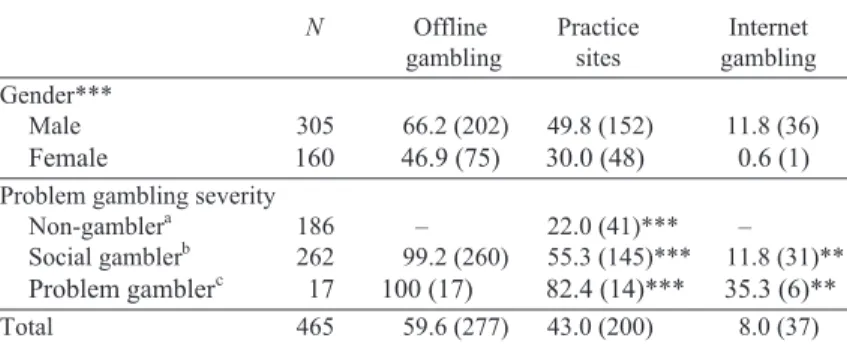
Gambling participation
A total of 59.6% of students reported gambling offline, 43.0% reported playing on practice sites, and 8.0% reported gambling on the Internet in the past year (see Table 2). The most popular online game for money was cards (poker) with 67.6% of those who had gambled online reporting they had gambled at cards online in the past year. This was followed by slot machines (18.9%), blackjack (18.9%), roulette (16.2%) and sports betting (13.5%). The most popular prac-tice game was also poker, with 81.2% of those who had
played on practice sites reporting they had played at cards in the past year. This was followed by blackjack (39.5%), slot machines (22.2%) and sports betting (15.5%).
It should be noted, in accordance with Wood and Wil-liams (2011), only two students reported exclusively gam-bling on the Internet. Thus the term “Internet gambler” re-fers more to those students who have also gambled on the Internet, in addition to gambling offline. Interestingly, there was a group of “pure” practice players (8.8% of participants and 22% of practice players) who did not gamble outside of the practice sites, either offline or online. Further research is needed to determine if this type of gambler would move from the free to the paid sites and what impact this may have on problem gambling.
Similar to the results for gambling severity, gambling participation results are heavily skewed for gender. Signifi-cantly more males than females reported gambling offline [c2(1,N= 465) = 16.32,p< .001], playing on practice sites [c2(1,N= 465) = 16.85,p< .001], and gambling for money on the Internet [c2(1,N= 465) = 17.91,p< .001] (see Table 2). While land based gambling rates for females is consistent with that seen elsewhere (Burger et al., 2006; Ellenbogen et al., 2008; LaBrie et al., 2003), only one female reported past-year online gambling.
Problem gamblers and social gamblers were equally likely to have gambled offline in the previous year. There were significant differences based on problem gambling se-verity for playing on practice sites [c2(1,N= 465) = 60.35,p
< .001] and significantly more problem than social gamblers report online gambling [c2(1,N= 279) = 7.64,p< .01] (see Table 2). Although it is difficult to compare statistically be-cause of different group sizes, it is notable that among Internet gamblers (n= 37) 16.2% are classified as problem gamblers, whereas among participants who have not gam-bled on the Internet (n= 428) 2.6% are classified as problem gamblers.
Internet gambling and risk-taking behavior
A one-way between-groups ANOVA was used to compare mean scores on the RTQ (M = 52.02, SD = 11.50, range 22–94). There were significant differences among non-gam-blers (M= 48.07,SD= 11.23), social gamblers (M= 54.43, SD = 10.80), and problem gamblers (M = 57.98,SD= 12.94) on the RTQ (F(2, 457) = 20.25,p
< .001). Post-hoc Tukey tests revealed that both problem gamblers and social gamblers have signifi-cantly higher risk-taking scores than non-gamblers, while there were no statistically significant differ-ences in risk-taking scores for problem and social gamblers. To compare gamblers and non-gamblers, after meeting assumptions for normality, independ-entt-tests were conducted. Those who gambled on the Internet had overall higher mean scores (M = 60.60,SD= 9.57) than those respondents who had not gambled online (M= 51.27,SD= 11.36) (t(458) = –4.85,p< .001). Similarly, offline gamblers had higher mean RTQ scores (M = 54.67,SD= 10.95) than non-gamblers (M= 48.09,SD= 11.20) (t(458) = –6.26,p< .001) and those who played on practice sites had higher risk-taking scores (M= 53.98,SD= 10.07) than those who had not (M = 50.52,SD = 12.29) (t(458) = –3.24,p= .001).
Table 1. Problem gambling severity by gender
N Problem gambling severity
1
Non- Social Problem
gamblera gamblerb gamblerc
Gender***
Male 305 33.1 (101) 62.3 (190) 4.6 (14)
Female 160 53.1 (85) 45.0 (72) 1.9 (3)
Total 465 40.0 (186) 56.3 (262) 3.7 (17)
1
Percentage, participant numbers in parentheses.
a
DSM-IV score = 0, no gambling activity (on or off the Internet) in past 12 months. b DSM-IV score (0–2). c DSM-IV score (³3). ***p< .001
Table 2. Past-year gambling participation (on and off the Internet) based on gender and problem gambling severity
N Offline Practice Internet
gambling sites gambling
Gender***
Male 305 66.2 (202) 49.8 (152) 11.8 (36)
Female 160 46.9 (75) 30.0 (48) 0.6 (1)
Problem gambling severity
Non-gamblera 186 – 22.0 (41)*** –
Social gamblerb 262 99.2 (260) 55.3 (145)*** 11.8 (31)**
Problem gamblerc 17 100 (17) 82.4 (14)*** 35.3 (6)**
Total 465 59.6 (277) 43.0 (200) 8.0 (37)
1
Percentage, participant numbers in parentheses.
a
DSM-IV score = 0, no gambling activity (on or off the Internet) in past 12 months. bDSM-IV score (0–2). c DSM-IV score (³3). ***p< .001 **p< .01
Logistic regression
In the prediction model, both scores on the RTQ and risk group classification significantly predicted past-year gam-bling; an increment of 1 on the RTQ results in that individual being 1.05 times more likely to have gambled in the past year. Individuals with low and medium risk-approach scores are 24% and 45% less likely than those with high risk-ap-proach scores to have gambled (see Table 3). Male gender was also a significant predictor for gambling.
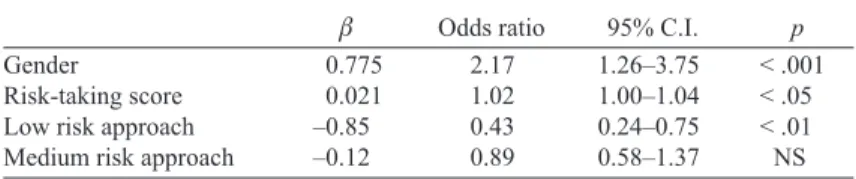
Both scores on the RTQ and risk group classification sig-nificantly predicted past-year practice site playing; an incre-ment of 1 on the RTQ results in that individual being 1.02 times more likely to have played on practice sites. Individu-als with low risk-taking motivation are 43% less likely than those with high risk-taking motivation to have played on practice sites (see Table 4). There was no significant differ-ence between those with medium and high risk-approach scores in their likelihood to have played on practice sites. Male gender emerged as a significant predictor for playing on practice sites.
Both scores on the RTQ and risk group classification sig-nificantly predicted past-year Internet gambling; an incre-ment of 1 on the RTQ results in that individual being 1.07 times more likely to have gambled on the Internet. Individu-als with low and medium risk-approach scores are 22% and 17% less likely than those with high risk-approach scores to have gambled on the Internet (see Table 5). Being male was also a significant predictor for online gambling.
DISCUSSION
The present study was conducted to explore the gambling behavior of university students. Overall, 8% of students and 12% of males (1% of females) reported past-year online gambling. With respect to problem gambling severity, 35% of problem gamblers and 12% of social gamblers reported gambling on the Internet for money in the past year. Internet gamblers had higher risk-taking scores when compared to participants who had not gambled online. Those university
students who have gambled on the Internet are at signifi-cantly greater risk for gambling problems than those who are not. Unfortunately, due to the correlational nature of the data, whether gambling on the Internet leads to gambling problems or whether those with gambling problems are more attracted to online gambling remains unanswered.
Internet gambling
Although the sample size of Internet gamblers is relatively small, the percentage of university students who en-gaged in this behavior is higher than that which had been previously found in earlier studies (Jones, 2003; LaBrie et al., 2003; Wardle et al., 2007), but lower than in later studies (e.g., Griffiths & Barnes, 2008; Petry & Weinstock, 2007). This may reflect a trend of increasing participation and popularity of online gambling; this is consistent with the increases in reported revenues and wagers by Internet gam-bling companies (Christiansen Capital Advisors, 2005). The Responsible Gambling Council of On-tario (2006) reported 5.5% of 18–24-year olds were gambling online at poker sites in 2005, compared to 1.4% in 2001. The possibility that more students have personal computers (in particular laptops), the introduction of wireless connections on many cam-puses (including university classrooms), and the es-calating popularity in the media of online gambling, specifically Texas Hold’Em poker, can be specu-lated to have contributed to increasing Internet bling rates. As prevalence rates for land-based gam-bling are, in general, higher for college students than adults (Blinn-Pike et al., 2007; Burger et al., 2006; Platz et al., 2005), it is not known whether the Internet gambling rates will decrease, remain steady, or in-crease as college students mature, leave school, and have greater revenues. More longitudinal studies are needed to collect data on this behavior. It can be speculated, however, that as more countries and governments move toward regu-lation of Internet gambling, they will legitimize and actively promote it. Online gambling will continue to grow and more research is clearly needed.
Gambling problems
Early gambling patterns may lay the foundation for future problems for some individuals (Winters et al., 1998). A sig-nificant finding in the current study is that among Internet gamblers, 16% were classified as problem gamblers. This is nearly four times the rate found in the entire sample, and six times the rate found among those who have not gambled on the Internet. These inflated rates are consistent with other re-ports of an overrepresentation of problem gamblers on the Internet (Griffiths & Barnes, 2008; Ladd & Petry, 2002; Parke, Wood, Griffiths & Rigbye, 2006; Petry, 2006; Wood & Williams, 2007a, 2007b). Whether or not the Internet is addicting in itself, or simply a medium through which to channel an existing addiction remains unknown. Nonethe-less, the convenience of gambling to be had at one’s finger-tips – 24 hours a day – may be attractive, yet particularly dif-ficult for those who are already experiencing problems with gambling. This necessitates consideration of how more ef-fective measures can be introduced to protect these vulnera-ble individuals (Monaghan, 2009).
Table 3. Direct logistic regression predicting past-year gambling
b Odds ratio 95% C.I. p
Gender 0.608 1.84 1.07–3.15 < .01
Risk-taking score 0.049 1.05 1.03–1.08 < .001
Low risk approach –1.41 0.24 0.14–0.43 < .001
Medium risk approach –0.79 0.45 0.28–0.73 .001
Table 4. Direct logistic regression predicting past-year practice site playing
b Odds ratio 95% C.I. p
Gender 0.775 2.17 1.26–3.75 < .001
Risk-taking score 0.021 1.02 1.00–1.04 < .05
Low risk approach –0.85 0.43 0.24–0.75 < .01
Medium risk approach –0.12 0.89 0.58–1.37 NS
Table 5.Direct logistic regression predicting Internet gambling
b Odds ratio 95% C.I. p
Gender 2.83 16.89 1.21–235.21 < .01
Risk-taking score 0.067 1.07 1.02–1.12 < .001
Low risk approach –1.52 0.22 0.06–0.76 < .05
Risk-taking behavior
As gambling involves risking something of value with the expectation of winning something of value in return, one might speculate that gambling inherently attracts risk-seek-ing individuals. There is some evidence that individuals who gamble, or have positive attitudes toward gambling, tend to-ward taking risks (Kassinove, 1998). While researchers have established a link between land-based gambling and risk-taking (Engwall et al., 2004; Gupta et al., 2006; Huang et al., 2007b; Powell et al., 1999), to date no studies have ex-amined the relationship between risk-taking and Internet gambling. The results of this study suggest that students who had gambled on the Internet had greater risk-taking scores than students who had not, and those classified as problem gamblers had greater risk-taking scores than non-gamblers. Results also suggest both higher risk-taking scores and clas-sification as a high risk-taker predict online gambling. While statistically significant and therefore indicating the results are greater than chance, the odds ratios are low. Although these small ratios are most likely due to the small sample of Internet gamblers, further research examining risk-taking and Internet gambling is warranted. If high risk-takers are attracted to Internet gambling, intervention strategies could include teaching more adaptive methods to satisfy risk-seek-ing behavior.
Internet “gambling” without money
Although the lack of wagering for real money suggests that practice sites do not conform to traditional definitions of gambling, the games played (e.g., poker, roulette) mimic gambling games; the behavioral patterns they instill in gam-blers and the physiological reactions to playing may place individuals at risk to develop a gambling addiction. Added to that is the perception by many that poker (the most popu-lar form of online gambling in this study) is a game of skill and that practice sites help improve skills may mean youth who frequent these sites are at greater risk for developing gambling problems. Future research would do well to exam-ine the physiological reactions to gambling on money versus practice sites (e.g., cortisol levels, heartbeat, and ideally, ar-eas of the brain implicated in both) to determine how these sites might contribute to later gambling addiction.
Among those who reported having played practice games in the past year, significantly more problem gamblers (82.4%) than social gamblers (55.3%) endorsed participa-tion. Interestingly, 8.8% of university students who do not gamble for money (either on or off the Internet) report play-ing on practice sites. It may be a sign of the level of normal-ization of gambling in today’s society that even non-gam-blers choose gambling-type games as a form of recreational past time. The ramifications of this are that students who or-dinarily may not have tried gambling are introduced to a “risk-free” form of gambling, which ultimately may then lead them to gamble for money. Longitudinal research is needed to examine whether practice sites serve as a “gate-way” to gambling with money. Gateway theory is tradition-ally used to describe a sequence and progression in addictive substance use, e.g., from tobacco and cannabis to heroin and cocaine (Kandel, 2002). There is some evidence that youth follow a similar pattern of progression in gambling, begin-ning with playing cards for money or gambling on
skill-re-lated activities, to buying lottery tickets, to sports betting, to VLTs, and casinos (Gupta & Derevensky, 2000). What is not known is how the easy accessibility of practice sites and appeal of “free” gambling games contribute to development of problem gambling. More research is needed on the social and psychological dynamics of “gambling” on practice sites.
Limitations
This research corroborates previous work examining gam-bling among college students, but it is not without its limita-tions. The data were obtained between 2005 and 2007, and while this period of time is significant in the context of Internet gambling, given the rapid changes in the field of Internet gambling that have occurred since, the prevalence rates may not be current. The results may not inform our un-derstanding of current patterns of gambling; nonetheless, the study contributes to scarce knowledge about Internet gam-bling at a point in time and fills in a gap in the literature. The data collection period was also quite long and may result in differences within the sample.
Another limitation of this study, due to small sample size, is the inability to distinguish between different types of Internet gamblers. Research with offline gamblers reports different types of gamblers (e.g., card gamblers, casino/slot gamblers) differ on measures of novelty seeking, alcohol and drug use, and self-identified gambling problems (Goudriaan, Slutske, Krull & Sher, 2009). In addition, cer-tain forms of gambling are associated with increases in SOGS-RA problem gambling symptoms (Welte et al., 2009). It is becoming clear Internet gamblers are a hetero-geneous group, and most gamble offline as well as online (Gainsbury et al., 2012; Wardle, Moody, Griffiths, Orford & Volberg, 2011; Wood & Williams, 2011). It is also a diffi-cult group to research, as very large random community samples are needed to ensure a large enough sample of Internet gamblers (Gainsbury et al., 2012; Wood & Wil-liams, 2011). This leads to targeting online gamblers, a methodology that is not without its own set of problems (Griffiths, 2011; Shaffer, Peller, LaPlante, Nelson & LaBrie, 2010; Wardle et al., 2011). However, as more countries move toward regulation of Internet gambling these method-ological difficulties must be overcome in order to give an ac-curate portrait of those who gamble online to inform prob-lem gambling prevention policies.
As with any retrospective self-report questionnaire, there are some limitations with respect to the methodology, in-cluding memory-errors, self-presentation strategies (i.e., social desirability bias), and miscomprehension. Although an attempt was made to sample as diverse a population as possible, in the end this is a relatively small convenience sample of students from a few rigorous fields and as such may underestimate gambling and problem gambling rates. A degree of caution is required in generalizing results, as findings may not be representative of the wider popula-tion of university students. Students with serious gambling problems may miss class or drop out of school and therefore may be underrepresented in the present sample. The small number of Internet gamblers may have affected the statisti-cal analyses, in that the small odds ratios may be a reflection of the sample size. These are problems that will always af-fect a study of modest size, nonetheless they must be recog-nized.
CONCLUSIONS
The current study provides empirical evidence of the preva-lence of Internet gambling on university campuses and adds to the literature on risk-taking and gambling by including Internet gambling. The findings provide important initial in-formation regarding a growing and little-researched area of gambling, and suggest several avenues for future research. Developing a solid understanding of the relationship be-tween Internet gambling, risk taking and problem gambling is important for developing regulation initiatives. While some might argue the number of students actually gambling on the Internet is not sufficiently large enough to warrant concern, or even government intervention, there are some clear indications that it is not the number of people engaging in this type of behavior, rather the characteristics of those who do so which demand attention. It is apparent that gam-bling on the Internet may be dangerous for some individuals; males, those with high risk-approach motivation, and, most certainly, those already exhibiting problem gambling behav-iors. Awareness, prevention, and responsible social policies should be at the forefront of university initiatives. Universi-ties would be best advised to initiate campus-wide preven-tion programs, similar to drug and alcohol campaigns, pro-viding guidelines for responsible gambling and warning signs for problem gambling (Ellenbogen et al., 2008; Engwall et al., 2004).
ACKNOWLEDGEMENTS
A debt of gratitude is owed to the professors and students who participated in this research study.
REFERENCES
American Psychiatric Association (2000).Diagnostic and statisti-cal manual of mental disorders (4th edition, text revision). Washington, DC: American Psychiatric Association.
Arnett, J. (1992). Reckless behavior in adolescence: A develop-mental perspective.Developmental Review, 12(4), 339–373. Arnett, J. J. (2000). Emerging adulthood: A theory of development
from the late teens through the twenties.American Psycholo-gist, 55, 469–480.
Arnett, J. J. (2004).Emerging adulthood: The winding road from late teens through the twenties. New York: Oxford Press. Arnett, J. J. (2007). Emerging adulthood: What is it, and what is it
good for?Child Development Perspectives, 1,68–73. Blinn-Pike, L., Worthy, S. L. & Jonkman, J. N. (2007). Disordered
gambling among college students: A meta-analytic synthesis. Journal of Gambling Studies, 23(2), 175–183.
Bradley, G. & Wildman, K. (2002). Psychosocial predictors of emerging adults’ risk and reckless behaviors.Journal of Youth and Adolescence, 3,253–265.
Burger, T. D., Dahlgren, D. & MacDonald, C. D. (2006). College students and gambling: An examination of gender differences in motivation for participation.College Student Journal, 40(3), 704–714.
Christiansen Capital Advisors (2005).eGaming data report. Re-trieved from http://www.cca-i.com/Primary%20Navigation/ Online%20Data%20Store/internet_gambling_data.htm Cox, B. J., Enns, M. W. & Michaud, V. (2004). Comparisons
be-tween the South Oaks Gambling Screen and a DSM-IV-based
interview in a community survey of problem gambling. Cana-dian Journal of Psychiatry, 49(4), 258–264.
Cox, B. J., Yu, N., Afifi, T. O. & Ladouceur, R. (2005). A national survey of gambling problems in Canada.Canadian Journal of Psychiatry, 50(4), 213–217.
Derevensky, J. L. & Gupta, R. (2000). Prevalence estimates of ado-lescent gambling: A comparison of the SOGS-RA, DSM-IV-J, and the GA 20 questions. Journal of Gambling Studies, 16, 227–251.
Duangpatra, K. N., Bradley, G. L. & Glendon, A. (2009). Variables affecting emerging adults’ self-reported risk and reckless be-haviors.Journal of Applied Developmental Psychology, 30(3), 298–309.
Ellenbogen, S., Jacobs, D., Derevensky, J., Gupta, R. & Paskus, T. (2008). Gambling behavior among college student-athletes. Journal of Applied Sport Psychology, 20(3), 349–362. Engwall, D., Hunter, R. & Steinberg, M. (2004). Gambling and
other risk behaviors on university campuses.Journal of Ameri-can College Health, 52(6), 245–255.
Gainsbury, S., Wood, R., Russell, A., Hing, N. & Blaszczynski, A. (2012). A digital revolution: Comparison of demographic pro-files, attitudes and gambling behavior of Internet and non-Internet gamblers. Computers in Human Behavior, 28, 1388–1398.
Goudriaan, A. E., Slutske, W. S., Krull, J. L. & Sher, K. J. (2009). Longitudinal patterns of gambling activities and associated risk factors in college students.Addiction, 104,1219–1232. Griffiths, M. & Barnes, A. (2008). Internet gambling: An online
empirical study among student gamblers.International Jour-nal of Mental Health and Addiction, 6,194–204.
Griffiths, M., Parke, J., Wood, R. & Rigbye, J. (2010). Online poker gambling in university students: Further findings from an online survey.International Journal of Mental Health and Addiction, 8,82–89.
Griffiths, M., Wardle, H., Orford, J., Sproston, K. & Erens, B. (2009). Sociodemographic correlates of Internet gambling: Findings from the 2007 British Gambling Prevalence Survey. CyberPsychology & Behavior, 12,199–202.
Griffiths, M. D. (2011). Empirical Internet gambling research (1996–2008): Some further comments.Addiction Research & Theory, 19(1), 85–86.
Gupta, R. & Derevensky, J. L. (2000). Adolescents with gambling problems: From research to treatment.Journal of Gambling Studies, 16(2–3), 315–342.
Gupta, R., Derevensky, J. L. & Ellenbogen, S. (2006). Personality characteristics and risk-taking tendencies among adolescent gamblers. Canadian Journal of Behavioural Science, 38(3), 201–213.
Huang, J.-H., Jacobs, D. F., Derevensky, J. L., Gupta, R. & Paskus, T. S. (2007a). A national study on gambling among US college student-athletes.Journal of American College Health, 56(2), 93–99.
Huang, J.-H., Jacobs, D. F., Derevensky, J. L., Gupta, R. & Paskus, T. S. (2007b). Gambling and health risk behaviors among U.S. college student-athletes: Findings from a national study. Jour-nal of Adolescent Health, 40(5), 390–397.
Jones, S. (2003, July 6). Let the games begin: Gaming technology and entertainment among college students. Washington, DC: Pew Internet & American Life Project. Retrieved from http://www.pewinternet.org/~/media//Files/Reports/2003/PIP _College_Gaming_Reporta.pdf
Kandel, D. B. (2002). Examining the gateway hypothesis: Stages and pathways of drug involvement. In D. B. Kandel (Ed.), Stages and pathways of drug involvement: Examining the gate-way hypothesis(pp. 3–15). New York: Cambridge University Press.
Kassinove, J. I. (1998). Development of the gambling attitude scales: Preliminary findings.Journal of Clinical Psychology, 54, 763–771.
Kerber, C. S. (2005). Problem and pathological gambling among college athletes. Annals of Clinical Psychiatry, 17(4), 243–247.
King, D., Delfabbro, P. & Griffiths, M. (2010). The convergence of gambling and digital media: Implications for gambling in young people.Journal of Gambling Studies, 26(2), 175–187. Knowles, E. S. (1976). Searching for motives in risk-taking and
gambling. In W. R. Eadington (Ed.),Gambling and society: In-terdisciplinary studies on the subject of gambling (pp. 295–322). Springfield, IL: Charles S. Thomas.
LaBrie, R. A., Shaffer, H. J., LaPlante, D. A. & Wechsler, H. (2003). Correlates of college student gambling in the United States.Journal of American College Health, 52(2), 53–62. Ladd, G. T. & Petry, N. M. (2002). Disordered gambling among
university-based medical and dental patients: A focus on Internet gambling. Psychology of Addictive Behaviors, 16, 76–79.
Lesieur, H. R. & Blume, S. B. (1987). The South Oaks Gambling Screen (SOGS): A new instrument for the identification of pathological gamblers.American Journal of Psychiatry, 144, 1184–1188.
Lesieur, H. R., Cross, J., Frank, M., Welch, M., White, C. M., Rubenstein, G., Moseley, K. & Mark, M. (1991). Gambling and pathological gambling among university students. Addic-tive Behaviors, 16, 517–527.
Lesieur, H. R. & Klein, R. (1987). Pathological gambling among high school students.Addictive Behaviors, 12,129–135. Lesieur, H. R. & Rosenthal, R. J. (1991). Pathological gambling: A
review of the literature (prepared for the American Psychiatric Association task force on DSM-IV committee on disorders of impulse control not elsewhere classified.Journal of Gambling Studies, 7,5–39.
McBride, J. & Derevensky, J. (2009). Internet gambling behavior in a sample of online gamblers.International Journal of Men-tal Health and Addiction, 7,149–167.
McMillen, J. (2003). From local to global gambling cultures. In G. Reith (Ed.),Gambling: Who wins? Who loses?(pp. 49–63). Amherst, NY: Prometheus Books.
Monaghan, S. (2009). Responsible gambling strategies for Internet gambling: The theoretical and empirical base of using pop-up messages to encourage self-awareness.Computers in Human Behavior, 25,202–207.
Neighbors, C., Lostutter, T. W., Cronce, J. M. & Larimer, M. E. (2002). Exploring college student gambling motivation. Jour-nal of Gambling Studies, 18,361–370.
Nelson, L. J. & Barry, C. M. (2005). Distinguishing features of emerging adulthood. Journal of Adolescent Research, 20, 242–262.
Parke, J., Wood, R., Griffiths, M. & Rigbye, J. (2006).Net poker behaviour: Findings from an online student survey. Paper pre-sented at the 1st Global Remote and E-Gambling Research In-stitute, Amsterdam, Holland. Retrieved from http://www.gregri.org/files/conference/Jonathan_Parke.pdf Petry, N. M. (2005). Pathological gambling: Etiology,
comorbidity, and treatment. Washington, DC: American Psy-chological Association.
Petry, N. M. (2006). Internet gambling: An emerging concern in family practice medicine?Family Practice, 23(4), 421–426. Petry, N. M. & Weinstock, J. (2007). Internet gambling is common
in college students and associated with poor mental health.The American Journal on Addictions, 16(5), 325–330.
Platz, L., Knapp, T. & Crossman, E. (2005). Gambling by underage college students: Preferences and pathology.College Student Journal, 39(1), 3–6.
Powell, J., Hardoon, K., Derevensky, J. L. & Gupta, R. (1999). Gambling and risk-taking behavior among university students. Substance Use & Misuse, 34(8), 1167–1184.
Ravert, R. D., Schwartz, S. J., Zamboanga, B. L., Kim, S. Y., Weisskirch, R. S. & Bersamin, M. (2009). Sensation seeking and danger invulnerability: Paths to college student risk-tak-ing.Personality and Individual Differences, 47,763–768. Responsible Gambling Council (2006, Newslink Fall/Winter).The
poker boom: Harmless pastime or gateway to gambling prob-lems? Retrieved from http://www.responsiblegambling.org/ en/research/newslink.cfm
Rockey Jr., D. L., Beason, K. R., Howington, E. B., Rockey, C. M. & Gilbert, J. D. (2005). Gambling by Greek-affiliated college students: An association between affiliation and gambling. Journal of College Student Development, 46(1), 75–87. Romer, D. (2010, October 14). Internet gambling grows among
male youth ages 18 to 22: Gambling also increases in high school age female youth. Retrieved from http://www. annenbergpublicpolicycenter.org/Downloads/Releases/ACI/ Card%20Playing%202010%20Release%20final.pdf
Rose, I. N. (2010). The third wave of legal gambling.Gambling and the Law® Retrieved from http://www. gamblingandthelaw.com/articles/253-the-third-wave-of-legal-gambling.html
Schulenberg, J. E. & Zarrett, N. R. (2006). Mental health during emerging adulthood: Continuity and discontinuity in courses, causes, and functions. In J. J. Arnett & J. L. Tanner (Eds.), Emerging adults in America: Coming of age in the 21stcentury (pp. 135–172). Washington, DC: APA Books.
Sévigny, S., Cloutier, M., Pelletier, M.-F. & Ladouceur, R. (2005). Internet gambling: Misleading payout rates during the “demo” period.Computers in Human Behaviour, 21(1), 153–158. Shaffer, H. J., Hall, M. N. & Vander Bilt, J. (1997).Estimating the
prevalence of disordered gambling behavior in the United States and Canada: A meta-analysis. Boston, MA: Harvard Medical School Division of Addictions.
Shaffer, H. J., Peller, A. J., LaPlante, D. A., Nelson, S. E. & LaBrie, R. A. (2010). Toward a paradigm shift in Internet gambling re-search: From opinion and self-report to actual behavior. Addic-tion Research & Theory, 18(3), 270–283.
Shead, N. W., Derevensky, J. & Paskus, T. (in press). Trends in gambling behavior among college student-athletes: A compar-ison of 2004 and 2008 NCAA survey data.Journal of Gam-bling Issues.
Skitch, S. A. & Hodgins, D. C. (2005). A passion for the game: Problem gambling and passion among university students. Ca-nadian Journal of Behavioural Science, 37(3), 193–197. Slutske, W. S. (2006). Natural recovery and treatment-seeking in
pathological gambling: Results of two U.S. national surveys. American Journal of Psychiatry, 163,297–302.
Stinchfield, R. (2002). Reliability, validity, and classification ac-curacy of the South Oaks Gambling Screen (SOGS).Addictive Behaviors, 27(1), 1–19.
Stinchfield, R. (2003). Reliability, validity, and classification ac-curacy of a measure of DSM-IV diagnostic criteria for patho-logical gambling. American Journal of Psychiatry, 160(1), 180–182.
Stuhldreher, W. L., Stuhldreher, T. J. & Forrest, K. Y. Z. (2007). Gambling as an emerging health problem on campus.Journal of American College Health, 56(1), 75–88.
Volberg, R. A. (2002). The epidemiology of pathological gam-bling.Psychiatric Annals, 32(3), 171–178.
Wardle, H., Moody, A., Griffiths, M., Orford, J. & Volberg, R. (2011). Defining the online gambler and patterns of behaviour integration: Evidence from the British Gambling Prevalence Survey 2010.International Gambling Studies, 11,339–356.
Wardle, H., Sproston, K., Orford, J., Erens, B., Griffiths, M., Constantine, R. & Pigott, S. (2007, September).British Gam-bling Prevalence Survey 2007. Retrieved from http://www.gamblingcommission.gov.uk/pdf/britsh%20gamb ling%20prevalence%20survey%202007%20-%20sept%2020 07.pdf
Weinstock, J., Whelan, J., Meyers, A. & Watson, J. (2007). Gam-bling behavior of student-athletes and a student cohort: What are the odds?Journal of Gambling Studies, 23,13–24. Welte, J. W., Barnes, G. M., Tidwell, M.-C. O. & Hoffman, J. H.
(2009). The association of form of gambling with problem gambling among American youth.Psychology of Addictive Be-haviors, 23,105–112.
Winters, K. C., Bengston, P., Door, D. & Stinchfield, R. (1998). Prevalence and risk factors of problem gambling among col-lege students. Psychology of Addictive Behaviors, 12(2), 127–135.
Wong, V. W., Chan, E. K., Tai, S. P. & Tao, V. Y. (2008). Problem gambling among university students in Macao.Journal of Psy-chology in Chinese Societies, 9(1), 47–66.
Wood, R. T. & Williams, R. J. (2007a). Problem gambling on the internet: Implications for internet gambling policy in North America.New Media Society, 9,520–542.
Wood, R. T. & Williams, R. J. (2007b). Internet gambling: Past, present and future. In G. Smith & D. C. Hodgins (Eds.), Re-search and measurement issues in gambling studies (pp. 491–514). Boston, MA: Elsevier.
Wood, R. T. & Williams, R. J. (2011). A comparative profile of the Internet gambler: Demographic characteristics, game-play pat-terns, and problem gambling status. New Media & Society, 13(7), 1123–1141.
Wood, R. T. A. & Griffiths, M. D. (1998). The acquisition, devel-opment and maintenance of lottery and scratchcard gambling in adolescence.Journal of Adolescence, 21,265–273. Worthy, S., Jonkman, J. & Blinn-Pike, L. (2010).
Sensation-seek-ing, risk-takSensation-seek-ing, and problematic financial behaviors of college students. Journal of Family and Economic Issues, 31, 161–170.
Zuckerman, M. (1979). Sensation seeking: Beyond the optimal level of arousal. New York: L. Erlbaum & Associates. Zuckerman, M. (2007). Sensation seeking and risky behavior.
Washington, DC: American Psychological Association. Zuckerman, M., Eysenck, S. B. G. & Eysenck, H. J. (1978).
Sensa-tion seeking in England and America: Cross cultural, age, and sex comparisons.Journal of Consulting and Clinical Psychol-ogy, 46(1), 139–149.